
Third Trimester Guide: Symptoms, Appointments, Labor Signs, and Preparation
The third trimester — roughly weeks 28 through 40 — is the final stretch of pregnancy, and for most people it’s the trimester that mixes anticipation with real physical demands. Appointments become more frequent, the body visibly and mechanically changes as the baby grows into a confined space, and the question that dominates everyone’s mind eventually becomes: how will I know when labor actually starts? This guide walks through what happens week by week, what your prenatal visits will cover, how to tell true labor apart from the Braxton Hicks contractions and false alarms that often come first, and how to get practically ready for labor, birth, and the early postpartum period.
This guide complements, rather than repeats, two things already covered elsewhere on this site: the broader sign-of-pregnancy framework in our signs of pregnancy guide, and the detailed monitoring protocols for specific conditions like gestational diabetes and preeclampsia, each covered in their own dedicated guides, linked throughout. What this guide adds is the complete third-trimester picture — development, appointments, labor signs, and preparation — in one place.
Short Answer: What Happens in the Third Trimester
In the third trimester, your baby gains most of their birth weight, the lungs and brain continue maturing toward full readiness for life outside the womb, and your body goes through a series of mechanical and hormonal changes that prepare it for labor. Prenatal visits become more frequent — typically every two to three weeks, then weekly as you approach your due date — and add new elements like Group B strep testing and fetal position checks. Toward the end of this trimester, Braxton Hicks contractions often intensify, and a cluster of signs (cervical changes, the mucus plug, increased pelvic pressure) can signal that labor is getting closer, even before it actually starts.
Key Takeaways
- The third trimester runs from roughly week 28 through delivery, typically around week 40, though a full-term range extends from 37 to 42 weeks.
- Prenatal visits become more frequent during this trimester, adding Group B strep testing and fetal position checks to the routine.
- Braxton Hicks contractions and a cluster of pre-labor signs often appear before true labor starts — this guide covers how to tell the difference in detail.
- Know your specific warning signs for preterm labor, preeclampsia, and reduced fetal movement — see Section 16 and call your provider promptly if any apply.

A Quick Example: An Uncomplicated Third Trimester
For many people with a low-risk pregnancy, the third trimester settles into a fairly predictable rhythm, even though the specifics vary from person to person. Prenatal appointments become more frequent as the weeks progress, physical discomfort gradually intensifies as the baby grows, a Group B strep test is typically performed around 36 to 37 weeks, and labor generally begins sometime in the weeks surrounding the calculated due date without major incident. Within that general pattern, though, real variation remains completely normal. Some people experience strong, frequent Braxton Hicks contractions for weeks before labor actually starts, while others barely notice any at all; some go into labor right around their due date, while plenty of healthy pregnancies go a week or two earlier or later in either direction. None of this variation is itself a sign that anything is wrong — it simply reflects how much individual physiology shapes the final stretch of pregnancy, even among people whose third trimester is, on the whole, uncomplicated. This guide’s week-by-week sections and appointment schedule describe what a typical uncomplicated third trimester tends to look like, while leaving room for that normal variation.
A Quick Example: When This Trimester Needs Closer Monitoring
Not every third trimester follows the uncomplicated pattern described above, and it’s worth knowing in advance what tends to shift that picture. A diagnosis like gestational diabetes or preeclampsia, a multiples pregnancy, or a baby who remains persistently in a breech position late in pregnancy all move the third trimester toward more frequent monitoring, additional testing, and more active conversations with your provider about delivery planning. None of this means the pregnancy is in danger by default — it means the situation calls for closer attention than the baseline schedule provides, which is exactly what that closer monitoring is designed to catch early. Importantly, even in these situations, the general third-trimester structure covered throughout this guide — developmental milestones, the appointment cadence, labor-sign recognition, and practical preparation — still applies as a foundation. What changes is the frequency of visits and the specific areas of emphasis, with the full depth on any particular condition available in this site’s dedicated guides, such as our gestational diabetes guide and preeclampsia guide, rather than repeated here. If you’re navigating one of these situations, it’s worth reading this guide alongside, not instead of, the condition-specific one.
How the Third Trimester Is Defined
This site uses weeks 28 through 40 as the third trimester, though — as with the earlier trimester boundaries — this is a convention, not a single universally fixed rule.
Common Conventions
As with the earlier trimesters, the exact week where the third trimester begins isn’t perfectly standardized across sources. For the week-by-week structure used throughout this guide, the third trimester runs from week 28 through delivery, typically landing somewhere around week 40 — a convention consistent with the boundaries used in this site’s second trimester guide and first trimester guide, so the three guides fit together as one continuous week-by-week series. Other reputable sources draw the line slightly differently: the NICHD and some other organizations describe the third trimester as beginning at week 29 and running through birth, a one-week difference from this site’s convention. This isn’t a factual disagreement about development — it reflects genuine variation in how different organizations choose to round trimester boundaries, since pregnancy doesn’t actually divide itself into three perfectly equal thirds. This site’s pregnancy week calculator guide covers this same cross-source comparison for all three trimesters side by side, if you want to see exactly how different conventions line up against each other.
Why the Exact Boundary Rarely Matters Practically
Whichever convention you use, the exact week where “third trimester” technically begins matters far less in practice than it might seem. Your care team tracks your specific gestational week, not just which trimester you’re in, since the things that actually drive clinical decisions — screening windows, the point where visit frequency increases, and the full-term milestone — are all tied to specific weeks rather than to the trimester label as a block. In other words, your provider isn’t thinking “she’s now in her third trimester, so X happens”; they’re thinking in terms of your exact week, which is a much more precise and clinically useful unit than a three-part division of pregnancy ever could be. What actually matters more than the trimester boundary are two more clinically meaningful reference points covered later in this guide: full term, which spans weeks 37 through 42 and is itself broken into more precise sub-categories, and your actual delivery, whenever that turns out to happen. Those two milestones, not the abstract trimester boundary, are what genuinely shape the decisions your care team makes as your due date approaches.
| Source | Third trimester range |
|---|---|
| This site’s working convention | Weeks 28 through delivery (typically ~week 40) |
| NICHD and some other sources | Weeks 29 through birth |
Weeks 28-29
The third trimester opens with continued rapid brain development and the start of more frequent prenatal visits.
Baby’s Development
During weeks 28 and 29, brain development continues accelerating, with increasing surface folding — the convolutions that give a mature brain its characteristic wrinkled appearance — as more neural tissue develops and organizes. The eyes can now open and close, and the earliest version of a blinking reflex is present, building on the visual-system development that began earlier in pregnancy. Size-wise, the fetus is often compared to an eggplant at week 28, growing to roughly the size of a butternut squash by week 29 — a useful rough marker, though actual size varies meaningfully from pregnancy to pregnancy. This period marks a genuine turning point in the pregnancy: with the second trimester behind you, growth and refinement, rather than the laying-down of entirely new structures, increasingly characterize what’s happening developmentally from here through delivery. Many of the organ systems that will support life outside the womb are now functioning in at least a basic form, even though several — the lungs in particular — still have meaningful maturing left to do before full term.
What You Might Notice
As you enter the third trimester, a few practical and physical shifts tend to show up around this point. Prenatal visits typically become more frequent starting around now, generally shifting from a monthly cadence to roughly every two to three weeks — the full third-trimester appointment schedule, including why visits increase in frequency, is covered later in this guide. Physically, backaches and pelvic pressure often become more noticeable as the uterus continues growing and shifting your center of gravity; this is a normal part of the third trimester’s physical demands rather than something necessarily wrong, though persistent or severe pain is always worth mentioning to your provider rather than assuming it’s purely routine. This guide’s section on common third-trimester discomforts covers practical coping strategies for backaches, pelvic pressure, and the other physical changes that tend to accumulate during these final weeks, so you don’t have to simply endure them without any plan for managing them.
Weeks 30-31
This window continues the steady weight-gain pattern that defines much of the third trimester.
Baby’s Development
Weeks 30 and 31 bring a shift toward steadier, more rapid weight gain, which continues in earnest from this point onward as the baby builds the fat stores that will help with temperature regulation after birth. The lanugo — the fine, downy body hair that covered much of the baby’s skin earlier in pregnancy — typically begins thinning during this window, one of several small refinements happening as the pregnancy approaches its final stretch. In terms of size, the fetus is often compared to a cabbage at week 30, growing to roughly the size of a coconut by week 31. This period of steady, cumulative weight gain is part of why caloric and protein needs increase further in the third trimester compared to earlier in pregnancy, a topic covered in more depth in this guide’s nutrition section — the baby’s rapid growth during these weeks draws directly on the additional nutritional support your body is providing.
What You Might Notice
Shortness of breath with ordinary activity — climbing stairs, walking briskly, even just talking for an extended period — becomes more common for many people during this window, as the growing uterus pushes upward against the diaphragm and reduces the lungs’ available space to expand fully. This is generally a normal, if uncomfortable, part of late pregnancy rather than a sign of a respiratory problem, though sudden, severe shortness of breath, especially with chest pain or a rapid heartbeat, is different and warrants prompt medical attention. For those who experience Braxton Hicks contractions, this is also often when they become noticeably more frequent — this guide’s dedicated section on Braxton Hicks versus true labor covers in full detail how to tell the two apart, since that distinction becomes increasingly relevant as these practice contractions pick up through the rest of the trimester.
Weeks 32-33
This window marks continued lung maturation and a milestone many people look forward to: more active, countable fetal movement.
Baby’s Development
Lung maturation continues progressing through weeks 32 and 33, with the lungs producing increasing amounts of surfactant — a substance that coats the inside of the air sacs and keeps them from collapsing with each breath after birth. Full lung maturity isn’t typically reached until closer to full term, which is part of why babies born significantly preterm often need respiratory support, while babies born even a few weeks early frequently do fine on their own. In terms of size, the fetus is often compared to a pineapple at week 32, growing to roughly the size of a honeydew melon by week 33. The steady progress happening with the lungs during this window is one of the clearest examples of why “ready to be born” and “as developed as full term” aren’t quite the same thing — meaningful maturation is still happening even as the baby becomes increasingly capable of surviving outside the womb if needed.
What You Might Notice
Fetal movement often becomes more noticeable but paradoxically less erratic-feeling during this window, as the baby has progressively less room to execute large, sweeping movements and instead produces more distinct rolls, stretches, and targeted kicks. Some providers recommend starting a simple kick-count routine around this point — tracking how long it typically takes to feel a certain number of movements — as a way of getting to know your baby’s normal pattern, which becomes a useful baseline for noticing a genuine change later on. Heartburn and reflux often intensify during this stretch as well, as the growing uterus puts increasing upward pressure on the stomach and pregnancy hormones continue relaxing the valve between the esophagus and stomach; this guide’s section on common third-trimester discomforts covers practical management strategies for heartburn specifically, since it tends to be one of the more persistent complaints during this part of pregnancy.
Weeks 34-35
This window brings continued central nervous system maturation and, for many, the start of genuine nesting energy.
Baby’s Development
The central nervous system continues maturing through weeks 34 and 35, refining the coordination between brain and body that will eventually support everything from feeding reflexes to basic motor control after birth. A small but notable detail: the baby’s fingernails typically reach the fingertips around this point, one of many small milestones that illustrate just how much fine detail is still being finished even this late in pregnancy. In terms of size, the fetus is often compared to a cantaloupe at week 34, growing to roughly the size of a honeydew melon — somewhat larger than the week-33 reference point — by week 35. With roughly five to six weeks remaining before the full-term window begins, most of the major developmental milestones are now behind the pregnancy, and the remaining time is increasingly focused on continued growth, fat accumulation, and the fine-tuning of systems that are already functioning in basic form.
What You Might Notice
Group B strep testing typically happens around this point in many care protocols, usually performed somewhere between 36 and 37 weeks, though some practices test slightly earlier within this general window — this guide’s appointment section covers what this test involves and what a positive result means for labor management. Many people also notice a burst of energy and a strong urge to prepare the home during this stretch, often called the “nesting instinct” — a well-recognized and common experience, even though its underlying cause isn’t fully understood. If you’re feeling this urge, it’s worth pacing yourself deliberately rather than overexerting through a sudden wave of cleaning or organizing projects, since the third trimester’s physical demands mean overdoing it can leave you more fatigued and uncomfortable than the nesting impulse itself accounted for.
Weeks 36-37: Full Term
This window includes one of the most important milestones in the entire pregnancy: reaching full term.
Baby’s Development
Weeks 36 and 37 bring the pregnancy to its most clinically significant milestone yet: full term. The terminology here is more precise than many people realize — a pregnancy is generally considered “early term” starting at 37 weeks, “full term” from 39 weeks through 40 weeks and 6 days, “late term” covering 41 weeks, and “postterm” referring to 42 weeks and beyond. This more granular framework replaced the older, single “full term” label specifically because research found that outcomes differ somewhat even within what used to be called one category, with the 39-to-40-week window associated with the best average outcomes. In terms of size, the fetus is often compared to a head of romaine lettuce at week 36, growing to roughly the size of a bunch of Swiss chard by week 37. Reaching this milestone is a genuinely significant moment, even though — as this guide covers elsewhere — healthy babies are still born both somewhat before and somewhat after this window.
What You Might Notice
Many people notice the baby settling lower into the pelvis around this time, sometimes called “lightening” or “dropping” — a shift that can genuinely ease breathing, since it relieves some of the upward pressure on the diaphragm, while simultaneously increasing pelvic pressure and urinary frequency as the baby’s weight shifts downward. This site’s signs of pregnancy guide covers this particular sensation, among others, in more depth. Prenatal visits also typically shift to a weekly cadence starting around this point, continuing at that frequency through delivery — a meaningful jump from the every-two-to-three-weeks pattern of recent weeks, reflecting how much more closely your care team wants to monitor you and the baby as full term approaches and delivery draws genuinely near. This guide’s appointment section covers specifically what these final, more frequent visits tend to include.
Weeks 38-40 and Beyond
The home stretch — continued fine-tuning of systems already largely ready for life outside the womb, and, for most people, delivery sometime during this window or shortly after.
Baby’s Development
By weeks 38 through 40, the baby’s organ systems are generally considered ready for life outside the womb, and the developmental work remaining mostly involves continued fat accumulation and fine-tuning rather than any major new structural milestones. This is, in a real sense, the finishing stretch — the architecture is complete, and what’s happening now is more about building reserves and refining function than constructing anything new. In terms of size, the fetus is often compared to a small pumpkin at week 38, continuing to roughly the size of a small watermelon by week 40, though it’s worth remembering that actual birth weight varies considerably from baby to baby regardless of these size comparisons, which are meant as rough, approximate references rather than precise predictions. With the major developmental work essentially finished, the primary remaining variable in this window isn’t what’s happening inside the womb so much as when labor itself will begin.
What You Might Notice
This is the window where most people start closely watching for the labor signs covered later in this guide — increased Braxton Hicks contractions, cervical changes your provider might note at an appointment, and the loss of the mucus plug. That heightened attention is completely natural as the due date approaches, even though, as this guide covers elsewhere, none of these individual signs reliably predicts exactly when labor will start. It’s also worth knowing in advance that many pregnancies extend past the calculated due date without anything being wrong at all — this guide’s later section on going past your due date, along with this site’s due date calculator guide, cover in detail what typically happens if this stretch continues past 40 weeks, including how your provider approaches monitoring and the eventual conversation about induction.
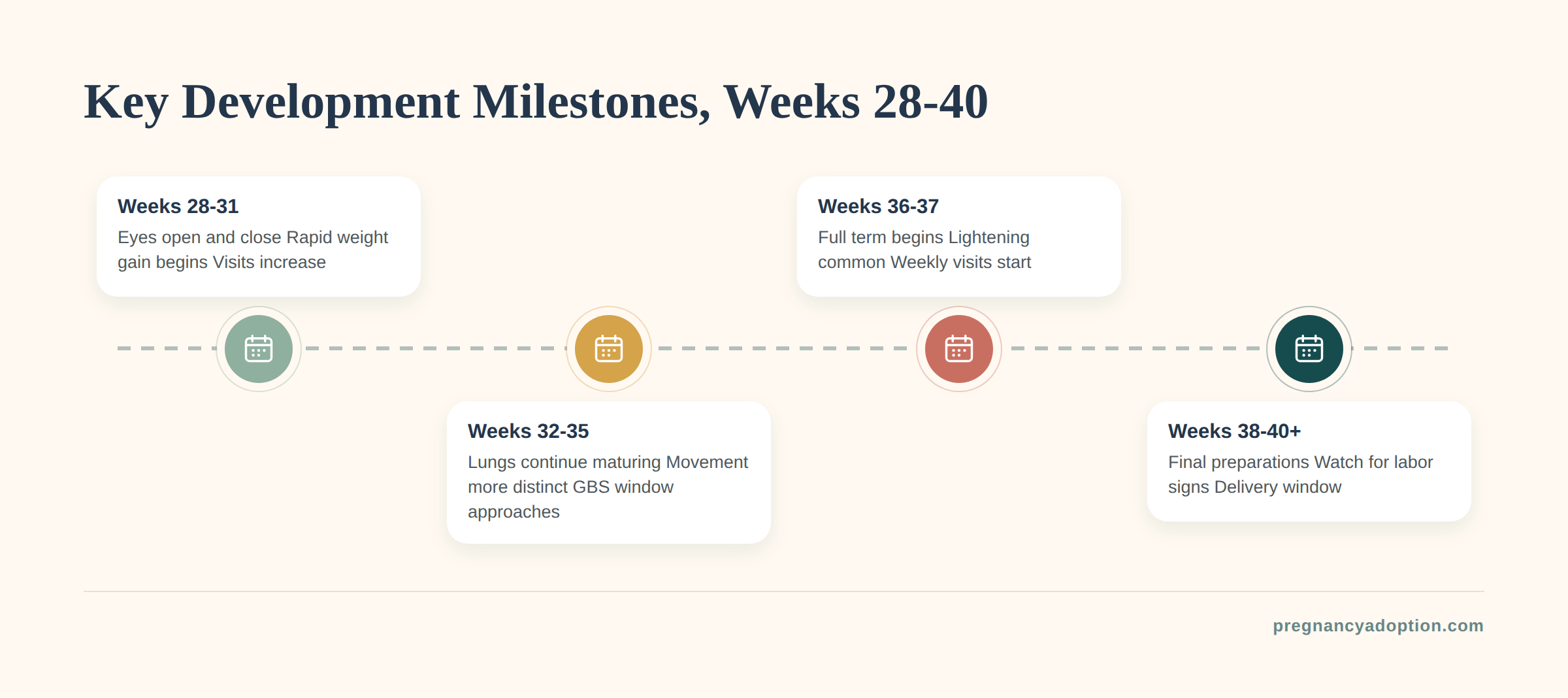
| Week range | Size reference | Key milestone |
|---|---|---|
| 28-29 | Eggplant to butternut squash | Accelerated brain/eye development; visits increase |
| 30-31 | Cabbage to coconut | Rapid weight gain begins |
| 32-33 | Pineapple to honeydew melon | Lung maturation continues; movement more distinct |
| 34-35 | Cantaloupe to honeydew melon | Group B strep window approaches; nesting common |
| 36-37 | Romaine lettuce to Swiss chard | Full term begins (37 weeks); lightening common |
| 38-40+ | Small pumpkin to small watermelon | Final preparations; weekly visits; delivery window |
Prenatal Appointments in the Third Trimester
Prenatal care intensifies in the third trimester, both in frequency and in what each visit covers.
How Often You’ll Be Seen
The frequency of prenatal visits is one of the more noticeable changes as the third trimester progresses. For a low-risk pregnancy, visits typically shift from a monthly cadence to roughly every two to three weeks somewhere around 28 to 36 weeks, and then to weekly from around 36 weeks until delivery — a steadily tightening schedule that reflects how much more there is to monitor as delivery approaches. This increased frequency isn’t arbitrary: more frequent visits allow your provider to closely track blood pressure, the baby’s growth, and fetal position as the pregnancy nears its end, and changes in any of these can develop relatively quickly in the final weeks. A blood pressure reading that was normal a month ago, for instance, could shift meaningfully by the next visit, which is exactly the kind of change this tighter visit cadence is designed to catch early rather than miss between widely spaced appointments.
What’s New in Third-Trimester Visits
A few specific checks appear in prenatal visits during the third trimester that weren’t part of the routine earlier in pregnancy. Group B strep testing — a vaginal and rectal swab checking for GBS bacteria — is typically performed between 36 and 37 weeks; a positive result doesn’t mean treating the infection itself before labor, but rather receiving antibiotics during labor to reduce the risk of transmission to the baby. Starting around 36 weeks, your provider will also typically begin checking the baby’s position by feeling your abdomen, confirming by ultrasound if needed, to determine whether the baby is head-down, breech, or in another position — a finding that matters directly for delivery planning, covered in more depth later in this guide. Some providers also begin checking cervical dilation and effacement at visits in the final weeks, though this isn’t universal practice, and it’s worth knowing upfront that a cervical check’s findings don’t reliably predict exactly when labor will actually start.
Cervical Checks, If and When Your Provider Recommends Them
Some providers begin checking cervical dilation and effacement at visits in the final weeks, though this isn’t universal practice and a cervical check’s findings don’t reliably predict exactly when labor will start.
| Approximate timing | Typical visit frequency | What’s newly added |
|---|---|---|
| 28-35 weeks | Every 2-3 weeks | Continued blood pressure, weight, fundal height, fetal heart rate |
| 36-37 weeks | Weekly begins | Group B strep testing; fetal position checks begin |
| 38 weeks to delivery | Weekly | Continued position/growth monitoring; cervical checks at some practices |
True Labor vs. Braxton Hicks and False Labor
This is the question most third-trimester patients eventually ask, and it’s worth genuine, dedicated depth — our signs of pregnancy guide touches on this briefly as part of its broader sign-classification framework, and this section is where the complete, practical version lives.
What Braxton Hicks Contractions Actually Are
Braxton Hicks contractions are irregular, generally painless tightening sensations in the abdomen that can begin as early as the second trimester for some people and often become noticeably more frequent as the third trimester progresses. They’re sometimes called “practice contractions,” though that nickname is a bit misleading — unlike true labor contractions, Braxton Hicks don’t actually produce the cervical thinning and dilation that constitute real labor progress; they’re more a byproduct of the uterine muscle’s normal activity than functional preparation for birth. A number of everyday triggers can set off a Braxton Hicks episode, including dehydration, a full bladder, physical activity, and even the baby’s own movement. This is actually useful information in practice: because these common triggers are so closely tied to the experience, changing position, resting for a while, or simply drinking a glass of water often makes Braxton Hicks ease up or stop — a helpful, low-effort way to tell them apart from labor that doesn’t respond to any of those interventions.
The Key Differences From True Labor
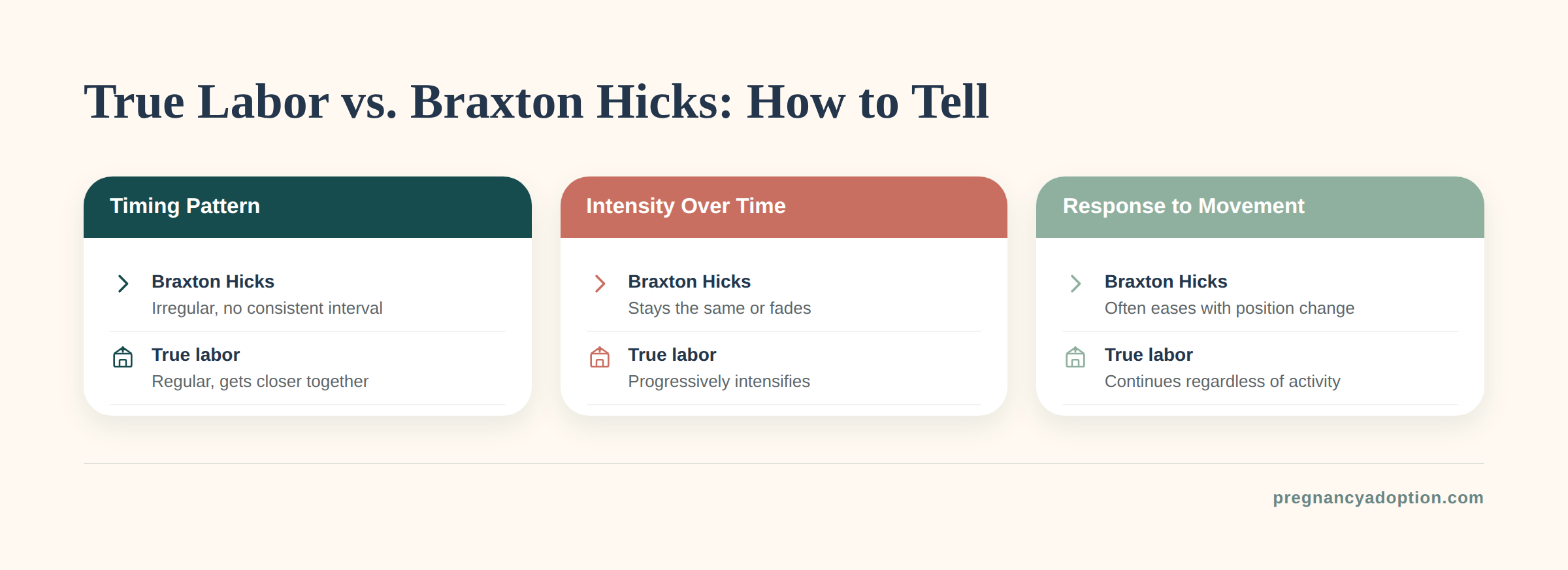
Distinguishing Braxton Hicks from true labor comes down to a handful of concrete differences, each worth knowing well before you’re actually trying to tell the two apart in the moment. True labor contractions settle into a regular, predictable pattern that gets progressively closer together over time, while Braxton Hicks stay irregular, without a consistent, tightening interval. True labor contractions also intensify progressively — each one tends to feel stronger than the last over the course of an hour or more — while Braxton Hicks tend to stay roughly the same intensity throughout, or fade away entirely rather than building. Response to a position change is another reliable clue: Braxton Hicks often ease or stop entirely with a change in position, a short walk, or simple rest, while true labor contractions continue regardless of what you do to try to make them stop. Finally, there’s a practical test of your own ability to function through them — you can generally still talk and walk through a Braxton Hicks contraction with only mild discomfort, while true labor contractions, once established, typically demand your full attention and often make talking difficult right at their peak.
Response to Position Change
Braxton Hicks often ease or stop entirely with a position change, a short walk, or rest, while true labor contractions continue regardless of what you do.
Ability to Talk or Walk Through Them
You can generally still talk and walk through a Braxton Hicks contraction with only mild discomfort, while true labor contractions, once established, typically require your full attention and often make talking difficult at their peak.
| Feature | Braxton Hicks / false labor | True labor |
|---|---|---|
| Timing pattern | Irregular; doesn’t form a consistent interval | Regular, and intervals get progressively closer together |
| Intensity over time | Stays the same or fades | Progressively intensifies |
| Response to position change | Often eases or stops | Continues regardless of position or activity |
| Ability to talk/walk through it | Generally yes, with mild discomfort | Increasingly difficult as contractions peak |
| Typical duration per contraction | Variable, often brief | Commonly 30 to 90 seconds |
A Simple Way to Track Contractions at Home
Once you suspect contractions might be the real thing, having a simple system for tracking them makes the difference between a vague impression and information your provider can actually act on. A commonly cited rule of thumb, sometimes called the “5-1-1” pattern, is to call your provider when contractions are about 5 minutes apart, lasting about 1 minute each, for at least 1 hour — though it’s worth knowing your own provider may give you a different specific guideline tailored to your situation, and that personalized guidance always takes priority over this general rule. For the actual tracking, a dedicated contraction-timing app works well, but so does simply using a phone’s stopwatch alongside a notepad to record each contraction’s start time, duration, and the gap before the next one begins. The specific method matters far less than consistency — what actually helps your provider make a good decision over the phone is a clear, continuously tracked record once contractions begin, not which particular tool you used to create it.
Signs Labor Is Approaching
A cluster of signs often appears in the final weeks or days before labor actually starts — none of them guarantee labor is imminent, but together they’re worth knowing.
Cervical Changes
In the weeks or days leading up to labor, the cervix typically begins two related processes: effacement, meaning it thins out, and dilation, meaning it gradually opens. Some providers check for these changes at late prenatal visits, though not universally, and the pace at which they happen varies enormously — sometimes unfolding gradually over days or weeks, sometimes progressing much more quickly once active labor actually begins. It’s important to understand what a cervical check can and can’t tell you: being a certain number of centimeters dilated at a given appointment doesn’t reliably predict how soon labor will actually start. Some people stay at the exact same dilation measurement for weeks with no change, while others who show little dilation at one visit progress quickly once labor truly begins a short time later. In other words, a cervical check is a snapshot of where things stand at that specific moment — not a forecast of what happens next, however tempting it is to read it that way.
The Mucus Plug
The mucus plug is a thick collection of mucus that seals the cervical canal throughout most of pregnancy, serving as a protective barrier. Losing it — which can happen all at once in one noticeable piece, or more gradually over several days — is a recognized sign that the body is beginning to prepare for labor, though it’s important to understand that losing the mucus plug doesn’t mean labor is about to start immediately; it can precede actual labor by anywhere from days to a couple of weeks. What you notice can vary: sometimes it’s lightly blood-tinged, in which case it’s often described as “bloody show,” and this lighter spotting is generally not a cause for alarm on its own. Heavier bleeding that more closely resembles an actual period, however, is a different and more significant finding, and it warrants a call to your provider rather than being treated the same way as ordinary mucus plug loss — the warning-signs section of this guide covers that distinction in more detail.
Increased Pelvic Pressure and Other Late Signs
As the baby settles lower into the pelvis in the weeks or days before labor — the “lightening” described earlier in this guide — pelvic pressure and urinary frequency often increase further, building on changes that may have already started somewhat earlier. Energy levels can shift unpredictably during this same window: some people notice a sudden, almost surprising burst of energy in the day or two before labor begins, sometimes experienced as an intensified version of the nesting instinct described earlier, while others feel unusually fatigued instead, with little obvious warning either way. Both patterns are commonly reported in the final stretch before labor, and neither one reliably predicts exactly when labor will actually start on its own — they’re worth noticing and mentioning to your provider if asked, but not worth treating as a firm signal that labor is imminent within any specific timeframe.
When to Call Your Provider or Go to the Hospital
Knowing the difference between “call your provider” and “go to the hospital now” matters, and this section gives you the practical version.
Call Your Provider
A handful of situations call for a phone call to your provider’s office rather than an immediate trip to the hospital, since your provider is usually the right first point of contact to help you decide what happens next. Once contractions begin matching the pattern your provider gave you — often close to the “5-1-1” guideline described earlier in this guide, though your provider’s specific guidance always takes priority — that’s the moment to call; they’ll be able to tell you, based on your specific situation and history, whether to come in right away or continue monitoring things at home a bit longer. Losing the mucus plug, or noticing light, blood-tinged “bloody show,” generally isn’t an emergency in itself, but it’s still worth a call simply to confirm your provider doesn’t want you to come in sooner or adjust how you’re monitoring things in the meantime — a quick check-in rather than a crisis response.
Go to the Hospital or Call Emergency Services Right Away
A smaller set of situations call for heading straight to the hospital or calling emergency services, rather than starting with a phone call and waiting for guidance. Your water breaking — whether as a dramatic gush or a steady trickle of fluid — is one of the clearest examples: call your provider and head to the hospital as directed, even if you aren’t yet having regular contractions, since labor and delivery units generally want you evaluated promptly once this happens, because the time elapsed from water breaking to delivery matters clinically. Heavy bleeding resembling or exceeding a normal period, severe or constant abdominal pain, or a significant, sustained reduction in your baby’s usual movement pattern all call for immediate evaluation rather than a wait-and-see approach, since each can signal a situation that genuinely needs prompt attention. Finally, a severe headache, vision changes, sudden significant swelling, or upper abdominal pain can all signal preeclampsia, and warrant prompt evaluation rather than being written off as ordinary late-pregnancy discomfort — this site’s preeclampsia guide covers the complete symptom and diagnosis picture in full depth.
Signs of Preeclampsia
A severe headache, vision changes, sudden significant swelling, or upper abdominal pain can signal preeclampsia and warrant prompt evaluation; see our preeclampsia guide for the complete symptom and diagnosis picture.
| Sign | Possible concern | What to do |
|---|---|---|
| Regular contractions matching your provider’s guidance | Labor may be starting | Call your provider |
| Water breaking | Labor has likely started or will soon | Call your provider and go to the hospital as directed |
| Heavy bleeding or severe abdominal pain | Several possible causes | Seek emergency care |
| Severe headache, vision changes, sudden swelling | Preeclampsia | Call your provider promptly; see our preeclampsia guide |
| Significantly reduced fetal movement | Possible fetal distress | Call your provider the same day |

Fetal Position and What It Means
Starting around 36 weeks, your provider will check how the baby is positioned — information that meaningfully affects delivery planning.
Head-Down (Vertex) Position
Most babies settle into a head-down position, medically called vertex, by the time the third trimester is well underway, and this is generally the position associated with the most straightforward vaginal delivery process. Importantly, a baby who isn’t yet head-down in the middle of the third trimester often still turns before delivery, so an earlier finding of breech or another position isn’t necessarily the final word on how the baby will be positioned by the time labor actually begins. Within head-down position, there’s a further, more subtle distinction worth knowing: “anterior” position, where the baby faces toward your back, is generally considered more favorable for labor than “posterior” position, where the baby faces toward your front, sometimes nicknamed “sunny-side up.” A posterior position can be associated with a somewhat longer or more uncomfortable labor, though it’s worth emphasizing that many posterior babies still deliver vaginally without any complication at all — posterior position is a variation to be aware of, not a predictor of a difficult outcome.
Breech Position
Breech position means the baby is positioned bottom-first or feet-first rather than head-down, and it’s considerably less common by late pregnancy than it is earlier on, since most babies who were breech at some point earlier in pregnancy go on to turn head-down on their own before delivery. If a baby remains breech close to your due date, your provider will talk through the available options with you directly. These typically include an external cephalic version, a procedure where a provider attempts to manually turn the baby from outside the abdomen; a planned cesarean delivery; or, with some providers and under specific conditions, a vaginal breech delivery. This is a conversation worth having directly and as early as possible with your provider once breech position is identified, rather than waiting until labor is imminent to sort through the options, since some of them, like external cephalic version, have a window in which they’re most likely to succeed. This site’s C-section guide covers planned and unplanned cesarean delivery in full depth, including what to expect from the procedure itself.
Transverse Position
Transverse position means the baby is lying sideways across the uterus, rather than head-down or bottom-first — a position that, like breech, is uncommon close to delivery, since most babies rotate into either a head-down or breech position as the due date approaches and space in the uterus becomes more limited. The practical significance of transverse position is fairly direct: a baby who remains transverse at the actual time of labor generally can’t deliver vaginally, since the positioning doesn’t allow for a safe vaginal passage. Because of this, a cesarean delivery is typically planned in advance if transverse position persists close to the due date, rather than being decided in the moment once labor has already started. This site’s C-section guide covers what to expect from a planned cesarean in much more depth, including how the procedure itself is typically approached and what recovery looks like afterward.
Preparing for Labor and Birth
The third trimester is the natural window for the practical preparations that make labor and the first days home go more smoothly.
Packing a Hospital Bag
Many sources suggest having a hospital bag packed and genuinely ready to go by around 36 weeks — a timeline set well before the earliest edge of the full-term range, specifically because labor can begin before your calculated due date, and you don’t want to be packing in a rush once contractions have already started. A reasonable starting list for what to include covers identification and insurance information, comfortable clothing for both you and the baby, basic toiletries, phone chargers, and any specific comfort items you already know you’ll want during labor or the hospital stay afterward. Many hospitals and birth centers also provide their own suggested packing lists, often tailored to their specific facility’s amenities and policies, which can be a useful supplement to a general list like this one — worth asking for at a prenatal visit or checking the hospital’s own website well before your due date approaches.
Writing a Birth Plan
A birth plan is a written document outlining your preferences for labor and delivery — things like your preferred approach to pain management, who you want present in the room, and other specific wishes — that helps communicate what matters to you to a care team that, especially in a hospital setting, may include people you’ve never met before labor actually starts. Because labor doesn’t always unfold as anticipated, it’s worth writing your plan with the clear understanding that your care team may need to adapt it in real time if a safety concern arises for you or the baby. Treating it as a strong statement of preference and a communication tool, rather than as a binding contract that must be followed no matter what, tends to lead to less disappointment if circumstances require a different approach on the day itself — flexibility built into the plan from the start, rather than added reluctantly in the moment.
Choosing a Pediatrician
Many hospitals ask for your chosen pediatrician’s information at admission or shortly after birth, which makes identifying one during the third trimester — including scheduling a brief introductory visit if the practice offers one — a genuinely useful step to take care of ahead of time rather than scrambling to decide in the hospital. A short list of practical questions can help you compare options meaningfully: how the practice approaches common early decisions such as newborn screening and vaccination scheduling, what their after-hours availability looks like for urgent questions once you’re home, and whether they’re in-network with your specific insurance plan. An introductory visit, when available, also gives you a chance to get a feel for the practice’s communication style and whether it’s a good fit for your family, which can be harder to judge from a phone call or website alone.
Car Seat and Final Nursery Steps
Most hospitals require confirmation of a properly installed, rear-facing infant car seat before they’ll approve discharge, which makes this one of the more concrete, checkable items on a third-trimester to-do list. Many fire departments, and some hospitals, offer free car-seat installation checks — well worth scheduling before your due date rather than attempting the installation for the first time on the day you’re bringing the baby home. For the nursery itself, the third trimester is generally a better window for finishing touches than for starting large new projects: assembling furniture, organizing supplies, and handling any remaining small tasks tend to fit this stage better than beginning a significant renovation or furniture search, given both the physical demands of late pregnancy and the real possibility of an earlier-than-expected delivery that could cut your remaining preparation time short.
Exercise and Movement in the Third Trimester
Staying appropriately active in the third trimester, with your provider’s approval, remains beneficial for most pregnancies, though both the goals and the limits shift from earlier trimesters.
What Generally Stays Safe
Walking, swimming, stationary cycling, and prenatal yoga generally remain safe and genuinely beneficial activities through the third trimester for an uncomplicated, low-risk pregnancy, even as the intensity and duration you can comfortably sustain often need to decrease as your physical size and fatigue both increase. The guiding principle for exercise shifts somewhat compared to earlier in pregnancy: listening to your body becomes even more important now than before, since your center of gravity has shifted meaningfully as your belly has grown, making some activities — anything with meaningful balance demands in particular — genuinely riskier for falls than they would have been earlier on. Shortness of breath also tends to arrive more quickly during exertion at this stage, which means a pace or intensity that felt entirely comfortable back in the second trimester may need real, honest adjustment now, rather than being pushed through out of habit or a desire to maintain an earlier routine.
When to Stop and Call Your Provider
A specific set of warning signs during exercise call for stopping the activity and contacting your provider rather than pushing through or waiting to mention it later: vaginal bleeding, contractions, fluid leakage, chest pain, severe shortness of breath, dizziness, or calf pain or swelling during or after physical activity all fall into this category. Beyond specific warning signs, a handful of positions and activities are generally recommended against altogether in the third trimester: lying flat on your back for extended periods, which can reduce blood flow to the uterus; contact sports and other activities carrying a meaningful fall risk; and scuba diving, due to pressure-related risks that are specific to pregnancy. If you’re unsure whether a particular activity you enjoy falls into a gray area, it’s always reasonable to ask your provider directly rather than guessing — they can speak to your specific pregnancy and activity level far better than a general list can.
Nutrition Deep Dive: Fueling the Final Stretch
Nutritional needs continue shifting in the third trimester as the baby gains the majority of their birth weight during this window.
Increased Caloric and Protein Needs
Caloric needs typically increase modestly again in the third trimester compared to the second, reflecting the rapid weight gain that characterizes this final stretch of pregnancy as the baby builds fat stores and continues growing quickly. Exactly how much more you need varies by individual circumstances, including your starting weight and activity level, which is why your provider’s guidance for your specific pregnancy is more useful here than a single number that applies to everyone equally. Protein’s role also grows during the third trimester, since it directly supports the rapid fetal growth happening during these weeks; lean meats, eggs, dairy products, legumes, and nuts are commonly cited as good sources worth emphasizing a bit more heavily during this final stretch, whether through slightly larger portions of foods you’re already eating or simply more consistent attention to including a protein source at each meal.
Key Nutrients to Prioritize
Iron needs remain elevated through the third trimester to support the significantly increased blood volume that pregnancy requires, while calcium needs stay just as important as they were earlier in pregnancy, since the baby’s skeleton continues hardening and mineralizing during these final weeks. Your prenatal vitamin and your overall diet together are generally the two main sources your provider will ask about if bloodwork suggests either nutrient needs more attention. Staying adequately hydrated is a related priority that’s genuinely harder to maintain at this stage: frequent urination, driven by the growing uterus pressing on the bladder, can make cutting back on fluids feel tempting, but doing so tends to backfire, since adequate hydration actually helps manage swelling, the frequency of Braxton Hicks contractions, and constipation — all common third-trimester complaints that proper hydration can meaningfully ease rather than worsen.
Cost and Insurance Considerations for Labor and Delivery
The third trimester is a practical window to confirm the financial and insurance details of labor and delivery before they become urgent.
Confirming Your Coverage
A short list of insurance-related items is worth confirming well before your due date, rather than discovering gaps in your understanding during labor itself: which hospital or birth center is in-network under your plan, what your expected out-of-pocket costs look like for a vaginal delivery versus a cesarean, since these can differ meaningfully, and your plan’s specific deadline for enrolling a newborn, covered in more depth in the next section. Many hospitals also offer pre-registration ahead of your due date, which can meaningfully speed up the admission process once labor actually starts — a genuinely practical step that’s easy to overlook amid everything else on a third-trimester checklist, but one that can make the difference between a smooth admission and unnecessary paperwork delays while you’re actively in labor.
Planning for Newborn Insurance Enrollment
Most insurance plans require you to formally enroll a newborn within a specific window after birth — often 30 days — in order to add them to your policy without any gap in coverage; the exact deadline and process vary by plan, so it’s worth confirming your specific plan’s requirements before delivery rather than assuming a general timeline applies to you. Knowing in advance exactly which documents your insurer requires for this enrollment — often the birth certificate or a hospital-issued birth record, depending on the insurer — can help you complete the process smoothly and promptly once the necessary paperwork is actually in hand after birth, rather than scrambling to figure out the requirements while also adjusting to a newborn at home. A quick call to your insurer during the third trimester, well before you need the information, is generally all it takes to have this sorted out in advance.
Preparing Siblings and Pets for the New Baby
If this isn’t your first child, or if you have pets at home, the third trimester is a reasonable window to begin preparing them for the change ahead.
Preparing an Older Sibling
Simple, honest, age-appropriate conversations about the upcoming change — covering what will stay the same, what will be genuinely different, and clear reassurance about continued love and attention — tend to help an older sibling adjust more than either avoiding the topic altogether or over-explaining it with more detail than they’re ready to process. The right balance depends heavily on the child’s age and temperament, so there’s no single script that works for every family, but the general principle of honest, age-appropriate framing tends to hold across a wide range of ages. Involving an older sibling directly in preparation — letting them help pick out an outfit for the new baby, decorate a shared space, or otherwise feel genuinely included in getting ready — can also ease the transition once the baby actually arrives, giving them a sense of ownership and involvement in the family change rather than feeling like something is simply happening to them.
Preparing Pets
Some families take a gradual approach to introducing a pet to baby-related sounds and scents before the baby actually arrives — playing a recording of an infant crying, for instance, or bringing home a blanket carrying the baby’s scent ahead of the baby’s own arrival — though the evidence on exactly how much this specific preparation helps varies, and not every family finds it necessary. More universally useful is simply having a calm, supervised plan for the pet’s first actual meeting with the new baby, rather than leaving that moment to chance in what’s likely to be a busy, overwhelming time for everyone involved. A deliberate, low-key introduction — on the pet’s own territory, without a crowd of excited visitors all trying to see the baby at once — tends to go more smoothly than an improvised first meeting, and it’s a reasonable, low-cost step for most families to plan for in advance.
Intimacy and Relationships in the Third Trimester
Physical and emotional changes in the third trimester often affect intimacy and the broader partner relationship, and both are worth acknowledging directly.
Physical Intimacy
For most uncomplicated pregnancies, sex remains safe through the third trimester, and there’s no blanket reason to avoid it simply because you’re in the final stretch — the exception is when a provider has specifically advised against it for a condition like placenta previa or an elevated risk of preterm labor, in which case that individual guidance should take priority over general reassurance. If you’re unsure whether your specific situation falls into that exception, it’s always worth asking your provider directly rather than guessing. Beyond the safety question, it’s extremely common for desire and physical comfort to shift during this trimester, driven by a combination of physical discomfort, body-image changes, and fatigue that tend to accumulate as pregnancy progresses. Open, direct communication between partners about what feels good and what doesn’t tends to matter more during this stretch than in earlier trimesters, simply because the physical landscape is changing more noticeably and more quickly.
The Broader Relationship
It’s common for both partners to feel a genuine mix of excitement and anxiety as delivery approaches, even when one partner seems outwardly calmer than the other — naming this openly, rather than assuming only one partner is experiencing it while the other is simply fine, often eases tension that might otherwise build up silently. Explicitly dividing up the remaining preparation tasks described earlier in this guide — the hospital bag, the birth plan, the pediatrician search, final nursery and car-seat steps — between partners, rather than letting them default to falling on one person simply because that’s how earlier tasks happened to get split, is a practical, concrete step worth taking directly and deliberately rather than assuming it will sort itself out naturally. A short conversation specifically about who’s handling what, had explicitly rather than left unspoken, tends to prevent both logistical gaps and resentment from building up in these final, busy weeks.
Twins and Multiples: What’s Different
A multiples pregnancy generally follows the same broad third-trimester structure as a singleton pregnancy, with several meaningful differences worth knowing.
Timing Differences
Multiples are, on average, delivered earlier than singleton pregnancies — commonly sometime in the late third trimester rather than reaching a full-term singleton’s typical timing — which means “full term” is often discussed somewhat differently with your provider if you’re carrying more than one baby. This isn’t necessarily a sign of anything going wrong; it largely reflects the practical reality that a uterus carrying multiple babies reaches its physical limits, and the point at which continuing the pregnancy versus delivering becomes the better choice, somewhat sooner than with a single baby. Multiples pregnancies also typically involve more frequent growth ultrasounds and monitoring visits during the third trimester compared to a singleton pregnancy, given the genuinely added complexity of tracking more than one baby’s individual growth and wellbeing simultaneously, often requiring closer attention to make sure each baby, not just the pregnancy overall, is progressing well.
Delivery Planning Differences
Whether a vaginal delivery is an option for a multiples pregnancy depends heavily on factors specific to that pregnancy: each baby’s individual position, and the specific type of multiples pregnancy involved, including whether the babies are identical or fraternal and whether they share a single placenta. Given how much these specifics matter, this is a conversation worth having specifically, directly, and early with a provider who has real experience managing multiples deliveries, rather than assuming the same general delivery expectations that apply to a singleton pregnancy will carry over unchanged. On the practical preparation side, getting ready for more than one newborn at once — car seats, nursery setup, and lined-up support for the genuinely demanding early weeks — is generally worth starting earlier than a singleton pregnancy’s typical third-trimester timeline would suggest, given both the earlier average delivery timing and the simple fact that there’s more logistics to handle per baby added to the mix.
Common Myths and Misconceptions About the Third Trimester
A few recurring misunderstandings about this trimester are worth naming directly.
Myths About Labor Signs
A couple of persistent myths about labor signs are worth addressing directly. The idea that your water breaking is always a dramatic, unmistakable gush isn’t quite accurate — for some people, it’s a slow trickle rather than a sudden flood, which is exactly why any unusual fluid leakage is worth calling your provider about rather than assuming it must be something else, like ordinary urinary leakage, simply because it didn’t match the dramatic version often shown in movies and television. Similarly, the belief that a cervical check can tell you exactly when labor will start isn’t true either — as covered earlier in this guide, dilation and effacement findings at any single visit don’t reliably predict timing, and some people stay at the same measurement for weeks before anything changes. Both myths share a common thread: they promise more certainty than late pregnancy actually offers, and believing them too firmly can lead to either unnecessary alarm or false reassurance at exactly the wrong moment.
Myths About Due Dates and Timing
The common claim that babies are rarely born on their actual due date is partly true but also somewhat overstated: while a due date functions as a statistical midpoint rather than a guarantee, it still represents the single most common window for delivery overall, not some unlikely outlier date that almost nobody actually hits. A related myth — that going past your due date always means induction is imminent — isn’t accurate either. As this guide covers in more depth later, many providers simply increase monitoring for some period of time once a pregnancy extends past the due date, rather than moving straight to inducing labor at exactly 40 weeks and one day. Both of these myths tend to create unnecessary anxiety around a due date that was always meant to be an estimate rather than a deadline, and understanding the more nuanced reality behind each one can make the final weeks feel considerably less fraught.
Mental and Emotional Preparation for Labor
Alongside the physical and logistical preparation covered elsewhere in this guide, the third trimester is also a reasonable time for mental and emotional preparation.
Processing Anxiety About Labor
Feeling anxious about labor and delivery — the pain, the many unknowns, the weight of becoming a parent — is an extremely common experience in the third trimester, and feeling it doesn’t indicate anything is wrong with how you’re handling the pregnancy or suggest you’re less prepared than someone who claims to feel entirely calm. A number of practical tools are commonly cited as genuinely helpful for managing this kind of anxiety: childbirth education classes that walk through what to realistically expect, talking through specific fears directly with your provider rather than carrying them silently, and simple relaxation or breathing techniques practiced ahead of time so they feel more natural to use once labor actually begins. None of these tools eliminates anxiety entirely, but each can make it more manageable, which is a realistic and worthwhile goal heading into labor rather than expecting to feel entirely fearless by the time it starts.
Setting Realistic Expectations
Labor rarely goes exactly as planned, and building that flexibility into your mental expectations — alongside the flexibility already recommended for your written birth plan earlier in this guide — tends to meaningfully ease disappointment if your actual labor experience ends up differing from what you originally pictured. This isn’t about expecting the worst; it’s about leaving genuine room for a different path than the one you imagined, so that an unexpected turn doesn’t feel like a failure on top of everything else happening. It’s also worth taking a brief look ahead to the period right after delivery while you’re still in the third trimester, since the intense focus on labor itself can understandably eclipse preparation for the days and weeks immediately afterward. This site’s postpartum depression guide covers what to watch for in the early postpartum period in real depth, and it’s genuinely worth reading before delivery, not only after, so you already know what’s normal and what isn’t.
How This Guide Compares to This Site’s Other Trimester Guides
If you’ve read this site’s first and second trimester guides already, a few differences in this guide’s focus are worth noting.
What’s Similar
This guide shares a deliberate structure with this site’s first trimester guide and second trimester guide: development is organized week by week — here, in two-week blocks that match the second trimester guide’s format — alongside appointment, symptom, and preparation content covering the same general categories readers have seen in the earlier guides. That consistency is intentional, meant to make the three-guide series feel like one continuous resource rather than three separately designed pieces that happen to cover the same pregnancy. As with its sibling guides, this guide also deliberately links out to dedicated condition-specific guides — this site’s preeclampsia guide and gestational diabetes guide, for instance — rather than attempting to re-derive their full depth within this overview. That choice keeps this guide focused on what’s generally true of the third trimester while still pointing readers toward the fuller, more specialized resource when a specific condition applies to their situation.
What’s Different
Where this guide meaningfully diverges from its two sibling trimester guides is in its center of gravity: rather than weighting development and symptoms most heavily, as the earlier guides do, this guide shifts considerably more attention toward labor-sign recognition and delivery preparation — a reflection of what actually becomes most practically urgent as the due date approaches and delivery moves from a distant future event to something that could happen any day. This guide also serves as the natural closing chapter of the three-part trimester series: together, the first, second, and third trimester guides on this site cover the complete week-by-week pregnancy journey from the earliest days after conception all the way through delivery, each guide weighted toward whatever matters most during its particular stretch of the pregnancy.
Common Third-Trimester Discomforts and Coping
Several discomforts become more prominent in the third trimester as a direct, mechanical result of the growing uterus.
Swelling (Edema)
Swelling in the feet, ankles, and hands is a common complaint in the third trimester, driven by a combination of fluid retention and the growing uterus putting increasing pressure on the veins responsible for returning blood from the legs back toward the heart. A handful of practical steps can help manage ordinary swelling: elevating your feet whenever you’re resting, staying well hydrated, counterintuitive as that may sound for a fluid-retention symptom but genuinely helpful, wearing supportive footwear, and avoiding long stretches of standing in one place without a break. It’s worth drawing a clear distinction, though, between this ordinary, gradual swelling and a sudden or severe onset, especially when it’s accompanied by a headache or vision changes — that combination is different and warrants prompt attention, since it can be a sign of preeclampsia rather than routine late-pregnancy fluid retention, as covered in more depth in this guide’s warning-signs section.
Back Pain and Pelvic Pressure
A combination of factors contributes to the back pain and pelvic pressure that’s common in the third trimester: shifting posture as your center of gravity moves forward, ligaments loosening under the influence of the hormone relaxin in preparation for delivery, and simply the growing uterus’s increasing weight placing more mechanical strain on your lower back and pelvis than earlier in pregnancy. A number of practical measures can help: a supportive belly band to help redistribute some of that weight, prenatal-approved stretching to keep the surrounding muscles from tightening up further, a genuinely supportive mattress and pillow setup for sleep, and avoiding heavy lifting wherever possible. Persistent or severe pain — rather than the ordinary, manageable ache most people experience — is worth specifically mentioning to your provider rather than assuming it’s purely routine, since it’s always better to have it checked than to simply assume it’s expected.
Sleep Difficulty
A cluster of factors commonly converge to disrupt sleep in the third trimester: your physical size making comfortable positions harder to find, frequent urination interrupting sleep multiple times a night, reflux that often worsens when lying flat, and general physical discomfort that simply makes settling down harder than it used to be. A few practical adjustments can genuinely help, even if they can’t eliminate the problem entirely: sleeping on your side with a pillow between your knees and another supporting your belly, avoiding large meals or excessive fluids close to bedtime, and keeping as consistent a sleep schedule as possible given the other disruptions. It’s worth being realistic, though — uninterrupted, fully restful sleep is genuinely harder to come by during this final stretch, and that’s a normal, if frustrating, part of the third trimester rather than something you’re necessarily doing wrong.
Heartburn and Reflux
Heartburn in the third trimester has two main physiological drivers working together: the growing uterus puts increasing upward pressure on the stomach, while pregnancy hormones simultaneously relax the valve between the esophagus and stomach that would otherwise keep stomach acid where it belongs. A handful of practical adjustments can help manage it: eating smaller, more frequent meals rather than a few large ones, avoiding lying down immediately after eating, and steering clear of whatever specific foods you’ve noticed tend to trigger it for you personally, since trigger foods vary somewhat from person to person. If you’re considering an over-the-counter antacid, it’s worth checking with your provider first rather than simply picking one off a pharmacy shelf, since not every antacid is recommended during pregnancy, and your provider can point you toward options known to be appropriate for your situation.
Warning Signs to Know
This section stays intentionally brief and link-heavy — full depth on each condition lives in its own dedicated guide.
Preeclampsia
Preeclampsia’s core warning signs are worth knowing clearly: a severe headache, vision changes, sudden significant swelling, and upper abdominal pain are the key symptoms to watch for, though this site’s preeclampsia guide covers the complete picture in much more depth, including risk factors and exactly how the condition is diagnosed. Vigilance about these specific signs matters particularly in the third trimester because preeclampsia can develop, or worsen, quite quickly during this stretch of pregnancy — sometimes over the course of days rather than weeks. This is a major part of why the increased-frequency visits described earlier in this guide specifically include a blood pressure check at every single appointment during the third trimester, rather than only checking periodically as might happen earlier in pregnancy; that consistent monitoring is specifically designed to catch the condition’s earliest signs before it has a chance to progress significantly.
Preterm Labor (Before 37 Weeks)
Regular contractions, menstrual-like cramping, a change in vaginal discharge, or pelvic pressure occurring before 37 weeks all warrant a prompt call to your provider, rather than being assumed to be ordinary third-trimester discomfort the way similar sensations might be closer to your due date. This distinction matters because the third trimester technically begins before full term, which means labor-like signs appearing in its earlier weeks — roughly 28 through 36 — are evaluated against a meaningfully different, more urgent clinical standard than the exact same signs would be at, say, 38 or 39 weeks. When in doubt during these earlier third-trimester weeks specifically, the right move is to call your provider rather than wait and see whether the symptoms resolve on their own, since catching preterm labor early can make a real difference in how it’s managed and what options remain available to potentially delay delivery if that’s clinically appropriate.
Reduced Fetal Movement
A significant, sustained reduction in your baby’s usual movement pattern — not simply one quiet hour here or there, but a real, noticeable, and lasting change from their established normal pattern — warrants a same-day call to your provider rather than waiting to mention it at your next scheduled visit. Getting to know your baby’s typical movement pattern over the course of the third trimester, including noticing that they tend to be more active at certain times of day than others, makes it considerably easier to recognize a genuine, meaningful change worth calling about when it actually happens, rather than second-guessing every slightly quieter stretch out of general anxiety. This is part of why some providers recommend the kick-count routine mentioned earlier in this guide — not to create anxiety around counting, but to build a concrete, personal baseline that makes a real deviation easier to notice and act on promptly.
Going Past Your Due Date
Many pregnancies extend past the calculated due date without anything being wrong — this section gives the brief, practical version; our due date calculator guide covers the statistics and reasoning in full.
Why Due Dates Are Estimates, Not Guarantees
A due date is best understood as the statistical midpoint of a normal delivery range, rather than a specific day your baby is actually expected to arrive on — a subtle but important distinction, since many entirely healthy pregnancies deliver meaningfully before or after that calculated date without anything being wrong. This site’s due date calculator guide covers exactly how a due date is calculated in much more depth, including the difference between an estimate based on your last menstrual period and one based on an early ultrasound measurement, and why the two methods can sometimes produce slightly different dates for the same pregnancy. Understanding a due date as an estimate rather than a deadline from the outset can make the final weeks of pregnancy feel considerably less like a countdown to a specific moment and more like the genuinely variable window it actually represents.
What Typically Happens if You Go Past 40 Weeks
If a pregnancy continues past 40 weeks, many providers respond by increasing monitoring — through tools like nonstress tests or biophysical profiles — specifically to keep confirming the baby’s ongoing wellbeing as the pregnancy extends beyond the calculated due date, rather than simply waiting passively for labor to start on its own. Your provider will also typically begin discussing induction timing with you directly once your pregnancy continues past a certain point, generally somewhere in the 41-to-42-week range, though the exact timing of that conversation and any eventual decision is based on your specific situation rather than a single fixed rule that applies identically to everyone. This individualized approach reflects how much genuine variation exists even among pregnancies that go past their due date, with the specific combination of monitoring results, your personal history, and your own preferences all factoring into when and whether induction ultimately gets recommended.
A Simple Action Checklist
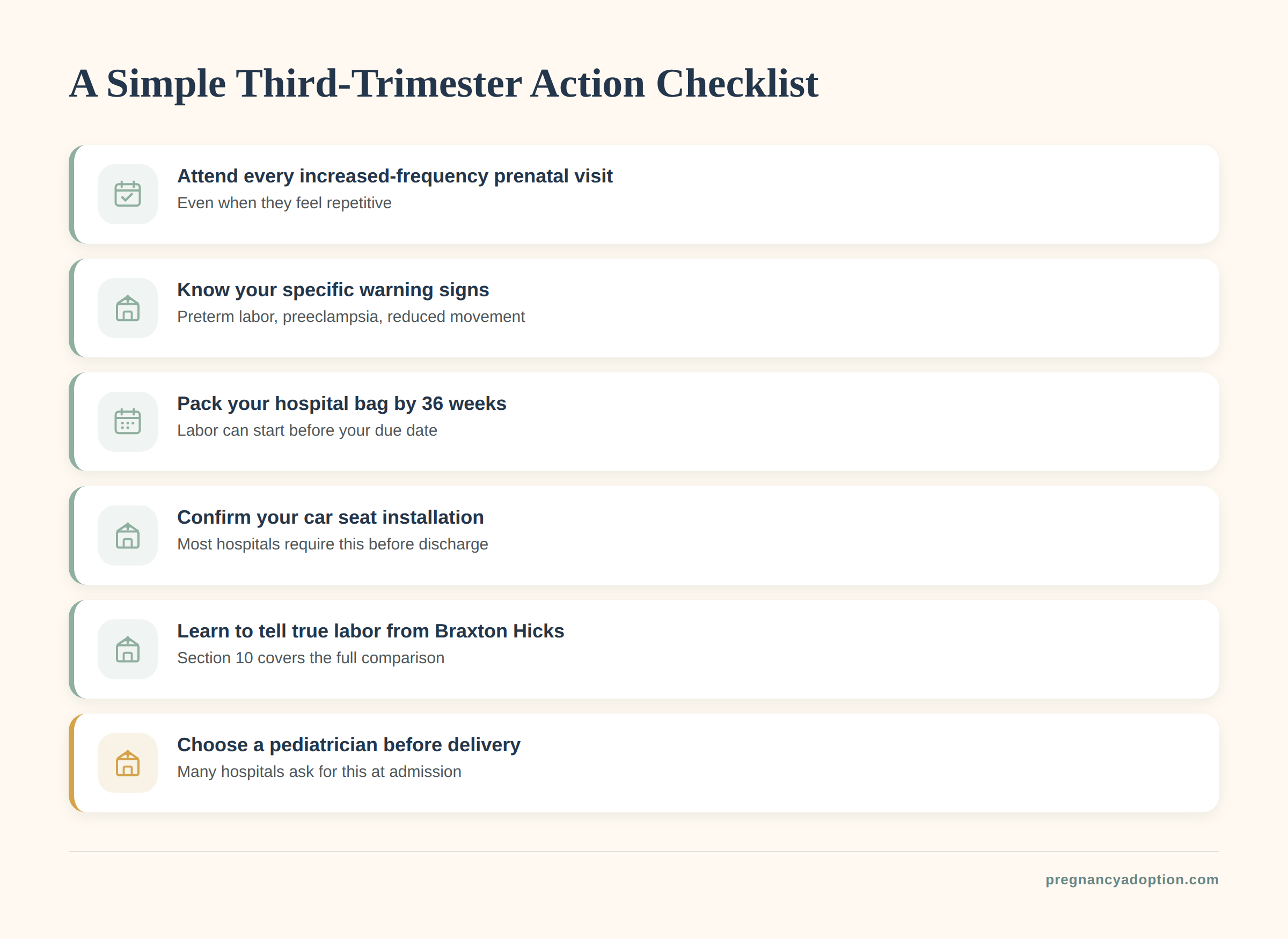
A short, practical checklist pulling together the most important actions from this guide.
Medical To-Dos
Keep Up With the Increased Visit Schedule
Attend every third-trimester visit, even when they feel repetitive — they’re how your care team catches a developing issue early.
Know Your Specific Warning Signs
Review Section 16 and know exactly what warrants a call versus emergency care, for your specific situation.
Practical To-Dos
Pack Your Hospital Bag by 36 Weeks
Have it ready well before your due date, since labor can start earlier than expected.
Confirm Your Car Seat Installation
Schedule a car-seat check if one’s available locally, well ahead of your due date.
| Week range | Key focus |
|---|---|
| 28-31 | Visits increase; watch for early Braxton Hicks |
| 32-35 | Track movement; Group B strep window approaches |
| 36-37 | Full term begins; weekly visits start; pack hospital bag |
| 38-40+ | Watch for labor signs; confirm car seat and pediatrician |
Glossary of Terms in This Guide
Development and Timing Terms
Full term
The range from 39 through 40 weeks 6 days, within the broader early-term (37-38 weeks 6 days) through postterm (42+ weeks) framework.
Lanugo
Fine body hair present earlier in pregnancy that typically thins as the third trimester progresses.
Surfactant
A substance produced by the lungs that helps keep air sacs open after birth; production increases through the third trimester.
Labor-Related Terms
Braxton Hicks contractions
Irregular, generally painless practice contractions that can begin as early as the second trimester and often intensify through the third.
Effacement
The thinning of the cervix that occurs before and during labor, usually described as a percentage.
Dilation
The opening of the cervix that occurs before and during labor, usually described in centimeters.
Lightening
The sensation of the baby settling lower into the pelvis, often noticed in the final weeks before labor.
Mucus plug
A thick collection of mucus that seals the cervical canal during pregnancy; its loss is a sign the body is preparing for labor.
Position and Delivery Terms
Vertex (head-down) position
The most common and generally preferred fetal position for labor, with the baby’s head pointed toward the birth canal.
Breech position
A fetal position with the baby positioned bottom- or feet-first rather than head-down.
External cephalic version
A procedure in which a provider attempts to manually turn a breech baby into a head-down position before labor.
Frequently Asked Questions
General Third-Trimester Questions
When does the third trimester start?
This site uses week 28 as the start of the third trimester, though some sources use week 29; see our pregnancy week calculator guide for the full cross-source comparison.
How long does the third trimester last?
Roughly 12 weeks, from week 28 through delivery, which most commonly happens somewhere around week 40, though timing varies.
Questions About Development
Is my baby’s brain fully developed by the third trimester?
No — brain development continues rapidly throughout the third trimester and, in important respects, continues well beyond birth into early childhood.
When are my baby’s lungs considered fully mature?
Lung maturity generally continues developing until close to full term; this is one reason early-term birth (37-38 weeks) still carries some additional respiratory risk compared to full term.
Questions About Appointments
Why do visits become so much more frequent in the third trimester?
Changes in blood pressure, growth, and fetal position can develop relatively quickly late in pregnancy, so closer monitoring helps catch a developing issue early.
What happens if I test positive for Group B strep?
You’ll typically receive antibiotics during labor to reduce the risk of transmission to your baby, rather than treatment before labor begins.
Questions About Labor Signs
How will I know for sure that it’s true labor and not Braxton Hicks?
The pattern matters most — true labor contractions get progressively closer together, more intense, and don’t ease with a position change or rest, unlike Braxton Hicks.
Can I go into labor without my water breaking first?
Yes — many people go into labor with contractions starting first, and the water breaking happens later, sometimes not until active labor is already well underway.
Questions About Fetal Position
When will I know if my baby is head-down?
Your provider typically starts checking position around 36 weeks, though many babies settle into their final position only in the last few weeks before delivery.
Is there anything I can do to help my baby turn head-down?
Some people try specific positioning exercises, though evidence on their effectiveness varies; discuss any technique with your provider before trying it, and know that an external cephalic version is the evidence-based medical option if the baby remains breech close to delivery.
Questions About Preparation
How early should I pack my hospital bag?
Many sources suggest around 36 weeks, well before the earliest edge of full term, since labor can start earlier than expected.
Do I need a formal written birth plan?
No, it isn’t required, but many people find it a useful way to communicate preferences clearly to a care team they may be meeting for the first time during labor.
Questions About Discomfort
Is swelling in my feet and ankles normal in the third trimester?
Mild, gradual swelling is common and generally not concerning, though sudden or severe swelling, especially with a headache or vision changes, warrants prompt medical attention.
Why is my back pain getting worse as I get closer to my due date?
A combination of shifting posture, loosening ligaments, and the growing uterus’s weight all contribute; see Section 15 for coping strategies, and mention persistent or severe pain to your provider.
Questions About Going Past Your Due Date
Is it dangerous to go past my due date?
Going modestly past your due date is common and not inherently dangerous, though your provider will typically increase monitoring and discuss induction timing as the postterm range approaches.
Will I automatically be induced if I go past 40 weeks?
Not automatically — induction timing is an individualized decision based on your specific situation, discussed with your provider rather than applied as a fixed rule at exactly 40 weeks.
Questions About Exercise and Activity
Can I still travel by air in the third trimester?
Many airlines allow travel until somewhere around 36 weeks for an uncomplicated pregnancy, though policies vary by airline and some require a doctor’s note closer to the due date; confirm with your specific airline and provider before booking.
Is it safe to continue a regular exercise routine I started earlier in pregnancy?
Often yes, with modifications for balance and intensity, though check with your provider about continuing any specific routine as your pregnancy progresses.
Questions About Nutrition
Do I need to eat significantly more in the third trimester?
Caloric needs increase modestly compared to the second trimester, though “eating for two” in a literal sense overstates the actual increase; your provider can give guidance specific to your pregnancy.
Should I take a different prenatal vitamin in the third trimester?
Generally no — most people continue the same prenatal vitamin throughout pregnancy unless your provider specifically recommends a change based on your individual labs or needs.
Questions About Cost and Insurance
How much does labor and delivery typically cost?
This varies enormously by location, insurance plan, delivery type, and any complications; confirming your specific expected out-of-pocket costs with your insurer before your due date is the most reliable way to know your own number.
Does my insurance cover a doula if I want one?
This varies by plan — some insurance plans and some state Medicaid programs cover doula services, while others don’t; confirm directly with your specific insurer.
Questions About Preparing Siblings and Pets
How early should I start preparing an older sibling?
This varies by the child’s age and temperament — some families start conversations months ahead, while others find starting a few weeks before the due date works better; there’s no single right timeline.
Will my pet become aggressive toward a new baby?
This is uncommon with typical, well-socialized pets, though every animal is different; a gradual, supervised introduction plan is a reasonable precaution regardless of your pet’s typical temperament.
Questions About Intimacy and Relationships
Is it normal to feel disconnected from my partner in the third trimester?
It’s common for the physical and logistical demands of late pregnancy to temporarily shift focus away from the relationship itself; naming this directly with your partner often helps more than assuming it will resolve on its own.
When should I avoid sex in the third trimester?
If your provider has specifically advised against it for a condition like placenta previa, preterm labor risk, or ruptured membranes, follow that guidance; otherwise, sex generally remains safe for most uncomplicated pregnancies.
Questions About Twins and Multiples
Will I automatically need a cesarean if I’m having twins?
Not automatically — delivery method depends on each baby’s position and the specific type of multiples pregnancy; discuss your specific situation with a provider experienced in multiples delivery.
Do I need two of everything if I’m having twins?
Largely yes for items used simultaneously, such as car seats and cribs, though some items (like a stroller designed for two) are purpose-built for multiples and worth researching specifically.
Questions About Labor Myths
Does a full moon actually increase the chance of going into labor?
This is a widely repeated claim without reliable supporting evidence; it’s best treated as folklore rather than something to plan around.
Do certain foods reliably trigger labor?
No food has been reliably shown to trigger labor on demand, despite many commonly repeated claims (spicy food, pineapple, and others); discuss any specific interest in natural induction methods with your provider.
Questions About Mental Preparation
Is it normal to feel scared about labor even if I’ve done a lot of preparation?
Yes — thorough preparation reduces uncertainty but doesn’t eliminate the normal anxiety many people feel heading into labor; this is a very common experience, not a sign you haven’t prepared enough.
Should I take a childbirth education class even for a second or third pregnancy?
Many people find a refresher class worthwhile even with prior birth experience, since practices and your own needs can change between pregnancies; it’s a personal choice either way.
Questions About Induction
What does it actually mean to be “induced”?
Induction means using medical methods — such as medication or a mechanical method — to start or advance labor rather than waiting for it to begin on its own.
Is induction more painful than spontaneous labor?
Experiences vary considerably; some people find induced labor more intense, particularly with certain medications, though pain management options remain available regardless of how labor starts.
Questions About Pain Management Options
What pain management options are typically available during labor?
Options commonly include an epidural, other medications, and non-medication techniques like breathing exercises, movement, and hydrotherapy; availability varies by hospital and provider.
Do I have to decide on pain management in advance?
No — many people keep an open mind and decide in the moment based on how labor actually feels, though researching your options in advance, as part of your birth plan, can help you feel more prepared either way.
Questions About Delayed Cord Clamping
What is delayed cord clamping?
It refers to waiting a short period — commonly 30 to 60 seconds or longer — after birth before clamping and cutting the umbilical cord, rather than doing so immediately.
Is delayed cord clamping something I need to request?
Many hospitals now practice it routinely for an uncomplicated delivery, but it’s still worth including as a preference in your birth plan and confirming directly with your provider.


