
Early Pregnancy Symptoms… If you’re reading this a day or two after ovulation, or the morning after a single missed dose of birth control, chances are you’re not asking the same question as someone who is already three days late for a period. You’re asking something narrower and more specific: how early can a real pregnancy symptom actually appear, and is what I’m feeling right now even biologically possible yet? That question deserves a more precise answer than “wait and see,” and it’s the only question this guide is built to answer.
This is a companion piece to our complete guide on pregnancy symptoms, testing, and what to do next, which covers the full picture — every common symptom, PMS comparisons, how to test, what results mean, due dates, warning signs, and next steps. This guide does something different on purpose: it zooms in on the earliest possible window, day by day, symptom by symptom, using days-post-ovulation (DPO) rather than weeks of pregnancy, because in the first two weeks, days are the unit that actually matters. If you’re looking for how testing works, what a positive result means, how to calculate a due date, or where to find affordable prenatal care, our main pregnancy symptoms guide covers all of that in depth — this guide links out to it rather than repeating it, so that what’s left here is entirely focused on the earliest-signs question.
What follows is a realistic, evidence-informed look at how early implantation can happen, how early hCG can rise, how early each individual symptom has been documented to start, and — just as importantly — why so much of what gets read as an “early sign” during the two-week wait is actually something else entirely. Symptom-spotting is one of the most common experiences of trying to conceive, and it’s also one of the least reliable ways to find out whether you’re pregnant. This guide tries to hold both of those facts at once, honestly, without either dismissing what you’re noticing or promising it means more than it does.
Key takeaways
- Nothing pregnancy-related can be felt in the first several days after ovulation. Until an embryo implants — typically 6 to 12 days after ovulation, per the landmark Wilcox et al. implantation-timing study — there is no placenta and essentially no hCG, so any sensation before then has a different cause.
- The single earliest realistic signal is a rise in hCG itself, which can sometimes be detected by a sensitive test a few days before a missed period — but “earliest possible” and “typical” are very different things, and most people detect nothing reliable until closer to the missed period.
- Every individual symptom people search for — cramping, breast tenderness, fatigue, nausea, bloating, smell sensitivity, urination, mood changes — has a documented earliest onset window, and this guide covers each one specifically, along with why each is easy to misread during the two-week wait.
- Body-based signs like basal body temperature, cervical mucus, and cervical position can be tracked, but none of them is a substitute for a pregnancy test, and each has real limitations covered in detail below.
- Symptom-spotting during the two-week wait is a well-documented experience, and research on symptom recall suggests it’s a poor predictor of pregnancy on its own — people who are not pregnant report early-pregnancy-like symptoms at rates similar to people who are.
- Irregular cycles, recently stopping hormonal birth control, and fertility treatment all change how reliable DPO counting and body-based tracking signs are — this guide covers what shifts in each situation, separately from the general “missed period doesn’t work as a signal” content already covered in our main guide.
- For everything about testing mechanics, results, due dates, fertility treatment, and affordable care, this guide links out to our complete pregnancy symptoms and testing guide rather than repeating it — this piece stays narrowly focused on the earliest-signs question.
What Counts as an “Early” Pregnancy Symptom — And How Early Can You Realistically Know?
“Early” means different things depending on who’s asking. For some people it means the first week after a missed period. For the person this guide is written for, it means something much tighter: the days immediately surrounding ovulation itself, before a period would even be due. Getting precise about what “early” means is the first step to answering the question honestly, because the biology genuinely does set a floor on how soon anything can be felt — no amount of attentiveness gets around it.
Why “Early” Means Different Things to Different People
A lot of confusion in early-symptom searches comes from mixing up two very different ideas: noticing a change in your body, and having a hormone level a test can actually detect. They usually don’t arrive on the same day, and conflating them is where most of the false alarms — in both directions — come from.
Symptom-Based Awareness vs. Test-Confirmed Pregnancy
A symptom is a subjective sensation: soreness, tiredness, a wave of nausea, a twinge low in the abdomen. A positive test is an objective measurement of a hormone (hCG) crossing a specific concentration threshold in urine or blood. These two things are related but not synchronized — plenty of people feel something and test negative that same day, and plenty of people feel nothing at all on the day they get a clearly positive result. Throughout this guide, “how early can X happen” refers to the earliest a sensation has been documented or is plausible based on known hormone physiology, not a promise that you personally will feel it on that day, or at all.
Why This Article Focuses on the Earliest Physiological Window
Most general pregnancy-symptom content is written around the missed-period mark, because that’s when most people start paying close attention and when most symptoms have had time to become noticeable. That approach is useful for the majority of readers, which is exactly what our main pregnancy symptoms guide is built around. This guide exists for the specific and very common situation of wanting to know sooner — during the days right after ovulation, in the thick of what’s often called the “two-week wait.” Answering that honestly means talking in days-post-ovulation rather than weeks-of-pregnancy, and being upfront about how much uncertainty is still built into even the earliest end of these ranges.
The Two Timelines That Matter: Ovulation Date vs. Missed Period Date
Nearly all confusion about “how many days along am I” or “is this too early to feel anything” traces back to which starting point is being used. There are two, and they measure different things.
Why Counting From Your Last Period Can Be Misleading
Clinically, pregnancy is dated in “weeks of gestation” counted from the first day of your last menstrual period (LMP) — a convention explained in full in our due dates and gestational age section. That method is useful for consistent clinical dating across a whole pregnancy, but it’s a poor tool for answering “how early can I feel something,” because it assumes a textbook 28-day cycle with ovulation on day 14 — an assumption that doesn’t hold for a large share of real cycles. If your cycles run short, long, or irregular, LMP-based dating can be off from your actual ovulation date by many days, which is exactly why it isn’t the right frame for this guide.
Why Counting From Ovulation (DPO) Is More Precise
Days-post-ovulation (DPO) counting starts from the day an egg is actually released, which is also, for practical purposes, close to the day fertilization would occur if conception happens that cycle. Because implantation and the hormonal changes that follow are tied to ovulation — not to the calendar date of your last period — DPO is the more precise way to talk about “how early.” Every timeline, table, and symptom-onset figure in this guide is expressed in DPO for that reason. If you don’t track ovulation directly (through ovulation predictor kits, cervical mucus, or basal body temperature, all covered further below), DPO can only be estimated, which is itself one more layer of uncertainty worth keeping in mind before reading too much into any single day’s sensations.
Who This Guide Is (and Isn’t) For
Because this guide takes a deliberately narrow angle, it helps to say plainly who benefits most from reading it, and who should skip ahead to our broader guide instead.
If You’re in the Two-Week Wait Right Now
If you’re somewhere between ovulation and an expected period, actively wondering whether a specific sensation means anything, this guide was written for exactly that situation. It’s organized around the question “is this too early for that to be real,” which is a different question from “what does a positive test mean” — the latter is thoroughly covered in our main pregnancy symptoms guide, and this guide intentionally doesn’t repeat that ground.
If You Already Have a Positive Test
If you’ve already tested positive, most of this guide’s content — earliest possible onset windows, symptom-spotting psychology, whether you could have “felt” implantation — is now retrospective rather than forward-looking, though some readers still find it useful for making sense of the two weeks they just went through. From here, our complete pregnancy symptoms and testing guide is the more directly useful resource: it covers what a positive result means, how to confirm it, due dates and gestational age, warning signs, and what happens next.
Why Some People Want to Know as Early as Possible
It’s worth acknowledging directly that wanting to know earlier than “wait for a missed period” is a completely reasonable thing to want, not a sign of impatience to be talked out of. There are real, practical reasons behind it, alongside the emotional ones.
Practical Decisions That Can Depend on Timing
Some medications, elective procedures, imaging tests, vaccinations, and even workplace considerations (certain physically demanding jobs, travel to areas with specific health advisories) are things a person might reasonably want to adjust around a possible pregnancy as early as is realistically possible, rather than after a period is already a week late. For these situations, understanding the genuine detection floor covered throughout this guide — rather than an unrealistic expectation of near-immediate certainty — helps with planning around real constraints instead of an imagined timeline.
Emotional Readiness and the Choice of When to Test
Other people prefer to know as early as biologically possible for entirely emotional reasons — a history of pregnancy loss that makes early information feel protective, or simply a personality that finds uncertainty harder to sit with than a clear answer, even an early and less certain one. Both approaches (testing as early as possible versus deliberately waiting for a more reliable result) are reasonable; this guide aims to make the trade-offs of each clear rather than to recommend one over the other.
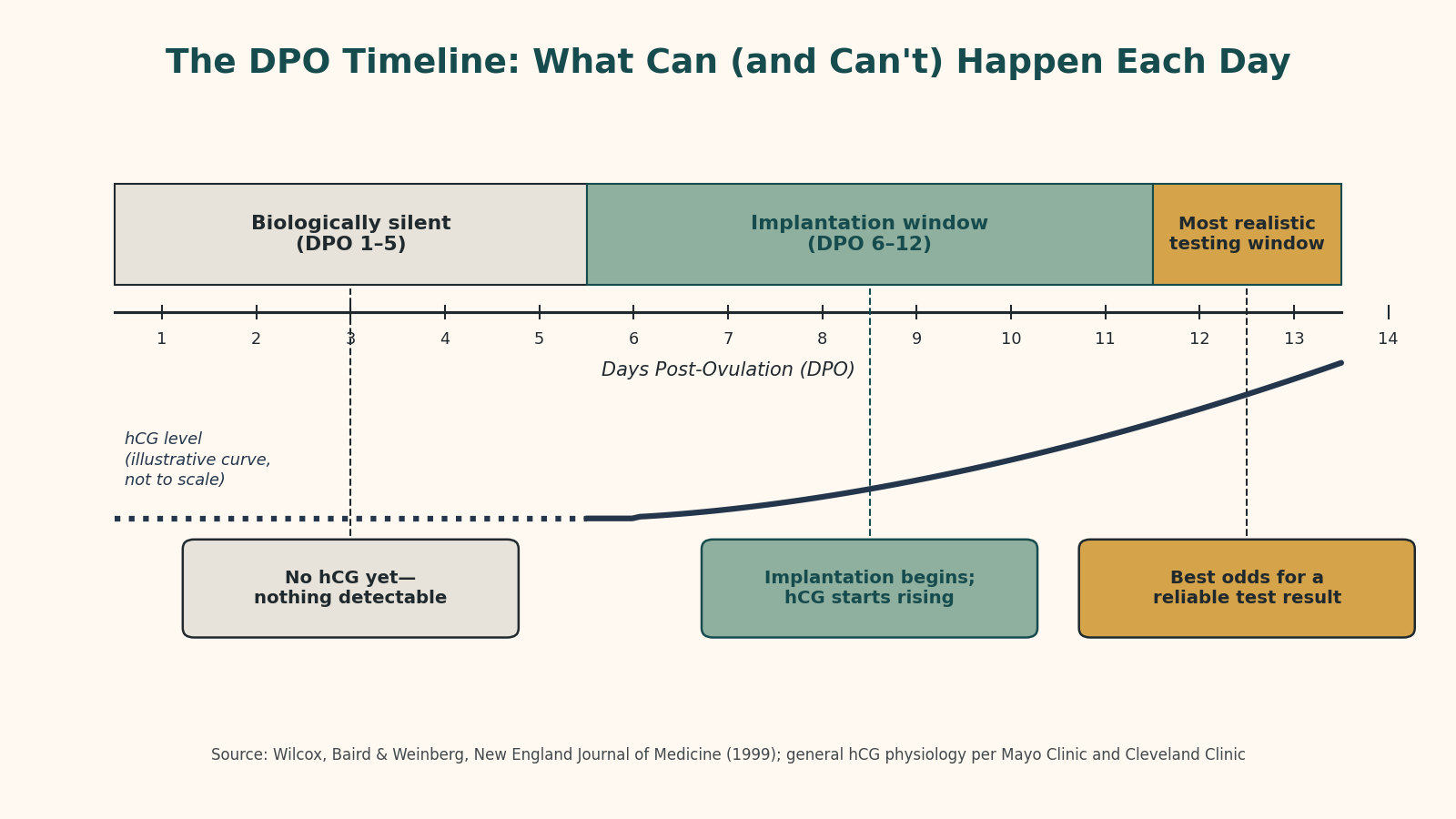
The Day-by-Day Timeline: What’s Happening Inside Your Body, DPO 1 Through 14
This section is the backbone of the entire guide. It walks through what is physiologically happening — and, just as importantly, what is not yet happening — on each stretch of days after ovulation, based on the landmark research of Wilcox, Baird, and Weinberg, published in the New England Journal of Medicine, which tracked daily urine hCG in a large group of women trying to conceive and remains the most cited source on implantation timing decades later.
DPO 1–5: Fertilization and the Journey to the Uterus
What’s Happening Biologically
If an egg is fertilized, it happens within about 24 hours of ovulation, typically in the fallopian tube. From there, the resulting embryo spends the next several days traveling toward the uterus while dividing into a small cluster of cells, reaching the uterine cavity around DPO 3 to 4 and continuing to develop for a few more days before it’s ready to implant. During this entire window, the embryo is free-floating — it has not attached to the uterine lining, there is no placenta, and it is not yet in direct contact with your bloodstream in any way that would allow it to release hormones you could detect.
Why No Test or Symptom Can Detect Anything Yet
This is the single most useful fact in this entire guide, so it’s worth stating plainly: there is no physiological mechanism for a pregnancy symptom, or a positive pregnancy test, in the first five days after ovulation — full stop, regardless of how “in tune” with your body you are, and regardless of what a symptom-tracking app or forum thread might suggest. Any cramping, tenderness, mood shift, or fatigue felt during DPO 1–5 has a cause other than pregnancy, most often the normal hormonal fluctuations of the early luteal phase, ovulation itself (a cramping sensation called mittelschmerz is common around ovulation and is sometimes mistaken, after the fact, for “implantation” cramping days too early), or everyday causes like poor sleep, dehydration, or stress. Knowing this window exists — and that it is, quite simply, biologically silent — is one of the most effective ways to short-circuit anxious symptom-spotting in the earliest days of a cycle.
DPO 6–10: The Implantation Window
What “Implantation” Actually Means
Implantation is the process by which the embryo burrows into the uterine lining (endometrium) and begins to establish a blood supply connection that will eventually become the placenta. According to the Wilcox et al. study, implantation occurs anywhere from DPO 6 to DPO 12, with the majority of implantations — about 84% in that study’s data — happening between DPO 8 and DPO 10. Only once implantation begins does the developing tissue start producing human chorionic gonadotropin (hCG), the hormone every pregnancy test measures. This is the true starting line for anything symptom- or test-related; everything before it is, physiologically, a closed door.
Why This Window Varies by Several Days Between Pregnancies
A six-day spread (DPO 6 to DPO 12) might not sound like much, but in the context of a two-week wait, it’s enormous — it’s the difference between a faint positive test being possible on the same day someone else is still five days from any detectable hCG at all. The Wilcox research is also the source of one of the most clinically important findings in this entire field: pregnancies that implanted later in this window (closer to DPO 11–12) had a substantially higher rate of early pregnancy loss than those that implanted earlier (DPO 8–10). This doesn’t mean a later implantation is a guaranteed problem — plenty of perfectly healthy pregnancies implant on the later end of the range — but it does help explain why the exact same “how many DPO am I” question can have such different, and equally normal, answers for different people.
DPO 10–14: Early hCG Rise and the Run-Up to a Missed Period
How hCG Climbs Once Implantation Begins
Once implantation is underway, hCG enters the bloodstream and begins rising quickly, roughly doubling every 48 to 72 hours in early pregnancy. In the Wilcox data, hCG was detectable in daily urine samples as early as 6 to 12 days after ovulation — in other words, right at implantation itself, in the most sensitive lab assays used for research purposes. That’s a very different sensitivity level than a home pregnancy test bought at a pharmacy, which brings us to the next point.
Why Even “Early” Tests Still Have a Detection Floor
Home pregnancy tests, including ones marketed as “early result” tests, require hCG to reach a specific concentration — commonly in the range of 10 to 25 mIU/mL depending on the brand — before they’ll show a positive line. Because hCG starts at essentially zero at implantation and climbs over several days, there is an unavoidable lag between “implantation has happened” and “a home test will reliably detect it,” even for the most sensitive consumer tests on the market. This is precisely why testing on DPO 8, 9, or 10 — appealingly early as it sounds — carries a meaningfully higher chance of a false negative than waiting even a few more days, a topic covered in full, including test types and result interpretation, in our complete pregnancy testing guide. This guide’s focus stays on the timeline and the symptoms themselves rather than repeating that testing-mechanics content here.
A Closer Look: Day-by-Day Highlights Worth Knowing
DPO 1–7 At a Glance
DPO 1–2: If fertilization occurred, it happened in the last day; the resulting cell cluster is still in the fallopian tube. Nothing hormonal has changed yet relative to a non-conception cycle. DPO 3–4: The embryo typically reaches the uterine cavity around this point, but remains free-floating; this is also when ovulation-related mittelschmerz cramping, if it happened at all, has usually faded, making any new cramping around now more likely tied to normal luteal-phase changes than to anything embryo-related. DPO 5–7: The embryo continues developing and, for a minority of cycles, implantation may begin right at the tail end of this window (closer to DPO 7). For the majority, this remains a quiet stretch hormonally — progesterone is doing its normal luteal-phase job regardless of whether conception occurred, which is exactly why fatigue, mild bloating, or breast tenderness felt during this week is not yet distinguishable from an ordinary premenstrual pattern.
DPO 8–14 At a Glance
DPO 8–9: This is the leading edge of peak implantation timing per the Wilcox data; hCG, if implantation has begun, is only just starting to be produced and remains far below any home test’s detection floor. DPO 10–11: hCG has had a few days to roughly double once or twice for pregnancies that implanted early in the window; some very sensitive tests may occasionally pick up a faint line here, though a negative result is still common and uninformative at this point. DPO 12: The later edge of the implantation window closes around here; pregnancies implanting this late are still entirely normal, though the Wilcox research associated later implantation with a somewhat higher rate of early loss, as noted above. DPO 13–14: Around the time a period would typically be due; for pregnancies that implanted on the earlier side of the window, hCG has usually risen enough by now for a home test to have a realistic chance of returning a positive result, and for a small number of people, the first genuinely pregnancy-specific sensations (mild fatigue, breast tenderness) may be just barely perceptible.
| Days post-ovulation | What’s physiologically happening | Can a symptom or test be genuinely pregnancy-related? |
|---|---|---|
| DPO 1–3 | Fertilization (if it occurs) and early cell division; embryo travels toward the uterus | No — no hormonal signal exists yet |
| DPO 4–5 | Embryo reaches the uterine cavity and continues developing before implantation | No — still no hCG production |
| DPO 6–7 | Earliest possible start of implantation for a minority of pregnancies | Extremely unlikely; hCG, if present at all, is far below any test’s detection floor |
| DPO 8–10 | Peak window for implantation (the majority of pregnancies implant here) | Possible but early; hCG is just beginning to rise and a home test is more likely to be a false negative than a true positive |
| DPO 11–12 | Later end of the implantation window; hCG rising more clearly for pregnancies that implanted here | More plausible; some very sensitive tests may pick up a faint line, though a negative result is still common and not reassuring either way |
| DPO 13–14 | Around the time a period would be expected; hCG has had several days to rise for most implanted pregnancies | Most realistic window for an early positive test and for the first subtle symptoms to be genuinely possible |
Timing reflects the Wilcox et al. (1999) daily-hCG implantation study and general hCG physiology as described by Mayo Clinic and Cleveland Clinic patient-education resources. Individual cycles vary, and this table describes population-level patterns, not a guarantee for any single cycle.
Tracking DPO When Your Cycle Doesn’t Cooperate: Irregular Ovulation, PCOS, and Recently Stopping Birth Control
Everything covered so far assumes you have a reasonably confident ovulation date to count from. For a substantial number of people, that assumption doesn’t hold. This section covers three common situations that make DPO counting and body-based tracking specifically less reliable — distinct from our main guide’s broader discussion of why a missed period doesn’t work as a pregnancy signal for everyone, which covers the same underlying situations from a different angle.
Irregular or Delayed Ovulation
Why DPO Estimates Get Shakier
If your cycles vary by more than a few days from month to month, ovulation timing is varying right along with them, which means any DPO estimate based on a typical calendar assumption (such as “day 14”) can be off by a week or more. Since virtually every timing figure in this guide — implantation window, hCG rise, symptom onset — is anchored to the actual day of ovulation rather than to a cycle-day number, an inaccurate ovulation estimate throws off every downstream estimate along with it.
More Reliable Ways to Pin Down Ovulation Day
Ovulation predictor kits (which detect the LH surge that precedes ovulation by roughly 24 to 36 hours), basal body temperature charting (which confirms ovulation has already happened via the post-ovulation temperature rise described earlier in this guide), and cervical mucus changes together give a considerably more reliable ovulation estimate than counting from the calendar alone, particularly for anyone with a cycle length that varies noticeably month to month.
PCOS and Anovulatory Cycles
Why “DPO” May Not Apply Some Months
Polycystic ovary syndrome (PCOS) and other conditions that affect ovulation can produce cycles where ovulation is delayed by weeks, happens very close to the next expected period, or doesn’t happen at all that cycle (an anovulatory cycle). In an anovulatory cycle, there is no egg release and therefore no possibility of conception, which means “DPO” as a concept simply doesn’t apply until ovulation actually occurs, whenever that ends up being.
What to Rely On Instead
For anyone managing PCOS or another ovulation-affecting condition, confirming ovulation directly — through an ovulation predictor kit, BBT confirmation, or a provider-ordered progesterone blood test — matters considerably more than counting days from the start of a period, since period-to-period intervals can vary widely without a consistent ovulation date to anchor them.
Recently Stopping Hormonal Birth Control
Why Your First Few Cycles Can Be Unpredictable
After stopping hormonal birth control, it can take anywhere from a few weeks to a few months for ovulation to resume a predictable pattern, and the first one or two cycles are commonly anovulatory or have an unusually long or short luteal phase while the body’s own hormone signaling re-establishes itself.
How This Affects Body-Based Tracking Signs
Basal body temperature and cervical mucus patterns can also take a cycle or two to normalize after stopping hormonal birth control, which means the body-based signs covered earlier in this guide may be temporarily less reliable than they would be in an established, unmedicated cycle. Treating the first couple of post-birth-control cycles as a baseline-establishing period, rather than expecting textbook-clean signals right away, sets more realistic expectations.
Timing Terms That Get Confused: DPO, DPT, Gestational Weeks, and Conception Age
Part of what makes early-signs research online so confusing is that different sources count time differently — sometimes without saying so. This short section defines the terms you’ll encounter, including one that’s specific to fertility treatment, so the rest of this guide (and anything else you read afterward) is easier to interpret correctly.
Terms You’ll See in This Guide vs. Elsewhere
DPO vs. DPT (Days Post Transfer)
For anyone going through IVF, “DPO” isn’t quite the right frame — embryo transfer, not ovulation, is the relevant reference point, so fertility clinics and patient communities instead use “DPT” (days post transfer). A day-5 blastocyst transfer roughly corresponds to DPO 5 at the time of transfer, since the embryo has already been developing outside the body for that long; a day-3 transfer corresponds to roughly DPO 3. This means a “5dpt” symptom question is asking about something close to DPO 10 in the framework used throughout this guide — worth keeping in mind when comparing notes between an IVF-specific forum and general DPO-based content like this guide.
DPO vs. Gestational Weeks
Gestational weeks — the system used clinically and throughout our main pregnancy symptoms guide — count from the first day of your last menstrual period (LMP), not from ovulation. Because ovulation typically happens around two weeks after the start of a period, gestational age runs about two weeks ahead of conception age at any given point. In other words, “4 weeks pregnant” clinically corresponds to roughly DPO 14 — right around a missed period — which is also why this guide’s entire DPO 1–14 timeline maps to what clinical sources would call “weeks 2 to 4” of gestation.
Why the Confusion Causes Real Problems
Comparing Symptoms Across Different Counting Systems
A huge share of “is this normal” anxiety comes from comparing a DPO-based symptom report to a gestational-week-based one (or a DPT-based one) without realizing they’re on different clocks. Someone posting “no symptoms at 4 weeks” is describing roughly DPO 14 — right at the edge of this guide’s timeline, where the data in the symptom-by-symptom section above shows feeling little or nothing is genuinely common — not a distant, symptom-heavy point in pregnancy the phrasing might otherwise suggest.
A Quick Conversion Reference
| Days post-ovulation (DPO) | Approx. days post 5-day transfer (DPT) | Approx. gestational age (LMP-based) |
|---|---|---|
| DPO 1–5 | Pre-transfer / DPT 0 at transfer | ~2 weeks, 1–5 days |
| DPO 6–10 | DPT 1–5 | ~2 weeks, 6 days – 3 weeks, 3 days |
| DPO 11–14 | DPT 6–9 | ~3 weeks, 4 days – 4 weeks |
Approximate figures for a standard 5-day blastocyst transfer and a typical 14-day luteal phase; individual clinics and cycles vary. This reference is for orientation only, not a substitute for your clinic’s own calendar.
How “Early Detection” Expectations Have Changed Over Time
Part of why extremely early detection feels like a reasonable thing to expect is that consumer pregnancy tests have genuinely gotten much more sensitive over the past few decades — it’s worth understanding that history briefly, since it explains where some of today’s expectations (and some outdated advice still circulating online) come from.
From Lab-Only Detection to Sensitive Home Tests
Earlier Generations of Home Tests
Home pregnancy tests first became widely available in the late 1970s, and early versions generally required hCG concentrations considerably higher than most modern tests do, meaning reliable results typically weren’t available until at least a week after a missed period, if not later. Testing “early” in that era meant something quite different from testing early today.
Why Modern Tests Detect Pregnancy Sooner
Improvements in antibody-based detection technology have progressively lowered the hCG concentration consumer tests can reliably detect, down to the roughly 10–25 mIU/mL range common among today’s most sensitive home tests, per FDA consumer guidance on home pregnancy tests. This is a genuine technological shift, not a change in how quickly a real pregnancy’s hCG actually rises — the biology described throughout this guide hasn’t changed, but the tools available to detect it earlier have.
What This Means for How You Read Older Advice or Family Stories
Why a Relative’s “I Just Knew at Two Days Late” Story May Not Translate
Older family stories about testing or symptom timing may reflect a genuinely different testing landscape, not a different biology — someone testing in an earlier decade may have needed to wait longer for any test to register positive, shaping their memory of “when things became detectable” around the tools available at the time rather than around the underlying implantation and hCG timeline this guide describes.
Why This Matters for Setting Realistic Expectations Today
Because test sensitivity keeps improving, it’s worth checking a specific test’s stated sensitivity (usually printed on the box in mIU/mL) rather than assuming all home tests perform identically — a more sensitive test genuinely can detect pregnancy a day or two earlier than a less sensitive one at the same hCG level, which is one of the few genuinely controllable factors in the entire early-detection picture this guide has covered.

Symptom-by-Symptom: How Early Can Each One Realistically Start?
This is the section most readers of this guide come for: not a general list, but a specific answer, symptom by symptom, to “how early could this actually be pregnancy, versus something else entirely.” Each symptom below includes its earliest documented or physiologically plausible onset in DPO, and — because this is where nearly every false alarm happens — a clear explanation of why that particular symptom is so easy to misattribute during the two-week wait.
Implantation Cramping and Spotting
Earliest Documented Onset
Because implantation itself typically occurs between DPO 6 and DPO 12, any cramping or spotting genuinely caused by it cannot happen before DPO 6, and for most pregnancies that do experience it, it clusters around DPO 8 to DPO 10 — right in the peak implantation window described in the timeline above. Implantation bleeding, when it happens at all, is generally described as light pink or brown spotting, noticeably lighter than a period, lasting from a few hours up to a couple of days. It’s worth being direct about frequency here too: it is not universal. Estimates of how many pregnancies produce noticeable implantation spotting vary across sources, and a large share of confirmed pregnancies report none at all — so its absence means nothing one way or the other.
Why It’s Easy to Misread This Symptom
This is arguably the single most over-attributed symptom in early-pregnancy searches, for a straightforward reason: ovulation itself commonly causes a similar sensation. Mittelschmerz — a one-sided cramping or twinge around the time of ovulation — happens around DPO 0, and normal luteal-phase cramping can recur in the days leading up to a period, which lands in almost exactly the same window as true implantation cramping would. Because the sensations can feel nearly identical and the timing windows overlap, a cramp on DPO 8 is genuinely ambiguous even under ideal conditions, and no amount of paying closer attention changes that. The only way to resolve the ambiguity is time and, eventually, a test — not a more careful read of the cramp itself.
What This Means for Your Two-Week Wait
Practically speaking, a single cramp or spot of pink discharge anywhere between DPO 6 and DPO 12 is worth noting but not worth building expectations around either way — and, just as importantly, its complete absence doesn’t rule anything out, since a large share of confirmed pregnancies never produce noticeable spotting at all. The most useful response to cramping in this window is simply to log the day it happened (if you’re tracking) and move on, rather than searching for reassurance about what it “definitely means.”
Breast Tenderness and Sensitivity
Earliest Documented Onset
Breast and nipple tenderness in a genuine early pregnancy is driven by rising estrogen and progesterone following implantation, which puts its earliest realistic onset at roughly DPO 8 to 10 at best, with most people who notice it at all doing so closer to the end of the two-week wait or after a missed period, according to Mayo Clinic and Cleveland Clinic patient-education materials.
Why It’s Easy to Misread This Symptom
Progesterone rises every single cycle after ovulation, whether or not conception occurs, as part of the normal luteal phase — and breast tenderness is one of the most common effects of that normal progesterone rise. This is exactly why premenstrual breast tenderness and early-pregnancy breast tenderness can feel completely identical: for the first week or so after ovulation, they’re driven by the same hormone, at similar levels, regardless of whether implantation has happened. Breast tenderness starting at DPO 3 or 4 is almost certainly ordinary luteal-phase/PMS-related tenderness, not a pregnancy sign, simply because it’s too early for pregnancy-specific hormone changes to be the cause yet.
What This Means for Your Two-Week Wait
Because breast tenderness is present in some form during the luteal phase of a large share of ordinary, non-conception cycles, its presence during the first week after ovulation carries essentially no diagnostic weight. A more informative pattern, if anything, is tenderness that continues or intensifies past the point where a period would normally bring relief — that shift over time is more telling than the tenderness itself on any single day.
Fatigue and Sleepiness
Earliest Documented Onset
Fatigue is frequently cited as one of the earliest pregnancy symptoms, and there’s a reasonable physiological explanation: progesterone has a sedating effect, and progesterone levels are elevated throughout the entire luteal phase, then rise further and are sustained (rather than dropping, as they would before a period) if implantation occurs. Genuinely pregnancy-related fatigue — as opposed to ordinary luteal-phase tiredness — would realistically track with the implantation window, so DPO 8 onward at the earliest, continuing to build afterward as hCG and progesterone climb.
Why It’s Easy to Misread This Symptom
Because progesterone is elevated during the luteal phase of every cycle, some degree of tiredness in the days after ovulation is simply normal and has nothing to do with whether conception occurred that cycle. Fatigue is also one of the most nonspecific symptoms in medicine generally — it responds to sleep debt, stress, hydration, caffeine timing, minor illness, and dozens of other everyday factors, none of which announce themselves as clearly as “this is just normal tiredness.” Noticing fatigue at DPO 5 and reading it as an early pregnancy sign is a very common but largely unsupported leap, given that progesterone hasn’t yet had a chance to be pregnancy-elevated rather than simply luteal-phase-elevated at that point.
What This Means for Your Two-Week Wait
Fatigue is a genuinely poor solo indicator, given how many everyday variables affect it. If you’re tracking it anyway, a more useful pattern to watch for is a level of tiredness that feels disproportionate to your actual sleep and activity that week and doesn’t ease up as the days go by — rather than trying to pin significance to feeling sleepy on any one particular DPO.
Nausea (With or Without Vomiting)
Earliest Documented Onset
Nausea is closely tied to hCG levels rising, which places its earliest realistic onset later than most of the other symptoms on this list — typically not before DPO 10 to 12 at the very earliest edge, and for most people considerably later, often not until close to or after a missed period, consistent with Mayo Clinic’s patient guidance that nausea commonly begins around four to six weeks of pregnancy (roughly two to four weeks after ovulation). Research summarized in reviews of nausea and vomiting of pregnancy has also examined whether hCG level correlates with nausea severity; findings are mixed, but there is general agreement that nausea is not a same-week, let alone same-day, response to implantation.
Why It’s Easy to Misread This Symptom
Because nausea has such a strong cultural association with pregnancy, almost any stomach upset during a two-week wait tends to get filtered through that lens first — even when the far more statistically likely explanations are something eaten, a minor stomach bug, anxiety itself (which can produce genuine nausea), or normal digestive changes tied to the luteal phase. Nausea reported at DPO 4 or 5 is essentially never pregnancy-related, simply on physiological timing grounds; it’s one of the clearer cases in this guide where the “earliest possible” answer is later than most people assume.
What This Means for Your Two-Week Wait
If nausea shows up before roughly DPO 10, it’s worth looking for a more ordinary explanation first — something eaten, anxiety, or a passing stomach bug — rather than treating it as an early pregnancy clue. Nausea that begins later, closer to or after a missed period, fits the documented pattern far better and is a more reasonable prompt to test if you haven’t already.
Bloating and Digestive Changes
Earliest Documented Onset
Bloating, gas, and mild constipation are progesterone-driven, since progesterone slows digestive motility. Because progesterone is elevated throughout the entire luteal phase regardless of pregnancy status, mild bloating can appear well before implantation, but bloating that’s specifically pregnancy-related — meaning driven by sustained, rising progesterone rather than a normal luteal-phase level that will drop again before a period — realistically doesn’t become distinguishable until DPO 10 or later.
Why It’s Easy to Misread This Symptom
This is one of the most overlap-prone symptoms on the entire list, because ordinary premenstrual bloating and early-pregnancy bloating share the exact same hormonal driver and can feel indistinguishable in the moment. There is no reliable way to tell the two apart by sensation alone in the first week or so after ovulation; the distinguishing factor is what happens next — whether a period arrives (in which case it was premenstrual bloating) or doesn’t.
What This Means for Your Two-Week Wait
Bloating is a low-value signal on its own during the first week or so after ovulation, simply because it’s expected regardless of outcome. It becomes marginally more interesting only if it persists noticeably past the point where a period would normally have started, alongside other signs — never as a standalone data point.
Heightened Smell Sensitivity and Food Aversions
Earliest Documented Onset
Like nausea, a heightened sense of smell and specific food aversions are associated with rising estrogen and hCG, placing their earliest realistic onset around DPO 10 to 14 at best, and more commonly after a missed period, per Mayo Clinic and Cleveland Clinic patient-education guidance. This is one of the later-arriving symptoms on this list, not an early one, despite frequently being searched for during the first days of the two-week wait.
Why It’s Easy to Misread This Symptom
Smell sensitivity is highly suggestible — once someone starts actively checking whether a food or scent seems “off,” they tend to notice things they’d otherwise overlook, an effect that has little to do with any actual hormonal change this early. A sudden distaste for coffee on DPO 3 is far more likely to reflect normal day-to-day variation in taste, or simple attention bias, than any hormonal shift, since the hormones that typically drive this symptom haven’t risen meaningfully yet at that point in the cycle.
What This Means for Your Two-Week Wait
Because this symptom is so late-arriving and so suggestible, noticing it before DPO 10 is best treated as noise rather than signal. If a genuine, persistent aversion to a previously enjoyed food or smell develops closer to or after a missed period, that timing makes it a far more credible early pregnancy sign than the same reaction would be a week earlier.
Frequent Urination
Earliest Documented Onset
Frequent urination in early pregnancy is generally attributed to rising hCG and increased blood flow to the pelvic area and kidneys, both of which depend on implantation having already occurred and hCG having had time to build. A realistic earliest onset is therefore DPO 10 to 14, with most people not noticing a clear change until after a missed period, consistent with the general pattern described in patient-education resources from Mayo Clinic and Johns Hopkins Medicine.
Why It’s Easy to Misread This Symptom
Fluid intake, caffeine, alcohol, temperature, and simple day-to-day variation all affect urination frequency far more than early hormonal changes do. Noticing an extra bathroom trip or two on DPO 4 or 5 is a coin flip at best and, statistically, much more likely to reflect what and how much was had to drink that day than any pregnancy-related physiology, which by that point in the cycle hasn’t yet had a chance to develop.
What This Means for Your Two-Week Wait
This is one of the least useful symptoms to track for early detection purposes specifically because it’s so heavily influenced by fluid intake. If you want to note it at all, it’s more informative later in the window (DPO 12 onward) and essentially uninformative in the first week.
Mood Changes and Irritability
Earliest Documented Onset
Mood changes track the same hormonal curve as fatigue and bloating — driven by progesterone and, later, rising estrogen and hCG — which puts a genuinely pregnancy-specific mood shift no earlier than the implantation window, DPO 8 onward, and more reliably identifiable later in the two-week wait as hormone levels continue climbing rather than falling.
Why It’s Easy to Misread This Symptom
Mood changes are, without much competition, the symptom most susceptible to confirmation bias on this entire list. Everyone has emotionally variable days for reasons that have nothing to do with reproductive hormones — sleep, work stress, relationship dynamics, or simply a bad day — and premenstrual mood changes are themselves extremely common and driven by the same progesterone pathway. During an emotionally charged two-week wait, it’s easy to notice irritability and immediately search for hormonal meaning in it, when the far more mundane explanation (ordinary PMS, or an ordinary bad day, amplified by the anxiety of waiting) is usually the better fit, especially in the first week after ovulation.
What This Means for Your Two-Week Wait
Given how strongly mood is shaped by expectation and stress, it’s reasonable to simply not read anything into ordinary emotional ups and downs during the two-week wait. If mood tracking is useful to you for other reasons, keep doing it — just hold it loosely as an early-pregnancy indicator specifically.
Metallic Taste in the Mouth (Dysgeusia)
Earliest Documented Onset
A persistent metallic or “coppery” taste, medically called dysgeusia, is reported by some people in early pregnancy and is thought to be linked to rising estrogen affecting taste perception — placing its plausible earliest onset in a similar window to smell sensitivity and food aversions, roughly DPO 10–14 at best, and more commonly after a missed period.
Why It’s Easy to Misread This Symptom
A metallic taste has several unrelated everyday causes — certain supplements (especially prenatal vitamins or iron), dehydration, sinus congestion, or even a minor dental issue — all of which are considerably more common than an early pregnancy cause during the two-week wait specifically, particularly for anyone who has already started a prenatal vitamin in anticipation of trying to conceive.
What This Means for Your Two-Week Wait
Given the overlap with a prenatal vitamin’s own side effects, a metallic taste noticed shortly after starting or changing a supplement is more likely explained by the supplement itself than by pregnancy, especially before DPO 10.
A Feeling of Warmth or Low-Grade, Flu-Like Achiness
Earliest Documented Onset
Some people describe a subtle feeling of being warmer than usual or a mild, flu-like body ache in early pregnancy, plausibly connected to the same sustained post-ovulation temperature rise described in this guide’s basal body temperature section — meaning it would track with an elevated post-implantation temperature, realistically DPO 8 onward at the earliest.
Why It’s Easy to Misread This Symptom
Normal luteal-phase basal body temperature is already elevated compared to the follicular phase in every cycle, pregnant or not, which means a mild, generalized feeling of warmth in the days right after ovulation is expected regardless of outcome. A genuine, low-grade viral illness moving through a household is also common and produces a very similar sensation, making this one of the more nonspecific entries on this list.
What This Means for Your Two-Week Wait
If this sensation is accompanied by other clear illness symptoms (sore throat, congestion, cough), an ordinary viral cause is far more likely than pregnancy; on its own, it’s too nonspecific to weigh heavily either way, especially in the first week after ovulation.
Quick Answers to Common “Is DPO X Too Early?” Questions
Reading the Table Below
The table below distills the DPO-specific reasoning from this guide’s timeline and symptom-by-symptom sections into single-line answers to the exact questions people most often search for during a two-week wait, organized by DPO rather than by symptom.
| Question | Short answer |
|---|---|
| Is DPO 3 too early for any real symptom? | Yes — this falls in the biologically silent window before implantation is possible. |
| Is DPO 5 too early for implantation cramping? | Almost certainly — implantation rarely begins before DPO 6, and more often DPO 8–10. |
| Is DPO 7 too early to test? | Yes for a reliable result — implantation may be just beginning at best, with little to no hCG yet. |
| Is DPO 9 too early for a faint positive? | Very early but not impossible for pregnancies that implanted on the earlier end of the window; a negative result at DPO 9 is still common and uninformative. |
| Is DPO 10 too early for nausea? | Yes for most people — nausea realistically starts later, DPO 12–14 at the earliest edge. |
| Is DPO 12 too early to trust a negative test? | Somewhat — hCG may still be below a home test’s detection floor for pregnancies that implanted later in the window. |
| Is DPO 14 too early for real symptoms? | No — this is the most realistic window in this guide’s entire timeline for the first genuinely plausible symptoms and test results. |
These are general patterns based on the DPO timeline and symptom-onset data covered throughout this guide, not guarantees for any individual cycle.
Why These Answers Are Approximate, Not Absolute
Every answer in the table above describes what’s realistic for most cycles based on the implantation and hormone-timing research covered throughout this guide — not a hard rule for every individual cycle. A small number of pregnancies will genuinely fall outside these ranges in either direction, which is part of why this guide consistently frames these figures as “realistic” rather than “guaranteed.”
| Symptom | Earliest realistic onset | Reliability as a same-week pregnancy signal |
|---|---|---|
| Implantation cramping/spotting | DPO 6–10 | Low — overlaps heavily with ovulation and premenstrual cramping |
| Breast tenderness | DPO 8–10 | Low — nearly identical to normal premenstrual tenderness |
| Fatigue | DPO 8 onward (some overlap with normal luteal tiredness before then) | Very low alone — highly nonspecific |
| Nausea | DPO 10–14 at the earliest, often later | Low-to-moderate later in the window; near zero before DPO 10 |
| Bloating/digestive changes | DPO 8–10 for a pregnancy-specific version | Low — shares a hormonal driver with premenstrual bloating |
| Smell sensitivity/food aversions | DPO 10–14, often after a missed period | Low before DPO 10; highly suggestible symptom |
| Frequent urination | DPO 10–14, often after a missed period | Very low — heavily influenced by fluid intake |
| Mood changes/irritability | DPO 8 onward | Very low — the symptom most prone to confirmation bias |
| Metallic taste (dysgeusia) | DPO 10–14, often later | Low — easily confused with a prenatal vitamin side effect |
| Feeling warm/flu-like achiness | DPO 8 onward | Very low — overlaps with normal luteal-phase temperature rise and ordinary illness |
“Earliest realistic onset” reflects the physiological window in which a symptom could plausibly be caused by an actual pregnancy, based on implantation timing (Wilcox et al., NEJM) and hormone-symptom associations described by Mayo Clinic and Cleveland Clinic patient-education resources. It is not a guarantee that any individual symptom will appear on that day, or at all — most people who go on to have a confirmed pregnancy do not notice most of these symptoms until several days later than the earliest documented edge.
Four Illustrative Timelines: Early Implantation, Typical Implantation, a Non-Pregnant Luteal Phase, and a Medicated IVF Cycle
Everything in this guide so far has been presented symptom by symptom and day-range by day-range. This section pulls it all together into four composite, illustrative timelines — not real case reports, but realistic composites built from the physiology and onset windows covered throughout this guide — to show concretely just how similar a pregnant and a non-pregnant two-week wait can look for much of their length, where they actually start to diverge, and how a medicated fertility-treatment cycle adds its own layer of complexity on top.
Example 1: Early Implantation (Implantation Around DPO 7)
How This Timeline Unfolds
DPO 1–6: Nothing pregnancy-related is happening yet; any sensations reflect ordinary early-luteal-phase hormone changes. DPO 7: Implantation begins on the earlier edge of the documented window. hCG production starts, but at a vanishingly low level — far below anything a test could detect and almost certainly below anything that could be consciously felt. DPO 8–9: hCG continues rising; some people in this position report the first faint hint of breast tenderness or fatigue around now, though many notice nothing at all. A test at DPO 9 could, in principle, show a very faint line, but a negative result is still the more likely outcome even in this early-implanting scenario. DPO 10–12: hCG has had several days to roughly double multiple times; fatigue, mild bloating, and breast tenderness become more plausible, though still not universal. A sensitive home test has a meaningfully better chance of showing a positive line by this point. DPO 13–14: hCG is well into its rising curve for this scenario; a home pregnancy test is now quite likely to return a positive result, and a period does not arrive on schedule.
What This Illustrates
Even in this best-case, earliest-implantation scenario, nothing definitively pregnancy-related is detectable — by symptom or by test — until roughly a week after ovulation, and a confidently positive test still isn’t likely before DPO 12 or so. “Early implantation” narrows the window somewhat, but it doesn’t collapse it to the first few days many people hope for when they start symptom-spotting on DPO 2 or 3.
Example 2: Typical Implantation (Implantation Around DPO 9–10)
How This Timeline Unfolds
DPO 1–8: Biologically silent to nearly silent, consistent with this guide’s earlier timeline section; any sensations felt are attributable to normal luteal-phase hormone activity rather than pregnancy specifically. DPO 9–10: Implantation occurs, squarely in the most common window identified by the Wilcox research. hCG begins its rise from essentially zero. DPO 11–12: hCG is still in its early rising phase; symptoms, if present at all, remain subtle — mild fatigue or a vague sense of breast fullness are the most commonly reported, and a home test at this point is more likely to be negative than positive, even though a pregnancy is genuinely underway. DPO 13–14: Around the expected start of a period, hCG has had roughly four to five days to rise; some people get a positive test right around this point, while others still test negative and don’t get a clear positive until a few days after the missed period, once hCG has climbed further.
What This Illustrates
This is, statistically, the most common real-world pattern: a pregnancy that is genuinely present and progressing normally, but that produces little to nothing detectable — by symptom or by home test — until at or after the expected period. For most people reading this guide during the earliest days of a two-week wait, “typical implantation” is a more realistic expectation to hold than “early implantation,” and it’s also the scenario in which patience is most clearly rewarded with a more reliable result.
Example 3: A Non-Pregnant Luteal Phase That Looks Remarkably Similar
How This Timeline Unfolds
DPO 1–7: Progesterone rises normally after ovulation, exactly as it would in a conception cycle, producing the same category of luteal-phase sensations — mild fatigue, occasional bloating, some breast tenderness — that a pregnant cycle would also produce during this window, for the simple reason that they’re driven by the same hormone at similar levels. DPO 8–11: Progesterone continues at an elevated luteal-phase level; some people notice cramping (unrelated to implantation, since no embryo is present), mood changes, or bloating that would be entirely plausible descriptions in a symptom-spotting post, indistinguishable in written description from Examples 1 or 2 above. DPO 12–14: Without a rising hCG level to sustain the uterine lining, progesterone begins to fall in the day or two before a period. This drop itself can produce a further cluster of premenstrual symptoms — mood changes, cramping, breast tenderness — that, described in isolation, would again be hard to distinguish from early pregnancy. A period arrives on or close to schedule.
What This Illustrates
This is the core, uncomfortable point this entire guide has been building toward: for roughly the first week and a half of the two-week wait, a real pregnancy and an ordinary non-pregnant luteal phase can produce a very similar written symptom list, because they’re substantially driven by the same hormone during that stretch. The two scenarios only clearly diverge in the final days — hCG continuing to rise and sustaining the uterine lining in a pregnancy, versus progesterone falling and a period arriving in a non-pregnant cycle — which is exactly why this guide, and the health organizations it draws on, consistently point back to properly timed testing rather than symptom interpretation as the reliable way to tell the two apart.
Example 4: A Medicated IVF Cycle, Counting From Transfer (DPT)
How This Timeline Unfolds
DPT 0 (transfer day, roughly equivalent to DPO 5 for a blastocyst transfer): The embryo is placed directly in the uterus, already at the developmental stage it would have reached naturally around DPO 5. DPT 1–4 (≈DPO 6–9): The embryo, if it’s going to, implants during this window — the same DPO 6–12 implantation window described throughout this guide, just reached faster because the embryo skipped the days it would otherwise have spent traveling through the fallopian tube. Supplemental progesterone, started before transfer, is also active during this stretch, independently producing fatigue, bloating, and breast tenderness regardless of whether implantation is occurring. DPT 5–8 (≈DPO 10–13): hCG rises for pregnancies that implanted early in this window; bloating from ovarian stimulation (covered in this guide’s warning-signs section) may also still be resolving during this stretch, adding another layer of symptom ambiguity beyond what a natural cycle would have. DPT 9–12 (≈DPO 14–17): This is typically when a clinic schedules a quantitative beta hCG blood draw — a scheduled, objective measurement that resolves the ambiguity home symptom-spotting and even home urine testing cannot, which is exactly why most clinics discourage home testing before this point.
What This Illustrates
A medicated IVF cycle layers two independent sources of symptom ambiguity on top of each other: the same natural implantation-timing uncertainty covered throughout this guide, plus medication-driven symptoms (progesterone support, residual stimulation effects) that are present regardless of whether implantation occurs. This compounding is precisely why fertility clinics rely on a scheduled blood test rather than home symptom-spotting or even home urine tests — the scheduled DPT framework removes ambiguity that this guide’s DPO framework, built around a natural cycle, doesn’t fully address on its own.
These four timelines are illustrative composites built from the physiological windows and onset data covered throughout this guide (Wilcox et al. implantation research; Mayo Clinic and Cleveland Clinic symptom-onset patient guidance); they are not case reports and are not intended to predict any individual’s actual experience.
Symptom-Spotting During the Two-Week Wait: What’s Realistic and What’s Wishful Thinking
“Symptom spotting” — closely monitoring your body for any hint of pregnancy in the days after ovulation — is one of the most universal experiences of trying to conceive, and also one of the most psychologically loaded. This section steps back from individual symptoms to look at the pattern as a whole: what happens when attention, hope, and normal hormonal noise collide during a two-week wait.
What Research Says About Symptom Prediction Accuracy
Why Pregnant and Not-Pregnant Cycles Often Feel the Same
The uncomfortable truth at the center of this entire guide is that the luteal phase — the roughly two-week stretch between ovulation and either a period or a positive test — produces its own set of hormonally driven sensations every single cycle, pregnant or not. Progesterone rises after ovulation regardless of whether conception occurred, and it’s progesterone that’s largely responsible for the fatigue, bloating, breast tenderness, and mood changes people search for as “early signs.” Because the same hormone is doing similar things in both a pregnant and a non-pregnant cycle for at least the first week or so, it stands to reason — and patient-education sources consistently caution — that symptoms alone cannot reliably distinguish the two, especially before DPO 10.
The Role of Confirmation Bias and Selective Memory
Once someone starts actively looking for pregnancy symptoms, ordinary bodily sensations that would otherwise go completely unnoticed get reinterpreted through that lens — a phenomenon sometimes called confirmation bias, where information that fits an existing hope or expectation gets noticed and remembered more readily than information that doesn’t. This is compounded by selective memory after the fact: someone who turns out to be pregnant will often recall “just knowing” from very early symptoms, while someone with the same symptoms who isn’t pregnant simply forgets them once a period arrives, because there was nothing to retroactively make them meaningful. This asymmetry in what gets remembered is part of why anecdotal “I knew immediately” stories are so common and so unreliable as a general guide.
Healthier Ways to Get Through the Wait
Limiting Symptom-Checking Behaviors
Because symptom-spotting is, by its nature, an exercise in looking for uncertain signals in ordinary noise, deliberately reducing how often you check in with your body — rather than tracking every sensation multiple times a day — tends to make the two-week wait considerably less stressful without changing the actual outcome one bit. A brief daily note, if you want to keep one at all, is generally more useful and less anxiety-provoking than repeated symptom-checking throughout the day.
When It’s Reasonable to Test Anyway
If waiting is genuinely difficult, there’s nothing wrong with testing a few days before a missed period, as long as it’s done with realistic expectations about accuracy at that point in the cycle — a negative result that early is common and not necessarily meaningful, for the hCG-timing reasons covered throughout this guide. Our complete testing guide covers test types, optimal timing, and how to interpret an early result in full detail.
A Quick Way to Sort Noise From Signal
Why a Simple Framework Helps
Given everything covered in this guide’s symptom-by-symptom section, it helps to have one simple filter to apply whenever a new sensation shows up during the wait, rather than researching each one individually in the moment. The table below distills that filter into three quick questions.
| Ask yourself | If the answer points toward “noise” | If the answer points toward “possible signal” |
|---|---|---|
| What DPO am I? | Before DPO 8 — implantation hasn’t realistically happened yet | DPO 10 or later — implantation has had time to occur for most cycles |
| Does this feel like ordinary PMS? | Yes, similar to previous premenstrual cycles | Noticeably different from your usual premenstrual pattern |
| Is it a single sensation or several together? | One isolated symptom, especially early in the window | Several symptoms clustering together later in the window |
This is a reasoning aid, not a diagnostic tool — only a properly timed pregnancy test can actually answer the underlying question.
Putting the Framework to Use
The most practical way to use this filter is in the moment a new sensation prompts a search or a symptom-tracking entry: run through the three questions first, and let the answer inform how much weight to give the sensation before reaching for a test or a forum. Over a full two-week wait, this small habit tends to reduce the number of moments that spiral into extended research sessions, without requiring you to ignore your body or stop noticing things altogether.
Why Hope, Anxiety, and Online Symptom Culture Shape What You Notice
The two-week wait doesn’t happen in a vacuum. For most people trying to conceive today, it happens alongside period-tracking apps, symptom forums, and a constant stream of other people’s DPO-by-DPO updates. This section looks at how that environment itself changes what gets noticed and reported — a layer of the early-signs picture that’s rarely addressed directly but that shapes almost everyone’s experience of this window in some way.
How Tracking Apps and Communities Amplify Symptom-Spotting
The Vocabulary Effect
Once a specific term — “implantation dip,” “9dpo symptoms,” “TWW symptoms” — becomes common vocabulary in a community someone participates in, it becomes far easier to notice and label a sensation using that term, even when the underlying sensation itself is entirely ordinary. This isn’t a criticism of the communities themselves, which often provide genuine emotional support during a difficult wait; it’s simply a description of how shared vocabulary shapes perception, a well-documented general pattern in psychology that applies here as much as anywhere else.
Social Comparison and Timeline Anxiety
Reading a large volume of other people’s day-by-day symptom posts creates an implicit timeline against which to measure your own experience, and a mismatch — feeling “behind” or “ahead” of what others describe at the same DPO — can generate anxiety that has nothing to do with whether a given cycle resulted in pregnancy. Because symptom timing genuinely varies as much as this guide has described throughout, no individual post or thread reflects a universal schedule worth measuring yourself against.
The Placebo-Adjacent Effect of Expecting a Symptom
Why Expectation Alone Can Produce a Sensation
Expectation effects — where anticipating a particular sensation makes a person more likely to perceive and report it, even absent an objective physical cause — are well documented broadly in symptom-perception research, not specific to pregnancy. Applied to a two-week wait, actively expecting nausea, fatigue, or tenderness on a particular day can genuinely make ordinary background sensations more noticeable and more likely to be labeled as that specific symptom, independent of any actual hormonal change that day.
This Doesn’t Mean the Sensation Isn’t “Real”
It’s worth being careful here: this isn’t a claim that people are imagining symptoms or that their experience isn’t genuine. The sensation itself is real; what expectation effects change is which ordinary background sensations get noticed, labeled, and remembered as significant. Understanding this mechanism is meant to lower anxiety about interpretation, not to dismiss what anyone is actually feeling.
A Practical Way to Engage With Symptom Communities Without the Downsides
Using Communities for Support, Not Diagnosis
Online communities can be genuinely valuable for the emotional side of a two-week wait — normalizing the anxiety, providing company during a stressful stretch — without needing to be treated as a diagnostic resource. Separating those two functions explicitly (support versus diagnosis) tends to reduce the specific pattern this section describes, where reading enough individual anecdotes starts to feel like accumulating evidence, when in aggregate it mostly demonstrates how varied and inconsistent symptom timing genuinely is.
Setting a Personal Boundary Around Tracking
Some people find it useful to set a specific, limited check-in schedule for symptom communities or tracking apps (for example, once a day rather than continuously) as a middle ground between disengaging entirely and the near-constant checking this guide’s earlier section on the two-week wait describes as unhelpful. There’s no single right answer here — the goal is simply to notice whether a given habit is adding useful information or just adding anxiety, and adjust accordingly.
| Common thought | A more accurate reframe |
|---|---|
| “Everyone in this thread felt symptoms by DPO 5, so something must be wrong with me.” | Most posted “symptoms” that early are luteal-phase sensations common to every cycle, pregnant or not — the thread reflects reporting variation, not a medical standard. |
| “I don’t feel anything, so I must not be pregnant.” | Per this guide’s timeline, feeling nothing through at least DPO 10–12 is the statistically expected experience, not an exception. |
| “I felt a twinge right on schedule, so I must be pregnant.” | Ordinary ovulation and luteal-phase sensations commonly fall in the same window purely by coincidence, as covered in this guide’s section on implantation sensation. |
| “My symptoms are stronger than last time, so something’s different or wrong.” | Symptom intensity varies between pregnancies in the same person for reasons that aren’t fully understood and don’t, on their own, indicate a problem. |
Body-Based Signs Beyond Classic Symptoms: BBT, Cervical Mucus, and Cervical Position
Beyond the classic symptom list, some people track more direct physical signals — basal body temperature, cervical mucus, and cervical position — originally developed as fertility-awareness tools for identifying ovulation, but also sometimes used to look for early clues of pregnancy. This section covers what each one can and can’t tell you, based on guidance from the Cleveland Clinic and the American College of Obstetricians and Gynecologists (ACOG) on fertility awareness-based methods.
Basal Body Temperature (BBT) and the Triphasic Pattern
What a Triphasic Chart Looks Like
Basal body temperature — your resting temperature taken first thing each morning before getting out of bed — typically shows a two-phase pattern across a cycle: relatively lower in the follicular phase (before ovulation), then a sustained rise of roughly 0.5 to 1 degree Fahrenheit after ovulation, driven by progesterone, that continues through the luteal phase. A “triphasic” pattern refers to a second, smaller rise in temperature roughly a week after ovulation, on top of the post-ovulation rise, which some charting sources describe as more common in cycles that result in pregnancy.
How Reliable Is It, Really?
A triphasic pattern is, at best, a suggestive observation rather than a diagnostic one. Plenty of non-pregnant cycles show a triphasic-looking pattern, and plenty of confirmed pregnancies never show one at all, in part because BBT is sensitive to sleep quality, illness, alcohol, room temperature, and measurement timing — any of which can create a temperature blip that looks meaningful on a chart but has nothing to do with pregnancy. Basal body temperature is a genuinely useful tool for identifying that ovulation has already happened (which helps with DPO counting throughout this guide), but per Cleveland Clinic and ACOG guidance on fertility awareness methods, it is not a validated early pregnancy indicator, and it should not be relied on as one.
Cervical Mucus Changes
What Changes to Look For
Cervical mucus changes texture and volume across the menstrual cycle in response to estrogen and progesterone, becoming clear, stretchy, and egg-white-like near ovulation to support sperm survival, then typically becoming thicker, stickier, or drier during the luteal phase as progesterone rises. Some people report a further change — an increase in thick, creamy discharge — in the days approaching a missed period if pregnancy has occurred, related to continued hormonal support of the uterine lining.
Limitations of This Method for Detecting Pregnancy
Cervical mucus is a well-established and clinically recognized tool for identifying the fertile window before ovulation. Its usefulness for detecting an already-established pregnancy afterward is far less established — normal luteal-phase mucus changes and early-pregnancy mucus changes are driven by the same hormone (progesterone) and can look and feel very similar, which limits how much weight this sign can reasonably carry on its own during a two-week wait.
Cervical Position
How Position Is Said to Change
Cervical position — how high, soft, and open or closed the cervix feels on self-exam — is sometimes tracked as part of fertility awareness, with the cervix generally described as higher, softer, and more open near ovulation, then lower, firmer, and more closed during the luteal phase. Some sources describe the cervix becoming softer again and higher in early pregnancy, though this description varies considerably between sources.
Why This Is the Least Reliable Sign of the Three
Of the three body-based signs covered in this section, cervical position is the least standardized and the most dependent on practiced, consistent technique to interpret at all — small differences in hand position, timing relative to other activities, or simple day-to-day anatomical variation make it easy to misread even for people with significant charting experience. It is best understood as a supplementary data point for people already comfortable with fertility awareness methods generally, not a stand-alone early pregnancy indicator, and it is not addressed in ACOG’s fertility awareness guidance with the same specificity as temperature and mucus tracking.
| Sign | Best used for | Key limitation for detecting pregnancy |
|---|---|---|
| Basal body temperature (BBT) | Confirming ovulation already occurred; estimating DPO | A “triphasic” pattern is suggestive at best; easily disrupted by sleep, illness, or alcohol |
| Cervical mucus | Identifying the fertile window before ovulation | Luteal-phase and early-pregnancy changes are driven by the same hormone and can look identical |
| Cervical position | Supplementary data point for experienced fertility-awareness trackers | Least standardized sign; highly technique-dependent and easy to misread |
Based on Cleveland Clinic and ACOG patient-education guidance on fertility awareness-based methods. None of these signs is a validated substitute for a pregnancy test.
Combining All Three Signs: Does Using Them Together Help?
What Layering Signs Can and Can’t Add
Using BBT, cervical mucus, and cervical position together gives a more complete picture of where you are in your cycle than any one sign alone — which is exactly why fertility awareness-based methods for family planning combine them rather than relying on a single sign. For confirming that ovulation happened and roughly when, that combination is genuinely useful and clinically recognized. For detecting an already-established pregnancy days before a test could, the combination doesn’t add as much as it might seem to, because all three signs are responding to the same underlying hormone (progesterone, initially) that’s elevated in every luteal phase regardless of outcome.
A Reasonable Way to Use These Signs in Practice
The most defensible use of all three signs during a two-week wait is retrospective and organizational — confirming your ovulation date so your DPO count is accurate, and noticing if your luteal phase runs unusually long (past 16–18 days without a period) as a reason to test — rather than treating any single day’s temperature, mucus, or position reading as a direct early-pregnancy signal in itself.
Can You Really Feel Implantation? Separating Sensation From Myth
“I felt it happen” is one of the most common claims in early-pregnancy forums and comment sections — a specific twinge, at a specific moment, that someone later connects to the exact instant of implantation. This section takes that claim seriously enough to examine it honestly, rather than either mocking it or endorsing it uncritically.
What Implantation Cramping Can and Can’t Feel Like
Documented Characteristics
When implantation cramping is reported, it’s typically described as mild, brief, and localized — a dull ache or light twinge on one side of the lower abdomen, sometimes lasting anywhere from a few minutes to a day or two, and generally much milder than menstrual cramping. Some, though not all, of these reports come alongside light spotting, covered earlier in this guide’s symptom-by-symptom section.
What It Cannot Reliably Tell You
Because implantation is a microscopic, cellular-level process — an embryo a fraction of a millimeter across attaching to the uterine lining — there is no established physiological mechanism by which it would produce a sharply localized, precisely timed sensation strong enough to be consciously identified as “the moment.” Any cramping felt during the implantation window (DPO 6–12) may or may not be related to implantation, but there’s no reliable way to know that from the sensation itself in the moment it happens — only in hindsight, if a pregnancy is later confirmed, and even then, correlation with a specific twinge doesn’t establish that the twinge was actually caused by implantation rather than being coincidental.
Why “I Felt It Happen” Stories Persist
Timing Coincidence
With millions of people trying to conceive at any given time, and implantation happening somewhere within a six-day window for most of them, it’s statistically inevitable that a meaningful number of people will experience some unrelated cramp, twinge, or ache that happens to fall within that same window purely by chance. When a pregnancy is later confirmed, that coincidental sensation gets retroactively promoted to “the moment I knew.”
Retrospective Reinterpretation
This ties directly back to the confirmation-bias and selective-memory dynamic described earlier in this guide’s section on symptom-spotting: a positive test result gives the brain a strong incentive to search backward through the two-week wait for a specific, meaningful-feeling moment to attach the outcome to, and an ordinary twinge on DPO 9 is a convenient, plausible candidate. None of this means implantation cramping isn’t real for some people — it likely is, in a mild and nonspecific way — but it does mean the vivid, precisely timed “I knew the second it happened” stories should be read as reconstructed narratives rather than reliable physiological reporting.
What About Cramping That Starts Later, Around DPO 12–14?
A Different — and More Ambiguous — Picture
Cramping that begins closer to DPO 12–14, right around when a period would be expected, sits in a genuinely harder-to-interpret zone than cramping earlier in the implantation window. By this point, both a normal, imminent period and an early, ongoing pregnancy can produce very similar mild, crampy sensations as the uterine lining is either about to shed or continuing to be hormonally maintained.
Why Timing Relative to Your Expected Period Matters More Here
At this stage, the single most useful piece of information isn’t the cramping itself but whether a period actually arrives on schedule. Cramping on DPO 13 followed by a period on DPO 14 is simply a normal period arriving with its usual preceding cramps; the same cramping with no period days later is a more reasonable, though still not conclusive, prompt to test, exactly as covered in this guide’s testing section above.
If You’ve Had a Pregnancy Loss Before: How It Changes the Two-Week Wait
Everything covered so far in this guide applies the same way regardless of pregnancy history. But for anyone who has experienced a previous pregnancy loss, the two-week wait often carries a different emotional weight, and it’s worth addressing that directly rather than treating every reader’s experience of symptom-spotting as identical.
Heightened Symptom Vigilance After a Previous Loss
Why This Response Is Common and Understandable
After a pregnancy loss, it’s extremely common to monitor bodily sensations more closely and more anxiously in a subsequent cycle, sometimes tracking symptoms multiple times a day in a way that can feel compulsive even to the person doing it. This response makes complete sense: a previous loss is direct, lived evidence that a pregnancy can end unexpectedly, which naturally raises the perceived stakes of every subsequent signal, ambiguous or not.
How It Can Make Ordinary Symptoms Feel More Loaded
The same nonspecific symptom described throughout this guide — mild cramping, a quiet day with no symptoms at all, a headache — can feel considerably more threatening after a previous loss than it would to someone without that history, even though, medically, its meaning hasn’t changed. Recognizing that this heightened interpretation is a normal response to a real, painful experience — rather than “overreacting” — is itself a useful first step, separate from anything this guide can say about the biology.
What’s Different Medically the Second Time (or Third, or Fourth)
Does a Previous Loss Change This Pregnancy’s Timeline?
In most cases, a single previous early loss does not change the implantation timing, hCG rise, or symptom-onset windows described throughout this guide — the physiology covered here applies the same way. As our main pregnancy symptoms guide covers in more depth, most early losses are related to chromosomal factors specific to that pregnancy and don’t indicate anything about how a future pregnancy’s timeline or symptoms will unfold.
When Extra Monitoring Might Be Offered
After recurrent losses specifically (generally defined as two or more), a provider may offer earlier or more frequent monitoring in a subsequent pregnancy — such as an earlier blood hCG series or an earlier ultrasound — which is a reasonable, medically driven form of the same reassurance many people are seeking informally through intensive symptom-spotting. If this applies to you, raising it with your provider as soon as a pregnancy is confirmed is a more direct path to that reassurance than continued self-monitoring during the two-week wait itself.
Coping Strategies Specific to This Situation
Grounding Techniques for Symptom-Spotting Anxiety
Some people find it helpful to schedule a specific, limited window each day for symptom-checking (rather than continuous monitoring), to write down worries rather than repeatedly researching them, or to plan something absorbing for the specific days that feel hardest. None of these change the underlying biology this guide has described, but they can make an already difficult stretch of time more manageable.
When to Loop in a Mental Health Professional
If anxiety around a subsequent pregnancy feels persistently overwhelming, is affecting sleep or daily functioning, or doesn’t ease once a pregnancy is confirmed and monitored, that’s a reasonable and common reason to talk with a therapist or counselor, ideally one with experience in reproductive or perinatal mental health. Many fertility clinics and OB-GYN practices can also provide a referral. Seeking that kind of support is a proactive, practical step, not a sign that something is wrong with how you’re coping.
Does Maternal Age Affect Any of This Timeline?
Age comes up often in early-pregnancy searches, usually in the context of risk rather than timing. This short section addresses the timing question specifically: does being younger or older change how early implantation, hCG rise, or symptoms happen?
What Age Does and Doesn’t Change
Implantation Timing and hCG Rise
There’s no strong evidence that maternal age itself shifts the implantation window (DPO 6–12) or the general pace of early hCG rise once implantation occurs — the physiology described throughout this guide applies similarly across the reproductive age range. What does change with age is the underlying probability of conception occurring at all in a given cycle, and, to some degree, egg quality — factors that affect whether a pregnancy happens and how likely it is to continue, not how quickly symptoms would appear once one has.
Symptom Perception and Reporting
Some research on symptom reporting more broadly suggests that prior pregnancy experience — which often correlates with age simply because it requires having been pregnant before — can affect how confidently someone interprets or reports a given sensation, independent of any biological difference in the sensation itself. This lines up with this guide’s broader theme: much of what looks like an age effect is really a familiarity-and-interpretation effect layered on top of an unchanged underlying timeline.
What This Means in Practice
For Younger Readers of This Guide
If you’re younger and this is a first pregnancy attempt, the timelines, symptom-onset windows, and testing guidance throughout this guide apply to you the same way they would to anyone else — there’s no younger-specific adjustment needed to any of the DPO figures covered.
For Readers Trying to Conceive Later in Their Reproductive Years
If you’re trying to conceive later in your reproductive years, the timing content in this guide still applies unchanged once conception occurs; age-related considerations that do matter — such as more individualized monitoring recommendations — are a conversation for your provider and are covered from a broader clinical-care perspective in our main pregnancy symptoms guide, rather than duplicated here.
Common Myths About Detecting Pregnancy Extremely Early, Fact-Checked
The intense attention that comes with a two-week wait creates fertile ground for myths — small, plausible-sounding claims that get repeated often enough to feel like established fact. This section addresses four that come up specifically in the context of extremely early detection, distinct from the broader myth set covered in our main pregnancy symptoms guide.
Myth: A Faster Resting Heart Rate Means You’re Pregnant
What’s Actually True
Resting heart rate can rise slightly in early pregnancy as blood volume and metabolic demand begin to increase, but this change is gradual and tied to pregnancy progressing over weeks, not something that shows up as a detectable shift within days of ovulation. A slightly elevated heart rate on DPO 5 is far more likely to reflect stress, poor sleep, caffeine, or simply normal day-to-day variation than any pregnancy-related change.
Why the Myth Persists
Wearable fitness and cycle-tracking devices have made resting heart rate easy to monitor continuously, and normal day-to-day fluctuation in that number is common enough that some fluctuation will inevitably coincide with a two-week wait. Combined with the same confirmation-bias dynamic covered earlier in this guide, an ordinary uptick gets interpreted as a meaningful early clue rather than routine noise.
Myth: You Can Tell From Dreams or Sleep Changes
What’s Actually True
There’s no established clinical evidence that dream content or vividness changes in a specific, identifiable way in the first two weeks after conception. Sleep quality can shift somewhat later in pregnancy due to hormonal and physical changes, but this is a gradual pattern over weeks, not a signal available during the two-week wait.
Why the Myth Persists
Vivid or unusual dreams are common in general and are influenced by stress, sleep position, and anxiety — all of which are frequently elevated during a two-week wait specifically because someone is hoping for or worried about a pregnancy result. The anxiety itself, not an early pregnancy, is the more likely source of any dream changes during this window.
Myth: Symptoms Are Always Stronger With Twins
What’s Actually True
Stronger symptoms, particularly nausea, can be associated with higher hCG levels, and multiple pregnancies do tend to produce higher hCG on average later in the first trimester. However, this association applies to established pregnancies with meaningfully elevated hCG — it has no bearing on symptoms in the first one to two weeks after ovulation, well before any meaningful hCG difference between a singleton and a multiple pregnancy could exist.
Why the Myth Persists
This myth blends a fact that’s roughly true later in pregnancy (some correlation between hCG level and symptom intensity) with an assumption that it applies from day one, when in reality there’s no way to distinguish a future singleton from a future twin pregnancy based on how someone feels during the two-week wait itself.
Myth: No Symptoms at All Means Something Is Wrong
What’s Actually True
A meaningful number of confirmed, healthy pregnancies produce few or no noticeable symptoms in the first two weeks, and some people don’t feel distinctly different for several weeks beyond that. The absence of symptoms during the two-week wait specifically is not a meaningful signal in either direction, given how late in the timeline most symptoms realistically begin, as covered throughout this guide’s symptom-by-symptom section.
Why the Myth Persists
Because so much online content is built around symptom lists, it’s easy to internalize the unstated assumption that a “real” pregnancy should produce a checklist of feelings on schedule. In reality, given how late most symptoms genuinely start (DPO 8 at the earliest, and often considerably later), feeling nothing at all during the two-week wait is the statistically expected experience for a large share of people, not an exception to worry about.
Myth: A “Dip” on a BBT Chart Confirms Implantation and Pregnancy
What’s Actually True
An “implantation dip” — a brief one-day drop in basal body temperature partway through the luteal phase — is a popular charting concept, but temperature naturally fluctuates day to day for reasons that have nothing to do with implantation, including sleep quality, room temperature, and measurement timing. Per the fertility-awareness guidance covered earlier in this guide, a temperature dip is not a validated pregnancy indicator, and plenty of confirmed pregnancies never show one, while plenty of non-pregnant cycles do.
Why the Myth Persists
Because basal body temperature is measured daily and charted visually, any single-day dip is highly visible on a chart and easy to notice retroactively once a pregnancy is confirmed — reinforcing the same selective-memory pattern behind the “I felt implantation happen” stories addressed earlier in this guide, just applied to a number on a chart instead of a physical sensation.
| Myth | What’s actually true |
|---|---|
| A faster resting heart rate means you’re pregnant | Any early change is gradual and tied to weeks of pregnancy, not detectable within days of ovulation |
| You can tell from dreams or sleep changes | No established evidence; anxiety during the wait is the more likely cause of any sleep change |
| Symptoms are always stronger with twins | True only for established pregnancies with measurably higher hCG — irrelevant in the first two weeks |
| No symptoms at all means something is wrong | Feeling nothing during the two-week wait is common and expected, not a warning sign |
| A BBT “implantation dip” confirms pregnancy | Not a validated indicator; many pregnant and non-pregnant charts look identical |
When Early Symptoms Might Signal Something Else
This guide is focused on distinguishing normal early signs from normal luteal-phase noise — but a small number of symptoms deserve mention regardless of whether you’re in a two-week wait, are already pregnant, or are not pregnant at all, because they call for medical attention on their own merits.
Symptoms That Overlap With Your Period or PMS
How to Tell Them Apart When You Can’t Yet Test
As this guide has covered in detail, mild cramping, breast tenderness, bloating, and mood changes in the days after ovulation are common in both pregnant and non-pregnant cycles and cannot be reliably distinguished by feel alone before roughly DPO 10. If you can’t yet test with confidence, the most useful approach is simply to wait for either a period or a reliably timed test, rather than trying to interpret ambiguous early sensations — a theme covered at length throughout this guide.
When the Overlap Itself Is the Answer
If you find yourself unable to decide whether a sensation is “just PMS” or something more, that very uncertainty is itself informative: it means the sensation is behaving exactly as this guide’s symptom-by-symptom section predicts for this stage of the cycle, rather than being a sign you’re missing something important. Genuine certainty, one way or the other, tends to arrive with either a period or a positive test — not with more careful analysis of an ambiguous symptom.
Symptoms That Warrant Medical Attention Regardless of Pregnancy Status
When to Call a Doctor Promptly
Cramping or pain that is severe, one-sided, and worsening — rather than mild and fluctuating — warrants a call to a health care provider whether or not a pregnancy has been confirmed, since it can have causes unrelated to pregnancy (such as ovarian cyst complications) that still need timely evaluation.
When to Seek Emergency Care
Severe abdominal pain paired with dizziness, fainting, or shoulder-tip pain needs emergency evaluation immediately, regardless of test results, because these are patterns associated with medical emergencies such as ectopic pregnancy or ovarian torsion that cannot be safely waited out. Our complete pregnancy symptoms guide covers the full range of pregnancy-specific warning signs — ectopic pregnancy, early pregnancy loss, and hyperemesis gravidarum — in detail, including exactly which patterns call for a same-day call versus emergency care; this section intentionally stays brief because that guide is the more thorough resource once a pregnancy is confirmed or strongly suspected.
A Two-Week-Wait-Specific Warning Sign After Fertility Treatment
Ovarian Hyperstimulation Syndrome (OHSS)
For anyone who has recently completed ovarian stimulation as part of IUI or IVF, significant bloating, abdominal pain, rapid weight gain, or difficulty breathing during the two-week wait can be signs of ovarian hyperstimulation syndrome (OHSS) — a reaction to fertility medication itself, separate from anything related to a developing pregnancy. This is distinct from the ordinary progesterone-driven bloating covered earlier in this guide’s symptom-by-symptom section, both in severity and in cause.
Why This Needs Its Own Call, Separate From Symptom-Spotting
Because OHSS symptoms can resemble an exaggerated version of ordinary early-pregnancy bloating, it’s worth explicitly not filing significant post-stimulation bloating or pain under “normal two-week-wait symptoms” — a fertility clinic will typically have specific guidance on what level of bloating or discomfort warrants a call, and that guidance should take priority over general symptom-spotting content like this guide.
If You Suspect You’re Pregnant Extremely Early: What to Actually Do Next
Once you’ve read through the timeline and symptom-by-symptom breakdown above, the practical question is simple: what should you actually do with that information? This section keeps the answer short and points you to the resources that go deeper, rather than repeating content this guide has deliberately chosen not to duplicate.
Testing: The Short Version
Why We Don’t Repeat the Full Testing Guide Here
Based on everything covered in this guide’s timeline section, the most accurate, lowest-anxiety approach is to wait until at least the day of your expected period, if you can manage it, since that’s when hCG has had the most time to rise for the widest range of implantation timings. If you’d rather test earlier, understand that a negative result before then is common and not conclusive. Test types, brand sensitivity differences, how to read faint lines, and what a positive or negative result actually means are covered in full in our complete pregnancy testing guide — repeating that material here would only dilute this guide’s focus on the earliest-signs question it exists to answer.
The One Number Worth Remembering
If this guide’s entire timeline boils down to a single practical number, it’s this: DPO 13–14, the point at which this guide’s illustrative timelines placed the first genuinely reliable results for most implantation scenarios. Testing before that point is a personal choice with real trade-offs, covered throughout this guide — testing at or after that point is simply the more accurate choice, with less guesswork attached to whatever result you get.
What to Do While You Wait to Test
Practical Self-Care Steps
Regardless of whether this cycle turns out to be a pregnancy, it’s reasonable to start or continue a prenatal vitamin with folic acid if you’re actively trying to conceive, since neural tube development begins very early — before most people would even get a positive test. Staying reasonably hydrated, keeping normal sleep habits, and treating the two-week wait as an ordinary two weeks rather than a medical countdown all support both your wellbeing and a more accurate read on any symptoms that do show up.
What to Avoid Overdoing
Based on everything in this guide, repeated symptom-checking, early testing on a near-daily basis, and heavy forum or search-engine use to “diagnose” individual sensations tend to increase anxiety without improving accuracy, given how much overlap exists between early-pregnancy and non-pregnancy luteal-phase sensations. A single, reasonably timed test remains more informative than any amount of symptom analysis.
If a Test Comes Back Positive While You’re Still in This Guide
Where to Go From Here
If you’ve been reading this guide during the two-week wait and a test turns positive, everything from this point forward — confirming the result, what a positive test actually means, scheduling prenatal care, understanding due dates, fertility-treatment-specific considerations, affordable testing and prenatal care, and the warning signs worth knowing as the pregnancy progresses — is covered in depth in our complete pregnancy symptoms and testing guide, which was written to pick up exactly where this guide’s narrower, earliest-signs focus leaves off.
What Not to Worry About Retroactively
Whatever mix of testing early, waiting, symptom-tracking, or trying hard not to symptom-track you ended up doing during your own two-week wait, none of it affected the outcome — as this guide has covered throughout, the underlying implantation and hCG timeline unfolds the same way regardless of how closely it was watched. There’s no “wrong” way to have gotten through the wait that needs to be second-guessed once a result is in hand.
Once you have a confirmed positive result, our main pregnancy symptoms and testing guide covers everything that comes next: confirming with a provider, scheduling prenatal care, understanding due dates and gestational age, fertility-treatment-specific symptom considerations, affordable testing and prenatal care options if cost is a concern, and — if it’s relevant to you — accurate, judgment-free information about the options that follow a confirmed pregnancy.
A Short Glossary of Terms Used Throughout This Guide
This guide uses several terms more precisely and more frequently than general pregnancy content typically does. This short glossary collects them in one place for quick reference.
Hormone Terms
hCG, Progesterone, and Estrogen
Human chorionic gonadotropin (hCG) is the hormone produced by developing placental tissue after implantation and the one every pregnancy test measures; it rises from essentially zero and roughly doubles every 48–72 hours in early pregnancy. Progesterone is produced by the corpus luteum (the structure left behind after an egg is released) throughout the luteal phase of every cycle, pregnant or not, and is largely responsible for fatigue, bloating, and mood changes; it stays elevated and continues rising if pregnancy occurs, or falls in the days before a period if it doesn’t. Estrogen also rises during pregnancy and contributes to breast tenderness, nausea, and smell sensitivity, generally somewhat later in the timeline than progesterone’s earliest effects.
Luteal Phase
The luteal phase is the portion of the menstrual cycle between ovulation and either the start of a period or a confirmed pregnancy, typically lasting 10 to 16 days, with 12 to 14 days being most common. Nearly every symptom covered in this guide’s earliest days is explained by normal luteal-phase hormone activity, which is identical whether or not conception occurred that cycle — the central reason this guide spends so much time distinguishing “luteal phase symptom” from “pregnancy symptom.”
Timing Terms
DPO, DPT, and Ovulation
DPO (days post-ovulation) counts forward from the day an egg is released, and is the primary unit used throughout this guide because it’s the most precise available anchor for implantation and symptom timing. DPT (days post transfer) is the equivalent unit used in IVF, counting from the day a laboratory-grown embryo is placed in the uterus rather than from ovulation, as covered in this guide’s terminology section. Ovulation itself is the release of a mature egg from an ovary, typically once per cycle, and the starting point both units are built around.
Implantation Window
The implantation window refers to the DPO 6–12 range (per the Wilcox et al. research) during which a fertilized egg most commonly attaches to the uterine lining and begins producing hCG. It is the single most important concept in this guide, since essentially nothing pregnancy-specific — symptom or test result — is physiologically possible before it begins.
Testing and Outcome Terms
Detection Threshold and Sensitivity
A pregnancy test’s detection threshold (or sensitivity) is the minimum hCG concentration, typically expressed in mIU/mL, that the test needs to register a positive result — commonly 10 to 25 mIU/mL for consumer home tests. Because hCG starts at zero at implantation and rises gradually, a test’s sensitivity directly determines how many days after implantation it can realistically detect a pregnancy, which is why “early result” and standard tests can give different answers on the exact same day of the same cycle.
Chemical Pregnancy
A chemical pregnancy is a very early pregnancy loss occurring shortly after implantation, often around the time of an expected period, typically identified only because a test was positive briefly before a period arrived (or a second test turned negative). It reflects a real, if very short-lived, hCG rise and implantation — covered in more clinical depth, including what it means medically and emotionally, in our main pregnancy symptoms guide.
False Negative and Evaporation Line
A false negative is a negative test result despite an actual, ongoing pregnancy, almost always caused by testing before hCG has risen above the test’s detection threshold — the single most common cause of a “wrong” result anywhere in this guide’s DPO 1–12 range. An evaporation line is a faint, colorless line that can appear in the test window after the recommended reading time has passed, caused by the test liquid drying rather than by hCG; reading a test only within its specified window, as covered in our main testing guide, avoids this source of confusion entirely.
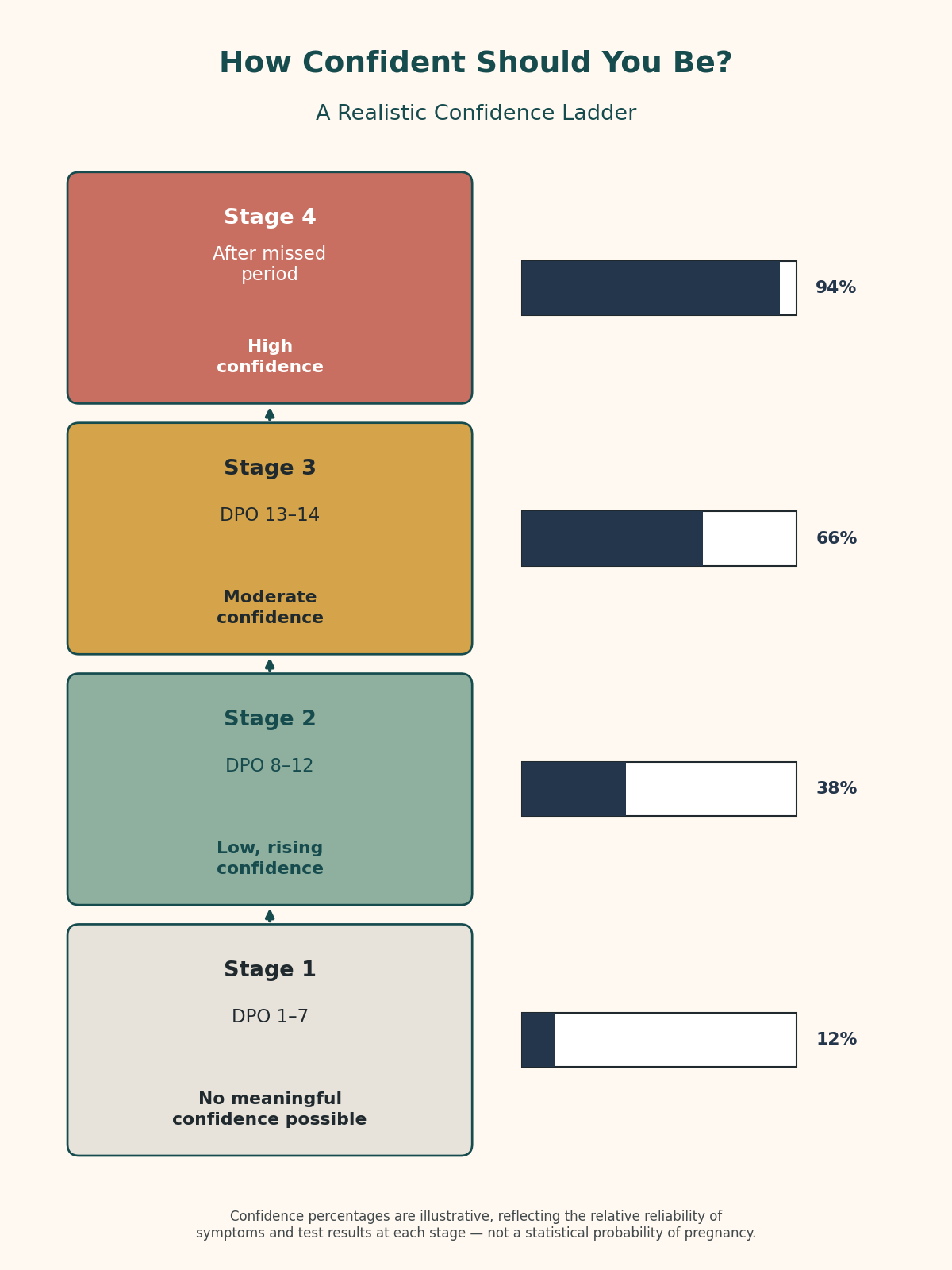
How Confident Should You Be at Each Stage? A Realistic Confidence Ladder
As a final way of pulling this guide’s timeline together, here’s a stage-by-stage look at how much confidence any symptom or test result genuinely deserves at each point after ovulation — moving from “essentially none” to “high” as the two-week wait progresses.
Stage 1: DPO 1–7 — No Meaningful Confidence Is Possible
Why This Stage Is Different From the Others
As this guide’s timeline section established, implantation has not occurred for the overwhelming majority of eventual pregnancies before DPO 6, and hCG production hasn’t begun. Any symptom felt in this window, no matter how specific or convincing it feels, cannot be verified or meaningfully weighed as pregnancy-related — not because it isn’t real, but because the biology needed to produce a genuine pregnancy symptom isn’t in place yet.
What a Reasonable Approach Looks Like Here
The most useful approach during this stage is essentially to disengage from symptom interpretation altogether — noting your ovulation date for DPO tracking purposes is useful; reading meaning into any sensation this early is not, per everything covered in this guide’s symptom-by-symptom and myths sections.
Stage 2: DPO 8–12 — Low, Rising Confidence
What Changes at This Stage
Implantation has occurred for most eventual pregnancies by the end of this window, and hCG is genuinely present and rising for those pregnancies, even though it may still be below a home test’s detection floor for several more days. Symptoms in this stage carry slightly more potential weight than in Stage 1, but — as this guide’s three illustrative timelines demonstrated — they remain difficult to distinguish from an ordinary non-pregnant luteal phase for most of this window.
What a Reasonable Approach Looks Like Here
This is a reasonable stage to begin loosely noting symptoms if you find that useful, without expecting clarity from them. Testing is possible late in this window for those who don’t want to wait, with the clear caveat, covered throughout this guide, that a negative result remains common and uninformative even at DPO 12.
Stage 3: DPO 13–14 — Moderate Confidence
What Changes at This Stage
By now, hCG has had close to a week to rise for pregnancies that implanted anywhere in the typical window, and this guide’s “typical implantation” illustrative timeline placed the first genuinely plausible positive test results right around this stage. A period failing to arrive on schedule is itself a meaningful, if still not definitive, signal at this point.
What a Reasonable Approach Looks Like Here
This is the point at which testing starts to carry real informational value for most cycles, consistent with general guidance to test around the time of an expected period for the most reliable result. A negative test here is more informative than one taken a week earlier, though as our main testing guide explains, it still isn’t necessarily the final word if a period doesn’t follow.
Stage 4: After a Missed Period — High Confidence
What Changes at This Stage
Once a period is clearly late, hCG has had the most time possible within this guide’s scope to rise, and a home pregnancy test reaches its highest reliability window. This is also the point at which this guide’s narrow, earliest-signs focus reasonably ends and hands off to broader, more clinically applicable content.
Where to Go From Here
From this stage forward, our complete pregnancy symptoms and testing guide is the more useful resource — it covers everything from confirming a positive result and understanding due dates, to warning signs, fertility-treatment considerations, and affordable care options, none of which this guide has repeated by design.
How This Guide Was Researched
Because this guide makes fairly specific claims about DPO windows and earliest-onset timing — the kind of detail that’s easy to get wrong or overstate — it’s worth being transparent about where that specificity comes from.
Sourcing Approach
Why This Guide Leans Heavily on One Landmark Study
The Wilcox, Baird, and Weinberg implantation-timing study, published in the New England Journal of Medicine in 1999, remains the most frequently cited source on day-by-day implantation timing decades after its publication, because it directly measured daily urine hCG in a large group of women trying to conceive — a methodology that’s difficult and expensive to repeat, which is part of why more recent studies of the same precision are uncommon. This guide leans on it explicitly, rather than on secondary summaries alone, for exactly the figures (the DPO 6–12 implantation window, the DPO 8–10 concentration of most implantations) that require that level of methodological rigor to state with any confidence.
Why Patient-Education Sources Fill in the Rest
For symptom-onset windows that haven’t been studied with the same daily-measurement precision as implantation timing itself, this guide relies on patient-education guidance from major academic medical centers (Mayo Clinic, Cleveland Clinic, Johns Hopkins Medicine) and professional bodies (ACOG, CDC), consistent with this site’s general source-tiering standard of favoring government and medical-authority sources first. Where a claim is more of a general clinical pattern than a precisely studied figure — most individual symptom-onset windows fall into this category — this guide says so directly (using language like “realistic” or “plausible” rather than implying precision the underlying research doesn’t actually offer).
What This Guide Deliberately Avoids Claiming
No Invented Statistics
Where research doesn’t clearly quantify something — for example, exactly what percentage of pregnancies produce implantation spotting, a figure that varies considerably across sources — this guide describes the pattern qualitatively rather than presenting a specific percentage as more precise than the underlying evidence supports.
Distinguishing Established Findings From Reasonable Inference
Some content in this guide — such as the reasoning connecting progesterone’s known luteal-phase role to why certain symptoms overlap between PMS and early pregnancy — represents a reasonable physiological inference built on well-established hormone science, rather than a single study measuring that exact comparison. This guide tries to signal that distinction through its language (for example, “a reasonable physiological explanation” rather than “research shows”) rather than blurring inference and direct findings together as if they carried equal evidentiary weight.
Frequently Asked Questions About Early Pregnancy Signs
DPO and Timing Questions
What’s the earliest DPO anyone has gotten a genuine positive test?
In research settings using highly sensitive lab assays, hCG has been detected as early as 6 to 12 days after ovulation — right at the start of the implantation window. Consumer home tests are considerably less sensitive than research-grade lab assays, so a genuine home-test positive that early is uncommon; most people who get an early positive do so closer to DPO 12–14.
Can implantation happen on DPO 5, or is that too early?
Based on the Wilcox et al. implantation-timing study, DPO 5 is on the very early edge of what’s been documented, with the large majority of implantations occurring between DPO 8 and DPO 10. It’s not impossible, but it would be unusually early, and hCG at that point would still be far too low for any test or symptom to reflect it yet.
Symptom Questions
Can you have zero symptoms at DPO 10 and still be pregnant?
Yes, easily. DPO 10 is right at the edge of the implantation window for many pregnancies, and most symptoms covered in this guide don’t reliably appear until several days after implantation, if at all. Feeling nothing at DPO 10 says very little either way.
Is a headache at DPO 3 ever an early pregnancy sign?
Not realistically. DPO 3 falls within the biologically silent window described earlier in this guide, before implantation is even possible. A headache that early has a cause other than pregnancy — dehydration, sleep, stress, or ordinary luteal-phase hormone shifts are all far more likely explanations.
Testing Questions
Can a test ever be falsely positive this early?
True false positives are uncommon, but a very early chemical pregnancy (a pregnancy that implants briefly and doesn’t continue) can produce a genuine positive test followed by a negative one or a period arriving on time or slightly late — this reflects a real, if very early, hCG rise rather than a test error. Our complete testing guide covers chemical pregnancy and result interpretation in detail.
Is testing at night instead of morning ever useful this early?
For very early testing, urine concentration matters more than time of day — a more concentrated sample (typically first thing in the morning, or after several hours without urinating) gives hCG a better chance of reaching a detectable level, regardless of whether that happens to be morning or night.
Tracking Method Questions
Does my BBT have to stay elevated to confirm pregnancy?
A sustained temperature rise beyond the typical 12–14 day luteal phase (rather than a drop before a period) is a reasonable indirect sign that a period hasn’t started, but it’s not a substitute for a pregnancy test and shouldn’t be read as confirmation on its own.
Can cervical mucus alone tell me I’m pregnant before a missed period?
No. As covered earlier in this guide, luteal-phase and early-pregnancy mucus changes are driven by the same hormone and can look and feel very similar, so mucus observations alone aren’t a reliable way to detect pregnancy before you’d otherwise be able to test.
Special Situations Questions
How do I count DPO if my cycles are irregular?
Counting from the calendar alone becomes unreliable with irregular cycles; an ovulation predictor kit, basal body temperature confirmation, or cervical mucus tracking — covered earlier in this guide — gives a considerably more accurate ovulation date to count DPO from than assuming a standard cycle length.
Can I still use this guide’s timeline if I have PCOS?
Yes, but only from your actual ovulation date, if and when ovulation occurs that cycle — the DPO windows in this guide describe what happens after ovulation, not a fixed calendar date, so they apply once you’ve confirmed ovulation has happened, regardless of the underlying cycle length.
Fertility Treatment Timing Questions
How does DPO counting change after an IVF transfer?
As covered in this guide’s terminology section, clinics and patient communities typically count “days post transfer” (DPT) rather than DPO after an embryo transfer, since transfer — not ovulation — is the relevant reference point; a day-5 transfer starts at roughly the DPO 5 equivalent.
Is it normal to feel intense bloating during the wait after IVF specifically?
Some bloating is common and expected after ovarian stimulation, but bloating that is severe, rapidly worsening, or paired with pain or difficulty breathing should be discussed with your fertility clinic promptly, since it can indicate ovarian hyperstimulation syndrome (OHSS) rather than ordinary early-pregnancy or medication-related bloating, as covered earlier in this guide.
Two-Week Wait and Reassurance Questions
Is it normal to feel nothing at all during the entire two-week wait?
Yes, very normal, and consistent with the timeline covered throughout this guide — most symptoms don’t realistically begin until DPO 8 or later, and many people don’t notice anything distinct until after a missed period, if at all in the first couple of weeks.
Why do some people say they “just knew” within days?
This is usually explained by the confirmation-bias and selective-memory pattern covered in this guide’s two-week wait section — an ordinary sensation gets remembered and re-told as meaningful once a pregnancy is confirmed, while the same sensation in a non-pregnant cycle is simply forgotten.
After a Previous Loss Questions
Is it normal to check for symptoms constantly after a previous loss?
Yes, this is a very common response, as covered earlier in this guide, and it doesn’t mean anything is wrong with you or with how you’re coping. If the checking itself starts to feel distressing or hard to stop, the grounding strategies and professional-support guidance in that section may help.
Does having had a miscarriage mean I’ll get symptoms earlier or later this time?
No — a single previous loss doesn’t change the implantation and symptom-onset timelines described throughout this guide. Symptom timing in a new pregnancy depends on that pregnancy’s own hormone levels, not on a previous pregnancy’s history.
Multiples and Individual Variation Questions
Does carrying twins change anything in this guide’s timeline?
Implantation and initial hCG production begin the same way regardless of whether one or multiple embryos implant; the well-known difference — generally higher hCG levels with multiples — becomes measurable later in the first trimester, not within the DPO 1–14 window this guide focuses on.
Why do some people say they always know within days, cycle after cycle?
Some people are simply more attuned to their own luteal-phase sensations generally, which can make ordinary premenstrual changes feel very familiar and specific — without necessarily reflecting a genuine ability to distinguish a pregnant cycle from a non-pregnant one, per the confirmation-bias and selective-memory patterns covered in this guide’s two-week-wait section.
Additional Timing Questions
Can stress or travel around ovulation delay implantation itself?
There’s no strong evidence that ordinary stress or travel delays implantation once fertilization has occurred; stress is more commonly associated with delaying or disrupting ovulation itself, which would shift your entire DPO count rather than delaying implantation within an otherwise normal cycle.
Does the specific day of the week or time of month matter for any of this?
No — every timeline in this guide is anchored to days since ovulation, not to calendar days, weekdays, or the date within a given month, which is precisely why DPO is used throughout instead of calendar dates.