
A little unexpected spotting in the days before your period is due can send you straight to the internet, and for good reason — it might be nothing, it might be an early sign of pregnancy, or it might be something else your body is telling you about. Implantation bleeding is the name for light spotting that some people notice around the time a fertilized egg attaches to the uterine lining, roughly a week to ten days before a missed period would otherwise arrive. It’s genuinely common, genuinely not universal, and — in the vast majority of cases — genuinely not a cause for concern. This guide walks through what it actually looks like, how to tell it apart from your period and from several other things early bleeding can be, and exactly when a light spot on the toilet paper is something to mention at your next visit versus something that needs a same-day call.
Key takeaways
- Implantation bleeding is typically light pink or brown spotting, noticeably lighter than a period, lasting anywhere from a few hours to about two days, occurring roughly 10–14 days after ovulation.
- It is common but not universal — most sources estimate that somewhere around a quarter of pregnancies involve some visible early spotting, which means the majority don’t, and its absence means nothing on its own.
- The clearest difference from a period is trajectory: a period usually starts light and builds into a heavier flow, while implantation bleeding tends to stay light and then simply stop.
- Not all early-pregnancy bleeding is implantation bleeding — cervical irritation, infection, subchorionic hemorrhage, threatened miscarriage, and (rarely) ectopic pregnancy can all cause spotting or bleeding too, and telling them apart sometimes requires a doctor’s visit rather than careful observation alone.
- Heavy bleeding, bleeding with moderate-to-severe pain, passing tissue, or bleeding with dizziness or fainting is never “probably just implantation” — those patterns warrant prompt medical attention regardless of how early in a suspected pregnancy they occur.
Implantation Bleeding at a Glance
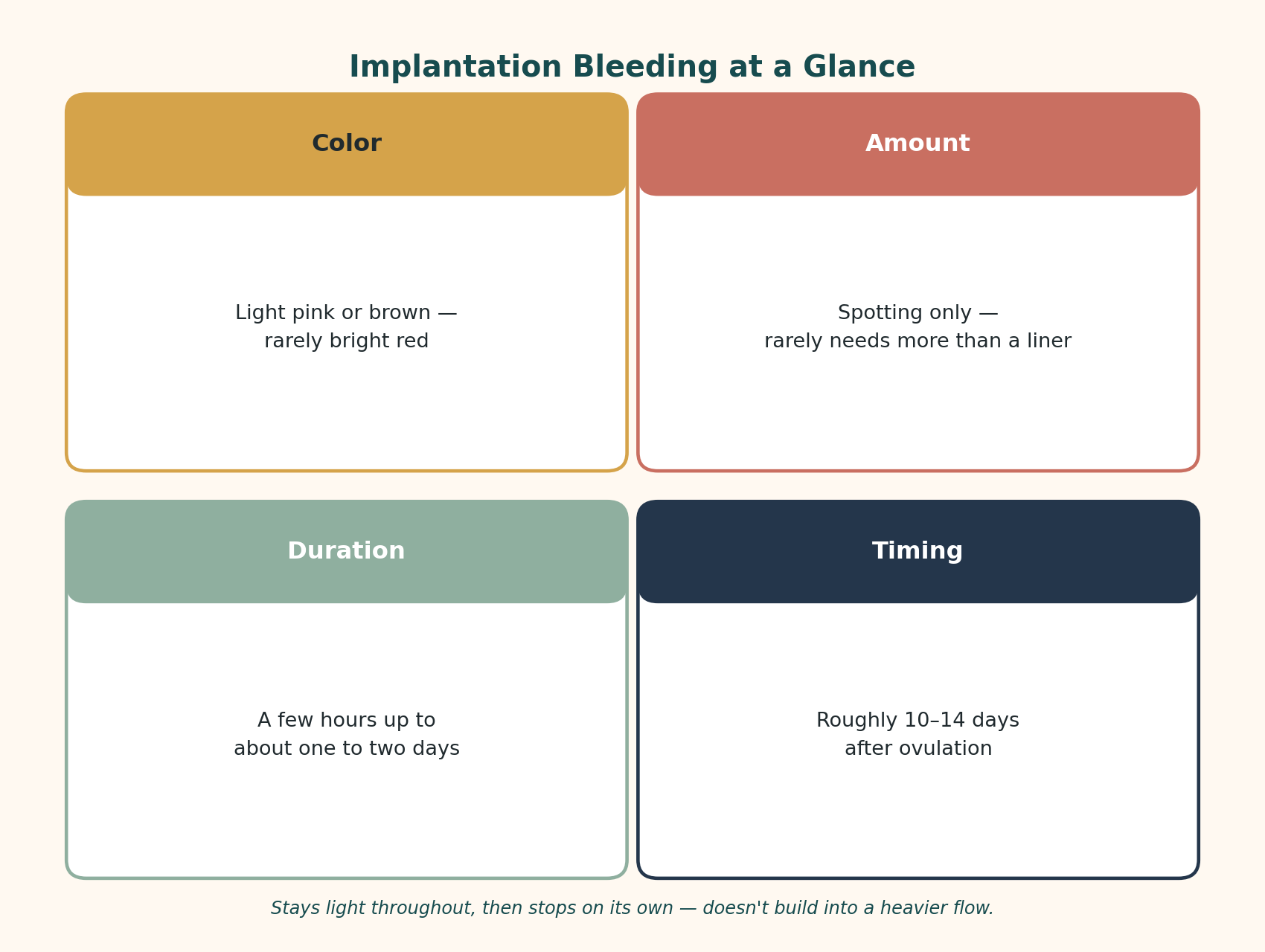
The Short Answer
| Feature | Typical pattern |
|---|---|
| Color | Light pink or brown; rarely bright red |
| Amount | Spotting only — a light stain or a few drops, not enough to need a pad |
| Duration | A few hours up to about one to two days |
| Timing | Roughly 10–14 days after ovulation, often a few days before a period would be expected |
| Pattern over time | Stays light throughout, then stops on its own — doesn’t build into a heavier flow |
| Accompanying symptoms | Sometimes mild, dull cramping; otherwise usually symptom-free |
What Matches This Pattern
If what you’re noticing is light, pink or brown, brief, and lines up with roughly 10 to 14 days after ovulation, it’s reasonable to consider implantation bleeding a likely explanation. The more of these features that line up together — not just one in isolation — the more confidently you can lean toward this explanation while you wait to test or for the spotting to resolve.
What Doesn’t Match This Pattern
If what you’re noticing is heavier, longer, more painful, bright red, or badly timed relative to ovulation, it’s worth holding that explanation more loosely. This doesn’t mean something is necessarily wrong — plenty of harmless, unrelated things can also cause bleeding that doesn’t fit the implantation pattern — but it does mean this guide’s other-causes section and self-check are more likely to have your actual answer than this section alone.
Who This Guide Is For
If You’re Trying to Conceive and Watching Closely
If you’re actively trying to conceive, you may already be tracking ovulation, checking for early signs daily, and are highly motivated to interpret every sensation correctly. This guide is written to give you the specific, evidence-based detail that kind of close tracking deserves, rather than the vaguer reassurance (“some spotting is normal!”) that general pregnancy content often settles for.
If You Weren’t Expecting to Be Pregnant at All
If pregnancy wasn’t necessarily on your radar and you’re simply trying to make sense of unusual spotting, this guide works just as well starting from the short-answer table above and moving through whichever sections match what you’re experiencing — you don’t need to have been tracking your cycle closely for any of the guidance here to apply to you.
How to Use This Guide
How the Sections Are Ordered
The sections below are organized the way a methodical person — or a good clinician — would actually work through this question: what implantation bleeding is and when it happens, what it looks like compared with a period and with other kinds of spotting, the fuller list of things early bleeding can be beyond implantation, a structured self-check, and then exactly when it’s worth a call versus something to simply mention at your next routine visit. It assumes you haven’t yet confirmed a pregnancy with a positive test — if you have, the “if you’ve confirmed you’re pregnant” section near the end points you toward what comes next.
What This Guide Doesn’t Cover (and Where That Lives Instead)
This guide doesn’t re-explain the full day-by-day early-symptom timeline, hCG and testing mechanics, or the detailed non-pregnancy causes of a missed-but-negative period — our early pregnancy symptoms guide, our full pregnancy test guide, and our guide to a missed period with a negative test each cover one of those in depth. If you’ve already confirmed a pregnancy, our guide to what to do after a positive test picks up from there.
What Implantation Bleeding Is and Why It Happens
The Biology: How a Fertilized Egg Reaches and Enters the Uterine Lining
The Journey From Fertilization to the Uterus
After an egg is fertilized in the fallopian tube, it spends the next several days traveling toward the uterus while dividing into a growing cluster of cells. By the time it arrives in the uterine cavity, it has developed into what’s called a blastocyst — a hollow ball of cells with an outer layer that will eventually become the placenta and an inner cluster that will become the embryo itself. This entire trip, from fertilization to arrival in the uterus, typically takes around three to four days.
Attaching to the Uterine Lining
Once in the uterus, the blastocyst floats freely for a short time before beginning to attach to the endometrium — the uterine lining that has spent the past two weeks thickening under the influence of estrogen and progesterone in preparation for exactly this possibility. Attachment isn’t instantaneous; the blastocyst gradually burrows into the lining over roughly one to two days as specialized cells reach into the tissue to establish the connection that will eventually become the placenta.
Why This Process Can Cause Bleeding
Small Blood Vessels, Briefly Disrupted
According to Cleveland Clinic’s patient guidance, this attachment process can disrupt small blood vessels within the uterine lining as the embryo burrows in. That disruption is what produces the light bleeding some people notice — it isn’t an injury in any concerning sense, and it isn’t a sign that anything is going wrong with the process. It’s simply a mechanical byproduct of implantation succeeding, in much the same way that a small cut bleeds briefly before it seals itself.
Why It’s Light Rather Than Heavy
The blood vessels involved are small capillaries near the surface of the lining, not the larger vessels responsible for a full menstrual flow. Because only a small, localized area is affected and the disruption is brief, the resulting bleeding tends to stay minimal — closer to spotting than to anything resembling a period — and typically resolves on its own within a day or two as the site of attachment stabilizes.
Not Everyone Bleeds — and That’s Normal Too
Implantation Doesn’t Require Visible Bleeding
It’s worth being direct about this: implantation happening successfully does not require any visible bleeding at all, and a large share of confirmed, entirely healthy pregnancies never involve a single spot of it. Whether implantation happens to disrupt a blood vessel large enough, and close enough to the surface, to produce noticeable spotting appears to be somewhat a matter of individual anatomy and chance rather than something tied to how “successfully” the pregnancy is progressing.
Its Absence Isn’t a Warning Sign
If you’re watching closely for implantation bleeding as a hoped-for early sign and don’t see any, that tells you essentially nothing about whether a pregnancy is underway. The only way to know is a pregnancy test taken at the right time — see our guide to when to take a pregnancy test for exactly when that is — not the presence or absence of a specific symptom that a majority of pregnant people never experience in the first place.
When Implantation Bleeding Happens
Timing Relative to Ovulation and Conception
The 10-to-14-Day Window
Cleveland Clinic describes implantation as typically occurring about 10 to 14 days after ovulation, which — since fertilization has to happen within about a day of ovulation for pregnancy to occur at all — places it at roughly the same point after conception. A landmark study published in the New England Journal of Medicine (Wilcox et al., 1999) narrowed the window further, finding that implantation itself generally occurs between 6 and 12 days after ovulation, with the days around 8 to 10 being the most common. Bleeding, when it happens, typically shows up right around when implantation is completing — so slightly later than the earliest edge of that window, and clustering close to when a period would otherwise be due.
Why “10 to 14 Days After Ovulation” and “6 to 12 Days After Conception” Aren’t Contradictory
These two ways of describing the timing can look inconsistent at first glance, but they’re not — they’re just measuring from slightly different starting points and reflecting the natural spread of a biological process rather than a fixed number. Implantation isn’t an instant event; it unfolds over a day or two, and the specific day it starts (and therefore the specific day any bleeding might appear) varies from one pregnancy to the next even when everything is proceeding normally.
Timing Relative to Your Missed Period
Often Days Before You’d Expect a Period
Because implantation typically happens 10 to 14 days after ovulation — which, in a average-length cycle, is close to when a period would be due — implantation bleeding often shows up in the days just before your period would normally start, sometimes overlapping with when you might expect early PMS symptoms. This overlap is exactly why it’s so easy to mistake for the beginning of a period, particularly for someone who isn’t tracking ovulation closely or watching for the distinction on a fertility chart.
Why This Makes It Easy to Miss or Misread
If you’re not specifically trying to conceive, a day or two of light spotting before your period is easy to write off as “my period starting weird this month” — and most of the time, that’s exactly what it is, since implantation bleeding is far less common than an ordinary period. The distinguishing clues covered in the next section are what actually separate the two, rather than timing on its own.
Why Timing Varies From Person to Person
Ovulation Timing Isn’t Identical Every Cycle
Even for someone with generally regular cycles, the exact day of ovulation can shift by several days from one cycle to the next depending on stress, illness, travel, and plenty of other everyday factors. Because implantation timing is calculated from ovulation rather than from the calendar, any shift in ovulation shifts the entire window for implantation — and any bleeding associated with it — by the same amount.
Individual Biology Plays a Role Too
The exact speed at which a particular embryo develops and travels to the uterus, and the specific point at which attachment begins, both vary somewhat between pregnancies even under otherwise identical circumstances. This is part of why the medical literature describes a range (6 to 12 days after ovulation for implantation itself) rather than a single fixed day — the range reflects real, normal biological variation, not measurement imprecision.
What Implantation Bleeding Looks Like: Color, Amount, and Duration
Color: The Pink-to-Brown Spectrum
Why Color Differs From Fresh Menstrual Blood
Implantation bleeding is characteristically light pink, dark brown, or a rust-like brown rather than the bright or dark red typical of menstrual flow. According to Cleveland Clinic’s patient guidance, this color difference comes down largely to how quickly the blood leaves the body: fresh, bright-red blood reflects a faster flow, while blood that takes longer to travel out oxidizes along the way and appears pink, brown, or rust-colored by the time it’s visible. Because implantation bleeding is slow and minimal by nature, it tends to fall on the browner, older-blood end of that spectrum far more often than a period does.
Some Variation Is Still Normal
Not every instance of implantation bleeding looks identical — some people describe a faint pink tinge only visible on toilet paper, while others notice a slightly darker brown discharge over a day or two. What’s more diagnostic than the exact shade is the combination of color, amount, and duration together, which is why the comparison table below looks at all three side by side rather than color in isolation.
| Color | What it often suggests |
|---|---|
| Light pink | Common with implantation bleeding; also possible with cervical irritation |
| Brown or rust-colored | Common with implantation bleeding and with old blood clearing from the vagina after any minor bleeding event |
| Bright red | More typical of a period, fresh cervical bleeding (for example, after sex), or bleeding that needs prompt evaluation if it’s heavy or persistent |
| Dark red with clots | More typical of a heavier menstrual flow or a bleeding pattern that warrants medical attention if a pregnancy is suspected or confirmed |
Color alone is a useful clue, not a diagnosis. A same-day call to a provider is reasonable any time bright red or heavier bleeding occurs alongside a suspected or confirmed pregnancy, regardless of how the color compares to the patterns above.
Amount: Spotting, Not a Flow
What “Spotting” Actually Means
Mayo Clinic describes implantation bleeding as “a small amount of light spotting or bleeding” — in practice, this usually means a faint mark on toilet paper or a light stain on underwear, not something that requires a pad or shows up as a noticeable flow when you stand up or move around. Cleveland Clinic’s comparison is a useful mental image: implantation bleeding resembles vaginal discharge more than it resembles a period, both in texture and in the amount involved.
When Amount Alone Is a Red Flag
If you’re soaking through a pad or tampon within an hour, or bleeding enough that you’re changing protection repeatedly over a short period, that’s a meaningfully different pattern from implantation bleeding regardless of color or timing, and it’s covered in more detail in the when-to-call section below.
Duration: A Few Hours to a Couple of Days
Typically Brief
Cleveland Clinic describes implantation bleeding as lasting anywhere from a few hours up to a few days, though most descriptions cluster around one to two days at most. Unlike a period, which generally continues at some level of flow for several days, implantation bleeding tends to taper off and stop on its own well before that point.
What to Make of Bleeding That Continues Longer
Spotting that continues for more than about three days, or that seems to be increasing rather than decreasing, moves further away from a typical implantation-bleeding pattern and closer to something worth mentioning to a provider — not necessarily an emergency, but a pattern that deserves a conversation rather than continued at-home observation alone.
Accompanying Sensations: Mild Cramping and What’s Still Normal
Cramping Can Happen, but It’s Usually Mild
Some people notice mild, dull cramping alongside implantation bleeding, generally similar to light period cramps rather than anything sharp or severe. This cramping is thought to relate to the same uterine-lining changes involved in the attachment process itself, and it typically resolves within the same short window as the bleeding.
What Would Be Different
Cramping that’s severe, one-sided, or steadily worsening — rather than mild and diffuse — is a different pattern that points toward causes covered in the other-causes section below rather than typical implantation bleeding, and it’s covered again in the when-to-call section in terms of how quickly to act on it.
Implantation Bleeding vs. Your Period

Trajectory: Building Flow vs. Light-Then-Stop
The Single Most Useful Distinguishing Clue
Of everything covered so far, trajectory over time is the clue clinicians and patient-education sources point to most consistently. A period typically starts light and builds into a heavier flow over the first day or two before gradually tapering off toward the end of its several-day course. Implantation bleeding, by contrast, tends to stay light the entire time and then simply stop — it doesn’t build toward anything heavier, because there’s no ongoing uterine-lining shedding process driving it the way there is with a period.
Watching the Pattern, Not Just the First Hour
Because trajectory is the key signal, a single spot of pink or brown discharge doesn’t tell you much on its own — what matters is what happens over the following 24 to 48 hours. If it stays light and resolves, that’s consistent with implantation bleeding. If it builds into something heavier and more period-like, it was very likely the start of an actual period after all.
| Feature | Implantation bleeding | Menstrual period |
|---|---|---|
| Color | Light pink or brown | Bright or dark red, sometimes with clots |
| Amount | Spotting; rarely needs more than a liner | Noticeable flow, typically requiring a pad or tampon |
| Duration | A few hours to about two days | Several days, commonly 3–7 |
| Trajectory | Stays light, then stops | Builds to a heavier flow, then gradually tapers |
| Timing | Roughly 10–14 days after ovulation, often a few days before an expected period | At the expected point in the cycle based on your typical cycle length |
| Accompanying symptoms | Sometimes mild, dull cramping; often none | Often more typical PMS/period symptoms — cramping, bloating, breast tenderness that resolve once flow starts |
If Your Cycles Are Already Irregular, This Gets Harder
Timing Clues Are Less Reliable Without a Predictable Baseline
Everything above assumes you have a reasonably good sense of when your period is “due,” which is straightforward with regular cycles and considerably harder with irregular ones. If your cycle length regularly varies by a week or more, timing-based reasoning (“this is earlier than my period would normally start”) is less trustworthy, and color, amount, and trajectory become even more important than usual.
When a Test Is More Useful Than More Observation
If your cycles are irregular enough that you genuinely can’t tell whether spotting is early, on-time, or late relative to an expected period, a pregnancy test taken at an appropriate point — see our timing guide for how irregular cycles change that calculation — will usually resolve the question faster than continued symptom-watching.
When Timing Alone Can’t Settle It
The Only Way to Know for Certain
Even with a textbook-perfect implantation-bleeding pattern, a pregnancy test (and, if needed, a blood test) is the only way to confirm what’s actually happening — the pattern described in this section makes one explanation more or less likely, but it isn’t a diagnosis. If the spotting stops and no period follows within the next several days, testing is the reasonable next step.
When It’s Genuinely Ambiguous
Sometimes bleeding simply doesn’t fit either pattern cleanly — moderate in amount, uncertain in timing, or occurring on someone with a history of irregular spotting between periods for unrelated reasons. In that situation, waiting a few days to see how it resolves, then testing, is usually more informative than trying to force the pattern into one category or the other based on a single data point.
Implantation Bleeding vs. Ovulation Spotting, Birth Control Breakthrough Bleeding, and Other Non-Pregnancy Spotting
Ovulation Spotting
What It Is and When It Happens
A small number of people notice light spotting around ovulation itself, roughly midway through the cycle, thought to be related to the brief hormonal dip that occurs right around when an egg is released. Because it happens well before implantation would occur — implantation is 10 to 14 days later — ovulation spotting and implantation bleeding sit at opposite ends of the cycle rather than overlapping in timing.
Telling Them Apart
The clearest distinguishing factor is timing relative to your cycle: ovulation spotting happens roughly mid-cycle, well before a period would be due, while implantation bleeding happens much closer to when a period would be expected. If you track ovulation (through an app, a fertility monitor, or cervical mucus changes), noting the date of any spotting relative to that estimated ovulation day is the most reliable way to tell the two apart in real time.
Breakthrough Bleeding on Hormonal Birth Control
Why It Happens
Hormonal birth control — pills, patches, rings, hormonal IUDs, implants, and injections — can all cause unscheduled light bleeding or spotting between expected periods (or in place of a period entirely), particularly in the first few months of starting a new method, after missing doses, or after switching methods. This is a well-documented, generally harmless side effect of how these methods work rather than a sign of pregnancy or of anything going wrong.
Why This Complicates the Picture
If you’re using hormonal birth control and also wondering whether you might be pregnant (for example, after a missed dose or a method failure), breakthrough bleeding and implantation bleeding can look genuinely similar, and neither timing nor appearance reliably tells them apart on their own. In this specific situation, a pregnancy test is a considerably more efficient way to get an answer than trying to interpret the bleeding pattern itself.
Spotting From a Missed or Late Period Unrelated to Bleeding Itself
When the Real Question Isn’t About the Spotting at All
Sometimes what looks like a pattern-matching question about bleeding is really a broader question about a missed or unusually light, late period — stress, significant weight change, PCOS, thyroid disorders, and several other common, non-pregnancy causes can all produce an unusually light or spotty period rather than a normal one, independent of pregnancy or implantation entirely.
Where That Full Differential Lives
Our guide to a missed period with a negative pregnancy test covers that broader differential in depth, including a structured self-check and guidance on what a doctor’s workup involves — it’s the right resource if your actual question is “why is my period late and unusual” rather than “is this specific spotting implantation bleeding.”
How Common Is Implantation Bleeding, Really?
What the Research Actually Shows
Estimates Vary, but It’s Genuinely a Minority Experience
Precisely how many pregnancies involve visible implantation bleeding is difficult to pin down exactly, because it depends on self-reporting of something brief, light, and easy to miss or misattribute to a period. Estimates commonly cited in patient-education materials put the figure at around one in four pregnancies experiencing some form of early light bleeding, though the true figure for implantation bleeding specifically (as opposed to early bleeding from any cause) is harder to isolate with precision, since not every study distinguishes cleanly between the two.
Why This Guide Doesn’t Cite a More Precise Number
Where research doesn’t clearly quantify something down to a specific percentage, this guide describes the pattern using the range that patient-education sources consistently cite rather than presenting a more precise-sounding figure than the underlying evidence actually supports. The consistent finding across sources is the same regardless of the exact percentage: implantation bleeding is a recognized, legitimate phenomenon, but it is not something every pregnant person experiences.
Why Its Absence Doesn’t Mean Anything
Most Pregnancies Never Show This Sign
If roughly a quarter or fewer of pregnancies involve noticeable spotting, that means the clear majority don’t — which makes the absence of implantation bleeding the statistically normal outcome, not a sign that something is different or wrong about a particular pregnancy. Plenty of confirmed, healthy pregnancies proceed from conception all the way through delivery without a single instance of visible spotting.
Don’t Use It as a Pregnancy Test Substitute
Because implantation bleeding is inconsistent and easy to miss even when it does occur, watching for it as a way to predict a pregnancy test result is unreliable in both directions — its presence doesn’t confirm pregnancy (see the other causes below), and its absence doesn’t rule pregnancy out. A test taken at the appropriate time remains the only way to actually know.
Implantation Bleeding and Pregnancy Testing
Can You Test the Same Day You Notice Spotting?
Usually Still Too Early
Because implantation bleeding typically occurs right around the time implantation is completing, hCG has often only just begun entering your bloodstream when the bleeding happens — meaning a test taken the same day frequently comes back negative even in a pregnancy that will go on to test positive within the following days. This is simply a timing issue, not a sign that the bleeding wasn’t implantation-related after all.
A More Useful Testing Window
Waiting a few days after the spotting resolves — ideally testing with first-morning urine around the time your period would be due or slightly after — gives hCG more time to rise to a detectable level and produces a considerably more reliable result than testing on the day of the spotting itself.
Where the Full Testing-Timing Guidance Lives
This Guide Doesn’t Re-Explain Test Mechanics
How home pregnancy tests actually work, the full range of test types, and detailed line-reading guidance are covered thoroughly in our full pregnancy test guide rather than repeated here. If you want the exhaustive day-by-day breakdown of when testing becomes reliable relative to ovulation, our guide to when to take a pregnancy test covers that in depth, and our guide to how early you can take a pregnancy test covers the absolute earliest theoretical boundary for anyone testing before implantation bleeding would even be expected to occur.
If You Test Negative After Noticing Spotting
A negative test on or shortly after implantation-bleeding-pattern spotting doesn’t necessarily mean the spotting wasn’t implantation-related — it may simply mean hCG hasn’t risen high enough yet. Our guide to a missed period with a negative pregnancy test covers exactly what to do next in that situation, including when to retest and when a blood test is the more efficient path to an answer.
Other Causes of Bleeding or Spotting in Early Pregnancy
Implantation bleeding is only one of several things early spotting or bleeding can be — and if you’ve already confirmed a pregnancy with a positive test, it’s worth knowing the fuller picture rather than assuming every instance of bleeding must be implantation-related simply because that’s the most commonly searched explanation. The American Academy of Family Physicians notes that roughly one in four pregnant people experiences some bleeding in the first trimester, and the causes range from entirely harmless to ones that need prompt attention. This section walks through the most common possibilities in roughly the order a clinician would consider them.
Subchorionic Hemorrhage (Hematoma)
What It Is
A subchorionic hemorrhage — sometimes called a subchorionic hematoma — happens when blood collects between the uterine wall and the chorion, the membrane surrounding the developing gestational sac. Cleveland Clinic describes it as the most common finding associated with vaginal bleeding between 10 and 20 weeks of pregnancy, and it’s frequently discovered incidentally on a routine ultrasound even in people who had no bleeding symptoms at all.
What It Feels Like and How It’s Found
Symptoms, when present, range from light spotting to heavier bleeding with clots, sometimes alongside mild cramping. Many people with a small subchorionic hemorrhage have no symptoms whatsoever and only learn about it when a provider spots it on an ultrasound performed for an unrelated reason.
Outlook
The outlook for a subchorionic hemorrhage is generally favorable — Cleveland Clinic notes that many resolve on their own without causing complications, and treatment typically involves monitoring, follow-up ultrasounds, and sometimes activity modification rather than aggressive intervention. Larger hematomas with more significant bleeding are followed more closely and can occasionally be associated with a higher-risk pregnancy course, which is part of why any bleeding during a confirmed pregnancy is worth reporting rather than simply waiting to see what happens.
Cervical Causes: Ectropion, Polyps, and Irritation After Sex or an Exam
Cervical Ectropion
Cervical ectropion is a harmless anatomical variation in which glandular cells normally found inside the cervical canal are present on its outer surface instead. Cleveland Clinic notes it becomes more common during pregnancy because of rising estrogen levels, and while most cases cause no symptoms at all, it can occasionally cause light bleeding after sex or a pelvic exam, or spotting between periods. It isn’t cancerous, doesn’t raise cancer risk, and doesn’t threaten the pregnancy — most cases need no treatment and resolve on their own over time.
Cervical Polyps and Irritation
Small, usually benign growths on the cervix called polyps can also cause light spotting, particularly after intercourse or a pelvic exam, because the cervix becomes more vascular (meaning it has a richer blood supply) during pregnancy and bleeds more easily than usual with any direct contact or friction. This kind of bleeding is typically light, stops quickly, and is not a sign that anything is wrong with the pregnancy itself — it’s a separate, local phenomenon involving the cervix rather than the uterus.
Why Sex or an Exam Can Trigger This
If you notice light spotting specifically after sex or a recent pelvic exam, cervical irritation of this kind is a common and usually reassuring explanation, especially if the bleeding is light, brief, and not accompanied by pain. It’s still worth mentioning at your next appointment so your provider can take a look and rule out anything else, but it generally doesn’t require an urgent same-day evaluation on its own.
Infection
Vaginal or Cervical Infections
Certain vaginal or cervical infections can cause irritation and light bleeding or spotting, sometimes alongside unusual discharge, odor, itching, or discomfort. These are generally treatable once identified, and treating the underlying infection typically resolves the associated bleeding as well.
Urinary Tract Infections and Bleeding
A urinary tract infection doesn’t typically cause vaginal bleeding directly, but the discomfort and urgency it causes can sometimes be confused with other pelvic symptoms, and untreated UTIs during pregnancy are worth addressing promptly for reasons beyond bleeding alone. Burning or pain with urination, alongside or separate from any bleeding, is worth mentioning to a provider within a day or so.
Threatened Miscarriage
What the Term Means
“Threatened miscarriage” is a clinical term describing vaginal bleeding, sometimes with mild cramping, occurring in the first 20 weeks of a confirmed pregnancy where the cervix remains closed and the pregnancy is still potentially viable. It’s a description of a situation and a set of findings, not a prediction that a pregnancy loss will definitely happen — Cleveland Clinic notes that of people who experience some vaginal bleeding in the first 20 weeks, a solid majority go on to continue the pregnancy to term.
What Tends to Cause It
A range of factors are associated with a higher likelihood of threatened miscarriage, including a random chromosomal variation in the developing embryo (by far the most common underlying factor), a prior history of miscarriage, certain infections, and, less commonly, physical trauma. In many individual cases, no specific cause is ever identified, which can be frustrating but doesn’t change the generally favorable statistical outlook.
How It’s Distinguished From Other Bleeding
What separates a threatened miscarriage from routine implantation bleeding is largely a combination of timing (it can occur at any point in the first 20 weeks, not just the implantation window), amount and duration (often somewhat heavier or longer-lasting), and confirmation via ultrasound and hCG/progesterone testing — which is exactly why any bleeding after a pregnancy is already confirmed is worth evaluating rather than assumed to be implantation-related after the fact.
Early Pregnancy Loss (Miscarriage)
How Common It Is
Early pregnancy loss is more common than most people realize — commonly cited estimates suggest that somewhere between 10% and 20% of known pregnancies end in miscarriage, with the true rate likely higher still, since a meaningful number of very early losses occur before a person even knows they’re pregnant. Most losses happen within the first 13 weeks.
Bleeding Patterns Worth a Call
Bleeding associated with an ongoing miscarriage often — though not always — becomes heavier over time than implantation bleeding or a threatened-miscarriage pattern, sometimes with clots or tissue passing, and is frequently accompanied by cramping that’s more noticeable than the mild version described earlier in this guide. That said, patterns vary considerably from person to person, which is part of why bleeding that doesn’t clearly match a “light and brief” implantation pattern deserves a conversation with a provider rather than an at-home judgment call.
This Guide Doesn’t Duplicate the Full Warning-Signs Detail
Our pregnancy symptoms guide covers the full warning-signs picture for early pregnancy loss and ectopic pregnancy — including when to call a provider versus go to an emergency room — in more depth than repeated here. For symptoms, causes, diagnosis, and recovery specific to early pregnancy loss, see our miscarriage guide. The when-to-call section below summarizes the bleeding-specific thresholds that matter most.
Ectopic Pregnancy
Why This Guide Doesn’t Re-Explain the Mechanics
An ectopic pregnancy — one that implants outside the uterus, most often in a fallopian tube — can cause bleeding alongside other symptoms like one-sided pelvic pain, shoulder-tip pain, or dizziness, and it is a medical emergency requiring immediate care. Because our pregnancy symptoms guide already covers what ectopic pregnancy is, why it happens, and exactly which symptoms warrant emergency evaluation, this guide doesn’t repeat that explanation in full — the short version relevant here is that bleeding paired with sharp, one-sided pain or dizziness is never something to sit with and observe, regardless of how early in a suspected pregnancy it occurs.
What Makes Bleeding From an Ectopic Pregnancy Different
Bleeding associated with an ectopic pregnancy can actually look deceptively light and unremarkable on its own — it’s the combination with pain, particularly one-sided pain, that’s the more reliable warning sign, not the bleeding’s appearance by itself. This is exactly why the pain and dizziness criteria matter as much as, or more than, the bleeding pattern when this specific possibility is being considered, and why a light spot of blood should never be used to reassure yourself out of seeking care if it comes with concerning pain.
Molar Pregnancy
A Rare but Important Possibility
A molar pregnancy is a rare condition in which abnormal tissue grows in the uterus instead of, or alongside, a typical pregnancy, sometimes producing bleeding that can look brownish or resemble prune juice, along with other findings like an unusually high hCG level or a uterus that measures larger than expected for the stage of pregnancy. It’s uncommon, and most instances of early bleeding are not related to it — but it’s part of why unusual bleeding patterns are evaluated with an ultrasound rather than assumed to be routine, since an ultrasound can distinguish a molar pregnancy from a typical one clearly.
What Happens If One Is Identified
A molar pregnancy can’t continue as a normal pregnancy and is typically managed with a procedure to remove the abnormal tissue, followed by monitoring of hCG levels over the following weeks to months to confirm they return to zero. This is understandably difficult news to receive, and providers who diagnose a molar pregnancy typically walk patients through both the medical next steps and what it means for future pregnancies, which in the large majority of cases remain entirely normal.
Vanishing Twin Syndrome
A Rare, Usually Painless Possibility in Early Multiple Pregnancies
In pregnancies that start as twins or higher-order multiples, one of the developing embryos or gestational sacs occasionally stops developing very early on and is reabsorbed by the body, sometimes with light bleeding or spotting and sometimes with none at all — a phenomenon commonly called vanishing twin syndrome. It’s typically identified on an early ultrasound rather than suspected from symptoms alone, and it generally doesn’t affect the health or outcome of the remaining pregnancy. This is a rare and specific scenario, mentioned here for completeness rather than as a likely explanation for most spotting.
Why It’s More Often Noticed Now Than in the Past
Vanishing twin syndrome is identified more frequently today than in past decades, largely because early ultrasounds are now more routine and more sensitive, catching multiple gestational sacs very early on that might previously have gone undetected if one didn’t continue developing. It’s a good example of how earlier, more detailed imaging can surface findings that were always occurring biologically but weren’t previously visible — it’s a reflection of better detection, not a sign that this outcome itself has become more common.
What Happens If Early Pregnancy Loss Is Confirmed
Management Options
If an evaluation confirms an early pregnancy loss, there are generally three approaches, per clinical guidance on managing first-trimester loss: expectant management (allowing the process to complete on its own, with monitoring), medical management (medication that helps the body complete the process), and surgical management (a procedure to remove remaining tissue from the uterus). Which approach makes sense depends on how far along the pregnancy was, how you’re doing physically, personal preference, and your provider’s clinical judgment — there is rarely only one “correct” choice, and providers typically walk through the trade-offs of each option with you rather than choosing on your behalf.
Emotional and Practical Support
Whatever the medical details, a confirmed early pregnancy loss is a real loss, and it’s reasonable to grieve it regardless of how early it occurred or whether anyone else knew about the pregnancy yet. Many people find it helpful to talk with a mental health professional experienced in pregnancy loss, connect with a support group (in person or online), and give themselves permission to take the time they need before making decisions about trying again. There is no required timeline for grief, and wanting to try again quickly, or needing much more time, are both normal responses.
Special Situations That Change the Picture
An IUD in Place
Both Hormonal and Copper IUDs Commonly Cause Irregular Bleeding
Both hormonal and copper IUDs are well-documented causes of irregular spotting or bleeding, particularly in the first several months after placement, independent of pregnancy entirely. If you have an IUD and notice spotting, that alone is not a signal to suspect pregnancy — IUD-related bleeding pattern changes are common and expected, especially early on.
When Pregnancy With an IUD Still Needs Ruling Out
IUDs are highly effective but not absolutely foolproof, and pregnancy occurring with an IUD in place — while uncommon — also carries a somewhat higher relative likelihood of being ectopic if it does occur. If you have an IUD, have missed a period, and are experiencing pelvic pain alongside any bleeding, that combination is worth a prompt call rather than being attributed to routine IUD-related spotting by default.
A Recent Pregnancy Loss or Chemical Pregnancy
Why This Time Can Feel Different
If you’ve experienced a pregnancy loss or a chemical pregnancy (a very early loss, often around the time of an expected period) before, it’s common to feel heightened anxiety around any spotting in a subsequent pregnancy attempt, even when the pattern itself looks entirely typical for implantation bleeding. That anxiety is a completely understandable response to a real prior experience, not an overreaction, and it’s worth naming explicitly to your provider so they can offer appropriately reassuring monitoring rather than the standard “wait and see” approach that might not feel sufficient given your history.
What Providers Sometimes Do Differently
Depending on your history, a provider might recommend earlier or more frequent monitoring (an earlier ultrasound, more frequent hCG checks) than they would for someone without a prior loss, specifically to provide reassurance sooner rather than because your current pregnancy is inherently at higher risk. It’s reasonable to ask directly whether closer monitoring is available to you given your history, rather than assuming you need to simply tolerate the same waiting period as anyone else.
Conceiving via Fertility Treatment
Progesterone Supplementation Can Confound the Picture
Many fertility treatment protocols include supplemental progesterone to support the uterine lining after a transfer, and while progesterone itself doesn’t typically cause bleeding, some protocols and delivery methods (particularly vaginal suppositories) can cause local irritation or spotting unrelated to implantation itself. This adds a layer of uncertainty beyond what someone conceiving without fertility treatment would experience.
Where the Fuller Fertility-Treatment Guidance Lives
This guide doesn’t repeat the detailed guidance on symptoms during fertility treatment cycles that our pregnancy symptoms guide already covers — if you conceived via IVF, IUI, or another fertility treatment and want the fuller picture of how medication affects symptom interpretation generally, that guide’s fertility-treatment section is the more complete resource. The short version relevant to bleeding specifically: don’t assume any bleeding during a medicated cycle is either automatically implantation-related or automatically concerning — mention it to your fertility clinic, which is generally monitoring you closely enough to interpret it accurately in the context of your specific protocol.
A Simple Self-Check: Sorting Through the Possibilities
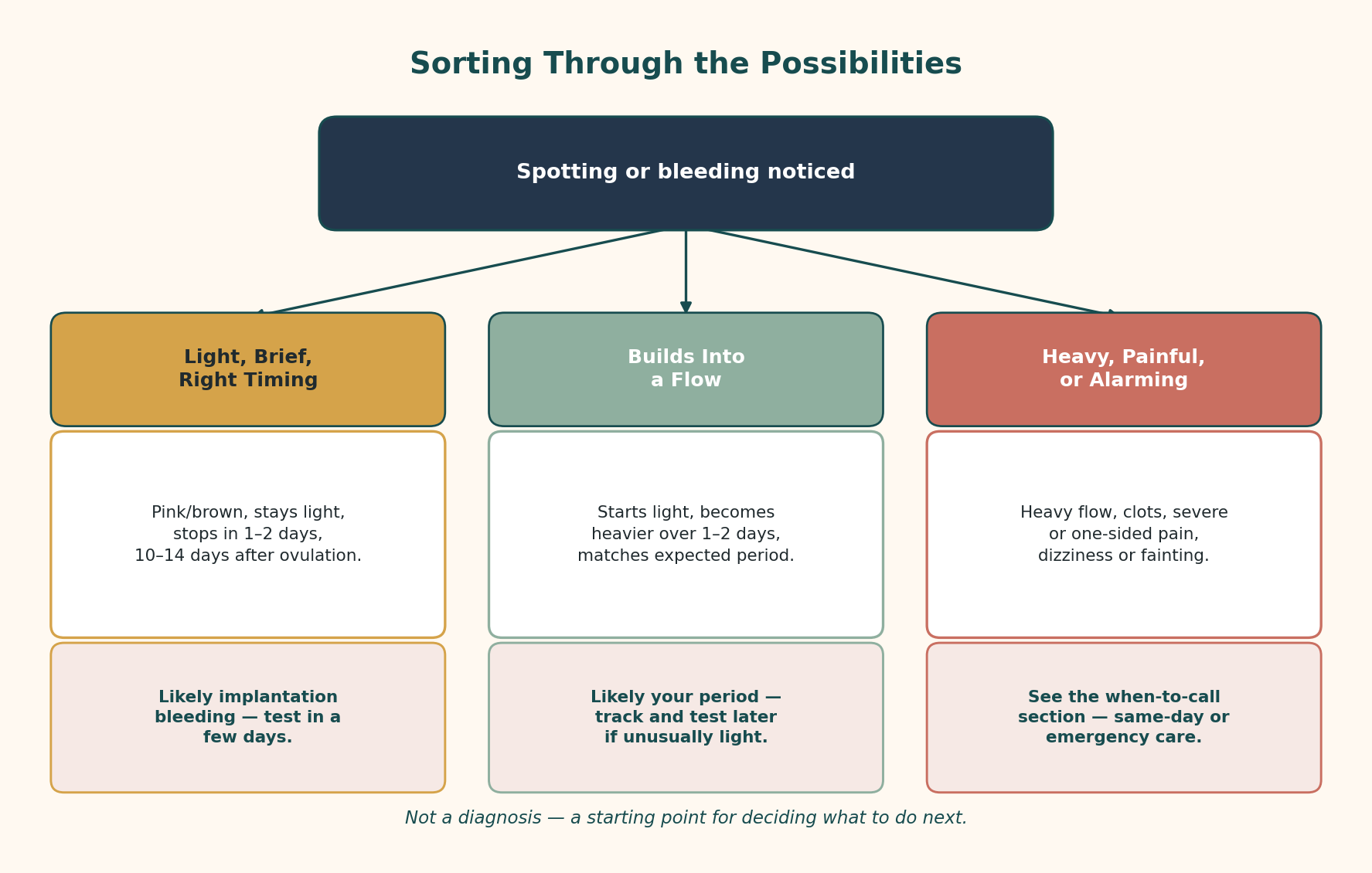
Working Through It Step by Step
Start With What You Actually Know
Before consulting the table below, get clear on a few basics: whether you’ve confirmed pregnancy with a positive test yet, roughly where you are in your cycle (or how many weeks pregnant, if confirmed), and the specific details of what you’re noticing — color, amount, duration, and any accompanying pain. Having these details clear in your mind (or written down) makes the table considerably more useful than trying to match a vague impression against it.
How to Read the Table
The table below isn’t a diagnosis — it’s a starting point for organizing what you’re noticing before deciding what to do next. Work through it in order, and if your situation matches more than one row, default to the one that calls for more caution rather than less. If nothing matches cleanly, that’s a reasonable signal on its own that a conversation with a provider, rather than more self-assessment, is the right next step.
| What you’re noticing | Most likely explanation | Reasonable next step |
|---|---|---|
| Light pink/brown spotting, 10–14 days after ovulation, stays light and stops within 1–2 days | Implantation bleeding | Test in a few days if no period follows |
| Light spotting mid-cycle, well before a period would be due | Ovulation spotting | No action needed; note the date if trying to conceive |
| Spotting that builds into a heavier, longer flow | Likely your period after all | Track as usual; test later if the period seems unusually light or short |
| Light spotting after sex or a pelvic exam, no pain, pregnancy already confirmed | Cervical irritation (ectropion, polyp) | Mention at next routine visit |
| Spotting or bleeding with mild cramping, pregnancy confirmed, cervix closed on exam | Possible threatened miscarriage | Same-day call to your provider |
| Bleeding that’s moderate-to-heavy, with clots or tissue, pregnancy confirmed | Possible pregnancy loss in progress | Same-day call to your provider |
| Bleeding with sharp one-sided pain, shoulder pain, dizziness, or fainting | Possible ectopic pregnancy | Emergency care now |
| Bleeding with fever, unusual discharge, or pain urinating | Possible infection | Same-day to next-day call to your provider |
What This Self-Check Can’t Tell You
It Doesn’t Replace an Exam or an Ultrasound
Several of the possibilities in this guide — subchorionic hemorrhage, threatened miscarriage, molar pregnancy, and early pregnancy loss among them — can look genuinely similar from the outside and are only reliably distinguished with an exam, an ultrasound, and sometimes bloodwork. This self-check is meant to help you decide how urgently to seek that evaluation, not to substitute for it.
When in Doubt, Call
If your situation doesn’t clearly match any single row, or if you’re simply anxious and want reassurance, calling your provider’s office and describing what you’re experiencing is always a reasonable choice. Provider offices field exactly this kind of question routinely, and asking doesn’t require you to already have it figured out yourself.
When to Call a Doctor: Bleeding Patterns and Timing That Matter
Call Right Away (Same Day or Emergency Care)
Signs That Warrant Immediate Attention
Seek emergency or same-day urgent care for heavy bleeding (soaking through a pad within an hour), bleeding with moderate-to-severe cramping or pain, bleeding with passing tissue or clots, or bleeding accompanied by dizziness, fainting, or sharp one-sided pelvic or shoulder pain. These patterns can indicate an ectopic pregnancy, an active miscarriage, or another condition requiring prompt evaluation, and none of them should be managed by waiting to see if things improve on their own.
Don’t Wait to Research Further First
If you’re experiencing any of the signs above, the right move is to call your provider or go to an emergency room, not to spend additional time reading about the possibilities — time can matter in some of these situations, and a phone call takes less time than continued searching.
Call Within a Day or Two
Patterns That Are Usually Not Urgent But Deserve a Conversation
A same-day-to-next-day call is reasonable for bleeding that’s more than light spotting but not heavy, mild cramping that’s more noticeable than typical implantation cramping, bleeding that continues beyond about three days without a clear explanation, or bleeding alongside fever, unusual discharge, or pain with urination. These situations are frequently explained by something straightforward — a cervical cause, an infection, or a subchorionic hemorrhage — but benefit from an exam to confirm rather than ongoing at-home guessing.
If You Simply Want Reassurance
You don’t need to be certain something is wrong to justify calling. If bleeding is making you anxious and you’d feel better with a professional opinion, that’s a legitimate reason to call within a day or two even if nothing about the pattern seems especially concerning on paper.
Usually Fine to Mention at Your Next Visit

Patterns That Typically Don’t Need an Urgent Call
Light pink or brown spotting that matches the classic implantation-bleeding pattern — brief, light, no significant pain, resolving within a day or two — generally doesn’t require an urgent call, though it’s still worth mentioning at your next scheduled appointment, especially once a pregnancy is confirmed, so it’s part of your record. The same is generally true of light spotting clearly tied to sex or a recent pelvic exam with no other symptoms.
A General Rule of Thumb
If you’re ever unsure which category your situation falls into, treating it as worth at least a phone call is the safer default. Providers would far rather field a call about bleeding that turns out to be nothing than have someone wait through a genuinely concerning pattern out of a wish not to “bother” the office.
What Happens at a Doctor’s Visit for Early Bleeding
The Exam and Your History
What to Expect First
A visit for early bleeding typically starts with questions about your last menstrual period, whether you’ve had a positive pregnancy test, when the bleeding started, how heavy it is, what color it is, and whether you have any pain, and then a physical exam that usually includes a speculum exam. According to a clinical review published in American Family Physician, the exam helps identify non-pregnancy causes such as cervical irritation, polyps, or infection, and can confirm whether the cervix is open or closed — a closed cervix is one of the defining features of a threatened rather than an in-progress miscarriage.
Why Vital Signs Matter
Your provider will also typically check your vital signs — blood pressure, heart rate, and similar measures — since these help assess whether you’re hemodynamically stable, meaning your body is coping well with any blood loss that has occurred. Signs of instability change the urgency and type of evaluation needed and are part of why heavier bleeding, or bleeding with dizziness, is treated as more urgent than light spotting.
Quantitative hCG, the “Discriminatory Zone,” and Serial Testing
Why a Number, Not Just a Positive/Negative Result
Unlike a home test, which simply gives a positive or negative result, a blood test measures the actual quantitative hCG level, expressed in mIU/mL. This number is genuinely useful in evaluating early bleeding because it can be compared against what’s typically expected at a given point in pregnancy and, when repeated a couple of days later, can show whether the level is rising the way it typically does in early pregnancy or failing to rise or falling instead.
The “Discriminatory Zone” Explained Simply
Clinicians use the term “discriminatory zone” to describe the hCG level above which a normal pregnancy located in the uterus should be visible on a transvaginal ultrasound — commonly cited as somewhere in the range of 1,500 to 3,000 mIU/mL, per the clinical literature on evaluating first-trimester bleeding. In practice, this means that once your hCG level is high enough, an ultrasound should be able to confirm where the pregnancy is located and whether it’s developing as expected; below that level, an ultrasound may not yet show enough to be conclusive, which is why serial hCG testing (checking the level again after a couple of days) is often used earlier on instead.
What a Rising or Falling Pattern Suggests
In a typical early pregnancy, hCG roughly doubles every two to three days. A level that’s rising more slowly than expected, plateauing, or falling can suggest a pregnancy that isn’t developing typically — including a possible early loss or, in some patterns, an ectopic pregnancy — though a single number in isolation is rarely enough to draw a firm conclusion, which is exactly why serial testing and imaging are often used together rather than relying on either alone.
Transvaginal Ultrasound: What It Can and Can’t Show This Early
What It Can Confirm
A transvaginal ultrasound (performed with a probe rather than externally, which gives a clearer picture very early in pregnancy) can typically confirm the location of a pregnancy, detect a gestational sac and, a bit later, an embryo with a heartbeat, and identify findings like a subchorionic hemorrhage. Once hCG is above the discriminatory zone described above, this is usually the most direct way to get concrete answers about how a pregnancy is progressing.
Why an Early Ultrasound Sometimes Can’t Say Much Yet
Very early in a pregnancy — before hCG has risen high enough, or before enough time has passed since conception — an ultrasound may show little more than an empty uterus or a very small gestational sac without a visible embryo, simply because there isn’t yet enough there to see, not because anything is wrong. In this situation, a provider will typically recommend a repeat ultrasound after a week or so rather than drawing conclusions from a single early scan, and that waiting period, while difficult, doesn’t by itself indicate a poor outcome.
Progesterone Testing
What It Adds to the Picture
A single progesterone level can sometimes help distinguish a viable from a non-viable pregnancy — per the clinical literature on evaluating first-trimester bleeding, a level below a certain threshold reliably indicates a pregnancy that isn’t viable, while higher levels are more reassuring, though progesterone testing is used alongside hCG and ultrasound findings rather than as a stand-alone answer.
Why It’s Not Always Ordered
Not every provider orders a progesterone level for every instance of early bleeding — its usefulness depends on the specific clinical picture, and ultrasound plus serial hCG is often sufficient on its own. If your provider doesn’t order one, that isn’t a sign your situation is being handled incompletely; it simply reflects that the other tools already available were considered sufficient for your specific case.
What Happens After the Visit
If Everything Looks Normal
If your exam, hCG trend, and ultrasound (once timing allows for one) all look consistent with a typical, developing pregnancy, you’ll generally be transitioned to routine prenatal care on the usual schedule, with no special follow-up required specifically because of the earlier bleeding. It’s still worth mentioning the episode again at your first full prenatal visit so it’s part of your complete record.
If Follow-Up Is Needed
If your initial evaluation is inconclusive — for example, hCG hasn’t yet reached the discriminatory zone, or an early ultrasound doesn’t yet show enough to be conclusive — your provider will typically schedule a specific follow-up, whether that’s a repeat hCG in 48 hours or a repeat ultrasound in about a week. Ask directly what result would change the plan and what number or finding they’re specifically looking for, so the waiting period feels less like an open-ended unknown and more like a defined next step with a clear purpose.
Coping With the Anxiety of Bleeding in Early Pregnancy
Why This Hits Especially Hard
The Uncertainty Itself Is Stressful
Bleeding in early pregnancy — or bleeding while wondering whether you might be pregnant at all — sits at the intersection of hope, fear, and genuine medical uncertainty, and that combination is legitimately stressful regardless of how the situation ultimately resolves. It’s common to feel a kind of whiplash between reassuring yourself with statistics (“most bleeding is fine”) and being unable to stop imagining the worse possibility, sometimes within the same hour.
It’s Not a Sign You’re Overreacting
Wanting answers quickly, calling your provider’s office more than once, or feeling unable to focus on anything else until you know more are all common, understandable responses to this kind of uncertainty — not signs that you’re being dramatic or difficult. Provider offices are accustomed to exactly this kind of call and won’t think less of you for making it.
What Tends to Help
Get an Answer Rather Than Keep Guessing
For most people, the anxiety of not knowing is worse than almost any answer they eventually get — which is part of why calling a provider, rather than continuing to search symptoms and compare experiences online, tends to genuinely reduce distress rather than just delay it. A concrete plan (testing on a specific day, an appointment already scheduled, clear instructions on what to watch for) is usually more calming than open-ended waiting.
Lean on Support, Not Just Information
Talking with a partner, a trusted friend, or a family member about what you’re going through — separate from researching medical facts — can help in a way that more information alone doesn’t. If the bleeding does turn out to reflect a pregnancy loss, that support becomes even more important, and there’s no requirement to process something like that alone or silently while you wait for clarity.
A Reasonable Perspective to Hold Onto
Most instances of early bleeding, and the majority of pregnancies that experience some bleeding in the first trimester, continue without complication. That statistic doesn’t erase the anxiety of the waiting period, and it’s not offered here to talk you out of taking your own symptoms seriously — but it’s worth holding onto as context while you get the evaluation and answers you need.
Tracking Your Bleeding: What to Note and Why It Helps
What to Record
The Details That Actually Matter to a Provider
If you notice spotting or bleeding, jotting down a few specific details makes any follow-up conversation with a provider considerably more useful than trying to reconstruct the timeline from memory later: the date and time it started, the color, the approximate amount (spotting only, or enough to need a liner or pad), whether it’s getting lighter or heavier over time, whether you have any cramping or pain and how severe, and where you are in your cycle or pregnancy (days past ovulation, or weeks pregnant if already confirmed).
A Simple Format Is Enough
A running note in your phone, with a new line each time something changes, works just as well as anything more elaborate — the goal is being able to answer “when did this start, and has it changed” clearly and specifically, not producing a polished record. Photos are generally unnecessary and not something providers typically ask for.
Bringing It to Your Appointment
What to Mention, Even If It Seems Minor
Mention any bleeding at your next appointment even if it has already resolved and even if you suspect it was implantation bleeding — providers want it in your record regardless of the outcome, and it can be relevant context for interpreting other findings later in the pregnancy.
Questions Worth Asking
If you’ve had bleeding and are being evaluated, reasonable questions to ask include: what your hCG level was and whether it’s expected to be rechecked, whether an ultrasound found anything specific, what pattern of bleeding (if any) would warrant a call before your next scheduled visit, and whether any activity restrictions are actually necessary or simply a precaution.
Common Myths About Implantation Bleeding
Myths About Timing and Cause
“Implantation Bleeding Always Happens Exactly at the Missed-Period Mark”
It’s a myth that implantation bleeding lines up precisely with a missed period — it typically occurs 10 to 14 days after ovulation, which is often a few days before a period would actually be expected, not exactly on the day itself. The overlap is close enough to cause confusion, but it isn’t a precise match.
“Heavier Bleeding Just Means a ‘Stronger’ Implantation”
There’s no such thing as a “stronger” implantation producing heavier bleeding as a good sign — implantation bleeding is characteristically light by definition, and heavier bleeding points toward a different explanation entirely (a period, or one of the other causes covered in this guide) rather than a more robust version of the same phenomenon.
| Myth | Fact |
|---|---|
| Everyone who’s pregnant experiences implantation bleeding | Most estimates suggest a minority of pregnancies involve visible spotting; its absence is normal and means nothing on its own |
| Implantation bleeding always happens exactly at the missed-period mark | It typically occurs 10–14 days after ovulation, often a few days before a period would be expected, not exactly on the day |
| Heavier bleeding just means a “stronger” implantation | Implantation bleeding is characteristically light; heavier bleeding points toward a different explanation and is worth having evaluated |
Myths About What It Means
“If You Don’t See It, You’re Not Pregnant”
This is one of the most common and most unhelpful myths about implantation bleeding — the only reliable way to know whether you’re pregnant is a test taken at the appropriate time, not the presence or absence of a symptom that the majority of pregnant people never notice in the first place.
“Any Bleeding Early in Pregnancy Means a Miscarriage Is Likely”
This myth causes a disproportionate amount of unnecessary fear. Most bleeding in the first trimester, including in confirmed pregnancies, does not end in pregnancy loss — bleeding is a reason to get evaluated, not a reason to assume the worst outcome by default.
| Myth | Fact |
|---|---|
| If you don’t see implantation bleeding, you’re not pregnant | The only way to know is a pregnancy test taken at the appropriate time — this symptom’s absence doesn’t rule anything out |
| Cramping with implantation bleeding means something is wrong | Mild, dull cramping is a normal accompaniment; it’s severe or one-sided cramping that’s a different, more concerning pattern |
| You can always tell implantation bleeding apart from a period just by looking at it | Trajectory over the following day or two — staying light and stopping, versus building into a flow — is usually more reliable than a single-moment assessment |
| Any bleeding early in pregnancy means a miscarriage is likely | Most bleeding in the first trimester, including in confirmed pregnancies, does not end in pregnancy loss |
If You’ve Confirmed You’re Pregnant: What Comes Next
A Brief Bridge, Not a Repeat
Where the Full First-Week Guidance Lives
If a positive test follows what you’ve been experiencing, congratulations — and rather than duplicating that guidance here, our dedicated guide to what to do after a positive pregnancy test walks through the first-week priorities step by step: confirming with a provider, starting a prenatal vitamin, understanding your due date, and deciding when and how to share the news.
Mention Any Bleeding When You Schedule
If any bleeding continues or recurs after your positive test, mention it when you schedule that first appointment rather than waiting for the visit itself, so the office can advise you on timing — some practices will move your appointment earlier if you report bleeding, since it can change what the first visit needs to cover.
If Bleeding Continues After a Positive Test
Don’t Just Wait for the Scheduled Visit
A positive test doesn’t retroactively explain away ongoing bleeding — if spotting continues, changes character, or is joined by new symptoms after you’ve already confirmed pregnancy, treat it using the same when-to-call guidance covered earlier in this guide rather than assuming it’s simply part of normal early pregnancy because a test came back positive.
A Positive Test and a Healthy Pregnancy Aren’t Automatically the Same Thing Yet
Very early on, a positive test confirms that a pregnancy has started, but it doesn’t yet confirm where it’s located or that it’s developing typically — those are questions your first ultrasound and follow-up hCG testing help answer. This isn’t meant to introduce worry where none is needed; it’s simply why continued bleeding still deserves attention even with a confirmed positive result in hand.
Common Mistakes to Avoid
Assuming Every Instance of Spotting Is Implantation Bleeding
Why This Happens
Because implantation bleeding is the most commonly searched explanation for early spotting, it’s tempting to default to it for any unexpected bleeding — it’s a hopeful, reassuring explanation, especially for someone actively trying to conceive.
What to Do Instead
Match your specific pattern against the self-check rather than assuming the most hoped-for explanation by default. Several other causes covered in this guide are also common, and some need prompt attention rather than quiet optimism.
Waiting Too Long to Call Because “It’s Probably Nothing”
Why This Happens
The flip side of the mistake above is dismissing a pattern that actually warrants a call simply because implantation bleeding is common and reassuring to believe in, or because calling feels like an overreaction to “just some spotting.”
What to Do Instead
If your bleeding is heavier, more painful, or longer-lasting than the classic implantation pattern, treat it according to the when-to-call guidance rather than assuming the best case by default. Calling and being told it’s nothing is a far better outcome than the reverse.
Testing the Same Day and Trusting a Negative Result Completely
Why This Happens
Spotting understandably triggers an urge to test immediately for an answer, and a negative result can feel definitive in the moment even though it often isn’t yet.
What to Do Instead
Testing on the day of spotting and getting a negative result doesn’t rule out pregnancy — hCG is often still too low at that exact point, even in a pregnancy that will go on to test positive within days. Retesting a few days later, per our timing guide, gives a much more reliable answer.
Not Mentioning Resolved Bleeding at Your Next Visit
Why This Happens
Because implantation-pattern bleeding typically resolves quickly on its own, it’s easy to forget to bring it up once a pregnancy is confirmed weeks later — it no longer feels urgent or relevant by the time the appointment arrives.
What to Do Instead
Mention it anyway, even after the fact, so it’s part of your complete history. It costs nothing to mention and can be useful context if anything related comes up later in the pregnancy.
Comparing Your Experience Too Closely to Someone Else’s
Why This Happens
Online accounts of implantation bleeding vary widely — some describe a single spot, others describe something closer to two days of light flow — and it’s natural to want a single, definitive description to compare your own experience against.
What to Do Instead
Both kinds of accounts can be genuine descriptions of the same underlying phenomenon. Comparing your own pattern too rigidly against any one person’s description is less useful than comparing it against the general ranges (color, amount, duration, trajectory) covered throughout this guide.
Real-World Scenarios: Putting It All Together
Sometimes it’s easier to work through a specific example than an abstract table. The five scenarios below walk through how the guidance in this article actually applies to situations people commonly describe — none of them are a substitute for your own provider’s evaluation, but they show how the pieces fit together in practice.
Scenario 1: Light Pink Spotting, 10–12 Days Past Ovulation, Gone by the Next Day
What You’d Notice
A faint pink mark only visible when wiping, no need for even a liner, mild dull cramping for a few hours, then nothing further the next day. You’re 10 to 12 days past your estimated ovulation date, a few days before your period would normally be due.
What This Pattern Suggests
This closely matches the classic implantation-bleeding pattern in color, amount, duration, and timing. A reasonable next step is to wait and test with first-morning urine in a few days, around when your period would be due, rather than testing immediately.
Scenario 2: Spotting That Builds Into a Normal Flow Over 36 Hours
What You’d Notice
Light pink spotting on day one, becoming a heavier red flow by the following evening, arriving right around your expected period date, with typical period-like cramping.
What This Pattern Suggests
The building trajectory is the key signal here — this is much more consistent with the start of a normal period than with implantation bleeding, which stays light and stops rather than building. If a period follows through in the usual way, testing generally isn’t necessary unless your period is unusually different from your normal pattern.
Scenario 3: Brown Spotting After Sex, Pregnancy Already Confirmed, No Pain
What You’d Notice
A small amount of brown spotting noticed a few hours after sex, no pain, no cramping, resolving within a day. You already have a confirmed pregnancy from a positive test the previous week.
What This Pattern Suggests
This pattern — timing tied specifically to sex, light amount, no pain — is consistent with cervical irritation (ectropion or a polyp), which becomes more common in pregnancy due to increased blood flow to the cervix. It’s worth mentioning at your next visit, but this specific pattern generally doesn’t need an urgent same-day call on its own.
Scenario 4: Bleeding With Worsening Cramping, Positive Test Last Week
What You’d Notice
Bleeding that started light but is becoming heavier over several hours, with cramping that’s more noticeable than typical period cramps and seems to be intensifying rather than easing, in a pregnancy confirmed about a week ago.
What This Pattern Suggests
Worsening bleeding paired with worsening cramping, in a confirmed pregnancy, is a pattern that warrants a same-day call to your provider rather than waiting to see how it develops further — this is the kind of pattern covered under threatened miscarriage and early pregnancy loss earlier in this guide, and an exam and ultrasound can clarify what’s happening.
Scenario 5: Sharp One-Sided Pain and Light Spotting, Late Period
What You’d Notice
Light spotting alongside a sudden, sharp pain concentrated on one side of your lower abdomen, with a period that’s about a week late and no pregnancy test taken yet.
What This Pattern Suggests
Sharp, one-sided pain — regardless of how light the accompanying bleeding is — is the specific combination that warrants emergency evaluation, since it’s a hallmark sign associated with ectopic pregnancy. This is not a pattern to test-and-wait on; it calls for same-day emergency care.
Frequently Asked Questions
Timing and Biology Questions
How many days after sex does implantation bleeding happen?
It depends on when ovulation and fertilization occurred relative to sex, not on the day of sex itself, since sperm can survive in the reproductive tract for several days before fertilization happens. Once fertilization occurs, implantation bleeding — if it happens at all — typically follows about 10 to 14 days after ovulation, which could be anywhere from a few days to about a week after the specific instance of sex that led to conception.
Can implantation bleeding happen before a missed period?
Yes — in fact, it usually does. Because implantation typically occurs 10 to 14 days after ovulation, which is close to when a period would be expected, implantation bleeding often shows up in the days just before a missed period rather than after it.
Color, Amount, and Appearance Questions
Can implantation bleeding be bright red?
It’s uncommon but not impossible — most descriptions emphasize pink or brown as the more typical colors, since slower bleeding tends to oxidize before it’s visible. Bright red bleeding is more often associated with a period or with fresher, faster bleeding from another cause, so it’s worth paying closer attention to amount and trajectory if the color is bright red rather than assuming implantation by default.
Can implantation bleeding come with clots?
This would be unusual. Implantation bleeding is typically described as very light spotting without clots; bleeding that includes clots more often points toward a heavier flow, whether that’s a period or a different early-pregnancy cause worth having evaluated.
Distinguishing From a Period or Other Spotting Questions
My period is usually heavy. Could a genuinely light period still be implantation bleeding?
It’s possible, though an unusually light period for you personally is also just a normal cycle-to-cycle variation that happens for plenty of non-pregnancy reasons. The clearest way to tell is trajectory and duration — if it stays light throughout and resolves within a day or two rather than continuing at even a light flow for several days, that leans toward implantation bleeding; if it continues at any consistent flow for your typical period length, it’s more likely just a lighter-than-usual period.
I have PCOS and irregular cycles. Does that make this harder to figure out?
Yes, meaningfully so. Without a predictable cycle length, timing-based reasoning is much less reliable, and irregular spotting between periods is also more common with PCOS independent of pregnancy. If you have PCOS and are trying to figure out whether spotting could be implantation-related, testing is generally more useful than trying to reason it out from timing and pattern alone.
Other Causes and Medical Questions
How common is a subchorionic hemorrhage?
It’s described by Cleveland Clinic as the most common finding associated with vaginal bleeding between 10 and 20 weeks of pregnancy, meaning it’s a relatively frequent explanation for bleeding once a pregnancy is confirmed and further along than the implantation window specifically.
Does a subchorionic hemorrhage mean I’ll have a miscarriage?
Not necessarily. Cleveland Clinic notes that many subchorionic hemorrhages resolve on their own without complications, particularly smaller ones. Larger hematomas with heavier bleeding are followed more closely and can be associated with somewhat higher risk, which is why any diagnosed subchorionic hemorrhage is monitored with follow-up ultrasounds rather than left unaddressed.
When to Worry / Doctor Visit Questions
Is any amount of bleeding in early pregnancy “normal”?
Light spotting is common enough to be considered a frequent, usually benign occurrence, but “common” isn’t the same as something to ignore. Any bleeding during a confirmed pregnancy is worth mentioning to your provider, even if it turns out to be nothing — it’s about building a complete record and ruling things out, not assuming the worst.
Should I go to the emergency room or just call my regular provider?
For heavy bleeding, severe pain, or symptoms like dizziness or fainting, go to an emergency room or call emergency services rather than waiting for your regular provider’s office to open or return a call. For lighter bleeding without those symptoms, a same-day or next-day call to your regular provider’s office is generally the more appropriate first step.
Practical and Lifestyle Questions
Can I keep working out if I have light spotting?
If the spotting matches a typical implantation-bleeding pattern and you have no diagnosed complication, most people don’t need to change their activity level. If you’ve been told you have a subchorionic hemorrhage or a threatened miscarriage, ask your provider directly, since recommendations vary by individual situation.
Should I use a panty liner or pad to track how much I’m bleeding?
A liner is a practical way to both manage light spotting and get a rough sense of amount — if you’re needing more than a liner within an hour or two, that’s useful, concrete information to share with a provider.
Trying to Conceive and Special Situations Questions
I’m trying to conceive and track basal body temperature. Does implantation bleeding show up on a BBT chart?
Implantation bleeding itself doesn’t produce a specific BBT signature, though some people notice a brief one-day dip in temperature (sometimes called an implantation dip) around the same general time. This dip isn’t a reliable pregnancy indicator on its own, and plenty of people who are pregnant never see one, while plenty of people who aren’t pregnant do.
Can implantation bleeding happen on the exact day of a missed period?
It’s possible, since the 10-to-14-day window overlaps closely with when a period would be due, but it’s more commonly described as occurring a few days before that point rather than on the exact day.
Understanding Your Results and Numbers Questions
My hCG level seems low for how many weeks I think I am. Does that mean something is wrong?
Not necessarily on its own — dating a very early pregnancy precisely is difficult, and a single hCG number can look “low” simply because you’re earlier in the pregnancy than estimated, not because anything is wrong. What matters more than any single number is the trend across two or more measurements taken a couple of days apart.
What counts as a “normal” rise in hCG between two tests?
In a typical early pregnancy, hCG roughly doubles every 48 to 72 hours, though the exact rate can vary somewhat and still be entirely normal. Your provider will interpret your specific numbers in that context rather than expecting an exact doubling every single time.
Support and Recovery Questions
Where can I find support if bleeding leads to a confirmed pregnancy loss?
Many hospitals and clinics have dedicated early-pregnancy-loss support resources, and your provider’s office can typically refer you to a counselor or support group experienced specifically in pregnancy loss. National and online support communities also exist for exactly this experience, and you don’t have to search for support entirely on your own.
How long should I wait before trying to conceive again after an early loss?
Medical guidance on this varies and depends on how the loss was managed (expectant, medical, or surgical) and your individual recovery — your provider can give guidance specific to your situation. Emotionally, there’s no required waiting period; readiness to try again is a personal decision, not a fixed timeline.
Age, Health Conditions, and Risk Factor Questions
Does age affect the likelihood of implantation bleeding?
There’s no strong evidence that age itself changes whether someone experiences implantation bleeding. Age is, however, associated with somewhat higher rates of early pregnancy loss overall, particularly after the mid-30s and more so after 40, which is part of why any bleeding pattern is worth taking seriously regardless of how “normal” it might otherwise seem.
Does having endometriosis change how I should interpret spotting?
Endometriosis itself doesn’t specifically alter implantation-bleeding timing or appearance, though endometriosis can be associated with irregular bleeding patterns generally, which may make cycle-based reasoning less reliable. If you have endometriosis and are trying to interpret spotting, leaning more on a pregnancy test and less on timing-based inference is often more reliable.
Glossary of Terms
Bleeding and Cycle Terms
Implantation bleeding
Light spotting some people notice around the time a fertilized egg attaches to the uterine lining, typically 10–14 days after ovulation.
Spotting
Very light bleeding, usually only a few drops or a faint stain, not heavy enough to need a pad.
Menstrual period
The regular shedding of the uterine lining that occurs when pregnancy has not happened in a given cycle, typically producing a flow that builds and then tapers over several days.
Ovulation spotting
Light spotting some people notice around the time of ovulation, roughly mid-cycle, unrelated to implantation or pregnancy.
Breakthrough bleeding
Unscheduled light bleeding or spotting that can occur with hormonal birth control methods, particularly after starting, stopping, switching, or missing doses.
Cervical ectropion
A harmless anatomical variation in which glandular cells normally inside the cervical canal are present on its outer surface, more common during pregnancy due to higher estrogen levels.
Medical and Pregnancy Terms
Subchorionic hemorrhage (hematoma)
A collection of blood between the uterine wall and the chorion (the membrane surrounding the gestational sac), the most common finding associated with vaginal bleeding between 10 and 20 weeks of pregnancy.
Threatened miscarriage
A clinical term for vaginal bleeding, sometimes with mild cramping, in the first 20 weeks of a pregnancy where the cervix remains closed and the pregnancy is still potentially viable.
Ectopic pregnancy
A pregnancy that implants outside the uterus, most often in a fallopian tube, which cannot develop into a viable pregnancy and requires prompt medical treatment.
Molar pregnancy
A rare condition in which abnormal tissue grows in the uterus instead of, or alongside, a typical pregnancy, identified through ultrasound and hCG findings.
Vanishing twin syndrome
A rare phenomenon in an early multiple pregnancy in which one developing embryo or gestational sac stops developing and is reabsorbed, sometimes with light bleeding, without affecting the remaining pregnancy.
Discriminatory zone
The hCG level (commonly cited as roughly 1,500–3,000 mIU/mL) above which a normal pregnancy located in the uterus should be visible on a transvaginal ultrasound.
hCG (human chorionic gonadotropin)
The hormone produced by the placenta after implantation, detected by pregnancy tests, which roughly doubles every two to three days in typical early pregnancy.
Transvaginal ultrasound
An ultrasound performed with a probe rather than externally, which gives a clearer picture of very early pregnancy structures than an abdominal ultrasound can.
Progesterone
A hormone that helps maintain the uterine lining in early pregnancy; a single blood level can sometimes help distinguish a viable from a non-viable pregnancy alongside other findings.
The bottom line
Light pink or brown spotting that stays light and resolves within a day or two, roughly 10 to 14 days after ovulation, fits the classic pattern of implantation bleeding — common, harmless, and not something every pregnancy shows. Bleeding that’s heavier, more painful, longer-lasting, or paired with dizziness or one-sided pain is a different picture and deserves prompt attention rather than an assumption that it’s “probably just implantation.” When in doubt, a phone call to your provider costs you very little and can settle the question far faster than continued searching or symptom comparison ever will.
About pregnancyadoption.com
pregnancyadoption.com publishes free, judgment-free information on pregnancy, pregnancy options, and adoption for anyone trying to understand what’s happening in their body or what choices are available to them. We are not a law firm, an adoption agency, or a medical practice — we’re an independent editorial resource, and we don’t place children, provide legal representation, or profit from which option a reader ultimately chooses.
Every article carrying medical information is written to a source-tiering standard (government and medical-authority sources first, established nonprofits second, commercial sources never used as factual authority) and reviewed by a licensed clinician before publication. Time-sensitive information is scheduled for review on a recurring cadence, and factual errors reported by readers are corrected promptly. Read our full About & Editorial Guidelines page for details on our review process, sourcing standards, and how to report a correction.
Medical and Legal Disclaimer
This article is provided for general educational purposes only and does not constitute medical, legal, financial, or tax advice. Reading this content does not create a doctor-patient, attorney-client, or any other professional relationship between you and pregnancyadoption.com, its authors, or its reviewers. Always seek the advice of a licensed physician, midwife, attorney, or other qualified professional with any questions you may have regarding a medical condition, a legal right, or a financial decision, and never disregard or delay seeking professional guidance because of something you have read here. If you believe you may be experiencing a medical emergency, call 911 or your local emergency number immediately.
Clinical definitions, timing ranges, and prevalence figures referenced in this article are accurate to the best of our knowledge as of this article’s last review date but may not reflect the most current research or your individual situation. We make reasonable efforts to verify accuracy but make no warranty, express or implied, as to the completeness, reliability, or timeliness of any information on this page. Links to third-party websites are provided for convenience only; we do not control and are not responsible for the content, accuracy, or privacy practices of external sites, and inclusion of a link is not an endorsement.
To the fullest extent permitted by applicable law, pregnancyadoption.com and its authors, editors, and medical/legal reviewers disclaim all liability for any loss, injury, or damage of any kind arising from reliance on the information in this article. This disclaimer does not limit any rights you may have under law that cannot be waived. Read our full Medical and Legal Disclaimer for complete terms.
Sources and further reading
This guide draws on patient-education and clinical guidance from the following organizations. Individual circumstances vary — use this guide to prepare good questions for your own health care provider, not as a substitute for individualized medical advice.
- Cleveland Clinic — Implantation Bleeding: Causes, Symptoms & What to Expect
- Mayo Clinic — Implantation Bleeding: Common in Early Pregnancy? (Expert Answer)
- Cleveland Clinic — Subchorionic Hematoma: Causes, Symptoms & Treatment
- Cleveland Clinic — Threatened Miscarriage: Causes, Symptoms & Treatment
- Cleveland Clinic — Cervical Ectropion: Causes, Symptoms & Treatment
- American Academy of Family Physicians — American Family Physician: First-Trimester Bleeding — Evaluation and Management (2019)
- MedlinePlus (National Institutes of Health) — Vaginal Bleeding During Pregnancy
- Wilcox AJ, Baird DD, Weinberg CR — “Time of Implantation of the Conceptus and Loss of Pregnancy,” New England Journal of Medicine (1999)
- American College of Obstetricians and Gynecologists (ACOG) — Bleeding During Pregnancy FAQ