

If you’ve searched “signs of pregnancy at 1 week” and come away more confused than when you started, you’re not imagining it. Some sources will tell you nothing is possible yet. Others list cramping, sore breasts, and even a positive test as “week 1” symptoms. Both answers can be technically correct — because they’re answering two completely different questions using the same three words.
This guide exists specifically to untangle that confusion. Rather than repeating the same broad symptom list our other guides already cover in depth, it focuses narrowly on this one specific, extremely common point of confusion: what “1 week pregnant” actually means, what’s physiologically possible at that point under each of the two ways people count it, and which widely-repeated “week 1” symptom claims hold up and which don’t.
Key takeaways
- “1 week pregnant” means two different things to two different sources, and they’re not close together on a calendar. Medical dating counts from your last period; colloquial dating usually means about a week after ovulation or conception. Confusing the two is the single biggest reason search results seem to contradict each other.
- Under medical (LMP) dating, “week 1” is before ovulation and conception have even happened in a typical cycle — so no pregnancy sign of any kind is physiologically possible yet, full stop.
- Under the more common colloquial meaning — about a week after ovulation — you’re still in or just entering the implantation window, which is also, for most of that week, too early for any reliable symptom or test result.
- A home pregnancy test at either version of “week 1” is essentially never going to give you a reliable answer, regardless of which symptoms you may or may not be noticing.
- Feeling nothing at all right now is completely normal at this stage under either dating convention, not a sign that anything is wrong.
- For the full, exhaustive day-by-day breakdown of what’s possible from day 1 after ovulation through a missed period, our earliest-signs guide covers that ground in much greater depth than this guide attempts to. For the full symptom list, testing, and what-to-do-next guidance, our main pregnancy symptoms guide is the better starting point.
The Question Behind the Question: What Does “1 Week Pregnant” Actually Mean?
Before any specific symptom can be evaluated, the question itself needs to be pinned down — because “1 week pregnant” is genuinely ambiguous, and the two most common meanings point to very different moments in a cycle.
Two Completely Different Starting Points
Medical Dating: Counting From Your Last Period
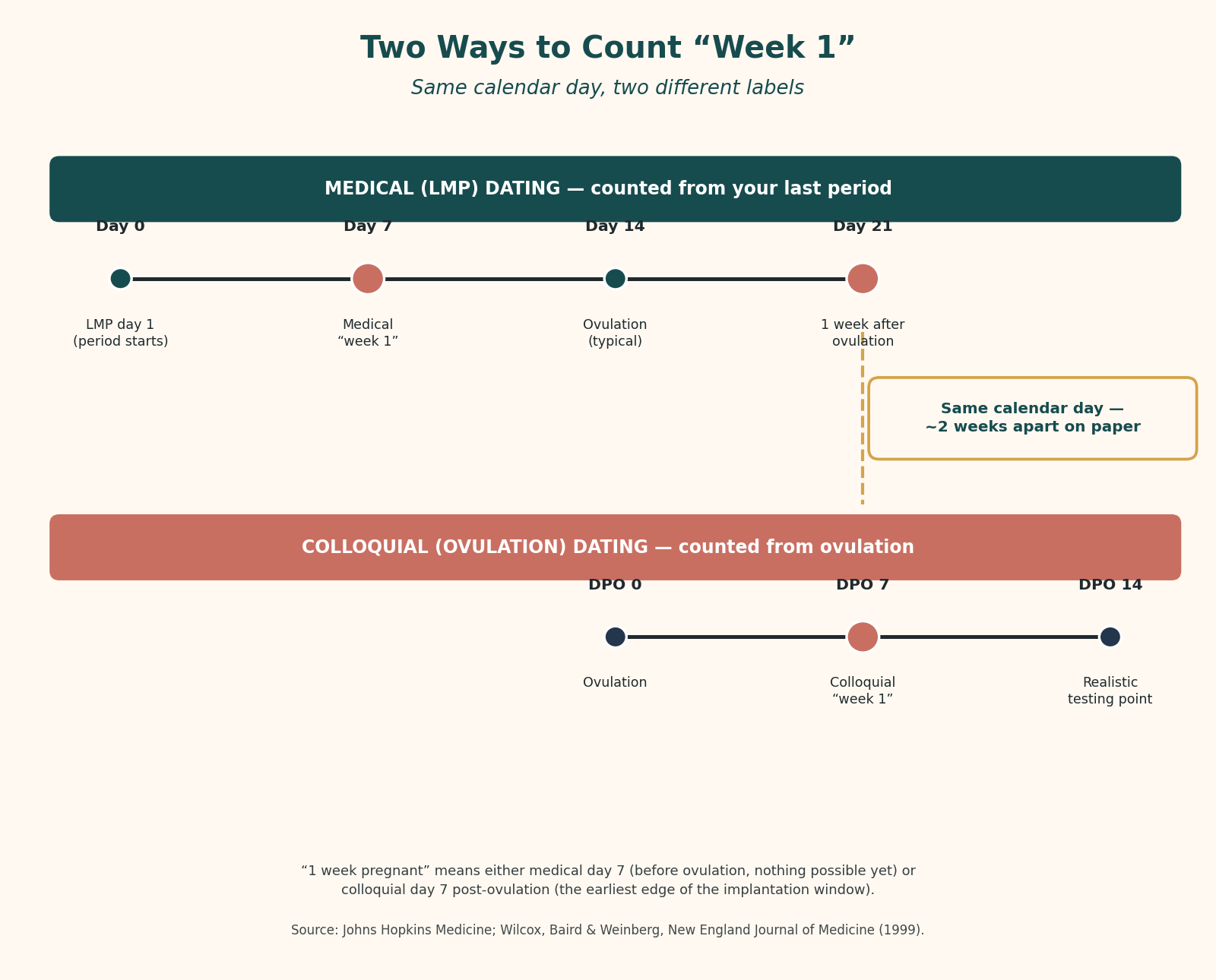
Clinically, pregnancy is dated from the first day of your last menstrual period (LMP), not from conception. According to Johns Hopkins Medicine, “a typical pregnancy lasts, on average, 280 days, or 40 weeks — starting with the first day of the last normal menstrual period as day 1.” That convention, sometimes called Naegele’s rule, is what a provider, a due-date calculator, and an ultrasound report all use by default. Under this system, “week 1” of pregnancy is simply the week your last period started — before ovulation has happened, and well before conception is even possible in a typical cycle.
Colloquial Dating: Counting From Ovulation or a Missed Period
When most people type “signs of pregnancy at 1 week” into a search bar, though, they don’t mean the medical definition above. They usually mean one of two other things: about a week after ovulation or a known conception event (roughly day 7 post-ovulation), or, less precisely, “the first week I might actually be pregnant,” which usually clusters around the days just before or after a missed period. Neither of these lines up with medical week 1 at all — colloquial “week 1” is closer to medical week 3, a two-week gap that explains a great deal of the contradictory information floating around.
Why This Guide Focuses on Both, Separately
Why Search Results Disagree With Each Other
A source answering strictly from the medical-dating convention will correctly say nothing is possible yet at week 1. A source answering the colloquial version will correctly describe early implantation-window physiology, roughly a week after ovulation. Both are right, given what they’re actually answering — the disagreement is about definitions, not facts, which is precisely why this guide treats both interpretations directly and explicitly, rather than picking one and hoping it’s the one you meant.
What This Guide Covers, in Order
The next two sections work through each version of “week 1” on its own terms: first the strict medical definition (spoiler: nothing is possible yet), then the far more common colloquial meaning of roughly a week after ovulation (where the honest answer is still “mostly nothing, but the earliest window has just opened”). After that, this guide moves into a dedicated myth-vs-fact section addressing specific claims people search for at this stage, then covers testing, dating math, and when — if ever — this particular moment calls for contacting a provider.
| Dating convention | What’s actually happening | Is any pregnancy sign possible? |
|---|---|---|
| Medical / LMP dating (“week 1” = day 1 of your last period) | You’re likely still on your period; ovulation and conception haven’t happened yet | No — nothing pregnancy-related exists yet to cause a sign |
| Colloquial dating (“week 1” = about 1 week after ovulation) | Days 1–5 post-ovulation are biologically silent; implantation may just be beginning around days 6–7 | Almost never — a small minority may be right at the very start of the implantation window |
Both conventions are legitimate; they’re just answering different questions. This guide covers each on its own terms below.
The “Two-Week Wait” and Where Day 7 Fits Into It
Anyone actively trying to conceive has likely run into the phrase “two-week wait,” often abbreviated TWW in forums and fertility apps. It’s worth defining directly, since it’s the community-specific frame that a lot of “signs at 1 week” searching actually happens inside of.
What the Two-Week Wait Actually Refers To
Why It’s Called Two Weeks
The two-week wait is the informal name for the stretch between ovulation and the point where a pregnancy test becomes realistically reliable — roughly the same 12-to-15-day window referenced earlier in this guide’s testing section. It isn’t a formal medical term, but it’s used consistently enough across fertility communities, tracking apps, and patient forums that it’s functionally the community equivalent of the “colloquial dating” convention this guide has used throughout.
Why It Feels Longer Than It Sounds
Two weeks is a short span on paper, but for someone actively hoping for a pregnancy, it commonly feels much longer, precisely because there is genuinely nothing to observe for a large portion of it — the exact physiological reality this guide has spent its earlier sections documenting. That gap between “nothing detectable is happening” and “it feels like something should be happening” is a large part of why searches like the one that likely brought you to this guide are so common in the first place.
Where Colloquial Day 7 Sits Inside It
Roughly the Halfway Point
Colloquial “1 week pregnant” — day 7 post-ovulation — falls almost exactly at the midpoint of a typical two-week wait. That’s a useful way to reframe the question this guide addresses: rather than “am I 1 week pregnant,” the more physiologically accurate framing is “I’m about halfway through the two-week wait, and here’s what is and isn’t possible to know at the halfway mark” — which is exactly what the sections above have covered in detail.
What Changes Between Now and the End of the Wait
The second half of the two-week wait is where the picture actually shifts — implantation completing for most pregnancies, hCG beginning to rise, and testing gradually becoming meaningful, all covered in the “look ahead” section later in this guide and in far more day-by-day detail in our earliest-signs guide. If you’re reading this at day 7 specifically, you’re not at the end of the uncertainty — you’re roughly at its midpoint, with the more physiologically eventful half still ahead.
What’s Physiologically Possible at Medical Week 1 (Counting From Your Last Period)
Taking the strict clinical definition first: if “week 1” means the week your last period started, the honest, complete answer is short.
What’s Actually Happening in Your Body
You’re Likely Still on Your Period
Medical week 1 begins on day 1 of your last menstrual period, which means for at least the first several days of this “week,” you’re menstruating — shedding the uterine lining from the previous, non-conception cycle. Any cramping, fatigue, mood change, or breast tenderness you notice during this window is far more plausibly explained by your period itself than by anything related to a new pregnancy, because a new pregnancy doesn’t exist yet at this point.
Ovulation and Conception Haven’t Happened Yet
In a typical 28-day cycle, ovulation occurs around day 14 — roughly two weeks after medical week 1 begins. Conception can only occur around ovulation, when an egg is available to be fertilized. That means for essentially the entire span of medical week 1, ovulation hasn’t happened yet, an egg hasn’t been fertilized, and there is, quite simply, no pregnancy — confirmed, early, or otherwise — for any symptom to be a sign of.
Why No Pregnancy Sign Is Possible Yet
No hCG Exists to Produce Any Symptom
Every classic early pregnancy sign — nausea, breast tenderness, fatigue, frequent urination — is driven by rising hCG, progesterone, and estrogen from an actual, implanting pregnancy. At medical week 1, none of those hormone changes have begun, because there’s no fertilized egg yet to produce them. Any sensation felt during this week has a cause entirely unrelated to pregnancy: the period itself, ordinary premenstrual physiology from the cycle that just ended, or everyday causes like stress, poor sleep, or illness.
What About “I Just Knew” Stories?
Stories of someone “knowing” they were pregnant during their period, before ovulation had even occurred, are common online, but they don’t describe a physiological mechanism — they describe a memory formed after the fact, once a later positive test made an earlier, otherwise-unremarkable feeling feel meaningful in hindsight. This isn’t a criticism of anyone’s experience; retrospective meaning-making around a hoped-for or unexpected pregnancy is a completely normal psychological pattern. It simply isn’t evidence that a sign existed at medical week 1, because nothing yet exists at that point for a sign to be a sign of.
What’s Physiologically Possible About 1 Week After Ovulation (What Most People Actually Mean)
Now the more common, colloquial version of the question: if you actually mean roughly a week after ovulation — around 7 days post-ovulation (DPO 7) — the answer is more nuanced, though still mostly “not yet.”
Where This Falls in the Fertilization-to-Implantation Process
Days 1–5 Post-Ovulation: Still Biologically Silent
If fertilization occurred, the earliest days after ovulation are spent with the fertilized egg traveling through the fallopian tube toward the uterus — a process that takes several days on its own, before implantation can even begin. According to research on implantation timing published by Wilcox, Baird, and Weinberg in the New England Journal of Medicine, there is no physiological mechanism for a pregnancy symptom or a positive test during this window, regardless of how closely anyone is paying attention to their body. Our earliest-signs guide covers this “biologically silent” window, and the full day-by-day timeline that follows it, in much greater depth.
Around Day 6–7: The Implantation Window Just Beginning
The same research found that implantation — the point at which a fertilized egg attaches to the uterine lining and hCG production can begin — most commonly occurs between 8 and 10 days after ovulation, with a documented range of roughly 6 to 12 days. That means day 7 post-ovulation sits right at the earliest edge of when implantation can occur for some pregnancies, but well before it has occurred for most. hCG isn’t produced until implantation begins, so even in the best-case scenario, hCG has only just started entering the bloodstream at this point, if it’s started at all.
Why Even This Window Is Still “Too Early” for Most People
Implantation Hasn’t Necessarily Happened Yet
Because the implantation window spans days 6 through 12, a meaningful share of pregnancies haven’t implanted yet by day 7 — implantation is still ahead of them, not behind them. For those pregnancies, day 7 is functionally identical to the biologically silent days that precede it: no hCG, no physiological basis for a symptom, no possibility of a positive test. Even among pregnancies where implantation happens right at the earliest edge of the range, hCG has had at most a day or two to begin accumulating — nowhere near enough for most home tests to detect it reliably, and nowhere near enough time for hormone-driven symptoms to develop.
Where to Go for the Full Day-by-Day Breakdown
This guide deliberately stays narrow and high-level on the DPO timeline itself, because our earliest-signs guide already covers it exhaustively — day-by-day highlights from DPO 1 through 14, a full symptom-by-symptom earliest-onset reference, illustrative example timelines, and a realistic confidence ladder for how much stock to put in any given day’s sensations. If what brought you here is genuinely “what’s happening day by day,” that guide is the more complete resource; this one exists specifically to resolve the “which week 1 do you mean” confusion and to fact-check the specific claims that circulate around this exact search.
Why This Confusion Is So Common (and How to Read Any “Pregnancy Week” Number)
The “week 1” mix-up covered above isn’t a one-off quirk of this particular search — it’s a structural feature of how pregnancy is dated, and it quietly causes confusion well beyond this exact question. Understanding the pattern once means you can spot it anywhere it shows up.
The Same Two-Week Offset Shows Up Everywhere
Due-Date Calculators and Week-by-Week Apps
Any due-date calculator, pregnancy app, or week-by-week email series that asks for your last period date is using medical (LMP) dating — the same convention discussed throughout this guide. That means the “week 4” update you receive from such an app or calculator corresponds to only about 2 weeks after conception, not 4 weeks, which surprises plenty of people the first time they do the math themselves. The offset is always the same roughly two weeks, because it’s baked into the dating convention itself, not into any individual app’s quirks.
Why “How Many Weeks Pregnant Am I” Quizzes Can Disagree With a Home Calculation
A quick mental calculation from a known ovulation or conception date will consistently land about two weeks earlier than an LMP-based calculator’s answer, for the same underlying pregnancy. Neither number is wrong — they’re both internally consistent, just anchored to different starting points. The practical fix is the same one this guide has used throughout: check which starting point a given number is using before comparing it to another number from a different source.
A Quick Way to Check Which Convention Any Source Is Using
Look for the Word “Ovulation” or “Conception” Specifically
If a source’s explanation ever mentions ovulation date, conception date, or days-post-ovulation directly, it’s very likely using the colloquial/conception-based convention this guide calls “colloquial dating.” If it only ever references your last period, a due date, or “weeks pregnant” without further explanation, it’s almost certainly using standard medical (LMP) dating.
When in Doubt, Ask Which Starting Point Is Being Used
If you’re ever unsure which convention a specific number, article, or app is using — including anywhere else on this site — the two-week gap described above is the fastest sanity check: if a number seems to be running about two weeks “behind” what you’d expect from a known ovulation date, it’s very likely using LMP-based medical dating instead, and the two numbers are actually consistent with each other once that’s accounted for.
A Brief Day-by-Day Glance: Days 1 Through 7 Post-Ovulation
Since “colloquial week 1” spans roughly the first seven days after ovulation, a short, condensed glance at that specific window is useful here — not as a substitute for the exhaustive day-by-day breakdown in our earliest-signs guide, which covers this same window and the week that follows it in far more depth, but as a quick, self-contained reference for exactly the range this guide focuses on.
Days 1 Through 3: Fertilization and Early Travel
What’s Physiologically Happening
If fertilization occurred around ovulation, the fertilized egg spends these first few days dividing and beginning its journey through the fallopian tube toward the uterus. No implantation has occurred yet, and won’t for at least several more days. hCG production hasn’t started, because hCG is produced only once implantation begins.
What’s Detectable
Nothing, by any means available — no symptom has a physiological basis, and no test can detect a hormone that doesn’t exist yet. This is true regardless of how the rest of the cycle eventually turns out.
Days 4 Through 7: Arrival at the Uterus and the Start of the Implantation Window
What’s Physiologically Happening
By around day 4 or 5, a fertilized egg has typically reached the uterine cavity as a developing blastocyst, where it spends a short time before implantation can begin. According to the implantation-timing research by Wilcox, Baird, and Weinberg discussed earlier in this guide, the earliest documented implantation occurs around day 6, with the most common range falling between days 8 and 10 — meaning day 7 sits inside the window where implantation has begun for some pregnancies, but is still pending for many others.
What’s Detectable
For the minority of pregnancies where implantation has just begun by day 7, hCG has, at most, existed for a day or so — nowhere near enough to reliably produce a symptom or register on a home test. For the majority where implantation is still ahead, days 4 through 7 remain functionally identical to the biologically silent days that preceded them.
| Days post-ovulation | What’s happening | Anything detectable? |
|---|---|---|
| 1–3 | Fertilization (if it occurred) and early cell division; travel toward the uterus | No |
| 4–5 | Arrival at the uterus as a developing blastocyst | No |
| 6–7 | Implantation begins for the earliest pregnancies; still pending for most | Almost never — hCG has at most just begun to appear in a minority of cases |
This table covers only days 1–7. For day 8 onward — including when most implantations complete, when hCG becomes reliably detectable, and a full symptom-by-symptom earliest-onset reference — see our earliest-signs guide.
Myth vs. Fact: Common “Signs at 1 Week” Claims, Checked
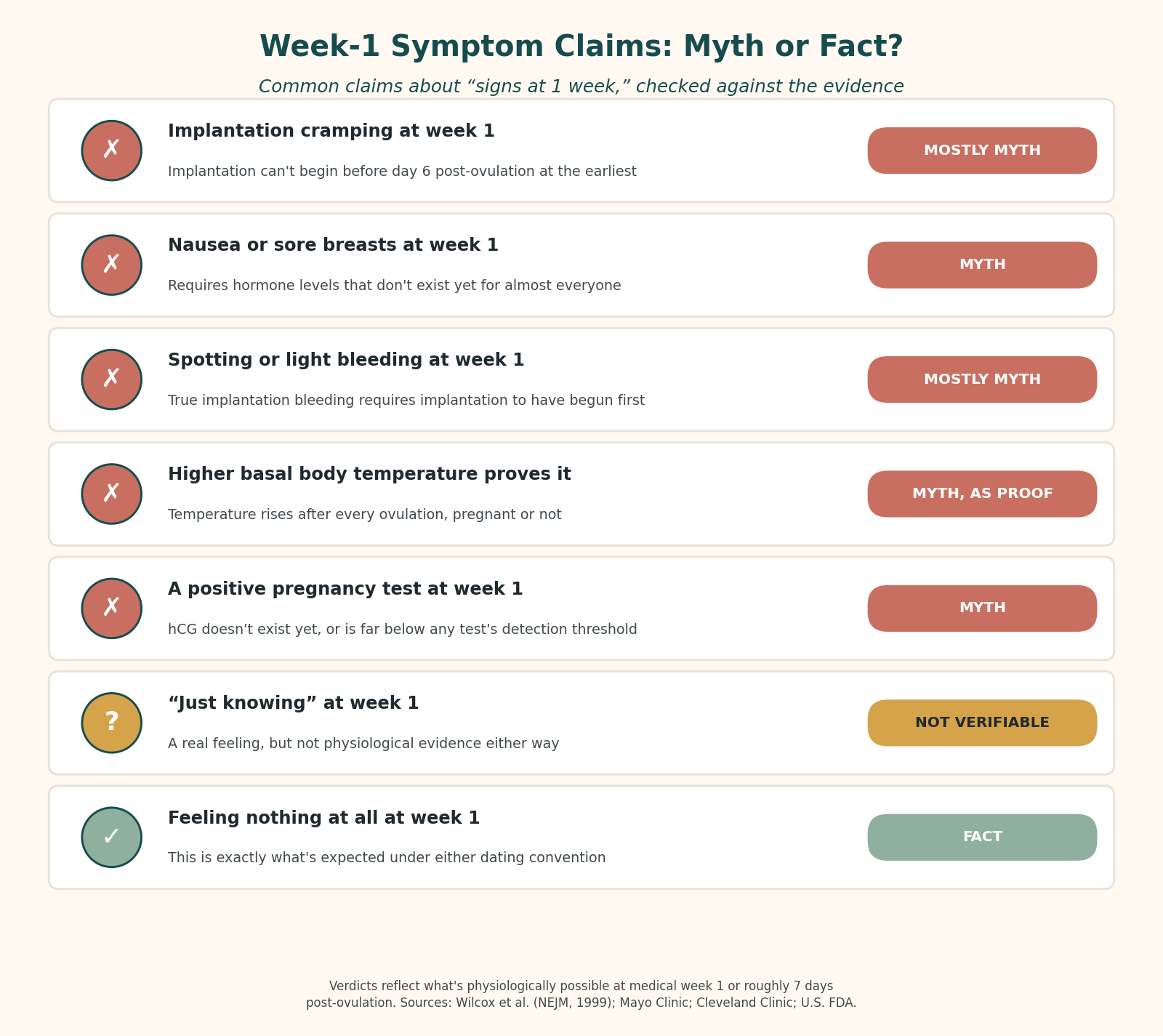
With both dating conventions covered, it’s worth checking the specific claims that actually circulate around this search — the individual symptoms and stories people encounter and wonder whether to trust.
Symptom Claims People Search For
“Implantation Cramping at 1 Week”
Mostly myth, with a narrow exception. Under medical dating, this is flatly impossible — there’s no fertilized egg yet to implant. Under colloquial dating (about DPO 7), it’s at the very earliest theoretical edge of possibility, since implantation itself can begin as early as day 6, per the Wilcox et al. research cited above — but for most pregnancies, implantation is still days away at this point, meaning any cramping felt around DPO 7 is far more likely to be ovulation-related discomfort (sometimes called mittelschmerz), digestive activity, or an unrelated cause than true implantation cramping.
“Nausea or Sore Breasts at 1 Week”
Myth, under either dating convention. Both of these signs are driven by rising hCG, progesterone, and estrogen — hormones that either don’t exist yet (medical week 1) or have, at absolute best, just barely begun to rise (DPO 7, only if implantation happened at the earliest possible edge of its range). Clinical and patient-education sources, including Mayo Clinic’s guidance on early pregnancy symptoms, consistently place the realistic onset of nausea and breast tenderness later — commonly in the second week after ovulation at the earliest, and often not until close to a missed period.
“Spotting or Light Bleeding at 1 Week”
Mostly myth as a pregnancy sign at this specific point, though the underlying sensation is often real. Under medical dating, light bleeding during week 1 is simply your period, by definition. Under colloquial dating (around DPO 7), true implantation bleeding — spotting caused by a fertilized egg attaching to the uterine lining — is possible only once implantation has actually begun, which for most pregnancies hasn’t happened yet even by day 7. Cleveland Clinic’s patient guidance describes implantation bleeding as light spotting, distinct from a period, that some but not all pregnant people notice around the time of implantation — meaning its absence is just as normal as its presence, and its timing tracks implantation itself, not a fixed day count.
“A Higher Basal Body Temperature Proves It at 1 Week”
Myth, as proof — though a sustained temperature rise is a genuinely useful ovulation-confirmation tool, just not a pregnancy-confirmation one this early. Basal body temperature rises after ovulation regardless of whether conception occurs, staying elevated through the luteal phase in both a pregnant and a non-pregnant cycle alike. A temperature that stays elevated notably longer than a typical luteal phase (sometimes called a “triphasic” pattern) is sometimes cited as an early pregnancy clue, but this pattern, if it appears at all, wouldn’t be recognizable until well past the 1-week mark this guide focuses on — not from a single day’s reading at DPO 7.
Testing and Confirmation Claims
“A Positive Test at 1 Week”
Myth, under either dating convention, for the overwhelming majority of people. Under medical dating, there’s no hCG to detect at all. Under colloquial dating (DPO 7), hCG has at most just started to appear in a small share of pregnancies, at levels far below what any home test can reliably detect. The next section covers exactly why testing this early essentially never produces a trustworthy result, in either direction.
“You Can ‘Just Know’ at 1 Week”
Understandable, but not physiologically verifiable, and not the same thing as a sign. As covered above, feeling confident this early is a real and common experience, but it isn’t produced by a detectable pregnancy-related mechanism at this stage — it’s an emotional and psychological experience, not medical evidence one way or the other. Nothing about this section is meant to dismiss that feeling; it simply isn’t something this guide, or any guide, can validate as an actual physiological sign.
| Claim | Verdict | Why |
|---|---|---|
| Implantation cramping at week 1 | Mostly myth | Implantation can’t occur before day 6 post-ovulation at the earliest, and hasn’t happened yet for most pregnancies even by day 7 |
| Nausea or sore breasts at week 1 | Myth | Requires hormone levels that don’t exist yet, or have only just begun to rise in a small minority of cases |
| Spotting or light bleeding at week 1 | Mostly myth as a sign this early | True implantation bleeding requires implantation to have already begun, which hasn’t happened yet for most pregnancies by day 7 |
| Higher basal body temperature proves it at week 1 | Myth, as proof | Temperature rises after ovulation in every luteal phase, pregnant or not; any pregnancy-specific pattern wouldn’t be recognizable this early anyway |
| A positive pregnancy test at week 1 | Myth | hCG doesn’t exist yet, or exists in amounts far below any test’s detection threshold |
| “Just knowing” at week 1 | Not physiologically verifiable | A real emotional experience, but not evidence of a detectable pregnancy sign at this stage |
| Feeling nothing at all at week 1 | Fact — and completely expected | This is exactly what should be expected under either dating convention |
Why a Pregnancy Test Won’t Give You a Reliable Answer This Early
Whichever version of “week 1” you meant, the practical question underneath it is usually the same: should I just test and find out? Here’s why that specific test, taken this specific early, is very unlikely to be useful.
The hCG Threshold Problem
What a Test Actually Detects
Home pregnancy tests work by detecting hCG in urine once it crosses a specific concentration threshold, measured in mIU/mL. According to the U.S. Food and Drug Administration, tests vary in how sensitive they are — some can detect lower hCG concentrations than others — but every test has some minimum threshold below which it simply cannot register a positive result, regardless of how the pregnancy is actually progressing.
Why There’s Nothing to Detect Yet
At medical week 1, hCG doesn’t exist yet, so no test, however sensitive, can detect it. At colloquial week 1 (DPO 7), hCG has at absolute best just started to appear in a minority of pregnancies where implantation occurred at the earliest edge of its range — and even then, at concentrations almost certainly still below what any home test can register. The FDA’s own guidance is direct about the timing problem this creates: even for people who wait until their missed period to test, “10 to 20 pregnant women out of every 100 will not detect their pregnancy on the first day of their missed period,” which is roughly a week and a half to two weeks later than either version of “week 1” discussed in this guide.
What Testing Too Early Can Cause
False Negatives and Unnecessary Anxiety
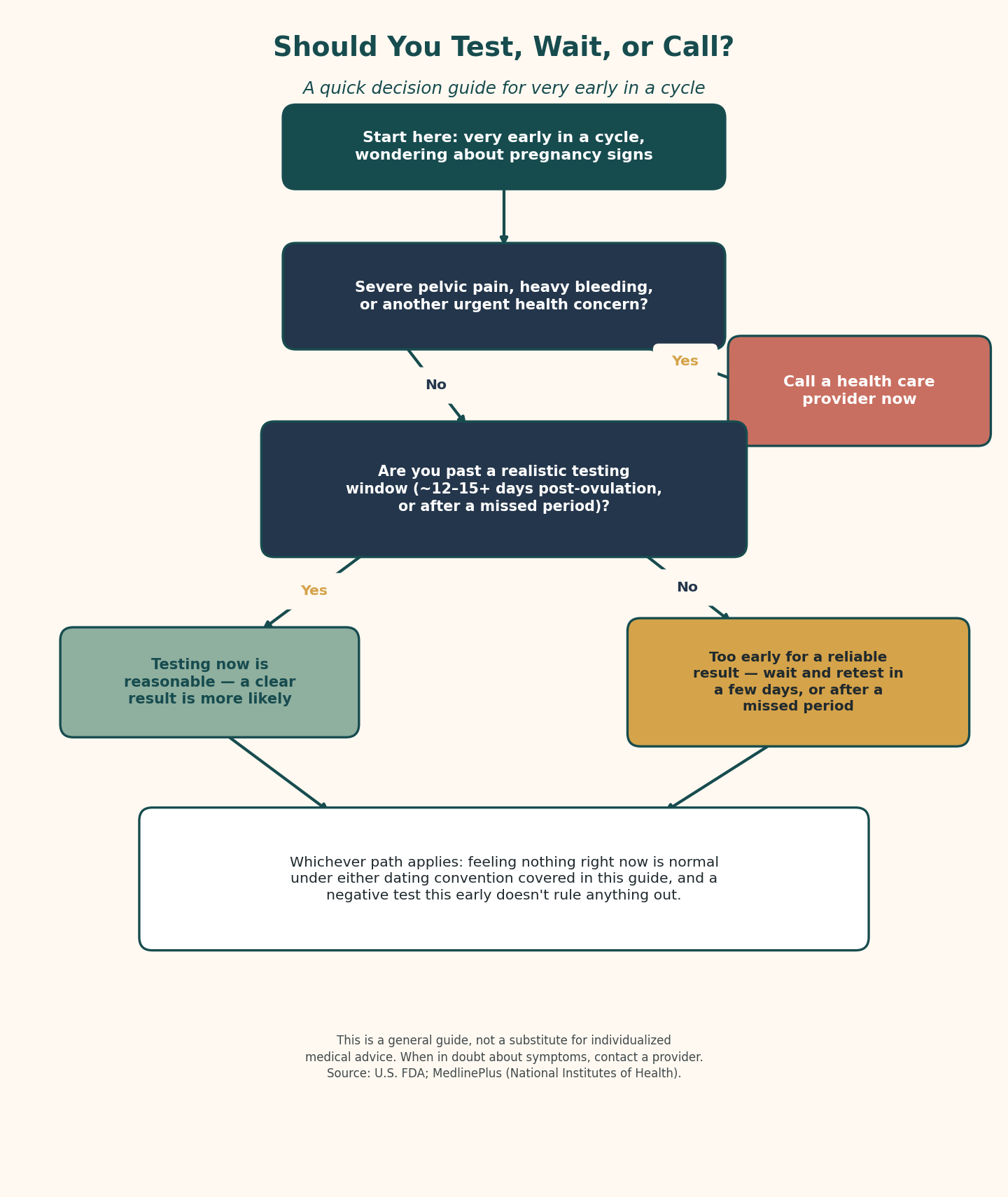
A negative test at week 1, under either dating convention, tells you essentially nothing — not that you aren’t pregnant, and not that you are. It simply reflects that it’s too early for any test to give a meaningful answer yet. Testing this early and getting a negative result is one of the more common sources of unnecessary two-week-wait anxiety, precisely because it’s easy to mistake “too early to tell” for “not pregnant.”
When Testing Actually Becomes Worthwhile
The FDA recommends waiting until 1 to 2 weeks after a missed period for the most reliable results, and even sensitive tests generally can’t be trusted much before roughly 12 to 15 days after ovulation in a typical cycle. For a precise, day-by-day answer to exactly when testing starts to become worthwhile for your own situation, our earliest-signs guide covers realistic testing windows in full detail; for general testing mechanics, types, and how to read a result once you’re in a realistic testing window, see our main pregnancy symptoms guide.
Figuring Out How Far Along You Actually Are
Since so much of this confusion comes down to counting method, it’s worth working through how to actually figure out where you stand, using either convention.
Calculating From Your Last Period
The Standard LMP Method
Clinically, gestational age is calculated from the first day of your last menstrual period, per the Naegele’s-rule convention described earlier — Johns Hopkins Medicine describes the process as counting from LMP day 1 through a 280-day, 40-week pregnancy. If you know the first day of your last period, you can count forward in weeks from that date to find your current medical gestational age, the same way a provider or an online due-date calculator would.
Why This Can Be Off by Days or Weeks
This method assumes a textbook 28-day cycle with ovulation on day 14, which doesn’t hold precisely for everyone. Johns Hopkins notes explicitly that “dates may have to be adjusted for longer or shorter menstrual cycles” — someone with a 35-day cycle likely ovulates later than day 14, meaning LMP-based dating can overstate how far along a pregnancy actually is by a week or more, until an early ultrasound corrects it.
Calculating From Ovulation Instead
Why This Is More Precise If You Know Your Ovulation Date
If you know or can estimate your ovulation date — from ovulation predictor kits, basal body temperature tracking, or cervical mucus changes — counting forward in days-post-ovulation (DPO) sidesteps the cycle-length assumption built into LMP dating entirely. This is the counting method this guide uses for the “colloquial week 1” discussion above, and it’s generally more precise for figuring out exactly how far a specific, known conception window has progressed.
Where to Get a Precise Day-by-Day Answer
If you want to translate a specific DPO count into what’s realistically possible on that exact day — not just around the one-week mark this guide focuses on — our earliest-signs guide provides a full day-by-day breakdown from DPO 1 through 14, including illustrative timelines for a few different common situations.
| LMP-based “pregnancy week” | Approximate days post-ovulation | What’s typically happening |
|---|---|---|
| Week 1 | Before ovulation (days −14 to −7 relative to ovulation) | Menstruation; no pregnancy possible yet |
| Week 2 | Around ovulation (day 0) | Ovulation and the fertile window |
| Week 3 | DPO 1–7 | Fertilization, if it occurs, followed by the journey to the uterus and the start of the implantation window — this is what most people colloquially mean by “1 week pregnant” |
| Week 4 | DPO 8–14 | Implantation typically completes for most pregnancies; hCG begins rising; a missed period usually falls near the end of this week |
Based on a typical 28-day cycle with ovulation on day 14; individual cycles vary, and this table is illustrative rather than a personal dating tool. Implantation timing per Wilcox, Baird & Weinberg, New England Journal of Medicine (1999).
If You’re Feeling Nothing at All Right Now
Whichever version of “week 1” applies to your situation, it’s worth addressing directly: feeling nothing right now is not just common, it’s the expected, typical experience at this stage.
Why “Nothing Yet” Is Completely Normal
Absence of Symptoms Isn’t a Bad Sign
As covered throughout this guide, there is little to nothing physiologically available to feel at either version of week 1 — under medical dating, because pregnancy hasn’t begun yet; under colloquial dating, because hormone levels are at most just starting to rise, if they’ve started at all. Feeling nothing at this stage isn’t a sign that anything is wrong with a pregnancy that does turn out to be there, and it isn’t a sign that you aren’t pregnant either. It’s simply too early for your body to have produced a signal either way.
Individual Variation Is Enormous
Even once symptoms do become physiologically possible — later than either version of week 1 — how early any individual person notices anything varies enormously, driven by individual hormone sensitivity as much as by absolute hormone levels. Nothing about this guide’s timeline should be read as a schedule you’re expected to match.
Healthier Ways to Get Through This Waiting Period
Limiting Repetitive Symptom-Checking
Repeatedly scanning your body for signs during a window where, as this guide has shown, very little is actually physiologically detectable yet tends to produce anxiety without producing useful information. If you find yourself checking for symptoms multiple times a day at this early stage, that’s a reasonable moment to consciously redirect your attention elsewhere, rather than a sign you need to check more closely.
When It’s Reasonable to Just Test
If uncertainty itself is the hard part, waiting until a realistic testing window — per the FDA’s own guidance, ideally 1 to 2 weeks after a missed period for the most reliable results, or per a sensitive test’s own instructions closer to the point our earliest-signs guide describes — will resolve the question far more reliably than continuing to monitor for symptoms that aren’t reliably present yet in either dating convention covered in this guide.
Special Situations That Change What “Week 1” Even Means
Everything covered so far assumes a fairly typical, predictable cycle. A number of common situations change the picture — sometimes significantly — and are worth addressing directly rather than leaving readers in those situations to assume the standard timeline applies to them.
Irregular or Unpredictable Cycles
Why LMP-Based “Week 1” Gets Even Less Precise
The standard LMP dating convention assumes ovulation around day 14 of a 28-day cycle. For someone with a longer, shorter, or unpredictable cycle, ovulation may happen considerably earlier or later than that assumption — which means medical “week 1,” and every week that follows it until an ultrasound corrects the estimate, can be off by several days or more. This doesn’t change anything about the physiology discussed in this guide; it simply means the calendar-based week numbers themselves are less trustworthy for irregular cyclers than the underlying biology they’re meant to represent.
What to Rely On Instead
If you know your own ovulation timing — through tracking, prior cycle history, or a fertility awareness method — counting from that date directly, as this guide’s “colloquial dating” section does, is generally more meaningful than an LMP-based week number for someone with irregular cycles. An early ultrasound, once one is medically relevant, will also generally provide a more accurate estimate than either calendar-based method.
PCOS and Anovulatory Cycles
Why “Days Post-Ovulation” May Not Apply Some Months
Polycystic ovary syndrome (PCOS) and other causes of anovulation mean that, in some cycles, ovulation doesn’t occur at all — which also means there’s no “1 week after ovulation” to speak of that month, regardless of how much time has passed since a period. For someone with PCOS actively trying to conceive, confirming that ovulation actually occurred in a given cycle is often a more useful first question than counting days from an assumed ovulation date.
Where Fuller Guidance Lives
Tracking methods that can help confirm whether and when ovulation actually occurred — including basal body temperature patterns and ovulation predictor kits — are covered in more practical depth in our earliest-signs guide’s section on body-based tracking signs, rather than repeated here.
Recently Stopping Hormonal Birth Control
Why Your First Few Cycles Can Be Unpredictable
After stopping a hormonal birth control method — the pill, a hormonal IUD, or an implant — it can take a cycle or more for regular ovulation to resume predictably. During this window, cycle length itself may be unusually long, short, or irregular, which compounds the LMP-dating imprecision described above and makes any “week 1” calculation, under either convention, considerably less reliable than it would be in an established, predictable cycle.
Why This Also Affects How Symptoms Feel
Stopping hormonal birth control can itself produce symptoms — breast tenderness, mood changes, cycle irregularity — that overlap with the presumptive-type signs discussed throughout this guide’s companion articles, entirely independent of pregnancy. This makes symptom-based self-assessment even less reliable than usual during this specific window, reinforcing why this guide leans on physiological timing and testing rather than symptom-spotting as the more trustworthy approach.
Ovulation Trackers, Fertility Apps, and IUI/IVF Timing
Why an App’s “Week 1” Might Differ From This Guide’s
Fertility-tracking apps vary in which convention they default to, and some allow switching between LMP-based and ovulation-based counting — worth checking directly in an app’s own settings or help documentation if its numbers don’t match the framework in this guide, rather than assuming the app or this guide is wrong.
Fertility Treatment Uses Its Own Counting System Entirely
For pregnancies conceived through intrauterine insemination (IUI) or in vitro fertilization (IVF), clinics typically count from the insemination or transfer date rather than from LMP or a naturally occurring ovulation — sometimes expressed as “days post transfer” (DPT) rather than DPO. This is yet a third counting convention, distinct from both discussed in this guide, and is covered in more detail alongside DPO in our earliest-signs guide’s section on timing terms.
Carrying Twins or Multiples
Does Any of This Timing Change With More Than One Baby?
No — the dating conventions themselves work identically whether a cycle results in one baby, twins, or more. Both LMP-based medical dating and ovulation-based colloquial dating are anchored to when the pregnancy started, not to how many embryos are eventually involved, so everything covered earlier in this guide about medical week 1 and colloquial day 7 applies the same way regardless of how many implantations eventually occur.
Why an Early Difference, If There Is One, Shows Up Later
Where multiples can eventually diverge from a singleton pregnancy is in hCG levels, which tend to rise faster and higher with more than one developing pregnancy — but that difference, when it appears at all, becomes relevant only once hCG exists in the first place, which, as this guide has established throughout, isn’t the case yet at the 1-week mark under either dating convention. There is no early, twin-specific “week 1” sign to look for; the divergence, if any, shows up later, alongside the testing and symptom timeline covered in our earliest-signs guide.
If You’ve Had a Pregnancy Loss Before
Why This Specific Week Can Feel Heavier the Second Time
If a previous pregnancy ended in loss, it’s common to pay unusually close attention to a stage like this one — even though, as this entire guide has shown, there is genuinely very little to notice yet under either dating convention. That heightened vigilance is an understandable response to a difficult experience, not a sign of a problem, and it doesn’t change any of the physiology covered in this guide: hCG and pregnancy hormones follow the same basic timeline in a subsequent pregnancy as they did before, regardless of how a previous pregnancy ended.
Where to Find More Support-Focused Guidance
This guide stays narrowly focused on the physiological “what’s possible” question rather than the emotional experience of trying again after a loss, which deserves its own dedicated treatment. Our earliest-signs guide addresses heightened symptom vigilance after a previous loss directly, alongside what is and isn’t medically different about a subsequent pregnancy’s early timeline.
A Brief Look Ahead: What Changes in Week 2 and Beyond
Everything covered so far has stayed deliberately narrow — the specific week this guide is named for, under both counting systems. It’s worth briefly previewing what actually changes just one week later, partly to show how quickly the picture shifts, and partly to explain why the guide you’d want next is a different one from this one.
Medical Week 2 (Days 8 Through 14 After the Last Period)
What’s Physiologically Different
Under standard LMP-based dating, medical week 2 covers the run-up to ovulation itself in a typical 28-day cycle — meaning conception, if it happens this cycle, most likely occurs somewhere near the boundary between week 2 and week 3, not during week 2. This is one more place the LMP convention can be counterintuitive: “week 2 pregnant” under this dating system usually describes a stretch of time before conception has even occurred yet, which is exactly the same kind of definitional quirk this guide has spent its earlier sections unpacking for week 1.
When Testing Starts to Make Sense
Because medical week 2 sits before or right around ovulation for most cycles, it remains just as early as week 1 from a testing standpoint — there is still no fertilized egg, and still no hCG, for most of this window. The meaningful shift doesn’t happen on the calendar’s week-2-to-week-3 boundary; it happens biologically, once ovulation and (if it occurs) fertilization actually take place, which is why this guide has anchored its explanations to ovulation-based timing rather than the week number alone.
Colloquial Days 8 Through 14 After Ovulation
Implantation Completes for Most Pregnancies in This Window
This is where the picture changes the most. The same Wilcox, Baird, and Weinberg research cited earlier in this guide found that while implantation can begin as early as day 6, the most common range is days 8 through 10 post-ovulation, with the large majority of implantations completing by day 12. Practically, that means days 8 through 14 are when implantation actually happens for most pregnancies that will go on to be detectable — a sharp contrast with days 1 through 7, covered earlier in this guide, when it hadn’t happened yet for almost anyone.
Why This Is Where Our Earliest-Signs Guide Picks Up
Once implantation has occurred, hCG production begins and rises quickly enough that both symptoms and home pregnancy tests start to become physiologically plausible — first faintly, then, by the time of a missed period, reliably for most people. That shift is exactly the starting point for our earliest-signs guide, which picks up where this guide leaves off: day-by-day symptom onset, realistic testing windows, and what a faint or early positive result does and doesn’t mean. This guide has intentionally stayed on the “before” side of that line; that one covers the “after” side in full.
Key Terms Used Throughout This Guide
This guide leans on a handful of specific terms repeatedly, some of which get used loosely — or inconsistently — elsewhere online. Here’s a quick, precise reference for each one, gathered in one place.
Dating and Timing Terms
LMP, Gestational Age, and Due Date
LMP stands for “last menstrual period” — specifically, the first day of a person’s last period before conception. Gestational age is the age of a pregnancy counted from that date, which is the medical dating convention used throughout this guide’s “medical week” discussions. A due date is typically calculated as 40 weeks of gestational age from the LMP, following Naegele’s rule, though it’s an estimate rather than a precise prediction, and most births happen within a range of days around it rather than on the exact date.
DPO, Ovulation Date, and Fertilization Age
DPO stands for “days post-ovulation” — the count this guide calls colloquial dating, anchored to the estimated or tracked date of ovulation rather than the last period. Fertilization age (sometimes called conceptional age) is very close to DPO, since fertilization typically occurs within about a day of ovulation if it happens at all. The gap between gestational age and fertilization age is consistently about two weeks, which is the “two-week offset” this guide has referenced several times as the fastest way to reconcile two different-seeming week numbers for the same pregnancy.
Physiological and Testing Terms
hCG, Implantation, and Blastocyst
hCG (human chorionic gonadotropin) is the hormone home pregnancy tests detect and the one responsible for many early pregnancy symptoms; it’s produced only after implantation begins, which is why this guide repeatedly points out that nothing hCG-driven is physiologically possible before that point. A blastocyst is the stage of development a fertilized egg reaches by around day 5 or 6 after fertilization, just before implantation — it’s the structure that actually implants into the uterine lining, not the single-cell fertilized egg from days 1 through 3.
Sensitivity, False Negative, and Chemical Pregnancy
A test’s sensitivity is the minimum hCG concentration, measured in mIU/mL, that it can reliably detect — a lower number means a more sensitive test, capable of detecting a positive result earlier. A false negative is a negative result on an actual pregnancy, most commonly caused by testing too early for hCG to have reached a detectable level, which is the scenario this guide’s testing section focuses on. A chemical pregnancy is a very early pregnancy loss, typically occurring around the time of an expected period, often identified only through hCG testing before it would have been visible on an ultrasound; it’s a recognized and relatively common outcome, not a sign that anything was done incorrectly, and it’s mentioned here only for definitional completeness rather than as a focus of this guide.
When to Actually Contact a Provider This Early
Given everything covered above, it’s worth being direct about when this specific, very early moment actually calls for medical attention — and when it doesn’t.
Situations Worth a Call Regardless of Pregnancy Status
Severe Pain or Heavy Bleeding
Severe pelvic or abdominal pain, unusually heavy bleeding, or bleeding that doesn’t fit your normal period pattern are worth a call to a health care provider regardless of whether pregnancy turns out to be involved at all — these warrant evaluation on their own, at any point in a cycle, “week 1” or otherwise.
Anything Unrelated to Pregnancy That Concerns You
General health concerns — a fever, an infection, an injury, a preexisting condition acting up — don’t stop mattering just because you’re wondering about a possible pregnancy. Contact a provider for anything that would normally concern you, independent of the pregnancy question this guide addresses.
Why Severe One-Sided Pain Deserves Extra Caution
Sudden, severe pain concentrated on one side of the lower abdomen — especially later in a cycle than this guide’s 1-week window, once a pregnancy could plausibly be further along than either dating convention discussed here allows for — is one of the more recognized warning signs of an ectopic pregnancy, a pregnancy implanted outside the uterus, most often in a fallopian tube. According to MedlinePlus, a service of the National Institutes of Health, ectopic pregnancy is a medical emergency once it occurs, and one-sided pain along with irregular bleeding are among its more common early indicators. At the literal 1-week mark this guide focuses on, an ectopic pregnancy isn’t yet a realistic concern under either dating convention, for the same reason nothing else pregnancy-related is: implantation itself is still pending. The relevant takeaway is simply to keep this warning sign in mind going forward, past the window this guide covers, rather than to watch for it specifically this week.
Why Most “Week 1” Situations Don’t Need Urgent Care
This Is a Normal, Low-Stakes Waiting Period for Most People
Outside of the situations above, medical week 1 and the days just after ovulation are, medically speaking, an unremarkable and low-stakes part of an ordinary cycle for the overwhelming majority of people — whether or not that cycle turns out to include a pregnancy. There’s rarely a medical reason to seek care specifically because of where you are in this particular window, as opposed to any symptom that would independently warrant attention at any other time.
Where the Full Warning-Signs List Lives
Once a pregnancy is confirmed and further along, a distinct and more extensive set of warning signs becomes relevant — sudden severe one-sided pain, heavy bleeding with tissue, and others covered in full in our main pregnancy symptoms guide’s dedicated warning-signs section. Almost none of that section applies at the “week 1” stage this guide covers, simply because a confirmed, detectable pregnancy doesn’t exist yet at this point under either dating convention — but it’s the right resource to bookmark for later, once testing and timing have moved past the window this guide addresses.
Frequently Asked Questions About Signs of Pregnancy at 1 Week
Dating and Definition Questions
Why do different websites give completely different answers about “week 1” symptoms?
Because they’re answering different questions using the same phrase. Medical dating counts “week 1” from your last period, before ovulation; colloquial dating usually means about a week after ovulation. The two are roughly two weeks apart on an actual calendar.
Which definition of “1 week pregnant” is correct?
Both are legitimate, depending on context. A provider, a due-date calculator, and an ultrasound report all use the medical (LMP) definition. Most people typing this exact search, however, mean the colloquial version — about a week after ovulation.
If I’m on my period, can I be “1 week pregnant” at the same time?
Under medical dating, yes — confusingly, medical week 1 overlaps with your period, since pregnancy is dated from LMP day 1, before conception has occurred. This is exactly the confusion this guide exists to clear up.
My doctor’s office and a due-date calculator gave me numbers that don’t match my own count from ovulation — who’s wrong?
Neither is wrong. Providers and calculators use LMP-based medical dating almost universally, since that’s the convention taught in medical training and used on ultrasound reports; a personal count from a known ovulation date will consistently run about two weeks behind that number for the same pregnancy, exactly as this guide’s comparison table shows.
Symptom Questions
Is it possible to feel implantation cramping exactly 1 week after ovulation?
At the very earliest theoretical edge, barely — implantation can begin as early as day 6 post-ovulation for a minority of pregnancies — but for most, it’s still a few days away even at day 7, making true implantation cramping unlikely this early.
Can nausea start this early?
It’s very unlikely under either dating convention. Nausea requires hormone levels that, at absolute best, have only just begun to rise for a small minority of pregnancies by day 7 post-ovulation, and don’t exist at all under medical week 1.
I felt something distinct at exactly 1 week — was that real?
The sensation itself may well have been real, but a specific cause tied to pregnancy this early is physiologically unlikely under either dating convention. Ovulation-related discomfort, digestive activity, and ordinary daily sensations are all far more probable explanations at this stage.
Why do some people swear they had symptoms this early?
Often a combination of genuine but unrelated sensations, heightened attention while actively trying to conceive, and — as discussed in this guide — memory that gets reshaped once a later positive test makes an earlier sensation feel significant in hindsight.
Can stress from the two-week wait itself cause physical symptoms?
Yes, and this is worth separating out explicitly. Anxiety and heightened attention during the two-week wait can produce genuinely real physical sensations — tension, digestive changes, disrupted sleep, even breast tenderness in some people — through stress-related mechanisms that have nothing to do with pregnancy hormones. These sensations are real, but they aren’t evidence of pregnancy one way or the other, since the same stress response would occur during a non-pregnant two-week wait too.
Testing Questions
Should I test at 1 week just to be safe?
You can, but be prepared for a negative result to mean nothing either way — it’s simply too early for hCG to be reliably detectable under either dating convention, so a negative test at this stage doesn’t rule anything out.
Do any tests claim to work this early?
Some tests are marketed as more sensitive than others, but every test has some minimum hCG threshold. At medical week 1, there’s no hCG at all to detect regardless of sensitivity; at colloquial week 1 (DPO 7), any hCG present is almost certainly still below even the most sensitive test’s threshold for the large majority of pregnancies.
When will a test actually be reliable?
The FDA recommends waiting 1 to 2 weeks after a missed period for the most reliable results. Our earliest-signs guide covers the realistic earlier testing window, for those who want to test before that point, in full detail.
Would a blood test at a doctor’s office catch something a home test would miss at 1 week?
A quantitative blood test is generally more sensitive than a home urine test and can detect lower hCG concentrations somewhat earlier — but it still depends on hCG existing in the first place. At medical week 1, there’s none to detect regardless of test type; at colloquial week 1 (DPO 7), a blood test’s added sensitivity mostly matters once implantation has occurred, which for most pregnancies hasn’t happened yet even by day 7.
Reassurance Questions
Is it bad that I don’t feel anything at 1 week?
No — feeling nothing at this stage is the expected, typical experience under either dating convention, not a sign that anything is wrong.
Does feeling nothing this early mean I’m not pregnant?
No — it’s simply too early for your body to have produced a detectable signal either way, regardless of which dating convention applies to your situation.
How do I stop obsessively checking for symptoms this early?
Recognizing that very little is physiologically possible to feel yet, as this guide covers, is often the first step. Limiting repeated body-checking and deciding in advance when you’ll actually test can help redirect that attention more productively.
Is it normal to feel disappointed that there’s nothing to notice yet?
Yes, especially during a cycle you’re hoping results in a pregnancy. Wanting there to be something to notice is a completely ordinary response to the waiting itself, separate from anything physiological — it doesn’t mean anything about how the cycle will actually turn out.
Practical Next-Step Questions
How do I figure out exactly how far along I am?
Count from the first day of your last period for the standard medical (LMP) method, or from a known ovulation date for a more precise days-post-ovulation count. Both methods are covered in this guide’s dating section above.
Where can I get a full day-by-day breakdown instead of just the 1-week mark?
Our earliest-signs guide covers DPO 1 through 14 in full detail, including a symptom-by-symptom earliest-onset reference and a realistic confidence ladder.
Where can I read the full symptom list and what to do after a positive test?
Our main pregnancy symptoms guide covers the complete symptom list, testing mechanics, due dates, warning signs, and next steps after a confirmed pregnancy.
Is there a more clinical way doctors classify these signs?
Yes — clinicians use a presumptive/probable/positive classification system for evidentiary weight. Our guide to how doctors classify signs of pregnancy covers that full framework, including exam-based findings not covered in this guide.
Special Situation Questions
My cycles are irregular — does any of this “week 1” math even apply to me?
Less precisely than for someone with a predictable cycle. LMP-based week numbers assume ovulation around day 14, which may not hold for you, so counting from a known or estimated ovulation date, once you have one, is generally more meaningful than a calendar-based week number.
I have PCOS and I’m not sure I ovulated this cycle — how does this guide apply?
If ovulation didn’t occur, there’s no “days post-ovulation” count to speak of for that cycle at all. Confirming whether and when ovulation happened, through tracking methods covered in our earliest-signs guide, is a more useful starting point than assuming a standard timeline.
I just stopped birth control — can I trust any “week 1” calculation right now?
Treat it with extra caution. Cycles are often unpredictable for a cycle or more after stopping hormonal birth control, which affects both LMP-based and ovulation-based counting, and stopping birth control can itself produce symptoms unrelated to pregnancy.
My fertility app shows a different “week” than this guide describes — which is right?
Check which starting point your app uses — many default to LMP-based dating, matching a provider’s convention, while others let you switch to ovulation-based counting. Neither is “wrong”; they’re just anchored to different starting points, generally about two weeks apart.
I’m 1 week past an IUI or embryo transfer — does this guide’s timeline apply to me?
Not directly — fertility clinics typically count from the insemination or transfer date using its own “days post transfer” (DPT) convention, a third counting system distinct from both covered in this guide. Our earliest-signs guide covers DPT alongside DPO in more detail.
I might be carrying twins — does “week 1” or “day 7” look any different for multiples?
Not at this stage. Both dating conventions this guide covers are anchored to when the pregnancy started, not to how many embryos are involved, so the physiological picture at medical week 1 or colloquial day 7 is identical whether one or more than one implantation eventually occurs. Any multiples-specific difference — mainly in how quickly hCG rises — only becomes relevant once hCG exists, which isn’t yet the case at this stage.
Quick Reference Questions
What’s the single most important thing to take from this guide?
“1 week pregnant” means two different, roughly two-weeks-apart things depending on who’s answering, and under neither meaning is a reliable pregnancy sign or test result realistically possible yet.
If I only do one thing after reading this, what should it be?
Figure out which dating convention actually applies to your question, using the comparison table earlier in this guide — it resolves most of the apparent contradiction in what you’ll read elsewhere.
Is there ever a case where a “week 1” sign is real?
At the extreme earliest edge of colloquial dating — implantation beginning right at day 6 post-ovulation — a very faint, easily-missed signal is theoretically possible for a small minority of pregnancies, but it’s the exception, not something to expect or search for.
How does the “two-week wait” relate to the dating conventions in this guide?
The two-week wait is essentially the community name for the colloquial dating window this guide uses — the roughly 14 days between ovulation and a realistic testing point. Day 7 of the two-week wait and “colloquial day 7 post-ovulation” describe the same moment; the two-week wait framing just adds the context of what’s ahead, since it names the full window rather than a single day within it.
Where should I go next?
Our earliest-signs guide for the full day-by-day timeline, our main pregnancy symptoms guide for the complete symptom list and next steps, or our signs-of-pregnancy classification guide for how clinicians weigh evidence once signs do become possible.
The bottom line
“Signs of pregnancy at 1 week” is a genuinely confusing search because it’s really two different questions wearing the same three words. Under strict medical dating, week 1 is before ovulation and conception — nothing pregnancy-related is possible yet. Under the more common colloquial meaning, about a week after ovulation, you’re at the very earliest edge of the implantation window at best, still mostly too early for a reliable symptom or test. Either way, feeling nothing right now is normal, testing this early is unlikely to be useful, and the most productive next step is usually simply waiting for a realistic testing window rather than searching for signs that aren’t reliably there yet.
About pregnancyadoption.com
pregnancyadoption.com publishes free, judgment-free information on pregnancy, pregnancy options, and adoption for anyone trying to understand what’s happening in their body or what choices are available to them. We are not a law firm, an adoption agency, or a medical practice — we’re an independent editorial resource, and we don’t place children, provide legal representation, or profit from which option a reader ultimately chooses.
Every article carrying medical information is written to a source-tiering standard (government and medical-authority sources first, established nonprofits second, commercial sources never used as factual authority) and reviewed by a licensed clinician before publication. Time-sensitive information is scheduled for review on a recurring cadence, and factual errors reported by readers are corrected promptly. Read our full About & Editorial Guidelines page for details on our review process, sourcing standards, and how to report a correction.
Medical and Legal Disclaimer
This article is provided for general educational purposes only and does not constitute medical, legal, financial, or tax advice. Reading this content does not create a doctor-patient, attorney-client, or any other professional relationship between you and pregnancyadoption.com, its authors, or its reviewers. Always seek the advice of a licensed physician, midwife, attorney, or other qualified professional with any questions you may have regarding a medical condition, a legal right, or a financial decision, and never disregard or delay seeking professional guidance because of something you have read here. If you believe you may be experiencing a medical emergency, call 911 or your local emergency number immediately.
Clinical definitions, timing ranges, and prevalence figures referenced in this article are accurate to the best of our knowledge as of this article’s last review date but may not reflect the most current research or your individual situation. We make reasonable efforts to verify accuracy but make no warranty, express or implied, as to the completeness, reliability, or timeliness of any information on this page. Links to third-party websites are provided for convenience only; we do not control and are not responsible for the content, accuracy, or privacy practices of external sites, and inclusion of a link is not an endorsement.
To the fullest extent permitted by applicable law, pregnancyadoption.com and its authors, editors, and medical/legal reviewers disclaim all liability for any loss, injury, or damage of any kind arising from reliance on the information in this article. This disclaimer does not limit any rights you may have under law that cannot be waived. Read our full Medical and Legal Disclaimer for complete terms.
Sources and further reading
This guide draws on patient-education, clinical, and regulatory sources from the following organizations. Individual circumstances vary — use this guide to prepare good questions for your own health care provider, not as a substitute for individualized medical advice.
- Wilcox AJ, Baird DD, Weinberg CR — “Time of Implantation of the Conceptus and Loss of Pregnancy,” New England Journal of Medicine (1999)
- Johns Hopkins Medicine — Calculating a Due Date (Naegele’s Rule)
- U.S. Food and Drug Administration — Home Use Tests: Pregnancy
- Mayo Clinic — Symptoms of Pregnancy Patient Guidance
- Cleveland Clinic — Implantation Bleeding and Early Pregnancy Symptoms (Patient Education)
- American College of Obstetricians and Gynecologists (ACOG) — Fertility Awareness and Ovulation Timing Patient FAQs
- MedlinePlus (National Institutes of Health) — Pregnancy Overview


