A positive pregnancy test usually confirms what your body has already been telling you, but the symptoms themselves often show up earlier and less clearly than most people expect. Early pregnancy symptoms typically begin one to two weeks after conception, around the time a period would normally start, and they range from a missed period and sore breasts to nausea, fatigue, and frequent trips to the bathroom. Some of these signs are easy to mistake for PMS, the flu, or plain stress, especially in the days right before an expected period when the two situations are hormonally almost indistinguishable. Others, like a positive test followed by sudden one-sided pain, are signals worth a same-day call to a health care provider rather than a wait-and-see approach or another round of searching for reassurance online.
This guide walks through what pregnancy symptoms actually are, when they can realistically start, why they vary so much from person to person, how they compare with PMS, how home and clinical pregnancy tests work, what a positive or negative result really means, how to figure out how far along you are, and which symptoms are simply uncomfortable versus which ones need urgent medical attention. It closes with what typically happens next: confirming a pregnancy with a health care provider, scheduling prenatal care, and finding accurate, judgment-free information about the options that follow a confirmed pregnancy — because a positive test is a medical fact, not a decision, and the two are worth keeping separate in your own head even when they arrive at the same moment.
Key takeaways
- Symptoms usually start after implantation, roughly 6–12 days after conception, though many people feel nothing unusual until after a missed period, and a smaller number feel nothing at all for weeks.
- A missed period, sore or swollen breasts, nausea, fatigue, and frequent urination are the symptoms reported most often in the first several weeks, but nearly every one of them also overlaps with ordinary PMS.
- Symptom intensity varies enormously based on individual hormone sensitivity, whether you’re carrying multiples, and even which pregnancy number this is for you — none of that variation, on its own, signals a problem.
- Home pregnancy tests are most accurate after a missed period. Testing several days earlier raises the chance of a false negative, even with an “early result” test, because hCG simply may not have risen high enough yet.
- Symptoms alone cannot confirm or rule out pregnancy. Only a positive test — confirmed if needed with a blood test — and a health care provider’s evaluation can do that with confidence.
- Most symptoms are uncomfortable but not dangerous. Severe one-sided abdominal pain, heavy bleeding, fainting, or shoulder-tip pain are different from ordinary discomfort — those need same-day medical attention, not reassurance from a search engine.
- If you’re pregnant and unsure what you want to do, parenting, adoption, and abortion are all legitimate paths to learn about before deciding anything, and gathering information is not the same as making a choice.
What Are Early Pregnancy Symptoms, and How Soon Can They Start?
Early pregnancy symptoms are the physical and emotional changes your body produces in response to the hormones of a new pregnancy, mainly human chorionic gonadotropin (hCG), progesterone, and estrogen. They are not the same thing as a positive test, and it helps to keep that distinction in mind before you start reading your own body for clues in a two-week wait. Symptoms are your body’s early, imprecise signal; a test measures an actual hormone level in urine or blood. Both matter, but only a test — ideally confirmed by a health care provider — can tell you with real confidence whether you’re pregnant. Plenty of people have “textbook” symptoms and a negative test, and plenty of others have almost no symptoms at all and a clearly positive one, which is exactly why this guide treats symptoms as a prompt to test rather than a verdict on their own. Doctors actually sort pregnancy indicators into a more formal framework — see our guide to the presumptive, probable, and positive signs of pregnancy for how clinicians weigh symptoms differently from a confirmed test result.
How Pregnancy Symptoms Begin: Conception, Implantation, and Hormones
Pregnancy symptoms don’t start at the moment of conception, no matter how attentively you’re paying attention to your body that week. They start once the fertilized egg (embryo) implants in the lining of the uterus and the placenta begins forming and releasing hCG into your bloodstream. Until that happens, there’s usually nothing real to feel yet, which is the single most useful fact in this entire guide for calming down a stressful two-week wait between a specific event and a test you can trust.
What Happens Between Conception and Implantation
After an egg is fertilized, it travels through the fallopian tube toward the uterus over roughly three to four days, then spends several more days dividing and developing before it implants in the uterine lining. In total, implantation typically occurs about 6 to 12 days after conception, though the exact timing varies from person to person and cycle to cycle depending on when ovulation actually happened, how quickly the embryo developed, and other individual factors that aren’t visible from the outside. Before implantation is complete, there’s no placenta yet and therefore very little hCG in your system, which is why testing during this window almost always produces a negative result even in a pregnancy that will go on to be confirmed a week later. This is also why a single instance of unprotected sex can’t reliably be “confirmed or ruled out” by symptoms within the first few days — the biology simply hasn’t caught up with the anxiety yet, and no amount of careful attention to how you feel can shortcut that timeline.
Which Hormones Cause Pregnancy Symptoms (hCG, Progesterone, and Estrogen)
Once implantation happens, the developing placenta starts producing human chorionic gonadotropin (hCG), the hormone that home pregnancy tests detect and that roughly doubles every two to three days in early pregnancy. At the same time, progesterone rises to help maintain the uterine lining and prevent the body from shedding it the way it would during a period; progesterone is largely responsible for fatigue, mood changes, and digestive slowdown. Meanwhile, rising estrogen contributes to breast tenderness, nausea, and a heightened sensitivity to smell. This hormonal combination, not the pregnancy “growing bigger” in any physical sense yet, is what produces most of the symptoms covered in this guide. Understanding which hormone drives which symptom is also useful practically: it explains why nausea and smell sensitivity tend to arrive together (both estrogen-linked), while fatigue and constipation tend to track together (both progesterone-linked), and it’s part of why the section later in this guide on why symptoms vary so much focuses so heavily on hormone levels rather than anything about willpower or attentiveness.
How Early Symptoms Can Realistically Appear After Conception
It’s extremely common to search for symptoms within days of a single instance of unprotected sex, but the underlying biology sets a hard limit on how early anything can genuinely be felt. Understanding that limit can save you from over-interpreting normal, unrelated sensations as pregnancy symptoms during the two-week wait — or from dismissing real ones later because “it’s too soon,” when in fact enough time has passed for them to be genuine.
Symptoms in the First One to Two Weeks After Conception
During the first few days after conception, before implantation, true pregnancy symptoms are not physiologically possible because hCG has not yet entered your bloodstream in meaningful amounts. Any cramping, breast tenderness, or fatigue felt during this window is more likely related to ovulation itself, the luteal phase of your cycle (the same hormonal phase that produces PMS), or everyday causes such as stress, poor sleep, or a minor illness moving through your household. The earliest genuine pregnancy-related sensations, such as mild implantation cramping or light spotting, generally cannot appear before about day 6 after conception at the very earliest, and for most people they appear later than that or not at all. If you find yourself symptom-spotting on day two or three after sex — checking for sore breasts, sniffing your coffee suspiciously, timing every twinge — it’s worth knowing that whatever you’re feeling has a cause other than pregnancy, even if a pregnancy does turn out to be underway once enough time has passed.
Why Some People Feel Nothing for Weeks
Not everyone develops noticeable symptoms early on, and a lack of symptoms in the first few weeks is not, by itself, a sign that anything is wrong. hCG levels, individual sensitivity to hormonal change, and even how closely someone is paying attention to their body all vary widely from person to person. Some people don’t notice anything different until several days after a missed period, and a smaller number don’t feel distinctly “pregnant” until well into the first trimester, if ever, before an ultrasound or routine visit confirms it. If you have a positive test, the absence of dramatic symptoms in the first two or three weeks is common and not, on its own, a reason for concern — it’s simply one of the many ways early pregnancy can look different from person to person and from one pregnancy to the next in the same person, a theme this guide returns to in more detail a little further down.
The Most Common Early Pregnancy Symptoms (Complete List)
The symptoms below are the ones reported most consistently in early pregnancy, drawn from patient-education guidance from Mayo Clinic and Johns Hopkins Medicine. Not everyone experiences all of them, and experiencing several does not replace a pregnancy test — it only means it may be worth taking one. Think of this list as a reason to test, not a substitute for testing, and as a reference to come back to over the following weeks rather than something to memorize in one sitting.
| Symptom | Typical onset after conception | How long it usually lasts |
|---|---|---|
| Missed or unusually light period | ~2 weeks (around expected period) | N/A — pregnancy continues |
| Sore, swollen, or tingling breasts | 2–6 weeks | Often eases after weeks 8–12 |
| Nausea (“morning sickness”) | 4–6 weeks (before week 9) | Usually improves by weeks 12–14 |
| Fatigue | As early as 1 week | Often improves in the second trimester |
| Frequent urination | 2–4 weeks | Continues intermittently through pregnancy |
| Bloating, gas, constipation | 2–4 weeks | Varies; often persists into the first trimester |
| Food aversions/cravings, smell sensitivity | 4–8 weeks | Often improves after the first trimester |
| Mood changes | 2–8 weeks | Fluctuates throughout pregnancy |
| Light implantation spotting | 6–12 days (about 1 in 4 people) | 1–2 days, much lighter than a period |
| Headaches, backaches, nasal congestion | 2–8 weeks | Varies; often intermittent |
Timing ranges reflect general patterns described by Mayo Clinic and Johns Hopkins Medicine patient-education resources; individual experience varies and some people notice a given symptom earlier, later, or not at all.
Physical Symptoms Most Often Reported
Missed or Unusually Different Period
A missed period is usually the clearest and most familiar early sign, and for people with regular cycles it’s often the reason a test gets taken in the first place. According to Mayo Clinic, this sign can be misleading if your cycle is already irregular, since a late or unusually light period can happen for reasons that have nothing to do with pregnancy — stress, illness, travel, or a hormonal condition among them. A missed period paired with any of the other symptoms on this list is a reasonable prompt to test, even before other symptoms show up clearly, and testing is a far more reliable way to answer the question than watching the calendar and re-reading your own body for clues that may or may not be there.
Breast and Nipple Changes
Hormonal shifts, mainly rising estrogen and progesterone, can make breasts feel sore, heavy, tingly, or unusually sensitive within about two to six weeks of conception, sometimes to the point that a hug or a seatbelt feels genuinely uncomfortable. Some people also notice the areola (the skin around the nipple) darkening or becoming more prominent, and small bumps on the areola (Montgomery’s tubercles, which produce a lubricating substance) may become more visible than before. This discomfort is often one of the first symptoms noticed and, per Mayo Clinic and Johns Hopkins Medicine, tends to ease somewhat after the first several weeks as the body adjusts to sustained hormone levels, though for some people it continues on and off throughout pregnancy rather than resolving on a fixed schedule.
Nausea and Morning Sickness
Despite the name, “morning sickness” can happen at any time of day or night, and for many people it’s worse in the evening than the morning, or triggered unpredictably by specific smells rather than the clock. It most commonly begins before nine weeks of pregnancy, often in the four-to-six-week range, and is most noticeable during the first trimester, according to Mayo Clinic. Some people feel queasy without ever vomiting; others vomit regularly; and a meaningful number feel little to no nausea at all, which is also entirely normal and not a sign that something is wrong with the pregnancy, despite how often that assumption gets repeated informally.
Fatigue and Sleepiness
Fatigue is one of the earliest and most commonly reported symptoms, sometimes appearing within the first week after conception, before a missed period would even be expected. It’s driven largely by a sharp rise in progesterone, along with the increased metabolic demand of building a placenta and supporting early fetal development. Many people describe it as a heavier, harder-to-shake tiredness than typical premenstrual fatigue — the kind that isn’t solved by an extra cup of coffee and that makes an early bedtime feel non-negotiable, even on nights when there’s genuinely nothing else wrong.
Digestive and Urinary Symptoms
Frequent Urination
An increase in blood volume means your kidneys are processing more fluid, which can lead to more frequent trips to the bathroom well before the uterus is physically large enough to press on the bladder. This symptom can start within the first few weeks — often around the same time as the missed period — and often continues, on and off, throughout pregnancy as blood volume keeps expanding and, later, as the growing uterus adds mechanical pressure on top of the hormonal effect. It’s rarely painful; frequent urination that burns or stings is a different pattern worth mentioning to a provider, since it can indicate a urinary tract infection rather than a routine pregnancy symptom.
Bloating, Constipation, and Gas
Rising progesterone relaxes smooth muscle throughout the body, including in the digestive tract, which slows the movement of food through the intestines and can cause bloating, gas, and constipation. Many people describe this as feeling similar to premenstrual bloating, just less predictable in timing and, for some, more persistent since it doesn’t resolve when an expected period fails to arrive. Staying hydrated and keeping some fiber in the diet are reasonable, low-effort ways to manage mild versions of this symptom, and more specific self-care suggestions are covered later in this guide.
Sensory and Emotional Symptoms
Food Aversions, Cravings, and a Heightened Sense of Smell
A stronger-than-usual sense of smell is a distinctly pregnancy-associated change, and it often drives sudden food aversions — coffee, certain meats, and strong perfumes are common examples — as well as specific new cravings that can feel entirely out of character for someone who previously had no strong opinion about pickles or citrus. This tends to develop alongside nausea, in roughly the same four-to-eight-week window, and the two often reinforce each other: a smell that wouldn’t have bothered you a month earlier can now trigger genuine queasiness from across the room.
Mood Changes and Emotional Swings
The rapid rise in estrogen and progesterone can cause noticeable mood swings, irritability, tearfulness, or anxiety, similar in feel to PMS but sometimes more intense or less predictable in timing. Mood changes alone are not a reliable pregnancy indicator, since they overlap heavily with premenstrual symptoms, everyday stress, and sleep loss from the fatigue described above — but combined with a missed period, they’re a reasonable prompt to test rather than a symptom to interpret carefully on its own merits.
Less Common or Easily Overlooked Symptoms
Headaches, Backaches, and Nasal Congestion
Hormonal shifts and increased blood flow can trigger headaches and lower back discomfort even in the first few weeks, before most people would think to connect either symptom to pregnancy rather than to a long day or bad sleep. Swelling of the nasal mucous membranes, sometimes called “pregnancy rhinitis,” can also cause stuffiness that has nothing to do with a cold or seasonal allergies and that doesn’t respond to typical allergy medication the way allergy-related congestion would, since the underlying cause is hormonal rather than an immune reaction to an allergen.
Basal Body Temperature Changes and Lightheadedness
If you track basal body temperature (BBT) for fertility purposes, a temperature that stays elevated for more than about two weeks past ovulation, rather than dropping in the day or two before a period, can be an early clue worth noting on a chart — often called a “triphasic pattern” in fertility-tracking communities, referring to a third, higher plateau in temperature beyond the usual two-phase cycle. Mild lightheadedness can also occur as blood vessels relax and blood pressure shifts slightly in early pregnancy, though dizziness paired with fainting or severe pain is different and is covered later in the warning signs section of this guide.
Symptoms Sometimes Confused With Pregnancy But Caused by Something Else
Because so many early pregnancy symptoms are nonspecific, it’s just as easy to mistake an unrelated illness for pregnancy as it is to mistake pregnancy for PMS. A little differential awareness can save you from either over-testing or, just as unhelpfully, dismissing a real illness because you’ve decided it must be pregnancy.
When Nausea Isn’t Pregnancy-Related
A stomach virus, food poisoning, migraine, acid reflux, and ordinary stress or anxiety can all cause nausea that has nothing to do with pregnancy. A useful distinguishing feature is duration and company: pregnancy-related nausea tends to persist for days to weeks and travels alongside other symptoms like breast tenderness or fatigue, while a stomach virus is usually shorter-lived and often comes with fever, diarrhea, or clear exposure to someone else who’s sick.
When Frequent Urination Isn’t Pregnancy-Related
Frequent urination that comes with burning, stinging, pelvic pressure, or urine that looks cloudy or smells unusual is more consistent with a urinary tract infection (UTI) than with pregnancy alone, whether or not you’re also pregnant — pregnancy and a UTI can certainly occur at the same time. UTIs are common and treatable, but per general clinical guidance they’re also more likely to lead to complications during pregnancy if left untreated, so pain or burning with urination is worth a call to a provider rather than something to simply attribute to pregnancy and wait out.
Why Symptoms Vary So Much From Person to Person and Pregnancy to Pregnancy
It’s common to compare notes with a friend, a sibling, or your own previous pregnancy and find the experiences don’t match at all — one person spends six weeks unable to look at chicken, another sails through the first trimester barely noticing anything. That mismatch isn’t a sign that something is unusual about either pregnancy. Symptom variation is the norm, not the exception, and it has identifiable biological explanations rather than being random or a matter of who’s “handling it better.”
Biological Factors Behind the Variation
Multiple Pregnancy (Twins or More) and Higher hCG
According to Cleveland Clinic, twin and higher-order multiple pregnancies tend to produce the same symptoms as a singleton pregnancy, “but may be more intense,” including more pronounced breast tenderness, fatigue, increased urination, and morning sickness. This is generally attributed to higher circulating levels of pregnancy hormones such as hCG, since more placental tissue is producing them, and it’s one reason unusually strong or early symptoms sometimes prompt a provider to check for multiples on an early ultrasound. That said, symptom intensity is not a reliable way to self-diagnose a multiple pregnancy — plenty of singleton pregnancies also produce intense symptoms, and plenty of twin pregnancies feel unremarkable early on.
Genetics, Family History, and Individual Hormone Sensitivity
Some people are simply more physiologically sensitive to hormonal fluctuation than others, in the same way some people get seasick more easily or notice medication side effects more strongly than someone else taking the same dose. A family history of severe nausea or hyperemesis gravidarum in a mother or sister is also associated with a somewhat higher personal likelihood of experiencing it, though it doesn’t guarantee anything either way, and plenty of people with no family history at all develop severe symptoms regardless. None of this is something you can change in the moment, but it can help explain why your experience doesn’t match a friend’s, a sister’s, or an internet forum’s confident description of what’s “typical.”
Why Your Second Pregnancy Can Feel Completely Different From Your First
Common Reported Differences Between Pregnancies
Many people report that a second or later pregnancy feels noticeably different from the first — sometimes milder, sometimes more intense, and often simply different in which symptoms show up first or how strongly they register. Some of this may relate to differences in hCG trajectory between pregnancies, differences in the pregnancy itself (such as carrying twins the second time when the first was a singleton, or vice versa), and some of it may simply reflect that a first pregnancy is unfamiliar territory that gets noticed and analyzed closely, while a second pregnancy often unfolds while caring for an older child, working, and generally having far less spare attention to devote to symptom-tracking.
Why “It Was Different Last Time” Doesn’t Mean Something Is Wrong
There’s no clinical basis for treating a different symptom pattern between pregnancies as concerning on its own. A pregnancy with less nausea than a previous one is not automatically “less healthy,” and a pregnancy with more fatigue is not automatically more complicated or higher-risk. If a difference is accompanied by one of the warning signs described later in this guide — significant pain, heavy bleeding, or the other emergency patterns covered there — that combination is worth a call. The difference in symptom pattern by itself, without those accompanying signs, generally is not.
Practical, Evidence-Informed Self-Care for Common Symptoms
None of the strategies below are a substitute for medical care, and none of them are guaranteed to eliminate a given symptom entirely. They’re the same general, low-risk first steps that clinicians commonly recommend before considering medication, drawn from Cleveland Clinic and ACOG patient-education materials, and they’re worth trying before assuming a symptom simply has to be endured for weeks.
Managing Nausea and Food-Related Symptoms
Eating and Hydration Strategies
Small, frequent meals — rather than three large ones — tend to reduce nausea for many people, especially bland, easy-to-digest options like crackers, toast, and bananas paired with protein-rich snacks such as yogurt, cheese, or nut butter on apple slices or celery. Sipping fluids throughout the day rather than drinking large amounts at once, avoiding an empty stomach for long stretches (some people find keeping crackers at the bedside and eating a few before getting up helps with morning-specific nausea), and steering clear of spicy, greasy, or strongly scented foods are all reasonable first steps before anything more targeted. Good ventilation and avoiding known trigger smells — a particular soap, a coworker’s lunch, a partner’s cologne — can prevent nausea episodes rather than just responding to them after the fact.
Ginger, Vitamin B6, and When to Ask About Medication
Ginger, whether as tea made from grated fresh ginger or as ginger candies, is a commonly recommended natural remedy with a long track record in clinical guidance for mild nausea. For more persistent symptoms, many providers recommend vitamin B6 (pyridoxine), often combined with the antihistamine doxylamine — both available over the counter individually and also sold together as a prescription combination — as a reasonable first-line option per patient-education guidance from Cleveland Clinic. Some people also find relief from acupressure wristbands, though evidence for these is more limited than for the options above. If nausea is severe enough that you’re vomiting more than a few times a day or struggling to keep food and fluids down at all, that’s the point to call your provider rather than trying another home remedy, since prescription anti-nausea medication (antiemetics) may be appropriate and is generally considered safe in pregnancy when recommended and monitored by a provider.
Managing Fatigue, Bloating, and Breast Tenderness
Rest, Movement, and Realistic Expectations
Early pregnancy fatigue generally responds best to simply allowing more rest than usual — an earlier bedtime, a short nap where your schedule allows it, and lowering expectations for how much you can accomplish in a given evening without treating that as a personal failing. Gentle movement, such as a short daily walk, can help with both energy levels and digestion for many people, though it’s reasonable to scale activity back on days when fatigue is more intense rather than pushing through it out of guilt or habit. Delegating tasks where possible, even temporarily, is a legitimate strategy rather than something to feel you need to apologize for.
Comfort Measures for Bloating and Breast Tenderness
For bloating and constipation, adequate water intake, fiber from fruits, vegetables, and whole grains, and light daily movement are the usual first recommendations before anything more targeted is needed, and a fiber supplement can be a reasonable next step if diet alone isn’t enough — it’s worth asking your provider before adding any supplement, including fiber, to confirm it’s a good fit for your specific situation. For breast tenderness, a supportive, well-fitted bra — including a soft, wire-free option at night for some people — can meaningfully reduce discomfort, and avoiding unnecessary pressure or friction on the area helps in the meantime while hormone levels stabilize and the initial sharpness of the tenderness typically eases.
Sleep and Comfort Adjustments
Sleep Position and Getting Comfortable
In very early pregnancy, sleep position doesn’t yet carry the same specific guidance it will later on (when many providers recommend side-sleeping), but general comfort measures still help: a pillow between the knees or under the belly, keeping the bedroom cool, and avoiding large meals or a lot of fluid right before bed can reduce nighttime discomfort and the number of times you’re up using the bathroom. If breast tenderness is disrupting sleep, a soft, wire-free sleep bra is a low-cost, low-effort fix worth trying before assuming you simply have to live with it.
When Insomnia or Vivid, Unusual Dreams Show Up
Some people sleep more than usual in early pregnancy; others find it harder to fall or stay asleep, sometimes alongside unusually vivid or emotionally intense dreams, which is generally attributed to the same hormonal shifts driving other symptoms plus more frequent nighttime waking to urinate. Basic sleep hygiene — a consistent bedtime, limiting screens beforehand, and keeping caffeine within the daily limit described later in this guide — is a reasonable first response. Persistent insomnia significant enough to affect daytime functioning is worth mentioning at a prenatal visit rather than treating as something to simply push through for months.
| Symptom | Reasonable first steps | When to involve a provider |
|---|---|---|
| Nausea/vomiting | Small frequent meals, ginger, good ventilation, avoiding trigger smells | Vomiting several times daily, can’t keep liquids down, weight loss |
| Fatigue | Earlier bedtime, short naps, gentle daily movement, delegating tasks | Fatigue severe enough to prevent basic daily function |
| Bloating/constipation | Hydration, fiber-rich foods, light movement | No improvement after dietary changes; significant pain |
| Breast tenderness | Supportive, well-fitted bra (including at night if helpful) | Severe, one-sided, or accompanied by a lump or discharge |
| Headaches | Hydration, rest, regular meals | Severe, sudden, or accompanied by vision changes |
This table describes general, low-risk self-care strategies referenced in Cleveland Clinic patient-education materials. It is not a substitute for individualized guidance from your own health care provider, especially before starting any supplement or medication.
Symptom Timeline: What Happens Week by Week
“How many weeks pregnant am I” and “when should my symptoms start” are really two versions of the same question, and the answer depends on which starting point you use. Health care providers count gestational age from the first day of your last menstrual period (LMP), not from conception, which means you’re typically considered about two weeks pregnant on the day you actually conceive. That two-week offset trips up almost everyone the first time they hear it, so it’s worth sitting with for a moment before the timeline below, which uses days since conception for symptom timing (since that better reflects the underlying biology) and notes the matching gestational week in parentheses so you can translate between the two systems without doing mental math mid-appointment.
Weeks 1–2 After Conception (Gestational Weeks 3–4): Before a Missed Period
What Is Physically Happening
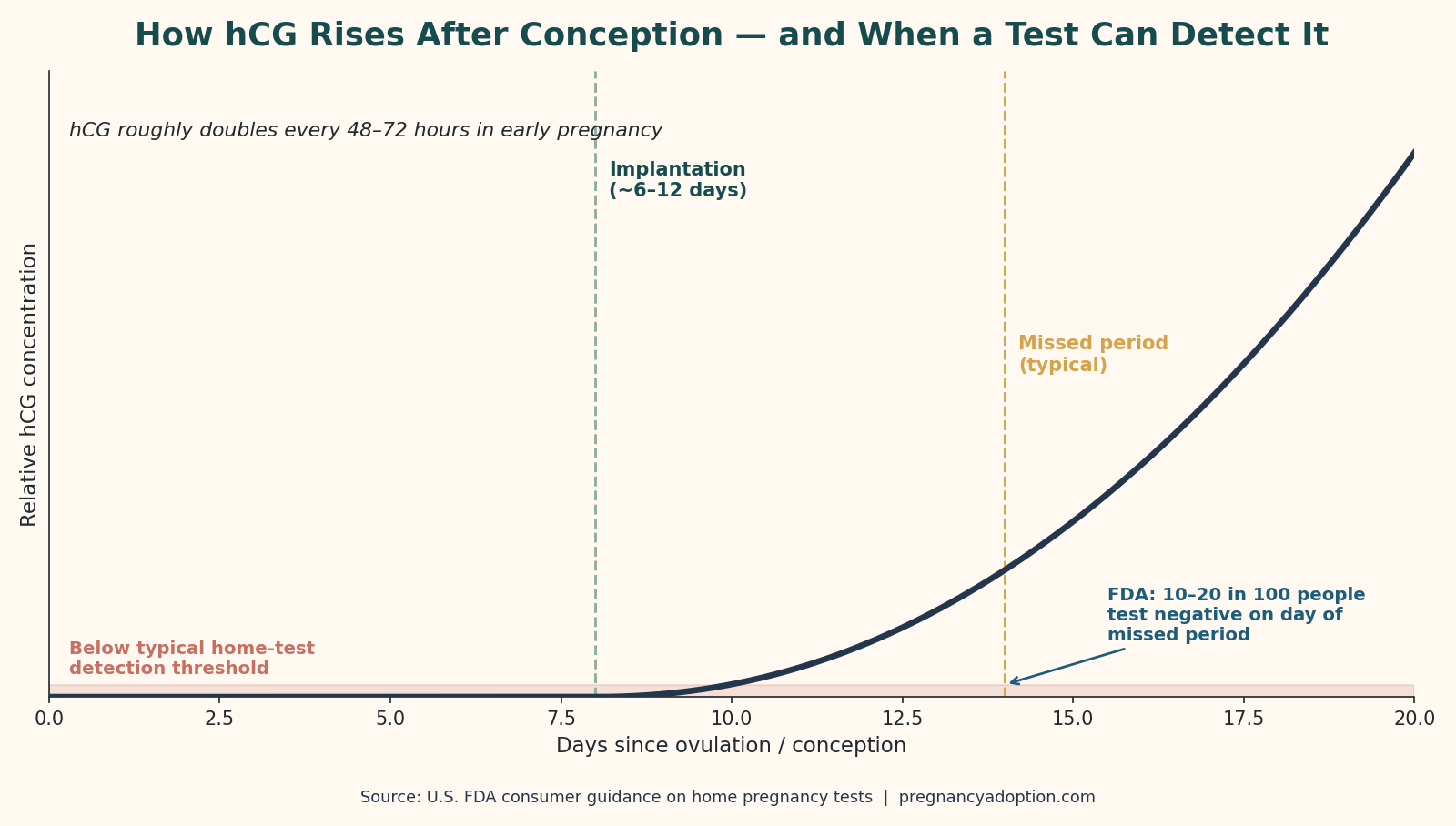
The fertilized egg travels to the uterus and implants in the uterine lining, typically 6 to 12 days after conception. Once implantation is complete, the placenta begins forming and starts releasing hCG into your bloodstream, doubling roughly every two to three days in a typical early pregnancy. This is the earliest point at which a sensitive blood test could theoretically detect a pregnancy, though home urine tests generally can’t yet, since the absolute hCG concentration is still very low even as it starts its rapid rise, and a urine test simply isn’t sensitive enough to pick up the earliest traces the way a lab-based blood test can.
What You Might — or Might Not — Feel
Some people notice light implantation spotting or mild cramping around this time, but many feel nothing at all, and both experiences are normal. Any fatigue, breast tenderness, or mood change during this window is just as likely to be a normal part of the luteal phase of the menstrual cycle as an early pregnancy sign, since the two can feel biologically identical this early — both are driven by progesterone, whether or not implantation has occurred. This is the main reason testing before a missed period is unreliable: the biology hasn’t caught up yet, regardless of how convinced you are that something feels different, and a negative test at this point genuinely doesn’t rule anything out, even if you retake it twice in the same day out of frustration.
Weeks 3–4 After Conception (Gestational Weeks 5–6): Around the Missed Period
Typical New Symptoms
This is when most people first suspect pregnancy, largely because it coincides with a missed period. hCG levels are now high enough that most home tests can detect them reliably in a first-morning urine sample. Breast tenderness tends to become more noticeable during this window, fatigue often intensifies to the point of affecting daily routines and evening plans, and early nausea can begin for some people, particularly toward the end of this two-week stretch as hCG climbs further and estrogen rises alongside it.
When Symptoms Usually Intensify
By the end of week 4 after conception, many people report that fatigue and breast changes have gone from “maybe” to “definitely different than usual,” and some notice their first wave of nausea or a stronger-than-normal reaction to a familiar smell, like a partner’s coffee or a favorite restaurant. This is also a reasonable point to take a first home pregnancy test if you haven’t already, since a missed period combined with a positive test is enough, on its own, to justify scheduling a first prenatal visit rather than waiting for more symptoms to appear before making that call.
Weeks 5–12 After Conception (Gestational Weeks 7–14): The Rest of the First Trimester
Peak Symptom Weeks
For most people who experience nausea, it peaks somewhere in this window, often between gestational weeks 8 and 10, alongside continued fatigue, frequent urination, and heightened smell sensitivity. Breast changes and mood shifts typically continue as well, and some people notice new symptoms during this stretch, including mild headaches, nasal congestion, or occasional dizziness when standing up too quickly. This is also typically when a first prenatal visit is scheduled and when a health care provider can offer an ultrasound to confirm dating and viability if there’s any uncertainty about timing or symptoms that have come up since the positive test.
When Symptoms Typically Start to Ease
According to Mayo Clinic’s patient guidance, nausea and vomiting most often improve by weeks 12–14 as hCG levels plateau and then gradually decline from their first-trimester peak, which is one reason the “12-week mark” carries so much cultural weight as an informal turning point, both for symptoms and for when many people choose to share pregnancy news more widely. Fatigue for many people improves somewhat heading into the second trimester as the body adjusts to sustained progesterone levels and the placenta takes over more of the hormonal workload from the corpus luteum, though this varies and some people continue to feel tired well beyond the first trimester, which is also entirely within the range of normal and not a sign that anything is being missed.
Pregnancy Symptoms vs. PMS: How to Tell the Difference
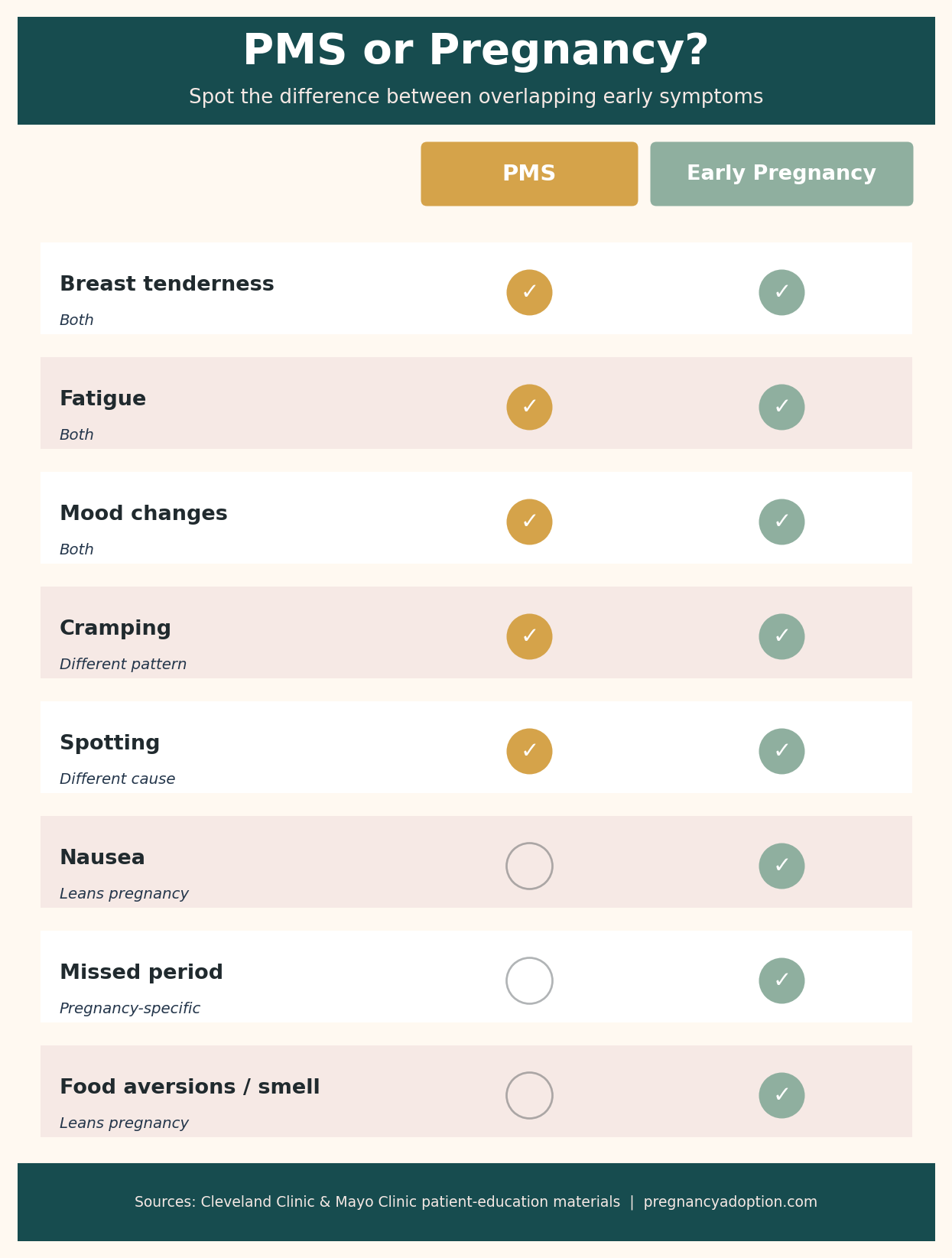
Premenstrual syndrome and early pregnancy share so many symptoms that the overlap is the single biggest reason people end up staring at a calendar, re-reading their own bodies, and trying to figure out which one they’re experiencing before a test can settle it. Both are driven by the same core hormones, progesterone and estrogen, which is exactly why they can feel so similar — and why symptom-spotting alone is such an unreliable way to answer the question, no matter how carefully you pay attention.
Why the Symptoms Overlap in the First Place
Shared Hormonal Pathways
In the days before a period, progesterone and estrogen rise after ovulation and then fall sharply if pregnancy doesn’t occur, which is what triggers the uterine lining to shed and a period to begin. In early pregnancy, the same two hormones rise on a similar early trajectory, but instead of falling, they keep rising, supported by hCG from the new pregnancy. Because the hormonal direction is initially the same in both cases, symptoms like breast tenderness, bloating, fatigue, and mood changes can feel nearly identical whether or not implantation has actually occurred — your body genuinely can’t tell you which scenario you’re in from sensation alone, which is a frustrating but biologically accurate fact worth accepting rather than fighting against with more symptom-tracking.
Why Bloating and Cramping Feel So Similar
Mild lower-abdominal cramping is common both right before a period and around implantation, and both can come with bloating caused by hormone-driven changes in digestion and fluid retention. Neither sensation, on its own, reliably distinguishes one from the other, which is part of why the only way to know for certain is a pregnancy test rather than a careful inventory of how your abdomen feels on a given afternoon or comparing this month’s cramps to last month’s.
Key Differences Worth Watching For
Timing and What Comes Next
The clearest eventual difference is simple: PMS resolves when a period starts, and early pregnancy symptoms continue and often intensify instead of resolving on schedule. Implantation spotting, when it happens, tends to occur earlier in the cycle (about 6–12 days after ovulation, often several days before a period would be expected) and is lighter and shorter than a typical period, while PMS-related spotting, if any, usually leads directly into full menstrual flow within a day rather than staying light and then stopping on its own.
Symptoms That Lean More Toward Pregnancy
A few signs are more specific to pregnancy than to PMS: a heightened, sometimes unpleasant sense of smell that wasn’t there the month before, new food aversions to things you previously liked (coffee is a classic example, along with certain meats or eggs), and nausea that continues for more than a day or two rather than resolving quickly the way premenstrual queasiness sometimes does. None of these are proof on their own, but their combination — especially alongside a late or missed period — is a reasonable prompt to test rather than to keep waiting for more certainty to arrive on its own over another few days.
| Symptom | PMS pattern | Early pregnancy pattern |
|---|---|---|
| Breast tenderness | Builds before period, eases once it starts | Builds gradually and continues past the expected period |
| Fatigue | Mild, typically resolves with period onset | Often more pronounced; continues or worsens over days |
| Bloating/cramping | Peaks just before period, resolves with flow | Milder cramping may occur around implantation, then eases; no period follows |
| Spotting | Usually leads directly into full menstrual flow | Implantation spotting (if any) is lighter, shorter, earlier, and is not followed by a full period |
| Nausea | Uncommon as a primary PMS symptom | Common starting around gestational weeks 5–6 |
| Sense of smell | Usually unchanged | Often noticeably heightened |
| Food cravings/aversions | Common but usually mild and short-lived | Can be sudden, specific, and tied to smell sensitivity |
| Mood changes | Common in the days before a period | Can continue and fluctuate for weeks rather than resolving |
| Resolution | Ends when period starts (within days) | Does not resolve; a missed period follows and symptoms tend to continue |
No single row in this table is diagnostic on its own. The only reliable way to distinguish PMS from early pregnancy is a pregnancy test, ideally taken on or after the day of an expected period.
What About Ovulation Symptoms Being Mistaken for Pregnancy?
Ovulation Pain (Mittelschmerz) vs. Implantation Cramping
Some people feel a brief, one-sided twinge or ache around ovulation, sometimes called mittelschmerz, roughly two weeks before a period would be due. Because it happens well before implantation would occur, it isn’t an early pregnancy symptom — it’s simply a normal part of some people’s cycles, and testing the same day as ovulation pain will not yet show a result either way, since fertilization and implantation haven’t had time to occur yet.
Ovulation Spotting vs. Implantation Spotting
A small number of people also notice light spotting around ovulation itself, separate from the implantation spotting described earlier in this guide. The distinguishing factor is timing relative to your cycle: ovulation spotting happens roughly mid-cycle, well before a period would be due, while implantation spotting happens closer to the expected period, about 10–14 days after conception. If you’re trying to tell the two apart in real time, the safest approach is simply to note the date and test at the appropriate time later rather than trying to diagnose which kind of spotting it was in the moment.
Implantation Bleeding and Early Spotting: What’s Normal
Light bleeding in early pregnancy is common enough that it shouldn’t automatically cause alarm, but it’s also common enough as a sign of something else entirely — a period, a cycle irregularity, or occasionally a complication — that it’s worth understanding clearly rather than guessing from a search result at 11 p.m. while trying not to panic.
What Implantation Bleeding Typically Looks Like
Color, Amount, and Duration
Implantation bleeding, when it happens, is usually light pink or brown rather than bright red, noticeably lighter in volume than a period (often just spotting on toilet paper or a light stain on underwear rather than anything that requires a pad), and typically lasts from a few hours up to one or two days. Mayo Clinic and Johns Hopkins Medicine both describe it as occurring roughly 10 to 14 days after conception, around the time a period would otherwise be due, which is exactly why it’s so easy to mistake for one, especially for someone who isn’t actively trying to conceive and isn’t watching for the distinction between the two on a fertility chart.
How It Differs From a Period
The biggest practical difference is trajectory: a period typically starts light and builds to a heavier flow over a day or two, while implantation spotting tends to stay light throughout and then simply stop rather than progressing into full flow. According to the NICHD, roughly one in four pregnant people notices some form of light bleeding in early pregnancy, meaning the majority never see this sign at all — its absence is not a cause for concern, and plenty of confirmed, healthy pregnancies never involve any visible spotting whatsoever from conception through delivery.
When Spotting Needs Medical Attention
Spotting That’s Usually Still Fine
Light, brief spotting without significant pain, especially around the expected-period timeframe, is common and, per Mayo Clinic’s guidance on first-trimester bleeding, does not by itself mean a pregnancy is at risk. Many pregnancies with early spotting continue without complication, and providers generally treat isolated light spotting as something to mention at a routine visit rather than something that requires an immediate call, provided it stays light and brief and isn’t accompanied by pain or other concerning signs.
Spotting That Warrants a Same-Day Call
Bleeding that soaks through a pad within an hour, that’s accompanied by moderate-to-severe cramping or pain, that includes passing tissue or clots, or that comes with dizziness or fainting is different and should prompt a same-day call to a health care provider or a same-day visit, since these patterns can indicate a miscarriage or an ectopic pregnancy rather than routine implantation spotting. These situations, along with the specific symptoms that separate them from normal spotting, are covered in more detail in the warning signs section below, which is worth reading in full even if you’re not currently experiencing any bleeding, simply so you know what to watch for.
Pregnancy Testing: When and How to Test for a Reliable Result
A pregnancy test result is only as reliable as its timing. Testing too early is, by a wide margin, the most common reason for a false negative, and understanding why can save you an emotional rollercoaster of retesting every single morning for a week and reading too much into each faint line you hold up to the window for better light.
How Home Pregnancy Tests Work
What hCG Is and Why It Matters
Every home pregnancy test, regardless of brand or price, works the same basic way: it detects human chorionic gonadotropin (hCG) in urine using antibodies that react to the hormone and produce a visible line, plus sign, or digital word once enough of it is present. hCG is produced by the placenta after implantation and, per the U.S. Food and Drug Administration (FDA), its accumulation in your urine over the days following implantation is what eventually makes a test line appear. No hCG in the urine sample means no line, whether that’s because you’re not pregnant or because it’s simply too early in a real pregnancy for the hormone to have built up to a detectable level yet — and from the outside, holding two negative tests days apart, those two situations look identical until more time passes.
Urine Test Mechanics and Result Windows
Most tests ask you to either hold the absorbent tip in your urine stream for a few seconds or dip it into a small cup of collected urine, then wait a set number of minutes (typically 3–5, though this varies by brand and is printed on the individual insert) before reading the result. Reading a test outside its stated window, especially checking back much later after the test has fully dried, can produce a misleading “evaporation line” — a faint, colorless or gray line caused by dried urine residue interacting with the test strip rather than a true positive. This is one of the most common sources of confusion with home testing, and it’s entirely avoidable by simply following the printed instructions and timer rather than checking obsessively over the following hour.
When to Test for the Most Accurate Result
Testing Before a Missed Period
Some tests are marketed as detecting pregnancy several days before a missed period, sometimes branded as “early result” or similar language on the box. That’s biologically possible in some cases, since hCG can be present in small amounts within about 10 days after conception for people who implanted early, but it’s also exactly when false negatives are most likely, regardless of what the packaging promises. The FDA notes that 10 to 20 out of every 100 pregnant people will not get a positive result on the day of their first missed period, largely because hCG hasn’t yet reached a detectable concentration for that individual’s cycle and implantation timing — not because the test is defective or because the person isn’t really pregnant, but simply because the underlying biology hasn’t caught up to the calendar date yet for everyone equally.
Testing After a Missed Period
Waiting until after a missed period substantially improves accuracy, and both Mayo Clinic and Cleveland Clinic describe correctly used home tests as roughly 99% accurate at that point. If your cycle is irregular and you’re not sure when a period is “due,” a reasonable rule of thumb is to test no sooner than about two to three weeks after a specific instance of unprotected sex, and to retest a few days later if the first result is negative but your period still hasn’t arrived. Testing daily or every other day well before that window mostly adds stress and expense without adding reliable information, since the result on day 8 after conception is not meaningfully more informative than the result on day 6.
| When you test | Days after conception | Reliability if negative |
|---|---|---|
| Several days before missed period | ~7–10 days | Low — hCG may not yet be detectable; retest if period doesn’t arrive |
| Day of missed period | ~14 days | Moderate — about 10–20 out of 100 pregnant people still test negative |
| 1 week after missed period | ~21 days | High — hCG has usually risen well above the detection threshold |
| 2+ weeks after missed period | 28+ days | Very high, especially for a urine test using first-morning urine |
Table reflects general guidance from the FDA and Mayo Clinic patient-education materials. If bleeding, pain, or other concerning symptoms accompany a missed period, contact a health care provider regardless of test timing or result.
Practical Tips for a Reliable Result
- Use first-morning urine when possible, since it’s the most concentrated in hCG after several hours without fluid intake overnight.
- Avoid drinking large amounts of fluid right before testing, which can dilute a borderline result into a false negative.
- Check the expiration date on the individual test wrapper before using it, since reactive chemicals can degrade over time even if the outer box hasn’t expired.
- Follow the exact wait time printed in the instructions, rather than glancing at it early or checking back much later after it has dried.
- If the result is negative but your period still hasn’t started within a few days, retest with first-morning urine rather than assuming the first result is final and moving on with uncertainty.
- If you get two different brands and two different results, trust the later, more clearly timed test over an earlier ambiguous one rather than treating the mismatch as unsolvable.
Types of Pregnancy Tests and How They Compare
Not all pregnancy tests are the same, and knowing the difference between a drugstore test and the test your provider might order can help you understand why results sometimes seem to conflict with each other, or why a provider orders a blood test when you’ve already taken three at home and gotten a clear positive each time.
At-Home Urine Tests
Standard Strip and Cassette Tests
These are the most common and least expensive option, usually showing a line, plus sign, or similar marker to indicate a positive result. According to Cleveland Clinic, most are approximately 99% effective when used exactly as directed and at the right time relative to a missed period. A faint line is still generally considered a positive line, since test sensitivity, not line darkness, is what determines a true result — a very faint positive at the correct testing time usually reflects lower (but still rising) hCG rather than a “weaker” pregnancy, and the line will typically darken over the following days as hCG continues to climb.
Digital Tests
Digital tests use the same hCG-detecting chemistry but display a plain-language result (“Pregnant” or “Not Pregnant”) instead of a line, which removes the ambiguity of interpreting a faint line for someone who finds that stressful or has had trouble reading lines correctly in the past. They tend to cost more but don’t offer meaningfully higher accuracy — they mainly reduce the chance of misreading a borderline line result, which can be worth the extra cost for some people and entirely unnecessary for others who are comfortable reading a standard strip.
Ovulation Tests vs. Pregnancy Tests: Don’t Mix Them Up
Ovulation predictor kits (OPKs) look similar to pregnancy tests and are also urine strip tests, but they detect a completely different hormone — luteinizing hormone (LH), which surges before ovulation, not hCG. An OPK cannot substitute for a pregnancy test, and a pregnancy test cannot substitute for an OPK. According to patient-education sources on PCOS and fertility tracking, conditions such as polycystic ovary syndrome (PCOS) can cause consistently elevated baseline LH, which makes OPK results harder to interpret for ovulation timing specifically — but this does not translate into false positives on an actual hCG-based pregnancy test, since the two hormones are read by different antibodies on different tests.
Clinical Blood Tests
Qualitative vs. Quantitative Blood Tests
A qualitative blood test simply confirms yes-or-no whether hCG is present, similar in concept to a home test but drawn from blood rather than urine. A quantitative blood test (a “beta hCG” test) measures the exact amount of hCG in your blood, which allows a provider to track whether the level is rising appropriately over 48–72 hours — useful when there’s uncertainty about how far along a pregnancy is, or a concern about its location or viability that a single yes/no answer can’t address on its own.
When a Provider Might Recommend a Blood Test
Blood tests can detect pregnancy slightly earlier than most home urine tests, sometimes within about 7–10 days after conception, and are typically used when timing needs to be more precise: to investigate a possible ectopic pregnancy, to monitor early pregnancy after fertility treatment where trigger-shot hCG needs to be distinguished from a new pregnancy’s own hCG, or to clarify a confusing pattern of home test results, such as a faint positive followed by a negative a few days later.
| Test type | Where it’s done | Earliest reliable detection | Best used for |
|---|---|---|---|
| Home urine test (strip/cassette) | At home | Around missed period for most reliable result | Initial confirmation |
| Home digital test | At home | Same as strip tests | Clear yes/no reading; reduces line-reading ambiguity |
| Qualitative blood test | Clinic/lab | ~7–10 days after conception | Early confirmation |
| Quantitative (beta hCG) blood test | Clinic/lab | ~7–10 days after conception | Tracking hCG trends; evaluating concerns about location or viability |
Understanding Your Results: False Negatives, False Positives, and Chemical Pregnancy
A test result is a data point, not a verdict, and understanding what can make it wrong in either direction helps you know when to trust it, when to retest, and when to call your provider instead of guessing at 2 a.m. based on a forum post.
Why a Test Might Give an Incorrect Result
Common Causes of False Negatives
The most common cause, by far, is testing too early — before hCG has risen high enough to detect, regardless of what the box promises about “early results” or “six days sooner.” Other contributors include diluted urine from drinking a lot of fluid beforehand, testing later in the day rather than using first-morning urine, and reading the result outside the instructed time window, either too soon or too late. A negative result alongside a missed period that continues past a week or more is a good reason to retest rather than assume the first result was final and move on without more information.
Less Common Causes of False Positives
True false positives are uncommon. According to Cleveland Clinic, the most frequent explanation for a positive test that doesn’t lead to a continuing pregnancy is a very early pregnancy loss — meaning a pregnancy did occur, even if only briefly, so the test wasn’t technically wrong at the moment it was taken. Other causes include lingering hCG from fertility medication (providers generally advise waiting at least two weeks after an hCG trigger injection before testing, since the medication itself can trigger a positive result unrelated to a new pregnancy) and residual hCG for four to six weeks after a recent pregnancy, miscarriage, or ectopic pregnancy treatment. User error, such as reading a test outside its time window and mistaking an evaporation line for a faint positive, can also produce a misleading result that a repeat test, done correctly, will usually resolve.
When a Positive Test Is Followed by a Negative
What a Chemical Pregnancy Is
A chemical pregnancy is a very early pregnancy loss, occurring before about five weeks of gestation, in which an embryo implants and produces enough hCG for a positive test but stops developing before it would ever be visible on an ultrasound. Per Cleveland Clinic, signs can include a positive test followed by a negative one within days to weeks, a period that arrives later and heavier than usual, and more intense cramping than a typical period. Because the embryo never developed far enough to be visible on imaging, some people never realize a chemical pregnancy occurred and instead simply experience what feels like an unusually late, heavy period with more cramping than expected.
What This Means Medically and Emotionally
Chemical pregnancies are thought to be common, accounting for a meaningful share of very early pregnancy losses — many of which likely go unnoticed by people who don’t test early or repeatedly during the days right around a missed period. They don’t indicate a higher risk for future pregnancies in most cases, and most people who experience one go on to have a successful pregnancy afterward, whether or not they conceived again in the very next cycle. That said, the emotional weight of a chemical pregnancy is real even when the medical risk is low, and it’s a legitimate loss to grieve rather than something to minimize simply because it happened early. If you experience a positive test followed by bleeding and a subsequent negative test, and you want confirmation of what happened rather than simply moving forward with uncertainty, a health care provider can check hCG levels by blood draw over a few days to see whether they’re falling as expected, which is the most reliable way to understand what occurred.
Pregnancy Symptoms After Fertility Treatment (IUI and IVF)
If you’ve gone through intrauterine insemination (IUI) or in vitro fertilization (IVF), almost everything in this guide still applies, but a few things about testing and symptoms work differently — and are worth understanding on their own rather than trying to force them into the general timeline above.
Why Symptoms Can Be Especially Confusing After Fertility Treatment
The hCG Trigger Shot vs. a New Pregnancy
Many IUI and IVF cycles include a “trigger shot” containing hCG to finalize egg maturation before retrieval or insemination. Because home pregnancy tests detect that same hormone, testing too soon after a trigger shot can produce a positive result caused by leftover medication rather than a new pregnancy — this is a well-documented reason fertility clinics generally ask patients not to test at home during the days immediately following a trigger injection, since the result genuinely cannot distinguish one hCG source from the other.
Progesterone Support and Symptom Overlap
Many fertility protocols also include progesterone supplementation (by injection, vaginal suppository, or oral medication) to support the uterine lining after transfer. Because progesterone is one of the main hormones responsible for fatigue, bloating, breast tenderness, and mood changes in a naturally occurring pregnancy, supplemental progesterone can produce nearly identical sensations whether or not implantation actually occurred — which means, more than in a non-medicated cycle, symptoms during this specific window are genuinely not a reliable way to predict a test result.
When to Test and What Your Clinic Will Likely Recommend
Why Clinics Typically Rely on a Blood Test, Not a Home Test
Fertility clinics generally schedule a quantitative beta hCG blood test rather than relying on a home urine test, commonly sometime in the range of 9 to 14 days after a transfer, with the exact day set by your specific clinic’s protocol. A blood test avoids the trigger-shot confusion described above, since your clinic knows the trigger medication’s expected clearance timeline, and it gives a specific hCG number that can be tracked over 48 hours to confirm it’s rising appropriately rather than a simple yes-or-no result.
The Wait Between Transfer and Testing
The period between a transfer and a scheduled blood test, sometimes called the “two-week wait,” is widely described as one of the more emotionally difficult stretches of fertility treatment, partly because progesterone-driven symptoms can feel like promising pregnancy signs one day and like nothing at all the next. Testing at home before your clinic’s scheduled blood draw is generally discouraged by most clinics specifically because of the trigger-shot false-positive risk described above — if you’re tempted to test early, calling your clinic to ask about their specific guidance is more useful than guessing based on a general guide like this one.
What a Confusing Result Might Mean After Fertility Treatment
Chemical Pregnancy Risk After IVF
A chemical pregnancy — the very early loss described earlier in this guide, where a positive test or a low initial beta hCG is followed by a falling level rather than a rising one — can happen after fertility treatment just as it can after a naturally conceived pregnancy. Because IVF and IUI cycles are already closely monitored with bloodwork, this pattern is often identified earlier and more precisely than it would be in an unmonitored cycle, which can feel more clinical and less ambiguous, but doesn’t make the experience any less real to process emotionally.
When hCG Doesn’t Rise as Expected
Your clinic will typically recheck beta hCG 48 hours after the first positive result specifically to confirm it’s roughly doubling as expected. A level that rises more slowly than expected, plateaus, or falls doesn’t automatically mean the same thing in every case — your care team will interpret it alongside your specific history, medication protocol, and any additional testing, which is why this is a conversation to have directly with your clinic rather than a pattern to try to diagnose from a general number found online.
You Got a Positive Test: What to Do in the First Days
A positive test is a starting point, not a finish line. What happens in the next few days and weeks depends less on the test itself and more on connecting with a health care provider and beginning a few basic, low-effort prenatal steps, even before your first appointment happens.
Immediate Next Steps
Confirm With a Health Care Provider
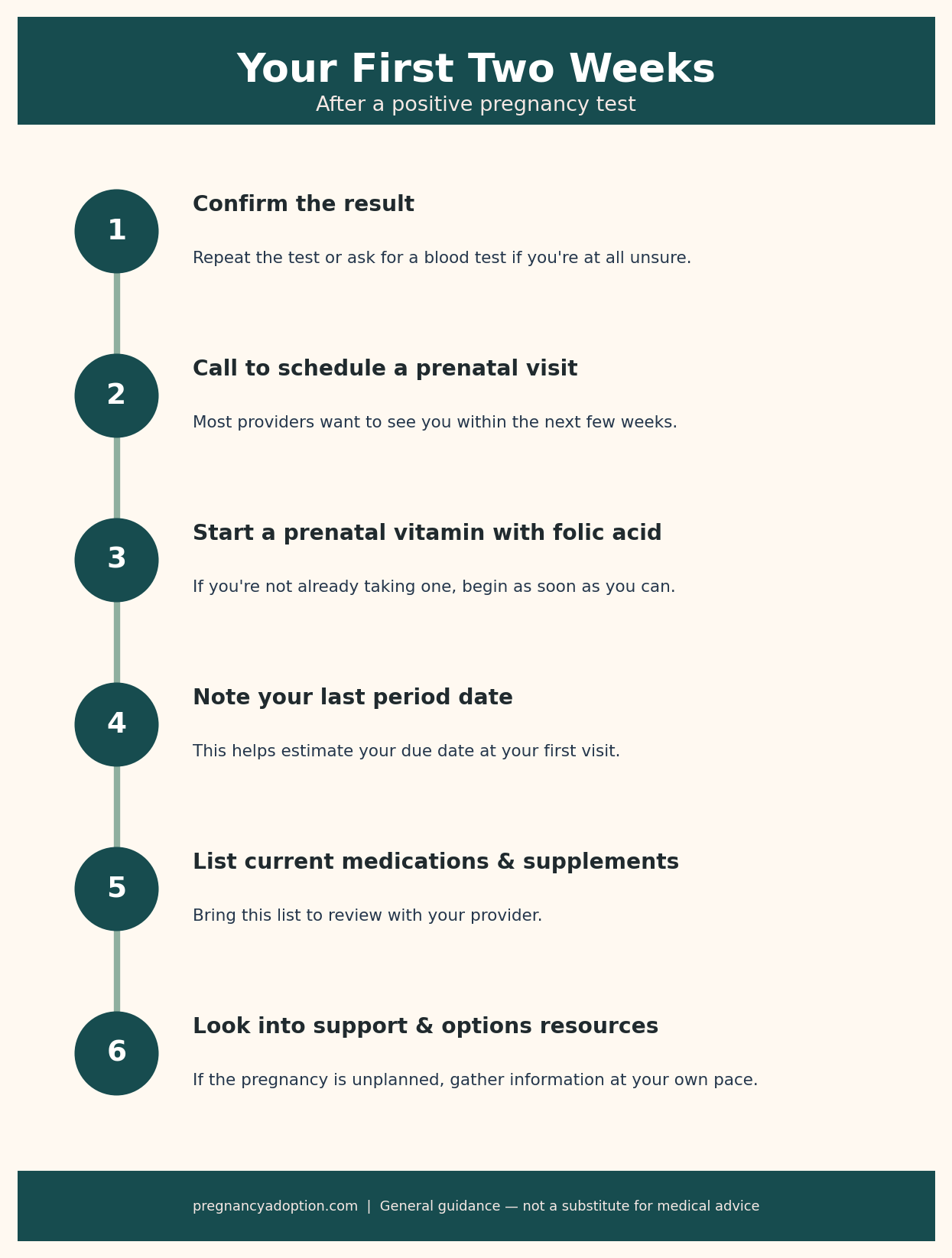
Call an OB-GYN, midwife, family medicine provider, or community health clinic to schedule a first prenatal visit. Many practices will confirm a positive home test with a clinical urine or blood test at that first visit rather than requiring a separate confirmation appointment beforehand — ask when you call what their specific process is, since this varies by practice and by whether you have existing symptoms that need earlier attention than a routine first visit. If you don’t currently have a provider, community health centers and many OB-GYN practices accept new patients specifically for early pregnancy care and can usually get you scheduled within one to two weeks, sometimes sooner if you mention a positive test when you call.
Start or Continue a Prenatal Vitamin With Folic Acid
The NICHD recommends at least 400 micrograms of folic acid daily, ideally starting before conception, because it reduces the risk of neural tube defects by around 70%. If you weren’t taking a prenatal vitamin before finding out, starting one now — and mentioning it at your first visit — is a reasonable and low-pressure next step; it’s not too late to start benefiting from it even if you didn’t take one during the weeks before you knew you were pregnant, since folic acid continues to matter throughout early fetal development, not just in a narrow pre-conception window.
Scheduling and Preparing for Prenatal Care
When to Book Your First Prenatal Visit
There’s no single universal rule for exactly which week to schedule a first prenatal visit, but many people are seen sometime between weeks 6 and 10 of pregnancy (counting from the last menstrual period). If you have a history of pregnancy complications, a chronic health condition such as diabetes or high blood pressure, or you’re experiencing any of the warning signs described below, call sooner rather than waiting for a routine appointment slot — most practices have a process for getting a newly pregnant patient with concerning symptoms seen quickly, even outside their normal scheduling window, so don’t hesitate to mention symptoms specifically when you call rather than only saying you’d like to schedule a routine visit.
What Typically Happens at the First Visit
According to patient-education guidance from MedlinePlus and the Office on Women’s Health, a first prenatal visit usually includes a full health history, a physical exam, blood work, and confirmation of your estimated due date; it may also include a pelvic exam and Pap test depending on your history and provider’s practice. It’s a reasonable visit to bring a written list of your symptoms, the date of your last menstrual period, any medications or supplements you’re taking, your family’s relevant medical history, and questions you want answered, since a lot of information gets covered in a single appointment and it’s easy to forget a question you had in the car on the way there.
After that first visit, a typical low-risk pregnancy is seen about once a month through week 28, twice a month from weeks 28–36, and weekly from week 36 until delivery — though your provider will adjust this based on your individual health history and how the pregnancy progresses over time. Someone over 35, or with a high-risk condition such as diabetes or hypertension, should generally expect a more frequent schedule than this baseline, and that’s a routine precaution rather than a sign that something is already wrong.
Missed Period but Negative Test? Common Reasons and Next Steps
A missed period with a negative test is a genuinely common, frustrating situation, and pregnancy is only one of several possible explanations — it’s worth working through the alternatives methodically before assuming the test is simply wrong or retesting compulsively for another week.
Reasons Unrelated to Pregnancy
Stress, Weight Changes, and Illness
Significant stress, rapid weight gain or loss, intense or newly increased exercise, travel across time zones, and illness can all delay ovulation and, in turn, delay or skip a period entirely, independent of pregnancy. These causes are common enough that a single late period without other symptoms isn’t automatically concerning, particularly if you can point to one of these disruptions — a stressful work deadline, a new training program, a recent flu — in the weeks beforehand.
Hormonal Conditions and Medications
Conditions such as polycystic ovary syndrome (PCOS) and thyroid disorders are well-known causes of irregular or missed periods, sometimes for months at a time and sometimes as the very first sign that leads to a diagnosis. Certain medications, including some hormonal contraceptives, emergency contraception, and other prescriptions, can also shift cycle timing in ways that mimic a missed or late period without any pregnancy involved. If missed or irregular periods are a recurring pattern rather than a one-time event, it’s worth discussing with a health care provider regardless of pregnancy status, since an underlying condition may benefit from its own evaluation and treatment rather than being repeatedly attributed to stress.
Reasons Related to the Test Itself
Testing Too Early Relative to Ovulation
If ovulation happened later than usual in a given cycle, your actual conception date, and therefore implantation and detectable hCG, will also be later than a standard cycle-based calculation would predict. In practice, this means your period can feel “late” by the calendar while you’re not actually as far past ovulation as you think — and a test taken at that point may simply be too early rather than wrong, even though the calendar on your phone insists otherwise.
Diluted Urine or User Error
Testing with diluted urine (for example, after drinking a large amount of water beforehand) or misreading the result window can produce a false negative even in an otherwise well-timed test. Repeating the test with first-morning urine, following the instructions exactly and reading it within the stated window, is a reasonable way to rule this out before assuming something more complicated is going on with your cycle or your health.
What to Do Next
When to Retest
If your period still hasn’t started, a reasonable approach is to retest with first-morning urine about three to five days after the first negative, since hCG roughly doubles every two to three days and a borderline-early test may become clearly positive within that window without any other action needed on your part in the meantime.
When to See a Provider Regardless of Test Results
If a period is more than about a week late with no positive test, if you have a history of irregular cycles that makes “late” hard to judge with confidence, or if you have any pain or unusual bleeding, it’s reasonable to contact a health care provider for a clinical evaluation rather than continuing to retest at home indefinitely. A blood test can detect hCG at levels a home test might miss, and a provider can also investigate non-pregnancy causes of a missed period, such as a thyroid or hormonal issue, that a pregnancy test was never going to reveal in the first place no matter how many times you took one.
How Far Along Am I? Due Dates and Gestational Age Explained
Once a pregnancy is confirmed, the next question is almost always “how far along am I,” and the answer depends on a counting convention that surprises a lot of people the first time they hear it explained clearly rather than just seeing a number on an app.
How Gestational Age Is Calculated
Counting From the Last Menstrual Period
Health care providers count gestational age starting from the first day of your last menstrual period (LMP), not from the date of conception. Because ovulation and conception typically occur about two weeks after the start of a period, you’re generally considered about two weeks pregnant on the day you actually conceive. This is a counting convention rooted in the fact that most people know their LMP date more reliably than their exact conception date — it’s not a claim that anything meaningful happened to the pregnancy before conception occurred, just a practical, standardized starting point that every provider uses consistently.
Why Gestational Age Isn’t the Same as Conception Age
This distinction matters because it explains why a positive test taken around your missed period corresponds to roughly “4 weeks pregnant” by LMP dating, even though conception happened only about two weeks earlier and the embryo itself is only about two weeks old developmentally. If you’re comparing symptom timelines, due-date math, or “how many weeks” conversations with someone else, confirming whether they’re using LMP dating or conception dating avoids a lot of confusing back-and-forth about numbers that don’t actually match even though both people are technically correct.
| Trimester | Gestational weeks | What’s generally happening for you |
|---|---|---|
| First trimester | Weeks 1–13 | Confirming the pregnancy, first prenatal visit, symptoms typically peak and begin easing near the end |
| Second trimester | Weeks 14–27 | Many people feel a symptom improvement; monthly prenatal visits continue |
| Third trimester | Weeks 28–40 | Visits increase to twice monthly, then weekly near the due date |
This table describes typical visit cadence and general symptom patterns from the pregnant person’s perspective, not fetal development milestones. Your own provider’s schedule and your symptom pattern may differ from this general outline.
Estimating Your Due Date
Naegele’s Rule and Its Limits
The traditional method for estimating a due date, known as Naegele’s rule, adds 280 days (40 weeks) to the first day of your last menstrual period. It’s a useful starting estimate, and it’s the basis for most online due-date calculators, but it assumes a textbook 28-day cycle with ovulation on day 14 — an assumption that doesn’t hold for everyone, particularly people with longer, shorter, or irregular cycles, which is why the result is treated as an estimate rather than a guarantee accurate to the exact day.
When an Ultrasound Changes Your Due Date
An early ultrasound, particularly one performed in the first trimester, can measure the embryo or fetus directly and is generally considered more accurate for dating than LMP-based calculation alone, especially for people with irregular cycles or uncertain LMP dates. If your provider adjusts your due date after an early ultrasound, that’s a routine and expected part of dating a pregnancy accurately — it doesn’t mean anything is wrong with the pregnancy, only that the ultrasound measurement is considered a more precise data point than the calendar-based estimate it’s replacing, and providers generally trust an early ultrasound measurement over a shaky LMP memory.
Common Due-Date Questions in Practice
What If I Don’t Know My Last Menstrual Period Date?
This is common, especially with irregular cycles, recent hormonal birth control use, or simply not having tracked it closely. It’s not a barrier to getting an accurate due date — a first-trimester ultrasound can establish gestational age directly from measurements of the embryo or fetus, without needing your LMP date at all, so there’s no need to guess or feel behind if you can’t answer that question with confidence at your first visit.
What “Full Term” Means and Why the Range Is Wide
Due dates are often treated as a single fixed day, but ACOG and the Society for Maternal-Fetal Medicine define a range of terms around it: early term is 37 weeks 0 days through 38 weeks 6 days, full term is 39 weeks 0 days through 40 weeks 6 days, late term is 41 weeks 0 days through 41 weeks 6 days, and postterm is 42 weeks 0 days or beyond, according to March of Dimes patient guidance. In other words, a due date is the center of a multi-week range considered full term, not a deadline — a detail that becomes more relevant later in pregnancy but is worth knowing from the start so a due date feels less like a countdown to a single day.
Everyday Questions: Alcohol, Caffeine, Exercise, and Medications Once You Suspect You’re Pregnant
Once a test turns positive — or even while you’re still waiting to find out — a lot of practical questions tend to surface quickly: is it fine to finish that glass of wine, keep up your morning coffee, keep going to your usual workout class, or take the medication you already had planned for tonight. None of these are trivial questions, and none of them require panic if you didn’t know sooner.
What to Stop or Limit Right Away
Alcohol: Why There’s No Established Safe Amount
Both the CDC and Mayo Clinic are direct on this point: there is no known safe amount or safe time to drink alcohol during pregnancy, including in the earliest weeks before a person realizes they’re pregnant. If you drank before you knew, the CDC’s guidance is clear that stopping as soon as you find out is the right response — it’s never too late to stop, and the recommendation going forward is simply not to drink for the remainder of the pregnancy, not to feel that earlier drinking has already determined an outcome.
Caffeine: A Reasonable Daily Limit
Caffeine doesn’t need to be eliminated entirely for most people, but Mayo Clinic’s patient guidance recommends keeping it under 200 milligrams a day — roughly the amount in one 12-ounce cup of coffee, since an 8-ounce cup contains about 95 mg. This means a couple of small coffees or a moderate mix of coffee, tea, and chocolate is generally considered reasonable, while multiple large coffee-shop drinks a day would exceed the commonly cited limit. Herbal teas are a separate consideration: because there isn’t enough research on how many herbal ingredients affect fetal development, Mayo Clinic recommends checking with your provider before regularly drinking a given herbal tea rather than assuming “herbal” means automatically safe.
Smoking, Vaping, and Recreational Drug Use
Why Stopping as Soon as Possible Matters
According to the CDC, smoking during pregnancy is linked to premature birth, low birth weight, certain birth defects such as cleft lip and cleft palate, and a higher risk of Sudden Infant Death Syndrome (SIDS) after the baby is born, while secondhand smoke exposure carries risks of its own. The same guidance applies to e-cigarettes and vaping: the CDC is explicit that nicotine itself is a health danger for a pregnant woman and her developing fetus, capable of affecting fetal brain and lung development regardless of whether it’s delivered by a cigarette or a vape, and some e-cigarette flavoring chemicals may carry additional risks that are still being studied. As with alcohol, there’s no version of “cutting back a little” that current guidance treats as a target — the recommendation is to stop entirely, and the CDC frames quitting at any point in pregnancy, even in the third trimester, as producing a real benefit rather than being “too late to matter.” For recreational or non-prescribed drug use of any kind during pregnancy, the safest and most direct step is an honest conversation with your provider as soon as possible, since it shapes what monitoring or support makes sense going forward and is treated as a medical conversation, not a confession.
Getting Help If Stopping Feels Difficult
Nicotine addiction is a physical dependency, not a failure of willpower, and quitting is often genuinely hard even with strong motivation to protect a pregnancy. Free, confidential coaching is available in the United States through 1-800-QUIT-NOW, and the CDC notes that e-cigarettes are not an FDA-approved cessation aid, so switching from cigarettes to vaping isn’t a recommended solution — a conversation with your provider about counseling-based approaches and, where appropriate, FDA-approved cessation options is the recommended path instead. The same principle extends to alcohol or other substance use that feels hard to stop on your own: providers can connect you with resources without judgment, and reaching out earlier in pregnancy generally allows more time for supportive strategies to help before delivery.
What’s Usually Fine to Continue (With Your Provider’s Input)
Exercise and Physical Activity
For most people, staying physically active in early pregnancy is not just permitted but beneficial — Mayo Clinic’s patient guidance describes exercise as helpful for easing aches and pains and for supporting healthy weight gain over the course of pregnancy. The general approach is to start slowly if you weren’t already active, continue moderately if you were, and skip movements that feel unstable or that make you likely to lose your balance and fall. People with a high-risk pregnancy or a specific pregnancy complication may be advised differently, which is exactly the kind of question worth raising at your first prenatal visit rather than assuming a blanket rule applies to your specific situation.
Medications, Supplements, and What to Ask About
Many common over-the-counter and prescription medications are considered compatible with pregnancy, and many are not — the safest approach is to bring your full list of current medications and supplements (including anything herbal) to your first prenatal visit, or to call your provider’s office sooner if you’re due for a dose before that appointment happens. Don’t stop a medication for a chronic condition on your own without talking to a provider first, since suddenly stopping some medications can carry its own risks; the goal is an informed conversation, not guessing in either direction. This is also a reasonable moment to ask specifically about pain relievers, allergy medication, and anything you take regularly, since “is my usual medication fine” is one of the most common questions providers field at a first visit.
Food Safety Questions Worth Knowing Early
Foods and Drinks Many Providers Suggest Limiting or Avoiding
According to Mayo Clinic’s patient-education guidance, categories commonly flagged for pregnancy include high-mercury fish (such as swordfish, shark, king mackerel, and bigeye tuna), raw or undercooked seafood, meat, poultry, and eggs, unpasteurized dairy products and soft cheeses made from unpasteurized milk, unwashed fruits and vegetables, and raw sprouts. This isn’t a call to panic over a single bite eaten before you knew you were pregnant — it’s a general going-forward list to keep in mind, and your provider can tailor it further based on your specific diet and health history.
Why These Recommendations Exist
Most of these categories are flagged for the same underlying reason: a higher risk of foodborne illness (from bacteria such as listeria or salmonella) or, in the case of high-mercury fish, a heavy metal that can affect fetal neurological development at high enough exposure levels. None of this means every undercooked egg or soft cheese automatically causes harm — it means these categories carry a higher average risk than well-cooked, pasteurized, and thoroughly washed alternatives, which is why they’re framed as things to limit or avoid going forward rather than sources of retroactive worry.
Tracking Your Symptoms: A Simple Way to Stay Organized Before Your First Visit
You don’t need a special app or a complicated system to keep useful notes in the weeks between a positive test and your first prenatal visit. A simple running list, kept on your phone or a notebook, is usually enough to turn a blurry memory of “I think it started sometime in week 5” into something specific and useful for your provider.
What to Track and Why It Helps
Symptoms and Timing
For each new symptom, jot down roughly when it started, how it feels, and anything that seems to make it better or worse. This is more useful than it sounds: providers often ask specifically “when did this start” and “has it changed,” and having an actual note beats trying to reconstruct the timeline from memory during a rushed appointment. It also helps you personally notice genuine changes — a new symptom, or an old one suddenly intensifying — against your own established pattern rather than a generic list from a guide like this one.
Bleeding, Pain, and Anything Unusual
Any bleeding or spotting is worth a specific note: the date, the color, the approximate amount, and whether it came with pain. The same goes for any pain itself — where it is, how it feels (sharp, cramping, dull), and how long it lasts. If you ever do need to call about a symptom described in the warning signs section above, being able to say “it started at 3 p.m., it’s on my right side, and it hasn’t let up” gets you a faster, more useful conversation than “I don’t know, sometime today, and it hurts.”
Turning Your Notes Into Useful Questions for Your Provider
Questions Worth Preparing in Advance
Common, reasonable questions to bring to a first visit include: what prenatal vitamin and dosage they recommend, which of your current medications or supplements are fine to continue, what your specific due date estimate is and how it was calculated, what symptoms should prompt a call versus wait for the next visit, and what their after-hours process looks like if you have a concern outside office hours. Writing these down in advance means you won’t spend half the appointment trying to remember what you wanted to ask.
What Not to Worry About Tracking Obsessively
Tracking is meant to be a light-touch habit, not a source of additional stress. You don’t need to log every twinge, rate your fatigue on an hourly scale, or compare your notes against an app’s “typical” symptom calendar every night. If tracking starts to feel like its own source of anxiety, it’s reasonable to simplify to just the specific items above — new symptoms, bleeding, and pain — and let the rest go unrecorded without guilt.
| Date | Symptom | Severity (mild/moderate/severe) | Notes |
|---|---|---|---|
| Example: Sept 3 | Nausea | Moderate | Worse in evening; helped by crackers |
| Example: Sept 5 | Light spotting | Mild | Pink, lasted a few hours, no pain |
Copy this format into any notes app or a small notebook. Four columns are enough — resist the urge to build something more elaborate than you’ll actually keep up with.
Warning Signs That Need Medical Attention Right Away
Most early pregnancy symptoms are uncomfortable rather than dangerous. A smaller set of symptoms is different, and recognizing them quickly matters more than almost anything else in this guide. This section describes general warning signs and is not a substitute for a medical evaluation. If you’re experiencing any of the emergency signs below, contact your health care provider immediately or go to an emergency room — don’t wait to see if symptoms pass, and don’t spend time researching further before making the call, since time can matter in exactly these situations.
Signs of a Possible Ectopic Pregnancy
Symptoms to Take Seriously
An ectopic pregnancy happens when a fertilized egg implants somewhere outside the uterus, most often in a fallopian tube, where it cannot develop into a viable pregnancy no matter how the rest of the pregnancy is progressing or how normal earlier symptoms felt. Per MedlinePlus (a service of the National Library of Medicine), it can initially feel like a completely normal early pregnancy — a missed period, breast tenderness, mild nausea — before other signs appear, which is part of what makes it dangerous to dismiss unusual pain as “just normal cramping” simply because everything else has felt typical so far. Seek immediate medical care if you have abdominal pain, shoulder-tip pain, vaginal bleeding, or dizziness or fainting, especially with a known or suspected pregnancy. Sharp, one-sided pelvic pain is a particularly important symptom to mention specifically when you call, since it points more directly toward a tubal problem than generalized cramping does, and naming it clearly can speed up how quickly you’re seen.
Why Ectopic Pregnancy Is a Medical Emergency
Because the fallopian tube isn’t built to hold a growing pregnancy, it can rupture as the pregnancy develops, causing internal bleeding that MedlinePlus describes as a life-threatening emergency requiring immediate surgery. Ectopic pregnancy cannot be treated by “waiting to see” or by home monitoring of symptoms, which is why the warning signs above call for same-day emergency evaluation rather than a routine next-available appointment days later. Certain factors, including a prior ectopic pregnancy, prior pelvic surgery, pelvic inflammatory disease, or conceiving with an IUD in place, raise the likelihood of a future ectopic pregnancy, but ectopic pregnancy can also occur with no known risk factors at all — which is exactly why the symptoms themselves, not your personal risk profile or how healthy you otherwise feel, should drive the decision to seek care.
For a complete walkthrough of ectopic pregnancy symptoms, diagnosis, and treatment options, see our ectopic pregnancy guide.
Signs of a Possible Early Pregnancy Loss
Bleeding and Cramping Patterns Worth a Call
According to Mayo Clinic’s patient guidance on pregnancy loss, warning signs include vaginal bleeding with or without pain (including light spotting), pelvic or lower-back pain and cramping, and passing fluid or tissue from the vagina. Miscarriage is relatively common — Mayo Clinic cites an estimated 10–20% of known pregnancies, with the true rate likely higher since many losses happen before a pregnancy is ever detected by a test — and most occur in the first 13 weeks, which is one reason many people choose to wait before sharing pregnancy news widely, though that choice is personal and there’s no rule requiring it.
When to Call vs. When to Go to the Emergency Room
Light spotting without significant pain is common in early pregnancy and, on its own, doesn’t necessarily indicate a miscarriage; many pregnancies with early spotting continue without complication, so a same-day call to your provider, rather than an immediate ER visit, is often the right first step in that specific scenario. Heavy bleeding (soaking through a pad in an hour or less), severe one-sided pelvic pain, shoulder pain, or fainting are different and warrant emergency care, since these patterns can also indicate an ectopic pregnancy rather than a routine early loss, and the two can be genuinely difficult to tell apart without an exam and, often, an ultrasound. If you pass tissue and want it evaluated, your provider may ask you to collect it in a clean container to bring in, which can help confirm what happened rather than leaving it as a lasting uncertainty.
Severe Nausea and Vomiting (Hyperemesis Gravidarum)
When Morning Sickness Becomes Dangerous
Typical morning sickness is uncomfortable but manageable with rest, small frequent meals, and time, as described in the self-care section earlier in this guide. A more severe form, hyperemesis gravidarum, involves persistent vomiting severe enough to cause dehydration or significant weight loss — Mayo Clinic defines this as losing more than 5% of pre-pregnancy body weight. This condition sometimes requires IV fluids, anti-nausea medication, or other hospital-based treatment, and it’s not something to simply push through with willpower, ginger candy, or the hope that it will pass on its own within a few more days.
Symptoms of Dangerous Dehydration to Watch For
Contact a health care provider if you produce little or no urine, or urine that’s noticeably dark; if you can’t keep any liquids down for an extended period; if you feel dizzy or faint when standing up; or if your heart is racing without an obvious cause. These are signs of dehydration or an electrolyte imbalance that typically need professional evaluation rather than home management alone, and providers have effective treatments available once hyperemesis is identified, so there’s a real, tangible benefit to reporting it rather than trying to manage it independently for another week and hoping it improves.
| Symptom pattern | Possible concern | What to do |
|---|---|---|
| Sharp one-sided abdominal pain, shoulder-tip pain, dizziness or fainting | Possible ectopic pregnancy | Emergency care now |
| Heavy bleeding (soaking a pad within an hour), passing tissue, severe cramping | Possible miscarriage or ectopic pregnancy | Emergency care now |
| Light spotting, mild cramping, no significant pain | Often normal (implantation or unrelated) | Mention at next visit; call if it worsens |
| Can’t keep liquids down, dark or little urine, racing heart, dizziness when standing | Possible hyperemesis gravidarum / dehydration | Same-day call to provider |
| High fever (over 100.4°F), chills | Possible infection | Same-day call to provider |
| Burning or pain with urination | Possible urinary tract infection | Call within a day or two; sooner if fever develops |
| Typical nausea, fatigue, breast tenderness, mild bloating | Common early pregnancy symptoms | No urgent action; discuss at routine prenatal visit |
This table is a general orientation tool based on Mayo Clinic and MedlinePlus patient-education content, not a diagnostic tool. When in doubt, call — a health care provider would rather field an unnecessary call than have a serious symptom go unreported for another day.
| Situation | Why it often means extra monitoring |
|---|---|
| Age 35 or older | Providers commonly recommend a somewhat closer visit schedule and additional screening options |
| Pre-existing condition (diabetes, hypertension, thyroid disease) | The condition and pregnancy can each affect the other and benefit from coordinated management |
| Prior pregnancy loss or complication | Providers may schedule earlier or more frequent check-ins to monitor this pregnancy specifically |
| Twin or higher-order multiple pregnancy | Higher hormone levels and added physical demands generally call for closer follow-up |
| Conceived through IUI or IVF | Early monitoring with blood work is standard practice regardless of how the pregnancy is progressing |
None of these situations mean something is wrong. They’re common, well-understood reasons a provider might see you a bit more often than the standard schedule described earlier in this guide.
Common but Usually Harmless Discomforts Worth Tracking
Between “totally normal” and “call immediately” sits a middle category: symptoms that are uncomfortable, common, and generally not dangerous, but still worth mentioning at your next prenatal visit so your provider has the full picture of how the pregnancy is progressing for you specifically, not just the textbook version.
Discomforts to Track, Not Panic About
Mild, Brief Cramping
Occasional mild cramping, similar to light period cramps and lasting a few minutes to a couple of hours, is common in early pregnancy as the uterus adjusts and stretches slightly to accommodate the growing pregnancy and the ligaments supporting it. It’s different from the persistent, worsening, or one-sided pain described in the warning signs above, and keeping a rough mental note of when it happens and how long it lasts is more useful than trying to decide in the moment, mid-cramp, whether it’s “bad enough” to call.
Ongoing Fatigue and Breast Tenderness
Both of these are expected to continue, sometimes for weeks, and don’t require intervention beyond basic self-care — rest, supportive clothing, and adjusting your schedule where possible — unless they become severe enough to interfere significantly with daily functioning, in which case it’s reasonable to mention it at your next visit rather than simply enduring it in silence until it feels unbearable.
When “Normal” Discomfort Is Worth a Call Anyway
When Symptoms Change Suddenly or Sharply Worsen
A symptom that has been mild and stable for days and then suddenly intensifies, especially pain, is a reasonable reason to call even if it doesn’t neatly meet the criteria in the warning-signs table above. You know your own baseline better than a general guide can predict, and a sudden change from that baseline is itself useful information for a provider trying to understand what’s going on.
When You’re Simply Not Sure
If you’re uncertain whether something is worth reporting, calling your provider’s after-hours or triage line and describing what you’re feeling is a normal, appropriate use of that resource — not an overreaction or a bother to the staff answering the phone at 9 p.m. Providers routinely field these calls specifically so patients don’t have to self-diagnose alone at home, and a five-minute call is a small price for peace of mind either way, regardless of how the conversation ends.
Skin, Saliva, and Other Changes People Don’t Expect
Skin Changes (Acne, a “Glow,” or Darkening Patches)
Hormonal shifts can go either direction for skin: some people notice more acne, especially early on, while others notice fewer breakouts and a flushed, dewier look sometimes described informally as a “pregnancy glow.” Darkened patches of skin, particularly on the face (sometimes called melasma) or as a dark line down the center of the abdomen (linea nigra, more noticeable later in pregnancy), are also common and hormone-driven. None of these variations are dangerous, though sun protection can help limit how noticeable melasma becomes over time.
Excess Saliva and a Metallic Taste
Some people notice unusually heavy salivation (sometimes called ptyalism) or a persistent metallic taste in the mouth (dysgeusia) in early pregnancy, both attributed to hormonal changes and, for some people, closely linked to nausea. Neither is dangerous, though both can be genuinely unpleasant; sipping water, chewing sugar-free gum, and the same nausea strategies described earlier in this guide can help with both.
Special Situations: Irregular Cycles, Birth Control, and No Symptoms at All
Some situations make the general guidance above harder to apply directly, since they remove the calendar-based landmarks most of this guide relies on to make sense of timing. A few of the most common ones are worth addressing on their own terms rather than trying to force them into the standard timeline.
If Your Cycle Is Irregular or You Use Hormonal Birth Control
Why “Missed Period” Doesn’t Work as a Signal for Everyone
If your cycles are naturally irregular, or if you use a hormonal method that lightens, delays, or eliminates periods altogether, a “missed period” isn’t a reliable early clue, since there’s no predictable baseline to notice a deviation from in the first place. In these situations, other symptoms — nausea, breast tenderness, fatigue — combined with a specific timeframe since a known instance of unprotected sex are more useful prompts to test than watching a calendar for a period that was never predictable to begin with.
What to Do Instead
If you can’t rely on cycle timing, testing about two to three weeks after a specific event, and again a week later if negative and you have ongoing symptoms, is a reasonable default approach. If you have an IUD or another long-acting method and suspect pregnancy for any reason, contact your provider promptly, since this specific combination needs clinical evaluation regardless of test results, given the slightly elevated risk of ectopic pregnancy associated with conception on an IUD compared with conception without one.
If You Have No Symptoms at All
Is That Normal?
Yes. A meaningful number of people have few or no noticeable symptoms in the first several weeks, and some have very mild versions of common symptoms that they don’t connect to pregnancy until much later, sometimes not until a scheduled visit reveals it or a friend points out something they hadn’t noticed. The absence of symptoms is not, by itself, a sign that anything is wrong with a confirmed pregnancy, and it’s not something to feel like you need to “fix” by watching more closely for signs that simply may not be there for you this time around.
When Absence of Symptoms Is Worth Mentioning
If you had a positive test and then developed no symptoms at all along with bleeding or a negative follow-up test, that combination — not simply feeling “too normal” on its own — is what’s worth discussing with a provider, since it could reflect the very early loss patterns described earlier in this guide rather than anything to do with symptom intensity by itself. A single missing symptom, or a mild version of everything on the list, is not the same signal and doesn’t need the same level of concern or urgency.
If You Recently Stopped Hormonal Birth Control
Why Cycles Can Be Unpredictable for a While Afterward
After stopping the pill, patch, ring, or another hormonal method, it can take a few cycles for your body’s own hormone patterns to become predictable again, and a “missed period” during this window may simply reflect that recalibration rather than pregnancy or anything concerning. Some people also notice symptoms similar to the ones covered in this guide — bloating, breast tenderness, mood changes — as their own hormone levels adjust, independent of pregnancy.
When to Test in This Situation
If you had unprotected sex after stopping a hormonal method and your cycle hasn’t returned to a predictable pattern yet, testing based on time since that specific instance of sex (roughly two to three weeks, as described earlier in this guide) is more useful than waiting for a “missed period” that may not arrive on any predictable schedule yet. If several months pass without a period returning at all, that’s a reasonable, separate reason to check in with a provider regardless of pregnancy status.
Common Myths About Early Pregnancy Symptoms, Fact-Checked
A few claims about pregnancy symptoms circulate so widely that they start to sound like established fact. None of the four below hold up against the same clinical sources cited throughout this guide, and it’s worth clearing them up directly rather than letting them shape how you interpret your own body.
Myths About What Symptoms Can Predict
Myth: Symptoms Can Predict the Baby’s Sex
The idea that severe nausea means a girl, or that a calm first trimester means a boy, is a long-standing piece of folklore without clinical support. Symptom intensity reflects hormone levels and individual sensitivity, not fetal sex, and no patient-education source cited in this guide treats symptom pattern as a way to predict it. If you want to know, that information comes from genetic testing or an ultrasound at the appropriate gestational age, not from how queasy you feel in week 7.
Myth: More Nausea Automatically Means Twins
It’s true, as covered earlier in this guide, that twin and multiple pregnancies are often associated with more intense symptoms because of higher hCG levels. But the reverse claim — that especially bad nausea means you must be carrying multiples — doesn’t hold up, since plenty of singleton pregnancies also produce severe nausea, and some multiple pregnancies produce relatively mild symptoms. The only reliable way to know whether you’re carrying more than one is an ultrasound, not a symptom checklist.
Myths About Bleeding and Testing
Myth: You Can’t Get a “Real” Period While Pregnant
Once pregnancy is established, true menstruation (a full uterine lining shed triggered by a hormone drop) does not occur, since the hormonal signal that triggers a period is exactly what pregnancy hormones prevent. However, bleeding during pregnancy is not automatically dismissible just because “you can’t have a real period” — as covered in the warning signs section of this guide, bleeding in pregnancy always deserves attention rather than being written off with this piece of folk wisdom in either direction.
Myth: Home Pregnancy Tests Are Too Unreliable to Trust
Some people assume a home test is just a rough guess and that only a clinical test “really” counts. As covered earlier in this guide, correctly timed and correctly used home tests are approximately 99% accurate per Mayo Clinic and Cleveland Clinic patient-education materials — the accuracy problem is almost always about timing (testing too early) rather than the test itself being fundamentally untrustworthy. A clinical blood test offers more precision and earlier detection, not a fundamentally different level of trustworthiness for a correctly timed result.
What Partners, Family, and Friends Can Do to Help
If you’re reading this because someone else is pregnant, not because you are, most of the medical content above still applies to understanding what they’re going through — but a few things are worth knowing specifically about your role, which is support, not decision-making.
Practical Support During Early Symptoms
Simple, Concrete Help That Actually Reduces Burden
Small, specific offers tend to help more than open-ended ones: picking up bland snacks and ginger tea, taking over a task that involves a smell that’s currently intolerable (dishes, cooking, taking out the trash), covering an errand so an early bedtime is possible, or simply going to a first prenatal appointment together if that’s wanted. Fatigue and nausea are real and often invisible to someone who isn’t experiencing them, so believing the severity described rather than comparing it to how a different pregnancy or a different person’s experience looked is one of the most useful things you can offer.
What to Avoid Saying, Even With Good Intentions
Comments like “at least it’s not that bad” or “my sister/friend didn’t have any symptoms” tend to land as dismissive even when meant as reassurance, since they compare rather than acknowledge. Questions about whether it’s “definitely” a certain outcome, or pressure to decide anything before the pregnant person feels ready, are also worth avoiding — the earlier sections of this guide on warning signs and next steps exist so you can be genuinely informed without needing to project confidence you don’t have or push for answers before they’re ready to give them.
Respecting the Pregnant Person’s Decisions
Supporting Without Taking Over
It’s natural to want to help by researching, calling providers, or making appointments, but checking first before acting on someone else’s behalf matters, especially for anything involving their medical care or their eventual decision about parenting, adoption, or abortion. Being present at an appointment, if invited, and asking what kind of support is actually wanted (listening, logistics, information, or space) tends to be more useful than assuming.
If You Disagree About What Happens Next
As covered earlier in this guide, clinical guidance is explicit that a pregnant person’s own needs take priority in decisions about parenting, adoption, or abortion — including over the preferences of a partner, family member, or prospective adoptive family. If you have strong feelings about what should happen, expressing them honestly once, without repeating pressure, and then supporting the actual decision made is generally more constructive than continued advocacy for a particular outcome. If you and the pregnant person disagree and need help navigating that conversation, a counselor experienced in pregnancy decision-making can provide a neutral space for both of you rather than either person trying to persuade the other alone.
Affordable Testing and Prenatal Care If Cost or Insurance Is a Concern
Cost is one of the most common reasons people delay testing or delay that first prenatal visit, and it’s rarely addressed directly in symptom-focused guides. It deserves to be, because a delay driven by cost or fear of cost is one of the few genuinely fixable barriers described in this entire guide — the options below exist specifically for people without insurance, between jobs, or unsure they can afford a visit right now.
Getting an Accurate Test Without Paying for It
Free Pregnancy Testing at Health Centers and Clinics
HRSA-funded community health centers — sometimes called Federally Qualified Health Centers, or FQHCs — provide primary medical care “to people of all ages, whether or not they have health insurance,” according to the Health Resources and Services Administration, and services are offered on a sliding fee scale based on your ability to pay rather than a fixed price. Many of these centers, along with local health departments and family planning clinics, offer pregnancy testing at no cost or at a price scaled to income, and a clinic visit has the added benefit of connecting a positive result immediately to next steps — a blood test if needed, a first conversation about prenatal care, or a referral — rather than leaving you to figure out what comes next on your own. HRSA’s “Find a Health Center” locator tool can identify centers near a given ZIP code.
Why a Clinic Test Isn’t Just “The Same Test You Could Buy”
A free clinic test uses the same hCG-detection principle as a home test, described earlier in this guide, so it isn’t more “accurate” in a chemical sense. What it adds is context: staff trained to advise on timing and next steps if the result is unexpected (a very faint line, an unusually early test, a result that doesn’t match your symptoms), and, in most cases, a direct path to scheduling prenatal care or a follow-up blood test the same day if there’s any uncertainty. For someone weighing whether to spend money on a home test at all, that built-in next step is often the more valuable part of the visit.
Getting Prenatal Care Started Even Without Insurance Yet
Medicaid Presumptive Eligibility: Care Can Start Before Paperwork Is Finished
All states are required to cover pregnant women on Medicaid up to at least 133% of the federal poverty level, and most states cover considerably higher, according to the nonpartisan Medicaid and CHIP Payment and Access Commission (MACPAC). A feature worth knowing about specifically is presumptive eligibility: certain qualified providers can begin billing Medicaid for prenatal care based on preliminary income information, before a full eligibility determination is complete, which MACPAC describes as allowing people to “obtain Medicaid-covered prenatal care immediately” rather than waiting weeks for paperwork to process. That presumptive coverage period generally lasts up to 60 days, during which a full application needs to be completed for coverage to continue — but it means a lack of proof of eligibility on day one is not, by itself, a reason to delay that first prenatal visit.
Community Health Centers and Sliding-Scale Fees for Ongoing Care
The same HRSA-funded health centers that offer low-cost testing typically also provide ongoing prenatal care on the same sliding fee scale, which makes them a practical option for continuing care while a Medicaid application, an employer’s insurance waiting period, or a Health Insurance Marketplace enrollment window is still being sorted out. Because eligibility rules, provider networks, and specific programs vary by state, the most reliable first step is usually a phone call or a visit to a local health center or the state Medicaid office directly, rather than relying on a general national rule — an office visit specifically to ask “what would this cost me, and what am I eligible for” is a legitimate and common first appointment on its own, not something that requires already knowing the answer.
| Resource | What it typically offers | Good first step if… |
|---|---|---|
| HRSA-funded community health center (FQHC) | Sliding-scale pregnancy testing and prenatal care regardless of insurance status | You’re uninsured or unsure what you can afford right now |
| State Medicaid office | Income-based coverage for prenatal care, labor and delivery, and postpartum care; presumptive eligibility in many states | You think you may qualify based on income but haven’t applied yet |
| Local health department | Often free or low-cost pregnancy testing and referrals to prenatal care | You want a test before deciding on a full prenatal care plan |
| Health Insurance Marketplace | Subsidized private insurance; pregnancy can qualify as a special enrollment event in some circumstances | You have some income but no employer coverage |
Program names, income thresholds, and enrollment rules vary by state and change over time. This table is a starting-point reference, not a guarantee of eligibility — a call to a local health center or your state Medicaid office is the most reliable way to confirm current rules.
If You’re Pregnant and Weighing What to Do Next
A confirmed pregnancy raises a medical question (what’s happening in your body) and, for many people, a separate personal question (what you want to do about it). This guide focuses mainly on the first question, but it would be incomplete to stop there, since a positive test is often the moment both questions arrive at once, sometimes within the same hour and sometimes before you’ve even told another person.
You Have More Than One Option, and That’s Normal to Sit With
The Three Paths Most Clinical Guidance Describes
Medical and family-practice guidance, including a 2025 clinical review published in American Family Physician, generally frames the options after a confirmed pregnancy as continuing the pregnancy and parenting, continuing the pregnancy and making an adoption plan, or ending the pregnancy through medication or procedural abortion. That same guidance is explicit that options counseling should be nonjudgmental and unbiased, delivered in a timely manner so it doesn’t create unnecessary delay, and that a patient’s own needs and timeline take priority over any other party’s preferences, including those of prospective adoptive parents. You are not required to have an opinion about any of these paths yet, and taking time to gather accurate information is a normal, reasonable first step rather than a decision in itself — nobody is on the clock the moment a test turns positive, even though it can feel that way in the first few days.
Why This Site Covers Adoption in Particular
pregnancyadoption.com focuses much of its content on the adoption path specifically because it tends to be the least well-explained option in general pregnancy resources, not because it’s presented as preferable to parenting or abortion — the clinical guidance above is explicit that a patient’s needs come first, not an outcome preferred by this site, an agency, or anyone else involved. If you’re exploring what an adoption plan actually involves — including who makes decisions, what “open adoption” means in practice, and what legal rights you keep throughout the process — a good starting point is our guide to being pregnant and considering adoption, which walks through the process, your rights, and what typically happens at each stage, written for someone who hasn’t decided anything yet and may never choose this path at all.
Where to Get Accurate, Pressure-Free Information
For Understanding All of Your Options
If you want a single overview that treats parenting, adoption, and abortion with equal weight and without pressure toward any of them, our guide to pregnancy options in the U.S. and our broader unplanned pregnancy resource are designed for exactly that starting point. Neither page requires you to have decided anything before reading it, and both are written to be read privately, at your own pace, without an account or a phone call required first, so you can gather information on your own terms and timeline.
For Medical, Legal, or Emotional Support Right Now
For medical questions about the pregnancy itself, your OB-GYN, midwife, or another qualified health care provider is the right first call, and that call is exactly the same whether you’re certain about your plans or haven’t thought about them at all yet. For confidential, nonjudgmental counseling about your options, a licensed counselor who is not affiliated with a single adoption agency can discuss all paths without steering you toward one in particular. If you want to explore adoption specifically without committing to anything, reputable adoption professionals can answer questions by phone or email — asking questions is information-gathering, not a commitment to place a child for adoption, and you can end that conversation at any point without any obligation or explanation required.
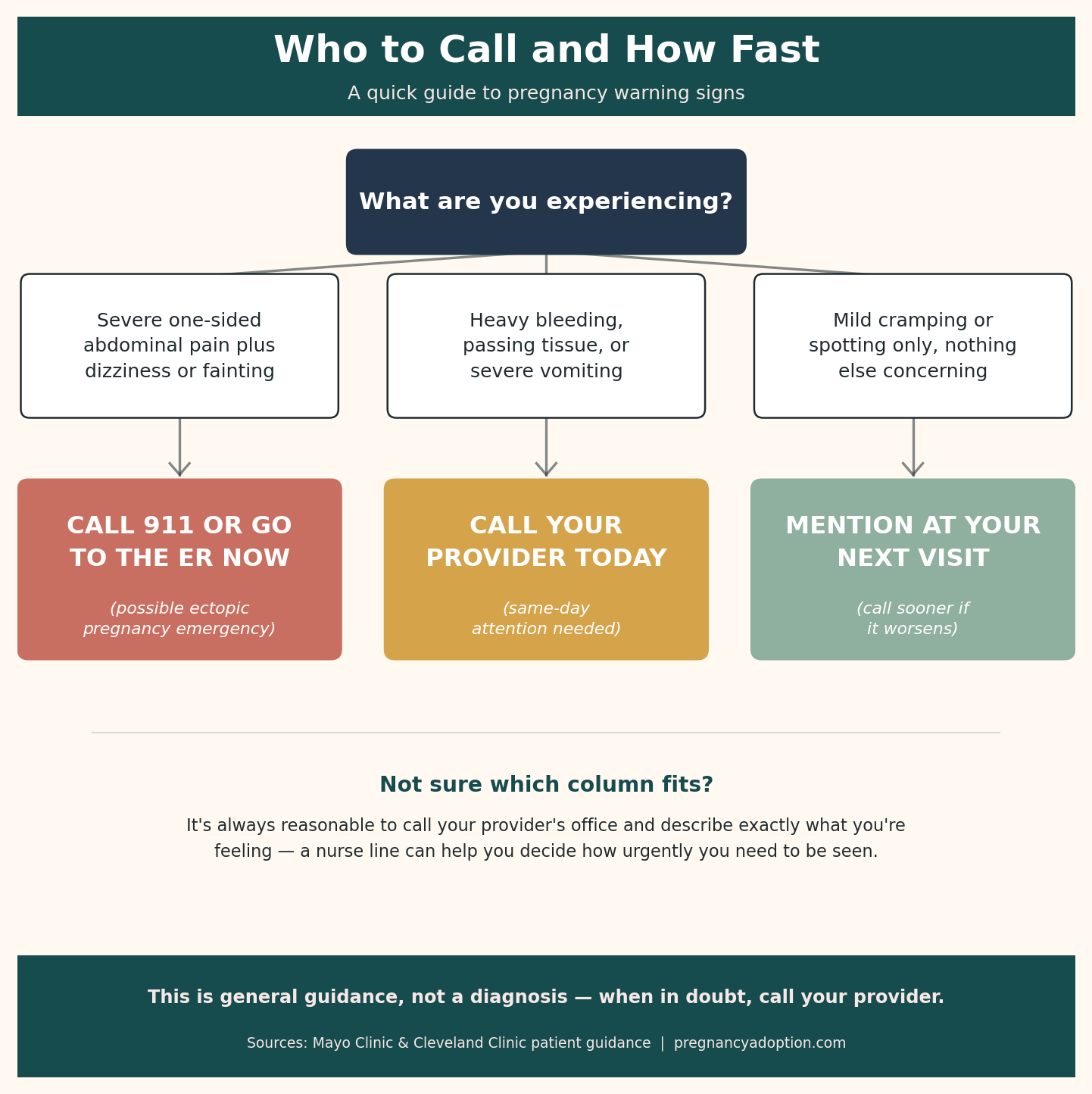
Frequently Asked Questions About Pregnancy Symptoms and Testing
Symptom Questions
Can you have real pregnancy symptoms the day after sex?
No. Because implantation hasn’t happened yet, there’s no hCG in your system and no physiological basis for a true pregnancy symptom within a day of sex. Anything felt that quickly is coincidental or related to something else entirely, such as ovulation, digestion, or simple anxiety about the possibility of pregnancy itself.
Is it normal to have no symptoms at all at 5 weeks?
Yes. Symptom intensity varies enormously from person to person and even from one pregnancy to the next in the same person, as discussed earlier in this guide. Having few or no symptoms at 5 weeks, with a confirmed positive test, is not on its own a cause for concern, and it doesn’t predict anything about how the rest of the pregnancy will feel or how it will progress.
Testing Questions
How many days after a missed period should I test to be sure?
Testing on the day of a missed period is reasonable, but waiting about a week longer meaningfully improves accuracy if an early test comes back negative and your period still hasn’t started, since hCG continues to rise significantly during that extra week.
Can stress or medication cause a false positive?
Ordinary stress does not cause a false positive result on a pregnancy test. Certain fertility medications containing hCG can, for a limited window after the last dose, which is why providers typically advise waiting at least two weeks after an hCG trigger injection before testing at home.
Cost and Access Questions
I don’t have insurance. Can I still get a free pregnancy test?
Yes. HRSA-funded community health centers, many local health departments, and family planning clinics commonly offer pregnancy testing at no cost or on a sliding scale based on income, regardless of insurance status. A locator tool like HRSA’s “Find a Health Center” can identify one near you, and the visit typically comes with a direct path to next steps if the result is positive.
What if I can’t afford prenatal care right now?
Lack of insurance on day one isn’t a reason to delay that first visit. Medicaid presumptive eligibility allows qualified providers in many states to begin prenatal care based on preliminary income information while a full application is processed, and HRSA-funded health centers offer ongoing prenatal care on a sliding fee scale in the meantime. A call to a local health center or your state Medicaid office is a reasonable first step even before you know whether you’ll qualify.
Timeline Questions
How many weeks pregnant am I if I just found out today?
It depends on your last menstrual period, not on the day you found out. Providers count from the first day of your LMP, so if your period was about four weeks ago, you’re typically considered about four weeks pregnant even though you just confirmed it today with a test.
When will I actually see a doctor for the first time?
Many people are seen for a first prenatal visit sometime between weeks 6 and 10 of pregnancy, though this varies by provider and individual circumstances. Call as soon as you have a positive test to get on the schedule, and call sooner if you have any of the warning signs described earlier in this guide.
More Symptom Questions
Can you have period-like cramps and still be pregnant?
Yes. Mild, period-like cramping can occur around implantation and again as the uterus grows and stretches in the early weeks, without meaning anything is wrong. The distinguishing factor isn’t the type of cramping but its severity and what accompanies it — cramping that’s severe, one-sided, or paired with heavy bleeding is different and is covered in the warning signs section above.
Is back pain alone an early pregnancy sign?
Back pain can occur early in pregnancy due to hormonal changes and increased blood flow, but it’s a very nonspecific symptom shared with poor sleep, an existing back issue, stress, or an approaching period. On its own, back pain isn’t a reliable pregnancy indicator; combined with a missed period and other symptoms, it’s part of the broader picture worth testing over.
Pregnancy Loss Questions
If I miscarry, did something I did cause it?
In the large majority of cases, early pregnancy loss is caused by chromosomal factors in the embryo that aren’t related to anything a person did or didn’t do — not exercise, not stress, not sex, and not the intensity or absence of symptoms beforehand. If you’re processing a loss and want to understand what happened medically, your provider can discuss your specific situation, but self-blame based on ordinary daily activities isn’t supported by the clinical picture.
How do I know if bleeding is “just spotting” or something more serious?
The distinguishing features covered earlier in this guide — amount (spotting versus soaking a pad), color, presence of pain, and whether tissue is passed — are the most useful signals, and this guide’s warning signs section lays out which combinations call for a same-day call versus emergency care. When genuinely unsure, calling your provider to describe exactly what you’re seeing is more reliable than trying to self-classify it from a general description online.
Fertility Treatment Questions
Can an hCG trigger shot really cause a false positive after IUI or IVF?
Yes. Because a trigger shot contains the same hormone (hCG) a home test detects, testing too soon afterward can pick up leftover medication rather than a new pregnancy. This is exactly why most clinics advise against home testing in the days immediately following a trigger injection and rely on a scheduled blood test instead.
Why does my clinic want a blood test instead of letting me use a home test?
A quantitative blood test gives an exact hCG number that can be tracked over 48 hours to confirm it’s rising as expected, and it avoids the trigger-shot confusion described above. It also gives your care team more diagnostic information than a simple positive/negative result from a home test could provide.