
If you’re pregnant and adoption has entered your thinking — whether it’s a firm idea, a distant possibility, or just a question you can’t quite put down — you’re in a genuinely different position than the marketing on most adoption websites assumes. Most of what’s easy to find online is written for hopeful adoptive parents: waiting-family profiles, agency fee schedules, “why choose us” pitches. Very little of it is written primarily for you, the expectant parent, in language that treats you as the one making the decision rather than the one being recruited into someone else’s plan.
This guide is written for you specifically. It covers what modern adoption actually involves, the rights that professional adoption-practice standards say you’re entitled to regardless of which agency or attorney you work with, how choosing an adoptive family and an openness level actually works, what happens to consent and your ability to change your mind at each stage, what a hospital plan is, how to recognize pressure or bad-faith practices before they cost you anything, and what support exists if you place a child and are processing what comes after. Nothing here assumes you’ve already decided. If you’re also weighing parenting or ending the pregnancy, our unplanned pregnancy resource covers all three options at comparable depth, and our guide to pregnancy options in the U.S. covers the broader legal landscape connecting them. This guide goes deep specifically on the adoption path — what it’s like to actually walk through it, and what protects you along the way.
The Child Welfare Information Gateway (U.S. Department of Health and Human Services) is a useful national reference alongside the guidance here. The National Council For Adoption also publishes resources specifically for expectant parents weighing this decision.
Key takeaways
- Considering adoption is not a commitment to adoption. You can research, talk to professionals, and even start matching with a family while continuing to weigh parenting — nothing is final until you sign consent after the baby is born, and in many states not even then for a further window.
- You have rights that don’t depend on which agency or attorney you choose. Professional adoption-practice standards, summarized in this guide as ten specific rights, apply regardless of who you’re working with, and a professional who violates them is a reason to look elsewhere, not a reason to doubt yourself.
- Modern adoption is usually open or semi-open, not closed. Most domestic infant adoptions today involve some ongoing contact between the birth parent and the adoptive family, at a level you help define — full closed adoption with no contact is less common than it once was, though it remains an option.
- Legitimate adoptive families and their agencies pay for their own home study, legal fees, and matching services — never you. In most states, they may also lawfully help with your pregnancy-related medical and living expenses, but that support cannot be conditioned on your decision to sign consent.
- Consent cannot legally be signed before birth anywhere in the United States, and most states provide a further window afterward during which you can still change your mind — the length of that window varies significantly by state.
- A pattern of pressure, urgency, or isolation from support is a warning sign, not a normal part of the process. This guide includes a dedicated section on recognizing it and protecting yourself.
Short Answer: What Being “Pregnant and Considering Adoption” Actually Means
If you are pregnant and considering adoption, you are weighing a real, workable option — not a last resort — and this guide walks through what that choice actually involves.
Being pregnant and considering adoption means you’re weighing a specific legal path — continuing the pregnancy, giving birth, and then voluntarily and legally placing the child with another family to raise — as one of your options, without having committed to it. It is a distinct choice from parenting, not a lesser or fallback version of it, and it comes with considerably more legal structure, more of your own input, and more ongoing choice than most people expect walking in.
The One-Paragraph Version
What Happens, in Brief
In a typical modern domestic adoption, an expectant parent connects with a licensed agency or an adoption attorney, reviews profiles of prospective adoptive families and selects one (or asks a professional to help narrow the field), works out a preferred level of ongoing contact, and continues the pregnancy while a plan takes shape. After birth, the expectant parent’s legal consent — which cannot be given beforehand — starts the formal adoption process, which is finalized in court, usually months later. At any point before signing consent, and in most states for some additional window afterward, the plan can change.
What This Guide Assumes About You
This guide doesn’t assume you’ve decided anything. Some readers arrive here having already ruled out parenting and abortion for their own reasons and want to understand adoption specifically; others are comparing all three options and want adoption explained at the same depth as the others get elsewhere on this site; others have already started an adoption plan and want to understand a right or a step more clearly. All three are the right reason to be reading this.
How to Use This Guide
Read in Any Order That Serves You
Each section is written to stand largely on its own, so if you already know you want to understand your legal rights, or how expenses work, or what a hospital plan involves, you can jump directly to that section rather than reading start to finish. The glossary near the end is a fast way to look up an unfamiliar term if one comes up mid-conversation with a professional.
What This Guide Doesn’t Cover
This guide focuses on your rights and decisions as the expectant/birth parent. It doesn’t provide a full step-by-step walkthrough of the adoptive-parent side of the process — the home study, matching algorithms used by agencies, or post-placement supervision requirements adoptive families go through — since that’s a different audience’s process, covered only briefly here where it affects your own timeline. A dedicated, audience-neutral guide to the full mechanics of how adoption works is planned for this site as part of a forthcoming adoption-process series. This guide also doesn’t cover foster care adoption or international adoption, which involve different legal frameworks entirely.
Is Adoption Right for You? A Framework for Thinking It Through
There’s no test that produces a correct answer here, and anyone who implies otherwise — including a well-meaning friend, a family member, or an adoption professional — is offering their own opinion, not a fact. What follows is a framework for thinking it through on your own terms, not a checklist that adds up to a verdict.
Questions Worth Sitting With, Not Answering Quickly
What Does Parenting This Child Right Now Actually Look Like?
Not parenting in the abstract — parenting specifically, given your actual current circumstances: your housing, your income and support system, your health, and anything else genuinely relevant to you. It’s worth being honest about what’s realistically fixable in the next several months (a job, a living situation) versus what isn’t, and separating “I don’t have this yet” from “I have no path to this,” since those are different situations that call for different next steps. Our unplanned pregnancy guide’s support-resources section covers the financial and practical assistance available to parents specifically, which is worth reviewing before ruling parenting out on resource grounds alone.
What Does Adoption Actually Offer That Parenting Right Now Doesn’t?
For some people, it’s stability for the child that they can’t currently provide. For others, it’s not being ready — emotionally, financially, or in terms of life stage — without that meaning anything negative about their capacity to parent well at a different point in life. For others, it’s a specific circumstance: a relationship, a health situation, an already-full family. There’s no ranking of “good enough” reasons; the honest answer for you is the useful one, not the most flattering one.
What Would You Need to Feel at Peace With Either Choice?
Some people find it useful to imagine each path a year out, and notice which anxieties feel manageable and which feel like they’d follow them regardless of outcome. This isn’t a reliable predictor of how you’ll actually feel — nothing is — but it can surface a concern worth naming out loud to a counselor or professional rather than carrying silently.
Talking It Through Without Being Talked Into Anything
Neutral Options Counseling Exists for Exactly This
A counselor who isn’t affiliated with a single adoption agency, and who has no financial stake in which option you choose, can walk through parenting, adoption, and abortion with you without steering you toward any of them — our unplanned pregnancy guide covers how to identify genuinely neutral counseling and what to expect from it in more depth than this section does.
Talking to an Adoption Professional Is Not a Commitment
Calling an agency or an adoption attorney to ask questions, or even beginning to review family profiles, does not obligate you to place a child for adoption. Reputable professionals understand this and will tell you so directly; if a professional’s language implies otherwise — that reaching out means you’re “in the process now” — that’s worth noticing, and it’s covered further in this guide’s red-flags section.
You Can Hold More Than One Option Open at the Same Time
It’s entirely reasonable to begin reviewing adoptive family profiles while still genuinely undecided, to start prenatal care without having ruled out adoption, or to change your mind more than once as the pregnancy progresses. None of this makes you difficult to work with or dishonest — an ethical professional expects and plans for genuine uncertainty, since forcing an early, artificial certainty serves no one well, including the prospective adoptive family.
What Modern Adoption Looks Like Today
A lot of the discomfort people feel about adoption comes from an outdated picture of it — one shaped by decades-old stories of closed records, no contact, and expectant mothers with very little say in the process. Modern domestic infant adoption, as it’s actually practiced by licensed agencies and adoption attorneys today, looks meaningfully different, and it’s worth updating that mental picture before deciding whether the option fits you.
You Are the Expectant Parent, Not Yet a “Birth Mother”
Language Reflects Where You Actually Are
Before you’ve made and finalized a placement decision, you’re an expectant parent or a pregnant person considering adoption — the term “birth mother” (or “birth father”) only accurately applies after a legal placement has actually occurred. This isn’t just a semantic nicety: using “expectant parent” throughout the process, rather than a term that presumes an outcome, reflects the fact that you remain the child’s legal parent with full parental rights until you sign consent and, in many states, for some additional window afterward.
“Placing” or “Making an Adoption Plan,” Not “Giving Up”
You’ll see the phrase “give up a baby for adoption” in search results and in casual conversation, and it’s a phrase this guide uses only to acknowledge it, not to describe the process accurately. “Making an adoption plan” or “placing a child for adoption” better reflects what’s actually involved: an active, legal, considered process in which you retain meaningful decision-making authority throughout, not a passive loss of control.
What’s Genuinely Different From the Adoption of Decades Past
You Generally Choose the Adoptive Family, Not the Reverse
In most modern domestic infant adoptions, the expectant parent reviews profiles of prospective adoptive families — often called “family profiles” or “Dear Birth Mother” letters, though the format varies by agency — and selects one, rather than an agency or family selecting a birth parent from a pool of candidates. This guide’s section on choosing an adoptive family covers what that process actually involves and what you can typically specify.
Contact After Placement Is the Norm, Not the Exception
Most domestic infant adoptions today are open or semi-open to some degree, meaning some level of ongoing contact or information exchange between you and the adoptive family continues after placement — the next section covers this spectrum in detail. Fully closed adoption, with no post-placement contact and no identifying information exchanged, remains available in every state but is the less common arrangement today.
Professional Standards Exist, Even Though Practice Still Varies
National organizations including the National Council for Adoption have published explicit standards for how expectant parents should be treated throughout the process — covered in full in this guide’s rights section — and licensed agencies and adoption attorneys are expected to meet them. Standards existing doesn’t guarantee every professional meets them in practice, which is exactly why this guide also includes a dedicated section on recognizing when they aren’t being met.
For a full step-by-step walkthrough of how the process unfolds from matching through finalization, see our guide to how adoption works.
Key Takeaways
- You remain the child’s legal parent, with full parental rights, until you sign consent — nothing before that point is legally binding.
- Modern adoption typically involves choosing the adoptive family yourself and maintaining some level of contact afterward, not a one-way, anonymous handoff.
- Professional standards for how you should be treated exist and are described in detail later in this guide — knowing them in advance helps you recognize when a specific agency or attorney isn’t meeting them.
Open, Semi-Open, and Closed Adoption: Understanding the Spectrum
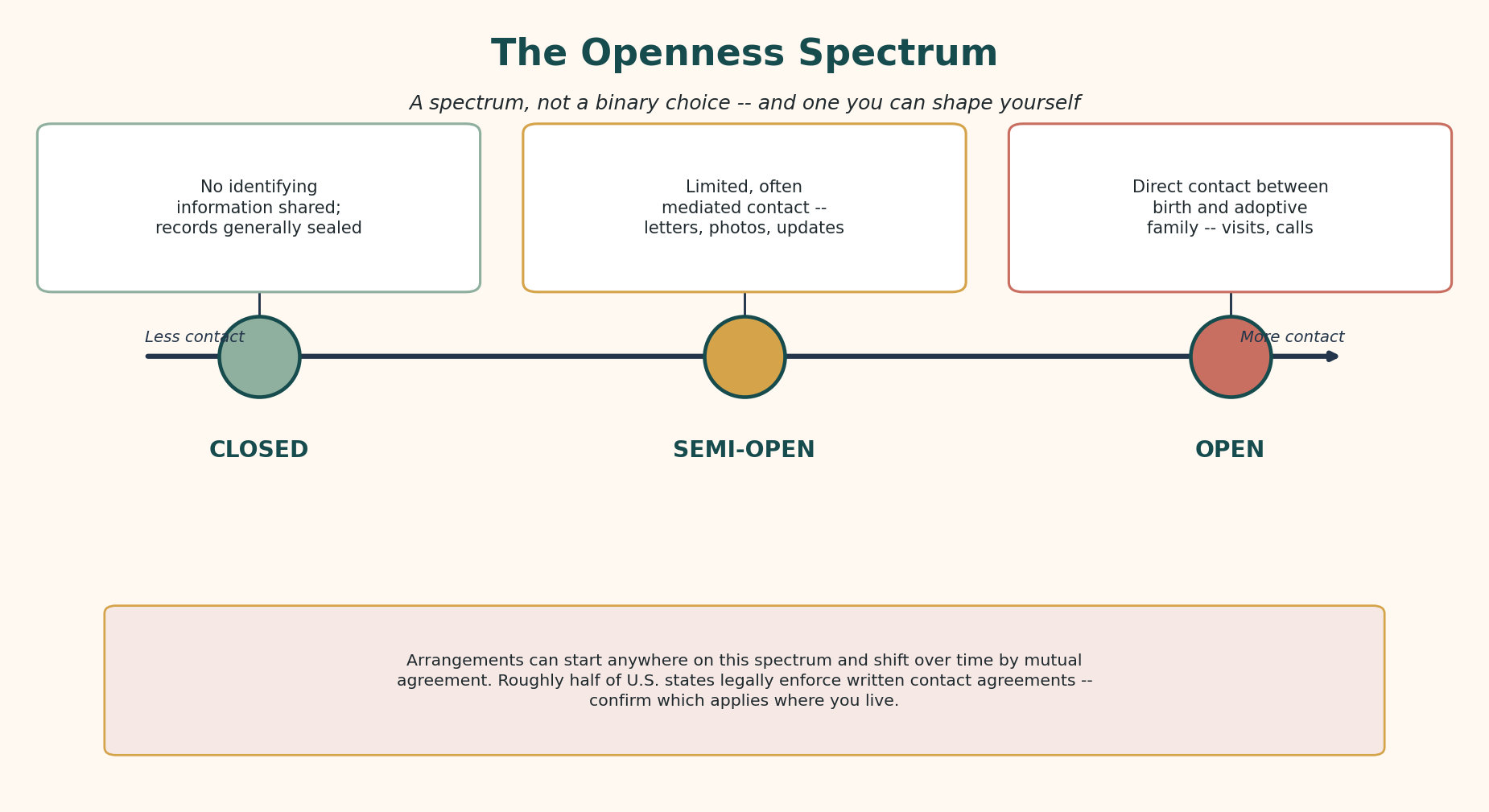
“Open adoption” and “closed adoption” get used as though they’re two fixed options, but in practice openness is a spectrum, and most arrangements land somewhere in the middle with terms specific to the people involved rather than matching a textbook definition exactly.
The Three General Categories
Closed Adoption
In a closed adoption, no identifying information is exchanged between the birth parent and the adoptive family, and there’s no direct post-placement contact. Some closed adoptions include limited, non-identifying updates passed through an agency (a photo or a general health update, without names or addresses), while others involve no ongoing exchange at all. Closed adoption was the dominant model for most of the 20th century and remains a legitimate choice today for anyone who prefers it, though it’s the least common arrangement in current domestic infant adoption.
Semi-Open Adoption
A semi-open adoption typically involves some exchange of information or contact, but managed at a distance — often through an agency, a designated intermediary, or a private online platform rather than direct, unmediated contact. This might mean periodic letters and photos exchanged through the agency, occasional emails, or scheduled updates, without necessarily exchanging home addresses or last names.
Open Adoption
A fully open adoption typically involves direct contact between the birth parent and adoptive family — this can range from occasional texts and photos to regular visits, phone calls, and shared holidays, depending on what both parties agree to and how the relationship develops over time. Open adoption does not mean shared custody or shared legal parenting; the adoptive family retains full legal and day-to-day parenting authority, and openness describes the relationship and information-sharing, not the legal structure.
| Arrangement | Typical contact | Identifying information shared? |
|---|---|---|
| Closed | None, or occasional non-identifying updates through the agency | No |
| Semi-open | Periodic letters, photos, or messages, usually managed through an agency or intermediary | Sometimes, by mutual agreement — often first names only |
| Open | Direct contact: calls, texts, visits, shared events, at a frequency both parties agree to | Yes, typically |
These are general descriptions, not fixed legal categories — real arrangements are individually negotiated and often blend elements of more than one category, and the right level for you is a personal decision, not a default to accept.
Post-Adoption Contact Agreements: What They Are and What They’re Worth Legally
Putting the Agreed Level of Contact in Writing
A post-adoption contact agreement (sometimes called a PACA, or an open adoption agreement) is a written document specifying the type and frequency of contact both sides have agreed to — for example, photos twice a year, an annual visit, or a specific communication method. Having the agreement in writing, even in a state where it isn’t legally enforceable, is still worth doing: it creates a clear shared reference point and a record of what was actually agreed to, which matters even without a court able to enforce it.
Enforceability Genuinely Depends on Your State
This is one of the most misunderstood aspects of open adoption: roughly half of U.S. states have laws making post-adoption contact agreements legally enforceable in court, while the other half do not, meaning an adoptive family in those states can lawfully decide to reduce or end contact even if a written agreement said otherwise. In states without enforceability, there is generally no legal recourse if an adoptive family stops honoring an agreement — a licensed agency may decline to work with that family again, but that’s a professional consequence, not a legal one, and it doesn’t restore contact. Because this varies so significantly by state and can change, ask directly — before finalizing an agency or a specific family — whether post-adoption contact agreements are enforceable in your state, and if not, understand that any agreement rests on the good faith of the adoptive family rather than a legal guarantee.
Even Where Enforceable, Courts Weigh the Child’s Well-Being
In states that do enforce these agreements, a court can still modify or void one if maintaining the agreed contact would be unsafe or harmful to the child — enforceability isn’t absolute, and it’s balanced against the child’s welfare rather than treated as a rigid contract in every circumstance.
Openness Can Change Over Time
What’s Agreed at Placement Isn’t Necessarily Permanent
Many open and semi-open relationships evolve — sometimes toward more contact as trust builds, sometimes toward less as life circumstances change on either side. A thoughtful initial agreement anticipates this rather than assuming the exact terms at placement will hold unchanged for eighteen years, and many agencies build in a process for revisiting the arrangement periodically.
Choosing Your Own Comfort Level Matters More Than Choosing the “Right” Answer
There’s no research consensus that any one openness level is uniformly best for birth parents, adoptive families, or children — what matters most is that the level chosen reflects genuine preferences on both sides rather than one side’s preference or a professional’s default recommendation. If you’re unsure what level you want, it’s reasonable to say so directly and ask for time to think it through, rather than agreeing to an arrangement that doesn’t feel right in order to keep things moving.
For a deeper look at how each level actually works day to day, see our guides to open adoption and closed adoption, including how contact, boundaries, and records differ between them.
The Ten Rights Every Expectant Parent Considering Adoption Has
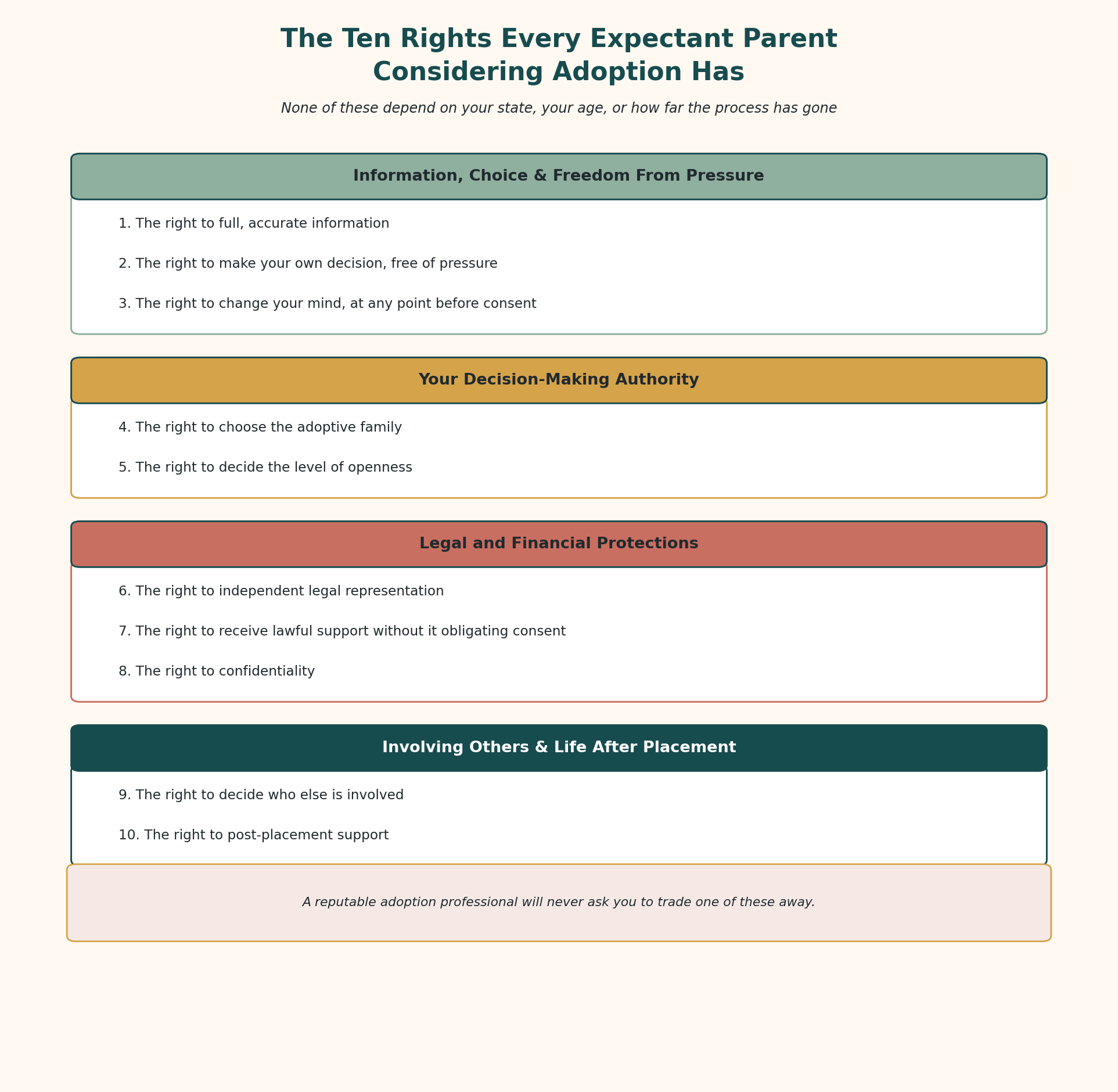
The National Council for Adoption — a national nonprofit organization focused on adoption policy and ethics — has published an explicit list of rights expectant parents considering adoption should be able to expect from any licensed agency or adoption professional they work with. These aren’t legally binding in the way a statute is, but they represent the current professional consensus on ethical practice, and a professional who consistently falls short of them is worth reconsidering, whatever else about them seems appealing. This section walks through all ten in detail.
Information, Choice, and Freedom From Pressure
The Right to Full Options Counseling and Education
You’re entitled to comprehensive, honest information about all of your pregnancy options — not just adoption — including a fair discussion of the genuine benefits and challenges of each. A professional whose only real subject is adoption, and who deflects or minimizes questions about parenting or ending the pregnancy, isn’t providing the full counseling this right describes; that’s a reasonable moment to seek a separate, neutral counseling resource alongside whatever adoption-specific conversations you’re having.
The Right to Clear Disclosure of Services and Costs
Before you become a client of any kind, a legitimate agency or attorney should give you a written explanation of the services they provide, what those services cost (to be clear: costs to the adoptive family, not to you — more on this in the expenses section), and how their role differs from other types of adoption professionals. If a professional is vague about what they actually do, how they’re compensated, or how they differ from an agency versus an attorney versus a facilitator, ask directly rather than assuming the distinction doesn’t matter to your situation.
The Right to a Pressure-Free Environment
Ethical practice calls for expectant parents and adoptive families to have separate points of contact — separate counselors, separate advocates — specifically so that neither side feels pressured by proximity to the other’s hopes or disappointment. You’re entitled to make your decision based on your own circumstances and preferences, not on a sense of obligation to a specific family you’ve been introduced to or grown to like.
Your Decision-Making Authority
The Right to Change Your Mind Within Legal Timeframes
Up until you sign legal consent — and in most states, for some further window afterward — you retain the right to change your mind and decide to parent instead, without threats, guilt, or intimidation from anyone involved. This right deserves to be presented to you clearly and without hedging by any professional you work with, not treated as an awkward possibility nobody quite wants to mention. This guide’s section on consent and revocation covers exactly when that window opens and closes.
The Right to Choose the Adoptive Family
You’re entitled to review multiple screened, home-study-approved families rather than being steered toward whichever one a professional presents first, and to choose based on what actually matters to you — geography, family structure, religious background, parenting philosophy, openness preferences, or anything else relevant to how you picture the child’s future. The next major section but one covers what this selection process typically looks like in practice.
Legal and Financial Protections
The Right to Independent Legal Counsel
You’re entitled to your own attorney — separate from any attorney representing the adoptive family — to explain your state’s adoption laws, your parental rights, and the specific consequences of the paperwork you’re being asked to sign, and in most established adoption arrangements this representation is provided to you at no personal cost. An adoptive family’s attorney cannot ethically represent you as well, since your interests and theirs can genuinely diverge at exactly the moments that matter most (timing of consent, expense questions, contact terms) — the professional-selection section covers this conflict-of-interest issue further.
The Right to Determine Openness and Confidentiality
As covered in the previous section, the level of contact and information-sharing after placement is yours to help define, through a clear written agreement, rather than a term imposed on you by an agency’s default policy or an adoptive family’s unstated preference.
The Right to Help With Pregnancy-Related Expenses
Where lawful in your state, you’re entitled to assistance with legitimate pregnancy and childbirth-related costs, along with connections to broader community resources you may qualify for regardless of your ultimate decision — without that assistance being used as leverage or a coercive financial tactic. This guide’s expenses section covers what’s typically allowed, what isn’t, and why the distinction exists.
Involving Others and Life After Placement
The Expectant Father’s Right to Appropriate Involvement
When an expectant father wishes to participate, he’s entitled to his own counseling and a meaningful role in decisions, facilitated appropriately by the professionals involved — his involvement (or the specific legal steps required when he isn’t involved, or can’t be located) is covered in more detail in this guide’s section on birth fathers and other legal parents.
The Right to Post-Placement Support
If you place a child, you’re entitled to ongoing support afterward — grief counseling, connection with other birth parents who understand the experience firsthand, and guidance navigating an open or semi-open relationship as it evolves over the years. A professional relationship that effectively ends the day placement is finalized, with no further support offered, falls short of this standard; this guide’s section on life after placement covers what good post-placement support typically looks like and where to find it independently if your agency doesn’t provide it.
These rights are grounded in state law, which varies in important ways — see our guide to birth mother rights for a state-by-state look at consent, revocation, and notice requirements.
Key Takeaways
- These ten rights reflect current professional consensus on ethical adoption practice, not a legal guarantee — but a professional who consistently falls short of them is a reasonable professional to reconsider.
- Independent legal counsel, freedom from pressure, and the ability to change your mind are not favors a good agency does for you — they’re baseline expectations.
- Post-placement support doesn’t end at finalization; it’s part of what a genuinely supportive professional relationship includes.
Choosing an Adoption Professional: Agency, Attorney, or Facilitator
Who you work with shapes almost everything else about your experience — how much support you get, how thoroughly your rights are protected, and how the legal process actually unfolds. The three main categories of adoption professional differ more than their similar-sounding names suggest.
Licensed Adoption Agencies
What They Do
A licensed adoption agency is a state-licensed organization that provides comprehensive adoption services: counseling, matching you with prospective adoptive families, coordinating the home study process for those families, and generally supporting both sides through placement and often beyond. Agencies are subject to state licensing requirements and oversight, which is a meaningful protection compared with an unlicensed intermediary.
What They Can’t Do
An agency generally cannot represent you legally in court — that requires an attorney, either one the agency works with regularly or one you or the agency retains specifically for your legal representation, separate from any attorney representing the adoptive family.
Adoption Attorneys
What They Do
An adoption attorney handles the legal side of the process directly: drafting and filing the required paperwork, guiding consent and, where applicable, interstate placement compliance, and representing a party’s interests through court finalization. Some adoption attorneys also help connect expectant parents with prospective adoptive families, functioning somewhat like an agency in that respect, though this varies by attorney and by state.
What They Can’t Do
An attorney representing the adoptive family cannot also ethically represent you — this is the conflict-of-interest issue raised in the rights section above. If an attorney offers to “help both sides” without separate representation, that’s a signal to ask directly how your specific interests are being protected, not an efficiency to appreciate.
Adoption Facilitators, and Why They Warrant Extra Caution
What They Do
A facilitator’s role is narrower: connecting expectant parents with prospective adoptive families, then referring both sides to a licensed agency or attorney to actually complete the legal process. A facilitator is not the one handling your legal rights, your counseling, or the finalization itself.
Why Licensing Status Matters Here Specifically
Many adoption facilitators are not licensed, and a number of states prohibit or heavily restrict the use of facilitators entirely — this is the single most important thing to check before working with one. Ask directly whether a facilitator is licensed in your state, and if facilitation isn’t permitted where you are, that arrangement isn’t a viable path regardless of how it’s presented to you.
| Professional type | Primary role | Handles legal finalization? | Licensing |
|---|---|---|---|
| Licensed adoption agency | Full-service: counseling, matching, home study coordination, often post-placement support | No — refers to or works alongside an attorney | State-licensed and regulated |
| Adoption attorney | Legal representation, paperwork, consent, court finalization; sometimes also matching | Yes | State bar admission; adoption-law experience varies by attorney |
| Adoption facilitator | Connects expectant parents and adoptive families, then refers out for legal completion | No | Frequently unlicensed; prohibited or restricted in some states — verify before proceeding |
Whichever type of professional you’re considering, verifying current state licensing status directly — rather than taking a website’s claim at face value — is a reasonable and expected step, not an insult to the professional.
Questions Worth Asking Before You Commit to Anyone
About Licensing and Track Record
Is this agency or attorney currently licensed in my state? How long have they been operating, and can they connect me with a birth parent who’s worked with them before? What happens if I decide not to place after we’ve started working together — is there any cost or consequence to me?
About Structure and Support
Will I have my own point of contact, separate from whoever is working with the adoptive family? Is independent legal counsel provided for me, and at what cost? What ongoing support is available after placement, and for how long?
Choosing the Adoptive Family
For most people new to adoption, this is one of the more surprising parts of the modern process: you generally choose, rather than being chosen.
How Family Profiles Work
What a Profile Typically Includes
Prospective adoptive families create a profile — sometimes a printed book, sometimes a website or video, often called a “Dear Birth Mother” letter historically, though that specific framing is less universal today — describing who they are, their home and community, their values, and why they want to adopt. Agencies and attorneys generally screen and home-study-approve families before their profiles are shown to expectant parents, which is a meaningful vetting step already completed by the time you’re looking at a given family.
What You Can Typically Specify
Most agencies let you specify preferences in advance — geographic region, family structure (married couple, single parent, same-sex couple), religious or cultural background, whether the family already has other children, and your preferred openness level — and will narrow the profiles they show you accordingly, rather than presenting every family in their pool regardless of fit.
Making the Selection
There’s No Required Number of Profiles to Review
Some people know quickly after reviewing a handful of profiles; others want to review many more, or to have a phone call or meeting with a family before deciding, which most agencies can arrange. Feeling like you need to decide quickly, or that only one family has been made available to you, is worth naming directly to your professional — you’re entitled to a genuine selection, not a single option.
What to Actually Look For Beyond the Surface Presentation
A polished profile reflects effort, not necessarily fit — it’s reasonable to look past the presentation itself toward the specific values, plans, and answers a family gives about openness, discipline philosophy, and how they intend to talk with the child about adoption as they grow up. Direct conversation, where possible, usually reveals more than a profile document alone.
Changing Your Mind About a Specific Family Is Different From Changing Your Mind About Adoption
If you’ve selected a family and later feel it isn’t the right fit, that’s a separate and entirely legitimate decision from deciding not to place at all — a good agency can help you select a different family without treating the request as evidence you’re not serious about your decision.
If you want a complete checklist-style walkthrough of placing a baby for adoption from this point forward, see our guide on how to place a baby for adoption.
Medical and Living Expenses: What’s Allowed and How It Works
Money is one of the most sensitive and most misunderstood parts of adoption, largely because the underlying legal concern — preventing adoption from resembling a payment for a child — creates rules that can feel confusing or even suspicious from the outside. Understanding the actual framework helps.
Why This Is Regulated So Specifically
The Core Concern: Preventing Baby-Selling and Coercion
Every state regulates what adoptive families and agencies can lawfully pay toward an expectant parent’s expenses, for one central reason: without limits, financial support could function as an inducement to place a child, effectively treating parental rights as something purchased rather than voluntarily relinquished. The specific categories and limits vary by state, but the underlying goal — support that helps you get through the pregnancy without becoming leverage over your decision — is consistent nationwide.
Support Cannot Be Conditioned on Your Final Decision
Lawfully provided living or medical expenses do not, and legally cannot, obligate you to sign consent for adoption. If you receive support during the pregnancy and later decide to parent instead, you are not required to repay it in a properly structured, lawful arrangement — a professional who suggests otherwise, or who frames assistance as something you’ll “owe” if you change your mind, is describing something inconsistent with how legitimate adoption expense arrangements are supposed to work, and it’s worth raising directly or seeking a second opinion.
What’s Typically Allowed
The General Principle: Documented, Itemized, and Genuinely Tied to Need
Across the states that regulate this most explicitly, the pattern is consistent even though the specific dollar limits differ: expenses have to be real, itemized, and connected to genuine pregnancy-related need, rather than a round, unexplained sum. This is why an agency or attorney will typically ask for receipts, lease agreements, or utility bills rather than simply handing over a lump sum — the paper trail is what keeps the arrangement lawful.
Where the Line Gets Drawn
The clearest, universal line is the one separating support for your actual pregnancy-related needs from anything that starts to resemble payment for the child itself or for your decision — the table below reflects this distinction as it’s commonly applied, though the specific categories and caps are set state by state.
| Category | Typical status |
|---|---|
| Pregnancy-related medical care and childbirth costs | Commonly permitted, often within limits and requiring documentation |
| Reasonable living expenses (rent, utilities, basic phone, groceries) during pregnancy, tied to genuine hardship | Commonly permitted in many states, within limits set by state law |
| Counseling services related to the adoption decision | Commonly permitted |
| Legal fees for your own independent representation | Commonly permitted and often provided at no cost to you |
| A payment for “finding” or “locating” you as an expectant parent | Commonly prohibited |
| Vague, unitemized lump-sum payments without documented services or costs | Commonly prohibited |
| Any payment framed as compensation for the child or for signing consent | Prohibited everywhere — this is the core baby-selling prohibition |
This table describes a general nationwide pattern illustrated by state regulatory frameworks reviewed during research (including Florida’s, which explicitly requires itemized documentation and explicitly states that expense payments do not obligate consent). Specific dollar limits, allowable categories, and documentation requirements vary by state — an adoption attorney licensed in your state can confirm exactly what’s permitted where you are.
How the Payment Process Actually Works
Documentation and Oversight
States generally require the adoptive family or agency to keep detailed, itemized records of every expense paid on your behalf, often submitted to the court as an affidavit before finalization — this isn’t paperwork designed to make your life harder, it’s the mechanism that keeps the arrangement transparent and lawful for everyone involved.
Who Actually Pays
In a legal domestic adoption, the adoptive family (directly or through their agency) covers their own home study, legal fees, and matching costs, and, where permitted, your pregnancy-related expenses — you are never expected to pay an agency, attorney, or facilitator out of pocket for adoption services themselves.
Support Beyond What Adoption-Specific Funds Cover
General Pregnancy Resources Remain Available Regardless of Your Decision
Medicaid, WIC, and other pregnancy-related support programs are available based on your own eligibility, independent of whether you ultimately choose adoption, and don’t require going through an adoption agency at all — our unplanned pregnancy guide’s support-resources section covers these programs in detail and is worth reviewing alongside anything an agency offers.
Applying for These Programs Doesn’t Signal a Decision Either Way
Applying for Medicaid, WIC, or another general support program is not a statement about whether you’re parenting or placing — these are pregnancy-based benefits available to you simply because you’re pregnant, and using them alongside an active adoption plan, or instead of one, doesn’t create any inconsistency worth worrying about.
Consent, Revocation, and Finalization: The Legal Timeline
This is the section with the most legally significant, state-variable content in this guide — and also the section where knowing the general framework in advance matters most, since it directly shapes how much genuine flexibility you have and for how long.
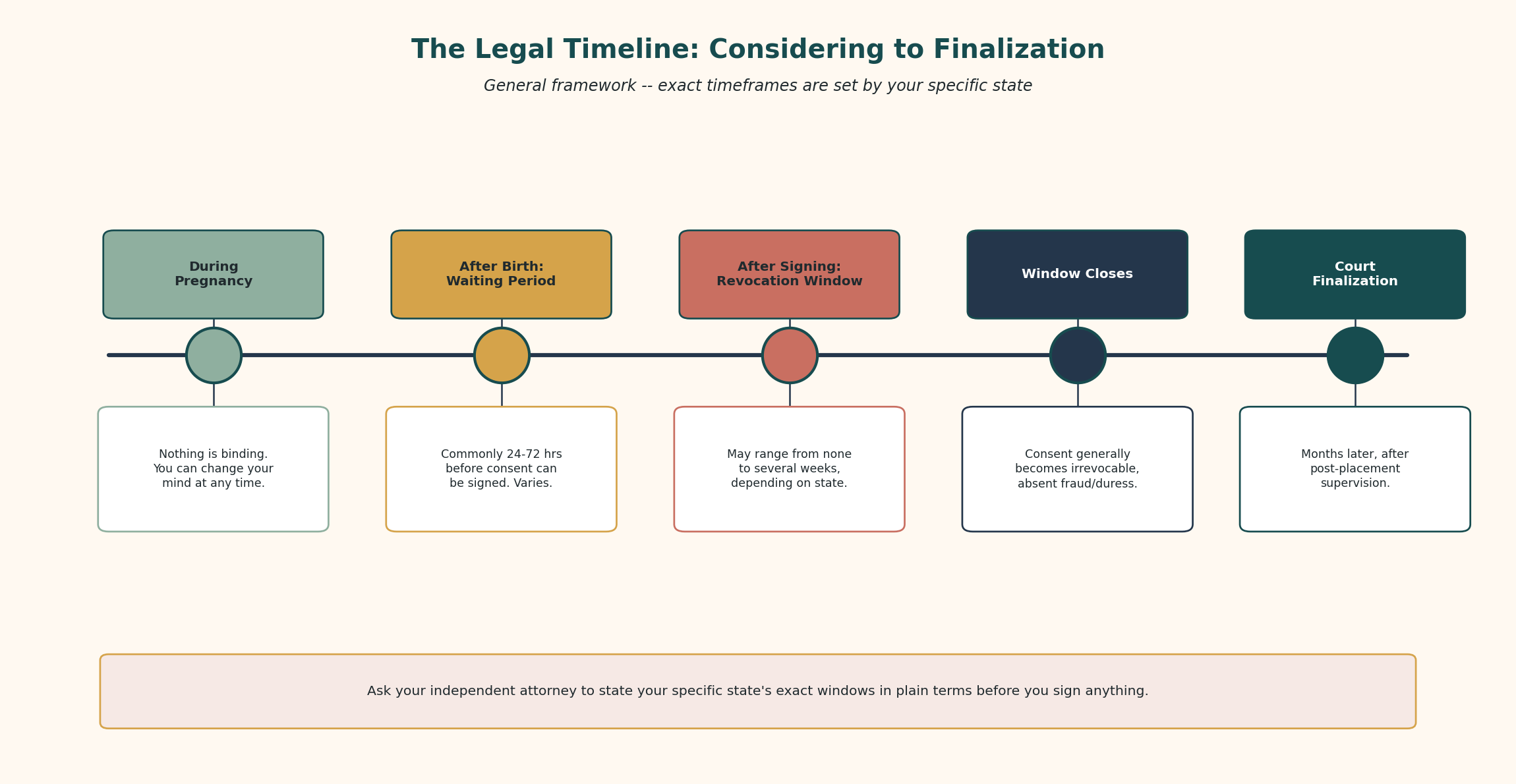
Before Birth: Nothing Is Legally Binding
Consent Cannot Be Signed Before Birth, Anywhere in the U.S.
In every U.S. state, a legally binding consent to adoption cannot be signed until after the child is born. This means that no matter how far along a plan is — a family chosen, a hospital plan written, expenses already received — you retain full legal parental rights and the ability to change your mind at any point up until birth and beyond, described next.
Pre-Birth Agreements Are Not Enforceable Consent
Some states allow a pre-birth “matching” agreement or letter of intent, but these are not legal consent and cannot be enforced to compel you to sign consent after birth — they function more as a statement of current intention than a binding commitment, and understanding this distinction matters if a professional’s language blurs the two.
After Birth: Consent and the Revocation Window
A Minimum Waiting Period Applies Almost Everywhere
Most states require a minimum waiting period after birth — commonly in the range of 24 to 72 hours, though this varies — before legal consent can be signed, giving you time after delivery before being asked to make the decision final.
Revocation Periods Vary Significantly and Matter Enormously
After signing consent, many — but not all — states provide a further window during which you can revoke that consent and reclaim parental rights before the adoption is finalized in court. The length of this window differs dramatically: some states provide no revocation period at all once consent is properly signed, while others provide a period of days to a few weeks, and some states distinguish revoking consent outright from contesting finalization on other narrower grounds (such as fraud or duress). Ask your independent attorney to state your specific state’s revocation rule in plain terms before you sign anything — this is one of the most consequential facts in the entire process, and it should never be left ambiguous.
| Stage | What’s true at this stage |
|---|---|
| During pregnancy | No consent is possible; any agreement is non-binding and can change at any time |
| Immediately after birth | A minimum waiting period (commonly 24–72 hours, varies by state) applies before consent can be signed |
| After signing consent | A revocation window may apply, varying from none to several weeks depending on the state — confirm yours specifically |
| After any revocation window closes | Consent is generally final and irrevocable absent fraud or duress |
| Court finalization | Typically occurs months after placement, following a post-placement supervision period for the adoptive family |
This is a general framework, not a substitute for state-specific legal advice — exact timeframes and conditions vary by state and can change. Your independent adoption attorney should confirm the precise rule that applies to your situation before you sign anything.
Finalization: The Last Legal Step
What Happens Between Placement and Finalization
After the revocation window (if any) closes, the adoptive family typically undergoes a post-placement supervision period — additional visits or check-ins with a social worker, required by the state before the adoption is legally finalized in court, generally taking several months. This period doesn’t reopen your own revocation rights once your specific window has closed; it’s a separate requirement on the adoptive family’s side of the process.
What Finalization Legally Changes
Court finalization is the point at which the adoption becomes legally permanent and a new birth certificate is generally issued listing the adoptive parents. Before this point, especially during any revocation window, the legal picture can still change; afterward, it generally cannot, barring the kind of narrow legal challenges (fraud, duress) mentioned above.
The Birth Father and Other Legal Parents
An adoption plan generally requires addressing the legal rights of the child’s other biological or legal parent, which can be straightforward or genuinely complicated depending on your specific situation.
When the Birth Father Is Known and Involved
His Own Legal Rights and Consent
If the biological father is known and involved, he generally has his own legal rights that must be addressed — in most cases, his consent is also required for the adoption to proceed, and he’s entitled to his own counseling and role in decisions, as covered in this guide’s rights section. If you and the biological father agree on the adoption plan, this part of the process is usually more straightforward than the situations described below.
If You and the Biological Father Disagree
If he opposes the adoption while you’re considering it, this becomes a more complex legal situation specific to your state’s parentage and custody law — our guide to pregnancy options in the U.S. covers the broader legal framework for how parentage and custody disputes are generally handled, though a family law attorney is essential for a specific, contested situation like this one.
When the Birth Father Is Unknown, Unreachable, or Uninvolved
Putative Father Registries
Most states maintain a putative father registry — a state system allowing a man who believes he may have fathered a child to register that possibility, which then entitles him to notice of any adoption proceeding. If a man doesn’t register within his state’s specific window, he generally forfeits the right to notice and can lose the ability to contest the adoption later, even if he didn’t know about the pregnancy. Registration windows vary significantly: some states allow only a matter of days after birth, while others allow a longer window, and most states allow registration before birth as well. Roughly a third of states don’t maintain a formal registry at all and instead rely on a court-ordered search or inquiry process to attempt to identify and notify a potential father.
Diligent Search Requirements
In states without a registry, or in addition to one, courts generally require a documented “diligent search” effort to locate and notify a known or possible father before an adoption can proceed without his consent — this is a legal safeguard for his rights, and your attorney will guide you through what it requires in your specific situation, including what happens if a genuine, good-faith search doesn’t locate him.
Why This Matters to You Directly
An adoption that proceeds without properly addressing the biological father’s rights — skipping required notice, search, or registry checks — can be vulnerable to a later legal challenge, which is deeply disruptive for everyone involved, including the child. This is one of the clearest reasons independent legal counsel matters: your attorney’s job includes making sure this part of the process is done correctly the first time.
Other Legal-Parent Situations Worth Knowing About
A Legal Father by Marriage, Even Without a Biological Connection
If you’re married, your spouse may be presumed the child’s legal father under your state’s parentage law even if he isn’t the biological father, depending on your state’s specific presumption rules — this needs to be addressed directly with your attorney, since it can affect whose consent is legally required regardless of biology.
Situations Involving Assisted Reproduction or a Known Donor
If the pregnancy involved a sperm donor, parentage rules for the donor’s legal status vary by state and by whether a written agreement exists; our guide to pregnancy options in the U.S. covers general parentage-law frameworks including donor-conception situations in more depth than this guide does.
Making a Hospital Plan
A hospital plan is a written document, prepared in advance with your adoption professional, describing what you want to happen at the hospital around the time of birth and immediately after — and it’s worth taking seriously, since decisions made in the moment, during labor and delivery, are harder to think through clearly than decisions made calmly in advance.
What a Hospital Plan Typically Covers
Who Is Present and Who Isn’t
A hospital plan can specify who you want in the delivery room, whether you want the prospective adoptive parents present for the birth or to visit afterward (or not at all), and who you want to be the first to hold the baby. There’s no standard answer here — some expectant parents want the adoptive family closely involved from the first moments; others prefer time alone with the baby first, or no adoptive-family presence at the hospital at all. Every hospital has its own specific policies, and no universal protocol applies everywhere — ask your specific hospital’s social worker or maternity staff directly about their adoption-related procedures well before your due date.
Naming and Medical Decision-Making
You generally retain the right to name the baby, at least until consent is signed, and to make medical decisions for the baby during the hospital stay, since you remain the legal parent throughout this period. Your hospital plan can specify how you want naming and any medical decisions handled, including whether you want input from the adoptive family on either.
Discharge Planning
The hospital plan should also address what happens at discharge — whether the baby leaves with you, with the adoptive family (sometimes possible in states allowing a hospital-based physical transfer before formal consent, subject to your state’s specific rules), or under another arrangement your professional can explain for your state specifically. This is a genuinely state-variable detail worth confirming well in advance rather than during labor.
Privacy and Emotional Support at the Hospital
Your Privacy Preferences Matter
You can specify who has access to your room, whether social workers or agency staff are present during labor, and how much hospital staff should know about your adoption plan versus keeping it private from staff who don’t need to know for medical reasons. A good hospital plan protects your privacy as much as it coordinates logistics.
Emotional Support Doesn’t Have to Come Only From the Adoption Side
It’s reasonable to want a friend, family member, doula, or counselor present for emotional support specifically for you, separate from anyone connected to the adoptive family — your hospital plan can and should reflect this, and a good professional will actively encourage rather than discourage this kind of independent support.
You Can Revise the Plan, Including at the Hospital Itself
A hospital plan is a plan, not a contract — if something feels different once you’re actually there, including deciding you want more time, less contact, or a change to who’s present, that’s a legitimate thing to say in the moment, and hospital and agency staff should accommodate a genuine change of heart or plan rather than pressuring you to stick to what was written down in advance.
Red Flags: Protecting Yourself From Pressure and Bad-Faith Practices
Most licensed agencies and adoption attorneys operate ethically, but the stakes here are high enough, and the emotional vulnerability of an unplanned or unexpected pregnancy real enough, that it’s worth knowing exactly what pressure and coercion can look like — because it’s rarely as obvious as an outright threat.
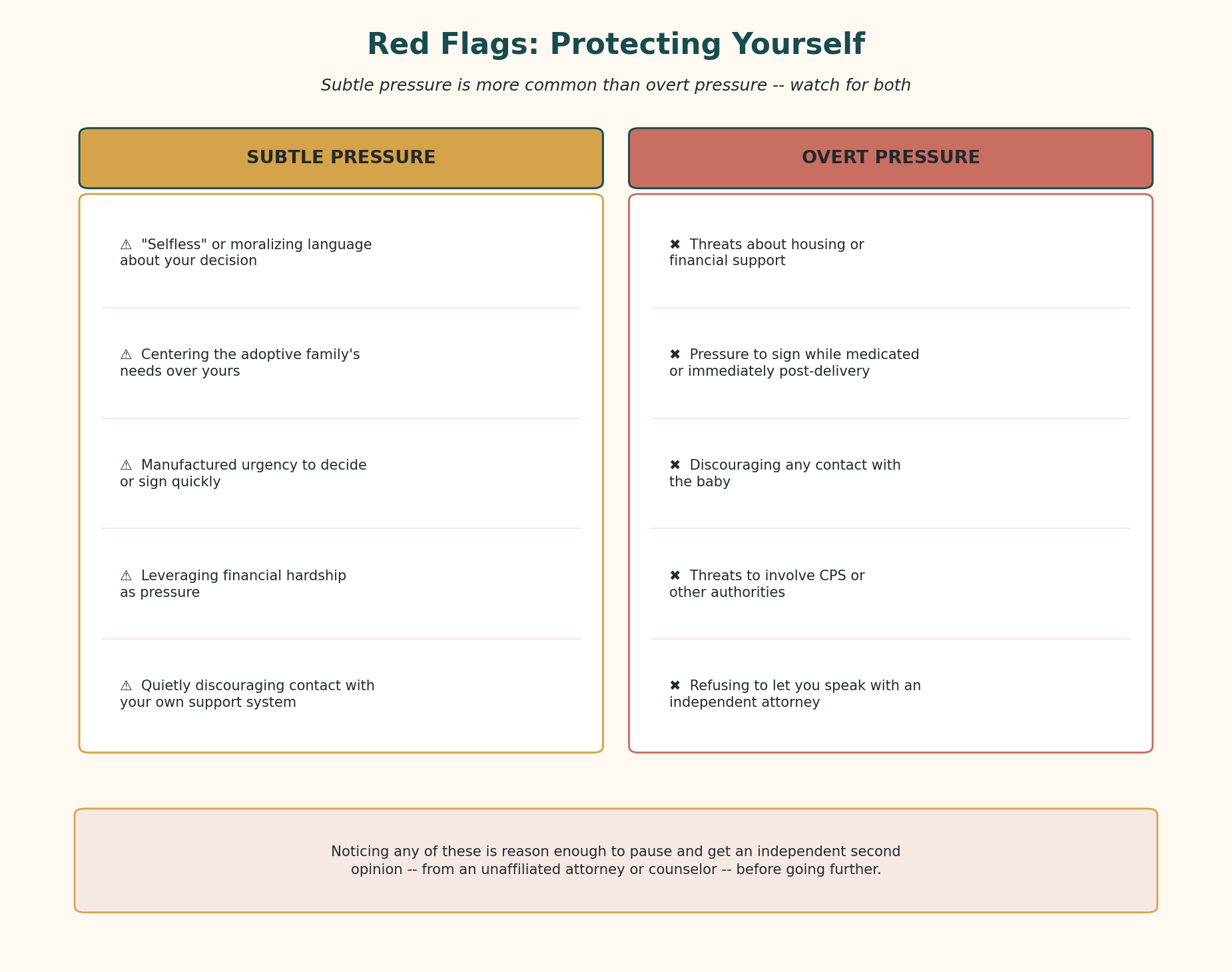
Subtle Pressure Is More Common Than Overt Pressure
Language That Frames Adoption as the “Selfless” or “Right” Choice
Phrases like “the most loving thing you can do” or heavy emphasis on “what’s best for the baby” can function as subtle moral pressure, especially when they’re used to override your own stated uncertainty or preference rather than simply describing one possible perspective among several. Ethical options counseling presents information; it doesn’t frame one option as more virtuous than the others.
Centering the Adoptive Family’s Hopes Over Your Own Circumstances
If conversations consistently focus on how much a waiting family wants a child, how long they’ve waited, or how disappointed they’d be, rather than on your own needs and decision, that imbalance can create a felt obligation to follow through even when you’re genuinely unsure — your decision is about your life and your child, not about managing another family’s expectations.
False Urgency
No decision is legally final until you actually sign consent after birth — a professional who implies otherwise, or who suggests you need to decide “before discharge” or that a family will be told the placement is set before you’ve actually signed anything, is misrepresenting your legal position. Genuine uncertainty doesn’t need to be resolved on someone else’s timeline.
Financial and Isolation Tactics
Financial Hardship Presented as Your Only Option
If a professional treats financial difficulty as though it eliminates parenting as a realistic possibility, without discussing the broader support programs and resources covered in our unplanned pregnancy guide, that framing removes an option you may not have actually explored yet. A genuinely neutral conversation includes those alternatives before treating financial hardship as decisive.
Isolation From Your Own Support System
Encouragement to distance yourself from friends or family who might raise questions or offer a different perspective is a warning sign, not a reasonable request for “space to think clearly.” A trustworthy process supports you having people in your corner, not fewer of them.
Threats, However Indirect
Any suggestion that your housing, financial support, or the assistance you’ve been receiving depends on following through with placement is both an ethical violation and, in most cases, illegal, since lawful expense assistance cannot legally be conditioned on your final decision, as covered in this guide’s expenses section. The same goes for a threat to involve Child Protective Services as leverage, discouragement from holding or spending time with the baby, or pressure to sign paperwork while medicated or exhausted immediately after delivery.
| Reasonable, ethical practice | Red flag |
|---|---|
| Presents parenting, adoption, and abortion with comparable weight | Discusses only adoption, or minimizes questions about other options |
| Gives you your own separate point of contact and, where applicable, your own attorney | Uses the same representative or attorney for you and the adoptive family |
| Confirms in plain language that you can change your mind before consent (and often for a window after) | Implies or states that a decision is final before consent is actually signed |
| Offers a genuine selection of prospective families | Presents only one family and frames it as your only realistic option |
| Frames expense assistance as unconditional support during pregnancy | Suggests you’ll “owe” money back or face consequences if you decide to parent |
| Encourages you to involve trusted friends or family | Discourages contact with your existing support system |
If You Notice a Red Flag
You Can Switch Professionals or Agencies
Recognizing a red flag doesn’t mean adoption itself is wrong for you — it means that specific professional or agency is worth leaving. Switching to a different licensed agency or attorney is possible at nearly any point before consent is signed, and a genuinely difficult experience with one professional says nothing about whether a different, more ethical one might serve you well.
Where to Get a Second Opinion or Report a Concern
An independent attorney not affiliated with the agency or professional you’re concerned about can give you an honest read on whether something you’ve experienced crosses a line, and your state’s licensing board for adoption agencies (typically part of the state’s health and human services or child welfare department) is the appropriate place to report a licensed agency’s conduct if warranted. Trusting your own discomfort enough to ask someone else is never an overreaction.
Life After Placement: Grief, Contact, and Support
If you place a child for adoption, what comes next deserves the same honest attention this guide has given to everything leading up to it.
Grief Is a Normal, Expected Part of the Experience
Even a Confident, Well-Considered Decision Can Come With Real Grief
Placing a child for adoption, even when it’s the decision you’re most at peace with, is still a genuine loss, and grief afterward doesn’t mean the decision was wrong — the two aren’t in tension. Feeling relief and grief at the same time, or grief that resurfaces at unexpected moments (a birthday, a holiday, an anniversary of placement) years later, is a widely reported and entirely normal pattern, not a sign that something needs to be fixed.
Grief Doesn’t Follow a Predictable Timeline
Some people feel the loss most intensely in the first weeks and find it eases with time; others find certain moments — the child reaching an age milestone, a life event of their own — bring it back with real intensity long after placement. Neither pattern is more “normal” than the other, and ongoing grief years later doesn’t indicate anything is wrong with how you’re coping.
Support Specifically for Birth Parents
Peer Support From People Who’ve Lived It
Birth-parent support groups — in person, online, and through many agencies specifically as a post-placement service — connect you with people who understand the experience in a way friends and family, however caring, often can’t fully replicate. If your agency doesn’t proactively offer this, ask; it’s part of the post-placement support described as a right earlier in this guide, and it’s also available independently through several national organizations even if your specific agency’s post-placement services fall short.
Individual Counseling Focused on Adoption-Specific Grief
A counselor experienced specifically in adoption-related grief — not grief counseling in general — can be more useful than a generalist, since the specific shape of this loss (a living child, an ongoing relationship in many cases, complicated feelings about a choice made under real constraints) differs from other kinds of loss counseling is usually built around.
Navigating the Ongoing Relationship, If You Have One
Open and Semi-Open Contact Takes Its Own Kind of Adjustment
Receiving photos, letters, or visits is often a genuine source of comfort, but it can also stir up grief in its own way — both are normal reactions to an ongoing relationship shaped by an adoption, and neither reaction means the openness level you chose is wrong for you.
Boundaries Are Allowed to Exist and to Change
You’re allowed to need more space at some points and more contact at others, and to communicate that directly to the adoptive family rather than assuming the original agreement is fixed forever, especially given the openness-agreement enforceability limits covered earlier in this guide. A respectful adoptive family will generally welcome this kind of honest communication rather than treating it as a threat to the arrangement.
Records and Future Contact, Even in a Closed or Distant Arrangement
Even with limited current contact, keeping your own records — the agency’s name, any case number, key dates, and contact information you’re comfortable sharing later — can matter if you or the child want more information or contact at some point in the future; adoption relationships sometimes open up over time even after starting more closed than either side initially expected.
Special Situations
Most of this guide describes the general framework, but several situations change the picture enough to deserve their own direct treatment.
If You Are a Minor
Whether a Parent or Guardian Must Be Involved Is a Separate, State-Specific Question
Whether a pregnant minor needs a parent or guardian’s involvement in her own decision to place a child for adoption is governed by each state’s adoption statutes specifically, not by the judicial-bypass framework that applies to a minor’s abortion decision — the two are commonly and understandably confused, but they’re legally distinct questions with potentially different answers in your state. Our guide to pregnancy options in the U.S. covers this distinction in more depth.
Confidential Resources Still Apply
Regardless of your state’s specific involvement rule, confidential options counseling and the ten rights covered earlier in this guide still apply to you as a minor considering adoption — a licensed agency or attorney can explain exactly how your state’s rules intersect with your own situation.
If You’re Concerned About Safety or a Coercive Relationship
Adoption Decisions Made Under Duress Aren’t Valid Decisions
If a partner, family member, or anyone else is pressuring you toward or away from adoption through threats, control, or coercion, that’s a safety concern first and a pregnancy-options question second — our unplanned pregnancy guide’s safety and domestic violence section covers confidential resources, and the National Domestic Violence Hotline can help regardless of what you ultimately decide about the pregnancy.
Confidential Address and Contact Protections
If safety is a concern, ask your adoption professional directly about keeping your address and contact information confidential from a specific person, including, where relevant, from the biological father — agencies and attorneys who handle sensitive situations regularly can generally accommodate this.
If You’re Carrying Multiples
Placement Decisions Can Apply to One, Both, or All
If you’re pregnant with twins or more, you’re not required to make the same decision for every child — some expectant parents choose to parent one and place another, though this is a significant and personal decision worth discussing thoroughly with a counselor experienced in multiples-specific situations, since it carries its own emotional complexity beyond a single-birth placement.
Matching and Cost Considerations Can Differ Too
Placing multiples together with the same adoptive family is the more common arrangement when a full-multiples placement is chosen, and it’s worth discussing directly with your agency how matching, cost, and post-placement contact might work differently for a multiples situation compared with a single-birth placement, since not every prospective family’s profile or agency’s process anticipates it by default.
If the Baby May Have a Diagnosed Health Condition
This Doesn’t Close Off Adoption as an Option
Families specifically interested in adopting a child with a diagnosed medical condition or disability do exist and work with agencies that specialize in this kind of matching — a diagnosis doesn’t mean adoption isn’t a realistic option, though it may narrow or reshape which specific families and agencies are the right fit.
Full, Honest Medical Disclosure Protects Everyone
Sharing complete, honest medical information with your agency and, in turn, with prospective families is both an ethical expectation and a practical necessity — it ensures the family you’re matched with has genuinely agreed to the situation with full information, rather than discovering it after placement in a way that could destabilize the arrangement for everyone, including the child.
If You Have Native American Heritage
The Indian Child Welfare Act May Apply
If the child may be eligible for membership in a federally recognized tribe, the Indian Child Welfare Act (ICWA) establishes additional legal requirements and protections that apply on top of ordinary state adoption law, including specific notice requirements to the relevant tribe and, in many cases, placement preferences. This is a distinct federal legal framework that a general adoption attorney may not have deep experience with — ask directly whether your attorney or agency has specific ICWA experience if this may apply to your situation.
Raise This Early, Even If You’re Uncertain About Eligibility
You don’t need to already know your child qualifies under ICWA to raise the question — mentioning possible tribal heritage to your agency or attorney early lets them make the appropriate inquiries with the relevant tribe before the process is further along, since addressing this correctly from the start avoids the kind of later legal vulnerability described elsewhere in this guide’s discussion of the birth father’s rights.
Common Mistakes and Misconceptions About Considering Adoption
A handful of misunderstandings come up often enough to be worth addressing directly.
Misconceptions About What Adoption Requires of You
Myth: Once You Start Working With an Agency, You’re Committed
Reviewing profiles, talking to professionals, even selecting a family — none of it is binding until you sign consent after birth. Starting the process is not the same as finishing it, and a reputable agency understands and expects this.
Myth: Closed Adoption Is the Only “Real” or Traditional Option
Open and semi-open arrangements are the more common practice today, not a newer, less legitimate alternative to a “real” closed adoption — the framing has simply shifted over the past few decades toward more openness being the norm rather than the exception.
Misconceptions About Money and Legal Finality
Myth: You’ll Have to Repay Expenses If You Decide to Parent
Lawfully structured pregnancy-related expense assistance is not a loan and cannot be conditioned on your final decision — if a specific arrangement has been presented to you as repayable if you don’t place, that’s worth a second opinion from an independent attorney, since it likely doesn’t reflect how legitimate expense assistance is actually supposed to work.
Myth: Consent Can Be Given or Implied Before Birth
No matter how detailed a plan is before delivery — a family chosen, a hospital plan written, a due date circled — legal consent cannot be given until after the child is born, and anything signed or agreed to before that point isn’t binding consent, whatever it’s called informally.
Misconceptions About Openness and Contact
Myth: An Open Adoption Agreement Is Always Legally Guaranteed
As covered earlier in this guide, roughly half of states don’t legally enforce post-adoption contact agreements, meaning an agreed level of contact ultimately depends partly on the adoptive family’s good faith in those states — this is worth understanding clearly before finalizing an agreement’s specific terms, not discovering afterward.
Myth: Feeling Grief After Placement Means You Made the Wrong Choice
As covered in the previous section, grief and confidence in a decision aren’t mutually exclusive — many birth parents describe both simultaneously, and grief afterward is a normal response to a real loss, not evidence of regret or error.
Glossary of Adoption Terms for Expectant Parents
A quick reference for terms used throughout this guide and likely to come up in conversation with an adoption professional.
Process and Relationship Terms
Expectant parent
The preferred term for a pregnant person who is considering adoption but has not yet placed a child — used instead of “birth mother,” which accurately applies only after placement.
Birth parent / birth mother / birth father
Terms used after a legal placement has occurred, referring to the child’s biological parent(s) who placed the child for adoption.
Making an adoption plan / placing a child
The preferred, active-voice phrasing for the adoption decision and process, used instead of “giving up” a child, which implies passivity rather than an active, legal choice.
Open, semi-open, and closed adoption
The three general categories describing the level of contact and information exchange between a birth parent and adoptive family after placement — see this guide’s dedicated section for full definitions.
Post-adoption contact agreement (PACA)
A written agreement specifying the type and frequency of post-placement contact; legally enforceable in roughly half of U.S. states and not in the other half.
Home study
The background-check, interview, and home-visit process a prospective adoptive family completes before being approved to adopt — conducted on the adoptive family’s side of the process, not the expectant parent’s.
Facilitator
A professional who connects expectant parents with prospective adoptive families but does not handle legal finalization; often unlicensed, and prohibited or restricted in some states.
Legal Terms
Consent
The legal, voluntary agreement to place a child for adoption; cannot be signed before birth anywhere in the U.S., and subject to a minimum post-birth waiting period in most states.
Revocation period
A window after signing consent, in states that provide one, during which a birth parent can legally withdraw consent and reclaim parental rights; the length varies significantly by state, and some states provide none.
Finalization
The court proceeding that makes an adoption legally permanent, typically occurring months after placement following a post-placement supervision period for the adoptive family.
Putative father registry
A state system allowing a man who believes he may have fathered a child to register that possibility and thereby preserve his right to notice of an adoption proceeding.
Diligent search
A documented, court-required effort to locate and notify a known or possible biological father before an adoption can proceed without his consent.
Independent adoption / private domestic adoption
An adoption arranged directly, often through an attorney, without a licensed agency’s full-service involvement — legal in most but not all states, with rules varying on what independent arrangement is permitted.
Indian Child Welfare Act (ICWA)
A federal law establishing additional requirements and protections when a child may be eligible for membership in a federally recognized tribe, including specific notice and placement-preference rules.
Frequently Asked Questions
Just Starting to Consider Adoption
I just found out I’m pregnant and adoption crossed my mind. Is it too early to look into it?
No — it’s never too early to gather information, and doing so doesn’t commit you to anything. Many expectant parents start researching well before they’ve decided anything, simply to understand what the option actually involves.
Do I have to tell anyone I’m considering adoption before I talk to a professional?
No. You can contact an agency or attorney confidentially to ask questions before telling family, a partner, or anyone else, and reputable professionals are used to fielding exploratory questions from people who haven’t told anyone yet.
Is Adoption Right for Me?
How do I know if I’m making this decision for the right reasons?
There’s no external test for “the right reasons” — what matters is that the decision reflects your own honest assessment of your circumstances and preferences, made with accurate information and without pressure, rather than meeting someone else’s definition of a good reason.
What if I feel pressured by my family to place, or not to place?
Family pressure in either direction is common and doesn’t have to determine your decision. A neutral counselor, separate from your family and from any adoption agency, can help you think through what you actually want, separate from what others are pushing for.
Modern Adoption Myths
Is closed adoption even still legal?
Yes — closed adoption remains legal and available in every state, even though open and semi-open arrangements are more common in current practice. Choosing a closed arrangement is a legitimate preference, not an outdated one.
Do I lose all say over who adopts my child?
No — as covered in this guide’s section on choosing the adoptive family, most modern domestic adoptions involve you actively selecting the family, not an agency assigning one to you.
Open vs. Closed Adoption Specifics
Can I start with a semi-open arrangement and move to fully open later?
Often yes — many relationships evolve over time by mutual agreement, as covered earlier in this guide. Starting more cautiously and opening up later, or vice versa, is common and not unusual.
What happens if the adoptive family moves away?
A move doesn’t automatically end an agreed level of contact — most current forms of contact (calls, video, mail, occasional visits) don’t depend on geographic proximity, though a move can understandably affect the practicality of in-person visits specifically.
Choosing an Agency or Attorney
How do I check if an agency is actually licensed?
Your state’s health and human services or child welfare department typically maintains a list of licensed adoption agencies, and you can call to confirm a specific agency’s current status directly rather than relying on the agency’s own website claim.
Can I work with an agency in a different state than where I live?
Often yes, though interstate placements involve additional legal requirements under the Interstate Compact on the Placement of Children (ICPC) — our guide to pregnancy options in the U.S. explains how ICPC works in more depth.
Choosing the Adoptive Family
How many family profiles will I typically see?
This varies by agency and by your own preferences — some expectant parents review a handful, others review many more. You can ask to see additional profiles at any point if the initial selection doesn’t feel like a good fit.
Can I meet a family in person before deciding?
Many agencies can arrange this if you and the family are both interested, though it’s not universal — ask your specific agency what’s typically offered.
Expenses and Financial Questions
What’s a reasonable range for living-expense assistance?
This varies enormously by state law and by individual circumstances, so there’s no reliable general figure to cite — an adoption attorney licensed in your state can explain the specific categories and limits that apply where you are.
Do I need to provide receipts for everything?
Generally yes — documentation is what keeps expense assistance lawful and transparent, as covered earlier in this guide, and a request for receipts or documentation isn’t a sign of distrust, it’s a standard part of the legal framework.
Consent and Revocation Specifics
Exactly how long after birth can I wait before signing consent?
Most states require a minimum waiting period, commonly in the range of 24 to 72 hours, before consent can be signed at all, but there’s no requirement to sign the moment that period ends — you can wait longer if you want more time. Confirm your specific state’s minimum with your attorney.
Can I revoke consent after finalization?
Generally no — once finalization occurs in court, the adoption is legally permanent, and reopening it afterward is extremely difficult and limited to narrow legal grounds like fraud, entirely separate from an ordinary revocation window, which closes well before finalization.
Birth Father Questions
What if I don’t know who the biological father is?
This happens and doesn’t halt the adoption process outright — your attorney will explain your state’s specific requirements, which may include a diligent search process or registry check as covered earlier in this guide.
What if the biological father wants to parent but I want to place?
This is a genuinely complex legal situation requiring individualized legal advice — a family law or adoption attorney can explain how your specific state’s parentage and consent laws apply when the two parents disagree.
Hospital Plan Questions
Do I have to let the adoptive family into the delivery room?
No — this is entirely your choice, and you can specify any level of adoptive-family presence (or absence) you want in your hospital plan, from full participation to none at all.
Can I change my hospital plan after I’ve written it?
Yes — as covered earlier in this guide, a hospital plan is a plan, not a binding contract, and you can revise it, including in the moment at the hospital itself, if your preferences change.
Red Flags and Protecting Yourself
What’s the single fastest way to check if an agency is legitimate?
Call your state’s licensing agency directly and ask whether the specific agency you’re considering is currently licensed and in good standing — this single call cuts through advertising claims faster than almost anything else you could check.
Is it a red flag if an agency wants me to decide quickly?
Yes, generally — as covered in this guide’s red-flags section, manufactured urgency is one of the more common subtle pressure tactics, and a reputable professional has no legitimate reason to rush a decision of this magnitude.
Life After Placement and Grief
Is it normal to want to see photos of the baby constantly after placement, even in a closed adoption?
Yes — this is a common and understandable response to a major loss, even when it coexists with confidence in the decision. If you chose closed adoption but find the absence of contact harder than expected, a birth-parent support group or grief counselor can help you process that specific tension.
How long does the grief typically last?
There’s no fixed timeline, and grief connected to placement often resurfaces at meaningful moments — birthdays, holidays, later pregnancies — for years afterward rather than resolving on a schedule. This doesn’t indicate anything has gone wrong with your adjustment.
Post-Adoption Contact Agreements
Is a post-adoption contact agreement the same thing as an open adoption?
Not exactly — open adoption describes the general relationship and level of contact you and the adoptive family agree to; a post-adoption contact agreement (PACA) is the more formal, sometimes court-recognized document that puts specific terms of that contact in writing.
Do I need a lawyer to write a post-adoption contact agreement?
It’s strongly advisable — your independent attorney can help ensure the agreement’s terms are realistic, clearly worded, and, where your state allows it, structured in the way most likely to be recognized if a dispute ever arises later.
Minors Considering Adoption
If I’m a minor, can I contact an adoption agency without my parents finding out first?
In most cases, yes — you can have an initial, confidential conversation with a licensed agency or attorney before telling your parents anything. Whether your parents or a guardian must ultimately be involved in the decision itself is a separate, state-specific legal question, covered in this guide’s special-situations section.
Does being a minor change any of the ten rights covered earlier in this guide?
No — the ten rights apply to you as a minor considering adoption just as they apply to an adult expectant parent. What can differ by state is whether a parent or guardian must also be formally involved in the legal process.
Safety and Coercion Situations
What if the person pressuring me is the same person I’d need to ask for help?
This is exactly the kind of situation confidential, independent resources exist for — an adoption professional, an options counselor, or the National Domestic Violence Hotline can help you find support and next steps that don’t depend on the person creating the pressure.
Can I get help finding a safe place to stay while I sort out my decision?
Yes — many pregnancy support organizations and domestic violence resources can help with emergency or temporary housing, separate from and regardless of any adoption plan. Our unplanned pregnancy guide covers housing and safety resources in more depth.
Multiples, Health Conditions, and ICWA Situations
If I’m placing multiples, do they have to go to the same adoptive family?
Not necessarily, though placing multiples together is more common when a full placement is chosen — as covered earlier in this guide, this is worth discussing directly and early with an agency experienced in multiples-specific placements.
Does a prenatal diagnosis automatically limit which families would consider adopting?
It can narrow the pool somewhat, but as covered earlier in this guide, families specifically seeking to adopt a child with a diagnosed condition do exist, and an agency experienced in this kind of matching can identify them.
Privacy and Confidentiality
Can I keep my adoption plan private from extended family and friends?
Yes — how widely you share your plan, and with whom, is entirely your choice. Agencies and attorneys are bound by confidentiality standards, and you’re never obligated to disclose your plans to anyone beyond who you choose to tell.
Will my name appear anywhere the adoptive family or their broader circle could find later, in a closed adoption?
In a closed adoption, identifying information is generally not shared with the adoptive family beyond what’s legally required in court records, which are typically sealed. Ask your specific agency or attorney how confidentiality is handled in your state.
LGBTQ+ Considerations
Does being LGBTQ+ myself change anything about my rights as an expectant parent considering adoption?
No — the ten rights and the overall legal framework covered in this guide apply regardless of your sexual orientation or gender identity. A reputable agency or attorney serves expectant parents without regard to these factors.
Can I specifically choose an LGBTQ+ adoptive family, or specifically choose not to?
Yes — as covered earlier in this guide, you can express preferences about the adoptive family’s background and characteristics, and a good agency will work to match accordingly within the profiles available.
Considering Parenting Alongside Adoption
Can I keep exploring parenting resources even after I’ve started the adoption process?
Yes — starting conversations with an agency or attorney doesn’t close off parenting as an option at any point before you sign consent. Our unplanned pregnancy guide covers parenting resources and support programs you can look into in parallel.
What if I start leaning toward parenting partway through matching with a family?
Tell your agency or attorney as soon as you notice the shift — a reputable professional will support you in stepping back from the process without pressure or penalty, at any point before consent is signed.
