
If you’re pregnant and thinking about adoption, or you’ve already placed a child, you have a specific, substantial set of legal and ethical rights — not a vague sense of being “treated well,” but actual, nameable protections covering who you choose, who represents you, when you can legally sign anything, how long you can change your mind afterward, what support you can accept without it being construed as selling a child, and what privacy you’re entitled to. This guide is the deep, dedicated reference for exactly those rights. It assumes you already have a basic orientation to adoption as a path — if you don’t yet, our lighter overview of what considering adoption involves and our guide to all three options if you’re still deciding anything at all are better starting points. This guide goes further and deeper than either of those, specifically on your rights, because getting this part wrong — not knowing what you’re entitled to, or signing something before you understood it — is the single most consequential mistake available in the entire adoption process.
Short Answer: The Rights You Have, At a Glance
As a birth mother or expectant mother considering adoption in the United States, you have the right to choose the adoptive family and the level of ongoing contact; the right to independent counseling and your own attorney, usually at no cost to you; the right to have your consent refused before birth under any circumstances; a further right, varying by state, to revoke that consent for some period after signing it; the right to receive certain medical and living expenses without that support being treated as payment for the child; the right to privacy about your decision and your identity, within real legal limits; and the right to report or pursue legal recourse if any of this is violated. None of these rights depends on which agency you use, how far along your plan already is, or whether you’ve already accepted financial support.
The Rights in Brief
Choice, Counsel, and Timing
You choose the adoptive family and the openness level, not the other way around. You’re entitled to counseling and your own lawyer, separate from anyone representing the adoptive family. And no matter how detailed a plan gets before delivery, your legal consent cannot exist until after the child is born — full stop, in every state.
Financial Support, Privacy, and Recourse
You can lawfully receive help with pregnancy-related medical and, in most states, some living expenses, without that being “selling” your child — the line between the two is drawn by state statute, not by how it feels. You’re entitled to meaningful privacy, though not absolute secrecy from every legal process. And if any of this is violated — through fraud, coercion, or a professional cutting corners — you have real avenues for recourse, covered in full later in this guide.

The Child Welfare Information Gateway maintains a state-by-state summary of consent-to-adoption statutes. The American Bar Association Family Law Section can help you find qualified independent counsel in your state.
Key Takeaways
- You have at least six distinct categories of rights: choice of family and openness level, independent counseling and legal representation, a timing rule that bars consent before birth, a post-signing window to change your mind in most states, lawful financial support that isn’t “payment,” and privacy with real but not absolute limits.
- None of these rights is conditional on your agency, your state, how far your plan has progressed, or whether you’ve accepted expense support already.
- This guide is written specifically for you as a birth mother or expectant mother — not for adoptive parents, and not as a general process walkthrough. For that walkthrough, see how domestic infant adoption works and the step-by-step adoption process.
How This Guide Is Organized
Who This Guide Is For
This guide is written for you specifically if you are pregnant and considering placing a child for adoption, or if you have already placed a child and are navigating the period immediately after. It assumes you already have some basic familiarity with what adoption involves; if you’re earlier in the process than that, start with our lighter companion overview, which covers the full landscape at an introductory level, including a shorter version of some of the rights covered here in far more depth.
What This Guide Deliberately Doesn’t Cover
This is not a step-by-step action checklist for finding an agency, building a hospital plan, or managing logistics — our guide to placing a baby for adoption owns that ground and is the better resource if you’re looking for a task list rather than a rights reference. It’s also not a deep dive into post-placement contact-agreement drafting, which our open adoption guide covers in full, or into the general mechanics and timeline of adoption, which our how-adoption-works guide and our process guide cover. And it is not the birth father’s guide to his own rights — those run on a meaningfully different legal track, covered in full in our companion piece on birth father rights, which this guide references throughout rather than repeats.
Understanding These Rights: Where They Come From and Why They Matter
Not every “right” discussed in adoption conversations carries the same legal weight, and understanding the difference matters before you rely on any of them. Some of what follows is a hard legal rule enforceable in court. Some is a professional ethics standard that a reputable agency follows but that isn’t independently prosecutable on its own. And some is a right you create yourself, through a negotiated agreement. Knowing which category a given right falls into tells you exactly how much protection it actually offers.
Three Different Sources of “Rights”
Constitutional and Statutory Rights
Some rights come directly from the U.S. Constitution’s protection of parental rights, or from your state’s adoption statutes. The rule that consent cannot be signed before birth, for example, is a statutory rule in every state — it isn’t a courtesy an agency extends to you, it’s a legal requirement an agency cannot waive even if you both wanted to. These rights are enforceable; violating them can void a consent or expose a professional to licensing discipline.
Professional Ethics Standards
Organizations such as the National Council For Adoption publish standards describing how expectant and birth parents should be treated — informed, non-coercive counseling; respect for your decision-making authority; freedom from pressure. These standards shape what a reputable, accredited agency does and are a meaningful benchmark for evaluating a professional, but they are generally enforced through accreditation, reputation, and industry pressure rather than being independently actionable in court the way a statutory violation is.
Contractual Rights You Negotiate
A post-adoption contact agreement specifying how much contact you’ll have after placement is a right you and the adoptive family create together, not one state law hands you automatically. Depending on your state, such an agreement may or may not be legally enforceable in court — our open adoption guide covers exactly how that works and how to make an agreement as solid as your state allows.
Why “It Varies by State” Is the Honest Answer, Not a Dodge
Family Law Is Primarily State Law
Adoption law, like most family law in the United States, is set and administered at the state level, not federally. That means the specific number of days in a waiting period, the exact length of a revocation window, and the precise dollar caps on allowable living expenses are all answers that exist — but they exist fifty-plus times over, once per state and territory, and they change as legislatures amend statutes. A guide that stated a single national number for any of these would be giving you a number that’s wrong for a meaningful share of readers, and potentially wrong for you.
How to Find Your State’s Actual Rule
Throughout this guide, wherever a rule varies by state, we describe the general pattern and the range it typically falls into, flagged for verification, and point you to two live sources rather than guessing: Child Welfare Information Gateway’s State Statutes Search tool, which maintains current summaries of each state’s adoption statutes, and a licensed adoption attorney in your own state, who can tell you the exact rule that applies to your specific situation today.
Key Takeaways
- Some of your rights are hard statutory law (enforceable, cannot be waived by agreement); some are professional ethics standards (a strong benchmark, but enforced differently); and some are rights you negotiate yourself, like a contact agreement.
- Family and adoption law is set primarily at the state level, which is why this guide describes patterns and ranges rather than a single national number for anything state-variable.
- Child Welfare Information Gateway’s State Statutes Search tool and a licensed adoption attorney in your own state are the two sources to use for your state’s actual current rule, every time.
Your Right to Choose: The Adoptive Family, the Adoption Plan, and the Level of Openness
In modern domestic infant adoption, you are not a passive party waiting to be selected — you are, in most arrangements, the one doing the selecting, and you retain that authority at every stage until you’ve signed legal consent after birth.
Choosing the Adoptive Family
Reviewing Profiles and Making the Selection
A licensed agency or attorney will typically present you with profiles of prospective adoptive families — often called “family profiles” or “Dear Birth Mother” letters — and you choose which one to pursue, rather than a family or agency choosing you. You can usually specify preferences up front: geography, religion, family structure, whether you want a family with other children or none, and how much openness you want going forward. A reputable professional builds the matching process around your stated preferences, not around convenience for the agency or pressure toward a particular family.
What Happens If You Change Your Mind About the Family
Choosing a family is not binding. If, after meeting a family or learning more, the match no longer feels right, you retain the right to ask your agency or attorney to present other options, up until you’ve signed consent after birth. This applies even if a hospital plan has already been built around that specific family, even if they’ve already attended appointments with you, and even if they’ve already covered some of your expenses — none of that converts a chosen family into a legally final one.
Choosing the Openness Level
The General Spectrum, Briefly
Adoption arrangements today generally fall somewhere between fully closed (no post-placement contact or identifying information shared) and fully open (ongoing direct contact, visits, and shared information), with a wide range of semi-open arrangements — letters and photos through an intermediary, periodic updates, occasional visits — in between. This guide doesn’t walk through the full mechanics of negotiating and drafting the contact terms themselves; our dedicated open adoption guide covers that in depth, including how enforceable a given arrangement actually is in your state.
Why This Right Belongs to You, Not the Agency
The openness level is a decision between you and the adoptive family, not a default an agency assigns or a package tier it sells. A professional who tells you a specific openness level is simply “how we do it here,” without describing it as a negotiable starting point, is not accurately describing your actual rights. You can propose more openness than a family initially expected, or less, and the final arrangement is whatever you and the family agree to.
Choosing Whether to Proceed With Adoption at All, at Every Stage Before Consent
Nothing Before Signed Consent Is Binding
This is the right that underlies all the others in this section: every choice you make before you sign legal consent after birth — the family, the openness level, the agency itself — remains revisable. A hospital plan, a matched family, accepted expense support, even a verbally stated intention to place — none of it is legally binding. Section 5 of this guide covers exactly why consent timing works this way and what it protects.
Switching Agencies or Attorneys Midstream
You are also free to change which agency or attorney you’re working with at any point before consent, including late in pregnancy, if the relationship isn’t serving you. This can feel logistically disruptive, and reasonably so, but it remains your right — a professional discouraging you from this option, rather than simply noting the practical complexity, is worth treating as a flag rather than sound advice. If you’re still early enough to be assembling your plan from scratch, our placing-a-baby-for-adoption guide walks through choosing a professional and building a plan step by step.
Key Takeaways
- You choose the adoptive family from presented profiles, not the reverse, and you can ask to see other options at any point before signing consent.
- The openness level — closed, semi-open, or open — is negotiated between you and the adoptive family, not assigned by the agency.
- Nothing before signed, post-birth consent is legally binding: not a hospital plan, not a matched family, not accepted expense support.
Your Right to Independent Counseling and Legal Representation
Two distinct professionals exist specifically to protect your interests in this process — a counselor, whose job is your emotional and decisional clarity, and an attorney, whose job is your legal protection — and both are typically available to you at no direct cost.
The Right to Counseling
What Counseling Is Supposed to Cover
Adoption-competent counseling should cover your options honestly (including the option of not placing), help you process the decision itself, prepare you for the emotional realities of pregnancy, placement, and life afterward, and continue to be available to you after placement if you want it. A counselor’s job is to support whatever decision you actually make, not to steer you toward placement because that’s the outcome that serves the agency’s business model.
Who Typically Provides It and Who Pays
A licensed adoption agency typically employs or contracts with social workers or counselors trained specifically in pregnancy and adoption decision-making, and this counseling is generally included as part of the service the adoptive family’s fees fund — meaning it typically costs you nothing directly. If you’re working with an attorney rather than a full-service agency, ask directly whether counseling is included or referred out, since attorneys don’t always provide it themselves.
The Right to Your Own Attorney — Separate From the Adoptive Family’s
Why Dual Representation Is a Conflict of Interest
An attorney representing the adoptive family cannot also ethically represent you, even if everyone involved feels aligned and cooperative in the moment. Your interests and the adoptive family’s interests can diverge at exactly the moments that matter most — the timing of your consent, the scope of expense support, the terms of a contact agreement — and a single attorney cannot advocate for both sides of a potential disagreement at once. You are entitled to your own, independent attorney whose only job is explaining your state’s law, your parental rights, and the specific consequences of anything you’re asked to sign.
Who Pays for Your Attorney
In the large majority of domestic infant adoptions, the adoptive family or their agency pays for your independent attorney’s fee, as a standard, expected cost of the adoption — this is not a favor or a special accommodation, and it is not something that obligates you to proceed with that specific placement.
What to Do If You’re Told You Don’t Need Your Own Attorney
That Claim Is a Red Flag, Not a Cost-Saving Favor
If an agency or the adoptive family’s attorney tells you that you don’t need your own lawyer, that “everyone’s on the same side here,” or that getting independent counsel will “complicate things,” treat that as a serious warning sign rather than reassurance. A professional acting in good faith has no reason to discourage you from understanding your own rights before you sign away parental rights permanently.
Where to Find Independent Counsel If One Hasn’t Been Offered
If independent representation hasn’t been offered to you, ask for it directly and in writing. If it’s refused or discouraged, your state bar association’s lawyer referral service, a legal aid organization, or a different licensed adoption agency can connect you with an attorney whose only client is you. This is also exactly the kind of situation covered further in this guide’s section on recourse if your rights are being violated.
Key Takeaways
- You’re entitled to adoption-competent counseling focused on your decision, not the agency’s outcome, and typically at no direct cost to you.
- You’re entitled to your own attorney, separate from the adoptive family’s, almost always paid for by the adoptive family or their agency.
- Being told you don’t need your own lawyer is a red flag, not a courtesy — ask for independent representation directly if it hasn’t already been offered.
Your Right to Timing: Why Consent Cannot Be Signed Before Birth
This is the single most important timing rule in the entire adoption process, and it applies to you no matter which state you’re in: your legal consent to an adoption cannot exist until after the child is born. Not close to birth. Not with a signed intent-to-place letter beforehand. After.
The Universal Rule Across All 50 States
Prenatal Promises Are Not Legally Binding
Every U.S. state requires that a birth parent’s formal legal consent be executed after delivery, not before. This rule exists specifically to prevent anyone from locking in an irreversible decision while still pregnant, under the influence of circumstances that can change dramatically by the time the baby actually arrives. Whatever you’ve agreed to, said, written, or signed before birth — a letter of intent, a hospital plan, a verbal commitment to a specific family — is not a legal consent and does not bind you to anything.
What This Means Practically, Even Late in an Adoption Plan
This holds true even if you’re already in the delivery room with an adoptive family present, even if every detail of a plan has been finalized, and even if you’ve received substantial expense support already. You retain full legal parental rights, including the right to change your mind entirely, until the moment you actually sign consent — and that moment cannot legally occur before the child exists outside the womb.
The Post-Birth Waiting Period
Why States Require a Waiting Period at All
Beyond simply requiring that consent come after birth, most states add a further minimum waiting period — a specific number of hours or days that must pass after delivery before consent can be validly signed. The stated purpose is consistent across states even where the length differs: giving you time, after the physical and emotional experience of childbirth itself, before being asked to execute an irreversible legal document.
Illustrative Categories — and Why We Won’t State Your State’s Number Here
States’ approaches to this minimum generally fall into a few broad patterns — a short window measured in hours, a window measured in a small number of days, or a longer window measured in a week or more — and some states layer on additional procedural requirements, such as requiring the signing to occur before a judge, notary, or specific court officer. The table below describes these as illustrative categories, not a state-by-state list, because stating a specific state’s number incorrectly in a guide like this one is a worse outcome than not stating it at all.
| Illustrative Category | General Pattern | What Tends to Drive the Difference |
|---|---|---|
| Shorter minimum | A minimum measured in hours after delivery, sometimes tied to discharge from the hospital | States prioritizing a faster path to placement stability for the child |
| Moderate minimum | A minimum measured in a small number of calendar days after birth | A middle-ground approach common across many states |
| Extended minimum | A minimum measured in a week or more after birth | States prioritizing a longer buffer for the birth parent’s physical and emotional recovery before signing |
| Minimum plus added procedure | A baseline minimum plus a required step, such as signing before a judge or specific court officer, or a second confirming signature | States building in an additional procedural safeguard on top of the time-based minimum |
How to use this table
These four categories describe general patterns observed across state adoption statutes, not a specific state’s actual rule. Your agency or attorney should be able to state your specific state’s rule in plain, direct language before you’re anywhere near signing anything — if they can’t or won’t, that’s worth treating as a problem on its own.
What Happens at the Moment of Signing
Who Must Be Present or Available
Depending on your state, signing consent may need to happen in front of a notary, a judge, a court-appointed officer, or a witness independent of the adoptive family, specifically so there’s a documented, neutral record that the signing was voluntary and that you understood what you were signing. Your independent attorney should walk you through exactly who needs to be present in your state before the day it actually happens, not for the first time in the room.
What You’re Entitled to Before You Sign
Before signing, you’re entitled to read the actual document in full, ask questions about anything in it, have your attorney present or available, and take whatever time you need within your state’s rules — rushing you through this moment, or presenting it as a formality after “everything’s already been decided,” is not how a legitimate signing is supposed to go.
Key Takeaways
- Consent cannot legally exist before birth in any U.S. state — anything signed or agreed to beforehand is not binding, no matter how final it felt.
- Most states add a further minimum post-birth waiting period before consent can be validly signed, generally falling into a short-hours, moderate-days, or extended-week-plus pattern, sometimes with an added procedural requirement.
- You’re entitled to read the document, ask questions, and have your attorney present before signing — being rushed through this step is a red flag, not standard practice.
Your Right to Change Your Mind: Revocation and Rescission Periods
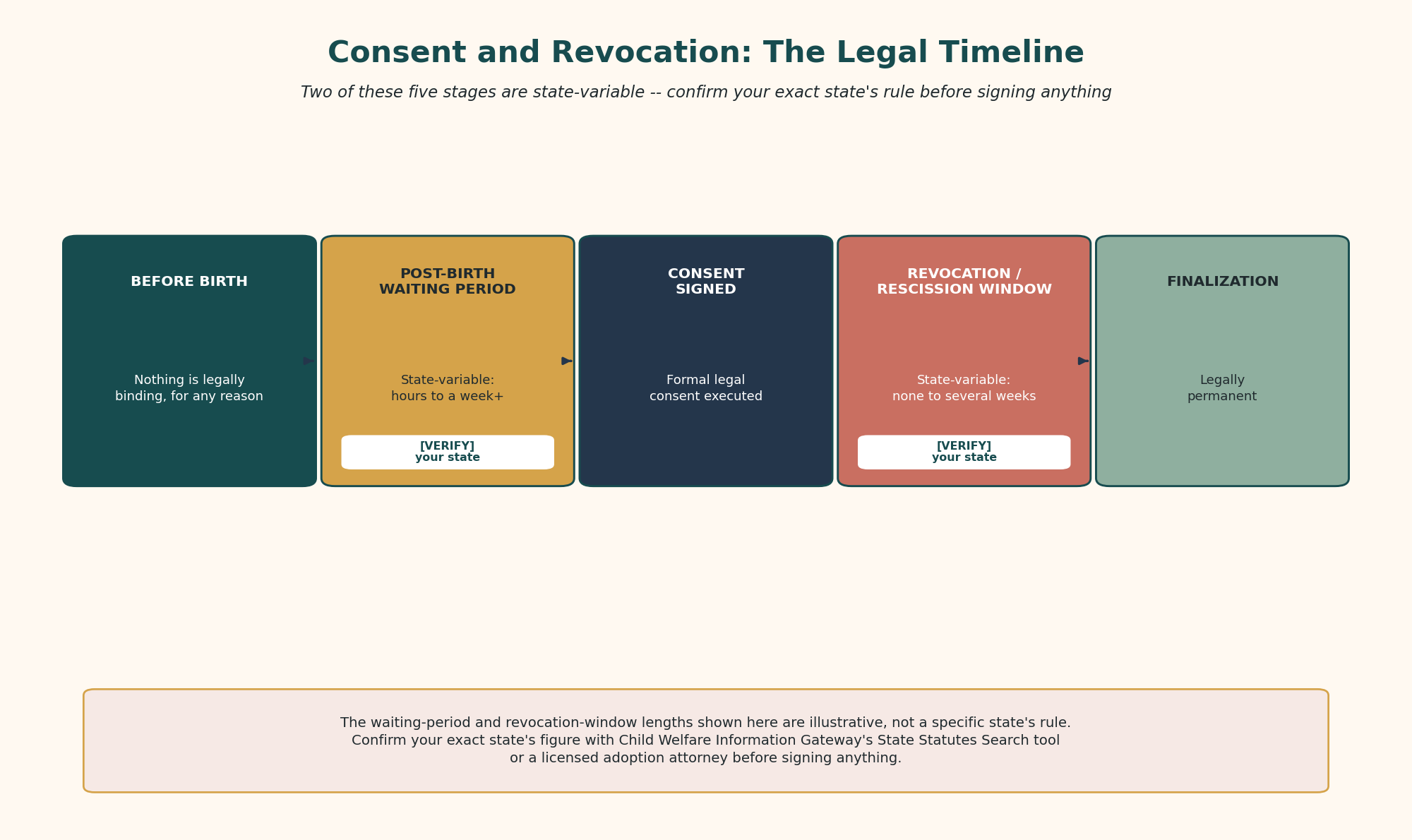
Signing consent is not necessarily the final word. In most — but not all — states, a further window exists afterward during which you can legally revoke that consent and reclaim your parental rights, and the length of that window is one of the most consequential, and most variable, facts in this entire guide.
What Revocation Actually Means
Revocation vs. Contesting Finalization
Revocation specifically means withdrawing a validly signed consent during a defined window that your state’s law provides for that purpose, reclaiming your parental rights without needing to prove anything went wrong. This is legally distinct from contesting a finalized adoption after that window has closed, which generally requires proving a specific legal defect — such as fraud or duress, covered in the next section — rather than simply changing your mind.
Revocation vs. Simply Changing Your Mind Before Signing
It’s also worth being precise about timing: changing your mind before you’ve signed consent at all isn’t “revocation” in the legal sense — it’s simply exercising the right covered in Section 5, since nothing was ever binding yet. Revocation specifically refers to undoing a signature that has already been made.
How Revocation Windows Vary — Illustrative Categories
States With No Separate Revocation Period
Some states provide no automatic revocation window at all once consent is validly signed and all statutory requirements were met — in those states, consent is generally treated as final immediately upon signing, absent a specific legal defect like fraud or duress. This is a genuinely different legal landscape than a state with even a short revocation window, and it is exactly the kind of fact you need confirmed in plain language before you sign anything, not learned afterward.
States With a Defined Window
Many other states provide a defined period — ranging, across different states, from a handful of days to several weeks — during which you can revoke consent for any reason or no stated reason at all, simply by notifying the court or the agency in the manner your state’s law specifies. Some states further distinguish an unconditional revocation right (available to anyone, for any reason, within the window) from a conditional one (available only if, for example, the adoptive placement hasn’t yet occurred, or only if a judge finds it’s in the child’s best interest).
| Illustrative Category | General Description | Practical Implication for You |
|---|---|---|
| No separate revocation period | Consent is generally treated as final upon valid signing, with no automatic additional window | Everything in Section 5 about being certain before you sign matters even more in these states |
| Short, fixed window | A defined period of a small number of days during which revocation is available | Act immediately and in writing if you want to revoke — this window does not pause for any reason |
| Extended window | A defined period measured in multiple weeks | More breathing room, but still finite and still requires formal action, not just a change of heart |
| Conditional revocation only | Revocation is available only under specific conditions (for example, before physical placement with the adoptive family, or only with a court finding) | Your attorney needs to explain exactly what the condition is in your state before you sign, not after |
This is the fact to get in writing, from your own attorney, before you sign anything
Of everything in this guide, this is the single piece of state-variable information most worth pinning down in plain, specific language — not “it varies,” but the actual number of days or weeks that apply to you, stated by your own attorney, before you’re anywhere near a signing appointment.
How to Actually Revoke Consent If You Change Your Mind
Act Immediately and in Writing
If you’re within your state’s revocation window and want to revoke, contact your attorney immediately and follow your state’s specific procedure for doing so — typically a written notice delivered to the court, the agency, or both, within the window. Delay is the primary risk here: a window measured in days can close while you’re still deciding how to say it, so act on the decision itself and sort out the details with your attorney simultaneously, not sequentially.
What Happens to the Child During This Window
In most arrangements, physical placement with the adoptive family begins at or shortly after birth, meaning the child may already be in the adoptive family’s physical care during your revocation window even though your legal rights haven’t yet been finalized. If you revoke within your window, your attorney can explain your state’s specific process for the child’s return to your custody — this is a situation that benefits enormously from legal guidance given its sensitivity for everyone involved, including the child.
Key Takeaways
- Revocation means withdrawing an already-signed consent within a window your state’s law may provide — distinct from changing your mind before signing (nothing to revoke yet) and from contesting a finalized adoption later (requires proving a legal defect).
- Revocation windows range from none at all to several weeks, and some states make revocation conditional rather than automatic — this is state-variable and must be confirmed in plain, specific terms before you sign.
- If you want to revoke, act immediately and in writing through your attorney — these windows do not pause, and delay is the most common way people lose a right they actually had.
When Consent Can Be Contested or Voided: Fraud, Duress, and Coercion
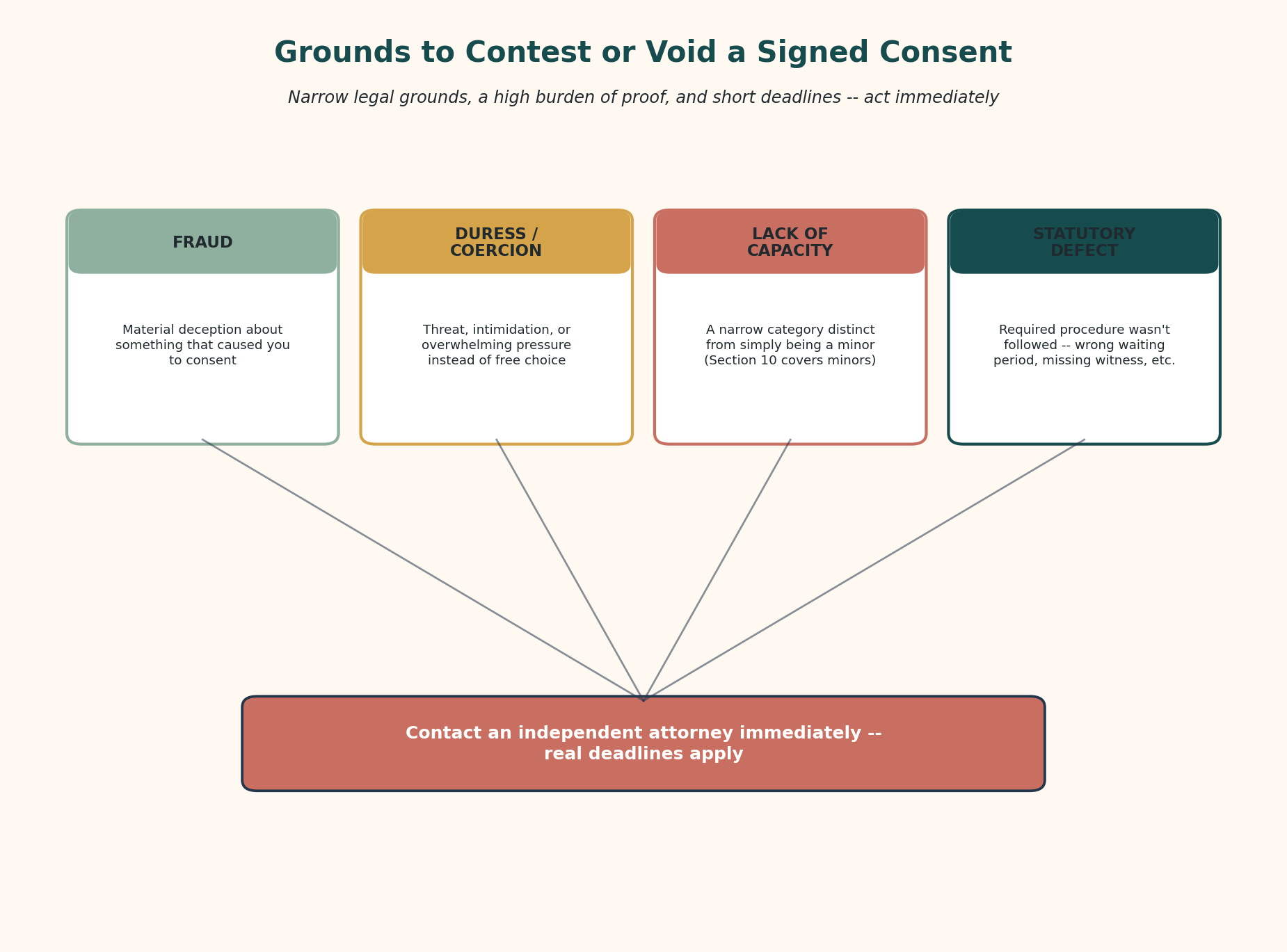
Even after a revocation window has closed, or in a state that never provided one, a signed consent is not necessarily unchallengeable forever. Courts in every state recognize certain narrow grounds on which a consent can be contested or voided — but the bar is high, and the window to act is almost always shorter than you’d expect.
Grounds Courts Generally Recognize
Fraud
Fraud, in this context, generally means you were deceived about something material to your decision — misrepresented facts about the adoptive family, about the legal effect of what you were signing, or about your own rights, where that deception actually caused you to consent when you otherwise wouldn’t have. A professional’s honest mistake, or a fact that simply turned out differently than expected, is not the same as fraud; courts look for intentional deception on something that mattered to your decision.
Duress and Coercion
Duress or coercion generally means your consent wasn’t truly voluntary — you were threatened, intimidated, or placed under such severe pressure that you signed something you didn’t actually agree to of your own free will. This can come from a professional, a family member, or a partner, and it’s covered in detail in the next subsection, since it’s the ground most people recognize in hindsight but struggle to prove after the fact.
Lack of Capacity or Statutory Defect
A consent can also potentially be challenged if you lacked the legal capacity to consent at the time (a narrow category, distinct from being a minor, which has its own separate set of rules covered in Section 10), or if the signing itself failed to follow your state’s required procedure — the wrong waiting period observed, a required witness missing, the wrong form used. These are technical, fact-specific grounds that an attorney needs to evaluate against your state’s actual statute.
What Coercion Looks Like in Practice
Financial Pressure Disguised as Support
Coercion through money rarely looks like an explicit threat. It more often looks like expense support escalating to a level that creates real financial dependency, combined with language suggesting you now “owe” the placement, or implying you couldn’t possibly repay what’s already been given if you changed your mind. As Section 8 covers in detail, lawful expense support is not supposed to create this kind of leverage, and a professional who lets it happen — or encourages the framing — is not acting within ethical, and potentially legal, bounds.
Emotional, Relational, or Time Pressure
Coercion can also come from a partner, parent, or even a well-meaning professional repeatedly emphasizing how disappointed a chosen family would be, how far along the process already is, or how little time is left to decide — none of which changes the actual legal fact that nothing is binding until you sign. A pattern of being rushed, guilt-tripped, or isolated from outside input in the lead-up to a decision is worth naming to someone outside that dynamic, ideally your independent attorney or counselor, before you sign anything.
The Practical Reality of Contesting Signed Consent
The Burden of Proof Is High
Courts generally give significant weight to a signed, properly executed consent, precisely because adoption’s whole structure depends on finality at some point for the child’s stability. Successfully contesting one after the fact typically requires clear, specific evidence of fraud, duress, or a statutory defect — a general feeling of regret or a sense that you were pressured, without more, is unlikely to meet that bar on its own, however real the feeling is.
Why Acting Immediately Matters More Than Almost Anything Else in This Guide
If you believe your consent was obtained through fraud or coercion, contact an independent attorney immediately — not next week, not after thinking it over alone. Every state imposes real deadlines on legal challenges to a consent or a finalized adoption, and those deadlines run regardless of how long it takes you to decide to act. Section 12 of this guide covers exactly who to contact and what to expect from each avenue if you’re in this situation right now.
Key Takeaways
- Signed consent can potentially be contested on narrow grounds — fraud, duress or coercion, lack of capacity, or a statutory defect in how it was signed — even after a revocation window closes.
- Coercion often looks like escalating financial dependency framed as obligation, or sustained emotional and time pressure, rather than an overt threat.
- The burden of proof is high and the deadlines to act are short — if you believe any of this applies to you, contact an independent attorney immediately rather than waiting to decide on your own.
Your Right to Receive Allowable Support Without It Being “Selling” a Child
You can lawfully accept financial help during your pregnancy from an adoptive family or their agency — this is not something to feel uneasy about on principle. But every state draws a specific legal line around what kind of support is allowed, precisely so it never functions as payment for the child.
Why This Area Is So Heavily Regulated
The Legal Line Between Support and Payment
Every state’s adoption statutes prohibit paying a birth parent for the child itself — this is sometimes called the prohibition on “baby selling,” and it exists to keep parental rights from becoming something that can be purchased rather than voluntarily and knowingly relinquished. At the same time, every state also recognizes that pregnancy involves real costs, and that an expectant parent considering adoption shouldn’t be financially worse off than one who isn’t. The resulting rule, in every state, is a defined category of lawful “support” — typically pregnancy-related medical costs and, in many states, reasonable living expenses within a capped time period — that is legally distinct from payment for the child.
Who Actually Pays, and Who Doesn’t
In a lawful domestic infant adoption, the adoptive family or their agency pays these costs — you are not expected to pay for your own adoption-related legal fees, counseling, or (in states that allow it) living expenses. Our dedicated guide to adoption costs covers the fuller financial picture from both sides of an adoption, including typical overall cost ranges; this section focuses specifically on what you, as the birth parent, are legally allowed to receive.
What’s Typically Allowed
Medical and Pregnancy-Related Costs
Prenatal care, delivery, postpartum medical care, and pregnancy-related counseling are typically payable by the adoptive family or agency in every state, usually through direct payment to providers or documented reimbursement, rather than cash handed to you directly.
Living Expenses, Within Limits
Many, though not all, states also allow reasonable living expenses — housing, utilities, food, maternity clothing, transportation to appointments — typically within a capped dollar amount, a bounded time period (often limited to the pregnancy and a short period after birth), and a documentation requirement showing the expenses were actually incurred and reasonable, not an open-ended allowance.
| Category | Generally Allowed | Generally Restricted or Prohibited |
|---|---|---|
| Medical care | Prenatal, delivery, and postpartum costs, usually paid directly to providers | Payment beyond actual, documented, reasonable costs |
| Counseling | Pregnancy- and adoption-related counseling before and often after placement | — |
| Living expenses | Housing, food, utilities, maternity clothing, transportation, often within a capped amount and time window | Open-ended or indefinite support; expenses unrelated to the pregnancy itself |
| Legal fees | Your independent attorney’s fee, paid by the adoptive family or agency | You being asked to pay the adoptive family’s own attorney |
| Lost wages | Time off directly tied to pregnancy, delivery, or recovery, allowed in some states within limits | Compensation framed as payment for placing the child, rather than for documented lost income |
| Any amount contingent on placement | — | Prohibited in every state: payment conditioned on completing the adoption, “finder’s fees,” or cash gifts beyond documented need |
State-specific caps and categories vary
This table describes a general nationwide pattern, not a specific state’s dollar figures or exact categories. Your agency or attorney should be able to show you, in writing, exactly what’s being paid, for what, and under what state-law authority.
What Happens If You Receive Support and Then Change Your Mind
In Most States, You Do Not Have to Repay It
This is one of the most important facts in this entire section: in the large majority of states, lawfully provided pregnancy-related expense support is not required to be repaid if you decide not to place the child, whether that decision comes before signing consent, during a revocation window, or through a successfully contested consent. This is a deliberate legal design choice — if receiving support could be clawed back as a debt, it would function as exactly the kind of financial leverage the expense rules are supposed to prevent.
Why This Rule Exists, and the Rare Exception
If repayment could be demanded, accepting any support at all would create real pressure to follow through on placement regardless of what you actually wanted — which defeats the entire purpose of regulating expenses as support rather than payment. If anyone — an agency, an attorney, or an adoptive family — tells you that you “owe” money back for changing your mind, treat that claim as something to verify independently and immediately, not something to accept at face value.
Key Takeaways
- Lawful expense support (medical costs, and in most states, capped living expenses) is legally distinct from payment for the child, which is prohibited in every state.
- In most states, you don’t have to repay lawfully received support if you change your mind — verify this for your specific state, and treat a claim that you “owe” money back as something to check immediately with an independent attorney.
- Any amount explicitly contingent on completing the placement is prohibited everywhere and is a serious red flag, not a normal variation in how agencies operate.
Your Right to Privacy and Confidentiality
You have a real right to privacy throughout this process — over your decision, your medical information, and, depending on the arrangement you choose, your identity. That right has meaningful limits, though, and understanding exactly where those limits sit protects you from being surprised later.
What Confidentiality Covers During the Process
Medical and Counseling Records
Your prenatal and delivery medical records, and anything you discuss with a counselor, are protected by the same general health-privacy protections that apply to any patient, meaning they aren’t shared outside the professionals directly involved in your care without your authorization. This holds true regardless of which path you’re considering, and regardless of whether you ultimately place the child.
Your Identity, If You Choose a Closed or Semi-Open Arrangement
If you choose an arrangement that limits identifying information being shared with the adoptive family, or vice versa, a licensed agency is generally structured to honor that choice through the matching and placement process, acting as an intermediary rather than disclosing identifying details directly. This protection is meaningfully different in scope from full court-record sealing, covered next.
What Confidentiality Does Not Mean
It Doesn’t Override Required Legal Notice to the Other Legal Parent
Confidentiality about your decision does not eliminate the legal requirement, in most circumstances, to provide notice to the child’s other legal or biological parent, since his rights run on a separate track that your privacy preferences can’t unilaterally override. Our companion guide on birth father rights covers exactly how notice requirements work from his side, including what happens when he’s unknown or unreachable — this guide won’t re-derive that content here, since it belongs there.
It Doesn’t Automatically Seal Court Records Forever
Court records related to an adoption are often sealed to the public, but “sealed” doesn’t always mean permanently inaccessible to every party in every state — some states provide the adopted person access to original birth records or identifying information once they reach adulthood, sometimes automatically and sometimes through a mutual consent registry requiring both parties to agree.
Your Information in an Open Adoption Arrangement
What You Control
If you choose any degree of openness, you control how much identifying information you share and when — a semi-open arrangement, for instance, might share first names and general updates without addresses or last names, routed through the agency rather than directly. These details are genuinely yours to negotiate.
What a Contact Agreement Can and Can’t Guarantee Legally
A written post-adoption contact agreement can specify exactly what information and contact you’re agreeing to, but whether that agreement is legally enforceable in court if the adoptive family later doesn’t honor it depends entirely on your state — roughly half of states give these agreements real legal teeth, and the rest treat them as good-faith arrangements without a court remedy if broken. Our open adoption guide covers exactly how to find out which category your state falls into and how to make an agreement as protective as your state allows — a question worth resolving before, not after, you’re relying on an agreement that may or may not hold up.
Key Takeaways
- Your medical and counseling records are protected by standard health-privacy rules regardless of which option you’re considering.
- Confidentiality about your decision doesn’t override legally required notice to the other legal parent, and sealed court records don’t always mean permanently inaccessible in every state once the adopted person reaches adulthood.
- How much openness and identifying information you share is genuinely yours to control and negotiate — but a contact agreement’s legal enforceability depends on your state, which is worth confirming before you rely on it.
If You’re a Minor: How These Rights Apply to You
Being under 18 does not strip away the rights covered throughout this guide. It does add some additional procedural layers in most states, which this section walks through directly.
Which Rights Stay Exactly the Same
Counseling, Choice, and Freedom From Pressure
Your right to adoption-competent counseling, your right to choose the adoptive family and openness level, and your right to be free from pressure toward any particular outcome apply to you as a minor exactly as they apply to an adult expectant parent. No professional standard or state law reduces these rights because of your age.
Financial Support and Timing Rules
The rules on lawful expense support (Section 8) and the requirement that consent cannot be signed before birth, plus whatever post-birth waiting period and revocation window your state provides (Sections 5 and 6), also apply to you without modification based on age. Your state may add extra steps around who else is involved in the process, covered next, but the underlying substantive rights and timelines are the same ones covered throughout this guide.
What Can Be Different for a Minor
Parental or Guardian Involvement
Some states require that a minor’s parent or legal guardian be notified of, or involved in, the adoption-planning process, the counseling, or the consent signing itself, while other states allow a minor to proceed through some or all of the process independently, particularly if she is a legally “emancipated minor.” This varies significantly by state and is worth confirming directly and early.
A Guardian Ad Litem or Additional Court Oversight
Some states appoint a guardian ad litem — an independent advocate, often an attorney, whose specific job is representing a minor’s interests in the legal proceeding — or otherwise add a layer of court review to a minor’s consent that doesn’t apply to an adult’s. This is an additional protection, not a sign that something is wrong or that your judgment is being second-guessed in a punitive way.
If You Don’t Have Support From Your Own Parents
Your Rights Don’t Depend on Having Family Support
If your own parents aren’t supportive, aren’t involved, or disagree with your decision, your underlying rights as an expectant parent considering adoption don’t disappear — a licensed agency, an attorney, or a guardian ad litem (where applicable) can help you navigate your state’s specific procedural requirements even without family involvement.
Where to Get Help if You’re Under 18 and Need It
A school counselor, a licensed adoption agency, a legal aid organization serving minors, or a confidential helpline can all be starting points if you’re not sure where to turn. If safety at home is part of what’s complicating your situation, the National Domestic Violence Hotline and related resources, referenced further in Section 12, are available to you regardless of age.
Key Takeaways
- Your rights to counseling, choice, lawful support, and the full consent/revocation timeline apply to you as a minor exactly as they apply to an adult.
- States vary on whether a parent or guardian must be involved, or whether a guardian ad litem is appointed — this is a real procedural difference, not a reduction of your substantive rights.
- Lack of support from your own parents doesn’t disqualify you from these rights or protections — a licensed agency, attorney, or guardian ad litem can help you proceed regardless.
The Birth Father’s Parallel Rights, and Why They’re Legally Distinct
The child’s other biological parent has his own, substantial set of rights — not a subset of yours, and not automatically overridden by your decision. Those rights run on a legally distinct track, and understanding the shape of that distinction (without this guide re-deriving his rights in full) matters for how your own process unfolds.
Why His Rights Run on a Different Legal Track
Paternity Has to Be Established Before Rights Attach
Unlike your legal parentage, which is established simply by giving birth, a biological father’s legal rights generally depend on establishing paternity — through marriage to you, a signed acknowledgment, or a court action — and on taking certain timely steps in some states to preserve his right to notice, such as registering with a putative father registry where one exists. The specifics of how paternity gets established, what a putative father registry requires, and what happens when a father is unknown, unreachable, or has taken no action are covered in full in our companion guide on birth father rights — his dedicated reference, the same way this guide is yours.
Notice Requirements Exist to Protect His Rights, Not to Slow You Down
If your state requires notifying the biological father, or conducting a documented “diligent search” to locate him before an adoption can proceed without his consent, that requirement exists to protect his legal rights from being bypassed — it is a safeguard for him, not primarily a procedural burden on you, even though it can add time and complexity to your own plan. Skipping this step to move faster can leave a finalized adoption vulnerable to a later legal challenge, which is a worse outcome for everyone, including the child, than taking the time to do it correctly.
Where the Two Tracks Intersect
Joint Decisions You Can Make Together
If the biological father is known, involved, and in agreement with the adoption plan, he can participate in choosing the adoptive family, in counseling, and in his own consent process alongside yours — and in practice, a plan built jointly with an involved father tends to move more smoothly than one where his role is unresolved.
What Happens When You Disagree
If you and the biological father don’t agree — he wants to parent and you’re pursuing adoption, or the reverse — his legal rights (again, detailed in our birth father rights guide) generally mean his consent, or a legal basis for proceeding without it, is required before an adoption can be finalized. This is a genuinely difficult situation without a universal answer, and it’s exactly the kind of circumstance where your own independent attorney’s guidance matters most, since the two of you may reasonably need separate legal advocates given your potentially diverging interests.
Key Takeaways
- The biological father’s rights depend on establishing paternity and, in many states, timely action like registering with a putative father registry — a legally distinct track from your own automatic parentage.
- Notice and diligent-search requirements protect his rights and also protect the adoption from a later legal challenge — they’re a safeguard, not just a delay.
- Our companion guide on birth father rights is the dedicated resource for his side of this; this guide intentionally doesn’t re-derive that content.
When Your Rights Are Violated: Recourse, Reporting, and Getting Help
If something in this guide didn’t happen the way it was supposed to — you weren’t offered independent counsel, you were pressured, you were misled about a material fact, or a timing rule wasn’t followed — you have real options, and acting quickly matters more here than almost anywhere else in this process.
Recognizing a Violation
Signals From a Professional
Being discouraged from independent legal representation, being rushed through a signing, being given inconsistent or evasive answers about expense repayment, or being told a specific openness level or family choice isn’t actually negotiable are all signals that a professional may be falling short of — or actively violating — the rights covered throughout this guide.
Signals From a Personal Relationship
Pressure from a partner or family member — financial threats, emotional ultimatums, isolation from outside input, or being told you have no other choice — is a different category of violation, one that intersects with safety and not just adoption procedure specifically. If this describes your situation, the domestic-violence resources referenced below are a parallel, not a substitute, track for support.
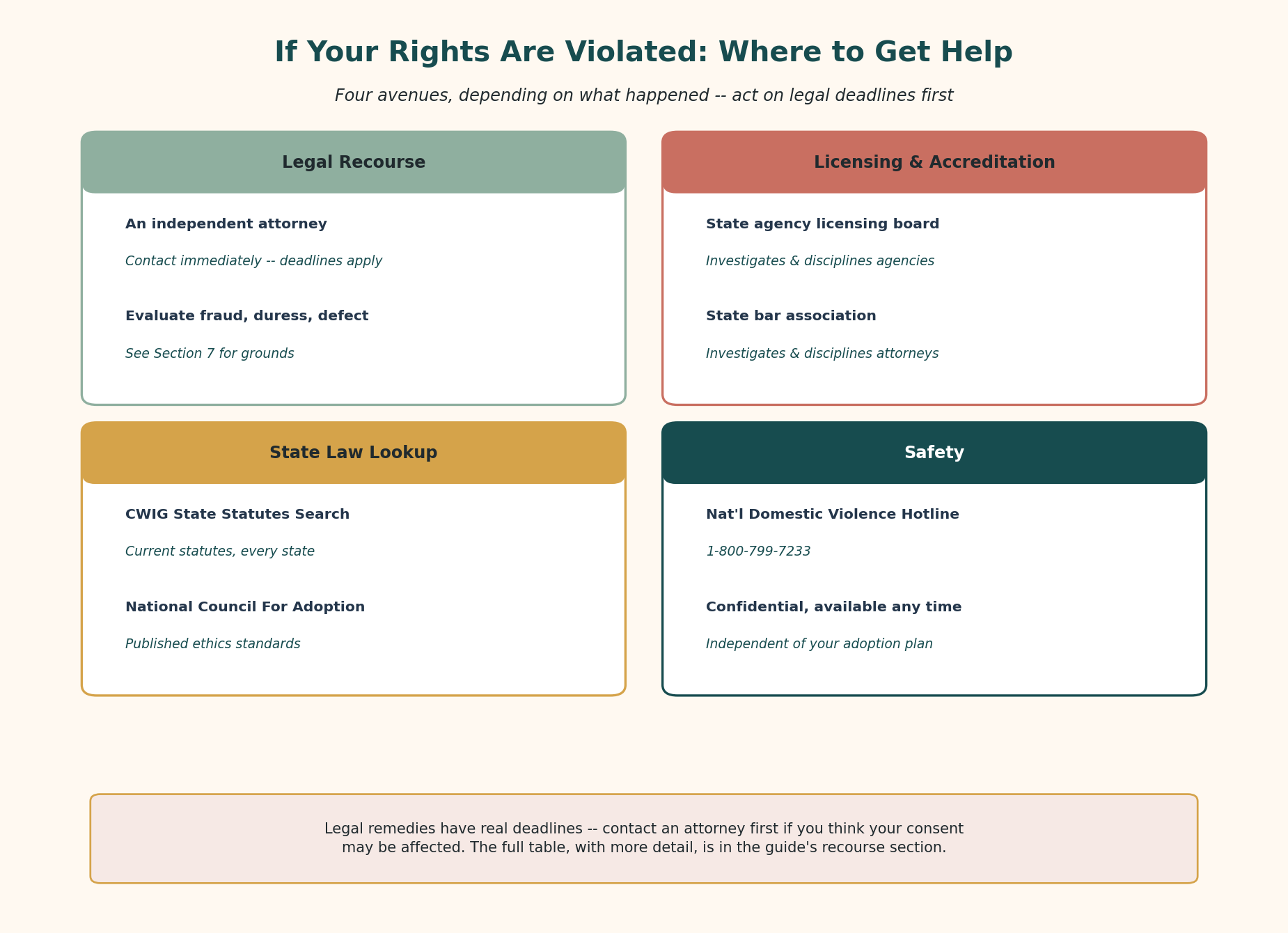
Who to Contact, Depending on What Happened
An Independent Attorney, First
For anything involving a potentially invalid consent, a missed deadline, or a professional’s conduct, an independent attorney — not affiliated with whoever you believe violated your rights — is almost always the right first call, since they can evaluate your specific facts against your specific state’s law and tell you what deadlines, if any, are already running.
Your State’s Licensing Board
Licensed adoption agencies and attorneys are regulated by state licensing authorities (typically a state’s department overseeing child welfare or social services for agencies, and the state bar for attorneys), and you can file a complaint if you believe a licensed professional violated ethical or legal standards. This won’t necessarily undo a completed adoption, but it can trigger an investigation and protect future birth parents from the same conduct.
Child Welfare Information Gateway’s State Statute Database
Before or alongside contacting an attorney, Child Welfare Information Gateway’s State Statutes Search tool is the place to confirm exactly what your state’s law actually requires, so you’re evaluating what happened against the real rule rather than a general impression of what should have happened.
What You Can Realistically Expect From Each Avenue
Legal Remedies Have Deadlines
Every path that could actually change your legal outcome — contesting a consent, revoking within a window, pursuing a claim related to fraud or coercion — operates on a real deadline set by your state, and those deadlines do not extend because you’re still processing what happened or deciding how to proceed. If there’s any chance you want to pursue a legal remedy, contacting an attorney immediately protects that option even while you’re still deciding whether to use it.
Reporting Still Matters Even When It’s Too Late to Change Your Own Outcome
If a legal deadline has already passed for your own situation, a licensing complaint or a report to an organization like the National Council For Adoption, which maintains professional standards and accreditation relationships, can still matter — both for accountability and for protecting the next expectant parent that agency or attorney works with.
| Situation | Who to Contact | What They Can Realistically Do |
|---|---|---|
| You believe consent was fraudulent, coerced, or improperly executed | An independent attorney, immediately | Evaluate grounds and deadlines, and act on your behalf if grounds exist |
| An agency or attorney engaged in unethical or unlicensed conduct | Your state’s agency licensing authority, or the state bar for an attorney | Investigate, discipline, or revoke a license |
| You’re unsure what your state’s law actually requires | Child Welfare Information Gateway’s State Statutes Search tool | Current, authoritative statutory summaries by state |
| You’re in an unsafe or coercive relationship | The National Domestic Violence Hotline (1-800-799-7233) | Confidential safety planning and support, separate from the adoption process itself |
| You want to understand or report against professional ethics standards | National Council For Adoption | Published standards, accreditation information, and a channel for concerns about agency conduct |
| You need the practical step-by-step checklist, not a rights reference | Our placing-a-baby-for-adoption guide | A full action checklist for building or rebuilding a plan correctly |
Key Takeaways
- An independent attorney is almost always the right first call for anything that might affect your legal rights, since real deadlines are often already running.
- A state licensing board or bar complaint can discipline a professional and protect future birth parents, even when it’s too late to change your own legal outcome.
- Child Welfare Information Gateway’s State Statutes Search tool and the National Domestic Violence Hotline are available as parallel resources — one for confirming the actual law, one for safety concerns that intersect with but aren’t limited to the adoption process.
Common Mistakes and Misconceptions About Birth Mother Rights
A few misunderstandings come up often enough, and carry high enough stakes, that they’re worth naming directly rather than leaving to be inferred from the sections above.
Misconceptions About Timing and Finality
“I Verbally Agreed, So It’s Final”
A verbal agreement, a signed letter of intent, or even a detailed hospital plan is not legal consent and is not binding, no matter how firmly it was stated or how many people were counting on it. The only thing that starts your state’s legal clock is a validly signed consent, executed after birth, following whatever procedure your state requires.
“Once I Accepted Help, I Couldn’t Back Out”
Lawfully provided expense support is not a down payment on your decision, and in most states you don’t owe it back if you change your mind (Section 8). If anyone suggests otherwise, that claim is worth verifying independently and immediately rather than accepting as a reason to proceed.
Misconceptions About Who’s Protecting You
“The Agency’s Attorney Is Looking Out for Me Too”
An attorney retained by or representing the adoptive family has a professional obligation to that family specifically, not to you — this isn’t a character judgment about that attorney, it’s a structural conflict of interest (Section 4) that exists regardless of how friendly or reassuring that attorney is in person.
“If It’s Legal, It Must Be Ethical — and Vice Versa”
A professional can technically comply with every statutory requirement while still falling short of the ethical standards described throughout this guide, such as genuinely non-coercive counseling or presenting the openness decision as truly negotiable. Conversely, a well-meaning professional’s ethical lapse doesn’t automatically mean a law was broken. Both categories matter, and distinguishing between them helps you know whether a situation calls for an attorney, a licensing complaint, or both.
The bottom line
As a birth mother or expectant mother, you hold a specific, substantial set of rights that exist independently of your agency, your state, or how far your plan has already progressed: the right to choose the adoptive family and openness level, independent counseling and legal representation (almost always at no direct cost to you), a hard rule that consent cannot exist before birth, a further chance in most states to change your mind afterward, lawful financial support that is never “payment” for your child, and real privacy with defined limits. Nothing about accepting help, meeting a family, or building a hospital plan locks any of this in before you’ve actually signed consent, and if anyone tells you otherwise, that claim is worth checking immediately with an independent attorney — not accepting because it was said with confidence. The specific numbers (your state’s waiting period, your state’s revocation window, your state’s expense caps) vary and must be confirmed through Child Welfare Information Gateway’s State Statutes Search tool and your own attorney, but the underlying rights themselves are yours everywhere in the United States, every time.
Glossary of Legal Terms
A quick reference for terms used throughout this guide and likely to come up in conversation with an agency, attorney, or court.
Consent and Timing Terms
Consent
The legal, voluntary agreement to place a child for adoption; cannot be validly signed before birth in any U.S. state, and subject to a minimum post-birth waiting period in most states.
Post-birth waiting period
The minimum amount of time, set by state law, that must pass after delivery before consent can be validly signed; varies by state from a matter of hours to a week or more.
Revocation period
A window, provided by many but not all states, during which a birth parent can withdraw already-signed consent and reclaim parental rights without needing to prove a legal defect; length varies significantly, and some states provide none.
Rescission
A term sometimes used interchangeably with revocation in state statutes, referring to the legal undoing of a signed consent within whatever window applies.
Finalization
The court proceeding that makes an adoption legally permanent, typically occurring months after placement, following a post-placement supervision period on the adoptive family’s side of the process.
Void vs. voidable consent
A “void” consent is treated as never having had legal effect (for example, one signed before birth); a “voidable” consent was initially valid but can be set aside if a party successfully proves a specific defect, such as fraud or duress, generally within a limited time frame.
Legal Roles and Process Terms
Independent (birth parent) attorney
An attorney representing only the birth parent’s interests, separate and distinct from any attorney representing the adoptive family; typically paid for by the adoptive family or agency as a standard cost of the adoption.
Guardian ad litem
An independent advocate, often an attorney, appointed in some states specifically to represent a minor’s interests in an adoption proceeding.
Putative father registry
A state system allowing a man who believes he may have fathered a child to register that possibility and thereby preserve his right to notice of an adoption proceeding; covered in full in our birth father rights guide.
Diligent search
A documented, court-required effort to locate and notify a known or possible biological father before an adoption can proceed without his consent.
Termination of parental rights (TPR)
The formal legal action that ends a parent’s legal rights and responsibilities toward a child; in a voluntary adoption, this occurs through validly executed consent and court approval rather than a contested court proceeding.
Licensed adoption agency vs. facilitator
A licensed agency is regulated by the state and typically provides counseling, matching, and legal coordination directly; a facilitator connects expectant parents with prospective families but refers out for the legal process itself, and is unlicensed or restricted in some states.
Financial and Privacy Terms
Allowable expenses
The category of pregnancy-related costs (medical, and in many states, living expenses) that an adoptive family or agency may lawfully pay on a birth parent’s behalf without it constituting payment for the child.
Post-adoption contact agreement (PACA)
A written agreement specifying the type and frequency of contact after placement; legally enforceable in roughly half of U.S. states and not in the other half — see our open adoption guide for the state-by-state pattern and how to draft one.
Closed, semi-open, and open adoption
The general spectrum describing how much contact and identifying information is shared between a birth parent and adoptive family after placement, from none (closed) to full ongoing contact (open), with many variations between.
Identifying information
Details such as full names, addresses, or other information that could allow one party to independently locate or identify the other, as distinct from non-identifying information such as first names, general location, or medical history.
Mutual consent registry
A state-run system allowing a birth parent and an adult adoptee to each register their willingness to be identified to the other, releasing identifying information only if both parties have registered.
Fraud, duress, and coercion (as legal grounds)
Narrow legal grounds on which a signed consent can potentially be contested: fraud involves material deception that caused the consent; duress and coercion involve consent obtained through threat, intimidation, or overwhelming pressure rather than genuinely voluntary agreement.
Expectant parent
The preferred term for a pregnant person who is considering adoption but has not yet placed a child, used instead of “birth mother,” which accurately applies only after a legal placement has occurred.
Licensing board (adoption)
The state agency, typically within a department of health or human services, responsible for licensing and disciplining adoption agencies; a separate body (the state bar) licenses and disciplines attorneys.
Frequently Asked Questions
Just Starting to Understand Your Rights
Do these rights apply to me even if I haven’t decided for sure that I want to place my child for adoption?
Yes — every right in this guide applies to you as soon as you’re an expectant parent considering adoption as an option, regardless of how firm or tentative that consideration is.
Do I lose any of these rights if I’m working with a facilitator instead of a licensed agency?
Your underlying legal rights (consent timing, revocation, lawful expense categories) don’t change based on who you’re working with, but a facilitator typically refers the legal process out rather than handling it directly, so confirming who is actually providing your counseling and legal representation matters more in that arrangement.
Choosing the Adoptive Family and Openness Level
Can an agency refuse to show me more family profiles if I don’t like the first ones?
No — you’re entitled to keep reviewing options until you find a match that feels right, within whatever reasonable timeline your agency operates on.
Can I choose a family and then change my mind about them specifically, without giving up on adoption entirely?
Yes — you can ask to be matched with a different family at any point before signing consent, for any reason.
Counseling and Legal Representation
Is counseling mandatory, or can I decline it?
You generally cannot be forced to attend counseling, but it’s offered as a right specifically because it tends to support better-informed decisions — declining it doesn’t forfeit any of your other rights.
What if I don’t like my assigned counselor?
Asking for a different counselor is reasonable and generally accommodated; a good agency wants you working with someone you can actually be honest with.
Consent Timing Basics
Is there any state where consent can be signed before birth?
No — this rule is universal across all 50 states and U.S. territories; the only variation is in the post-birth waiting period and revocation rules that follow.
What if I want to sign as early as possible after birth — can I speed up my state’s minimum?
No — the minimum waiting period is a floor set by statute, not a default that can be shortened by mutual agreement, even if everyone involved wants to move faster.
The Post-Birth Waiting Period
Why can’t I just sign the moment I feel ready, if that’s sooner than the minimum?
The minimum exists specifically because “feeling ready” immediately after childbirth isn’t considered a reliable enough basis for an irreversible legal decision under most states’ legislative judgment — it’s a protective floor, not a measure of your personal readiness.
Does the waiting period differ for a hospital birth versus a home birth?
The underlying statutory minimum doesn’t generally depend on delivery setting, though practical logistics (where a notary or officer can meet you) can differ — your attorney can address this if it applies to you.
Revocation and Changing Your Mind
If my state has no revocation period, does that mean I have no options at all after signing?
It means there’s no automatic window to revoke without cause — but the grounds covered in Section 7 (fraud, duress, lack of capacity, statutory defect) may still apply if they’re genuinely present in your situation; an attorney can evaluate this.
Does the revocation window pause if I’m trying to reach my attorney but can’t get through right away?
No — these windows generally run on calendar time regardless of logistical difficulty, which is exactly why acting the moment you decide matters so much.
Contesting a Signed Consent
How long do I have to contest a consent based on fraud or duress?
This deadline varies significantly by state and is often shorter than people expect — contact an attorney immediately if you believe this applies to you rather than researching the general answer first.
What kind of evidence actually matters if I want to contest consent?
Specific, documented facts — messages, dates, witnesses, financial records — tend to matter far more than a general account of how you felt; an attorney can tell you what to start gathering right away.
Coercion and Pressure
Does pressure from my own family count as coercion in a legal sense?
It can, particularly if it rises to the level of genuine duress affecting your signed consent, though the legal bar is higher than ordinary family disagreement or disappointment — describe the specifics to an attorney rather than assuming either way.
What if I felt pressured but can’t point to one specific incident?
A pattern of sustained pressure can still matter legally; document what you can remember as specifically as possible (approximate dates, what was said, by whom) and bring it to an attorney.
Medical and Living Expenses
Can I ask for a specific monthly amount for living expenses, or does the agency set that?
This is generally negotiated within your state’s lawful caps and categories, not a fixed amount every agency uses identically — ask directly what’s typical and what your state allows.
What if my living expenses genuinely exceed what’s typically covered?
Discuss this directly with your agency or attorney; some additional costs tied specifically to the pregnancy may still be coverable within your state’s categories even if they exceed a typical baseline.
Privacy and Confidentiality
Can the adoptive family find out my last name if I don’t want them to?
In a closed or semi-open arrangement structured to limit identifying information, a licensed agency can generally act as an intermediary to prevent this — confirm exactly what information flows through your specific arrangement.
Will my employer or school find out I’m placing a child for adoption?
Not through any standard part of the adoption process itself — your medical and counseling information is protected the same way any patient’s would be, independent of your employer or school.
Open Adoption and Ongoing Contact
Is a verbal promise about future contact worth anything if it’s not written down?
Much less than a written agreement — see our open adoption guide for how to put contact expectations into a document that holds up as well as your state allows.
Can the adoptive family change their mind about openness after placement?
This is exactly the risk a written post-adoption contact agreement is meant to address, with enforceability depending on your state — our open adoption guide covers this in full.
If You’re a Minor
Do I need my parents’ permission to place a child for adoption if I’m under 18?
This depends on your state — some require parental involvement or notification, others allow a minor to proceed independently in some circumstances — confirm your specific state’s rule directly and early.
Can my parents force me to place a child for adoption against my wishes?
No — the decision remains legally yours as the pregnant person, regardless of your parents’ preference, though your state’s procedural rules about their involvement in the process may still apply.
The Birth Father and Other Legal Parents
Does the biological father have to agree before I can place the child for adoption?
In most circumstances, yes, his consent or a valid legal basis for proceeding without it is required — see our birth father rights guide for exactly how this works, including when he’s unknown or unreachable.
What if I don’t know who the biological father is?
States generally still require a documented, good-faith effort (a “diligent search”) before proceeding without his consent; your attorney can guide you through what this requires in your state.
If Your Rights Were Violated
What’s the very first thing I should do if I think my rights were violated?
Contact an independent attorney immediately — before deciding how serious it is on your own, since they can tell you what deadlines may already be running.
Can I still get help if the adoption has already been finalized?
Legal options to undo a finalized adoption are narrow and time-limited, but reporting conduct to a licensing board or National Council For Adoption can still matter for accountability, even if your own legal outcome can’t be reversed.
Reporting an Agency or Attorney
Where do I actually file a complaint against a licensed adoption agency?
Typically through the state agency that licenses adoption providers (often part of a state’s health or human services department) — an independent attorney or Child Welfare Information Gateway’s state resource pages can point you to the right office for your state.
How do I file a complaint against an attorney specifically?
Through your state’s bar association, which handles attorney licensing and discipline independently of adoption-specific agency licensing.
State-to-State Variation
Why doesn’t this guide just tell me my state’s specific numbers?
Because adoption law is set at the state level and changes over time, stating a specific figure here risks being wrong for your state or outdated by the time you read it — Child Welfare Information Gateway’s State Statutes Search tool and a licensed attorney give you the current, accurate number instead.
What if I move to a different state partway through my pregnancy or the process?
Which state’s law applies can depend on several factors (where you reside, where the birth occurs, where the adoptive family lives); raise a cross-state move with your attorney immediately, since it can change meaningful details like your revocation window.
Safety and Coercive Relationships
What if the person pressuring me is the one who’s supposed to be supporting me through this process?
That’s still worth naming to an independent counselor or attorney, specifically because of that role — someone meant to support your decision-making pressuring you toward a specific outcome is a direct conflict with their actual role.
Is the National Domestic Violence Hotline only for physical violence?
No — it supports a wide range of coercive and controlling situations, including financial and emotional coercion, not only physical safety concerns.
LGBTQ+ Birth Parents
Does being LGBTQ+ change any of the rights covered in this guide?
No — your rights as a birth parent apply regardless of your sexual orientation or gender identity, and a reputable agency or attorney serves birth parents without regard to these factors.
Can I choose an adoptive family based on their views toward LGBTQ+ people?
Yes — like any other preference, you can factor this into your selection process when reviewing family profiles.
If the Adoptive Family Backs Out
Can an adoptive family change their mind after we’ve matched?
Yes — matching isn’t legally binding on either side until the legal process is complete, which means an adoptive family can also step back from a match, just as you can.
What happens to expense support already provided if the adoptive family backs out?
This typically isn’t something you’d be expected to repay, since it was provided as lawful pregnancy-related support rather than a loan contingent on the match succeeding — confirm this with your attorney if it happens.
