
Adoption cost is one of the first questions almost every prospective adoptive parent asks, and one of the hardest to get a straight answer to, because the honest answer is “it depends enormously on which path you choose.” A foster-care adoption can cost close to nothing. A domestic infant adoption through a licensed agency commonly runs $25,000 to $60,000. An international adoption can land anywhere from roughly $25,000 to $70,000 once travel is included. A stepparent or relative adoption might cost a few hundred dollars in court fees. This guide breaks down what you’ll actually pay by adoption type, exactly what’s included in a typical fee, and the real, verifiable financial assistance available to close the gap — grants, the federal adoption tax credit, employer benefits, military reimbursement, and adoption loans. It also makes one point clearly up front, because it matters enormously and gets confused constantly: in a legal domestic adoption, the birth parent does not pay for their own adoption. If you’re an expectant parent reading this to understand your own situation rather than an adoptive parent’s, our guide on pregnancy and considering adoption and our guide to placing a baby for adoption cover your side of this directly — you won’t find a bill in either of them, because there isn’t one.
Short Answer: What Adoption Costs, by Type
There is no single number for “how much does adoption cost,” because the United States doesn’t have one adoption system — it has several, each with a different cost structure. The table below gives you the real range for each path, based on current data from Creating a Family’s ongoing agency and family cost surveys, the federally funded AdoptUSKids foster-care program, and government and nonprofit sources cited throughout this guide. Treat every figure here as a planning range, not a quote — your actual cost depends on your state, your agency or attorney, and your specific situation.
The Child Welfare Information Gateway (U.S. Department of Health and Human Services) publishes a national overview of adoption costs by adoption type. The National Council For Adoption also tracks typical fee ranges and financial assistance options for prospective adoptive families.
Key Takeaways
- Foster-care adoption typically costs $0 to about $2,500, and many of those costs are later reimbursed.
- Domestic infant adoption through a licensed agency typically runs $25,000 to $60,000; working independently with an attorney typically runs $35,000 to $50,000.
- International adoption typically runs roughly $25,000 to $70,000+ once travel, in-country fees, and immigration processing are included, and varies significantly by country.
- Relative and stepparent adoption is usually the least expensive path, often a few hundred to a few thousand dollars in court and legal fees, with no agency fee and often a simplified home study.
- In a legal domestic adoption, the birth parent’s pregnancy-related medical costs and, in many states, reasonable living expenses are paid by the adoptive family or agency — never by the birth parent. See Section 8 below.
- Real financial assistance exists and can meaningfully reduce your net cost: the federal adoption tax credit (full details here), nonprofit grants, employer benefits, military reimbursement, and adoption loans, covered in Sections 9 through 12.

| Adoption type | Typical total cost | Who usually pays | Where this is covered |
|---|---|---|---|
| Foster care adoption | $0–$2,500 (often reimbursed) | Adoptive family, largely offset by federal/state reimbursement and the full adoption tax credit regardless of actual expenses | Section 5 |
| Relative or stepparent adoption | Roughly $100s–$3,000+ (state-variable) | Adoptive parent (court filing and, often, attorney fees only) | Section 7 |
| Domestic infant adoption, independent/attorney-led | $35,000–$50,000 | Adoptive family | Section 3 |
| Domestic infant adoption, licensed agency | $25,000–$60,000 | Adoptive family | Section 3 |
| International/intercountry adoption | Roughly $25,000–$70,000+ including travel | Adoptive family | Section 6 |
Why These Ranges Are So Wide
Multiple Independent Cost Drivers Stack on Top of Each Other
Agency reputation and overhead, your state’s cost of living, whether an attorney bills by the hour or a flat fee, how far you need to travel, and whether a birth parent needs significant medical or living-expense support all move independently of each other. A $25,000 domestic adoption and a $60,000 domestic adoption aren’t necessarily “cheap” versus “expensive” in quality — they can simply reflect different combinations of these variables.
“Cost of Adoption” Questions Usually Mean Different Things to Different People
Someone asking about foster-care adoption and someone asking about international adoption are really asking two different questions that happen to share the same four words. This guide treats each path as genuinely distinct rather than trying to average them into one misleading number.
How to Use This Guide
If You Already Know Which Path You’re Considering
Jump directly to that path’s section (domestic infant, foster care, international, or relative/stepparent) for the real cost breakdown, then read Sections 9 through 13 for how to reduce your net cost.
If You’re Still Comparing Paths
Read straight through. Cost is a legitimate factor in choosing a path, but it shouldn’t be the only one — our guide to how adoption works and our guide to the adoption process cover the practical and legal differences between these paths beyond just price.
Why Adoption Costs Vary So Much
Before breaking down each adoption type individually, it helps to understand the handful of factors that actually drive adoption cost up or down. The same five or six variables show up again and again across every path, just in different combinations.
Who Sets the Price
There Is No Single National Fee Schedule
Unlike, say, a hospital’s published chargemaster or a flat government filing fee, adoption costs are set by a patchwork of licensed private agencies, individual attorneys, foreign governments and their accredited intermediary agencies, and, for foster care, state child-welfare systems — each operating under different state licensing rules, different overhead structures, and different fee philosophies (flat-fee, sliding-scale-by-income, or itemized).
Nonprofit Status Doesn’t Automatically Mean Lower Cost
Many licensed adoption agencies are structured as nonprofits, but “nonprofit” describes tax status, not price. A nonprofit agency still has to cover staff salaries, home-study and post-placement supervision labor, office overhead, and often significant charitable support for birth parents who don’t ultimately place — all of which gets reflected in the fee it charges adoptive families.
The Variables That Actually Move the Number
Agency vs. Independent (Attorney-Led) vs. Facilitator
Working with a full-service licensed agency typically costs more than working independently with an attorney, because the agency fee bundles services (matching support, counseling, education, post-placement supervision) that you’d otherwise have to assemble piece by piece. Independent/attorney-led adoption can cost less in aggregate but requires you to coordinate more of the moving parts yourself. Section 3 below compares these directly.
Birth-Parent Support Needs
If a birth parent has significant pregnancy-related medical needs, limited income, or needs a longer period of living-expense support, those real, state-regulated costs (covered lawfully by the adoptive family or agency, never by the birth parent — see Section 8) add to the total. This is not padding; it’s the system working as designed.
Geography, on Both Ends
Adoption professionals’ fees generally track regional cost of living, and many families work with an agency or attorney outside their home state, which can add travel and lodging costs on top of the base fee — a dynamic that’s especially pronounced in international adoption (Section 6).
Sliding-Scale Pricing
Some licensed agencies set fees on a sliding scale tied to adoptive-family income, meaning two families working with the exact same agency for a comparable adoption can pay noticeably different total fees. It’s worth asking directly whether an agency does this before assuming a quoted range applies to you.
Supply, Demand, and Timing Factors
How Many Families Are Waiting, Relative to How Many Expectant Parents Are Matching
Agency and attorney fees respond, at least loosely, to how many prospective adoptive families are actively waiting relative to how many expectant parents are making an adoption plan in that agency’s or attorney’s network at a given time. This is one reason a quoted range can shift somewhat year to year, independent of inflation alone, and why a fee quoted by an agency three or four years ago isn’t a reliable stand-in for its current fee.
How Many Adoptions a Professional Has Completed Does Not Reliably Predict Price
It’s tempting to assume a highly experienced, well-established agency or attorney automatically costs more, or that a newer one is automatically cheaper, but neither assumption holds up consistently across the industry. Overhead structure, regional cost of living, and how the fee is itemized matter more than years in operation alone — which is exactly why this guide keeps steering you back toward getting an actual written quote rather than estimating from reputation.
Key Takeaways
- Adoption cost varies because there’s no single pricing authority — agencies, attorneys, foreign governments, and state child-welfare systems each set their own fees under different rules.
- The biggest cost drivers are which professional path you use (agency, independent/attorney, or public foster system), birth-parent support needs, and geography.
- A nonprofit agency isn’t automatically cheaper than a for-profit attorney arrangement, and a more experienced professional isn’t automatically more expensive — tax status, experience, and price are each independent of one another.
Domestic Infant Adoption Costs: Agency vs. Independent/Attorney-Led
Domestic infant adoption — adopting a U.S.-born infant, typically matched with an expectant parent before or shortly after birth — is the path most people picture when they hear “adoption,” and it’s also the path with the widest and most-discussed cost range. The two main routes, licensed agency and independent (attorney-led), have real cost and process differences worth understanding before you pick one.
| Factor | Licensed agency adoption | Independent (attorney-led) adoption |
|---|---|---|
| Typical total cost | $25,000–$60,000 | $35,000–$50,000 (some sources cite a lower $10,000–$15,000 average for simpler, uncomplicated matches, with complex cases running well above that) |
| Who matches you with an expectant parent | The agency, using its own network and the expectant parent’s stated preferences | You and your attorney, often through independent advertising/networking, your own outreach, or a parallel matching/consulting service |
| Who provides counseling to the expectant parent | Agency-employed or agency-contracted counselors, bundled into the fee | Independent counselor, typically billed separately or arranged through the attorney |
| Who handles the home study | Often the same agency (sometimes for an added fee) or a separate licensed home-study provider | A separate licensed home-study provider, almost always billed separately — see our full guide to the home study |
| Legal representation | Often coordinated or recommended by the agency; you still need your own attorney for finalization | Central to the process from the start; separate attorneys are required for you and for the birth parent |
| Where legal availability varies | Legal and licensed in every state | Legal in most states; a small number of states restrict or prohibit fully independent (non-agency) adoption |
Agency Adoption Costs
What You’re Paying For
A licensed agency’s fee typically bundles: the home study (or a referral and administrative fee if outsourced), matching and case-management services, required adoptive-parent education and training, birth-parent counseling and case-management, and administrative/legal coordination through placement. Many agencies also cover a portion of birth-parent medical and living expenses within the fee, which is one reason agency fees run higher on average than independent-adoption figures.
Why the Range Is So Wide ($25,000–$60,000)
At the low end, you’re typically looking at a smaller regional nonprofit agency with modest overhead and a birth parent whose expense needs are limited. At the high end, you’re typically looking at a larger national agency, a longer or more complex match, higher birth-parent support costs, or travel to work with an out-of-state agency. Ask any agency for a complete, itemized fee schedule in writing before signing anything — a reputable agency will provide one without hesitation.
Independent (Attorney-Led) Adoption Costs
What “Independent” Actually Means
Independent adoption means you and the birth parent find each other directly (through networking, your own outreach, a parallel matching consultant, or word of mouth) rather than through a full-service agency’s internal matching program, and an attorney — usually two attorneys, one for each side — handles the legal process. You’re still required to complete a home study, and the birth parent still typically receives independent counseling; you’re simply assembling these pieces yourself rather than through one bundled agency fee.
Why It Can Cost Less, and Why It Sometimes Doesn’t
Independent adoption can cost less than agency adoption because you’re not paying for a bundled matching program, and some sources cite average costs as low as $10,000–$15,000 for straightforward cases. But costs rise quickly if the match takes longer, if a birth parent has significant medical or living-expense needs, or if legal complications arise — which is why the more commonly cited full range, $35,000–$50,000, better reflects what many families actually spend once every category is totaled.
Which Costs More, and Why That’s Not the Only Question
Lower Average Cost vs. More Required Coordination
Independent adoption’s lower reported averages come with a real tradeoff: you and your attorney are personally responsible for coordinating matching, counseling referrals, and timeline management that an agency would otherwise bundle and manage for you. For some families, that tradeoff is well worth the savings; for others, the agency’s structure and support are worth the added cost.
State Law Shapes Which Option Is Even Available to You
A small number of states don’t permit fully independent, non-agency domestic adoption, or impose additional requirements on it. Before deciding between the two paths on cost alone, confirm what’s actually legal and practical in your state — our guide to adoption requirements and a licensed adoption attorney in your state are the right places to confirm this.
Comparing Quotes Across Agencies or Attorneys
Ask for the Same Breakdown From Every Professional You Consider
Before comparing two agencies’, or an agency’s and an attorney’s, bottom-line numbers, ask each one for the same category-by-category breakdown: home study, program or matching fee, legal fees for both sides, estimated birth-parent medical and living-expense support, and post-placement supervision. A $30,000 quote that excludes birth-parent living-expense support and a $40,000 quote that includes a generous estimate of it aren’t actually $10,000 apart in what you’ll likely spend overall — they’re priced differently because they’re estimating different things.
Ask What Happens to Your Money if the Adoption Doesn’t Proceed
Get this answer in writing, from every agency or attorney you seriously consider, before paying anything: which fees are fully refundable, partially refundable, or nonrefundable if a match falls through or a birth parent decides not to place. This single question often reveals more about an organization’s overall approach than its headline price does.
Key Takeaways
- Agency adoption ($25,000–$60,000) bundles matching, counseling, education, and case management into one fee; independent/attorney-led adoption ($35,000–$50,000, sometimes less for simple matches) requires more self-coordination but can cost less in a straightforward case.
- Both paths require a home study and legal representation; neither path lets you skip either requirement.
- A small number of states restrict fully independent adoption — confirm what’s legal where you live before ruling either path in or out based on cost alone.
What’s Actually Included in a Typical Domestic Adoption Fee
“Agency fee” and “adoption cost” can feel like one opaque number until you see it broken into its actual components. The categories below are the ones that commonly appear, in some combination, across licensed agency and independent domestic infant adoptions — commonly cited in federally supported adoption-education materials, though every agency itemizes somewhat differently, so always ask for a written, category-by-category fee schedule rather than relying on any general breakdown, including this one.
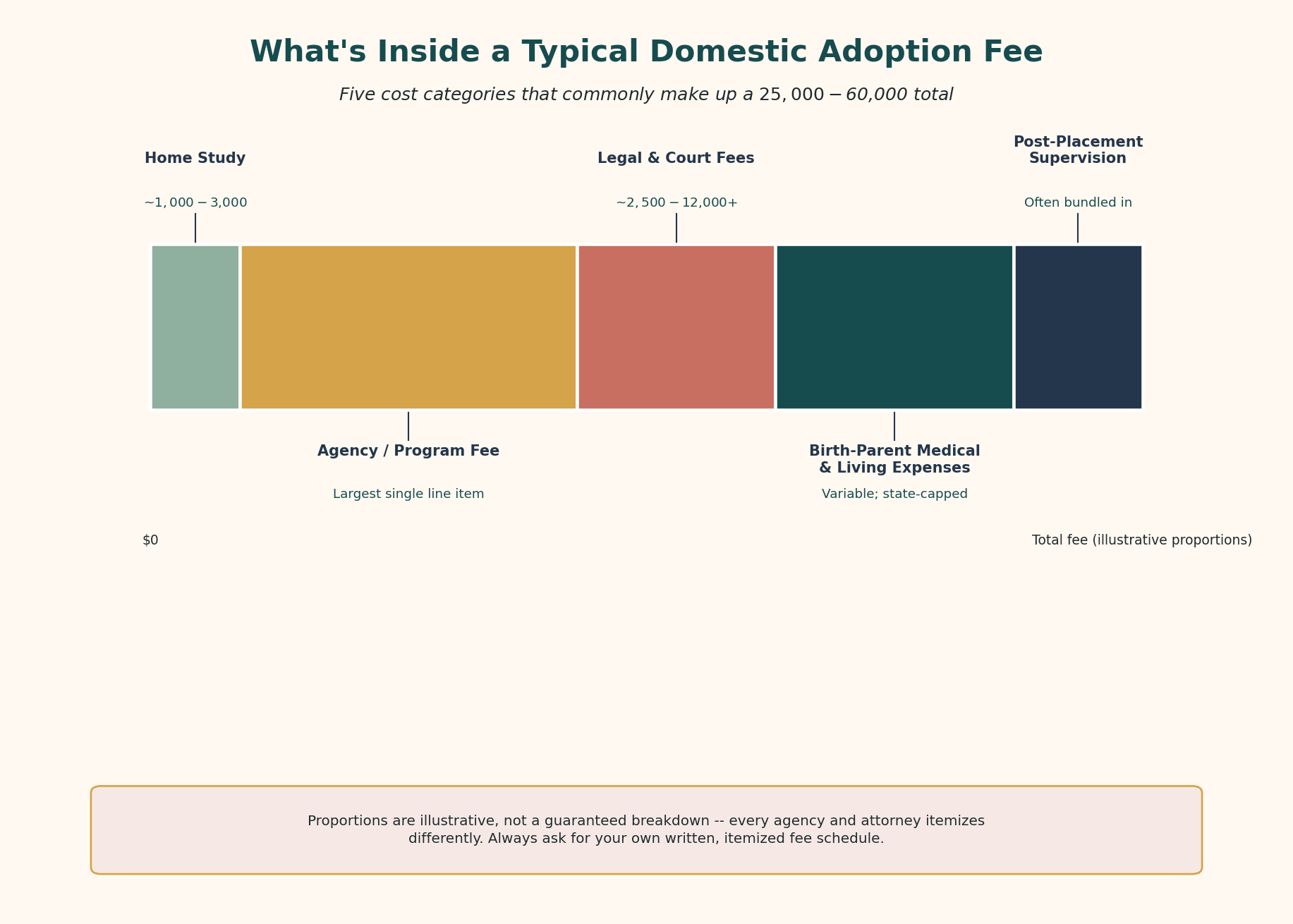
| Fee category | Typical range | What it covers |
|---|---|---|
| Home study | Roughly $1,000–$3,000 | Background checks, home visits, interviews, and the written report required before you can be matched or finalize an adoption — see our dedicated home study guide |
| Agency/program fee | Varies widely by agency; often the largest single line item | Matching services, adoptive-parent education, case management, birth-parent counseling and support coordination |
| Legal and court fees | Roughly $2,500–$12,000+ | Attorney representation for the adoptive family (and, separately, the birth parent), court filing fees, and finalization costs |
| Birth-parent medical and living expenses | Highly variable; state-capped where living expenses are allowed | Pregnancy-related medical care and, in many states, reasonable living expenses during pregnancy — lawful support, never payment for the child; see Section 8 and our birth-mother-rights guide |
| Post-placement supervision | Often bundled into the agency/program fee, or billed as a smaller separate line item | Required follow-up visits and reports (frequency and duration set by your state and often your receiving state, for several months after placement) before finalization |
Home Study and Agency Fees
The Home Study Is a Fixed Requirement, Not an Upsell
Every U.S. adoption — domestic, international, foster, and in most states even relative/stepparent adoption to some degree — requires a completed home study before placement or finalization. It’s billed separately from the broader agency fee in independent adoption, and often (though not always) bundled into the agency fee in agency adoption. Our full home study guide covers exactly what the process involves; this article focuses only on its place in your overall budget.
Why the Agency/Program Fee Is Usually the Biggest Line Item
This fee is really several services sold as one bundle: staff time for matching, training curricula, licensed counselors’ time with the birth parent, and the agency’s own administrative and insurance overhead. Ask specifically what’s bundled into this single line before comparing two agencies’ quoted “program fee” as if they were the same product.
Legal and Court Fees
Why Two Sets of Legal Fees Are Often Involved
Ethically and, in many states, legally, the birth parent is entitled to their own independent attorney, separate from the one representing the adoptive family — a single attorney generally cannot represent both sides at once, since their interests can diverge. In many arrangements, the adoptive family covers both sets of legal fees as part of the overall cost, consistent with the broader principle that the adoptive family bears the financial burden, not the birth parent.
What Drives Legal Fees Toward the High End of the Range
A straightforward, uncontested, in-state adoption with no legal complications tends to land toward the lower end of the $2,500–$12,000+ range. Anything that adds legal complexity — an interstate placement requiring Interstate Compact on the Placement of Children (ICPC) coordination, a contested consent, locating or formally terminating a non-consenting birth father’s rights, or a legally complicated birth-parent situation — pushes legal costs upward, sometimes substantially.
Birth-Parent Medical and Living Expenses
This Is Support, Not a Line Item You Can Simply Skip
In nearly every domestic infant adoption, some portion of the overall cost reflects lawful, state-regulated support for the birth parent’s pregnancy-related medical care and, in many states, capped living expenses. This isn’t an optional add-on you can decline to save money — it’s a core, legally structured part of how domestic infant adoption works, and attempting to arrange an adoption without it (or to arrange it outside your state’s legal boundaries) raises real legal risk.
Where the Legal Depth on This Lives
What counts as lawful support, what’s prohibited as resembling payment for the child, and what happens if a birth parent decides not to place after receiving support are all covered in detail, with full legal nuance, in our birth-mother-rights guide. This article’s job is narrower: making sure you understand, as the paying party, that this category exists, is a real and often substantial part of your budget, and is not something to view with suspicion when an agency or attorney explains it to you.
Post-Placement Supervision
What It Is and Why It’s Required
After the child is placed in your home and before the adoption is legally finalized, most states require a series of post-placement visits and written reports from a licensed social worker confirming the placement is going well. This typically continues for several months and is a standard, non-negotiable part of the legal process in nearly every domestic adoption.
Where It Shows Up in Your Total Cost
Some agencies bundle post-placement supervision into the overall program fee; others bill it as a distinct line item, sometimes payable closer to placement rather than up front. Either way, budget for it as a real cost category rather than assuming your spending is done once a child is placed in your home.
Key Takeaways
- A typical domestic adoption fee breaks into five recognizable categories: home study, agency/program fee, legal and court fees, birth-parent medical/living expenses, and post-placement supervision.
- The agency/program fee is usually the single largest line item because it bundles several distinct services.
- Birth-parent medical and living expense support is a lawful, structured, and expected part of the total cost — not an optional extra and not payment for the child.
Foster Care Adoption Costs: Often Free or Very Low-Cost
Adopting a child from the U.S. foster care system is, by a wide margin, the least expensive adoption path — and for many prospective parents considering cost as a real factor, it’s worth understanding clearly on its own terms rather than as an afterthought to domestic infant or international adoption.
Why Foster Adoption Costs So Little
It’s a Public, State-Funded System
According to AdoptUSKids, the federally supported national foster-care adoption recruitment program, “adoption from foster care costs little to nothing,” because most families adopt through their state or county public child-welfare agency, where the process is state-funded rather than fee-for-service. This is structurally different from private domestic infant or international adoption, where you’re paying a private agency or attorney directly for services rendered.
The Home Study Itself Is Often Free
When conducted by the public agency rather than a private contractor, the home study required to become a licensed foster-to-adopt family is typically completed at no charge to you, as part of the state’s broader effort to recruit and prepare foster and adoptive families for children already in its care.
Adoption Assistance (Subsidy) After Foster Adoption
Title IV-E Adoption Assistance
Most children adopted from foster care — particularly those with a “special needs” determination under their state’s criteria, which is a broader legal category than it sounds and can include older age, sibling-group placement, or documented medical/emotional needs — qualify for the federal Title IV-E Adoption Assistance Program. This can provide a one-time payment, ongoing monthly financial assistance, continued Medicaid coverage, or some combination, continuing after finalization.
Nonrecurring Adoption Expense Reimbursement
Separately from ongoing monthly assistance, many states reimburse adoptive families for the one-time, “nonrecurring” costs directly tied to finalizing the adoption of a child with a special needs determination — things like legal fees, court costs, and the home study itself — up to a state-set cap.
What You Might Still Pay Out of Pocket
Typical Out-of-Pocket Range: $0 to Roughly $2,500
Even with a largely state-funded process, some families still incur modest out-of-pocket costs — background-check fees, required training-course materials, document and record fees, or travel to required appointments — generally landing somewhere between $0 and about $2,500 depending on your state and county.
Working With a Private Agency for a Foster Adoption
Some families work with a licensed private agency that specializes in foster-to-adopt placements rather than going directly through the public system; this can involve somewhat higher upfront costs than the fully public path, though families in this situation can typically recoup much of that out-of-pocket spending through the same federal and state reimbursement programs once the adoption finalizes.
The Adoption Tax Credit Applies Regardless of Actual Expenses
One detail that surprises many foster-adoptive families: because a child adopted from foster care with a special needs determination is treated as automatically having qualified adoption expenses for federal tax-credit purposes, the family can generally claim the full federal adoption tax credit regardless of how little they actually spent out of pocket. Our full adoption tax credit guide covers exactly how this works and how to claim it; Section 9 below gives you the brief version.
Key Takeaways
- Foster-care adoption typically costs $0 to about $2,500 out of pocket, and much of that is often reimbursable.
- Most foster-adopted children with a special needs determination qualify for Title IV-E adoption assistance (one-time and/or ongoing payments, plus continued Medicaid) and for nonrecurring expense reimbursement up to a state-set cap.
- Families adopting a child with a special needs determination from foster care can generally claim the full federal adoption tax credit regardless of their actual out-of-pocket spending.
International (Intercountry) Adoption Costs
International, or intercountry, adoption is typically the most expensive domestic-vs-international comparison point, and the cost structure is genuinely different from either domestic infant or foster adoption, because it involves two countries’ legal systems, U.S. immigration processing, and travel.
| Country example | Typical cost range (excluding most travel) | Typical timeline | Notable process feature |
|---|---|---|---|
| Colombia | $35,000–$60,000 plus travel | 18 months–3 years | Hague Adoption Convention partner country |
| India | $30,000–$46,000 plus travel | Up to 4 years; typical in-country stay around 2 weeks | Hague Adoption Convention partner country |
| Bulgaria | $25,000–$43,000 plus travel | 6 months–4 years | Typically requires two separate in-country stays |
These three countries are illustrative examples, not an exhaustive or current ranked list — intercountry adoption program availability, timelines, and costs change based on both the sending country’s policy and U.S. State Department accreditation status, sometimes with little notice.
What Drives International Adoption Costs Up
Two Countries’ Requirements, Not One
You’re simultaneously meeting your receiving country’s (the child’s country of origin) legal and procedural requirements and the United States’ immigration and adoption-eligibility requirements, administered primarily by U.S. Citizenship and Immigration Services (USCIS) and, for Hague Adoption Convention countries, the U.S. State Department. Each layer carries its own fees, paperwork, and, often, its own required professionals.
Travel Is a Separate, Often Underestimated Cost Category
Most international adoptions require at least one, and often two, in-country trips — sometimes for a stay of one to several weeks — covering airfare, lodging, local transportation, food, and sometimes a required translator or in-country facilitator fee. This travel cost is frequently quoted separately from the “adoption cost” headline figure, which is why country-level totals in Table 4 above specifically flag travel as additional.
Typical Cost Categories
U.S.-Side Costs
Your home study (same requirement as domestic adoption, though often with additional intercountry-specific training), your U.S.-based agency’s program fee, USCIS immigration-petition filing and biometrics fees, document authentication, and dossier preparation.
Foreign-Country-Side Costs
Fees paid to your receiving country’s government or its accredited adoption authority, in-country orphanage or child-welfare program contributions (where applicable and legally required), foreign legal and court fees, translation services, and, in many programs, an escrow-style deposit held by your agency for in-country logistics.
Travel and Logistics
Airfare for one or two adult travelers (sometimes for one or two separate trips), lodging for the full required in-country stay, local transportation, meals, and sometimes a required in-country facilitator or guide fee.
Country-by-Country Cost Examples
Why This Guide Doesn’t Give a Single International Figure
Unlike domestic infant adoption, where cost ranges are reasonably consistent nationwide, intercountry adoption cost and process depend heavily on which specific country you’re adopting from, since each country sets its own legal requirements, timeline, and fee structure independently. Table 4’s three examples illustrate the range rather than defining it.
Where to Get a Current, Country-Specific Estimate
A U.S. State Department-accredited intercountry adoption service provider working in your country of interest is the right source for a current, country-specific cost estimate — program costs and country availability shift over time based on both the sending country’s policy and U.S. accreditation status, in ways a static guide like this one cannot responsibly predict.
Key Takeaways
- International adoption typically costs more than domestic infant adoption once every category is totaled, largely because it layers two countries’ legal and procedural requirements plus travel on top of the same core U.S. costs (home study, agency fee, legal fees).
- Travel is a real, separate cost category, often one or two in-country trips of one to several weeks each.
- Country-specific costs, timelines, and even program availability change over time — confirm current figures directly with an accredited agency and the State Department rather than relying on a fixed number from any guide.
Relative and Stepparent Adoption Costs: The Least Expensive Path
Adopting a stepchild or a relative — a grandchild, niece, nephew, or younger sibling, for example — is structurally different from domestic infant, foster, or international adoption, and it’s consistently the least expensive path, because several of the cost categories that drive up other adoption types simply don’t apply.
Why These Cost Less
No Agency Fee, in Most Cases
Because you already have a relationship with the child and typically with the child’s other legal parent (in a stepparent adoption) or family (in a relative adoption), there’s no matching process to pay for, and most relative and stepparent adoptions proceed without a licensed placement agency at all.
Simplified or Waived Home Study, Depending on Your State
Many states simplify, shorten, or in some circumstances waive the standard home study requirement for a stepparent or close-relative adoption, on the reasoning that the child is already living with or well-known to the adopting relative. This varies by state and by the specific family relationship involved.
What You’ll Typically Pay
Court Filing Fees
Every state charges a court filing fee to initiate an adoption case, typically in the range of roughly $100 to a few hundred dollars, though the exact amount varies by state and county court. This is usually the one cost every relative or stepparent adoption shares in common, regardless of state.
Attorney Fees, If You Use One
Many families complete a stepparent or relative adoption with an attorney handling the paperwork and court filing, which is strongly advisable even in an otherwise straightforward case, since finalizing an adoption terminates and transfers legal parental rights permanently. Total attorney fees for an uncontested stepparent or relative adoption are generally far lower than for domestic infant or international adoption, often landing in a low-thousands-of-dollars range, though this varies by state, by attorney, and especially by whether the adoption is contested by another legal parent.
What Can Make a Relative or Stepparent Adoption More Expensive
Cost rises mainly when the adoption is contested — for example, when a non-custodial legal parent does not consent and their parental rights must be formally and legally terminated through a contested court process rather than a voluntary relinquishment. A contested relative or stepparent adoption can approach the legal complexity, and cost, of other adoption types. Our guide to adoption requirements covers the general legal groundwork that applies across adoption types, including consent and parental-rights termination.
Key Takeaways
- Relative and stepparent adoption is the least expensive path because it typically skips agency matching fees and often simplifies the home study.
- The core costs are a court filing fee (roughly $100 to a few hundred dollars) and, if you use one, attorney fees — frequently totaling a few hundred to a few thousand dollars for an uncontested case.
- Cost and complexity both rise sharply if another legal parent contests the adoption, since that requires a formal, contested parental-rights termination process.
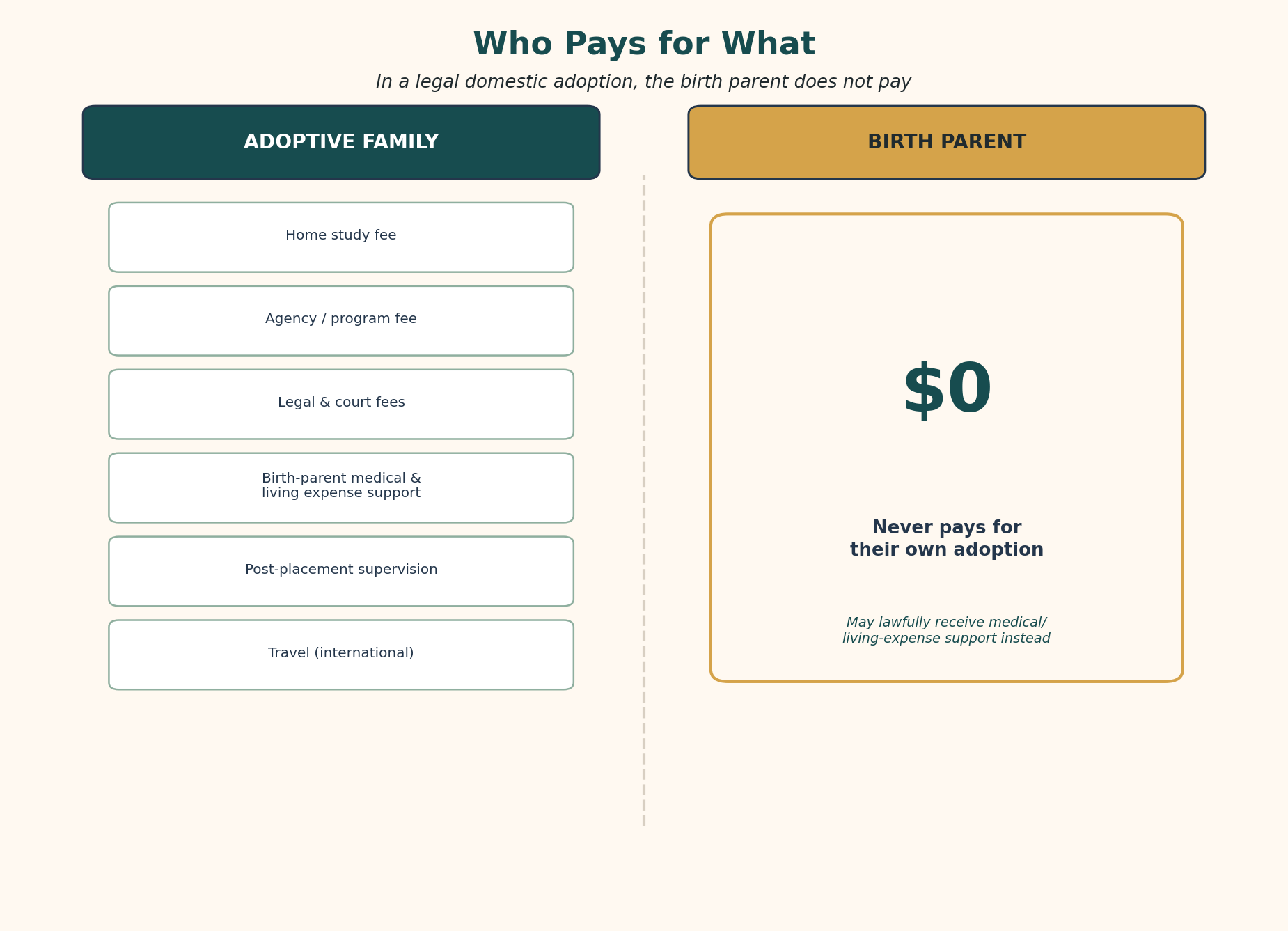
Who Actually Pays? The Birth Parent Does Not Pay for Their Own Adoption
This section exists because the confusion it addresses is common and consequential: in a legal domestic adoption in the United States, the birth parent does not pay agency fees, legal fees, or any cost associated with placing their child for adoption. If anything, lawful financial support typically flows in the other direction, from the adoptive family or agency to the birth parent, for pregnancy-related medical care and, in many states, living expenses.
The Legal Rule Behind This
Every State Prohibits Paying a Birth Parent for the Child
Every state’s adoption statutes prohibit paying a birth parent in exchange for placing a child — sometimes called the prohibition on “baby selling” — precisely so that parental rights can never become something a wealthier family simply purchases. The flip side of that same rule is that the birth parent is never the one billed for agency services, legal representation, or any part of the adoption process itself; those costs are the adoptive family’s responsibility by law and by nearly universal professional practice.
Lawful Support Is Legally Distinct From Payment for the Child
States that allow adoptive families or agencies to cover a birth parent’s pregnancy-related medical costs and, often, capped living expenses draw a careful legal line: that support compensates for real costs the pregnancy itself creates, it is not consideration for placing the child, and in most states a birth parent who lawfully received this support and later decides not to place does not have to repay it. Our birth-mother-rights guide covers this distinction, and what’s allowed versus prohibited, in complete legal depth — this article’s role is simply to make sure adoptive parents understand this support as a normal, lawful, expected line item in their own budget (Section 4 above), not a gray-area expense.
What Birth Parents CAN Lawfully Receive
Pregnancy-Related Medical Expenses
In every state, the adoptive family or agency can lawfully cover the birth parent’s pregnancy-related medical costs — prenatal care, delivery, and related care — as part of the adoption arrangement.
Reasonable Living Expenses, Where State Law Allows
Many, though not all, states also permit reasonable living-expense support — housing, utilities, food, maternity clothing, transportation to appointments — typically within a capped dollar amount and a bounded time window, with a documentation requirement. The exact categories and caps are set state by state.
If You’re an Expectant Parent Reading This
You’re in the Right Place for Context, But Not the Full Picture
This article is written primarily for adoptive parents budgeting for the cost of adoption, which is why it covers fee categories and financing options in this much depth. If you’re pregnant and considering adoption yourself, our guide on pregnancy and considering adoption and our guide to placing a baby for adoption are written specifically for your situation and cover your rights, your choices, and your timeline — not an adoptive family’s budget.
If Anyone Asks You for Money as Part of an Adoption Plan
No legitimate adoption professional, agency, or adoptive family should ever ask you, as the birth parent, to pay a fee of any kind to place your child for adoption. If that happens, treat it as a serious red flag and contact a licensed adoption attorney or your state’s child welfare agency — our birth-mother-rights guide covers how to recognize and respond to exploitation or coercion in more detail.
Key Takeaways
- The birth parent never pays agency, legal, or placement fees in a legal domestic adoption — those costs belong to the adoptive family.
- Lawful medical and, in many states, living-expense support can flow to the birth parent and is legally distinct from — and never classified as — payment for the child.
- A request for payment from a birth parent is a serious warning sign, not a normal part of any legitimate adoption arrangement.
The Federal Adoption Tax Credit: A Major Cost-Offset Tool
The federal adoption tax credit is, for most adoptive families who owe federal income tax, the single largest piece of cost relief available, and it applies across adoption types — domestic infant, foster care, and international (with some differences in what counts as a “qualified expense” and when you can claim it). This section covers it briefly, as a cost-offset tool to factor into your budget; our dedicated adoption tax credit guide is the full resource for eligibility rules, exactly what counts as a qualified adoption expense, how and when to file Form 8839, phase-out income levels, and carryforward rules — read that guide before you file, not this one.
What the Credit Is Worth
Current Maximum Amount
Per the IRS, the maximum federal adoption tax credit is $17,280 per eligible child for tax year 2025, rising to $17,670 per eligible child for tax year 2026 under annual inflation adjustment. These figures move every year, so always confirm the current-year maximum directly on IRS.gov or in our tax-credit guide before relying on a specific number.
A Significant Recent Change: Partial Refundability
Under federal legislation signed in July 2025, the credit became partially refundable for tax years 2025 and beyond — up to $5,000 of the credit per child is now refundable, meaning a family can receive that portion even if it exceeds what they owe in federal income tax that year. Before this change, the credit was entirely nonrefundable, which meant families with lower tax liability in a given year couldn’t benefit from the full credit amount in that year. This is a meaningful shift for lower- and middle-income adoptive families specifically, and it’s covered in full in our dedicated tax-credit guide.
Who It Helps Most
Foster-Care Adoptive Families, Almost Automatically
As noted in Section 5, families adopting a child from foster care with a special needs determination can generally claim the full credit regardless of their actual out-of-pocket spending, which makes this credit particularly valuable relative to the real cost of a foster adoption.
Middle- and Upper-Middle-Income Families Below the Phase-Out Range
The credit phases out above a certain modified adjusted gross income (MAGI) threshold — for 2026, the IRS-published phase-out begins at $265,080 and completes at $305,080 — so very high-income families may receive a reduced or no credit. Our tax-credit guide covers the exact phase-out mechanics and how to calculate your specific credit; treat the figures above as context for budgeting, not a substitute for that full calculation.
Key Takeaways
- The federal adoption tax credit is worth up to $17,280 per child for 2025 and $17,670 per child for 2026, and is now partially refundable (up to $5,000 per child) starting with the 2025 tax year.
- Foster-adoptive families with a special needs determination can generally claim the full credit regardless of actual spending.
- The credit phases out at higher incomes — see our full adoption tax credit guide for the exact mechanics, qualified-expense definitions, and how to file.
Grants for Adoption: Gift of Adoption, National Adoption Foundation, and Others
Adoption grants are funds given to adoptive families, generally need-based and not requiring repayment, specifically to help cover adoption costs. They typically don’t cover the entire cost of an adoption on their own, but they can meaningfully close a funding gap, especially when combined with the tax credit, employer benefits, or a loan.

Gift of Adoption
What It Provides
Gift of Adoption Fund is a national nonprofit that provides grants directly to adoptive families to help complete adoptions already underway. According to its 2025 annual report, the organization awarded an average grant of $5,091 per family, totaling roughly $3.4 million across 815 children’s adoptions that year, spanning both domestic and international placements.
What to Expect From the Application Process
Gift of Adoption’s grants are intended to help finish an adoption that’s already in progress rather than fund one from the very start, and the organization operates through regional/state chapters in many areas.
National Adoption Foundation
What It Provides
National Adoption Foundation is a longstanding nonprofit known for offering low-interest adoption loans to adoptive families, alongside a more limited direct-grant program. Because loan and grant terms, and the organization’s exact current contact channel, can shift over time, confirm current details directly before relying on any specific figure.
Why This Guide Is Being Deliberately Cautious Here
In researching this guide, a search for National Adoption Foundation’s own domain returned an unexpected redirect rather than the organization’s expected content — a reminder that nonprofit organizations serving families in a space like adoption financing can change domains, lapse, or be impersonated by unrelated sites without much public notice. Rather than publish a possibly-stale or possibly-wrong web address, this guide names the organization and its historical program type (low-interest adoption loans, a smaller grants program) and asks you to independently verify its current, legitimate contact information — through your adoption attorney, your agency, or a basic search cross-checked against multiple independent sources — before sending any application or payment information.
Other Grant Organizations to Know
A Scattered but Real Landscape
Beyond the two organizations above, a number of smaller and often faith-affiliated or community-affiliated nonprofits offer adoption grants or interest-free loans, typically for a narrower population (a specific religious community, a specific racial or ethnic community, or families adopting specifically from foster care or specific countries). Eligibility, award size, and even an organization’s continued operation can change year to year, which is why this guide names the category rather than guaranteeing any specific smaller organization’s current terms.
How to Vet a Grant Organization Before Applying
Confirm 501(c)(3) nonprofit status (searchable through the IRS Tax Exempt Organization Search tool), look for a transparent, published application process and eligibility criteria, and be cautious of any organization that asks you to pay a fee to apply for a grant — legitimate adoption grant programs do not charge application fees.
Key Takeaways
- Gift of Adoption awarded an average grant of $5,091 per family in 2025, typically to help finish an adoption already underway.
- National Adoption Foundation is known primarily for low-interest adoption loans plus a more limited grants program — confirm current contact details and terms directly before applying.
- Smaller grant organizations exist, often with narrower eligibility criteria; verify 501(c)(3) status and never pay an application fee.
Employer Adoption Benefits
A meaningful and growing share of U.S. employers offer financial assistance and paid leave specifically for adoption, and checking your own employer’s benefits package before assuming you’ll pay 100% of your adoption cost out of pocket is one of the highest-value, lowest-effort steps in this entire budgeting process.
How Common Employer Benefits Are
Roughly One in Five Employers Offers Financial Adoption Assistance
According to 2024 research cited by the Society for Human Resource Management (SHRM), drawing on data from the International Foundation of Employee Benefit Plans, about 20% of employers offered financial assistance for adoption in 2024, while 37% offered paid adoption leave specifically (up from 34% in 2022) — leave and financial assistance are often offered independently of each other, so check both.
Larger and Benefits-Focused Employers Are More Likely to Offer It
Adoption financial assistance is more common among larger employers and those that compete heavily on benefits (notably in tech, finance, and professional services), and less common among smaller employers — though it’s increasingly offered as part of broader family-building benefit packages that also cover fertility treatment and surrogacy.
What a Strong Benefit Looks Like
Among Recognized “Adoption-Friendly” Employers, Benefits Run Considerably Higher
The Dave Thomas Foundation for Adoption’s Best Adoption-Friendly Workplaces survey, which tracks employers specifically recognized for strong adoption benefits (not a cross-section of all employers), found that participating companies offered an average of $16,716 in financial reimbursement for adoption costs in its 2026 survey, with $5,000 the minimum reimbursement threshold required for the program’s basic certification. Paid leave among this same group averaged 8.9 weeks for adoptive parents and 9 weeks for foster parents. This figure describes a recognized subset of especially adoption-friendly employers, not a typical employer’s benefit — most employers that offer any adoption assistance at all offer less.
What to Actually Ask Your Employer
Ask HR directly whether your employer offers: (1) a direct reimbursement benefit for adoption expenses and its dollar cap, (2) paid adoption leave separate from standard parental/FMLA leave, and (3) whether the reimbursement is taxable income to you (some employer adoption-assistance amounts are excludable from income up to the same IRS limit as the adoption tax credit, within IRS rules covered in our tax-credit guide).
How to Find Out What Your Employer Offers
Check Your Benefits Portal and Summary Plan Description First
Adoption assistance is sometimes buried under a broader “family-building benefits” or “parental benefits” section rather than listed on its own, so search your benefits portal for “adoption” specifically before concluding your employer doesn’t offer anything.
Ask Even If It’s Not Listed
Some employers, especially smaller ones, offer adoption assistance informally or on a case-by-case basis without a formal published policy. It’s worth asking HR directly rather than assuming the absence of a listed policy means no benefit exists at all.
Key Takeaways
- About 20% of U.S. employers offered financial adoption assistance and 37% offered paid adoption leave as of 2024 — check your own benefits portal and ask HR directly, since this is often listed under “family-building” rather than “adoption.”
- Among employers specifically recognized for strong adoption benefits, average reimbursement reached $16,716 in 2026 — well above the typical employer, but a useful sign of how generous a strong benefit can be.
- Ask specifically about the dollar cap, whether leave is separate from standard parental leave, and whether reimbursement is taxable.
Military Adoption Reimbursement
Active-duty service members have access to a dedicated Department of Defense adoption reimbursement benefit, separate from and in addition to the federal adoption tax credit and any other financial assistance covered in this guide.
What DoD Reimbursement Covers
The Dollar Amount
The Department of Defense reimburses qualifying adoption expenses up to $2,000 per adopted child, with a family-wide cap of $5,000 per calendar year for families completing more than one qualifying adoption in the same year.
What Counts as a Qualifying Expense
Per military service guidance, qualifying expenses include public and private adoption agency fees, placement fees, legal fees, and court costs for services not otherwise available through military legal assistance, plus certain adoption-related medical expenses. Travel costs and basic necessities (clothing, furniture, and similar items) are explicitly excluded from reimbursement.
Eligibility and How to Claim It
Who Qualifies
The benefit is available to active-duty and qualifying Reserve service members (generally those serving on continuous active duty for a minimum period, per service-specific guidance), and the adoption must be finalized while the service member is on active duty. Retired service members are generally not eligible for this specific benefit. If both adoptive parents are service members, only one may claim reimbursement per child.
Where to File
Each branch of service administers its own adoption reimbursement claim process through its legal assistance office or personnel/finance office; your installation’s legal assistance office or family support center is the right first stop to confirm your branch’s current claim form and required documentation.
Key Takeaways
- Active-duty service members can receive up to $2,000 per child in DoD adoption reimbursement, capped at $5,000 per family per calendar year.
- Covered expenses include agency, placement, legal, and court fees, plus certain medical costs; travel and basic necessities are excluded.
- Your installation’s legal assistance office administers the claim — confirm your branch’s current process before assuming a specific procedure applies.
Adoption Loans and Other Financing Options
When grants, employer benefits, and the tax credit still leave a funding gap, some families turn to financing. This is a legitimate and common tool, but it’s worth approaching deliberately, since you’re borrowing against future income to cover a cost that, unlike a house or a car, has no asset attached to it as collateral.
Adoption-Specific and General Personal Loans
Dedicated Adoption Loan Programs
A small number of nonprofit and credit-union lenders offer adoption-specific loan programs, sometimes at a reduced interest rate compared to a standard personal loan, and National Adoption Foundation (Section 10 above) is one of the better-known names in this space. Terms, rates, and availability change, so treat any specific rate you see quoted anywhere, including on a lender’s own site, as something to reconfirm at the time you actually apply.
General Unsecured Personal Loans
Many families simply use a standard unsecured personal loan from a bank, credit union, or online lender, applied toward adoption costs the same way they might for any other large expense. These aren’t adoption-specific, so there’s no special underwriting consideration for the purpose — approval and rate depend on your credit profile, same as any other personal loan.
Other Ways Families Bridge the Gap
Home Equity Financing
Homeowners sometimes use a home equity loan or line of credit to fund adoption costs, which can offer a lower interest rate than an unsecured personal loan, but which puts your home itself up as collateral — a real tradeoff worth discussing with a financial advisor rather than deciding on interest rate alone.
Retirement Account Withdrawals
Some adoptive parents consider withdrawing from a 401(k) or IRA to cover adoption costs. This can trigger early-withdrawal penalties and taxes depending on the account type and your age, and has a real long-term retirement-savings cost — a qualified financial or tax professional can help you weigh this specific tradeoff for your situation.
Crowdfunding and Community Fundraising
Some families raise part of their adoption budget through crowdfunding platforms or community fundraising (a benefit dinner, a matching-gift drive through a faith community, and similar efforts). This isn’t guaranteed funding and works better as a supplement to, rather than a replacement for, the more structured options covered throughout this guide.
Sequencing Your Funding Sources
A practical approach many families use: apply grants and any available savings first, use the adoption tax credit and employer reimbursement to offset costs incurred that tax year (timing these against when expenses actually land matters — see our tax-credit guide), and treat a loan as the gap-filler for whatever remains, rather than the first or only source you reach for.
Key Takeaways
- Dedicated adoption loan programs and general unsecured personal loans are both legitimate financing tools; adoption-specific programs sometimes offer better terms, but always reconfirm current rates directly with the lender.
- Home equity financing and retirement-account withdrawals are real options with real tradeoffs (collateral risk and retirement-savings cost, respectively) — involve a financial professional before using either.
- A practical sequencing approach: grants and savings first, tax credit and employer benefits next, financing to fill whatever gap remains.
Building Your Adoption Budget: A Practical Approach
With every cost category and funding source now on the table, this section walks through actually building your own number — not a generic range, but a working budget specific to your path, your state, and your situation.
Step 1: Estimate Your Real Range for Your Specific Path
Start With This Guide’s Range for Your Adoption Type
Use the relevant section above (Sections 2, 4, 5, or 6) as your starting range, then narrow it by getting an actual written fee schedule from at least two or three licensed agencies or attorneys in your consideration set — ranges in any guide, including this one, are planning tools, not quotes.
Add a Contingency Buffer
Build in a buffer of at least 10 to 20% above your estimated range for the unplanned: a longer-than-expected wait, an interstate placement requiring extra legal coordination, additional birth-parent medical needs, or a failed match that requires restarting part of the process. Many families who feel “blindsided” by adoption cost were working from a number with no buffer built in at all, not from an inaccurate guide.
Step 2: Map Funding Sources to Your Timeline
Know Which Sources Pay Before vs. After You Spend
Grants and loans generally need to be secured before or during the process, since they help you actually pay the bills as they come due. The federal adoption tax credit and many employer reimbursement programs, by contrast, typically pay you back after qualifying expenses are incurred and, for the tax credit specifically, often not until you file your taxes for that year — sometimes months after the expense itself. Plan your cash flow around this timing gap, not just the total dollar amount of assistance you expect to eventually receive.
Confirm Each Source’s Specific Timing Rule
Our adoption tax credit guide covers exactly when you can claim the credit relative to when the adoption finalizes (the rules differ for domestic vs. foreign adoptions); your employer’s HR department can confirm its own reimbursement timing; and a grant organization will specify its own disbursement timeline during the application process.
Step 3: Build In a Contingency Buffer and Revisit It
Revisit Your Budget at Each Major Milestone
Re-check your actual spending and remaining funding gap at each major process milestone — after the home study is complete, after a match, and after placement — rather than only at the very start. Costs and available assistance both tend to shift as the process unfolds.
Where This Budget Fits Into the Broader Process
This article focuses specifically on cost; the practical step-by-step process it maps onto — including timelines, matching, and finalization — is covered in full in our guide to how adoption works and our guide to the adoption process, and the requirements you’ll need to meet to be approved at all are covered in our guide to adopting a child and our adoption requirements guide.
Key Takeaways
- Start with this guide’s range for your specific adoption type, then get written quotes from two or three real agencies or attorneys, and add a 10–20% contingency buffer.
- Match each funding source to its actual payment timing — grants and loans typically pay as you go, while the tax credit and many employer benefits typically reimburse after the fact.
- Revisit your budget at each major process milestone rather than only at the start.
Cost-Related Red Flags to Watch For
Most adoption professionals are legitimate, licensed, and transparent about cost. A small number are not, and cost-related red flags are often the earliest, clearest signal that something is wrong — before a legal or emotional problem becomes apparent.
Red Flags in Domestic Adoption
No Written, Itemized Fee Schedule
A licensed agency or attorney should be able to give you a complete, written breakdown of fees by category, in advance, without pressure. Vague verbal estimates, reluctance to put a number in writing, or a fee schedule that keeps shifting are all reasons to pause and ask more questions, or look elsewhere.
Any Suggestion That You Should Pay a Birth Parent Directly for the Child
As covered in Section 8, lawful support for a birth parent’s medical and living expenses flows through regulated, documented channels, within state-set categories and caps — not as a direct, undocumented cash payment framed as compensation for placing the child. An agency or attorney encouraging the latter is describing something illegal, not a shortcut.
Pressure to Pay More Than Your State Allows for Birth-Parent Expenses
If an agency or attorney tells you a birth parent “needs” living-expense support well beyond what your state’s allowable-expense rules permit, or frames additional payments as necessary to “secure” the match, that’s a legal and ethical red flag worth raising with an independent adoption attorney before proceeding.
Red Flags in International Adoption
An Agency Not Currently Accredited for Your Country of Interest
U.S. State Department accreditation status for intercountry adoption service providers can change, and working with an agency that isn’t currently accredited for the specific country you’re adopting from is both a legal and a financial risk. Confirm current accreditation status directly on the State Department’s intercountry adoption website before paying any fee.
Unusually Fast Timelines or Unusually Low Fees for a Given Country
If a quoted timeline or total cost is dramatically faster or cheaper than what accredited agencies and current State Department guidance describe for a specific country, treat that as a signal to verify independently rather than a reason to feel fortunate — intercountry adoption fraud schemes often use exactly this kind of offer to attract families.
Key Takeaways
- A legitimate agency or attorney will provide a complete, written, itemized fee schedule without resistance.
- Any direct cash payment to a birth parent framed as compensation for the child, rather than documented, state-regulated expense support, is illegal and a serious red flag.
- In international adoption, confirm your agency’s current State Department accreditation for your specific country, and treat unusually fast or cheap offers with caution rather than relief.
How Cost Connects to the Adoption Process and Timeline
Cost doesn’t arrive as one lump sum on one day — it’s spread across the process, and knowing roughly when each category of spending typically hits helps you plan cash flow, not just a total budget.
When You’ll Typically Pay What
Early: Application, Home Study, and Training
Application fees, home-study fees, and required adoptive-parent training or education costs are typically among the earliest expenses, often due before you’re matched with any child or birth parent at all.
During Matching and Pregnancy (Domestic) or Dossier Processing (International)
In domestic infant adoption, birth-parent medical and living-expense support typically flows during this window, following your state’s legal rules. In international adoption, this is when dossier preparation, foreign-government fees, and USCIS processing costs typically come due.
At and After Placement
Remaining agency or legal fees, travel costs (international), and the start of post-placement supervision fees typically cluster around placement itself.
At Finalization
Court filing and finalization costs, plus any remaining legal fees, are typically due as the adoption moves to its final court hearing — the point described in our adoption process guide and our how adoption works guide as the moment the adoption becomes legally permanent.
How This Guide Fits With Our Other Adoption Guides
For the Step-by-Step Process Itself
Our guide to how adoption works and our guide to the adoption process walk through the full timeline, legal steps, and milestones that the costs in this guide map onto — read those for the “what happens and when” picture, and this guide for the “what it costs at each stage” picture.
For Eligibility and the Home Study Itself
Our guide to adopting a child and our adoption requirements guide cover who can adopt and what’s required to be approved; our home study guide covers that specific process in depth, beyond the cost line item covered in Section 4 above.
For the Birth-Parent Side of This Same Process
Our guide on pregnancy and considering adoption, our guide to placing a baby for adoption, and our birth-mother-rights guide cover the same process from the birth parent’s perspective, including the full legal depth on allowable expenses this guide intentionally keeps brief (Section 8).
Key Takeaways
- Costs cluster in four rough windows: early application/home-study, during matching or dossier processing, at placement, and at finalization — plan cash flow around all four, not just a single total.
- This guide covers cost specifically; the step-by-step process, eligibility requirements, and birth-parent perspective are each covered in their own dedicated guides linked throughout.
Illustrative Net-Cost Examples After Financial Assistance
Everything in Sections 9 through 12 reduces your net cost on its own, but seeing how several of them can stack together is often more useful than reading about each one in isolation. The scenarios below are illustrative arithmetic, not statistics about what a typical family actually receives — treat them as a way to practice your own math, not as a promise of what you personally will qualify for or receive.
| Scenario | Starting cost estimate | Illustrative assistance applied | Illustrative remaining net cost |
|---|---|---|---|
| Domestic agency adoption, no special assistance beyond the tax credit | $40,000 (mid-range agency estimate) | Federal adoption tax credit, 2025 maximum: $17,280 | $22,720 before any other financing |
| Domestic agency adoption, tax credit plus one grant | $40,000 | Tax credit ($17,280) plus an illustrative Gift of Adoption-sized grant ($5,091 average) | $17,629 before any other financing |
| Domestic agency adoption, tax credit plus a strong employer benefit | $40,000 | Tax credit ($17,280) plus an illustrative employer reimbursement at the high end some Best Adoption-Friendly Workplaces report (up to roughly $16,716 average among that recognized group) | Roughly $6,000 before any other financing, in this specific combination |
| Foster care adoption with a special needs determination | $0–$2,500 out-of-pocket estimate | Full federal adoption tax credit ($17,280) generally available regardless of actual spending, plus likely nonrecurring-expense reimbursement | Often a net financial gain relative to actual spending, once the credit is received |
Why These Numbers Won’t Match Everyone’s Actual Experience
Eligibility, Timing, and Tax Liability All Affect the Real Result
The adoption tax credit only offsets what you actually owe in federal tax (plus, as of 2025, up to $5,000 refundable per child even above that), a grant isn’t guaranteed to any applicant, and the employer figure in the table reflects a recognized group of unusually generous employers, not a typical benefit. Your own combination of eligibility, timing, and tax situation will differ from every row in Table 5 — that’s the point of calling these illustrative rather than typical.
Stacking Assistance Is Allowed, But Coordination Rules Can Apply
Generally, you can pursue the tax credit, grants, employer benefits, and military reimbursement (if eligible) at the same time, but some programs have coordination rules preventing you from claiming the exact same dollar of expense twice across two different programs. Our tax-credit guide covers the coordination rule between the credit and employer-provided assistance specifically; a tax professional can confirm how your full combination of assistance interacts for your specific filing.
How to Build Your Own Version of This Table
Start From Your Real Quote, Not This Guide’s Midpoint Figure
Replace the $40,000 starting estimate in Table 5 with your own actual written quote from Section 14’s budgeting process, then substitute in only the specific assistance programs you’ve actually confirmed you’re eligible for, at their actual (not average) amounts once you know them.
Recompute at Each Major Milestone
Your real net cost picture will sharpen considerably once you have a completed home study, an actual match or placement, and confirmed grant/employer decisions — recompute this table for yourself at each of those points rather than anchoring to an early estimate.
Key Takeaways
- The tax credit, grants, employer benefits, and (if eligible) military reimbursement can generally be pursued together, which is why net cost is often meaningfully lower than the headline fee range in Section 1.
- Table 5’s figures are illustrative example math, not statistics about what a typical adoptive family actually nets — build your own version using your real quote and your confirmed eligibility.
- Some programs have coordination rules preventing you from double-counting the same expense dollar — confirm this with a tax professional once you know your full combination of assistance.
Keeping Records for Tax Credits, Reimbursement, and Grants
Nearly every form of financial assistance covered in this guide — the tax credit, employer reimbursement, military reimbursement, grants, and state nonrecurring-expense reimbursement for foster adoption — requires documentation. Good recordkeeping, started on day one rather than assembled retroactively, is one of the highest-value, lowest-cost habits in this entire process.
What to Keep, From the Very First Expense
Itemized Invoices and Receipts for Every Category
Keep itemized invoices or receipts for home-study fees, agency or program fees, legal and court fees, travel (for international adoption specifically), and any birth-parent medical or living-expense support your agency or attorney documents on your behalf. A generic credit-card statement line showing “Agency Payment — $4,500” is far less useful at tax time or for a grant application than the agency’s own itemized invoice for that payment.
Dates and Milestones, Not Just Dollar Amounts
Record the date your home study was completed, the date of any match, the date of placement, and the date of finalization. Several forms of assistance — including specific adoption tax credit timing rules covered in our dedicated guide — depend on exactly when in the process a given expense was paid relative to these milestones, not just on the total amount spent.
Why This Matters Beyond Tax Season
Grant Applications Often Require the Same Documentation
Many grant organizations (Section 10 above) ask for documentation showing the adoption is genuinely underway and showing your actual costs to date — the same itemized invoices you’re keeping for tax purposes typically satisfy this requirement directly, with no extra work if you’ve already organized them.
Employer and Military Reimbursement Claims Depend on It Too
Your employer’s benefits team and, for military families, your installation’s legal assistance office will both typically require receipts or invoices matching their specific reimbursement categories before releasing funds — exactly the categories covered in Sections 11 and 12 above. Organizing documentation by category as you go, rather than reconstructing it after the fact, meaningfully speeds up these claims.
Key Takeaways
- Keep itemized invoices (not just payment confirmations) for every cost category, and record key milestone dates (home study completion, match, placement, finalization) alongside them.
- The same documentation typically supports the tax credit, employer reimbursement, military reimbursement, and grant applications — organize it once, by category, rather than four separate times.
- Good recordkeeping from day one is faster and more reliable than reconstructing records after the fact when a claim or application deadline arrives.
Glossary of Terms
A quick reference for cost-related terms used throughout this guide.
General and Financial Terms
Qualified Adoption Expenses
The specific categories of adoption-related spending (such as agency fees, legal fees, and travel) that count toward the federal adoption tax credit, defined in detail by the IRS — see our tax-credit guide for the full definition.
Home Study
The required background-check, interview, and home-visit process, completed by a licensed social worker, that every prospective adoptive family must complete before placement or finalization — see our dedicated guide.
Post-Placement Supervision
The required series of visits and written reports, typically over several months after a child is placed and before finalization, confirming the placement is stable and appropriate.
Nonrecurring Adoption Expenses
One-time costs (such as legal and court fees) directly tied to finalizing the adoption of a child with a special needs determination from foster care, which many states reimburse up to a state-set cap.
Adoption-Type-Specific Terms
Independent Adoption
A domestic infant adoption arranged directly between the adoptive and birth parent (often through an attorney, rather than a full-service licensed placement agency) for matching and legal coordination.
Special Needs Determination (Foster Care Context)
A state-specific legal classification, broader than the term might suggest, that can make a child eligible for adoption subsidy and an automatic federal adoption tax credit regardless of actual adoptive-family spending; factors can include age, sibling-group status, or documented medical/emotional needs.
Hague Adoption Convention
An international treaty governing intercountry adoption procedures between participating countries, intended to protect children, birth parents, and adoptive families and to prevent abduction, sale, or trafficking in connection with intercountry adoption.
Title IV-E Adoption Assistance
The primary federal program providing financial support (one-time and/or ongoing) to families adopting children with a special needs determination from foster care.
Financing and Assistance Terms
Adoption Tax Credit
A federal tax credit (up to $17,280 per child for 2025, $17,670 for 2026, and now partially refundable up to $5,000 per child) that offsets qualified adoption expenses — see our dedicated guide.
Employer Adoption Assistance
A workplace benefit, offered by roughly one in five U.S. employers as of 2024, that reimburses some or all adoption-related expenses, often alongside paid adoption leave.
Adoption Grant
Need-based financial assistance given to adoptive families by a nonprofit organization, not requiring repayment, intended to help close a funding gap on an adoption already underway.
Military Adoption Reimbursement
A Department of Defense benefit reimbursing active-duty service members up to $2,000 per adopted child (capped at $5,000 per family per calendar year) for qualifying adoption expenses.
Frequently Asked Questions
Getting Started on Adoption Cost
What’s the single most accurate answer to “how much does adoption cost”?
There isn’t one number — it depends entirely on which path you choose. Foster care typically costs $0–$2,500; domestic infant adoption typically costs $25,000–$60,000; international adoption typically costs $25,000–$70,000+; and relative/stepparent adoption typically costs a few hundred to a few thousand dollars. Section 1’s table gives you the full comparison.
Why do people say adoption costs “$0” and “$60,000” and both are true?
Because they’re describing different adoption types. Foster care adoption genuinely can cost close to nothing; domestic infant and international adoption genuinely can cost tens of thousands of dollars. Both figures are accurate for the path they describe.
Domestic Infant Adoption Cost
Is agency adoption always more expensive than independent adoption?
Usually, but not always. Agency adoption bundles more services into one fee, which often makes it cost more in total, but a complicated independent adoption with significant birth-parent support needs or legal complexity can cost as much as or more than a straightforward agency adoption.
Can I negotiate an agency’s fee?
Some agencies offer sliding-scale pricing based on income, and it’s reasonable to ask directly whether any flexibility exists, but many licensed agencies set standard fees that aren’t individually negotiable. Asking never hurts, but don’t expect it as a given.
Foster Care Adoption Cost
Is foster care adoption really free?
Often very close to it. Most costs are covered by the state-funded public system, and many families’ modest out-of-pocket costs (generally $0–$2,500) are further offset through reimbursement programs and the federal adoption tax credit.
Do I have to foster a child before adopting them from foster care?
Not always, but many foster-care adoptions do happen after a period of fostering, once a child becomes legally available for adoption and the foster family decides to adopt. This process question is covered in our how adoption works guide; this article focuses only on the cost side.
International Adoption Cost
Why is international adoption usually the most expensive option?
Because it layers two countries’ legal and procedural requirements, U.S. immigration processing, and often significant travel on top of the same core costs (home study, agency fee, legal fees) that domestic adoption already involves.
Is travel really a separate cost from the quoted adoption fee?
Usually, yes — many quoted program costs explicitly exclude travel, which is why Table 4 in Section 6 flags travel as additional for every country example given. Always ask whether a quoted total includes or excludes travel before comparing two programs.
Relative and Stepparent Adoption Cost
Do I need an attorney for a stepparent adoption if everyone agrees?
It’s strongly advisable even when uncontested, since the adoption permanently terminates and transfers legal parental rights, and an attorney helps ensure the paperwork and required steps are handled correctly the first time.
Is the home study always waived for stepparent adoption?
Not always — many states simplify or shorten it, and some waive it under specific circumstances, but this varies by state. Confirm your state’s specific rule rather than assuming a waiver applies.
Who Pays for What
Is it true the birth parent never pays anything?
In a legal domestic adoption, yes — the birth parent doesn’t pay agency fees, legal fees, or any placement-related cost. Section 8 covers this and the legal reasoning behind it in full.
If a birth parent receives living-expense support, do they have to pay it back if they change their mind?
In most states, no — lawfully provided support is not treated as a debt, specifically so that receiving it doesn’t create pressure to go through with a placement the birth parent no longer wants. Our birth-mother-rights guide covers the small number of state-specific exceptions and nuances.
The Adoption Tax Credit
Do I get the tax credit the same year I pay adoption expenses?
Not necessarily — timing rules differ by adoption type and by when the adoption finalizes. Our dedicated tax-credit guide covers the exact timing rules; this guide only covers the credit’s existence and approximate value as a budgeting input.
Is the adoption tax credit the same as a deduction?
No — a credit reduces your tax bill dollar-for-dollar (up to the maximum), which is generally more valuable than a deduction, which only reduces your taxable income. Our tax-credit guide explains this distinction in more depth.
Grants, Employer Benefits, and Military Reimbursement
Can I apply for more than one grant at the same time?
Generally, yes — most adoption grant organizations don’t prohibit applying to multiple programs simultaneously, and many families combine several smaller grants. Confirm each organization’s specific policy, since a small number may ask about other funding you’ve secured or applied for.
Do grant organizations require a completed home study before I apply?
Many do, since it demonstrates the adoption is genuinely underway rather than speculative, but exact requirements vary by organization. Confirm directly with each program before assuming your current stage qualifies.
Financing and Loans
Is it a bad idea to take out a loan for adoption?
Not inherently — many families successfully use financing as part of a broader funding plan. The key is understanding the full cost of borrowing (interest over time) and not treating a loan as your first or only funding source before exploring grants, the tax credit, and employer benefits.
Do adoption-specific loans have better rates than regular personal loans?
Sometimes, through nonprofit or credit-union adoption loan programs, but this isn’t universal, and rates change over time — always compare actual current offers rather than assuming “adoption loan” automatically means a better deal.
Comparing Costs Across Paths
If cost is my primary concern, which adoption type should I pick?
Foster care adoption is the least expensive path by a wide margin, followed by relative/stepparent adoption. But cost is only one factor — weighing adoption against other paths and understanding each adoption type’s process, timeline, and the age/background of children typically available through each path (covered in our how adoption works guide) matters just as much as the price tag.
Is a more expensive adoption agency necessarily a better one?
Not necessarily — cost reflects overhead, bundled services, and regional pricing as much as quality. Checking an agency’s state licensing status, reviews, and complaint history matters more than assuming a higher price guarantees better service.
Budgeting and Planning
How much should I have saved before starting the process?
There’s no universal number, but many families start the process with enough saved or accessible (through a combination of savings, a pre-approved loan, and known grant/employer-benefit eligibility) to cover the lower end of their chosen path’s typical range, with a realistic plan for the rest as the process unfolds — see Section 14’s full budgeting approach.
What’s the biggest budgeting mistake families make?
Budgeting to the low end of a cost range without a contingency buffer, and not accounting for the timing gap between when costs are due and when reimbursement-style assistance (the tax credit, many employer benefits) actually arrives.
Interstate Adoption and ICPC-Related Costs
What is the ICPC, and does it cost extra?
The Interstate Compact on the Placement of Children (ICPC) is the legal framework governing a placement where the adoptive family and the birth parent are in different states, and it typically adds both time and legal-coordination cost on top of a same-state adoption, since two states’ authorities must review and approve the placement.
Why do interstate domestic adoptions tend to cost more?
Beyond the added legal coordination, families often travel to the birth parent’s state and stay through part of the required waiting period before ICPC clearance allows them to bring the child home, adding travel and lodging costs similar in kind, if usually smaller in scale, to what international adoption involves.
When a Match or Adoption Disrupts
What does “disruption” mean in adoption, and does it affect cost?
Disruption generally refers to an adoption process ending before finalization — most often a birth parent deciding not to place after a match was made. It can leave an adoptive family having already spent money on matching, legal, and sometimes birth-parent support costs that aren’t recovered.
Can I get my money back if a birth parent changes her mind?
This depends entirely on your specific agency’s or attorney’s written refund policy, which is exactly why Section 3’s advice to get this answer in writing before paying anything matters so much. Some costs (matching fees, certain program fees) may be partially refundable or creditable toward a future match; lawful birth-parent support already provided generally is not recoverable, and is not supposed to be, per Section 8’s explanation of why that support isn’t treated as a repayable debt.
Adoption Facilitators and Consultants
What’s the difference between an agency, an attorney, a facilitator, and a consultant?
An agency and an attorney are the two primary licensed paths covered throughout this guide. A “facilitator” or “consultant” is a separate category — sometimes operating alongside an attorney, sometimes independently — that helps with matching and networking specifically, and the legality and licensing requirements for this role vary significantly by state.
Are facilitator fees included in the ranges given in this guide?
Not consistently — Table 2’s independent-adoption figures assume attorney-led coordination; if you add a separate paid facilitator or matching consultant on top of that, budget for their fee as an additional line item rather than assuming it’s already captured in the ranges given.
LGBTQ+ Families and Adoption Cost
Do LGBTQ+ couples or individuals pay more to adopt?
Cost itself — agency fees, attorney fees, home study fees — doesn’t legally differ based on sexual orientation or gender identity. Access can differ in practice: some agencies and some countries are not LGBTQ+-inclusive, which can narrow your realistic options and, indirectly, affect which price range actually applies to you.
How do I find an LGBTQ+-inclusive agency without wasting money on the wrong one?
Ask directly, early, and in writing whether an agency has placed children with LGBTQ+ families before and whether its home-study and matching practices are explicitly inclusive, before paying any non-refundable application fee.
Health Insurance and Adoption-Related Medical Costs
Does my health insurance cover an adopted child’s medical costs?
Generally, yes, once the child is added to your plan, typically through a qualifying life event enrollment window tied to placement or finalization — but exact timing and documentation rules vary by insurer and by employer plan. Confirm this directly with your insurance provider or HR benefits team as soon as a placement becomes likely.
Does my insurance cover the birth mother’s pregnancy-related medical costs in a domestic adoption?
Typically, no — the birth parent’s own insurance (often Medicaid, given income-eligibility rules that are generally more generous for pregnancy, as covered in our pregnancy symptoms guide‘s Medicaid table) or the adoption-specific medical-expense support described in Section 8 covers this, not the adoptive family’s health plan.
Re-Adoption and Post-Finalization Costs for International Adoptees
What is “re-adoption,” and is it an extra cost on top of the international adoption fee?
Re-adoption (sometimes called readoption or domestication) is an optional or, in some states, recommended additional state-court process to formally recognize an international adoption under your own state’s law and obtain a state-issued birth certificate, and it typically involves its own modest attorney and court filing fees separate from the core intercountry adoption cost in Section 6.
Is re-adoption required everywhere?
Requirements and recommendations vary by state and can also depend on the specific legal pathway (IR-3 vs. IR-4 immigrant visa category, for instance) your international adoption used.
Faith-Based and Community-Specific Financial Assistance
Are faith-based adoption grants only available to people of that faith?
Often, yes — many faith-affiliated grant organizations (mentioned generally in Section 10) do restrict eligibility to members or practitioners of their specific religious community, though not universally, so it’s worth checking each organization’s actual stated criteria rather than assuming either way.
Are there grant organizations focused on specific racial or ethnic communities?
Yes, a number of smaller organizations focus specifically on supporting adoptive families within a particular racial or ethnic community, often in response to documented disparities in access to adoption financing. Section 10 names this as a category; specific current organizations and their criteria should be verified directly.
When Cost Concerns Signal It’s Time to Step Back
At what point should rising costs make me pause and reconsider an agency or attorney?
If costs are rising well beyond your original written quote without a clear, documented reason (such as a legitimately more complex match), or if an agency becomes resistant to explaining a cost increase in writing, that’s a reasonable point to pause, ask hard questions, and potentially consult an independent adoption attorney before paying more.
Is it ever reasonable to switch agencies partway through for cost reasons?
It can be, though it’s a significant decision with real process implications beyond just cost (potentially restarting parts of the home study or matching process) — weigh it carefully, and get an independent, non-agency-affiliated opinion if you’re seriously considering it.
