
If you’re ready to grow your family through adoption, the process can feel like a maze of unfamiliar terms — home study, matching, post-placement supervision, finalization — strung across a timeline nobody will give you a straight answer about. This guide walks through the whole arc from the adoptive parent’s side: the paths you can choose between, what each one typically costs and takes, how to pick an agency or attorney you can trust, and what actually happens at every stage between deciding to adopt and the day a judge makes it permanent. We aren’t an adoption agency, a law firm, or a placement service, and nothing here depends on which path you choose or which professional you hire. Our goal is simply to make sure you walk into this process knowing what’s coming.
Short Answer: The Six Stages Every Adoption Goes Through
However you adopt — a newborn through an agency, a child from foster care, a child from another country, or a relative’s child already in your life — every U.S. adoption moves through the same six stages: choosing your path, getting approved (including a home study), waiting and getting matched with a child, placement, a period of post-placement supervision, and court finalization. What changes dramatically from path to path is how long each stage takes, what it costs, and what kind of child you’re likely to be matched with.
The Child Welfare Information Gateway (U.S. Department of Health and Human Services) maintains a national overview of how to adopt a child. AdoptUSKids is a useful next stop if adopting from foster care is part of what you’re considering.
Key Takeaways
- There is no single “adoption process” — there are four main paths (domestic infant, foster care, international, and relative/stepparent), and your path determines almost everything else about cost, timeline, and the child you’ll likely parent.
- Every path still passes through the same six stages in roughly the same order: path, approval/home study, waiting/matching, placement, post-placement supervision, finalization.
- Specific eligibility rules, home-study requirements, and costs vary by state, by agency, and by path — this guide gives you the full overview and sends you to our dedicated adoption requirements, home study, and adoption cost guides for the deep-dive detail on each.
- No path is inherently “better.” Each one trades differently on cost, wait time, and the age or background of the child you’re likely to be matched with — Section 4’s comparison table lays this out directly.
The Four Main Paths, in One Sentence Each
Domestic Infant Adoption
You work with a licensed agency or an adoption attorney to be matched with an expectant parent in the U.S. who is making an adoption plan, typically for a newborn or very young infant — covered in full in Section 5.
Foster Care Adoption
You become licensed as a foster and/or adoptive parent through your state’s public child welfare agency and adopt a child, usually school-age or older, whose birth parents’ legal rights have been or are being terminated — covered in full in Section 6.
International (Intercountry) Adoption
You work with a U.S. agency accredited under the Hague Adoption Convention to adopt a child from another country, following both U.S. immigration law and that country’s adoption law — covered in full in Section 7.
Relative or Stepparent Adoption
You adopt a child you already have a family relationship with — a grandchild, niece, nephew, or your spouse’s child — typically with a simpler process than adopting a child you don’t already know — covered in full in Section 8.
Why There’s No Single Timeline or Price Tag
Your Path Determines Most of the Variables
A stepparent adoption can sometimes finalize in a matter of months for a few hundred dollars in filing fees. An international adoption from a country with a small, carefully regulated program can take several years and tens of thousands of dollars. Both are “adoption.” Neither number applies to the other.
Your State Determines the Rest
On top of the path you choose, the state you live in sets its own rules for minimum age, background-check requirements, post-placement supervision length, and court procedure. Wherever this guide references a rule that varies by state, it says so and points you to our adoption requirements guide or a licensed adoption attorney rather than guessing at a number that might be wrong for your state.
Is Adoption Right for You? Starting the Conversation
Before the logistics, it’s worth being honest about why you’re considering adoption and what you expect from it, since the path that fits your reasons may not be the one you first imagined.
What Draws People to Adoption
Building or Growing a Family
Many prospective adoptive parents come to adoption after infertility, after deciding not to pursue biological parenting, or simply because adoption was always part of how they envisioned building a family. All of these are complete, sufficient reasons on their own — you don’t need a specific backstory to pursue any path.
Providing Permanency for a Waiting Child
Others come to adoption specifically wanting to parent a child who needs a permanent family now — often through foster care, where tens of thousands of children are legally free for adoption and waiting at any given time. This motivation points more directly toward Section 6 than the other paths.
What Adoption Is Not
Not a Faster or Cheaper Alternative to Biological Parenting
Every path in this guide involves real cost, real waiting, and a legal process that exists to protect the child, the birth family, and you. If you’re exploring adoption specifically because it seems like the “easy” option, it’s worth recalibrating that expectation before you start — our companion piece on how adoption works covers the neutral mechanics of what adoption is (and isn’t) in more depth than this guide’s action-focused format allows.
Not a Single, Uniform Process
“I want to adopt” is the start of a conversation, not a complete plan — the rest of this guide is built to help you turn that into a specific, informed choice among real paths, each with its own requirements, timeline, and cost profile.
Key Takeaways
- Whatever draws you to adoption — building a family, or providing permanency for a child who needs one — is a legitimate starting point; neither motivation is “more correct” than the other.
- Adoption is not a shortcut around the cost or time of biological parenting; every path has real requirements built to protect everyone involved.
- Your underlying motivation is a useful first filter for which path (Section 4) is likely to fit you best.
The Six Stages of Adoption at a Glance
Before diving into the four paths individually, it helps to see the shape of the whole process — the six stages that essentially every U.S. adoption passes through, regardless of path.

| Stage | What happens | Who’s typically involved |
|---|---|---|
| 1. Choose your path | Decide among domestic infant, foster care, international, or relative/stepparent adoption | You, and often a few informational calls with agencies before committing |
| 2. Get approved | Select an agency or attorney, submit an application, and complete a home study (background checks, interviews, home visit, training) | You, your agency/attorney, a licensed home-study provider |
| 3. Wait and get matched | Your profile is shown to expectant parents, a child welfare agency, or a foreign country’s central authority until a match is proposed | You, your agency, an expectant parent or child welfare caseworker |
| 4. Placement | The child is placed in your home, either directly from the hospital, through a transition from foster care, or after international travel | You, the agency or caseworker, sometimes the birth family |
| 5. Post-placement supervision | A social worker visits your home over a period of months to confirm the placement is going well and document it for the court | You, a licensed social worker |
| 6. Finalization | A judge issues a final decree of adoption, permanently and legally establishing you as the child’s parent | You, your attorney, the court |
Reading the Stages Without Assuming a Fixed Timeline
Some Stages Run in Parallel
Choosing an agency and completing your home study often overlap; so do waiting and some early matching conversations. The six stages describe the usual order, not six fully sequential blocks of time stacked end to end.
Your Path Changes Which Stages Apply
A relative adoption may compress stages 2 through 4 into a few weeks because the child is already living with you. An international adoption adds extra sub-steps — country-specific approval, travel, sometimes a second domestic court process — inside stages 2 through 6. The core six-stage shape holds; the texture inside each stage does not.
Where Each Stage Is Covered in This Guide
Early Stages: Path, Eligibility, and Agency
Sections 4 through 10 cover choosing your path, general eligibility, and choosing and vetting an agency or attorney.
Later Stages: Home Study Through Finalization
Sections 11 through 15 cover the home study overview, waiting and matching, placement, post-placement supervision, and finalization, in that order, followed by a dedicated cost section (16) and timeline section (17).
Choosing Your Path: Domestic Infant, Foster Care, International, or Relative Adoption
This is the single most consequential decision in the entire process, because it determines most of what follows: your likely cost, your likely wait, and the age and background of the child you’re likely to parent. There is no universally “right” path — only the one that fits your circumstances, timeline, and what kind of child you’re prepared to parent.
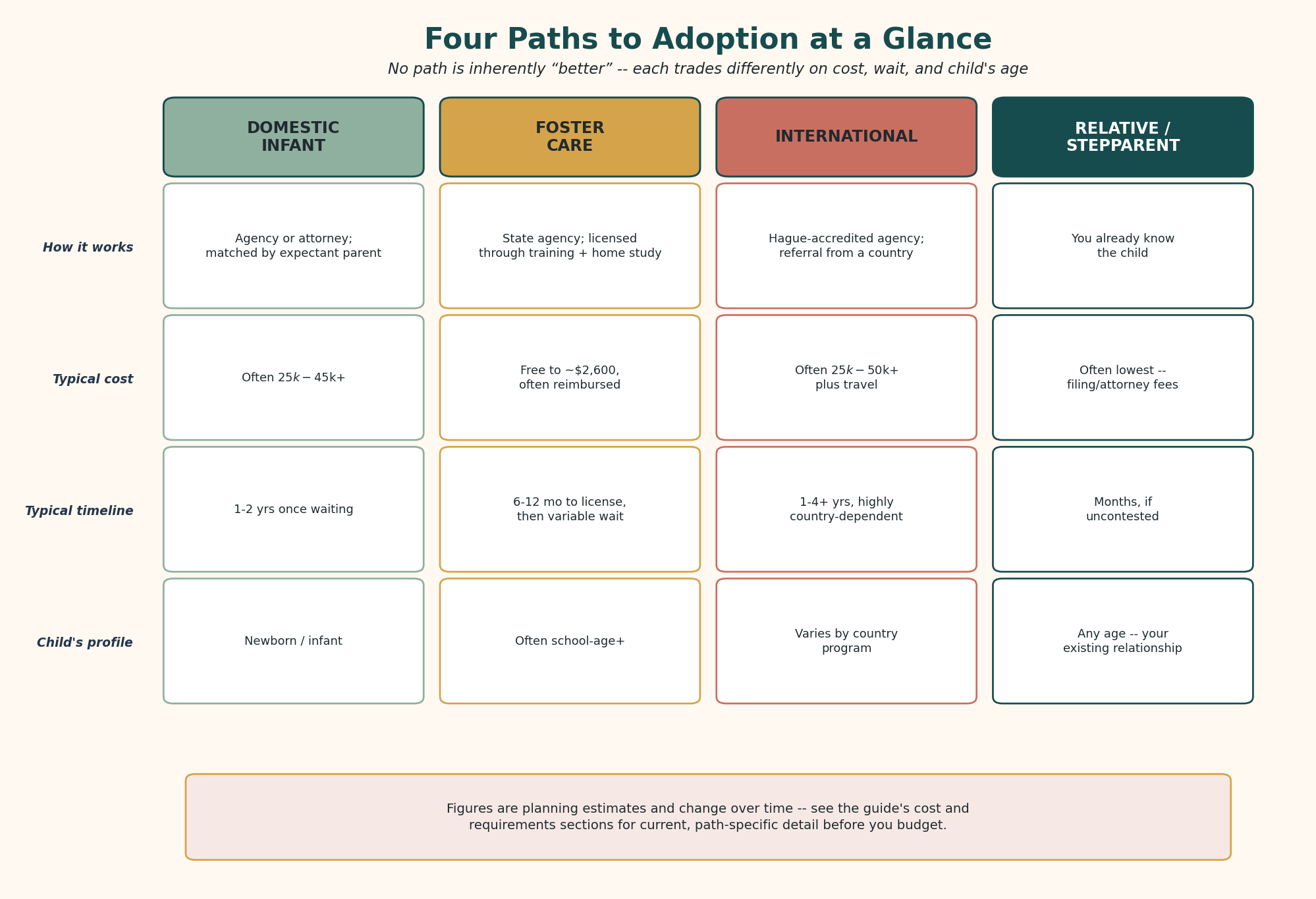
| Factor | Domestic Infant | Foster Care | International | Relative/Stepparent |
|---|---|---|---|---|
| Typical cost | Often $25,000–$45,000+ through an agency, sometimes more; see our cost breakdown | Usually free to about $2,600, often reimbursable; see our cost breakdown | Often $25,000–$50,000+ plus travel, highly country-dependent; see our cost breakdown | Often the lowest of all paths — sometimes only court filing and attorney fees |
| Typical timeline | Roughly 1–2 years from active waiting to placement for most families | Often 6–12 months to get licensed, then a highly variable wait to be matched | Often 1–4+ years depending on the country program and its current status | Can finalize in months once consent and paperwork are in order |
| Child’s typical age | Newborn or very young infant | Average age of children waiting nationally skews school-age; ranges from infants to teens | Varies by country program; many are toddlers through school-age rather than newborns | Any age — determined by your existing family relationship |
| Background considerations | Prenatal history disclosed by the expectant parent and agency, reviewed with you in advance | Often includes early trauma, multiple placements, or sibling groups; full background shared before matching | Often includes an orphanage or institutional-care history; medical records can be limited depending on the country | You typically already know the child’s history and circumstances |
| Who you’re matched by | Chosen by the expectant parent, often from a profile you create | Matched by a caseworker based on your approved home-study profile | A specific child or referral proposed by the country’s central adoption authority | Not a “match” — you petition to adopt a specific child you already know |
How to Use the Comparison Table
Match the Columns to Your Own Priorities
If a fast timeline matters most, that points one direction; if parenting a very young infant matters most, that points another; if cost is your binding constraint, foster care and relative adoption look different from the other two. Rank your own priorities before you compare paths, not after.
None of These Paths Is “Better” — Only Different
Every column in this table represents thousands of families who chose that path deliberately and are glad they did. The table exists to help you choose accurately, not to steer you toward any one option.
Why Timeline and Cost Estimates Carry a Flag
These Numbers Shift With Policy and the Economy
Agency fees, foster care reimbursement caps, and which countries currently allow adoptions to the U.S. all change over time — sometimes within a single year. Treat every figure in this guide as a planning estimate, not a quote, and confirm current numbers with your own agency or attorney.
National Averages Can Mask Wide Local Variation
A domestic infant adoption through a small regional agency in a state with high demand and few expectant parents can look very different from the same adoption through a large national agency. Ask any agency or attorney you’re considering for their own recent placement statistics, not just the national averages cited here.
Domestic Infant Adoption: Working With an Agency or an Attorney
Domestic infant adoption means being matched with an expectant parent in the United States who has decided to make an adoption plan, typically resulting in placement of a newborn or very young infant directly with you. According to National Council For Adoption’s most recent analysis, roughly 25,000 private domestic (non-stepparent) adoptions occur in the U.S. each year — the most common way Americans adopt a child who isn’t already a relative or a child from foster care. It splits into two structurally different routes: agency-assisted and independent.
Agency-Assisted Domestic Infant Adoption
What the Agency Does
A licensed adoption agency manages the entire relationship: it recruits and counsels expectant parents, markets prospective adoptive family profiles, coordinates the match, often provides or arranges counseling for the expectant parent, and handles much of the paperwork through placement and sometimes through finalization.
What You Do
You apply, complete a home study (Section 11), build a family profile, and wait to be chosen. Many agencies also require a parent-preparation class covering open adoption, attachment, and talking with your future child about their adoption story.
Typical Fit
Agency-assisted adoption tends to fit prospective parents who want structured support, built-in counseling resources for the expectant parent, and a single point of contact managing the process — often at a somewhat higher cost than independent adoption in exchange for that infrastructure.
Independent (Attorney-Led) Domestic Infant Adoption
What “Independent” Means
In an independent adoption, you (often with help from an adoption attorney or a facilitator, where legal) connect directly or semi-directly with an expectant parent, and an attorney handles the legal side: drafting consent documents, filing with the court, and representing your interests through finalization.
How It Differs From Agency Adoption
There’s typically less built-in counseling infrastructure for the expectant parent and more responsibility on you (or your attorney) to arrange home studies, advertising or outreach, and matching logistics, which is why independent adoption can — but doesn’t always — cost somewhat less than full-service agency adoption.
State Rules Vary on What’s Allowed
Whether independent adoption is legal at all, whether facilitators (non-attorney, non-agency intermediaries) may be used, and what advertising is permitted differ by state in ways significant enough that this is a question to ask a licensed adoption attorney in your state before assuming independent adoption is available to you.
Who Domestic Infant Adoption Tends to Fit
Comfort With Openness
Most domestic infant adoptions today involve some level of ongoing contact between the adoptive family and the birth family — see Section 18 for how this works as a matching preference you’ll discuss early, and our open adoption guide for the full relationship mechanics.
Readiness for an Unpredictable Wait
Unlike foster care, where a caseworker actively works to match you, domestic infant adoption often depends on an expectant parent choosing your profile — a process with real uncertainty in how long it takes, even with a strong agency and a complete home study.
Key Takeaways
- Domestic infant adoption splits into agency-assisted (more structure, often somewhat higher cost) and independent/attorney-led (less built-in infrastructure, sometimes lower cost) — both result in the same kind of placement.
- Whether independent adoption and facilitators are legal varies by state; confirm this before building a plan around it.
- Most domestic infant adoptions today involve some level of post-placement openness with the birth family — worth thinking through before you finalize your agency choice.
Foster Care Adoption: Adopting a Waiting Child
Foster care adoption means adopting a child from the public child welfare system whose birth parents’ rights have been — or are in the process of being — legally terminated, after efforts at reunification with their birth family were unsuccessful or unsafe. It is the single largest source of U.S. adoptions: National Council For Adoption’s analysis counted roughly 53,500 foster care adoptions finalized nationally in a recent year, and a federal count found nearly 109,000 children in foster care were legally free and waiting to be adopted at a single point in time.
What Makes Foster Care Adoption Different
Lower Cost, Different Child Profile
Public agency foster care adoption is usually free or very low cost — AdoptUSKids describes it as typically free to around $2,600, with many of those costs reimbursable by the state. In exchange, the child you’re matched with is less likely to be a newborn: nationally, more than one in five children waiting to be adopted from foster care are teenagers, and siblings groups are common.
Many Adoptions Start as Foster Placements
“Dual licensing” — being approved for both fostering and adopting at once — is increasingly the norm, because most children adopted from foster care are adopted by the foster parent they were already placed with, rather than matched with a brand-new family after their birth parents’ rights are terminated.
The Licensing and Training Process
Orientation and Application
You start by locating your state’s public agency (or a private agency contracted to recruit foster/adoptive families) and attending an orientation, followed by a formal application that includes reference letters, income verification, and criminal background checks at the local, state, and federal level.
Pre-Service Training
Nearly every state requires a structured training curriculum — commonly a program built on the MAPP (Model Approach to Partnerships in Parenting) or PRIDE (Parent Resources for Information, Development, and Education) curricula — that typically runs four to ten weeks and covers trauma-informed parenting, attachment, and the realities of the foster care system.
Background Checks and the Home Study
A home study is required for foster care adoption (and often for fostering as well), following the same general shape described in Section 11 — our dedicated home study guide covers the full checklist and timeline specific to this path. AdoptUSKids estimates the full licensing process, start to finish, typically takes six to twelve months.
Who Foster Care Adoption Tends to Fit
Flexibility on Age and Background
Families open to an older child, a sibling group, or a child with a documented trauma history are the best fit for this path — narrowly specifying “infant only” sharply limits your realistic options within the foster care system.
Comfort With Trauma-Informed Parenting
Because many waiting children have experienced instability, abuse, or neglect before entering care, this path tends to fit families genuinely prepared — through training, support networks, and sometimes specialized therapeutic resources — to parent with that history in mind, not families looking for a lower-cost version of newborn adoption.
Key Takeaways
- Foster care adoption is usually free or low-cost and is the largest single source of U.S. adoptions, but it generally means parenting a school-age or older child, often with a trauma history.
- Licensing (orientation, training, background checks, home study) typically takes six to twelve months before you’re even eligible to be matched.
- Most foster care adoptions are finalized by the child’s existing foster family, not a new family matched after the fact — dual fostering/adoption licensure is increasingly standard.
International (Intercountry) Adoption: Adopting From Abroad
International adoption means adopting a child from another country, a path that has changed dramatically over the past two decades. U.S. intercountry adoptions peaked at nearly 23,000 in fiscal year 2004 and have fallen more than 90% since, to roughly 1,275 in fiscal year 2023, as major historical sending countries — including China, Russia, Guatemala, and Ethiopia — have restricted or closed their programs. This doesn’t mean international adoption is unavailable, but it does mean the landscape looks very different than it did even ten years ago, and it changes often enough that this guide can only describe the framework, not a specific country’s current status.
The Hague Convention Framework
Accredited Agencies Only
For adoptions from any country that has joined the Hague Adoption Convention (most countries the U.S. adopts from today), federal law requires you to work with a U.S. adoption service provider that is specifically accredited or approved for intercountry adoption work — not just any licensed domestic adoption agency.
Forms I-800A and I-800
Early in the process, you file Form I-800A with U.S. Citizenship and Immigration Services to be found eligible to adopt internationally; after you’re matched with a specific child, you file Form I-800 for that child’s immigrant-visa eligibility. Both filings depend on your completed home study, which — per the State Department — must be conducted by an agency licensed in your state of residence.
The Country-Specific Process
Why Country Programs Change Often
Each country sets its own eligibility rules (age, marital status, sometimes family size), its own timeline, and its own willingness to work with U.S. adoptive families at all — and these rules can change with little notice. Confirming a specific country’s current status directly with the State Department’s intercountry adoption office, rather than this guide or any other general source, is essential before building a plan around one country.
Travel and In-Country Requirements
Most country programs require at least one, often two, in-country trips — sometimes a required minimum stay of two weeks or more — adding real time and cost on top of the paperwork timeline. Illustrative country-level cost ranges reported in adoption-cost surveys run roughly $25,000 to $60,000 or more, plus travel, with timelines anywhere from about six months to four or more years depending on the country and the year.
Visa Categories and What They Mean
A child adopted from a Hague Convention country typically travels home on an IR-3 visa (if the adoption was fully finalized abroad) or an IR-4 visa (if it was not, meaning the adoption still needs to be finalized or re-finalized in your U.S. state of residence). Which category applies affects whether your child receives automatic U.S. citizenship under the Child Citizenship Act of 2000 or needs that additional domestic step first.
Who International Adoption Tends to Fit
Specific Country or Program Interest
Families drawn to this path often have a specific connection — heritage, an existing relationship with a country, or a particular program’s child-profile focus — rather than arriving at international adoption as a default choice.
Readiness for the Longest, Most Variable Timeline
Of the four paths, international adoption typically carries the most moving parts outside your control: a foreign government’s process, travel logistics, and a country program’s overall stability. It tends to fit families with genuine flexibility in timeline and budget.
Key Takeaways
- Intercountry adoption to the U.S. has declined more than 90% from its 2004 peak as major sending countries have closed or restricted their programs — the field looks very different than it did a decade ago.
- Hague Convention adoptions require a specifically accredited U.S. agency and two federal filings (Forms I-800A and I-800) tied to your home study.
- Country-specific rules, costs, and timelines change often enough that this guide deliberately does not state them as fixed — confirm current country status directly with the State Department or your accredited agency.
Relative (Kinship) and Stepparent Adoption
Not every adoption starts with matching a family to a child they’ve never met. When the child is already a relative or your spouse’s child, the process is structurally different — often faster and simpler, because much of what the other three paths exist to establish (a relationship, trust, a background history) is already in place.
Relative (Kinship) Adoption
What It Typically Involves
A grandparent, aunt, uncle, or other relative adopts a child already connected to them by family ties, often after the child has been living with that relative informally or through a kinship foster care placement. The legal steps are the same general shape as any adoption — consent or termination of the birth parents’ rights, a home study, and court finalization — but the matching and placement stages largely don’t apply, since the relationship already exists.
How Requirements Can Differ by State
Many states streamline parts of the process for relative adoptions — sometimes waiving or shortening the home study, sometimes not — but exactly which requirements are relaxed, and how much, varies significantly by state. Our adoption requirements guide covers general eligibility rules that still apply even when the process itself is shortened.
Stepparent Adoption
Consent From the Other Legal Parent
A stepparent adopting a spouse’s child generally needs either the other legal parent’s written consent or a court finding that terminates that parent’s rights on another legal basis (such as abandonment), which is usually the step that determines how straightforward the case is, far more than any other part of the process.
Why It’s Often Faster and Less Expensive
Because the child is already living with the adoptive parent and the home study is sometimes waived or significantly abbreviated, uncontested stepparent adoptions are frequently the fastest and least expensive path in this entire guide — often finalizing within months for a few hundred to a few thousand dollars in court and attorney fees once consent is secured.
Key Takeaways
- Relative and stepparent adoptions skip the matching and placement stages that define the other three paths, since the child and adoptive parent already have a relationship.
- For stepparent adoption, the other legal parent’s consent (or its legal termination) is usually the determining factor in how fast and how simple the case is.
- Exactly which requirements are streamlined — home study, background checks, waiting periods — varies by state; confirm with an attorney rather than assuming full requirements are waived.
Where Adoption Law Comes From: Federal, State, and Foreign Law
One reason this guide repeats “varies by state” so often isn’t caution for its own sake — it reflects how adoption law is actually structured in the U.S., across three separate layers of authority that each control a different piece of your process.
What’s Set at the State Level
Eligibility, Home Study Procedure, and Court Process
Who may adopt, exactly what a home study must cover, how long post-placement supervision lasts, and which court handles finalization are all set primarily by the state you live in (and, for an interstate placement, sometimes by the child’s state too). No two states’ adoption statutes are identical, even where they’re broadly similar in structure.
Why This Is Deliberately Not a 50-State Table Here
A table trying to summarize 50 states’ adoption statutes in a few words per cell would be outdated within a legislative session and would risk giving you a specific number that’s wrong for your actual state. Our adoption requirements guide is built around directing you to a live, maintained source — your state’s statute or a licensed attorney — rather than a static table, and this guide follows the same practice.
What’s Set at the Federal Level
Interstate Placement and Hague Accreditation
A handful of pieces are federal and apply uniformly: the Interstate Compact on the Placement of Children (ICPC) governs any placement across state lines, and the Intercountry Adoption Act of 2000 sets the Hague accreditation framework described in Section 7, regardless of which state you live in.
Citizenship, Immigration, and the Adoption Tax Credit
Immigration status and citizenship timing for an internationally adopted child are entirely federal matters, governed by U.S. Citizenship and Immigration Services and the Child Citizenship Act of 2000, not state law. The adoption tax credit is likewise a federal tax provision — see our adoption tax credit guide — that applies the same way regardless of your state, aside from how your state separately taxes the same income.
Key Takeaways
- Adoption law in the U.S. is layered: most of the process-and-eligibility detail is state law, interstate placement and international accreditation are federal, and a specific country’s requirements apply only for international adoption.
- This is exactly why this guide and its companion pieces point you to live, maintained sources for state-specific numbers rather than stating them as fixed facts.
- Knowing which layer governs a given question helps you ask the right professional — your state licensing body, your agency’s Hague accreditation, or the IRS — rather than guessing.
General Eligibility Basics: What Most Paths Require
Before investing time in any specific agency or attorney, it’s worth understanding the broad eligibility landscape — not the full state-by-state detail (that’s our dedicated adoption requirements guide), but the handful of factors that come up across nearly every path.
Age, Marital Status, and Relationship Status
Minimum Age Requirements Vary
States and agencies set their own minimum ages for adoptive parents — commonly somewhere between 18 and 25 — and some set a maximum age gap relative to the child rather than a flat minimum. There is no single national number, which is exactly why our adoption requirements guide exists as a dedicated deep dive rather than a table here.
Single Parents and LGBTQ+ Parents Can Adopt
Single adults are eligible to adopt in every U.S. state, and the great majority of agencies and states also work with LGBTQ+ prospective parents and same-sex couples, though individual agencies — particularly some faith-based ones — may have their own additional criteria. It’s a reasonable, direct question to ask any agency before applying.
Financial Stability and Health
Stability, Not Wealth
Agencies and states generally look for demonstrated financial stability — steady income, the ability to meet a child’s needs, no history that suggests the household couldn’t support a child — rather than a minimum income threshold or a requirement to be debt-free. This is assessed as part of the home study (Section 11), not as a separate screening step.
Health Requirements Are Usually About Capacity, Not Perfection
A medical reference or statement from your own physician is a standard home-study component across nearly every path, generally used to confirm you have a reasonable life expectancy and capacity to care for a child — not to disqualify applicants for manageable chronic conditions or disabilities.
Key Takeaways
- Minimum age, marital status, and other baseline eligibility rules vary by state and agency — there’s no single national standard, and our requirements guide is where the full detail lives.
- Single adults and LGBTQ+ prospective parents are broadly eligible to adopt nationwide, with some agency-level variation worth asking about directly.
- Financial and health screening generally looks for stability and capacity, not wealth or perfect health.
Choosing and Vetting an Adoption Agency or Attorney
Your agency or attorney isn’t just a service provider — for most of this process, they’re your main source of information, your advocate, and often the only person managing both your side and the birth family’s side of a sensitive situation. Choosing well matters as much as choosing a path.
Agency, Attorney, or Facilitator: Who Does What
Licensed Adoption Agencies
A licensed agency typically handles recruiting and counseling expectant parents, matching, home studies (directly or through a licensed subcontractor), and much of the post-placement process — the most full-service option, used across domestic infant, foster care, and international adoption alike.
Adoption Attorneys
An attorney’s role is specifically legal: drafting and filing consent and termination documents, representing you in court, and advising on your state’s specific requirements. In independent domestic adoption, an attorney often fills much of the coordinating role an agency would otherwise play.
Facilitators and Consultants
Some states permit non-agency, non-attorney intermediaries — often called facilitators or adoption consultants — to help connect prospective parents with expectant parents, usually for a fee, without providing the licensed services an agency or attorney would. Whether this is legal, and how it’s regulated, varies significantly by state.
Questions to Ask Before You Sign
Fee Structure and What’s Refundable
Ask exactly what’s included in the quoted fee, what additional costs commonly come up, and — critically — what happens to fees already paid if a match falls through or an expectant parent changes their plan. This single question reveals more about an agency’s structure than almost anything else you can ask.
A Realistic Timeline for Your Specific Profile
Ask for the agency’s actual average wait time for families with a profile similar to yours (age range you’re open to, geographic flexibility, openness to a sibling group), not just a general marketing timeline.
What Support Is Included
Ask what happens if a placement disrupts, what post-placement support looks like, and whether counseling or support groups are available to you and, where relevant, to the birth family.
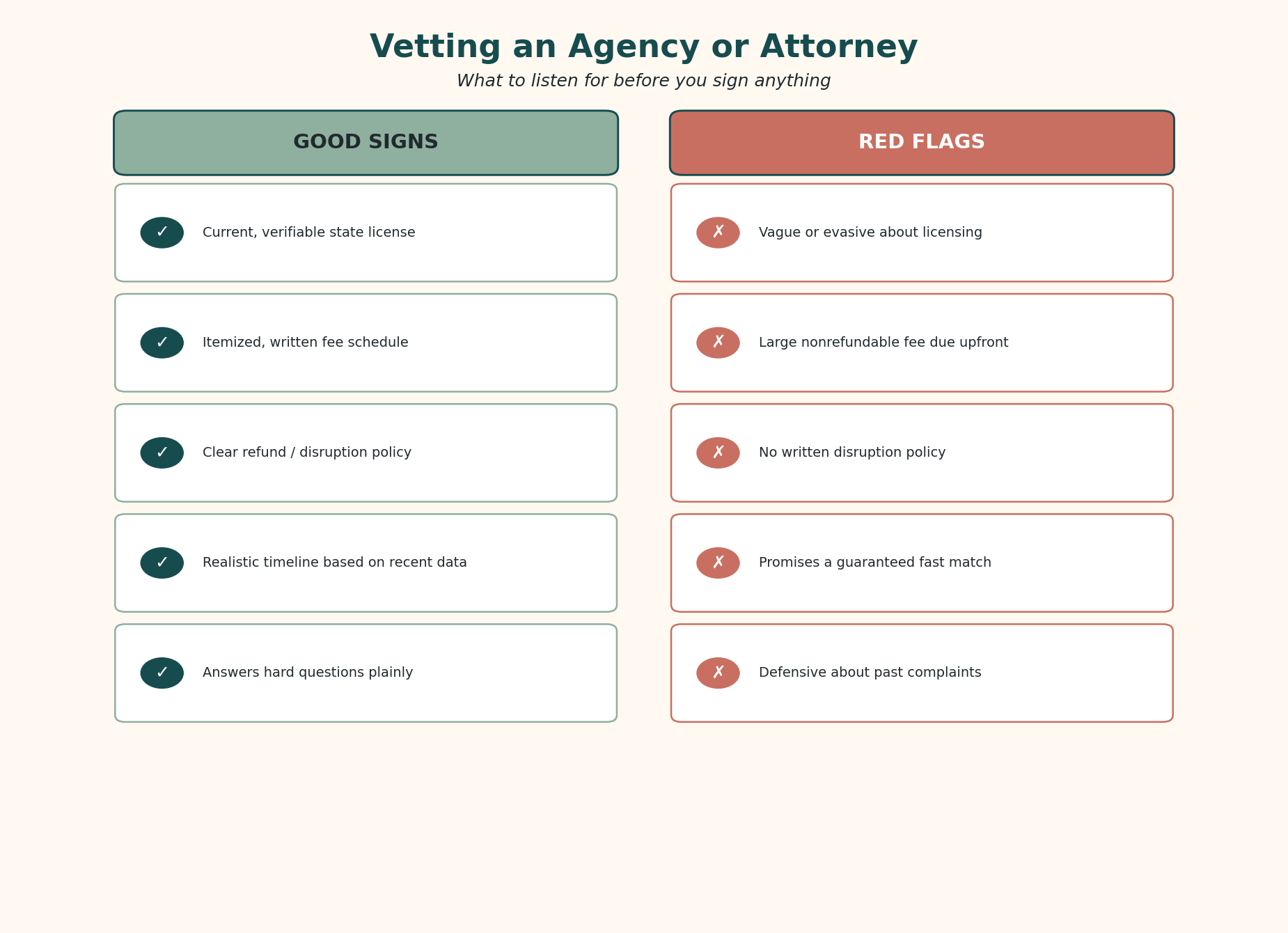
| Area | Good sign | Red flag |
|---|---|---|
| Licensing | Current license verifiable through your state’s licensing body; accreditation for the specific path you’re pursuing (e.g., Hague accreditation for international) | Vague or evasive answers about licensing; relies on “we work with” a licensed partner without naming them |
| Fee structure | Itemized, written fee schedule with a clear refund/disruption policy | Large nonrefundable payments due upfront with no itemization or written disruption policy |
| Timeline claims | Gives a realistic range based on recent placement data for families like you | Promises a guaranteed or unusually fast match |
| Counseling and ethics | Provides or requires independent counseling for the expectant parent, separate from the adoptive family’s interests | Appears to pressure or rush an expectant parent toward placement |
| Communication | Answers direct questions plainly, including about risk and disruption | Becomes defensive or vague when asked about past disrupted placements or complaints |
Red Flags to Watch For
Guarantees and Pressure Tactics
No ethical agency or attorney can guarantee a match within a specific timeframe, because matching depends on factors outside their control. Treat a guarantee as a warning sign, not reassurance.
Unclear or All-at-Once Fees
A single large payment due immediately, without a written breakdown of what it covers or what’s refundable under which circumstances, is one of the most common complaints in adoption fraud cases. Ask for everything in writing before paying anything substantial.
Key Takeaways
- Agencies, attorneys, and facilitators play different roles — know which one(s) your chosen path requires, and confirm facilitator legality in your state before engaging one.
- The fee-refund question (what happens if a match falls through) is the single most revealing question you can ask before signing with anyone.
- Guarantees of a fast or certain match are a red flag, not a selling point — no one can ethically promise a specific match timeline.
The Home Study: Your Overview
Every path to adoption in this guide — even most relative and stepparent adoptions in some form — requires a home study, the formal assessment that determines whether you’re approved to adopt. This section gives you the overview; our dedicated home study guide covers the full checklist, state-by-state variation, and detailed timeline.
What a Home Study Generally Covers
Background Checks
Expect fingerprint-based criminal background checks at the state and federal level, and a check of your state’s child abuse and neglect registry, for every adult in the household.
Home Visits and Interviews
A licensed social worker visits your home at least once, usually more, and conducts individual and joint interviews with you (and your partner, if applicable) covering your childhood, relationship history, parenting philosophy, and motivation to adopt.
Health, Financial, and Reference Documentation
You’ll typically provide a recent physical exam or physician’s statement, proof of income or financial stability, and several personal references — the specific list varies by state and agency, covered in full in our home study guide.
Timeline and What Comes Next
How Long It Typically Takes
Most home studies take a few months from application to approval, depending on how quickly you gather documents and how backed up your social worker or agency is — again, with real variation by state and provider covered in detail in our home study guide.
What Happens After Approval
Once your home study is approved, you move into Section 12’s waiting-and-matching stage — for most paths, this is also when your family profile starts actively circulating to expectant parents, caseworkers, or a foreign country’s central authority.
Key Takeaways
- A home study is required across nearly every adoption path, and it’s a process you go through once per adoption, not a one-time lifetime certification.
- It generally covers background checks, home visits, interviews, and health/financial/reference documentation — the specific checklist and timeline live in our dedicated home study guide.
- Home study approval is what unlocks the waiting-and-matching stage, not the end of the process.
Waiting and Matching: How Adoptive Families Get Matched With a Child
Once you’re approved, how you actually get matched with a specific child looks completely different depending on your path.
Domestic Infant Matching
Profiles and “Dear Expectant Parent” Letters
You and your agency build a family profile — photos, a letter addressed to a prospective expectant parent, and background information — that gets shown to expectant parents considering adoption, often alongside profiles from other waiting families.
The Expectant Parent’s Role in Choosing
In most modern domestic adoptions, the expectant parent reviews multiple family profiles and selects one, rather than an agency or family selecting from available children. This is a meaningful shift from how adoption worked decades ago, and it’s part of why building a genuine, honest profile matters more than a polished one.
Foster Care Matching
Child-Specific Matching
A caseworker reviews your approved home-study profile against children who are legally free for adoption (or approaching that point) and proposes a match based on fit — your stated openness to age range, sibling groups, and specific needs drives which children you’re even considered for.
Adoption Exchanges and Photo Listings
National and state photo-listing services, including AdoptUSKids’ own searchable database, let approved families browse children who are waiting and express interest directly, in addition to caseworker-initiated matches.
International Matching
Referral and Match Proposals
Depending on the country program, you may receive a specific child’s referral (background information, photos, available medical records) that you review and decide whether to accept, or in some country programs you may travel to meet a child as part of the matching process itself.
Accepting or Declining a Match
You generally have the right to decline a proposed match if, after reviewing the available information, you don’t feel equipped to parent that specific child — an important, sometimes emotionally difficult safeguard built into the system rather than a failure on your part to raise if it comes up.
Key Takeaways
- Domestic infant matching is typically expectant-parent-driven (they choose your profile); foster care matching is typically caseworker-driven (they propose a fit); international matching is typically referral-driven (a specific child’s file is proposed to you).
- You generally retain the right to decline a proposed match in every path if you don’t feel prepared for that specific child’s needs.
- How you present your family profile matters most in domestic infant adoption, where an expectant parent is actively choosing among profiles.
Placement: Bringing a Child Home
Placement is the moment the child physically moves into your home or custody — a milestone, but legally still provisional until post-placement supervision and finalization are complete.
Domestic Infant Placement
Hospital and Discharge Logistics
In many domestic infant adoptions, you’re present at or shortly after the birth, and the child is discharged from the hospital into your care once the expectant parent’s consent process (which varies by state and is covered by our adoption process guide from the birth-parent side) reaches the point state law allows.
Interstate Placement Rules
If you live in a different state than the child was born in, the Interstate Compact on the Placement of Children (ICPC) generally requires approval from both states before the child can legally travel home with you, which can add days to a couple of weeks to this stage.
Foster Care and International Placement
Transition Visits
For an older child moving from foster care, placement is typically preceded by a series of transition visits — meetings, meals, overnight stays — building familiarity gradually rather than a single abrupt move, especially for a child who has experienced previous placement disruptions.
Travel and Arrival for International Adoption
International placement usually happens abroad, during your required in-country trip(s), followed by travel home together once the country’s exit requirements and the child’s visa are finalized — the point at which Section 15’s readoption and citizenship considerations become relevant.
Key Takeaways
- Placement is a major milestone but not the legal finish line — post-placement supervision and finalization still lie ahead in every path.
- An interstate domestic placement typically requires ICPC approval from both states, adding real time to this stage.
- Foster care placements are usually eased in through transition visits rather than a single abrupt move, particularly for older children.
Post-Placement Supervision
After placement, nearly every path requires a defined period of post-placement supervision before you can petition the court to finalize — essentially a continuation of the home-study relationship, now focused on how the placement is actually going.
What Post-Placement Visits Involve
Social Worker Visits
A licensed social worker — often, though not always, the same one who conducted your home study — visits your home periodically to observe the child’s adjustment, your parenting, and the overall fit, and writes a report that becomes part of the court record supporting finalization.
Typical Frequency and Duration
Many states require roughly six months of post-placement supervision with visits spaced every few weeks to monthly, though the exact length and visit frequency vary meaningfully by state and sometimes by agency.
Why This Step Exists
Protecting the Child and the Family
Post-placement supervision exists to catch problems early — attachment difficulties, unmet medical or behavioral needs, a mismatch that isn’t working — while there’s still time to add support or, in rare cases, reconsider the placement before it becomes legally permanent.
Building the Court Record for Finalization
The post-placement reports your social worker writes are typically what the court relies on, alongside your attorney’s filings, to decide whether finalization is appropriate — making this stage a documentation requirement as much as a support one.
Key Takeaways
- Post-placement supervision is a required, documented period — commonly around six months, but state-variable — between placement and finalization, not an optional check-in.
- It exists to protect the child and surface any problems early, not to second-guess a placement that’s going well.
- The reports generated during this stage are what the court typically relies on to approve finalization.
Finalization: Making the Adoption Legally Permanent
Finalization is the court proceeding that makes the adoption permanent — the moment you stop being a prospective adoptive parent and become, in every legal sense, the child’s parent.
The Finalization Hearing
What Happens in Court
A judge reviews the completed home study, post-placement reports, and all required consent or termination documentation, often asks you and sometimes the child a few questions, and then issues a final decree of adoption — frequently a short, celebratory hearing rather than an adversarial one, since by this point the legal groundwork has already been done.
What Legally Changes
Once finalized, you have the same legal rights and responsibilities as a biological parent, for life, and any prior legal parent’s rights (where applicable) are permanently terminated.
After Finalization
Amended Birth Certificate and Social Security
You can typically request an amended birth certificate listing you as the child’s parent, and you’ll need to update or obtain a Social Security number reflecting the child’s new legal name, if changed.
Readoption and Citizenship for International Adoptions
If your child was adopted abroad on an IR-4 visa (Section 7) rather than fully finalized there, many immigration attorneys recommend completing a readoption in your home state to ensure a U.S.-issued birth certificate and confirm citizenship timing under the Child Citizenship Act of 2000.
The Adoption Tax Credit
Many finalized adoptions qualify for a federal adoption tax credit covering a meaningful share of your qualified adoption expenses — the mechanics, current credit amount, and income phase-outs are covered in full in our adoption tax credit guide, since the rules change periodically and deserve dedicated treatment.
Key Takeaways
- Finalization is typically a short, positive court hearing that makes your legal parentage permanent and equal in every respect to a biological parent’s.
- After finalization, plan for an amended birth certificate, updated Social Security records, and — for many families — a federal adoption tax credit claim.
- Internationally adopted children on an IR-4 visa often benefit from a state-level readoption to secure a U.S. birth certificate and confirm citizenship timing.
What Adoption Actually Costs: An Overview
Cost is often the first question prospective adoptive parents ask and the hardest to get a straight answer to, because it depends almost entirely on which path you choose. This section gives you the relative picture; our dedicated adoption cost guide breaks down every fee category, by path, in detail.
Relative Cost by Path
Highest-Cost Paths
Domestic infant adoption through an agency and international adoption are generally the most expensive paths, often running into the tens of thousands of dollars once agency fees, legal fees, home-study fees, and (for international adoption) travel are totaled.
Lowest-Cost Paths
Foster care adoption and most relative or uncontested stepparent adoptions are the least expensive by a wide margin — foster care adoption is usually free or low-cost and often reimbursable, while relative and stepparent adoptions frequently involve only court filing and attorney fees.
Ways to Reduce or Offset Cost
The Federal Adoption Tax Credit
The federal adoption tax credit can offset a substantial portion of qualified expenses for most finalized adoptions — see our adoption tax credit guide for the current credit amount, which expenses qualify, and how income affects it.
Employer Benefits and Foster Care Subsidies
Many employers now offer adoption-assistance benefits (reimbursement or paid leave), and foster care adoptions often come with an ongoing monthly adoption subsidy and continued Medicaid coverage for the child, particularly when the child has been designated as having special needs for adoption-assistance purposes.
Key Takeaways
- Cost varies more by path than almost any other factor in this guide — foster care and relative/stepparent adoption are typically far less expensive than domestic infant or international adoption.
- The federal adoption tax credit and, for foster care adoptions, ongoing subsidies can meaningfully offset your actual out-of-pocket cost — see our tax credit guide and our cost guide for the full detail.
- Ask every agency or attorney for a complete, itemized fee estimate before committing — national averages are a planning tool, not a quote.
Preparing Financially and Emotionally Before You Apply
Agencies will ask you to be ready on paper — income, references, a completed home study. Fewer of them walk you through getting ready in the ways that actually make the wait and the early placement period easier.
Financial Preparation
Budgeting Beyond the Headline Fee
The number an agency quotes up front is rarely the full picture. Home-study fees, travel for training or court hearings, legal fees separate from agency fees, and incidentals (document certification, required courses) all add up around the edges of the main program fee — ask for a complete itemized list rather than budgeting around one headline number, and see our cost guide for the full category breakdown.
Building In a Contingency Fund for a Disrupted Match
Because a match can fall through after money has already been spent (Section 10), many financial counselors who work with adoptive families recommend budgeting a contingency beyond your expected total cost, rather than planning around the single best-case number alone.
Emotional and Practical Preparation
Preparing Family and Household Routines
Whatever path you’re on, it helps to think through practical logistics before a match is proposed, not after: who covers work obligations in the first weeks, how extended family will be introduced, and how any current children at home will be prepared and included.
Finding Your Own Support Network Before You Need It
Waiting is its own emotional experience, often with its own grief and uncertainty, especially after a match falls through or a long stretch passes with no news. Many prospective parents find it useful to connect with a support group of other waiting families — through their agency, a local adoption organization, or an online community — before they’re in the hardest part of the wait, not during it.
Key Takeaways
- Budget around a complete itemized cost list, not a single headline fee — see our cost guide for the categories most families miss.
- A contingency fund for a disrupted match is a common piece of advice from financial counselors who specialize in adoption.
- Lining up practical support and an emotional support network before you’re matched tends to make the waiting stage meaningfully easier.
Your Step-by-Step Timeline, Start to Finish
Pulling the six stages and four paths together, here’s roughly how long the whole journey tends to take, start to finish, and which parts of that timeline you actually have some control over.

| Path | Approval stage | Waiting/matching | Post-placement to finalization | Rough total |
|---|---|---|---|---|
| Relative/stepparent | Days to a few weeks (often abbreviated) | Not applicable — child already known | A few weeks to a few months | A few months, if uncontested |
| Foster care | 6–12 months to get licensed | Highly variable; often fastest for the child’s current foster family | About 6 months post-placement, then finalization | Roughly 1–2+ years from start to finalization |
| Domestic infant | 2–4 months for the home study | Often 6 months to 2 years to be matched | A few months post-placement, then finalization | Roughly 1–2 years once actively waiting |
| International | 3–6 months for home study and initial filings | Highly country-dependent; can be 1–3+ years | Varies; may include both a foreign and a U.S. finalization step | Roughly 1–4+ years, strongly dependent on the country program |
Fastest and Slowest Paths
What Tends to Move Quickly
Uncontested stepparent and relative adoptions move fastest because the biggest variable in every other path — finding and being chosen by a match — simply doesn’t apply.
What Tends to Take Longest
International adoption tends to take longest and carries the widest range, because it depends on a foreign government’s process and a country program’s overall stability, both outside any U.S. agency’s control.
What You Can Control vs. What You Can’t
Paperwork and Preparation
How quickly you gather home-study documents, respond to your agency’s requests, and complete required training is squarely in your control and is the easiest place to shave real time off your timeline.
Matching and Court Calendars
How long it takes to be matched, and how quickly a court can schedule a finalization hearing, are largely outside your control — padding your expectations for these specific stages, rather than assuming the fastest-case scenario, tends to make the wait easier psychologically.
Key Takeaways
- Relative/stepparent adoption is typically fastest; international adoption typically takes longest and varies the most — the other two paths fall in between.
- Paperwork speed is within your control; matching timing and court scheduling generally are not.
- Every figure in Table 4 is a planning estimate — ask your specific agency or attorney for their own recent timeline data.
Open, Semi-Open, and Closed Adoption: A Matching Preference to Think About Early
Before you’re far into matching, you’ll be asked how much ongoing contact you want with your child’s birth family — a decision that shapes your profile, your matching pool, and your family’s life for years afterward.
What These Terms Mean for You as the Adoptive Parent
A Spectrum, Not a Single Arrangement
Openness ranges from fully open (direct, ongoing contact and visits) to semi-open (letters, photos, or updates exchanged, often through the agency) to closed (no contact or identifying information shared) — and most real arrangements land somewhere along that spectrum rather than at either end.
Most Domestic Infant Adoptions Lean Open Today
Fully closed adoptions are less common in domestic infant adoption today than they were decades ago, though they remain available where both parties prefer it. Our open adoption guide and our closed adoption guide cover the full relationship mechanics, boundaries, and legal enforceability of each arrangement in depth.
How Openness Shows Up in Your Process
Discussing Preferences With Your Agency
Your agency will typically ask about your openness preferences early, both because it affects which expectant parents you’re shown to and because mismatched expectations on this point are a common source of post-placement conflict.
The Expectant Parent’s Role in Setting Terms
In most domestic adoptions, the expectant parent has significant input into the openness arrangement, sometimes more than the adoptive family does — worth knowing going in, so this doesn’t come as a surprise during matching conversations.
Key Takeaways
- Openness is a spectrum, and most domestic infant adoptions today involve at least some form of ongoing contact or information exchange.
- Your stated openness preferences affect your actual matching pool, not just your post-placement life — it’s worth deciding this early, not deferring it.
- Our open adoption guide and our closed adoption guide cover the relationship details this overview intentionally doesn’t duplicate.
Common Mistakes Prospective Adoptive Parents Make
Most of the mistakes that derail or needlessly complicate an adoption are avoidable, and most prospective parents make at least one of them simply because nobody warned them in advance.
Mistakes During the Decision and Agency-Selection Stage
Choosing Based on Cost Alone
The cheapest agency or attorney isn’t automatically the wrong choice, but choosing solely on price without checking licensing, references, and disruption policy is a common way families end up with an unpleasant surprise later.
Skipping the Reference-Checking Step
Ask any agency or attorney for references from recently placed families, and actually call them — a step many prospective parents skip out of politeness or time pressure, and one of the most useful ten minutes you can spend in this entire process.
Not Reading State Eligibility Rules First
Assuming eligibility rather than confirming it with our adoption requirements guide or a licensed attorney can mean discovering a disqualifying issue (an outdated background check, a residency requirement, an age-gap rule) well into the process, after time and money are already invested.
Mistakes During Waiting and Matching
Over-Narrowing Your Preferences Too Early
Being extremely specific about a child’s age, sex, or background before you’ve talked through those preferences with your agency or a social worker can extend your wait far longer than necessary, sometimes without actually reflecting what would be a dealbreaker in practice.
Treating the Home Study as a One-Time Event
Many states require a home-study update if significant time passes, your household changes, or you move — treating the home study as a box checked once rather than a living document can cause delays right when you’re closest to being matched.
Underestimating Post-Placement Logistics
Families sometimes plan carefully for the wait and the finalization hearing but underprepare for the first weeks after placement — adjusted work leave, pediatric care, and attachment-focused routines matter as much as the paperwork on either side of them.
The bottom line
Every U.S. adoption — whether it’s a newborn through an agency, a waiting child from foster care, a child from another country, or a relative already in your life — moves through the same six stages: choosing a path, getting approved through a home study, waiting and getting matched, placement, post-placement supervision, and finalization. What differs dramatically by path is cost, timeline, and the age and background of the child you’re likely to parent, which is exactly why Section 4’s comparison table is worth returning to before you commit to one path over another. From there, our adoption requirements guide, our home study guide, our adoption cost guide, and our adoption tax credit guide are where the deep, state-specific, and dollar-specific detail for each stage actually lives — this guide is the map; those are the turn-by-turn directions once you know which road you’re on.
Glossary of Adoption Terms
A quick reference for terms used throughout this guide.
General Terms
Prospective Adoptive Parent
A person or couple who has applied or is preparing to apply to adopt, before a child has been placed with them.
Placement
The point at which a child physically moves into a prospective adoptive family’s home or custody, before finalization makes the adoption legally permanent.
Finalization
The court proceeding that makes an adoption legally permanent, establishing the adoptive parent as the child’s legal parent in every respect.
Waiting Child
A child, typically in foster care, who is legally free for adoption (or approaching that point) and does not yet have an identified adoptive family.
Legal and Process Terms
Home Study
The formal assessment — background checks, interviews, home visits, and documentation — used to determine whether a prospective adoptive parent is approved to adopt.
Post-Placement Supervision
A required period after placement, typically involving periodic social-worker visits, documenting how the placement is going before the court will finalize the adoption.
Interstate Compact on the Placement of Children (ICPC)
A legal agreement among all U.S. states governing how a child is placed for adoption across state lines, generally requiring both states’ approval before the child can travel to the adoptive family’s home state.
Consent and Revocation
Consent is the legal document a birth parent signs agreeing to the adoption; a revocation period, where state law provides one, is a window afterward during which that consent can still be withdrawn — covered from the birth parent’s side in our adoption process guide.
Foster Care Terms
Concurrent Planning
A child welfare practice of simultaneously working toward reunifying a child with their birth family while also identifying a potential adoptive placement, in case reunification isn’t achieved.
Fost-Adopt (Dual Licensing)
Being approved as both a foster parent and a prospective adoptive parent at the same time, allowing a family to adopt a child they are already fostering if reunification efforts end.
Adoption Subsidy
An ongoing monthly payment and continued medical coverage some states provide for children adopted from foster care, particularly those designated as having special needs for adoption-assistance purposes.
International Adoption Terms
Hague Adoption Convention
An international treaty setting minimum standards and procedures for intercountry adoption among member countries, implemented in U.S. law through the Intercountry Adoption Act of 2000.
Accredited or Approved Adoption Service Provider (ASP)
A U.S. agency specifically accredited or approved to provide adoption services for Hague Convention country adoptions, a separate credential from standard state agency licensing.
IR-3 / IR-4 Visa
Immigrant visa categories for internationally adopted children: IR-3 applies when the adoption was fully finalized abroad; IR-4 applies when it was not, generally requiring a readoption step in the U.S.
Readoption
A U.S. state-level adoption proceeding completed after an international adoption, often used to obtain a U.S.-issued birth certificate and, in some cases, confirm citizenship timing.
Frequently Asked Questions
Getting Started
I think I want to adopt but have no idea where to start. What’s the very first step?
Start by reading through this guide’s four paths (Section 4) and being honest with yourself about which one fits your circumstances, timeline, and what kind of child you’re prepared to parent — that decision shapes every step after it.
Can I pursue more than one path at the same time?
Some families do, especially combining foster-to-adopt licensing with being open to a domestic infant match, though this adds complexity and isn’t the right fit for everyone — ask any agency you’re considering how they handle concurrent processes.
Choosing a Path
What if I’m not sure which path is right for me?
Talking with more than one agency, and asking each one directly about cost, timeline, and typical child profile for your situation, is the most useful next step — Section 4’s comparison table is built to help you prepare for those conversations.
Can I switch paths partway through if one isn’t working out?
Yes, though it often means restarting parts of the approval process with a new agency or program, since home-study and licensing requirements aren’t always fully transferable between paths.
Domestic Infant Adoption Questions
What’s the real difference between agency and independent adoption?
An agency manages the full relationship including expectant-parent counseling and matching; independent adoption relies more on an attorney for the legal side, with less built-in infrastructure — Section 5 covers both in full.
Can I create my own adoptive family profile, or does the agency do it?
It’s usually a collaborative effort — most agencies provide guidance, templates, or a photographer, but the content and voice are yours.
Foster Care Adoption Questions
Do I have to foster before I can adopt from foster care?
Not necessarily — many states allow adoption-only licensing, though dual fostering/adoption licensure (“fost-adopt”) is increasingly common and often speeds up matching.
What does MAPP or PRIDE training actually involve?
These are structured pre-service training curricula, typically spanning four to ten weeks, covering trauma-informed parenting, attachment, and the realities of the child welfare system — exact hours and content vary by state.
International Adoption Questions
Which countries can I adopt from right now?
This changes often enough that no general guide can state it reliably — confirm current country program status directly with an accredited agency or the State Department’s intercountry adoption office.
Why has international adoption declined so much?
Several of the historically largest sending countries — including China, Russia, Guatemala, and Ethiopia — have restricted or closed their intercountry adoption programs over the past two decades, driving most of the national decline.
Relative and Stepparent Adoption Questions
Do I still need a home study for a relative adoption?
Often yes, though many states streamline or shorten it for relatives — confirm your state’s specific rule with a family law or adoption attorney.
What if the other biological parent won’t consent to a stepparent adoption?
You generally need either their written consent or a court finding terminating their rights on another legal basis — a contested case is meaningfully longer and more complex than an uncontested one.
Eligibility Questions
Is there a maximum age to adopt?
Some states or agencies set a maximum age gap between parent and child rather than a flat maximum age — this varies, and our requirements guide covers it directly.
Can I adopt if I rent rather than own my home?
Yes — home studies generally assess safety and stability of your living situation, not ownership status.
Choosing an Agency or Attorney
How do I verify an agency’s license is current?
Contact your state’s licensing or child welfare regulatory body directly and ask them to confirm, rather than relying solely on what the agency’s own website states.
Should I use a local agency or a national one?
Both have trade-offs — a national agency may have a larger matching pool, while a local one may offer more personal support; ask each directly about their placement statistics for families like you.
The Home Study
Does the home study examine my finances in detail?
It generally reviews income stability and the ability to meet a child’s needs, not a detailed personal financial audit — our home study guide covers exactly what’s reviewed.
Do I need to redo my home study if I move?
Often yes, at least an update — moving changes the physical safety and space assessment your home study is partly based on.
Waiting and Matching
Is there anything I can do to shorten my wait?
Being genuinely flexible on age range, sibling groups, or background (within what you’re truly prepared to parent) is the most reliable way to expand your matching pool and shorten a realistic wait.
What happens if I’m matched but then the match falls through?
This does happen, particularly in domestic infant adoption if an expectant parent changes their plan after matching but before placement — your agency should have a clear process and support plan for this possibility, which is worth asking about before you sign.
Placement and the First Weeks
What should I expect emotionally in the first weeks after placement?
A wide range — joy, exhaustion, and sometimes a slower-than-expected bonding process are all common and don’t necessarily predict how attachment will develop over time.
Do I need to take leave from work immediately at placement?
Most families do, and many employers now offer parental leave specific to adoption placement — check your employer’s policy and, where relevant, FMLA eligibility ahead of time.
Finalization
Do I need an attorney to finalize, even if I used an agency?
Usually yes — agencies generally don’t provide courtroom legal representation themselves, so most families retain an attorney specifically for the finalization filing and hearing.
Will my child need to be present at the finalization hearing?
Often yes, especially for older children, and many courts treat this as a positive, sometimes celebratory moment rather than a formal interrogation.
Costs and Financial Help
Is there financial help available before I’ve spent any money?
Some grant and low-interest loan programs exist specifically for adoption costs, and employer adoption-assistance benefits are increasingly common — worth researching alongside your path and agency choice, not after you’ve already committed funds.
Are foster care adoption costs ever not reimbursed?
Reimbursement caps and covered categories vary by state, so some out-of-pocket cost is still possible — confirm your specific state’s reimbursement policy before assuming everything is covered.
The Adoption Tax Credit
Do I automatically get the adoption tax credit just by adopting?
No — you need to meet the specific eligibility and documentation requirements covered in our adoption tax credit guide, and it phases out at higher incomes.
Does the tax credit apply to foster care adoption even though it’s low-cost?
Often yes, and in some cases foster care adoptions involving a child with special needs may qualify for the full credit regardless of actual qualified expenses — see our dedicated guide for the current rule.
Openness and Contact
Can I choose a fully closed adoption if that’s what I prefer?
In domestic infant adoption, this generally depends on what the expectant parent also wants — it’s a negotiated preference, not something you can unilaterally select.
Does foster care adoption involve openness arrangements too?
Sometimes, particularly with siblings or extended birth family members, depending on the case and the child’s best interests as determined by the court.
LGBTQ+ and Single Prospective Parents
Can single people adopt in every state?
Yes, single adults are eligible to adopt nationwide, though individual agency policies and realistic matching timelines can still vary.
Are there agencies that specifically won’t work with LGBTQ+ families?
Some faith-based agencies maintain additional eligibility criteria; it’s a reasonable, direct question to ask before applying anywhere.
Adopting a Child With Special Medical Needs
What does “special needs” mean in an adoption context?
In adoption and child-welfare terminology, “special needs” is a broad, specific designation — covering physical, developmental, emotional, or medical conditions, but also factors like older age or being part of a sibling group — used to determine eligibility for adoption assistance, not necessarily a severe diagnosis.
Are there agencies that specialize in medically complex placements?
Yes, some agencies and adoption exchanges focus specifically on children with significant medical needs, often with specialized matching support and connections to pediatric specialists experienced with adopted children.
Adoption Scams and Fraud Prevention
What are the most common signs of an adoption scam?
Pressure to send money quickly without documentation, inability to verify licensing, vague or shifting details about an expectant parent or child, and promises of an unusually fast or guaranteed match are among the most frequently reported warning signs.
How can I verify an expectant parent’s situation is genuine, in an independent adoption?
This is one of the key reasons to work with a licensed attorney or agency rather than connecting entirely informally — they generally have processes to verify a pregnancy and the expectant parent’s legal situation that an individual prospective parent cannot easily do alone.
Support Groups and Post-Adoption Counseling
Where do most adoptive families find ongoing community after finalization?
Many find it through their original agency’s post-adoption program, national and local adoptive-parent support groups, and online communities organized by path (foster care, international, transracial) or by shared experience — worth identifying a few options before you need them, not only after a difficult moment arrives.
Is it normal to want professional support even when the adoption is going well?
Yes — many adoptive families use adoption-competent counseling proactively, for support with identity conversations, attachment questions, or simply processing a major life transition, not only in response to a crisis.
