
If you’re reading this, you’ve probably already decided you’re interested in adoption — you just don’t know what to actually do first. That’s normal, and it’s the right question to ask before you call anyone. This guide is the “before you start” guide: it covers the handful of real first steps that come before you ever open a checklist, including an honest readiness self-assessment, how to talk it through with a partner or support system, what a first consultation call actually feels like, and a realistic picture of what the first 30 days look like once you decide to move forward. Once you’re ready to actually work through the full process step by step, this guide hands you off to our complete adoption checklist, which picks up exactly where this one leaves off.
Short Answer: How to Actually Start
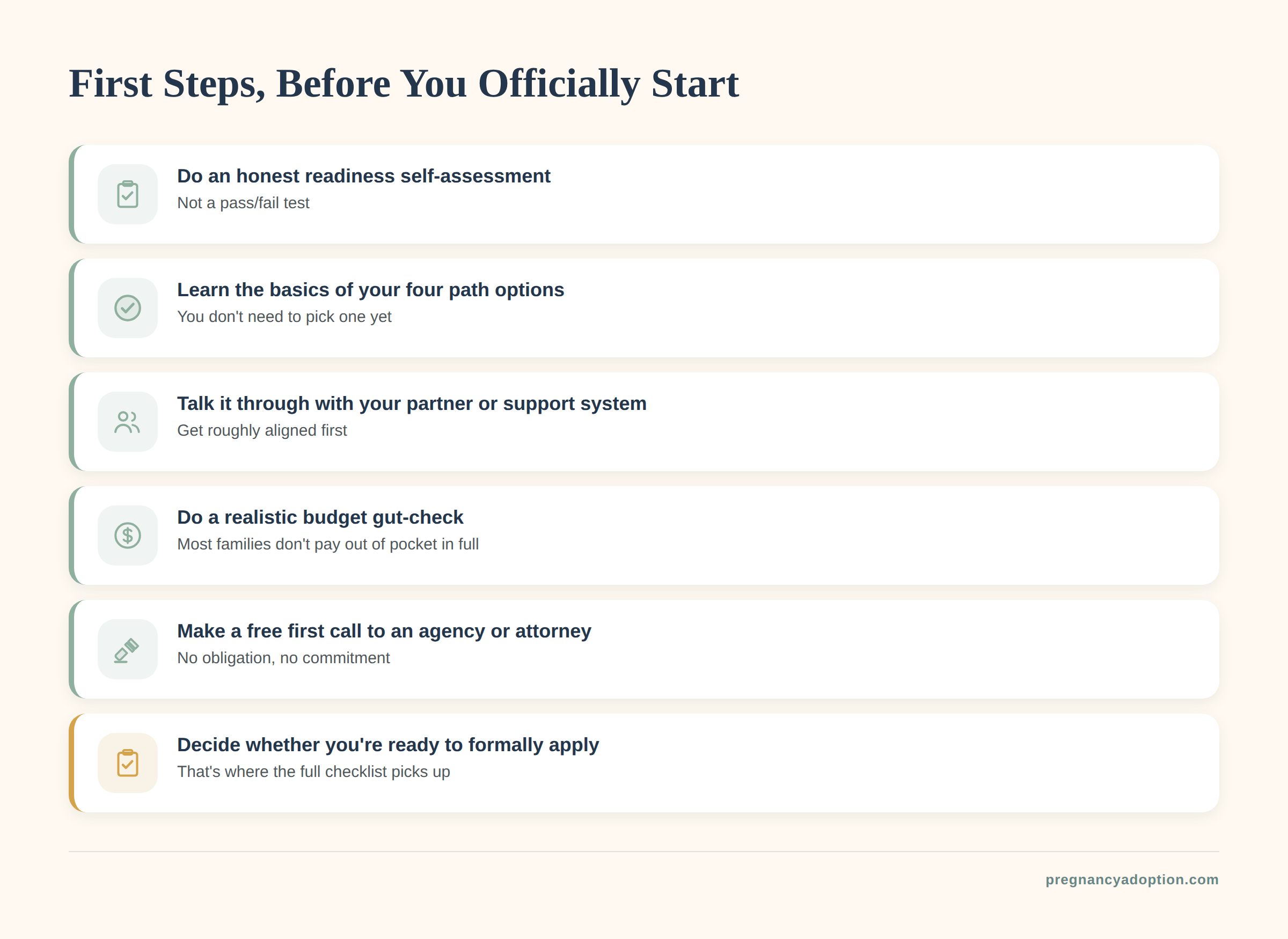
Key Takeaways
- Starting the adoption process doesn’t begin with paperwork — it begins with an honest readiness conversation, a basic understanding of your path options, and a realistic budget gut-check.
- The single most useful early action is a no-obligation first call with a licensed agency or attorney, which exists specifically to answer a beginner’s questions.
- You do not need to know which path you want before you make that first call — most people don’t, and a good professional will help you figure it out rather than push you toward one.
- Once you’ve made your first call and decided to move forward, our full adoption checklist is the resource to work through step by step; this guide only covers what comes before that.
What This Guide Is, and Isn’t
What It Covers
This is a “getting started” guide for someone who hasn’t yet contacted an agency or attorney and isn’t sure how to begin. It focuses on the readiness question, early research, the first consultation call, and the realistic first month — the part of the journey that happens before Step 1 of a formal process checklist.
What It Links Out For
Once you’ve decided to move forward, you don’t need a second checklist here — you need our complete, phase-by-phase adoption checklist, which covers everything from gathering documents through finalization and beyond. This guide exists to get you to that starting line with confidence, not to duplicate it.
Why “Starting” Feels Harder Than It Should
There’s No Single Front Door
Unlike, say, applying to college, adoption doesn’t have one official starting point. You can start by calling an agency, attending a free information session, reading about the different paths, or simply having a conversation with your partner. All of these count as starting — there’s no wrong order.
The Fear of Committing Too Early
Many people delay their first call because they worry it locks them into something. It doesn’t. A first consultation is informational, not contractual, and a reputable professional will tell you that explicitly in the first five minutes.
Are You Ready? A Readiness Self-Assessment
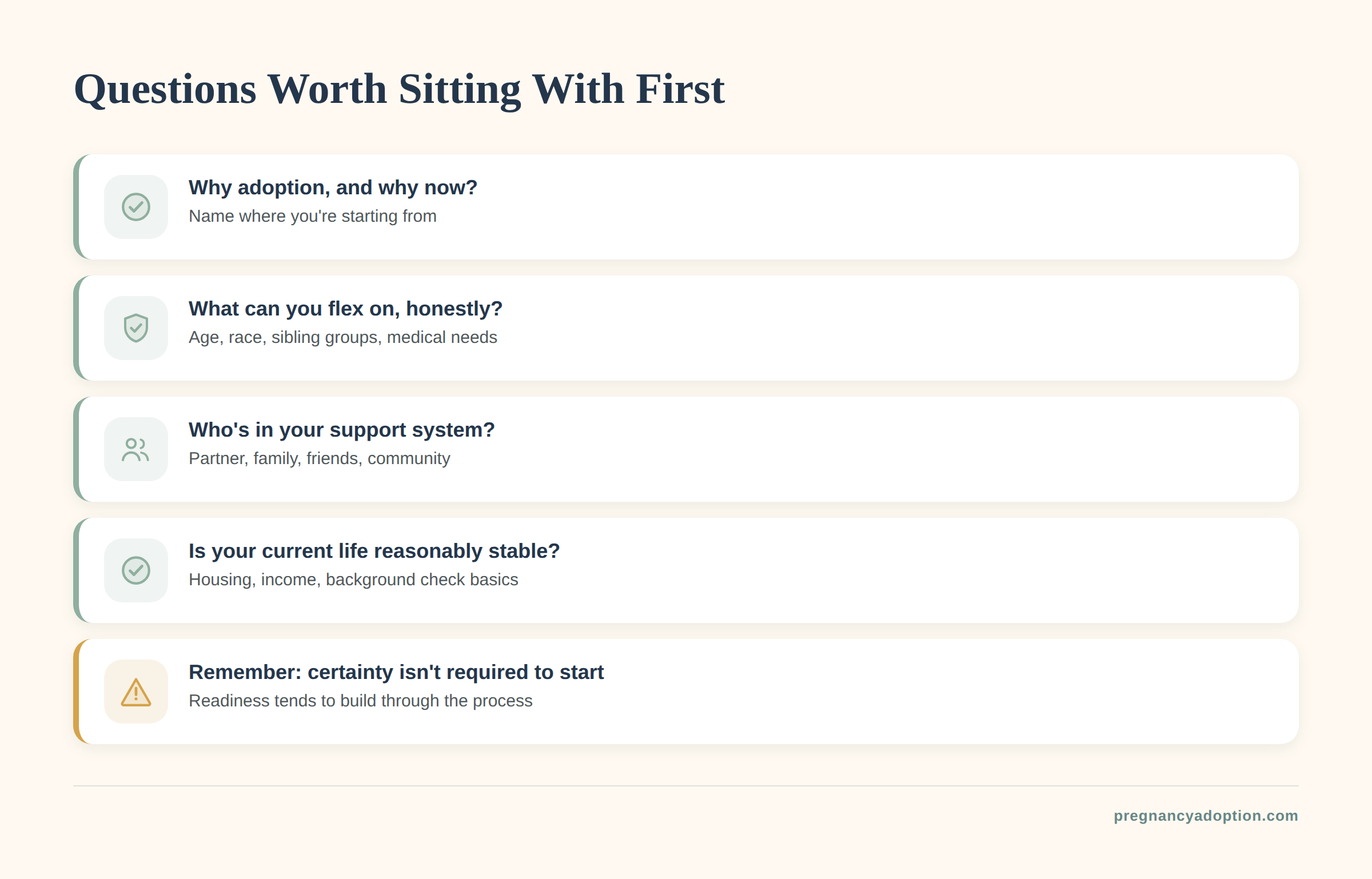
Readiness Isn’t a Pass/Fail Test
What Agencies Actually Look For
Readiness isn’t about having a perfect life. Agencies and attorneys are looking for stability, honesty, and willingness to learn — not a specific income level, family structure, or life story.
Readiness Is a Direction, Not a Destination
Most people who eventually adopt didn’t feel 100% ready when they made their first call. Readiness tends to solidify through the process itself — through the home study, through training, through conversations with a caseworker — rather than being a precondition for starting it.
Questions Worth Sitting With First
Why Adoption, and Why Now
Are you pursuing adoption as a first choice, or after infertility or loss? Both are valid starting points, but it’s worth naming which one applies to you, since it shapes the emotional work ahead. If infertility is part of your story, many people find it helpful to process that grief separately from the decision to adopt, rather than treating adoption as simply “the next step” without acknowledging what came before.
What You Can and Can’t Flex On
Can you be open to a child of a different race, a sibling group, an older child, or a child with known or unknown medical needs? There’s no required answer, but naming your honest boundaries now — rather than discovering them mid-process — saves confusion later. Agencies will ask you this directly during your application.
Your Support System
Who else is in your corner — a partner, family, friends, a faith community? Adoption can be a long and sometimes uncertain process, and having people who understand what you’re doing (even loosely) matters more than most first-time adopters expect.
Your Current Life Stability
Most paths require some baseline stability: a place to live with adequate space, a reasonably stable income (not a specific amount, in most cases), and the capacity to pass a background check. Our full adoption requirements guide covers exact eligibility criteria by path in detail; this section is only the first gut-check.
If You’re Not Sure Yet, That’s a Valid Place to Start From
A First Call Doesn’t Require Certainty
You don’t need to resolve every one of these questions before you pick up the phone. In fact, talking them through with a professional who has heard every version of this uncertainty before is often the fastest way to get clarity.
Information Sessions Are a Lower-Commitment Option
If a one-on-one call feels like too big a first step, most agencies offer free group information sessions (in person or virtual) as an even lower-pressure way to start learning.
Step 1: Learn the Basics of Your Path Options
The Four Broad Paths, Briefly
Domestic Infant Adoption
Working with a licensed agency or attorney to adopt a newborn or infant whose birth parent(s) have chosen adoption, typically through a voluntary, often open or semi-open arrangement.
Foster Care Adoption
Adopting a child from the public foster care system, usually after a period of fostering, often at lower direct cost than other paths but with its own emotional and logistical considerations.
International Adoption
Adopting a child from another country, governed by that country’s requirements plus U.S. immigration law, generally the most complex and highest-cost path, with eligibility and available countries shifting over time.
Relative or Stepparent Adoption
Adopting a child already related to you by blood or marriage, which follows a substantially simpler legal process than the other three paths in most states.
You Don’t Need to Pick Today
Why This Is a Brief Summary, On Purpose
Each of these four paths has its own cost structure, timeline, eligibility nuance, and emotional profile — enough to fill an entire guide on its own. Our complete guide to adopting a child walks through all four paths in full depth, including how to decide between them; this section exists only so you’re not calling an agency with zero context.
Many First Calls Are Spent Narrowing This Down
It’s genuinely common to start a first consultation undecided between two paths. A good professional will ask about your situation, your flexibility, your timeline, and your budget, and help you narrow it down rather than assuming you’ve already chosen.
Step 2: Talk It Through With Your Partner or Support System
If You’re Adopting With a Partner
Get on the Same Page Before the First Call
It’s worth having at least one real conversation with your partner about why you’re pursuing adoption, what you’re both open to, and what timeline feels realistic, before either of you talks to a professional. Agencies will eventually interview both of you, often separately, so unresolved disagreement tends to surface either way — better to find it early.
It’s Normal to Not Fully Agree Yet
Partners sometimes start in different places — one ready to move quickly, the other still processing. That gap is common and workable, but naming it honestly (to each other, and eventually to your agency or attorney) is healthier than papering over it.
If You’re Adopting as a Single Parent
Build Your Support Network Early
Single-parent adoption is legal and increasingly common across all four paths, though eligibility and agency openness vary. Our adoption requirements guide covers path-by-path single-applicant eligibility in detail. Identifying who will realistically help with childcare, emergencies, and day-to-day support is worth doing before your first call, since agencies often ask about this directly.
You May Field More Questions, Not Fewer Doors
Some single applicants worry they’ll be turned away outright. In practice, most agencies evaluate single applicants on the same core criteria as couples — stability, support system, and readiness — though it’s reasonable to ask a prospective agency directly about their experience working with single adoptive parents.
Telling Family and Friends
There’s No Required Timeline for Disclosure
Some people tell their whole family the moment they start researching; others wait until they’ve made a first call, or until they’re matched. Both are fine. A useful guideline: tell the people whose practical help (money, childcare, a place to stay during travel for international or out-of-state placements) you might eventually need, early enough that it isn’t a last-minute ask.
Preparing for Mixed Reactions
Not everyone in your life will react the way you hope, at least at first. Unfamiliarity, outdated assumptions about adoption, or simply surprise can all produce an awkward first reaction that softens over time as people see your commitment and ask real questions.
Step 3: Do a Realistic Budget Gut-Check
| Path | Typical total-cost range | What drives the range |
|---|---|---|
| Domestic infant adoption | $20,000–$45,000+ | Agency fees, legal fees, birth-parent expenses where permitted by state law |
| Foster care adoption | $0–$2,500 | Often largely reimbursed; primarily minor legal and incidental costs |
| International adoption | $25,000–$50,000+ | Country-specific fees, immigration processing, required travel |
| Relative or stepparent adoption | $1,000–$5,000 | Largely legal/court filing fees; home study sometimes waived or simplified |
This Is a Gut-Check, Not a Final Number
Why We’re Not Going Deeper Here
Real budgeting for adoption involves fee structures, sliding scales, employer benefits, grants, loans, and the adoption tax credit — far more than a first-steps guide can responsibly cover. Our complete adoption cost guide breaks down every fee category and every major financial assistance option path by path; our adoption tax credit guide covers the federal credit specifically.
The Point of This Step
Before your first call, it’s worth knowing roughly which cost bracket fits your situation, so the conversation can focus on fit rather than sticker shock. Most agencies are used to walking first-time callers through financing options, including grants and loans that aren’t widely advertised.
Financial Readiness Isn’t All-or-Nothing
Most Families Don’t Pay Out of Pocket in Full
Grants, employer adoption-assistance benefits, interest-free adoption loans, and the federal adoption tax credit meaningfully offset the total cost for many adoptive families.
A Free Call Can Clarify Financing Before You Commit to Anything
You can — and many people do — ask about cost and financing options on your very first call, before filling out any application or paying any fee.
Step 4: Research and Shortlist Agencies or Attorneys
What to Look for at This Early Stage
Licensing and Accreditation, First
Confirm any agency you’re considering is licensed in its home state, and check whether it holds Hague accreditation if international adoption is on the table. This is the single non-negotiable first filter.
A Short List, Not a Final Choice
At this stage, aim for two or three agencies or attorneys to contact, not a single final decision. Comparing how different professionals answer the same questions on an initial call is one of the best ways to evaluate fit.
Where to Find Candidates
Directories and Referrals
State adoption authority directories, national accreditation bodies, and referrals from other adoptive parents are all reasonable starting points for building your shortlist.
Full Vetting Comes Next, Not Now
Deep agency vetting — reviews, complaint history, fee transparency, success rates, specific interview questions — deserves its own dedicated process. Our complete guide to choosing an adoption agency walks through exactly how to vet and compare agencies once you have a shortlist; this step is only about building that shortlist.
Step 5: Make Your First Call
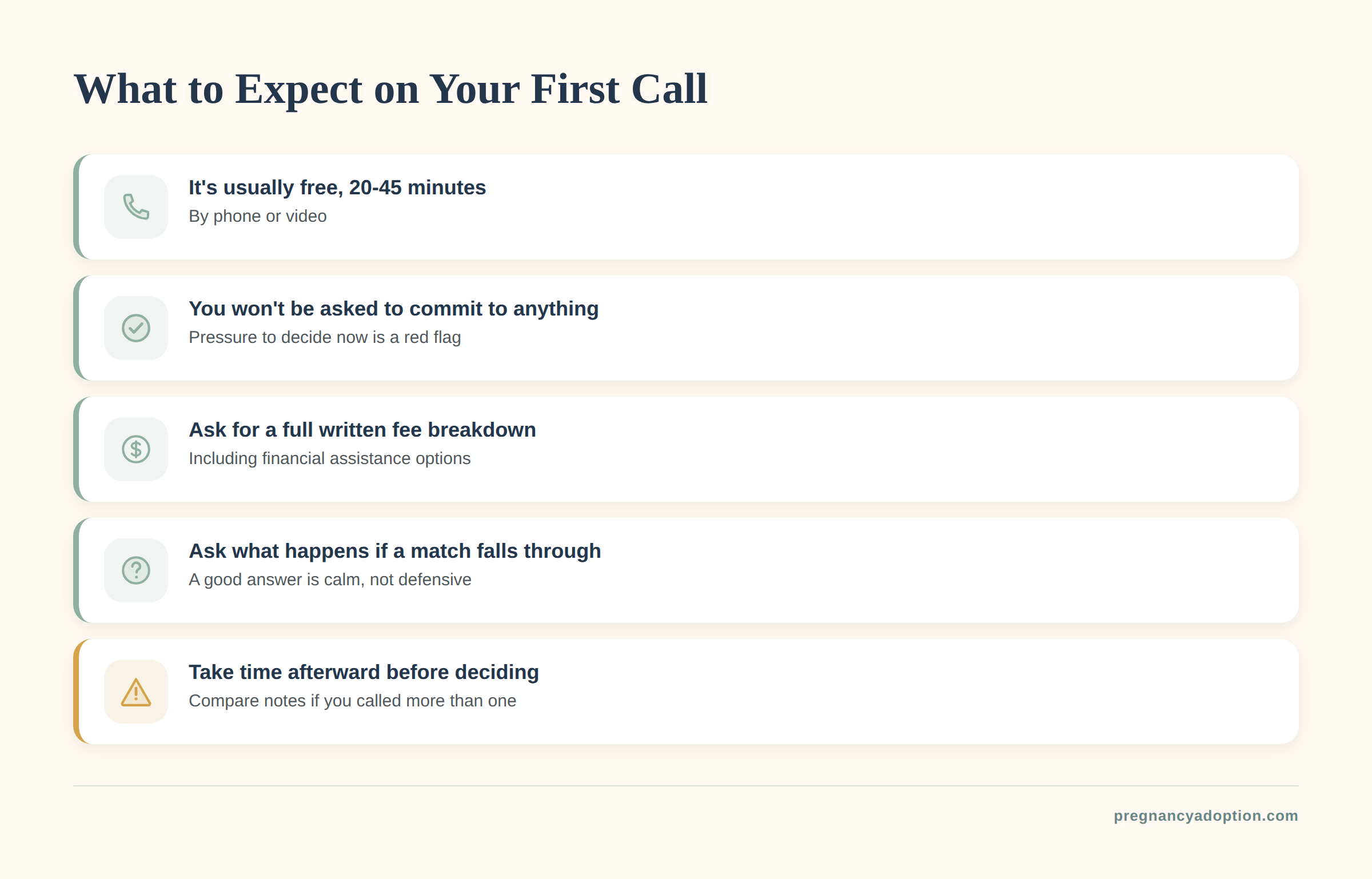
What a First Call Actually Looks Like
It’s Usually Free and Low-Pressure
Most licensed agencies and attorneys offer a free initial consultation, typically 20–45 minutes, by phone or video. Its purpose is mutual: you learn about them, and they get a general sense of your situation.
You Won’t Be Asked to Commit to Anything
A reputable professional will not ask for payment, a signature, or a firm commitment on a first call. If one does, treat that as a red flag rather than normal urgency.
What They’ll Likely Ask You
Expect general questions about your family situation, your flexibility (age, race, sibling groups, medical needs), your rough timeline, and your budget range — nothing invasive, and nothing you can’t answer honestly with “I’m not sure yet.”
Questions Worth Bringing With You
About the Process
Ask about typical timelines for your likely path, what their application and home-study process involves, and what support they offer during the waiting period.
About Cost and Fees
Ask for a full, itemized fee breakdown in writing, whether fees are due in installments, and what financial assistance options (grants, loans, sliding scale) they’re familiar with.
About Their Track Record
Ask how long they’ve been operating, roughly how many families they place with annually, and what happens if a match falls through — a legitimate, non-defensive answer to that last question is a good sign.
About What Happens Next
Ask what the very next step would be if you decided to move forward, and whether there’s any obligation created simply by having this call. There shouldn’t be.
After the Call: Give Yourself Room to Think
You Don’t Have to Decide on the Spot
A good agency or attorney expects you to think it over, compare notes if you spoke with more than one, and come back with follow-up questions. Pressure to decide immediately is itself worth noticing.
Comparing Notes Across Calls
If you spoke with more than one agency or attorney, compare how each answered the same questions — about fees, timelines, and what happens if things don’t go as planned — side by side, rather than relying on first impressions alone.
Step 6: Decide Whether to Move Forward
Signs You’re Ready to Formally Start
You Have a Professional You Trust
You’ve had at least one consultation that left you with clear, honest answers and a sense that this agency or attorney would tell you the truth even when it’s inconvenient.
You Have a Rough Budget Plan
Not a fully finalized plan, but a realistic sense of how you’d cover the likely cost range, including any grants, loans, or benefits you’d pursue.
You and Your Partner (If Applicable) Are Aligned Enough to Start
You don’t need to agree on every detail, but you should both be genuinely willing to begin the process, not one person going along reluctantly.
Signs You Might Want More Time
Unresolved Grief or Ambivalence
If adoption still feels like a backup plan rather than something you want for its own sake, it’s worth giving that feeling more room before signing an application, not as a reason to abandon the idea, but as a reason to go a bit slower.
You Haven’t Talked to Anyone Yet
If you haven’t had even one consultation call or information session, that’s a sign to go back to Step 4 or 5 rather than to the formal checklist — there’s no rush, and more information rarely hurts.
What “Moving Forward” Actually Means
It Usually Means Submitting an Application
For most agencies, the next concrete action after deciding to move forward is submitting a formal application, often alongside an initial fee. Our dedicated guide to the adoption application covers exactly what that involves and how to prepare it well.
It Is Still Not Fully Binding
Submitting an application is a real commitment of time and sometimes money, but in most cases you can still withdraw if your circumstances change — ask your specific agency or attorney to confirm their own policy on this directly.
What the First 30 Days Actually Look Like
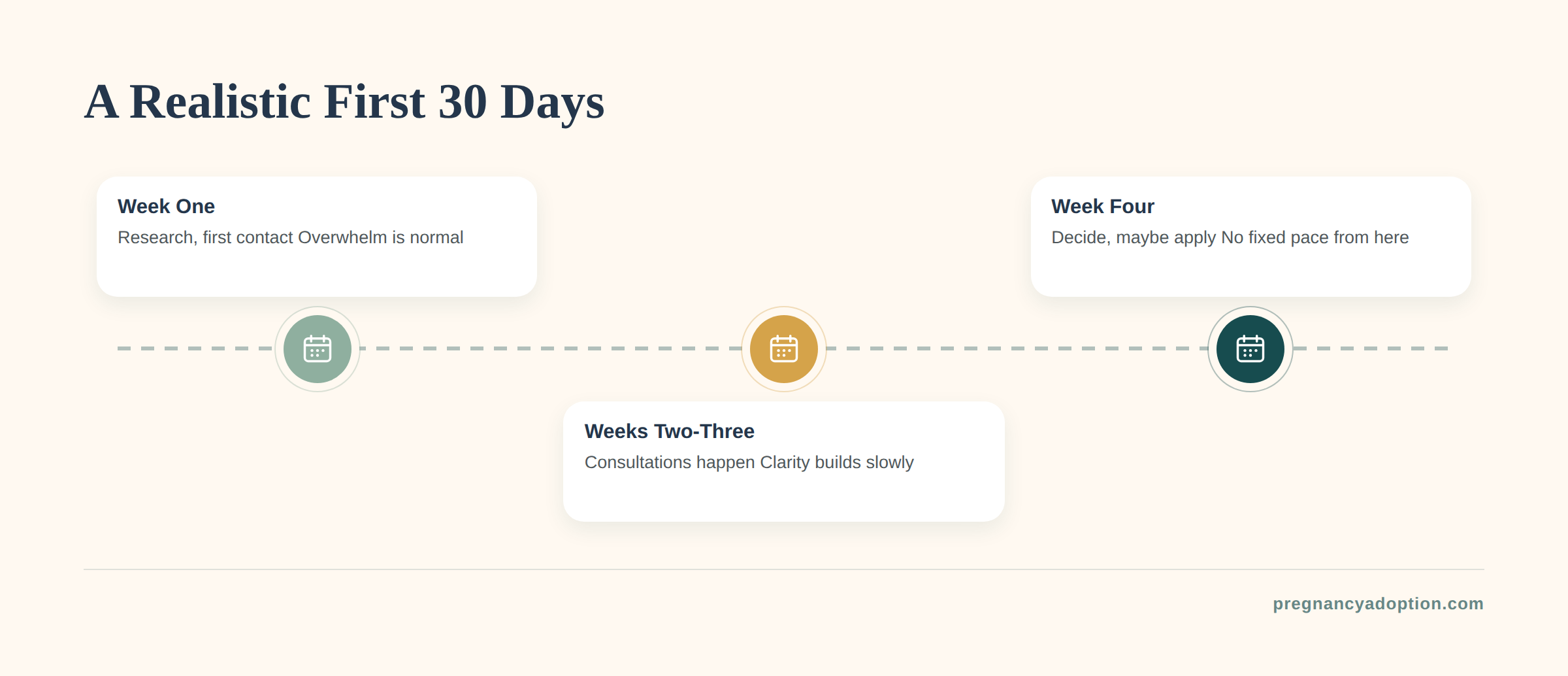
Week One: Research and First Contact
Typical Actions
Reading guides like this one, attending an information session, and reaching out to one or two agencies or attorneys to schedule a consultation.
What to Expect Emotionally
A mix of excitement and overwhelm is completely normal in week one. Most people describe the sheer number of options and unknowns as the hardest part of the very beginning, not any single decision.
Weeks Two and Three: Consultations and Narrowing Down
Typical Actions
Having your first consultation call or calls, comparing notes, and doing an initial budget gut-check against what you learned.
What to Expect Emotionally
Clarity tends to build gradually here rather than arriving all at once. It’s common to end week three still choosing between two paths or two agencies rather than having a single clear answer — that’s on pace, not behind.
Week Four: Deciding and (Maybe) Applying
Typical Actions
Some people submit a formal application by the end of month one; many others take longer, revisit a second consultation, or pause to firm up finances first.
There’s No “Normal” Pace Beyond This Point
Once you’ve applied, the overall timeline varies enormously by path — our full adoption checklist and our adoption process guide cover realistic timelines for each phase from here forward in detail.
Common First-Step Mistakes to Avoid
Moving Too Fast
Signing With the First Agency You Talk To
It’s tempting to commit to the first agency that gives you a good feeling, but comparing at least two or three, even briefly, tends to surface differences in fees, communication style, and specialization that matter later.
Skipping the Budget Gut-Check
Starting the application process before having any sense of the likely cost range is one of the most common sources of mid-process stress and regret.
Moving Too Slowly
Research Paralysis
Some prospective parents research for months or years without ever making a first call, often out of fear of commitment that a free consultation doesn’t actually create. If you’ve read several guides and still feel stuck, that’s usually a sign to make the call, not to read a fourth guide.
Waiting for “Perfect” Readiness
As covered above, readiness tends to build through the process, not before it. Waiting to feel fully ready before taking any action can delay things indefinitely for little real benefit.
Other Early Missteps
Not Getting on the Same Page With a Partner First
Starting the formal process while a partner is still ambivalent tends to surface conflict later, during interviews or the home study, rather than resolving it earlier when it’s easier to address.
Assuming One Path Is “Easier” Without Checking
Each path trades one kind of difficulty for another — cost, timeline, uncertainty, or complexity — rather than any single path being universally easiest. Our guide to the types of adoption compares these trade-offs directly.
If You’re Not Sure Which Path Is Right for You
That’s Common, and Workable
Most People Start Undecided
Few prospective adoptive parents arrive at their first consultation already certain which path fits them best, and agencies are used to helping narrow this down rather than expecting a decision in advance.
A Few Questions That Help Narrow It Down
How flexible is your timeline? How flexible is your budget? Do you have a strong preference for an infant versus an older child? Are you open to travel, including possibly extended stays abroad? Your honest answers to these four questions eliminate some paths quickly for most people.
It’s Fine to Explore More Than One Path at Once, Briefly
Parallel Research Is Normal Early On
Reading about two or three paths simultaneously in these early weeks is common and useful. Committing resources (fees, paperwork) to more than one path at once is where it gets genuinely complicated, and worth avoiding once you’ve narrowed down.
Where to Go for the Full Comparison
Our complete guide to adopting a child and our guide to the types of adoption both walk through a full side-by-side comparison of all four paths across cost, timeline, and typical experience.
Starting as a Single Parent, LGBTQ+ Couple, or Non-Traditional Family
Eligibility Has Broadened, But Varies
Legal Eligibility Is Not the Same as Agency Culture
Being legally eligible to adopt and finding an agency that is genuinely experienced and welcoming toward your specific family structure are two different things worth checking separately.
Asking Directly on a First Call Is Reasonable
It’s entirely appropriate to ask a prospective agency directly, on your very first call, about their experience working with families like yours, and to use their answer (and their tone) as part of how you evaluate fit.
Finding the Right Fit
Agency Specialization Exists
Some agencies specifically specialize in working with LGBTQ+ prospective parents or single applicants and can be a more comfortable starting point than a general-practice agency. National directories and referrals from other adoptive parents in similar family structures are a good way to find them.
You’re Allowed to Prioritize Comfort, Not Just Credentials
If an agency is licensed and reputable but something about a first call felt dismissive or uninformed about your family structure, it’s reasonable to keep looking rather than proceed out of a sense of obligation.
What Comes After You Start: A Brief Preview
| This guide (before you start) | The full adoption checklist (once you start) |
|---|---|
| Readiness self-assessment | Confirming formal eligibility criteria |
| Learning path basics | Choosing and committing to a path |
| Budget gut-check | Full financial planning and fee schedules |
| Researching a shortlist of agencies | Formally vetting and selecting an agency or attorney |
| A free first consultation call | Submitting a formal application |
| Deciding whether to move forward | Home study, training, matching, placement, and finalization |
Once You Apply, the Formal Process Takes Over
A Longer, Structured Journey
From application onward, the process follows a fairly consistent structure across most agencies: eligibility confirmation, document gathering, the home study, required training, matching, placement, post-placement supervision, and legal finalization. Our complete adoption checklist walks through every one of these phases as an actionable, chronological list.
You Won’t Need This Guide Again Until You’re Advising Someone Else
Once you’ve made your first call and decided to move forward, this guide has done its job. Bookmark the checklist instead — it will carry you from here through finalization and beyond.
If Things Don’t Move in a Straight Line
Starting Over Is Common, Not a Failure
Some prospective parents start with one agency or one path, and switch after a first consultation or even after beginning an application. That’s a normal part of finding the right fit, not a sign anything went wrong.
This Guide Still Applies the Second Time
If you find yourself needing to restart — a new agency, a different path — the same readiness questions and first-call approach in this guide still apply; you’re simply applying them with more information than you had the first time.
A Simple Action Checklist for This Week

If You Have 30 Minutes
Do the Readiness Self-Assessment
Work through the readiness questions above honestly, ideally writing down your answers so you can revisit them.
Skim the Four Path Options
Read the brief path summaries above, and note which one or two feel most realistic for your situation right now.
If You Have an Afternoon
Build a Short Agency Shortlist
Identify two or three licensed agencies or attorneys to contact, using a state directory, accreditation body, or referral.
Schedule Your First Call
Reach out to request a free initial consultation with at least one of them this week.
Before and After the Call
Write Down Your Questions in Advance
Use the question list in Step 5 above so you don’t forget anything important in the moment.
Debrief With Your Partner or a Trusted Person Afterward
Talk through what you heard before deciding anything, especially if you’re adopting with a partner who wasn’t on the call.
Glossary of Terms in This Guide
People and Professionals
Agency
A licensed organization that facilitates adoptions, providing services such as home studies, matching, and post-placement support.
Attorney-Facilitated Adoption
An adoption arranged primarily through a private adoption attorney rather than an agency, common in some states for domestic infant adoption.
Process Terms
Consultation
An initial, typically free conversation with an agency or attorney to learn about their services and discuss your situation, without obligation.
Home Study
A formal assessment, conducted by a licensed social worker, of a prospective adoptive family’s readiness and home environment, required for all adoption paths.
Matching
The process by which a prospective adoptive family is connected with a specific child or birth parent considering adoption.
Placement
The point at which a child physically moves into the home of the adoptive family, typically followed by a period of post-placement supervision before finalization.
Fees and Credentials
Hague Accreditation
A credential required for agencies handling adoptions from countries party to the Hague Adoption Convention, indicating compliance with international standards.
Sliding-Scale Fee
A fee structure, used by some agencies, that adjusts cost based on an applicant’s income.
Frequently Asked Questions
Getting Started
Do I need to pick an agency before I know which path I want?
No. Many agencies handle multiple paths and can help you narrow down your options during your first consultation rather than requiring you to arrive with a decision already made.
Is there a “wrong” way to start the adoption process?
Not really. Whether you start by reading, attending an information session, or calling an agency directly, all of these are legitimate first steps — there’s no required sequence.
How do I know if I’m actually ready to adopt?
Readiness tends to build gradually through the process rather than arriving fully formed beforehand. A reasonable bar for starting is honest willingness to learn and move forward, not a sense of total certainty.
The First Call
Is the first consultation really free?
At most licensed agencies and attorneys, yes.
What if I call and then decide not to move forward?
That’s completely fine. A consultation creates no obligation, and reputable professionals expect that many callers will not move forward immediately, if at all.
Should I call multiple agencies before choosing one?
Yes, speaking with two or three is a reasonable, common approach that helps you compare fees, communication style, and overall fit before committing.
Readiness and Timing
What if my partner isn’t ready yet?
It’s worth having an honest conversation before starting formally, since agencies typically interview both partners. Some couples benefit from one partner attending an information session first to ease into the idea together.
Is there an ideal age to start the adoption process?
There’s no universal ideal age; eligibility requirements vary by path and are covered fully in our adoption requirements guide. Readiness factors (stability, support, flexibility) matter more than age alone in most cases.
How long does it typically take from first call to application?
This varies enormously, from a single week to many months, depending on how quickly someone feels ready to move forward. There’s no standard timeline for this particular stretch.
Budget and Cost
Do I need to have all the money saved before I start?
No. Most families finance adoption through a combination of savings, grants, loans, and the adoption tax credit, and a first consultation is a good place to ask about those options before any money changes hands.
Will an agency turn me down for not having enough money upfront?
Policies vary by agency. Many are familiar with helping families identify financial assistance options rather than requiring full payment in advance — ask directly during your first call.
Using This Guide
Do I need to read the full adoption checklist before I start?
No — that checklist is meant for once you’ve decided to move forward. This guide is specifically designed to get you to that decision point first.
What should I read next if I’m ready to move forward?
Our complete adoption checklist is the natural next step, along with our guide to choosing an adoption agency if you haven’t finalized your shortlist yet.
Choosing Between an Agency and an Attorney
Should I start with an agency or an adoption attorney?
It depends on your path and state. Agencies typically offer broader support services (counseling, matching, post-placement supervision), while attorney-facilitated adoptions can sometimes move faster for domestic infant adoption in states that allow it. Asking both what their process involves is a reasonable way to compare.
Can I work with both an agency and an attorney at the same time?
Many domestic infant adoptions do involve both: an agency handling the home study and matching, and an attorney handling the legal finalization. This is normal, not redundant.
How many agencies should I realistically contact at the start?
Two or three initial consultations is a common, manageable number. Contacting many more than that at once can become overwhelming without adding much additional clarity.
What if every agency I call gives me a different answer about timelines?
That’s common, since timelines genuinely vary by agency, path, and your own flexibility. Ask each agency what specifically drives their estimate, rather than treating any single number as fixed.
Starting Domestic Infant Adoption Specifically
What’s the very first step for domestic infant adoption specifically?
The same first steps in this guide apply, with an emphasis on finding an agency or attorney experienced in domestic infant placements and discussing openness (contact level with birth parents) on your first call.
Do I need to decide on open or closed adoption before my first call?
No. Most domestic infant adoptions today are open or semi-open to some degree, and your first call is a good place to start learning what that actually means in practice. Our open adoption guide and our closed adoption guide cover both in depth.
How soon after my first call could I be matched with a birth parent?
This varies enormously and typically happens only after your home study and application are complete, not immediately after a first consultation.
Starting Foster Care Adoption Specifically
Do I start with my state’s foster care agency or a private one?
Both are usually options. Many states allow you to begin directly through the public child welfare agency, while some regions also have private agencies that specialize in foster-to-adopt placements.
Do I need to become a licensed foster parent before I can adopt from foster care?
In most cases, yes — foster-to-adopt typically requires foster licensing first, though the training and home study often overlap significantly with adoption requirements.
Is the first call different for foster care adoption than for other paths?
The same core questions apply, though you’ll also want to ask specifically about typical ages and needs of children currently waiting, and what support is available for children who have experienced trauma.
Starting International Adoption Specifically
How do I know which countries are currently open to adoption?
This changes periodically based on international agreements and each country’s own policies. A Hague-accredited agency specializing in international adoption will have current information on which country programs are active.
Do I need to travel immediately after starting the process?
No — travel typically happens much later, after a match and country-specific approvals, not during these early first-step stages.
Is international adoption a reasonable first choice, or should I rule it out early if I’m uncertain?
It’s reasonable to keep it on your shortlist through your first few consultations, since cost, timeline, and country-specific requirements are easier to evaluate with a specialized agency’s direct input than through general research alone.
Starting Relative or Stepparent Adoption Specifically
Do I still need to go through all these first steps for a stepparent adoption?
The process is typically much simpler. Many states streamline or waive the home study for stepparent and close-relative adoptions, so your real first step is usually a consultation with a family law attorney rather than an adoption agency.
Who do I even call first for a relative adoption?
A family law attorney with adoption experience in your state is the typical starting point, rather than a general adoption agency.
Family, Support, and Disclosure
Do I have to tell my employer I’m starting the adoption process?
Not at this early stage. Most people disclose to an employer closer to placement, when leave planning becomes relevant, rather than during initial research or consultations.
What if my extended family disagrees with our decision to adopt?
This is a real and common challenge. Many prospective parents find it helpful to lead with their own clarity and confidence rather than seeking buy-in from everyone before starting, while still staying open to honest conversations over time.
Should I join a support group before I even make my first call?
It’s not required, but many prospective adoptive parents find connecting with others earlier rather than later — even informally online — helps normalize the uncertainty of these first steps.
What if my partner wants to adopt and I’m still unsure?
Attending an information session together, without either of you committing to anything, is often a lower-pressure way to explore the idea jointly before one partner feels pressured to catch up to the other’s certainty.
Religious, Cultural, and Identity Considerations
Do I need to adopt through a faith-based agency if I have a religious preference?
Not necessarily, though some prospective parents prefer it for alignment on values and birth-parent counseling approach. It’s reasonable to ask any agency directly about their religious affiliation, if any, during your first call.
How do I start the process if I want to prioritize cultural or racial matching?
Raise this directly and early, ideally on your first call, since agency practices and availability around cultural or racial matching vary and are easier to discuss honestly from the start than to renegotiate later.
Timing, Life Changes, and Practical Logistics
Is it okay to start the adoption process while I’m also considering a move?
It’s worth mentioning upcoming moves on your first call, since home studies are location-specific and a cross-state or cross-country move during the process can add complexity and delay.
What if I lose my job shortly after starting the process?
Tell your agency or attorney as soon as it happens. Many processes can pause or adjust rather than ending outright, though specific policies vary by professional.
Can I start the adoption process while pregnant or trying to conceive?
Yes, many families pursue both simultaneously, sometimes called “adopting while expecting” or pursuing parallel paths to parenthood. It’s worth discussing openly with your agency, since some have specific policies about active pursuit of both paths at once.
Does military service or frequent relocation complicate starting the process?
It can add logistical complexity, particularly around home studies and licensing across state lines, but many agencies have specific experience supporting military families — worth asking about directly on your first call.
Red Flags and Avoiding Problems Early
What’s a red flag I should watch for during a first call?
Pressure to commit or pay immediately, vague or evasive answers about fees, and an inability to clearly explain what happens if a match falls through are all worth treating with caution.
What if an agency pressures me to decide on the spot?
Treat that as a signal to slow down and compare with at least one other agency or attorney before deciding anything, regardless of how the first call otherwise went.
How do I verify an agency is actually licensed before my first call?
Most states maintain a public directory of licensed child-placing agencies; checking this before reaching out is a quick, worthwhile first-step safeguard.
Emotional Readiness in More Depth
Is it normal to feel scared to start, even if I’m sure I want to adopt?
Yes, this is extremely common. Fear at the beginning is usually about the unknowns of the process itself, not a sign of ambivalence about wanting to adopt.
How do I know if I’ve truly processed infertility grief enough to start?
There’s no fixed test for this, but many people find it useful to notice whether they can talk about adoption as its own path forward, rather than purely as a consolation for what didn’t happen biologically. A therapist experienced in family-building issues can help with this specifically if it feels unresolved.
What if I feel guilty about wanting a specific type of child (age, background, etc.)?
Having honest preferences is normal and expected — agencies ask about this directly precisely because it helps them match appropriately. Naming your real boundaries isn’t something to feel guilty about.
What Happens If You Pause or Stop
Can I pause the process after I’ve started without losing everything?
In most cases, yes, especially in these earliest stages before a formal application. Ask any agency or attorney directly about their specific pause or withdrawal policy before you begin.
What if I start the process and then decide adoption isn’t right for us after all?
That’s a legitimate outcome of exploration, not a failure. Most of what happens in these first steps — research, consultations — carries no binding commitment, specifically so this kind of reconsideration remains possible.
Documents and Paperwork, Previewed
Do I need to gather documents before my first call?
No. Document gathering (identification, financial records, medical reports, background-check paperwork) is part of the formal process once you apply, not a prerequisite for a first consultation.
What’s the very first document I’ll likely need after I apply?
Most agencies start with a basic application form and proof of identity; the fuller document list comes once your home study begins. Our full adoption checklist covers the complete document list in its own dedicated phase.
Should I start organizing financial and personal records now, just in case?
It’s a reasonable, low-pressure thing to do during these early weeks, since it saves time later without requiring any commitment now.
Cost and Financial Assistance, Previewed
What financial assistance options should I ask about on my first call?
Ask specifically about sliding-scale fees, grants the agency is familiar with, adoption loans, and whether they have experience helping families use the federal adoption tax credit.
Are grants hard to get, and should that affect which agency I choose?
Competitiveness varies by grant. Choosing an agency partly based on their familiarity and track record with grant applications is reasonable if cost is a significant concern for your family.
Does starting the process cost anything before I officially apply?
Typically no — research, information sessions, and first consultations are usually free. Costs generally begin at or after the formal application stage.
Can fundraising cover a meaningful part of adoption costs?
Many families do raise some funds through community fundraising, though it’s rarely a complete solution on its own. Our full adoption cost guide covers fundraising alongside other financial assistance options in more depth.
Waiting, Uncertainty, and Early Expectations
How do I cope with not knowing how long any of this will take?
Many people find it easier once they shift from expecting a fixed timeline to expecting a general range with real variability, and from focusing on the destination to focusing on the next concrete step in front of them.
Is it normal to feel impatient right from the start?
Yes, very normal. Impatience at the beginning, before you’ve even applied, is common and doesn’t predict how you’ll handle the process’s later, often longer waiting periods.
Should I set a personal deadline for making a decision?
Some people find a loose target (such as “make a decision within two months of our first call”) helpful for maintaining momentum, while others prefer an open timeline. Either approach is fine as long as it isn’t adding unnecessary pressure.
Working With a Caseworker or Social Worker Later
Will I be assigned a caseworker right away?
Usually not until after you’ve applied and your home study process begins. Your point of contact before that is typically an intake coordinator or the professional you first consulted with.
What’s the difference between a caseworker and the agency I first called?
The agency is the organization; a caseworker or social worker is the specific individual assigned to guide your home study and ongoing process once you’re further along.
Background Checks and Training, Previewed
Will I need a background check just to have a first consultation?
No. Background checks are part of the formal application and home-study process, not required for an initial information-gathering call.
What kind of training should I expect later in the process?
Most agencies require pre-adoption training covering topics like attachment, trauma-informed parenting, and transracial or transcultural parenting where relevant. Our full checklist covers typical training requirements in its own dedicated phase.
Matching and Waiting Children, Previewed
Can I start browsing waiting children before I’ve even applied?
Some foster care photolisting databases are publicly browsable, but formally expressing interest in a specific child typically requires being an approved, licensed prospective family first.
Will I be shown multiple options, or just matched with one at a time?
This varies by path and agency. Domestic infant adoption matching usually involves one situation at a time; foster care matching sometimes allows browsing several waiting children’s profiles simultaneously.
Siblings, Multiples, and Existing Children at Home
Does already having biological or adopted children affect how I start?
Not substantially at the first-steps stage; most of the same research, readiness, and first-call guidance applies. Agencies will factor in your current children’s ages and needs later, during the home study and matching phases.
Should I ask on my first call about adopting siblings together?
Yes, if that’s something you’re open to or specifically interested in, since not every agency has frequent sibling-group placements, and asking early helps you gauge fit.
Do I need to prepare my current children before I even make a first call?
Not at this stage. Most families involve current children more directly once the process is further along and a placement feels more concrete.
Health, Medical, and Special Needs Considerations
Do I need a clean bill of health to start the adoption process?
No specific health standard is required just to start researching or make a first call; some paths and countries do have health-related eligibility criteria that come up later in the formal application. Our adoption requirements guide covers these in detail.
How do I start thinking about openness to a child with special needs?
It’s worth reflecting honestly on this during your own readiness self-assessment, since agencies will ask directly, and many have specific programs and additional support for families open to children with known medical or developmental needs.
State and Jurisdiction Variation
Does the process of “starting” vary a lot by state?
The core first steps in this guide are broadly similar nationwide, though specific requirements (home-study standards, attorney-involvement rules, post-placement supervision length) vary meaningfully by state once you’re further along.
Should I look for an agency licensed in my state specifically, or is national licensing enough?
Agencies must generally be licensed in the state where services are provided, though many operate across multiple states. Confirm this directly during your first call if you’re unsure.
If a Match or Process Falls Through Later
What if I start over after a failed match down the road?
Many adoptive parents experience at least one match that doesn’t proceed to placement. If this happens, most of the groundwork from these first steps — your readiness, your agency relationship, your financial planning — carries forward rather than resetting to zero.
How common is it for an adoption to not move forward after matching?
This varies by path and circumstance and is worth asking any agency directly about during your first call, including what support they offer if it happens.
Alternatives and Making Sure Adoption Is Right for You
What if I start this process and realize adoption isn’t actually what I want?
That’s a legitimate and not uncommon realization during these early steps, and it’s exactly what this low-commitment stage is designed to help you discover before any major investment of time or money.
Are there lower-commitment ways to “test the waters” before fully starting?
Attending an information session, reading first-person accounts from adoptive parents, or talking to a therapist about your motivations are all lower-commitment ways to explore the idea before your first formal consultation.
Should I compare adoption to other family-building options before starting?
If you haven’t already ruled out other paths to parenthood and are still weighing adoption against them, it’s reasonable to take the time to do that first — starting the adoption process works best once adoption itself, not just a path within it, feels like the right fit.
Finding Reliable Information Online
How do I know if an adoption website or forum is giving me accurate information?
Favor sources that cite licensed professionals, government agencies, or accredited organizations over anonymous forum posts, and treat personal anecdotes as one data point rather than a universal rule — your own agency or attorney is the best source for anything specific to your situation.
Is it safe to join online adoption groups this early?
Generally yes, and many people find peer communities genuinely valuable during these first uncertain weeks, though it’s worth remembering that individual experiences shared online can vary widely and aren’t a substitute for professional guidance on your specific situation.
Finding a Therapist or Counselor Before You Start
Do I need to see a therapist before starting the adoption process?
It’s not required, but if you’re processing infertility, loss, or significant ambivalence, many prospective parents find that working through those feelings with a professional first makes the early steps feel less overwhelming.
How do I find a therapist who specifically understands adoption and infertility?
Look for a therapist who lists family-building, infertility, or adoption-competent experience specifically, since general counseling skills don’t always include familiarity with these particular dynamics.
Timeline Comparison Across Paths
Which path typically has the shortest timeline from starting to placement?
Relative and stepparent adoptions are usually fastest, often resolving in months, while domestic infant, foster care, and international adoption typically take considerably longer and vary widely by individual circumstances. Our adoption process guide covers typical timelines by path in more depth.
Does starting earlier in the year matter for timeline?
Not meaningfully. Most agencies operate on an ongoing basis without a particular “best” time of year to begin, though individual caseworker caseloads and court schedules can create minor regional variation.
If You Already Have a Home Study or Prior Application
Can I reuse a home study from a previous adoption attempt?
Many home studies remain valid for a set period (often one to two years) and can sometimes be updated rather than fully redone — ask your agency directly if this applies to your situation.
What if I started the process with a different agency years ago and stopped?
You can generally restart, either by reactivating your relationship with that agency if still appropriate, or by beginning fresh with a new one — your prior experience and any existing paperwork may still have some value worth discussing on a new first call.
Confidentiality and Privacy at This Stage
Is what I share on a first call kept confidential?
Reputable agencies and attorneys treat initial consultations as confidential, though it’s reasonable to ask directly about their specific privacy practices if you have concerns.
Do I need to disclose my full personal history on the very first call?
No. A first call is a general conversation, not a formal intake interview; deeper personal history disclosure typically comes later, during the formal application and home study.
LGBTQ+ Prospective Parents: Additional First-Step Questions
Will I face additional scrutiny during the process as an LGBTQ+ applicant?
Licensed agencies are generally required to evaluate all applicants against the same core criteria, though it’s fair to ask a specific agency about their track record and comfort level directly if you have any doubt.
Should I avoid international adoption as an LGBTQ+ couple?
Some countries do not currently permit adoption by LGBTQ+ couples or individuals, which can meaningfully narrow international options; a specialized agency can clarify which current country programs are realistically open to you.
Single Parents: Additional First-Step Questions
Is foster care adoption more accessible for single applicants than other paths?
Many single prospective parents find foster care adoption relatively accessible, though all four paths are legally open to single applicants in most states, with varying practical availability by agency.
What should I specifically ask on my first call as a single parent?
Ask about the agency’s experience working with single applicants specifically, what their support-system expectations are, and whether they’ve placed with single parents in similar circumstances before.
Blended and Informal Family Situations
I’ve been raising a relative’s child informally for years — how do I “start” making it legal?
This typically starts with a consultation with a family law attorney rather than a general adoption agency, since relative adoption usually follows a simpler, more direct legal path than other adoption types.
Does an informal, long-standing caregiving arrangement change how I should start?
It can simplify parts of the home-study and matching process in many states, but it’s still worth starting with a proper legal consultation rather than assuming informal caregiving alone establishes legal parentage.
Explaining the Decision to Children Already at Home
How early should I tell my current kids we’re starting the adoption process?
There’s no fixed rule; many families wait until the process feels more concrete (after applying, or closer to a potential match) to avoid long stretches of uncertainty for children, though this depends on their age and how directly involved they’ll be.
What if my child asks questions I can’t answer yet about timing?
It’s fine to tell children honestly that grown-ups don’t always know exactly when something will happen, while reassuring them that you’ll keep them updated as you learn more yourself.
Oversight, Regulation, and Checking an Agency’s Standing
Who regulates adoption agencies, and how do I check an agency’s standing?
Adoption agencies are licensed and regulated at the state level, typically through a state’s department of health and human services or equivalent; most states publish a searchable public directory of licensed agencies and any disciplinary history.
Is it worth checking an agency’s Better Business Bureau rating or online reviews?
It’s a reasonable supplementary check, though reviews should be weighed alongside direct licensing verification and your own impression from a first call, rather than relied on alone.
What happens if an agency I’m working with closes or loses its license mid-process?
This is rare but serious; cases are typically transferred to another licensed agency, sometimes with state oversight involvement. It’s a reasonable question to ask directly about contingency plans during your first call, especially for international adoption.
Post-Placement and Finalization, Briefly Previewed
Do I need to think about post-placement supervision or finalization at this early stage?
Not in detail — these come much later in the process. It’s enough to know they exist as later phases; our full checklist covers both in depth when you’re ready for them.
Is finalization the point where the adoption becomes fully permanent and irreversible?
Generally yes, finalization is the legal point at which the adoption becomes permanent through a court order, though exact procedures vary by state and path. This is far beyond the first-steps stage covered in this guide.
In-Person vs. Virtual First Consultations
Is a virtual first consultation as good as an in-person one?
For most agencies today, virtual consultations are standard and equally informative as a first step; in-person meetings, when offered, tend to happen later in the process rather than at this initial stage.
What should I have ready for a virtual first call?
A quiet space, your written list of questions, and a rough sense of your timeline and budget are enough — no documents or formal preparation are typically required for this first conversation.
Military and Veteran Families
Are there adoption benefits specifically for military families?
Some military branches offer adoption reimbursement benefits, and it’s worth asking your branch’s family support office directly, alongside your agency, early in the process.
Does an upcoming deployment affect when I should start?
It’s worth discussing directly with your agency or attorney, since a deployment during the home-study or placement window can require planning around, but it doesn’t necessarily mean you need to delay starting the research and consultation stage.
Age and “Is It Too Late to Start” Concerns
Am I too old to start the adoption process?
Most paths don’t set a strict maximum age, though some do set minimum age gaps between parent and child or country-specific age guidance for international adoption. Our adoption requirements guide covers current age-related criteria by path.
Is it too late to start if we’ve already spent years trying other paths to parenthood?
No — many adoptive parents begin after years of trying other routes, and agencies are generally accustomed to working with families arriving at adoption after a long journey already.
Starting Again After a Previous Disruption
How do I start again emotionally after a placement that didn’t finalize?
Many people benefit from processing that loss with a therapist experienced in adoption-related grief before restarting, since the first steps in this guide tend to go better once that grief has some room to be acknowledged rather than rushed past.
Should I tell a new agency about a previous disrupted placement?
Yes — being upfront about your history helps a new agency support you appropriately and is generally expected as part of an honest application.
Legal Help and Low-Cost Resources
What if I can’t afford a private adoption attorney to start?
Some areas have legal aid organizations or law school clinics that handle adoption cases at reduced or no cost, particularly for relative and stepparent adoptions; your state’s bar association referral service is a reasonable starting point for finding one.
Do I need a lawyer at all if I’m working with a full-service agency?
Many agencies include legal finalization services as part of their standard process or work with an affiliated attorney, so a separate attorney isn’t always necessary — confirm this directly on your first call.
Past Records and Background Concerns
Will an old, minor criminal record automatically disqualify me from starting?
Not necessarily. Many states evaluate background-check findings individually, considering factors like how long ago an offense occurred and its nature, rather than applying a single automatic disqualification rule. Our adoption requirements guide covers this in more detail.
Should I disclose a past record proactively on my first call, or wait to be asked?
Being upfront early, even informally, tends to go better than waiting for a formal background check to surface it, since it lets a professional advise you honestly about your specific situation from the start.
Financial Planning Beyond the First Gut-Check
Should I involve a financial advisor or accountant before I formally start?
It’s not required at this stage, but if your budget gut-check revealed real uncertainty about financing, a brief conversation with a financial professional before applying can clarify your options, including how the adoption tax credit timing works alongside your other finances.
When should I actually claim the adoption tax credit — before or after I start?
The credit generally applies to qualifying expenses paid during the adoption process and is claimed on your tax return for the relevant year, not something you apply for upfront before starting. Our adoption tax credit guide covers exact timing and eligibility rules in full.
Public vs. Private Foster Care Pathways
What’s the difference between starting through a public child welfare agency versus a private foster-to-adopt agency?
Public agencies are run directly by the state and typically have no placement fees; private agencies often provide more individualized support and training but may charge fees or serve a narrower region. Asking both about their specific process is a reasonable way to decide where to start.
Can I start the inquiry process with more than one foster care pathway at once?
In many regions, yes, though it’s worth mentioning to each that you’re exploring both so neither duplicates licensing work unnecessarily.
A Few Last Practical Questions
Do I need a specific job or income level to start?
Most paths look for stable, sufficient income relative to household size rather than a specific minimum figure, and this is confirmed in detail during the home study rather than required to simply make a first call. Our adoption requirements guide covers income-related criteria by path.
Can renters start the adoption process, or do I need to own a home?
Renters are generally eligible across all four paths; what typically matters is adequate space and a stable living situation, not ownership status.
Is it better to start the process alone first and bring my partner in later?
Most agencies prefer both partners involved from the first consultation onward, since they’ll both ultimately be part of the home study and application regardless of who makes the initial call.
What if we have pets — does that affect how we should start?
Pets don’t typically affect your earliest first steps, though home studies do generally include a basic review of pets and their temperament, so it’s reasonable to mention them during your first call if you have any concerns.
Should we start the process before or after a planned major purchase, like a new car or home renovation?
If a major purchase would meaningfully affect your adoption budget or your home’s readiness for a home study, it’s worth sequencing deliberately — many families find it simplest to stabilize large financial decisions before formally applying, even if early research and consultations happen in parallel.
Is there a maximum number of times I’m allowed to change agencies while starting?
No formal limit exists. Switching once or even twice while you find the right fit is common and not viewed negatively by agencies, who generally understand that early exploration sometimes takes more than one attempt to get right.
What’s the single best thing I can do this week if I’m still overwhelmed by all of this?
Pick just one small action from the checklist above — reading one more guide, scheduling one consultation, or having one honest conversation with your partner — rather than trying to resolve everything at once. Starting well is about momentum, not completeness.
Will I regret not starting sooner?
Many adoptive parents look back and wish they’d made that first call earlier, simply because the uncertainty of not knowing tends to feel worse in hindsight than the actual process of finding out. That feeling is common, but it’s not a reason to rush — it’s simply a reason to take the first small step whenever you genuinely feel ready to.
Bottom Line
- Starting the adoption process is less about paperwork and more about an honest readiness conversation, basic path research, a budget gut-check, and one good first phone call.
- You don’t need certainty to make that first call — most people don’t have it yet either, and a good professional will help you find it.
- Once you’ve made that call and decided to move forward, our full adoption checklist picks up exactly where this guide leaves off.
About pregnancyadoption.com/
pregnancyadoption.com/ provides independent, expert-reviewed information on pregnancy and adoption to help people navigate major decisions with clear, practical guidance. This article was researched using current publicly available guidance and is reviewed for accuracy; items flagged should be reconfirmed against current agency or legal sources for your specific situation.
Disclaimer
This article is for general informational purposes only and does not constitute legal advice. Adoption law and agency practices vary by state and by professional. Please consult a licensed adoption attorney or agency for guidance specific to your situation.
Editor’s Note
This article was reviewed for accuracy and clarity. Items flagged should be reconfirmed by an adoption professional before publication, since agency practices, fee structures, and state-specific eligibility details vary and change over time.
