
“Adoption” isn’t one process — it’s a family of related but genuinely different paths, each with its own typical cost, timeline, eligibility rules, and emotional shape. This guide is built specifically to help you figure out which type actually fits your situation, with a deeper side-by-side comparison than you’ll find elsewhere on this site, plus the practical questions people run into once they start narrowing down: how adoptions get arranged, what you can expect to pay and wait for by type, whether you can pursue more than one path at once, and what to do if your first path doesn’t work out.
This article is written for general education and does not replace the specific guidance of a licensed adoption attorney or adoption professional. It has been reviewed for accuracy, and figures that vary by source, by state, or could not be confirmed against a live source this session are flagged throughout — see the editor’s note at the end of this guide. For a full description of what each adoption type actually is and how it typically unfolds, see this site’s companion guide, How Does Adoption Work?, which this article builds on rather than repeats.
Short Answer: How to Think About Adoption Types
There are five commonly recognized main types of adoption — domestic infant, foster care, international, relative/kinship, and stepparent — plus a handful of less common categories like adult adoption, embryo donation, and second-parent adoption. Separately, any adoption can be arranged through a licensed agency, independently through an attorney, or through a hybrid “identified” arrangement. This guide’s job is to help you compare types on the criteria that actually matter for your decision — cost, timeline, eligibility, openness, and legal complexity — rather than just defining each one.
Why a Second Guide, Beyond “How Does Adoption Work?”
This site’s adoption overview guide is the right starting point if you’re brand new to adoption and want to understand what domestic infant, foster care, international, relative/kinship, and stepparent adoption each actually mean, along with the broader legal and emotional landscape of adoption in general — think of it as the foundational explainer that answers “what is adoption and what are the types” at a conceptual level. This guide picks up from there, assuming you already have that baseline understanding. Once you know roughly what each type is, the next real question most people face isn’t “what does domestic infant adoption mean” but “which one actually fits my specific situation” — and that’s fundamentally a comparison and decision-support problem rather than a definitions problem, which is exactly what the rest of this article is built around. If you haven’t yet read that foundational guide, it’s worth starting there first; if you have, and you’re now trying to actually choose or narrow down your options, this guide’s comparison framework, decision-support sections, and practical details on things like combining paths or switching types are where the real decision-making work happens.
What This Guide Covers
This guide goes beyond a simple type-by-type description by building a richer, multi-criteria comparison matrix that weighs cost, timeline, typical openness norms, and legal complexity side by side across every type covered here — so instead of reading five separate descriptions and trying to compare them yourself, you get the comparison already structured for you. Beyond the matrix itself, this guide also covers practical questions that most general adoption guides skip entirely: how adoptions actually get arranged in practice (through an agency, an identified match, or an independent path), whether you can reasonably pursue more than one type at the same time, and what realistic next steps look like if your first chosen path doesn’t work out the way you expected. These are covered here specifically because they come up constantly in practice but rarely get addressed head-on in more general adoption content, which tends to focus on describing each type rather than on the practical decision-making and troubleshooting that actually matters once you’re trying to choose a path or navigate an unexpected setback.
Key Takeaways
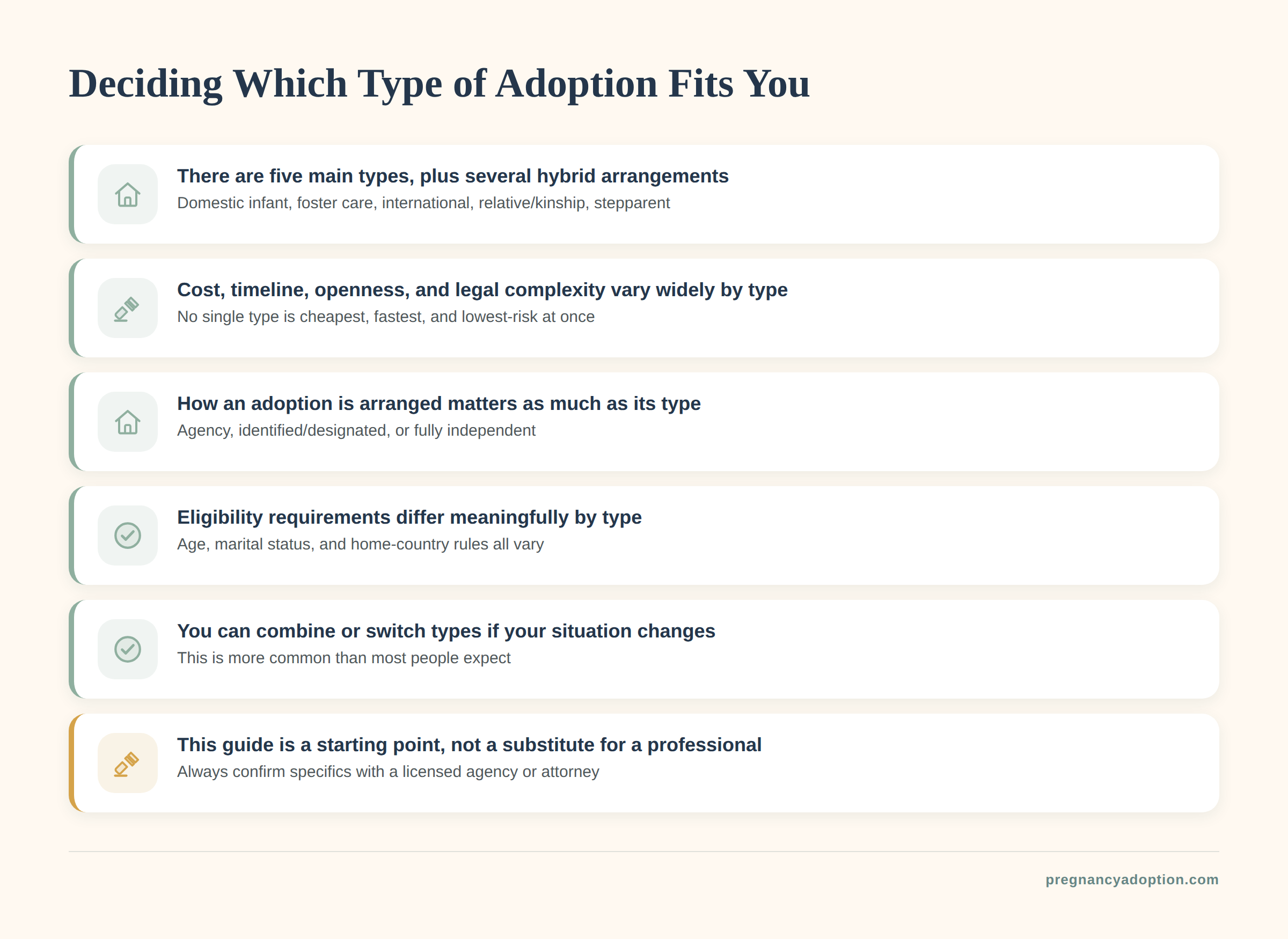
- Five main types of adoption exist (domestic infant, foster care, international, relative/kinship, stepparent), plus less common categories like adult adoption, embryo donation, and second-parent adoption.
- Any adoption can be arranged through an agency, independently, or through a hybrid “identified” arrangement — a separate dimension from the type itself.
- Cost, timeline, eligibility, and openness norms vary enormously by type, and this guide compares them side by side on each criterion.
- You can pursue more than one type simultaneously in many cases, and switching types after a setback is common and not a failure.
- For full descriptions of what each type actually is, see this site’s companion guide, How Does Adoption Work?
The Types, Briefly — and Where to Go for Full Depth
Before comparing, here’s a quick-reference summary of each type. Full descriptions, including how each one typically unfolds from both the birth-parent and adoptive-parent sides, live in this site’s adoption overview guide — this section intentionally stays brief.
The Three “Origin” Types
Domestic infant, foster care, and international adoption are distinguished primarily by where the child comes from: domestic infant adoption involves a U.S. newborn whose expectant parent is making an adoption plan, foster care adoption involves a child who is already in the U.S. foster care system, generally after being removed from their family of origin, and international adoption involves a child who is a citizen of another country, adopted through that country’s legal process in addition to U.S. immigration requirements. Beyond simply where the child comes from, each of these three types involves meaningfully different agencies and professionals, different typical cost ranges, and different typical timelines, which is why they’re often the three types people think of first when picturing adoption generally, despite being quite different from one another in practice. The fuller comparison across cost, timeline, openness, and legal complexity for all three — not just these three but every type covered in this guide — starts in the comparison section just ahead, which is the more useful place to actually weigh them against each other rather than against relative or stepparent adoption, which work quite differently.
The Two “Relationship” Types
Relative/kinship and stepparent adoption are distinguished not by where the child comes from, but by the adoptive parent’s existing relationship to the child before the adoption begins: relative or kinship adoption involves a family member — often a grandparent, aunt, or uncle — adopting a child they’re frequently already caring for in some capacity, while stepparent adoption involves a spouse adopting their husband’s or wife’s child from a prior relationship, typically after already living together as a family. Because an existing relationship, and very often an existing living arrangement, is already in place before the adoption process begins, these two types typically involve a meaningfully shorter and less complex process than starting from no existing connection to a specific child, since much of what a home study and matching process are designed to assess is already visible in an ongoing relationship. That said, “typically shorter” isn’t “always shorter” — specific circumstances, particularly around parental rights and consent, can still add real complexity and time even within these generally more streamlined categories, as covered in more depth in this guide’s eligibility and timeline sections further down.
| Type | One-line summary |
|---|---|
| Domestic infant | A U.S. newborn whose expectant parent is making an adoption plan |
| Foster care | A child already in the U.S. foster care system, parental rights terminated or being terminated |
| International | A child who is a citizen of another country |
| Relative/kinship | A family member adopting a related child, often one they’re already caring for |
| Stepparent | A spouse adopting their partner’s child from a prior relationship |
For full descriptions of each, including how the process unfolds from both sides, see this site’s adoption overview guide.
A Much Deeper Comparison: Every Type, Side by Side
This is the heart of this guide: a genuinely multi-criteria comparison, not just a one-line description per type. Use it to narrow down before reading the type-specific detail later in this article.
Criteria That Actually Drive the Decision
Cost, timeline, and certainty are often the three criteria people weigh first when comparing adoption types, and for good reason: how much a type typically costs, how long it typically takes from start to placement, and how predictable or uncertain that timeline tends to be are all genuinely practical, often financially significant factors. Some types have a wide typical range — domestic infant adoption’s timeline, for instance, depends heavily on how quickly a match happens, which varies considerably — while others, like relative adoption within the same household, tend to be more consistent and predictable. Beyond these three, a fuller comparison also weighs openness (how much ongoing contact with birth family is typical for that type), legal complexity (how many steps, how much court involvement, how many parties’ rights need to be addressed), and overall fit (which circumstances and family situations each type tends to suit best). Together, these six criteria — cost, timeline, certainty, openness, legal complexity, and fit — form the comparison framework this guide uses throughout, rather than treating any single factor, like cost alone, as the whole picture.
Reading the Matrix
No type of adoption is objectively “best” in some universal sense — every type creates an equally real, equally permanent, equally legally recognized family once finalized, and the differences between types are about process, cost, and typical circumstances, not about the legitimacy or strength of the resulting family. This comparison matrix exists specifically to help you find the type that fits your own particular circumstances, resources, and preferences, not to rank the options from best to worst in some general sense that would apply the same way to everyone. For many people, in practice, the field narrows itself well before they ever sit down to compare six different types side by side: a grandparent already raising a grandchild isn’t meaningfully choosing between five options, and a family already licensed as foster parents has a fairly natural next step if they want to adopt a child in their care. The comparison below is most useful specifically for people who are genuinely weighing more than one realistic path — if your situation has already narrowed things down to one clear option, the more practical sections on requirements, costs, and process may be more directly useful to you than the comparison itself.
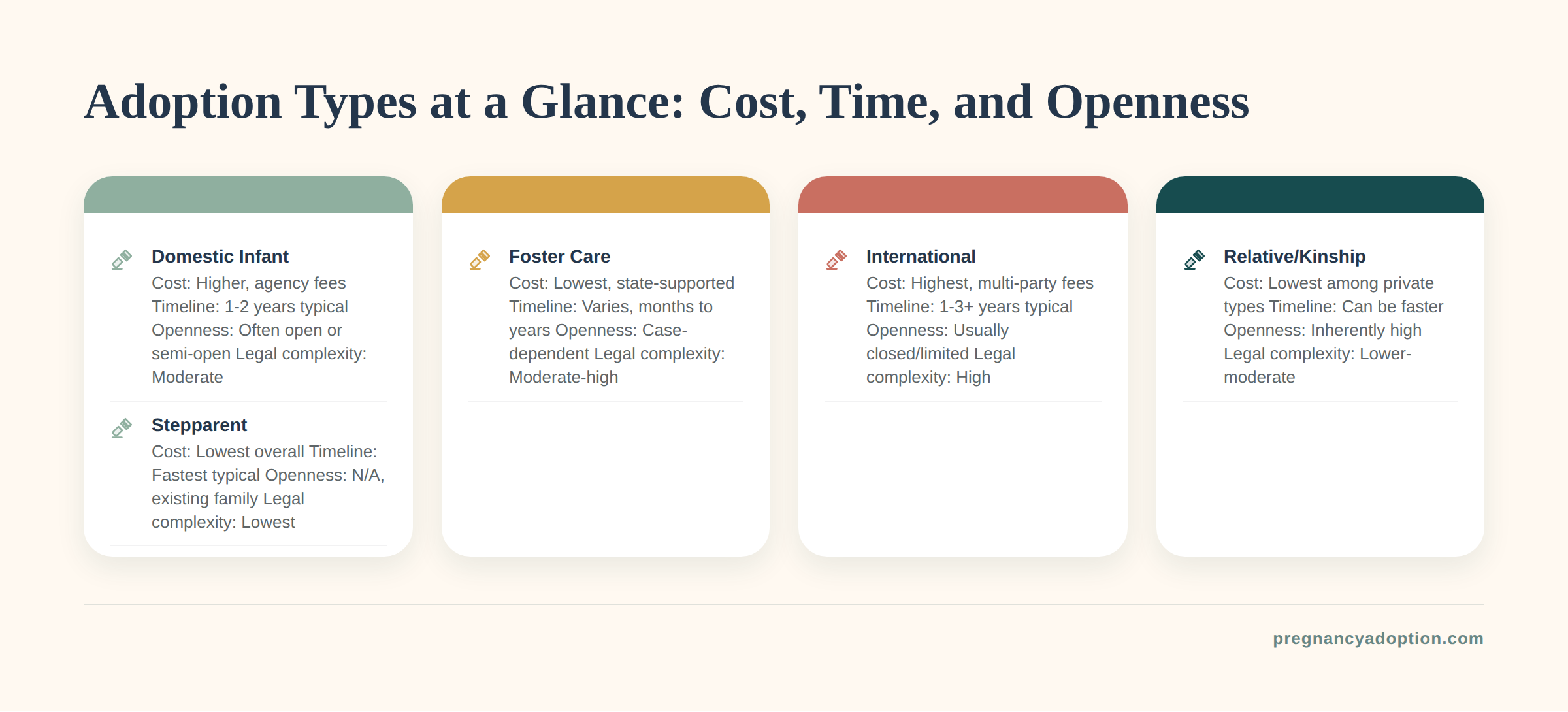
| Type | Typical cost | Typical timeline | Typical openness | Legal complexity | Tends to suit |
|---|---|---|---|---|---|
| Domestic infant | Moderate to high | 1-2+ years waiting, variable | Open or semi-open is now typical | Moderate | Those wanting to parent from infancy, comfortable with ongoing contact |
| Foster care | Low, often near $0 | Variable; can be faster for waiting children | Varies, sometimes court-ordered contact | Moderate to high (court involvement) | Those open to older children, sibling groups, or a child with known needs |
| International | High to very high | 1-3+ years, country-dependent | Typically limited, growing in some programs | High (two legal systems) | Those with a specific country connection or interest, flexible on child’s age/background |
| Relative/kinship | Low to moderate | Often faster; existing relationship | Typically high (existing family ties) | Low to moderate; may have reduced requirements | Those already caring for or closely connected to the specific child |
| Stepparent | Low to moderate | Often fastest; existing household | N/A (within existing family) | Low, unless other parent objects | Those formalizing an existing parental role |
Cost, timeline, and openness figures are general patterns, not guarantees — all vary by state, agency, and individual circumstances.
How Adoptions Are Arranged: Agency, Identified/Designated, or Independent
Separate from which type of adoption you pursue is a second, often-overlooked dimension: how the match itself gets arranged. This applies across most of the types above.
Agency-Facilitated Adoption
In an agency-facilitated adoption, a licensed public or private agency manages matching, screening, counseling for both the adoptive family and the birth parent, and much of the required paperwork, making it the most structured and heavily guided path through the adoption process — which is a significant part of why many first-time adoptive parents gravitate toward this option, since it doesn’t require them to navigate matching or legal complexity largely on their own. Choosing an agency-facilitated path does involve a real tradeoff worth naming directly: you generally have less direct control over the matching process itself compared to finding a match independently, since the agency is making many of those connections and decisions based on their own process and the preferences you’ve shared with them. In exchange, you gain built-in counseling for everyone involved, professional screening designed to support a good match, and an ongoing support infrastructure that an agency provides throughout the process and, often, well beyond finalization — a tradeoff that many people find genuinely worthwhile, particularly for a first adoption where having experienced professional guidance at each step reduces a lot of uncertainty.
Identified or Designated Adoption
In an identified, sometimes called designated, adoption, the expectant parent and the prospective adoptive family find each other independently — through personal connections, word of mouth, a mutual acquaintance, or active networking — and then bring in a licensed agency or attorney specifically to handle the legal filing, required counseling, and home-study requirements, rather than having the agency responsible for the matching itself. This is a genuinely hybrid path, and many people don’t realize it exists as a distinct, fairly commonly used category until they’re deep into researching their options: it combines the personal connection and sense of choice that comes with independent adoption with the legal structure, required services, and professional oversight that an agency provides. Some agencies offer reduced fees specifically for identified matches, since they aren’t doing the time- and resource-intensive matching work themselves — only the legal and counseling components — which can make this path somewhat more affordable than a fully agency-facilitated match while still providing the professional infrastructure that independent adoption, covered next, may lack in some states.
Independent (Attorney-Led) Adoption
In an independent, attorney-led adoption, the match happens without an agency serving as the central coordinator — often arranged through an attorney’s own network, a smaller independent network, or, in some states, a licensed facilitator — though an attorney is still required to handle the legal filing and the consent process regardless of how the match itself came together, since that legal work isn’t optional in any adoption. This path appeals to some prospective parents who want more direct involvement in finding and connecting with an expectant parent, rather than having that process managed entirely by an agency on their behalf. Independent adoption is legal in most, though not all, states, and a few states require agency involvement for some or all steps of the process regardless of how the match was found, which makes it worth confirming your specific state’s rules early, before investing significant time or money into pursuing this path, since discovering a state-level restriction partway through can mean needing to restructure your approach.
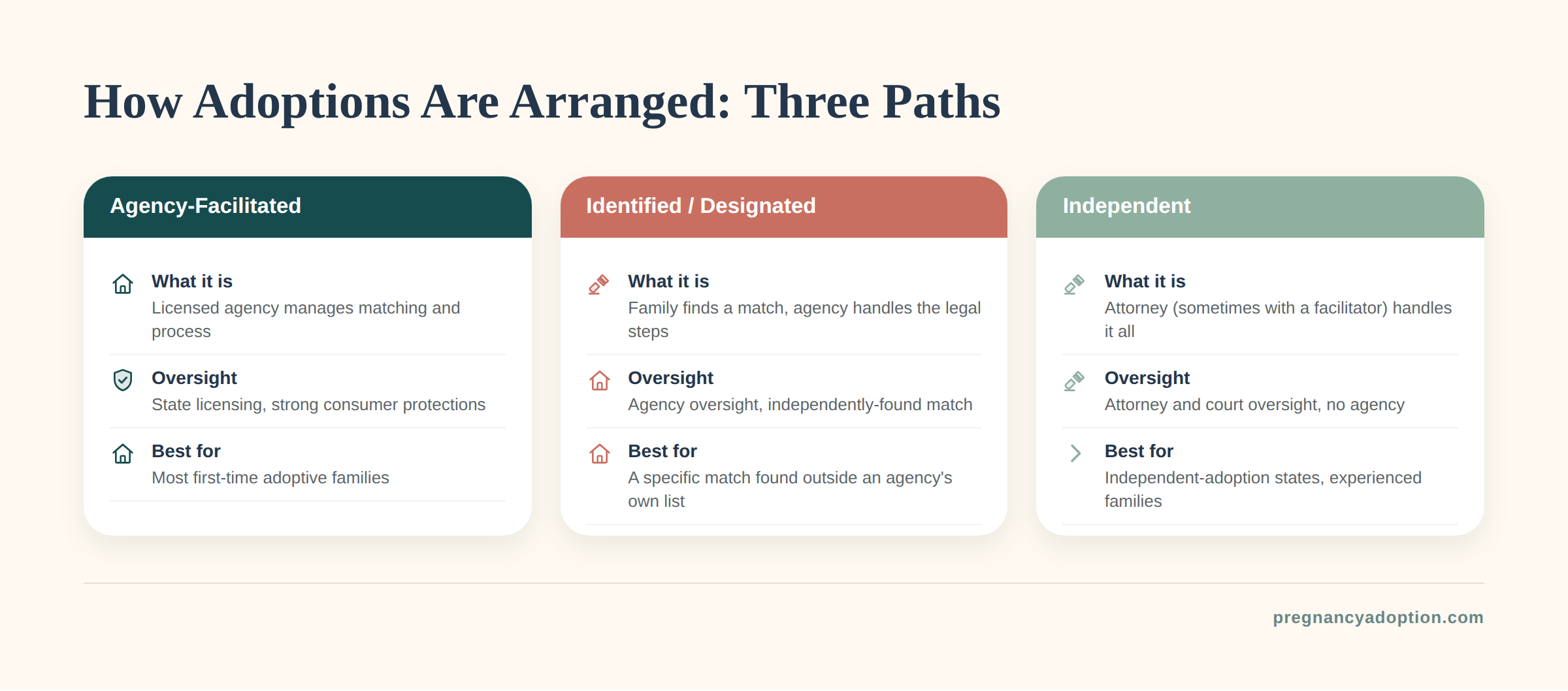
| Arrangement | Who finds the match | Who handles legal/counseling | Typical cost impact |
|---|---|---|---|
| Agency-facilitated | The agency | The agency, often in-house | Full agency fee structure |
| Identified/designated | You, independently | An agency or attorney, brought in after the match | Often reduced, since matching work is already done |
| Independent | You, an attorney, or a facilitator | An attorney, for the legal filing specifically | Varies widely; no agency overhead but attorney and other costs still apply |
Which Type Fits Your Situation? A Decision Framework
Rather than just listing pros and cons, here’s a structured way to narrow down your options based on your actual circumstances.
Start With Your Existing Connections
If you’re already caring for, or closely connected to, a specific child — a grandchild, a partner’s child, or a child you’re currently fostering — relative/kinship adoption, stepparent adoption, or fost-adopt may be your most direct and realistic path forward, and the comparison covered throughout this guide shows these paths are often genuinely faster and less costly than starting from no existing connection to any specific child, precisely because so much of what a matching process and early relationship-building are designed to establish already exists. If you’re starting fresh, without a specific child already in mind, the decision usually comes down to choosing among domestic infant, foster care, or international adoption, and the next parts of this guide — covering the criteria that actually drive the decision, and the comparison matrix itself — can help narrow things down further based on your specific priorities around cost, timeline, and the kind of child-placement situation you’re open to and prepared for.
Weigh Your Resources and Preferences
If cost is a primary constraint shaping your decision, foster care adoption’s typically much lower cost compared to domestic infant or international adoption is worth serious, honest consideration, since the financial gap between these paths is often substantial enough to meaningfully affect what’s realistically accessible to you. If a faster, more predictable timeline matters most to you specifically, that preference should weigh heavily in your decision too, given the real timeline variability described throughout this guide’s comparison sections — some types simply offer more predictability than others by their nature, independent of cost. Openness to a child’s age, background, and specific needs is a separate but equally important dimension worth being honest with yourself about: if you’re specifically seeking to adopt an infant, domestic infant adoption is the most direct path toward that specific goal, while if you’re genuinely flexible on a child’s age, or have the capacity and readiness to parent a child with known medical, emotional, or behavioral needs, foster care adoption opens up many more waiting children nationally who need families, often with shorter timelines than people expect once genuine flexibility is part of the picture.

Eligibility Requirements, Broken Out by Type
This site’s adoption requirements guide covers general eligibility standards (age, background checks, health, financial stability) in full depth. This section focuses specifically on how those standards, and additional type-specific ones, differ across types.
Requirements That Apply Broadly
A fairly similar baseline set of requirements applies across nearly every type of adoption, regardless of which path you ultimately choose: age minimums for adoptive parents, criminal background checks, a home study conducted by a licensed professional, and some form of financial-stability review are all standard components you can expect to encounter almost universally — this site’s dedicated adoption requirements guide covers the full detail on each of these baseline requirements if you want to understand exactly what’s involved in a home study or background check before you begin. What actually changes, and what’s worth understanding type by type, is the additional, type-specific requirement layered on top of that shared baseline — a different set of extra steps, documentation, or training depending on which type you’re pursuing, covered in the next section just below. Understanding this two-layer structure — a common baseline plus type-specific additions — makes it considerably easier to anticipate what a given type will actually require of you, rather than being surprised by requirements that turn out to be specific to one path and not others.
Type-Specific Additional Requirements
Foster care adoption typically requires becoming a licensed foster parent first, or pursuing adoption through a fost-adopt dual-licensing track that combines fostering and adoption readiness into a single process, and this licensing requires completing a specific training curriculum — often called MAPP (Model Approach to Partnerships in Parenting) or PRIDE (Parent Resources for Information, Development, and Education), with the exact name and content depending on your state — that goes meaningfully beyond the standard home study required for other adoption types. This training is designed specifically to prepare you for the realities of fostering and adopting children who have experienced removal from their family of origin, which is a genuinely different preparation than other adoption types require. International adoption layers a different kind of additional requirement on top of the standard U.S. baseline: you need to meet both U.S. federal adoption requirements and the specific receiving country’s own requirements, which can include additional criteria like a minimum age gap between you and the child, minimum marriage-length requirements if you’re adopting as a couple, or other country-specific criteria that vary significantly from one country program to another — covered in considerably more depth in this guide’s dedicated international section further down.
Relative/Kinship: Often Reduced or Waived Requirements
Many states offer reduced or streamlined requirements for relative adoption specifically, recognizing the child’s existing relationship and often existing living arrangement with the adoptive family.
Stepparent: Typically the Lightest Additional Layer
Stepparent adoption typically has the lightest additional requirements of any type, often skipping a full traditional home study in favor of a more limited background check and household evaluation, since the child is often already living in the home.
| Type | Baseline requirements | Additional layer |
|---|---|---|
| Domestic infant | Standard home study, background checks | Agency or attorney-specific criteria, often minimal beyond baseline |
| Foster care | Standard home study, background checks | Foster licensing and training curriculum (MAPP/PRIDE) |
| International | Standard home study, background checks, USCIS approval | Receiving country’s own criteria (age gap, marriage length, and more) |
| Relative/kinship | Often reduced | Varies by state; some waive portions of the standard home study |
| Stepparent | Often reduced | Typically lightest layer; limited background check common |
Cost and Timeline, Broken Out by Type
This site’s adoption cost guide covers overall cost ranges and what drives them in full depth. This section focuses specifically on how cost and timeline break out across types, building on that guide rather than repeating it.
Why Cost Varies So Much by Type
Why does cost vary so dramatically across adoption types? Largely because what you’re actually paying for differs fundamentally depending on which type you’re pursuing. Foster care adoption’s notably low typical cost reflects the fact that it’s substantially publicly funded, since the state has already assumed responsibility for the child’s welfare before an adoptive match happens. Domestic infant and international adoption’s considerably higher typical costs reflect private agency fees, legal fees for handling the match and finalization, and, for international adoption specifically, the additional layer of country-specific legal fees, required travel, and sometimes extended stays in the child’s country of origin. It’s also worth understanding that within any single type, cost varies meaningfully by agency, by state, and by individual circumstances — the typical ranges cited throughout this guide and elsewhere are general patterns meant to help with planning and expectations, not fixed quotes you should expect to match exactly. Getting an actual, itemized cost estimate directly from a specific agency or attorney you’re considering remains the only way to know what your own adoption is likely to actually cost.
Why Timeline Varies So Much by Type
Timeline variation across adoption types largely comes down to what’s actually driving the wait in each case. Domestic infant and international adoption timelines are often dominated by waiting for a match to happen in the first place — there’s no specific child identified yet when you start the process, so the clock is primarily running on finding and being chosen by an expectant parent or being matched through a country program. Foster care and relative adoption timelines, by contrast, are often dominated by legal process once a specific child is already identified and in your care or custody — steps like the formal termination of parental rights and required waiting periods built into state law, rather than waiting to find a child in the first place. International adoption timelines carry an additional layer of real unpredictability beyond this general pattern: a country’s own program status can shift based on that country’s internal policy decisions, sometimes with little advance notice, which is covered in considerably more depth in this guide’s dedicated international section further down and is a genuinely distinct source of timeline risk that domestic adoption types don’t share in the same way.
| Type | Typical cost range | Typical timeline range |
|---|---|---|
| Domestic infant | $20,000-$45,000+ | 6 months-2+ years waiting for a match |
| Foster care | $0-$2,500 | 6 months-2+ years, variable by case |
| International | $25,000-$50,000+ | 1-3+ years, country-dependent |
| Relative/kinship | $0-$3,000 | A few months-1 year, often faster |
| Stepparent | $500-$3,000 | A few months-1 year, often fastest |
All figures are general ranges and should be confirmed against current sources, including this site’s adoption cost guide, before relying on them.
Openness Across Types: What’s Typical Where
This site’s open adoption guide and closed adoption guide cover the full openness spectrum in depth. This section covers how typical openness norms differ by type specifically.
Where Openness Is Most Common
Open or semi-open arrangements — meaning some degree of ongoing contact or information-sharing between the adoptive family and birth family — are now typical in domestic infant adoption specifically, though the exact degree of contact varies enormously from one individual agreement to another, ranging from occasional letters and photos to regular visits, depending on what both parties agree to and feel comfortable with. This site’s dedicated open adoption guide covers the full spectrum of what these arrangements can look like and how they’re typically structured, negotiated, and sometimes formalized, if you want to understand openness in more depth than fits here. Relative and kinship adoption tends toward especially high openness almost by default, simply because the adoptive family and birth family already know each other, are often part of the same extended family, and frequently continue living in the same community after the adoption — openness in these cases isn’t usually something that gets separately negotiated the way it does in domestic infant adoption; it’s often just an ongoing extension of an existing family relationship.
Where Openness Looks Different
Openness functions differently in foster care adoption than in domestic infant adoption: contact with birth family can be court-ordered, particularly when it comes to maintaining sibling relationships or connections with other relatives, rather than functioning purely as a private, voluntarily negotiated agreement between the adoptive and birth families the way it typically does in domestic infant adoption. This is an important distinction to understand going in, since it means openness decisions in foster care adoption aren’t always entirely up to the adoptive family and birth parent working things out between themselves — a court may have already established certain contact requirements as part of the broader child welfare case before an adoption is even finalized. International adoption has traditionally involved more limited openness than domestic paths, largely as a practical consequence of geographic distance, language differences, and the legal separation involved in intercountry adoption, though it’s worth noting that some country programs and individual circumstances now support meaningfully more ongoing contact and information-sharing than was typical in the past, as adoption practice generally has shifted toward valuing continued connection where it’s feasible and appropriate.
International Adoption: Country Programs and the Hague Convention
International adoption has a dimension the other types don’t: the specific country program you pursue adoption through, which shapes nearly everything else about the process.
Hague vs. Non-Hague Countries
The Hague Convention on Intercountry Adoption is an international treaty that establishes minimum standards and safeguards specifically for intercountry adoption, designed to protect children, birth families, and adoptive families by setting consistent expectations around how intercountry adoptions should be conducted. Countries that are parties to this treaty are generally referred to as “Hague countries,” and adoptions from them follow a standardized process built around these treaty-established safeguards, which many people find offers additional peace of mind given the complexity and distance involved in international adoption. Adoptions from non-Hague countries, by contrast, follow each country’s own individual process rather than operating within this standardized framework, which can mean genuinely more variability in the safeguards and procedures involved from one non-Hague country to another. Working with a Hague-accredited agency that has specific, current experience with your chosen country is especially important when pursuing a non-Hague adoption, precisely because the standardized protections of the Hague framework aren’t automatically in place the way they are with a Hague country.
Why Country Choice Matters So Much
Country programs for international adoption can open, close, or significantly change their requirements with relatively little advance notice, driven by that country’s own internal policy decisions rather than anything on the adoptive family’s end — this represents a real, and somewhat unique, source of timeline unpredictability specific to international adoption that domestic paths simply don’t carry in the same way. Choosing a country program based on outdated information is a genuinely common and costly mistake, which is why confirming current status directly with a Hague-accredited agency experienced in that specific country, right before committing financially, matters considerably more than it might seem. Beyond program-level changes, each country also sets its own eligibility criteria independent of U.S. requirements — things like marital status requirements, age minimums or maximums for adoptive parents, limits on the number of existing children already in your family, and other criteria that vary significantly from country to country. This means your eligibility can genuinely differ from one country program to another even though your U.S.-side qualifications, like your home study approval, stay exactly the same — a country choice isn’t just a preference, it’s also an eligibility question worth confirming early.
Can You Pursue More Than One Type at Once?
This is one of the most common practical questions people have once they start researching, and the answer is often yes — though with real caveats.
When Pursuing Multiple Paths Makes Sense
Some prospective parents reasonably pursue domestic infant adoption through an agency while simultaneously becoming licensed as foster parents, since the two processes don’t inherently conflict with each other, and being a licensed foster parent doesn’t commit you to adopting specifically through that path if a domestic infant match happens first — the two can genuinely run in parallel for people open to either outcome. If you’re considering pursuing more than one path at once, being upfront and transparent with each professional involved — every agency or attorney working with you — is both a clear ethical expectation within the adoption field and, in most practical cases, simply a necessity, since each professional needs an accurate picture of your overall situation, your availability, and what happens if you’re matched through more than one path around the same time. Professionals experienced in this field generally understand that pursuing multiple paths is a legitimate strategy for many families, and most can help you think through how to manage it responsibly rather than treating the question itself as somehow inappropriate to raise.
Where Combining Paths Gets More Complicated
International adoption tends to be where combining paths gets genuinely more complicated, largely because of its particular cost and timeline structure: it involves substantial upfront costs and a real commitment to a specific country program, both of which make pursuing it simultaneously alongside another path less common in practice and worth discussing candidly and directly with your agency about actual feasibility before committing financially to both. Beyond the cost structure, there’s a specific scenario worth planning for in advance rather than discovering in the moment: if you end up matched through more than one path around roughly the same time — which can genuinely happen when pursuing multiple paths in parallel — you’ll need to make a real, often emotionally difficult decision about which match to proceed with. Discussing this exact scenario with your agency or attorney before it happens, rather than only after you’re facing it, means expectations are already clear on all sides, including with the professionals involved in each path, rather than navigating an unexpected and time-sensitive decision without having thought through how you’d actually handle it.
Switching Types After a Setback
Adoption plans don’t always go as expected — a match falls through, a country program closes, or circumstances change. Switching types afterward is common and not a sign of failure.
Common Reasons People Switch
A match falling through is one of the more common reasons people end up reconsidering which adoption type to pursue. If an expectant parent you were matched with decides to parent their child, as is always their right up until legal consent is finalized, this represents a genuine and often profound loss for the prospective adoptive family, not something to minimize — and some families, after processing that loss, reconsider their overall approach at this point, sometimes moving toward foster care adoption or reconsidering an identified match instead of continuing with purely agency-facilitated matching. A country program closing or significantly changing its requirements is the comparable disruption on the international adoption side: if you were pursuing adoption through a specific country and that program closes, suspends, or changes its requirements in a way that no longer fits your situation, switching to a different country program, or pivoting to a domestic path entirely, is a real and fairly common response to this kind of disruption, however difficult the pivot itself may feel after investing time and emotional energy into a specific plan.
Practical Steps When Switching
An already-approved home study can frequently be updated or amended to reflect a new adoption type or program rather than needing to start the entire home-study process completely from scratch — this can save meaningful time and expense if you’re switching paths after already investing in an initial home study, so it’s genuinely worth asking your agency or attorney directly about this option rather than assuming you need to begin again. Beyond the practical logistics of transferring paperwork and updating documentation, it’s worth naming directly that a setback and a subsequent pivot to a new path represents a real loss worth actually processing, separate from simply handling the practical mechanics of switching. A counselor experienced specifically with adoption-related loss can genuinely help with this emotional processing, and it’s worth knowing that this kind of support isn’t only available to or appropriate for birth parents navigating their own loss — prospective adoptive parents experiencing a disrupted match or a closed program are also processing a real loss of their own, and seeking support for that is a reasonable, healthy response rather than something to push through alone.
Less Common and Emerging Categories
Beyond the five main types, a few additional categories exist, each covered at the conceptual level by this site’s adoption overview guide; this section adds a comparison angle.
Adult Adoption
Adult adoption — the legal adoption of someone who is already an adult, typically 18 or older — is generally both faster and less expensive than adoption of a minor child, since most states don’t require a home study or the kind of child-welfare-based review process that governs adoption of minors; it’s primarily a legal filing process built around the adult being adopted giving their own informed consent, rather than the extensive screening and oversight designed to protect a minor child’s welfare. People pursue adult adoption for a range of reasons, most commonly to formally and legally recognize a long-standing parent-child-like relationship that developed outside the traditional adoption system — for instance, a stepparent who helped raise a child who has since become an adult, or a long-term guardian — to establish clear inheritance rights, or in specific family caregiving contexts where formalizing the relationship serves a practical legal purpose. This site’s adoption overview guide covers the broader landscape of why and how people pursue adult adoption in more depth, if this is a path relevant to your own situation.
Embryo Adoption/Donation
Embryo adoption, sometimes called embryo donation, is governed by an entirely different legal framework than the child-welfare-based adoption law that covers the rest of the types in this guide — it’s generally governed by contract law and reproductive-technology law instead, since no living child exists yet at the time the donation agreement is made; what’s being transferred is a frozen embryo, not a child who has already been born. This fundamental difference shapes everything else about how this path works in practice. Cost and timeline look meaningfully different too: costs typically center around the medical and fertility-clinic process itself, including the embryo transfer and any related fertility treatment, rather than the agency fees or legal fees for matching and home studies that drive cost in child-welfare-based adoption types. Timeline is similarly driven by fertility treatment logistics — the practical scheduling of medical procedures and the biological process of attempting pregnancy — rather than by waiting for a match with a specific child or birth parent, making this a genuinely distinct path worth understanding on its own terms rather than assuming it works similarly to other adoption types just because it shares the word “adoption.”
Second-Parent and Same-Sex Co-Parent Adoption
Second-parent adoption, which includes same-sex co-parent adoption in states or situations where legal parentage for both partners isn’t otherwise automatically recognized, serves a fundamentally different purpose than the other adoption types covered in this guide. Unlike domestic infant, foster care, or international adoption, it isn’t about a child joining a new family from outside — it’s specifically about confirming and legally securing parentage for a co-parent who is already raising the child, without terminating the other legal parent’s existing rights the way most other adoptions involve ending a birth parent’s rights. Because the child is typically already living with both parents as a family, and there’s no question of a child transitioning into a new home or family structure, second-parent adoption is often among the fastest and least expensive adoption paths available, structurally similar in this respect to stepparent adoption — the legal process exists primarily to formalize and protect a parent-child relationship that’s already functioning as a family, rather than to establish and support a new one.
Financial Planning and Fundraising, by Type
This site’s adoption cost guide covers overall cost figures and what drives them. This section focuses specifically on how financial planning and fundraising strategies differ by type.
Financing Strategies That Vary by Type
Adoption-specific grants and loans are most commonly used, and most heavily marketed toward, domestic infant and international adoption, specifically because of these two types’ notably higher typical costs compared to the other paths covered in this guide — the financial need these programs address is genuinely concentrated in types where total costs can run considerably higher. These same financing tools are far less often needed, and less commonly used, for foster care, relative, or stepparent adoption, given those types’ typically much lower overall costs, which changes the financial-planning picture considerably if you’re pursuing one of these lower-cost paths. Employer adoption-benefit reimbursement programs work somewhat differently and are worth checking regardless of which type you’re pursuing: many employers that offer this benefit apply it regardless of adoption type, rather than restricting it to higher-cost paths specifically, though the exact coverage amount and which expenses qualify vary meaningfully by employer. Checking your own employer’s specific policy directly, rather than assuming it either does or doesn’t apply to your situation, is worth doing early in your planning regardless of which adoption type you’re considering.
Timing Your Finances to Your Type
Domestic infant and international adoption both typically require more significant cost upfront, before you even know when or whether a match will actually happen, which is a meaningful part of why financial planning well before you formally begin the process matters especially for these two types — you’re often paying real money toward a process whose timeline and outcome aren’t yet certain. Foster care, relative, and stepparent adoption, by contrast, typically involve a much lower upfront financial burden, which genuinely changes the overall financial-planning calculus: there’s less need to have substantial savings in place before beginning, since the cost structure for these types tends to be lower throughout and more predictable. That said, it’s worth being clear that “lower upfront burden” doesn’t mean “no cost at all” — legal fees for finalizing the adoption, and any required travel or logistics costs, particularly for a relative adoption spanning state lines, still apply across all of these lower-cost types and are worth budgeting for even when the overall financial picture is considerably more manageable than domestic infant or international adoption.
Interstate and ICPC Considerations, by Type
The Interstate Compact on the Placement of Children (ICPC) governs how a child is placed for adoption across state lines, and it affects different types differently.
When ICPC Applies
ICPC, the Interstate Compact on the Placement of Children, is an agreement among all U.S. states governing how children are placed across state lines for adoption and foster care, and it applies in a couple of specific, fairly common scenarios worth understanding in advance. When the adoptive family and the expectant parent are located in different states, ICPC approval from both the sending state (where the child is born) and the receiving state (where the adoptive family lives) is generally required before the child can legally travel to the adoptive family’s home state — and this approval process can add real time, sometimes a week or more, to an otherwise fully ready placement, which is worth knowing about in advance so it doesn’t come as a frustrating surprise right when you’re eager to bring your baby home. ICPC also applies when a child already in the foster care system in one state is being placed with an adoptive family in a different state, a situation that comes up fairly commonly with relative placements that span state lines, since family members don’t always live in the same state as the child they’re hoping to adopt.
Types Less Affected by ICPC
Relative and stepparent adoption, when the adoptive family and the child already live in the same state, generally don’t involve ICPC at all, since ICPC specifically governs interstate — meaning across state lines — placement, and there’s simply no interstate placement happening when everyone already lives in the same state throughout the process. This is one more reason these two types tend to be comparatively streamlined compared to paths that more often involve an interstate element. International adoption operates under an entirely separate legal framework rather than ICPC: it’s governed by U.S. immigration law and the Hague Convention framework covered earlier in this guide, rather than by the interstate compact, since ICPC was specifically designed to address placement between U.S. states, not placement of a child from another country into the United States. If you’re trying to figure out whether ICPC applies to your specific situation, the key question is simply whether a child is moving across a U.S. state line as part of the adoption — if not, ICPC generally isn’t a factor you need to plan around.
Post-Placement and Post-Finalization Support, by Type
What happens after a child joins your family, and what kind of ongoing support is typically available, also differs meaningfully by type.
Required Supervision Periods
A required period of post-placement supervision — meaning scheduled visits from a social worker who documents how the placement is actually going for both the child and the adoptive family — typically precedes finalization across most adoption types, serving as a structured check-in period before the adoption becomes legally permanent. The specific length and frequency of these visits vary by type and by state, but the general principle of some supervised period before finalization is common across the large majority of adoptions, including domestic infant and foster care adoption. Stepparent adoption and some relative adoptions may have a meaningfully shorter post-placement supervision period, or in some cases have it waived entirely, largely because the child is often already living in the home with the adoptive parent well before the legal adoption process begins, which means much of what post-placement supervision is designed to observe and confirm has effectively already been happening and is visible to the court through other means.
Ongoing Support After Finalization
Foster care adoption often comes with more formal, structured ongoing support after finalization than other adoption types: adoption subsidy (sometimes called an adoption assistance payment), continued medical coverage, and access to post-adoption support services are frequently available specifically for children adopted from foster care, particularly for children with identified special needs, reflecting the public investment already made in that child’s welfare before the adoption. This kind of formal, built-in ongoing support is less automatic and less universally structured for other adoption types. That said, post-adoption counseling and support services do exist for families regardless of which type of adoption they pursued, even though awareness of these resources and actual access to them varies considerably depending on where you live and which professionals you worked with. This is genuinely worth researching proactively, before you ever need it, rather than only searching for support once a specific challenge has already arisen — knowing in advance what adoption-competent counseling or support groups exist in your area means you’re not starting that search from scratch during an already difficult moment.
Red Flags When Choosing an Agency, Attorney, or Facilitator
Whichever type you’re pursuing, who you work with matters enormously. A few warning signs are worth knowing before you commit to working with anyone.
Red Flags in How They Operate
A reputable adoption professional, regardless of type, gives you genuine time to make an informed decision rather than pressuring you to sign documents or make payments quickly — pressure to decide fast is one of the clearer warning signs worth taking seriously, since legitimate urgency, such as a real, time-sensitive match with an expectant parent who’s already in labor, looks and feels meaningfully different from manufactured pressure designed to rush you past careful consideration or independent legal review. Vague or resistant answers about fees are an equally meaningful red flag: a professional who’s unwilling or unable to give you a clear, itemized breakdown of exactly what you’re paying for and what happens financially if circumstances change, such as a match falling through, is a warning sign worth taking seriously regardless of which adoption type or path you’re pursuing. Trustworthy agencies and attorneys, across every type covered in this guide, are generally comfortable being transparent about both of these things, because clear expectations and informed consent are part of operating ethically in this field, not an inconvenience to be minimized or deflected.
Red Flags in Licensing and Track Record
A licensed agency or attorney should be readily able to confirm their licensing status and their current standing with your state’s regulatory body when asked directly — hesitation, evasiveness, or an inability to provide this basic verification is a serious warning sign that’s worth treating as disqualifying rather than something to overlook because other aspects of working with them feel positive. Separately, asking for references or other verifiable information about a professional’s actual experience with your specific type of adoption is a reasonable and standard request: a legitimate, established agency or attorney should have this readily available, whether as direct references from past clients or other verifiable evidence of their track record with the particular type you’re pursuing. Neither of these checks takes very long to do, and both are worth doing before you invest significant time or money with a specific agency or attorney, rather than discovering licensing problems or a lack of relevant experience only after you’re already deeply committed to working with them.
Common Mistakes When Choosing a Type
A few patterns come up repeatedly among people navigating this decision.
Choosing Based on Assumptions Rather Than Current Information
The comparison ranges throughout this guide are deliberately broad for a reason: individual circumstances can push any adoption type’s actual cost or timeline well outside what’s typically described as the “typical” range, so it’s worth treating these figures as reasonable starting points for your own research and planning, not as guarantees or firm quotes you should expect to match exactly for your own situation. Assuming one type is always cheaper or always faster than another, without accounting for your own specific circumstances, is a common planning mistake that can lead to real disappointment or financial surprise partway through the process. For international adoption specifically, committing financially to a country program based on outdated information is a particularly common and costly version of this same mistake, since country program status, covered earlier in this guide, can change with little notice — confirming current, up-to-date status directly with a Hague-accredited agency experienced in that specific country, right before you commit any significant money, is a simple step that can prevent a genuinely painful and expensive situation.
Decision-Process Mistakes
Not getting independent legal counsel is a decision-process mistake worth avoiding regardless of which adoption type you’re pursuing: having your own attorney — one who represents your interests specifically, separate from an attorney representing the agency or the other party involved — review any agreement before you sign it is a genuine safeguard worth the additional cost, not an unnecessary extra step or a sign of distrust toward an otherwise reputable agency. Adoption involves significant legal, financial, and emotional stakes, and independent review protects you specifically in a way that relying solely on an agency’s own attorney cannot, since that attorney’s primary obligation is to the agency, not to you individually. Rushing past the “which type actually fits me” question is a separate but related mistake: moving straight to selecting a specific agency without first working through the comparison and decision framework covered earlier in this guide sometimes leads to a mismatch between the type you’ve chosen and what would have actually suited your circumstances best — a mismatch that’s often only discovered after significant time, money, and emotional investment have already gone into a path that wasn’t the best fit from the start.
Questions to Ask Before Committing to a Type
A short list of questions worth asking whichever agency, attorney, or professional you’re considering, specific to the type you’re leaning toward.
Questions for Any Type
Regardless of which adoption type you’re considering, a few questions are worth asking any agency or attorney you’re evaluating, rather than relying on general industry figures from guides like this one. Ask specifically for their actual current timeline — their specific current wait times and match rates right now, not just the general range cited in articles or on their own marketing materials, since actual current performance can differ meaningfully from a general industry figure, in either direction. Ask what their total fee structure actually includes in detail: request an itemized breakdown rather than accepting a single total figure, and ask specifically what happens, cost-wise, if a match falls through partway through the process — some agencies have clear policies here, and understanding yours in advance avoids an unpleasant surprise if that scenario happens to you. These two questions alone — real current timeline, and a transparent, itemized fee breakdown including what happens if things don’t go as planned — tend to reveal a lot about how a specific professional or agency actually operates in practice.
Type-Specific Questions
Beyond the general questions worth asking any agency or attorney, a few questions are specifically worth asking depending on which type you’re pursuing. For international adoption, ask directly about the specific country program’s current status: any recent changes, any suspensions, or any known upcoming changes to the program you’re considering, since this status can shift with relatively little notice, as covered earlier in this guide, and you want the most current information available before committing. For foster care adoption, ask specifically what post-adoption support actually looks like in practice — adoption subsidy eligibility for the specific child you may be adopting, what ongoing support services are genuinely available in your area, and importantly, what happens if a placement disrupts before finalization, since understanding this possibility and the support available if it happens is worth knowing in advance rather than discovering it only if that difficult situation arises. These type-specific questions, combined with the general questions covered just above, together give you a considerably fuller picture of what working with a specific agency or attorney for your chosen path will actually involve.
Special Situations
A few circumstances change how this comparison applies in practice.
If You’re Already a Licensed Foster Parent
If you’re already fostering a child whose reunification efforts with their birth family have ended, fost-adopt (dual licensing as both a foster parent and prospective adoptive parent) is often the most direct path to finalizing that specific placement, and it’s meaningfully distinct from starting an entirely new foster-care matching process aimed at finding a different child to adopt — your existing relationship and placement with this particular child is the foundation fost-adopt is specifically designed to build toward adoption. Being a licensed foster parent, and pursuing fost-adopt for a child currently in your care, doesn’t preclude you from also considering domestic infant or international adoption if your circumstances, resources, and interests genuinely extend beyond your current placement — these paths aren’t mutually exclusive, and some families do pursue finalizing an existing foster placement while remaining open to or actively pursuing an additional adoption through a different type, depending on their overall family-building goals and capacity.
If You Have a Connection to a Specific Country
Many families pursuing international adoption have a genuine personal, cultural, or family connection to the specific country they ultimately choose — whether through heritage, a prior personal relationship with that country, or another meaningful connection — and this is a legitimate, common, and well-understood factor in narrowing down among the many country programs available, not something you need to justify or downplay when discussing your preferences with an agency. That said, it’s worth being clear that even a strong personal or heritage connection to a country doesn’t automatically guarantee your eligibility to adopt from that specific program — each country still sets its own independent eligibility criteria, covered earlier in this guide, around things like marital status, age, and number of existing children, and a personal connection doesn’t override those requirements. Confirming the current, specific requirements directly with a Hague-accredited agency experienced in that particular program, before you become emotionally invested in a specific country based on connection alone, helps you understand realistically whether that connection can translate into an actual eligible path forward.
If You’re a Single Prospective Adoptive Parent
Single-parent adoption is legally available across every type of adoption covered in this guide and in all U.S. states, so being single is not, on its own, a legal barrier to adopting domestically through any path — though it’s worth knowing that individual country programs, for international adoption specifically, and some individual agencies may have their own additional policies or preferences worth researching directly before committing to a specific path, since country-level and agency-level openness to single applicants varies more than state-level legal eligibility does. Some paths are more common than others in practice for single prospective adoptive parents, which is worth knowing as you weigh your options: foster care adoption and domestic infant adoption both have substantial, well-established numbers of single adoptive parents nationally, reflecting broader comfort and experience with single-parent families within those systems. International adoption programs vary considerably more from country to country in their openness to single applicants, so confirming directly and specifically with a given country program, rather than assuming international adoption works the same way regardless of destination, is genuinely worthwhile if you’re a single prospective parent considering this path.
A Simple Action Checklist
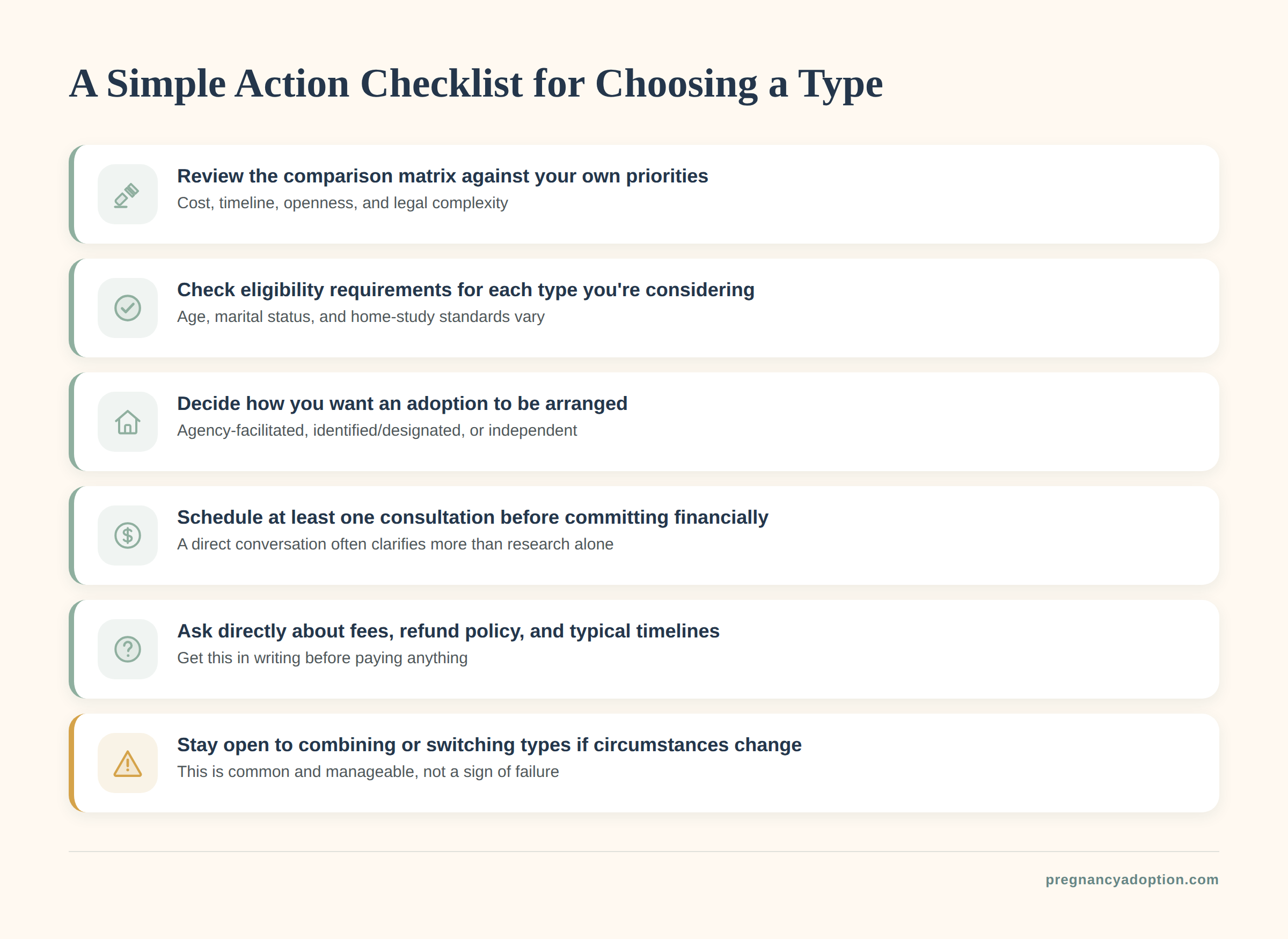
Here’s a condensed list pulling together everything above into concrete next steps.
Narrow Down First
Work Through the Decision Framework
Use the decision framework above to narrow to one or two candidate types before researching agencies.
Review the Comparison Matrix Against Your Own Priorities
Revisit Table 2 and weigh cost, timeline, openness, and complexity against what matters most to you specifically.
Then Research and Commit
Get Independent Legal Counsel Before Signing Anything
Regardless of type, have your own attorney review any agreement before committing.
Ask the Type-Specific Questions Above
Use the questions section above with any agency or attorney you’re seriously considering.
| If this describes you… | …consider this type first |
|---|---|
| Already caring for a related child | Relative/kinship adoption |
| Already raising a partner’s child | Stepparent adoption |
| Already a licensed foster parent with an ended-reunification placement | Fost-adopt |
| Seeking an infant, flexible on cost | Domestic infant adoption |
| Flexible on a child’s age, cost-constrained | Foster care adoption |
| Strong connection to a specific country | International adoption |
Glossary of Terms in This Guide
Arrangement Terms
Agency-Facilitated Adoption
An adoption in which a licensed agency manages matching, screening, counseling, and paperwork.
Identified/Designated Adoption
A hybrid arrangement in which the match happens independently, then an agency or attorney is brought in for the legal and counseling requirements.
Independent Adoption
An adoption arranged without an agency as the central coordinator, typically through an attorney.
Type Terms
Fost-Adopt (Dual Licensing)
Being approved as both a foster parent and a prospective adoptive parent simultaneously.
Hague Convention Country
A country that is party to the Hague Convention on Intercountry Adoption, following its standardized safeguards and process.
Second-Parent Adoption
A co-parent not biologically or legally related to a child adopting that child to confirm legal parentage, without terminating the other parent’s rights.
Frequently Asked Questions
Choosing a Type
Is there a “best” type of adoption overall?
No — each type creates an equally real, equally permanent family once finalized. The right type depends entirely on your circumstances, resources, and preferences, which is exactly what this guide’s comparison and decision framework are built to help with.
How long does it typically take to decide which type to pursue?
This varies enormously by person — some people know immediately because of an existing connection to a specific child, while others take weeks or months of research and reflection; there’s no required timeline for this decision.
Agency vs. Identified vs. Independent
Is identified adoption legal everywhere?
Identified adoption is legal in most states, though specific rules about how it must be structured vary — confirm with an attorney or agency in your specific state.
Can I switch from independent to agency-facilitated partway through?
In many cases, yes, particularly if an independent match falls through and you decide a more structured path fits better going forward — discuss specifics with an attorney or agency.
Cost and Financial Questions
Are there financial assistance programs specific to certain types?
Yes — foster care adoption often comes with an ongoing adoption subsidy for qualifying children, and this site’s adoption tax credit guide covers a federal benefit that can apply across multiple types.
Does domestic infant adoption always cost more than foster care adoption?
Typically, yes, by a significant margin, though individual circumstances vary — see the cost and timeline section above for the general ranges by type.
International Adoption Questions
How do I find out if a specific country’s program is currently open?
A Hague-accredited agency experienced with that specific country is the most reliable source for current program status, since this can change with little public notice.
What happens if a country program closes after I’ve started the process?
This is a genuine risk with international adoption; agencies experienced in the specific country should be able to advise on contingency options, and some families pivot to a different country or type, as covered in this guide’s switching types section.
Foster Care Questions
Do I have to foster before I can adopt from foster care?
Not necessarily — some families become licensed specifically to adopt a waiting child who is already legally free for adoption, without an ongoing foster placement first, though fost-adopt (fostering with intent to adopt) is also common.
What if a foster placement doesn’t end in adoption?
Reunification with the birth family is the primary goal of the foster care system, and many foster placements do reunify rather than end in adoption — this is worth understanding clearly before pursuing fost-adopt specifically.
Relative, Kinship, and Stepparent Questions
Do grandparents get any special consideration in adoption law?
Many states give preference to relative placements generally, and some streamline requirements specifically for grandparent or other relative adoptions — confirm current rules for your state with an attorney.
Does the other biological parent need to consent to a stepparent adoption?
Generally, yes, unless their rights have already been terminated or they’re unreachable after a legally sufficient search — this site’s birth father rights guide and adoption overview guide cover consent and termination concepts in more depth.
Combining and Switching Questions
Will pursuing two paths at once slow either one down?
Not inherently, though it does require more of your time and attention managing two processes — be upfront with each agency or attorney about your overall situation so they can plan accordingly.
Is it dishonest to pursue more than one path at once?
No, as long as you’re transparent with each professional involved — what matters is disclosure, not limiting yourself to a single path.
Eligibility and Requirements Questions
Do unmarried couples qualify for every type?
This varies by state and, for international adoption, by country — some jurisdictions and country programs restrict adoption to married couples or single individuals specifically; confirm current rules for your situation directly.
Does a past criminal record disqualify me from every type?
Not automatically — specific disqualifying offenses are generally narrower than people assume, and this site’s adoption requirements guide covers background-check standards in depth.
Timeline and Process Questions
What’s the very first step regardless of type?
Generally, choosing an agency or attorney and beginning the home study process — this site’s home study guide covers what that involves in full depth.
Does the home study process differ by type?
The core elements (background checks, interviews, home visits) are similar across types, though specific training requirements (like foster care’s MAPP/PRIDE curriculum) and additional documentation can differ — see the home study guide for full detail.
Embryo Adoption and Second-Parent Questions
Is embryo adoption legally the same as adopting a born child?
No — embryo adoption/donation is generally governed by contract and reproductive-technology law, not child-welfare adoption law, since no living child exists yet at the time of the agreement; this is a meaningful legal distinction, not just a naming preference.
Does embryo adoption require a home study?
Typically not in the same way minor-child adoption does, though some embryo donation programs have their own screening process — this varies by clinic and program.
Birth Parent Perspective Questions
Does the type of adoption affect a birth parent’s rights?
The fundamental legal protections (informed consent, revocation periods where applicable) generally apply regardless of type, though specific procedures can vary — this site’s birth mother rights guide covers this from the birth parent’s side in full depth.
Does an expectant parent choose the adoptive family the same way across types?
Primarily in domestic infant adoption; in foster care adoption, it’s typically the child’s caseworker making that determination instead, and relative or stepparent adoption doesn’t generally involve this kind of selection process at all.
Questions About Disruption and Risk
Does the risk of a placement falling through vary meaningfully by type?
Somewhat — domestic infant adoption carries the most-discussed disruption risk because many states give birth parents a legal revocation period after placement, while foster-care adoption and finalized international or identified adoptions carry comparatively lower post-placement legal-reversal risk once specific legal milestones are passed.
What exactly does “adoption disruption” mean, and when can it happen?
Disruption typically refers to an adoption process ending before legal finalization (most relevant during a revocation period or before a foster placement converts to adoption), as distinct from “dissolution,” which refers to an adoption ending after finalization — both are uncommon but worth understanding by type.
Questions About Transracial and Cross-Cultural Adoption
Does the likelihood of a transracial placement differ by adoption type?
It can — international adoption inherently involves cross-cultural and often cross-racial placement, while domestic infant and foster care adoption may or may not, depending on the specific match; this is worth discussing directly and early with your agency regardless of type.
What should prospective parents consider before pursuing a transracial or cross-cultural adoption?
Most adoption professionals recommend genuinely reflecting on your own readiness to support a child’s racial and cultural identity actively (not just acceptingly), including building real relationships and connections to that child’s community of origin, rather than treating it as a secondary consideration.
Questions About Birth Certificates and Legal Identity
Does an adopted child get a new birth certificate, and does this differ by type?
In most U.S. states, finalization results in an amended birth certificate listing the adoptive parents as legal parents, regardless of type; for international adoptions, the process and exact document (sometimes a certificate of citizenship or a re-issued U.S. birth certificate after readoption) can work somewhat differently depending on the child’s country of origin and citizenship pathway.
Is the original birth certificate sealed in every type of adoption?
Historically yes in most states, though a growing number of states now allow adult adoptees to request their original birth certificate — policies vary significantly by state and have been changing in recent years, so confirm your specific state’s current rules.
Questions About Adoption Tax Credit and Benefits by Type
Does the federal adoption tax credit apply equally across every type?
The federal adoption tax credit generally applies to domestic and international adoption of a non-special-needs child based on qualified expenses, while adoption of a child with special needs (common in foster care adoption) can qualify for the full credit amount regardless of actual expenses paid — this site’s adoption tax credit guide covers the current-year details.
Is stepparent adoption eligible for the federal adoption tax credit?
No — adopting your spouse’s child (stepparent adoption) is specifically excluded from federal adoption tax credit eligibility, which is an important distinction from the other types covered in this guide.
Questions About Adoption Records and Confidentiality
How confidential are adoption records across different types?
Confidentiality protections generally apply across all types but with meaningful variation by state and by the specific openness arrangement in place — open adoptions involve intentionally shared information by design, while closed and some international adoptions involve stricter sealing of identifying records.
Can I access my own adoption file as an adoptive parent later in the process?
Adoptive parents typically have access to non-identifying background information shared during the matching and placement process, though full case files held by agencies or courts may have more limited access depending on state law.
Questions About Adoption and Immigration Status
Does the prospective adoptive parent’s immigration status affect eligibility by type?
Most domestic adoption processes require at least one prospective parent to be a U.S. citizen or lawful permanent resident, and international adoption has its own specific immigration-status requirements under U.S. law — confirm current requirements with your agency or an immigration attorney.
How does a child’s immigration status get resolved in international adoption specifically?
Children adopted internationally through the proper legal process generally become eligible for U.S. citizenship, often automatically under the Child Citizenship Act once specific conditions are met, though the exact pathway and required additional steps depend on the child’s age, country, and visa category — an immigration attorney experienced in international adoption can confirm the specific pathway.
Questions About Adoption After Infertility or Loss
Does having experienced infertility or pregnancy loss affect which adoption type is recommended?
Not directly from an eligibility standpoint, but many adoption professionals recommend taking time to process grief from infertility or loss before actively pursuing any adoption type, since unresolved grief can shape expectations and readiness in ways worth addressing first.
Will an agency or home study ask about my fertility history?
It’s common for an agency or home study to ask about this as part of understanding your overall readiness and motivations, not as a disqualifying factor, but as part of a holistic picture of your family-building journey.
Questions About Adoption Counseling and Mental Health Support
Is counseling required as part of the adoption process, and does this vary by type?
Many agencies require or strongly recommend counseling for birth parents considering domestic infant adoption as part of ensuring informed, uncoerced consent, while requirements for adoptive parents vary more by agency than by type specifically.
Should adoptive parents seek counseling even if it’s not required?
Many adoption professionals recommend it, particularly for families navigating infertility, loss, or a particularly complex placement, since processing these experiences with professional support often strengthens a family’s readiness rather than signaling a problem.
