
“Closed adoption” gets used loosely — sometimes to mean “the old-fashioned way,” sometimes as a synonym for “no relationship at all,” and sometimes as a vague worry that records are locked away forever with no way back in. The actual legal and practical meaning is narrower and more specific than any of that: a closed adoption is one in which no identifying information is exchanged between the birth parent(s) and the adoptive family, and there is no direct contact before or after placement. Everything else — how rare it is today, what happens to the paperwork, whether an adult adoptee can ever find out who they are, whether a birth parent can ever be found — depends on specifics this guide walks through one at a time.
This guide is written for three different readers who land on this page for three different reasons, and we’ve tried to serve all three without making any of them wade through content meant for someone else. If you’re an expectant or birth parent weighing how much openness you want in a potential adoption plan, this page explains what “closed” actually commits you to and what it doesn’t. If you’re an adoptive parent or prospective adoptive parent in a closed or semi-open arrangement, it explains what you can and can’t control, including what happens if someone reaches out later. If you’re an adult adoptee — or a birth parent — from a closed adoption decades ago trying to understand sealed records, state registries, or what a DNA test might turn up, the second half of this guide is built specifically around that search. This is the direct companion to our open adoption guide, and the two are meant to be read as a pair — whichever one you landed on first, the other fills in the side you didn’t start with.
The Child Welfare Information Gateway maintains a state-by-state summary of adoption records access and search-and-reunion laws. The National Council For Adoption also tracks state-level reform efforts on this topic.
Key takeaways
- “Closed” has a specific meaning: no identifying information, no contact. It is not the same as “the adoptive family doesn’t know much” or “there’s an awkward relationship” — those are semi-open arrangements, covered in depth in our open adoption guide.
- Closed adoption is now the exception, not the rule. Research on domestic infant adoption has found the large majority of placements now involve some openness; fully closed arrangements are a minority of current adoptions, though they still happen and remain legal everywhere in the U.S.
- “Sealed” doesn’t mean “destroyed” or “inaccessible to everyone.” A sealed adoption record still exists; what varies — dramatically, by state and by the era of the adoption — is who is legally allowed to see it and under what process.
- Consumer DNA testing has changed what “closed” can realistically guarantee. Promises of permanent anonymity made decades ago were made before databases like AncestryDNA and 23andMe existed at scale, and that changes the practical picture for anyone involved in an older closed adoption.
- If you’re choosing an openness level now, you’re not choosing between only two options. Semi-open sits between closed and open as a genuine middle path, and our guide for expectant parents considering adoption covers the full spectrum from the decision-making side.
The Short Answer: What “Closed” Actually Means
Before the history, the law, and the search mechanics, it’s worth pinning down exactly what the term refers to — because most of the confusion around closed adoption comes from people using it to describe things it doesn’t technically mean.
What Closed Adoption Actually Refers To
A closed adoption has two defining features, and both have to be true for the term to apply correctly.
No identifying information is exchanged
The birth parent(s) and the adoptive family don’t know each other’s names, addresses, or other details that would let either side locate the other. Agencies and attorneys typically still collect this information for legal and medical purposes, but they don’t share it between the parties. This is the feature that most sharply distinguishes closed adoption from semi-open adoption, where identifying information may be known even if direct contact is limited.
There is no contact before or after placement
No meetings, no letters, no photos, no updates — not at the time of placement and not afterward, unless and until someone later pursues a formal search-and-reunion process as an adult. This is different from an open or semi-open arrangement that simply tapers off over time; a closed adoption is structured from the outset to have no ongoing channel at all.
What It Does Not Mean
Several things people often associate with “closed adoption” aren’t actually part of the definition, and conflating them causes real confusion when expectant parents are choosing an openness level.
It doesn’t mean illegal, unethical, or outdated
Closed adoption is legal in every U.S. state and remains an option any adoption agency or attorney can facilitate if that’s what the parties involved choose. It’s less common than it used to be, but “less common” isn’t the same as “prohibited” or “improper.”
It doesn’t mean the adoptive family knows nothing about the child’s background
Nonidentifying background information — medical history, general circumstances of the adoption, sometimes physical descriptions — is typically still collected and shared with the adoptive family, even in a fully closed arrangement. What’s withheld is the information that would let one party find the other, not all information whatsoever. The records section below covers exactly where that line falls.
If you came to this page from a search about general adoption types, you may actually be looking for the broader landscape first. Our guide to how adoption works and our step-by-step adoption process guide cover home studies, matching, and finalization mechanics that apply regardless of openness level — this page assumes you already have that general context and focuses specifically on the closed end of the spectrum.
Who Chooses — and Who Doesn’t Choose — This Page
Three different situations bring people to a page about closed adoption, and it’s worth being clear about which one is yours before you read further.
You’re deciding what openness level you want
If you’re an expectant parent and haven’t placed yet, nothing here commits you to anything. Our guide for expectant parents considering adoption walks through the decision from the start; this page goes deeper specifically on what the closed end of that spectrum involves.
You’re already in a closed arrangement from years or decades ago
If you placed a child, or were placed, under a closed arrangement — especially one from the 1950s through the 1980s, when closed adoption was closer to the default — the sections on sealed records and search and reunion are built for you.
You’re an adoptive parent navigating a closed or semi-open placement
A dedicated section below covers what you can and can’t control, and what tends to happen if a birth parent or an adult child later wants contact. Our broader guide to adopting a child covers the adoptive-parent side of the process generally.
| Feature | Closed | Semi-open | Open |
|---|---|---|---|
| Identifying information shared | No | Sometimes partial (first names only, for example) | Yes, generally |
| Direct contact at placement | No | Sometimes a single meeting | Usually yes |
| Ongoing contact after placement | None | Managed through an agency or intermediary (letters, photos) | Direct, by whatever means the parties agree to |
| How it’s typically arranged | Agency/attorney default or explicit choice by one or both parties | Negotiated as a specific middle-ground preference | Negotiated and often documented in a contact agreement |
| How common today | Minority of domestic infant placements | Significant share of placements | Majority of domestic infant placements |
| Can it change later? | Only through formal search/reunion processes as an adult | Can shift toward more or less contact by mutual agreement | Can shift toward more or less contact by mutual agreement |
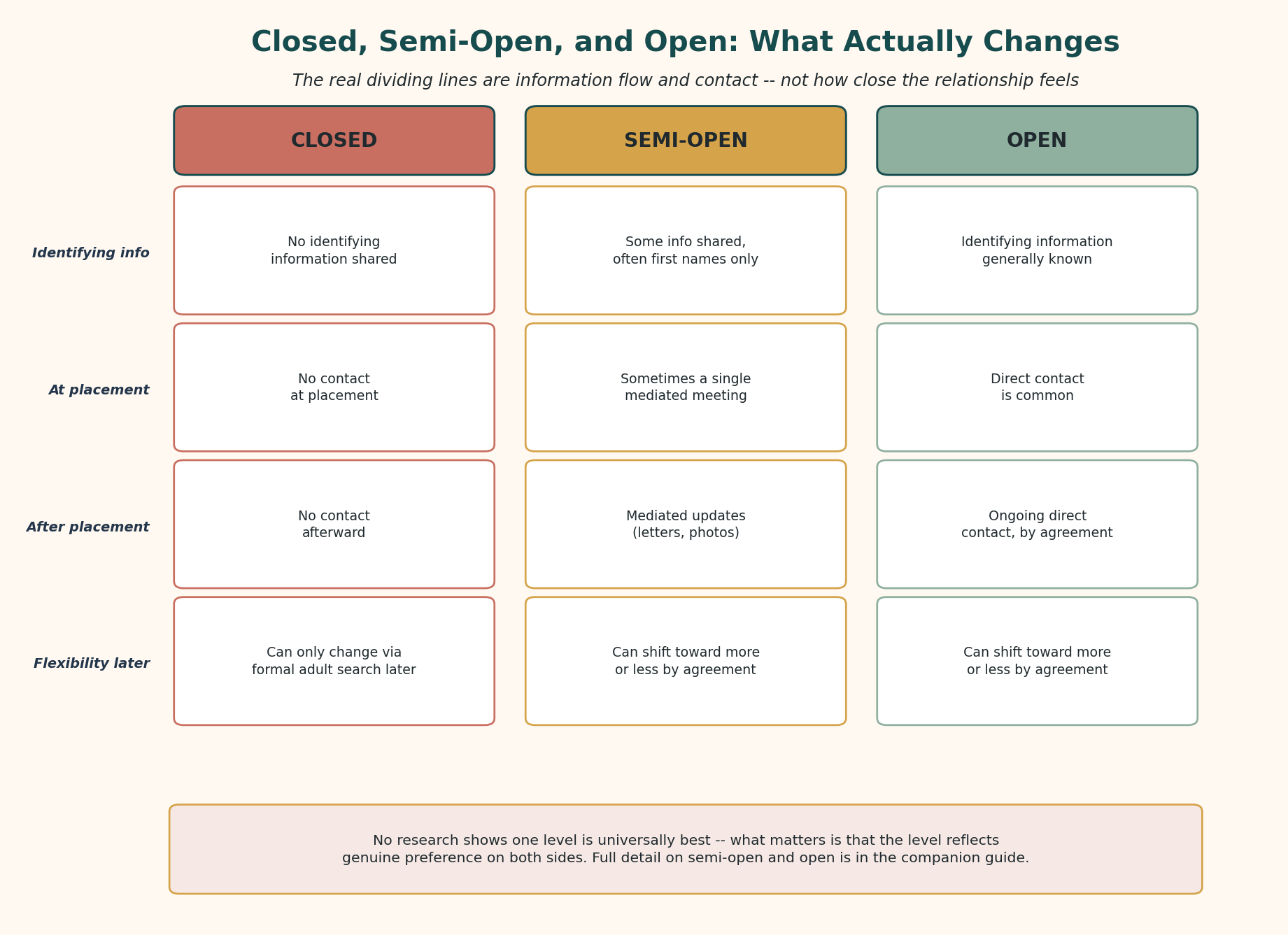
Notice that this table is organized around information flow and contact mechanics, not around the emotional experience of each arrangement. Our open adoption guide covers what day-to-day life inside an open arrangement actually looks like, how contact agreements get negotiated, and how relationships evolve over years — that’s genuinely its own subject, and worth reading in full if you’re building toward an open or semi-open placement rather than researching the closed end specifically.
Closed Adoption vs. Open and Semi-Open: The Real Differences
“Open adoption” and “closed adoption” are often presented as two opposite poles, but the more useful way to think about it is as a spectrum with a specific middle position — semi-open — that a large share of actual adoptions land on. This section draws the lines clearly, then hands off the deep “how semi-open and open arrangements actually work” content to the companion guide, since that’s genuinely a different subject from what closed adoption is and isn’t.
What Changes Operationally Between the Three
The practical differences come down to two mechanics: what information moves between the parties, and whether any channel for contact exists.
Identifying information: the core variable
This is the single clearest dividing line. In a closed adoption, neither party has the other’s legal name, address, or other details sufficient to locate them. In semi-open and open arrangements, some or all of that information is known — sometimes limited to first names and a general region, sometimes full contact details, depending on what the parties agree to.
Contact agreements: the mechanism, not the definition
A written post-adoption contact agreement — sometimes called a PACA — is the tool many open and semi-open arrangements use to specify what contact will happen, how often, and through what channel. Closed adoptions don’t use one, because there’s no contact to specify. If you want to understand how these agreements are drafted, what makes them enforceable, and what happens when one side wants to change the terms, our open adoption guide covers that in depth — it’s the more useful page for that specific question, since building and maintaining a contact agreement is a different task from understanding what closed adoption forecloses.
Where Semi-Open Fits as a Genuine Middle Path
Semi-open adoption isn’t a watered-down version of open adoption or a slightly-less-closed version of closed adoption — it’s its own distinct, commonly chosen arrangement, and it’s worth understanding on its own terms even in a guide centered on the closed end of the spectrum.
What semi-open typically looks like
Most semi-open arrangements route contact through an intermediary — an agency, attorney, or dedicated letterbox service — rather than directly between the parties. A birth parent might receive photos and a letter once or twice a year without ever learning the adoptive family’s last name or address, and vice versa. The exact mix varies enormously by agreement; some semi-open arrangements are close to open with only the identifying-information layer withheld, and others are closer to closed with only an occasional, mediated update. Our open adoption guide walks through the range of what these mediated arrangements commonly include and how they’re set up.
Why some families land here instead of fully closed or fully open
Semi-open gives both sides some of what they want from openness — updates, reassurance, a sense of the child’s wellbeing — without the identifying-information exchange that either party might not be ready for, particularly early on. It’s common for families to start semi-open and later move toward more direct openness as trust builds, though the reverse (starting open and later preferring less contact) also happens and is equally normal.
Key takeaways
- The dividing line is information and contact, not emotional closeness. A closed adoption withholds identifying information and direct contact entirely; semi-open withholds some of each while allowing mediated updates; open allows both, managed however the parties agree.
- Semi-open is a real, common choice — not a compromise nobody actually wants. Many families deliberately choose it as the arrangement that fits them best, not as a fallback from open or a step up from closed.
- The deep mechanics of contact agreements live in a separate guide. If you’re building or maintaining an open or semi-open relationship, our open adoption guide is the more detailed resource for that specific task.
Why Closed Adoption Was the Default for Decades
Understanding why closed adoption used to be standard practice helps explain both why sealed-record laws exist today and why so many adult adoptees and birth parents from that era are now navigating a system that wasn’t built with search in mind.
The Era of Sealed Records
Closed adoption, with records sealed from everyone involved, became the dominant U.S. practice for most of the 20th century, peaking in the decades following World War II — a period often referred to informally as the Baby Scoop Era.
How sealed-record laws spread
Minnesota is widely credited as the first U.S. state to pass a law sealing adoption records, in 1917, and most other states adopted similar sealed-record statutes over the following decades. By the mid-20th century, sealing the original birth certificate and the court adoption file had become near-universal practice.
The stated rationale, and what it actually did
The rationale offered at the time centered on protecting all three parties: shielding the adoptive family and child from a birth parent’s involvement, protecting the adoptee from a sense of stigma, and allowing a birth parent — often an unmarried woman facing significant social pressure — to move forward without the pregnancy following her. In practice, the laws were sometimes interpreted even more broadly than first intended, eventually sealing records not just from the public but from the adoptee and birth parent themselves, the very people the system had originally allowed access to as “parties to the action.”
Why the Model Shifted Starting in the 1970s and 1980s
Closed adoption didn’t disappear, but it stopped being the automatic default starting roughly in the final decades of the 20th century, for reasons that were as much about adoptee advocacy as agency practice.
The adoptee and birth-parent rights movement
Adult adoptees who had grown up under sealed records began organizing to push for access to their own original birth certificates and background information, arguing that a legal record of someone’s own birth and origins shouldn’t be permanently inaccessible to them. Birth parents who had placed children, often under significant pressure, similarly began advocating for the ability to know what had become of a child they’d placed decades earlier.
Changing agency and professional practice
Independent of the legal picture, adoption agencies gradually shifted their default recommendations toward some degree of openness, based on accumulating practice experience suggesting that ongoing information — and often ongoing contact — tended to serve expectant parents, adoptive families, and children better than total secrecy. By the time more recent research captured a snapshot of the field, the shift was dramatic: one widely cited study of domestic infant adoption found that fully closed placements had fallen to roughly 5% of cases, with the remainder split between fully open arrangements (roughly 55%) and mediated, semi-open arrangements (roughly 40%)
For the fuller picture of why most expectant parents today are offered — and choose — more openness than their counterparts a generation ago, our guide to considering adoption covers how that choice actually gets made during the matching process.
Why Some Adoptions Are Still Closed Today
Given how much the overall picture has shifted toward openness, it’s worth asking directly: why does closed adoption still happen at all? The honest answer is that it’s genuinely uncommon but not obsolete, and the reasons it still occurs fall into a few recognizable categories.
Reasons Tied to a Birth Parent’s Circumstances
Some closed arrangements reflect a birth parent’s own considered preference, not a default imposed on them.
A genuine, informed preference for privacy
Some birth parents decide, after thinking it through, that they want to move forward without ongoing contact or shared information — not out of pressure, but because that’s what actually feels right for their own healing and their own life circumstances. A professional’s job is to present this as one real option among several, not to steer a birth parent toward or away from it.
Safety concerns
In situations involving domestic violence, a controlling or dangerous partner, a stalking risk, or other safety concerns, withholding identifying information can be a protective measure rather than a preference about relationship style. An agency or attorney handling a situation like this should be explicitly told about the safety concern so that it factors into how the placement is structured.
Reasons Tied to the Situation Itself
Other closed arrangements happen not because either party chose “closed” as a style, but because the circumstances don’t support anything else.
A birth parent who can’t be located or identified
In cases involving an unknown or unreachable birth father, or a birth mother who has disappeared from contact during the process, an adoption can proceed as closed by necessity rather than by anyone’s preference. Our guide to birth father rights and our guide to birth mother rights cover the notice and consent requirements that apply in these harder-to-locate situations.
Certain international and foster-care-to-adoption situations
Some international adoptions involve biological parents who are unknown, deceased, or legally unreachable under the laws of the country of origin, making a closed arrangement the only realistic structure. Some adoptions out of the foster care system similarly involve a biological parent who is absent, unreachable, or whose parental rights were terminated under circumstances that make future contact inappropriate or unsafe for the child. These situations are different in kind from a domestic infant placement where openness was a live option that someone affirmatively declined.
Key takeaways
- Closed adoption today is usually either a considered choice or a practical necessity — rarely a default. That’s a real shift from decades past, when it often was the unquestioned standard.
- Safety is a legitimate, serious reason to choose closed. If domestic violence, stalking, or another safety concern is part of your situation, say so directly to whoever is handling your case so it shapes how the placement is structured.
- Not being able to locate a birth parent is different from a birth parent declining contact. Both can result in a closed adoption, but the legal notice requirements involved differ — see birth father rights and birth mother rights for that detail.
Sealed Records: What’s Actually Sealed and Why
“Sealed records” is one of the most misunderstood phrases in adoption. It doesn’t mean the information disappears, and it doesn’t mean absolutely nothing is available to anyone. It means access is legally restricted — and exactly how restricted depends heavily on where the adoption was finalized.
What Gets Sealed at Finalization
When an adoption is finalized in court, two specific sets of documents are typically placed under seal.
The original birth certificate (OBC)
Every adopted person has an original birth certificate listing their birth parent(s), created at the time of birth like anyone else’s. Once an adoption is finalized, most states issue a new, amended birth certificate listing the adoptive parents as the legal parents, and the original is sealed in state vital records — not destroyed, but placed in a restricted-access file. Our guide to how adoption works covers the finalization process itself, including when this certificate substitution happens.
The court adoption file
The underlying legal file — the petition, any consent documents, the home study, and the court’s final decree — is separately sealed as part of the court record. In most states, this file requires a specific legal process to unseal, generally distinct from the process for requesting the original birth certificate.
What “Sealed” Does and Doesn’t Mean in Practice
“Sealed” is often read as “permanently and completely inaccessible,” which overstates what actually happens.
Nonidentifying information usually remains available
Even when identifying details are sealed, most states and agencies will release nonidentifying background information on request — things like approximate birth parent age at placement, general medical and family health history, physical description, education level, and the stated circumstances of the adoption. This is a meaningfully different category from identifying information, and it’s worth specifically asking for if you’re an adoptee or adoptive parent who hasn’t already received it.
Sealing restricts access; it doesn’t erase the record
A sealed file still physically or digitally exists in a state vital records office or court archive. What changes is who can request it and how — not whether it continues to exist. This distinction matters directly for the state-by-state variation covered in the next section, since the mechanisms for getting past a seal are themselves state-specific legal processes rather than a single uniform rule.
| Category | Typically includes | Typically available to |
|---|---|---|
| Nonidentifying information | Approximate age at placement, general physical description, education, occupation, medical and family health history, reason for placement (in general terms) | Adoptive parents and adult adoptees in most states, often on simple request to the agency or state registry |
| Identifying information | Current or former legal name, date of birth, last known address, employer, other details sufficient to locate the person | Varies dramatically by state — see the access models below; often requires mutual consent, a confidential intermediary, or a court order |
| The original birth certificate specifically | Birth parent name(s) as recorded at birth | Treated as identifying information in most states, with its own specific access process separate from the general court file |

How Record Access Actually Varies by State
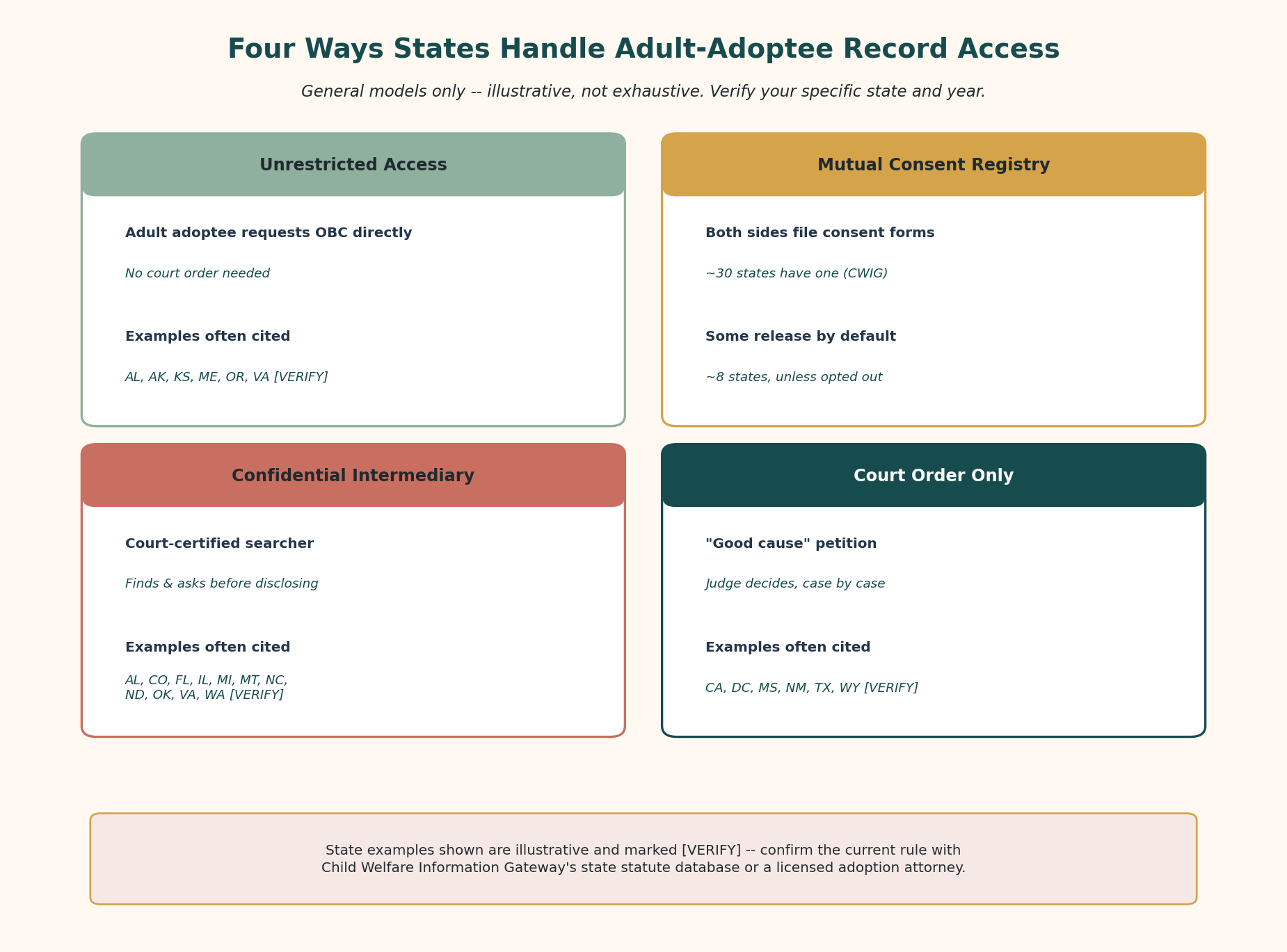
This is the section where state-by-state variation matters most, and also the section where the most caution is warranted. Adoption records law is set at the state level, is tied to the state where the adoption was finalized (not where anyone currently lives), and has changed significantly — in both directions — even within the last decade. Nothing below should be read as a complete or current 50-state reference; treat it as an orientation to the general models in use, and verify any state’s specific current rule before relying on it.
The General Access Models in Use
Rather than fifty different individual systems, most states’ approaches fall into a handful of recognizable models.
Unrestricted adult-adoptee access
A growing group of states allow an adult adoptee to request their own original birth certificate directly from the state, without a court order and without a birth-parent veto that could block release. States consistently identified as falling into this category include Alabama, Alaska, Kansas, Maine, Oregon, and Virginia, among others
Mutual consent registries
Roughly 30 states maintain a mutual consent registry — a state-run system where an adult adoptee, a birth parent, and sometimes an adoptive parent can each independently file a form indicating whether they’re willing to have identifying information released. If both sides consent, identifying information is shared; if only one side files, nothing is released, except in a subset of states (roughly eight) that release information by default unless someone has specifically filed a form declining.
Confidential intermediary programs
A number of states authorize a court-certified confidential intermediary — an individual with legal access to otherwise-sealed records — to locate a birth parent or other biological relative on an adoptee’s behalf and ask whether they’re willing to be contacted, without disclosing anyone’s identity until consent is confirmed on both sides. States that have historically operated confidential intermediary programs include Alabama, Colorado, Florida, Illinois, Michigan, Montana, North Carolina, North Dakota, Oklahoma, Virginia, and Washington, per Child Welfare Information Gateway’s summary materials
Court-order-only access
A smaller group of states provide no administrative path at all — the only way to unseal a record is a court petition, typically requiring the petitioner to show “good cause,” a standard that varies by judge and jurisdiction and often requires an attorney to pursue effectively. States frequently identified in this category include California, the District of Columbia, Mississippi, New Mexico, North Carolina, North Dakota, Texas, West Virginia, and Wyoming
Why This Is Genuinely Hard to Summarize Reliably
If the lists above feel hedged, that’s intentional — this is one of the most legitimately state-variable areas in all of adoption law, for reasons worth understanding rather than just accepting.
The law follows the state of birth, not current residence
An adoptee born in one state and now living in another is governed by the birth state’s record-access law, not the law where they currently live. Someone researching their own situation needs to look up the specific state where they were born and the adoption was finalized — not their home state’s general reputation on the issue.
Laws change — sometimes significantly — within just a few years
Several states have moved from restricted to unrestricted access, or added a registry or intermediary program, within the past decade, and some have specific rules that depend on exactly when the adoption was finalized (so two adoptees born in the same state a few years apart can be governed by different rules). Because of this, the single most reliable step is to consult Child Welfare Information Gateway’s state-by-state statute database directly for the current rule, or to speak with a licensed adoption attorney in the relevant state, rather than relying on any single article — including this one — for a specific current answer.
| Model | How it works | What it generally requires |
|---|---|---|
| Unrestricted access | Adult adoptee requests their own OBC directly from the state | Proof of identity and age; no court order or consent form |
| Mutual consent registry | Both sides file a form indicating willingness to be identified | Both parties (or, in some states, just one, depending on the state) actively registering |
| Confidential intermediary | A court-certified intermediary searches sealed records and asks about contact without revealing identity first | A court petition appointing the intermediary; usually a fee |
| Court order only | A judge decides whether to unseal records case by case | A “good cause” petition, typically with an attorney’s help |
How Adult Adoptees and Birth Parents Can Search Today
If you’re an adult adoptee or a birth parent from a closed adoption and you’re ready to look for the other person, there are more realistic paths available today than there were even one generation ago — both formal, state-sanctioned processes and informal paths that exist entirely outside the legal records system.
Formal, State-Sanctioned Paths
These are the mechanisms described in the previous section, from the search side rather than the policy side.
Filing with your state’s mutual consent registry
If your state (or the state where the adoption was finalized) has one, filing is usually inexpensive and doesn’t require an attorney — but it only works if the other party also files, so it can mean waiting indefinitely with no way to know whether the other person has heard about the registry or decided to use it.
Petitioning for a confidential intermediary
Where available, this path lets someone else do the actual searching and the first, careful contact, which many people prefer precisely because it avoids an unannounced, potentially unwelcome direct approach. It typically involves a court petition and a fee, and waiting time depends heavily on the specific court and intermediary’s caseload.
Petitioning the court directly for good cause
In states without a registry or intermediary option, or when those paths don’t apply to your specific situation, a direct court petition — generally with an attorney’s help — remains the formal legal route, though success depends heavily on the specific judge and the strength of the stated reason, commonly a documented medical need or a comparably serious circumstance.
Independent Paths Outside the State Records System
Separately from any state mechanism, several tools exist that don’t depend on anyone’s sealed court file at all.
Reunion registries like the International Soundex Reunion Registry (ISRR)
The ISRR is a free, nonprofit mutual-consent reunion registry, founded in 1975, that lets anyone separated by adoption — or by foster care, divorce, or other circumstances — register in hopes of matching with someone searching for them from the other side. It’s independent of any state system, so it’s worth using in addition to, not instead of, whatever state-level registry or process applies to your situation.
Consumer DNA testing
Uploading a DNA sample to a service like AncestryDNA or 23andMe searches against a database of millions of other users for genetic matches — close enough, in many cases, to identify a biological parent or close relative directly, entirely independent of sealed court records. The next section covers this in more depth, since it’s reshaped the whole landscape in ways worth understanding on their own.
Search angels and professional searchers
Volunteer “search angels” and paid professional genealogists specialize in using public records, genetic matches, and other open-source research techniques to help adoptees and birth parents locate each other, often working alongside — not instead of — the formal legal mechanisms. Vetting matters here: look for searchers with a track record and clear references, since this niche attracts both genuinely skilled volunteers and less reliable operators.
| Path | Typical cost | Best suited for |
|---|---|---|
| State mutual consent registry | Low or no cost | Starting point in any state that offers one; works best alongside other methods |
| Confidential intermediary | Court filing fee plus intermediary fee, where available | Preferring a cautious, mediated first contact rather than a direct approach |
| Court petition (good cause) | Attorney and court costs | States without a registry or intermediary option, or specific cases those paths don’t cover |
| ISRR and similar reunion registries | Free | A no-cost first step, used alongside formal state processes |
| Consumer DNA testing | Cost of a testing kit (one-time) | Many modern searches, especially when identifying information was never recorded or the other party is unreachable through records alone |
| Search angels / professional searchers | Free (volunteer) to a paid professional fee | Complex searches needing public-records and genealogy expertise |

Key takeaways
- You usually don’t have to pick just one method. Filing with a state registry, registering with the ISRR, and taking a DNA test are not mutually exclusive, and combining them improves the odds of a match.
- Mediated paths exist for a reason. A confidential intermediary or a registry’s mutual-consent design exists specifically so no one is contacted out of nowhere without some signal they’re open to it — worth considering even if a direct approach feels tempting.
- DNA testing works independently of any court record. It doesn’t require your state’s records to be unsealed at all, which is both its biggest advantage and the reason it’s reshaped the whole landscape, covered next.
The DNA Testing Wrinkle: Why “Closed” Isn’t Always Closed Anymore
Every structure described so far — sealed records, registries, intermediaries — assumes the records system is the only path to identity. Consumer DNA testing has broken that assumption, and it’s worth understanding both how and what it means if you’re connected to an older closed adoption.
How Consumer DNA Databases Changed the Math
Direct-to-consumer genetic testing didn’t just add one more search option — it changed the underlying probability of any search succeeding at all.
Why even a distant match can unravel anonymity
Major DNA testing databases now hold genetic profiles from tens of millions of people. At that scale, genetic genealogists have noted that nearly anyone who tests can expect to match with at least a cousin somewhere in the database — distant relationships are often enough, combined with basic genealogical research, to work backward to a specific birth parent or sibling, even without that specific person ever having tested themselves.
What this means if confidentiality was promised decades ago
Many closed adoptions from past decades were arranged with an explicit promise — sometimes even a stated legal expectation at the time — that identities would remain permanently unknown to each other. That promise was made before this technology existed, and it can no longer be guaranteed in practice regardless of what any sealed-record law says, because a biological relative’s own decision to test is outside anyone else’s control.
What to Know Before You Test — Or Before Someone Else Might
Whether you’re actively searching or simply trying to understand your own exposure, a few practical realities are worth sitting with before taking a test or receiving an unexpected message.
You can’t control whether a biological relative decides to test
Even someone who has no interest in testing themselves can be found this way, because a sibling, cousin, or other relative’s independent decision to test can surface a connection neither of them was looking for. This is true for birth parents who assumed anonymity just as much as for adoptees who’ve never actively searched.
The emotional preparation matters as much as the technical step
A DNA match can arrive with no warning — a message from a stranger claiming to be a half-sibling, or a “close family” match notification with no name attached yet. Many adoption-support organizations recommend thinking through, in advance, how you’d want to respond to an unexpected match before you take a test, precisely because the technical result can land faster than the emotional readiness to receive it.
If you’re an adoptive parent whose family’s adoption was structured as closed, this same dynamic applies to your child, now or eventually — the next section covers how to think about that ahead of time rather than being caught off guard by it.
Key takeaways
- DNA testing operates completely outside the sealed-records system. No state law, registry, or court seal has any effect on a private genetic testing company’s database.
- A match can come from someone else’s decision, not your own. A relative you’ve never met testing on their own can surface a connection you weren’t actively pursuing.
- This cuts both ways for birth parents and adoptees. Anyone connected to a closed adoption from any era should assume that a promise of permanent anonymity is no longer something anyone can fully guarantee.
What Closed Adoption Means for Adoptive Parents
If you’re an adoptive parent — or hoping to be one — in a closed or more limited semi-open arrangement, a few things are worth understanding clearly about what you do and don’t control, both now and as your child grows up.
What You Can and Can’t Control
A closed or semi-open arrangement isn’t entirely fixed, but it isn’t entirely under your control either.
You generally can’t unilaterally “reopen” a closed arrangement
If a birth parent chose closed adoption and hasn’t indicated otherwise, you generally can’t initiate contact on their behalf without consent, even with good intentions — doing so can be a significant, unwelcome intrusion precisely because the birth parent chose this arrangement for reasons of their own. If you’d like more openness than was originally arranged, the respectful path runs through whatever formal channel exists (an agency, a registry, a confidential intermediary) rather than an independent approach.
What happens if a birth parent or your child’s adult sibling reaches out later
It’s increasingly common, given the search tools covered above, for a birth parent or a biological relative to reach out years or decades after a closed placement. There’s no single “correct” response — it depends on your family, your child’s age and wishes if they’re old enough to have them, and your own readiness — but having thought about the possibility in advance tends to make the actual moment easier to navigate than being caught entirely by surprise.
Talking With Your Child About a Closed Adoption
Age-appropriate honesty about adoption generally serves children better than either secrecy or oversharing, and that’s true whether or not any contact exists.
Honesty doesn’t require contact to exist
You can tell your child the honest, age-appropriate truth about their adoption being closed — including that you don’t have identifying information to share — without that being a withholding or painful admission. What tends to matter most to children as they grow is that the subject isn’t treated as taboo, not that more information exists than actually does.
Preparing for the DNA-testing era specifically
Given everything covered in the previous section, it’s worth having an honest conversation with your child, especially as they near adulthood, about the realistic possibility that a DNA test — their own or a relative’s — could surface information or contact that wasn’t available through the records system. Framing this ahead of time as a normal possibility, rather than something to be anxious about, tends to make it easier to handle if and when it happens.
Our broader guide to adopting a child covers the adoptive-parent experience across the full process, including how openness level gets discussed and chosen during matching — this section intentionally stays narrow to the specific closed-adoption questions that guide doesn’t cover at this depth.
Weighing Closed Adoption Against the Alternatives
Whether you’re choosing an openness level now or already living inside a closed arrangement and wondering what else is possible, it helps to see the realistic alternatives laid out plainly rather than as a binary choice.
If You’re an Expectant Parent Still Choosing
If you haven’t placed yet, you have more room to shape this than you might think.
Semi-open as a genuine middle ground
If full openness feels like too much too soon, but full closure feels too final, semi-open is a real third option, not a consolation prize — many expectant and birth parents land there deliberately and are glad they did. Our open adoption guide covers what that arrangement typically involves and how it gets set up.
You’re generally not locked into your initial choice forever
Whether and how an openness level can shift later depends heavily on your specific agreement, your state’s law on the enforceability of post-adoption contact agreements, and simply what both sides want as time passes — none of which this page builds out in detail, since it’s genuinely a separate subject. Our open adoption guide covers how contact agreements work and what flexibility typically exists within them, and our adoption process guide covers the general timeline during which these decisions get formalized.
If You’re Already in a Closed Arrangement and Want More
If you’re past the placement stage and the arrangement is already closed, the realistic paths forward are narrower, but they exist.
What’s realistically possible at this point
Once both parties are adults — which may mean waiting years if the adoptee was a minor at the time you’re asking — the formal search mechanisms covered earlier in this guide become available: registries, confidential intermediaries, court petitions, and informal paths like DNA testing and reunion registries. There’s no guaranteed path to turning a closed adoption into an open one on demand; it depends on both sides being willing.
Where to get help navigating this specifically
A licensed adoption attorney in the state where the adoption was finalized, the state’s vital records or adoption registry office, or a reputable post-adoption search-and-support organization are the most reliable starting points for figuring out what’s actually available in your specific situation — far more reliable than any general guide, including this one, since the rules genuinely depend on your state and the exact year of finalization.
The bottom line
Closed adoption means no identifying information and no contact — a specific, legal, and still-available arrangement, not a synonym for “the old way things were done” or a permanent dead end. It’s a genuine minority choice today rather than a default, chosen for real reasons including privacy and safety, or arrived at by necessity when a birth parent can’t be located. What’s sealed is restricted, not erased, and how restricted it stays depends enormously on the state where the adoption happened and when. Formal search mechanisms — registries, confidential intermediaries, court petitions — exist in many states, and informal ones — reunion registries, DNA testing, search angels — exist everywhere, increasingly making old promises of permanent anonymity unreliable regardless of what any sealed record says. If you’re choosing an openness level now rather than looking backward at an old one, semi-open is a real middle path worth taking seriously, and our open adoption guide is the place to understand what that — and full openness — actually involve day to day.
Glossary of Closed Adoption and Records Terms
A quick reference for terms that come up throughout this guide and in conversations with agencies, attorneys, or state records offices.
Records and Access Terms
Original birth certificate (OBC)
The birth certificate created at the time of birth, listing the birth parent(s); sealed in most states once an adoption is finalized and replaced with an amended certificate listing the adoptive parents.
Sealed record
A court or vital-records file whose access is legally restricted — not destroyed or erased, but accessible only through whatever process the relevant state allows.
Identifying information
Any detail — a name, address, employer, or similar record — sufficient to locate a specific person; the category of information withheld in a closed adoption and the category most states restrict most heavily.
Nonidentifying information
Background detail — medical history, general circumstances, age, physical description — that doesn’t by itself reveal anyone’s identity; typically available on request even when identifying information is sealed.
Good cause petition
A court filing asking a judge to unseal a specific adoption record, generally requiring the petitioner to show a substantial, documented reason such as a medical need.
Search and Reunion Terms
Mutual consent registry
A state-run system letting an adult adoptee and a birth parent each independently file a form indicating willingness to be identified to the other; identifying information is released only when both sides have filed.
Confidential intermediary
A court-certified individual authorized to access otherwise-sealed records to locate a birth parent or other biological relative and ask about willingness to be contacted, without disclosing identity until consent is confirmed.
Disclosure veto / contact preference form
A mechanism in some states letting a birth parent either block release of identifying information (a veto) or simply state a preference about contact without blocking the adoptee’s own access to their birth certificate (a contact preference form) — the two function very differently, and which one a given state uses matters a great deal.
Search angel
A volunteer, typically experienced in genealogy and public-records research, who helps adoptees and birth parents search for each other, often without charge.
Post-adoption contact agreement (PACA)
A written agreement specifying the type and frequency of contact in an open or semi-open adoption; not used in closed adoptions, since there’s no contact to specify — covered in depth in our open adoption guide.
Frequently Asked Questions
Closed Adoption Basics
Is closed adoption still legal?
Yes. It’s legal in every U.S. state and remains an option an agency or attorney can facilitate; it’s simply far less common as a default choice than it used to be.
Does closed adoption mean the adoptive family knows nothing about the child?
No. Nonidentifying background information — medical history, general circumstances, physical description — is typically still shared. What’s withheld is identifying information that could let either party locate the other.
Can a closed adoption happen without anyone specifically choosing it?
Yes. If a birth parent can’t be located or identified, an adoption can proceed as closed by necessity rather than by anyone’s deliberate preference.
Is closed adoption the same as a “secret” adoption?
Not exactly. Closed adoption is a specific, legally structured arrangement about information and contact; it doesn’t mean the adoption itself is hidden from the adopted person, who is generally told about their adoption regardless of openness level under current professional practice standards.
Does choosing closed adoption mean I can never find out anything later?
No. Formal search mechanisms and informal tools like DNA testing exist in most situations, though what’s realistically possible depends heavily on your state and the specifics of your case, covered throughout this guide.
Closed vs. Semi-Open vs. Open
What’s the actual difference between closed and semi-open?
Closed involves no identifying information and no contact at all. Semi-open involves some identifying information or some mediated contact — through an agency or intermediary — without full direct openness.
Is semi-open just “closed with occasional letters”?
Not quite — semi-open specifically allows some information flow (even if mediated), while closed allows none at all. The presence of any channel, however limited, is the distinguishing feature.
Can I choose semi-open and switch to fully open later?
Often, yes, by mutual agreement, though it depends on your specific situation and state law on contact agreements. Our open adoption guide covers how these arrangements can evolve over time.
Is open adoption always better than closed?
There’s no research consensus that one openness level is universally best for every birth parent, adoptive family, or child — what matters most is that the chosen level reflects genuine preference on both sides, not pressure toward a particular “right” answer.
Where do I learn more about how open adoption actually works day to day?
Our open adoption guide — it covers contact agreements, communication logistics, and how relationships develop over the years, which is a different subject from what this guide focuses on.
Why Adoptions Are Still Closed Today
Why would anyone choose closed adoption now, if it’s so uncommon?
Reasons include a genuine, informed preference for privacy, safety concerns involving a dangerous or controlling individual, or circumstances where the other party simply can’t be located or identified.
Is wanting a closed adoption considered a red flag by agencies?
No. A reputable agency or attorney should present it as one legitimate option among several, without judgment, as long as it reflects the party’s own informed choice rather than pressure from someone else.
Can an adoptive family request a closed arrangement?
In principle, openness level is negotiated between both sides, and an adoptive family’s stated preference is a real factor — but most agencies today emphasize matching families based on compatible openness preferences rather than one side imposing its preference on the other.
Does international adoption automatically mean closed adoption?
Not automatically, but many international adoptions do end up structured as closed, often because biological parents are unknown, deceased, or legally unreachable under the laws of the country of origin rather than by anyone’s preference.
Does foster care adoption work the same way?
Not exactly — foster care adoptions vary enormously, and some do involve ongoing contact with biological family where that’s deemed safe and appropriate, while others are closed due to safety terminations of parental rights. The mechanics differ enough from domestic infant adoption that this guide doesn’t cover foster care adoption specifics in depth.
History of Closed Adoption
When did closed adoption become standard practice?
Sealed-record laws spread through most U.S. states over the early-to-mid 20th century, with closed adoption becoming the dominant model especially in the decades following World War II.
Why did adoption records get sealed in the first place?
The stated goals were protecting the adoptive family and child from birth-parent involvement, protecting the adoptee from stigma, and allowing the birth parent — often facing significant social pressure — to move forward privately.
Why did openness become more common later?
Adult-adoptee and birth-parent advocacy for access to records, combined with accumulating agency practice experience suggesting openness often served everyone involved better than total secrecy, shifted the field’s default recommendations over the final decades of the 20th century.
Is closed adoption basically a relic of the past now?
It’s a minority practice today, but it’s not extinct — it remains legal everywhere and continues to happen for the specific reasons covered in this guide, so “relic” overstates its actual current status.
Original Birth Certificates
What’s the difference between my original and amended birth certificate?
The original lists your birth parent(s) as recorded at birth; the amended certificate, issued after finalization, lists your adoptive parents as your legal parents. Most states treat the original as sealed, with your amended certificate functioning as your standard legal document going forward.
Can I get my own original birth certificate as an adult?
It depends entirely on the state where you were born and the adoption was finalized — some states allow unrestricted adult-adoptee access, others require a registry match, an intermediary, or a court order. See this guide’s state-variation section for the general models.
Does my current state of residence affect my OBC access?
No — the law of the state where the adoption was finalized governs, regardless of where you live now.
What if my original birth certificate didn’t list my birth father?
This was common historically, particularly when parents weren’t married; many original birth certificates from closed adoptions list only the birth mother, or no parent at all in some older records.
Is there a federal law about birth certificate access?
No — this is governed entirely by individual state law, not federal law, which is exactly why the rules vary as much as they do.
What “Sealed Records” Really Means
Does “sealed” mean the records were destroyed?
No. Sealed records still exist in state vital records offices or court archives; what’s restricted is who can access them and through what process.
Can anyone see a sealed record with the right paperwork?
Generally, yes, through whichever process the relevant state provides — a registry match, a confidential intermediary, or a court order — though the “right paperwork” varies significantly by state.
Are court adoption files sealed the same way as birth certificates?
Not necessarily — many states treat the original birth certificate and the broader court case file as separate sealed records with their own separate access processes.
Can I get nonidentifying information even if identifying information is sealed?
Usually yes — most states and agencies will release nonidentifying background information on request even when identifying details remain restricted.
Who decides what counts as “identifying” versus “nonidentifying”?
State law and agency practice define this, and the line is drawn similarly across most states, though specific edge cases (like a distinctive hometown or an unusual medical history) can sometimes function as identifying in practice even if categorized as nonidentifying on paper.
State Law Differences
Why does adoption records law vary so much by state?
Because it’s state law, not federal law — each state legislature has made its own choices about sealed records, registries, and intermediary programs, and those choices have changed at different paces and times in different states.
How do I find out my specific state’s current rule?
Child Welfare Information Gateway maintains a state-by-state statute database specifically for this purpose, and a licensed adoption attorney in the relevant state can confirm the current, specific process.
Do the rules depend on when the adoption happened, not just where?
In many states, yes — some states apply different access rules depending on the exact year or date range the adoption was finalized, which means two adoptees born in the same state a few years apart can face different rules.
Are these laws likely to keep changing?
Based on the pace of change over the past couple of decades, yes — several states have moved toward more access in recent years, so it’s worth re-checking the current rule periodically rather than assuming an answer from several years ago still applies.
Is there a way to check multiple states at once if I’m not sure where the adoption was finalized?
Start with the hospital or city of birth listed on any paperwork you have, and if that’s unavailable, a licensed adoption attorney or search angel experienced in older cases can often help identify the likely state based on other available records.
Mutual Consent Registries
What exactly is a mutual consent registry?
A state-run system letting an adult adoptee and a birth parent each file a form about their willingness to be identified to the other; information is released only when both sides have filed consent (except in states that default to release unless someone opts out).
Is there a cost to file with a mutual consent registry?
Costs vary by state but are generally modest; many state registries charge a small filing fee rather than requiring attorney involvement.
What happens if only I file and the other person never does?
In most states, nothing is released — the registry requires both sides to file before any match or disclosure happens, which means your filing can sit indefinitely if the other person hasn’t also registered.
Can I file with a registry and also pursue DNA testing at the same time?
Yes — these approaches aren’t mutually exclusive, and many people pursue several paths simultaneously to improve their chances of a match.
Confidential Intermediaries
What does a confidential intermediary actually do?
They’re authorized by a court to access sealed records, locate the other party, and ask whether that person is willing to be contacted — without revealing anyone’s identity to the other side until both have agreed.
How much does hiring a confidential intermediary cost?
It varies by state and by the specific intermediary, typically involving a court filing fee plus a separate fee for the intermediary’s search work.
Does every state offer a confidential intermediary program?
No — it’s available in a specific subset of states, and even within those states, availability can depend on the county or court. Confirm current availability directly rather than assuming it applies to your state.
What if the confidential intermediary can’t find the other person?
This happens, particularly in older cases with limited original records — it doesn’t mean no other path exists, but it may mean turning to DNA testing or a search angel as a next step.
Petitioning a Court for Records
What does “good cause” mean in a court petition to unseal records?
It generally means a substantial, documented reason — commonly a medical need — rather than general curiosity, though exactly what qualifies varies by judge and jurisdiction.
Do I need a lawyer to file a good cause petition?
It’s not always legally required, but it’s strongly advisable — these petitions involve legal standards that vary by court, and an experienced adoption attorney significantly improves the odds of a successful outcome.
How long does a court petition for records typically take?
It varies widely by court caseload and complexity; this is not a fast process in most cases and can take months.
What happens if my petition is denied?
Options after a denial depend on your state and the specific grounds for denial — an attorney can advise on whether to refile with additional documentation, appeal, or pursue a different path such as a confidential intermediary or DNA testing instead.
DNA Testing and Closed Adoption
Can a DNA test really find my birth parent even if records are sealed?
Often, yes — DNA testing works entirely independent of court or vital records, matching you against millions of other users’ genetic profiles regardless of any seal on your legal paperwork.
Which DNA testing service is best for this purpose?
The largest consumer databases (AncestryDNA and 23andMe among them) tend to offer the best odds simply because of database size; many searchers test with more than one service to maximize potential matches.
What if I don’t want to be found through DNA testing?
You can decline to test yourself, but you can’t control whether a biological relative tests independently, which means a connection can surface regardless of your own choice.
Is it true that even a distant DNA match can lead to an identification?
Yes — genetic genealogists have noted that even a distant cousin match, combined with basic research, is often enough to work backward to a specific person.
What should I do if I get an unexpected DNA match message?
Take time before responding if you need it — there’s no obligation to reply immediately, and many adoption-support organizations recommend thinking through how you want to handle the conversation before engaging.
Search Angels, ISRR, and Independent Search
What is a “search angel,” exactly?
A volunteer, usually experienced in genealogy and public records, who helps adoptees and birth parents search for each other, typically without charge.
How do I find a reputable search angel?
Look for one with a track record and verifiable references, ideally through an established adoption-search community or organization rather than an unvetted online contact.
What is the ISRR and how is it different from a state registry?
The International Soundex Reunion Registry is a free, independent, nonprofit mutual-consent registry founded in 1975, separate from any state system — worth using in addition to, not instead of, your state’s own registry if one exists.
Does using a search angel cost anything?
Most search angels are volunteers and don’t charge, though some experienced professional genealogists who take on complex search cases do charge a fee — clarify this upfront before engaging anyone’s help.
If You’re a Birth Parent Weighing a Closed Adoption
Will choosing closed adoption mean I can never ask about my child again?
Not necessarily forever — formal search mechanisms generally only become available once the child reaches adulthood, but they do exist in many states at that point, alongside informal tools like DNA testing and reunion registries.
Can I change my mind about openness level after placement?
This depends heavily on your specific situation and state law; it’s a question worth raising directly with your agency or attorney before finalizing, since options narrow considerably after the fact.
Is it normal to feel uncertain about choosing closed instead of semi-open?
Yes, completely normal — this is a significant decision, and taking time to talk it through with an unbiased counselor rather than deciding under pressure is a reasonable response to that uncertainty.
Will the adoptive family know my name even in a closed adoption?
Generally no — in a properly closed arrangement, the adoptive family doesn’t receive your identifying information, though they may receive nonidentifying background information you provide.
Where can I learn about my broader legal rights as a birth parent?
Our guide to birth mother rights and our guide to birth father rights cover consent, revocation, and notice requirements in depth — subjects this guide doesn’t rebuild.
If You’re an Adoptive Parent in a Closed Adoption
Can I reach out to my child’s birth parent even though the adoption is closed?
Generally, no, not unilaterally — doing so without the birth parent’s consent can be an unwelcome intrusion into a choice they made for their own reasons. Any attempt to open contact should go through a formal channel instead.
What if a birth parent contacts me directly years later?
There’s no single correct response; consider your family’s readiness, your child’s age and wishes if they’re old enough to weigh in, and your own comfort level, and it’s reasonable to take time before responding.
Should I tell my child their adoption was closed?
Yes — age-appropriate honesty about the adoption, including that it was closed and what information is or isn’t available, generally serves children better than treating the subject as off-limits.
Do I need to prepare my child for the possibility of a DNA match someday?
It’s worth having that conversation, especially as your child approaches adulthood, since a DNA test — theirs or a relative’s — could surface information or contact outside the traditional records system.
Where can I read more about the adoptive-parent experience generally?
Our guide to adopting a child covers the broader process, including how openness level typically gets discussed and chosen during matching.
If You’re an Adult Adoptee From a Closed Adoption
Where do I even start if I want to search?
Start by identifying the state and approximate date your adoption was finalized, then check whether that state offers unrestricted OBC access, a mutual consent registry, or a confidential intermediary program — alongside registering with the ISRR and considering a DNA test.
What if I don’t know which state I was adopted in?
Any paperwork you have — even a copy of your amended birth certificate — may list the state or county; a licensed adoption attorney or an experienced search angel can often help narrow this down from partial information.
Is it normal to feel conflicted about searching?
Yes, very common — wanting information about your origins and feeling loyalty to your adoptive family aren’t contradictory, and many adoptees hold both at once.
What if I search and find out my birth parent has died?
This is a real and difficult possibility, especially for older adoptions; many searchers still find value in locating other biological relatives, medical history, or simply closure even when a direct reunion isn’t possible.
Can I get my nonidentifying information even without pursuing a full search?
Generally yes — this is usually available on simple request to your adoption agency or the relevant state office, separate from any identifying-information search process.
Talking With Your Child About a Closed Adoption
At what age should I start talking to my child about their adoption being closed?
Most child development guidance supports age-appropriate honesty from early childhood onward, in simple terms that grow more detailed as your child grows — not a single disclosure conversation saved for later.
What if my child asks questions I can’t answer because records are sealed?
It’s fine to say honestly that you don’t have that information and explain, at an age-appropriate level, that some adoption records are kept private — this is more reassuring to most children than evasiveness.
Should I bring up DNA testing myself, or wait for my child to ask?
Many family counselors recommend raising it proactively, especially as your child nears the age where testing becomes realistic on their own, so the topic feels normal rather than sprung on them later.
What if my child wants to search and I feel hurt by that?
That reaction is understandable, but a child’s wish to know more about their origins isn’t a rejection of their adoptive family — most adoption counselors see the two as separate, coexisting things rather than competing loyalties.
Can a Closed Adoption Become More Open Later?
Can a fully closed adoption become semi-open or open after the fact?
It’s possible if both sides want it and can be located, generally through the formal or informal search paths covered in this guide — but it requires mutual willingness and isn’t guaranteed or automatic.
Does my state’s law affect whether this is possible?
Yes — whether a court will facilitate any kind of transition, and what access mechanisms exist at all, depends on your specific state, which is why checking your state’s current rule matters more than general expectations.
What if only one side wants more contact?
Contact generally can’t be forced on an unwilling party; most mechanisms, including registries and confidential intermediaries, are specifically designed to confirm willingness on both sides before any identity is revealed.
Is there a formal process to convert a closed adoption into an open one legally?
Not typically in the way a new open adoption is set up from the start — it’s less a legal conversion and more a practical shift in contact once both parties have found each other and agreed to it.
International and Foster-Care Adoptions
Are international adoption records sealed the same way as domestic ones?
Not exactly — international adoption records are governed by the laws of the country of origin as well as U.S. law, and search options vary enormously depending on that country’s own record-keeping and legal framework.
Can an internationally adopted adult search for birth family?
Often yes, through some combination of DNA testing, search organizations specializing in the country of origin, and that country’s own records system where one exists — the specifics vary too much by country to summarize generally here.
Is a foster-care adoption automatically closed?
No — foster care adoptions vary; some involve ongoing contact with biological family members where that’s been determined safe and appropriate, while others are closed, often due to the circumstances that led to termination of parental rights.
Where can I learn more about the general adoption process regardless of type?
Our guide to how adoption works and our step-by-step adoption process guide cover the mechanics that apply across adoption types.
Costs, Timelines, and Practical Logistics
Is it expensive to search for a birth parent or adult child?
It varies widely — a state registry filing and a DNA test can both be relatively inexpensive, while a confidential intermediary or court petition typically costs more due to filing fees and possible attorney involvement.
How long does a typical search take?
There’s no typical timeline — some matches happen within weeks through DNA testing or a registry hit, while others take years or never resolve, depending heavily on the specific case and which paths are available.
Do I need an attorney for every search path?
No — registries, the ISRR, and DNA testing generally don’t require an attorney; confidential intermediary petitions and good-cause court petitions typically benefit from one.
Can an adoption agency help with a search even decades later?
Many agencies maintain post-adoption services for exactly this purpose, even for adoptions they facilitated decades earlier — it’s worth contacting the original agency directly, if it still operates, as an early step.
Odds and Ends
Is there a difference between “closed adoption” and “confidential adoption”?
The terms are generally used interchangeably in everyday conversation, though some legal and agency materials use “confidential” more specifically to describe the no-identifying-information feature and “closed” more broadly to include the no-contact feature as well.
Can a closed adoption involve a single in-person meeting at placement, just without ongoing contact?
If identifying information is withheld and there’s no further contact afterward, some sources still describe a single supervised, non-identifying meeting as compatible with an otherwise closed arrangement — this is a gray area best discussed directly with whoever is facilitating the adoption rather than assumed either way.
Does religion or culture affect whether a family chooses closed adoption?
Preferences vary by individual family and community rather than by any fixed rule, and a reputable agency should support whatever openness level reflects a family’s genuine preference rather than steering based on assumptions.
Is there a single best source to check my state’s current law?
Child Welfare Information Gateway’s state statute database is the most comprehensive publicly available starting point, with a licensed adoption attorney in the relevant state as the most reliable source for a specific, current answer to your exact situation.
About pregnancyadoption.com
pregnancyadoption.com publishes free, judgment-free information on pregnancy, pregnancy options, and adoption for anyone trying to understand what’s happening in their body or what choices are available to them. We are not a law firm, an adoption agency, or a medical practice — we’re an independent editorial resource, and we don’t place children, provide legal representation, or profit from which path a reader ultimately chooses.
This article covers legal and adoption-practice subject matter and is reviewed for accuracy by both a licensed attorney and an adoption professional before publication. Read our full About & Editorial Guidelines page for details on our review process, sourcing standards, and how to report a correction.
Medical and Legal Disclaimer
This article is provided for general educational purposes only and does not constitute medical, legal, financial, or tax advice, and does not constitute adoption-placement services. Reading this content does not create a doctor-patient, attorney-client, agency-client, or any other professional relationship between you and pregnancyadoption.com, its authors, or its reviewers. Always seek the advice of a licensed physician or other qualified health provider regarding a medical condition, a licensed attorney regarding a legal right, and a qualified tax or financial professional regarding cost, benefit, or tax information referenced here. Never disregard or delay seeking professional guidance because of something you have read on this page. If you believe you may be experiencing a medical emergency, call 911 or your local emergency number immediately.
Legal and financial rules referenced in this article vary significantly by U.S. state and change over time. Wherever this article references a state-variable legal or financial rule, it deliberately avoids stating a specific figure as universal and instead points to an actively maintained source or a licensed professional. We make reasonable efforts to verify accuracy but make no warranty, express or implied, as to the completeness, reliability, or timeliness of any information on this page. Links to third-party websites are provided for convenience only; we do not control and are not responsible for the content, accuracy, or privacy practices of external sites.
To the fullest extent permitted by applicable law, pregnancyadoption.com and its authors, editors, and reviewers disclaim all liability for any loss, injury, or damage of any kind arising from reliance on the information in this article. Read our full Medical and Legal Disclaimer for complete terms.
Editor’s note & sources
Key sources consulted:
- Child Welfare Information Gateway (childwelfare.gov), “Access to Adoption Records” — state statute summaries, mutual consent registry and confidential intermediary program definitions and counts, and identifying/nonidentifying information definitions
- Donaldson Adoption Institute, “Openness in Adoption: From Secrecy and Stigma to Knowledge and Connections” (2012) — statistics on the current prevalence of open, semi-open (mediated), and closed domestic infant adoption
- International Soundex Reunion Registry (ISRR) — organizational and founding information for this independent reunion registry
- Secondary legal-reference summaries (including adoptee-rights legal resources and adoption-records reference sites) cross-checked against each other for illustrative state examples; used only for illustrative purposes given disagreement between sources on specific state categorizations, never as sole authority for a current legal rule
