
If you’re reading this, there’s a good chance you’ve already done the hardest part of this decision: you’ve worked out, for yourself, that abortion isn’t the path you’re weighing right now, and what’s actually in front of you is a choice between two full, legitimate ways forward — continuing this pregnancy and raising the child yourself, or continuing this pregnancy and placing the child with another family through a legal adoption plan. Both are real options. Neither is a backup plan for the other, a more responsible choice, or a more loving one. This guide is built specifically to put the two side by side, in detail, across every dimension that actually matters to people living through this decision: how each path tends to feel, what it costs, what your relationship with the child looks like afterward, how much you can change your mind and when, what support you’ll need, and what grief and regret look like on each side. It closes with a decision-support worksheet you can actually work through, not a quiz that scores you toward an answer. We’re not a law firm, an adoption agency, or a medical practice, and nothing about how this guide is written benefits from you choosing one path over the other.
Short Answer: How to Use This Guide If You’ve Already Ruled Out Abortion
This is a head-to-head comparison between parenting and adoption specifically, written for someone who has narrowed their decision to these two paths and wants to work through the comparison in real depth rather than read a general overview. If that’s not quite where you are yet, the next section points you to the right starting place first.
What This Guide Covers, and What It Deliberately Doesn’t
Comparing Parenting and Adoption, Not Re-Explaining Abortion
If abortion is still genuinely on the table for you, or you haven’t yet ruled it out, this isn’t the right starting document — our guide to unplanned pregnancy options lays out all three paths at genuine parity, including abortion’s medical facts, timing, and legal variability, and is the better place to start. This guide assumes that decision is already made and spends its entire length on the comparison you have left.
Comparing the Two Paths, Not Walking Through Either One’s Mechanics Step by Step
We also don’t re-walk the detailed logistics of either path here. The day-to-day mechanics of adoption — matching with a family, the home study process for adoptive parents, ICPC paperwork for interstate placements — belong to our dedicated adoption process overview and step-by-step adoption process guide. The detailed logistics of early parenting — confirming the pregnancy, starting prenatal vitamins, scheduling a first visit, telling people — belong to our guide to what to do after a positive pregnancy test. This guide links to both rather than repeating them, so it can spend its length on the comparison itself.
The Short Version, If You Read Nothing Else Past This Point
Both Are Full, Legitimate Paths — Not a Default and a Fallback
Parenting is not automatically the “real” choice with adoption as a lesser backup, and adoption is not a more selfless or more responsible choice than parenting. Both involve real love for the child. Both involve real loss of something. The honest comparison below treats them as two complete paths, each with its own structure, its own support needs, and its own version of what you give up and what you keep.
The Right Answer Depends on Your Life, Not a Formula
Nothing in this guide — including the worksheet in a later section — is built to output a “correct” answer. It’s built to help you see your own values, your own resources, and your own support network clearly enough that whichever way you lean, you’re leaning toward something you actually examined rather than something you assumed or were pushed toward.
The U.S. Department of Health and Human Services’ Office of Population Affairs provides neutral, factual information on the full range of pregnancy options. The Child Welfare Information Gateway covers the adoption path specifically in more depth.
Key Takeaways
- This guide is a two-way, head-to-head comparison for people who have already ruled out abortion — if that’s not you yet, start with our unplanned pregnancy options guide instead.
- Parenting and adoption are compared here as two complete, legitimate paths, not as a “main” option and a backup.
- Detailed step-by-step mechanics for either path live in dedicated guides this article links to rather than repeats, so this one can focus entirely on the comparison.
Who This Guide Is For (and Who Should Start Elsewhere)
Because this is a comparison tool rather than a general overview, it works best for a specific kind of reader at a specific point in the decision. A few honest signposts up front save you time if a different guide on this site actually fits your situation better right now.
You’re in the Right Place If
You’ve Ruled Out, or Aren’t Considering, Abortion
Maybe that’s based on your own values, your gestational age, your state’s laws, or simply that it was never on your list of options. Whatever the reason, if abortion isn’t part of your active decision, everything below is written directly for you.
You Want a Genuine Head-to-Head, Not a Quick Overview
If you’ve already read a general options overview and want to go deeper specifically on parenting versus adoption — real comparison tables, a worksheet, grief and regret research, support-network mapping — that’s exactly what this guide adds that a broader overview can’t.
You May Want a Different Guide First If
Abortion Is Still Genuinely on the Table for You
If you haven’t ruled it out, or you’re not sure yet, our unplanned pregnancy guide covers all three options at equal depth, including abortion’s medical facts and time-sensitive timeline, and is the more complete starting point. You can always come back to this guide once that piece of the decision is settled.
You’ve Already Decided and Need Action Steps, Not More Comparison
If you’ve already settled on parenting, our guide to next steps after a positive pregnancy test gets you straight into logistics. If you’ve already settled on adoption and are ready to act, our step-by-step guide to placing a baby for adoption is the practical checklist you want. This guide is for the comparison itself, not for either path’s execution.
Key Takeaways
- This guide assumes abortion is not part of your active decision — if it still is, start with the broader three-way options guide first.
- If you’ve already decided, skip straight to the action-focused guide for your path rather than reading a comparison you no longer need.
- If you’re genuinely weighing parenting against adoption and want real depth, you’re in the right place — the rest of this guide is built for exactly that.
Parenting and Adoption, Side by Side: The Big Picture
Before going deep on any single dimension, it helps to see both paths next to each other on the same terms. The table below is a starting map, not a scoreboard — nothing in it is arranged to make one column look better than the other.
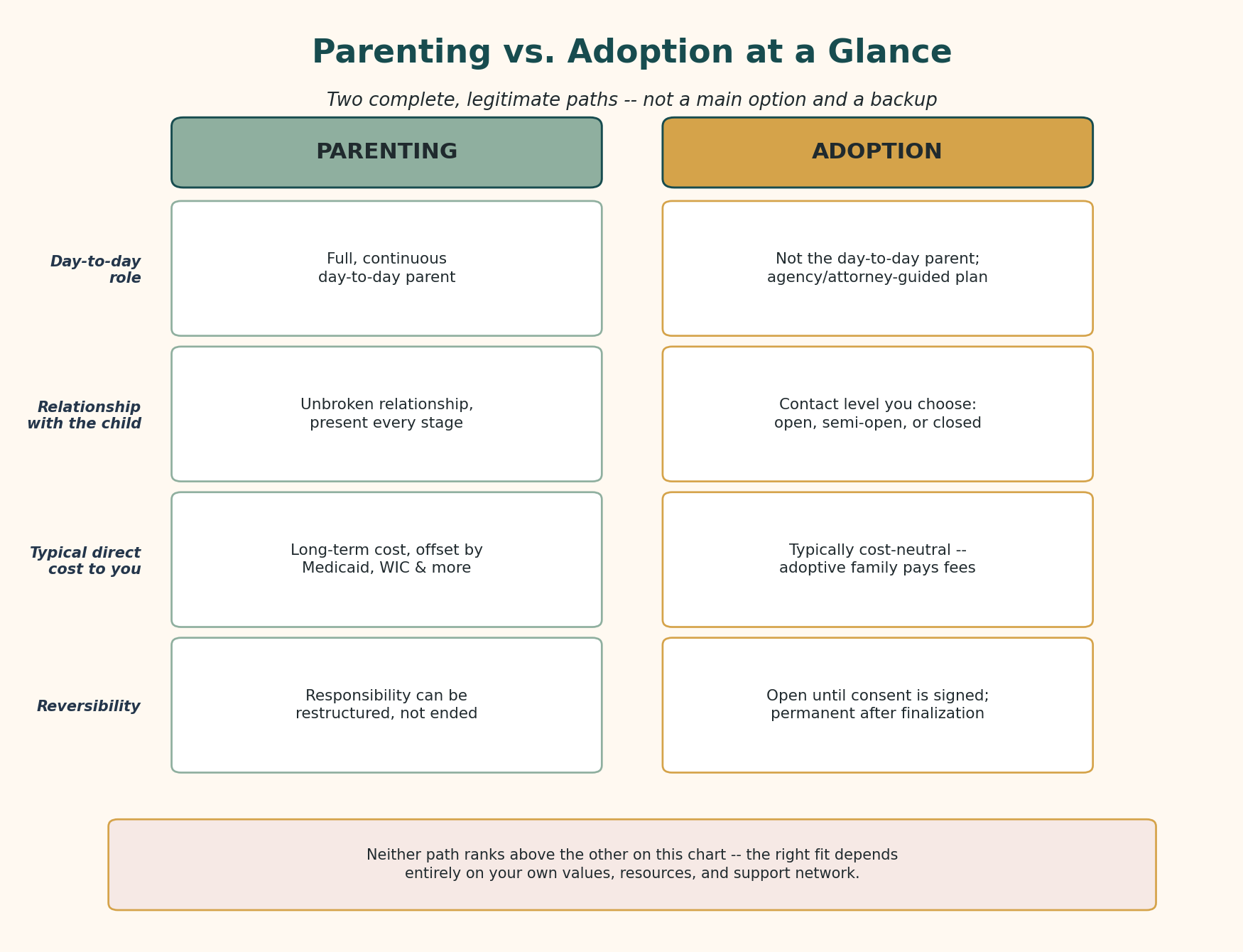
| Factor | Parenting | Adoption |
|---|---|---|
| What happens | You continue the pregnancy, give birth, and take on ongoing day-to-day responsibility for raising the child | You continue the pregnancy, give birth, and legally place the child with another family, with real input into who that family is and how much ongoing contact you have |
| Who has day-to-day responsibility | You (alone or with a co-parent) hold full legal and practical responsibility from birth onward | The adoptive family holds full legal and practical responsibility after finalization; your role afterward is defined by the openness arrangement you choose |
| Relationship with the child going forward | Continuous and unbroken — you’re present for every stage of the child’s life | Ranges from regular ongoing contact (open) to periodic updates (semi-open) to no contact (closed), by mutual agreement — see Section 5 |
| Typical direct medical/financial cost to you | Prenatal care and delivery costs, plus 18 years of child-rearing costs, offset in part by Medicaid, WIC, SNAP, and other programs | Pregnancy-related medical costs and, in most states, reasonable living expenses are typically covered by the adoptive family or an agency — not by you |
| Decision timeline | Open-ended — there is no legal deadline to “decide” to parent, and you can shift toward it from an adoption plan at any point before signing consent | Flexible to explore before birth; a specific, state-governed legal clock (consent, then revocation window) starts only once you sign consent after birth |
| Reversibility | Ongoing responsibility can be restructured later through family court (custody, support orders) but is not something you can simply end | Fully open to change your mind any time before signing consent; after signing, most states allow a limited revocation window, then the decision becomes legally permanent at finalization |
| Support most people need | Practical (housing, child care, income) and relational (partner, family, peer) support, sustained over years | Decision-stage counseling, legal guidance, and grief support concentrated around pregnancy, birth, and the months after placement |
| Legal involvement | Standard birth registration; family court involvement only if custody is later disputed | A licensed adoption agency or attorney, formal consent, a state-specific revocation window, and court finalization — see our adoption process guide |
Reading the Table Without Ranking the Rows
No Factor Here Is a Scorecard
Cost, timeline, and relationship structure are practical facts about how each path is built, not a ranking of which one is better. A person who deeply values day-to-day presence might read the “relationship” row as decisive; a person who deeply values financial stability for the child might read the “cost” row as decisive. Neither reading is wrong, because the table isn’t trying to produce a single answer.
Your Own Weighting Is the Only One That Matters
Two people could look at this exact table, weigh the same facts differently based on their own circumstances and values, and land on opposite — and equally sound — decisions. That’s the entire reason Section 12’s worksheet exists: to help you find your own weighting rather than borrow someone else’s.
What Doesn’t Show Up in a Table
Day-to-Day Texture, Not Just Milestones
A table can tell you that parenting means continuous presence and adoption means a chosen level of contact, but it can’t convey what a random Tuesday feels like on either path — what it’s like to be up at 3 a.m. with a sick toddler, or what it’s like to open a photo update from an adoptive family eight months after placement. Sections 4 and 5 go deeper on exactly that texture.
How You’ll Feel in Five or Twenty Years, Not Just Next Month
Both paths change over time in ways that are hard to predict from inside a single pregnancy. Section 9’s research on grief and regret, further down, is the closest this guide can get to that longer view, with the caveat that research on large groups of people never tells you exactly how one specific person — you — will feel.
Where a Partner or Co-Parent Fits Into This Comparison
A Partner’s Experience of Parenting Is Its Own, Related but Separate, Decision
If you have a partner who will co-parent, their own readiness, resources, and feelings matter to the practical outcome even though the legal decision belongs to you as the pregnant person. It’s worth having an honest version of this same comparison conversation with them specifically, rather than assuming your own conclusion automatically reflects theirs.
A Partner’s Experience of an Adoption Plan Can Differ From Yours
A partner who has established legal parentage typically has their own consent role in an adoption plan, governed by your state’s law, and may experience the decision, and any later grief, differently than you do. Section 10 covers the legal mechanics of this; this is a reminder that the emotional comparison in this section applies to a partner too, not only to the pregnant person.
The Emotional Experience of Each Path
Before the practical comparisons, it’s worth sitting with what each path actually feels like to live through, because the emotional shape of parenting and the emotional shape of adoption are genuinely different — not better or worse, just structured differently in time.
What Parenting Tends to Feel Like
Early Months: Exhaustion, Identity Shift, and Attachment Building in Real Time
The first weeks and months of parenting are commonly described as a blend of intense love and intense depletion — sleep disruption, a reshuffling of identity and routine, and attachment that, for many people, builds gradually through the repetition of care rather than arriving instantly and fully formed at birth. This is a normal pattern, not a sign that something is wrong with your bond.
Over Years: Day-to-Day Love Mixed With Day-to-Day Grind
Further out, parenting tends to settle into a rhythm where profound attachment and plain logistical grind coexist — school pickups, financial stress, illness, milestones, ordinary joy — in a continuous relationship that doesn’t pause. There’s no “finishing” parenting emotionally; it keeps evolving as the child does, for the rest of your life.
What Making an Adoption Plan Tends to Feel Like
Pregnancy and the Weeks Around Birth
People who are planning an adoption often describe pregnancy itself as emotionally layered in a specific way — carrying and caring for a pregnancy while also preparing, practically and emotionally, for a separation that parenting doesn’t involve. Birth itself is frequently described as the most acute point: it’s simultaneously the end of pregnancy and, often, among the most significant moments of the child’s life that the birth parent is present for in the way a parent would be.
Months and Years After Placement
After placement, birth parents commonly describe a grief process that doesn’t resolve on a fixed timeline — waves of loss that can resurface around anniversaries, the child’s birthday, or significant life events, sometimes for years. This runs alongside, not instead of, a sense of having made an active, deliberate choice; the two can and often do coexist. Section 9 covers what research specifically says about this grief in more depth.
Why “Which Feels Better” Is the Wrong Question
Both Paths Involve Real Love and Real Loss
Parenting involves loss too — of independence, of certain kinds of freedom, sometimes of other life plans — even though that loss is rarely named as grief the way adoption’s loss is. Adoption involves real love too, expressed through the act of choosing a family and, in many arrangements, staying connected. Framing the comparison as “which one feels good” versus “which one feels bad” misses that both paths carry both.
Anticipatory Guessing Is Often Wrong
People who’ve lived through either path frequently report that how they expected to feel beforehand didn’t match how they actually felt afterward — some who feared devastating regret over an adoption plan found real peace in it; some who worried they weren’t ready to parent found unexpected capacity once the child arrived. This doesn’t mean your current feelings are unreliable — it means it’s worth treating your prediction of the future as a hypothesis to test against the practical and values-based questions in Section 12’s worksheet, not as a certainty to act on alone.
Key Takeaways
- Parenting’s emotional shape is continuous and evolving; adoption’s is concentrated around pregnancy, birth, and a grief process that can resurface for years afterward.
- Both paths involve genuine love and genuine loss — neither is the “happy” option and the other the “hard” one.
- People’s predictions about how they’ll feel often don’t match their actual experience later, which is a reason to lean on the structured worksheet in Section 12 alongside your gut feeling, not instead of it.
Your Ongoing Relationship With the Child, Compared
This is often the single factor that drives people’s leaning one way or the other, so it’s worth laying out concretely rather than in the abstract. Parenting gives you one, fixed kind of relationship. Adoption gives you a relationship whose shape you have real, ongoing input into.
| Arrangement | Day-to-day role | Contact after birth | Decision-making authority |
|---|---|---|---|
| Parenting (any arrangement) | Full, continuous, hands-on parent | Every day, for the rest of the child’s childhood and beyond | You hold full parental decision-making authority, shared with a co-parent if you have one |
| Open adoption | Not the day-to-day parent; a known, ongoing presence in the child’s life by mutual agreement | Regular — can include visits, calls, texts, social media contact, shared holidays, depending on what both parties agree to | None over the child’s upbringing; decision-making rests entirely with the adoptive parents |
| Semi-open adoption | Not the day-to-day parent; a known but less frequent presence | Periodic — typically letters, photos, and updates on an agreed schedule, often exchanged through the agency rather than directly | None over the child’s upbringing |
| Closed adoption | Not the day-to-day parent; generally not an ongoing presence in the child’s daily awareness | None, or very limited non-identifying information exchanged through an agency | None over the child’s upbringing |
Parenting: Full, Continuous, Day-to-Day Relationship
What Daily Parental Responsibility Actually Involves
Choosing to parent means you are the one making medical decisions, enrolling the child in school, handling discipline and routine, and being present for both the mundane and the significant moments, continuously, from birth through adulthood and typically beyond in an ongoing adult relationship.
Co-Parenting and Custody Can Still Change the Shape of This
If you have a co-parent, legal parentage and custody arrangements determine how responsibility is actually split, and those arrangements can be renegotiated later through family court if circumstances change — but the baseline remains that you, as a parent, retain ongoing authority and presence that an adoption plan does not include.
Adoption: A Relationship You Help Design
Open and Semi-Open Adoption
Most domestic infant adoptions today involve some degree of openness, meaning the birth parent and adoptive family agree to some form of ongoing contact or information exchange — this can range from frequent visits and regular communication to occasional letters and photos. Our dedicated guide to open adoption covers exactly what this can look like and how it’s typically structured.
Closed Adoption and Why It’s Less Common Today
Fully closed adoptions, with no post-placement contact or identifying information shared, remain a legal option in every state but are chosen less often today than in past decades. Our guide to closed adoption covers who tends to choose this arrangement and what it means in practice, including for the child’s later access to information.
What You Can and Can’t Lock In Ahead of Time
Post-Adoption Contact Agreements Are Not Always Enforceable the Same Way Everywhere
Many states allow a written post-adoption contact agreement specifying the openness arrangement, but whether — and how — that agreement is legally enforceable after finalization varies by state. Our guide to your rights when considering adoption goes deeper on this specific legal question.
Openness Can Change on Both Sides Over Time
Even where an agreement is enforceable, real-world openness arrangements sometimes shift over the years — some relationships grow closer than originally planned; others become less frequent than either side expected. This is worth factoring in honestly: the arrangement you agree to at placement is a strong starting framework, not an unbreakable guarantee of exactly how contact will look in year ten.
Key Takeaways
- Parenting means one fixed, continuous, full-authority relationship with the child.
- Adoption lets you choose a relationship’s shape along a real spectrum, from regular ongoing contact to no contact — see our dedicated guides to open and closed adoption for depth.
- Written openness agreements are a strong starting point but aren’t always legally enforceable the same way in every state, and real-world contact can shift over time on either side.
Money: What Each Path Actually Costs You
Financial reality is a legitimate factor to weigh honestly in this decision — pretending cost doesn’t matter helps no one. Here’s what each path typically costs the expectant parent specifically, not the adoptive family or the state.
| Cost category | Parenting | Adoption |
|---|---|---|
| Pregnancy-related medical care and delivery | Your responsibility, though often substantially covered by Medicaid or private insurance — see our pregnancy symptoms guide for the financial-eligibility detail | Typically covered by the adoptive family or the adoption agency, not by you — see our adoption cost guide for the full breakdown |
| Ongoing child-rearing costs, birth to age 18 | Your responsibility, offset in part by public benefit programs; commonly cited estimates run well into six figures over 18 years | None — ongoing child-rearing costs become the adoptive family’s responsibility after placement |
| Legal and agency fees | None specific to this decision | None to you — legal and agency fees in a lawful adoption are paid by the adoptive family, never by the birth parent |
| Living expenses during pregnancy | Your own resources, plus any public assistance you qualify for | In most states, the adoptive family or agency may lawfully cover reasonable pregnancy-related living expenses within state-set limits |
| Net financial direction | A long-term financial commitment, substantially offset by assistance programs | Cost-neutral to cost-positive for you during the pregnancy itself, with no ongoing financial obligation afterward |
The Cost of Parenting
Direct Costs Over 18 Years
Estimates of the total cost of raising a child to age 18 vary significantly by methodology, region, and household income, and no federal agency currently publishes an official annual update — the U.S. Department of Agriculture’s last full report estimated roughly $233,610 for a child born in 2015, and inflation-adjusted and private-sector estimates since then have placed the figure anywhere from the high $200,000s to well over $350,000, excluding college.
Public Support That Changes the Real Number
That headline figure is a gross cost, not a net one. Medicaid and CHIP for pregnancy and child health coverage, WIC for nutrition, SNAP for food assistance, TANF for cash assistance, and child care subsidies in many states can meaningfully reduce the out-of-pocket reality for a parent facing financial strain. Our pregnancy symptoms guide carries the detailed Medicaid and financial-eligibility table; this guide won’t repeat it, since that one already owns it in depth.
The Cost of Adoption (to You, the Expectant Parent)
Why the Birth Parent Typically Pays Nothing
In a lawful domestic adoption, the birth parent does not pay agency fees, legal fees, or home-study costs — those are the adoptive family’s financial responsibility. Our dedicated adoption cost guide breaks down exactly who pays for what in a typical adoption and is the place to go for the full picture; the short version for this comparison is that adoption is not a financial burden to the person making the plan.
What’s Covered, and What the Legal Limits Are For
Most states allow the adoptive family or agency to cover the birth parent’s pregnancy-related medical costs and, often, reasonable living expenses (housing, food, transportation, maternity clothing) during the pregnancy, within limits set by state law specifically to keep the arrangement from resembling payment for the child itself. What counts as “reasonable” and what the exact caps are varies by state — a licensed adoption attorney or agency in your state is the accurate source for current numbers, not a general guide like this one.
Financial Pressure Should Not Be the Deciding Factor, But It’s Real
Separate “Can’t Afford It Alone” From “Can’t Afford It With Help”
If financial strain is pushing you toward adoption, it’s worth doing the actual math on available assistance before treating “I can’t afford this” as settled. The gap between those two statements is sometimes larger than it first appears, and Section 11’s support-building section goes deeper on exactly how to find out.
If Someone Is Offering You Money to Choose Adoption, That’s a Red Flag
There’s an important legal line between lawful reimbursement of pregnancy-related medical and living expenses — which is permitted within state limits — and any payment that functions as compensation for placing the child, which is illegal baby-selling in every U.S. state. If an agency, attorney, or prospective adoptive family offers you money beyond documented, reasonable expenses, or ties payment to your final decision, that’s worth raising with an independent attorney immediately, not treating as a normal part of the process.
Key Takeaways
- Parenting is a genuine long-term financial commitment, substantially offset by Medicaid, WIC, SNAP, TANF, and similar programs — see our pregnancy symptoms guide for the eligibility detail.
- Adoption is typically cost-neutral or cost-positive for the birth parent during pregnancy, with no ongoing financial obligation afterward — see our adoption cost guide for specifics.
- Any payment beyond documented, state-limited reasonable expenses tied to an adoption decision is a legal red flag, not a normal part of a lawful process.
Timeline and Reversibility: What’s Decided When, and What Can Change
One of the clearest structural differences between these two paths is how — and when — each one becomes final, and how much room you have to change course along the way.
Parenting’s Timeline
The Decision Itself Has No Deadline
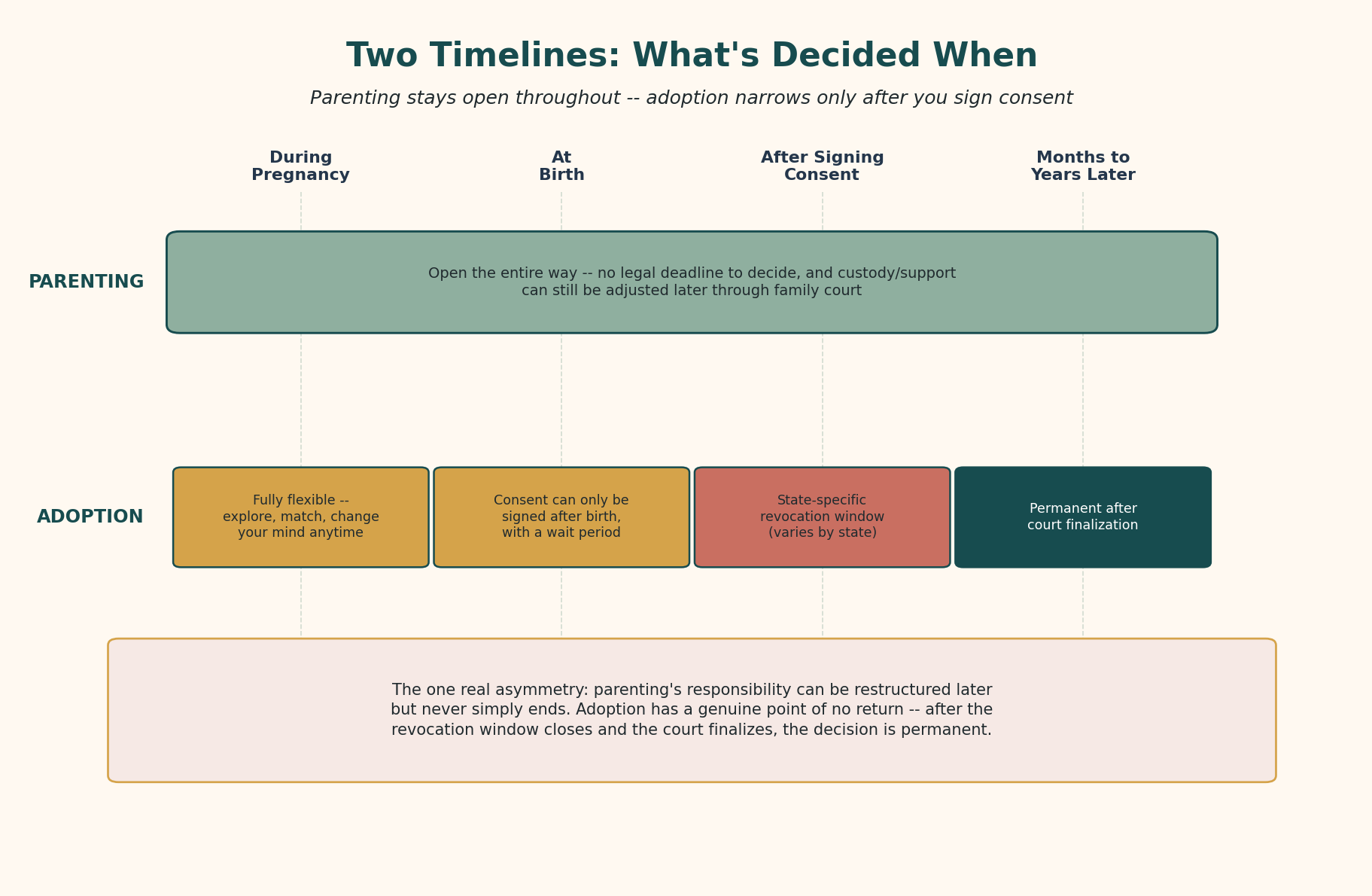
There is no legal moment at which “deciding to parent” has to be finalized — it’s simply the path you’re on by default once a child is born to you, unless and until you sign adoption consent. You can lean toward adoption for most of a pregnancy and still choose parenting at the last moment, right up until that signature.
What Can Change Later: Custody, Co-Parenting, Support Orders
Choosing to parent doesn’t lock every detail in place forever — custody arrangements, child support orders, and co-parenting agreements can all be revisited later through family court if circumstances genuinely change. What doesn’t change is the underlying fact of being the child’s legal parent; that status, once established, is not something family court reverses.
Adoption’s Timeline
Before Birth: Fully Flexible
You can talk to an agency or attorney, start matching with a family, or even fully plan an adoption, and still change your mind at any point before birth — none of it is legally binding until you sign consent, which by law in every U.S. state can only happen after the child is born.
After Birth: Consent, Revocation, and Finalization
Once you sign consent — typically after a minimum waiting period of at least 24 to 72 hours post-delivery, though the exact minimum varies by state — most states then provide a further revocation window during which you can still change your mind and reclaim parental rights before the adoption is finalized in court. The length of that window varies enormously by state, from none in some states to days or weeks in others. Our guides to birth mother rights and the adoption process go deeper on this specific legal sequence.
The One Real Asymmetry Between the Two Paths
Parenting Can Still Shift Toward Adoption Later in Pregnancy — Adoption Can Shift Toward Parenting Right Up Until Signing
Both directions of changing your mind remain genuinely available throughout pregnancy. This is a structural fact worth knowing early: you are not required to commit to either path today, and starting prenatal care, or starting a conversation with an adoption agency, does not lock you in.
Adoption Has a Specific Point of No Return That Parenting Doesn’t
The one asymmetry is what happens after that point of no return. Parenting’s “finality” is about ongoing responsibility that can be legally restructured (through custody arrangements) but not erased. Adoption’s finality, once consent is signed and any revocation window passes, is a complete and permanent legal termination of your parental rights — a different, more absolute kind of final step that parenting simply doesn’t have an equivalent to.
Key Takeaways
- Parenting has no decision deadline; adoption is fully flexible before birth and then governed by a specific, state-set legal sequence after you sign consent.
- You can change your mind in either direction throughout pregnancy — neither starting prenatal care nor starting to talk with an adoption agency commits you.
- Adoption’s finality after the revocation window closes is a different kind of permanent than anything parenting involves — confirm your state’s exact timelines with a licensed adoption attorney before signing consent.
What Support You’ll Need for Each Path
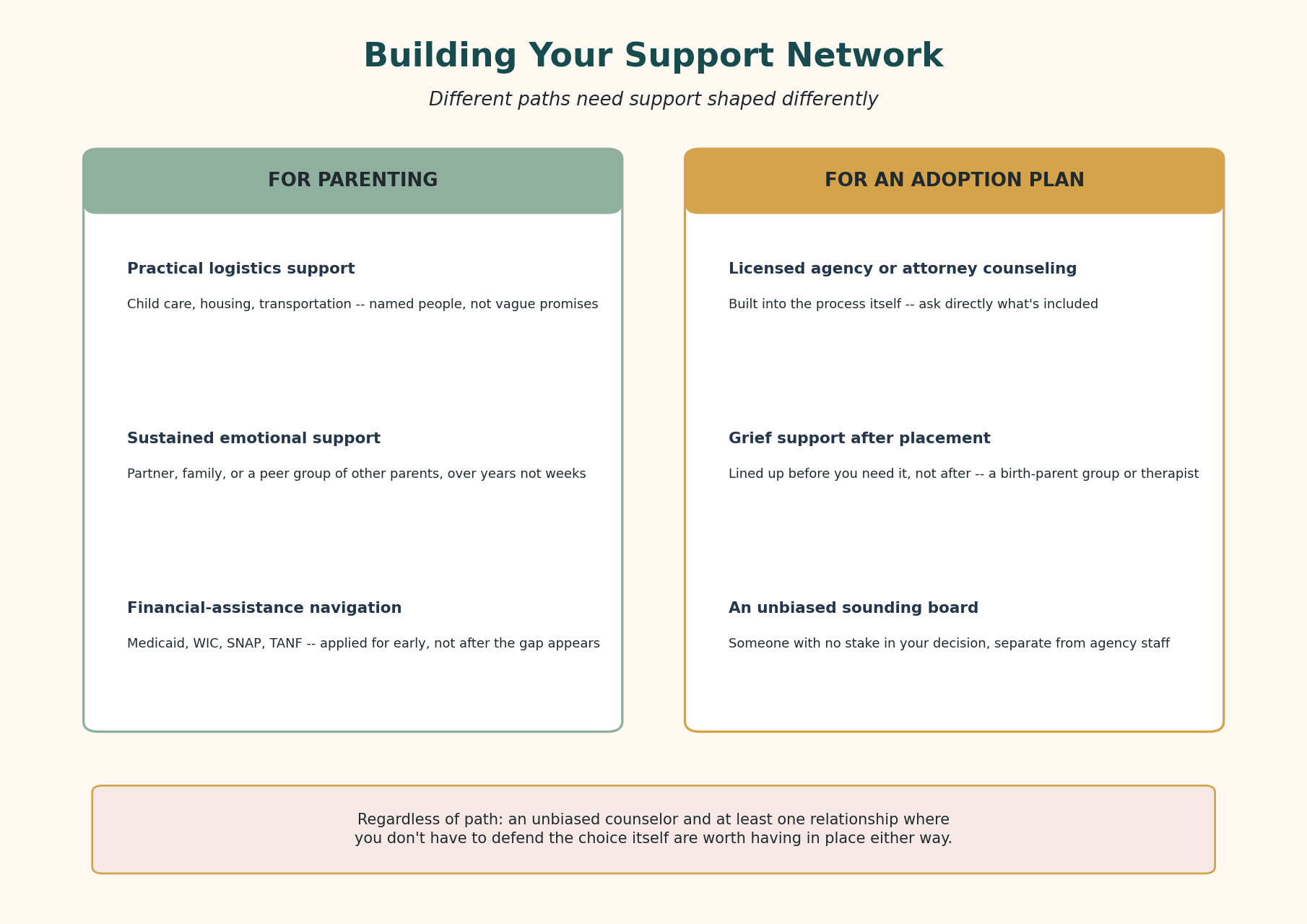
Neither path is meant to be done entirely alone, and the kind of support each one requires is genuinely different — parenting needs support sustained over years; adoption needs concentrated support around a shorter, more intense window.
Building Support for Parenting
Practical Support: Child Care, Housing, Transportation
Realistic parenting support usually means identifying, concretely, who can help with child care on specific days, whether housing is stable enough for a child, and how you’ll manage transportation to appointments and, later, school and work — not a vague sense that “it’ll work out,” but an actual list of names and backups.
Emotional Support: Partner, Family, Peer Groups
Sustained emotional support — a partner, family members, or a peer community of other parents in similar circumstances — tends to matter more over the long run than any single resource, since parenting support needs don’t end after a few months the way some adoption-related support does.
Building Support for an Adoption Plan
Your Agency or Attorney’s Counseling Role
A licensed adoption agency or attorney typically provides or connects you with decision-stage counseling as part of the adoption-planning process itself — this is a core part of what you’re working with them for, not an extra service. Our adoption process overview covers what to expect from that relationship in more detail.
Grief Support After Placement, Specifically
Because adoption’s emotional weight is concentrated around birth and the months after, dedicated post-placement grief support — through your agency, a birth-parent support group, or an individual therapist experienced with adoption specifically — is worth lining up before you need it, not after you realize you do.
Support Neither Path Can Skip
A Counselor Who Isn’t Trying to Steer You
Whichever way you’re leaning, talking it through with someone who has no financial or personal stake in your decision — not the same person providing your adoption services, and not a family member with a strong preference — adds something neither path’s built-in support structure fully replaces.
At Least One Person Who Isn’t Judging the Choice
Both parenting and adoption can attract unsolicited judgment from people who’ve never walked through this decision themselves. Having at least one relationship — a friend, a counselor, a support group — where you don’t have to defend the choice itself, only talk through how you’re actually doing with it, matters regardless of which path you take.
Key Takeaways
- Parenting needs practical and emotional support sustained over years; adoption needs concentrated support around pregnancy, birth, and the months after placement.
- A licensed agency or attorney typically provides adoption-decision counseling as part of the process itself — ask directly what support is included.
- Regardless of path, an unbiased third party and at least one non-judgmental relationship are worth having in place before you need them.
Grief, Loss, and Regret: What the Research Says About Each Path
This is the section people often most want and most avoid. Being honest about grief and regret on both sides — rather than pretending one path is simply “the happy ending” — is part of making a decision you can actually stand behind later.
Grief Is Not Unique to Adoption
Parenting Involves Its Own Losses
Parenting involves real, if less-often-named, grief of its own — lost independence, changed relationships, sometimes a different life trajectory than the one you’d pictured. This grief is rarely framed that way culturally, which can make people who feel it quietly assume something is wrong with them, when it’s actually a normal part of a major life change.
Adoption Grief Has Been Studied More Directly
Because adoption’s loss is more structurally visible — an identifiable before-and-after moment — it has been studied more directly than the diffuse grief that can accompany parenting. The Child Welfare Information Gateway, a federal clearinghouse operated by the Department of Health and Human Services’ Administration for Children and Families, maintains resources specifically on the impact of adoption on birth parents, which is a useful starting point if you want to read further.
What Birth-Parent Grief Research Describes
Grief That Comes in Waves, Not a Single Event
Clinical and child-welfare literature on birth-parent grief commonly describes it as recurring rather than resolving on a fixed timeline — surfacing around the child’s birthday, holidays, or significant life transitions, sometimes for years after placement. This pattern is often described using the concept of “ambiguous loss”: grief for someone who is still alive and, in an open arrangement, still present in your life in some form, which can make the grief harder to categorize than loss through death.
Openness Is Associated With Different, Not Simply “Better,” Outcomes
Research and professional literature on adoption openness generally associate ongoing contact with some birth parents reporting an easier grief process, since uncertainty about the child’s wellbeing is replaced with real information — but openness is not a guarantee of less grief for everyone, and some birth parents in closed arrangements report finding their own path to peace without ongoing contact.
What Parenting Regret Looks Like When It Happens
Regretting Circumstances, Not Necessarily the Child
When people who chose to parent describe regret, it’s frequently regret about timing, circumstances, or a relationship that didn’t work out — not regret about the child’s existence or their love for the child, which can coexist with real difficulty or even resentment about how their life changed. Naming that distinction honestly tends to be more useful than treating any admission of struggle as evidence of a wrong decision.
When Parenting Regret Signals a Bigger Problem
Occasionally, what surfaces as “regret” is actually a sign of untreated postpartum depression or anxiety, an unsafe relationship, or a lack of basic support — all of which are addressable on their own terms and don’t necessarily mean adoption would have been the better call. If regret feelings are intense, persistent, or paired with thoughts of harming yourself or the child, that’s a reason to reach out for mental-health support immediately rather than to interpret it only as evidence about the original decision.
What Tends to Help, Regardless of Path
Professional Support Specifically Trained in This Area
A therapist or counselor experienced specifically in either birth-parent grief or the ordinary strains of new parenthood tends to be more useful than general talk therapy alone, since both experiences have enough specific, well-documented patterns that specialized familiarity helps. Ask directly about this experience when choosing a provider.
Peer Support From Others Who’ve Made the Same Choice
Birth-parent support groups and new-parent peer groups both exist specifically because talking with people who’ve lived through the same path tends to normalize feelings that can otherwise seem isolating or alarming. Your adoption agency, a local hospital, or a community organization can typically point you toward either, depending on which path you’re on.
Key Takeaways
- Both paths involve real grief — parenting’s is less often named as such, adoption’s has been studied more directly as “ambiguous loss.”
- Openness in adoption is associated with different grief experiences for many birth parents, but it isn’t a guarantee of an easier outcome for everyone.
- Parenting regret is frequently about circumstances, not the child; if it’s intense or persistent, treat it as a reason to seek mental-health support, not just as evidence about the original decision.
Your Legal Rights and Protections in Each Path
Both paths come with specific legal protections and obligations. This section gives you the map; the depth lives in dedicated guides this one links out to rather than duplicates.
If You Parent
Pregnancy and Postpartum Workplace Protections
Federal law provides real, if imperfect, workplace protection during pregnancy and after birth. The Pregnancy Discrimination Act prohibits employment discrimination based on pregnancy, childbirth, or related medical conditions. The Pregnant Workers Fairness Act, in effect since June 2023, requires covered employers to provide reasonable accommodations for pregnancy, childbirth, and related conditions. The Family and Medical Leave Act provides eligible employees at covered employers with job-protected, though generally unpaid, leave. All three apply to you whether or not parenting is your eventual choice, since they cover the pregnancy itself and protect you while you’re still deciding.
Establishing Legal Parentage for a Partner
If you have an unmarried partner, their legal parentage is typically not automatic and usually requires a paternity acknowledgment or a court process before they hold enforceable parental rights or obligations. If you’re married, your spouse is generally presumed to be the legal parent under most state laws, though this can vary, particularly in same-sex marriages depending on the state — worth confirming with a family law attorney if it applies to you.
If You Make an Adoption Plan
Rights Before You Sign Anything
Before signing consent, you retain full legal parental rights, the right to change your mind at any point, the right to receive counseling, and — in most states — the right to help choose the adoptive family and the openness arrangement. Our guide to your rights when considering adoption covers this specific list in depth and is the right place to go before any conversation with an agency or attorney moves further.
Rights That Continue to Apply After Signing, Depending on Your State
After signing consent, your remaining rights — primarily the ability to revoke that consent during a state-specific window — depend entirely on your state’s law. Our dedicated birth mother rights guide covers this in full detail, including how to find your specific state’s current rule rather than relying on a general figure that might not apply to you.
Key Takeaways
- Pregnancy itself comes with federal workplace protections (the PDA, PWFA, and FMLA) regardless of which path you ultimately choose.
- Before signing adoption consent, you retain full parental rights, including the right to change your mind — see our full rights guide for the complete list.
- What happens legally after signing consent is state-specific — confirm your exact state’s revocation rule with a licensed adoption attorney, via our birth mother rights guide.
Common Myths About Adoption vs. Parenting
Both paths attract persistent myths that can distort a decision if left unexamined. A few of the most common ones, named directly.
Myths About Parenting
Myth: Choosing to Parent Without Resources Already in Place Means No Support Exists
It’s a common assumption that if you don’t already have stable housing, income, or child care lined up, parenting simply isn’t realistic. In fact, a real — if imperfect — public and private support infrastructure exists specifically for parents facing exactly this situation; Section 6 and our pregnancy symptoms guide cover what’s actually available before you rule parenting out on resource grounds alone.
Myth: Considering Adoption and Then Choosing Parenting Means You “Almost Didn’t Want” the Child
Seriously exploring adoption and then deciding to parent isn’t a sign of ambivalence toward the child — it’s evidence that you took the decision seriously enough to examine both real options before committing to one. Plenty of parents who are now certain of their choice spent real time considering adoption first.
Myths About Adoption
Myth: Making an Adoption Plan Means You Don’t Love the Child
This is one of the most persistent and most inaccurate myths about adoption. Choosing adoption is frequently described by birth parents as an act driven specifically by love and by a clear-eyed assessment of what they could offer the child at that point in their life — not an absence of love. The language itself reflects this: “placing a child for adoption” or “making an adoption plan” describes an active, deliberate choice, not the older and less accurate phrase “giving up,” which implies passivity or resignation.
Myth: You Lose All Say Once You Start Talking to an Agency
Starting a conversation with a licensed adoption agency or attorney is informational, not binding, and you retain full decision-making authority throughout — including the choice to stop at any point before signing consent, or to change the openness arrangement you originally discussed. Our adoption process overview covers what that early relationship actually looks like.
Key Takeaways
- Lack of current resources doesn’t automatically rule out parenting — real assistance programs exist specifically for this situation.
- Exploring adoption and then choosing to parent reflects careful decision-making, not ambivalence toward the child.
- Choosing adoption is commonly described as an act of love and deliberate planning, not an absence of love — and talking to an agency doesn’t bind you to anything.
The Decision-Support Worksheet: A Deeper Framework
This is the heart of this guide: a structured way to work through your own decision, in four parts, that goes deeper than a quick checklist. It’s designed to be worked through slowly, over more than one sitting if useful, ideally with pen and paper or a notes app open alongside this page.

Part 1: Values Clarification
Naming What You Actually Value, Separate From What’s Expected of You
Write down, honestly, what matters most to you about this decision — independent of what a partner, parent, religious community, or friend expects. Common values that show up here include: being the one who raises your own child day to day; giving the child a specific kind of stability you’re not sure you can currently provide; staying connected to the child in some form regardless of who raises them; minimizing disruption to other parts of your life; or living out a value about family, faith, or responsibility that you hold strongly. There’s no required list — the goal is naming your own, specifically.
Imagining Both Paths Concretely, Not Abstractly
For each path, write a few sentences describing a specific, ordinary day five years from now — not the dramatic high points, the ordinary texture. What does a Tuesday look like if you parented? What does a Tuesday look like if you placed the child with an open adoption arrangement? People often find that one of these concrete pictures feels noticeably more like their own life than the other, in a way the abstract version of the question didn’t reveal.
Part 2: Resource Inventory
What You Have Right Now
List, specifically, what you currently have available: housing situation and stability, income and employment, health insurance status, existing child care access if relevant, and your physical and mental health capacity right now. Be concrete and honest rather than optimistic or pessimistic by default — this inventory is only useful if it’s accurate.
What You’d Need to Add, and Whether That’s Realistic
For whichever gaps show up, note specifically what resource would close them — and then check Section 6 and our pregnancy symptoms guide for whether a real program exists to help close that specific gap. The question isn’t “do I have everything already” — almost no one does — it’s “is the gap between what I have and what I’d need realistically closeable, and on what timeline.”
Part 3: Support-Network Mapping
Who’s Actually Available, Not Just Who Says They Are
List every person who has offered support, then separately note, honestly, who has a track record of actually following through versus who offers support in the moment but hasn’t historically been reliable. This distinction matters more than the raw number of people who’ve said “I’ll help.”
Mapping Support Separately for Each Path
Some support is path-specific — a family member willing to help with child care is a parenting-specific resource; a family member who could sit with you through an adoption agency meeting is an adoption-specific one. Map your support list against both paths separately rather than assuming the same people show up the same way for either one.
Part 4: Putting It Together
Signals, Not a Scorecard
The table below lists common signals that tend to accompany a lean toward one path or the other, drawn from the three parts above. It is explicitly not a point system — having more items in one column doesn’t mean that’s the “correct” answer for you, and plenty of people land on a path with signals pointing the other way for reasons the table can’t capture.
| Area | Signals that often accompany a parenting lean | Signals that often accompany an adoption lean |
|---|---|---|
| Resources & stability (Part 2) | Current or realistically closeable gaps in housing, income, or support feel manageable with assistance programs factored in | Gaps feel significant even after mapping available assistance, or the timeline to close them doesn’t match the pregnancy’s timeline |
| Relationship to the pregnancy (Part 1) | Picturing yourself as this child’s day-to-day parent feels like relief or a clear “yes,” even amid practical worry | Picturing day-to-day parenting feels persistently wrong for this point in your life, separate from fear of any single hard conversation |
| Support network (Part 3) | Specific, reliable people are mapped to concrete parenting-support roles | Support network is thinner for sustained day-to-day parenting than for a shorter, more concentrated decision-and-placement process |
| Values (Part 1) | Being the one who raises this specific child, personally, is a value you hold strongly and concretely | Giving the child a specific kind of life or stability matters more to you than being the one who provides it day to day yourself |
| Feelings about contact (Part 1) | Not applicable — parenting means continuous contact by definition | Some form of ongoing connection (open or semi-open) feels important to you, or, alternatively, you’re genuinely at peace with a closed arrangement |
When to Bring In an Unbiased Third Party
Once you’ve worked through all four parts, bringing the whole worksheet — not just your tentative conclusion — to a genuinely neutral counselor, OB-GYN, or licensed adoption professional is the recommended next step. Our unplanned pregnancy guide covers, in its own options-counseling section, how to tell a neutral source from one that has a stake in your answer, which applies just as much to this two-way decision as it does to the three-way one.
Key Takeaways
- Work through values, resources, and support network separately before trying to put them together — skipping a part tends to produce a decision that feels wrong later.
- The signals table is a tool for noticing patterns in your own answers, not a scoring system that outputs a correct choice.
- Bring the completed worksheet, not just a tentative conclusion, to an unbiased counselor as your next step.
If You’re Leaning Toward Parenting: Next Steps
If the worksheet and the comparisons above have you leaning toward parenting, here’s where to focus next, in roughly the order it tends to help.
This Week
Confirm Dates and Start Prenatal Care
If you haven’t already, confirming the pregnancy with a provider and scheduling a first prenatal visit is the practical next step. Our guide to what to do after a positive pregnancy test walks through this specific logistics list step by step, including prenatal vitamins, choosing a provider, and telling people — detail this guide deliberately doesn’t repeat.
Start the Financial-Assistance Applications Now, Not Later
Medicaid, WIC, and other assistance programs can take time to process, and applying early — even before you feel fully settled on parenting — protects your access to prenatal coverage either way. Our pregnancy symptoms guide has the detailed eligibility and application information.
Before the Baby Arrives
Legal Parentage and Paperwork for a Partner
If you have an unmarried partner who will be a co-parent, look into your state’s paternity acknowledgment process before birth, since establishing this early avoids complications with custody, support, and decision-making authority later.
Line Up Practical Support Before You Need It
Using Part 3 of the worksheet above, confirm specific people for specific roles — who’s on call for a 2 a.m. question, who can help with transportation to appointments, who can step in if you’re ill — rather than leaving this vague until you’re already managing a newborn.
Key Takeaways
- Confirm dates and start prenatal care through our next-steps guide as your immediate priority.
- Apply for financial assistance programs early rather than waiting until you feel fully certain.
- Resolve a partner’s legal parentage and line up concrete practical support before the baby arrives, not after.
If You’re Leaning Toward Adoption: Next Steps
If you’re leaning toward making an adoption plan, here’s where to focus next — this section is intentionally brief, since the detailed action checklist lives in a dedicated guide this one points you to.
This Week
Talk to a Licensed Agency or Attorney, No Commitment Required
An initial conversation with a licensed adoption agency or adoption attorney is informational and doesn’t commit you to anything. Our adoption process overview covers what that first conversation typically covers and how to evaluate whether an agency or attorney is a good fit.
Know Your Rights Before You Say Yes to Anything
Before signing any document, read our guide to your rights when considering adoption and our birth mother rights guide, so you know exactly what you’re entitled to — including counseling, choice of adoptive family, and the ability to change your mind — before you’re in a room being asked to decide.
When You’re Ready to Act
The Full Action Checklist Lives in a Dedicated Guide
Once you’re ready to move from considering adoption to actively planning one, our step-by-step guide to placing a baby for adoption is the practical checklist built specifically for that stage — this guide intentionally stops short of repeating that detail, since that one owns it.
Choosing Openness Level Is a Process, Not a One-Time Decision
You don’t need to have the exact openness arrangement decided before your first conversation with an agency. Our guides to open adoption and closed adoption cover the real range of arrangements in detail, and most agencies will walk through this with you as part of matching rather than expecting a decided answer upfront.
Key Takeaways
- An initial conversation with a licensed agency or attorney is informational, not binding — start it whenever you’re ready.
- Read our rights guide and birth mother rights guide before signing anything.
- When you’re ready to act, our placing a baby for adoption guide is the detailed, step-by-step companion to this comparison.
If You’re Still Torn: What That Usually Means
If you’ve worked through the comparisons and the worksheet and you’re still genuinely unsure, that’s not a failure of this process — it’s common, and it usually means one of a few specific things.
Being Undecided Is a Normal, Not a Failed, State
You Can Hold Both Paths Open Simultaneously
As covered in Section 7, both paths remain genuinely open throughout pregnancy. You can begin prenatal care and also have an initial conversation with an adoption agency; neither action commits you, and holding both open while you keep working through the decision is a legitimate choice in itself, not indecisiveness to be ashamed of.
Deciding Doesn’t Have to Happen in One Conversation or One Sitting
Big decisions rarely resolve in a single conversation. Giving yourself permission to revisit the worksheet, talk to a counselor more than once, and let your thinking develop over weeks rather than forcing a conclusion in one sitting tends to produce a decision you trust more, not less.
When to Get Outside Help With the Decision Itself
Unbiased Counseling Is Different From Pressure From Either Side
If you’ve mostly been processing this with people who have a stake in the outcome — a partner who wants to parent, a family member who’s suggested adoption — bringing in a genuinely neutral third party is worth doing specifically because they don’t have a preferred answer. Our unplanned pregnancy guide covers how to identify truly neutral options counseling, which applies here too.
Signs the Indecision Is About Something Else
Sometimes what looks like indecision about parenting versus adoption is actually about something adjacent — fear of a specific conversation, unresolved grief from an earlier experience, or pressure you haven’t named yet. If you notice the “torn” feeling isn’t really about the comparison itself, Section 15’s special-circumstances section below may speak more directly to what’s actually going on.
Key Takeaways
- Remaining undecided after real effort is common, not a sign you’re doing this wrong.
- Both paths can stay open simultaneously while you keep working through the decision.
- If the indecision seems to be about something other than the comparison itself — pressure, unresolved grief, fear of one specific conversation — Section 15 may be more directly useful than more comparison.
Special Circumstances That Change the Calculus
A few situations add real complexity to this decision beyond the general comparison above. If any of these apply to you, they’re worth reading closely.
A Partner Who Disagrees With You
Whose Decision This Legally Is
If you’re the pregnant person, the decision to parent or make an adoption plan is legally yours to make; a partner’s legal rights and required involvement depend on whether paternity has been legally established and vary by state, particularly for unmarried partners.
What to Do When You Can’t Agree
A disagreement with a partner is worth bringing to a neutral counselor or mediator rather than resolving through pressure in either direction. If an adoption plan is being considered, a licensed adoption attorney can also explain exactly how partner disagreement affects the legal process in your state specifically.
Family or Community Pressure Toward One Path
Recognizing Pressure Versus Support
Support respects that the decision is yours; pressure tries to make the decision for you, whether through guilt, ultimatums, or withholding help unless you choose a specific path. Both parenting and adoption can attract this kind of pressure from family, a partner, or a religious or cultural community.
Getting Space to Decide Without That Pressure in the Room
If you’re not able to think clearly because of pressure from someone close to you, a confidential conversation with a neutral counselor, your OB-GYN, or a licensed adoption agency can give you space to work through the worksheet in Section 12 without that influence directly present — this is a legitimate reason to seek outside counseling even if you’d otherwise have preferred to decide privately within your family.
A Prior Adoption or Parenting Experience
How an Earlier Decision Does and Doesn’t Predict This One
If you’ve placed a child for adoption before, or parented a child before, this pregnancy is still its own decision — your circumstances, resources, and values may have genuinely changed, and there’s no obligation to repeat an earlier choice.
Grief From a Prior Experience Can Resurface Now
A new pregnancy can bring up unresolved grief from an earlier adoption or an earlier difficult parenting period, even years later. If that’s happening, it’s worth naming to a counselor directly rather than letting it silently steer this decision without your full awareness of what’s influencing it.
A Baby With a Diagnosed Health Condition or Disability
Both Paths Remain Fully Open
A prenatal diagnosis doesn’t close off either parenting or adoption as an option. Families specifically seeking to adopt children with particular diagnoses exist, and adoption agencies experienced with this situation can speak to it directly and accurately rather than in generalities.
Specialized Resources Exist for Both Paths
If you’re weighing this specifically, ask any agency or counselor you talk to about their direct experience with this exact situation, since it benefits from specialized knowledge beyond this guide’s general comparison.
A History of Pregnancy Loss or Fertility Treatment
How an Earlier Loss Can Shape This Decision
If this pregnancy followed a miscarriage, stillbirth, or a long or difficult path to conception, those experiences can realistically intensify how high-stakes this decision feels, in either direction — sometimes toward wanting to parent this specific pregnancy no matter the circumstances, sometimes toward a clearer sense that you’re not in a place to parent right now despite wanting to be. Naming that history directly to a counselor, rather than treating it as background noise, tends to produce a clearer picture of what’s actually driving your leaning.
This History Doesn’t Obligate You Toward Either Path
However much an earlier loss or a difficult path to this pregnancy weighs on you emotionally, it doesn’t create an obligation toward parenting or toward adoption — the decision is still about your actual current circumstances, values, and resources, worked through with the same worksheet in Section 12 as anyone else’s.
If You’re a Minor
Your Rights Still Belong to You
Being under 18 doesn’t erase your right to accurate information, counseling, and a real say in this decision. Our guide to your rights when considering adoption covers minors’ rights specifically within that process.
Parental Involvement Rules Vary and Are Worth Confirming Early
Whether a minor needs a parent or guardian’s involvement to place a child for adoption, and what that involvement specifically requires, varies by state.
Key Takeaways
- A partner’s disagreement doesn’t override your legal decision-making authority, but it’s worth working through with neutral help rather than resolving through pressure.
- Pressure from family or community is different from support, and confidential outside counseling is a legitimate way to get decision-making space when pressure is present.
- A prior adoption or parenting experience, a prenatal diagnosis, or being a minor all add real complexity but don’t close off either path — specialized resources and this guide’s linked sibling guides go deeper on each.
Glossary of Terms
A quick reference for terms used throughout this guide.
General and Decision-Process Terms
Expectant Parent
A pregnant person who has not yet finalized a decision about parenting or adoption; the preferred, non-presumptive term used throughout this guide before a placement decision is made.
Options Counseling
Structured counseling that presents available paths — in this guide’s context, parenting and adoption — without bias toward either outcome, consistent with the person-centered counseling standard described by the American College of Obstetricians and Gynecologists and the American Academy of Family Physicians.
Decisional Regret
A recognized concept in decision-making research describing distress or second-guessing about a choice already made, studied across many types of medical and life decisions, not unique to parenting or adoption.
Ambiguous Loss
A grief concept describing loss without the clarity or closure of a death — commonly used in adoption-related clinical literature to describe birth-parent grief for a child who is alive and, in many arrangements, still present in some form.
Adoption-Specific Terms
Birth Mother / Birth Father
Terms that accurately apply only after an adoption is placed; before that point, “expectant parent” is the accurate and preferred term throughout this guide.
Open, Semi-Open, and Closed Adoption
Terms describing the level of ongoing contact between a birth parent and adoptive family after placement, ranging from regular contact (open) to periodic letters or updates (semi-open) to no contact or identifying information shared (closed). See our dedicated open adoption and closed adoption guides.
Revocation Period
A window, set by state law and varying significantly in length, during which a birth parent who has signed adoption consent can still change their mind and reclaim parental rights before finalization.
Finalization
The court proceeding that makes an adoption legally permanent, terminating the birth parent’s rights and establishing the adoptive parents as the child’s legal parents in every respect.
Post-Adoption Contact Agreement
A written agreement specifying the agreed openness arrangement between a birth parent and adoptive family; enforceability varies by state.
Parenting and Legal/Financial Terms
Legal Parentage / Paternity Acknowledgment
The formal legal establishment of a parent’s rights and responsibilities toward a child; for unmarried partners, typically requires a signed acknowledgment form or a court process rather than being automatic.
Pregnant Workers Fairness Act (PWFA)
A federal law, in effect since June 2023, requiring covered employers to provide reasonable workplace accommodations related to pregnancy, childbirth, and related medical conditions.
Pregnancy Discrimination Act (PDA)
A federal law prohibiting employment discrimination on the basis of pregnancy, childbirth, or related medical conditions.
Family and Medical Leave Act (FMLA)
A federal law providing eligible employees at covered employers with job-protected, generally unpaid, leave for certain family and medical reasons, including childbirth.
Frequently Asked Questions
Getting Started With This Comparison
I’ve ruled out abortion — now what’s the actual difference between parenting and adoption?
Structurally: parenting means continuous, full responsibility for raising the child yourself; adoption means continuing the pregnancy and then legally placing the child with another family, with real input into who that family is and how connected you stay. Section 3’s side-by-side table is the fastest way to see the full comparison at once.
Do I have to pick one today?
No. Both paths remain genuinely open throughout pregnancy, and you can hold both open simultaneously while you keep working through the decision, including using the worksheet in Section 12.
Understanding What Each Path Actually Involves
What does “making an adoption plan” actually mean, day to day, during pregnancy?
It typically means working with a licensed agency or attorney on matching with an adoptive family, deciding on an openness arrangement, and continuing routine prenatal care — all of which can happen while you’re still deciding, since nothing is binding until you sign consent after birth.
What does choosing to parent actually commit me to right now?
In the immediate term, just continuing routine prenatal care. The deeper commitments of parenting — custody, ongoing responsibility — take effect at birth by default unless you sign adoption consent.
Weighing the Emotional Side
Is it normal to feel multiple, even contradictory, things about both options at once?
Yes. Relief, grief, hope, and fear can all show up together regardless of which path you’re leaning toward, and none of them individually tells you the “right” answer.
I’m scared I’ll regret whichever choice I make. Is that a sign I shouldn’t decide yet?
Fear of regret is extremely common and doesn’t necessarily mean you’re not ready — it often just means you’re taking the decision seriously. Working through Section 12’s worksheet can help separate genuine uncertainty from ordinary fear of an irreversible-feeling choice.
Comparing the Relationship With the Child
Can I decide on an openness level later, after the child is already placed?
Openness arrangements are typically discussed and agreed before placement, but real-world contact can evolve afterward on both sides. Our open adoption guide and closed adoption guide cover how these arrangements typically work and change over time.
What happens if the adoptive family stops honoring our openness agreement?
This depends heavily on whether your state treats post-adoption contact agreements as legally enforceable, which varies significantly. Our rights guide covers this question in more depth.
Comparing the Financial Reality
Will I owe anything if I choose adoption and later regret it?
No. There’s no financial penalty for choosing adoption, and if you change your mind before signing consent (or during your state’s revocation window afterward), you owe nothing back for medical or living expenses already lawfully covered.
Is it true that adoptive families “pay” birth mothers to adopt their baby?
No — that would be illegal baby-selling in every U.S. state. What’s lawful is reimbursement of documented, reasonable pregnancy-related medical and living expenses, within state-set limits, which is different from payment for the child. Section 6 covers this distinction directly.
Comparing Timelines and Changing Your Mind
How late in pregnancy can I still decide between parenting and adoption?
Right up until you sign adoption consent, which by law can only happen after birth. Both paths remain genuinely open the entire length of pregnancy.
Once I sign adoption consent, is that absolutely final?
Not immediately in most states — a revocation window typically follows, though its length varies enormously by state, from none to several weeks. After that window closes and the court finalizes the adoption, the decision becomes permanent.
Comparing Support Needs
What kind of support do most new parents underestimate needing?
Sustained, practical, day-to-day support — not a single dramatic gesture of help, but reliable people available for ordinary logistics over months and years. Section 8 covers how to map this specifically rather than assume it will appear when needed.
What kind of support do birth parents most often say they wish they’d had?
Grief support specifically dedicated to the months after placement, rather than support concentrated only around the decision and birth itself. Section 8 and Section 9 both touch on why this specific gap matters.
Grief, Loss, and Regret Questions
Is grief after an adoption plan a sign I made the wrong decision?
Not necessarily. Grief and regret are different things, and research on birth-parent experience describes grief as a common, expected part of the adoption experience even among birth parents who remain confident in their decision.
Is struggling emotionally with parenting a sign I made the wrong decision?
Not necessarily, for the same reason — difficulty and regret aren’t the same thing, and ordinary parenting struggle doesn’t by itself indicate the decision was wrong. Persistent, severe distress is worth raising with a mental-health provider regardless of what it does or doesn’t mean about the original decision.
Legal Rights Questions
Do I have the same legal rights during pregnancy no matter which path I’m leaning toward?
Yes — federal workplace protections like the PDA, PWFA, and FMLA apply to you based on the pregnancy itself, regardless of your eventual parenting-versus-adoption decision.
What rights do I have specifically if I’m considering adoption but haven’t decided?
The right to accurate information, counseling, and to change your mind at any point before signing consent — our full rights guide covers this list in detail.
Questions From People Leaning Toward Parenting
I’m leaning toward parenting but I’m scared I don’t have enough support. What should I do first?
Work through Section 8’s support-mapping approach concretely, then check Section 6 and our pregnancy symptoms guide for assistance programs that can close specific gaps — the combination of real support-mapping and real assistance research often changes the picture more than it first appears.
Is it too late to decide to parent if I’ve already started talking to an adoption agency?
No — talking to an agency is informational and doesn’t commit you to anything. You can stop that conversation and choose parenting at any point before signing consent.
Questions From People Leaning Toward Adoption
What’s the very first practical step once I’m leaning toward adoption?
An initial, no-commitment conversation with a licensed adoption agency or attorney — our adoption process overview covers what that conversation typically covers.
How do I know if an adoption agency or attorney is legitimate?
Confirm they’re licensed in your state, ask directly about their fee structure (which should be paid by the adoptive family, not you), and ask how they handle counseling and your right to change your mind. Our adoption process overview covers what to look for in more depth.
Questions From People Who Are Still Torn
Is it okay to still be undecided this late in pregnancy?
Yes — both paths remain open until birth and, for adoption specifically, until you sign consent afterward. Being undecided doesn’t close off either option on its own.
How do I find a truly neutral person to talk this through with?
Look for someone with no financial or personal stake in your decision — your own OB-GYN or family medicine provider, a Planned Parenthood counselor, or an independent counselor not affiliated with a single adoption agency. Our unplanned pregnancy guide covers how to vet this specifically.
Questions About Minors and Special Situations
Can a minor place a baby for adoption without a parent’s involvement?
This varies significantly by state — in some states a minor parent can consent to their own child’s adoption independently; in others, a parent or guardian’s involvement, or a court process, may be required.
Do minors have the same rights to counseling and information as adults in this decision?
Yes — age doesn’t reduce your right to accurate information and counseling about either path, though some procedural requirements around parental involvement may differ. Our rights guide covers this specifically.
Finding Unbiased Help With This Decision
Who can give me genuinely neutral guidance on parenting versus adoption specifically?
Your own OB-GYN or family medicine provider, a Planned Parenthood counselor, or an independent counselor without a financial stake in either outcome are all good starting points. An adoption agency can speak knowledgeably about adoption specifically but, reasonably, isn’t a neutral source for the parenting side of the comparison.
How do I tell if a “pregnancy counseling” organization is actually neutral?
Ask directly whether they present both parenting and adoption with comparable depth, whether there’s a fee, and whether they’ll answer direct questions about either path without steering. Our unplanned pregnancy guide covers this vetting process in detail.
Co-Parenting and Shared Custody Questions
If I choose to parent, does a co-parent automatically share legal custody with me?
Not automatically, especially for unmarried partners — legal custody and decision-making authority generally follow from established legal parentage, which for an unmarried partner typically requires a paternity acknowledgment or court process first.
What happens if my co-parent and I disagree about major parenting decisions later?
Once both of you hold established legal parentage, disagreements about custody, visitation, or decision-making can be resolved through family court if you can’t work them out directly — this is a separate legal process from the original decision to parent.
Mental Health During the Decision Process
Is it normal for this decision to bring up anxiety or depression symptoms?
It’s common for a major, high-stakes decision during pregnancy to intensify anxiety or mood symptoms, including for people with no prior history — this is worth mentioning to your OB-GYN or a mental-health provider directly rather than assuming it will resolve once the decision is made.
Should I wait to address mental-health symptoms until after I’ve decided?
No — untreated anxiety or depression can make this decision harder to think through clearly, so addressing it concurrently, not afterward, tends to help both the decision process and your wellbeing.
Previous Pregnancy Loss or Infertility and This Decision
Does a history of pregnancy loss make me more likely to choose parenting?
Not necessarily, and there’s no obligation either way — a prior loss can intensify feelings in either direction, and the decision still rests on your current circumstances, values, and resources rather than on what you’ve been through to get here.
Should I mention a history of fertility treatment or loss to an adoption counselor?
Yes, if it feels relevant to you — a counselor experienced in this area can help you separate grief or anxiety connected to that history from your actual, current leaning on this specific decision.
When the Pregnancy Itself Involves Conflict or Safety Concerns
What if I’m not safe in my current relationship while making this decision?
Your safety comes first, separate from and before this decision — the National Domestic Violence Hotline and resources named in our unplanned pregnancy guide can help you find safety and confidential support regardless of which path you’re considering.
Can I make this decision privately if I’m not safe telling a partner yet?
Yes — medical providers, counselors, and adoption agencies can generally work with you confidentially, and a domestic-violence advocate can help you think through safety alongside the decision itself.
What Happens If You Start Down One Path and Switch
If I start prenatal care planning to parent and then explore adoption, does that create problems?
No — nothing about starting routine prenatal care commits you to parenting, and switching to explore or choose adoption afterward is both legally and practically unproblematic.
If I start talking to an adoption agency and then decide to parent, am I obligated to continue?
No — initial conversations and even matching with a prospective family are not binding; you can choose parenting at any point before signing consent without owing anything to the agency or the adoptive family for services already provided to you.
