
“How does adoption work?” is really several questions at once: What does adoption legally mean? What kinds of adoption exist? Who’s actually involved? And what does the experience look like if you’re the one living through it, whether that’s as an expectant parent weighing a placement decision or as someone hoping to become an adoptive parent? This guide is the big-picture answer to all of that — a complete map of U.S. adoption as a concept and a system, so you understand what you’re looking at before you go deep on any one piece of it. We’re not a law firm, an adoption agency, or a medical practice, and nothing here is written to steer you toward or away from adoption; our only goal is for you to understand how the whole thing actually fits together.
Short Answer: How Does Adoption Work, in Brief
So how does adoption work, in practice? It comes down to a defined sequence of legal and logistical steps, not a single overwhelming event.
Adoption is the legal process by which a court permanently transfers parental rights and responsibilities for a child from their birth or legal parents to adoptive parents, creating a new, legally equal parent-child relationship. In the United States, it always involves some combination of three things: a legal ending of the existing parental relationship (through consent or a court’s termination of parental rights), a period of matching and placement, and a court finalization that makes the new relationship permanent. Beyond that shared legal skeleton, “adoption” covers several genuinely different paths — domestic infant adoption, foster care adoption, international adoption, relative or kinship adoption, and stepparent adoption chief among them — each with its own typical process, cost range, and timeline.
The One-Paragraph Version
What Adoption Means, Stripped to Basics
At its core, adoption does two things simultaneously: it legally and permanently ends one set of parental rights (whether through voluntary consent, as in most domestic infant adoptions, or through a court’s termination of parental rights, as in most foster care adoptions), and it legally creates a new, equally permanent set of parental rights in the adoptive parent or parents. Nothing about an adoption is final until a judge signs an order saying so — not an agreement with an agency, not a signed consent form on its own, and not simply having a child placed in your home.
What This Guide Covers — and What It Deliberately Doesn’t
This article is the conceptual front door to a much larger series on how adoption actually works in practice. It explains what adoption is, the main types that exist, who’s involved, and a readable overview of the journey from both the birth-parent and adoptive-parent sides. It deliberately does not walk through the detailed, week-by-week legal steps, state-by-state consent and revocation rules, or exact cost figures — those live in dedicated guides this article links to throughout, especially our full step-by-step adoption process guide, which is the right place to go once you understand the landscape this article lays out.
The Five Main Types, Named Up Front
Domestic Infant, Foster Care, and International Adoption
These three types are distinguished mainly by where the child comes from. Domestic infant adoption involves a U.S. expectant parent planning, during or shortly after pregnancy, to place a newborn with an adoptive family. Foster care adoption involves adopting a child whose birth parents’ rights have already been or are being legally terminated, usually after a period in foster care. International (or intercountry) adoption involves adopting a child who is a citizen of another country, through a process governed by both U.S. law and that country’s law.
Relative/Kinship and Stepparent Adoption
These two types are distinguished mainly by the adoptive parent’s existing relationship to the child rather than by where the child comes from. Relative or kinship adoption is a family member — most often a grandparent, aunt, or uncle — legally adopting a child they’re often already caring for. Stepparent adoption is a spouse legally adopting their husband’s or wife’s child from a prior relationship. Together, these two “already-connected” types account for a substantial share of all U.S. adoptions finalized each year, more than many people expect going in.
The Child Welfare Information Gateway (U.S. Department of Health and Human Services) maintains a national overview of how adoption works. AdoptUSKids is a useful next stop if foster-care adoption is part of what you’re considering.
Key Takeaways
- Adoption is always a two-part legal event: ending one parental relationship permanently, and creating another one permanently, with a court finalization in between that makes it official.
- There isn’t one “adoption process” — there are at least five commonly recognized types (domestic infant, foster care, international, relative/kinship, stepparent), each with its own typical path, cost range, and timeline.
- This guide is the overview. For the detailed step-by-step mechanics, timelines, and legal specifics, see our full adoption process guide.
- No single number or rule applies nationwide to adoption law — it’s set primarily at the state level and varies in ways this guide flags rather than guesses at.
What Adoption Actually Is, Legally and Practically
Before comparing types of adoption, it helps to be precise about what the word itself means in U.S. law, because “adoption” gets used loosely in everyday conversation to describe things that aren’t legally adoption at all — fostering a child, informally raising a relative’s child without a court order, or even just feeling emotionally attached to someone else’s family member. None of those things is legally an adoption, and the difference matters.
The Legal Definition
A Permanent Transfer of Parental Rights and Responsibilities
Legally, adoption is the court-supervised process that permanently and completely transfers all parental rights and responsibilities from a child’s existing legal parent or parents to one or more adoptive parents. Once finalized, the adoptive parent has exactly the same legal rights and obligations as a biological parent — the right to make decisions about the child’s upbringing, medical care, education, and religion, and the responsibility to support them — and in nearly every legal sense, including inheritance, the adopted child becomes the adoptive parent’s child, full stop.
Why “Adoption” Is a Court Action, Not Just an Arrangement
A private agreement between two families — even a detailed, signed, notarized one — is not an adoption unless a court finalizes it. This is intentional: because adoption permanently ends one person’s parental rights and permanently creates another’s, the law requires a judge to review the case and confirm that the legal requirements (proper consent or termination of parental rights, a completed home study where required, notice to anyone with legal standing to object) have actually been met before making it official. This is also why, throughout the process, people are described as “placing” or having a child “placed” with them rather than as having already adopted — placement and adoption are related but legally distinct events, and the gap between them is exactly where most of the legal safeguards described later in this guide live.
What Adoption Is Not
It’s Not Foster Care (Even Though One Can Lead to the Other)
Foster care is a temporary, state-supervised arrangement in which a child lives with a foster family while the state works toward a permanency goal — which might be reunification with their birth family, placement with a relative, or, if neither is possible, adoption. A foster parent is not a legal parent and does not have the same rights a parent has; foster care adoption, covered in its own section below, is what happens when that temporary arrangement transitions into a permanent, legal one.
It’s Not Guardianship
Legal guardianship gives an adult court-ordered authority to make decisions for a child, but it does not permanently end the legal parents’ rights, and it’s generally intended to be more flexible and more easily modified or ended than adoption. Guardianship is sometimes used within families, especially in kinship situations, as an alternative to adoption when permanently ending a parent’s rights isn’t necessary or desired — it’s a meaningfully different legal tool, not a lesser version of adoption.
It’s Not “Giving Up” a Child
Older, informal language sometimes describes adoption as a birth parent “giving up” a child, but that phrase inaccurately implies passivity and loss of control. In a legal adoption, an expectant or birth parent is making an active, voluntary decision, typically retains real choice over the adoptive family in domestic infant adoption, and in most modern arrangements can define the degree of ongoing contact, if any, they want going forward. We use “placing a child for adoption” or “making an adoption plan” throughout this guide instead, for that reason.
The Three Things True of Every Legal Adoption in the U.S.
Someone’s Parental Rights Must Be Legally Ended First
Before a child can be adopted, every person who holds legal parental rights over them — both parents, in most cases, including a father whose paternity has been legally established or who has taken steps to assert it — must either voluntarily and legally consent to the adoption, or have their parental rights involuntarily terminated by a court, typically for reasons such as abandonment, abuse, or neglect. This is true whether the type is domestic infant, foster care, international, relative, or stepparent adoption; the mechanism differs by type, but the requirement doesn’t.
A Court — Not an Agency or a Contract — Makes It Final
No matter how the adoption was arranged — through a licensed agency, an attorney, a state child welfare agency, or an informal family agreement — it isn’t legally complete until a judge in the appropriate court reviews the case and enters a final decree or order of adoption. This is the step that converts “a child placed with a family, with everyone’s intention to adopt” into “a legally adopted child with a legally adoptive parent,” and it’s also the point past which the adoption generally cannot be undone.
Once Finalized, It’s Permanent
A finalized adoption is designed to be as legally permanent as biological parenthood — it isn’t revisited if the adoptive family’s circumstances change, and it doesn’t expire or require renewal. The specific windows during which a decision can still be changed — a birth parent’s right to revoke consent before finalization, for instance — exist earlier in the process and are covered by state law in detail our adoption process guide and our dedicated birth mother rights and birth father rights guides go into; this permanence is specifically what exists on the other side of those windows, once they’ve closed.
The People and Institutions Involved in Every Adoption
Every legal adoption, regardless of type, involves some combination of the same core people and institutions. Knowing who’s who — and what each party’s actual role and legal standing is — makes everything that follows in this guide easier to follow, since later sections will refer back to these roles by name rather than re-explaining them each time.
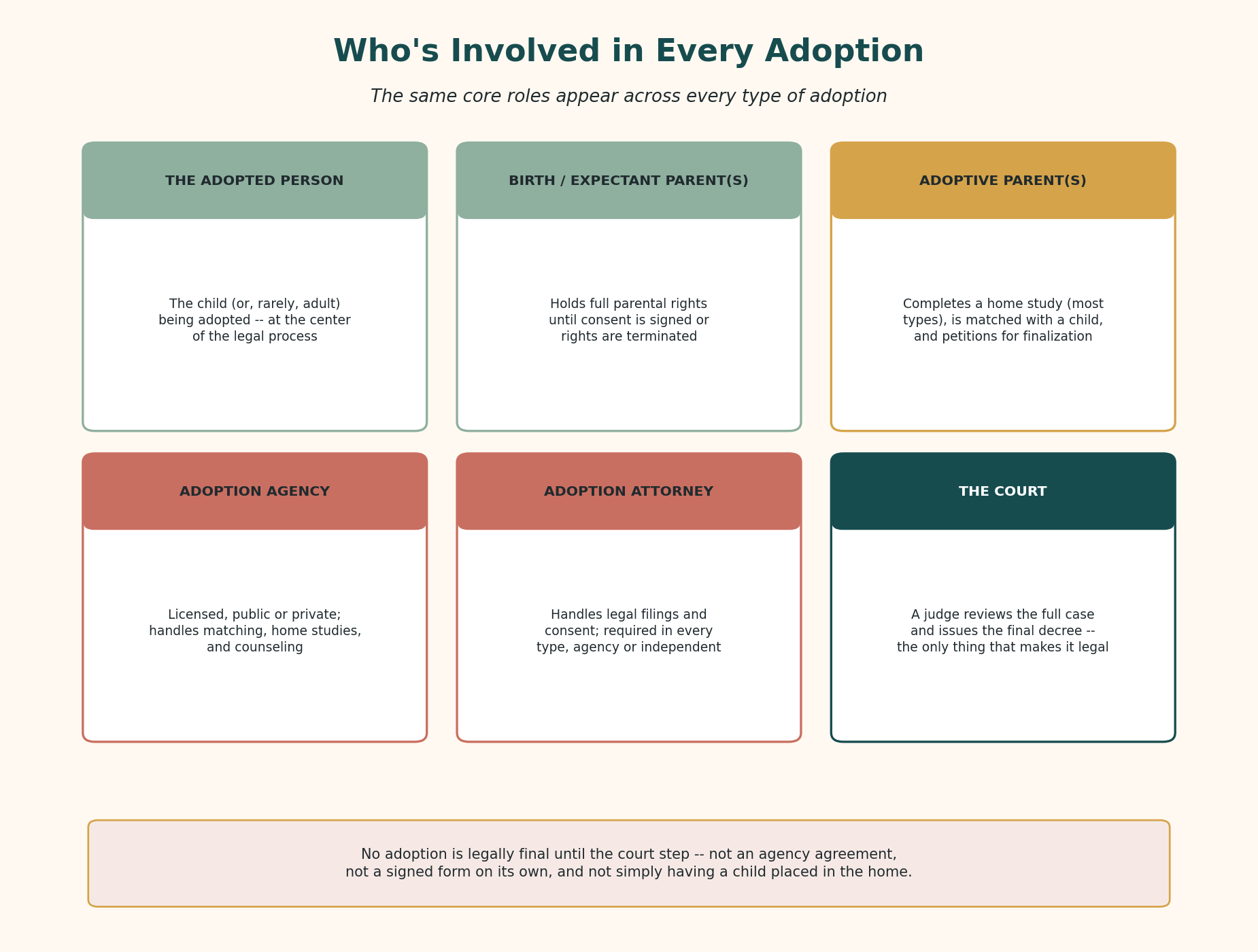
| Role | Who They Are | What They Actually Do |
|---|---|---|
| The adopted person | The child (or, in rare cases, the adult) being adopted | At the center of the legal process; has no decision-making role if a minor, though older children’s preferences are sometimes considered by the court |
| Birth or expectant parent(s) | The child’s existing legal parent(s) before adoption | Must consent to the adoption or have parental rights involuntarily terminated by a court before it can proceed |
| Adoptive parent(s) | The person or people who will become the child’s legal parent(s) | Complete a home study (in most types), are matched with or select a child, and petition the court for finalization |
| Adoption agency | A state-licensed organization (public or private, nonprofit or for-profit) | Handles matching, home studies, counseling, and compliance with state and federal adoption law |
| Adoption attorney | A lawyer licensed in the relevant state(s) | Handles the legal filings, represents one or more parties, and guides independent (non-agency) adoptions |
| The court | A state family or probate court and the judge presiding over the case | Reviews the full record and issues the final decree of adoption — the only thing that makes an adoption legally final |
The Three People at the Center
The Adopted Person (the Child or, Later, the Adult)
The child being adopted is, legally and practically, the reason the entire process exists, even though as a minor they typically have no formal decision-making role in it. Depending on the state and the child’s age, an older child may have their preferences considered by the court, and in some states a child above a certain age (often around 12 to 14, though this varies) must consent to their own adoption. The adopted person’s wellbeing, often phrased in law as their “best interest,” is the standard the court is ultimately required to apply when deciding whether to finalize an adoption.
The Birth Parent(s) or Expectant Parent(s)
Before birth or before a placement decision is finalized, the term “expectant parent” is the accurate and preferred one; “birth parent” (or “birth mother”/”birth father”) accurately applies only after a child has been placed for adoption. This isn’t just a style preference — it reflects that, up until the point of legal consent or a court’s termination of rights, this person holds full, unqualified parental rights, identical to any other parent’s. Our guide for expectant parents considering adoption goes deep on this side of the process; this article covers it only at the overview level needed to understand the whole system.
The Adoptive Parent(s)
Adoptive parents can be a married couple, a single adult, or, depending on the state and type of adoption, an unmarried couple; most states have moved away from older restrictions based on marital status, and Obergefell v. Hodges established marriage equality nationwide, which extended existing marital-adoption pathways to same-sex spouses as well. What’s actually required of a prospective adoptive parent — income, age, background checks, the home study — depends heavily on the type of adoption and the state; our dedicated adoption requirements guide and guide to adopting a child cover this in the depth this overview intentionally doesn’t.
The Professionals Who Make It Legally Happen
Adoption Agencies
A licensed adoption agency — public (state-run, typically handling foster care adoption) or private (nonprofit or for-profit, typically handling domestic infant and some international adoption) — manages much of the practical work: matching, home studies, pre- and post-placement counseling and supervision, and ensuring the process complies with state and, for international adoption, federal and treaty-based requirements. Agencies are licensed and regulated at the state level, and licensing requirements, services, and fee structures vary considerably from one agency to another.
Adoption Attorneys
An adoption attorney handles the legal side directly — drafting and filing consent and petition documents, representing a party’s interests, and guiding what’s sometimes called independent or attorney-led adoption, where no agency is involved. Even in agency-facilitated adoptions, a separate attorney is frequently involved to represent the adoptive parents, the birth parent, or both, since the agency itself generally does not provide individualized legal representation the way an attorney does.
Caseworkers and, in Foster Care, Guardians ad Litem
In foster care adoption specifically, a state or county caseworker manages the child’s case throughout their time in care, and a court-appointed guardian ad litem (GAL) or child advocate — often a volunteer through a program such as CASA (Court Appointed Special Advocates) — represents the child’s best interests independently of the parents, the state, and the adoptive family, reporting directly to the court.
The Court’s Role
The Judge Who Finalizes the Adoption
A judge in the appropriate state court — typically a family court, probate court, or a specialized juvenile/dependency court for foster care cases — presides over the finalization hearing, reviews the full record (consent or termination order, completed home study, any required reports), and either grants or, far less commonly, denies the petition for adoption. In most uncontested adoptions, this hearing is brief and often emotionally significant for the family, rather than adversarial.
Why the Court’s Involvement Is What Makes It Legally Real
Every other party in this list — agency, attorney, caseworker, even the adoptive and birth parents acting in full agreement — can complete every other step correctly and the adoption still isn’t legally final until the court says so. This single-point-of-finality design exists specifically to protect everyone involved: it gives the child’s best interest an independent check, it gives a birth parent a defined, legally reviewable process rather than an informal handshake, and it gives adoptive parents a legally unassailable basis for their parental rights going forward.
The Two Big Questions That Shape Every Adoption
Once you understand the shared legal skeleton and the cast of people involved, nearly every specific adoption can be understood by answering two questions: where does the child come from, and how is the adoption being arranged? The rest of this guide’s type-by-type sections are organized around the first question; a later section covers the second in depth.
Question One: Where Does the Child Come From?
A Domestic Newborn, a Child Already in Foster Care, or a Child From Another Country
This is the most common way adoption gets categorized, and it’s the organizing structure for the next several sections of this guide: domestic infant adoption (a U.S. newborn), foster care adoption (a child already in the U.S. child welfare system), and international adoption (a child who is a citizen of another country). Each involves a genuinely different legal framework, timeline, and typical cost structure, which is exactly why lumping them together as “adoption” in general conversation can be misleading.
A Relative’s Child, or a Spouse’s Child From a Prior Relationship
The other major way to categorize adoption is by the adoptive parent’s pre-existing relationship to the child rather than by the child’s origin: relative or kinship adoption (most often a grandparent, aunt, or uncle) and stepparent adoption (a spouse adopting their partner’s child). These two types can, in principle, overlap with any of the three “origin” categories above — a grandparent might adopt a grandchild who was in foster care, for instance — but they’re usually discussed as their own categories because the existing relationship changes so much about how the process actually unfolds.
Question Two: How Is the Adoption Arranged?
Through a Licensed Agency
Agency-facilitated adoption means a licensed public or private agency manages matching, screening, counseling, and much of the paperwork, in exchange for fees (in private domestic adoption) or, for public agency foster care adoption, generally at no direct cost to the adoptive family. This is the more structured and, for many first-time adoptive parents, more heavily guided path.
Independently, Through an Attorney or Facilitator
Independent adoption means the match between expectant/birth parent and adoptive family happens without an agency as the central coordinator — often through an attorney, a smaller network, personal connections, or, in some states, a licensed facilitator — with an attorney still required to handle the legal filing and consent process. This path is legal in most but not all states and comes with a different risk and responsibility profile than agency adoption, covered in its own section below.
Key Takeaways
- Nearly every adoption can be placed on a simple grid: where the child comes from (domestic newborn, foster care, international, a relative’s child, or a spouse’s child) crossed with how it’s arranged (agency or independent).
- The next five sections walk through each major “origin” type in turn; a later section covers the agency-versus-independent question in its own right.
- No type is inherently “better” — each fits different circumstances, and many people’s first real decision is simply which of these five doors to walk through.
Domestic Infant Adoption
Domestic infant adoption is what most people picture by default when they hear the word “adoption”: a U.S. expectant parent decides, sometime during pregnancy or shortly after birth, to place their newborn with an adoptive family, typically through a licensed agency or an adoption attorney.
What It Is
An Expectant Parent Plans, Before or Shortly After Birth, to Place a Newborn
In domestic infant adoption, the expectant parent — usually, though not always, working with a licensed adoption agency or attorney — reviews profile information on prospective adoptive families (sometimes called a “waiting family profile” or “Dear Birth Mother” letter) and selects one, or works with an agency to identify a good match based on preferences they specify. Legal consent, as covered in more detail later in this guide, cannot be signed until after the baby is born, no matter how far along the planning was beforehand.
How Common It Is
Private domestic adoptions (a category that includes both infant adoptions and a smaller number of older-child private placements, and excludes stepparent adoptions, which are tracked separately) have numbered in the range of roughly 25,000 per year in recent national estimates from the National Council For Adoption Demand from prospective adoptive parents has consistently exceeded the number of infants placed for adoption in any given year, which is part of why matching and waiting times can be longer than many first-time adoptive parents expect.
How It Typically Works, at a High Level
Matching and Waiting
After completing a home study, prospective adoptive parents are generally either presented to expectant parents as a profile option (through an agency) or make themselves known through an attorney, agency, or personal network (in independent adoption). Being “matched” — an expectant parent choosing or agreeing to a particular adoptive family — isn’t the same as placement or adoption; it’s an agreement to move forward together, and in most domestic infant adoptions, it’s understood on all sides that the expectant parent retains the right to change their mind at any point before signing consent after birth.
Hospital and Immediate Post-Birth Period
Many domestic infant adoptions include a hospital plan — an agreed-upon arrangement for who’s present at the birth, how much time the birth parent has with the baby, and what happens immediately afterward — developed in advance with the agency or attorney’s guidance. This period, along with the signing of legal consent and the start of any state-mandated waiting or revocation period, is covered in full step-by-step detail in our adoption process guide and in our guide for expectant parents considering adoption, which this overview deliberately doesn’t duplicate.
Who It Tends to Involve
A Licensed Agency or Adoption Attorney
The large majority of domestic infant adoptions involve either a licensed private adoption agency or an adoption attorney managing the legal and, often, much of the logistical work — informal, fully do-it-yourself domestic infant adoption without any licensed professional involved is both legally risky and, in most states, not how the required consent and home study steps can be lawfully completed.
An Expectant Parent Who Retains Real Choice
Modern domestic infant adoption practice, reflected in professional standards from organizations such as the National Council For Adoption, generally gives the expectant parent meaningful choice over the adoptive family, the degree of post-placement openness, and, up until legal consent, whether to proceed with adoption at all. This is a meaningful shift from historical adoption practice, where expectant parents often had far less information and far less control.
Where to Go Deeper
The Birth-Parent Side
If you’re an expectant parent and this type is the one you’re actually weighing, our complete guide to being pregnant and considering adoption is the right next stop — it covers the rights every expectant parent has, choosing a professional and an adoptive family, and what happens after placement, all at a depth this overview doesn’t attempt.
The Legal Mechanics
If you want the detailed, step-by-step legal timeline — consent timing, revocation periods, and finalization — our adoption process guide covers domestic infant adoption’s legal mechanics specifically, state-variable rules flagged rather than guessed at.
Foster Care Adoption (Foster-to-Adopt)
Foster care adoption is the adoption of a child whose birth parents’ parental rights have been, or are in the process of being, legally terminated by a court — most often after the child has spent time in the foster care system while the state attempted reunification with the birth family first.
What It Is
Adopting a Child Whose Parents’ Rights Have Already Been Terminated
Children become legally available for adoption from foster care only after a court terminates both parents’ rights (or a parent voluntarily relinquishes them), which under federal law generally happens only after the state has made reasonable efforts toward reunification and a judge has determined that returning the child home isn’t safe or appropriate. Once rights are terminated, the child’s case plan goal typically shifts to adoption, and the state (through its public child welfare agency) becomes legally responsible for finding an adoptive family.
“Foster-to-Adopt” as a Specific Pathway
“Foster-to-adopt” describes becoming licensed as a foster parent with the explicit goal of adopting a child placed with you, if and when that child becomes legally free for adoption. It’s distinct from fostering generally (where reunification, not adoption, is the default goal) and is usually pursued by families specifically interested in adopting rather than in fostering as an end in itself; many states also allow prospective adoptive parents to be matched directly with a child who is already legally free, without first fostering them.
How Many Children This Involves
National Numbers
According to the U.S. Department of Health and Human Services’ Administration for Children and Families, 46,935 children were adopted from foster care nationally in federal fiscal year 2024 (preliminary data), while roughly 70,400 children in foster care had adoption as their case plan goal as of the end of that fiscal year These are federal, government-collected numbers — the most reliable national figures available for any category of U.S. adoption.
Who These Children Tend to Be
Children waiting to be adopted from foster care span all ages, though older children, children in sibling groups who need to be placed together, and children with documented medical, developmental, or emotional needs are generally harder to place and wait longer on average than younger children without documented needs. States and many private agencies maintain photo-listing services specifically to help find families for children who’ve waited longest.
How It Typically Works, at a High Level
Licensing as a Foster Parent First
For families pursuing the foster-to-adopt path, the first step is becoming a licensed foster parent through the state or a contracted private agency — a process that includes a home study, background checks, and state-mandated training (often called PRIDE, MAPP, or a similarly named curriculum depending on the state), generally less expensive and, in many respects, less extensive than a private domestic infant adoption home study, though the exact requirements vary by state.
From Placement to Adoption Finalization
A child is placed in a licensed home as a foster placement first; if and when the court terminates the birth parents’ rights and determines that family is the right permanent placement, the case transitions toward an adoption finalization hearing, often (though not always) with a required post-placement supervision period first. Our adoption process guide covers this transition and the typical timeline in detail; this overview is limited to the big picture.
Cost and Support Differences From Other Types
Lower Direct Cost, Often
Foster care adoption is generally the least expensive of the main adoption types for the adoptive family, since it’s facilitated by a public agency; many of the typically significant costs associated with private domestic infant or international adoption (agency matching fees, in particular) generally don’t apply in the same way. Our adoption cost guide covers the real range in detail; this overview flags only that the difference is substantial.
Adoption Assistance (Subsidy) Programs
Many children adopted from foster care qualify for adoption assistance (sometimes called adoption subsidy), a federal-and-state-funded program that can provide ongoing monthly payments, Medicaid coverage, and other support, recognizing that many of these children have documented needs that come with real, ongoing costs. Eligibility and benefit levels are state-specific
International (Intercountry) Adoption
International, or intercountry, adoption is the adoption of a child who is a citizen of a country other than the United States, through a process that must satisfy both U.S. federal law and the laws of the child’s country of origin — and, for most countries, an international treaty as well.
What It Is
Adopting a Child Who Is a Citizen of Another Country
In an intercountry adoption, a U.S. family adopts a child from abroad, which requires satisfying immigration requirements (so the child can lawfully enter and reside in the U.S.), the adoption law of the child’s country of origin, and, in most cases, the Hague Adoption Convention’s procedural safeguards, all at the same time.
The Hague Adoption Convention
The Hague Convention on Protection of Children and Co-operation in Respect of Intercountry Adoption is a multinational treaty, implemented in the U.S. through the Intercountry Adoption Act, that establishes shared procedural safeguards — including background checks, accredited agency involvement, and standards intended to prevent child trafficking — between the U.S. and other member countries. Adoptions from a Hague member country follow the treaty’s process; adoptions from a non-member country follow a separate, generally less standardized federal immigration process.
Why It Has Changed So Much
The Numbers Then and Now
International adoptions to the United States peaked at 22,988 in fiscal year 2004, according to U.S. Department of State records, and have fallen dramatically since — to 1,275 in fiscal year 2023, a decline of roughly 94 percent from the peak This isn’t a U.S.-specific trend; many other receiving countries have seen comparable declines over the same period.
Why the Decline Happened
Several factors have driven this shift: many countries have strengthened domestic child welfare and in-country adoption systems (reducing the number of children considered eligible for intercountry placement), Hague Convention implementation added procedural requirements intended to prevent abuse, and several major countries (including, at different points, Russia, Guatemala, and others) significantly restricted or suspended intercountry adoption programs entirely, sometimes with little advance notice to families already in process.
How It Typically Works, at a High Level
Two Legal Systems at Once
A prospective adoptive parent must generally complete a home study and be approved both by U.S. immigration authorities (through U.S. Citizenship and Immigration Services, which issues approvals that allow a child to immigrate for adoption purposes) and by the adoption authority of the child’s country of origin, typically with a Hague-accredited agency coordinating both sides of the process simultaneously.
Travel and Immigration Steps
Most intercountry adoptions require at least one, and often two, trips to the child’s country of origin, along with an immigrant visa process before the child can enter the United States; depending on the specific visa category and country, the adoption may be finalized abroad, in the U.S. afterward, or both. This dual-track legal process is a major reason intercountry adoption tends to take longer and involve more total cost than other types, covered in broad terms later in this guide and in detail in our adoption cost guide and adoption process guide.
What to Know Before Considering It
It’s Often the Most Expensive and Longest Path
Between the home study, Hague-accreditation-related agency fees, country-specific program fees, and international travel, intercountry adoption is generally the highest-cost adoption type, often substantially so, and timelines can run considerably longer than domestic options, with significant year-to-year and country-to-country variability.
Country-Specific Rules Change Often
Which countries have active, open intercountry adoption programs — and under what specific eligibility rules — changes more frequently than domestic adoption law does, since it depends on both bilateral diplomatic relationships and the other country’s own domestic policy choices. Anyone seriously considering this path should treat country-specific program information as something to confirm directly and currently with a Hague-accredited agency or the State Department’s intercountry adoption office, not something to rely on from any single article, including this one.
Relative and Kinship Adoption
Relative adoption — often used interchangeably with the broader term kinship adoption — is a family member, most commonly a grandparent, aunt, uncle, or adult sibling, legally adopting a child they are often already caring for in some capacity.
What It Is
A Grandparent, Aunt, Uncle, or Other Relative Adopts
When a child’s parents are unable to care for them — due to death, incarceration, substance use, or a child welfare finding — a relative sometimes steps in, and that arrangement can, under the right legal circumstances, become a formal adoption rather than a less permanent custody or guardianship arrangement. Grandparent adoption is common enough that some states and organizations (including AARP) maintain resources specifically for grandparents navigating this process.
Kinship Care vs. Kinship Adoption
“Kinship care” describes a relative caring for a child, often informally or through a state child welfare placement, without necessarily having adopted them; “kinship adoption” describes the subset of those situations where that relationship becomes legally permanent through a finalized adoption. Many kinship caregivers choose guardianship instead of adoption, for reasons ranging from wanting to preserve the birth parent’s legal relationship to differences in available financial support between the two legal statuses — a choice worth discussing specifically with a family law attorney rather than assuming one option is automatically better.
Why Families Choose This Path
Keeping a Child Within the Family When Parents Cannot Care for Them
For many families, relative adoption is less about a deliberate “choice” among adoption types and more about an existing family member stepping into a permanent caregiving role that’s already, in practice, underway — formalizing a relationship that already exists rather than creating an entirely new one.
Often Connected to the Foster Care System
A substantial share of relative adoptions happen through, or alongside, the foster care system — a grandparent or aunt becomes a licensed kinship foster placement for a child already in state care, and later adopts once parental rights are terminated — which means much of what the foster care adoption section above describes about licensing, the court process, and adoption assistance can also apply to relative adopters working through that system.
How It’s Different From Other Types
The Child and Adoptive Parent Already Have a Relationship
Unlike domestic infant, foster care (from a stranger placement), or international adoption, relative adoption usually doesn’t involve a “matching” process at all — the relationship predates the adoption decision, which changes the emotional and practical shape of the process considerably, even though the legal requirements (consent or termination of the birth parents’ rights, and court finalization) still apply in full.
Legal Process Can Be Simpler, but Isn’t Automatically Simple
Many states streamline certain requirements for relative adopters — sometimes a modified or waived home study, for example — but relative adoption is not automatically faster or less legally involved than other types, especially if a birth parent contests the adoption, if there are competing relatives, or if the child was not previously in the state’s foster care system.
Stepparent Adoption
Stepparent adoption is a spouse legally adopting their husband’s or wife’s child from a previous relationship, formally establishing the same legal parental relationship the biological or already-adoptive parent has.
What It Is
A Spouse Adopts Their Spouse’s Child
In a stepparent adoption, the person adopting is already living with and often functioning, day to day, as a parent to the child — the adoption formalizes that existing role legally, giving the stepparent the same rights (decision-making authority, the ability to consent to medical care, standing in custody matters) and the same obligations (financial support) as any other legal parent, and generally making the child eligible to inherit from the stepparent the same way a biological child would.
How Common It Is
Stepparent adoptions are a significant share of all U.S. adoptions finalized each year — national estimates from the National Council For Adoption have put stepparent adoptions at roughly half of all private adoptions in recent years — which makes this one of the most common, if least discussed, types of adoption in the country.
What Makes It Legally Distinct
Often a Simplified Home Study or None at All
Because the stepparent is already a known, vetted part of the child’s household through marriage, many states waive or significantly simplify the home study requirement for stepparent adoptions compared to what’s required for domestic infant, foster care, or international adoption — though “simplified” varies considerably by state, and some states still require at least a basic background check or abbreviated assessment.
The Other Legal Parent’s Rights Still Matter
A stepparent adoption still legally requires either the other legal parent’s voluntary consent to terminate their own parental rights, or a court’s involuntary termination of those rights (most often for abandonment or a documented failure to support or maintain contact with the child) — a stepparent cannot adopt simply because the custodial parent and stepparent both want it, if the other legal parent objects and hasn’t otherwise lost their parental rights. This is frequently the most legally and emotionally complex part of an otherwise comparatively simple process.
What to Expect
Marriage-Length and Residency Requirements
Some states require the stepparent to have been married to the child’s parent for a minimum period, or for the child to have lived in the household for a minimum period, before a stepparent adoption petition can be filed; others have no such requirement.
Consent or Termination of the Other Parent’s Rights
When the non-custodial legal parent is willing to consent, stepparent adoption is often one of the more straightforward adoption types to complete; when that parent objects, is unreachable, or has an unclear legal status (for instance, a father whose paternity was never legally established), the case can require the same kind of notice, search, and termination-of-rights process used in contested adoptions generally, which our adoption process guide and birth father rights guide cover at the depth this overview doesn’t.
Key Takeaways
- Domestic infant, foster care, and international adoption are distinguished mainly by where the child comes from; relative/kinship and stepparent adoption are distinguished mainly by the adoptive parent’s existing relationship to the child.
- Foster care adoption (46,935 children nationally in FFY2024) and domestic infant adoption (roughly 25,000 private domestic adoptions annually) are both tracked at the national level, while international adoption has fallen roughly 94% from its 2004 peak.
- Stepparent and relative adoptions typically involve an existing relationship rather than a matching process, which changes both the timeline and the emotional shape of the process considerably.
The Five Main Types, Side by Side — Plus a Few Others You May Encounter
With all five main types now covered individually, it’s useful to see them side by side on the same terms, and then to briefly note a few additional, less common categories you may run across while researching adoption.

| Type | Child’s Situation | How It’s Typically Arranged | Relative Cost Level |
|---|---|---|---|
| Domestic infant | A U.S. newborn whose expectant parent is making an adoption plan | Licensed private agency or adoption attorney | Moderate to high |
| Foster care | A child already in the U.S. foster care system whose parents’ rights are terminated or being terminated | Public (state) child welfare agency, sometimes with a contracted private agency | Low, often near $0 to the adoptive family |
| International | A child who is a citizen of another country | Hague-accredited agency, plus U.S. and foreign-country legal processes | High to very high |
| Relative/kinship | A child already related to the adoptive parent | Often through the foster care system, or privately with an attorney | Low to moderate; may qualify for reduced requirements |
| Stepparent | A spouse’s child from a prior relationship | Directly through an attorney, usually without a full agency process | Low to moderate |
Reading the Comparison Without Ranking the Options
Each Type Fits Different Circumstances
Which type applies to a given adoption is usually determined by circumstance rather than open choice — most people don’t pick among all five the way they’d pick a product; a stepparent adopts the child they’re already raising, a family already related to a child in crisis considers relative adoption, and someone with no existing connection to a specific child typically chooses among domestic infant, foster care, and international adoption based on their own preferences, resources, and timeline.
None Is a “Default” or “Fallback”
It’s worth saying directly: foster care adoption is not a lesser or “backup” version of domestic infant adoption, and international adoption is not inherently more prestigious or more complete than either. Each type creates an equally legally permanent, equally real parent-child relationship once finalized — the differences described throughout this guide are about process, origin, and circumstance, not about the legitimacy or completeness of the resulting family.
A Few Other Types You May Encounter
Adult Adoption
Most U.S. states allow the adoption of a legal adult (typically 18 or older), most often used to formalize a long-standing parent-child-like relationship (such as a former foster child who “aged out” of care while still connected to a family, or a stepchild who was never formally adopted as a minor), to establish inheritance rights, or in some family caregiving contexts. Adult adoption generally requires the adult being adopted to consent personally, since there’s no “best interest of the child” standard protecting someone who is legally able to make their own decisions.
Embryo Adoption/Donation
Embryo adoption (also called embryo donation) involves a person or couple with remaining frozen embryos from fertility treatment donating them to another person or couple, who then carries the resulting pregnancy. Despite the common name, this is generally governed by contract and reproductive-technology law rather than the child-welfare-based adoption law described throughout the rest of this guide, since no living child exists yet at the time of the donation agreement; terminology and legal treatment vary, and some professionals prefer “embryo donation” for exactly this reason.
Second-Parent and Same-Sex Co-Parent Adoption
Confirming Legal Parentage for a Non-Biological Parent
Second-parent adoption lets a same-sex (or, less commonly, different-sex unmarried) co-parent who is not biologically or legally related to a child adopt that child to confirm legal parentage, without terminating the other parent’s existing rights — distinct from stepparent adoption in that it generally doesn’t require marriage, though in practice many same-sex parents are now married and some instead use the marital stepparent-adoption pathway.
Why This Still Matters Even With Marriage Equality
Since Obergefell v. Hodges (2015) established nationwide marriage equality, and since many states now offer simplified parentage-establishment options for married same-sex couples (sometimes without requiring a formal adoption at all), some families assume a formal second-parent or stepparent adoption is no longer necessary. Many family law attorneys still recommend it as a belt-and-suspenders legal protection, particularly for interstate travel, situations involving assisted reproduction, or any circumstance where a presumption of parentage might later be challenged.
Agency-Facilitated vs. Independent (Attorney-Led) Adoption
Beyond where a child comes from, the other major fork in how adoption works is who coordinates the process: a licensed agency, or an independent arrangement typically led by an attorney.
Working With a Licensed Adoption Agency
What an Agency Typically Handles
A licensed agency generally manages matching (presenting adoptive family profiles to expectant parents, or vice versa), conducts or coordinates the home study, provides counseling to the expectant or birth parent, coordinates medical and, in many states, living-expense support within legal limits, and manages post-placement supervision requirements before finalization.
Public vs. Private Agencies
Public agencies are run by state or county government and primarily handle foster care adoption, generally at no direct cost to the adoptive family; private agencies are independently run (as nonprofits or, in some states, for-profit businesses), licensed by the state, and primarily handle domestic infant and some international adoption, typically charging fees that cover their services. Confirming a private agency’s state licensing status directly, rather than taking their own marketing materials at face value, is a reasonable and commonly recommended first step before working with one.
Independent (Attorney-Led) Adoption
What an Adoption Attorney Typically Handles
In an independent adoption, an attorney handles the legal filings and consent process directly, while matching happens outside a formal agency structure — sometimes through the attorney’s own network, sometimes through the adoptive family’s own outreach, and sometimes through a licensed facilitator (covered next). Independent adoption is legal in most, but not all, states; a few states require agency involvement for some or all steps.
When Independent Adoption Is and Isn’t a Good Fit
Independent adoption can mean more direct control and sometimes lower overall fees for adoptive parents, but it also means less built-in counseling support for the expectant parent and more responsibility on the adoptive family and attorney to ensure every legal requirement is properly met, since there’s no agency structure providing that oversight by default. Families considering this route are generally advised to work with an attorney who specifically and regularly practices adoption law, not a general-practice attorney handling their first adoption case.
Facilitators and Why They’re a Different Category
What a Facilitator Does (and Doesn’t) Do
An adoption facilitator is a person or organization that helps connect expectant parents and prospective adoptive families — essentially a matching service — without being a licensed adoption agency and generally without providing the counseling, legal, or oversight functions an agency or attorney provides.
Why Some States Restrict or Ban Facilitators
Because facilitators historically operated with less regulatory oversight than agencies or attorneys, several states restrict or prohibit for-profit facilitation specifically; where facilitators are legal, a licensed attorney is still required to handle the actual legal consent and filing process.
Openness: Where Contact Fits Into Any Type of Adoption
Separate from which of the five main types applies, every adoption also sits somewhere on a spectrum of openness — how much contact and information the birth family and adoptive family share, both around the time of placement and for years afterward.
Open, Semi-Open, and Closed Adoption
What Each Term Means
Open adoption generally involves ongoing, direct contact between the birth and adoptive families — visits, calls, or other regular communication, in whatever form both sides agree to. Semi-open (sometimes called “mediated”) adoption typically involves indirect contact, such as letters, photos, or updates exchanged through an agency rather than directly. Closed adoption involves no ongoing contact and no identifying information shared between the families after placement. Our dedicated open adoption guide and closed adoption guide cover what each actually looks like in practice, how agreements are typically structured, and what to know before committing to one, in far more depth than this overview attempts.
Why Fully Closed Adoptions Are Less Common Today
Most domestic infant adoptions today involve at least some degree of openness, reflecting both a broader shift in professional adoption practice and research suggesting many adopted people, birth parents, and adoptive parents benefit from some ongoing connection or at least access to information, though preferences genuinely vary and no single arrangement fits every family.
Openness Is a Dimension, Not a Type
Any of the Five Main Types Can Be More or Less Open
Openness isn’t exclusive to domestic infant adoption — foster care adoptions sometimes include ongoing contact with birth relatives or siblings, international adoptions occasionally involve some contact with birth family where circumstances allow, and relative or kinship adoptions, by their nature, often involve the most ongoing contact of any type, simply because the families were already connected.
Agreements Are Not Always Legally Enforceable the Same Way Everywhere
Whether a post-adoption contact agreement is legally enforceable — meaning a court could compel compliance if one side stops honoring it — varies significantly by state; some states have specific statutes authorizing enforceable agreements, while in others, openness arrangements are more of a good-faith understanding than a legally binding contract.
Key Takeaways
- Beyond the five main types, a few less common categories exist — adult adoption, embryo donation, and second-parent adoption chief among them — each governed by somewhat different legal frameworks.
- Adoptions can be arranged through a licensed agency or independently (usually attorney-led); neither path is inherently better, though each carries a different balance of structure, cost, and built-in support.
- Openness — how much contact birth and adoptive families maintain — is a separate dimension from adoption type, and most domestic infant adoptions today involve at least some degree of it.
The Adoption Journey, From the Expectant or Birth Parent’s Side
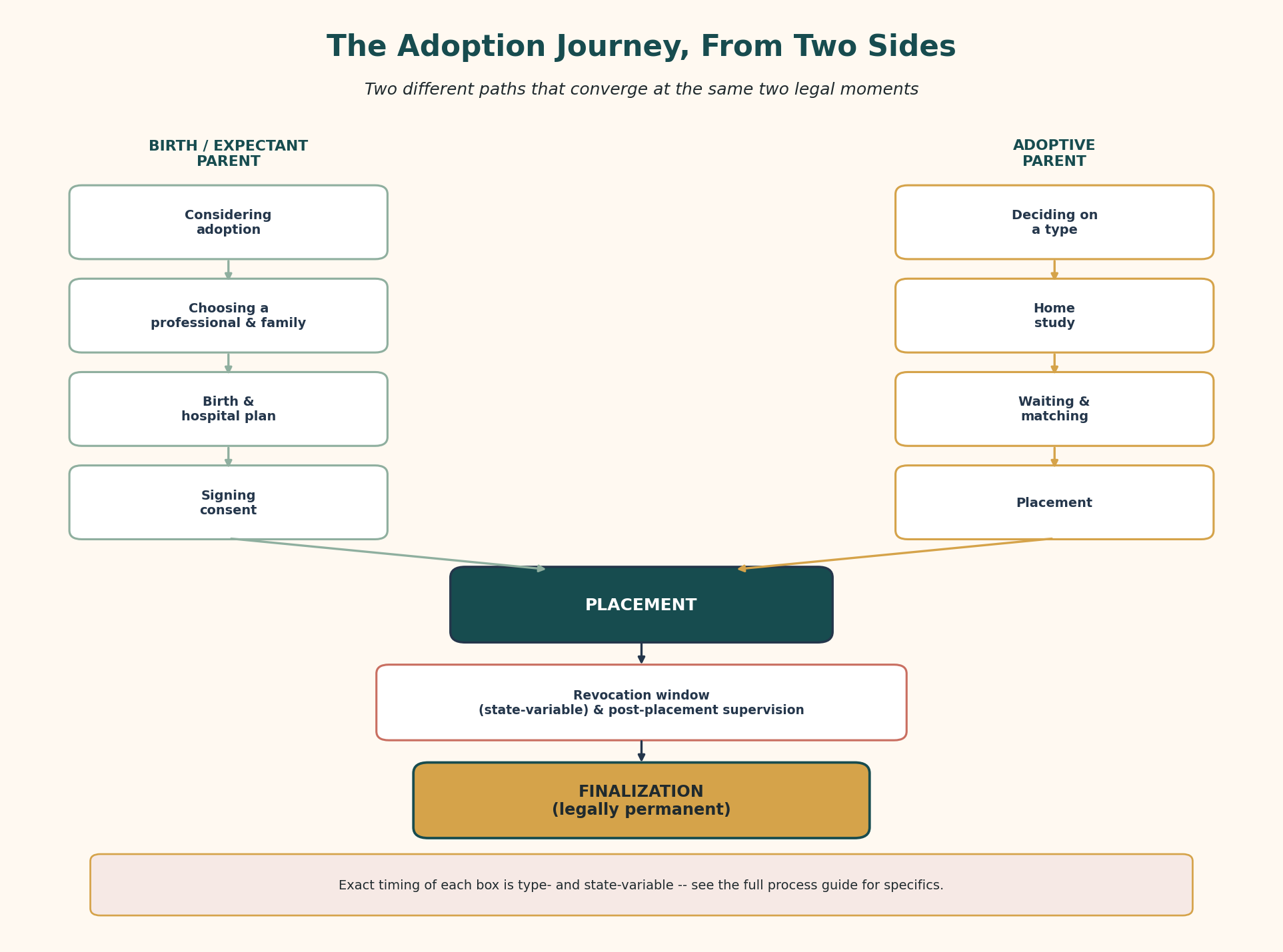
Having covered types and arrangements, it’s worth stepping back and walking through what the overall experience tends to look like from each side of the adoption — starting with the expectant or birth parent. This is a summary, not a substitute for the dedicated guides it links to throughout.
Before Birth
Considering the Decision
For most expectant parents, adoption is one of several paths being weighed, often alongside parenting and, depending on timing and personal values, abortion — a decision our unplanned pregnancy guide covers as a genuinely neutral, three-way framework, and our adoption versus parenting guide covers specifically for someone weighing those two paths against each other. This guide doesn’t repeat that decision-support content; it assumes you’re past that question or want to understand adoption specifically, regardless of where you land on it.
Choosing a Professional and, Often, a Family
Once adoption is the direction being pursued, an expectant parent typically connects with a licensed agency or an adoption attorney, and — in most domestic infant adoptions — reviews information on prospective adoptive families and selects one, or works with the agency to narrow the field based on stated preferences. Our guide for expectant parents considering adoption covers choosing a professional, choosing a family, and the full list of rights an expectant parent has throughout this process in complete detail.
Around Birth
The Hospital Period
Many expectant parents work with their agency or attorney in advance to create a hospital plan, covering who’s present, how much time they want with the baby, and what the immediate post-birth period looks like — a deeply personal set of decisions that the expectant parent generally controls.
Signing Consent
Legal consent to an adoption cannot be signed until after the child is born — in every U.S. state, there is some minimum waiting period after delivery before consent can be legally executed, though the exact minimum varies by state. Up until the moment consent is actually signed, the expectant parent retains full, unqualified parental rights. The specific legal rules governing consent, by state, are covered in our adoption process guide and our birth mother rights and birth father rights guides, not here.
After Placement
The Revocation Period
After consent is signed, most — though not all — states provide a further window during which the birth parent can revoke that consent and reclaim parental rights before the adoption is finalized in court; the length of this window varies enormously by state, from none in some states to a period of days or weeks in others.
Finalization and, Often, Ongoing Contact
Once any revocation period closes without revocation, the case proceeds toward court finalization, after which the birth parent’s rights are permanently and completely terminated. For birth parents in an open or semi-open arrangement, this isn’t necessarily the end of the relationship with the child or adoptive family — just the end of the legal parent-child relationship specifically; our open adoption guide covers what ongoing contact tends to look like in practice.
The Adoption Journey, From the Prospective Adoptive Parent’s Side
The same overall legal skeleton looks different from the adoptive parent’s vantage point, with its own distinct early stages — most notably, becoming approved to adopt in the first place.
Getting Ready
Deciding Which Type of Adoption to Pursue
Many prospective adoptive parents start by deciding among domestic infant, foster care, international, or, where applicable, a relative or stepchild already in their life — a decision shaped by cost, timeline tolerance, preference around the child’s age, and personal values, with no universally “right” choice among them. Our guide to adopting a child walks through this decision in more depth than this overview does.
The Home Study
With the exception of some stepparent and relative adoptions, nearly every adoptive parent must complete a home study — an assessment process involving interviews, background checks, a home visit, and often required training, conducted by a licensed social worker or agency — before being approved to adopt. Specific home study requirements vary by state, by agency, and, for international adoption, by the child’s country of origin; our dedicated adoption home study guide covers exactly what’s involved, and our adoption requirements guide covers who’s eligible to adopt at all, both at a level of detail this overview intentionally skips.
Waiting and Matching
What “Waiting” Looks Like
After a home study is approved, adoptive parents typically enter a waiting period whose length depends heavily on the type of adoption, their own stated preferences (for instance, openness to a wider age range or to a child with documented medical needs often shortens the wait), and, for foster care and international adoption specifically, how many children are currently in need of placement that match the family’s approval.
Being Matched or Selected
In domestic infant adoption, being “matched” generally means an expectant parent has chosen or agreed to move forward with that family; in foster care adoption, a caseworker generally identifies and proposes a potential match based on the child’s needs and the family’s approved profile; in international adoption, a country’s adoption authority typically proposes (“refers”) a specific child match to the family.
Placement to Finalization
The Placement Period
Placement — the child physically moving into the adoptive family’s home — is a distinct legal event from finalization, and in most types, a required post-placement supervision period follows, during which a social worker checks in (through required visits) to confirm the placement is going well before the adoption can be finalized.
Finalization in Court
Once any required waiting and supervision periods are satisfied, the adoptive parents’ attorney files a petition for adoption, and a judge reviews the full record at a finalization hearing — typically a brief, often celebratory proceeding in uncontested cases — after which the adoption is legally permanent and the adoptive parents are the child’s full legal parents in every respect. Our adoption process guide covers this entire sequence, type by type, in complete step-by-step detail.
Key Takeaways
- From the birth-parent side, the key legal moments are: consent (only after birth), any revocation window, and finalization — each covered in full in our adoption process guide and birth mother/birth father rights guides.
- From the adoptive-parent side, the key stages are: the home study, waiting and matching, placement, and finalization — covered in full in our home study and requirements guides.
- The two tracks run in parallel and converge at the same two legal moments: placement and finalization.
The Overall Timeline, Zoomed Out
“How long does adoption take?” doesn’t have one answer, because the honest response depends heavily on which type of adoption you’re asking about and which state’s law applies. This section gives the zoomed-out shape; the real, detailed timeline work happens in a dedicated guide.

| Type | What Tends to Move Fastest | What Tends to Add Time |
|---|---|---|
| Domestic infant | Home study, once started, is often completed in a matter of months | Waiting for a match can range widely; no guaranteed timeline exists |
| Foster care | No agency matching fee process to wait on; many children are already waiting | Court scheduling and any required post-placement supervision period |
| International | Varies by country; some programs move faster than others | Dual legal systems, travel requirements, and country program changes |
| Relative/kinship | No matching process; the relationship already exists | Court processes if a birth parent contests, or if paternity is unclear |
| Stepparent | No home study in many states; no matching process | Locating, notifying, or terminating the rights of an absent legal parent |
Why “How Long Does Adoption Take” Doesn’t Have One Answer
It Depends on the Type
As Table 3 shows, each type has a genuinely different typical shape — some types mostly depend on waiting for a match, others mostly depend on court and legal scheduling, and others depend heavily on a foreign country’s own administrative pace. Averaging across types to produce a single “adoption takes X months” figure would misrepresent all of them.
It Depends on the State
Within any given type, state law independently affects timing — required waiting periods before consent, revocation window length, how quickly local courts schedule finalization hearings, and, for foster care specifically, how a given state or county’s caseload affects case processing speed, all vary.
The Rough Shape, Type by Type
Faster-Moving Paths
Stepparent and some relative adoptions, where there’s no matching process and often no full home study, tend to move through the legal steps fastest once a petition is filed — though “fastest” here refers to procedural steps, not to emotional readiness or any birth parent’s own timeline for a decision.
Slower-Moving Paths
International adoption, with its dual legal systems and travel requirements, and domestic infant or foster care adoptions involving a longer wait for a match, tend to take the most total calendar time, start to finish — sometimes well over a year, with considerable variability even within the same type.
Where the Real, Detailed Timeline Lives
Week-by-Week and Step-by-Step Detail
Our adoption process guide is built specifically to walk through each type’s actual sequence of steps, with state-variable timing flagged rather than guessed at — this overview is intentionally limited to the shape, not the specifics.
What Can Speed Things Up or Slow Them Down
Factors like openness to a broader range of a child’s age, background, or needs; working with an experienced agency or attorney; and, for international adoption, choosing a country with a currently well-functioning program can meaningfully affect how long a given adoption takes — all covered, with appropriate nuance, in our dedicated process guide.
What Adoption Costs, in Broad Strokes
Cost is one of the most-asked questions about adoption, and one of the most type-dependent — the honest range runs from close to nothing to well into the tens of thousands of dollars, depending almost entirely on which type and arrangement you’re looking at.
| Type | Who Typically Pays | Broad Cost Band to the Adoptive Family |
|---|---|---|
| Domestic infant | Adoptive family (agency/attorney fees, often plus permitted birth-parent expenses) | Moderate to high |
| Foster care | Largely absorbed by the public system; minimal direct cost to the family | Low, often near $0 |
| International | Adoptive family (agency, country program, and travel costs) | High to very high |
| Relative/kinship | Varies; often court filing fees and modest legal costs only | Low to moderate |
| Stepparent | Adoptive parent (attorney and filing fees, generally no agency fee) | Low to moderate |
Why Cost Varies So Much by Type
Who Typically Pays What
In domestic infant and international adoption, the adoptive family typically bears the large majority of costs — agency or attorney fees, and, in domestic infant adoption, often the expectant parent’s pregnancy-related medical and, in many states, reasonable living expenses, within legal limits designed to prevent the arrangement from resembling payment for a child. In foster care adoption, the public system absorbs most costs; the birth parent is generally not a source of payment in any legal adoption, in any type.
What Drives the Difference
Cost differences mainly track the amount of professional labor, legal complexity, and (for international adoption) international travel and dual-country bureaucracy involved — not the “value” or completeness of the resulting family, and not, in a legal adoption, a payment for the child itself, which is illegal in every U.S. state regardless of adoption type.
Broad Ranges, Not a Quote
Lower-Cost Paths
Foster care adoption is, in broad terms, the lowest-cost path for an adoptive family, and stepparent and many relative adoptions are also comparatively low-cost, since they typically involve legal fees alone, without agency matching fees.
Higher-Cost Paths
Domestic infant and especially international adoption carry the widest and highest cost ranges, with significant variation by agency, state, and (for international adoption) country program. Our dedicated adoption cost guide is where the real, current figures and fee categories live — this overview deliberately stops at the broad-strokes level.
Help Paying for Adoption
The Federal Adoption Tax Credit
The federal government offers an adoption tax credit intended to offset qualified adoption expenses, available (with some restrictions) across most of the types described in this guide. Specific credit amounts, income phase-outs, and qualifying-expense rules change periodically and are covered in full, current detail in our adoption tax credit guide, not here.
Employer Benefits and Grants
A growing number of U.S. employers offer adoption-assistance benefits (partial reimbursement of adoption expenses), and numerous nonprofit organizations offer adoption grants or interest-free loans, particularly for domestic infant and international adoption’s higher cost ranges; our cost guide maintains a more complete overview of these resources.
The Legal Safeguards Built Into the Adoption Process
Adoption’s legal structure exists specifically to protect three parties whose interests don’t always naturally align on their own: the child, the birth parent(s), and the adoptive parent(s). Understanding the safeguards at a conceptual level helps make sense of why the process looks the way it does, even before getting into state-specific detail.
Protections for Birth Parents
Consent Cannot Be Given Before Birth
Every U.S. state requires that legal consent to an adoption be signed after the child is born, not during pregnancy — a safeguard against a birth parent being pressured into an irrevocable decision before they’ve met the child or fully experienced the birth. This rule is universal even though the specific waiting period after birth before consent can be signed varies by state.
A Revocation Window, in Most States
Most states provide some window after consent is signed during which a birth parent can still change their mind — though, as noted earlier in this guide, the length varies enormously and a small number of states provide none at all. Our birth mother rights and birth father rights guides cover these protections, state-variability and all, in the depth this overview intentionally doesn’t.
Protections for the Child
The Court’s Best-Interest Standard
Courts are generally required to evaluate adoption petitions against the child’s best interest, an independent legal standard that exists separately from what either the birth parents or adoptive parents want — in principle, a court can decline to finalize an adoption if it isn’t satisfied this standard is met, even where both sides agree.
Background Checks and the Home Study
The home study process, covered in overview earlier in this guide and in full detail in our adoption home study guide, exists specifically to screen adoptive households for safety before a child is placed — including criminal background checks, child-abuse registry checks, and, often, health and financial assessments.
Protections for Adoptive Parents
Finalization Makes It Permanent
Once an adoption is finalized, adoptive parents generally cannot have their parental rights unilaterally challenged or reversed the way, say, a custody arrangement might be revisited — this permanence is itself a safeguard, giving adoptive families the same legal stability any biological family has.
The ICPC for Interstate Placements
When a child is placed across state lines — common in both domestic infant and foster care adoption — the Interstate Compact on the Placement of Children (ICPC) requires approval from both the sending and receiving state’s child welfare authorities before the placement occurs, adding a procedural safeguard (and, often, real time) to interstate cases specifically. Our pregnancy options legal-landscape guide covers the ICPC, along with the related UCCJEA custody-jurisdiction framework, in dedicated detail; this overview flags only that it exists and matters.
Key Takeaways
- Adoption’s legal structure builds in safeguards for three parties at once: the birth parent (post-birth consent and, in most states, a revocation window), the child (the court’s best-interest standard and the home study), and the adoptive parent (permanence once finalized, and the ICPC for interstate placements).
- Cost and timeline both vary enormously by type — foster care adoption is generally lowest-cost, international adoption generally highest, and no fee paid speeds up a legally set waiting or revocation period.
- For the exact figures and state-specific rules behind these broad patterns, see our adoption cost, adoption tax credit, and adoption process guides.
How Adoption Compares to Parenting and to Other Paths
Understanding how adoption works doesn’t answer whether it’s the right path for any particular person — that’s a separate, deeply individual question this guide isn’t built to answer, though several of our other guides are.
If You’re an Expectant Parent Weighing Adoption Against Parenting
The Decision Isn’t Reversible the Same Way
As covered throughout this guide, parenting decisions remain changeable in ways a finalized adoption generally does not — which is exactly why this site treats the decision itself, not just the adoption mechanics, as its own dedicated topic rather than folding it into an “how adoption works” overview.
Where to Think This Through
Our adoption versus parenting guide is built specifically to help an expectant parent weigh these two paths against each other, and our unplanned pregnancy guide covers the full three-way decision (parenting, adoption, and abortion) at genuine parity — both are the right next stop if you’re still deciding, rather than trying to extract a decision framework from this article, which isn’t built to provide one.
If You’re Weighing Adoption Against Other Family-Building Paths
Foster Care, Fertility Treatment, and Adoption Are Different Roads
For someone hoping to become a parent, adoption is one of several possible paths alongside fertility treatment, surrogacy, or long-term fostering without a specific adoption goal — each with different costs, timelines, emotional considerations, and legal frameworks that this guide, focused specifically on how adoption itself works, doesn’t attempt to compare against non-adoption alternatives in depth.
There’s No Universally “Better” Path
Just as no single type of adoption is inherently superior to another, no single family-building path is inherently superior to the others — what fits depends on circumstances, values, timeline, and resources that vary enormously from one prospective parent to the next.
Common Mistakes and Misconceptions About How Adoption Works
A number of persistent misconceptions about adoption circulate in casual conversation, television, and even some older written material — worth naming directly, since several of them can lead to genuinely poor decisions if taken at face value.
Misconceptions About Birth Parents
“Birth Parents Give Up All Say in the Process”
In modern domestic infant adoption practice specifically, expectant parents typically retain meaningful choice over the adoptive family, the degree of openness, and, up until legal consent, whether to proceed at all — a meaningful departure from older historical practice that still shapes some people’s assumptions about how adoption works today.
“Open Adoption Means Co-Parenting”
Open adoption describes ongoing contact and relationship, not shared legal custody or decision-making authority — the adoptive parents hold full legal parental rights once finalized, regardless of how much contact the birth parent maintains. Our open adoption guide addresses this specific misconception directly and in more depth.
Misconceptions About Cost and Eligibility
“Only Wealthy People Can Adopt”
This is true, at most, of certain types and arrangements — foster care adoption in particular is generally low-cost, financial assistance and the federal adoption tax credit can meaningfully offset other types’ costs, and income requirements for adoption eligibility, where they exist at all, are typically about demonstrating financial stability rather than wealth. Our adoption cost guide and adoption requirements guide cover this directly.
“You Need to Be Married, Own a Home, or Be a Certain Age”
Most states no longer require marriage to adopt, renting rather than owning a home is not disqualifying on its own, and age requirements, where they exist, are typically a minimum (often 18 or 21) rather than any specific target age — though specific eligibility requirements genuinely vary by state and by type. Our adoption requirements guide covers exactly what’s required, by type and in general.
Misconceptions About Timing and Permanence
“Domestic Infant Adoption Is the Fastest Option”
As Table 3 above shows, stepparent and many relative adoptions, where no matching process is needed, often move through the legal steps faster than domestic infant adoption, where waiting for a match can take an unpredictable amount of time.
“Once a Child Is Placed With You, the Adoption Is Final”
Placement and finalization are legally distinct events, covered throughout this guide — a placement can, in some circumstances, be disrupted before finalization (for instance, if a birth parent revokes consent during a state’s revocation window), which is exactly why the legal safeguards described earlier in this guide exist in the specific order they do.
Glossary of Adoption Terms
A quick reference for terms used throughout this guide and the rest of our adoption-process series.
General Terms
Expectant Parent
A pregnant person who has not yet finalized a decision about adoption; the preferred term before a placement decision is made, used throughout this guide and site.
Birth Parent
The accurate term for a parent who has placed a child for adoption, used only after placement — not before.
Placement
The point at which a child physically moves into the home of the adoptive family, legally distinct from and generally preceding finalization.
Finalization
The court proceeding that makes an adoption legally permanent, terminating the birth parent’s rights in full and establishing the adoptive parent(s) as the child’s legal parent(s).
Types of Adoption
Domestic Infant Adoption
The adoption of a U.S. newborn whose expectant parent has made an adoption plan, typically through a licensed agency or attorney.
Foster Care Adoption
The adoption of a child already in the U.S. child welfare system whose birth parents’ rights have been or are being legally terminated.
Foster-to-Adopt
Becoming licensed as a foster parent with the specific intention of adopting a child placed with you, if and when they become legally free for adoption.
Intercountry (International) Adoption
The adoption of a child who is a citizen of another country, governed by both U.S. and that country’s law and, for most countries, the Hague Adoption Convention.
Relative (Kinship) Adoption
A family member — most often a grandparent, aunt, or uncle — legally adopting a child they are often already caring for.
Stepparent Adoption
A spouse legally adopting their husband’s or wife’s child from a previous relationship.
Second-Parent Adoption
An unmarried or, historically, same-sex co-parent adopting a partner’s child to confirm legal parentage, without terminating the other parent’s rights.
Process and Legal Terms
Home Study
An assessment process — interviews, background checks, a home visit, and often required training — used to evaluate and prepare prospective adoptive parents before approval.
Termination of Parental Rights (TPR)
A court’s legal, involuntary ending of a parent’s rights, most commonly used in foster care adoption cases, as distinct from voluntary consent.
Revocation Period
A state-law-defined window, varying significantly in length, during which a birth parent who has signed adoption consent can still change their mind before finalization.
Post-Placement Supervision
A period after a child is placed, before finalization, during which a social worker conducts required check-in visits to confirm the placement is going well.
Interstate Compact on the Placement of Children (ICPC)
A legal agreement among all U.S. states requiring approval from both states involved before a child is placed for adoption across state lines.
Hague Adoption Convention
A multinational treaty establishing shared procedural safeguards for intercountry adoption between the U.S. and other member countries, implemented domestically through the Intercountry Adoption Act.
Guardian ad Litem (GAL)
A court-appointed representative (often a volunteer through a CASA program) whose role is to advocate for a child’s best interests independently in a foster care case.
Adoption Assistance (Subsidy)
A federal- and state-funded program providing ongoing financial and medical support for many children adopted from foster care, particularly those with documented needs.
Open, Semi-Open, and Closed Adoption
Terms describing the level of ongoing contact between birth and adoptive families after placement, from direct contact (open) to indirect updates (semi-open) to none (closed).
Independent Adoption
An adoption arranged without a central agency, typically coordinated instead through an attorney, and legal in most but not all states.
Facilitator
A person or organization that helps match expectant parents and adoptive families without being a licensed adoption agency, restricted or prohibited in some states.
Adoption Tax Credit
A federal tax credit intended to offset qualified adoption expenses, with amounts and eligibility rules that change periodically.
Frequently Asked Questions
Getting Started
What’s the very first step if I’m thinking about adoption, from either side?
If you’re an expectant parent, start with our guide for expectant parents considering adoption; if you’re hoping to adopt, start with our guide to adopting a child. Both are built for exactly this “where do I even begin” stage.
Is adoption the same thing in every state?
No — the broad legal concept (ending one set of parental rights, creating another, with court finalization) is consistent nationwide, but specific rules around consent timing, revocation periods, home study requirements, and more vary by state. This guide flags that variability throughout rather than guessing at a single national answer.
How Adoption Works, Generally
What are the basic legal requirements for any adoption to be valid?
Every legal adoption requires that all legal parents either consent or have their rights involuntarily terminated by a court, and requires a final court decree or order of adoption — no adoption is complete without both, regardless of type.
Who actually decides whether an adoption is approved?
A judge in the appropriate state court makes the final decision at a finalization hearing, after reviewing the full case record, including consent or termination documentation and, in most types, a completed home study.
Domestic Infant Adoption
Can an expectant parent change their mind about domestic infant adoption?
Yes, at any point before legal consent is signed after birth, and in many states for some additional period afterward during a revocation window — covered in detail in our guide for expectant parents and adoption process guide.
Does the expectant parent get to choose the adoptive family?
In most modern domestic infant adoptions, yes — expectant parents typically review profiles and select or help select the adoptive family, rather than an agency choosing on their behalf without input.
Foster Care Adoption
Do I have to foster a child before I can adopt from foster care?
Not necessarily — some families become licensed foster-to-adopt parents and are matched with a child already in care, while others are matched directly with a child who is already legally free for adoption, without first fostering them.
Is foster care adoption really free?
It’s generally low-cost to the adoptive family since a public agency facilitates it, though “free” oversimplifies it — some minor costs (such as a background-check fee) can still apply; see our adoption cost guide for a realistic range.
International Adoption
Why has international adoption declined so much?
A combination of stronger domestic child welfare systems in many sending countries, added Hague Convention procedural requirements, and several countries restricting or suspending their programs has driven a roughly 94 percent decline from the 2004 peak, according to U.S. State Department data.
What is the Hague Adoption Convention, in plain terms?
It’s a multinational treaty establishing shared procedural safeguards for intercountry adoption, including accredited-agency involvement and background checks, intended to protect children and prevent trafficking.
Relative and Stepparent Adoption
Can grandparents adopt a grandchild if the parents are still alive?
Yes, if the parents voluntarily consent or have had their parental rights terminated by a court — a grandparent cannot adopt over a fit parent’s objection without a legal basis for ending that parent’s rights.
Does a stepparent adoption change the child’s legal name automatically?
Not automatically — a name change is usually a separate request made as part of the same court petition, if desired, rather than an automatic effect of the adoption itself.
Who Can Adopt and Who Can Be Adopted
Do I have to be married to adopt a child?
No — most states allow single adults to adopt, and marital status requirements have been significantly relaxed over recent decades; our adoption requirements guide covers current state-by-state patterns.
Is there an age limit for adopting?
Most states set a minimum age (often 18 or 21) rather than a maximum; some agencies and some countries’ international adoption programs do set their own additional age-related guidelines.
Birth Parents’ Rights and Role
Does a birth parent have to reveal their identity to the adoptive family?
Not necessarily — this depends on the type of openness arrangement chosen; a fully closed adoption, where it remains legal and available, doesn’t require sharing identifying information, though most domestic infant adoptions today involve at least some openness.
Can a birth parent set conditions on who adopts their child?
In domestic infant adoption, yes, generally — expectant parents can typically specify real preferences (such as geographic location, family structure, or openness level) that agencies use to narrow potential matches.
Consent, Revocation, and Finalization
Why can’t consent be signed before birth?
Every U.S. state requires this specifically to prevent a birth parent from being pressured into an irreversible decision before the child is born and before they’ve had the chance to experience the birth itself.
What is a “revocation period” exactly?
It’s a window, defined by state law and varying significantly in length, during which a birth parent who has already signed consent can still change their mind and reclaim parental rights before the adoption is finalized.
Open vs. Closed Adoption
Is open adoption legally binding?
It depends on the state — some states authorize legally enforceable post-adoption contact agreements, while in others, openness arrangements are more of a good-faith understanding than an enforceable contract. See our open adoption guide for state-variable detail.
Can an open adoption become closed later, or vice versa?
In practice, the level of contact in an open or semi-open adoption can change over time by mutual agreement (or, sometimes, by one side stepping back), though formally converting a fully closed adoption to open generally isn’t possible after the fact without both sides’ cooperation.
Agencies, Attorneys, and Facilitators
Do I need both an agency and an attorney?
Often, yes — even in agency-facilitated adoptions, a separate attorney frequently represents the adoptive parents, the birth parent, or both, since the agency itself typically doesn’t provide individualized legal representation.
How do I check if an agency is actually licensed?
Contact your state’s child welfare licensing authority directly to confirm current licensing status, rather than relying solely on an agency’s own website or marketing materials.
Cost and Financial Help
Is there a single “average cost” of adoption I can rely on?
No single figure applies across all types — cost varies enormously by type, agency, state, and individual case; our adoption cost guide covers current, type-specific ranges rather than one average.
Does the adoptive family ever pay the birth parent directly for the child?
No — paying for a child is illegal in every U.S. state, in every type of adoption; what’s lawfully covered (within state-specific limits) is the birth parent’s pregnancy-related medical and, in many states, reasonable living expenses, not payment for the adoption itself.
Timeline Questions
What’s the fastest any adoption can realistically be completed?
Stepparent and some uncontested relative adoptions, with no matching process and sometimes no full home study, tend to be among the fastest procedurally, though exact timing still depends on local court scheduling.
Why do foster care adoptions sometimes take a long time even with no matching delay?
Court scheduling, required post-placement supervision periods, and, in some cases, appeals or contested termination-of-rights proceedings can extend the timeline even without a matching wait.
Legal and Court Process
Do I need a lawyer even for a simple-seeming adoption?
Yes, in virtually every case — even comparatively simple stepparent or relative adoptions involve legal filings and a court process that a qualified attorney should handle correctly the first time.
What happens at a finalization hearing?
A judge reviews the full case record and, in most uncontested cases, holds a brief hearing before signing the final decree of adoption — often an emotionally significant, celebratory moment for the family, rather than an adversarial one.
Comparing Types as a Prospective Adoptive Parent
I’m not sure which type of adoption is right for my family — how do most people actually decide?
Most prospective adoptive parents weigh three practical factors against each other: how much uncertainty they can tolerate around matching timeline, how much total cost they can realistically take on, and whether they have a specific preference around a child’s age or background. There’s no formula that outputs a correct answer, but our guide to adopting a child walks through this decision in more structured detail than this overview attempts.
Can I change my mind about which type of adoption I’m pursuing partway through?
In many cases, yes — for instance, a family pursuing domestic infant adoption can sometimes also pursue foster-to-adopt licensing in parallel, or shift primarily toward foster care adoption if that path is moving faster. Switching fully away from an international adoption already in process is more complex, given the country-specific commitments already made, and is worth discussing directly with your agency before deciding.
Avoiding Scams and Bad-Faith Practices
How can I tell a legitimate adoption professional from a bad-faith one?
A legitimate agency or attorney will be transparently licensed in your state, willing to provide references, clear and specific about their fee structure in writing, and willing to explain exactly what consent, revocation, and finalization look like in your state rather than being vague about it. Hesitation, pressure to pay unusually large sums quickly, or vagueness about licensing are worth treating as serious warning signs.
Is it ever appropriate to pay an expectant parent directly for “choosing” my family?
No — this is illegal in every U.S. state in every type of legal adoption. What’s lawfully permitted in many states is coverage of pregnancy-related medical and, within limits, reasonable living expenses, which is a legally distinct category from payment for the adoption itself or for the child.
Life After Placement and Finalization
Do adoptive parents need to tell a child they were adopted?
Most adoption professionals and child development experts recommend age-appropriate, honest disclosure from early childhood rather than concealment, since children who learn of their adoption status later in life, from someone other than their parents, often experience it as a breach of trust. This guide doesn’t cover parenting-approach detail in depth; adoption-competent therapists and post-adoption support organizations are a good resource for this specifically.
Is post-adoption depression or grief something birth parents commonly experience?
Many birth parents experience grief after placement, even when the decision was one they made confidently and don’t regret — this is a widely recognized, normal response, not a sign the decision was wrong. Post-placement counseling and birth-parent support groups, often connected through the placing agency, exist specifically to support this.
Transracial, Transcultural, and Multicultural Adoption
What is transracial adoption, and how common is it?
Transracial adoption describes an adoption in which the adoptive parent(s) and child are of different races or ethnic backgrounds — common across domestic infant, foster care, and especially international adoption, since the pool of available children and the pool of prospective adoptive families don’t always match demographically. It raises its own set of considerations around identity, culture, and community that extend well beyond this guide’s conceptual scope.
Are there legal restrictions on adopting a child of a different race?
In the U.S., the Multiethnic Placement Act and its amendments generally prohibit delaying or denying a domestic adoption placement based on race, though agencies may still consider a family’s preparedness to support a child’s racial and cultural identity as part of a broader readiness assessment.
Paperwork, Records, and Documentation
What documents does an adoptive family typically end up with after finalization?
Generally, a certified copy of the final decree or order of adoption, an amended birth certificate listing the adoptive parent(s), and, for international adoption, an immigration and/or citizenship document; your attorney or agency will specify exactly what applies to your case and type.
Do I need to update my child’s Social Security card after adoption?
Typically, yes, once the adoption is finalized and a new or amended birth certificate is issued; the Social Security Administration has its own specific documentation requirements for this update, which your attorney or agency can usually walk you through.
