
Search for “signs of pregnancy” and you’ll get a list that looks almost identical every time: missed period, sore breasts, nausea, fatigue. Those are real, and they matter — but they’re also only one-third of the full picture that doctors, midwives, and nursing textbooks actually use when they talk about “signs of pregnancy.” The other two-thirds are things you’ll rarely see spelled out in a typical list: physical changes a clinician can find on an exam months before you’d feel most of them, and a small handful of findings that are the only things that count as absolute proof — not a missed period, not a positive home test, not even how certain you feel.
This guide is built around that fuller picture. Instead of one long, undifferentiated list, it uses the same three-tier framework taught in obstetric nursing and medical education: presumptive signs (what you notice and report yourself), probable signs (what an exam or a test can find, without being fully conclusive on its own), and positive signs (the small set of findings that confirm pregnancy with certainty). Along the way, it covers signs across all three trimesters — not just the first few weeks — plus the less-obvious physical changes almost nobody mentions until they’re already happening to you, and the handful of conditions that can convincingly mimic pregnancy without a pregnancy being involved at all.
Key takeaways
- “Signs of pregnancy” isn’t one category. Clinicians split them into presumptive (subjective, least certain), probable (objective, but still not 100% conclusive), and positive (definitive) — and knowing which tier a sign belongs to explains why some “obvious” signs still aren’t proof of anything.
- Only three findings are truly diagnostic: a detected fetal heartbeat, fetal movement felt directly by an examiner, and a fetus visualized on ultrasound. Everything else — including a positive home pregnancy test — falls short of that bar, even though a positive test is, in practice, extremely reliable.
- Many probable signs are exam-based, not something you’d notice yourself: a bluish tint to the cervix (Chadwick’s sign), a softened cervix (Goodell’s sign), a softened lower uterus (Hegar’s sign), and a uterus that grows on a predictable schedule a clinician can track by feel.
- Signs continue to appear well past the first trimester — quickening (feeling movement) typically isn’t felt until 16–20 weeks, Braxton Hicks contractions are a second- and third-trimester phenomenon, and several skin and pigment changes don’t show up until partway through pregnancy.
- A small number of conditions convincingly mimic pregnancy without an actual pregnancy present, most notably pseudocyesis (false pregnancy) — which is exactly why symptoms alone, however strong or numerous, are never the final word.
- For a deep dive on early-pregnancy timing and testing specifically, this guide deliberately stays high-level in a few places and points to our companion guides — Pregnancy Symptoms: Early Signs, Timing, Testing, and What to Do Next and Earliest Pregnancy Symptoms: A Day-by-Day DPO Guide — rather than repeating that ground here.
What “Signs of Pregnancy” Really Means: Three Kinds of Evidence, Not One List
The phrase “signs of pregnancy” gets used loosely enough in everyday conversation that it’s worth pausing on what it actually refers to before diving into any specific symptom. Not every sign carries the same weight, and conflating them is exactly how someone ends up feeling certain about a pregnancy that isn’t there, or dismissing a real one because it doesn’t look like the version they expected.
Why This Guide Is Organized Differently From a Typical Symptom List
Organized by Evidentiary Weight, Not by Week or Body System
Most pregnancy-symptom content is organized chronologically — what happens in week 4, week 6, week 9 — or by body system, grouping digestive symptoms together, then skin symptoms, and so on. Both approaches are useful, and our other guides use them. This guide is organized by evidentiary weight instead: how much a given sign actually tells you, on its own, about whether a pregnancy is present. That framing comes directly from how obstetric education and clinical references classify these findings, and it has a practical payoff for a reader trying to make sense of their own body: it tells you not just what a sign is, but how much to trust it.
The Same Word Covering Very Different Kinds of Evidence
A missed period and a visible fetal heartbeat on ultrasound are both, technically, “signs of pregnancy.” But one of them is also caused by stress, travel, illness, and a dozen unrelated hormonal conditions, while the other is caused by exactly one thing. Treating them as equivalent — as a flat list tends to — obscures that difference. Separating them by tier doesn’t.
The Presumptive, Probable, and Positive Framework Clinicians Actually Use
Where This Framework Comes From
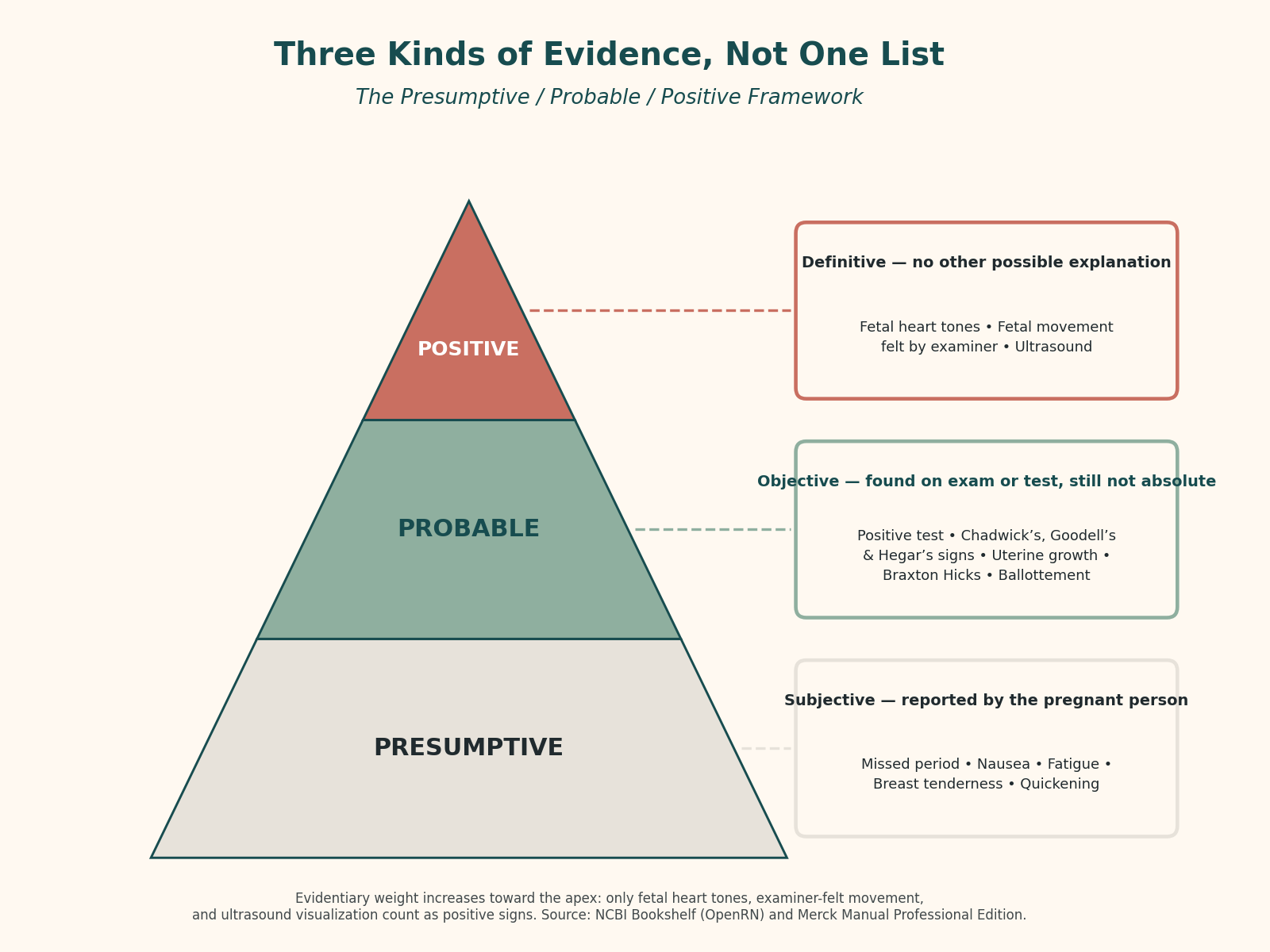
This three-tier classification is standard material in obstetric nursing and medical training, and it appears consistently across nursing textbooks and clinical references. In brief:
- Presumptive signs are subjective — reported by the pregnant person, not independently verified. A missed period, nausea, fatigue, breast tenderness, and urinary frequency all fall here. They’re the earliest and most familiar signs, and also the least specific, since every one of them has non-pregnancy explanations.
- Probable signs are objective — something a clinician can observe, measure, or test for — but still not, on their own, absolute proof. A positive urine or blood pregnancy test, a bluish discoloration of the cervix and vagina, a softened cervix, a softened lower uterine segment, a uterus enlarging on a predictable schedule, and Braxton Hicks contractions are all probable signs. They’re considerably more convincing than presumptive signs, and in ordinary practice a positive test is treated as close to conclusive — but strictly speaking, each of these has at least a theoretical alternative explanation, which is why they’re not classified as “positive.”
- Positive signs are the small, specific set of findings that confirm pregnancy beyond reasonable doubt: a fetal heartbeat detected separately from the pregnant person’s own pulse, fetal movement felt directly by an examiner (not just reported by the pregnant person), and a fetus visualized on ultrasound. Nothing else clears this bar.
Why Each Tier Gets Its Own Section
Each of these tiers gets its own full section later in this guide, with the individual signs explained one at a time, including several — like Chadwick’s sign, Goodell’s sign, and Hegar’s sign — that almost never appear in a typical “signs of pregnancy” article aimed at a general audience, simply because they’re exam findings rather than things you’d notice on your own.
How This Guide Fits With Our Other Pregnancy-Symptom Guides
For Practical Testing and Timeline Guidance
If what you actually want is a practical, comprehensive walkthrough of early pregnancy — what symptoms mean, when to test, how to read a result, what happens after a positive test, and the warning signs that need urgent attention — our main pregnancy symptoms guide covers that ground in depth and is the better starting point. If you’re specifically trying to figure out how early any sign could realistically appear, counted day by day from ovulation rather than from a missed period, our earliest-signs guide goes deep on that exact question.
What This Guide Covers Instead
This guide sits alongside both of those: it’s the reference for understanding what kind of evidence each sign represents and for the signs — especially exam-based and later-pregnancy ones — that neither of those guides covers in detail. Rather than repeating their content, this guide links out to them at the relevant points and stays focused on the tiered framework and the signs unique to it.
Presumptive Signs: What You Notice and Report
Presumptive signs are the ones this whole topic is best known for — they’re subjective, meaning they’re based entirely on what a person reports feeling, with nothing independently measured or examined. They’re also, almost always, the first signs anyone notices, which is exactly why they carry so much emotional weight relative to how little they actually prove.
Amenorrhea: The Original Presumptive Sign
Why It’s the First Sign Most People Notice
A missed period (amenorrhea) is the presumptive sign most people think of first, and historically it’s the one that has prompted pregnancy testing longer than any other. It’s also, on its own, one of the least specific signs on this entire list: stress, significant weight change, intense exercise, travel, illness, certain medications, and hormonal conditions such as polycystic ovary syndrome (PCOS) or thyroid disease can all delay or skip a period with no pregnancy involved. For someone with naturally irregular cycles or using a hormonal method that already suppresses periods, amenorrhea doesn’t function as a useful signal at all, since there’s no predictable baseline to notice a deviation from.
Where the Practical Guidance Lives
Our main pregnancy symptoms guide covers what to do about a missed period alongside a negative test in detail, including when irregular cycles change the picture — that’s a practical, decision-focused discussion this guide won’t repeat. What’s worth understanding here is simply amenorrhea’s classification: it’s presumptive because it’s a symptom you report, not a finding anyone else can verify without further testing, and because so many non-pregnancy conditions produce the identical symptom.
Nausea, Fatigue, Breast Changes, and Urinary Frequency
Why They’re Grouped Together Here
Nausea (with or without vomiting), unusual fatigue, breast tenderness or swelling, and increased urinary frequency round out the most commonly reported presumptive signs, and all four share the same underlying pattern: they’re driven by rising hCG, progesterone, and estrogen, and every one of them has plausible non-pregnancy causes — a stomach bug, poor sleep, premenstrual hormonal shifts, a urinary tract infection. Because these four signs, together with a missed period, are already covered in comprehensive depth — onset timing, how they compare to PMS, and practical self-care — in our main pregnancy symptoms guide, this guide treats them as background rather than re-explaining them symptom by symptom. If you want day-by-day timing for how early any of these can plausibly start counting from ovulation, our earliest-signs guide is the more detailed resource.
Why Intensity Doesn’t Equal Certainty
What’s worth adding here, specifically because of this guide’s tiered framework, is why these four signs stay “presumptive” no matter how strong they feel. Their intensity reflects individual hormone sensitivity and, to a real but limited degree, absolute hormone levels — not certainty of pregnancy. A textbook-severe wave of nausea is not more “proof” than a mild one; both are presumptive signs, full stop, until something from the probable or positive tier confirms them.
Quickening: Feeling Movement Later in Pregnancy
Typical Timing
Quickening — the first fetal movement a pregnant person feels, rather than one detected by a clinician or a machine — is also classified as presumptive, and it’s the one presumptive sign on this list that doesn’t show up until well into the second trimester. According to Cleveland Clinic’s patient guidance, quickening is typically felt somewhere between 16 and 20 weeks of pregnancy, though the fetus itself has generally been moving since around 12 weeks, before those movements are strong or coordinated enough to be felt from the outside.
Timing varies meaningfully by pregnancy history. People who have been pregnant before often notice quickening earlier, commonly around 16 weeks, in part because their uterine and abdominal muscles are already somewhat stretched and more sensitive to internal movement, and in part because they already know what sensation to expect. First-time parents more commonly don’t notice it until closer to 20 weeks. Early quickening is often described as fluttering, tapping, or “bubbles popping” rather than a distinct kick — sensations that are easy to mistake for gas or digestion until they become more frequent and recognizable over the following weeks.
Why It Stays Presumptive Despite Feeling Certain
Quickening is presumptive rather than probable or positive for a specific reason worth sitting with: it’s entirely self-reported. Nobody but the pregnant person can verify that a given sensation was fetal movement rather than digestion, a muscle twitch, or simple anticipation. That doesn’t make it any less real or any less exciting to notice — it simply means that, classified strictly, it stays in the same evidentiary tier as first-trimester nausea, not the tier reserved for a clinician directly feeling fetal movement (covered later in this guide under positive signs).
Why Presumptive Signs Alone Never Confirm Anything
The Shared Weakness Across All of Them
Every presumptive sign shares one structural weakness: each one, individually and even in combination, can be explained by something other than pregnancy. Stress alone can produce a late period, fatigue, and a queasy stomach. A gastrointestinal illness can produce nausea and fatigue with no menstrual change at all. Even a cluster of several presumptive signs together, however compelling it feels, is not the same category of evidence as a single probable sign like a positive test — let alone a positive sign like a detected heartbeat.
A Prompt to Act On, Not a Verdict
This isn’t a reason to dismiss presumptive signs; it’s the reason they exist as a named, separate category rather than being lumped in with everything else. They’re a reasonable, well-earned prompt to test or seek an exam. They’re not a substitute for either.
Probable Signs: What an Exam Finds — The Uterus and Cervix
Probable signs move the conversation from “what you feel” to “what can be observed or measured,” and this is where the classic exam-based findings live — several of which almost never appear in general-audience pregnancy content, simply because they require a clinical exam to notice rather than being something you’d feel at home. All four covered in this section involve physical changes to the uterus and cervix that follow a fairly predictable timeline, which is part of why they’re useful to a clinician confirming or dating a pregnancy.
Chadwick’s Sign
What It Is and When It Appears
Chadwick’s sign is a bluish, purplish, or purplish-red discoloration of the cervix, vagina, and vulva, caused by a sharp increase in blood flow to the pelvic region in early pregnancy. According to Cleveland Clinic, it typically becomes noticeable six to eight weeks after conception, though it can appear as early as four weeks in some people. The color change reflects increased blood volume in the small vessels near the skin’s surface — the same general mechanism behind several other early vascular changes in pregnancy — rather than anything happening to the developing embryo directly.
Why It’s Probable, Not Positive
Chadwick’s sign can be self-noticed in principle, but in practice it’s usually identified during a pelvic exam, since it’s not an area most people routinely inspect closely. Cleveland Clinic is explicit that it’s a “non-specific” finding: it suggests pregnancy is possible without confirming it, since a small number of other conditions that increase pelvic blood flow can theoretically produce a similar appearance. That’s precisely why it’s classified as probable rather than positive — a real, physiologically caused finding that still needs to be paired with a test or further exam to mean anything conclusive.
Goodell’s Sign
What It Is and When It Appears
Goodell’s sign refers to a softening of the cervix, distinct from its normal, firmer non-pregnant texture (often compared to the firmness of the tip of your nose, versus the softer texture pregnancy produces, sometimes compared to the texture of lips). It’s caused by increased blood flow and hormonally driven changes in the connective tissue of the cervix, and it’s generally detectable somewhat earlier than Chadwick’s sign — in the range of four to six weeks of pregnancy by clinical teaching materials, making it one of the earliest probable signs to appear on exam.
Why It Still Needs Confirmation
Like Chadwick’s sign, Goodell’s sign requires a clinical pelvic exam to identify reliably; it’s not something most people would notice or interpret correctly on their own. It’s also, on its own, non-specific: cervical softening can occur for reasons unrelated to pregnancy, so a clinician noting it will still confirm with a pregnancy test or further evaluation rather than treating it as sufficient by itself.
Hegar’s Sign
What It Is and When It Appears
Hegar’s sign is a softening of the lower segment of the uterus — the area just above the cervix — while the uterine fundus (the top portion) remains comparatively firmer. On a bimanual exam, this can create a distinctive sensation where the lower uterine segment feels compressible between the examiner’s two hands, almost as though the firmer uterine body and firmer cervix are connected by a soft, less resistant middle section. It typically becomes detectable in roughly the same window as Chadwick’s sign, around six to eight weeks of pregnancy, though exact timing varies by source and by individual anatomy.
Its Limits as Evidence
Hegar’s sign shares the same limitation as the other exam-based probable signs: it requires a trained examiner to elicit and interpret correctly, and it is not, by itself, diagnostic. Uterine fibroids and other structural conditions can occasionally complicate or mimic the finding, which is part of why clinical teaching consistently pairs it with the same caveat given for Chadwick’s and Goodell’s signs — useful supporting evidence, not proof on its own.
Uterine Enlargement and Fundal Height as a Timeline
A Predictable Growth Schedule
Beyond these three named signs, the uterus itself grows on a fairly predictable schedule that clinicians use as a rough, ongoing probable sign throughout pregnancy — not just in the first trimester. According to the Merck Manual’s clinical reference for evaluating a pregnant patient, the growth pattern by size comparison and fundal landmark runs approximately as follows: at 6 weeks, the uterus feels similar in size to a small orange; at 8 weeks, a large orange; by 12 weeks, roughly grapefruit-sized, with the top of the uterus (the fundus) becoming palpable just at the pubic bone; by 16 weeks, the fundus reaches the midpoint between the pubic bone and the navel; and by 20 weeks and beyond, the fundus reaches approximately the level of the navel itself, after which the distance in centimeters from the pubic bone to the fundus roughly correlates with the number of weeks pregnant.
| Gestational age | Approximate uterine size / landmark |
|---|---|
| 6 weeks | About the size of a small orange |
| 8 weeks | About the size of a large orange |
| 12 weeks | About the size of a grapefruit; fundus becomes palpable at the pubic bone |
| 16 weeks | Fundus at the midpoint between the pubic bone and the navel |
| 20+ weeks | Fundus at approximately the level of the navel; fundal height in centimeters begins to roughly track gestational weeks |
Landmarks reflect general clinical teaching summarized in the Merck Manual Professional Edition’s guide to evaluating a pregnant patient. Individual anatomy, a full bladder at the time of exam, body size, and whether it’s a first or later pregnancy can all shift these landmarks somewhat in either direction.
Why Size Alone Can Be Misleading
Uterine size is a probable, not positive, sign for a reason that becomes especially relevant later in this guide: fibroids, a full bladder, obesity, and — importantly — a pregnancy that’s actually further along or less far along than dates suggest can all make uterine size misleading on its own. A uterus measuring notably larger or smaller than expected for the dates is a common, unremarkable reason a provider orders an ultrasound — not, by itself, evidence that something is wrong.
Probable Signs, Continued: Contractions, Ballottement, and the Test Itself
The remaining probable signs move away from the cervix and uterine tissue specifically and cover two exam or self-observed findings, plus a category that surprises people the first time they hear it classified this way: the pregnancy test.
Braxton Hicks Contractions
What They Feel Like and When They Start
Braxton Hicks contractions are irregular, generally painless tightening sensations in the abdomen, often described as feeling like a mild menstrual cramp or a wave of tightness that comes and goes. According to Cleveland Clinic, they can start as early as the second trimester, though not everyone notices them, and they tend to become more frequent and more noticeable as pregnancy progresses into the third trimester.
Telling Them Apart From True Labor
Braxton Hicks are considered a probable sign of pregnancy specifically, and later in this guide they come up again in a different role — as one of the signs that can be confused with early labor. The distinguishing features are worth knowing regardless of which question brought you here: Braxton Hicks are erratic rather than building in a steady pattern, they don’t intensify or move closer together over time the way labor contractions do, you generally remain able to walk and talk through them, and changing position or activity often makes them stop. True labor contractions, by contrast, settle into a regular interval, typically last 30 to 90 seconds each, intensify over time, and aren’t relieved by changing position. Cleveland Clinic’s guidance is direct that strong contractions coming less than five minutes apart for an hour, an inability to walk or talk through a contraction, bright red bleeding, a sudden gush or continuous leak of fluid, or a noticeable decrease in fetal movement all warrant contacting a provider promptly, since these can indicate labor or another concern rather than routine Braxton Hicks.
Ballottement
How the Technique Works
Ballottement is an exam technique, not a symptom you’d notice on your own: a clinician gently taps or pushes the uterus during a pelvic or abdominal exam and feels the fetus move away and then float back to tap against the examining hand, similar to tapping an ice cube floating in a glass of water. It relies on there being enough amniotic fluid relative to fetal size for the fetus to move freely within the uterus when nudged, which generally makes it most reliably elicited in the middle portion of pregnancy — after the uterus is large enough to assess this way, but before the fetus grows large enough to fill the uterine cavity more snugly.
Why It Stops Short of “Positive”
Ballottement is classified as probable rather than positive for a specific reason that distinguishes it from the true positive sign covered in the next section: what the examiner is feeling here is the uterus and its contents responding to an external nudge, not independently observed spontaneous fetal movement. It’s a genuinely useful clinical technique, but it stops short of the higher bar set by the positive-sign tier.
The Pregnancy Test as a Probable, Not Positive, Sign
Why the Classification Surprises People
This is the classification that tends to surprise people most: a positive home or clinical pregnancy test — the single piece of evidence most people treat as the final word — is formally a probable sign, not a positive one. That’s not a knock on how reliable pregnancy tests are in practice; correctly timed and correctly used tests are genuinely accurate, and this guide isn’t suggesting otherwise. The classification exists because, strictly speaking, a small number of situations can produce a positive test without an ongoing, viable pregnancy — most notably a very early pregnancy loss (a chemical pregnancy) or, after fertility treatment, leftover hCG from a trigger injection. In both cases, the test result was real; what it indicated didn’t continue.
How hCG Levels Typically Change Over Time
Because a positive test result is a probable rather than a positive sign, it’s worth understanding a little about the hormone behind it — human chorionic gonadotropin, or hCG — rather than treating “positive” and “negative” as the only two facts that matter. Clinical references including the Merck Manual describe hCG as rising rapidly in very early pregnancy, roughly doubling every 48 to 72 hours through much of the first several weeks, before that rate of increase naturally slows later in the first trimester and levels plateau. This pattern is why a single hCG number, on its own, tells a clinician relatively little: what matters far more is the trend across two or more readings spaced a couple of days apart, particularly in situations — a suspected ectopic pregnancy, an uncertain viability question, early bleeding — where a provider is trying to determine whether a pregnancy is progressing as expected.
Individual starting values and rise rates vary widely enough between different people, and even between different pregnancies in the same person, that clinical references consistently caution against comparing one pregnancy’s numbers to another’s, or against using a single hCG value to estimate gestational age with any precision. A twin or higher-order multiple pregnancy commonly produces higher hCG levels than a singleton pregnancy at the same point, for instance, but a higher number on its own is not a reliable way to diagnose a multiple pregnancy without an ultrasound to confirm it. Once a pregnancy is far enough along to visualize directly, clinical guidance consistently treats ultrasound — not an hCG number — as the more accurate way to date a pregnancy and assess how it’s progressing, which is part of why hCG numbers matter most in the earliest weeks, before ultrasound becomes practically useful, and fade in clinical importance once it does.
Where the Testing Details Live
Because how pregnancy tests actually work, when to take one, how to read a faint line, and what a false negative or false positive can mean are already covered thoroughly elsewhere on this site, this guide won’t re-explain testing mechanics here. For that level of detail, see our main pregnancy symptoms guide’s testing section and, for the earliest possible testing window measured from ovulation, our earliest-signs guide. What matters for this guide’s framework is simply the classification: a positive test belongs alongside Chadwick’s sign, Goodell’s sign, Hegar’s sign, uterine enlargement, and Braxton Hicks in the probable tier — extremely useful, practically decisive in the overwhelming majority of cases, but not, in the strictest clinical sense, absolute proof on its own.
Why “Probable” Still Isn’t “Certain”
Certain Enough for Everyday Purposes
Reading through four exam findings, a growth timeline, and a pregnancy test all classified as merely “probable” can feel almost pedantic — in ordinary life, a positive test plus a softened cervix is about as certain as most people will ever need to be.
Where the Distinction Actually Matters
The distinction matters for a narrower but real reason: it explains why a clinician facing an unusual or ambiguous situation — bleeding alongside a positive test, uncertain dates, a suspected ectopic pregnancy, a uterus measuring inconsistently with expected dates — doesn’t stop at the probable tier. They move to the positive tier described next, because that’s the only tier that resolves genuine ambiguity with certainty rather than strong likelihood.
Positive Signs: What Confirms Pregnancy With Certainty
Positive signs are the shortest list in this entire guide, and that’s the point: they’re deliberately narrow, restricted to findings that have no other plausible explanation. Where presumptive and probable signs each carry some degree of uncertainty, positive signs don’t.
Fetal Heart Tones
Detection Timing by Method
A fetal heartbeat, detected separately from the pregnant person’s own pulse, is one of the three positive signs. Timing depends heavily on the method used. According to the Merck Manual’s clinical reference, a handheld Doppler ultrasound device can pick up fetal heart sounds as early as 8 to 10 weeks of pregnancy when the uterus is accessible through the abdomen, and fetal heart motion can sometimes be visualized directly on ultrasound even earlier, around 5 to 6 weeks. A traditional fetoscope or stethoscope, which doesn’t amplify sound the way Doppler technology does, typically can’t pick up fetal heart tones until considerably later in pregnancy, generally somewhere in the range of 18 to 20 weeks, which is one reason handheld Doppler devices became the standard tool for this purpose in routine prenatal visits.
Why It’s Unambiguously Positive
A detected heartbeat is positive rather than probable because there’s no other plausible source for it. Unlike uterine softening or a positive test, there’s no borderline case where a genuine fetal heartbeat is detected and no pregnancy is actually present.
Fetal Movement Felt Directly by an Examiner
How This Differs From Quickening
This is a distinct sign from quickening, even though both involve fetal movement, and the difference is exactly the one this guide’s framework is built to highlight: quickening is the pregnant person’s own subjective report of feeling movement, which makes it presumptive. Fetal movement independently felt by a clinician — placing a hand on the abdomen and feeling the fetus move, separate from anything the pregnant person reports — is positive, because it’s externally verified rather than self-reported.
When It’s Typically Elicited
In practice, this typically isn’t elicited until later in pregnancy than quickening itself, once fetal movements are strong and coordinated enough to be felt reliably through the abdominal wall by someone other than the pregnant person.
Ultrasound Visualization
Usually the First Positive Sign Obtained
Directly visualizing an embryo or fetus on ultrasound — confirming its presence, location, and typically cardiac activity — is the third positive sign and, in modern prenatal care, usually the first one actually obtained, often well before a heartbeat could be detected by handheld Doppler or fetal movement could be felt by anyone.
What Else an Early Ultrasound Confirms
An early ultrasound also does double duty clinically: beyond confirming the pregnancy itself, it can confirm the pregnancy’s location (ruling out an ectopic pregnancy), assess viability, and — as covered in our main pregnancy symptoms guide’s section on due dates and gestational age — often provide a more accurate dating estimate than calculation from a last menstrual period alone.
Why Only These Three Count as Truly Diagnostic
What’s Deliberately Excluded From This List
It’s worth being explicit about what’s deliberately excluded from this list. A strongly positive test, a clearly enlarged uterus, unmistakable Chadwick’s and Goodell’s signs together, and weeks of textbook symptoms are all compelling — and in ordinary circumstances, nobody needs to wait for a positive sign once several probable signs line up. But each of those, examined strictly, has at least a theoretical alternative explanation. Fetal heart tones, examiner-felt fetal movement, and ultrasound visualization don’t.
When Clinicians Reach for a Positive Sign
That’s the entire basis for the three-tier system this guide is organized around, and it’s why, when the stakes are genuinely high — a suspected ectopic pregnancy, an unusual bleeding pattern, uncertain viability — a clinician’s next step is always to reach for a positive sign rather than accumulate more probable ones.
Signs of Pregnancy in the First Trimester
The first trimester is where nearly all presumptive signs and the first probable signs appear, and it’s also the period our two companion guides already cover in the greatest depth. This section stays deliberately brief and points you to where the fuller detail lives.
The Presumptive Signs Most People Notice First
Presumptive Signs in This Window
Amenorrhea, nausea, fatigue, breast tenderness, and urinary frequency — the classic presumptive signs discussed earlier in this guide — cluster in the first trimester, typically starting anywhere from the first couple of weeks after conception through the weeks following a missed period.
The First Probable Signs on This Timeline
The first probable signs, Goodell’s sign and then Chadwick’s and Hegar’s signs, also emerge during this window, generally becoming detectable on exam somewhere between four and eight weeks of pregnancy, as covered earlier in this guide’s probable-signs sections.
Where to Go for the Full Week-by-Week Breakdown
For Practical, Week-by-Week Detail
If you want a detailed, week-by-week walkthrough of what’s happening physically and what you might feel during the first trimester specifically — including a full comparison against PMS, testing guidance, and what a positive result means — our main pregnancy symptoms guide is built around exactly that timeline. If your specific question is how early any sign could possibly appear, counted in days since ovulation rather than weeks of pregnancy, our earliest-signs guide covers that question symptom by symptom, including a day-by-day timeline from ovulation through a missed period.
This Guide’s Narrower Role Here
This guide won’t duplicate either of those breakdowns; its role in the first trimester is simply to show where amenorrhea, nausea, and the early exam findings fit into the larger presumptive/probable/positive framework.

Signs of Pregnancy in the Second Trimester
The second trimester (roughly gestational weeks 14 through 27) is where several genuinely new signs appear for the first time — not intensified versions of first-trimester symptoms, but signs that simply couldn’t have shown up any earlier. This is also where this guide starts covering territory our first-trimester-focused companion guides don’t.
Quickening and the “Feeling Pregnant” Shift
A Physical and Psychological Turning Point
Quickening, discussed in detail earlier in this guide’s presumptive-signs section, is the signature new sign of the second trimester, typically felt somewhere between 16 and 20 weeks. For many people, it marks a noticeable psychological shift as well as a physical one — the point where pregnancy stops being something confirmed by a test and abstract symptoms, and starts being something felt directly and repeatedly.
What Often Eases During This Window
Fatigue and nausea also often ease somewhat for many people during this window as hCG levels plateau and decline from their first-trimester peak, though as covered in our main symptoms guide, that improvement isn’t universal or guaranteed.
Skin, Hair, and Body Shape Changes That Begin Here
Skin and Pigment Changes
Several of the skin and pigment signs covered in detail later in this guide — linea nigra, melasma, and the earliest stretch marks (striae gravidarum) — typically begin appearing during the second trimester, as the uterus grows large enough to visibly change the shape of the abdomen and as pregnancy hormones continue accumulating their effects on melanin production and skin elasticity.
Hair Changes
Hair often looks fuller during this period as well, generally attributed to hormonally extended hair-growth cycles that temporarily reduce normal shedding — a change many people notice as a pleasant side effect of pregnancy hormones, though it typically reverses for a period after delivery as the extra hair enters its normal shedding phase.
New Probable Signs a Provider Starts Checking For
Routine Fundal Height Tracking
By the second trimester, fundal height — the uterine-growth timeline introduced earlier in this guide’s probable-signs section — becomes a routine measurement at prenatal visits, tracked in centimeters and compared against expected gestational age at each appointment.
Ballottement and Ongoing Heart-Tone Checks
This is also typically when ballottement, described earlier in this guide, becomes reliably elicitable on exam, and when fetal heart tones, if not already detected by Doppler in the first trimester, are checked routinely at every visit going forward.
Signs of Pregnancy in the Third Trimester
By the third trimester (roughly weeks 28 through 40), the question shifts from “is this a sign of pregnancy” to “is this a sign that pregnancy is ending” — Braxton Hicks intensify, the body prepares physically for labor, and several new, purely mechanical signs appear as a direct result of the pregnancy’s size and position rather than early hormonal shifts.
Braxton Hicks Intensify
More Frequent, More Noticeable
Braxton Hicks contractions, introduced earlier in this guide’s probable-signs section as a sign that can begin as early as the second trimester, generally become more frequent and more noticeable through the third trimester for people who experience them.
Why the Distinction From Labor Matters More Now
The distinguishing features from true labor — irregular timing, no progressive intensification, relief with a position change or activity change, and the ability to walk and talk through them — matter more here than at any earlier point in pregnancy, simply because the two become easier to confuse as the due date approaches.
Physical Signs of a Growing Uterus
Mechanical Effects of Late Pregnancy
Several third-trimester signs are direct mechanical consequences of a large uterus in a confined space: swelling (edema) in the feet, ankles, and hands from fluid retention and reduced venous return; shortness of breath as the diaphragm has less room to expand fully; heartburn and reflux as the growing uterus puts upward pressure on the stomach; and, for many people, a sensation sometimes called “lightening” as the fetus settles lower into the pelvis in preparation for labor, which can noticeably ease breathing while simultaneously increasing pelvic pressure and urinary frequency.
When These Signs Need Attention Instead
None of these are dangerous on their own, though sudden or severe swelling, sudden shortness of breath, or a severe headache alongside swelling are different and warrant prompt medical attention rather than being assumed to be routine — a pattern covered in the warning-signs section later in this guide.
Signs That Mean Labor Is Approaching (Not Yet Labor Itself)
The Pre-Labor Signal Cluster
A cluster of signs in the final weeks signal that labor is getting closer without meaning it has started: the cervix beginning to efface (thin) and dilate (open), sometimes checked at late prenatal visits; loss of the mucus plug; and an increase in Braxton Hicks frequency and intensity, sometimes called “false labor” specifically because it can feel deceptively similar to the real thing.
Why This Guide Keeps This Section Brief
This guide treats this topic briefly and by design, since distinguishing true labor from its many close impersonators is a substantial subject in its own right, deserving of dedicated coverage rather than a subsection here — for the emergency-relevant version of this question (when bleeding, fluid loss, or contraction patterns need same-day attention), see the warning-signs section later in this guide.
| Trimester | Sign tier | Representative signs |
|---|---|---|
| First (weeks 1–13) | Presumptive | Amenorrhea, nausea, fatigue, breast tenderness, urinary frequency |
| First (weeks 1–13) | Probable | Positive test, Goodell’s sign, Chadwick’s sign, Hegar’s sign, early uterine growth |
| First (weeks 1–13) | Positive | Ultrasound visualization (often the earliest positive sign obtained); Doppler heart tones from about 8–10 weeks |
| Second (weeks 14–27) | Presumptive | Quickening (~16–20 weeks); easing nausea and fatigue for many |
| Second (weeks 14–27) | Probable | Ballottement becomes reliably elicitable; routine fundal-height tracking begins; Braxton Hicks may start |
| Second (weeks 14–27) | Other notable signs | Linea nigra, melasma, early striae gravidarum, fuller-feeling hair |
| Third (weeks 28–40) | Probable | Braxton Hicks intensify; fundal height continues tracking; cervical effacement/dilation near term |
| Third (weeks 28–40) | Other notable signs | Edema, shortness of breath, heartburn, lightening/engagement, mucus plug loss |
Timing ranges are general patterns drawn from Cleveland Clinic and Merck Manual patient- and clinician-education materials; individual timing varies, particularly for first-time versus later pregnancies.
Less Obvious Signs Almost Nobody Warns You About
Beyond the classic presumptive signs and the exam-based probable signs already covered, pregnancy produces a long tail of smaller physical changes that rarely make it onto a standard symptom list — not because they’re rare, but because they’re less dramatic and, for some, mildly embarrassing to bring up. They’re common enough to be worth knowing about in advance, so they don’t catch you off guard.
Gum and Dental Changes (Pregnancy Gingivitis)
How Common It Is and Why It Happens
Pregnancy gingivitis — gum inflammation, tenderness, and a tendency to bleed more easily during brushing or flossing — is strikingly common, affecting an estimated 60% to 75% of pregnancies in the United States, according to Cleveland Clinic. It’s driven by the same rising estrogen and progesterone responsible for many other signs in this guide, which increase blood flow to gum tissue and change how it responds to plaque. Symptoms can begin as early as the first trimester and often peak in the second and third, but the reassuring news is that they typically resolve on their own after delivery as hormone levels return to baseline.
Managing It
Management centers on routine dental care rather than anything pregnancy-specific: a professional cleaning to remove plaque buildup, consistent brushing and flossing, and saltwater rinses for mild irritation. Prenatal dental visits are considered safe and are specifically recommended if gum symptoms are noticeable, since untreated gum disease has been associated with other pregnancy complications in some research, making this a sign worth mentioning at a dental visit rather than dismissing as a cosmetic annoyance.
Increased Vaginal Discharge (Leukorrhea)
What’s Normal
An increase in vaginal discharge, sometimes called leukorrhea, is common throughout pregnancy — Cleveland Clinic’s patient guidance notes it can begin even before a positive pregnancy test and continues, in some form, all the way through delivery. Normal pregnancy discharge is typically clear, white, or pale yellow, thin in consistency, odorless, and unaccompanied by itching, burning, or irritation. It results from progesterone stimulating the cervix to produce more mucus, which serves a protective role by helping guard the developing pregnancy against harmful bacteria.
What Isn’t
Discharge that’s dark yellow, green, or gray, thick like cottage cheese, foul-smelling, or accompanied by itching or burning is a different pattern and can indicate an infection such as bacterial vaginosis, a yeast infection, or a sexually transmitted infection — worth a call to a provider rather than assuming it’s routine. Heavy bleeding (not just spotting) or a sudden gush or continuous leak of clear fluid are different still and warrant emergency evaluation, since the latter can indicate the amniotic sac has ruptured.
Restless Legs
How Common It Is and When It’s Worst
Restless legs syndrome — an uncomfortable, hard-to-describe urge to move the legs, often worse in the evening or at rest — occurs in pregnancy at roughly two to three times the rate seen outside of pregnancy, according to research reviews on the topic, with reported prevalence during pregnancy ranging widely across studies (from under 3% to as high as 32%, depending on the diagnostic criteria used). It tends to worsen as pregnancy progresses and is most prevalent in the third trimester.
What Causes It
The leading explanation involves rising estrogen levels affecting the brain’s dopamine system, with iron and folate depletion — both used heavily to support fetal development — playing a secondary contributing role. For most people, symptoms resolve relatively quickly after delivery.
Varicose Veins and Visible Blood Vessels
Why They Appear and How to Manage Them
Enlarged, twisted, or visibly bulging veins — most often in the legs, though sometimes in the vulva — are a common later-pregnancy sign caused by a combination of increased blood volume, hormonally relaxed vein walls, and mechanical pressure from the growing uterus on the pelvic veins that drain the legs. They’re generally more of a cosmetic and comfort issue than a medical one, often easing somewhat after delivery, though support stockings, elevating the legs, and avoiding long periods of standing are commonly recommended comfort measures.
When It’s Something More Urgent
Sudden, severe leg swelling or pain — particularly if it’s one-sided — is a different and more urgent pattern, since it can indicate a blood clot rather than routine varicose veins, and is worth a prompt call to a provider.
Skin and Pigment Signs, Explained Individually
Skin and pigment changes are among the most visible signs of pregnancy, but they’re often lumped together into a single vague mention of “skin changes” in general pregnancy content. Each one has a distinct name, cause, and timeline worth understanding on its own.
Linea Nigra
What It Is and When It Appears
Linea nigra is a dark vertical line running down the midline of the abdomen, typically from the pubic bone toward or past the navel. According to Cleveland Clinic, the line itself is always present — before pregnancy it’s called the linea alba (“white line”) — but becomes visibly darkened as pregnancy hormones from the placenta increase melanin production. It’s most commonly noticed around 20 weeks, once it has darkened enough to stand out clearly, though the exact timing varies.
What Happens to It Afterward
It generally fades gradually after delivery as hormone levels return to normal, over a period of weeks to months, though for some people it doesn’t disappear completely, and it commonly reappears — sometimes in a different shade or at a different time — in later pregnancies.
Melasma (Chloasma)
What Causes It
Melasma, sometimes called chloasma or informally “the mask of pregnancy,” is patchy brown or grayish-brown pigmentation, usually on the face — commonly the cheeks, forehead, nose, and upper lip. It’s remarkably common, affecting up to an estimated 70% of pregnant people according to a clinical review published in American Family Physician, and results from the combination of normal pregnancy hormone changes and ultraviolet light exposure, with sun exposure specifically making it more pronounced.
Prevention and What Happens Afterward
Broad-spectrum sunscreen and sun avoidance are the primary prevention strategies during pregnancy itself. Most melasma fades on its own after delivery, though it can persist or recur, particularly with future pregnancies, oral contraceptive use, or continued sun exposure; persistent postpartum cases are sometimes treated with topical prescription creams under a dermatologist’s guidance, though these treatments generally aren’t used during pregnancy itself.
Striae Gravidarum (Stretch Marks)
Why They Form
Striae gravidarum — pregnancy stretch marks — are pink, red, or purplish streaks that most commonly appear on the abdomen, breasts, hips, and thighs as skin stretches to accommodate the growing pregnancy. They’re extremely common, present in up to an estimated 90% of pregnant people by the third trimester per the same clinical review, and result from a combination of the skin’s physical stretching and hormonally driven changes to its underlying connective tissue, with younger age, a larger baby, and higher body mass index all associated with increased likelihood.
Prevention and Long-Term Appearance
No cream or oil has been shown to reliably prevent them, despite widespread marketing claims to the contrary. Most striae fade to paler lines after delivery, though they typically don’t disappear entirely on their own; for anyone bothered by their appearance long-term, postpartum options such as topical or oral tretinoin or laser treatment exist, though these are cosmetic choices rather than medical necessities.
Why These Signs Vary So Much by Skin Tone and Genetics
The Role of Skin Tone and Family History
All three of these pigment- and skin-related signs vary considerably from person to person, and skin tone is one of the most significant factors: melasma and linea nigra tend to be more visible and more pronounced in people with naturally more melanin-rich skin, while lighter skin tones may show these changes more subtly or with a different color cast (pink or red rather than dark brown). Genetics also plays a role independent of skin tone — a family history of pronounced melasma or extensive stretch marks in pregnancy is associated with a somewhat higher likelihood of experiencing the same, though it’s far from a guarantee in either direction.
What This Variation Does and Doesn’t Mean
None of this variation reflects anything about how a pregnancy is progressing; it’s simply individual variation in skin biology, the same as the symptom-intensity variation discussed in our main pregnancy symptoms guide.
| Sign | What it looks like | Typical onset | Usually fades after delivery? |
|---|---|---|---|
| Linea nigra | Dark vertical line, pubic bone toward navel | Increasingly visible around 20 weeks | Usually, over weeks to months; not always completely |
| Melasma (chloasma) | Patchy brown/gray pigmentation, usually on the face | Variable; worsened by sun exposure | Often, but can persist or recur |
| Striae gravidarum | Pink, red, or purple streaks; abdomen, breasts, hips, thighs | Increasingly common through the third trimester | Fades to paler lines; rarely disappears fully |
Based on patient-education guidance from Cleveland Clinic and a clinical review published in American Family Physician. Appearance, timing, and resolution vary significantly by individual skin tone, genetics, and pregnancy history.
Cognitive and Emotional Signs
Alongside the physical signs covered so far, pregnancy hormones also affect mood, memory, and sleep in ways that are real, common, and worth naming directly rather than filing under a vague “emotional symptoms” heading.
“Pregnancy Brain” — What’s Actually Studied
What Research Says
The informal idea of “pregnancy brain” or “momnesia” — a sense of increased forgetfulness, distractibility, or mental fog during pregnancy — is widely reported anecdotally, and some research has explored measurable changes in memory and cognitive processing during pregnancy and the postpartum period, generally attributed to the combined effects of significant hormonal shifts, sleep disruption, and the substantial cognitive and emotional load of anticipating a major life change. The honest summary is that this is a real, commonly reported experience without a single settled explanation, and it’s generally understood as temporary rather than a lasting change.
When It’s Worth Mentioning to a Provider
If forgetfulness feels severe enough to interfere significantly with daily functioning or safety, that’s worth mentioning at a prenatal visit rather than assuming it’s simply an expected and unavoidable part of pregnancy.
Mood and Emotional Shifts Across Trimesters
Where the Fuller Discussion Lives
Mood changes, irritability, tearfulness, and anxiety are common throughout pregnancy, driven by the same major hormonal shifts responsible for many of the physical signs in this guide, and they can fluctuate rather than following one steady direction across trimesters. Because mood changes as an early presumptive sign, their overlap with PMS, and when a mood change might reflect something worth a dedicated conversation with a provider are already covered in our main pregnancy symptoms guide, this guide won’t duplicate that discussion.
Why Mood Signs Don’t Map Onto a Single Trimester
What’s worth adding here is simply that mood-related signs, like the physical ones in this guide, don’t map neatly onto a single trimester — they can appear, ease, and reappear at different points for different people, and that pattern by itself isn’t a signal that anything is wrong.
Sleep-Related Signs Beyond Fatigue
What People Commonly Notice
Beyond the general fatigue covered as a presumptive sign earlier in this guide, many people notice more specific sleep-related changes: unusually vivid or emotionally intense dreams, difficulty staying asleep due to increased nighttime urination, and, later in pregnancy, physical discomfort from a growing abdomen that makes some sleep positions difficult. Restless legs, covered earlier in this guide’s “less obvious signs” section, is a specific and well-documented contributor to disrupted sleep in the second and third trimesters.
When to Raise It With a Provider
None of these are dangerous, though persistent, significant insomnia that affects daytime functioning is worth raising at a prenatal visit rather than treating as something to silently push through for months.
Signs That Mimic Pregnancy But Aren’t: Pseudocyesis and Look-Alikes
Every sign covered in this guide so far describes something that happens because a pregnancy is actually present. This section covers the reverse: situations where a real, physically experienced set of pregnancy-like signs occurs with no pregnancy involved at all — which is exactly why, as this guide’s framework has emphasized throughout, no combination of presumptive or even probable signs substitutes for direct confirmation.
Pseudocyesis (False Pregnancy)
What It Is and How Common It Is
Pseudocyesis, sometimes called false or phantom pregnancy, is a genuine and well-documented clinical phenomenon in which someone experiences real pregnancy signs and symptoms — and is often personally convinced they’re pregnant — despite no pregnancy actually being present. According to Cleveland Clinic, it’s rare, estimated to affect somewhere between 1 and 6 out of every 22,000 births, and most documented cases involve people between roughly 16 and 39 years old. It was considerably more common historically, before modern pregnancy testing existed to resolve the question quickly and definitively.
Symptoms and Contributing Factors
The symptoms involved are not imagined in the sense of being faked or exaggerated — people with pseudocyesis genuinely experience breast tenderness, abdominal enlargement, missed periods, weight gain, nausea, food cravings, and even a subjective sense of fetal movement. Cleveland Clinic attributes the condition to a combination of psychological and hormonal factors: a strong desire for pregnancy, a history of infertility or pregnancy loss, depression, anxiety, or trauma on the psychological side, and hormonal conditions such as certain uterine or ovarian growths, or hormonal shifts related to approaching menopause, on the physiological side. Researchers believe an intense psychological desire for pregnancy may, in some cases, directly influence hormone levels enough to produce some of these physical changes, though the exact mechanism isn’t fully settled.
Diagnosis and Treatment
Crucially, pregnancy tests in pseudocyesis are reliably negative, since hCG — the hormone every pregnancy test detects — is only produced by an actual pregnancy, and imaging such as an ultrasound confirms no fetus is present. Diagnosis typically involves a pelvic exam, a pregnancy test, and imaging to definitively rule out pregnancy, and treatment centers on emotional support, counseling, and addressing whatever underlying psychological or hormonal factors are contributing, rather than treating the physical symptoms in isolation.
Hormonal and Gynecological Conditions That Mimic Signs
Common Conditions That Overlap
Short of full pseudocyesis, several ordinary gynecological and hormonal conditions can independently produce one or more signs covered in this guide, which is part of why isolated signs are unreliable and combinations of signs, confirmed by testing, matter so much. Uterine fibroids can cause uterine enlargement that mimics pregnancy-related growth. Ovarian cysts can cause abdominal swelling and bloating. Thyroid disorders can cause fatigue, weight changes, and menstrual irregularity that overlaps with several presumptive signs.
Why Testing Still Resolves the Question
None of these produce a positive pregnancy test, which remains the fastest and most reliable way to distinguish them from an actual pregnancy.
Perimenopause Overlap
Where the Symptoms Overlap
For people in their 40s and early 50s, perimenopause — the hormonal transition leading up to menopause — can produce a cluster of symptoms that overlaps meaningfully with early pregnancy signs: irregular or skipped periods, mood changes, breast tenderness, and fatigue among them.
Why Age Alone Doesn’t Rule Pregnancy Out
Because perimenopause and pregnancy can, in principle, occur in the same person during the same window of reduced but not absent fertility, a pregnancy test is a reasonable and appropriate step even when perimenopause seems like the more likely explanation, rather than assuming age alone rules pregnancy out.
Why a Test and an Exam — Not Symptoms — Settle It
What Pseudocyesis Illustrates
Pseudocyesis is an extreme illustration of a principle that runs through this entire guide at every tier: presumptive signs, no matter how numerous or how strongly felt, describe what’s happening in the body without independently verifying its cause. Probable signs get closer, but even they carry some theoretical exception. Only a positive sign — an ultrasound, a directly detected heartbeat, examiner-felt fetal movement — closes that gap completely.
Why This Isn’t a Reason for Self-Doubt
This isn’t a reason for suspicion or self-doubt about your own symptoms; it’s simply why testing and, when needed, an exam or ultrasound remain the reliable path forward rather than an extended process of interpreting signs on your own.
How Reliable Is Each Sign? A Comparative Look
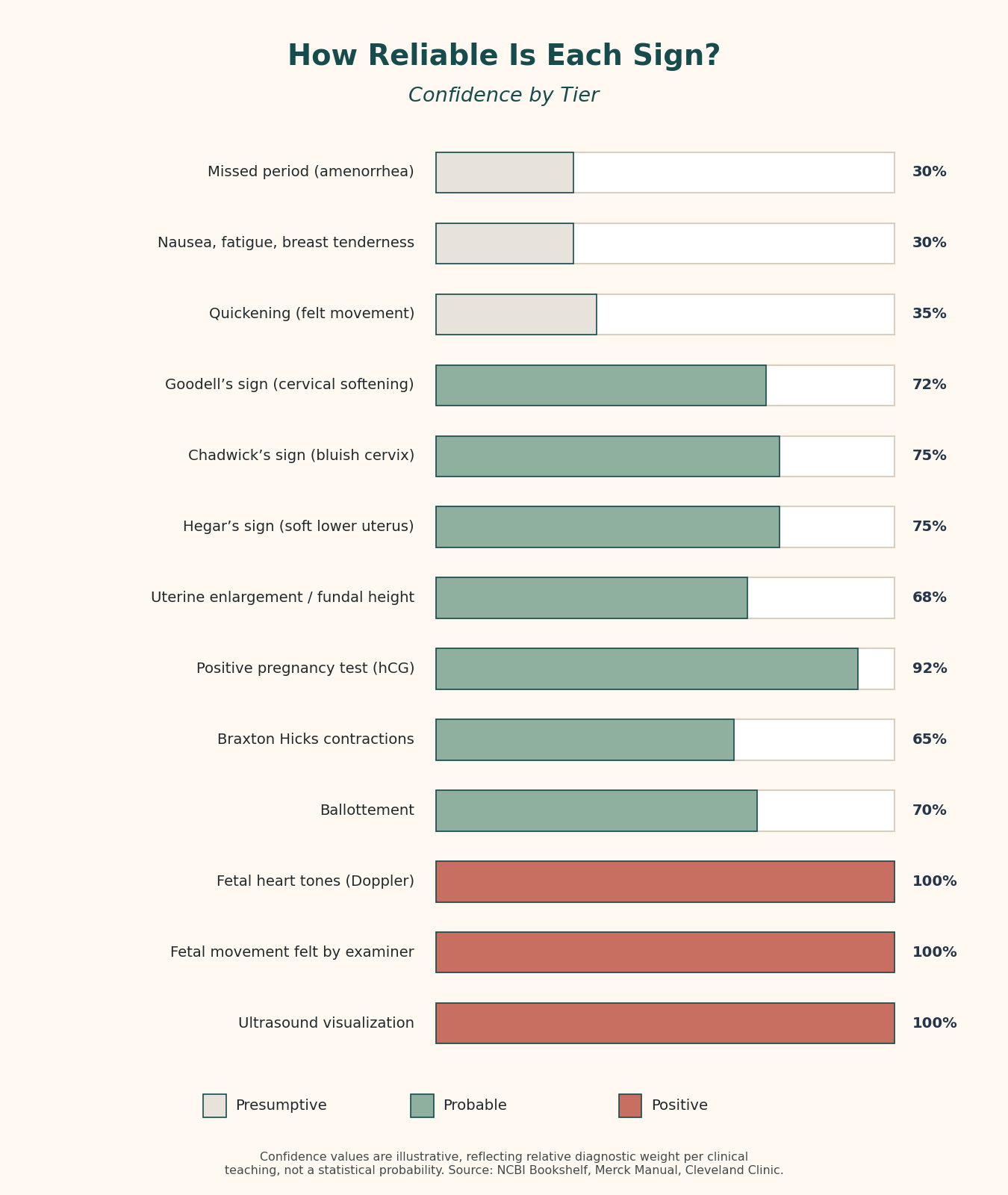
With every individual sign now covered across all three tiers, it’s useful to step back and see them side by side — not as a substitute for the detailed explanations above, but as a single reference for how much weight each sign realistically carries.
| Sign | Tier | Typical timing | Can occur without pregnancy? |
|---|---|---|---|
| Missed period (amenorrhea) | Presumptive | ~4 weeks (LMP dating) | Yes — stress, illness, PCOS, thyroid conditions, and more |
| Nausea, fatigue, breast tenderness, urinary frequency | Presumptive | 1–6 weeks | Yes — many unrelated causes |
| Quickening (felt fetal movement) | Presumptive | 16–20 weeks | Sensation can be misattributed (gas, muscle twitch) |
| Goodell’s sign (cervical softening) | Probable | 4–6 weeks | Rarely — a few other conditions can theoretically soften the cervix |
| Chadwick’s sign (bluish cervix/vagina) | Probable | 6–8 weeks | Rarely — other causes of increased pelvic blood flow |
| Hegar’s sign (soft lower uterus) | Probable | 6–8 weeks | Rarely — can be complicated by fibroids |
| Uterine enlargement / fundal height | Probable | Ongoing, 6 weeks onward | Yes — fibroids, a full bladder, incorrect dating |
| Positive pregnancy test (hCG) | Probable | From ~10 days post-ovulation | Rarely — chemical pregnancy, recent hCG medication, lab error |
| Braxton Hicks contractions | Probable | 2nd trimester onward | No true alternative cause, but easily confused with labor |
| Ballottement | Probable | Mid-pregnancy | No, but can be difficult to elicit reliably |
| Fetal heart tones (Doppler) | Positive | ~8–10 weeks | No |
| Fetal movement felt by an examiner | Positive | Mid-to-late pregnancy | No |
| Ultrasound visualization | Positive | As early as 5–6 weeks | No |
Timing reflects general patterns from Cleveland Clinic, the Merck Manual Professional Edition, and nursing/obstetric education references cited throughout this guide. Individual variation is normal and expected at every tier.
Reading the Confidence Table
The Pattern Across Tiers
The pattern across this table is consistent with everything covered so far: presumptive signs appear earliest but carry the most alternative explanations; probable signs are more specific but retain a genuine (if often small) exception in some circumstance; positive signs have none.
When the Framework Matters Most in Practice
This is also why the practical advice in this guide’s companion articles — test when the timing is right, and involve a provider for anything uncertain — doesn’t contradict the more theoretical framework here. In routine, low-risk situations, a probable sign like a correctly timed positive test is entirely sufficient to act on. The tiered framework matters most in the less routine situations: unclear dating, unusual bleeding, or any circumstance where a provider needs to move past “probable” to something certain.
Why Clinicians Still Combine Multiple Signs
Building a Coherent Picture
In everyday clinical practice, providers rarely rely on a single sign in isolation, even within the same tier. A positive test plus reported amenorrhea plus a uterus that’s grown appropriately for the expected dates, together, create a coherent and highly reliable picture well before an ultrasound is medically necessary to confirm the obvious.
What the Tiered System Is (and Isn’t) For
The tiered system isn’t a suggestion to distrust probable signs — it’s a map of exactly when combining several of them is enough, and when it’s time to move to something definitive instead.
Signs in Multiple Pregnancies and After Fertility Treatment
Two situations change how several signs in this guide typically present: carrying more than one fetus, and conceiving through fertility treatment. Both are already covered from a practical, day-to-day perspective in our other guides; this section focuses specifically on how they interact with the tiered framework used throughout this guide.
Signs That Tend to Be More Pronounced With Twins or More
Presumptive Signs, Amplified
As our main pregnancy symptoms guide covers in more practical detail, twin and higher-order multiple pregnancies tend to produce the same presumptive signs as a singleton pregnancy, often more intensely, generally attributed to higher circulating hCG from additional placental tissue.
Probable Signs Are Affected Too
What’s specific to this guide’s framework is that several probable signs are affected too: uterine growth tends to outpace the standard fundal-height timeline covered earlier in this guide, sometimes prompting an earlier ultrasound specifically because the uterus is measuring larger than expected for the stated dates.
Uterine-Size-for-Dates Discordance as a Clue
What It Can Mean
A uterus measuring meaningfully larger or smaller than expected for the calculated gestational age — sometimes called size-for-dates discordance — is one of the more common reasons a provider orders an ultrasound earlier than routine scheduling would otherwise call for. A larger-than-expected uterus can reflect a multiple pregnancy, inaccurate dating (a later ovulation than assumed, for instance), or excess amniotic fluid; a smaller-than-expected uterus can reflect earlier-than-assumed dating or, less commonly, a growth-related concern worth monitoring.
Why It Usually Resolves Routinely
In the large majority of cases, this discordance resolves into a routine explanation once an ultrasound clarifies the picture — a good example of a probable sign (uterine size) doing exactly its intended job of prompting a positive sign (ultrasound) rather than being treated as conclusive on its own.
When Uterine Position Complicates the Exam
One additional, ordinary anatomical variation is worth naming specifically because it can make early uterine-size assessment less straightforward: a retroverted uterus, meaning the uterus is tipped backward toward the spine rather than forward toward the bladder, which is its more common orientation. Cleveland Clinic notes this is a common variation rather than a disorder, affecting roughly one in five people with a uterus, and that it typically has no effect on the ability to conceive or carry a pregnancy. In early pregnancy specifically, a retroverted uterus can occasionally make fundal height feel less predictable on a manual exam, and, in some cases, can subtly complicate the angle of an early abdominal ultrasound, though a skilled sonographer routinely accounts for it, including by using a transvaginal approach when needed for a clearer early view.
In the substantial majority of pregnancies, a retroverted uterus naturally tips forward on its own as it grows out of the pelvis and into the abdominal cavity, typically by somewhere around the twelfth to fourteenth week, after which it behaves no differently than a uterus that was anteverted from the start. Cleveland Clinic describes a rare complication, uterine incarceration, in which the growing uterus becomes trapped against the pelvic bones instead of tipping forward as expected — a situation that can cause pelvic pain, pressure, or difficulty urinating, and that warrants prompt evaluation, though it affects only a small minority of retroverted-uterus pregnancies. For the overwhelming majority of people with a retroverted uterus, it’s simply a normal anatomical variation that resolves itself as pregnancy progresses, not a probable sign that anything is wrong.
Signs After IUI or IVF
Why Presumptive Signs Are Even Less Reliable Here
For pregnancies conceived through intrauterine insemination or in vitro fertilization, presumptive signs work identically to a naturally conceived pregnancy, but as our main pregnancy symptoms guide explains in its dedicated fertility-treatment section, supplemental progesterone commonly used after a transfer can produce fatigue, bloating, and breast tenderness independent of whether implantation actually occurred — making presumptive signs an even less reliable guide than usual during this specific window.
Why Clinics Rely on Blood Testing Instead
Fertility clinics typically rely on a scheduled quantitative blood test rather than home testing for exactly this reason, a topic covered in full in our main pregnancy symptoms guide rather than repeated here.
OHSS Bloating Versus Pregnancy Signs
A separate source of confusion after IVF specifically is ovarian hyperstimulation syndrome (OHSS), a reaction some people have to the ovarian-stimulation medications used earlier in the cycle, well before the presumptive signs covered in this guide would even become relevant. Mild OHSS is relatively common and produces abdominal bloating, mild discomfort, and nausea — a set of sensations that can be difficult to distinguish, by feel alone, from the presumptive signs of early pregnancy covered earlier in this guide, especially since both can be present in the same person at the same time if pregnancy does occur. This is yet another reason fertility clinics lean on scheduled blood testing and close monitoring rather than asking patients to interpret their own symptoms during this window: OHSS and early pregnancy signs can coexist, and distinguishing “which one is causing what I’m feeling” isn’t a distinction that self-observation can reliably make. Moderate or severe OHSS symptoms — rapid weight gain, severe abdominal pain, significant shortness of breath, or a marked decrease in urination — are a different matter entirely and warrant contacting the fertility clinic promptly regardless of pregnancy status, since they reflect a reaction to treatment rather than a pregnancy sign of any kind.
Putting the Framework Into Practice: Three Illustrative Composite Scenarios
The presumptive, probable, and positive framework can feel abstract laid out sign by sign. The three scenarios below are illustrative composites — not real patients, not case reports, and not a substitute for individualized medical advice — built to show how the framework actually plays out when several signs from different tiers show up together, in the order a person might actually notice them.
A Straightforward Early Pregnancy
How the Signs Typically Unfold
In a common, uncomplicated pattern, presumptive signs arrive first and roughly in the order this guide covers them: a period that doesn’t arrive on schedule, followed within days by breast tenderness, mild fatigue, and, for many people, some degree of nausea. None of these, individually, mean anything certain — as this guide has emphasized throughout, every one of them has explanations that have nothing to do with pregnancy. What moves the picture from “possible” to “probable” is a home pregnancy test, taken once a missed period makes testing worthwhile, showing a clear positive result. At a first prenatal visit shortly afterward, a clinician may also note early probable exam findings — Goodell’s sign, and a little later Chadwick’s sign — that corroborate the test result, though in routine, low-risk care a positive test plus reported amenorrhea is generally treated as sufficient without needing to catalog every probable sign individually.
Where the Framework Adds Value Here
The value of the tiered framework in a case like this isn’t that it changes what anyone does — test, then follow up with a provider — but that it explains why symptom intensity doesn’t need to correlate with anything. Someone with barely noticeable nausea and someone with a rough first few weeks are both, at this stage, sitting on exactly the same tier of evidence: presumptive signs, now confirmed by a probable one. The positive tier — an ultrasound, typically scheduled for roughly six to nine weeks in routine low-risk care — comes later, mainly to confirm dating, location, and viability rather than to answer a question the test has already effectively answered. A first prenatal visit in this kind of straightforward scenario typically combines all three tiers into one appointment: a review of presumptive signs and menstrual history, a probable-tier confirmation (repeating or reviewing the test result, and often a pelvic exam), and scheduling of the positive-tier ultrasound that will follow — a practical illustration of how the three tiers work together in routine care rather than functioning as separate, sequential hurdles.
Confusing Signs After Stopping Birth Control
Why the Presumptive Tier Gets Especially Unreliable Here
Stopping a hormonal birth control method — the pill, a hormonal IUD, or a contraceptive implant — commonly produces a stretch of cycle irregularity, breast tenderness, mood changes, and fatigue that overlaps heavily with the presumptive signs covered throughout this guide, entirely independent of whether a pregnancy is actually present. In this kind of scenario, presumptive signs are at their least useful: a late or absent period may reflect the body’s hormonal system simply recalibrating rather than pregnancy, and breast tenderness or fatigue may reflect the same recalibration, a genuine early pregnancy, or, in some cases, both at once if pregnancy occurred quickly after stopping.
Why Testing (Not Symptom-Watching) Is the Right Next Step
This is a case where relying on presumptive signs alone to decide whether to test would be genuinely misleading in either direction — dismissing real signs as “just my body adjusting,” or reading ordinary post-contraceptive irregularity as a strong pregnancy signal. A pregnancy test, timed appropriately relative to a reasonable estimate of ovulation, resolves the ambiguity directly rather than trying to interpret an unusually noisy set of presumptive signs. If cycles remain irregular enough that timing a test is difficult, that’s a reasonable topic for a provider visit independent of pregnancy specifically, since predictable ovulation can take a few cycles to fully return for some people after stopping hormonal contraception.
When Presumptive Signs Are Misleading
A Pattern Worth Recognizing, Not a Diagnosis to Self-Apply
Occasionally, someone experiences a genuinely convincing cluster of presumptive signs — a late period, breast tenderness, nausea, even a subjective sense of abdominal fullness — set against a strong emotional context, such as actively trying to conceive after a loss or a period of infertility, where the desire for a particular result is intense. As covered earlier in this guide’s section on pseudocyesis, this combination of circumstances is exactly the setting in which false or phantom pregnancy signs are most likely to occur, alongside far more common and far less rare explanations: a late period from stress or anovulation, or ordinary premenstrual symptoms that happen to arrive during a period of heightened attention to every bodily signal.
Why the Tiered Framework Is Reassuring Here, Not Alarming
This scenario is included specifically because the tiered framework is reassuring in exactly this situation, not alarming. Whatever the presumptive signs suggest, and whatever emotional weight they’re carrying, a test provides a clear, probable-tier answer in minutes — and if a test result and the felt experience of pregnancy don’t match, that’s a reasonable and judgment-free reason to talk with a provider, not a signal that something is wrong with a person’s perception of their own body. As covered earlier, pseudocyesis involves genuine physical and hormonal mechanisms; recognizing that this pattern exists is protective information, not a suggestion that a given reader’s experience fits it.
A Positive Test Shortly After a Trigger Shot
Why This Situation Is Genuinely Different
A fourth composite scenario is worth including specifically because it illustrates a case where the “probable, not positive” classification of a pregnancy test isn’t just a technicality — it changes what a result actually means. In a fertility-treatment cycle using a trigger injection (a dose of hCG given to finalize egg maturation before egg retrieval or timed intercourse/insemination), a home pregnancy test taken too soon afterward can return a genuine positive result because it’s detecting the injected hCG still clearing the body, not necessarily hCG produced by an implanted pregnancy. Depending on the dose and individual metabolism, residual trigger-shot hCG can remain detectable on a sensitive home test for a week or more after the injection, which overlaps uncomfortably with the earliest window someone might otherwise test.
Why a Blood Test Resolves It Cleanly
This is precisely the situation this guide’s companion discussion of fertility-treatment signs referenced earlier: a scheduled quantitative blood test, timed appropriately by the fertility clinic well after the trigger shot would have cleared, distinguishes a true pregnancy from residual medication far more reliably than a home test’s simple positive-or-negative result. A rising value on a second blood draw a couple of days later — consistent with the roughly 48-to-72-hour doubling pattern described earlier in this guide — is what actually confirms an ongoing pregnancy in this scenario, not the initial positive by itself. This is also exactly why fertility clinics generally discourage home testing during this window at all: an early home test in this specific situation isn’t more informative than waiting for the scheduled blood draw, and it carries real potential to mislead in either direction, producing either a false reassurance from residual trigger hCG or unnecessary worry if timed too early relative to when a genuine pregnancy’s own hCG would first become detectable.
When a Sign Might Point to Something Else: Warning Signs
Every sign covered in this guide describes a typical, expected part of pregnancy. A small number of symptom patterns are different, and recognizing them quickly matters more than any classification system. This section is a brief pointer, not a substitute for our complete warning-signs coverage.
Signs That Need Same-Day Medical Attention
The Core Emergency Patterns
Contact a health care provider immediately or go to an emergency room for: severe one-sided abdominal pain, shoulder-tip pain, or fainting (possible ectopic pregnancy); heavy bleeding that soaks a pad within an hour, or passing tissue, especially with cramping (possible miscarriage); persistent vomiting severe enough to prevent keeping down fluids (possible hyperemesis gravidarum); a sudden gush or continuous leak of fluid before term; contractions closer than five minutes apart for an hour, or strong enough to prevent walking or talking; and a noticeable decrease in fetal movement after the point in pregnancy when movement has become an established pattern.
Don’t Wait to Act on These
None of these should wait for a scheduled appointment or more research online.
Where to Read the Full Warning-Signs Guide
The Complete Coverage
Our main pregnancy symptoms guide dedicates a full section to warning signs, including the reasoning behind each one, how to tell an emergency pattern apart from a routine variation, and a complete decision table for what to do and how quickly.
Why This Section Stays Short
This guide won’t repeat that material — its purpose here is only to make sure the tiered framework above doesn’t accidentally read as reassurance in a situation that actually calls for urgent care.
Common Myths About Signs of Pregnancy, Fact-Checked
A few persistent beliefs about pregnancy signs circulate widely enough to sound authoritative. None hold up against the sources cited throughout this guide.
Myth: A Doctor Can Always Tell Just by Looking
What Actually Happens on Exam
Even experienced clinicians rely on the tiered framework covered in this guide rather than visual impression alone. Chadwick’s sign, Goodell’s sign, and uterine changes require a hands-on exam to assess accurately, not a glance, and none of them are visible “just by looking” in the way this myth implies.
Why Testing and Exams Still Matter
Every responsible clinical evaluation of suspected pregnancy still involves a test, an exam, or both — never intuition alone.
Myth: If You Don’t Have the “Classic” Signs, Something’s Wrong
Why Individual Variation Is Normal
As this guide has emphasized throughout, individual variation in presumptive signs is enormous and doesn’t predict anything about how a pregnancy is progressing. Plenty of confirmed, healthy pregnancies produce mild or unusual combinations of presumptive signs, arrive at probable signs on a slightly different timeline than the ranges given in this guide, or skip some signs (like noticeable nausea) altogether.
What Actually Confirms Things Instead
The tiered framework exists precisely so that the absence of one presumptive sign doesn’t need to feel alarming — a probable or positive sign is what actually confirms things, not a checklist of subjective symptoms.
Myth: Pseudocyesis Is “All in Someone’s Head”
The Physical Reality Behind It
As covered earlier in this guide, pseudocyesis produces genuine, measurable physical changes — real breast tenderness, real abdominal enlargement, sometimes even a real sensation of movement — and is generally understood to involve real hormonal and physiological mechanisms alongside psychological ones, not fabricated symptoms.
Why the “Imaginary” Framing Is Wrong
Describing it as imaginary misunderstands both the condition and the people who experience it; it’s better understood as a rare and complex mind-body phenomenon that deserves the same compassionate clinical response as any other diagnosis.
Myth: Braxton Hicks Means Labor Is Starting
How Early They Can Actually Start
As covered earlier in this guide, Braxton Hicks contractions can start as early as the second trimester — many weeks or months before labor — and are distinguished from true labor by their irregular timing, lack of progressive intensification, and tendency to ease with a position change.
Why Feeling Them Isn’t Cause for Alarm
Feeling them is a normal, common part of the third trimester (and sometimes the second) for many people, not an indication that labor is imminent.
| Myth | What’s actually true |
|---|---|
| A doctor can tell just by looking | Confirming pregnancy always requires a test, exam, or imaging — not visual impression |
| Missing “classic” signs means something’s wrong | Presumptive-sign variation is normal and doesn’t predict pregnancy health |
| Pseudocyesis is imaginary | It produces genuine physical changes via real hormonal and psychological mechanisms |
| Braxton Hicks means labor is starting | They can occur for months before labor and are distinguished by pattern, not just presence |
| A positive test is 100% infallible proof | It’s a probable, not positive, sign — extremely reliable in practice, but not absolute |
A Short History of How Pregnancy Was Diagnosed Before Modern Testing
The tiered framework used throughout this guide has deep roots — physicians and midwives have relied on presumptive and probable signs for as long as pregnancy has been diagnosed at all, simply because positive signs, in the modern sense, didn’t exist as tools until quite recently. Understanding that history explains why exam-based signs like Chadwick’s, Goodell’s, and Hegar’s signs were ever developed and named in the first place: for most of medical history, they were the most objective evidence available.
Ancient and Early Methods
The Egyptian Wheat-and-Barley Test
Pregnancy testing, in some informal form, is far older than modern medicine. According to Arizona State University’s Embryo Project Encyclopedia, ancient Egyptian sources describe a method dating to around 1350 BCE in which a woman urinated on wheat and barley seeds; whether the seeds sprouted, and which kind sprouted first, was taken as an indication of pregnancy and even the sex of the child.
An Early Version of a Familiar Idea
It’s an early example of the same basic idea behind modern testing — using something in urine as a biological signal — centuries before anyone understood hCG or hormones in general. What makes this particular ancient method more than a historical curiosity is that later researchers actually tested it: mid-twentieth-century investigations into the wheat-and-barley account found that urine from pregnant women did produce noticeably higher germination rates in these seeds than urine from non-pregnant women or men, an effect generally attributed after the fact to elevated estrogen levels in pregnancy urine affecting seed germination. It wasn’t remotely as reliable or as early-detecting as a modern immunoassay, and it’s not a method anyone would seriously suggest using today, but it’s a rare case of an ancient folk-medicine method turning out to have a genuine, if crude, biological basis rather than none at all.
The Animal Bioassay Era
The A-Z Test and the Rabbit Test
The first genuinely hormone-based pregnancy test arrived in 1927, when researchers Selmar Aschheim and Bernhard Zondek developed what became known as the A-Z test: injecting a woman’s urine into immature female mice (and, in variations, rats), and checking days later whether the animals’ ovaries had changed in a way that indicated exposure to hCG. A widely known variation, developed in the early 1930s by Maurice Friedman and Maxwell Edward Lapham, substituted a rabbit for the same basic procedure — which is the origin of the once-common phrase “the rabbit died” as a euphemism for a positive result, even though, as it happens, the rabbit was euthanized either way to examine its ovaries; a positive or negative result made no difference to the animal’s fate, only to what the examination revealed.
The Hogben Frog Test
A later refinement developed in the 1930s and used into the 1940s, sometimes called the Hogben test, used a species of African clawed frog specifically because its response to hCG could be observed without needing to euthanize the animal at all, a meaningful practical improvement over the earlier methods.
How Immunoassays Replaced Them
From Hemagglutination Inhibition to Radioimmunoassay
The shift away from live-animal bioassays began in 1960, when researchers Leif Wide and Carl Gemzell developed a hemagglutination-inhibition test that could detect hCG without an animal at all, though it was less sensitive than what followed. Radioimmunoassay techniques improved detection through the 1960s, but struggled to reliably distinguish hCG from other, structurally similar hormones.
The 1972 Breakthrough and the First Home Test
That problem was substantially resolved in 1972, when researchers Judith Vaitukaitis, Glenn Braunstein, and Griff Ross developed a radioimmunoassay specifically targeting the unique beta subunit of the hCG molecule — a refinement that dramatically improved both the accuracy and the earliness of detection, and that underpins the antibody-based technology still used in every home pregnancy test today. The first at-home pregnancy test kit received FDA approval in 1976, moving pregnancy testing from a lab-and-clinic process into something anyone could do privately, a shift that’s easy to take for granted now but that fundamentally changed how quickly and privately a probable sign could be obtained.
Why the Old Exam-Based Signs Still Matter Today
Still Part of Standard Clinical Teaching
Chadwick’s sign, Goodell’s sign, and Hegar’s sign all predate reliable hormone testing by decades, having been described by the clinicians whose names they carry as some of the best objective evidence available at the time. Modern testing has made them far less central to actually confirming a pregnancy — nobody today needs a pelvic exam to find out what a home test can answer in minutes — but they remain part of standard clinical teaching and occasionally still useful in specific situations: confirming a pregnancy when testing access is delayed, corroborating an uncertain or ambiguous test result, or simply as part of a thorough physical exam.
A Window Into How Recent Certainty Really Is
They’re also, as this guide has tried to show, a genuinely interesting window into how much more indirect the evidence for pregnancy used to be, and how recent the shift to fast, certain, at-home confirmation actually is in the broader span of medical history.
The Doctors Behind the Names
Three of the probable signs covered in this guide carry the names of the clinicians credited with first describing them in the medical literature — a naming convention common throughout nineteenth-century medicine, when a novel clinical observation was often attached permanently to whoever first published it. Their brief biographical context helps explain when and why these exam findings entered standard obstetric teaching in the first place.
James Chadwick and William Goodell
James Read Chadwick (1844–1905) was an American gynecologist practicing in Boston who is generally credited with describing the bluish cervical and vaginal discoloration that bears his name in the medical literature of the 1880s. He was an active figure in American gynecology in that era, involved in founding professional societies dedicated to the specialty at a time when obstetrics and gynecology were still consolidating into the organized medical fields they are today. William Goodell (1829–1894) was, separately, a professor of obstetrics at the University of Pennsylvania, and is credited with describing the characteristic softening of the cervix that bears his name from his own clinical observations of early pregnancy. Both signs emerged from the same broader nineteenth-century tradition of careful, exam-based clinical observation — in an era with no hormonal testing available at all, a clinician’s trained hands and eyes were the only diagnostic tools that existed, which made a reliably reproducible exam finding like either of these genuinely valuable.
Alfred Hegar and the Broader Pattern
Alfred Hegar (1830–1914) was a German gynecologist and professor who led a women’s clinic in Freiburg, Germany, and is credited with describing the distinctive softening of the lower uterine segment that bears his name. Hegar is also known in gynecologic history for developing a graduated set of cervical dilators — still referred to as Hegar dilators and still recognizable in concept in some modern gynecologic instrument sets — which speaks to a broader pattern worth noticing: many of the clinicians behind these nineteenth-century eponyms were also innovators in the practical tools and techniques of the emerging specialty, not solely observers cataloging what they saw. Their signs have outlasted almost everything else about the medicine of their era specifically because they describe a physical reality — increased pelvic blood flow, hormonally driven tissue softening — that a trained exam can still detect exactly as reliably today as it could in the nineteenth century, even though it’s no longer anyone’s first or only tool for confirming a pregnancy.
Why Eponyms Persist in Modern Teaching
It might seem like an obvious candidate for modernization — replacing “Chadwick’s sign” with a purely descriptive term like “cervical and vaginal cyanosis of pregnancy” would arguably be clearer to a newcomer. In practice, nursing and medical education has kept the eponyms largely because they function as compact, memorable shorthand once a student has learned them once, the same way countless other eponymous findings persist across medicine more broadly. Textbooks and clinical references typically pair the eponym with a brief descriptive phrase specifically to bridge that gap, which is the same approach this guide has taken throughout — naming the sign, then immediately explaining in plain language what it actually is — so that the historical name never has to be memorized in isolation to be useful.
A Glossary of Clinical Sign Names Used in This Guide
Several terms in this guide rarely come up outside of a nursing textbook or a clinical exam. This glossary collects them in one place for quick reference.
Uterine and Cervical Signs
Softening and Discoloration Signs
| Term | Plain-language definition |
|---|---|
| Chadwick’s sign | Bluish or purplish discoloration of the cervix, vagina, and vulva from increased pelvic blood flow |
| Goodell’s sign | Softening of the cervix, one of the earliest probable signs detectable on exam |
Growth and Measurement Terms
| Term | Plain-language definition |
|---|---|
| Hegar’s sign | Softening of the lower segment of the uterus, above the cervix |
| Fundal height | The distance from the pubic bone to the top of the uterus, measured to track growth against gestational age |
Movement and Exam Signs
Movement-Related Terms
| Term | Plain-language definition |
|---|---|
| Quickening | The pregnant person’s own first felt sensation of fetal movement, typically 16–20 weeks |
| Ballottement | An exam technique where a gentle tap on the uterus causes the fetus to move away and float back, felt by the examiner |
Contraction and Measurement Terms
| Term | Plain-language definition |
|---|---|
| Braxton Hicks contractions | Irregular, generally painless practice contractions, most common in the second and third trimesters |
| Size-for-dates discordance | A uterus measuring larger or smaller than expected for the calculated gestational age |
Skin and Pigment Terms
Skin and Pigment Signs
| Term | Plain-language definition |
|---|---|
| Linea nigra | The darkened vertical line down the midline of the abdomen |
| Melasma / chloasma | Patchy facial pigmentation sometimes called the “mask of pregnancy” |
| Striae gravidarum | Pregnancy stretch marks |
Other Clinical Terms Used in This Guide
| Term | Plain-language definition |
|---|---|
| Pseudocyesis | False or phantom pregnancy: genuine pregnancy-like signs without an actual pregnancy present |
| Leukorrhea | Normal increased vaginal discharge during pregnancy |
What to Do Once You Recognize These Signs
Recognizing a presumptive, probable, or positive sign is the start of the process, not the end of it — and what comes next has already been covered thoroughly elsewhere on this site, so this section stays intentionally brief.
If You’re in Early Pregnancy
For Testing Timing and Results
If you’re noticing presumptive signs and haven’t tested yet, or you’re deciding when to test, our main pregnancy symptoms guide covers testing timing, how to read a result, and what to do after a positive test in full detail.
For the Earliest Possible Window
Our earliest-signs guide covers the earliest possible testing window in even more granular, day-by-day detail if that’s specifically what you’re trying to figure out.
If You’re Further Along
Finding Prenatal Care
If the signs you’re recognizing are further along — quickening, Braxton Hicks, the third-trimester physical changes covered in this guide — and you don’t yet have a prenatal care provider, our main pregnancy symptoms guide’s section on what to do after a positive test covers how to find and schedule prenatal care, including options if cost or insurance is a concern.
When a Sign Needs Urgent Attention Instead
If anything you’re noticing matches the warning-signs pattern covered earlier in this guide, that takes priority over everything else — contact a provider or seek emergency care rather than continuing to research.
Reading Your Own Chart: Gravida, Para, and Due-Date Notation
Once a probable or positive sign has confirmed a pregnancy, the way it gets documented introduces its own small vocabulary — shorthand that shows up on after-visit summaries, patient portals, and referral paperwork, usually with no explanation attached. None of it changes anything covered earlier in this guide; it’s simply how the signs and the pregnancy they’ve confirmed get recorded in a medical chart.
Gravida and Para Notation
What the Numbers Mean
“Gravida” (often abbreviated G) counts the total number of times someone has been pregnant, including the current pregnancy, regardless of how any of them ended. “Para” (abbreviated P) counts the number of pregnancies carried to a viable gestational age — commonly defined as roughly 20 weeks or beyond — regardless of whether the outcome was a live birth or a stillbirth, and regardless of the number of babies born in a single pregnancy (a twin delivery still counts as one “para,” not two). A pregnancy that ended earlier than that threshold, including a miscarriage or an ectopic pregnancy, adds to the gravida count but not the para count. Some charts extend this into a longer system called GTPAL, breaking para down further into Term births, Preterm births, Abortions or losses (a clinical term that, in this context, includes early pregnancy loss generally, not only induced abortion), and Living children — a more detailed version of the same underlying idea.
A Few Worked Examples
A person pregnant for the first time, with no prior pregnancies of any kind, is G1P0 — gravida one, para zero. Someone in their third pregnancy overall, having previously given birth once at term and experienced one earlier miscarriage, would be recorded as G3P1: three pregnancies total (this one included), one of which reached viability. Someone currently pregnant with twins, after one prior full-term singleton birth, is G2P1 — the current pregnancy counts once toward gravida regardless of it being twins, and the prior birth counts once toward para regardless of it having been a single baby. None of this notation reflects a judgment about any pregnancy’s outcome; it’s a compact clinical shorthand for obstetric history, used the same way regardless of the specific circumstances behind any earlier pregnancy.
How Your Estimated Due Date Gets Set and Adjusted
The Two Common Starting Points
An estimated due date (EDD) is typically calculated one of two ways at a first prenatal visit. The traditional method, often called Naegele’s rule, starts from the first day of the last menstrual period (LMP) and adds 280 days (40 weeks), assuming a fairly typical 28-day cycle with ovulation around day 14 — an assumption that doesn’t hold precisely for everyone, which is part of why this method alone can be imprecise for people with longer, shorter, or irregular cycles. The second method dates the pregnancy from an early ultrasound measurement, most commonly the crown-rump length taken in the first trimester, which clinical guidance from organizations including ACOG generally treats as the more accurate dating method precisely because it measures the embryo or fetus directly rather than relying on an assumption about ovulation timing.
When and Why It Gets Moved
When LMP-based dating and first-trimester ultrasound dating disagree by more than a matter of days, standard clinical practice generally favors adjusting the due date to match the ultrasound estimate rather than the calculated one, since it tends to be more reliable — a routine, unremarkable adjustment rather than a sign of any problem with the pregnancy. This is also part of why an early ultrasound, covered earlier in this guide as a positive sign, does genuine double duty: beyond visually confirming the pregnancy itself, it very often resets or refines the due date first estimated from LMP alone, which is a normal and expected part of early prenatal care rather than something to be concerned about if it happens to you.
Other Common Chart Abbreviations
Dating and Location Shorthand
A few other abbreviations tend to show up alongside gravida/para notation and a due date. Gestational age is often written as a number of completed weeks plus days rather than a decimal — “8w3d” meaning eight completed weeks and three additional days — since pregnancy dating is conventionally tracked this way rather than in fractional weeks. “EGA” (estimated gestational age) and “GA” are often used interchangeably with this weeks-plus-days notation. “EDD” (estimated due date) and the older term “EDC” (estimated date of confinement) refer to the same thing — a historical holdover from when the due date marked an expected period of rest before and after delivery, a term still occasionally seen on older forms or in some clinical software despite being uncommon in everyday conversation. “IUP,” short for intrauterine pregnancy, is a common shorthand on an early ultrasound report specifically confirming that the pregnancy is located inside the uterus — directly relevant to this guide’s earlier discussion of ultrasound as a positive sign, since confirming an intrauterine location is exactly how ultrasound rules out an ectopic pregnancy.
Findings-Based Shorthand
A few abbreviations relate directly to signs covered earlier in this guide. “FHR” (fetal heart rate) and “FHT” (fetal heart tones) refer to the positive sign covered earlier in this guide, often charted as a specific beats-per-minute number once detectable by Doppler. “FM” (fetal movement) may appear both as a patient-reported presumptive sign (quickening, and later, a pattern of movement the pregnant person tracks and reports) and, less commonly on a chart, as an examiner-confirmed positive sign when specifically noted as felt by the clinician rather than reported by the patient — the same distinction this guide draws throughout between subjective and independently verified findings. None of this shorthand introduces new information beyond what’s already covered in this guide; it’s simply the compressed form the same signs and findings take once they’re written into a medical record.
| Abbreviation | Meaning |
|---|---|
| G / P (e.g., G2P1) | Gravida (total pregnancies) / Para (pregnancies reaching viable gestational age) |
| GTPAL | Expanded para breakdown: Term, Preterm, Abortions/losses, Living children |
| LMP | Last menstrual period — the traditional starting point for dating |
| EDD / EDC | Estimated due date / estimated date of confinement (same meaning, EDC is older phrasing) |
| EGA / GA | Estimated gestational age, typically written as weeks + days (e.g., 8w3d) |
| IUP | Intrauterine pregnancy — confirms the pregnancy is located inside the uterus |
| FHR / FHT | Fetal heart rate / fetal heart tones — a positive sign once detected by Doppler |
| FM | Fetal movement — either patient-reported (quickening) or examiner-confirmed |
Exact abbreviations and formatting can vary slightly between clinics and electronic health record systems; this table covers the most broadly common conventions rather than a single universal standard.
Who Sees This Notation, and How to Ask Questions About It
How to Access Your Own Chart Notes
In many modern health systems, patients can view a substantial portion of their own chart — including gravida/para notation, dating information, and visit notes — directly through a patient portal, without needing to formally request records. This varies by clinic, health system, and region, and some entries (particularly a provider’s own working notes, as opposed to structured data like dates and lab values) may be more limited in what’s shared directly through a portal versus what’s available on request.
What to Do When a Term Isn’t Covered Here
This glossary and the chart-notation section above cover the terms and abbreviations most likely to appear across the signs discussed throughout this guide, but individual clinics and electronic health record systems sometimes use additional shorthand of their own, or abbreviate things slightly differently than described here. If something in your own chart doesn’t match what’s covered in this guide, or simply isn’t addressed here at all, asking your provider or clinic directly remains the most reliable way to get an accurate, situation-specific answer — every clinic expects and welcomes exactly this kind of question, and there’s no such thing as a chart-notation question too basic to ask.
Frequently Asked Questions About Signs of Pregnancy
Framework and Classification Questions
What’s the difference between presumptive, probable, and positive signs of pregnancy?
Presumptive signs are subjective and self-reported (a missed period, nausea, fatigue). Probable signs are objective findings from an exam or a test that still fall short of absolute proof (a positive test, cervical or uterine changes, Braxton Hicks). Positive signs are the small set of findings with no other possible explanation: a detected fetal heartbeat, fetal movement felt by an examiner, and ultrasound visualization.
Is a positive pregnancy test a positive sign?
No — despite the name, a positive test is classified as a probable sign. It’s extremely reliable in practice, but a small number of situations (a very early pregnancy loss, leftover hCG from fertility medication) can theoretically produce a positive result without an ongoing pregnancy, which is why it doesn’t meet the stricter bar used for true positive signs.
Presumptive Sign Questions
Can you have every presumptive sign and still not be pregnant?
Yes. Stress, illness, hormonal conditions, and other causes can produce any or all of the classic presumptive signs without pregnancy being involved, which is exactly why they’re classified as presumptive rather than probable or positive.
Why is quickening presumptive instead of positive, if you can clearly feel it?
Because it’s entirely self-reported. Nobody else can independently verify that a specific sensation was fetal movement rather than digestion or a muscle twitch, which keeps it in the same evidentiary category as other self-reported symptoms, regardless of how confident it feels.
Probable Sign Questions
Can a doctor really tell I’m pregnant just from a pelvic exam, before I test?
A skilled exam can identify probable signs like Chadwick’s, Goodell’s, or Hegar’s signs, which make pregnancy quite likely — but responsible clinical practice still confirms with a test or imaging rather than relying on exam findings alone.
Do all three signs — Chadwick’s, Goodell’s, and Hegar’s — always appear together?
Not necessarily, and they don’t all appear at exactly the same moment even when all three do occur; each has a somewhat different typical onset window, generally within the four-to-eight-week range of early pregnancy, though individual timing and detectability vary.
Positive Sign Questions
How early can a heartbeat be detected?
By handheld Doppler, as early as 8 to 10 weeks in many cases; fetal cardiac activity can sometimes be visualized directly on ultrasound even earlier, around 5 to 6 weeks. A traditional fetoscope typically can’t detect it until much later, generally around 18 to 20 weeks.
If my provider can’t find a heartbeat by Doppler at 9 weeks, does that mean something is wrong?
Not necessarily — detection timing varies by individual factors including uterine position, body size, and precise dating accuracy. A provider unable to detect it by Doppler at that point will typically follow up with an ultrasound to get a clearer, more definitive answer rather than treating a single Doppler attempt as conclusive either way.
Trimester and Timing Questions
Do all pregnant people feel quickening at the same time?
No — timing varies, and people who’ve been pregnant before often notice it somewhat earlier (commonly around 16 weeks) than first-time parents (commonly closer to 20 weeks), generally attributed to prior stretching and familiarity with the sensation.
What’s the first new sign to expect in the second trimester?
For most people, it’s some combination of easing first-trimester symptoms and, later in the trimester, quickening — though skin and pigment changes like linea nigra and melasma commonly begin appearing during this window as well.
Skin and Physical Change Questions
Will my linea nigra go away completely after I give birth?
For most people it fades substantially over weeks to months as hormone levels normalize, though for some it doesn’t disappear entirely, and it commonly reappears, sometimes differently, in future pregnancies.
Can I prevent melasma during pregnancy?
You can’t fully prevent it if you’re prone to it, but consistent broad-spectrum sunscreen use and sun avoidance are the most effective ways to reduce how pronounced it becomes, since ultraviolet exposure is a major aggravating factor.
Less Obvious Sign Questions
Is more vaginal discharge in pregnancy always normal?
Increased clear, white, or pale-yellow, odorless discharge (leukorrhea) is normal and common. Discharge that’s discolored, thick, foul-smelling, or accompanied by itching or burning is different and worth a call to your provider.
Why do my legs feel so restless at night now that I’m pregnant?
This may be restless legs syndrome, which occurs at two to three times the usual rate during pregnancy, most often worsening in the third trimester. It’s generally linked to rising estrogen and, secondarily, to iron and folate demands from the pregnancy, and typically resolves relatively quickly after delivery.
Pseudocyesis and Mimicry Questions
Can you really feel “pregnant” without being pregnant?
Yes — pseudocyesis is a rare but genuine condition in which someone experiences real physical pregnancy signs, including a subjective sense of fetal movement, without an actual pregnancy present. It involves real hormonal and psychological mechanisms, not fabricated symptoms.
Would a pregnancy test catch pseudocyesis?
Yes, reliably — pregnancy tests detect hCG, which pseudocyesis does not produce, so a test will be negative even when symptoms feel entirely convincing.
Multiple Pregnancy and Fertility Treatment Questions
Do twin pregnancies show probable signs earlier than singleton pregnancies?
Often, yes — higher hCG levels from additional placental tissue can make a positive test and certain other signs more pronounced, and uterine growth commonly outpaces the standard fundal-height timeline, sometimes prompting an earlier ultrasound.
Why does my fertility clinic want a blood test instead of letting me use signs or a home test to figure things out?
Progesterone supplementation commonly used after a transfer can produce presumptive signs whether or not implantation occurred, and a recent hCG trigger injection can cause a misleading positive on a home test — both of which a scheduled quantitative blood test avoids or accounts for.
hCG and Testing Detail Questions
If my hCG number seems low, does that mean something is wrong?
Not necessarily — a single hCG number, on its own, tells a clinician relatively little, since starting values and rise rates vary widely between people and between pregnancies. What matters more is the trend across two or more readings a couple of days apart, which is why providers typically order a repeat test rather than interpreting one number in isolation.
Do twins always mean a higher hCG level?
Often, yes, but not reliably enough to diagnose a multiple pregnancy from hCG alone — an ultrasound remains the way to confirm that, rather than a number on a lab report.
Chart Notation Questions
What does G2P1 mean on my chart?
Gravida (G) counts total pregnancies, including the current one; para (P) counts pregnancies that reached viable gestational age, generally around 20 weeks, regardless of outcome. G2P1 means a second pregnancy overall, with one prior pregnancy having reached that viability threshold.
Does an early pregnancy loss count toward my para number?
No — a pregnancy that ends before roughly 20 weeks adds to the gravida count but not the para count, regardless of the specific circumstances involved. It’s a documentation convention, not a comment on the pregnancy’s significance.
Practical Scenario Questions
I stopped birth control and now my symptoms are confusing — could it just be my body adjusting?
It could be either or both — post-contraceptive cycle irregularity can produce signs that closely overlap with early pregnancy signs. A pregnancy test resolves the ambiguity far more reliably than trying to interpret symptoms alone in this situation.
Are the scenarios in this guide based on real patients?
No — they’re illustrative composites built to show how the tiered framework applies in practice, not case reports or real individuals, and they’re not a substitute for individualized medical advice from your own provider.
Chart Abbreviation Quick Reference
What’s the difference between EDD and EDC?
They refer to the same thing — an estimated due date. EDC (estimated date of confinement) is an older term that occasionally still appears on forms or in some clinical software, while EDD is the more common modern phrasing.
What does IUP mean on my ultrasound report?
Intrauterine pregnancy — confirmation that the pregnancy is located inside the uterus rather than elsewhere, which is exactly what an early ultrasound is checking for when ruling out an ectopic pregnancy.
Preparing for Your First Prenatal Visit
What should I bring to my first prenatal appointment?
Useful information includes the first day of your last menstrual period (for LMP-based dating), any known pregnancy test results and their dates, a list of current medications and supplements, and your general menstrual cycle history, especially if your cycles are irregular. None of this needs to be exact — approximate information is still useful, and a provider can help fill in gaps.
What if I don’t remember my last period’s exact start date?
That’s common and not a problem — an approximate date is still useful for an initial estimate, and a first-trimester ultrasound, which this guide covers as generally the more accurate dating method, can refine or replace an uncertain LMP-based estimate entirely.
Historical and General Knowledge Questions
Did doctors really use rabbits to test for pregnancy?
Yes — from the early 1930s, a test involving injecting urine into a rabbit and later examining its ovaries was a real, widely used method, part of a broader era of animal-based bioassays that also included mice and a particular species of frog.
When did home pregnancy tests become available?
The first FDA-approved at-home pregnancy test kit arrived in 1976, following a 1972 breakthrough in radioimmunoassay technology that made accurate, hormone-specific detection possible.
Provider Communication Questions
Is it reasonable to ask my provider to explain which tier a finding falls into?
Yes — most clinicians are glad to walk through this when asked, even though it isn’t always volunteered unprompted during a routine visit. Framing a question around “is this presumptive, probable, or positive evidence” tends to get a clearer, more specific answer than a more general question like “is everything okay.”
Should I mention every presumptive sign I’ve noticed at my prenatal visits?
Mentioning anything unusual, severe, or worrying is always reasonable, but routine presumptive signs already covered in this guide — ordinary nausea, fatigue, breast tenderness — don’t need to be exhaustively cataloged unless something about them feels outside the range this guide and your provider have described as typical.