
If you’re weighing an unplanned pregnancy right now and want practical, personal guidance on parenting, adoption, and abortion — what each involves, a decision-making framework, first steps, and support resources — see our unplanned pregnancy guide, which covers that ground in full. This article is different: it’s a legal-structure explainer for anyone who wants to understand how U.S. law actually treats these three paths — what’s decided at the federal level versus the state level, how that structure came to be, and how to find current, accurate law for your own state rather than relying on a number that might already be out of date.
Short Answer: How U.S. Law Treats Parenting, Adoption, and Abortion
In the United States, family law generally — including custody, parentage, and adoption — has always been primarily a matter of state law, with a handful of federal statutes and interstate compacts creating baseline rules and cross-state coordination. Abortion law was governed by a federal constitutional standard from 1973 (Roe v. Wade) until 2022, when the Supreme Court’s decision in Dobbs v. Jackson Women’s Health Organization returned abortion regulation to the states, producing the wide state-by-state variation seen today. Understanding this basic federal-versus-state split is the key to understanding almost everything else in this guide.
The U.S. Department of Health and Human Services’ Office of Population Affairs provides neutral, factual information on the full range of pregnancy options. The Child Welfare Information Gateway covers the adoption path specifically in more depth.
Key Takeaways
- Parentage, custody, and adoption law are primarily state law, coordinated across state lines by uniform laws and interstate compacts (the UCCJEA for custody, the ICPC for adoption placements).
- Abortion law was federally standardized under Roe v. Wade (1973) and Planned Parenthood v. Casey (1992) until Dobbs v. Jackson Women’s Health Organization (2022) returned the question to individual states, which now regulate it very differently from one another.
- A handful of federal laws apply nationwide regardless of state: employment protections (the PWFA, the PDA, the FMLA), medical privacy (HIPAA), and, for Native American children, the Indian Child Welfare Act’s adoption placement-preference framework.
- Because so much of this landscape is state-specific and actively changing, this guide teaches a methodology for finding current law rather than listing fixed figures that could become outdated.
The Federal Layer, in Brief
What’s Set Nationally
A relatively small set of rules apply the same way in every state: baseline employment protections for pregnant workers, medical-privacy protections, the interstate frameworks that let custody and adoption cases move between states in an orderly way, and — for Native American children specifically — the Indian Child Welfare Act’s placement preferences. Section 12 covers these in full.
What’s Not Set Nationally
Almost everything else — how parentage is established for unmarried couples, adoption consent and revocation timelines, and, since 2022, whether and when abortion is available — is decided state by state, sometimes very differently between neighboring states.
The State Layer, in Brief
Family Law Has Always Been Mostly a State Matter
This isn’t new or specific to abortion: custody, adoption, and parentage law have been primarily state-level for as long as the U.S. legal system has existed, which is why Sections 4 through 7 of this guide cover state-based frameworks that long predate 2022.
Abortion Law Joined the State Layer in 2022
What changed with Dobbs is that abortion moved from a federally standardized constitutional right into this same state-by-state structure — which is why Sections 8 through 10 spend real time on that specific history and its current landscape.
Why the Legal Landscape Matters, Even Before You Decide
You don’t need a law degree to make a decision about an unplanned pregnancy, and our decision-support guide is built so that you don’t need one. But understanding the basic shape of the legal system behind each option — even in outline — helps in a few concrete ways that this section walks through.
It Explains Why Answers Differ by Source
Why a Friend in Another State Gives You a Different Answer
If you’ve compared notes with someone in a different state about adoption timelines or abortion access and gotten a completely different picture, that’s not confusion or misinformation — it’s an accurate reflection of a genuinely state-by-state legal system. Recognizing this early prevents a lot of unnecessary alarm or false reassurance.
It Explains Why This Site Won’t Give You a Fixed Number
Consistent with our decision-support guide, this article deliberately avoids stating fixed state-specific figures (a consent age, a gestational limit, a processing timeline) as if they applied everywhere or would remain accurate indefinitely. Section 13’s methodology section explains exactly how to get a reliable, current answer instead.
It Helps You Ask Better Questions
Of an Attorney, Agency, or Clinic
Knowing that adoption consent timing and revocation periods are state-specific, for example, means you’ll know to ask an adoption attorney directly about your state’s rule rather than assuming a number you read somewhere else applies to you.
Of Yourself, About Timing
Understanding that abortion law specifically is both state-variable and, in some states, actively being litigated or amended helps explain why our decision-support guide’s timing section treats that option differently from parenting or adoption — it’s not an arbitrary distinction, it’s a structural feature of how that particular law currently works.
It Matters if You Move, Travel, or Have Ties to More Than One State
Custody and Adoption Cases Can Involve Multiple States
If you or the other biological parent live in different states, or an adoptive family lives out of state, interstate rules (Sections 5 and 7) determine which state’s courts and procedures apply — this isn’t automatic or obvious without understanding the framework.
Abortion Access Increasingly Involves Travel
Since 2022, a meaningful number of people seeking abortion care travel to a different state to access it, which raises legal questions — covered in Section 10 — that simply didn’t exist in the same way before Dobbs.
Key Takeaways
- State-by-state legal variation is a real, structural feature of the U.S. system, not confusion or inconsistent information.
- Understanding the framework helps you ask better, more specific questions of an attorney, agency, or clinic rather than relying on a generic number.
- Interstate situations — different states of residence, a move, or travel for abortion care — trigger specific legal frameworks covered later in this guide.
The Big Picture: What’s Federal and What’s State, for Each Option
Before going deep on each area of law individually, this table lays out the basic federal-versus-state split for parenting, adoption, and abortion, which the rest of this guide builds on section by section.
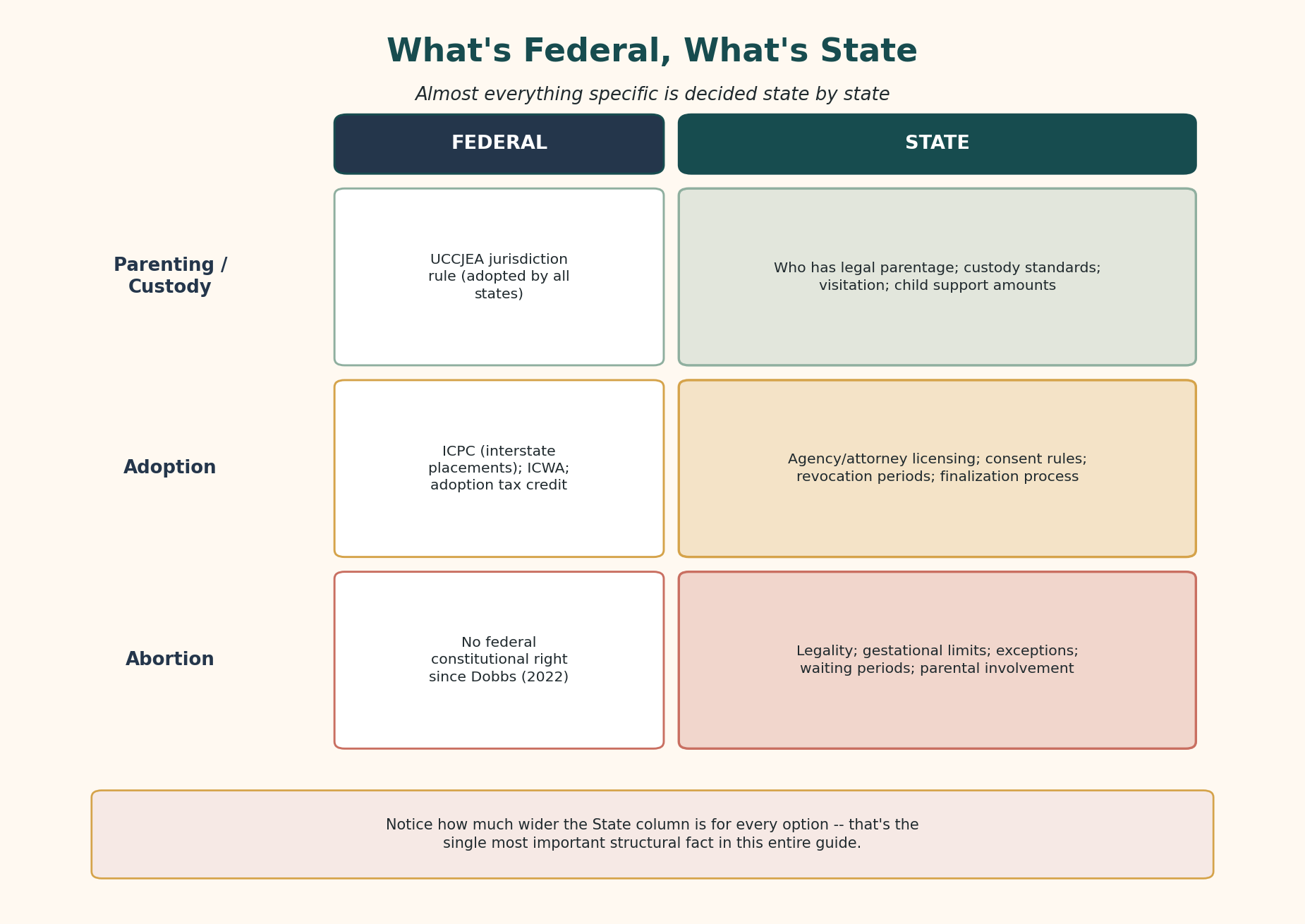
| Option | Set at the Federal Level | Set at the State Level |
|---|---|---|
| Parenting | Baseline employment protections (PDA, PWFA, FMLA); medical privacy (HIPAA) | Custody, child support, parentage/paternity establishment, interstate jurisdiction coordination (UCCJEA) |
| Adoption | Interstate placement coordination (ICPC); Indian Child Welfare Act placement preferences where applicable; adoption tax credit (IRS) | Agency/attorney licensing, consent timing and requirements, revocation periods, allowable birth-parent expenses, finalization procedure |
| Abortion | FDA approval of medication-abortion drugs; baseline constitutional limits the Supreme Court has recognized post-Dobbs | Whether and when abortion is legally available, waiting periods, consent/notification rules, telehealth rules |
Reading This Table Correctly
“Federal” Doesn’t Mean “Fixed Forever”
Federal rules can and do change — through new legislation, agency regulation, or Supreme Court decisions, as Dobbs itself demonstrates. “Federal” here means “currently set at the national level,” not “permanent.”
“State” Means Genuinely Different, Not Just Technically Different
For the state-level rows, this isn’t a formality — the actual content of the rule (how long a revocation period is, whether abortion is available and at what gestational point, how paternity is established for an unmarried couple) can differ substantially between neighboring states.
Why Some Topics Have Both Federal and State Components
Interstate Compacts Are a Federal-State Hybrid
The ICPC and UCCJEA are unusual: they’re not federal statutes in the ordinary sense, but interstate compacts that every state has adopted into its own state law, creating a nationally consistent procedural framework even though the underlying substantive law (who gets custody, whether a specific adoption is approved) remains state-determined. Sections 5 and 7 explain how this works in practice.
Abortion Has a Federal Regulatory Layer Even Though Legality Is State-Determined
The FDA’s approval of medication-abortion drugs is a federal regulatory fact that doesn’t change from state to state, even though whether and when abortion is legally available in a given state is now entirely a state question. This distinction — federal drug approval versus state legal availability — is a common source of confusion, addressed further in Section 9.
Key Takeaways
- A small set of federal rules (employment protections, medical privacy, interstate compacts, ICWA, FDA drug approval) apply the same way nationwide.
- Most of the substantive law governing custody, parentage, adoption, and abortion is set at the state level and genuinely varies.
- Interstate compacts (ICPC, UCCJEA) are a federal-state hybrid: nationally consistent procedure, state-determined substance.
Parentage Law: How Legal Parenthood Is Established
Before custody, child support, or an adoptive family’s rights can even become relevant questions, the law first has to determine who the child’s legal parents are. This section covers how that baseline determination works.
The Marital Presumption
The Traditional Default
In every U.S. state, a child born to a married woman is presumed by law to be the legal child of her spouse — a rule with roots in centuries-old common law, now codified in state statutes. This presumption can be challenged in certain circumstances (for example, with genetic testing showing another biological parent), but it operates automatically at birth unless and until it’s challenged.
How This Applies in Same-Sex Marriages
Following nationwide marriage equality, most states extend the marital presumption to a spouse in a same-sex marriage as well, though the exact statutory language and how consistently it’s applied can still vary by state — an area where confirming your specific state’s current treatment with a family law attorney is worthwhile if it applies to you.
Establishing Parentage for Unmarried Parents
Voluntary Acknowledgment of Paternity
For unmarried couples, most states offer a straightforward path: both parents can sign a voluntary acknowledgment of paternity, typically at the hospital at birth or afterward, which legally establishes the biological father’s parental rights and responsibilities without needing a court proceeding.
When Voluntary Acknowledgment Isn’t Available or Is Disputed
If one parent won’t sign, paternity is disputed, or genetic testing is needed, establishing parentage requires a court proceeding, which can be initiated by either parent or, in some cases, a state child-support agency.
The Uniform Parentage Act
What It Is
The Uniform Parentage Act (UPA) is a model law, drafted by the Uniform Law Commission and most recently substantially revised in 2017, that many states have adopted in whole or in part to standardize how parentage is established, including for children conceived through assisted reproduction and for same-sex parents. Not every state has adopted the same version, so the exact rules still vary.
Why a Model Law Still Produces State Variation
Because each state legislature independently decides whether and how to adopt a model law like the UPA — sometimes adopting an older version, a newer version, or a modified version — the practical result is more consistency than if each state had started from scratch, but still real variation, which is why confirming your own state’s current parentage statute matters.
| Situation | General Approach |
|---|---|
| Married couple, either spouse gives birth | Spouse presumed to be legal parent automatically at birth |
| Unmarried couple, both parents agree | Voluntary acknowledgment of paternity/parentage signed, typically at or after birth |
| Unmarried couple, parentage disputed | Court proceeding, often involving genetic testing |
| Conception via assisted reproduction with a known or anonymous donor | State-specific rules on donor’s parental status; many states following newer UPA versions specify the donor is not a legal parent absent a separate written agreement, but confirm the current rule for your state with a family law attorney |
Why This Matters for an Adoption Plan Specifically
The Biological Father’s Legal Status Affects Adoption Consent
As our decision-support guide notes, whether a biological father must consent to or be notified of an adoption plan often depends on whether his parentage has already been legally established — an unestablished, unacknowledged biological father may have fewer or different procedural rights than one who has signed an acknowledgment of paternity, which is one reason adoption agencies ask about this specifically.
Unresolved Parentage Can Delay an Adoption
An adoption agency or attorney will typically want the biological father’s status clarified — whether through his consent, a legal determination that he has no parental rights to assert, or expiration of a notice period — before finalizing a plan, since an unresolved paternity question is one of the more common sources of delay or later legal challenge in an adoption case.
Key Takeaways
- Legal parentage is established automatically for a married spouse (the marital presumption) or through voluntary acknowledgment or a court proceeding for unmarried parents.
- The Uniform Parentage Act standardizes much of this across states that have adopted it, but adoption is uneven and versions differ, so real state-by-state variation remains.
- An unresolved parentage question for the biological father is a common source of delay or complication in an adoption plan, which is why establishing it clearly matters even before an adoption decision is finalized.
Custody and Interstate Jurisdiction: The UCCJEA Explained
If you and the other biological parent live in different states, or might move after the child is born, a separate legal question arises that surprises many people: which state’s courts actually have authority to decide custody? The Uniform Child Custody Jurisdiction and Enforcement Act (UCCJEA) answers that question.
What the UCCJEA Is
A Uniform Law Adopted by Every State
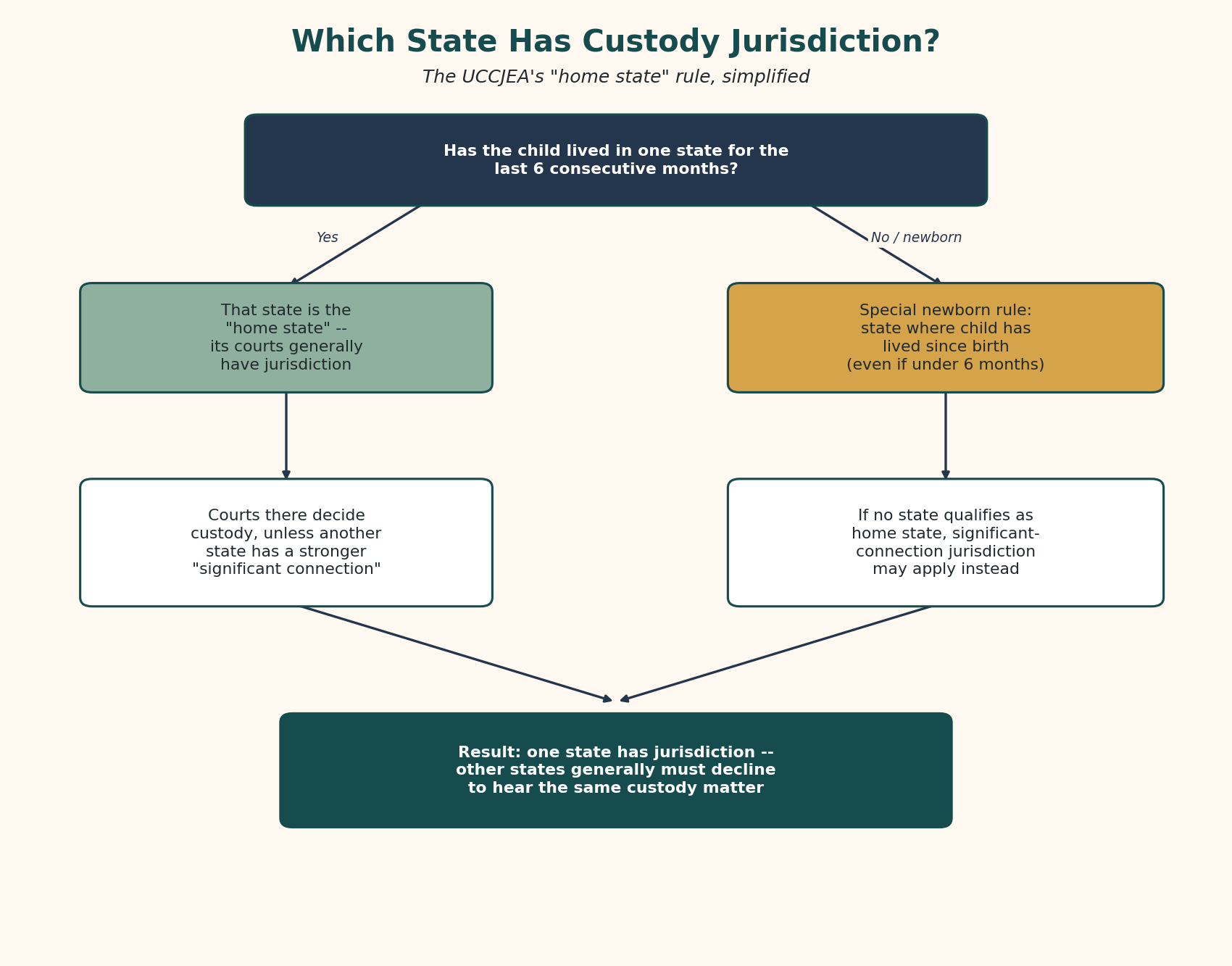
The UCCJEA is a model law, drafted by the Uniform Law Commission, that has been adopted (with only minor variations) by all 50 states, the District of Columbia, and U.S. territories, specifically to prevent competing custody orders from different states and to make interstate custody disputes more predictable.
What Problem It Solves
Before uniform laws like this existed, it was possible for two different states to each believe they had jurisdiction over the same custody case, producing conflicting court orders. The UCCJEA establishes a clear priority system so that, in the vast majority of cases, only one state’s courts have authority at a time.
The “Home State” Rule
The Six-Month Residency Standard
Under the UCCJEA, a child’s “home state” — the state with primary jurisdiction over custody — is generally the state where the child has lived with a parent for at least the six consecutive months immediately before a custody case is filed.
What Happens for a Newborn
For a child too young to have a six-month residency history, the home state is generally the state where the child has lived since birth, which for most newborns means the state where they were born and have lived continuously since.
When There’s No Clear Home State
Significant-Connection Jurisdiction
If no state qualifies as the home state (for example, a child who has moved between states repeatedly), the UCCJEA provides a secondary “significant connection” test, looking at where the child has meaningful ties and where substantial evidence about the child’s care is available.
Why This Matters Before Birth, Not Just After
If you and the other biological parent live in different states, understanding which state is likely to become the child’s home state can meaningfully affect practical decisions — including, for some people, where to plan to give birth — which is why a family law attorney is worth consulting early in a genuinely interstate situation, rather than only after a custody dispute arises.
How This Interacts With Adoption
The UCCJEA Generally Doesn’t Govern Adoption Placement Itself
Interstate adoption placements are primarily governed by the ICPC (Section 7), not the UCCJEA, though the UCCJEA can become relevant later if a custody dispute arises involving an adopted child across state lines.
Two Different Interstate Frameworks, Two Different Purposes
It’s worth keeping these frameworks distinct: the UCCJEA answers “which state’s courts decide custody,” while the ICPC answers “what has to happen before a child can be placed with a family in a different state for adoption or foster care.” Both matter in different interstate scenarios.
Key Takeaways
- The UCCJEA, adopted by every state, determines which state’s courts have authority over a custody case, primarily using a “home state” (six-month residency) rule.
- For a newborn, the home state is generally where the child has lived since birth.
- The UCCJEA governs custody jurisdiction; the ICPC (Section 7) governs interstate adoption placement — related but distinct frameworks.
Adoption Law: How the U.S. Structures Adoption
Adoption law in the United States is a patchwork of state licensing and procedure, coordinated across state lines by a federal interstate compact and, for Native American children, shaped by a specific federal statute. This section covers the structure; for the practical, step-by-step experience of making an adoption plan, see our decision-support guide’s adoption section, and watch for this site’s forthcoming dedicated adoption-process series.
State Licensing and Regulation
Agencies and Attorneys Are Licensed at the State Level
Every state independently licenses and regulates adoption agencies and, in most states, sets rules for attorney-facilitated (“independent”) adoptions — there is no single federal adoption license or federal adoption agency.
What This Means Practically
An agency licensed in one state generally cannot legally place children in another state without complying with that second state’s own rules and the interstate compact described in Section 7 — which is part of why interstate adoptions involve more procedural steps than same-state ones.
Consent and Revocation: A State-by-State Patchwork
No National Standard Timing
As our decision-support guide covers in practical detail, every state requires that a birth parent’s consent be signed only after birth, with a minimum waiting period that varies by state, and most (though not all) states then provide a further revocation window before finalization — with no two states required to set the same lengths.
Why No Uniform Law Has Fully Standardized This
Unlike custody jurisdiction (UCCJEA) or interstate placement procedure (ICPC), consent and revocation timing has proven politically and practically difficult to standardize nationally, since states differ in how they balance birth-parent protection against adoptive-family and child stability — the result is the wide variation seen today.
The Indian Child Welfare Act
What It Is and Why It Exists
The Indian Child Welfare Act (ICWA), a federal law enacted in 1978, sets specific placement preferences and procedural protections for the adoption and foster placement of children who are members of, or eligible for membership in, a federally recognized Native American tribe — enacted in response to historically high rates of Native children being removed from their families and communities.
How It Affects an Adoption Plan
Where ICWA applies, it generally requires notice to the child’s tribe, active efforts to keep the child within the family or tribal community where possible, and a placement preference order (extended family, other tribal members, other Native families) before a non-Native adoptive placement is considered — an adoption agency or attorney should identify early whether ICWA applies to a specific situation, since it changes the required process significantly.
The Adoption Tax Credit
A Federal Benefit for Adoptive Families
The federal adoption tax credit, administered by the IRS, offsets qualified adoption expenses for adoptive families up to an annually adjusted maximum amount — this is a benefit to the adoptive family, not the birth parent, and its current-year amount and eligibility rules are best confirmed directly through IRS guidance or a tax professional.
Why This Doesn’t Change the Birth Parent’s Financial Picture
As covered in our decision-support guide, birth-parent medical and living expenses are typically covered by the adoptive family or agency directly, separate from and unrelated to the adoptive family’s own tax credit — the two are easy to conflate but serve different parties.
For a full breakdown of eligibility, qualified expenses, and how to claim this benefit, see our adoption tax credit guide. If you want to see how these legal steps fit together in sequence, from matching through finalization, our adoption process walkthrough lays out the full timeline. Birth parents weighing consent should also review how birth mother rights and birth father rights differ by state before signing anything.
Key Takeaways
- Adoption agencies and attorneys are licensed and regulated at the state level; there is no single federal adoption license.
- Consent and revocation timing varies significantly by state and has not been nationally standardized, unlike custody jurisdiction or interstate placement procedure.
- The Indian Child Welfare Act sets federal placement preferences and procedural protections for eligible Native American children, changing the required process where it applies.
- The federal adoption tax credit benefits the adoptive family, separate from the birth parent’s own expense coverage.
The Interstate Compact on the Placement of Children (ICPC)
When a birth parent lives in one state and the adoptive family lives in another — a common scenario, since many agencies match birth parents with families nationwide — a specific interstate procedure has to be followed before the child can legally be placed. That procedure is the ICPC.
What the ICPC Is
An Agreement Among All 50 States
The Interstate Compact on the Placement of Children is an agreement, adopted into law by all 50 states, the District of Columbia, and the U.S. Virgin Islands, that governs the placement of a child across state lines for adoption or foster care.
Why It Exists
Before the compact, a child could be sent to another state for placement with no guarantee that the receiving state’s authorities had reviewed the placement or that the child would have legal protections while there — the ICPC requires both states’ central ICPC offices to review and approve a placement before it happens.
How It Works in Practice
The Sending State’s Role
The state where the birth parent lives (the “sending state”) submits required documentation about the birth parent, the child, and the proposed adoptive family to its own ICPC office, which forwards it to the receiving state.
The Receiving State’s Role
The state where the adoptive family lives (the “receiving state”) reviews the placement — typically including a home study of the adoptive family — and must approve it before the child can legally travel there to live with that family.
Timing
ICPC approval can take anywhere from a few days to several weeks depending on the states involved and how quickly required documentation is submitted; an experienced adoption agency or attorney handling an interstate placement will typically manage this process and can give you a realistic, current estimate for the specific states involved, since processing time depends partly on each state’s current volume.
What This Means for a Birth Parent Considering an Interstate Adoption
It Doesn’t Change Your Rights or Consent Timeline
The ICPC governs the adoptive family’s ability to bring the child across state lines — it doesn’t change your own state’s rules about when you can sign consent or your revocation rights, which remain governed by your own state’s law as covered in Section 6.
It Can Affect Practical Timing After Birth
Because ICPC approval has to happen before the child leaves the hospital’s state with the adoptive family in most cases, an interstate placement can mean a short additional waiting period immediately after birth compared to a same-state placement — worth discussing with your agency in advance so it doesn’t come as a surprise.
Key Takeaways
- The ICPC, adopted by all 50 states, requires both the birth parent’s state and the adoptive family’s state to review and approve a placement before a child can be adopted across state lines.
- It’s a procedural, interstate-coordination requirement — it doesn’t change your own state’s consent or revocation rules.
- It can add a short waiting period immediately after birth for an interstate placement; a licensed agency handles this process and can set realistic expectations.
Abortion Law: From Roe to Casey to Dobbs
To understand why abortion law looks the way it does today — and why it varies so much by state — it helps to know the basic legal history in outline. This section presents that history factually, as constitutional and legal fact, not as commentary on whether any of these decisions was correctly decided.
Roe v. Wade (1973)
What the Court Decided
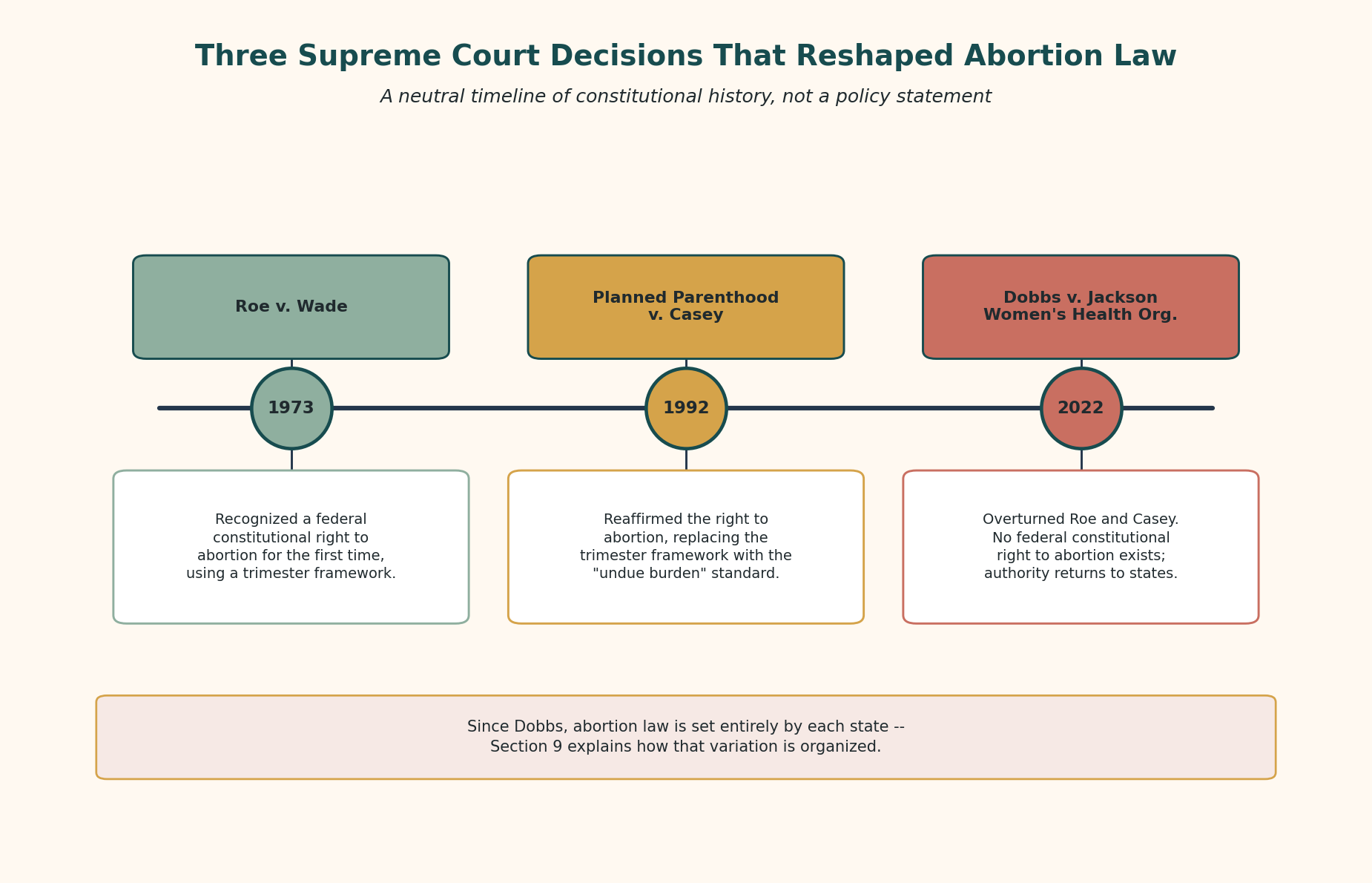
In 1973, the U.S. Supreme Court held in Roe v. Wade that the Constitution protected a right to abortion as part of a broader right to privacy, establishing a framework that limited states’ ability to restrict abortion, particularly earlier in pregnancy.
The Trimester Framework
Roe initially organized permissible state regulation around pregnancy trimesters, with states given more latitude to regulate as pregnancy progressed — a framework that would later be modified by the Supreme Court’s 1992 decision.
Planned Parenthood v. Casey (1992)
What the Court Decided
In 1992, the Supreme Court in Planned Parenthood v. Casey reaffirmed a constitutional right to abortion but replaced Roe’s trimester framework with the “undue burden” standard, asking whether a given state regulation placed a substantial obstacle in the path of a person seeking an abortion before fetal viability.
What Changed Practically
Casey allowed states somewhat more room to regulate abortion (for example, waiting periods and informed-consent requirements) as long as those regulations didn’t rise to an “undue burden,” while still maintaining a nationwide constitutional floor.
Dobbs v. Jackson Women’s Health Organization (2022)
What the Court Decided
In 2022, the Supreme Court in Dobbs v. Jackson Women’s Health Organization held that the Constitution does not confer a right to abortion, overturning both Roe and Casey and returning the authority to regulate or prohibit abortion entirely to individual states.
The Immediate Practical Effect
Following Dobbs, states became free to ban, restrict, or protect abortion access as each state’s own legislature and courts determine, without a nationwide constitutional floor — producing the wide state-by-state variation described in Section 9.
| Year | Case | What It Established |
|---|---|---|
| 1973 | Roe v. Wade | Recognized a constitutional right to abortion; introduced the trimester framework |
| 1992 | Planned Parenthood v. Casey | Reaffirmed the right while replacing the trimester framework with the “undue burden” standard |
| 2022 | Dobbs v. Jackson Women’s Health Organization | Overturned Roe and Casey; returned abortion regulation entirely to the states |
Where This Leaves Things Today
No Federal Constitutional Floor or Ceiling
Since Dobbs, there is no federal constitutional minimum level of access a state must provide, nor a federal maximum restriction a state cannot exceed — each state’s legislature, governor, and courts operate largely independently on this question, within their own state constitution’s limits, which some state supreme courts have interpreted to independently protect abortion rights under their own state constitutions regardless of the federal ruling.
The Legal Landscape Continues to Change
Since 2022, state abortion law has continued to shift through new legislation, ballot initiatives, and ongoing litigation in state and federal courts — which is precisely why Section 9’s framework for understanding state variation is built as a methodology rather than a fixed snapshot, and why Section 13 teaches you to find current information directly.
Key Takeaways
- Roe v. Wade (1973) established a constitutional right to abortion; Planned Parenthood v. Casey (1992) reaffirmed it under a different legal standard.
- Dobbs v. Jackson Women’s Health Organization (2022) overturned both, returning abortion regulation entirely to individual states.
- There is no federal constitutional floor or ceiling on state abortion law today, and the legal landscape continues to actively change through legislation, ballot measures, and litigation.
How States Regulate Abortion Today: A Framework for Understanding Variation
Since Dobbs, each state’s abortion law is genuinely its own, and a fixed list mapping all 50 states to a specific rule would be out of date within months, and possibly wrong the moment it was published — the exact situation this site’s editorial standards are built to avoid. Instead, this section teaches the framework that trackers like the Guttmacher Institute use to classify state approaches, so you can understand and look up any specific state’s current position, including your own.
The General Categories You’ll See in Any Current Tracker
Broadly Protective
Some states have passed their own laws or state constitutional protections affirmatively protecting abortion access, in some cases codifying rights beyond what Roe and Casey once provided federally.
Some Restrictions
Some states permit abortion but impose specific limits — a gestational cutoff earlier than viability, waiting periods, mandatory counseling, or parental involvement requirements for minors — without banning the procedure outright.
Most Restrictive or Banned
Some states ban abortion at all or nearly all stages of pregnancy, typically with narrow exceptions (commonly for the pregnant person’s life or specific serious health circumstances, and sometimes for cases of rape or incest, though the exact exceptions vary by state).
Why “Gestational Limit” Alone Doesn’t Tell the Whole Story
Exceptions Matter as Much as the Headline Number
Two states with the same stated gestational limit can differ substantially in practice based on how broadly or narrowly their medical exceptions are written and interpreted, and how those exceptions are applied by hospitals and providers in practice — a detail that a single-number summary misses entirely.
Trigger Laws and Rapid Change
Some states had “trigger laws” — legislation written before Dobbs designed to take effect automatically if Roe were overturned — while others have since passed new legislation, had laws blocked or reinstated by courts, or seen ballot initiatives change the law directly. This is part of why state abortion law has continued to shift since 2022 rather than settling into a fixed pattern.
| Category | General Characteristics | What to Check for a Specific State |
|---|---|---|
| Broadly protective | Affirmative legal or constitutional protection for abortion access | Whether protection is statutory, constitutional, or both, and how recently it was enacted |
| Some restrictions | Legal but with specific limits (gestational cutoff, waiting period, counseling, parental involvement) | The specific gestational point, and the scope of any medical exceptions |
| Most restrictive / banned | Banned at all or nearly all stages, with narrow exceptions | The precise exceptions (life, health, rape, incest) and how they’ve been interpreted or applied |
How to Use This Framework Responsibly
Use It to Understand the Shape of the Landscape, Not to Guess Your State’s Specific Rule
This framework tells you what kind of questions to ask about a given state; it does not tell you the current answer for any specific state, which can and does change. Section 13 covers exactly how to look that up.
Recheck Before Relying on Anything Time-Sensitive
If a decision is time-sensitive for you specifically (see our decision-support guide’s timing section), confirm your state’s current, specific rule directly with a licensed clinic or an actively maintained tracker immediately before acting on it, rather than from memory or an older source.
Key Takeaways
- State abortion law generally falls into a spectrum from broadly protective to most restrictive, but the exact rule for any state requires checking a current source.
- A gestational-limit number alone doesn’t capture the full picture — medical exceptions and how they’re applied matter just as much.
- State law has continued to change since 2022 through legislation, litigation, and ballot measures, so currency matters more here than almost anywhere else in this guide.
Interstate Travel and Shield Laws
Since Dobbs, a meaningful number of people travel to a different state to access abortion care that isn’t available where they live. This has raised new legal questions that didn’t exist in the same way before 2022, and some states have responded with specific “shield law” protections.
The Basic Legal Question
Can a State Restrict Its Residents From Traveling for Care?
Whether a state can legally restrict its own residents from traveling to another state to obtain a legal abortion there — or penalize someone who helps them do so — is a genuinely unsettled and actively litigated area of constitutional law, involving questions about the right to interstate travel that courts are still working through.
Can a State Prosecute Someone for an Abortion Legally Obtained Elsewhere?
Similarly unsettled: whether a state with restrictive abortion laws can take legal action against a resident, or a provider in another state, over an abortion that was entirely legal where and when it was performed. This is precisely the kind of live legal question this guide won’t attempt to resolve with a fixed answer, since court decisions are actively shaping it.
What Shield Laws Do
Protecting Providers
Some states with protective abortion laws have passed “shield law” statutes specifically designed to protect their own licensed providers from out-of-state legal action (such as being extradited or having their medical license challenged) for providing abortion care — including, in some states, telehealth care — to patients located in a more restrictive state.
Protecting Patients and Helpers
Some shield laws also aim to protect patients who travel for care, and people who help them (family members who provide transportation or funding, for example), from legal consequences back in their home state, though the actual enforceability of these protections across state lines is one of the unsettled questions noted above.
What This Means Practically
If You’re Considering Traveling for Care
A licensed clinic in the destination state, the National Network of Abortion Funds, or an attorney focused on reproductive rights can advise on the current legal landscape for your specific home state and destination state — this is a rapidly evolving area where personalized, current legal advice matters more than a general guide can responsibly provide.
If You’re Helping Someone Else Travel for Care
The same caution applies if you’re a partner, family member, or friend helping someone travel — if your home state has restrictive abortion laws and you’re uncertain about your own legal exposure in helping, that’s a reasonable, specific question for an attorney rather than an assumption either way.
Key Takeaways
- Interstate travel for abortion care has become legally significant since Dobbs, and several important questions (a state’s ability to restrict travel or reach conduct in another state) remain genuinely unsettled and actively litigated.
- Shield laws in some states aim to protect providers, patients, and helpers from out-of-state legal consequences, though their full enforceability is still being tested in court.
- Given how unsettled and fast-moving this area is, current legal advice specific to your states of residence and travel is more reliable than any general summary, including this one.
Minors and the Law: Consent, Notification, and Judicial Bypass
As our decision-support guide notes at a practical level, whether a minor needs parental involvement for an abortion or an adoption plan is genuinely state-specific. This section covers the legal structure behind that variation, including the constitutional doctrine that shapes it.
Parental Consent and Notification Laws
Two Different Legal Approaches
States that require parental involvement in a minor’s abortion decision generally use one of two approaches (or occasionally both): parental consent laws require a parent to affirmatively agree, while parental notification laws require only that a parent be informed, without necessarily needing to agree.
States Vary on Whether Either Is Required at All
Some states require neither parental consent nor notification for a minor’s abortion; others require one or both. As with the rest of this article’s state-variable content, the specific rule for any given state is a “check a current source” fact, not a fixed figure stated here.
The Constitutional Basis for Judicial Bypass
Bellotti v. Baird (1979)
In Bellotti v. Baird, the Supreme Court held that a state requiring parental consent for a minor’s abortion must also provide an alternative path — a judicial bypass procedure — allowing a minor to obtain authorization directly from a court instead, if involving a parent isn’t in the minor’s best interest or the minor is mature enough to decide independently.
What a Bypass Proceeding Generally Involves
A judicial bypass hearing is typically confidential, expedited, and doesn’t require the minor to prove anything beyond what Bellotti requires (maturity, or that the abortion is in their best interest); many states have specific, minor-focused legal aid organizations that help minors navigate this process, since going to court alone can otherwise feel like a significant barrier.
Minors and Adoption
A Different, Separately State-Determined Question
Whether a minor who is herself pregnant needs a parent or guardian involved in her own decision to place a child for adoption is a separate legal question, governed by each state’s own adoption statutes rather than by the constitutional judicial-bypass doctrine that applies specifically to abortion.
Why This Often Surprises People
Because the judicial-bypass concept is relatively well-known in the abortion context, people sometimes assume something similar automatically exists for a minor considering adoption — it doesn’t necessarily, and the actual requirement depends entirely on the specific state’s adoption law.
Confidentiality Protections for Minors
Medical Confidentiality Generally
Separate from parental-involvement laws specifically for abortion, many states and federal programs provide broader confidentiality protections for minors seeking certain reproductive health services, though the scope varies by state and by the specific service and payment method involved.
Where to Get a Reliable, Current Answer
As our decision-support guide recommends, Planned Parenthood’s helpline and website maintain current, state-specific guidance for minors, and a local legal aid organization focused on minors’ rights can address a specific situation directly.
Key Takeaways
- States that require parental involvement in a minor’s abortion decision use consent laws, notification laws, or occasionally both — and some states require neither.
- Bellotti v. Baird (1979) established that any state parental-consent requirement for a minor’s abortion must include a judicial bypass alternative.
- Judicial bypass is a doctrine specific to abortion; a minor’s own adoption-plan decision is governed separately by each state’s adoption statutes, which may or may not require similar parental or court involvement.
Nationwide Rights That Don’t Vary by State
Against the backdrop of so much state variation, it’s worth pulling together the handful of protections that apply the same way everywhere in the country. Our decision-support guide covers these in full practical detail; this section summarizes them as part of the overall federal-vs-state structural picture.
Employment Protections
The Pregnancy Discrimination Act and the Pregnant Workers Fairness Act
The Pregnancy Discrimination Act (1978) bars employment discrimination based on pregnancy at covered employers, and the Pregnant Workers Fairness Act (2023) requires reasonable workplace accommodations for pregnancy-related needs, absent undue hardship — both apply nationwide to employers of the covered size, regardless of state.
The Family and Medical Leave Act
The FMLA provides unpaid, job-protected leave nationwide for eligible employees at covered employers, for birth, bonding, or a related serious health condition — a federal floor that some states supplement with their own additional paid-leave programs.
Medical Privacy
HIPAA’s Baseline Protection
HIPAA’s medical-privacy rules apply nationwide, protecting pregnancy-related medical records — including records related to any of the three options — from disclosure without authorization except in narrow, legally defined circumstances.
State Law Can Add, but Not Subtract
Some states have additional privacy protections beyond HIPAA’s federal floor; none can legally provide less protection than HIPAA requires, since it sets a nationwide minimum.
Emergency Medical Care
EMTALA’s Nationwide Guarantee
The Emergency Medical Treatment and Labor Act requires hospitals with emergency departments, in every state, to provide a medical screening exam and stabilizing treatment for an emergency medical condition regardless of insurance status, immigration status, or ability to pay.
Why This Matters Regardless of Which Path You’re On
This protection applies the same way in every state and regardless of your pregnancy-options decision — a genuinely universal floor in an otherwise highly variable legal landscape.
| Right | Source | Applies To |
|---|---|---|
| No pregnancy-based employment discrimination | Pregnancy Discrimination Act (1978) | Employers with 15+ employees, nationwide |
| Reasonable workplace accommodations | Pregnant Workers Fairness Act (2023) | Employers with 15+ employees, nationwide |
| Unpaid, job-protected leave | Family and Medical Leave Act | Eligible employees at covered employers, nationwide |
| Medical record privacy | HIPAA | Covered health providers and plans, nationwide |
| Emergency medical screening and stabilization | EMTALA | Hospitals with emergency departments, nationwide |
What’s Deliberately Not on This List
Anything State-Determined
Custody, parentage establishment, adoption consent/revocation, and abortion legality and access are all state-determined, as covered throughout this guide, and are deliberately excluded from this “nationwide” list because they aren’t nationwide.
For the Full Practical Detail on These Rights
Our decision-support guide’s rights section covers these same protections with more day-to-day practical framing (what to do if an employer denies an accommodation, and so on) — this section’s purpose is specifically to show how they fit into the federal-vs-state structural picture.
Key Takeaways
- Employment protections (PDA, PWFA, FMLA), medical privacy (HIPAA), and emergency care (EMTALA) apply nationwide regardless of state or which of the three options you’re considering.
- States can add additional protections on top of these federal floors but cannot legally provide less.
- Custody, parentage, adoption, and abortion law are deliberately not on this list, since they are state-determined, not nationwide.
How to Find Your State’s Current Law
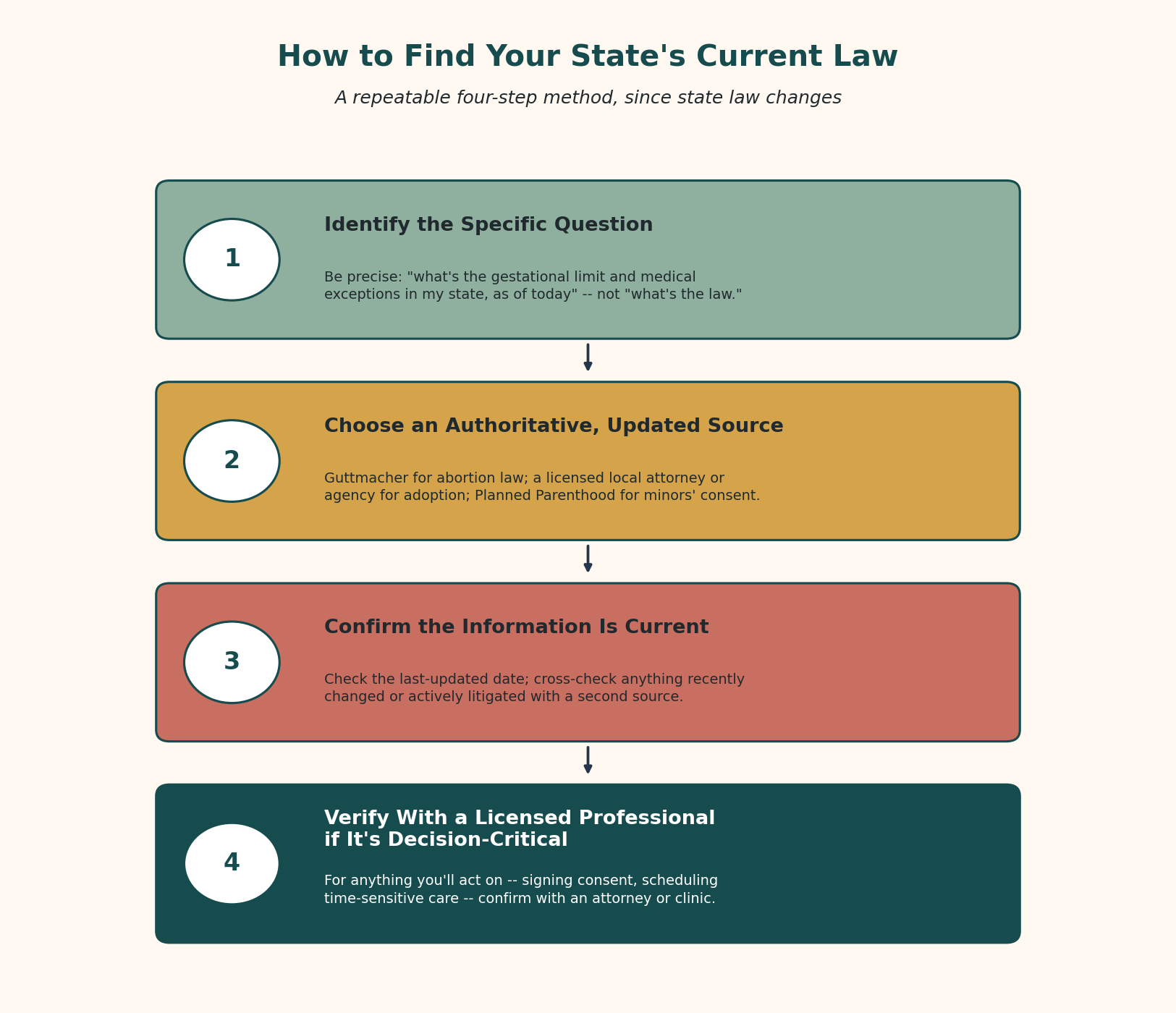
Every section of this guide has pointed toward the same idea: state law changes, and a static article shouldn’t pretend otherwise. This section is the practical payoff — a repeatable method for finding accurate, current information for your own state, whichever of the three areas you need.
Step One: Identify the Specific Question
Be Precise About What You Need to Know
“What’s the abortion law in my state” is too broad to research efficiently; “what is the gestational limit, and what are the medical exceptions, in my state, as of today” is answerable. The more specific the question, the more reliably you can find and verify an answer.
Separate Legal Fact From Practical Logistics
A legal question (“is this legal in my state”) is different from a logistics question (“which clinic near me can do this, and how soon”) — both matter, but they often have different best sources, covered below.
Step Two: Choose an Authoritative, Actively Updated Source
For Abortion Law
The Guttmacher Institute’s state policy tracker is specifically built and maintained to track this exact kind of state-by-state legal variation in near-real time, making it a stronger source than a news article or a general health website, which may not be updated as changes happen.
For Adoption Law
A licensed adoption attorney or agency in your specific state is generally a better source than a general legal-information website, since they work with your state’s current statutes and procedures directly and can address your specific situation, not just the general rule.
For Minors’ Consent Questions
Planned Parenthood’s website and patient helpline maintain current, state-specific guidance specifically because they update it as state law changes; a local legal aid organization focused on minors’ rights is a strong complementary source for anything court-related, like judicial bypass.
Step Three: Confirm the Information Is Current
Check the Publish or Last-Updated Date
Any source you’re relying on for a state-specific legal fact should show when it was last updated — if it doesn’t, or the date is more than a few months old for a rapidly changing area like abortion law, treat it as a starting point rather than a final answer.
Cross-Check Actively Litigated or Recently Changed Areas
If a specific state’s law has recently changed, is currently being challenged in court, or is the subject of a pending ballot measure, a single source — even a good one — may not capture the full, current picture; checking a second source or calling a local provider directly adds real confidence.
Step Four: Verify With a Licensed Professional if It’s Decision-Critical
When a General Source Isn’t Enough
For anything you’re actually going to act on — signing adoption consent, scheduling a time-sensitive abortion, or relying on a specific custody-jurisdiction analysis — a licensed attorney or clinic in the relevant state, who can confirm the current rule and apply it to your specific facts, is worth the step beyond a general tracker or guide.
This Guide’s Role in That Process
This article is designed to make you a better-informed client or patient when you have that conversation — understanding the structure and the right questions to ask — not to replace the conversation itself.
Key Takeaways
- Start with a precise, specific question rather than a broad one.
- Use a source built and maintained specifically for the area you’re researching (Guttmacher for abortion law, a licensed local attorney or agency for adoption, Planned Parenthood for minors’ consent).
- Confirm currency, especially in fast-changing or actively litigated areas, and verify anything decision-critical with a licensed professional before acting on it.
Common Mistakes and Misconceptions About Pregnancy Law
A handful of legal misunderstandings come up often enough across all three areas that they’re worth addressing directly, separate from the practical decision-support misconceptions already covered in our decision-support guide.
Mistakes About Federal vs. State Authority
Assuming a Federal Constitutional Right to Abortion Still Exists
Since Dobbs (2022), there is no federal constitutional right to abortion; availability is entirely determined by each state, a change significant enough that older information (including some still-circulating articles and social-media posts) may describe outdated law.
Assuming Custody and Adoption Law Are Federal
Unlike the recent, high-profile change in abortion law, custody, parentage, and adoption law have always been primarily state matters — this isn’t a recent shift, though it’s sometimes mistakenly assumed to be new or to have changed alongside abortion law.
Mistakes About Interstate Situations
Assuming Any State’s Court Can Hear a Custody Case
As Section 5 covers, the UCCJEA generally gives jurisdiction to a specific “home state,” not to whichever state a parent prefers or happens to file in first.
Assuming Interstate Adoption Placement Is as Simple as a Same-State One
The ICPC (Section 7) adds a real procedural step — review and approval by both states — that doesn’t exist for a same-state adoption, which can add time immediately after birth if not planned for in advance.
Mistakes About Abortion Law Specifically
Assuming a Gestational-Limit Number Tells the Whole Story
As Section 9 covers, medical exceptions and how broadly or narrowly they’re applied matter as much as the headline gestational number, and two states with the same stated limit can function very differently in practice.
Assuming Interstate Travel for Abortion Is Legally Fully Settled
As Section 10 covers, whether a state can restrict its residents’ travel for abortion care, or reach conduct occurring legally in another state, remains genuinely unsettled and actively litigated — treating it as fully resolved in either direction is currently inaccurate.
Mistakes About Minors’ Rights
Assuming Judicial Bypass Exists for Every Minors’-Rights Situation
As Section 11 covers, judicial bypass is a doctrine specific to abortion consent requirements; it doesn’t automatically apply to a minor’s adoption-plan decision, which is governed separately by state adoption law.
Assuming All States Require the Same Parental Involvement
Some states require parental consent, some require only notification, and some require neither — assuming your own state’s approach applies universally is a common and understandable, but incorrect, assumption.
Key Takeaways
- Abortion law changed dramatically and recently (2022); custody, parentage, and adoption law have always been primarily state matters.
- Interstate situations (custody jurisdiction, adoption placement, abortion travel) each have their own specific legal framework — none of them work the same as the equivalent same-state process.
- Judicial bypass and parental-involvement rules are more varied and more specific to abortion law than people often assume.
Glossary of Legal Terms
A quick reference for the legal terms used throughout this guide.
Constitutional and Case-Law Terms
Roe v. Wade
The 1973 U.S. Supreme Court decision that first recognized a constitutional right to abortion, later overturned by Dobbs in 2022.
Planned Parenthood v. Casey
The 1992 Supreme Court decision that reaffirmed a right to abortion under the “undue burden” standard, replacing Roe’s trimester framework.
Dobbs v. Jackson Women’s Health Organization
The 2022 Supreme Court decision that overturned Roe and Casey, holding that the Constitution does not confer a right to abortion and returning the question to the states.
Bellotti v. Baird
The 1979 Supreme Court decision establishing that a state requiring parental consent for a minor’s abortion must provide a judicial bypass alternative.
Interstate Framework Terms
UCCJEA (Uniform Child Custody Jurisdiction and Enforcement Act)
A uniform law, adopted by all states, that determines which state’s courts have jurisdiction over a custody case, primarily through a “home state” rule.
ICPC (Interstate Compact on the Placement of Children)
An interstate compact, adopted by all states, requiring review and approval by both the sending and receiving states before a child can be placed for adoption or foster care across state lines.
Shield Law
A state law designed to protect providers, patients, or helpers from out-of-state legal consequences related to abortion care that was legal where it was provided.
Parentage and Adoption Terms
Uniform Parentage Act (UPA)
A model law addressing how legal parentage is established, including for unmarried couples and assisted reproduction, adopted in varying forms by many states.
Marital Presumption
The legal presumption that a child born to a married person is the legal child of that person’s spouse.
Voluntary Acknowledgment of Paternity
A signed legal document, typically completed at or after birth, that establishes an unmarried biological father’s legal parentage without a court proceeding.
Indian Child Welfare Act (ICWA)
A 1978 federal law setting placement preferences and procedural protections for the adoption and foster placement of children eligible for membership in a federally recognized Native American tribe.
Abortion Law Terms
Gestational Limit
A state-law cutoff point in pregnancy after which abortion is not legally available, except under any exceptions the state’s law provides.
Trigger Law
A law passed before Dobbs, designed to take effect automatically or via quick legislative action if Roe v. Wade were overturned.
Judicial Bypass
A court process allowing a minor to obtain authorization for an abortion from a judge instead of a parent, where state law otherwise requires parental consent or notification.
Undue Burden Standard
The legal standard from Planned Parenthood v. Casey (1992) asking whether a state abortion regulation places a substantial obstacle in the path of a person seeking an abortion before viability; largely superseded at the federal level by Dobbs, though still referenced in some state-court analyses.
Frequently Asked Questions
Federal vs. State Basics
Why is family law mostly a state matter in the U.S.?
Family law has historically been considered a matter primarily within each state’s own authority, a structural feature of the U.S. federal system rather than something specific to any one issue.
Has family law always been state-based, or is this new?
It’s not new — custody, parentage, and adoption law have been primarily state-based for as long as the modern U.S. legal system has existed. What’s newer is abortion law joining that same state-based structure after 2022.
Parentage Law Questions
What happens if a married couple divorces before the baby is born?
The marital presumption generally still applies if the child is born during the marriage or shortly after its end, though exact timing rules vary by state — a family law attorney can address your specific timeline.
Can the marital presumption be challenged?
Yes, in certain circumstances (such as genetic testing showing a different biological parent), though the specific process and standard for challenging it vary by state.
Custody Jurisdiction (UCCJEA) Questions
What if I give birth in a different state than where I normally live?
Home-state determination generally looks at where the child has lived, not simply where they were born; a temporary stay for delivery generally doesn’t establish a new home state, though the specifics can matter — a family law attorney can address unusual situations.
Can I choose which state’s courts hear my custody case?
Not freely — the UCCJEA’s home-state rule generally determines jurisdiction regardless of where either parent might prefer to file.
Adoption Law Structure Questions
Why isn’t there a single national adoption law?
Adoption, like the rest of family law, has traditionally been a state responsibility; interstate compacts (the ICPC) and federal statutes (like ICWA) coordinate specific aspects nationally without fully federalizing the whole area.
Does every state require the same waiting period before consent can be signed?
No — every state requires consent to be signed after birth, but the specific minimum waiting period varies by state, as covered in our decision-support guide.
ICPC Questions
Does the ICPC apply to a same-state adoption?
No — it applies specifically when the birth parent and adoptive family are in different states; a same-state adoption doesn’t require ICPC review.
Who pays for ICPC processing?
Typically the adoptive family or agency covers ICPC-related costs, similar to how other adoption expenses are generally structured, though specifics can vary — confirm with your agency.
Abortion Law History Questions
Was abortion illegal everywhere before Roe v. Wade?
Before 1973, abortion law varied by state, with some states permitting it under certain circumstances and others prohibiting it broadly — Roe established a nationwide constitutional standard that superseded this state-by-state variation until 2022.
What exactly did Dobbs change?
Dobbs eliminated the federal constitutional right to abortion recognized in Roe and modified in Casey, returning full authority to regulate or prohibit abortion to individual states.
State Abortion Variation Questions
Why won’t this guide just list every state’s abortion law?
State abortion law changes often enough — through legislation, court rulings, and ballot measures — that a fixed list risks being outdated by the time you read it. Section 9’s classification framework and Section 13’s research method are built to stay useful even as individual state rules shift.
What does “broadly protective,” “some restrictions,” and “most restrictive” actually mean?
These are general categories describing roughly how far into pregnancy abortion remains available and how many additional requirements (waiting periods, counseling mandates, and similar) apply — not precise legal definitions, and any specific state can have unusual features that don’t fit neatly into one bucket.
Interstate Travel and Shield Law Questions
Is it legal to travel to another state for an abortion?
As Section 10 explains, this is one of the more legally unsettled questions post-Dobbs; some legal frameworks and proposed state laws have attempted to restrict this, and the constitutional limits on a state’s ability to do so are still being tested in court.
What is a shield law meant to protect against?
Shield laws are generally designed to protect a state’s own providers, and sometimes patients or helpers, from another state’s attempt to investigate, prosecute, or otherwise penalize legal abortion care provided within the shield-law state.
Minors and Judicial Bypass Questions
What exactly happens in a judicial bypass hearing?
A minor petitions a court, generally confidentially, asking a judge to authorize an abortion without parental consent or notification; the judge typically evaluates whether the minor is mature enough to decide independently or whether the abortion is in her best interest, depending on the state’s specific standard.
Does every state with a parental-consent law offer judicial bypass?
Judicial bypass is constitutionally required, under Bellotti v. Baird, wherever a state mandates parental consent for a minor’s abortion, so a bypass process should exist in any state with such a requirement — a local minors’-rights legal aid organization can confirm the specific procedure.
Finding Current State Law Questions
Is a state government website always the best source?
Often yes for the literal text of a statute, but official sites aren’t always the easiest to interpret or the fastest to reflect very recent changes; pairing an official source with a specialized tracker (like Guttmacher for abortion law) or a licensed local professional often gives a fuller, more current picture.
How often should I re-check a state law I looked up before?
If meaningful time has passed, especially in a fast-changing area like abortion law, or if you recall news of a relevant legislative or court change, it’s worth re-checking before relying on older information — Section 13’s currency-check step applies every time, not just the first time.
ICWA Questions
Does ICWA apply to every adoption involving a Native American child?
ICWA applies specifically to a child who is eligible for membership in a federally recognized tribe, as defined by the Act and the relevant tribe’s own membership criteria — an adoption professional can help confirm eligibility in a specific case.
What are ICWA’s placement preferences?
ICWA generally establishes a preference order favoring placement with extended family, then other members of the child’s tribe, then other Native American families, ahead of unrelated non-Native families, subject to certain exceptions and case-specific findings.
Same-Sex Couples and Parentage Questions
Does the marital presumption apply to same-sex married couples?
Following Obergefell v. Hodges (2015) and subsequent case law, the marital presumption is generally extended to same-sex married couples in the same way it applies to different-sex married couples, though the specific mechanics can still vary by state.
What about an unmarried same-sex couple using assisted reproduction?
This is an area where state law varies significantly, and the Uniform Parentage Act’s 2017 revision specifically addressed some of these gaps; a family law attorney familiar with assisted-reproduction parentage in your state is the most reliable source for a specific situation.
Attorney and Professional-Help Questions
Do I need a different attorney for adoption versus custody questions?
Not necessarily — many family law attorneys handle both, though some specialize specifically in adoption; ask a prospective attorney about their specific experience with your type of situation.
How do I find a licensed adoption attorney or agency in my state?
Your state’s bar association referral service, a national adoption organization’s professional directory, or a recommendation from a trusted source (like a healthcare provider or another family who has adopted) are all reasonable starting points.
Practical “What If” Questions: Abortion
What if I live in a state with a restrictive gestational limit but I’m past it?
Section 10’s interstate travel discussion is directly relevant here; a local clinic, a national abortion fund, or the National Abortion Federation hotline can provide current, situation-specific guidance and support.
What if my state’s law is currently being challenged in court?
Active litigation can mean a law’s enforceability is temporarily paused or uncertain; a local clinic’s current guidance, rather than the text of a challenged statute alone, is the most reliable practical source in this situation.
Cost and Financial Questions
Does interstate adoption cost more than a same-state adoption?
Often somewhat more, primarily due to ICPC processing time and any related travel or dual-state legal costs, though the exact difference depends heavily on the specific agency, attorney, and states involved.
Is legal representation for a custody jurisdiction dispute expensive?
Costs vary widely by region, attorney, and case complexity; some family law attorneys offer payment plans, and legal aid organizations may assist parents who meet income eligibility requirements.
Privacy and Confidentiality Questions
Is a judicial bypass proceeding confidential?
Yes — these proceedings are generally designed to be confidential, without notifying the minor’s parents, which is part of what distinguishes judicial bypass from the standard parental-consent pathway.
Is my medical information protected during an interstate adoption’s ICPC review?
Relevant medical information shared as part of the process is generally subject to standard confidentiality expectations, though the exact scope of what’s shared with each state’s reviewing agency can vary — ask your agency about their specific privacy practices.
Grandparent and Third-Party Custody Questions
Can grandparents get custody or visitation rights?
This varies significantly by state — some states provide meaningful grandparent visitation or custody pathways under certain circumstances, while others limit third-party rights more narrowly, generally favoring parental authority absent specific findings.
Does the UCCJEA apply to grandparent custody cases?
Yes — the UCCJEA’s home-state jurisdiction framework generally applies to custody proceedings broadly, including those involving grandparents or other third parties seeking custody or visitation.
Emergency and Urgent Situations
What should I do if I’m facing an urgent medical situation right now?
Contact your medical provider or emergency services immediately — legal questions can and should wait until any urgent medical need is addressed; EMTALA (Section 12) requires emergency stabilization regardless of ability to pay.
What if I’m close to a gestational deadline and unsure of my state’s law?
Contact a local abortion provider or the National Abortion Federation hotline immediately rather than researching independently — they can give you the most current, time-sensitive guidance for your specific situation and location.
