
If you’re a teenager and you’ve just found out you’re pregnant, you don’t have to figure out what comes next in one sitting, and you don’t have to figure it out alone. Parenting, adoption, and abortion are all real, legitimate options, and this guide walks through each of them specifically as they apply to a minor — including questions that are unique to being under 18, like whether you need a parent’s permission, what your school has to do for you, where you can get confidential help, and what financial support actually exists for teen parents.
This article is written for general education and does not replace the specific guidance of a licensed counselor, medical provider, or attorney. It has been reviewed for accuracy, and figures or legal specifics that vary by state, change over time, or could not be confirmed against a live source this session are flagged throughout — see the editor’s note at the end of this guide. Nothing in this guide pushes you toward any one option; its purpose is to make sure you have accurate information and know where to find real, confidential help, whatever you decide.
If you’re in immediate physical danger, call 911. If someone is pressuring, threatening, or controlling you around this pregnancy or any decision related to it, you can reach the National Domestic Violence Hotline 24/7 at 1-800-799-7233, by text (“START” to 88788), or online chat, and the Childhelp National Child Abuse Hotline at 1-800-422-4453 — both are confidential. If you’re having thoughts of harming yourself, call or text 988 any time, free and confidential. You do not have to wait for an appointment to use any of these, and reaching out does not mean you’re in trouble.
Short Answer: Your Options and Rights as a Pregnant Teen
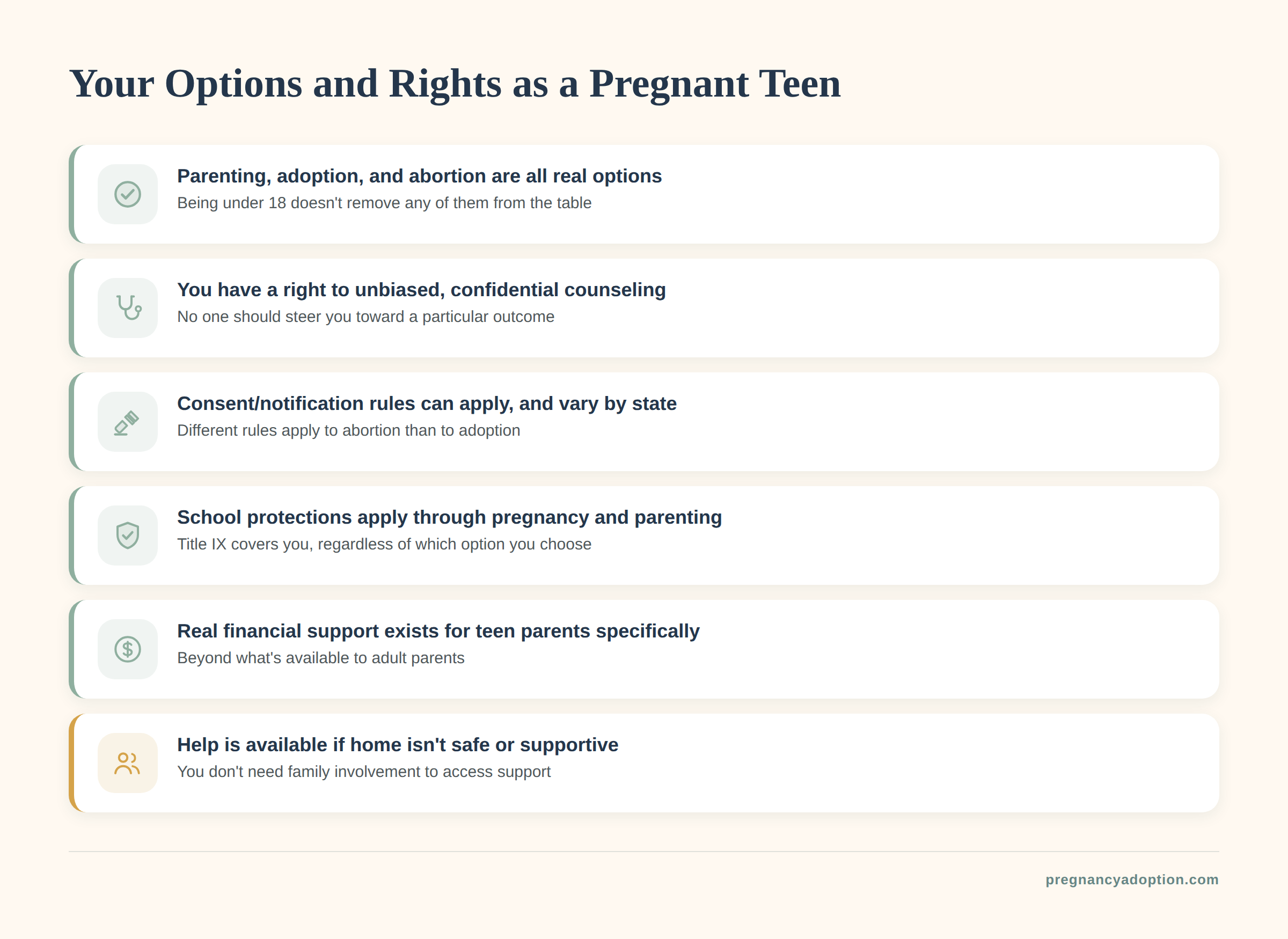
Being a minor doesn’t take parenting, adoption, or abortion off the table — all three remain real options, and you have a right to accurate, unbiased information and confidential counseling about each one. What being under 18 does change is some of the consent, notification, and support-access details around certain options, and those specifics genuinely vary by state and by your own situation. This guide focuses on exactly those teen-specific details — the parts that are different for you than they would be for an adult in the same situation — while linking out to this site’s deeper guides on each option itself for the full comparison, decision-support framework, and practical mechanics.
What Doesn’t Change Because You’re a Minor
Your Right to Accurate, Unbiased Information
You have a right to honest, neutral information about all three options, free from pressure toward any particular outcome — the same right an adult in your situation would have.
Your Right to Confidential Counseling
Confidential counseling exists specifically because many teens need a safe first conversation, with details covered in the next section — using it is a right, not something to feel guilty about.
What Can Change Because You’re a Minor
Consent and Notification Specifics
Depending on your state and which option you’re considering, a parent or guardian may need to consent to or be notified of certain decisions — covered in detail throughout this guide, option by option.
Access to Teen-Specific Support
Being a minor also opens up support specifically built for teen parents and pregnant students — school protections and financial-support programs that an adult in the same situation wouldn’t have access to, covered later in this guide.
Key Takeaways
- Parenting, adoption, and abortion all remain real options for a pregnant minor — this guide is neutral about which one is right for you.
- Confidential counseling and healthcare exist specifically because many teens need a safe first conversation before involving family — using them isn’t “sneaking around,” it’s a real right.
- Parental consent/notification rules for abortion, and parent/guardian involvement rules for adoption, are genuinely different, state-specific legal questions — don’t assume one tells you the answer to the other.
- Federal law (Title IX) protects your right to stay in school through pregnancy, birth, and parenting.
- Real financial and practical support exists specifically for teen parents, beyond what’s available to adult parents.
Your Three Options, Briefly
Before getting into what’s different for teens specifically, it helps to have the three options themselves laid out side by side. This site’s complete guide to unplanned pregnancy options covers all three in full depth — what each one actually involves, a four-part personal decision framework, and a national directory of hotlines and financial support — so this section stays brief on purpose.
Parenting
Raising the Child Yourself
Parenting means raising your child yourself, with whatever combination of your own resources, a partner, and your family’s support you’re able to put together. As a minor, you’re generally still the child’s legal parent with full parental rights and responsibilities, regardless of your own age — this is covered in more depth in the parenting-as-a-minor section below.
What It Takes Day to Day
Parenting as a teen means balancing childcare with school, often with less financial independence and life experience than an older parent would have — which is exactly why the support-program section later in this guide focuses specifically on resources built for that situation, not just general new-parent resources.
Adoption
Placing Your Child With Another Family
Adoption means choosing a family to raise your child, through a licensed agency or attorney, with a say (within state-law limits) over how much ongoing contact you have afterward. This site’s guide for anyone pregnant and considering adoption and step-by-step placement guide cover the full process and your rights throughout it.
What’s Different About Doing This as a Minor
The core process is the same, but whether a parent or guardian needs to be formally involved in your own decision is a separate, state-specific legal question, covered in its own section below with a link to this site’s deepest treatment of it.
Abortion
Ending the Pregnancy
Abortion ends a pregnancy, through medication or a procedure depending on how far along you are and state law. This site’s pregnancy options and the law guide covers the medical methods, the current legal landscape, and how that landscape has changed since *Dobbs v. Jackson Women’s Health Organization*.
What’s Different About Doing This as a Minor
Most of what’s different for a minor seeking an abortion involves parental consent or notification requirements, and the judicial bypass process that exists as an alternative in states that require them — both covered in detail below.
| Option | What it means | What’s teen-specific about it |
|---|---|---|
| Parenting | Raising the child yourself | You’re generally the child’s legal parent regardless of your age; see support-program and school-rights sections |
| Adoption | Placing the child with another family | Parent/guardian involvement in your own decision is a state-specific legal question, separate from abortion consent law |
| Abortion | Ending the pregnancy | Parental consent or notification may be required, with judicial bypass as an alternative in states that require it |
Getting Confidential, Unbiased Counseling First
Whatever you’re leaning toward, talking it through with someone trained to give neutral, accurate information — not someone invested in a particular outcome — is one of the most useful first steps you can take.
What “Unbiased” Actually Means
A Real Options Counselor Doesn’t Have a Preferred Outcome
A genuinely unbiased counselor lays out all three options factually and helps you think through your own values, resources, and circumstances, without steering you — this is different from a crisis pregnancy center or any organization whose materials or staff focus heavily on only one outcome, which this site’s unplanned pregnancy guide covers in more detail, including how to recognize the difference.
You Can Ask Directly How a Service Is Funded or Oriented
It’s a completely reasonable question to ask any counseling service upfront whether they present all three options or are oriented toward a specific one — a genuinely neutral service won’t be offended by the question.
Where to Find It
A School Counselor or Social Worker
A school counselor or social worker is often a reasonable first conversation, particularly because they’re generally familiar with local resources and, in most cases, bound by confidentiality rules similar to other professionals — though it’s worth asking directly about their specific confidentiality policy before sharing details.
A Clinic or Telehealth Service
Planned Parenthood and many community health clinics offer confidential, neutral options counseling specifically, often by phone or online, separate from any specific medical appointment — this can be a lower-pressure way to get accurate information before deciding on next steps.
Confidential Healthcare Access for Minors
Beyond counseling specifically, many types of healthcare are available to minors on a confidential basis — meaning you can consent to the care yourself, without a parent’s involvement, though the specifics genuinely vary by state and by the type of care.
Reproductive Healthcare
Pregnancy-Related Care Is Broadly Minor-Consent Accessible
In most states, minors can consent to their own pregnancy-related medical care — prenatal care, delivery, and pregnancy testing — without a parent’s involvement, even in states that require parental consent or notification specifically for abortion.
Abortion-Specific Consent Rules Are Covered Separately
Abortion specifically is the one area where many states add a parental consent or notification requirement on top of general minor-consent rules — covered in its own section below, since it’s different enough from general pregnancy care to deserve separate treatment.
Other Confidential Care Categories
STI Testing, Contraception, and Substance Use Treatment
Most states also allow minors to consent to their own STI testing and treatment, and many allow confidential access to contraception and substance-use treatment, independent of this pregnancy — relevant if any of these come up as you’re navigating prenatal care or a related decision.
Mental Health Care
Many states also allow minors some degree of confidential access to mental health counseling, which can matter if you’re processing a difficult decision or a difficult family situation and want to talk to someone without it automatically going back to a parent.
| Care category | Typical minor-consent pattern |
|---|---|
| General pregnancy care (prenatal, delivery) | Broadly minor-consent accessible in most states |
| Abortion | Often has an added parental consent/notification requirement — see dedicated section below |
| STI testing and treatment | Broadly minor-consent accessible in most states |
| Contraception | Commonly minor-consent accessible, though specifics vary by state and provider type |
| Mental health counseling | Partial minor-consent access in many states, often with limits (e.g., number of sessions) |
This table describes general patterns, not your specific state’s current law. The Guttmacher Institute’s minors’ consent law tracker maintains current, state-specific detail.
Parental Consent and Notification Laws: The Landscape
If you’re considering abortion specifically, this is the single most important teen-specific legal question to understand — and also the one with the most state-to-state variation.
Consent vs. Notification vs. Neither
Three Different Legal Approaches
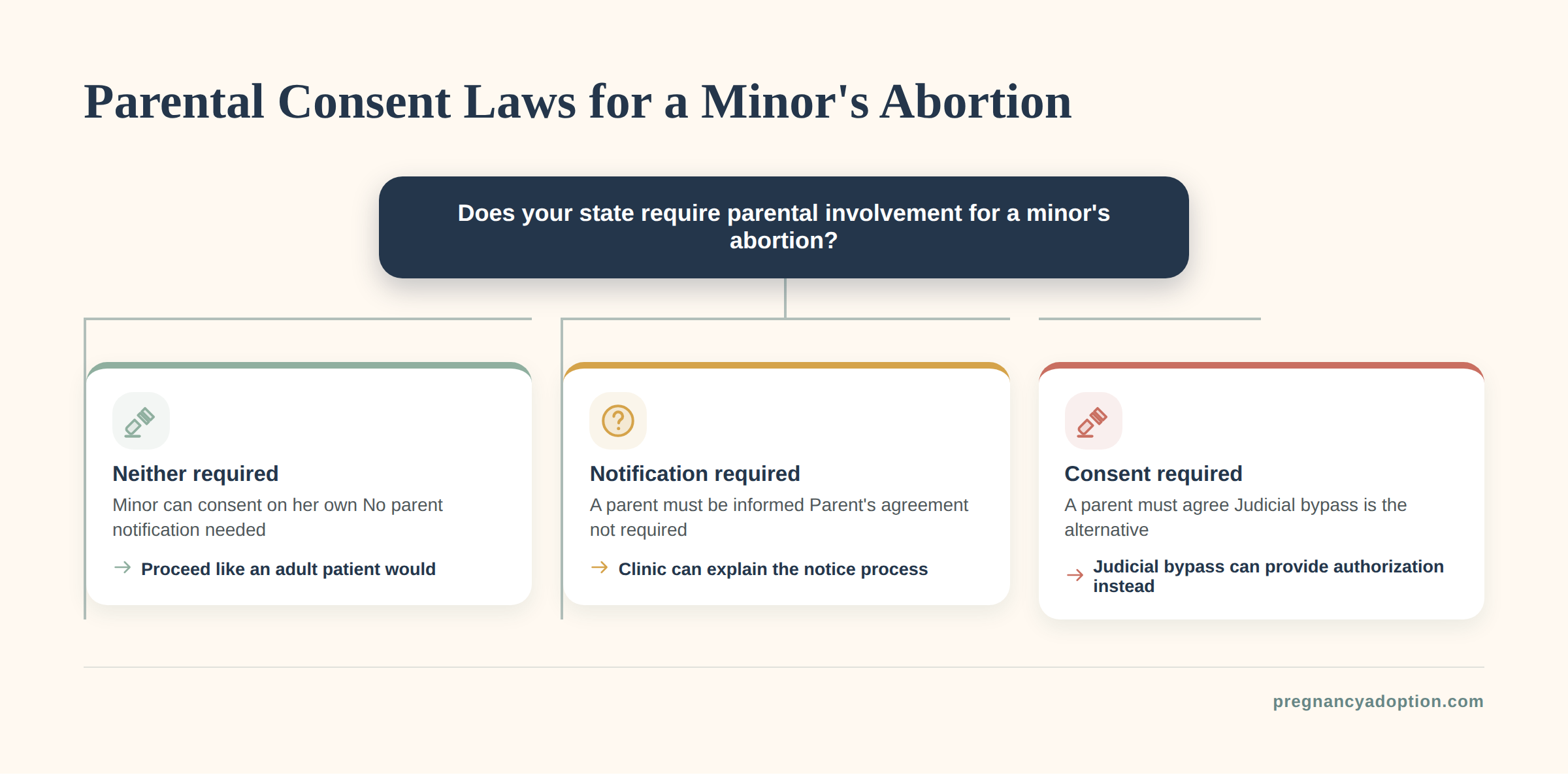
States take one of three general approaches: some require a parent’s affirmative consent, some only require that a parent be notified (without needing to agree), and some require neither, allowing a minor to consent to her own abortion the same way she can consent to other pregnancy-related care. Roughly half of all states currently fall into the consent-and/or-notification category, with the rest requiring neither.
This Site’s Deeper Legal Treatment
This site’s pregnancy options and the law guide covers the consent-vs-notification legal framework and the constitutional basis for judicial bypass (the *Bellotti v. Baird* Supreme Court case) in full depth — this section focuses on the practical side rather than repeating that legal background.
Finding Your State’s Current Rule
Use a Live Tracker, Not a Fixed List
Because this is an area of active litigation and legislation, this guide deliberately doesn’t publish a state-by-state list that could go stale. The KFF parental consent/notification tracker and the Guttmacher Institute’s parental involvement tracker are both maintained and updated as state law changes.
A Clinic Can Also Tell You Directly
Any clinic providing abortion care can tell you directly and currently what your state requires and what your options are if parental involvement isn’t possible or safe — this is often faster and more reliable than researching it yourself.
Judicial Bypass: What It’s Actually Like
In states that require parental consent, the law also has to provide judicial bypass as an alternative path — a way to get authorization from a court instead of a parent, when involving a parent isn’t possible or isn’t in your best interest.
The Legal Basis, Briefly
A Constitutional Requirement, Not a Favor
Judicial bypass isn’t a loophole or a special accommodation — the Supreme Court held in *Bellotti v. Baird* (1979) that any state requiring parental consent for a minor’s abortion must provide this alternative, so it’s a required part of the law wherever parental consent is required. This site’s pregnancy options and the law guide covers the full constitutional background.
It Applies to Abortion Specifically, Not Adoption
Judicial bypass is an abortion-specific legal doctrine — it does not automatically extend to a minor’s decision to place a child for adoption, which is governed by a different, state-specific set of adoption statutes instead, covered in its own section below. These two are commonly and understandably confused, but they’re legally distinct questions that can have different answers in your state.
What the Process Actually Involves
A Confidential, Expedited Hearing
A judicial bypass hearing is typically confidential (your name generally isn’t part of the public record) and expedited, meaning courts are required to move quickly given the time-sensitive nature of pregnancy decisions. You generally need to show either that you’re mature enough to make the decision yourself or that the abortion is in your best interest — not to meet some impossibly high bar.
Free Legal Help Is Often Available
Many states have legal aid organizations that specifically help minors through the judicial bypass process, often at no cost, and a clinic can typically connect you with one directly — you generally don’t have to navigate this alone or hire an attorney yourself.
If You Choose to Parent: Your Legal Standing as a Minor
If you decide to parent, it’s worth understanding what your legal status as a parent actually looks like while you’re still a minor yourself.
You’re Generally the Child’s Legal Parent
Your Age Doesn’t Change Your Parental Rights
In general, you’re the child’s legal parent — with the rights and responsibilities that come with that — regardless of your own age, the same as an adult parent would be. This site’s pregnancy options and the law guide covers this specific point in its own FAQ section in more depth.
You Generally Don’t Need Your Own Parents’ Consent for Decisions About Your Baby
You generally don’t need your own parents’ permission to make medical or other decisions for your baby, even though you may still need their involvement in decisions about your own life as a minor — these are two separate layers of legal status.
Living Arrangements as a Minor Parent
You’re Still a Minor in Your Own Household Situation
Even though you’re the legal parent of your child, you’re still a minor yourself when it comes to things like your own living arrangement, which can matter for programs like TANF (covered in the financial-support section below) that have specific rules about where a minor parent must live to qualify for assistance.
Emancipation Is a Separate, Bigger Step
Becoming a parent doesn’t automatically make you a legally emancipated adult in most states — emancipation is usually a separate court process with its own requirements, and isn’t something most teen parents need or pursue.
If You’re Considering Adoption as a Minor
If adoption is the direction you’re leaning, your underlying rights throughout the process are the same as an adult’s — what can be different is whether a parent or guardian needs to be formally involved in your own decision.
Your Rights Don’t Shrink Because You’re a Minor
Counseling, Choice of Family, and Freedom From Pressure All Still Apply
Your right to adoption-competent counseling, your right to choose the adoptive family and the level of ongoing contact, and your right to be free from pressure toward any particular outcome apply to you as a minor exactly as they apply to an adult — this site’s guide to birth mother rights covers this in full depth, including a dedicated section on exactly how these rights apply to minors specifically.
You Can Usually Have an Initial Confidential Conversation
In most cases, you can have an initial, confidential conversation with a licensed agency or attorney before telling your parents anything — whether your parents or a guardian must ultimately be involved in the decision itself is the separate legal question covered next.
Parent or Guardian Involvement Is a Separate, State-Specific Question
Not Governed by the Same Rule as Abortion
Whether a parent or guardian must be involved in your own decision to place a child for adoption is governed by your state’s adoption statutes specifically — not by the judicial-bypass doctrine covered earlier, which applies only to abortion. These are commonly confused, but they’re legally distinct questions that can have different answers in your state.
A Guardian Ad Litem May Be Appointed
Some states appoint a guardian ad litem — an independent advocate, often an attorney, whose job is representing your interests specifically in the legal proceeding — or add a layer of court review to a minor’s consent that doesn’t apply to an adult’s. This is an additional protection, not a sign that something is wrong or that your judgment is being second-guessed. This site’s birth mother rights guide covers guardian ad litem in more depth, including what to expect if one is appointed in your case.
School Rights: Title IX in Practice
Federal law gives you real, enforceable protections at school through pregnancy, childbirth, and parenting — and most students (and even some school staff) don’t know the specifics.
What Title IX Actually Requires
No Discrimination Based on Pregnancy or Parenting Status
Title IX (20 U.S.C. § 1681 et seq.) prohibits any school that receives federal funding from discriminating against a student because of pregnancy, childbirth, termination of a pregnancy, or recovery from any of these — this covers public K-12 schools and virtually all colleges.
Full Participation, Not Just Non-Discrimination
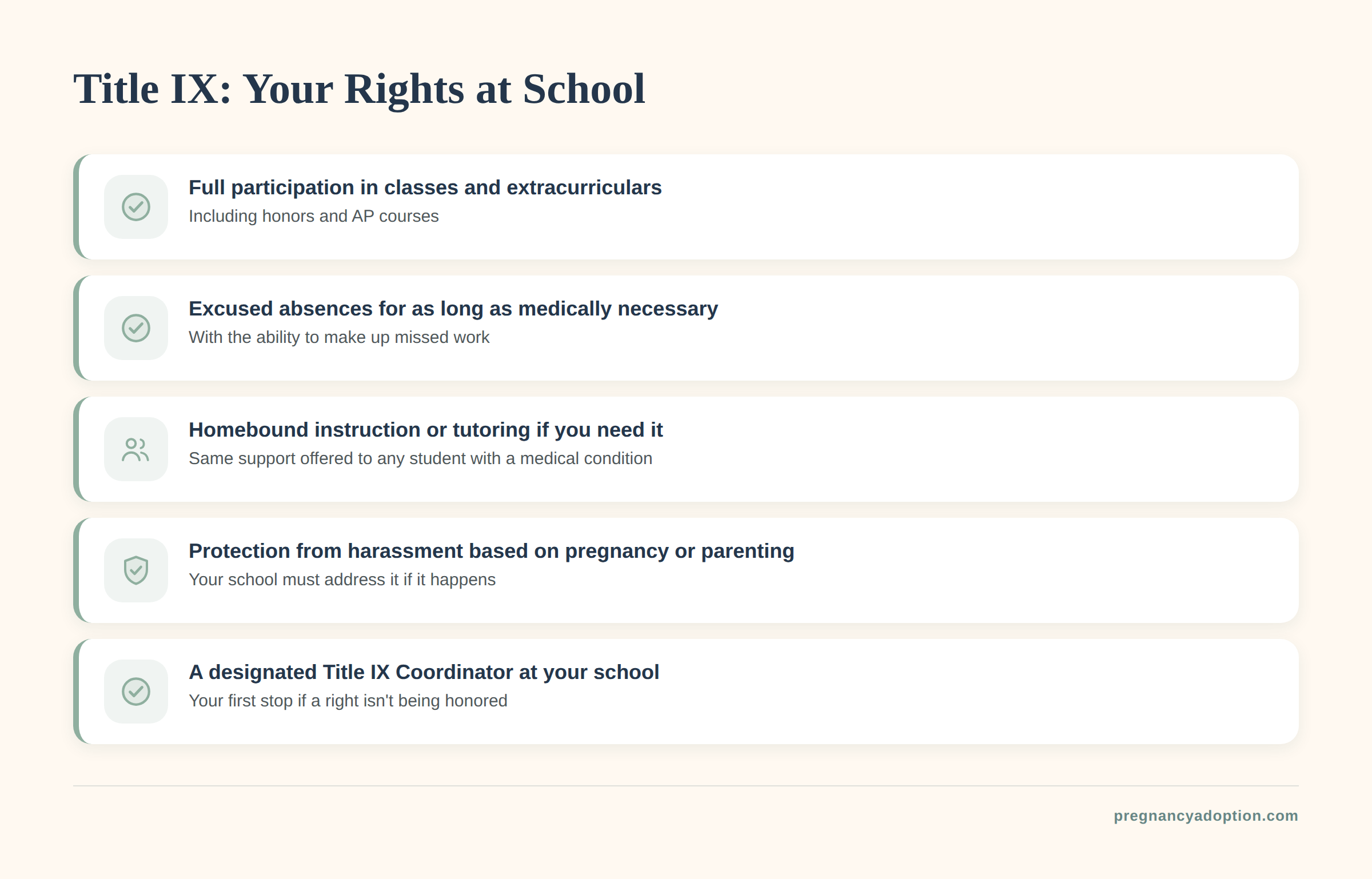
Beyond simply not discriminating, your school generally must let you continue full participation in classes, extracurriculars, and honors or AP courses, and must offer a separate program (like a teen-parent program) only if it’s truly voluntary and comparable in quality — you can’t be pushed out of the regular classroom.
Specific Protections You Can Expect
Excused Absences and Medical Accommodations
Your school must excuse absences related to pregnancy and childbirth for as long as your doctor says is medically necessary, and must let you make up missed work — this isn’t discretionary on the school’s part.
Homebound Instruction and Reasonable Accommodations
If you need time away from campus, your school must offer you the same kind of support it would offer any student with a temporary medical condition — homebound instruction, at-home tutoring, or independent study, along with other reasonable accommodations like extra bathroom breaks or a larger desk later in pregnancy.
| Area | What your school must generally do |
|---|---|
| Classes and extracurriculars | Let you continue full participation, including honors/AP courses |
| Separate programs | Can only be offered if truly voluntary and comparable in quality |
| Absences | Excuse them for as long as medically necessary, and let you make up work |
| Instruction options | Offer homebound instruction, tutoring, or independent study if needed |
| Harassment | Protect you from harassment based on pregnancy or parenting status |
If Your School Isn’t Following These Rules
Start With Your School’s Title IX Coordinator
Every federally funded school is required to have a designated Title IX Coordinator, and raising a concern with them directly is usually the fastest way to resolve an issue — your school’s website or front office can tell you who that is.
You Can File a Federal Complaint
If a direct conversation doesn’t resolve it, you can file a complaint with the U.S. Department of Education’s Office for Civil Rights — this site’s adoption vs. parenting guide briefly touches on returning to school, and a school counselor or local legal aid organization can also help you through this process if needed.
Telling Your Parents or a Trusted Adult
Even in situations where it isn’t legally required, involving a parent, guardian, or another trusted adult is worth genuinely considering — not because you have to, but because it can mean real, ongoing support through a hard decision.
Deciding Whether, and When, to Tell Them
There’s Rarely a “Perfect” Time
Many teens put off this conversation looking for a perfect moment that doesn’t really exist — it’s reasonable to pick a calm, private time rather than waiting indefinitely, especially given that some decisions (particularly abortion) are time-sensitive.
Practicing the Conversation Can Help
Rehearsing what you want to say, possibly with a counselor or trusted friend first, can make the actual conversation feel less overwhelming — starting with something simple and direct is often easier than you expect.
If You’re Worried About Their Reaction
Bringing a Support Person Can Help
If you’re anxious about how a parent will react, having a school counselor, another trusted adult, or even a sibling present for the conversation can help it go more smoothly and give you backup if it gets difficult.
A Hard Initial Reaction Isn’t Always the Final One
Many parents’ first reaction is shock, worry, or anger, which can soften significantly once it sinks in — this doesn’t mean every reaction will improve, which is exactly why the next section covers what to do if your specific situation genuinely isn’t safe.
If Home Isn’t Safe or Supportive
Not every family situation is safe or supportive, and it’s important to be honest about that rather than assume every teen’s path runs through involving a parent.
Recognizing Coercion or Abuse
Pressure Toward a Specific Outcome Is a Red Flag
If a parent, partner, or anyone else is pressuring, threatening, or trying to control your decision about this pregnancy — toward any outcome, including forcing you to continue or end a pregnancy against your wishes — that’s coercion, not support, and it’s a pattern worth naming and getting help with.
You’re Not Required to Justify Needing Help
You don’t need to prove your situation is “bad enough” before reaching out to a hotline, a counselor, or a trusted adult outside your immediate family — if something feels unsafe or wrong, that’s reason enough to ask for help.
Resources Built for This
Confidential Hotlines
The National Domestic Violence Hotline (1-800-799-7233, text “START” to 88788) and the Childhelp National Child Abuse Hotline (1-800-422-4453) are both confidential and available any time — also listed in the safety box at the top of this guide.
School and Legal Aid Resources
A school counselor or social worker is generally a mandatory reporter for abuse specifically, which can be a protective resource rather than something to avoid, and local legal aid organizations serving minors can help you understand your options, including judicial bypass if relevant, without family involvement.
Financial Help and Support Programs for Teen Parents
Real financial and practical support exists specifically for teen parents — beyond the general pregnancy-related financial assistance covered in this site’s broader guides.
Government Assistance Programs
TANF’s Minor-Parent Living Rules
Temporary Assistance for Needy Families (TANF) generally requires an unmarried minor parent to live with a parent, guardian, or in another approved adult-supervised setting to receive benefits, with exceptions in situations involving safety concerns — a caseworker can walk you through how this applies to your specific situation.
WIC, Medicaid, and SNAP
WIC (nutrition support for pregnant women, new mothers, and young children), Medicaid, and SNAP are all generally available to eligible teen parents on terms similar to adult parents, often with simplified eligibility during pregnancy specifically.
Teen-Specific Programs
Second Chance Homes and Similar Housing Programs
Some states and communities operate “Second Chance Home”-style supervised housing programs specifically for teen parents who can’t safely live with family, combining housing with parenting education and a path toward independence.
School-Based Parenting Programs
Many school districts offer school-based or school-linked programs providing on-site or nearby childcare, parenting classes, and case management specifically for pregnant and parenting students — ask your school counselor what’s available locally.
| Program type | What it generally offers |
|---|---|
| TANF | Cash assistance, with minor-specific living-arrangement rules |
| WIC | Nutrition support during pregnancy and early childhood |
| Medicaid | Health coverage, often with simplified pregnancy eligibility |
| Second Chance Home-style housing | Supervised housing plus parenting education, where available |
| School-based parenting programs | On-site or nearby childcare, parenting classes, case management |
Staying in School and Planning Ahead
Combining school with pregnancy or parenting is genuinely difficult, but your Title IX rights (covered above) mean staying enrolled and on track is a realistic goal with the right support in place.
Building a Support Plan With Your School
Meet With a Counselor Early
Meeting with a school counselor as early as you’re comfortable can help you map out a realistic plan — which accommodations you’ll need, how to handle absences around delivery, and what support programs (covered above) are available locally.
Put Your Plan in Writing
Having your specific accommodations (excused absences, makeup-work policy, any schedule changes) documented in writing, even informally in an email, can prevent misunderstandings later and gives you something to point to if an issue comes up.
Thinking Beyond High School
Your Options Afterward Aren’t Closed Off
Being a teen parent doesn’t close off college, trade school, or other post-graduation paths — many colleges have specific resources for student parents, and federal financial aid formulas account for dependents in ways that can work in your favor.
A GED Remains a Real Path Forward
If staying in a traditional high school program genuinely isn’t workable for your situation, a GED or other high school equivalency program remains a real, respected path toward the same opportunities — it’s a legitimate option, not a lesser one.
Emotional and Family Dynamics
Beyond the legal and practical layers, navigating this as a teenager comes with its own emotional weight that’s worth naming directly.
Processing This While Still Growing Up Yourself
It’s Normal to Feel Multiple Things at Once
Fear, relief, grief, excitement, and numbness can all coexist, sometimes within the same day, regardless of which option you’re leaning toward — there’s no one “correct” way to feel, and giving yourself permission to feel more than one thing at once is genuinely okay.
You’re Allowed to Take Reasonable Time to Decide
While some options (particularly abortion) are time-sensitive, you’re still allowed to take reasonable time to think clearly rather than deciding in a single moment of panic — a counselor can help you understand how much time you realistically have for your specific situation.
Navigating Family Relationships Through This
Your Relationship With Your Parents May Shift, in Either Direction
Some teens find this process brings them closer to their parents; others find it strains the relationship, at least for a while — both are common, and neither means you did something wrong in how you handled it.
Counseling Can Help With the Family Layer, Too
A counselor can help not just with the pregnancy decision itself but with the family dynamics around it — many of the same confidential counseling resources covered earlier in this guide are equipped to help with this specifically.
Talking to a Partner
If you have a partner involved, this decision affects both of you, even though the final choice about your own body and your own parental rights is legally yours.
Having the Conversation
Share How You’re Actually Feeling, Not Just the Decision
It can help to talk through how you’re each feeling, not just push toward a decision immediately — both of you are likely processing a lot at once, and rushing the conversation can create unnecessary conflict.
You’re Allowed to Disagree and Still Move Forward Together, or Not
You and a partner may not agree on every point, and that’s genuinely okay — the pregnancy decision itself is legally yours to make, while plenty of what comes after (co-parenting, adoption openness, ongoing relationship) benefits from ongoing conversation rather than a single decision.
If the Partner Relationship Is Part of What’s Unsafe
A Partner Can Also Be a Source of Pressure or Control
Everything in the earlier section on recognizing coercion applies to a partner just as much as to a parent — pressure toward a specific outcome, threats, or controlling behavior from a partner is a red flag worth naming, not something to minimize because it’s a relationship you care about.
You Can Get Support Without Involving Your Partner
Counseling, healthcare, and the hotlines listed earlier in this guide are available to you regardless of whether your partner is involved or supportive — you don’t need their agreement to access help for yourself.
Who Can Help: A Quick Reference
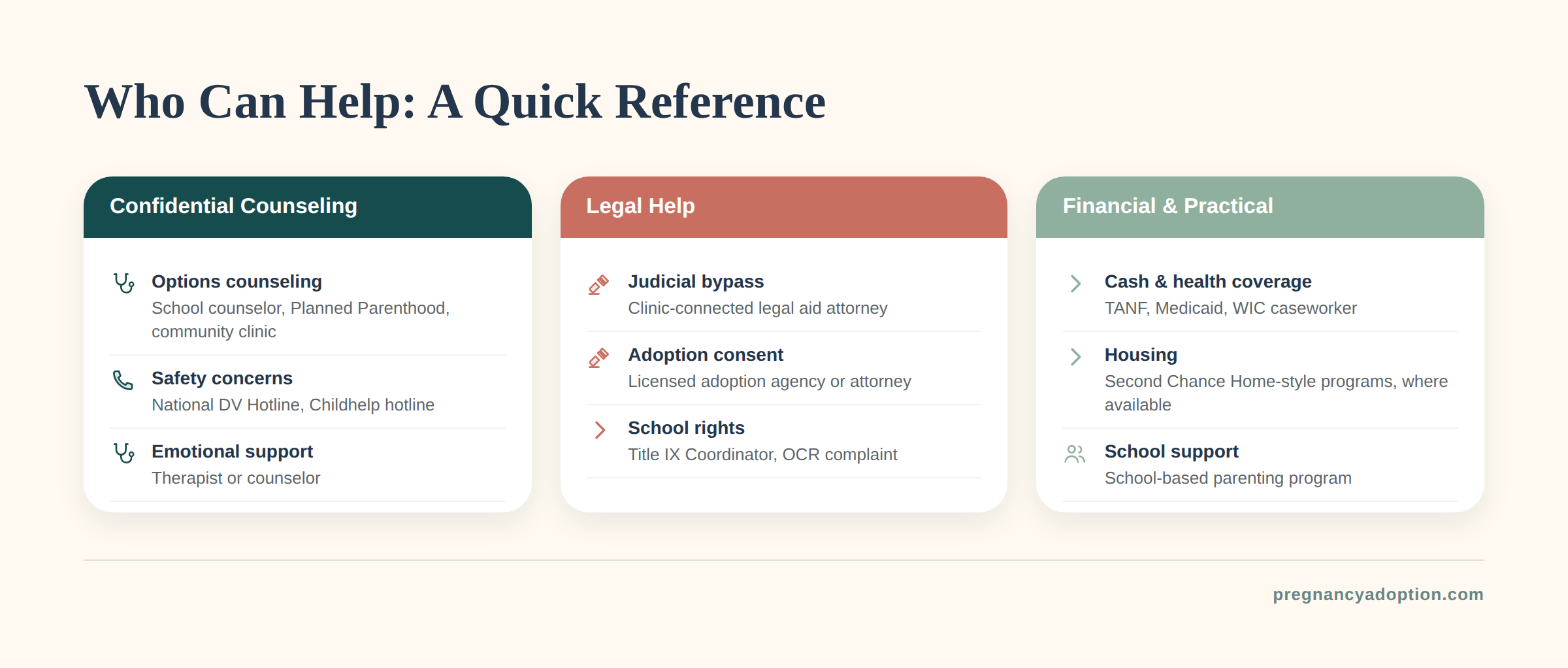
With so many different resources mentioned throughout this guide, it helps to see them grouped by what kind of help they actually provide.
Confidential and Counseling Resources
For Options Counseling
A school counselor, a Planned Parenthood clinic, or another neutral community health clinic can provide confidential, unbiased options counseling, as covered earlier in this guide.
For Safety Concerns
The National Domestic Violence Hotline and Childhelp National Child Abuse Hotline, both listed in the safety box near the top of this guide, are available any time if your situation involves pressure, coercion, or abuse.
Legal and Financial Resources
For Legal Questions
For Financial and Practical Support
A caseworker at your state’s health and human services department, or your school’s counselor, can connect you to the TANF, WIC, Medicaid, and school-based programs covered in the financial-support section above.
Special Situations
A few specific circumstances change some of the practical details covered throughout this guide.
Younger Teens
Some States Set a Younger-Teen Threshold for Certain Rules
A small number of states apply different rules (for example, mandatory reporting requirements tied to the age gap between partners) specifically for younger teens — a clinic or counselor can tell you how this applies in your state and situation.
The Same Rights and Resources Still Apply
Regardless of your specific age within the “minor” category, the confidential counseling, healthcare access, and support programs covered throughout this guide still apply to you.
If You’re in Foster Care
Your Caseworker Is a Resource, Not an Obstacle
If you’re in foster care, your caseworker can help connect you to confidential counseling and the specific consent rules that apply to youth in foster care, which can differ somewhat from the general minor-consent rules covered in this guide.
Extended Foster Care Support May Apply
Many states offer extended foster care support past age 18 for youth who remain in school or are working toward independence, which can be relevant to planning ahead as a teen parent.
If You’re Undocumented
Confidential Healthcare Access Generally Doesn’t Depend on Immigration Status
Confidential reproductive healthcare and options counseling are generally available regardless of immigration status, and a reputable clinic won’t ask about or report immigration status as a condition of care.
Some Financial Programs May Have Different Eligibility Rules
Some of the financial-support programs covered earlier in this guide have immigration-status-related eligibility rules that can differ from what’s described generally — a caseworker or immigrant-rights legal aid organization can clarify what applies to your specific situation.
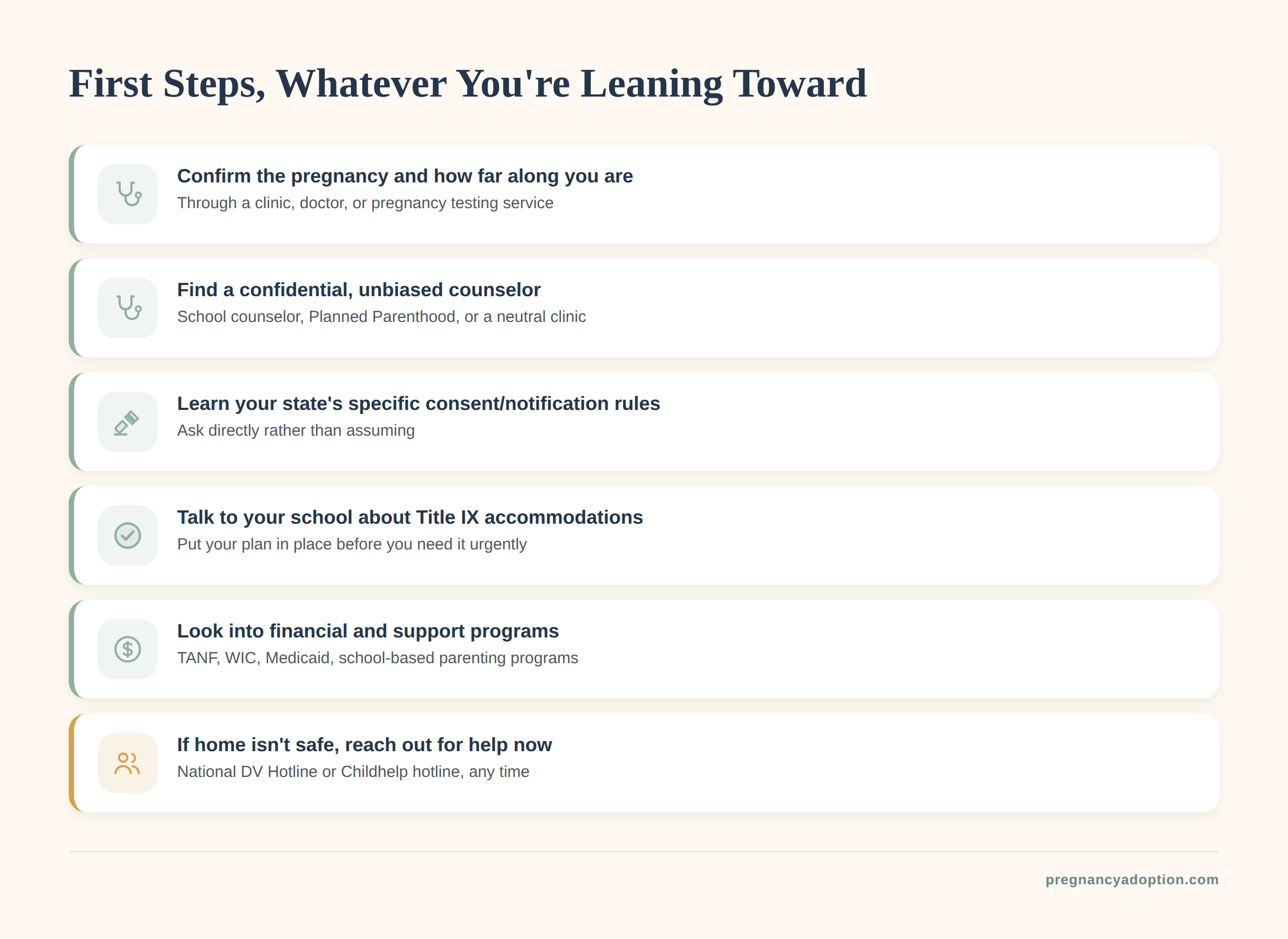
A Simple Action Checklist
If you’re not sure where to start, this checklist walks through reasonable first steps, regardless of which option you’re leaning toward.
Right Away
Get Confirmation and Basic Prenatal Guidance
Confirm the pregnancy and get a basic sense of how far along you are, through a clinic, your doctor, or a pregnancy testing service — this affects timing for every option, especially abortion.
Find a Confidential, Unbiased Counselor
Reach out to a school counselor, Planned Parenthood, or another neutral clinic for confidential options counseling, using the guidance in the earlier section on finding genuinely unbiased help.
Within the Next Few Weeks
Learn Your State’s Specific Rules
Ask your counselor or clinic directly what your state requires for the option(s) you’re considering — parental consent/notification for abortion, or guardian involvement for adoption — rather than relying on assumptions.
Talk to Your School
If you plan to stay in school, meet with a counselor to put your Title IX accommodations in place early, before you need them urgently.
| Your situation | Reasonable first step |
|---|---|
| Not sure which option is right for you | Confidential options counseling (see above) |
| Leaning toward abortion, parents may object | Ask a clinic about your state’s consent/notification rule and judicial bypass |
| Leaning toward adoption | Contact a licensed agency for an initial confidential conversation |
| Leaning toward parenting | Connect with your school counselor and a caseworker about support programs |
| Home isn’t safe | Call the National Domestic Violence Hotline or Childhelp hotline (see safety box above) |
Glossary of Terms in This Guide
A quick reference for terms used throughout this guide.
Legal Terms
Parental Consent
A legal requirement that a parent or guardian affirmatively agree to a minor’s decision (commonly discussed in the context of abortion law) before it can proceed.
Parental Notification
A legal requirement that a parent be informed of a minor’s decision, without necessarily needing to agree to it — a lighter requirement than consent.
Judicial Bypass
A court process, required by *Bellotti v. Baird*, that lets a minor obtain authorization for an abortion from a judge instead of a parent, in states that otherwise require parental consent or notification.
Guardian Ad Litem
An independent advocate, often an attorney, appointed by a court specifically to represent a minor’s interests in a legal proceeding, such as an adoption-consent case.
School and Support Terms
Title IX
The federal law prohibiting sex discrimination, including discrimination based on pregnancy or parenting status, at any school receiving federal funding.
Title IX Coordinator
The staff member every federally funded school is required to designate to handle Title IX concerns and complaints.
TANF
Temporary Assistance for Needy Families, a government cash-assistance program with specific living-arrangement rules for unmarried minor parents.
Emancipation
A separate legal court process through which a minor can be granted adult legal status; becoming a parent does not automatically emancipate you in most states.
Frequently Asked Questions
Getting Started and Basics
Can I still choose any of the three options if I’m under 18?
Yes — parenting, adoption, and abortion all remain real options for a pregnant minor; being under 18 changes some of the consent and support details, not which options are available to you.
Do I have to decide right away?
Not immediately, though some options (particularly abortion) are time-sensitive, so it’s worth starting the conversation with a counselor soon rather than waiting indefinitely.
Does this guide favor one option over the others?
No — this guide, and this site generally, is intentionally neutral across all three options; its goal is accurate information and real resources, not steering you toward a particular choice.
Where should I start if I don’t know anything yet?
Confirming the pregnancy and talking to a confidential, unbiased counselor are reasonable first steps — see the action checklist above.
Confidential Counseling and Healthcare
Will my parents find out I went to a clinic?
It depends on the type of care, your state’s law, and how the visit is billed (especially if you’re on a parent’s insurance) — ask the clinic directly about their specific confidentiality policy before your visit.
Can a school counselor tell my parents what I say?
School counselors are generally bound by confidentiality similar to other professionals, though policies vary by school and state, and some situations (like safety concerns) may require disclosure — ask directly about their specific policy.
Is Planned Parenthood only for abortion?
No — Planned Parenthood and similar clinics provide a full range of reproductive healthcare and neutral options counseling, not only abortion services.
Can I get prenatal care without my parents knowing?
In most states, yes — general pregnancy care is broadly minor-consent accessible, though insurance billing can still create visibility depending on your coverage.
What if I don’t have insurance?
Community health clinics often offer confidential care on a sliding scale or through Medicaid’s simplified pregnancy eligibility, covered in the financial-support section above.
Parental Consent and Notification for Abortion
How do I find out what my state requires?
Use a live tracker like KFF’s or Guttmacher’s (linked above), or ask a clinic directly — this guide intentionally doesn’t publish a state-by-state list that could go out of date.
What’s the difference between consent and notification?
Consent means a parent must affirmatively agree; notification means a parent must only be informed, without needing to agree — some states require one, both, or neither.
What if only one parent needs to be involved?
Rules vary by state on which parent, or whether any parent, guardian, or even grandparent may qualify — a clinic can clarify what applies in your state.
Does this rule apply to medication abortion too, or only procedures?
Generally, parental consent/notification rules apply to abortion overall, not just one method, though specifics can vary by state.
What if I’m pregnant as a result of assault?
Some states have exceptions to parental consent/notification requirements for pregnancies resulting from abuse or assault — a clinic or legal aid organization can tell you whether this applies to your situation.
Judicial Bypass
Do I need a lawyer to go through judicial bypass?
Not necessarily yourself — many states have legal aid organizations that provide free representation specifically for this process, often connected through a clinic.
How long does judicial bypass take?
Courts are generally required to move quickly given the time-sensitive nature of pregnancy decisions, though exact timelines vary by state.
Will my name be public record?
Judicial bypass hearings are typically confidential, often using initials or a case number rather than your full name.
What if the judge says no?
Most states allow an expedited appeal of a denial — a legal aid attorney can explain the specific appeal process available to you.
Can judicial bypass help with an adoption decision too?
No — judicial bypass is specifically an abortion-law doctrine; a minor’s adoption-consent question is governed by separate state adoption statutes, covered in the adoption-as-a-minor section above.
Parenting as a Minor
Am I legally my baby’s parent even though I’m a minor myself?
Generally yes — you’re the child’s legal parent with the rights and responsibilities that come with that, regardless of your own age.
Do I need my own parents’ permission to make decisions for my baby?
Generally no — you typically don’t need your parents’ consent for decisions about your child, even though you may still need it for decisions about your own life as a minor.
Does having a baby make me an emancipated adult?
Not automatically in most states — emancipation is usually a separate legal process with its own requirements.
Can I sign my baby up for Medicaid myself?
In most cases, yes — as the child’s legal parent, you can generally apply for benefits on your child’s behalf; a caseworker can walk you through the specific process.
Adoption as a Minor
Can I place my baby for adoption without my parents’ involvement?
It depends on your state’s adoption statutes — some states require some form of parent or guardian involvement in a minor’s adoption decision, while others don’t.
What is a guardian ad litem, and will I definitely get one?
A guardian ad litem is an independent advocate appointed to represent your interests in the legal proceeding; whether one is appointed depends on your state’s specific requirements.
Can I still choose the adoptive family if I’m a minor?
Yes — your right to choose the family and the level of ongoing contact applies to you as a minor exactly as it does to an adult.
Can an agency tell my school I’m placing a baby for adoption?
No — a licensed adoption agency or attorney has no reason to and no general obligation to contact your school.
School Rights and Title IX
Can my school force me into an alternative program instead of regular classes?
No — any alternative program must be genuinely voluntary and comparable in quality; you can’t be pushed out of the regular classroom.
How many absences am I allowed for pregnancy or childbirth?
Your school must excuse absences for as long as your doctor says is medically necessary — there’s no fixed day limit written into the law itself.
Does Title IX apply to private schools too?
Title IX applies to any school receiving federal funding, which includes most public schools and many private schools and colleges that accept federal funds or federal financial aid participation.
What if my school doesn’t have a designated Title IX Coordinator?
Every federally funded school is required to have one; if you can’t identify who it is, the U.S. Department of Education’s Office for Civil Rights can help.
Can I get extra time on assignments if I’m exhausted from a newborn?
Reasonable accommodations are part of what your school should offer — raise this specifically with your Title IX Coordinator or counselor.
Telling Parents and Family Dynamics
What if I’m scared to tell my parents at all?
That fear is worth taking seriously — a counselor can help you think through whether, when, and how to tell them, or help you access support without them if your situation genuinely isn’t safe (see the section above on if home isn’t safe).
Is it normal for my relationship with my parents to change after this?
Yes, in either direction — some relationships grow closer, others go through a difficult period; neither outcome means you handled things wrong.
Should I tell extended family too?
That’s a personal decision with no single right answer — a counselor can help you think through who you want involved and when.
What if my parents disagree with each other about what I should do?
This is a common and difficult situation; a counselor can help you navigate it, and ultimately, within whatever your state’s consent/notification rules require, the decision about your own pregnancy is yours.
If Home Isn’t Safe
What counts as coercion?
Pressure, threats, or control toward a specific outcome — whether that’s forcing you to continue or to end a pregnancy against your wishes — counts as coercion, not support.
Will calling a hotline get my parents in trouble?
Hotlines are focused on your safety and support first; specifics depend on your situation, and staff can walk you through what happens next before you share identifying details if you’re unsure.
Can I get help without going through my parents at all?
Yes — the counseling, healthcare, and hotline resources throughout this guide are available to you directly.
What if it’s my partner, not my parent, who’s the problem?
The same coercion-recognition guidance and the same hotlines apply — a controlling or threatening partner is just as serious a concern as an unsafe family situation.
Financial Help and Support Programs
Do I qualify for TANF if I live with my parents?
Possibly — TANF generally requires an unmarried minor parent to live with a parent, guardian, or approved adult-supervised setting, so living with your parents typically satisfies this requirement.
What if I can’t safely live with my parents?
TANF generally has exceptions for situations involving safety concerns, and Second Chance Home-style programs (where available) are specifically built for this situation — a caseworker can help.
Is WIC only for babies, or can it help me too?
WIC provides nutrition support for pregnant women and new mothers as well as young children, so it can help you directly during and after pregnancy.
How do I find out what’s available in my specific area?
Your state’s health and human services department, a caseworker, or your school counselor can point you to what’s actually available locally, since program availability varies significantly by state and community.
Staying in School and Planning Ahead
Can I still go to college if I have a baby in high school?
Yes — being a teen parent doesn’t close off college or trade school, and many colleges have specific resources for student parents.
Is a GED as good as a diploma for college or jobs?
A GED or equivalency credential is a legitimate, respected path that keeps the same opportunities open if staying in a traditional program genuinely isn’t workable for your situation.
What if my school doesn’t offer on-site childcare?
Ask your counselor about nearby school-linked childcare options or other arrangements — availability varies by district, but it’s worth asking rather than assuming nothing exists.
Can I switch to online or independent study if that works better?
In many cases, yes, as part of the reasonable accommodations your school should offer — raise this specifically with your counselor or Title IX Coordinator.
Practical and Logistical Questions
Can I get a learner’s permit or driver’s license as a pregnant or parenting teen?
Being pregnant or a parent doesn’t change standard driver’s licensing rules in most states — this is governed by ordinary age and licensing requirements, unrelated to pregnancy.
Can I sign medical consent forms for myself during pregnancy?
In most states, pregnancy itself grants you the ability to consent to your own pregnancy-related medical care, even in states where you otherwise couldn’t consent to general medical care as a minor.
What if I need to travel to another state for care?
This site’s pregnancy options and the law guide covers the current interstate travel legal landscape in more depth; a clinic can also advise on logistics specific to your situation.
Who pays for prenatal care if I’m a minor without my own income?
Medicaid’s pregnancy-specific eligibility, often simplified and available regardless of your parents’ income in many states, is usually the starting point — a clinic or caseworker can help you apply.
Miscellaneous Questions
Does any of this apply differently if I’m in a same-sex relationship?
The core legal protections covered in this guide (Title IX, minor-consent healthcare, judicial bypass where applicable) generally apply regardless of your partner’s gender; some logistics around parentage establishment can differ and are worth discussing with a counselor or attorney.
What if I’m not sure I’m actually pregnant yet?
This site’s guide to pregnancy testing covers when and how to test and what to do with the result.
Can I change my mind after starting down one path?
In many cases, yes, depending on how far the process has gone and which option — a counselor can walk through what’s realistic for your specific timeline and decision.
Is any of this different if I’m already a parent and I’m pregnant again?
The core rights and resources in this guide apply the same way; your existing experience as a parent may make some of the practical logistics more familiar, but the legal landscape doesn’t change based on whether this is your first pregnancy.
Emotional and Family Dynamics
Is it normal to feel completely overwhelmed?
Yes — feeling overwhelmed is a very common reaction to an unplanned pregnancy at any age, and especially as a teenager navigating school, family, and a major decision all at once; a counselor can help you work through that feeling, not just the logistics.
What if I feel differently about this from day to day?
That’s common and doesn’t mean you’re indecisive in a bad way — it’s reasonable to keep talking it through with a counselor as your thinking develops, within whatever timeline your specific option requires.
Should I talk to a therapist even if I’m not sure I need one?
If you’re going through a major decision like this, talking to someone trained to support you — even just a few sessions — is a reasonable and healthy step, not a sign that something is wrong with you.
How do I deal with friends who have opinions about what I should do?
You’re not obligated to share your decision-making process with everyone, and it’s okay to set a boundary with friends (even well-meaning ones) who are pushing a particular outcome — this decision is yours to make with the people you trust most.
Talking to a Partner
What if my partner wants a different outcome than I do?
The decision about your own pregnancy is legally yours; a counselor can help you both navigate disagreement, but your partner’s preference doesn’t override your legal right to decide for yourself.
Do I have to tell the other parent I’m pregnant?
Generally, yes in the sense that most people choose to, but there’s no single universal legal requirement forcing disclosure in every circumstance — a counselor or legal aid organization can address your specific situation, especially if safety is a concern.
What if my partner is also a minor?
Many of the same consent, confidentiality, and support resources covered in this guide apply to your partner as well if they’re also under 18 — a counselor can help you both understand what applies to each of you.
Does my partner have legal rights regarding the pregnancy decision itself?
No — the decision about whether to continue a pregnancy is legally yours alone to make, regardless of a partner’s preference, though decisions after birth (like adoption or custody) generally do involve the other legal parent.
Special Situations
Does any of this apply differently if I’m 13 or 14 rather than 16 or 17?
The core rights and resources in this guide apply across the minor age range, though a small number of states have additional rules (like mandatory reporting tied to partner age gaps) that can apply specifically to younger teens — a counselor or clinic can clarify what applies to your exact age and situation.
I’m in foster care — who do I talk to first?
Your caseworker is a reasonable first point of contact and can connect you to confidential counseling and the consent rules that specifically apply to youth in foster care.
Does being undocumented affect my ability to get confidential care?
Confidential reproductive healthcare and counseling are generally available regardless of immigration status; a reputable clinic won’t ask about or report immigration status as a condition of care.
What if I’m a teen considering adoption because of a prenatal diagnosis?
This site’s unplanned pregnancy guide and its special-situations content cover this intersection in more depth; a genetic counselor alongside your options counselor can help you think through both layers together.
Research and Sources
Why doesn’t this guide list exact state laws?
State-by-state abortion-consent and adoption-involvement rules change through litigation and legislation often enough that a fixed list risks going stale and giving you wrong information at a moment when accuracy matters — live trackers like KFF’s and Guttmacher’s, or a clinic directly, give you the current rule rather than a snapshot.
Where do the Title IX details in this guide come from?
From the federal Title IX statute and its implementing regulations, cross-checked against school Title IX office guidance; the exact regulation citation is flagged in this guide given recent amendment history, and your own school’s Title IX Coordinator is the best source for how it’s applied at your specific school.
Is this guide specific to one state?
No — it’s written for a general U.S. audience, which is exactly why state-variable details are flagged rather than stated as universal fact; use the linked trackers or a local professional for your specific state.
Who reviews articles like this one before they’re published?
This article is designated for medical and legal review before publication, given its subject matter and minor-specific audience — see the editorial notes for this site’s full review process.
Using This Guide Alongside Others on This Site
Should I read this guide or the main unplanned pregnancy guide first?
Either order works — this guide focuses specifically on what’s different for a minor, while the main unplanned pregnancy guide covers the full decision framework and all three options in depth; many readers find it useful to read both.
I’m 19 — does this guide still apply to me?
Most of the general decision-support content applies to anyone, but the minor-specific legal content (parental consent, judicial bypass, guardian involvement) generally does not apply once you’re 18 — the main unplanned pregnancy guide is likely the better starting point for you.
Does this guide cover what happens medically during an abortion or birth?
Not in depth — this guide focuses on the legal, school, and support-system questions specific to being a minor; this site’s pregnancy options and the law guide covers abortion methods, and other guides on this site cover labor and delivery in depth.
Can I share this guide with a friend who’s going through the same thing?
Yes — this guide is written to be useful to any pregnant teen trying to understand her options and rights, and sharing accurate information is one of the most helpful things you can do for a friend in this situation.
Adults Supporting a Pregnant Teen
I’m a parent and just found out my teenager is pregnant — where do I start?
Starting with a calm, non-judgmental conversation and, where possible, connecting your teen with confidential options counseling (covered earlier in this guide) tends to help more than pushing toward a particular outcome right away — your teen is more likely to stay open with you if the conversation doesn’t start with pressure.
I’m a teacher or counselor — what are my obligations here?
This varies by your role, your school’s policies, and your state’s mandatory-reporting law, which generally centers on abuse or safety concerns rather than the pregnancy itself — check your school’s specific policy and consult your school’s Title IX Coordinator or administration if you’re unsure.
How can I support a pregnant teen without pushing my own opinion on her?
Listening first, sharing accurate information rather than personal opinion, and helping her access neutral counseling (rather than a service oriented toward one outcome) are generally the most supportive things an adult can do.
What if I disagree with the decision she’s leaning toward?
You’re allowed to have your own feelings about it, but ultimately the decision is legally hers to make (within whatever consent/notification rules apply in your state) — staying involved and supportive, even through disagreement, tends to matter more to her long-term wellbeing than the specific outcome.
After the Decision
What support exists after I’ve made my decision, whatever it is?
Each path has its own form of ongoing support — postpartum and parenting support if you parent, post-placement counseling and contact-agreement support if you place for adoption, and aftercare counseling is available following an abortion as well; a counselor can connect you to the right resource for your specific path.
Is it normal to still have mixed feelings after deciding?
Yes — having complicated or mixed feelings after a major decision, even one you’re confident was right for you, is common and doesn’t mean you made the wrong choice.
Can I get support even if I made my decision a while ago?
Yes — counseling and support resources aren’t limited to the decision-making window itself; it’s never too late to reach out if you’re still processing something.
Where can I find more general information if I have a question this guide didn’t cover?
This site’s unplanned pregnancy guide and pregnancy options and the law guide are good next stops for anything broader than the teen-specific focus of this guide, and a confidential counselor remains the best resource for anything specific to your own situation.
Timing and Deadlines
Which option has the tightest deadline?
Abortion is the only one of the three options with a hard medical/legal timing window, since it’s tied to gestational age and state law; parenting and adoption decisions can generally be finalized later, though starting the process earlier still tends to go more smoothly for both.
How quickly do I need to start the judicial bypass process if I need it?
As soon as possible, given that it adds time on top of an already time-sensitive decision — a clinic can tell you how the specific timeline in your state interacts with your current gestational age.
Is there a deadline to decide on adoption?
Not a fixed legal deadline before birth, but starting the process earlier gives you more time to choose an agency, meet prospective families, and make a hospital plan without last-minute pressure.
What if I’m already past the point where abortion is an option in my state?
Parenting and adoption both remain fully available options regardless of gestational age; a counselor can help you move forward with whichever of those fits your situation.
If you’re in immediate physical danger, call 911. The National Domestic Violence Hotline is available 24/7 at 1-800-799-7233, by text (“START” to 88788), or online chat, and the Childhelp National Child Abuse Hotline is available at 1-800-422-4453 — both are confidential. If you’re having thoughts of harming yourself, call or text 988 any time, free and confidential.
The Bottom Line
- Parenting, adoption, and abortion all remain real options for a pregnant teen — this guide, and this site, is neutral about which is right for you.
- You have a right to confidential, unbiased counseling and to accurate information about every option.
- Parental consent/notification rules for abortion and guardian-involvement rules for adoption are separate, state-specific legal questions — a clinic, counselor, or legal aid organization can tell you what applies to you right now.
- Federal law protects your right to stay in school through pregnancy and parenting, and real financial support exists specifically for teen parents.
- If anyone is pressuring or controlling you, or if home isn’t safe, help is available without judgment, whether or not you involve your family.
pregnancyadoption.com/ provides neutral, accurate information about pregnancy options, including parenting, adoption, and abortion, so that anyone facing an unplanned pregnancy — at any age — has what they need to make an informed decision, free from pressure toward any particular outcome. Explore our complete guides to unplanned pregnancy, pregnancy options and the law, and adoption vs. parenting for more depth on any of the topics covered in this guide.
This article is for general educational purposes only and is not a substitute for personalized medical, legal, or mental health advice. Laws governing parental consent and notification, judicial bypass, minor-consent healthcare, and adoption vary significantly by state and change over time; figures and procedural details in this article that are state-variable or could not be confirmed against a live, current source this session are flagged with throughout and should be confirmed with a licensed attorney, healthcare provider, or counselor in your state before you rely on them. If you are in immediate danger, call 911. This site does not provide legal representation or medical care directly.
Editor’s Note & Sources
This article was researched using a combination of this site’s own previously published, fact-checked guides (linked throughout) and external legal and health-policy sources, and was flagged throughout with wherever a specific figure, citation, or state-by-state detail could not be confirmed against a live source this session or is known to vary by state and change over time. Given this article’s “Medical + legal review” designation and its minor-specific audience, every item should be treated as a required pre-publication check, not an optional one. Key external sources consulted or cited:
- KFF — Parental Consent/Notification Requirements for Minors Seeking Abortions (state policy tracker)
- Guttmacher Institute — Minors’ Access to Abortion Care, and Overview of Minors’ Consent Law
- Bellotti v. Baird, 443 U.S. 622 (1979) — the constitutional basis for judicial bypass
- U.S. Department of Education — Title IX statute (20 U.S.C. § 1681 et seq.) and implementing regulations
- National Domestic Violence Hotline and Childhelp National Child Abuse Hotline (crisis resources)
