The second trimester — roughly weeks 14 through 27 — is the stretch of pregnancy many people describe as the most comfortable. Early fatigue and nausea often ease, your baby’s movements become something you can actually feel, and a mid-pregnancy ultrasound gives you your first detailed look at how they’re developing. This guide walks through what typically happens week by week, the tests and scans offered during this stretch, common symptoms, and practical steps to take before the third trimester begins. If you’re looking for first-trimester detail instead, see this site’s first trimester guide; for a deeper look at symptoms across all three trimesters, see our full signs of pregnancy guide.
Short Answer: What Happens in the Second Trimester
Key Takeaways
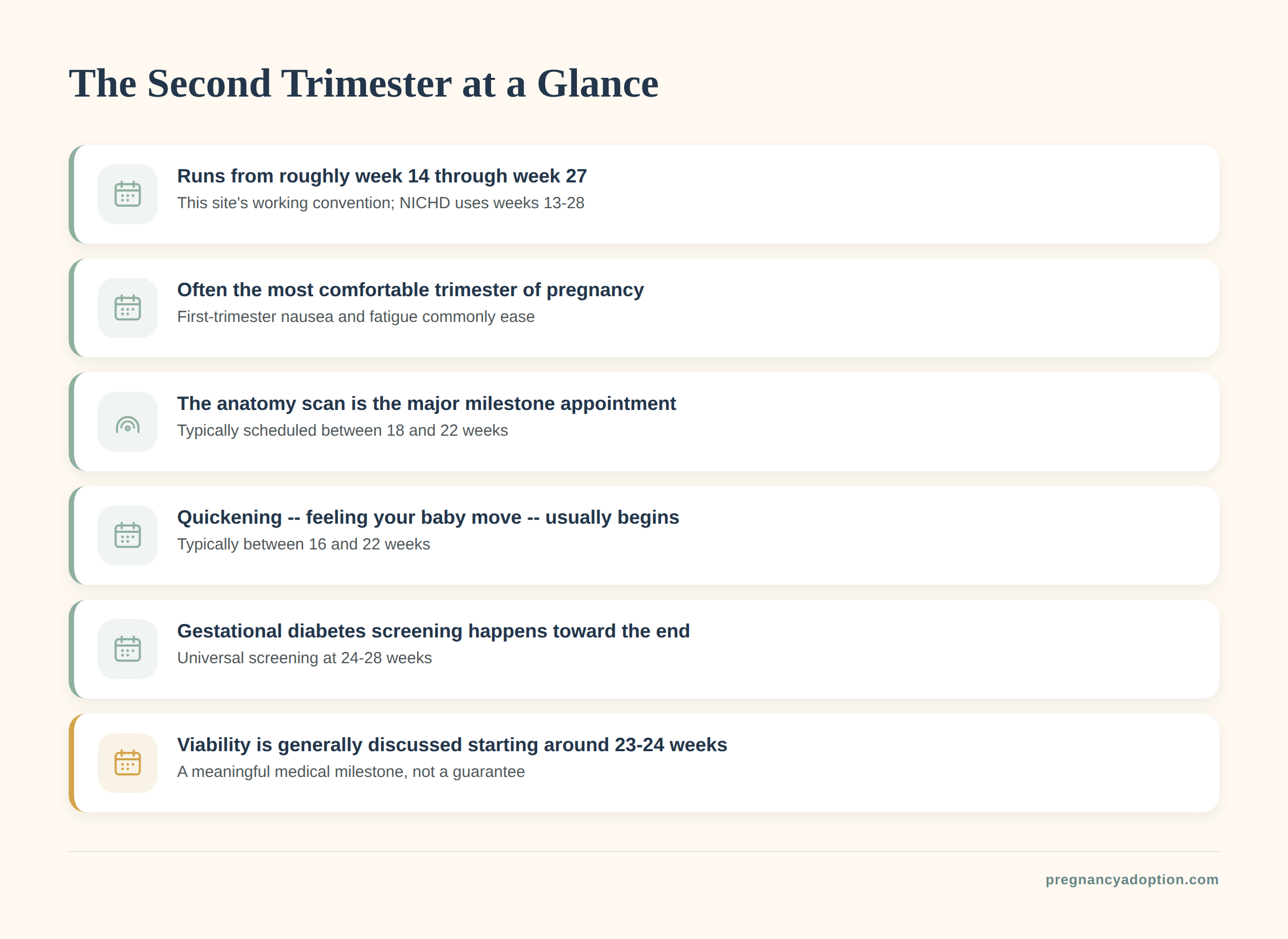
- The second trimester runs from roughly week 14 through week 27 — this site’s working convention, consistent with its pregnancy calculator hub.
- Many people find this the most comfortable trimester: first-trimester nausea and fatigue often ease, while the heaviest late-pregnancy discomforts haven’t started yet.
- Quickening — feeling your baby move for the first time — typically happens between 16 and 22 weeks.
- The anatomy scan, a detailed mid-pregnancy ultrasound, is usually done between 18 and 22 weeks.
- Additional screening options become available, including the quad screen, amniocentesis, and (toward the end of this trimester) gestational diabetes screening.
- Viability — the point at which a baby born very early has some chance of survival with intensive care — is generally discussed starting around 23 to 24 weeks.
What This Guide Covers
This guide narrates development and typical experience across the second trimester in two-week blocks — a slightly broader grouping than our week-by-week first-trimester guide uses, reflecting how this trimester’s changes tend to unfold a bit more gradually than the rapid, day-to-day shifts of the first trimester. Where the first trimester is often defined by how quickly things change from one week to the next, the second trimester tends to move at a steadier pace, which is part of why a two-week structure captures it more naturally than a strict week-by-week breakdown would. Beyond development, this guide covers the anatomy scan, second-trimester screening tests, common symptoms, warning signs, and practical planning — everything you need to feel prepared heading into the back half of pregnancy. The goal is to give you both the medical landmarks of this trimester — the tests, the scans, the milestones your provider will be watching for — and the practical, day-to-day picture of what this stretch of pregnancy tends to actually feel like, so you know roughly what’s ahead before you get there rather than being surprised by it.
Who This Guide Is For
Whether you just got a positive anatomy-scan date on the calendar or are still finishing out the first trimester and want to know what’s next, this guide is written to be read start to finish or jumped around using the section links above. If you’re newly arriving at the second trimester, starting from the beginning and reading through the week-by-week sections will give you the fullest picture; if you’re looking for something specific — the anatomy scan, a particular symptom, travel guidance — the section links make it easy to go straight there instead. Partners, family members, and friends supporting someone through pregnancy will also find this guide useful for understanding what to expect and how to help. A support person who understands the general shape of this trimester — when energy often picks back up, when quickening typically starts, when the major tests happen — is generally better positioned to offer the right kind of support at the right time, whether that’s practical help around the house, patience with mood or body-image shifts, or simply knowing what milestone to ask about.
How the Second Trimester Is Defined
Like trimester boundaries generally, exactly where the second trimester starts and ends varies slightly by source.
This Site’s Working Convention
This guide, consistent with this site’s pregnancy week calculator and first trimester guide, uses weeks 14 through 27 for the second trimester. That consistency matters for a practical reason: if you’ve been using our other guides and tools throughout your pregnancy, the week ranges here will line up with what you’ve already seen rather than introducing a slightly different boundary that could cause confusion about which guide to read when. As explained in more depth in our week calculator guide, no governing body assigns official trimester week-ranges, so sources reasonably differ by a week or so at each boundary. This isn’t a sign that one source is right and another is wrong — trimesters are a useful organizing convention for discussing pregnancy in thirds, not a precise medical classification with an authoritative, universally agreed-upon cutoff. What actually matters clinically is your specific gestational week, which your provider tracks precisely regardless of which broad trimester label is attached to it.
How Other Sources Divide It
NICHD, for example, uses weeks 13 through 28 for the second trimester, while this site and several clinical references use weeks 14 through 27 — see Table 1. Both conventions are reasonable, and the difference comes down to where exactly you draw the dividing line between trimesters rather than any disagreement about the underlying week-by-week development itself. For everyday purposes, does the exact boundary matter? No — the underlying gestational week, not the trimester label, is what actually matters for any specific clinical decision or screening window. Your provider will talk with you in terms of specific gestational weeks for anything that actually requires precision, like when a screening test is offered or when a particular developmental milestone typically occurs, rather than relying on the trimester label itself. Think of the trimester framework as a helpful way to organize and talk about pregnancy in broad strokes, while the specific week is what drives the actual clinical timeline.
| Source | Second trimester |
|---|---|
| This site | Weeks 14–27 |
| NICHD | Weeks 13–28 |
| Cleveland Clinic | ~Week 13 through end of week 27 |
For the full cross-source nuance and methodology, see our pregnancy week calculator guide.
Weeks 14-15
The second trimester opens with many people noticing real relief from first-trimester symptoms.
Baby’s Development
By week 14, facial features continue becoming more defined, and the baby can now make a range of small facial movements, including squinting and frowning, even though none of this is yet visible to you on the outside. These movements are part of the ongoing development of the muscles and nerves that will eventually give the baby control over facial expressions after birth, even though at this stage they’re involuntary and not yet something you’d be able to see on an ultrasound with much detail. In terms of size, the fetus is roughly the size of a lemon at week 14, growing to roughly the size of an apple by week 15 — a reflection of just how much growth happens in a short span during this stage of the second trimester. This window marks a meaningful shift from the earlier, more fragile first-trimester period into a stretch of steadier, more visible growth, even though most of these specific developments are still happening well out of view and won’t become apparent to you directly until later scans or until movement becomes noticeable.
What You Might Notice
Many people notice a genuine lift in energy and a reduction in nausea around this point, as hCG levels plateau and decline from their first-trimester peak — though as covered in our signs of pregnancy guide, this improvement isn’t universal, and some people continue experiencing nausea or fatigue well into the second trimester or beyond. For those who do experience the lift, it often feels like a noticeable turning point: tasks that felt exhausting a few weeks earlier start to feel manageable again, and appetite often returns in a way that can feel like a relief after weeks of difficulty eating. For many people, especially those who’ve been pregnant before, a small but noticeable bump often starts becoming visible around this time. The timing of a visible bump varies considerably from person to person, depending on body type, abdominal muscle tone, and whether it’s a first pregnancy or a later one — a later pregnancy often shows sooner, since the abdominal muscles and uterine ligaments have already been stretched once before.
Weeks 16-17
This is often when the first flutters of movement become possible to feel, though many people won’t notice them yet.
Baby’s Development
Bones continue hardening, and increasingly coordinated movements — including kicking, stretching, and even hiccupping — are now possible, even if not yet consistently felt from the outside. Fetal hiccups in particular are a distinctive and fairly common occurrence at this stage, caused by the diaphragm’s early, reflexive contractions as the baby practices the breathing-like movements that will eventually support life outside the womb. None of this is typically felt by the pregnant person yet at week 16, though some people, particularly those who’ve been pregnant before, may begin noticing the very first hints of movement around this general window. In terms of size, the fetus is roughly the size of an avocado at week 16, growing to roughly the size of a turnip by week 17 — continuing the steady growth trajectory that characterizes much of the second trimester, as the skeleton, muscles, and nervous system all continue maturing in ways that will soon translate into movement you can actually feel.
What You Might Notice
Some people, especially those who’ve been pregnant before, begin feeling the earliest flutters of quickening around this window — our quickening section below covers this in detail, including why timing varies so much from person to person and pregnancy to pregnancy. As the uterus grows, some people notice round ligament pain — brief, sharp or achy pulls on either side of the lower abdomen, especially with sudden movement, generally considered a normal part of this stage. Round ligament pain happens because the ligaments that support the growing uterus are stretching rapidly to accommodate its increasing size, and sudden movements — standing up quickly, coughing, rolling over in bed — can trigger a brief, sharp pull as those ligaments stretch. It’s generally considered a normal, if sometimes startling, part of second-trimester physical changes, though persistent or severe pain, or pain accompanied by other symptoms, is always worth mentioning to your provider so they can rule out anything that needs closer attention.
Weeks 18-19
This window often includes the anatomy scan, covered in full detail later in this guide.
Baby’s Development
Hearing continues developing, and by week 18 or so many babies can begin perceiving sound, including your voice and heartbeat. This is a meaningful developmental milestone — the auditory system has been forming for weeks, but it’s around this stage that it typically becomes functional enough for the baby to start perceiving sound from both inside and outside the womb, even if muffled by amniotic fluid and the uterine wall. Some people find this a meaningful point to start talking, reading, or playing music for the baby, even though there’s no requirement to do so and no strong evidence it affects development in any measurable way beyond the simple experience of bonding. In terms of size, the fetus is roughly the size of a bell pepper at week 18, growing to roughly the size of a mango by week 19 — continuing growth that, by this stage, is becoming substantial enough that many people begin noticing clearer, more frequent movement.
What You Might Notice
This detailed mid-pregnancy ultrasound, covered fully in the anatomy scan section below, is commonly scheduled between 18 and 22 weeks — so if you haven’t already had it, this window is typically when it happens. It’s one of the most anticipated appointments of pregnancy for many people, both because of the detailed structural information it provides and because it’s often the appointment where you can choose to learn the baby’s biological sex, if you want to know. More people, including many first-time parents, begin noticing quickening somewhere in this window. If you haven’t felt movement yet, that’s not unusual — the exact timing varies considerably, and first-time parents in particular often don’t recognize early movement as quickening the first few times they feel it, since it can be easy to mistake for digestion or other sensations until it becomes more distinct and familiar over the following weeks.
Weeks 20-21
Week 20 marks the halfway point of a typical 40-week pregnancy.
Baby’s Development
By week 20, the baby has developed a regular sleep-wake pattern and continues practicing swallowing and breathing-like movements that help prepare the lungs and digestive system for life after birth. These practice movements — the baby periodically swallowing small amounts of amniotic fluid, and the diaphragm making rhythmic breathing-like motions despite there being no air to actually breathe yet — are an important part of preparing organ systems that won’t be called into full use until after delivery, but that need this practice time to mature properly. In terms of size, the fetus is roughly the size of a banana at week 20, growing to roughly the size of a carrot by week 21. Week 20 in particular is a significant developmental checkpoint, both because of this functional maturation and because it typically falls within the window when the anatomy scan takes a detailed look at exactly these kinds of developing structures and systems.
What You Might Notice
Many people mark week 20 as a meaningful psychological milestone — the halfway point of a full-term pregnancy. Reaching the midpoint often brings a mix of relief and renewed anticipation: the early uncertainty and physical difficulty of the first trimester are well behind you, while the more physically demanding final stretch of the third trimester hasn’t yet begun. Linea nigra, melasma, and early stretch marks commonly begin appearing around this stage for many people — our signs of pregnancy guide covers each of these skin and pigment changes in detail. These changes are driven by the hormonal shifts of pregnancy and increased blood flow and skin stretching as the body accommodates the growing uterus; none of them are harmful, though some people find certain changes, like melasma on the face, more bothersome than others and worth discussing with a dermatologist or provider for guidance on minimizing their appearance if desired.
Weeks 22-23
This window brings continued steady growth and a baby who is increasingly responsive to outside stimuli.
Baby’s Development
The baby may respond to loud sounds with movement, and the sense of touch continues developing. By this stage, the baby’s nervous system has matured enough that a sudden loud noise can sometimes trigger a startle-like movement, which is occasionally noticeable to the pregnant person as a sudden kick or jump. The sense of touch, meanwhile, continues refining as nerve endings throughout the skin become more developed and responsive. In terms of size, the fetus is roughly the size of a papaya at week 22, growing to roughly the size of a large mango by week 23 — continuing a steady growth curve that, by this point in the second trimester, is bringing movement patterns that are increasingly distinct and recognizable to the person carrying the pregnancy.
What You Might Notice
Quickening typically becomes more regular and noticeable through this window, often shifting from occasional flutters to a more recognizable pattern that most people can clearly identify as fetal movement rather than mistaking it for something else. By this stage, many people describe being able to predict roughly when the baby tends to be more or less active during the day, which can become a reassuring, familiar part of daily life. Some people notice their first Braxton Hicks contractions — irregular, generally painless practice contractions — starting around this stage; our signs of pregnancy guide covers how to tell these apart from true labor. Braxton Hicks contractions are thought to help the uterus prepare for eventual labor, and they’re typically felt as a tightening sensation across the belly that comes and goes without a regular pattern and generally resolves on its own, distinguishing them from the more regular, intensifying pattern of true labor contractions.
Weeks 24-25
This window includes an important milestone: the generally recognized beginning of viability.
Baby’s Development
Around 23 to 24 weeks, a baby born very prematurely has some chance of survival with intensive neonatal care — a meaningful medical milestone, though a baby born this early still faces serious health risks and a long NICU stay. This point, sometimes referred to as the edge of viability, reflects ongoing advances in neonatal medicine, though it’s worth being clear that survival at this gestational age is far from guaranteed and typically comes with significant medical complexity and risk of long-term health effects. This milestone is mentioned here as a point of medical reference rather than as practical guidance, since most second-trimester pregnancies continue well past this point without complication. In terms of size, the fetus is roughly the size of an ear of corn at week 24, growing to roughly the size of a rutabaga by week 25, continuing the steady growth that, for the large majority of pregnancies, carries on uneventfully toward full term.
What You Might Notice
Universal gestational diabetes screening is typically scheduled for 24 to 28 weeks — see our full gestational diabetes guide for complete screening and diagnosis detail, including what the one-step and two-step testing approaches involve and what a diagnosis would mean for the rest of your pregnancy. This screening is considered routine for essentially all pregnant people, regardless of individual risk factors, because gestational diabetes can develop in pregnancies with no prior risk factors at all, and catching it early allows for management that reduces risk to both the pregnant person and the baby. For those already experiencing Braxton Hicks contractions, they may become somewhat more noticeable during this window, though they should remain irregular and resolve with rest or a position change — a pattern that helps distinguish them from the more concerning, regularly intensifying contractions that would warrant a call to your provider.
Weeks 26-27
The second trimester closes out with continued steady growth and preparation for the final stretch.
Baby’s Development
The baby’s eyes typically open for the first time around week 26, and the lungs continue maturing, though they still have significant development ahead before birth. The eyes opening is a notable developmental milestone, though it doesn’t mean the baby can actually see anything meaningful yet in the dark environment of the womb — it reflects more about the maturation of the eyelids and underlying eye structures than any functional vision at this stage. The lungs, meanwhile, continue developing the surfactant and structural maturity that will eventually allow independent breathing, though this process continues well into the third trimester and isn’t complete by week 26. In terms of size, the fetus is roughly the size of a head of lettuce at week 26, growing to roughly the size of a cauliflower by week 27, the close of the second trimester under this site’s convention.
What You Might Notice
If not already completed, gestational diabetes screening often happens during this window — again, see our gestational diabetes guide for full detail on what the test involves and what comes next if results suggest further testing is needed. This is typically one of the last major routine tests of the second trimester, and completing it before moving into the third trimester allows time for any necessary follow-up or management plan to be put in place well before delivery. As week 27 closes, you’re approaching the start of the third trimester under this site’s convention — our third trimester guide covers what comes next, including the shift toward more frequent prenatal visits, the group B strep test, and the practical preparations that tend to intensify as delivery gets closer. The transition between trimesters isn’t a sudden shift so much as a continuation of the same steady progression this guide has walked through, just moving into the home stretch.
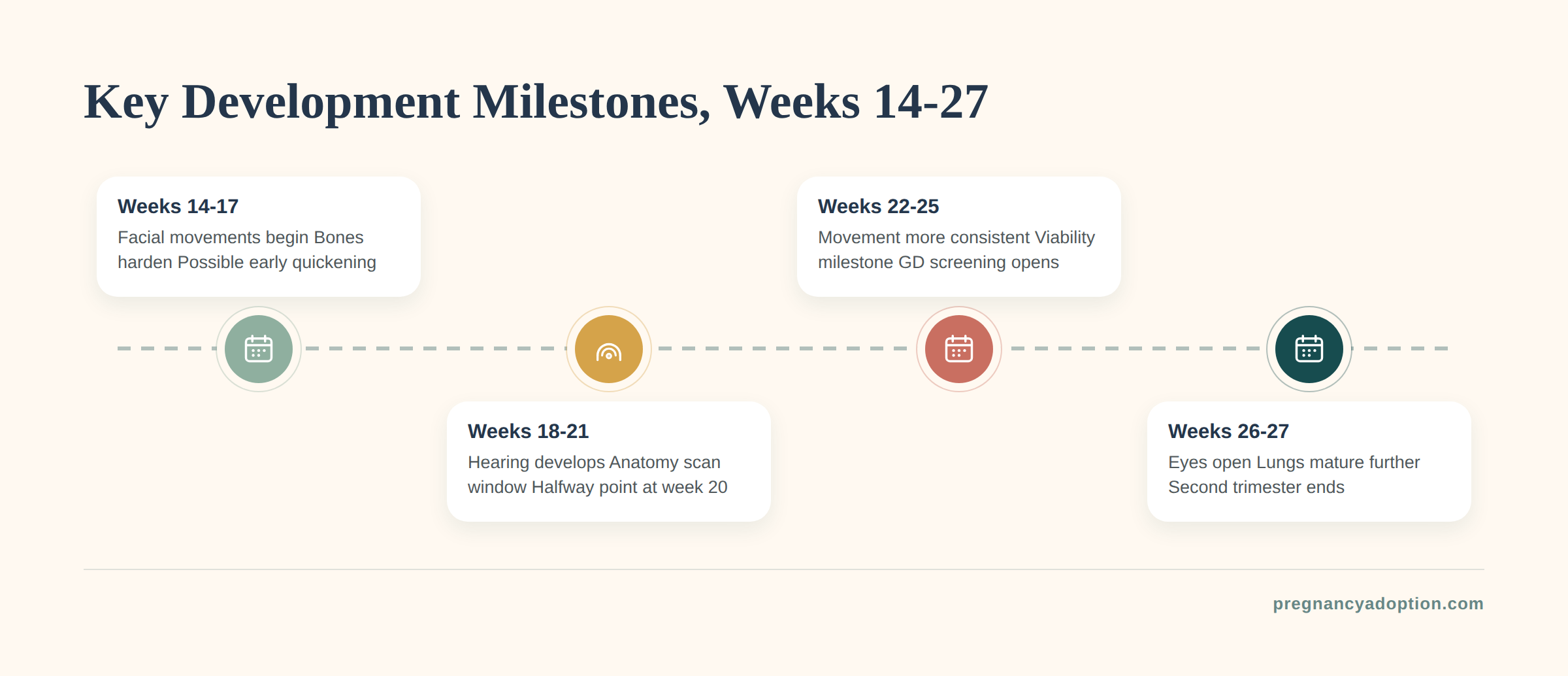
| Weeks | Approximate size | Key milestone |
|---|---|---|
| 14–15 | Lemon to apple | Facial movements begin; energy often returns |
| 16–17 | Avocado to turnip | Coordinated movement; possible early quickening |
| 18–19 | Bell pepper to mango | Hearing develops; anatomy scan window opens |
| 20–21 | Banana to carrot | Halfway point; skin changes may begin |
| 22–23 | Papaya to large mango | Quickening more consistent; possible first Braxton Hicks |
| 24–25 | Ear of corn to rutabaga | Viability milestone; GD screening window opens |
| 26–27 | Lettuce to cauliflower | Eyes open; approaching third trimester |
The Anatomy Scan: Your Mid-Pregnancy Ultrasound
The anatomy scan is one of the most anticipated appointments of pregnancy — a detailed look at your baby’s developing body.
What the Anatomy Scan Is
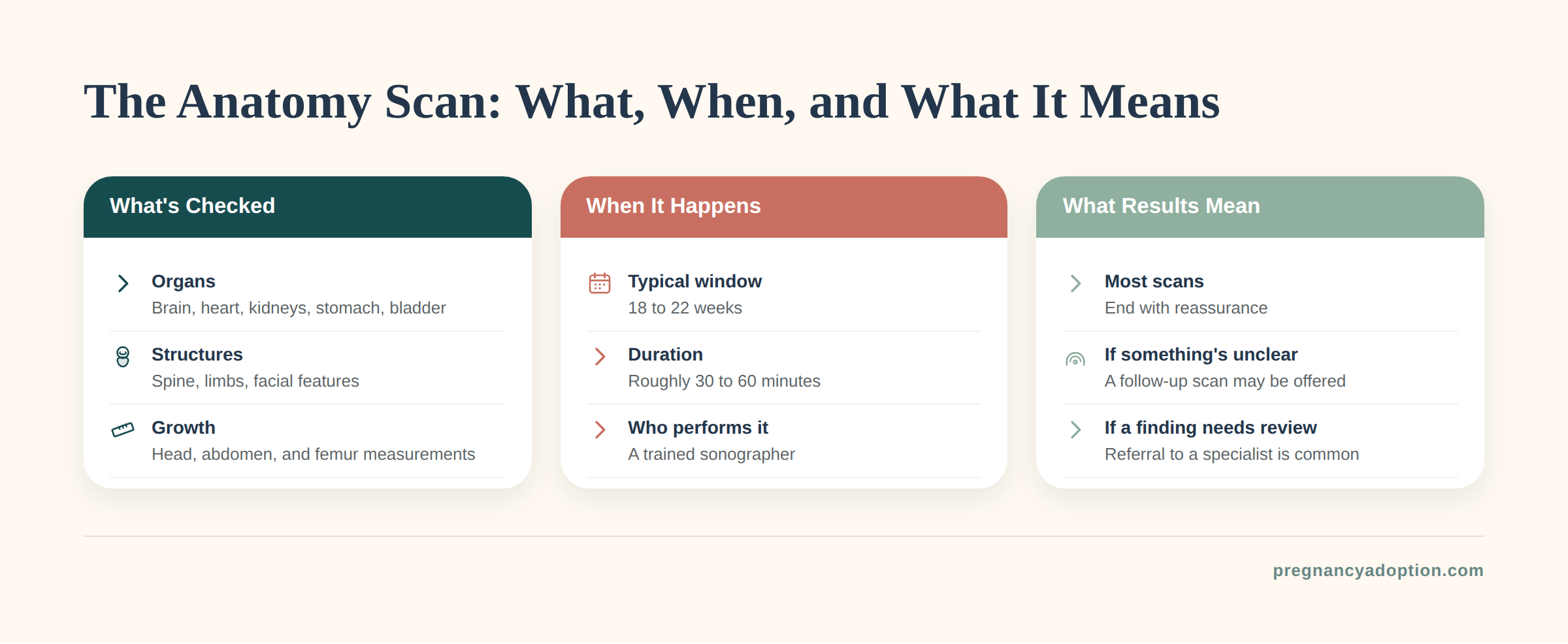
Also called a level 2 ultrasound or mid-pregnancy ultrasound, the anatomy scan is a detailed structural examination of the baby’s organs, bones, and overall development — more comprehensive than earlier dating ultrasounds, which focus mainly on measurement. For the general distinction between a dating scan and a later structural scan, see our gestational age guide, which covers how early ultrasounds estimate gestational age versus how this later scan shifts focus to structural and developmental assessment instead. Most anatomy scans happen between 18 and 22 weeks, since this window offers a reliable balance of fetal size and visibility for a thorough structural examination — the baby is large enough by this point for key structures to be clearly visualized, but not yet so large or positioned in a way that would make a complete structural survey more difficult, as can sometimes happen later in pregnancy.
What’s Checked
A sonographer typically examines the brain, spine, heart, kidneys, stomach, bladder, limbs, and facial structures, along with placental location and amniotic fluid volume. This comprehensive structural review is designed to check that each major organ system is developing as expected and that there are no structural concerns that would benefit from further evaluation or specialist involvement. Standard measurements — head circumference, abdominal circumference, and femur length, among others — are taken and used to estimate fetal size and confirm the pregnancy is progressing as expected for its gestational age. These measurements, taken together, give your provider a detailed picture of growth that gets compared against expected ranges for your specific gestational week, helping confirm the pregnancy is on track or flagging anything that might warrant closer monitoring going forward.
| Category | What’s examined |
|---|---|
| Brain and spine | Structure and development of the brain and spinal column |
| Heart | Chambers, valves, and major blood vessels |
| Abdominal organs | Kidneys, stomach, bladder |
| Limbs and extremities | Arms, legs, hands, feet |
| Facial structures | Lips, nose, and facial profile |
| Placenta and fluid | Placental location and amniotic fluid volume |
| Growth measurements | Head circumference, abdominal circumference, femur length |
Understanding Your Results
The large majority of anatomy scans find nothing concerning, and most appointments end with reassurance about the baby’s development. For most people, the anatomy scan is simply a chance to see a detailed, exciting view of the baby and get confirmation that development is progressing normally — a genuinely positive and often memorable appointment. If the sonographer can’t get a clear enough view of something, or notices something worth a closer look, you may be asked to return for a follow-up ultrasound or referred to a maternal-fetal medicine specialist — this is common and does not necessarily mean something is wrong. Follow-up scans are often simply about getting a clearer image of a structure the baby’s position made difficult to see the first time, which happens fairly often given how much the baby can move during an appointment; a referral to a specialist for a closer look is a standard, cautious next step rather than a sign of a confirmed problem.
Second-Trimester Screening and Testing
Beyond the anatomy scan, several screening and diagnostic tests are commonly offered during the second trimester.
The Quad Screen (Maternal Serum Screening)
The quad screen is a blood test measuring four substances in your blood to estimate the risk of certain chromosomal conditions and neural tube defects. Like other prenatal screening tests, it provides a risk estimate rather than a diagnosis — a result flagged as higher-risk means further testing, such as a detailed ultrasound or a diagnostic test, would typically be recommended to get a more definitive answer, not that a condition has been confirmed. It’s typically offered between 15 and 20 weeks, often alongside or instead of first-trimester screening, depending on when you start prenatal care and your provider’s practice. Some providers offer it as a standalone test, while others use it in combination with first-trimester screening results as part of an integrated screening approach that can improve overall detection accuracy — your provider can explain which approach applies to your care.
Amniocentesis
Amniocentesis is a diagnostic test in which a small sample of amniotic fluid is drawn with a thin needle and tested for chromosomal and genetic conditions, offering a definitive answer rather than a risk estimate. Unlike screening tests such as the quad screen, which estimate probability, amniocentesis analyzes fetal cells directly, which is why it can provide a much more definitive diagnosis for the specific conditions it tests for. It’s typically offered between 15 and 20 weeks, most often to people with a higher-risk screening result, an abnormal anatomy scan finding, advanced maternal age, or a known genetic risk factor, though it can be requested by anyone who wants a diagnostic rather than a screening answer. Because it’s an invasive procedure, your provider will typically walk through the specific risks and benefits relevant to your situation before you decide whether it’s the right choice for you.
Gestational Diabetes Screening
Universal gestational diabetes screening is typically scheduled for 24 to 28 weeks, toward the end of this trimester. This timing reflects when gestational diabetes most commonly develops and becomes detectable, which is why screening is scheduled for this specific window rather than earlier in pregnancy. This guide intentionally keeps this brief by design — our dedicated gestational diabetes guide covers the one-step and two-step screening approaches, diagnostic thresholds, and what a diagnosis means in full depth, since the topic has enough nuance and practical implication to warrant its own complete treatment rather than a condensed summary here. If you’re approaching this window, that dedicated guide is the better place to understand exactly what to expect from the test itself and what would happen next if results suggested further evaluation.
| Test | Type | Typical timing |
|---|---|---|
| Quad screen | Blood draw, screening | 15–20 weeks |
| Anatomy scan | Ultrasound, structural | 18–22 weeks |
| Amniocentesis | Fluid sample, diagnostic | 15–20 weeks |
| Gestational diabetes screening | Blood test, screening | 24–28 weeks |

Common Symptoms Through the Trimester
This section stays intentionally brief, since this site’s dedicated symptoms guide covers the second trimester’s signs in full depth.
What Often Eases
For many people, first-trimester nausea and fatigue ease substantially during the second trimester, though this isn’t universal — some people continue experiencing one or both well into the second trimester or beyond, and that variation is entirely normal rather than a sign anything is wrong. The easing that many people do experience is generally attributed to hCG levels, which peak in the first trimester, plateauing and then declining as the placenta takes over hormone production more fully. Frequent urination often eases somewhat during the middle of the second trimester, before returning later in pregnancy as the growing uterus presses on the bladder again. This mid-pregnancy lull happens because the uterus has risen up out of the pelvis by this point, temporarily relieving some of the direct pressure on the bladder that caused frequent urination earlier — pressure that typically returns in the third trimester as the baby grows and drops back down.
What Often Begins
Skin, movement, and body changes — pigment changes, quickening, round ligament pain, and (later) Braxton Hicks contractions — are all common second-trimester developments, each covered at full depth, with its own glossary entries and FAQ, in our complete signs of pregnancy guide. Rather than re-explaining each of these signs here, this guide focuses on week-by-week development, testing, and practical planning — see the signs of pregnancy guide for complete symptom-by-symptom detail across all three trimesters. That dedicated guide is organized around individual symptoms rather than timeline, which makes it the better resource when you want to understand a specific sign in depth — what causes it, how common it is, and when it would be worth mentioning to your provider — rather than seeing it in the broader context of what else is happening during this particular stretch of pregnancy.
Quickening: Feeling Your Baby Move
Quickening — the first time you feel your baby move — is one of the signature milestones of the second trimester.
When It Typically Happens
Quickening is typically felt somewhere between 16 and 22 weeks, though the exact timing varies considerably by individual. A wide range like this reflects real, normal variation rather than uncertainty about what’s typical — factors like body type, placental position, and simple individual sensitivity to internal sensations all play a role in exactly when movement first becomes noticeable. People who’ve been pregnant before often notice it somewhat earlier (commonly around 16 weeks) than first-time parents (commonly closer to 20 weeks), generally attributed to prior stretching and familiarity with the sensation. Having felt it before means knowing what to look for, which often means recognizing early, subtle movement sooner than someone experiencing it for the very first time, who may not initially identify the sensation as fetal movement rather than something else entirely.
What It Feels Like
Early quickening is often described as a flutter, a light tap, or a feeling similar to gas bubbles — subtle enough that many people don’t recognize it as fetal movement the first few times. This subtlety is part of why early quickening can be so easy to miss or misattribute to digestion, especially for someone experiencing it for the first time without a clear frame of reference for what it’s supposed to feel like. As the trimester progresses, movement typically becomes more frequent, stronger, and easier to distinguish from other sensations, eventually becoming a recognizable daily pattern. By the later weeks of the second trimester, most people describe movement as unmistakable — clear kicks, rolls, and stretches rather than the ambiguous flutters of the earlier weeks — and many begin noticing a rough pattern to when the baby tends to be more or less active.
For the full physical and psychological context around this milestone, including how it fits into the broader framework of pregnancy signs, see our signs of pregnancy guide.
Finding Out the Baby’s Sex
The second trimester is when many people find out, or choose to find out, their baby’s biological sex.
Methods and Timing
The anatomy scan, typically done between 18 and 22 weeks, is the most common way people find out, based on visible external genitalia — accuracy is generally high but not absolute, since it depends on fetal positioning and image clarity at the time of the scan. A baby positioned in a way that obscures a clear view can occasionally lead to an inconclusive result or, less commonly, a result that’s later revised, which is part of why some people choose to wait for delivery for complete certainty rather than relying solely on the ultrasound. Non-invasive prenatal testing (NIPT), typically done in the first trimester, can also reveal biological sex earlier and with high accuracy, since it analyzes fetal DNA directly rather than relying on visual confirmation — our first trimester guide covers NIPT timing and procedure in full, including how it works and what else it can screen for beyond sex determination.
Choosing Whether and When to Find Out
Finding out the baby’s sex before birth is entirely optional — some people prefer to be surprised at delivery, and there’s no medical requirement either way. This is purely a personal preference, and providers are generally accustomed to accommodating either choice without issue, whether that means sharing the information as soon as it’s available or deliberately withholding it until birth. If you want to know, let your provider or sonographer know at the start of your anatomy scan appointment, since some practices don’t share this information unless specifically asked. Being clear about your preference at the start of the appointment also helps the sonographer avoid accidentally revealing something during the scan if you’d rather not know yet, since the information is often visible on screen well before it would otherwise come up in conversation.
Warning Signs to Know
While the second trimester is generally a lower-risk stretch of pregnancy, it’s worth knowing which symptoms warrant prompt medical attention.
Signs of Preterm Labor
Regular contractions before 37 weeks, a noticeable change in vaginal discharge, pelvic pressure, or low, dull back pain that doesn’t ease can be signs of preterm labor and warrant a call to your provider. These signs can be subtle and easy to attribute to ordinary pregnancy discomfort, which is exactly why it’s worth knowing them specifically rather than assuming any new sensation during the second trimester is simply a normal part of pregnancy. Recognizing preterm labor signs early can allow for interventions that may help delay delivery or improve outcomes if early birth can’t be prevented. Providers would rather hear from you about a symptom that turns out to be nothing than have you wait and see — calling promptly if you notice any of these signs gives your care team the best chance to evaluate the situation and intervene if needed.
Signs Potentially Related to Preeclampsia
Sudden swelling of the face or hands, severe or persistent headache, vision changes, or upper abdominal pain can be early signs of preeclampsia, a pregnancy complication involving high blood pressure. These symptoms are worth taking seriously specifically because they can develop gradually and be mistaken for ordinary pregnancy discomfort, which is part of why routine prenatal visits include blood pressure checks throughout pregnancy — to catch early signs before symptoms become severe. This guide keeps this brief by design — our dedicated preeclampsia guide covers causes, risk factors, diagnosis, and management in full, since the condition has enough clinical nuance and potential seriousness to warrant its own complete treatment. If you notice any of these signs during the second trimester, contacting your provider promptly rather than waiting for your next scheduled visit is the generally recommended approach.
Reduced Fetal Movement
A significant, sustained reduction in movement from what has become your baby’s normal pattern is worth a call to your provider, particularly later in this trimester once movement has become consistent. Once you’ve become familiar with your baby’s typical movement pattern — which usually happens sometime after quickening becomes regular — a noticeable, sustained change from that baseline is the key thing to watch for, rather than any single quiet period, since babies do have natural rest cycles. Your provider can give guidance specific to your stage of pregnancy; most recommend calling the same day rather than waiting to see if movement picks back up. Providers generally have a specific, straightforward process for evaluating reduced movement concerns — often involving a quick check-in appointment with fetal heart rate monitoring — so reaching out promptly is both easy and the right first step if you’re concerned.
| Symptom | Possible concern | What to do |
|---|---|---|
| Regular contractions before 37 weeks | Preterm labor | Call your provider promptly |
| Sudden swelling, severe headache, vision changes | Preeclampsia | Call your provider promptly; see our preeclampsia guide |
| Significant reduction in fetal movement | Possible fetal distress | Call your provider the same day |
| Heavy bleeding or severe abdominal pain | Several possible causes | Seek emergency care |
Lifestyle and Prenatal Care Basics
Core prenatal care habits from the first trimester continue to matter through the second.
Prenatal Visits
Prenatal visits typically continue on a roughly monthly schedule through the second trimester, with the anatomy scan and gestational diabetes screening as the two major additional appointments beyond the routine monthly check-ins. This visit frequency reflects the generally lower-risk, more stable nature of the second trimester compared to the more frequent visits typical of the third trimester, when closer monitoring becomes more important as delivery approaches. Routine visits typically include fundal height measurement, fetal heart rate check, blood pressure and weight check, and a chance to ask questions. Fundal height — the measurement from the pubic bone to the top of the uterus — gives your provider a quick, simple way to track that growth is progressing roughly as expected between the more detailed measurements taken during scans, while the blood pressure check in particular is an important ongoing screen for early signs of preeclampsia.
Nutrition and Activity
Prenatal vitamins, a balanced diet, and regular low-impact activity (as approved by your provider) continue to matter through the second trimester, same as in the first. These foundational habits don’t become less important just because the more acute discomforts of early pregnancy may have eased — consistent nutrition and appropriate activity continue supporting both the pregnant person’s health and the baby’s ongoing development throughout this stage. Caloric and some nutrient needs modestly increase during the second and third trimesters compared to the first — your provider can give guidance specific to your situation, since the right increase varies based on factors like pre-pregnancy weight, activity level, and whether you’re carrying multiples. Rather than following a generic calorie target, checking in with your provider about what’s appropriate for your specific circumstances tends to be the more reliable approach.
Preparing: Nursery, Gear, and Practical Planning
Many people use the relative comfort of the second trimester — sometimes called the “golden trimester” — to get ahead on practical preparation.
Nursery and Gear
Starting nursery setup and major gear purchases (crib, car seat, stroller) during the second trimester, rather than waiting until the third, means you’re not tackling physically demanding tasks like furniture assembly while more uncomfortable later in pregnancy. The second trimester’s relatively higher energy and comfort levels make it a practical window for this kind of physical task, before the third trimester’s growing discomfort and more frequent appointments start competing for time and energy. A properly installed car seat and a safe sleep space are the two genuinely essential items; most other gear can be acquired gradually and isn’t urgent this early. Many hospitals and fire departments offer free car seat installation checks, which can be worth scheduling once you have the seat, since correct installation is more involved — and more important to get right — than it might first appear.
Maternity Clothes and Comfort
Many people start needing maternity or looser-fitting clothes sometime in the second trimester as the bump becomes more pronounced, though exact timing varies considerably by body type and whether it’s a first pregnancy. There’s no fixed week when this becomes necessary — some people comfortably wear their regular clothes well into the second trimester, while others find they need looser or maternity-specific clothing earlier, and both are entirely normal. A supportive maternity pillow, comfortable supportive footwear, and a well-fitting supportive bra are commonly cited as worthwhile second-trimester comfort investments. As the body changes shape and center of gravity shifts, these kinds of supportive items can meaningfully ease some of the physical discomfort that tends to build gradually through the second trimester and into the third, making them worth considering even before they feel strictly necessary.
Financial and Logistical Planning
The second trimester is a reasonable time to review your health insurance coverage for delivery, confirm your hospital or birth center is in-network, and start researching your workplace’s parental leave policy if you haven’t already. Handling this kind of administrative groundwork during the relatively more comfortable second trimester, rather than scrambling in the third trimester, tends to reduce stress later when your energy and attention may be more limited. Some people begin researching or interviewing pediatricians during the second trimester, though this isn’t urgent until closer to delivery. Starting early simply gives you more time to make a comfortable, well-informed choice rather than needing to decide quickly; many people find it helpful to have a pediatrician selected before delivery so that the first newborn appointment is already arranged in advance.
Work, Travel, and Daily Life
Many of the practical questions about navigating daily responsibilities carry over from the first trimester, with a few second-trimester-specific points worth knowing.
Working Through the Second Trimester
Many people find the second trimester the most comfortable stretch for working, since early fatigue and nausea have often eased and the physical demands of late pregnancy haven’t yet begun. This window — after the first trimester’s exhaustion but before the third trimester’s physical limitations — is often when people feel most able to maintain their usual work pace and routine, though individual experiences vary considerably. This is a reasonable time to start researching your specific workplace leave policy and any applicable state or federal protections, well ahead of when you’ll actually need to use them. Understanding your specific leave entitlements, any notice requirements your employer has, and how your particular benefits work takes time to sort out properly, which is exactly why starting this research during a relatively lower-stress window of pregnancy tends to work better than waiting until closer to delivery.
Traveling During the Second Trimester
Many providers consider the second trimester the most favorable window for travel, including air travel, given lower first-trimester-level nausea and fatigue and a lower risk of preterm labor than in the third trimester. This combination of factors — feeling physically better than in the first trimester, while not yet facing the travel restrictions many airlines and providers recommend closer to the due date — makes the second trimester a popular time for a final trip before the baby arrives. Staying hydrated, moving periodically on long flights or drives to reduce clot risk, and confirming your specific airline’s gestational-age policies ahead of time are commonly recommended precautions. Pregnancy does increase the risk of blood clots somewhat, which is why periodic movement during long periods of sitting is specifically recommended, and checking your airline’s policy ahead of time avoids any surprises at the gate, since policies on how late in pregnancy they’ll allow travel vary by airline.
Emotional Changes and Body Image
The second trimester often brings a different emotional texture than the first.
A Common Emotional Lift
As pregnancy loss risk declines and physical symptoms often ease, many people describe feeling more emotionally settled during the second trimester than the first. The earlier anxiety of the first trimester — worrying about miscarriage risk while managing nausea and fatigue — often gives way to a steadier emotional state once the pregnancy feels more established and physically manageable. Feeling movement for the first time often deepens a sense of connection to the pregnancy, which many people describe as a meaningful emotional shift. Quickening, in particular, is often described as the moment pregnancy starts to feel tangibly real in a new way — a direct, physical confirmation of the baby’s presence that ultrasounds and test results, however reassuring, don’t quite replicate in the same felt sense.
Body Image Through a Changing Shape
As the bump becomes more visible, some people feel excited and proud, while others find the visible changes to their body more complicated to navigate emotionally — both are normal reactions. There’s no single correct way to feel about a changing body during pregnancy, and many people experience a genuine mix of both reactions at different points, sometimes even within the same day. If feelings about body changes are significantly affecting your mood, eating, or daily functioning, talking with your provider or a mental health professional experienced in perinatal care is a reasonable and worthwhile step. Providers who work regularly with pregnant patients are generally well equipped to discuss body-image concerns specifically in the context of pregnancy, and reaching out is a sign of taking your wellbeing seriously, not something to feel like you should manage alone.
Special Situations
If You’re Expecting Multiples
Pregnancies with multiples often involve a more compressed timeline for some milestones and typically come with additional monitoring and more frequent ultrasounds during the second trimester. The additional monitoring reflects the generally higher level of medical attention multiples pregnancies call for, given the added complexity of tracking more than one baby’s growth and wellbeing simultaneously throughout the pregnancy. Expect your provider to recommend a more frequent visit schedule than for a singleton pregnancy, given the additional monitoring multiples pregnancies typically call for. If you’re expecting multiples, your provider will typically walk you through what this more involved schedule looks like specifically for your situation, since the exact approach can vary somewhat depending on factors like whether the babies share a placenta.
If You Have a Pre-Existing Health Condition
If you’re managing a pre-existing condition such as hypertension, diabetes, or a thyroid disorder, close coordination between your obstetric provider and any specialists managing that condition continues to matter through the second trimester. Pregnancy can affect how pre-existing conditions behave and how they’re managed, which is why ongoing communication between everyone involved in your care — rather than treating the condition and the pregnancy as separate, unrelated things — tends to produce the best outcomes. Depending on your specific condition, your provider may recommend additional monitoring, more frequent visits, or earlier screening than the standard second-trimester schedule. The specific adjustments depend heavily on your individual condition and how it’s responding to pregnancy, which is exactly why this kind of coordinated, individualized care plan matters more than following the standard schedule alone.
Exercise, Movement, and Physical Activity
The second trimester’s relative comfort often makes it an easier stretch to stay active than either the first or third trimester.
Generally Safe Activities
Walking, swimming, stationary cycling, and modified strength training are commonly considered safe for most second-trimester pregnancies without complications, as approved by your provider. These lower-impact activities tend to work well throughout pregnancy because they support cardiovascular health and overall fitness without the jarring impact or fall risk associated with higher-intensity or contact activities. Prenatal yoga and prenatal-specific fitness classes are designed around pregnancy’s changing center of gravity and loosening ligaments, which can make them a more comfortable option than general fitness classes as the bump grows. These pregnancy-specific classes are typically led by instructors trained to modify poses and movements appropriately for each trimester, which can make them a more comfortable and confidence-inspiring option than trying to adapt a general fitness class on your own.
Activities to Modify or Avoid
Exercises involving lying flat on your back for extended periods are generally discouraged starting in the second trimester, since the weight of the growing uterus can compress major blood vessels in this position. This compression can reduce blood flow back to the heart and, in turn, to the uterus and baby, which is why many prenatal exercise modifications involve switching to a side-lying or inclined position for any movement that would otherwise require lying flat. Contact sports and activities with a meaningful fall risk are generally discouraged throughout pregnancy, given the potential for abdominal trauma. This caution applies broadly across all three trimesters, not just the second, and reflects a simple risk-avoidance principle: activities with real potential for a fall or direct impact carry a risk to the pregnancy that most providers recommend avoiding, regardless of how fit or experienced you are.
Sleep During the Second Trimester
Sleep often improves somewhat during the second trimester compared to the fatigue-heavy first trimester, though it comes with its own adjustments.
Finding a Comfortable Position
Many providers begin recommending side-sleeping, particularly on the left side, as the uterus grows large enough to potentially compress major blood vessels when lying flat on your back for extended periods. Left-side sleeping in particular is often specifically recommended because it’s thought to optimize blood flow to the uterus and kidneys, though sleeping on either side is generally considered a reasonable and comfortable option compared to lying flat on your back. A pregnancy pillow or a few regular pillows positioned between the knees and under the belly can make side-sleeping more comfortable as the bump grows. These positioning aids can meaningfully reduce the hip and lower-back discomfort that often accompanies side-sleeping as pregnancy progresses, making it easier to maintain a comfortable position through the night rather than waking up repeatedly to readjust.
Common Sleep Disruptions
Some people report more vivid or unusual dreams during pregnancy, generally attributed to hormonal shifts and more fragmented sleep cycles, though this isn’t universal. The combination of hormonal changes and more frequent waking — whether from needing to use the bathroom, physical discomfort, or simply lighter sleep overall — is thought to contribute to more memorable dream recall during pregnancy for some people, even though the underlying mechanism isn’t fully understood. Persistent, severe sleep disruption that significantly affects daytime functioning is worth mentioning to your provider, who can help rule out or address specific contributing factors. Sleep difficulties during pregnancy can sometimes stem from specific, addressable causes — restless leg sensations, heartburn, or anxiety, among others — so a conversation with your provider can help identify whether something more targeted than general comfort measures might help.
Nutrition Deep Dive: Key Nutrients This Trimester
While general prenatal nutrition guidance continues through the second trimester, a few specific nutrients become increasingly important.
Iron and Calcium
Iron needs increase as blood volume expands significantly during the second trimester, and many prenatal vitamins are formulated with this increase in mind, though some people need additional supplementation based on bloodwork. This increased need reflects the substantial expansion of blood volume that happens during pregnancy, which requires additional iron to support the increased production of red blood cells carrying oxygen to both the pregnant person and the growing baby. Calcium needs also become more significant as the baby’s bones continue hardening through this trimester, supporting both fetal bone development and maintaining the pregnant person’s own bone density. If dietary calcium intake isn’t sufficient, the body will draw calcium from the pregnant person’s own bones to support fetal development, which is part of why adequate calcium intake through diet or supplementation matters particularly during this stage of active fetal bone development.
DHA and Other Key Nutrients
DHA, an omega-3 fatty acid, supports ongoing brain and eye development during this period of rapid neurological growth; many prenatal vitamins include it, or it can be obtained through low-mercury fish or a separate supplement. The second trimester is a period of particularly active brain and nervous system development, which is part of why DHA intake is commonly emphasized during this stage specifically, alongside its continued importance through the rest of pregnancy. Folic acid, vitamin D, and adequate protein intake all remain important through the second trimester, consistent with general prenatal nutrition guidance established in the first trimester. These foundational nutrients continue supporting different aspects of fetal development and the pregnant person’s own health throughout pregnancy, which is why prenatal nutrition guidance tends to emphasize consistency across trimesters rather than a dramatically different approach at each stage.
Cost and Insurance Considerations for Second-Trimester Testing
Second-trimester testing brings its own set of cost and insurance questions worth understanding ahead of time.
What’s Typically Covered
Most health insurance plans cover the anatomy scan and standard screening tests as part of routine prenatal care, though copays, deductibles, and specific coverage details vary significantly by plan. Because prenatal care is widely recognized as essential preventive care, most insurance plans treat these routine tests as a standard, covered part of pregnancy care, though the exact out-of-pocket cost you’ll see depends heavily on your specific plan’s structure. Coverage for optional tests like amniocentesis can depend on whether it’s recommended based on risk factors versus requested without a specific medical indication — check with your specific insurer ahead of the appointment if cost is a concern. A test recommended by your provider based on a risk factor or prior finding is generally more straightforwardly covered than the same test requested without a specific medical indication, which is worth understanding before scheduling if cost is a significant consideration for your family.
Planning Ahead
Calling your insurer or your provider’s billing office ahead of a scheduled test to confirm expected out-of-pocket costs can help avoid surprise bills. This kind of proactive check can feel like an extra step, but it’s generally a worthwhile one given how much variation exists between plans in terms of what’s covered, what requires prior authorization, and what your specific copay or deductible situation looks like for a given test. Pregnancy-specific Medicaid eligibility expansion, available in many states, and community health centers offering sliding-scale prenatal care are worth researching if you’re uninsured or underinsured. Many states have specific pathways to expand Medicaid eligibility for pregnant people, even those who wouldn’t otherwise qualify, recognizing that consistent prenatal care produces better outcomes — researching what’s available in your specific state is a reasonable and often fruitful step if cost is a barrier to care.
Preparing Siblings and Family for the New Baby
If this isn’t your first child, the second trimester is a common time to start preparing older children for a new sibling.
Age-Appropriate Conversations
Many families choose to tell older children once the pregnancy feels more established, often sometime during the second trimester, though timing is a personal decision with no single right answer. There’s no universally correct time to share this news with existing children — some families prefer to share it early, while others wait until later in pregnancy or until physical changes make it harder to keep private, and both approaches are entirely reasonable depending on your family’s preferences and circumstances. Younger children often have a limited sense of pregnancy timelines and may need the conversation revisited periodically, while older children may have more specific questions or mixed feelings worth making space for. Tailoring the conversation to your child’s age and developmental stage — keeping it simple and concrete for younger children, while being prepared for more nuanced questions from older ones — tends to help the news land in a way that’s appropriate and manageable for them.
Involving Siblings in Preparation
Involving older children in simple preparation tasks, like picking out an item for the nursery, can help build anticipation and a sense of involvement in the family’s change. Giving an older child a small, meaningful role in preparing for the new baby can help the pregnancy feel like a shared family event rather than something happening to them, which many parents find helps smooth the eventual transition once the baby arrives. It’s normal for older children to have mixed feelings about a new sibling; acknowledging those feelings rather than dismissing them is commonly recommended by child development professionals. Validating a child’s complicated feelings — excitement mixed with worry about change, or concern about sharing attention — rather than insisting they should simply feel happy, tends to help children process the transition in a healthier way than having those feelings dismissed or minimized.
Intimacy and Relationships During Pregnancy
Relationships, including intimacy, often shift during pregnancy, and the second trimester brings its own considerations.
Physical Intimacy
For most people with uncomplicated pregnancies, sexual activity is generally considered safe throughout the second trimester, though your provider can advise on any situation-specific restrictions. This is a common question many people feel hesitant to ask directly, but it’s a normal and reasonable topic to bring up with your provider, who can give guidance specific to your individual pregnancy rather than general assumptions. Specific conditions, such as placenta previa or a history of preterm labor, may call for modified guidance — ask your provider directly if you have any pregnancy complications. If you do have a condition that calls for modified guidance, your provider can explain specifically what that means for your situation, since restrictions in these cases are typically specific and targeted rather than a blanket recommendation to avoid intimacy altogether.
Relationship Dynamics
Many couples describe shifts in their relationship dynamic during pregnancy, including changes in how they communicate about physical and emotional needs. These shifts are a normal part of navigating a major life transition together, as both partners adjust to physical changes, emotional ups and downs, and the practical reality of an approaching life change that affects the relationship in ways that can take some adjustment to navigate smoothly. Open, ongoing communication about physical comfort, emotional needs, and expectations tends to help couples navigate these shifts more smoothly. Checking in with each other regularly — rather than assuming you already know what your partner is thinking or feeling — tends to help couples stay connected through a period when both partners may be experiencing real, sometimes unexpected changes in how they relate to each other and to the pregnancy itself.
Twins and Multiples: What’s Different
Expecting more than one baby changes several aspects of second-trimester experience and care.
Development Differences
Babies in a multiples pregnancy often measure slightly smaller on average than singleton pregnancies by the same gestational week, a generally normal pattern providers account for in monitoring. This size difference is an expected and accounted-for part of monitoring a multiples pregnancy, rather than a cause for concern on its own, since providers use growth charts and comparison standards specific to multiples pregnancies rather than applying singleton-pregnancy expectations. Many people pregnant with multiples report feeling quickening somewhat earlier than typical for a singleton pregnancy, though this varies individually. With more than one baby moving, and potentially more total surface area of the uterus being affected by movement at any given time, earlier and more noticeable movement is a commonly reported experience, though exactly when it becomes noticeable still varies from person to person.
Monitoring and Care Differences
Multiples pregnancies typically involve more frequent ultrasounds during the second trimester to monitor each baby’s individual growth and, for identical twins sharing a placenta, to watch for specific complications. This increased monitoring frequency reflects the additional complexity of tracking more than one baby’s development simultaneously, and for identical twins who share a placenta specifically, watching for complications unique to that particular situation that wouldn’t apply to a singleton or non-identical multiples pregnancy. Many providers recommend involving a maternal-fetal medicine specialist earlier in a multiples pregnancy than would be typical for a singleton pregnancy. This earlier specialist involvement reflects the generally higher level of medical complexity multiples pregnancies can involve, and having that expertise engaged early allows for a more proactive, well-coordinated approach to monitoring and care throughout the rest of the pregnancy.
Common Myths and Misconceptions
A few persistent myths about the second trimester are worth addressing directly.
Myths About Movement and Development
“If you can’t feel kicks yet by a specific week, something is wrong” is a common but inaccurate belief. Quickening timing varies widely and normally; not feeling movement by a specific calendar date, within the broad typical range, doesn’t by itself indicate a problem — your provider can offer reassurance specific to your situation. As covered earlier in this guide, the typical window for first feeling movement spans several weeks and depends on individual factors, so a specific date-based cutoff isn’t a meaningful way to judge whether anything is wrong. “The anatomy scan can tell you everything about your baby’s health” is another common misconception. While thorough, the anatomy scan has real limits — it cannot detect every possible condition, and a “normal” scan, while reassuring, isn’t an absolute guarantee. The scan is a valuable structural assessment, but it isn’t a comprehensive test for every possible genetic or developmental condition, which is worth understanding so a reassuring scan is appreciated for what it actually confirms rather than treated as an exhaustive guarantee.
Myths About Symptoms and Comfort
“The second trimester is always symptom-free” is a common misconception. While often more comfortable than the first trimester, the second trimester isn’t universally symptom-free — round ligament pain, skin changes, and other developments are all normal parts of this stage, not signs something is wrong. The second trimester’s reputation as the “easy” trimester is real for many people, but it can create unnecessary worry for those who do experience new or ongoing symptoms during this stage, when in fact a range of symptoms remains entirely normal. “You can tell the baby’s sex by how you’re carrying” is a long-standing piece of folklore. Popular folklore claims about belly shape, carrying position, or other physical signs predicting biological sex have no scientific basis; the anatomy scan or earlier genetic testing are the reliable ways to find out. These folk methods are a fun, low-stakes tradition many people enjoy, but they’re worth treating as entertainment rather than any kind of reliable prediction, since they have no basis in actual physiology.
How This Guide Compares to This Site’s Other Guides
This site has several guides that touch on second-trimester-adjacent topics, and it’s worth knowing how they relate to this one.
Relationship to the Signs of Pregnancy Guide
Our signs of pregnancy guide covers symptom-by-symptom detail across all three trimesters, including a dedicated second-trimester section; this guide instead focuses on week-by-week development, testing, and practical planning specific to this stage. The two guides are designed to complement rather than duplicate each other — this one organized around the timeline of the second trimester itself, the other organized around individual symptoms that can be looked up regardless of which trimester you’re in. Reading both guides together gives a genuinely complete picture: this guide for timeline and planning, the signs guide for symptom-level depth. If something covered briefly here — a particular symptom or sensation — leaves you wanting more detail on the symptom itself rather than its place in the second-trimester timeline, the signs of pregnancy guide is the natural next place to look.
Relationship to the First and Third Trimester Guides
This guide is the second installment of a three-part trimester series — see our first trimester guide for weeks 1 through 13, and our third trimester guide for weeks 28 through 40. Together, the three guides cover the full span of pregnancy, each focused specifically on what’s distinct and relevant to that particular stage rather than repeating the same general pregnancy information three times over. All three guides follow a consistent structure — week-by-week development, relevant testing, common symptoms, warning signs, and practical planning — so switching between them as your pregnancy progresses should feel familiar. That consistent structure means that once you’re used to navigating one guide in the series, moving on to the next as your pregnancy advances should feel immediately familiar, without needing to learn a new format or figure out where to find a particular kind of information again.
A Simple Action Checklist
A simple checklist to help you keep track of what’s ahead during the second trimester.
Appointments and Testing
Schedule Your Anatomy Scan
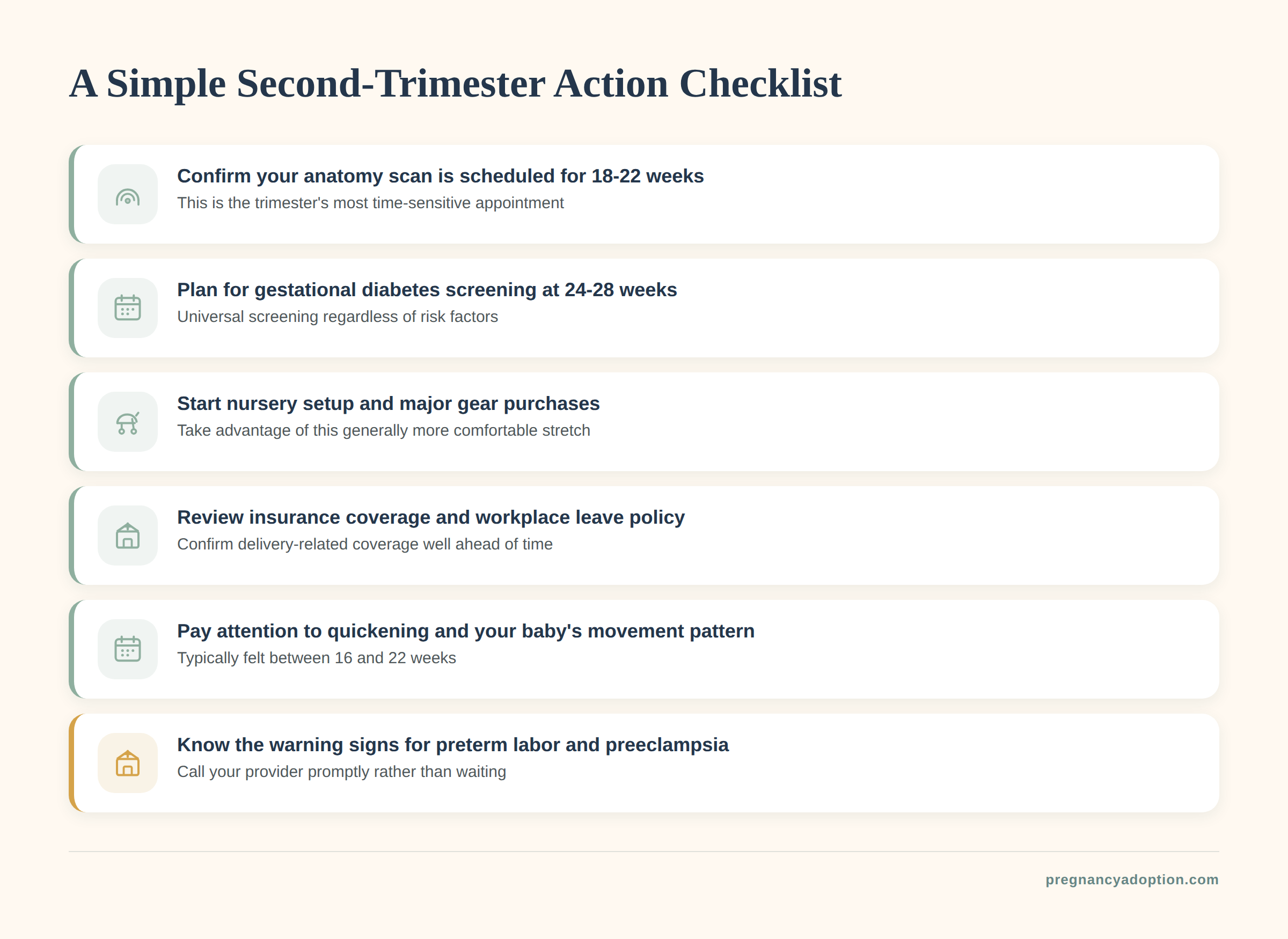
Confirm your anatomy scan is scheduled for between 18 and 22 weeks if it isn’t already.
Plan for Gestational Diabetes Screening
Expect this screening to be scheduled for sometime between 24 and 28 weeks.
Practical Preparation
Start Nursery and Gear Planning
Take advantage of this generally more comfortable trimester to begin nursery setup and major gear purchases.
Review Insurance and Leave Policies
Confirm your delivery-related insurance coverage and start researching your workplace leave policy.
| Weeks | Key focus |
|---|---|
| 14–17 | Energy often returns; possible early quickening |
| 18–21 | Anatomy scan window; halfway point at week 20 |
| 22–25 | Movement more consistent; viability milestone |
| 26–27 | GD screening window closes; approaching third trimester |
Glossary of Terms in This Guide
Development and Milestone Terms
Quickening
The first time a pregnant person feels fetal movement.
Viability
The point at which a baby born very prematurely has some chance of survival with intensive care, generally discussed starting around 23 to 24 weeks.
Testing and Screening Terms
Anatomy Scan
A detailed structural ultrasound, typically done between 18 and 22 weeks, examining the baby’s organs, bones, and overall development.
Quad Screen
A blood test measuring four substances to estimate risk of certain chromosomal conditions and neural tube defects.
Amniocentesis
A diagnostic test in which amniotic fluid is sampled and tested for chromosomal and genetic conditions.
Gestational Diabetes Screening
Universal blood-sugar screening typically done between 24 and 28 weeks; see our gestational diabetes guide for full detail.
Symptom and Comfort Terms
Round Ligament Pain
Brief, sharp or achy pulls on either side of the lower abdomen caused by stretching ligaments supporting the growing uterus.
Braxton Hicks Contractions
Irregular, generally painless practice contractions, most common in the second and third trimesters; see our signs of pregnancy guide for full detail.
Frequently Asked Questions
These questions cover the full range of follow-up questions that come up during the second trimester, organized by theme.
Timing and Definition Questions
Why does this guide spend so much time on exact week ranges?
Precise week ranges matter clinically because screening windows, the anatomy scan, and gestational diabetes screening are all tied to specific gestational weeks rather than to the trimester label itself, so understanding your exact week helps you anticipate what’s coming next.
Is the second trimester really weeks 14 through 27, or does it vary?
It varies slightly by source — this site uses weeks 14 through 27, while NICHD uses weeks 13 through 28; see our pregnancy week calculator guide for the full cross-source comparison.
Anatomy Scan Questions
What if I miss the 18-22 week window for my anatomy scan?
Talk with your provider — a scan slightly outside this window can often still provide useful information, though visibility and accuracy may be somewhat reduced the further outside the ideal window you are.
Can the anatomy scan detect every possible condition?
No — while thorough, an anatomy scan cannot detect every possible condition, and some conditions only become apparent later in pregnancy or after birth.
Screening Test Questions
Do I have to get the quad screen or amniocentesis?
No — all second-trimester screening and diagnostic tests are optional, and the decision about which, if any, to pursue is yours to make with your provider.
What happens if my quad screen comes back with a higher-risk result?
A higher-risk screening result doesn’t mean something is definitely wrong — it means further testing, such as amniocentesis or a detailed ultrasound, may be offered to get a more definitive answer.
Quickening and Fetal Movement Questions
What does quickening actually feel like compared to gas or digestion?
Many people describe quickening as more rhythmic or repetitive than digestive sensations, though early on the two can genuinely be hard to tell apart — it typically becomes more clearly distinguishable as the sensation strengthens over subsequent weeks.
Should I start counting kicks during the second trimester?
Formal kick counting is generally more relevant in the third trimester once movement is consistent; your provider will let you know when to start a formal counting routine if recommended for your pregnancy.
Gestational Diabetes Screening Timing Questions
Can I request gestational diabetes screening earlier than 24 weeks?
Yes, particularly if you have risk factors such as obesity, a prior gestational diabetes diagnosis, or PCOS — see our gestational diabetes guide for full detail on earlier screening criteria.
Does fasting matter for my second-trimester screening appointments?
It depends on the specific test — the one-step gestational diabetes approach requires fasting, while the two-step approach’s first step typically doesn’t; confirm with your provider’s office ahead of your specific appointment.
Exercise and Activity Questions
Can I start a new exercise routine during the second trimester if I wasn’t active before pregnancy?
Generally yes, with your provider’s approval and a gradual, low-impact approach — starting a new, more intense routine from scratch isn’t generally recommended, but gentle walking or prenatal-specific classes are commonly fine to begin.
Is it safe to continue running during the second trimester?
For many people who were already runners before pregnancy, continuing at a comfortable, modified pace is generally considered safe, though listening to your body and discussing it with your provider is important, especially as balance shifts.
Nutrition Questions
Do I really need to double my calorie intake now that I’m “eating for two”?
No — the “eating for two” framing is a myth; actual additional caloric needs during the second trimester are modest, generally a few hundred extra calories per day rather than a doubling.
What if I can’t tolerate my prenatal vitamin due to nausea that’s still lingering?
Talk with your provider about alternatives — options include a different formulation, taking it with food, or splitting the dose, since consistent folic acid and iron intake remain important.
Family Preparation Questions
What if my older child seems upset about the pregnancy?
Mixed or negative feelings from an older child are a normal response to a major family change; acknowledging those feelings directly, rather than insisting they should be excited, is commonly recommended.
Should I involve my older child in choosing the baby’s name?
This is entirely a personal family decision — some families find it a fun way to build involvement, while others prefer to keep naming decisions separate.
Intimacy and Relationship Questions
Is it normal for sex drive to change during the second trimester?
Yes — many people report an increase in sex drive during the second trimester compared to the first, generally attributed to easing symptoms and increased pelvic blood flow, though changes in either direction are normal.
Are there positions that become more comfortable as the bump grows?
Many couples find side-lying positions more comfortable as the pregnancy progresses, avoiding significant pressure on the abdomen, though comfort is highly individual.
Travel-Specific Questions
Is there a specific week considered the cutoff for air travel during pregnancy?
Policies vary by airline, with many allowing travel through the end of the second trimester or into the early third trimester without restriction; always confirm with your specific airline ahead of booking.
Do I need a doctor’s note to fly during the second trimester?
Most airlines don’t require one during the second trimester, though policies vary, and some airlines require documentation closer to the third trimester — check your specific airline’s policy ahead of travel.
Emotional Wellbeing Questions
Is it normal to feel more emotionally stable in the second trimester than I did in the first?
Yes, many people report this, generally attributed to easing physical symptoms, declining pregnancy-loss anxiety, and growing attachment following quickening — though emotional experience varies widely and there’s no single “normal” trajectory.
What if I don’t feel the emotional lift everyone describes about the second trimester?
This is also normal — not everyone experiences the “golden trimester” framing the same way, and persistent low mood or anxiety at any point in pregnancy is worth discussing with your provider rather than dismissing because it’s “not supposed to” feel that way.
Body Image and Physical Change Questions
Is it normal to feel disconnected from my changing body?
Yes — feeling disconnected from or unfamiliar with a rapidly changing body is a common experience some people have during pregnancy, and it doesn’t indicate anything is wrong with how you’re adjusting.
How do I handle unsolicited comments about my body size or shape?
Many pregnant people find comments about their size unwelcome; having a few simple, prepared responses (“I’d rather not discuss that” or redirecting the conversation) can help manage these interactions.
Multiples-Specific Follow-Up Questions
Can I find out the sex of each baby separately in a multiples pregnancy?
Yes — each baby is typically assessed individually during the anatomy scan, and sex can often be determined for each baby separately, though visibility can vary baby by baby depending on positioning.
Is gestational diabetes screening different for multiples pregnancies?
The screening test itself is generally the same, though some providers consider multiples a risk factor that may prompt earlier or more frequent screening; see our gestational diabetes guide for full detail.
Questions About Second-Trimester Loss
What is considered a second-trimester pregnancy loss?
Pregnancy loss occurring after roughly 13 weeks and before 20 weeks is sometimes categorized separately from earlier first-trimester miscarriage, with its own set of causes and considerations, though terminology and exact cutoffs vary by source.
Is second-trimester loss less common than first-trimester miscarriage?
Yes, considerably — the large majority of pregnancy losses occur in the first trimester, with second-trimester loss being comparatively rare, though it remains a real and valid loss when it does occur.
Questions About Blood Pressure and Cardiovascular Changes
Is it normal for blood pressure to change during the second trimester?
Blood pressure often dips slightly during the second trimester compared to pre-pregnancy levels, before trending back up later in pregnancy — this is a generally normal pattern your provider monitors at each visit.
Why is blood pressure checked at every single prenatal visit?
Consistent blood pressure monitoring is one of the main ways providers screen for preeclampsia and other hypertensive conditions, which can develop or progress at any point in pregnancy.
Questions About Genetic Counseling
Do I need genetic counseling during the second trimester?
Not everyone needs it, but it’s commonly offered or recommended if screening results suggest elevated risk, if you have a relevant family history, or if you’re specifically considering diagnostic testing like amniocentesis.
What does a genetic counselor actually do?
A genetic counselor helps interpret screening and test results, explains risk in plain language, and helps you understand your options, without directing you toward a specific decision.
Questions About Adoption and the Second Trimester
If I’m pregnant and considering adoption, does anything in this guide change?
The developmental and testing information in this guide applies regardless of whether you’re planning to parent or considering adoption; this site’s pregnancy options guide and adoption-specific prenatal care guide address the planning questions unique to considering adoption.
Can I still get an anatomy scan if I’m planning an adoption?
Yes — routine prenatal care, including the anatomy scan and standard screening, continues regardless of whether you’re planning to parent or place a child for adoption.
Questions About Amniotic Fluid
What does amniotic fluid actually do?
Amniotic fluid cushions the baby, supports lung development through practiced breathing-like movements, and allows room for movement — its volume is checked as a standard part of the anatomy scan.
What happens if amniotic fluid levels are flagged as too high or too low?
Either finding typically prompts closer monitoring and sometimes additional testing to identify a cause; many cases are managed successfully with monitoring alone, and your provider can explain what a specific finding means for your situation.
Questions About Cervical Length and Preterm Birth Risk
Is cervical length checked during the second trimester?
For some pregnancies, particularly those with risk factors for preterm birth, cervical length may be measured via ultrasound during the second trimester; it isn’t universally checked for every pregnancy.
What does a short cervix finding mean?
A shorter-than-typical cervical length can be associated with increased preterm birth risk and may prompt additional monitoring or specific interventions — your provider can explain what a specific finding means for your individual situation.