
Adopting a child touches almost every part of life at once — legal paperwork, a home visit, a background check, a budget, sometimes a training class, and then a waiting period that can stretch on with no fixed end date. It’s easy to feel like you’re tracking a dozen half-finished threads at the same time. This checklist pulls every major step into one chronological list, from the very first decision about which path to take through what to do in the weeks after your adoption is legally final, so you always know what’s next and where to go for the full detail on any one step.
This is a companion to this site’s deeper guides on each topic, not a replacement for them — every checklist item below links to the article that covers its full depth. It has been reviewed for accuracy by an adoption professional, and points that vary by state, agency, or source are flagged throughout so you know where to confirm specifics with your own agency or attorney.
Short Answer: The Adoption Checklist at a Glance
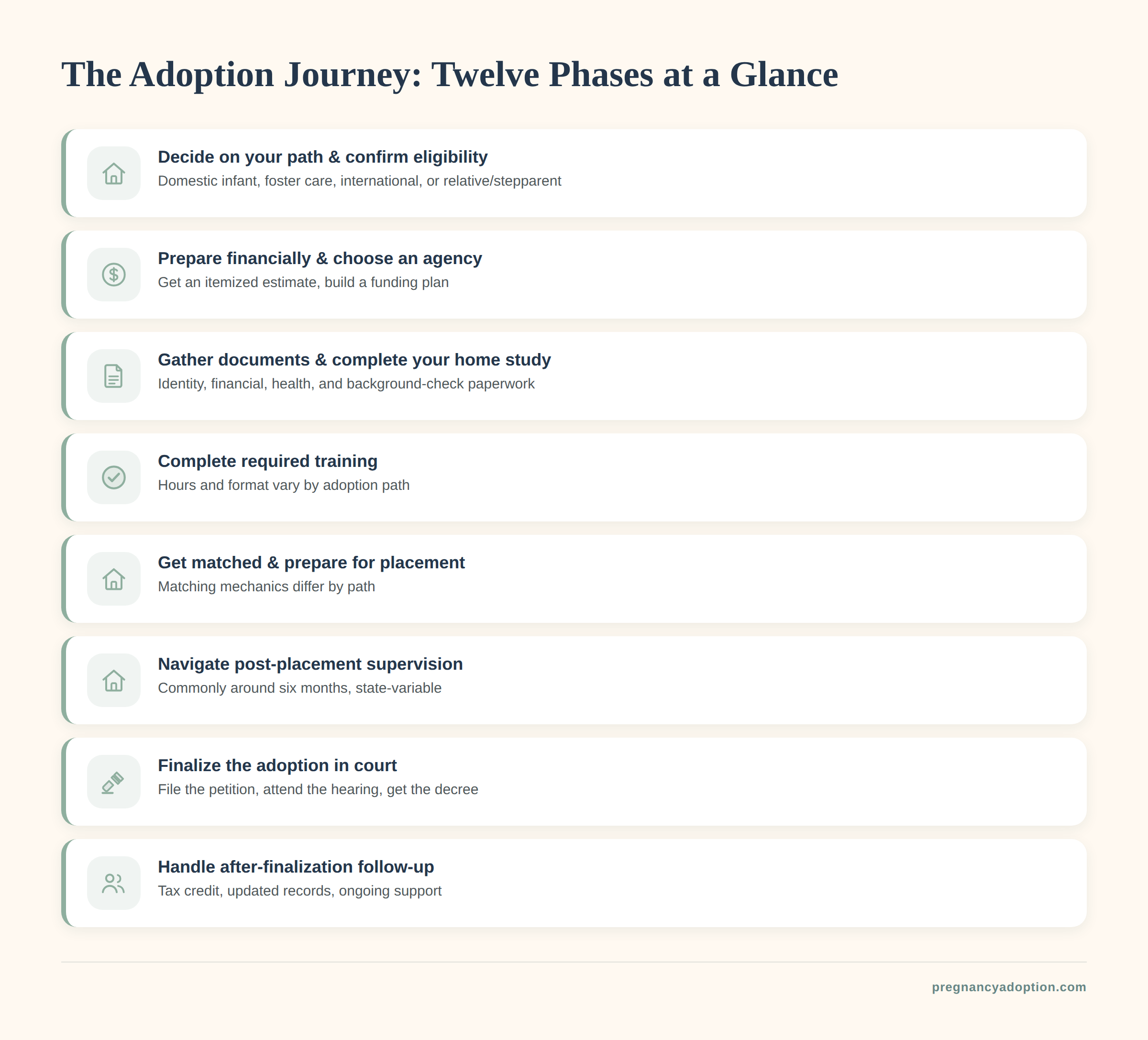
A complete adoption journey generally moves through a predictable sequence: choose a path and confirm your eligibility, prepare financially, choose and vet an agency or attorney, gather your documents, complete a home study and any required training, get matched, prepare for placement, complete post-placement supervision, and finalize the adoption in court — followed by a short list of after-finalization tasks like claiming the federal adoption tax credit. The specific steps and their order shift somewhat depending on whether you’re pursuing domestic infant adoption, foster care adoption, international adoption, or a relative/stepparent adoption, but the overall shape of the checklist is the same across all four paths.
The Adoption Checklist in One Paragraph
What This Checklist Covers
Every phase below is organized the same way: a short explanation of what the phase involves and why it matters, followed by specific checklist items you can act on, each one linking to the full-depth guide that covers it in detail. The goal is a single page you can work through from start to finish, checking items off as you go, rather than hunting across a dozen different articles to figure out what you should be doing right now.
What This Checklist Is Not
This is not a replacement for your agency’s or attorney’s own paperwork checklist, which will have state- and program-specific requirements this general guide can’t fully anticipate. It’s also not legal, financial, or professional advice for your specific situation — think of it as an organizing tool and a map of what’s coming next, with links to the depth you need at each step.
How Long the Whole Process Typically Takes
The Short Version
Depending on the path, the full journey from an active start (home study underway) to finalization commonly runs anywhere from roughly a year to several years, with the waiting-to-be-matched stage usually the single biggest source of variation. The timelines section below walks through typical ranges by path in more detail.
Why Timelines Vary So Much
Unlike the home study or the finalization hearing, which move at a fairly predictable pace once started, the matching/waiting stage depends on factors outside your control — how many expectant parents or children are being matched at a given time, how specific your preferences are, and simple chance. Knowing this upfront can help you plan your checklist pacing realistically instead of comparing your timeline to someone else’s.
Key Takeaways
- A complete adoption journey follows a predictable sequence of phases, even though the exact steps and timing shift by adoption path.
- This checklist is a companion to this site’s deeper guides, not a replacement — every item links to the full detail elsewhere.
- The matching/waiting stage is usually the biggest source of timeline variation, not the paperwork or the home study itself.
- Your agency or attorney’s own checklist will have state- and program-specific requirements this general guide can’t fully anticipate — use both together.
- There’s a short but important list of tasks that come after finalization, including the federal adoption tax credit, that are easy to forget once the adoption itself feels “done.”
How to Use This Checklist
A checklist is only useful if you actually use it the way it’s meant to be used. This section covers how this one is organized and how to adapt it so it fits your specific path rather than treating every item as universally required.
Why a Checklist Format
It’s a Companion, Not a Replacement
This site already has in-depth, narrative guides covering adoption requirements, the home study, costs, the overall process, and the tax credit, each running to significant length because the topic deserves that depth. What was missing was a single, consolidated action list that pulls the practical “do this next” items from all of those guides into one chronological sequence — that’s this article’s job, and it’s why it stays leaner than those deep-dive guides even though it touches on all of the same ground.
Every Item Links to the Full Guide
Wherever a checklist item below touches a topic this site covers in depth elsewhere — eligibility criteria, the document list, training hours, cost breakdowns, the tax credit, or matching mechanics — the item links directly to that guide rather than re-explaining it here. If you want the full reasoning, numbers, or state-by-state nuance behind any item, follow the link.
How to Adapt It to Your Situation
Skip What Doesn’t Apply to Your Path
Not every item applies to every path. A relative or stepparent adoption, for example, generally skips the matching phase entirely and often has a shortened home study process; an international adoption adds immigration paperwork this general checklist only touches on briefly. The special situations section below flags the biggest path-specific differences so you’re not left wondering why an item doesn’t seem to apply to you.
Work With Your Agency or Attorney’s Own Checklist Too
Your agency or attorney will almost certainly give you their own checklist or packet with state- and program-specific requirements. Use this guide to understand the overall shape of the journey and why each phase matters, and use theirs as the authoritative, specific list of exactly what they need from you and by when.
Phase 1: Decide on Your Adoption Path
Before anything else on this checklist can happen, you need to decide which general path you’re pursuing, since it shapes almost everything downstream — which agency or attorney you work with, what your home study and training will cover, how matching works, and roughly how long the process is likely to take.
Understand Your Main Options
Domestic Infant Adoption
Adopting a newborn or very young infant within the United States, typically arranged through an agency or an adoption attorney, with the expectant parent choosing the adoptive family from among presented profiles. This is the path with the most variable waiting time and generally the highest cost range; see this site’s full how-to-adopt guide for a complete path-by-path comparison.
Foster Care Adoption
Adopting a child from the public foster care system, usually through your state or county child welfare agency, after becoming a licensed foster-adoptive family. This path has the lowest direct cost (often free or low-cost through the public system) but the children available are typically older, are part of a sibling group, or have specific needs.
International Adoption
Adopting a child from another country, governed by that country’s requirements plus U.S. immigration law (and, for Hague Convention countries, Hague Adoption Convention requirements), generally through an agency accredited for international placements. This path has the most additional paperwork of the four, layered on top of everything else on this checklist.
Relative or Stepparent Adoption
Adopting a child who is already a relative (grandchild, niece/nephew, etc.) or a spouse’s child from a prior relationship. This path is usually faster and has a simplified home study and no matching phase at all, since the child and adoptive parent already have an established relationship; see the special situations section for how this shortens the checklist.
Checklist Items for This Phase
[ ] Research Each Path’s Basics Before Committing
Read through this site’s dedicated guide for each path you’re considering before narrowing down — the how-to-adopt guide walks through all four paths side by side, including rough cost and timeline comparisons, so you can make an informed choice rather than defaulting to whichever path you heard about first.
[ ] Talk Through the Decision With Your Partner or Support System
If you’re adopting with a partner, make sure you’re genuinely aligned on path, budget, and rough timeline expectations before you start spending money or time on applications — disagreement discovered mid-process is one of the more common sources of unnecessary stress and delay.
Phase 2: Confirm You Meet Basic Eligibility
Every adoption path has baseline eligibility criteria, and it’s worth confirming you meet them — or understanding what to address if you don’t — before you invest significant time or money into an application.
Self-Check the Basics
[ ] Confirm Age and Marital-Status Requirements for Your Path and State
Most states set a minimum adoptive-parent age (commonly 18 or 21, state-variable), and requirements differ for married couples, unmarried couples, and single applicants depending on the path and sometimes the specific agency. The full breakdown by category is in this site’s adoption requirements guide — confirm your specific situation there rather than assuming.
[ ] Confirm You Meet Financial-Stability Standards (Not a Minimum Income)
Agencies and courts generally look for financial stability — the ability to meet the household’s needs, including the child’s — rather than a specific minimum income figure, and this is one of the most commonly misunderstood eligibility criteria. See the myth-busting discussion in the requirements guide if cost or income is a concern holding you back from starting.
What Doesn’t Disqualify You
[ ] Don’t Assume Renting, a Modest Home, or a Non-Traditional Family Structure Disqualifies You
Homeownership is not required in most programs, apartment living is generally fine as long as there’s adequate space, and many agencies and states now explicitly welcome single applicants, LGBTQ+ applicants, and non-traditional family structures. If you’ve ruled yourself out based on an assumption rather than a confirmed requirement, the requirements guide is the place to check before you count yourself out.
[ ] Understand That a Past Health Condition or Minor Legal Issue Isn’t Automatically Disqualifying
A chronic health condition, a past minor legal issue, or a previous divorce does not automatically disqualify an applicant in most programs — what typically matters is the specific nature of the issue and, for background checks, specific disqualifying-offense categories under federal and state law.
Phase 3: Prepare Financially
Adoption almost always has real costs, and getting ahead of the financial-planning side early — rather than discovering costs as they come up — is one of the most practical things you can do in the first weeks of the process.
Understand Likely Costs for Your Path
[ ] Get an Itemized Fee Estimate From Your Prospective Agency or Attorney
Costs vary enormously by path — foster care adoption is often free or low-cost, while domestic infant and international adoption can run into the tens of thousands of dollars once every category of fee is included. Ask any agency or attorney you’re considering for a full itemized estimate rather than a single headline number; the complete category-by-category breakdown is in this site’s adoption cost guide.
[ ] Understand That the Birth Parent Never Pays
In ethical domestic adoption practice, the expectant or birth parent does not pay any adoption-related fees — all costs are borne by the adoptive family (or covered through the agency’s own financial-assistance programs). This is worth understanding early, since it shapes how lawful “expense assistance” to an expectant parent works and what it can and can’t cover; see the cost guide for the specifics.
Build Your Funding Plan
[ ] Research Grants, Employer Benefits, and Low-Interest Loan Programs
A meaningful share of adoption costs for many families is offset by adoption grants, an employer’s adoption-benefit program, or low-interest adoption loans — and the federal adoption tax credit, while not available until after the adoption is finalized, is worth factoring into your overall financial plan now. The full financial-assistance landscape is covered in the cost guide, with tax-credit-specific mechanics in the adoption tax credit guide.
[ ] Set Aside a Contingency Fund for a Disrupted or Delayed Match
Build in a financial cushion for the possibility that a match doesn’t move forward (a disrupted match, where an expectant parent decides to parent after some costs have already been incurred) or that the process simply runs longer than expected. This is one of the more emotionally and financially difficult possibilities to plan for, but having even a modest cushion reduces the stress if it happens.
[ ] Note the Tax Credit on Your Timeline, Not Just Your Budget
The federal adoption tax credit is claimed on your tax return for the year the adoption becomes final (with some exceptions for failed domestic adoption attempts), not during the process itself — mark this on your own planning timeline now so it isn’t a surprise later. Full mechanics, current dollar figures, and the Form 8839 filing steps are in the tax credit guide.
| Item | When to do it | Where to learn more |
|---|---|---|
| Get an itemized fee estimate | Before signing with an agency or attorney | Adoption cost guide |
| Research grants and employer benefits | Early, before major costs are incurred | Adoption cost guide |
| Set aside a contingency fund | Before actively waiting to be matched | — |
| Plan for the tax credit on your tax timeline | Noted now; claimed after finalization | Adoption tax credit guide |
Phase 4: Choose and Vet an Agency or Attorney
Your agency or attorney will be your primary guide and gatekeeper through most of the rest of this checklist, so choosing carefully at this stage pays off throughout the entire process.
Research Your Options
[ ] Decide Between an Agency, an Independent Attorney, or Both
Depending on your path and state, you may work with a licensed adoption agency, an adoption attorney handling an independent (non-agency) adoption, or both together. Requirements and the exact division of responsibilities vary by state; the adoption process guide covers how agency and attorney roles typically fit into the overall sequence.
[ ] Build a Short List and Request Information From Each
Request a written overview of services, fees, typical timelines, and the specific support offered during matching and post-placement from a short list of agencies or attorneys before committing, rather than choosing based on a single conversation or a search-result ranking.
Vet and Compare
[ ] Check Licensing, Accreditation, and Complaint History
Confirm the agency is licensed in your state (and, for international adoption, accredited for Hague Convention cases if applicable), and check for any public complaint history through your state’s licensing body or the Better Business Bureau. This is a basic due-diligence step that’s easy to skip under time pressure but important given how much trust you’re placing in this organization.
[ ] Ask About Disrupted-Match and Refund Policies Upfront
Ask directly, before signing anything, what happens financially and procedurally if a match doesn’t move forward — which fees are refundable, which aren’t, and what support is offered if you need to start the matching process again. Getting a clear answer in writing upfront avoids a difficult conversation during an already difficult moment later.
Phase 5: Gather Your Documents
Once you’ve chosen a path and an agency or attorney, document-gathering is usually the first concrete task you’ll be asked to complete, and starting early on the slower items (background checks, medical exams) keeps this phase from becoming a bottleneck.
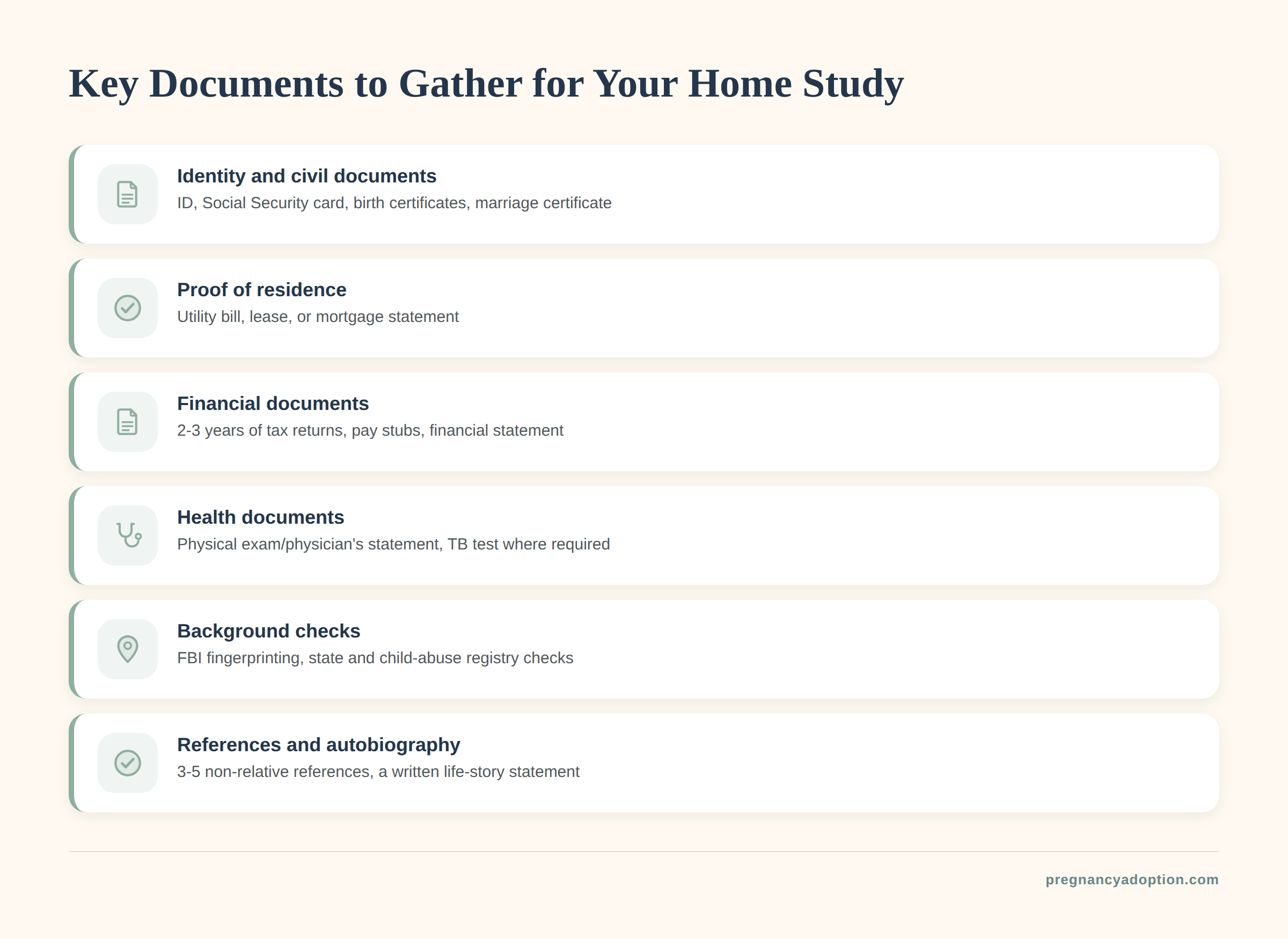
Identity and Civil Documents
[ ] Gather Government ID, Social Security Cards, and Birth Certificates for Every Household Member
Collect a government-issued photo ID, Social Security card, and certified birth certificate for yourself and anyone else in your household, plus a marriage certificate if applicable and any divorce or death decrees from prior marriages. Certified copies (not photocopies) are usually required, so order replacements early if you can’t locate originals.
[ ] Gather Proof of Residence
A recent utility bill, lease, or mortgage statement showing your current address is a standard requirement across nearly every program. This is usually the easiest item on the list, but it’s worth confirming your agency’s specific preference for which document type they’ll accept.
Financial and Health Documents
[ ] Gather Two to Three Years of Tax Returns and Recent Pay Stubs
Most home studies require two to three years of tax returns, recent pay stubs or W-2s, and sometimes an employment-verification letter, plus a written financial statement covering your assets, debts, and monthly budget. The full financial-documentation requirements and how they’re used in the home study are covered in this site’s home study guide.
[ ] Schedule a Physical Exam and Gather Proof of Insurance
Nearly every program requires a physician’s statement or physical exam, commonly required to have been completed within the prior twelve months, plus proof of health, life, auto, and homeowner’s or renter’s insurance. Many states and most international programs also require a TB test — schedule this early, since appointment availability can add unexpected delay.
[ ] Request a Mental-Health Statement If You’re Under Ongoing Treatment
If you’re under ongoing mental-health treatment, some programs ask for a brief statement from your provider confirming you’re stable and able to parent — this is a routine request, not a red flag, and is handled the same way a physical-health condition would be.
Background Checks and References
[ ] Submit Fingerprinting for FBI and State-Level Background Checks as Soon as You’re Told To
FBI fingerprint-based clearance and a state-level criminal history check (and, in most states, a child-abuse/neglect central registry check) apply to every adult in the household, and processing can take weeks. This is consistently flagged by agencies as the item most likely to delay a home study if it isn’t started immediately — the full background-check breakdown is in the home study guide.
[ ] Line Up Three to Five Non-Relative References Early
Most programs require three to five references from people who’ve known you for one to two years or longer, generally non-relatives, with at least one who has seen you around children. Reach out to your intended references as soon as you know you’ll need them, since the reference-response step is a common source of delay when someone is slow to reply to the agency’s questionnaire.
[ ] Draft Your Autobiographical Statement Early, Not Last-Minute
Most home studies require a written autobiographical or life-story statement, and giving yourself real time to draft and revise it — rather than writing it the night before it’s due — generally produces a stronger, more reflective document. The home study guide covers what this statement typically needs to include.
| Category | Typical documents | When to start |
|---|---|---|
| Identity and civil | Government ID, Social Security card, birth certificates, marriage certificate | Immediately |
| Residence | Utility bill, lease, or mortgage statement | Immediately |
| Financial | 2–3 years of tax returns, pay stubs, financial statement, proof of insurance | Within the first few weeks |
| Health | Physical exam/physician’s statement, TB test where required | Immediately — appointments can take weeks |
| Background checks | FBI fingerprinting, state criminal history, child-abuse registry check | Immediately — the slowest-moving item |
| References | 3–5 non-relative references | Immediately — contact referees before listing them |
| Personal | Autobiographical statement | Early, with time to revise |
Phase 6: Complete Your Home Study
The home study is the formal evaluation that most adoption paths require before you can be approved to adopt, combining the documents you’ve already gathered with interviews and at least one home visit.
Schedule and Prepare
[ ] Schedule Your Home-Study Interviews as Soon as Your Documents Are Submitted
Once your paperwork is in, your social worker will schedule one or more interviews (individual and, if applicable, joint) and a home visit. Scheduling promptly rather than letting it drift keeps this phase moving at a predictable pace; the full interview process is covered in the home study guide.
[ ] Walk Through Your Home for Basic Safety Items Before the Visit
Check smoke and carbon-monoxide detectors, fire extinguisher accessibility, secured firearm storage, pool barriers if applicable, and secured medications before your home visit — these are standard safety-check items, not an inspection designed to find fault, and addressing them in advance keeps the visit low-stress.
What Happens During the Process
[ ] Expect Honest Conversation About Your Background, Relationships, and Parenting Approach
Home-study interviews typically cover your own childhood and family relationships, your reasons for adopting, your support network, and your approach to discipline and parenting — this is a conversation meant to help your social worker write an accurate, supportive report, not an interrogation. The home study guide covers what to expect in more detail if the process itself feels intimidating.
[ ] Ask Your Social Worker Directly About Anything You’re Unsure Of
Your assigned social worker is generally a good resource for questions about timing, what’s left to complete, or how a specific past issue (a prior minor legal matter, a health condition) is likely to be handled — ask directly rather than guessing or worrying in silence.
Phase 7: Complete Required Training
Most adoption paths require some amount of pre-adoption education, and the hours and format vary significantly depending on which path you’re pursuing.
Know What’s Required for Your Path
[ ] Confirm Your Specific Training Requirement With Your Agency
Domestic infant adoption training is generally the lightest requirement; foster care adoption uses a structured, state-mandated curriculum such as PRIDE or MAPP, commonly cited in a ten-to-thirty-plus-hour range; and international (Hague) adoption has a federal mandatory minimum of ten hours. The full type-by-type hour breakdown and curriculum content is in the home study guide.
[ ] Ask Whether Training Can Be Completed Online
Many programs now offer some or all required training online rather than requiring in-person attendance, which can make scheduling considerably easier — ask your agency directly which format applies to your program.
Fit Training Into Your Timeline
[ ] Complete Training in Parallel With Your Home Study, Not After It
Training and the home study can generally be completed at the same time rather than sequentially, which is one of the more effective ways to keep this phase from adding unnecessary time to your overall timeline.
[ ] Ask About Hour Transferability if You’re Already Trained Through Another Program
If you’ve already completed foster-care licensing training or a prior adoption’s training requirement, ask whether those hours transfer or count toward a new program’s requirement — this varies by state and agency and can save meaningful time if it applies to you.
Phase 8: Prepare for Matching
Matching is the stage where you go from an approved, waiting family to a family connected with a specific child or expectant parent, and how it works differs more by adoption path than almost any other phase on this checklist.
Build Your Profile or Get Listed
[ ] Create a Strong, Honest Family Profile (Domestic Infant Adoption)
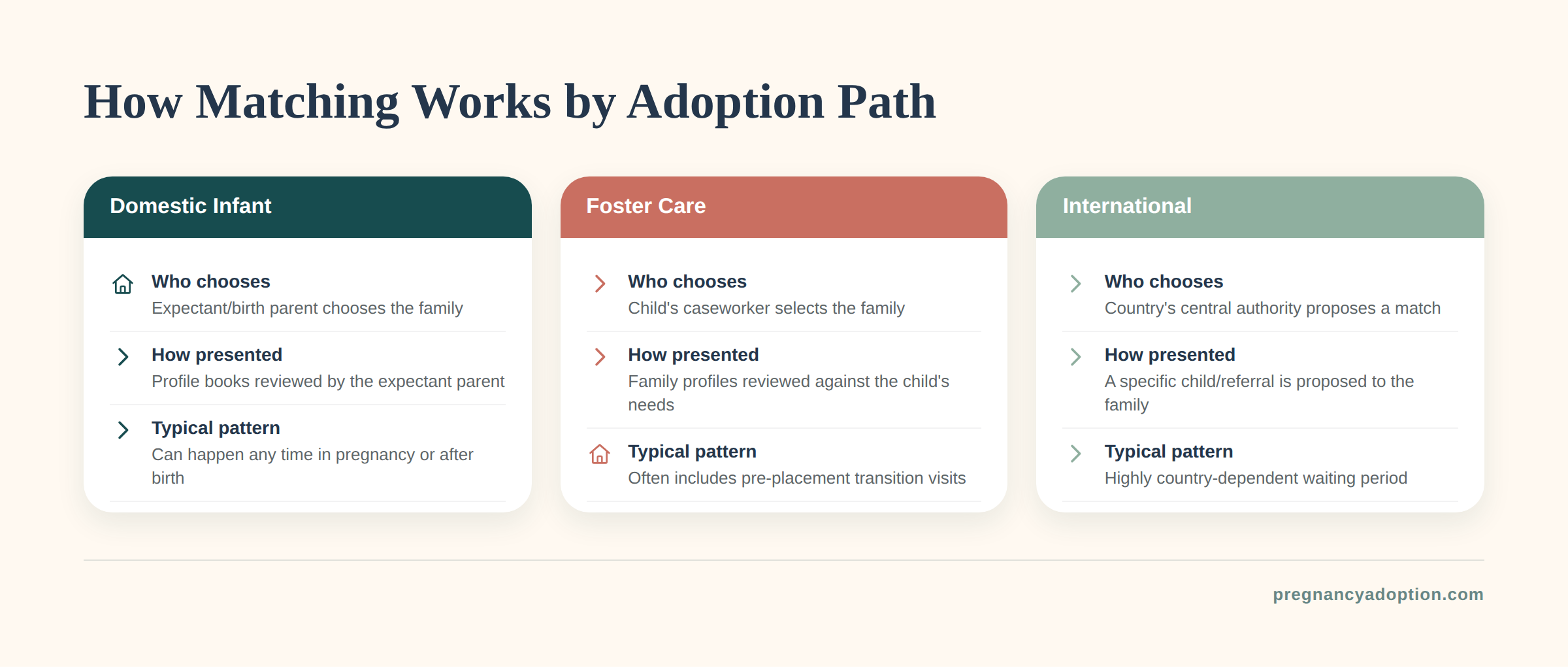
For domestic infant adoption, you’ll typically create a profile book or letter that your agency or attorney shares with expectant parents considering adoption — sometimes still called a “Dear Birth Mother” letter. The full mechanics of how these profiles are presented and how timing works are covered in the adoption process guide’s matching section.
[ ] Make Sure Your Profile Is Active on Waiting-Child Photolisting Services (Foster Care)
For foster care adoption, ask your agency to confirm your family’s profile is active and current on any photolisting services used in your state or region (such as AdoptUSKids), since this is often how a caseworker first identifies a potential match for a specific waiting child.
Understand How Matching Works for Your Path
[ ] Know Who Chooses Whom
In domestic infant adoption, the expectant or birth parent generally reviews family profiles and chooses the adoptive family — not the reverse. In foster care adoption, it typically works the other way: the child’s caseworker (sometimes with the child’s own input, depending on age) reviews family profiles and selects the family that seems the best fit for that specific child. This flip in who is doing the choosing is one of the more important differences between the two paths; see the how-to-adopt guide’s matching comparison for the full cross-path breakdown.
[ ] Expect Pre-Placement Visits for an Older or Waiting Child
For foster care adoption, especially with an older child, expect a series of transition visits — meetings, meals, and eventually overnight stays — before the actual placement date, which helps ease the move for the child. Domestic infant adoption generally doesn’t have an equivalent pre-placement-visit stage, since placement typically happens at or shortly after birth.
[ ] Discuss Openness Preferences Before You’re Matched, Not After
If you’re pursuing domestic infant adoption, think through and discuss your preferences around post-adoption contact — open, semi-open, or closed — before you’re presented with a specific match, since this is typically part of what’s negotiated during the matching conversation itself. This site’s open adoption guide and closed adoption guide cover what each arrangement actually looks like in practice.
Phase 9: Prepare for Placement
Once a match is confirmed, placement — the point where the child actually comes to live with you — can happen on a tight timeline, so it helps to have both the practical and emotional groundwork already in motion.
Practical Preparation
[ ] Confirm Your Leave Plan With Your Employer in Advance
If you’re employed, confirm what parental leave (paid or unpaid, under the federal Family and Medical Leave Act or your employer’s own policy) you’re entitled to for an adoption, and start the paperwork before you’re matched if you can, since placement can happen with very little notice, especially for an infant adoption.
[ ] Set Up the Basics at Home Ahead of Time
Have the immediate essentials ready — a safe sleep space, car seat, clothing, and basic supplies appropriate to the child’s age — so you’re not scrambling in the first days after placement. You don’t need everything finished, but having the essentials ready reduces stress during an already intense transition.
Emotional Preparation
[ ] Talk With Other Adoptive Parents About What the First Weeks Are Really Like
If you can, connect with other adoptive parents (through your agency’s support groups or independently) before placement to hear honestly about what the adjustment period was like for them — placement is a major transition for the whole family, including any children already in the home, and realistic expectations help.
[ ] Prepare Any Children Already in the Home
If you have other children, talk with them in age-appropriate terms about what’s about to change, and think through how you’ll manage their needs during the intense first days after a new placement, since their adjustment matters just as much as the family’s overall transition.
Phase 10: Navigate Post-Placement Supervision
After placement but before the adoption is legally finalized, most paths require a post-placement supervision period, during which a social worker checks in to confirm the placement is going well before the court finalizes the adoption.
Understand the Requirements
[ ] Know Your State’s Required Post-Placement Supervision Length
Post-placement supervision commonly runs around six months, often with about three visits spaced across that period, but the exact length and visit count are state-variable.
[ ] Understand That This Period Protects Everyone Involved
Post-placement supervision exists to confirm the placement is stable and working well for the child before the court makes it permanent — it’s a standard, expected part of the process for nearly every adoptive family, not a sign that something is wrong.
Prepare for Visits and Reports
[ ] Keep a Simple Running Log Between Visits
Jot down milestones, any challenges, and questions as they come up between social-worker visits, so you have specifics to discuss rather than trying to recall several weeks of a busy adjustment period from memory.
[ ] Ask What Happens if a Visit or Report Raises a Concern
Ask your social worker directly what the process looks like if a post-placement visit surfaces a concern — in most cases this leads to additional support or a short extension, not a disruption of the placement, but understanding the process in advance reduces anxiety if a concern does come up.
Phase 11: Finalize the Adoption
Finalization is the legal step that makes the adoption permanent, and while it’s often an emotional, celebratory day in court, there’s a specific sequence of administrative steps that lead up to and follow it.
Legal Steps
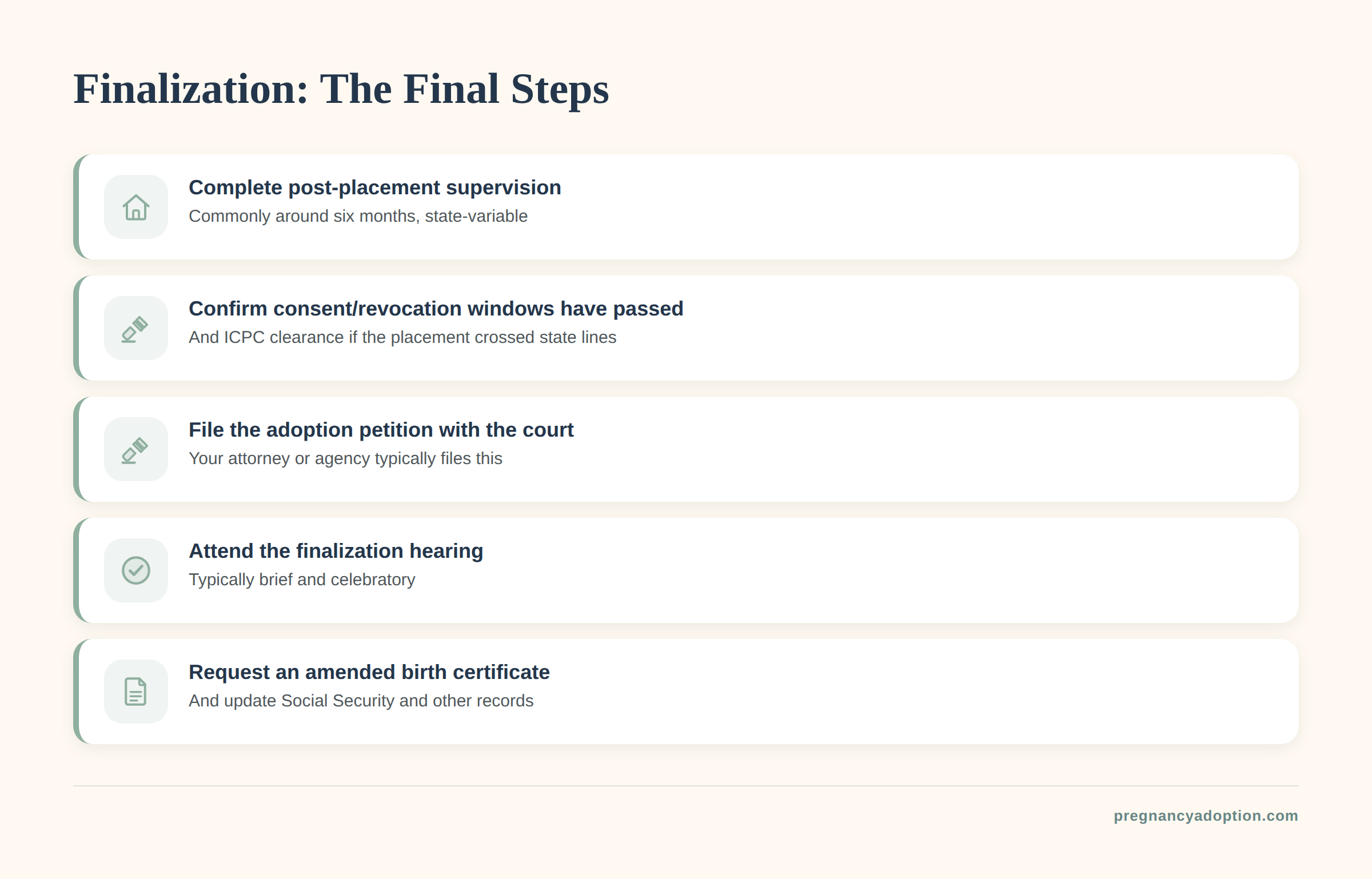
[ ] Confirm Post-Placement Supervision and Any Remaining Consent Windows Are Complete
Before the petition can be filed, confirm that your post-placement supervision requirement is fully satisfied and that any applicable consent or revocation window has passed. The adoption process guide covers consent and revocation timing in detail for domestic adoptions.
[ ] File the Adoption Petition With the Appropriate Court
Your attorney or agency will file the adoption petition with the appropriate state court — which specific court handles this varies by state — once all prerequisites are satisfied, including ICPC clearance if the placement crossed state lines.
[ ] Attend the Finalization Hearing
The finalization hearing itself is typically brief — commonly well under an hour — and is generally a celebratory rather than adversarial proceeding, where the judge confirms the adoption and signs the final decree.
Administrative Follow-Up
[ ] Request an Amended Birth Certificate
After the decree is signed, request an amended birth certificate listing the adoptive parent(s) — your attorney or agency can typically guide you through this state-specific process, which may take several weeks to process.
[ ] Update Social Security and Other Official Records
Update your child’s Social Security card and any other official records (health insurance, school enrollment) to reflect the finalized adoption and any legal name change. For international adoptions on certain visa categories, a state-level readoption is often recommended to secure a U.S.-issued birth certificate.
Phase 12: After Finalization
It’s tempting to consider the checklist finished the moment the adoption is legally final, but there’s a short list of follow-up tasks worth handling in the weeks and months afterward.
Financial Follow-Up
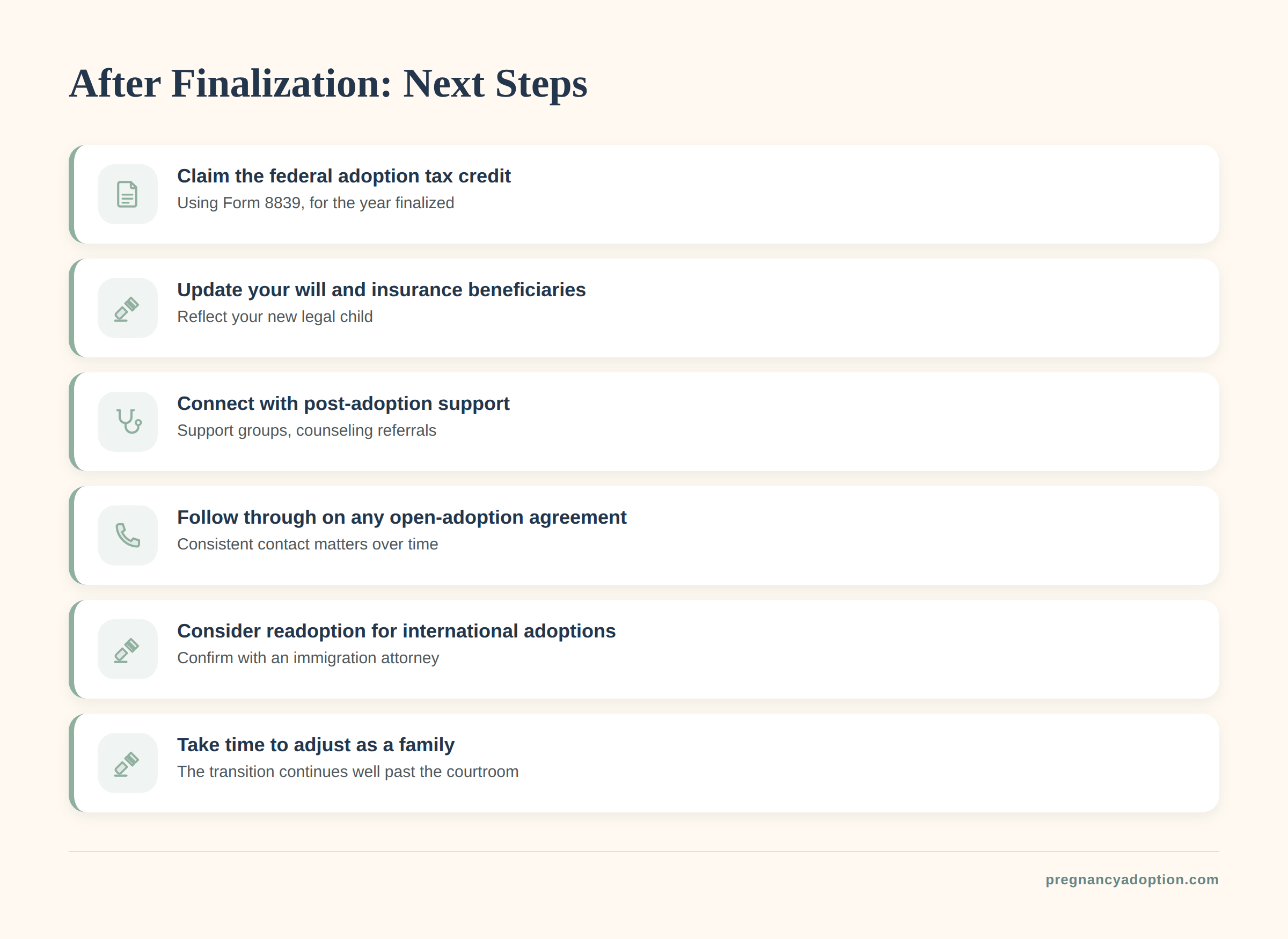
[ ] Claim the Federal Adoption Tax Credit Where Eligible
File for the federal adoption tax credit on your tax return for the year the adoption became final, using Form 8839. The adoption tax credit guide walks through current dollar figures, the phase-out rules, and the form line by line.
[ ] Update Your Will, Insurance, and Beneficiary Designations
Update your will, life insurance beneficiaries, and any other estate-planning documents to reflect your new legal child, if you haven’t already done so in anticipation of the adoption.
Ongoing Family Support
[ ] Connect With Post-Adoption Support Resources
Many agencies offer post-adoption support groups, counseling referrals, or resources specific to adoptive families, and connecting with other adoptive parents can help with the ordinary adjustment challenges that continue well past finalization.
[ ] Follow Through on Any Open-Adoption Contact Agreement
If you have an open or semi-open adoption arrangement, following through consistently on agreed-upon contact matters for the birth parent’s wellbeing and, over time, for your child’s own sense of identity and connection to their origins. The open adoption guide covers how these arrangements typically work and evolve over time.
A Note on Timelines
It’s worth repeating the point made earlier: timeline is the single most variable part of this entire checklist, and it’s driven almost entirely by the matching/waiting stage rather than by the paperwork, home study, or finalization steps, which move at a comparatively predictable pace once started.
Typical Ranges by Path
Domestic Infant and Foster Care Adoption
For foster care adoption, the licensing stage (application, home study, training) commonly runs roughly six to twelve months, with the subsequent waiting-to-match stage highly variable and the finalization stage adding roughly six more months of post-placement supervision; a reasonable overall estimate is roughly one to two-plus years. For domestic infant adoption, the home study itself commonly takes two to four months, while waiting to be matched can range from a few months to one to two-plus years, which is the dominant source of variability.
International and Relative/Stepparent Adoption
For international adoption, initial filings and the home study commonly take three to six months, while waiting for a referral or placement is highly country-dependent and can run one to three-plus years, with an in-country stay typically lasting from about ten days to a few weeks; a reasonable overall estimate is roughly one to four-plus years. Relative and stepparent adoptions are typically the fastest path, often finalizing within several months to about a year, since there’s no matching stage and the home study is frequently simplified.
What Drives the Variation
The Waiting-to-Match Stage
How quickly you’re matched depends on factors largely outside your control — how many expectant parents or waiting children are being matched at a given time, how specific your preferences are (age range, sibling groups, openness to certain health or background factors), and simple chance. Keeping your preferences realistic and discussing them honestly with your agency is one of the few levers you actually have over this stage’s length.
Court and Administrative Timing
Court scheduling, ICPC processing for interstate placements, and routine administrative backlogs can each add weeks to months to the finalization stage, independent of anything you do. Building a little slack into your own expectations for this stage, rather than assuming it will move the moment every requirement is technically satisfied, reduces unnecessary frustration.
| Path | Typical overall range | Biggest variable |
|---|---|---|
| Domestic infant | Roughly 1–2+ years once actively waiting | Time to be matched |
| Foster care | Roughly 1–2+ years from licensing to finalization | Time to be matched; post-placement length |
| International | Roughly 1–4+ years | Country-specific referral/placement timing |
| Relative/stepparent | Roughly several months to about a year | Court scheduling; no matching stage |
Common Mistakes to Avoid
A handful of avoidable missteps come up repeatedly across adoption paths, and knowing about them in advance is often enough to sidestep them entirely.
Mistakes Early in the Process
Choosing a Path Before Fully Understanding the Alternatives
Committing to a specific path based on limited information (a single conversation, a single article) rather than comparing all four paths against your own priorities, budget, and timeline tolerance is one of the more common early mistakes, and it’s also one of the easiest to avoid simply by reading broadly first.
Underestimating the Total Cost or Skipping the Contingency Fund
Budgeting only for the headline fee an agency quotes, without accounting for the full category-by-category breakdown or setting aside a contingency fund for a disrupted match, leaves many families financially stretched partway through the process.
Letting Background Checks and References Sit at the Bottom of the To-Do List
Because fingerprinting and reference responses are the slowest-moving items and don’t feel urgent on day one, they’re frequently the last things started and the first things that end up delaying the whole home study — start them immediately, not once everything else is done.
Mistakes Later in the Process
Comparing Your Timeline to Someone Else’s
Comparing your own waiting period to another family’s — especially one you’ve only heard about secondhand or seen online — is a common source of unnecessary anxiety, given how much the matching stage depends on individual circumstances and chance rather than anything either family did differently.
Not Asking About Disrupted-Match Policies Until After a Disruption Happens
Waiting until a match actually falls through to ask what happens financially and procedurally leaves you dealing with a difficult emotional moment and a confusing policy question at the same time — ask upfront, during Phase 4, instead.
Treating Finalization as the Finish Line and Forgetting the After-Finalization Tasks
The tax credit, updated estate-planning documents, and (for international adoptions) readoption or citizenship follow-up are easy to let slip once the adoption itself feels complete and the family is adjusting to life together — Phase 12 above is designed specifically to prevent that.
Special Situations: Path-Specific Checklist Variations
The checklist above assumes a fairly standard adoption, but a few specific situations change which phases apply and in what order.
Relative or Stepparent Adoption
Expect a Shortened, Simplified Checklist
Relative and stepparent adoptions typically skip Phase 8 (matching) entirely, since the child and adoptive parent already have an established relationship, and the home study in Phase 6 is frequently simplified or expedited in many states given the existing relationship.
Pay Close Attention to Consent Requirements
Stepparent adoption in particular has specific consent and, in some cases, termination-of-parental-rights requirements for the other legal parent that don’t apply the same way to other paths — this is worth discussing with an attorney early, since it can be one of the more legally complex parts of an otherwise simpler process.
International Adoption Add-Ons
Layer USCIS and Hague Paperwork on Top of This Checklist
International adoption adds a parallel immigration-paperwork track — generally USCIS Form I-800A for your own eligibility, followed by Form I-800 for a specific child — that runs alongside, not instead of, the phases above. Work closely with an agency accredited for international placements to keep both tracks synchronized.
Plan for an In-Country Stay and Post-Arrival Readoption
Budget time and cost for travel and an in-country stay (commonly ranging from about ten days to a few weeks, country-dependent), and ask about whether a state-level readoption is recommended after your child arrives in the U.S.
Foster-to-Adopt Overlap
Understand That Licensing and Home Study Often Happen Together
In a foster-to-adopt situation, the foster-care licensing process and the adoption home study frequently overlap or share significant paperwork, since you’re being approved as a foster-adoptive family from the start rather than completing two entirely separate approval processes.
Know That the Path to Finalization May Follow a Different Legal Sequence
Because a foster placement typically begins before parental rights are terminated, the legal sequence toward finalization (termination of parental rights, then adoption) differs from a domestic infant adoption’s consent process — your caseworker and attorney will guide you through the specific sequence that applies in your case.
The Full Master Checklist, All in One Place
For a printable or screenshot-friendly version, here’s every checklist item above pulled into one consolidated list, grouped by the same twelve phases.
Before Placement
Phases 1–8: Decision Through Matching
Research your path options and talk it through with your support system · confirm basic eligibility · get an itemized cost estimate and build a funding plan, including a contingency fund · choose and vet an agency or attorney · gather identity, financial, health, background-check, and reference documents · complete your home study interviews and home visit · complete required training · build your profile or confirm your photolisting is active, and discuss openness preferences if applicable.
What to Expect While Waiting
Expect the waiting-to-match stage to be the least predictable part of the whole process, keep your contingency fund available, and use the time productively — connecting with other adoptive parents, continuing to research your specific path’s post-placement and finalization requirements, and keeping your paperwork current if anything changes (a job change, a move, an expired document).
After Placement
Phases 9–12: Placement Through After Finalization
Confirm your leave plan and set up the basics at home · complete post-placement supervision visits and reports · confirm consent/revocation windows and post-placement requirements are satisfied, then file the petition and attend the finalization hearing · request an amended birth certificate and update Social Security and other records · claim the federal adoption tax credit and update your estate-planning documents · connect with post-adoption support and follow through on any open-adoption contact agreement.
A Final Reminder
This master list is intentionally high-level — it’s meant to help you see the whole journey at a glance and know what phase you’re in, while every individual checklist item earlier in this guide links to the full depth you need to actually complete it.
Glossary of Terms in This Guide
A quick reference for terms used throughout this checklist, grouped by the phase of the process where they’re most relevant.
Paperwork and Approval Terms
Home Study
The formal evaluation process — combining document review, interviews, and a home visit — that most adoption paths require before a family is approved to adopt. Covered in full in the home study guide.
ICPC (Interstate Compact on the Placement of Children)
The agreement among all fifty states governing the legal process for placing a child across state lines, which must clear before an interstate placement can proceed. Covered in the adoption process guide.
Post-Placement Supervision
The period after a child is placed but before the adoption is finalized, during which a social worker visits to confirm the placement is going well.
Finalization
The court hearing and decree that make an adoption legally permanent.
Matching and Placement Terms
Matching
The process of connecting a prospective adoptive family with a specific child or expectant/birth parent, which works differently depending on adoption path. Covered in detail in the how-to-adopt guide.
Profile Book (“Dear Birth Mother” Letter)
A booklet or letter prospective adoptive families prepare, typically including photos and a personal letter, that’s shared with expectant parents considering adoption in domestic infant adoption.
Disrupted Match
A situation where a match between a prospective adoptive family and an expectant parent doesn’t move forward to placement, most often because the expectant parent decides to parent.
Open, Semi-Open, and Closed Adoption
Terms describing the level of ongoing contact and information-sharing between birth and adoptive families after placement. See the open adoption guide and closed adoption guide for the full comparison.
Financial and Legal Terms
Federal Adoption Tax Credit
A federal tax credit available for qualified adoption expenses, claimed on the tax return for the year the adoption becomes final. Covered in full in the tax credit guide.
Termination of Parental Rights
The legal process that ends a birth parent’s (or, in foster care, a biological parent’s) legal rights to a child, required before an adoption can be finalized.
Consent and Revocation Period
The legal consent a birth parent gives to an adoption, and the window of time during which that consent can still be revoked under state law. Covered in the adoption process guide.
Frequently Asked Questions
Getting Started
Do I need to pick an adoption path before contacting an agency?
It helps to have a general direction, but many agencies and attorneys are happy to talk through the options with you before you commit — an initial consultation is often a useful way to narrow down your choice.
Can I pursue more than one adoption path at the same time?
Some families do pursue two paths simultaneously (for example, foster-to-adopt alongside domestic infant adoption), though this adds complexity and cost on both tracks — discuss the implications carefully with each agency involved.
How do I know if I’m ready to start?
There’s no single test for readiness, but having discussed the decision thoroughly with your partner or support system, having a realistic budget, and having the time and emotional capacity for a process that can take a year or more are all reasonable readiness indicators.
Is this checklist the same for every state?
No — the overall shape is consistent, but specific requirements (background-check details, training hours, post-placement supervision length) vary by state, which is why nearly every item links to a guide covering the state-variable specifics.
Where should I start if I’m completely new to this?
Start with Phase 1 above and this site’s adoption overview guide, which introduces the adoption landscape at a broader level before this checklist’s more action-oriented detail.
Documents
How long does it take to gather all the required documents?
Most families can gather the bulk of their documents within a few weeks, though background checks and reference responses often take longer — starting those two items immediately is the single best way to avoid document-gathering becoming a bottleneck.
What if I can’t find my birth certificate?
You can typically order a certified replacement copy from the vital records office in the state or country where you were born; build in extra time for this if you don’t already have your certified copy on hand.
Do both spouses need separate background checks?
Yes — background checks generally apply to every adult in the household, not just one spouse or partner.
Can a relative serve as one of my references?
Most programs require references to be non-relatives, though policies vary slightly by agency — confirm the exact rule with your own agency rather than assuming.
What goes into the autobiographical statement?
It typically covers your own upbringing, significant relationships, your reasons for adopting, and your parenting philosophy — the home study guide covers this in more depth.
Do I need to redo my background check if the process takes a long time?
Many states require background checks to be refreshed if a certain amount of time passes (often around a year) before placement — ask your agency about their specific policy if your process extends well beyond the original estimate.
Home Study and Training
How long does the home study take from start to finish?
This varies, but a few months is a reasonable general estimate once documents are submitted — see the home study guide for a fuller breakdown.
Will the social worker judge my home for being small or rented?
No — home studies generally look for adequate space and basic safety, not homeownership or a particular size or style of home.
How many training hours should I expect?
It depends heavily on your path — see Phase 7 above and the home study guide for the type-by-type breakdown, and confirm the exact number with your own agency since sources don’t fully agree on domestic-infant hours specifically.
Can I complete training before I’m matched with an agency?
Generally no — training is usually tied to a specific agency’s program once you’ve enrolled, though some general adoption-education resources can be useful background reading beforehand.
What if my home study identifies something that needs to be fixed?
Most issues identified during a home study (a missing safety item, an incomplete document) are simply addressed and resubmitted rather than ending the process — social workers are generally looking to help you get approved, not to find reasons to deny you.
Cost and Finances
What’s the single biggest cost driver across adoption paths?
Adoption path is the single biggest driver — foster care adoption is often free or low-cost, while domestic infant and international adoption involve substantially higher fees; see the cost guide for the full breakdown.
Is it true the birth parent never pays anything?
In ethical domestic adoption practice, yes — all adoption-related costs are the adoptive family’s responsibility, not the expectant or birth parent’s.
Can I use a loan to cover adoption costs?
Some families use adoption-specific loan programs or general personal loans to cover costs, often alongside grants or employer benefits — see the cost guide for the financial-assistance landscape.
When exactly can I claim the adoption tax credit?
You claim it on your tax return for the year the adoption becomes final, with some different rules for a failed domestic adoption attempt — the tax credit guide covers the specifics and current dollar figures.
What happens to the money I’ve spent if a match disrupts?
This depends entirely on your specific agency’s or attorney’s refund policy, which is exactly why Phase 4 above recommends asking about disrupted-match policies before you sign anything.
Do employer adoption-benefit programs cover all adoption paths?
Policies vary by employer — some cover only certain paths or cap the benefit amount, so check your specific plan details rather than assuming full coverage.
Matching and Waiting
How long will I wait to be matched?
This is the single hardest part of the timeline to predict — see the timelines section above for general ranges, but understand that individual waits vary widely and aren’t a reflection of anything you’re doing wrong.
Can I be matched more than once if an earlier match disrupts?
Yes — a disrupted match doesn’t disqualify you from being matched again, though it can be an emotionally difficult experience to go through more than once.
Do I get to meet the expectant parent before the baby is born?
Often yes, in domestic infant adoption, though the timing and amount of contact before birth varies by match and by how much contact both parties want.
What if I don’t feel ready when I’m presented with a match?
You generally have the right to decline a specific match presentation if it doesn’t feel right, though declining repeatedly or for reasons outside your stated preferences can affect how your agency presents future matches — discuss this openly with your agency.
How does matching work differently for an older child in foster care?
A caseworker typically reviews family profiles for a specific waiting child and may arrange pre-placement transition visits before the actual placement date, rather than the family being presented with options to choose from.
Placement and Post-Placement
How much notice will I get before placement?
This varies enormously — domestic infant placements can happen with very little notice around a birth, while foster care placements following transition visits are generally more predictable.
What if the post-placement visits reveal a problem?
Most concerns identified during post-placement visits lead to additional support or services, not a disruption of the placement — ask your social worker directly what the process looks like if you’re worried about this.
Can post-placement supervision be shortened?
Generally no — the required length is set by state law or agency policy and is not something that can typically be shortened on request.
Do both parents need to be present for every post-placement visit?
Policies vary by agency, but many require at least periodic visits with both parents present if applicable — confirm the specific requirement with your social worker.
Finalization and After
Do I need a lawyer for the finalization hearing?
In most cases, yes — an adoption attorney typically files the petition and represents you at the hearing, even if you worked primarily with an agency up to this point.
Can other family members attend the finalization hearing?
Many courts welcome family members at a finalization hearing, since it’s often treated as a celebratory occasion — check with your attorney about your specific court’s policies and any space limitations.
How long after finalization until I get the amended birth certificate?
This varies by state and can take several weeks to a few months — your attorney or agency can typically give you a more specific estimate for your state.
What if I forget to claim the adoption tax credit the year it’s due?
Consult a tax professional — there may be options depending on your specific situation, but the tax credit guide is the place to start to understand the filing requirements and deadlines.
Does finalization change my child’s citizenship status for international adoption?
This depends on the specific visa category and timing — this is a question to confirm directly with an immigration attorney rather than assume, since the rules are specific and consequential.
Special Situations
Does a stepparent adoption still require a home study?
Often a simplified or expedited version is required, but policies vary significantly by state — confirm with a family law attorney in your state.
Do relative adoptions skip background checks too?
No — background checks are still generally required even when adopting a relative, though other parts of the process (matching, sometimes training) are typically skipped or shortened.
Is foster-to-adopt faster than starting an entirely new home study for adoption?
Often yes, since much of the licensing paperwork and home study overlaps between fostering and adopting — ask your caseworker specifically how the two processes are coordinated in your case.
What additional costs come with international adoption specifically?
Travel, in-country stay costs, and immigration-filing fees are layered on top of standard adoption fees — the cost guide covers the international-specific cost categories.
Can I switch paths partway through the process?
Some families do switch paths (for example, from domestic infant to foster-to-adopt) partway through, though this usually means restarting parts of the paperwork and training specific to the new path — discuss the implications with your agency before deciding.
Using This Checklist
Should I follow the phases in exactly this order?
The order reflects a typical sequence, but some phases legitimately overlap (training and home study, for example) — use your agency’s own sequencing guidance alongside this checklist rather than treating the order here as rigid.
What if my agency’s checklist contradicts something here?
Defer to your agency’s or attorney’s specific guidance — they know your state’s and program’s exact requirements, while this checklist is a general map of the overall journey.
Can I print this checklist out?
Yes — the master checklist section above consolidates every item into one printable, screenshot-friendly list.
How often should I revisit this checklist during the process?
Many families find it useful to glance back at the relevant phase each time they finish a major step, simply to confirm nothing’s been missed before moving to the next one.
Choosing an Agency or Attorney
What’s the difference between a full-service agency and an independent attorney?
A full-service agency typically handles matching, counseling for the expectant parent, and much of the coordination in-house, while an independent adoption arranged through an attorney may involve you doing more of the outreach and coordination yourself, sometimes alongside a separate home-study provider — which structure is available to you depends heavily on your state.
How many agencies or attorneys should I talk to before choosing?
There’s no fixed number, but speaking with at least two or three before committing gives you a useful basis for comparison on fees, communication style, and typical timelines.
Should I be concerned if an agency pressures me to sign quickly?
Reputable agencies generally give you time to review contracts and ask questions rather than pushing for an immediate signature — treat pressure to rush as a reason to slow down and ask more questions, not less.
Can I switch agencies partway through the process?
It’s possible, though it usually means re-starting some paperwork and potentially forfeiting fees already paid, so it’s worth trying to resolve concerns with your current agency first if the relationship is otherwise workable.
Does a smaller or newer agency mean lower-quality service?
Not necessarily — agency size isn’t a reliable proxy for quality; licensing status, complaint history, and direct conversations with the agency’s own staff and (where possible) past clients are more useful indicators.
What questions should I ask every agency I’m considering?
Ask about their typical timeline for your specific path, their full fee structure, their disrupted-match policy, how they support expectant parents, and what post-placement and post-adoption support they offer — consistent answers across these five questions are a good sign.
Emotional Readiness and Support
Is it normal to feel anxious throughout this process?
Yes — waiting, uncertainty, and the stakes involved make some anxiety a very common experience throughout the adoption process, not a sign that something is wrong with you or your readiness to parent.
How do I manage the emotional ups and downs of waiting?
Many families find it helpful to stay connected with a support community of other waiting families, keep up with ordinary life and relationships rather than putting everything on hold, and give themselves permission to feel frustrated without treating every setback as a sign the process won’t work out.
What if friends or family don’t understand why the process takes so long?
It can help to share a general sense of the phases involved (this checklist is one way to do that) so people around you have a realistic picture, while also deciding how much detail you actually want to share versus keep private.
Is counseling available if the process becomes difficult?
Many agencies offer or can refer you to counseling specifically experienced with adoption-related stress, and this support is worth using if the process is weighing on you — it’s not a sign of failure to seek it.
How do I cope if a match disrupts?
Give yourself real space to grieve a disrupted match before jumping back into the process; many agencies offer specific support for this exact situation, and connecting with other families who’ve been through it can help normalize what’s a genuinely difficult experience.
Staying Organized
What’s the best way to keep track of all these documents and deadlines?
A simple shared folder (physical or digital) organized by the categories in Table 2 above, plus a basic spreadsheet or app tracking what’s submitted and what’s outstanding, is enough for most families — you don’t need specialized software.
Should I keep copies of everything I submit?
Yes — keep your own copies of every document you submit to your agency or attorney, both for your own records and in case anything is lost or needs to be resubmitted.
How do I keep my partner and I aligned on what’s been done?
A shared checklist or tracking document that both partners can see and update is one of the simplest ways to avoid duplicated effort or dropped tasks, especially during the document-gathering phase when there are many small action items at once.
What if a document expires before the process is finished?
Some documents (background checks, physical exams) have a validity window and may need to be refreshed if the process runs long — ask your agency proactively about expiration windows rather than waiting to be told something has lapsed.
Adopting Siblings or Multiples
Does adopting a sibling group change this checklist?
The overall phases stay the same, but financial planning, space preparation, and the emotional-preparation steps in Phase 9 generally need to account for more than one child’s needs at once — discuss sibling-group-specific considerations with your agency early.
Is it harder to be matched with a sibling group?
Families specifically open to sibling groups are often matched more quickly in foster care adoption, since keeping siblings together is a priority for most child welfare systems and there’s frequently more need than there are families open to it.
Do costs increase significantly for adopting more than one child at once?
Some costs increase (certain agency fees scale per child), while others don’t (a single home study generally covers your whole approved family) — ask for a clear breakdown specific to a sibling-group adoption from any agency you’re considering.
If You Already Have Children at Home
Does having biological or previously adopted children affect my eligibility?
No — having other children in the home doesn’t disqualify you, though most home studies will include those children in interviews and in the overall assessment of family readiness.
How do I prepare my other children for a new sibling through adoption?
Age-appropriate, honest conversations well before placement, plus involving them in some of the preparation (picking out a few items, choosing how to welcome their new sibling) can help children feel included rather than caught off guard.
Will my other children need to be part of the training or home study process?
Children in the home are often included in at least part of the home-study interview process, in an age-appropriate way, though the specifics vary by agency.
Foster Care and Caseworker Questions
How much contact will I have with my caseworker during the process?
This varies, but expect regular contact during licensing, during any pre-placement transition visits, and especially during post-placement supervision — your caseworker is generally your primary point of contact throughout foster care adoption.
What if I disagree with my caseworker about something in the process?
Raise concerns directly and, if needed, ask about your agency’s formal process for addressing disagreements — most agencies have a structured way to handle this rather than leaving it to an informal conversation alone.
Can I request updates on a specific waiting child I’m interested in?
Generally yes, through the photolisting service or your own caseworker, though the amount of information shared is balanced against the child’s privacy and best interests.
Does licensing as a foster parent guarantee I’ll be matched with a child to adopt?
No — licensing approves you to foster and potentially adopt, but matching with a specific child for adoption (rather than a temporary foster placement) depends on a child becoming legally available and a caseworker identifying your family as a good fit.
Recovering From a Setback
What should I do first after a disrupted match?
Give yourself time to process the loss, review your agency’s specific disrupted-match policy and any next steps they outline, and decide — on your own timeline, not anyone else’s — when you feel ready to re-enter the matching pool.
Do I need to redo any paperwork after a disrupted match?
Usually not, as long as your home study and other approvals are still current, though it’s worth confirming directly with your agency since validity windows do apply to some documents.
Is it common for families to eventually succeed after an earlier disruption?
Yes — a disrupted match is a difficult but not unusual part of many families’ overall journey, and it doesn’t predict the outcome of a future match.
International Adoption, in More Depth
How do I find an agency accredited for international adoption?
Look specifically for accreditation under the Hague Adoption Convention (for Hague countries) through the U.S. Department of State’s list of accredited and approved agencies, since this accreditation is required for intercountry adoption casework involving Hague countries.
What’s the difference between a Hague and non-Hague country adoption?
Hague Convention countries follow a standardized international framework with specific accreditation and process requirements; non-Hague countries have their own individual requirements that can vary significantly — your agency’s international program should clarify which applies to the country you’re considering.
Will I need to travel more than once for an international adoption?
Many countries require at least one and sometimes two separate trips (an initial visit and a later trip to finalize and bring the child home) — this varies significantly by country.
Does my child automatically become a U.S. citizen after an international adoption?
This depends on the specific visa category and circumstances — some children acquire citizenship automatically under federal law, while others require an additional naturalization step; confirm your child’s specific situation with an immigration attorney rather than assuming.
Life After Finalization
Does an open-adoption contact agreement change after finalization?
Many open-adoption relationships evolve over time by mutual agreement as the child grows, even if an initial understanding was set earlier — our open adoption guide covers how these arrangements typically develop.
What if the birth parent wants more or less contact than originally agreed?
Open conversation and flexibility, where both parties are willing, generally serve everyone — including the child — better than rigidly enforcing an original agreement that no longer fits either party’s circumstances.
Should I tell my child they’re adopted, and when?
Most adoption professionals recommend age-appropriate honesty from early childhood rather than a single disclosure later in life, framed matter-of-factly as simply part of the child’s story.
Is there ongoing support available years after finalization?
Many agencies and independent organizations offer post-adoption support well beyond the immediate post-finalization period, including support specifically for older children, teens, and adult adoptees processing their own adoption story over time.
Pets and Household Preparation
Do I need to make any special preparations for pets before a home study?
Most home studies ask for basic information about household pets, including vaccination records and, for dogs in particular, a general temperament assessment — this is a routine part of the overall safety review, not a separate hurdle.
Could having a pet disqualify me from adopting?
It’s very uncommon for a pet alone to disqualify an applicant; the focus is generally on whether the household is safe for a child, which most ordinary pet situations satisfy without issue.
Should I introduce a pet to a new child gradually?
Yes — a gradual, supervised introduction between an existing pet and a newly placed child is generally recommended, especially if the child hasn’t been around that type of animal before.
Do foster-to-adopt households face different pet requirements?
Requirements are generally similar across paths, though some states have specific pet-safety documentation for licensed foster homes — your caseworker can confirm your state’s specific requirement.
What if I get a new pet during the waiting period?
Let your social worker know, since a significant household change like a new pet may need to be noted in an updated home-study record depending on your state’s requirements.
Getting Independent Legal Advice
Do I need my own attorney if I’m working with a full-service agency?
Policies and state requirements vary, but many domestic infant and international adoptions still involve independent legal representation at some stage, particularly for finalization — ask your agency directly whether independent counsel is included, recommended, or required in your case.
When is it most important to get independent legal advice?
Independent legal advice is especially valuable for stepparent or relative adoptions with potential consent complications, international adoptions with citizenship questions, and any situation involving a contested consent or an interstate placement.
Can I use the same attorney as the expectant or birth parent?
No — ethical practice and, in many states, law requires independent legal representation for the adoptive family and the expectant or birth parent, to avoid a conflict of interest.
How do I find an adoption attorney if my agency doesn’t provide one?
State and local bar association referral services, and adoption-specific attorney directories maintained by national adoption organizations, are both reasonable starting points for finding an attorney experienced specifically in adoption law.
What should I expect to pay for independent legal review?
This varies by state, attorney, and the complexity of your situation — request a clear fee estimate upfront, the same way you would from an agency, and factor it into the overall budget discussed in Phase 3.
Religious, Cultural, and Identity Considerations
Can I request a match with a child of a specific cultural or religious background?
Some agencies allow families to express preferences, though many child welfare professionals encourage flexibility here, and some aspects of the match (particularly in foster care) are driven primarily by the child’s specific needs rather than family preference.
How do I support a child’s connection to their birth culture if we’re not from the same background?
Many adoptive parents in transracial or cross-cultural placements make an ongoing effort to learn about and incorporate their child’s birth culture into family life, often with guidance from their agency or from other families who’ve navigated the same situation.
Does religious affiliation affect eligibility with most agencies?
Most licensed agencies do not require a specific religious affiliation to adopt, though some faith-based agencies may have their own mission-specific preferences — ask directly if this is a consideration for you.
How should I talk with my child about their adoption story as they get older?
Honest, age-appropriate conversation that evolves as a child matures — starting simple in early childhood and adding nuance and detail over time — is the approach most adoption professionals recommend over either over-explaining too early or avoiding the topic.
Are there resources specifically for transracial adoptive families?
Yes — many agencies and independent adoption organizations offer resources, training, and community specifically focused on transracial and cross-cultural adoption; ask your agency what’s available or request a referral.
Practical Questions About the Waiting Period
Should I keep my home study updated while I wait?
Yes — promptly report any significant life changes (a move, a job change, a new household member) to your agency so your home study stays current and valid when a match does come.
Can I take a break from active waiting if the process becomes overwhelming?
Many agencies allow families to pause active matching for a period if needed — ask about this option directly rather than assuming you have to stay fully active the entire time if you need a break.
Is it normal to be presented with several potential matches before one results in placement?
Yes, particularly in domestic infant adoption — being considered for or presented with more than one potential match before an eventual placement is common and not a reflection of your family’s desirability.
How do I know if my family’s profile needs updating?
If it’s been a while since your profile was created, or if anything meaningful about your life has changed, ask your agency for feedback on whether an update would strengthen how your family is presented.
What should I do with my time while actively waiting?
Many families use the waiting period to finish nursery or space preparation, continue building their support network, and stay engaged with other waiting or adoptive families — productive waiting tends to feel better than waiting passively.
The bottom line
Adoption touches a lot of moving pieces at once, but the overall shape of the journey is the same predictable sequence no matter which path you take: decide and confirm eligibility, prepare financially, choose your agency or attorney, gather documents, complete your home study and training, get matched, prepare for and navigate placement and post-placement supervision, finalize, and handle the short list of after-finalization tasks. Use this checklist as your map of the whole journey and your agency’s own paperwork as the authoritative detail at each step. If you’re still deciding which path fits your family, our how-to-adopt guide compares all four side by side; if you want the full depth on any single phase, every checklist item above links directly to it.
pregnancyadoption.com/ provides free, independent information for people navigating pregnancy decisions and the adoption process, written and reviewed to reflect current practice and law. This article was prepared to meet this site's standard for content involving legal and financial process steps, and is intended for adoption-professional review before publication given its synthesis of eligibility, home-study, financial, and finalization requirements. Learn more about this site and our editorial approach.
This article is for general informational purposes only and does not constitute legal, financial, or professional adoption advice. Requirements, timelines, and costs vary by state, country, and individual agency or attorney, and change over time; a licensed attorney and your own adoption agency can advise on your specific situation. Nothing in this article creates an attorney-client relationship. See our full legal disclaimer for more information.
Editor’s Note & Sources
Primary reference sources used in preparing this article:
- Child Welfare Information Gateway, general guidance on the adoption home study process and pathways to adoption (Tier 1)
- AdoptUSKids, guidance on the foster care adoption process and matching with a waiting child (Tier 1/2)
- CEBC (California Evidence-Based Clearinghouse for Child Welfare), program description of the PRIDE Model of Practice (Tier 2/3)
- County/state child welfare agency program descriptions of MAPP/GPS training (Tier 3/4, state-specific detail should be verified against current program requirements)
- General adoption-industry guidance on document checklists, matching mechanics, and finalization steps (Tier 3/4, cross-checked against this site’s own PA-0020/PA-0028/PA-0029 production research where available)
This article deliberately does not re-derive adoption eligibility criteria (covered in our adoption requirements guide), the full home-study document list, reference requirements, and training-hour breakdown (covered in our home study guide), the full cost and financial-assistance breakdown (covered in our adoption cost guide), tax-credit mechanics and the Form 8839 filing steps (covered in our adoption tax credit guide), domestic-infant matching and consent/revocation mechanics (covered in our adoption process guide), or the cross-path narrative overview of choosing a path, matching, placement, and finalization (covered in our how-to-adopt guide); it links to each rather than repeating their content.
