
Once you’ve decided you’re ready to start the adoption process, the application itself is often the first concrete step — and also one of the most intimidating, since it asks you to put your family’s whole story on paper for a stranger to review. This guide walks through exactly what agencies and programs typically ask, what documents to gather beforehand, how application fees differ from total adoption cost, how long review usually takes, and practical tips for writing a strong, honest autobiography or personal statement.
Short Answer: What the Adoption Application Actually Involves
An adoption application is a formal, written request to a specific agency, attorney, or program, typically including a questionnaire about your household, health, and finances, a personal autobiography or statement, references, and an initial fee — it’s the step that triggers a deeper review (and, if you move forward, a home study) rather than a decision in itself.
Key Takeaways
- An adoption application usually includes a questionnaire, an autobiography or personal statement, references, and an initial fee.
- Application fees are separate from, and much smaller than, total adoption cost.
- Gathering key documents before you start can meaningfully speed up the process.
- Application review commonly takes a few weeks, though timelines vary by agency and program type.
- A strong autobiography is honest and specific, not polished or perfect.
Where This Fits in the Overall Process
After Readiness, Before the Home Study
If you haven’t yet worked through whether you’re ready to start, our guide to starting the adoption process covers that readiness self-assessment and the first consultation call; this guide picks up once you’re ready to formally apply.
The Application Triggers the Home Study
Submitting and being accepted at the application stage is generally what triggers the deeper home-study process — our adoption home study guide covers that next stage in full depth.
This Guide’s Own Focus
The Application Itself, in Detail
Unlike this site’s broader process guides, this article is organized specifically around the application: what’s asked, what to prepare, and how to write a strong personal statement.
For the Full Process or Eligibility Rules
Our adoption checklist covers the full 12-phase process end to end, our how to adopt a child guide covers the general process overview, and our adoption requirements guide covers general eligibility rules — this guide links to each rather than repeating them.

Documents to Gather Before You Apply
Having key documents ready before you start the application can meaningfully speed up the process and reduce back-and-forth with the agency.
Identity and Household Documents
Government-Issued ID and Marriage Certificate
Government-issued photo ID for every adult in the household, and a marriage certificate if applicable, are commonly requested early in the process.
Proof of Residence
A utility bill, lease, or mortgage statement showing your current address is a common, simple document to have ready.
Financial Documents
Recent Tax Returns and Pay Stubs
Recent federal tax returns and recent pay stubs or other proof of income are commonly requested to demonstrate financial stability.
A Basic Household Budget
Some agencies ask for a simple household budget or financial statement showing income and expenses — having this ready, even in a simple spreadsheet, can save time.
Health and Background Documents
Recent Physical Exam Results
A recent physical exam, sometimes with a specific form the agency provides, is commonly required for every adult applicant.
Background Check Authorization Forms
Background check authorization, including fingerprinting in many states, is a standard part of the broader process — some agencies begin this at the application stage, others wait until the home study.

The Application Itself: What Agencies Ask
While exact forms vary by agency and adoption type, most applications ask about the same broad categories.
Household and Family Information
Basic Household Composition
Expect questions about who lives in your household, ages, relationships, and whether you have other children, including through birth, adoption, or a previous marriage.
Marital and Relationship History
Marital status and history (including any previous marriages or divorces) is commonly asked, since agencies want a full picture of household stability.
Health and Lifestyle Questions
Physical and Mental Health History
Expect questions about your own and your household members’ physical and mental health history, including any ongoing conditions or treatment — this isn’t automatically disqualifying; it helps the agency understand your household’s needs and capacity.
Lifestyle Questions
Questions about smoking, alcohol use, and household firearms safety are common across most agencies and programs.
Financial and Employment Questions
Income, Employment, and Stability
Expect questions about employment, income sources, and overall financial stability — most agencies look for stable, sufficient income rather than a specific minimum dollar figure.
Debt and Major Financial Obligations
Some applications ask about significant debt or financial obligations, again generally to assess stability rather than to disqualify based on a specific number.
| Category | What’s commonly asked |
|---|---|
| Household composition | Who lives in the home, ages, relationships |
| Marital/relationship history | Current and previous marriages or partnerships |
| Health history | Physical and mental health of each adult applicant |
| Lifestyle | Smoking, alcohol use, firearms safety |
| Employment and income | Job stability, income sources, overall finances |
| References | Personal and sometimes professional references |
The Autobiography or Personal Statement
Most applications include a request for a written autobiography or personal statement — often the part applicants find most daunting.
What It’s Actually For
Understanding You as a Person, Not Just a Household
The autobiography helps the agency and, later, an expectant parent in many domestic infant adoption situations understand who you are beyond the factual questionnaire — your values, your upbringing, and why you want to adopt.
It’s Not a Test With a Single Right Answer
There’s no single “correct” autobiography — agencies are looking for honesty, self-awareness, and a genuine picture of your life, not a particular narrative.
What It Typically Covers
Your Own Upbringing and Family History
Most autobiographies ask you to describe your own childhood, family relationships, and significant life experiences.
Your Motivation and Parenting Philosophy
Expect to describe why you want to adopt and how you envision parenting — this is often the section applicants find hardest to write, covered further in the tips section below.
The Preferences Questionnaire
Many applications include a separate questionnaire asking what you’re open to in a potential match.
What’s Commonly Asked
Age Range and Number of Children
Expect questions about the age range you’re open to and whether you’re open to a sibling group.
Openness to Certain Health or Background Factors
Questions about openness to prenatal substance exposure, certain health conditions, or specific background factors are common, particularly in domestic infant and foster-care adoption.
Why This Matters
It Shapes How You’re Matched
Your answers here directly shape which situations an agency presents to you, so thinking through these questions honestly and in advance, rather than rushing through them, is worth the time.
You Can Often Revisit These Answers Later
Many agencies allow you to update your preferences questionnaire as you learn more during the process — it’s not necessarily a one-time, unchangeable decision.
Application Fees vs. Total Adoption Cost
It’s easy to confuse the application fee with the total cost of adoption — they’re very different numbers.
What an Application Fee Typically Covers
A Relatively Small Initial Fee
Application fees are typically a few hundred dollars, covering the agency’s cost of initial review and processing — a small fraction of total adoption cost.
It’s Usually Non-Refundable
Application fees are commonly non-refundable, even if you’re ultimately not accepted or decide not to proceed — worth confirming the specific agency’s policy before paying.
How This Differs From Total Cost
Total Cost Comes Later, in Stages
The application fee is just the first of several payments across the process — home study fees, agency program fees, legal fees, and others come later; our adoption cost guide covers the full financial picture in depth.
Don’t Let the Application Fee Be Your Only Budget Signal
A low application fee doesn’t necessarily mean a low total cost, and vice versa — use the application fee only as a first, small data point, not a predictor of the full budget.
| Application fee | Total adoption cost | |
|---|---|---|
| Typical range | A few hundred dollars | Varies widely by adoption type |
| When paid | At application submission | In stages across the full process |
| Refundable? | Generally no | Varies by fee component |
| What it covers | Initial review and processing | Home study, legal, agency program fees, and more |
How Long Application Review Takes
Timelines vary by agency and adoption type, but a few general patterns are common.
Typical Review Windows
Initial Review Often Takes a Few Weeks
Many agencies review a completed application within roughly two to six weeks, though this varies considerably by agency workload and adoption type.
An Incomplete Application Slows Things Down
The single biggest factor in a slow review is usually an incomplete application — missing documents or unanswered questions commonly add weeks to the timeline.
What You Can Do to Help the Process Move
Respond Quickly to Follow-Up Requests
If the agency asks for a missing document or clarification, responding promptly keeps your application from stalling in a queue.
Ask for a Timeline Estimate Upfront
It’s entirely reasonable to ask the agency directly what their current typical review timeline looks like, so you know what to expect rather than guessing.
What Happens After You Submit
Submitting the application isn’t the end of this stage — a few things typically happen next.
Initial Review and Possible Follow-Up
An Initial Completeness Check
Many agencies first check that your application is complete before a deeper review begins — incomplete applications are commonly sent back with a request for missing information.
A Possible Initial Phone or Video Interview
Some agencies conduct a brief initial interview, by phone or video, before moving forward — this is generally a getting-to-know-you conversation, not a formal evaluation.
Being Accepted Into the Program
Formal Acceptance and Next Steps
Once your application is accepted, the agency will typically explain next steps, including the home study process and any additional required training.
If You’re Not Accepted
Occasionally, an agency may not accept an application — see the “If Your Application Is Delayed or Denied” section below for what that can mean and what to do next.
From Application to Home Study
Understanding how these two stages connect can help you plan realistically.
The Application Is the Gateway
Acceptance Opens the Door to the Home Study
Being accepted at the application stage is generally what allows you to begin the home study — the deeper background-check, interview, and home-visit process covered in full in our adoption home study guide.
Some Steps Can Overlap
In some cases, certain home-study steps (like scheduling required training) can begin even while final application paperwork is being finalized — ask your specific agency how their process is sequenced.
Setting Realistic Expectations
This Is a Multi-Stage Process, Not a Single Step
The application is just the first formal stage of a longer process — our adoption checklist lays out the full sequence so you know what’s ahead.
Patience at This Stage Pays Off Later
Taking the time to submit a complete, thoughtful application tends to save time later, since a rushed or incomplete submission commonly creates delays down the line.

Common Application Mistakes
A few mistakes come up often enough to be worth calling out directly.
Rushing Through the Paperwork
Leaving Questions Blank or Vague
Leaving questions blank, or answering vaguely to save time, commonly leads to follow-up requests that slow the process down more than answering thoroughly the first time would have.
Not Proofreading the Autobiography
A rushed, unedited autobiography can undersell a genuinely strong family — taking time to review and revise is worth it.
Misunderstanding the Preferences Questionnaire
Treating It as Fixed and Unchangeable
Some applicants treat their initial preferences answers as locked in, when many agencies allow updates as you learn more — don’t be afraid to revisit these questions.
Not Discussing Preferences as a Couple or Household Beforehand
If you’re applying with a partner, discussing preferences questions together beforehand, rather than each answering separately without conversation, helps avoid mismatched expectations later.
Tips for a Strong, Honest Autobiography
A few practical habits can make this often-daunting part of the application easier to write well.
Be Specific, Not Generic
Use Real Stories, Not Just Adjectives
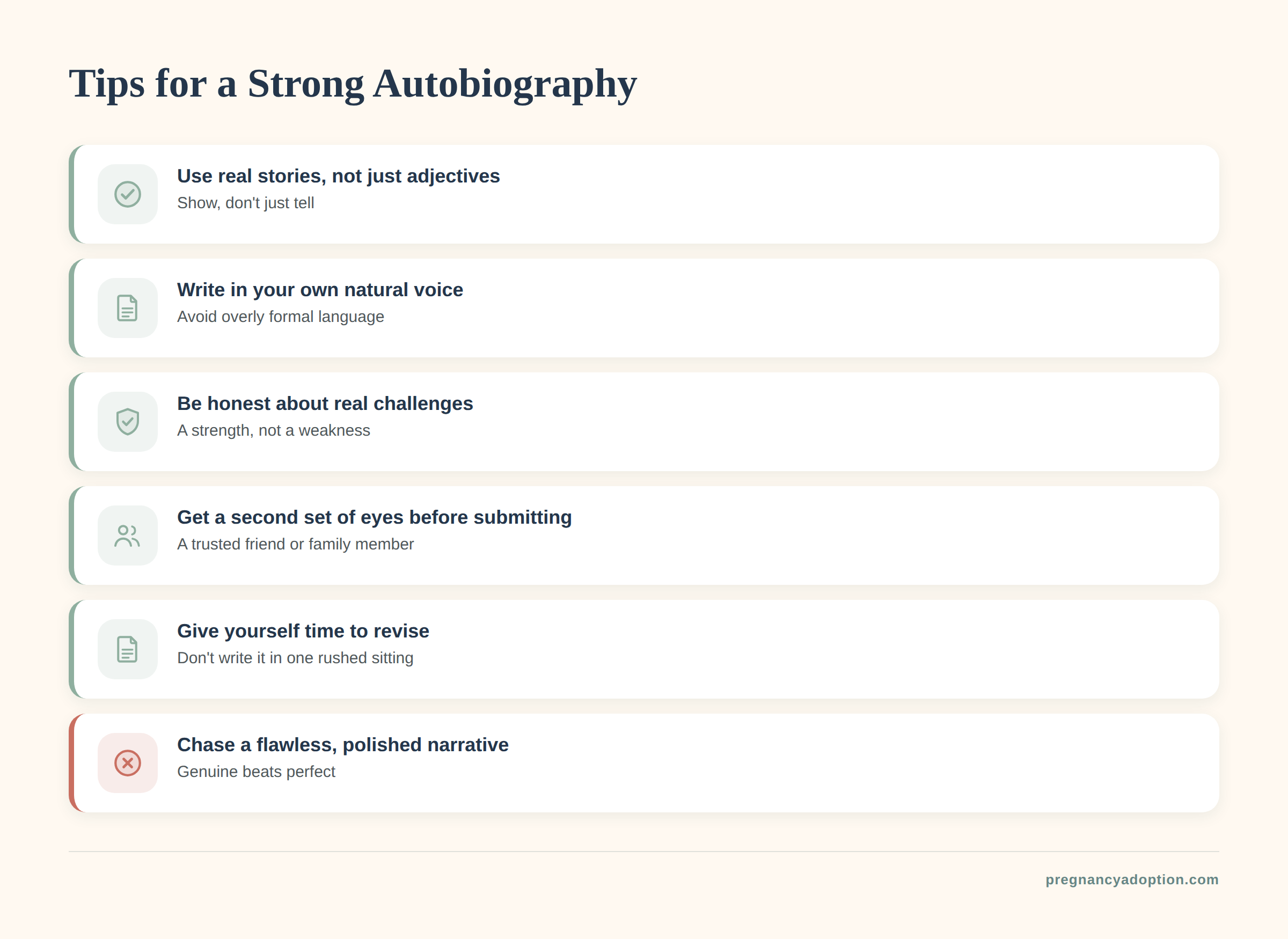
Instead of simply writing “I’m patient and loving,” a specific story that shows those qualities in action tends to leave a much stronger impression.
Avoid Overly Formal or Stiff Language
Writing in your own natural voice, rather than an overly formal tone, generally reads as more genuine and is easier for a reader to connect with.
Be Honest About Challenges, Too
You Don’t Need a Perfect Story
Agencies and, in domestic infant adoption, expectant parents are generally looking for an honest, grounded family, not a flawless narrative — acknowledging real challenges you’ve worked through can be a strength, not a weakness.
Get a Second Set of Eyes Before Submitting
Having a trusted friend or family member read your draft before you submit it can catch unclear passages or missing context you might not notice yourself.
If Your Application Is Delayed or Denied
This isn’t common, but it’s worth understanding what it can mean and what your options are.
Common Reasons for Delay
Missing or Incomplete Documentation
As covered above, incomplete paperwork is the most common cause of delay — usually resolved simply by providing what’s missing.
A Specific Follow-Up Question From the Agency
Sometimes an agency needs clarification on a specific answer before proceeding — this is a normal part of a thorough review process, not necessarily a sign of a problem.
If an Application Is Actually Denied
Ask Directly for the Reason
If an agency declines to move forward with your application, it’s reasonable to ask directly for the specific reason, since this information can help you understand whether a different agency or program might be a better fit.
A Denial From One Agency Doesn’t Mean Every Agency Will Decline
Agencies and programs vary in their specific criteria and focus — our choosing an adoption agency guide can help you think through finding a better-fitting program if this happens.
Applying to More Than One Agency
Some prospective parents choose to apply to more than one agency or program at once — here’s what to consider.
Potential Benefits
Faster Matching in Some Adoption Types
In domestic infant adoption specifically, applying with more than one agency can sometimes shorten overall waiting time, since you’re visible to more potential matches at once.
A Broader Sense of Fit
Going through more than one application process can also help you compare how different agencies communicate and operate before committing fully to one.
Potential Downsides
Multiple Fees and More Administrative Work
Each application typically comes with its own fee and paperwork, so applying to multiple agencies multiplies both the cost and the time commitment.
Not Always Appropriate for Every Adoption Type
Foster-care adoption through your state’s public system generally doesn’t involve this same multi-agency approach — check with your specific program about what’s appropriate for your situation.
A Simple Preparation Checklist
Here’s a condensed list pulling together what matters most before and during the application stage.
Before You Apply
Gather Key Documents
Pull together ID, proof of residence, recent tax returns, and recent physical exam results ahead of time.
Start Drafting Your Autobiography Early
Giving yourself time to write, revise, and get feedback on your autobiography tends to produce a stronger final version than writing it in a single rushed sitting.
While Your Application Is Under Review
Respond Quickly to Any Follow-Up Requests
Prompt responses to any agency follow-up questions help keep your application moving.
Start Learning About the Home Study
Reading ahead about what the home study involves, covered in our adoption home study guide, can help you feel more prepared for what typically comes next.
Glossary of Terms Used in This Guide
Application Terms
Autobiography / Personal Statement
A written narrative, usually part of the application, describing your own background, family, and motivation for adopting.
Preferences Questionnaire
A form asking what age ranges, backgrounds, or health factors you’re open to in a potential match.
Application Fee
The initial, generally non-refundable fee paid when submitting an adoption application, distinct from total adoption cost.
Process Terms
Home Study
The in-depth background-check, interview, and home-visit assessment that typically follows an accepted application.
Matching
The process by which an agency connects a prospective adoptive family with a specific child or expectant parent, informed in part by the preferences questionnaire.
Domestic Infant Adoption
Adoption of a newborn or infant within the same country, typically involving a direct relationship-building process with an expectant or birth parent.
Frequently Asked Questions
Getting Started
How long does it take to fill out an adoption application?
This varies widely depending on the agency’s specific form, but many applicants spend anywhere from a few hours to a few weeks, largely depending on how long the autobiography and documentation gathering take.
Can I start gathering documents before choosing a specific agency?
Yes — the general categories covered in this guide (ID, financial documents, health records) are commonly requested across most agencies, so starting early is a reasonable way to save time later.
Do I need a lawyer to fill out an adoption application?
Generally, no — most applications are designed to be completed by prospective parents directly; a lawyer typically becomes more relevant later in the legal finalization process.
The Application Itself
Will my application be rejected if I have a past minor criminal record?
Not necessarily — this depends heavily on the nature and timing of the record and the specific agency’s policies; it’s worth discussing directly with the agency rather than assuming disqualification.
Does a chronic health condition disqualify me from adopting?
Generally not on its own — agencies typically look at whether a condition is well-managed and how it affects your capacity to parent, rather than disqualifying based on diagnosis alone.
Is it normal to feel like the application asks very personal questions?
Yes — the application’s personal nature is a common source of discomfort for many applicants; understanding that this depth of information helps agencies support a good match can make it easier to approach.
Do unmarried couples face a different application process?
Eligibility rules for unmarried couples vary by state and by agency — our adoption requirements guide covers general eligibility patterns in more depth.
Can single applicants adopt?
Yes — single-parent adoption is legal and common across most adoption types and agencies, though specific program requirements vary.
Documents and Preparation
What if I don’t have all the documents on the list yet?
Most agencies will tell you exactly what’s still needed and give you time to gather it — missing a document at the start isn’t disqualifying, though it can add time to the review.
Do I need notarized copies of documents?
Some documents may need to be notarized or certified, depending on the specific agency and adoption type — the agency’s application instructions will specify exactly what’s required.
How recent do my tax returns need to be?
Agencies commonly ask for the most recent one to two years of tax returns, though this varies — check your specific agency’s instructions for the exact requirement.
What if my physical exam reveals a new health concern?
Disclose it honestly to the agency — as covered above, most health conditions aren’t automatically disqualifying, and withholding information tends to create bigger problems later than disclosing it upfront.
The Autobiography
How long should my autobiography be?
Length requirements vary by agency, but many run several pages — follow your specific agency’s guidelines rather than a generic length target.
Should my partner and I write separate autobiographies or one together?
This depends on the specific agency’s form — some ask for separate narratives from each applicant, others ask for a joint statement; follow the specific instructions you’re given.
What if I don’t know what to say about my own childhood?
Starting with simple, concrete memories — a family tradition, a formative relationship, a value you learned early — is often easier than trying to summarize your whole childhood in the abstract.
Is it okay to mention a difficult period in my life, like a past job loss or health struggle?
Yes — as covered above, honesty about real challenges, especially ones you’ve worked through, often reads as a strength rather than something to hide.
Can I revise my autobiography after submitting it?
Policies vary by agency — some allow updates, especially if your situation changes; ask directly if you need to revise something after submission.
The Preferences Questionnaire
What if my partner and I disagree on the preferences questionnaire?
Talking it through together before submitting, rather than each answering independently, tends to surface disagreements early when they’re easier to work through.
Is it okay to say I’m open to “anything”?
While possible, most agencies encourage genuine reflection on specific preferences rather than a blanket “open to anything” answer, since thoughtful answers tend to lead to better-fitting matches.
Will being more open on the questionnaire speed up matching?
In some adoption types, broader openness can shorten wait times, but this shouldn’t come at the expense of genuine readiness — answer based on what you can actually provide for, not simply to speed up the process.
Fees and Cost
Is the application fee the same across all agencies?
No — application fees vary by agency and adoption type; it’s worth asking directly about the specific fee and what it covers before applying.
Will I get my application fee back if I’m not accepted?
Generally no, since application fees are commonly non-refundable — confirm the specific agency’s refund policy before paying.
Are there financial assistance options for adoption costs?
Yes — our adoption cost guide covers grants, loans, employer benefits, and the adoption tax credit in full depth.
Timeline Questions
What’s the single biggest factor in how fast my application is reviewed?
Completeness — as covered above, a fully complete, well-prepared application is reviewed faster than one requiring multiple rounds of follow-up.
Can I check on my application’s status while it’s under review?
Yes — most agencies welcome a polite status check if you haven’t heard back within their stated timeline; asking is a reasonable step, not an imposition.
Does the time of year affect how quickly applications are processed?
Some agencies experience seasonal variation in volume, which can affect timelines — asking directly about current processing times is more reliable than assuming a seasonal pattern.
After Submitting
What if the agency asks for an in-person meeting before accepting my application?
Some agencies do include an initial in-person or video meeting as part of the review — this is generally a getting-to-know-you step, similar in spirit to the phone interview described above.
Will I be assigned a specific caseworker right away?
Often, yes, once your application is accepted — your caseworker typically becomes your main point of contact through the home study and beyond.
Can I ask questions during the review process?
Yes — reaching out with questions during review is normal and expected; a responsive agency should be willing to answer reasonable questions at any stage.
Multiple Agencies and Changing Course
Can I switch agencies after my application has been accepted?
Generally yes, though it may mean restarting parts of the process with the new agency — our choosing an adoption agency guide covers how to think through a switch.
If I apply to multiple agencies, do I need separate autobiographies for each?
Often you can adapt one core autobiography to each agency’s specific format, though some agencies have unique questions that may call for additions.
Is there a limit to how many agencies I can apply with?
No formal limit typically exists, though as covered above, each application adds its own cost and time commitment — weigh that trade-off before applying broadly.
A Few Final Questions
What’s the most important thing to get right on the application?
Honesty and completeness — a thorough, truthful application, even an imperfect one, moves faster and builds more trust than a rushed or incomplete one.
Should I expect the application to feel emotional?
Yes — putting your family’s story and hopes into a formal document is genuinely emotional for most applicants; giving yourself time and space for that is reasonable.
Where should I go next after finishing this guide?
If you haven’t yet, our starting the adoption process guide and choosing an adoption agency guide are natural next stops before or alongside completing your application.
Working With a Social Worker or Caseworker
Will I work with the same person throughout the whole process?
Often, yes, once you’re assigned a caseworker after application acceptance, though this varies by agency size and structure — ask directly about continuity if this matters to you.
What if I don’t feel comfortable with my assigned caseworker?
It’s reasonable to raise this directly with the agency — most agencies are willing to discuss a reassignment if the working relationship genuinely isn’t a good fit.
How often will I hear from my caseworker during the application stage?
This varies by agency, but many communicate at least every few weeks during active review — ask upfront what communication cadence to expect so you’re not left wondering.
Foster Care and International Adoption Differences
Is the application process different for foster-care adoption?
Yes, somewhat — foster-care adoption through your state’s public system often involves a standardized state application and required training (sometimes called MAPP or PRIDE), distinct from a private agency’s own form.
Is the application process different for international adoption?
Yes — international adoption applications typically also involve country-specific requirements and, in many cases, compliance with Hague Convention framework steps, in addition to the general categories covered in this guide.
Does this guide apply equally to all three adoption types?
The general categories covered here (documents, questionnaire, autobiography, fees, timeline) apply broadly across domestic infant, foster-care, and international adoption, though specific forms and requirements vary by type and, for foster care and international adoption, by state or country.
Specific Situations
Does a previous adoption application with a different agency affect a new one?
Generally not directly — each agency conducts its own independent review, though you may be asked whether you’ve previously applied elsewhere and why that process didn’t move forward.
What if I’m adopting as a stepparent or relative?
Stepparent and relative adoption often follow a simplified process compared to agency adoption — this guide’s content is more directly relevant to agency-based adoption; a family law attorney is the right resource for stepparent or relative adoption specifics.
Does military deployment affect the application timeline?
It can — some steps (like in-person interviews or home visits) may need to be scheduled around deployment; discussing this directly and early with your agency allows them to plan around it.
What if we’re applying after a previous adoption disruption or failed match?
This is worth disclosing honestly on your application — agencies generally want to understand what happened and how you’ve processed it, not to disqualify you for a previous difficult experience.
References
Who should I ask to be a reference?
Agencies commonly ask for personal references who know you well — friends, family members, or colleagues who can speak to your character and household — rather than professional references alone.
How many references does a typical application require?
This varies by agency, but commonly ranges from two to four — check your specific agency’s instructions for the exact number.
Should I tell my references what to expect?
Yes — letting references know they’ll likely be contacted, and giving them a sense of what’s being asked, helps the process go smoothly and avoids catching them off guard.
Household and Family Questions
Does having biological or previously adopted children affect my application?
Generally not negatively — many families who already have children go on to adopt again; the application simply wants an accurate picture of your full household.
What if someone in my household has a criminal record from many years ago?
Disclose it honestly — agencies generally evaluate the nature, timing, and context of a record rather than applying an automatic disqualification for any record at all.
Do extended family members living in the home need to go through the application too?
Generally, any adult regularly residing in the household is included in background checks and some application questions — check your specific agency’s policy on household composition.
Preparing Mentally for the Process
Is it normal to feel anxious about being judged during the application?
Yes — feeling exposed or judged during such a personal process is a very common reaction; remembering that agencies review thousands of applications and are looking for genuine, capable families, not perfection, can help.
How do I stay motivated if the process feels slow?
Breaking the process into the smaller steps covered in this guide, and celebrating each one (document gathering, autobiography draft, submission) rather than only focusing on the end goal, can help sustain motivation.
Should my partner and I divide up the application tasks?
Many couples find it helpful to divide tasks (one gathering documents while the other drafts the autobiography, for example) and then review everything together before submitting.
Costs Beyond the Application Fee
What’s the next fee after the application fee?
This typically depends on the agency, but a home study fee is commonly the next major cost once your application is accepted — our adoption cost guide covers the full sequence of fees.
Are there hidden fees I should ask about upfront?
Asking directly for a complete, itemized fee schedule before applying is a reasonable way to avoid surprises later — a transparent agency should be willing to provide this.
Does the application fee count toward later costs?
Generally no — application fees are usually separate from and not credited against later program or agency fees, though policies vary; confirm this directly with your specific agency.
Sibling Groups and Special Circumstances
Does applying to adopt a sibling group require a different application?
Not usually a separate application, but your preferences questionnaire is where you’d indicate openness to a sibling group, which can affect matching and sometimes household-size requirements.
What if I’m specifically interested in adopting a child with a known medical condition?
Your preferences questionnaire is where this openness is indicated — some agencies also have specific programs or specialists focused on medically complex adoptions worth asking about directly.
Does age of the applicant affect the application process?
Most agencies have a minimum age requirement, and some consider the age gap between applicant and child, but there’s typically no strict maximum age — our adoption requirements guide covers general age-related patterns.
LGBTQ+ Applicant Questions
Do LGBTQ+ applicants fill out a different application?
Generally not a different form, though eligibility and agency openness to LGBTQ+ applicants vary by state and by individual agency — researching a specific agency’s stated policies before applying is a reasonable step.
Are there agencies that specialize in working with LGBTQ+ applicants?
Yes, some agencies and adoption consultants specifically focus on or have strong track records with LGBTQ+ families — this is a reasonable thing to ask about directly when researching agencies.
Health and Disability Questions
Does having a disability affect my application?
Not automatically — agencies generally assess whether you can meet a child’s needs rather than disqualifying based on disability status alone; specific accommodations can often be part of that conversation.
What if I take regular prescription medication?
Routine, well-managed prescription medication use is generally not disqualifying — disclose it honestly as part of your health history questions.
Will my mental health history be held against me?
Generally, agencies look at whether a condition is being appropriately managed and how it affects your current capacity to parent, rather than treating any history of mental health treatment as automatically disqualifying.
Timing and Scheduling
Can I apply while I’m still in the middle of another major life change, like moving or changing jobs?
It’s worth discussing your specific timeline with the agency — significant upcoming changes don’t necessarily disqualify you, but stability at the time of the home study specifically does matter, so timing your application thoughtfully is worth considering.
Is there a best time of year to apply?
There’s no universally “best” time — agency processing volume can vary seasonally, but applying when you’re genuinely ready is more important than timing it to a particular month.
How soon after applying can I expect to start the home study?
This varies by agency, but once your application is accepted, scheduling the home study commonly begins within a few weeks to a couple of months.
Reapplying and Changing Your Mind
Can I reapply if I withdrew my application earlier for personal reasons?
Generally, yes — most agencies welcome a reapplication once your circumstances have changed; it’s reasonable to explain briefly why the timing is better now.
What if I start the application and realize I’m not ready yet?
It’s okay to pause or withdraw — our starting the adoption process guide covers the readiness self-assessment worth revisiting if this happens.
Is it normal to have second thoughts partway through the application?
Yes — this is a major decision, and pausing to reflect partway through the paperwork is a reasonable response, not a sign you shouldn’t be adopting.
Application Format and Logistics
Is the application usually submitted online or on paper?
Most agencies now offer online application portals, though some still use paper forms or a combination — check your specific agency’s preferred format.
Can I save a partially completed online application and finish it later?
Most online application systems allow saving a draft, though this varies by platform — check the specific portal’s functionality before you start if this matters to your planning.
Who should actually fill out the household questionnaire if my partner and I disagree on an answer?
Discuss and agree on an honest, shared answer together rather than submitting mismatched responses — consistency between household members’ answers is something agencies typically look for.
Working With an Adoption Consultant
What does an adoption consultant do differently from an agency?
An adoption consultant typically helps you navigate the broader process, sometimes across multiple agencies, rather than being the agency itself — this is a separate, optional service some families choose to use.
Does using a consultant change what’s asked on the application itself?
Generally not — the application itself is still submitted to and reviewed by the specific agency or program; a consultant’s role is more about guidance and strategy around that process.
Communication and Transparency
How transparent should I expect an agency to be during the application process?
A reputable agency should be willing to clearly explain its process, fees, and timelines upfront — if an agency is vague or evasive about these basics, that’s worth factoring into whether it’s the right fit.
Should I ask other adoptive families about their experience with a specific agency before applying?
Yes — hearing directly from families who’ve gone through a specific agency’s process can give you a more concrete sense of what to expect than the agency’s own marketing materials alone.
What if I have a disagreement with the agency during the application process?
Raising concerns directly and promptly, rather than letting them build, tends to lead to better outcomes — most reputable agencies want to address legitimate concerns rather than lose a good applicant family.
International Document Questions
Do I need my documents translated for international adoption?
Often, yes, depending on the country — certified translation is commonly required for international adoption paperwork; your agency or an immigration attorney can advise on the specific requirements for your situation.
Do I need a passport before I can apply for international adoption?
Not necessarily at the application stage, though you’ll need one before travel later in the process — it’s reasonable to start that process early so it isn’t a bottleneck later.
Does international adoption require additional immigration paperwork?
Yes — international adoption typically involves immigration forms in addition to the adoption application itself; our adoption process guide touches on this broader picture.
Financial Assistance and Employer Benefits
Should I ask my employer about adoption benefits before or after applying?
Either timing can work, but checking early gives you a clearer sense of your actual budget before committing to a specific agency or program — our adoption cost guide covers employer benefits and other financial assistance in depth.
Does an agency need proof of financial assistance before accepting my application?
Generally not at the application stage — most agencies assess general financial stability rather than requiring proof of specific grants or assistance upfront.
What Makes an Application Stand Out
Does a more polished application increase my chances of a faster match?
A complete, honest, well-organized application generally moves more smoothly through review, though “polish” in the sense of impressive formatting matters far less than genuine completeness and honesty.
Do agencies compare applications against each other competitively?
Not typically in the way a job application might be ranked — most agencies evaluate each application against their own criteria for a suitable adoptive family rather than ranking applicants against one another.
Should I mention specific reasons I’d be a good match for a particular type of adoption?
Yes, if genuine — explaining specific, honest reasons for your interest and readiness (rather than generic statements) tends to give the agency a clearer, more useful picture of your family.
Rare but Real Scenarios
What if I need to pause my application due to a family emergency?
Contact the agency directly and explain your situation — most agencies are willing to accommodate a reasonable pause, understanding that life circumstances can change during a lengthy process.
What if I move to a different state partway through the application?
This can affect timelines and sometimes requirements, since licensing and home-study rules vary by state — notify your agency as soon as a move becomes likely so they can advise on next steps.
What if the agency I applied with closes or stops operating?
This is rare but has happened to some families — if it occurs, your documentation and home study (if completed) can sometimes transfer to a new agency; consult a family law attorney or adoption consultant for guidance specific to your situation.
A Closing Set of Practical Questions
Is it worth hiring an editor or writing coach for my autobiography?
This is optional, but some applicants find professional writing help genuinely useful, especially if writing doesn’t come naturally — a trusted friend’s honest feedback can also work well without added cost.
Should I keep a copy of everything I submit?
Yes — keeping your own copies of the completed application, autobiography, and supporting documents is a simple, practical habit that can save time if anything needs to be resubmitted or referenced later.
What’s the one thing most applicants wish they’d known before starting the application?
That completeness and honesty matter far more than a polished presentation — many applicants spend more energy worrying about perfection than the process actually requires.
Waiting Family Profiles and Online Presence
Will I need to create an online profile for expectant parents to view?
In many domestic infant adoption programs, yes — a family profile, often building on your autobiography, is commonly shared with expectant parents considering a match; your agency will guide you through creating one.
Is my family profile the same document as my autobiography?
Often related but not identical — a family profile is typically a more visual, curated presentation (photos plus shorter text), while the autobiography is the fuller written narrative submitted with your application.
How much control do I have over how my family is presented?
Generally a good amount — most agencies work collaboratively with you on your profile’s content and photos, since an authentic, accurate presentation serves everyone’s interests.
Religious and Values-Based Agency Questions
Do faith-based agencies ask different application questions?
Some faith-based agencies include questions about religious practice or values alongside the general categories covered in this guide — review a specific agency’s application before applying if this is a consideration for you.
Can I apply to a faith-based agency if I don’t share their specific faith?
This varies by agency — some faith-based agencies serve families broadly regardless of religious affiliation, while others have specific requirements; checking directly with the agency is the clearest way to know.
Understanding Agency Size and Type
Does a larger agency have a different application process than a smaller one?
The core categories covered in this guide are fairly consistent, though larger agencies may have more standardized, automated online systems, while smaller agencies sometimes offer a more personal, direct application experience.
Is a nonprofit agency’s application different from a for-profit one?
Not fundamentally in content, though fee structures and specific policies can differ — our choosing an adoption agency guide covers questions worth asking about agency structure and reputation.
Translating Readiness Into the Application
How do I know if I’m actually ready to submit, versus still preparing?
If your documents are gathered, your autobiography reflects your honest story, and you’ve thought through the preferences questionnaire together as a household, you’re likely ready — our starting the adoption process guide covers the broader readiness self-assessment if you want to revisit it first.
Is it better to submit a slightly imperfect application now or wait until it’s flawless?
A complete, honest, reasonably well-prepared application submitted now is generally better than an indefinitely delayed pursuit of perfection — agencies expect genuine effort, not flawlessness.
What’s a reasonable amount of time to spend preparing before submitting?
This varies by individual circumstances, but many applicants spend anywhere from a few weeks to a couple of months gathering documents and drafting their autobiography before submitting.
Final Reassurance
Is it normal to feel both excited and nervous about submitting the application?
Yes — this is a significant, emotional step, and feeling both anticipation and nervousness at once is a completely normal response.
What happens if I realize after submitting that I made a small error?
Contact the agency directly to correct it — small errors are common and generally easy to fix; agencies would rather you flag it than worry silently.
Is there anything else worth knowing before I start?
Just that this stage, while detailed, is designed to be completable by any genuinely prepared family — take it step by step using this guide’s checklist, and reach out to your chosen agency directly with any question specific to their process.
Grandparent and Kinship Adoption Questions
Is the application different if I’m adopting a relative, like a grandchild?
Kinship adoption often follows a simplified or different process than agency-based adoption of an unrelated child — a family law attorney is the right resource for the specifics of kinship adoption in your state.
Do kinship adopters still need a home study?
Often yes, though requirements can be streamlined compared to unrelated adoption, depending on your state and circumstances — check with your state’s child welfare agency or an attorney for specifics.
Post-Submission Housekeeping
Should I update the agency if my contact information changes while my application is pending?
Yes — promptly updating any change in address, phone number, or email helps avoid missed communications that could delay your review.
What if I need to add a new household member, like a new roommate, after submitting?
Notify the agency as soon as possible — changes to household composition typically need to be reflected in your application and may affect background-check requirements.
Is there a formal way to withdraw my application if my plans change?
Most agencies have a straightforward process for this — a simple written notice is often all that’s needed; ask the agency directly about their specific procedure.
Comparing What Different Family Members Might Ask
How do I explain the application process to my own children, if I already have some?
Age-appropriate honesty — explaining in simple terms that you’re working on paperwork to possibly welcome a new family member — tends to work well; avoid over-promising specific timelines, since the process can take time.
Should extended family be involved in reviewing the application before I submit it?
This is a personal choice — some applicants find it helpful to have a trusted family member review the autobiography specifically, while the formal application itself is generally a decision made by the household applying.
A Few Numbers-Focused Questions
Roughly how many pages does a typical completed application run, including the autobiography?
This varies considerably by agency, but completed packets (application plus autobiography plus supporting documents) commonly run anywhere from a dozen to several dozen pages.
How many references does a typical application ultimately contact?
Most agencies contact all references listed on your application, commonly the two to four mentioned earlier in this guide.
Working Through Doubt or Disagreement
What if my partner is ready to apply but I’m not, or vice versa?
This is a common and important conversation to have openly before applying — submitting an application before both partners feel genuinely ready can create strain later in a process that requires sustained commitment from everyone in the household.
Is couples counseling a reasonable step before applying if we’re not aligned?
Yes — some couples find a few sessions with a counselor genuinely helpful for working through disagreement about timing, openness on the preferences questionnaire, or other adoption-related decisions before formally applying.
What if extended family disapproves of our decision to adopt?
This is ultimately your household’s decision — while family support can be a meaningful resource, disapproval from extended family doesn’t need to determine whether you move forward with an application you’ve thought through carefully.
A Few More Document Questions
Do I need letters of recommendation in addition to references who will be contacted directly?
Some agencies ask for both — written letters of recommendation and a list of references to be contacted directly — while others require only one format; check your specific agency’s instructions.
What if one of my references is unreachable or unresponsive?
Let the agency know and offer an alternative reference — agencies generally understand that a single unresponsive reference isn’t unusual and will work with you to get the information they need.
Do I need updated documents if there’s a delay between gathering them and submitting the application?
If a significant amount of time has passed (several months, for example), some documents like a physical exam or financial statement may need to be refreshed — check with your agency about their specific currency requirements.
One Last Round of Practical Tips
What’s a simple way to stay organized while completing the application?
Keeping a dedicated folder (physical or digital) for every document, draft, and piece of correspondence related to your application is a simple habit that saves real time and stress later in the process.
Should I set a personal target date for submitting?
Many applicants find it helpful to set a reasonable target date to stay motivated, while remaining flexible if gathering documents or finishing the autobiography genuinely takes a bit longer than planned.
What’s the best mindset to bring into this stage of the process?
Treating the application as the honest, thorough introduction of your family that it’s meant to be — rather than a test to pass perfectly — tends to make the process feel more manageable and genuinely reflect who you are.
Checking In With Yourself Before You Submit
Is there a final checklist I should run through right before submitting?
Confirming every document is included, every question is answered (not left blank), your autobiography has been proofread, and your references have been notified covers the most common final-check items.
Should I call the agency to confirm receipt after submitting?
This is a reasonable step, especially for a mailed paper application — a quick confirmation call or email gives you peace of mind that nothing was lost in transit.
What’s a healthy way to wait once the application is submitted?
Staying engaged with the next steps you can control — like learning about the home study, covered in our adoption home study guide — tends to feel more productive than simply waiting anxiously for a response.
Last Practical Notes
Is it okay to ask the agency how many families they typically accept per cycle?
Yes — this is a reasonable question that can help set realistic expectations about competition and timeline, particularly for high-demand programs.
What should I do if I haven’t heard anything after the agency’s stated review window has passed?
A polite follow-up call or email is entirely appropriate at that point — agencies generally expect and welcome a check-in once their own stated timeline has elapsed.
Second-Time Applicants
Is the application easier the second time if I’ve adopted before with the same agency?
Often somewhat, since the agency already has some of your history on file, though most agencies still require updated documents (like a current physical exam and background check) and an updated household questionnaire.
Do I need a whole new autobiography if I’m adopting again?
Often an updated version covering what’s changed since your last application — new experiences, how your family has grown — rather than starting completely from scratch, though this varies by agency.
Will my previous home study still be valid for a second adoption?
Home studies typically need to be updated periodically (commonly annually) regardless of whether you’re adopting again — our adoption home study guide covers renewal requirements in more depth.
A Few Last Clarifications
Does submitting an application obligate me to proceed with that specific agency?
No — submitting an application begins a review process, not a binding commitment; you can withdraw at any point if your circumstances or preferences change.
Is there a standard, universal adoption application used by every agency?
No — each agency and program typically has its own specific form, though the general categories covered throughout this guide are broadly consistent across most of them.
What’s the single best piece of advice for someone about to start their application?
Start early, be thorough, and be honest — those three habits, more than anything else covered in this guide, tend to make the biggest difference in how smoothly this stage goes.
Questions About Agency Accreditation
Does it matter if an agency is accredited, and does that affect the application?
Accreditation (particularly Hague accreditation for international adoption) can affect which countries or programs an agency is authorized to work in — our choosing an adoption agency guide covers what to check before applying.
How can I verify an agency’s licensing before I apply?
Most states maintain a public registry of licensed child-placing agencies — checking your state’s specific registry before applying is a reasonable due-diligence step.
Wrapping Up
Is there a short version of this guide’s advice I can keep handy while I work through my application?
The “Bottom Line” summary just below this FAQ section, along with the action checklist earlier in this guide, together capture the core guidance in a form you can return to without rereading the whole article.
What should I do immediately after finishing this guide?
If you haven’t already, start with the document-gathering checklist above, then move to drafting your autobiography — those two steps alone put most applicants well on their way to a strong, submittable application.
A Note on Terminology
Why does this guide say “expectant parent” instead of “birth mother” in some places?
Before a legal placement happens, “expectant parent” is generally the more accurate and respectful term, since a parent considering adoption hasn’t yet made a final decision — this site uses “birth parent” once a placement has actually occurred.
Does this guide assume a specific kind of family structure?
No — the application categories and guidance in this guide apply broadly regardless of marital status, family structure, or how many parents are applying.
One Final Word of Encouragement
If I only remember one thing from this guide, what should it be?
That the application, however detailed, is simply the honest, organized introduction of your family to an agency ready to help you move forward — thorough preparation now genuinely does make the rest of the process smoother.
Where should I go if I have a question this guide didn’t answer?
Your specific agency’s application instructions and staff are always the best source for anything unique to their particular process — this guide covers the general landscape to help you know what to expect and ask.
Keeping Perspective Through the Process
Is it possible to over-focus on getting every answer “perfect”?
Yes — as covered throughout this guide, genuine honesty and completeness matter far more than perfect phrasing; spending excessive time rewriting a single answer often isn’t the best use of your energy.
How do I avoid burning out before I even get to the home study?
Pacing yourself through the document-gathering and autobiography stages, rather than trying to finish everything in one marathon session, tends to produce both a better application and a less exhausting experience.
What’s a reasonable way to celebrate finishing the application?
Marking the milestone in whatever way feels meaningful to your household — it’s a genuine step forward, even though more steps (like the home study) still lie ahead.
A Few Questions About What Comes Next
Should I start researching the home study now, or wait until my application is accepted?
Reading ahead now, via our adoption home study guide, can help you feel more prepared and less caught off guard once that stage actually begins.
Is there anything I should be doing in parallel with waiting for application review?
Continuing to research agencies, save toward upcoming fees, and prepare your home for an eventual home-study visit are all reasonable, productive uses of the waiting period.
A Note for Partners Supporting Each Other Through This
How can one partner support the other if the application process feels overwhelming?
Taking on a fair share of the concrete tasks (document gathering, scheduling, proofreading), rather than leaving one person to manage everything alone, is a concrete and meaningful way to share the load.
Is it normal for one partner to feel more emotionally invested in this stage than the other?
Yes — it’s common for partners to process a major step like this differently; checking in with each other regularly about how you’re each feeling helps keep both people genuinely engaged.
Documentation and Record-Keeping Habits
Should I keep a running log of every call or email with the agency?
Many applicants find this genuinely useful — a simple dated log of who you spoke with and what was discussed can be a helpful reference if a question comes up later about what was said or agreed.
Is it worth asking for written confirmation of verbal agreements with the agency?
Yes, when practical — a brief follow-up email summarizing a phone conversation (“confirming what we discussed…”) creates a simple written record without requiring anything formal from the agency.
Last Thoughts Before You Begin
Is it okay to feel like this guide covers more than I’ll personally need?
Yes — this guide is written to address the wide range of situations different applicants face; use only the sections genuinely relevant to your own household and adoption type.
What’s the best first action to take after reading this guide?
Pulling up the action checklist above and starting with the first document on the list is a simple, concrete way to turn everything you’ve just read into real progress.
Closing Reassurance
Is it normal for this entire stage to take longer than I originally expected?
Yes — between gathering documents, drafting a thoughtful autobiography, and waiting for review, this stage commonly takes longer than first-time applicants anticipate; building in some flexibility to your own expectations helps.
What’s the most encouraging thing to remember while working through the application?
That thousands of families complete this exact process successfully every year — the application, while detailed, is a well-worn path, not an obstacle course designed to trip you up.
Wrapping Up
Thank you for reading this far — is there anything we missed?
If a question specific to your situation isn’t answered here, bringing it directly to your chosen agency is the right next step, as this guide has suggested throughout.
Is there a short version of this guide I can share with my partner if they’re short on time?
The “Bottom Line” summary just below this FAQ section captures the core message in a few sentences and is a reasonable starting point to share.
Final Notes
Is it reasonable to feel proud of simply getting the application submitted?
Absolutely — completing a thorough, honest application is genuine progress toward growing your family, and it’s worth acknowledging as the real milestone it is.
What’s the very last thing worth remembering from this guide?
That preparation, honesty, and patience — not perfection — are what actually move this stage of the adoption process forward.
A Closing Checklist Recap
Can you summarize the single most important sequence of steps one more time?
Gather your documents, draft and revise your autobiography, thoughtfully complete the preferences questionnaire, confirm your references, submit a complete package, and then respond promptly to any follow-up — in that order, this sequence covers nearly everything this guide has walked through.
Is it okay to return to this guide again later if I have follow-up questions?
Yes — treat this guide as a reference to revisit at any point during the application stage, rather than something to read only once from start to finish.
One Last Question
If I take away just one thing from this entire guide, what should it be?
That a complete, honest application — not a perfect one — is what moves your family forward toward the home study and, eventually, a match.
Where should I go next if a question about my own situation isn’t answered here?
Your chosen agency’s application staff are always the right resource for anything specific to their particular form and process.
A Final Word on Pacing
Is there a wrong way to pace myself through this stage?
The main pitfall is rushing a rushed, incomplete submission purely to feel like you’re moving fast — a steady, thorough pace almost always produces a better outcome than speed alone.
How will I know I’ve genuinely finished this stage well?
When every document is gathered, your autobiography honestly reflects your family, your preferences questionnaire has been thought through together, and your complete package has been submitted — at that point, this stage is done, and the next one begins.
Bottom Line
- An adoption application typically includes a household/health/financial questionnaire, an autobiography, references, and an initial fee.
- Gathering key documents and starting your autobiography early can meaningfully speed up the process.
- Application fees are small and separate from total adoption cost.
- Completeness is the single biggest factor in how quickly your application is reviewed.
- A strong autobiography is honest and specific, not polished or perfect.
About pregnancyadoption.com/
pregnancyadoption.com/ provides clear, judgment-free information on pregnancy, pregnancy options, and adoption, so you can make informed decisions about your own family. Learn more about our mission and editorial approach.
Legal Disclaimer
This article is for general informational purposes only and is not a substitute for professional legal or adoption-professional advice. Always consult a qualified adoption agency, attorney, or adoption professional about your specific situation. See our full legal disclaimer for details.
Editor’s Note & Sources
This article was researched using general patterns consistent with Child Welfare Information Gateway’s adoption-process guidance and this site’s own previously published adoption-pillar articles, current as of October 2026.
This article fulfills a reciprocal link back to our starting the adoption process guide, which forward-links here as the next step after readiness. See also our adoption home study guide, adoption checklist, and adoption requirements guide for the fuller process picture.
All claims marked require confirmation by a qualified adoption professional before publication, per this article’s “Adoption professional review” designation.
