If you’re wondering whether it’s safe to have sex during pregnancy, the short answer for most pregnancies is reassuring: yes. This guide walks through why sex is generally safe in an uncomplicated pregnancy, the specific medical situations where a provider may advise against it, how comfort and desire commonly change as pregnancy progresses, safer-sex and oral-sex specifics, what symptoms after sex are normal versus worth a call, and what the actual evidence says about sex and labor.
Short Answer: Sex Is Generally Safe During an Uncomplicated Pregnancy
For most pregnancies without a specific medical complication, sex — including intercourse, oral sex, and orgasm — does not harm the pregnancy and is considered a normal part of a healthy relationship throughout. A smaller set of specific medical situations changes this general guidance, which is why checking with your own provider about your specific pregnancy still matters.
Key Takeaways
- Sex is generally safe throughout an uncomplicated pregnancy, including orgasm.
- A specific, limited set of medical conditions is a reason to avoid sex — not pregnancy itself.
- Mild spotting or cramping after sex is common and usually not concerning.
- Sex does not reliably induce labor, despite the popular belief — the actual evidence is thin.
- Changes in desire, in either direction, are normal throughout pregnancy.
The One Thing to Know Right Now
The Baby Is Well Protected
The amniotic fluid and the strong muscles of the uterus cushion and protect the baby during sex, which is the physical reason sex doesn’t harm an uncomplicated pregnancy.
This Guide Covers General Guidance, Not Your Specific Case
A provider who knows your pregnancy’s specifics is always the better source for guidance tailored to you — use this guide to understand the general landscape and know what questions to bring to that conversation.
What This Guide Covers (and Where to Go for More)
This Guide’s Own Focus
This guide is the single, organized reference on sex during pregnancy specifically: safety, positions, symptoms, and the evidence behind common beliefs.
Our Trimester and Wellness Guides
For the complete picture of a specific trimester, see our first, second, and third trimester guides; for general pregnancy wellness alongside this topic, see our healthy pregnancy guide.

Why It’s Generally Safe
Understanding why sex is generally safe makes the rest of this guide’s guidance easier to follow.
How the Baby Is Protected
Amniotic Fluid Acts as a Cushion
The amniotic sac and fluid surrounding the baby absorb movement and pressure, keeping ordinary activity — including sex — from reaching or disturbing the baby directly.
The Uterine Muscle Is Strong
The uterus itself is a thick, muscular organ well-suited to protecting its contents from the pressure and movement involved in sex.
What Actually Causes Miscarriage (Not Sex)
Most Miscarriages Trace to Fetal Chromosomal Factors
Most miscarriages result from problems with the fetus’s own chromosomal or developmental growth, not from anything the pregnant person did or didn’t do, including sexual activity.
This Is Worth Repeating Because the Myth Persists
Despite how often the fear comes up, sex is not an established cause of miscarriage in a typical, uncomplicated pregnancy.
When to Avoid Sex: Medical Reasons
A specific, limited set of medical situations is a reason to avoid sex during pregnancy — not pregnancy as a general condition.
Conditions a Provider May Flag
The Main Situations
A healthcare provider may advise against sex if you have vaginal bleeding or leaking amniotic fluid, cervical insufficiency (a cervix that opens early), placenta previa (the placenta partly or fully covering the cervical opening), or a history of early labor or preterm birth.
These Are Individualized Recommendations
Being told to avoid sex (sometimes called “pelvic rest”) is based on your specific situation, not a general pregnancy rule — the guidance can also change as your pregnancy progresses, even within the same pregnancy.
| Condition or Situation | Why It Matters | A Question to Bring to Your Provider |
|---|---|---|
| Vaginal bleeding of unknown cause | Bleeding needs evaluation before resuming sexual activity | “Has my bleeding been evaluated, and is it safe to resume?” |
| Leaking amniotic fluid | May signal rupture of membranes, which changes infection risk | “Could this be my membranes, and what should I avoid now?” |
| Cervical insufficiency | An early-opening cervix raises preterm-birth risk | “Is pelvic rest part of my specific care plan?” |
| Placenta previa | The placenta covering the cervix raises bleeding risk with penetration | “Has my placenta’s position been rechecked recently?” |
| History of preterm labor or birth | Some providers recommend added caution in a current pregnancy | “Does my history change your guidance for this pregnancy?” |
| Multiple pregnancy (twins or more) | Some providers apply more individualized guidance here | “Does carrying more than one baby change anything for me?” |
When in Doubt, Ask Directly
A Reasonable Question for Any Visit
If you’re unsure whether anything about your specific pregnancy changes this general guidance, asking your provider directly is a reasonable, low-stakes question to bring to any prenatal visit.
Guidance Can Be Temporary
A recommendation to avoid sex because of a specific concern (a short episode of bleeding, for example) doesn’t necessarily mean “for the rest of the pregnancy” — ask specifically how long the recommendation applies.

How Pregnancy Changes Sex
Pregnancy changes the physical experience of sex for many people, in both directions.
Physical Changes That Affect Comfort
Increased Pelvic Blood Flow
Increased blood flow to the pelvic area during pregnancy can heighten sensation for some people, sometimes making arousal and orgasm more intense than before pregnancy.
Breast Tenderness and a Growing Belly
Breast tenderness, nausea, fatigue, and later a growing belly can all make certain positions or types of touch less comfortable at different points in pregnancy — adjusting rather than avoiding is usually the more useful response.
Desire Can Shift in Either Direction
Increased Desire Is Common
Many people report increased desire at some point in pregnancy, often in the second trimester once early symptoms ease and pelvic blood flow increases.
Decreased Desire Is Equally Normal
Nausea, fatigue, body-image changes, and emotional adjustment can just as reasonably reduce desire at any point in pregnancy — neither direction of change signals a problem.
Comfortable Positions as Your Body Changes
Most positions remain fine throughout pregnancy, with adjustment for comfort as your body changes.
General Principles, Not a Fixed List
Comfort Is the Main Guide
If a position feels uncomfortable, switching to another one is a reasonable response — there’s no required or forbidden position for most uncomplicated pregnancies.
Avoiding Direct Pressure on the Belly Later On
As the belly grows, positions that avoid direct pressure on the abdomen — side-lying positions, for example — are commonly found more comfortable, though comfort is highly individual.
Adjusting as the Belly Grows
What Worked Early May Need Adjusting Later
A position that was comfortable in the first trimester may need adjusting by the third — this is a normal, expected shift rather than a sign that something is wrong.
Communication Helps More Than a Fixed Plan
Talking openly with a partner about what feels comfortable in the moment tends to work better than assuming a position that worked before will keep working the same way throughout.
Oral Sex: What’s Different
Oral sex carries its own specific considerations during pregnancy, separate from intercourse.
STI Precautions Still Apply
The Same General Safer-Sex Guidance Applies
Avoiding oral, vaginal, and anal sex if a partner has a sexually transmitted infection, and using condoms or other barriers if either partner has other partners or is new, applies the same way during pregnancy as outside of it.
STIs Can Specifically Affect a Pregnancy
Some STIs carry pregnancy-specific risks beyond their general health effects, which is one more reason safer-sex precautions matter during pregnancy, not less.
The Air-Embolism Risk, in Context
A Rare but Real Risk Specific to Pregnancy
Blowing air directly into the vagina during pregnancy carries a rare but real risk of an air embolism (air entering a vein and traveling through the body), because pregnancy’s larger, closer uterine veins make it easier for air to enter the bloodstream this way.
This Is Specifically About Blowing Air In, Not Oral Sex Generally
The specific risk is from forcefully blowing air into the vagina, not from oral sex itself — avoiding that specific act, while continuing oral sex normally otherwise, addresses the actual risk directly.
Common Symptoms After Sex
A few symptoms after sex are common and not generally a sign of a problem.
Spotting and Mild Cramping
Light Spotting Is Common
Light spotting after sex is common, particularly as increased blood flow makes the cervix more sensitive during pregnancy, and is usually not a sign of a problem on its own.
Mild Cramping Is Also Common
Mild cramping after sex or orgasm is common and usually not concerning, reflecting a normal uterine response rather than a complication.
Braxton Hicks After Orgasm
Orgasm Can Trigger Uterine Contractions
Orgasm can cause the uterus to contract, sometimes felt as a tightening sensation (similar to Braxton Hicks contractions); this usually isn’t concerning and typically resolves on its own.
Distinguishing This From Labor Contractions
These post-orgasm contractions are generally brief and don’t establish a regular pattern, unlike labor contractions — if contractions become regular, painful, and don’t stop, that’s different and worth reporting (see “Warning Signs” below).
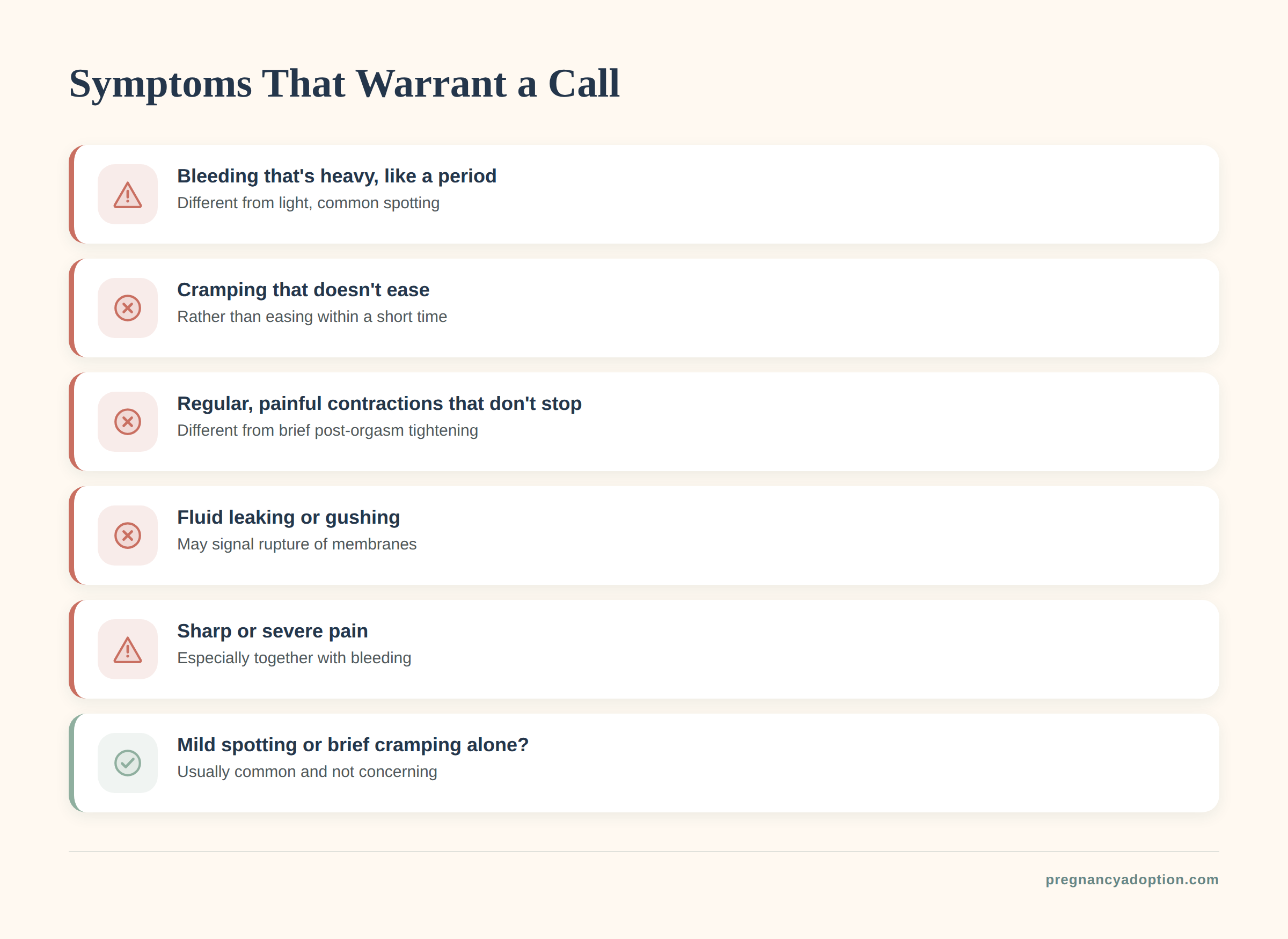
Warning Signs That Warrant a Call
A smaller set of symptoms after sex is different from the common, mild symptoms above and warrants contacting your provider.
| Symptom | Usually Normal | Warrants a Call |
|---|---|---|
| Spotting | Light, brief, pinkish or brown | Heavy, bright red, or persisting beyond a day |
| Cramping | Mild, eases within a short time | Moderate to severe, or doesn’t go away |
| Uterine tightening | Brief, irregular, resolves on its own | Regular, painful, and doesn’t stop |
| Fluid | None noticed | A gush or steady trickle of fluid |
| Pain | None, or very mild and brief | Sharp, severe, or accompanied by bleeding |
Symptoms to Report Promptly
Cramping That Doesn’t Go Away
Cramping after sex that persists rather than easing within a reasonably short time is worth reporting to your provider.
Heavy Bleeding
Bleeding that’s heavy, like a menstrual period, rather than light spotting, is different from the common post-sex spotting described above and warrants contacting your provider.
What to Do in the Meantime
Stop and Rest
If either of these symptoms occurs, stopping what you’re doing and resting is a reasonable immediate response while you reach out to your provider.
When to Seek Emergency Care Instead
Heavy bleeding with significant pain, fluid clearly leaking, or any sense that something is seriously wrong warrants emergency care rather than waiting for a routine callback.
Does Sex Induce Labor?
This is one of the most common questions about sex late in pregnancy, and the actual evidence is thinner than the popular belief suggests.
What the Evidence Actually Shows
The Research Is Genuinely Limited
A Cochrane systematic review looking specifically at sexual intercourse for cervical ripening and labor induction found only one small trial (28 women) addressing the question, describing the available evidence as “very limited” and the role of intercourse in inducing labor as uncertain.
No Reliable Conclusion Can Be Drawn
Because the evidence base is a single small, dated trial, no confident conclusion — for or against — can currently be drawn about whether sex reliably helps induce labor.
Why the Idea Persists Anyway
A Plausible-Sounding Mechanism
The idea has a plausible-sounding biological mechanism behind it (semen contains prostaglandins, and orgasm releases oxytocin, both involved in labor physiology), which likely helps the belief persist even though the clinical evidence for an actual effect remains thin.
It’s a Low-Risk Thing to Try, If You Want To
Because sex is generally safe in an uncomplicated, term pregnancy, there’s little downside to trying it near your due date if you’re interested — just without the expectation that it reliably works.
Sex in the First Trimester
The first trimester brings its own set of sex-specific considerations, mostly driven by early-pregnancy symptoms rather than any new physical restriction.
What Tends to Change Early On
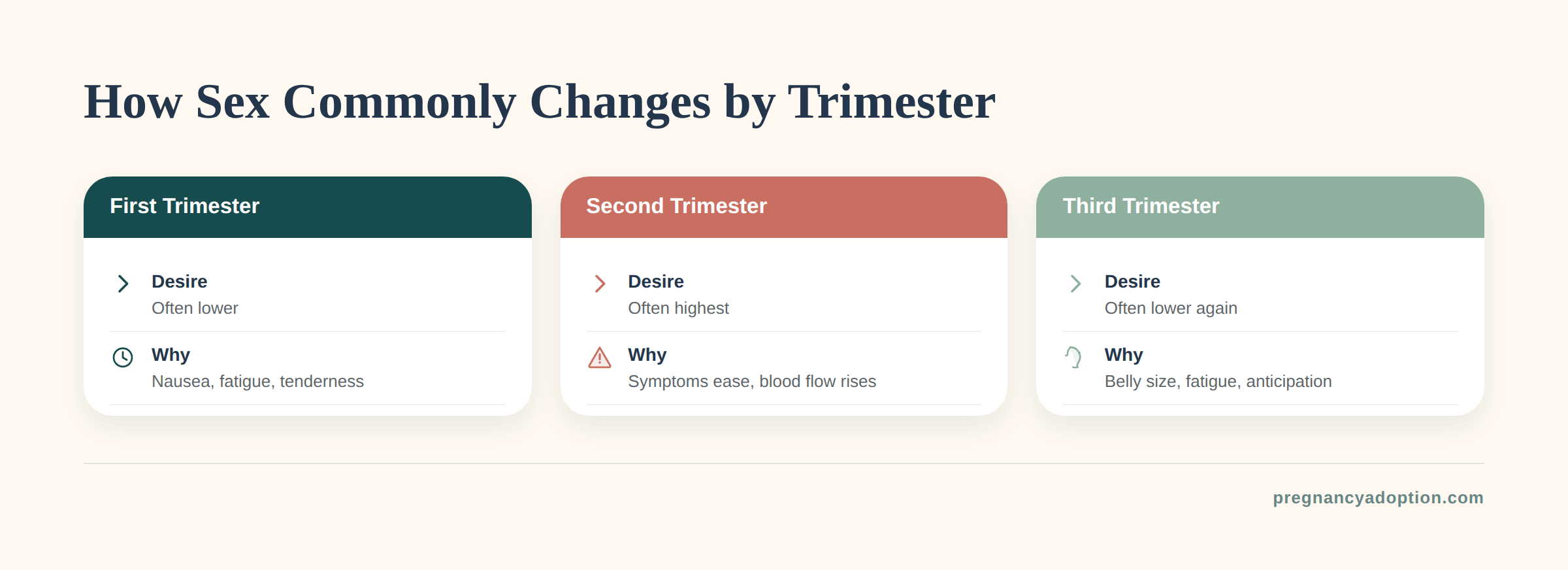
Nausea and Fatigue Often Reduce Interest
Nausea, fatigue, and breast tenderness commonly reduce interest in sex during the first trimester for many people — a common and temporary pattern, not a sign anything is wrong.
Spotting Can Feel Especially Worrying This Early
Light spotting after sex can feel especially alarming in the first trimester, when early-pregnancy anxiety about miscarriage is often highest, even though it’s generally no more concerning here than later in pregnancy.
Where to Go for the Full First-Trimester Picture
A Dedicated Guide to This Stage
For the complete first-trimester picture, see our first trimester guide.
This Section Stays Sex-Specific
This guide keeps its trimester sections focused specifically on sex so it can serve as a single reference across all three trimesters, rather than repeating each trimester guide’s full content here.
Sex in the Second Trimester
For many people, the second trimester brings renewed interest as early symptoms ease.
What Tends to Change in the Middle Trimester
Often the Most Interested Trimester
With nausea and fatigue typically easing and pelvic blood flow increasing, many people report their highest interest in sex during the second trimester, compared to either the first or third.
Comfort Is Usually at Its Peak Too
The belly isn’t yet large enough to meaningfully limit positions for most people, making the second trimester a comfortable window physically as well.
Where to Go for the Full Second-Trimester Picture
A Dedicated Guide to This Stage
For the complete second-trimester picture, see our second trimester guide.
A Note on New Diagnoses
If a second-trimester screening uncovers a new condition that affects this guide’s general guidance, your provider’s individualized recommendation takes priority over the general guidance here.
Sex in the Third Trimester
The third trimester usually calls for the most physical adjustment, though sex generally remains an option throughout for uncomplicated pregnancies.
What Tends to Change Late in Pregnancy
Physical Comfort Takes More Planning
A larger belly makes many positions impractical by the third trimester, which is part of why side-lying and other belly-sparing positions are commonly favored at this stage.
Interest Often Declines Somewhat
Physical discomfort, fatigue, and anticipation of delivery commonly reduce interest somewhat in the third trimester for many people — again, a normal pattern rather than a problem.
Where to Go for the Full Third-Trimester Picture
A Dedicated Guide to This Stage
For the complete third-trimester picture — including delivery preparation alongside this topic — see our third trimester guide.
Sex Near Your Due Date
Absent a specific reason your provider has given you to avoid it, sex generally remains an option right up until labor begins, including as a low-stakes (if evidence-thin) thing to try near your due date, as covered above.
When Desire Doesn’t Match Between Partners
It’s common for partners to want different things around sex at different points in pregnancy, and that’s worth addressing directly rather than letting it build into tension.
This Is Common, Not a Problem to Fix Urgently
Mismatched Desire Is Extremely Common in General
Differences in desire between partners are common in relationships generally, and pregnancy’s physical and emotional changes make a temporary mismatch even more likely — it’s not a sign of a deeper relationship problem by itself.
Open Communication Helps
Talking directly about what each partner wants, and why, tends to ease tension more effectively than either partner guessing or assuming.
Staying Close Without Penetrative Sex
Other Forms of Intimacy
Cuddling, kissing, and massage are all reasonable ways to stay physically close during a stretch when one or both partners aren’t interested in penetrative sex.
This Is a Normal, Temporary Phase for Many Couples
For many couples, interest in sex returns or shifts again later in pregnancy or postpartum — a temporary lower-interest stretch doesn’t have to be treated as a permanent change.
STI Precautions and Safer Sex
Safer-sex precautions matter during pregnancy as much as, or more than, outside of it.
Why This Still Matters During Pregnancy
Some STIs Carry Pregnancy-Specific Risks
Several sexually transmitted infections carry risks specific to pregnancy and to the baby, beyond their general health effects, which is part of why STI screening is a routine part of prenatal care.
A New Partner or Multiple Partners Changes the Calculation
If you or a partner have other partners, or a new partner during pregnancy, using condoms or other barriers remains a reasonable precaution, the same as outside of pregnancy.
Practical Steps
Avoid Sex With an Infected Partner
Avoiding vaginal, oral, and anal sex if a partner has an active STI is a straightforward, direct precaution.
Ask Your Provider About Screening
If you’re unsure about your or a partner’s STI status, asking your provider about screening — often already part of routine prenatal care — is a reasonable step.
Common Mistakes and Misconceptions
A few misconceptions about sex and pregnancy come up often enough to be worth addressing directly.
“Any Sex Is Risky Once You’re Pregnant”
Not Supported by Current Guidance
This is one of the more persistent misconceptions, and it isn’t supported by current guidance for the large majority of pregnancies — sex is generally safe and considered a normal part of a healthy pregnancy.
Where This Idea Often Comes From
This belief often comes from confusing the small set of genuinely restricted situations (see “When to Avoid Sex” above) with pregnancy in general.
“If It Felt Fine, Nothing Can Be Wrong”
Feeling Fine Doesn’t Rule Everything Out
Some warning signs, like heavier bleeding developing afterward, aren’t always something you’d feel during sex itself — paying attention afterward matters too.
Most of the Time, Mild Symptoms Are Genuinely Fine
At the same time, the common symptoms described above (light spotting, mild cramping) really are usually fine — the goal is recognizing the difference, not treating every symptom as alarming.
“We Have to Stop Entirely Once We’re Showing”
A Visible Bump Doesn’t Change the Underlying Guidance
The general safety guidance in this article doesn’t change once a pregnancy becomes visibly noticeable — what changes is comfort and position, covered in “Comfortable Positions” above, not whether sex is safe at all.
Adjustment, Not Avoidance
As with exercise and other physical activity during pregnancy, the general pattern is adjustment as the pregnancy progresses, not a hard stop at any particular point.
A Simple Communication Checklist
A few simple conversation starters can make navigating this topic easier throughout pregnancy.
Questions Worth Asking Your Provider
At Any Routine Visit
“Is there anything about my specific pregnancy that changes general guidance on sex?” is a reasonable, low-stakes question to ask at any prenatal visit, even if nothing currently concerns you.
If Something Changes
If a new symptom, diagnosis, or concern comes up, asking specifically whether and how it affects this guidance is worth doing directly rather than assuming.
Questions Worth Asking Each Other
Checking In Regularly
“How are you feeling about this right now?” is a simple, low-pressure way for partners to check in with each other as comfort and desire shift throughout pregnancy.
Naming What Feels Different
Naming specific physical changes (“this position isn’t comfortable anymore”) tends to be more useful than vague statements, and helps a partner understand what’s changing and why.
Glossary of Terms Used in This Guide
Medical Terms
Pelvic Rest
A provider’s recommendation to avoid vaginal penetration, including intercourse, usually because of a specific medical concern such as bleeding, a short cervix, or placenta previa.
Placenta Previa
A condition in which the placenta partly or fully covers the cervical opening, generally a reason to avoid sex and a focus of closer monitoring as pregnancy progresses.
Cervical Insufficiency
A condition in which the cervix begins to open prematurely without labor, increasing the risk of preterm birth and generally a reason to avoid sex.
Physiology Terms
Braxton Hicks Contractions
Irregular, generally painless tightening of the uterus that can occur throughout pregnancy, including after orgasm, and is different from labor contractions.
Air Embolism
A blockage caused by air entering the bloodstream, which can travel through the body and, rarely, cause serious harm; blowing air into the vagina during pregnancy carries a rare but real risk of this.
Prostaglandins
Hormone-like compounds involved in labor physiology, present in semen, often cited as part of the biological rationale behind the belief that sex can help induce labor.
Frequently Asked Questions
Getting Started
Is it safe to have sex in every trimester?
For most uncomplicated pregnancies, yes — sex is generally considered safe throughout all three trimesters, with adjustments to comfort and position as the pregnancy progresses.
Do I need my provider’s permission to have sex during pregnancy?
You don’t need formal permission, but if you have any specific concerns or a known complication, checking with your provider is a reasonable step.
Is it normal to feel nervous about having sex now that I’m pregnant?
Yes — feeling nervous, especially early in pregnancy, is common; understanding the general safety information in this guide can help ease that nervousness for many people.
Safety and Risk
Can sex cause a miscarriage?
No — sex is not an established cause of miscarriage in a typical, uncomplicated pregnancy; most miscarriages result from factors unrelated to sexual activity.
Can orgasm hurt the baby?
No — orgasm, including the uterine contractions it can cause, does not harm the baby in an uncomplicated pregnancy.
Is deep penetration dangerous?
Generally not, for most uncomplicated pregnancies — the cervix and uterus are not reached or disturbed by ordinary penetration; if a specific position causes discomfort, adjusting it is a reasonable response.
Can sex cause my water to break early?
There’s no established evidence that ordinary sex in an uncomplicated pregnancy causes membranes to rupture early; if you notice fluid leaking, contact your provider regardless of when it happens.
Is it safe to have sex if I’m carrying twins?
Many providers apply more individualized guidance for multiple pregnancies, so this is a good specific question to raise at a prenatal visit rather than assuming the general guidance applies unchanged.
Timing and Trimesters
Is it safe to have sex right up until labor starts?
In most uncomplicated, term pregnancies without a specific restriction from your provider, yes — sex generally remains an option right up until labor begins.
Why did my interest in sex change so much between trimesters?
Shifting hormones, physical comfort, fatigue, and pelvic blood flow all change across trimesters, which is why desire commonly rises and falls at different points for different people — see “How Pregnancy Changes Sex” above.
Is the second trimester really the easiest for sex?
For many people, yes — with early symptoms eased and the belly not yet large, many describe the second trimester as the most physically comfortable window, though this varies by individual.
Will sex feel different after I give birth?
Many people notice changes postpartum (healing time, hormonal shifts, breastfeeding-related changes), which is a separate topic from pregnancy itself and worth discussing with your provider at a postpartum visit.
Positions and Comfort
What position is safest in the third trimester?
There’s no single “safest” position for everyone — side-lying and other positions that avoid direct belly pressure are commonly found more comfortable late in pregnancy, but comfort is individual.
Is it safe to lie flat on my back during sex while pregnant?
Later in pregnancy, lying flat on your back for extended periods can cause lightheadedness for some people because the uterus can press on a major blood vessel; shifting position if you feel dizzy is a reasonable response.
Do I need to avoid certain positions entirely?
No position is universally forbidden in an uncomplicated pregnancy — comfort, not a fixed rule, is the main guide, as covered in “Comfortable Positions” above.
Oral Sex and Safer Sex
Is oral sex safe during pregnancy?
Generally yes, with the same STI precautions that apply outside of pregnancy, plus one pregnancy-specific caution: avoiding having air blown directly into the vagina (see “Oral Sex” above).
Why is blowing air into the vagina specifically risky during pregnancy?
Pregnancy’s larger, closer uterine veins make it easier for air to enter the bloodstream this way, creating a rare but real risk of air embolism that isn’t present the same way outside of pregnancy.
Do I need to use condoms with my regular partner during pregnancy?
If neither partner has other partners and both are free of STIs, condoms aren’t required for that reason alone; they remain a reasonable precaution if either of those things isn’t true.
Symptoms and When to Worry
I had light spotting after sex — should I panic?
Light spotting after sex is common and usually not a sign of a problem; the comparison in the “Warning Signs” table above can help you tell common symptoms apart from ones worth reporting.
How long should mild cramping after sex last?
Mild cramping after sex or orgasm usually eases within a short time; cramping that persists rather than easing is worth reporting to your provider.
I felt my uterus tighten after orgasm — is that labor starting?
Occasional tightening after orgasm is usually a brief, irregular contraction rather than labor; labor contractions are typically regular, increasingly painful, and don’t stop on their own.
Should I call my provider every time I have mild spotting after sex?
You don’t need to call for every instance of light, brief spotting, but mentioning a pattern of it at your next visit, and calling promptly for anything heavier or that doesn’t ease, is a reasonable approach.
Does Sex Induce Labor?
I’m overdue — will sex actually help bring on labor?
The evidence doesn’t reliably support this — the one relevant Cochrane review found only a single small, dated trial, too limited to draw a conclusion either way.
Is there any harm in trying sex to induce labor?
In an uncomplicated, term pregnancy without a specific restriction, there’s little downside to trying — just without the expectation that it reliably works.
Why do people still recommend sex to induce labor if the evidence is thin?
The idea has a plausible-sounding biological mechanism (prostaglandins in semen, oxytocin from orgasm) that keeps the belief circulating, even though the clinical evidence for an actual effect remains limited.
Relationships and Communication
My partner wants sex more than I do right now — what should I do?
Talking directly about what each of you wants and why tends to work better than either partner guessing; mismatched desire is common in pregnancy and doesn’t need to be resolved overnight.
Is it normal to not want sex at all for a while during pregnancy?
Yes — reduced interest at any point in pregnancy is normal and doesn’t require an explanation beyond how you’re feeling physically and emotionally right now.
How can we stay close if one of us doesn’t want penetrative sex?
Cuddling, kissing, and massage are all reasonable ways to maintain physical closeness during a stretch when intercourse isn’t what either or both partners want.
Will my relationship be affected long-term by a low-desire stretch during pregnancy?
For many couples, interest shifts again later in pregnancy or postpartum, so a temporary stretch of lower interest doesn’t have to be treated as a lasting change.
Specific Situations
I’m pregnant after a previous miscarriage — is sex still safe?
A previous miscarriage alone, without a current specific complication, doesn’t generally change this guidance, but it’s a reasonable thing to raise directly with your provider given the added anxiety it can bring.
I’m pregnant through IVF — does that change anything about sex?
Many fertility clinics give specific, individualized guidance for a period after certain procedures; following your own clinic’s specific instructions takes priority over this guide’s general guidance.
I have a low-lying placenta, not full previa — is sex safe?
A low-lying placenta is a reason to ask your provider directly, since guidance can depend on exactly how it’s positioned and whether it’s expected to resolve as pregnancy progresses.
I had a subchorionic hematoma early in pregnancy — can I have sex now?
This is a good specific question to bring to your provider, since guidance often depends on whether the hematoma has resolved and whether any bleeding is ongoing.
Mental and Emotional Side
I feel guilty about not wanting sex as much during pregnancy — is that normal?
Feeling conflicted about a change in desire is common; the change itself is a normal physical and emotional response to pregnancy, not something to feel guilty about.
I’m anxious about hurting the baby every time we have sex — how do I get past that?
Understanding the physical protection described in “Why It’s Generally Safe” above (the amniotic fluid and strong uterine muscle) can ease this specific worry for many people; if the anxiety persists, mentioning it to your provider is reasonable too.
My partner seems less attracted to me as my body changes — what should I do?
Talking directly about how you’re both feeling, rather than assuming the worst, tends to surface what’s actually going on — which may be about the partner’s own adjustment rather than attraction itself.
Quick Scenario Check
I’m 38 weeks and want to try sex to start labor — is that reasonable?
In an uncomplicated, term pregnancy without a specific restriction, yes, that’s a reasonable thing to try, understanding that the evidence it reliably works is thin.
I had mild cramping that eased after twenty minutes — do I need to call?
Mild cramping that eases within a short time generally doesn’t need a call; if it recurs frequently or starts lasting longer, that’s worth mentioning at your next visit.
I noticed a small amount of pink spotting once after sex — is one instance a pattern?
No — a single instance of light spotting isn’t itself a pattern; watching for whether it happens again or gets heavier is a reasonable approach rather than assuming the worst from one occurrence.
My provider told me to avoid sex for two weeks after a bleeding episode — then what?
Following that specific, time-limited guidance is the right approach; checking in at your next visit (or sooner if anything changes) about whether it’s safe to resume is a reasonable next step.
Masturbation and Sex Toys
Is masturbation safe during pregnancy?
Generally yes, under the same general guidance as partnered sex — if your provider has told you to avoid orgasm or vaginal stimulation for a specific reason, that guidance applies to masturbation as well.
Are sex toys safe to use during pregnancy?
Generally yes, with the same basic hygiene precautions (cleaning toys before and after use) that apply outside of pregnancy; avoid inserting anything that wasn’t designed for that purpose.
Can using a vibrator cause contractions?
Orgasm from any source, including vibrator use, can cause brief uterine tightening similar to what’s described in “Common Symptoms After Sex” above; this usually isn’t concerning on its own.
Is nipple or breast stimulation during masturbation a way to bring on labor?
Nipple stimulation releases oxytocin, the same hormone involved in labor, which is why some people try it near their due date; as with intercourse, the evidence that it reliably induces labor is limited.
Lubrication and Physical Changes
Why do I need more (or less) lubrication than before pregnancy?
Hormonal changes during pregnancy affect natural lubrication differently for different people, and either direction is a normal variation rather than a sign of a problem.
Is it safe to use lubricant during pregnancy?
Generally yes — water-based lubricants are a common, reasonable choice; if you have questions about a specific product, your provider or pharmacist can advise.
Why does sex sometimes feel uncomfortable now when it didn’t before?
Increased pelvic blood flow, a growing belly, and hormonal changes can all shift how sex feels during pregnancy; adjusting position, pace, or lubrication is a reasonable first response to discomfort.
Can increased vaginal discharge during pregnancy affect sex?
Increased discharge is common during pregnancy and doesn’t generally need to change anything about sex; a sudden change in color, smell, or texture is a reasonable thing to mention to your provider separately.
Postpartum and Breastfeeding
When is it safe to have sex again after giving birth?
This depends on your specific delivery and recovery, and is generally addressed at a postpartum visit; it’s outside the scope of this pregnancy-focused guide, but worth asking your provider directly before resuming.
Does breastfeeding affect desire or comfort during sex later on?
Many people notice hormonal effects from breastfeeding (including vaginal dryness) that can affect comfort; this is a postpartum topic separate from the pregnancy guidance in this article, worth raising with your provider.
I’m pregnant again while still breastfeeding — does that change this guidance?
Tandem situations like this are a good example of something specific enough to bring directly to your provider rather than relying on general guidance alone.
High-Risk and Special Pregnancies
I’m on bed rest — does that mean no sex at all?
Bed rest recommendations vary widely in what they restrict; asking your provider specifically whether sex is included in your particular bed-rest instructions is the right approach rather than assuming either way.
I tested positive for Group B strep — does that affect whether sex is safe?
GBS colonization is addressed separately at delivery with antibiotics and doesn’t generally change guidance about sex during pregnancy; mentioning it to your provider if you have concerns is still reasonable.
I have a high-risk pregnancy for a reason not listed in your table above — what should I do?
The conditions listed in “When to Avoid Sex” are the most common examples, not a complete list — any high-risk designation is worth asking your own provider about directly.
Does carrying multiples (twins or more) always mean avoiding sex?
Not automatically — but as noted above, many providers do apply more individualized guidance for multiple pregnancies, so this is worth confirming directly rather than assuming either way.
Myths and Misconceptions Revisited
Can sex cause the umbilical cord to wrap around the baby?
No — umbilical cord position and movement are related to the baby’s own movement within the amniotic fluid, not to sexual activity.
Can the penis or a sex toy reach or hurt the baby?
No — the cervix, uterine muscle, and amniotic fluid keep the baby well separated from and protected during penetration in an uncomplicated pregnancy.
Does semen harm the pregnancy?
No — semen does not harm an uncomplicated pregnancy; the prostaglandins it contains are sometimes discussed in connection with labor (see “Does Sex Induce Labor?” above), not as a safety concern.
Is it true that sex becomes “impossible” by the third trimester?
No — many people continue having sex throughout the third trimester with some adjustment to position and pace; it isn’t impossible, just often different from earlier in pregnancy.
Practical and Logistical Questions
How do I bring this topic up with my provider if I feel embarrassed?
Providers field this question routinely; a simple, direct opener like “Is there anything about my pregnancy that changes general guidance on sex?” covers it without needing extended explanation.
My partner is nervous about hurting me or the baby — how can I reassure them?
Sharing the physical explanation in “Why It’s Generally Safe” above (the amniotic fluid and strong uterine muscle protecting the baby) is often genuinely reassuring for a nervous partner.
Should I tell my provider how often we’re having sex?
There’s no requirement to report frequency; mentioning any symptoms or concerns that come up afterward is more useful to your provider than a frequency count on its own.
Is there a single best time of day for sex during pregnancy?
No — this is a matter of personal comfort and energy levels, which can shift throughout pregnancy (morning nausea, afternoon fatigue); there’s no medically preferred time.
Where can I read more about staying healthy during pregnancy generally, beyond this topic?
Our healthy pregnancy guide covers overall wellness during pregnancy, including nutrition, exercise, and sleep, alongside a brief mention of this topic that this article covers in full depth.
Exercise and Physical Activity Crossover
Does being physically active affect how I feel about sex during pregnancy?
Many people who stay active during pregnancy report better energy and comfort overall, which can carry over into comfort with sex as well; see our exercise during pregnancy guide for the fuller picture on staying active.
Can pelvic floor exercises help with sex during pregnancy?
Pelvic floor strength is discussed in more depth in our exercise during pregnancy guide; for most people, a healthy pelvic floor supports comfort generally, though this guide doesn’t make specific claims about its effect on sex.
Is it safe to exercise and have sex on the same day?
There’s no established reason to separate the two — both are generally safe activities on their own in an uncomplicated pregnancy, and nothing about doing both on the same day changes that.
After a Previous Cesarean or Complicated Delivery
I had a C-section last time — does that change anything about sex in this pregnancy?
A previous cesarean alone doesn’t generally change this article’s guidance for a current pregnancy, but it’s a reasonable detail to mention to your provider given your specific history.
I had a difficult or traumatic previous delivery — is it normal to feel anxious about sex now?
Yes — anxiety connected to a previous difficult delivery is a common and understandable response; talking with your provider, and with a mental health professional if the anxiety feels significant, is a reasonable step.
Mental Health Crossover
I’m dealing with anxiety or depression during pregnancy — does that affect this guidance?
Mental health conditions don’t generally change the medical safety guidance in this article, but they can genuinely affect desire and comfort; being gentle with yourself about changes in interest is reasonable either way.
Where can I read more about mood changes during and after pregnancy?
Our postpartum depression guide covers mood-related changes in more depth, including when a change in mood is worth discussing with a provider.
Can low desire during pregnancy be a sign of depression?
A change in desire alone isn’t a reliable sign of depression on its own; if you’re noticing other changes too — low mood, loss of interest in things you usually enjoy — mentioning the full picture to your provider is worth doing.
Partner and Relationship Logistics
My partner and I disagree about how risky sex is right now — how do we resolve that?
Bringing the question directly to your provider together, if possible, can settle a disagreement grounded in uncertainty about the medical facts more effectively than either partner guessing alone.
Is it okay to ask my partner to read this guide with me?
Yes — sharing information together is a reasonable way to make sure both partners are working from the same general understanding before a conversation about comfort or safety.
My partner has a different comfort level with risk than I do — whose preference should win?
There’s no single right answer here; an open conversation about each person’s comfort level, informed by the actual medical guidance rather than assumptions, tends to lead to a workable decision for both partners.
Without a Current Partner
Does any of this guidance change if I don’t have a partner right now?
The safety guidance itself doesn’t depend on relationship status; the masturbation-specific guidance above applies the same way regardless of whether you currently have a partner.
Is it normal to feel differently about my body and sexuality during pregnancy without a partner to talk it through with?
Yes — processing body and identity changes during pregnancy is common regardless of relationship status; a trusted friend, support group, or counselor can serve a similar role to a partner conversation if that’s useful to you.
Second Opinions and Other Sources
My friend told me something different than what’s in this guide — who’s right?
Guidance can genuinely vary by individual medical history, so a friend’s own provider’s specific advice to them doesn’t necessarily apply to you; your own provider’s guidance for your specific pregnancy is the most reliable source for your situation.
I read conflicting information online — how do I know what to trust?
Prioritizing sources that cite a specific medical organization or peer-reviewed research, like the sources listed in this article’s editor’s note, over anonymous forum posts or anecdotes is a reasonable approach.
Should I bring this article to my provider to ask about something specific?
Yes — bringing a specific question grounded in something you’ve read is a perfectly reasonable way to start a conversation with your provider about your own situation.
Infections and Sex
I have a yeast infection — is it safe to have sex?
Many providers recommend treating a yeast infection before resuming sex, since intercourse can irritate the area further and may pass the infection to a partner; checking with your provider about timing is reasonable.
I have a urinary tract infection (UTI) — does that affect sex during pregnancy?
A UTI is generally treated with antibiotics regardless of pregnancy; many providers suggest waiting until treatment is complete before resuming sex, partly for comfort and partly to avoid reintroducing bacteria.
Can sex during pregnancy cause a UTI?
Sex can be a contributing factor to UTIs generally (not specific to pregnancy), and pregnancy itself somewhat increases UTI risk; urinating after sex is a commonly suggested, low-effort precaution.
I have gestational diabetes — does that change this guidance?
Gestational diabetes itself doesn’t generally change the safety guidance in this article; our gestational diabetes guide covers that condition’s own management in full depth.
Pain During Sex (Not Necessarily an Emergency)
Sex is uncomfortable now in a way it wasn’t before — is that always a warning sign?
Not necessarily — mild discomfort from positioning, increased sensitivity, or a growing belly is common and usually resolves with adjustment; the “Warning Signs” table above distinguishes this from pain that warrants a call.
What’s the difference between normal discomfort and pain I should report?
Brief, mild discomfort that eases with a position change is generally not concerning; sharp, severe, or persistent pain — especially with bleeding — is different and worth reporting, as covered in “Warning Signs” above.
Why does deep penetration suddenly feel uncomfortable later in pregnancy?
As the uterus grows, some positions bring more direct contact or pressure than earlier in pregnancy; switching position is usually a simple, effective fix.
Anal Sex
Is anal sex safe during pregnancy?
General safer-sex guidance (avoiding it with an infected partner, using barriers as appropriate) applies the same way during pregnancy; hemorrhoids, which are common in pregnancy, can make it less comfortable for some people.
Can anal sex affect the baby?
There’s no established path by which anal sex specifically would affect the baby beyond the general safety considerations that apply to sex overall, covered throughout this guide.
Religious, Cultural, and Personal Values
My religious or cultural background has its own guidance about sex during pregnancy — does this article override that?
No — this article covers the medical safety picture only; religious, cultural, and personal values are a separate, equally valid part of any decision about sex during pregnancy.
Is it normal for couples to choose not to have sex during pregnancy for non-medical reasons?
Yes — personal preference, values, and comfort are entirely legitimate reasons on their own, separate from any medical consideration covered in this guide.
Quick Numbers and Specifics
Is there a safe number of times per week to have sex during pregnancy?
No — there’s no medically established frequency limit for an uncomplicated pregnancy; comfort and desire, not a number, are the practical guide.
At how many weeks pregnant should I stop having sex?
There’s no universal stopping point — absent a specific restriction from your provider, sex can generally continue right up until labor begins, as covered in “Sex Near Your Due Date” above.
Is early pregnancy (the first few weeks) riskier for sex than later on?
Not specifically — the general safety guidance in this article applies from early pregnancy onward; early spotting can feel more alarming simply because anxiety about miscarriage is often highest then, as noted in “Sex in the First Trimester” above.
Working With Your Care Team
Should I bring up sex at every single prenatal visit?
Not necessarily at every visit, but it’s a reasonable question to raise at least once, and again any time something changes (a new symptom, a new diagnosis, or a change in trimester).
What if my provider seems uncomfortable discussing this topic?
If you don’t feel you’re getting a useful answer, asking directly for a referral to someone else on your care team, or bringing a written question to your next visit, is a reasonable next step.
Is there a specific specialist I should see for sex-related concerns during pregnancy?
Your regular OB, midwife, or family medicine provider handles this topic as part of routine prenatal care for most people; a pelvic floor physical therapist is a reasonable additional resource for comfort-related concerns specifically.
Can a doula or birth partner help with this topic?
A doula’s role is generally focused on labor and birth support rather than medical guidance on sex during pregnancy, though some are comfortable discussing comfort and relationship topics as part of their broader support role.
Confidence and Reassurance
I still feel nervous even after reading all of this — is that okay?
Yes — understanding the general safety information doesn’t erase anxiety for everyone right away, and that’s a normal response; giving yourself time, and talking it through with your provider or partner, can help.
How do I know when I’ve asked my provider enough questions about this?
There’s no fixed limit — if you still have a question, that’s reason enough to ask it; providers generally expect and welcome specific questions about sex during pregnancy.
Is it normal for this to feel like a bigger topic than I expected going into pregnancy?
Yes — many people don’t think much about this topic before becoming pregnant and are surprised by how many questions come up; that’s a common experience, not a sign you’re overthinking it.
Comparing to Sex Before Pregnancy
Will sex ever go back to feeling the way it did before pregnancy?
For most people, yes, though timing varies — some changes resolve by later pregnancy or postpartum, and others (like a preference for certain positions) may simply become a lasting adjustment some couples keep.
I miss how sex felt before I was pregnant — is it normal to grieve that a little?
Yes — noticing and even missing how something felt before a major physical change is a normal, human response, not a sign anything is wrong with your current relationship or body.
Does having a good sex life before pregnancy predict anything about during pregnancy?
Not reliably — many factors specific to each pregnancy (symptoms, trimester, individual physiology) shape the experience, so it’s reasonable to expect some change regardless of what came before.
First-Time Parents vs. Experienced Parents
Is this guidance different for a first pregnancy versus a later one?
The core medical safety guidance doesn’t change based on which pregnancy this is for you, though your own history (a previous complication, for example) is always worth mentioning to your provider regardless of pregnancy number.
I didn’t have any issues with sex in a previous pregnancy — can I assume the same this time?
Not necessarily — each pregnancy can differ, so checking in with your provider about this specific pregnancy, rather than assuming a repeat of a previous one, is the more reliable approach.
A Few Final Clarifications
Does this guide apply the same way to all body types?
The general safety principles apply broadly, though comfort and position needs can vary by body type; working with what’s comfortable for your specific body, rather than a one-size-fits-all position list, is the practical approach.
Is there anything in this guide that’s specific to a first-time versus repeat cesarean plan?
A planned cesarean delivery doesn’t generally change this article’s guidance on sex during pregnancy itself; it’s a separate topic from delivery planning, which is worth discussing with your provider on its own terms.
What’s the single most important thing to remember from this whole guide?
That sex is generally safe throughout an uncomplicated pregnancy, with a specific, limited set of medical exceptions — and that your own provider, not a general guide, is the best source for guidance tailored to your pregnancy.
Preparing for the Conversation With Your Provider
What should I write down before my next appointment if I want to discuss this?
Jotting down any specific symptoms you’ve noticed (spotting, cramping, discomfort), any diagnoses you have, and your specific questions beforehand can make the conversation more efficient and complete.
Is it better to bring this up in person or ask through a patient portal message?
Either can work — a portal message is fine for a general question, while a specific symptom or concern is often better discussed in person or by phone so your provider can ask follow-up questions.
Should my partner come to the appointment if we want to discuss this together?
If your partner wants to be involved and your provider’s setup allows it, bringing them along (in person or virtually) is a reasonable way to make sure you’re both getting the same information directly.
When Guidance Changes Mid-Pregnancy
My provider told me something different at a later visit than at an earlier one — did I do something wrong?
No — guidance can reasonably change as a pregnancy progresses or as new information (like an ultrasound finding) becomes available; a change in guidance reflects your current situation, not a mistake on your part.
If I was told to avoid sex for a specific period, how will I know when that’s lifted?
Your provider should give you a specific timeframe or a condition to watch for (such as a follow-up ultrasound or the bleeding fully resolving); if that wasn’t made clear, asking directly at your next visit is a reasonable next step.
A Few Scenario Walkthroughs
I’m 10 weeks pregnant with no symptoms or complications — is sex just fine?
Yes — in an uncomplicated pregnancy at any stage without a specific restriction from your provider, sex is generally fine, understanding that some early symptoms (nausea, fatigue) may affect interest more than safety.
I’m 34 weeks and my provider just mentioned my cervix is shortening — now what?
This is exactly the kind of specific finding that changes general guidance — ask your provider directly whether and how it affects sex, since cervical shortening can be associated with the cervical-insufficiency concern covered in “When to Avoid Sex” above.
I’m 40 weeks and past my due date — is now a reasonable time to try sex?
In an uncomplicated, term pregnancy, yes, this is a reasonable and low-risk thing to try, with the understanding from “Does Sex Induce Labor?” above that it may not actually move things along.
I just found out I have placenta previa at my 20-week scan — should I stop having sex immediately?
Contacting your provider promptly to confirm their specific guidance is the right next step; placenta previa is one of the conditions where sex is generally advised against, as covered in Table 1 above.
Body Image and Self-Confidence
I don’t feel attractive right now — how does that affect this topic?
Body-image changes during pregnancy are common and can affect interest in sex in either direction; being open with your partner about how you’re feeling tends to help more than managing it alone.
My partner says I’m attractive but I don’t believe it right now — is that normal?
Yes — a mismatch between how you feel about your changing body and how your partner sees you is a common experience during pregnancy, not a sign of a relationship problem.
Will stretch marks or other visible changes affect my partner’s interest?
This varies by individual and couple, and isn’t something this guide can predict; an honest conversation with your partner is more useful than guessing at their reaction.
One More Round of Reassurance
I’ve read this whole guide and I’m still not 100% sure what’s right for us — is that okay?
Yes — this guide is meant to inform the conversation, not replace it; it’s entirely reasonable to still want your own provider’s input on your specific situation before deciding what’s right for you and your partner.
Is there anything else I should know before finishing this guide?
Just that the core message throughout is reassurance balanced with specificity: sex is generally safe, a limited set of situations is an exception, and your own provider is the best source for how any of this applies to you.
Documentation and Tracking
Should I track spotting or symptoms after sex in an app or journal?
Keeping a simple note of when spotting or cramping happened and how it resolved can be genuinely useful context to share with your provider, especially if a pattern develops over time.
Is it worth taking a photo if I notice unusual bleeding?
A photo isn’t necessary for your provider to help you, but noting the color, approximate amount, and how long it lasted is useful information to have ready when you call.
A Closing Word on Timing This Guide
Should I read this guide once, early in pregnancy, or come back to it later too?
Many people find it useful to revisit sections like “Sex in the Third Trimester” or “Warning Signs” as their pregnancy progresses, since what’s most relevant genuinely shifts stage to stage.
Will anything in this guide need to be rechecked by my provider as my pregnancy progresses?
Yes — because guidance can change with new findings, checking in periodically (not just once) is a reasonable habit, rather than treating one early conversation as settled for the whole pregnancy.
Working Through Fear After a Scare
I had a scary bleeding episode after sex once — will I always be anxious about it now?
It’s common to feel more cautious after a scare like that, even once you’ve been told it’s fine; giving yourself permission to go slowly, and talking it through with your provider or partner, can help the anxiety ease over time.
How do I rebuild confidence about sex after a complication earlier in this pregnancy?
Getting clear, specific confirmation from your provider about your current status, rather than relying on how you felt in the moment of the original scare, tends to help most people move forward with more confidence.
A Note on Terminology in This Guide
Why does this guide say “partner” instead of assuming a specific gender or relationship structure?
Pregnant people and their partners come from a wide range of relationship structures and gender combinations, and the safety guidance in this article applies the same way regardless of those specifics.
Does any of this guidance assume a particular sexual orientation?
No — the physical safety information in this guide is about the pregnant body and applies the same way regardless of a couple’s sexual orientation or gender combination.
Checking In With Yourself
How do I know if my own comfort level, not just the medical safety, is being respected in this decision?
If you ever feel pressured into sex you don’t want, during pregnancy or otherwise, that’s a separate and important issue from this guide’s medical safety content — your own comfort and consent matter regardless of what’s medically “allowed.”
Is it okay to simply say no, even if nothing medically restricts sex right now?
Yes, absolutely — medical safety information describes what’s generally possible, not an obligation; your own preference is always a valid and sufficient reason on its own.
Last Practical Tips
What’s one simple habit that makes this whole topic easier to navigate?
Treating it as an ongoing, low-pressure conversation — with your provider and your partner — rather than a single decision made once, tends to make each stage of pregnancy easier to navigate.
What should I do right after finishing this guide?
If anything here raised a specific question about your own pregnancy, jotting it down now so you remember to raise it at your next visit is a simple, practical next step.
One Last Reassurance
If I only remember one thing from this entire guide, what should it be?
That for the large majority of pregnancies, sex is a safe and normal part of a healthy relationship throughout — and the specific exceptions are rare enough, and clear enough, that you’ll know if one applies to you.
Where should I go next if I have a question this guide didn’t cover?
Your own prenatal care provider is always the right next step for anything specific to your pregnancy that this general guide didn’t address.
A Final Word for Partners Reading This
I’m the partner, not the pregnant person — is there anything specific I should take from this guide?
The same core message applies to you too: sex is generally safe throughout an uncomplicated pregnancy, your own questions are welcome at prenatal visits, and checking in regularly with your partner about comfort matters as much as the medical facts do.
How can I be most helpful to my partner around this topic specifically?
Asking directly what feels good to bring up and what doesn’t, rather than guessing, and being willing to adjust expectations as the pregnancy progresses, tends to be more helpful than any specific technique.
Keeping Things in Perspective
Is it possible to spend too much time worrying about this one topic during pregnancy?
Yes — like many pregnancy topics, this one benefits from getting clear information once, asking your specific follow-up questions, and then letting go of ongoing worry unless something actually changes.
What’s a healthy way to think about this topic for the rest of pregnancy?
Treating it as one normal, manageable part of a changing pregnancy — worth a few honest conversations along the way, but not something that needs to dominate your attention — tends to serve people well.
Wrapping Up
Is there a short version of this guide I can share with my partner if they don’t want to read all of it?
The “Bottom Line” summary just below this FAQ section captures the core message in a few sentences and is a reasonable thing to share if your partner wants the short version first.
Thank you for reading this far — is there anything we missed?
If a question about your own specific situation isn’t answered here, that’s exactly the kind of question worth bringing directly to your provider at your next visit, as this guide has suggested throughout.
Bottom Line
- Sex is generally safe throughout an uncomplicated pregnancy, including orgasm, right up until labor begins.
- A specific, limited set of medical conditions — not pregnancy itself — is a reason to avoid sex; ask your provider if you’re unsure whether any apply to you.
- Mild spotting or cramping after sex is common; heavier bleeding or pain that doesn’t ease is worth a call.
- Sex does not reliably induce labor — the evidence is too limited to draw a firm conclusion either way.
- Changes in desire, in either direction, are a normal part of pregnancy, not a sign something is wrong.
About pregnancyadoption.com/
pregnancyadoption.com/ provides clear, judgment-free information on pregnancy, pregnancy options, and adoption, so you can make informed decisions about your own body and your own family. Learn more about our mission and editorial approach.
Medical & Legal Disclaimer
This article is for general informational purposes only and is not a substitute for professional medical or legal advice. Always consult a qualified healthcare provider about your specific pregnancy, and a qualified attorney for legal questions specific to your situation. See our full legal disclaimer for details.
Editor’s Note & Sources
This article was researched using the following sources, current as of October 2026:
- Mayo Clinic, patient-education page on sex during pregnancy (general safety, contraindications, positions, STI precautions, and when to call a provider).
- Cochrane systematic review, “Sexual intercourse for cervical ripening and induction of labour” (grounding the “Does Sex Induce Labor?” section; the review identifies only one small trial addressing the question directly).
- Columbia University Go Ask Alice, health-education page addressing the air-embolism risk specific to blowing air into the vagina during oral sex.
This article fulfills a reciprocal link back to our healthy pregnancy guide and to our first trimester guide, which each forward-link here for full depth on this topic. See also our second and third trimester guides for the fuller picture at each stage.
All claims marked require confirmation by a qualified medical reviewer before publication, per this article’s “Medical review” designation.