
For most pregnancies, exercise isn’t just allowed — it’s actively encouraged. If you’re wondering whether it’s safe to keep moving, start a new routine, or get back to the gym now that you know you’re pregnant, the short version is reassuring: regular physical activity is one of the more evidence-backed, low-cost things you can do for a healthy pregnancy. This guide walks through why exercise helps, how much is generally recommended, which activities are considered safe and which are generally avoided, who should check with a provider before starting, the warning signs that mean stop and call, and how exercise priorities shift trimester by trimester.
Short Answer: Exercise Is Encouraged for Most Pregnancies
For the large majority of pregnancies without a specific medical or obstetric complication, physical activity is considered safe and is actively encouraged by major medical organizations — both to continue an existing routine and to start a new one. The goal isn’t intensity for its own sake; it’s consistent, moderate movement most days of the week, adjusted as your pregnancy progresses.
Key Takeaways
- Exercise is considered safe and beneficial for most pregnancies without complications.
- A common general target is about 150 minutes of moderate-intensity activity per week.
- Some activities and positions are generally recommended against; most low-impact exercise is not.
- Certain medical conditions are contraindications to aerobic exercise and call for individualized guidance.
- Specific warning signs mean stop exercising and contact your provider right away.
The One Thing to Know Right Now
Exercise and Pregnancy Are Not Generally at Odds
The default assumption in modern obstetric guidance is that physical activity belongs in a healthy pregnancy, not that it’s something to avoid out of caution. That default shifts only when a specific contraindication applies (see “Who Should Not Do Aerobic Exercise Without Guidance” below) — it isn’t a blanket caution that applies to every pregnancy.
This Guide Covers General Guidance, Not Your Specific Case
Every pregnancy is different, and a provider who knows your medical history, this pregnancy’s specifics, and any complications is always the better source for guidance tailored to you. Use this guide to understand the general landscape and to know what questions to bring to that conversation.
Who Should Talk to a Provider Before Starting
Anyone Starting something New
If you weren’t regularly active before pregnancy and want to start now, a quick conversation with your provider before beginning is a reasonable step — not because starting is risky by default, but because it’s a natural moment to flag anything specific to your pregnancy.
Anyone With a Known Complication or Condition
If you have a pre-existing health condition, a pregnancy complication, or anything your provider has flagged as something to monitor, check in before starting or changing an exercise routine rather than assuming general guidance applies the same way to your situation.

Why Exercise Helps During Pregnancy
The reasons exercise is encouraged during pregnancy go well beyond general fitness — research points to specific, measurable benefits for both the pregnancy itself and recovery afterward.
Physical Benefits Backed by Research
Lower Rates of Certain Complications
Observational research has associated regular physical activity during pregnancy with lower rates of gestational diabetes, cesarean birth, and operative vaginal delivery (a delivery assisted with forceps or vacuum extraction).
Shorter Postpartum Recovery
The same body of research links prenatal physical activity with shorter postpartum recovery time, on top of the general fitness benefits of staying active.
Mental Health and Postpartum Recovery Benefits
A Possible Role in Preventing Postpartum Depression
Physical activity during pregnancy and after birth may help prevent postpartum depressive disorders, according to the same guidance. If you want to read more about postpartum mood symptoms specifically, our postpartum depression guide covers screening, symptoms, and support in depth.
Everyday Mood, Sleep, and Comfort
Beyond the research-backed outcomes above, many people also report general benefits from staying active during pregnancy — better sleep, reduced lower-back discomfort, and improved mood — even though these day-to-day benefits are harder to measure in formal studies than complication rates.
How Much Exercise Is Recommended
General guidance converges on a similar weekly target, though it’s framed slightly differently depending on the source.
The General Weekly Target
About 150 Minutes of Moderate Activity Per Week
The CDC recommends at least 150 minutes of moderate-intensity aerobic activity per week during pregnancy and the postpartum period — for example, about 30 minutes on 5 days of the week. This can be split into shorter sessions across the day if that’s more realistic than one longer block.
A Similar Target, Framed as Daily Minutes
Other guidance frames a similar long-term goal as moderate-intensity exercise for about 20 to 30 minutes a day, on most or all days of the week — which works out to roughly the same weekly total, just described differently.
The “Talk Test” and Adjusting Intensity
A Simple Way to Gauge Intensity
The “talk test” is a commonly cited, simple check: if you can comfortably hold a conversation while exercising, the intensity is probably in a reasonable moderate range. If you’re too out of breath to talk, that’s a cue to ease off.
Intensity Isn’t the Same for Everyone
What counts as “moderate” depends on your own baseline fitness. A brisk walk might be moderate intensity for one person and light intensity for someone who runs regularly — the talk test and how you feel matter more than hitting a specific pace or heart rate number.
Starting From Scratch vs. Continuing an Existing Routine
How you approach exercise during pregnancy depends a lot on where you were starting from before you became pregnant.
If You Weren’t Active Before Pregnancy
Start Gently and Build Gradually
If you weren’t regularly active before pregnancy, starting now is still encouraged — just gradually. Walking is a common, accessible starting point; building up duration and frequency slowly, rather than jumping straight to 150 minutes a week, is a reasonable approach.
Check In With Your Provider First
Starting a new routine during pregnancy is a good reason to mention it to your provider at your next visit (or sooner, if you’d rather not wait) so they can flag anything specific to you before you begin.
If You Were Already Active or Athletic
Generally, You Can Keep Going
If you were already doing vigorous activity — running, for example — before pregnancy, you can generally continue that activity during pregnancy and the postpartum period, absent a specific reason not to. Being already fit is not itself a contraindication.
Expect Some Adjustment Anyway
Even continuing a familiar routine, expect some adjustment as pregnancy progresses — balance, breathing, and comfort all change over time, even for people who were highly active beforehand.
Generally Safe Types of Exercise
A range of activity types is generally considered compatible with most uncomplicated pregnancies.
Low-Impact Options Most People Can Start Anytime
Walking and Swimming
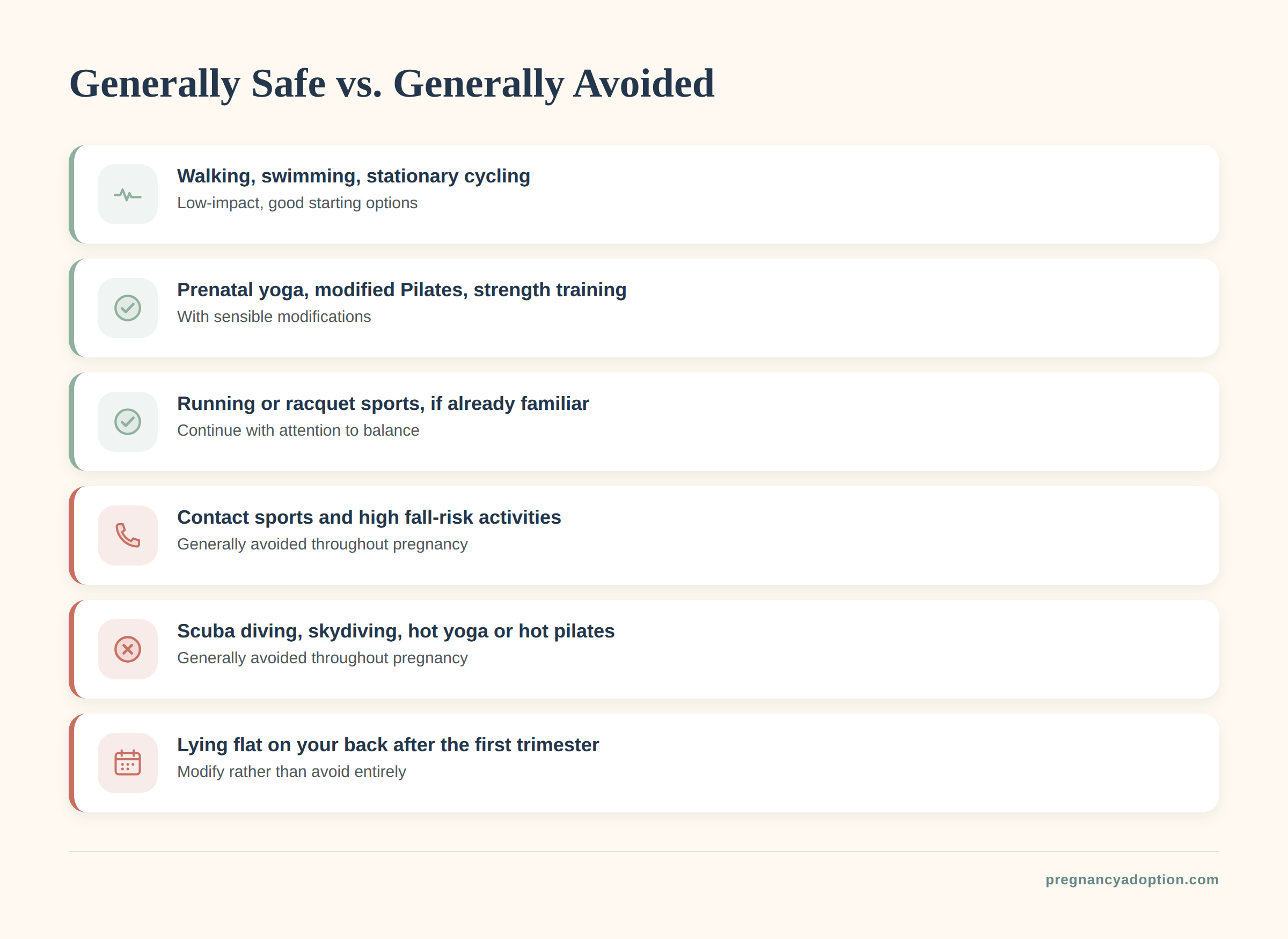
Walking and swimming are two of the most commonly recommended options precisely because they’re low-impact, easy to adjust in intensity, and accessible to most fitness levels, including people starting from scratch.
Stationary Cycling and Low-Impact Aerobics
Stationary cycling removes the balance and fall-risk concerns of road cycling while still offering a solid cardiovascular workout; low-impact aerobics classes offer a similar profile with added variety.
Strength Training and Flexibility Work
Modified Strength Training
Strength training is generally considered compatible with pregnancy when modified appropriately — for example, avoiding movements that involve lying flat on the back for extended periods after the first trimester, and adjusting weight and range of motion as needed.
Prenatal Yoga and Modified Pilates
Prenatal-specific yoga and modified Pilates classes are designed around pregnancy’s shifting center of gravity and loosening ligaments, which can make them more comfortable than a general class as pregnancy progresses. Regular (non-prenatal, non-hot) yoga and Pilates are also generally considered reasonable options with sensible modifications.
Running, Jogging, and Racquet Sports — If Already Familiar
Running, jogging, and racquet sports are generally considered reasonable for people who were already doing them regularly before pregnancy, continued with attention to balance and impact as the pregnancy progresses.
Activities to Avoid or Modify
A smaller set of positions and activity types is generally recommended against during pregnancy, for reasons specific to pregnancy’s physical changes.
Positions and Movements to Change
Lying Flat on the Back After the First Trimester
After the first trimester, it’s generally recommended to avoid activities that require lying flat on your back for extended periods. As the uterus grows, this position can compress major blood vessels and reduce blood flow — a modification rather than a reason to stop exercising altogether.
Positions With a Meaningful Fall Risk
As balance shifts later in pregnancy, some positions and movements that were fine earlier may need modification simply because the fall risk or strain has changed, even if the activity itself is still generally fine.
Activities Generally Recommended Against Entirely
Contact Sports and High Fall-Risk Activities
Contact sports (where collision is part of the activity) are generally recommended against throughout pregnancy because of the risk of abdominal trauma. Activities with a high risk of falling — such as gymnastics, downhill skiing, and horseback riding — carry a similar concern.
Scuba Diving, Skydiving, and Hot Yoga or Hot Pilates
Scuba diving and skydiving are generally recommended against during pregnancy, as is “hot yoga” or “hot pilates” — exercise classes performed in a deliberately heated room, due to concerns about overheating.
Who Should Not Do Aerobic Exercise Without Guidance
Most pregnancies have no contraindication to exercise at all. A smaller group of situations call for individualized guidance before starting or continuing aerobic exercise — some ruling it out, others simply calling for extra caution.
Situations That May Rule Out Aerobic Exercise
Conditions Generally Considered Absolute Contraindications
A set of situations is generally considered an absolute contraindication to aerobic exercise during pregnancy — meaning aerobic exercise is generally not recommended at all without a provider’s specific guidance otherwise. See Table 1 below for the full list.
Why These Are Treated Differently
These conditions generally involve either a structural or circulatory risk that aerobic exercise could worsen, or an underlying condition serious enough that exercise guidance needs to be built around managing that condition first.
Situations That Call for Extra Caution, Not Necessarily Avoidance
Conditions Generally Considered Relative Contraindications
A second group of situations is generally considered a relative contraindication — meaning exercise may still be appropriate, but only with individualized guidance weighing the specific risks and benefits for that situation. See Table 1 below.
This List Is Not Exhaustive
Both lists here reflect commonly cited examples, not an exhaustive clinical list. If you have any condition you’re unsure about, the right move is always to ask your own provider rather than rely on a general list.
| Category | Examples |
|---|---|
| Absolute contraindications to aerobic exercise | Ruptured membranes; preterm labor; unexplained ongoing vaginal bleeding; placenta previa after 28 weeks; pulmonary embolism; cervical insufficiency (incompetent cervix); intrauterine growth restriction; high-order multiple pregnancy (triplets or more); uncontrolled type 1 diabetes, hypertension, or thyroid disease; certain respiratory or systemic disorders |
| Relative contraindications (individualized guidance needed) | Recurrent pregnancy loss; history of spontaneous preterm birth; twin pregnancy after 28 weeks; mild-to-moderate cardiovascular or respiratory disease; symptomatic anemia; malnutrition; a current or past eating disorder |
Warning Signs to Stop Exercising and Call Your Provider
Regardless of how healthy your pregnancy has been so far, certain symptoms during or after exercise mean stop right away and contact your provider — or, for some of them, seek emergency care.
The Core Warning-Sign List
Symptoms That Mean Stop Immediately
Vaginal bleeding, dizziness or lightheadedness, shortness of breath before exertion, a racing or irregular heartbeat, chest pain, unusual or severe pain, and reduced or absent fetal movement are all widely cited warning signs that mean stop exercising and contact your provider right away.
Additional Signs Worth Knowing
Fluid leaking from the vagina, regular painful contractions, a severe headache, muscle weakness that affects your balance, and calf pain or swelling are also commonly listed as reasons to stop and get checked.
What to Do If a Warning Sign Occurs
Stop and Assess
If any of these symptoms occur, stop exercising right away rather than trying to push through or finish a set.
Call Your Provider — or Go to the ER for the Most Urgent Signs
Contact your provider promptly for guidance. For heavy bleeding, fluid clearly leaking, severe or constant pain, signs of labor before term, chest pain, or no felt fetal movement when you’d expect to feel it, go to an emergency room or labor and delivery unit rather than waiting for a callback.

Exercise in the First Trimester
The first trimester often brings its own exercise-specific considerations, mostly driven by fatigue and nausea rather than any new physical restriction.
What Tends to Change Early On
Fatigue and Nausea May Limit Intensity
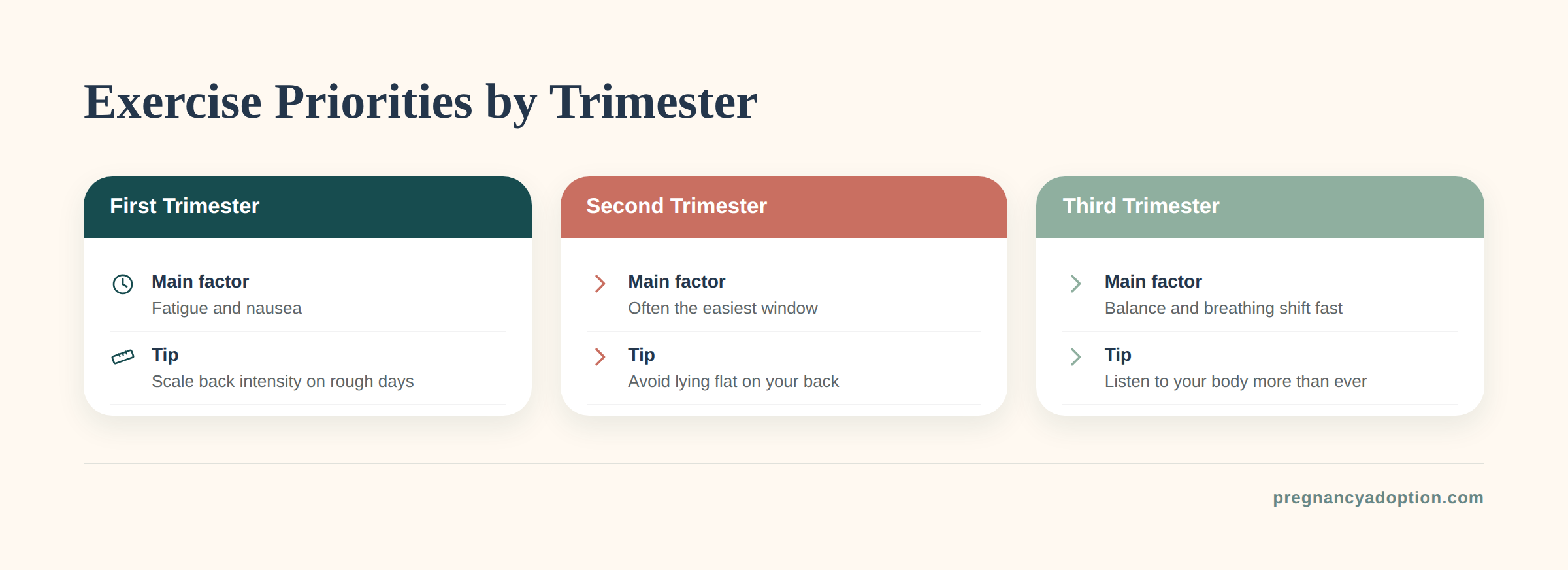
First-trimester fatigue and nausea can make even familiar workouts feel harder; scaling back intensity or duration on a rough day is a reasonable response rather than something to push through.
Hydration and Temperature Regulation
Staying well hydrated and avoiding overheating matters throughout pregnancy, but can be an easy thing to overlook in the first trimester when nausea may already be affecting appetite and fluid intake.
Where to Go for the Full First-Trimester Picture
A Dedicated Guide to This Stage
For the complete first-trimester picture — appointments, symptoms, nutrition, and more, alongside exercise — see our first trimester guide, which covers this stage in full depth.
This Section Stays Exercise-Specific
This guide keeps its trimester sections focused specifically on exercise so it can serve as a single reference across all three trimesters, rather than repeating each trimester guide’s full content here.
Exercise in the Second Trimester
For many people, the second trimester is the most comfortable stretch for staying active, as first-trimester fatigue and nausea often ease.
What Tends to Change in the Middle Trimester
Often the Easiest Trimester for Activity
With morning sickness typically easing and the belly not yet large enough to meaningfully affect balance for most people, the second trimester is often cited as the most comfortable window for maintaining or building an exercise routine.
The Back-Lying Modification Begins Here
This is the point where avoiding extended time lying flat on the back becomes a specific recommendation (see “Activities to Avoid or Modify” above) — a modification to keep in mind for floor exercises and some yoga poses from here forward.
Where to Go for the Full Second-Trimester Picture
A Dedicated Guide to This Stage
For the complete second-trimester picture, see our second trimester guide.
Checking In on Any New Conditions
If a second-trimester screening uncovers a new condition — gestational diabetes, for example — that can change exercise guidance; see “Exercise and Gestational Diabetes” below.
Exercise in the Third Trimester
The third trimester usually calls for the most adjustment, as the body’s changes become most pronounced.
What Tends to Change Late in Pregnancy
Balance and Breathing Change Faster
As the center of gravity shifts further and the growing uterus puts more pressure on the diaphragm, both balance and breathing can change more quickly than they did earlier in pregnancy — a pace that felt comfortable in the second trimester may need real adjustment now.
Listening to Your Body Matters More Than Ever
This is the trimester where paying closer attention to how you feel, rather than sticking rigidly to an earlier routine, tends to matter most.
Where to Go for the Full Third-Trimester Picture
A Dedicated Guide to This Stage
For the complete third-trimester picture — including delivery preparation alongside exercise — see our third trimester guide.
Exercise Doesn’t Need to Stop Near Your Due Date
Absent a specific reason to stop, gentle activity like walking is often encouraged right up until labor begins, though intensity for most people naturally decreases as the third trimester progresses.
Exercise and Gestational Diabetes
If gestational diabetes is diagnosed, exercise shifts from a general wellness habit to a specific, well-supported management tool.
A Specific, Well-Supported Use Case
Exercise Improves Insulin Sensitivity
Physical activity increases how efficiently muscles take up glucose from the bloodstream, directly counteracting the insulin resistance that drives gestational diabetes — sometimes with an effect visible the same day.
Walking After Meals Is a Specific, Simple Tactic
A short walk, even just 10 to 15 minutes, after a meal is a commonly recommended tactic specifically because it helps blunt the post-meal blood sugar spike that routine post-meal glucose monitoring is designed to catch.
Where to Go for the Full Management Picture
A Dedicated Guide to Gestational Diabetes
For the complete picture of managing gestational diabetes — diet, monitoring, medication when needed, and exercise together — see our gestational diabetes guide.
This Section Stays Focused on the Exercise Piece
This guide’s gestational-diabetes section stays narrowly focused on the exercise connection so the fuller management picture doesn’t need to be repeated here.
Pelvic Floor and Core Considerations
The pelvic floor and core muscles get special attention in pregnancy exercise guidance because of how pregnancy itself changes the forces acting on them.
Why This Area Gets Special Attention
Increased Pressure and Strain
A growing uterus increases intra-abdominal pressure and places additional strain on the pelvic floor and the connective tissue of the abdominal midline, which is why core and pelvic floor exercises are often modified rather than dropped entirely.
Pelvic Floor Awareness Can Help Later, Too
Building pelvic floor awareness during pregnancy is often framed as useful preparation for labor and postpartum recovery, not just a pregnancy-specific precaution.
Exercises Often Modified or Avoided
Traditional Crunches and Sit-Ups
Traditional crunches and sit-ups are commonly modified or replaced with gentler core work, since the forward-curling motion can increase strain on an already-stretched abdominal midline.
Heavy Straining or Breath-Holding Movements
Heavy lifting with breath-holding (the Valsalva maneuver) is generally discouraged, since the combination of straining and increased intra-abdominal pressure is specifically what pelvic-floor-focused guidance tries to avoid.
Common Mistakes and Misconceptions
A few misconceptions about exercise and pregnancy come up often enough to be worth addressing directly.
“Any Exercise Is Risky Once You’re Pregnant”
Not Supported by Current Guidance
This is one of the more persistent misconceptions, and it isn’t supported by current guidance for the large majority of pregnancies. Exercise is encouraged, not just tolerated, for most pregnancies without a specific complication.
Where This Idea Often Comes From
This belief often comes from outdated guidance or from confusing the small set of genuinely restricted activities (see “Activities to Avoid or Modify” above) with exercise in general.
“If I Feel Fine, Nothing Can Be Wrong”
Feeling Fine Doesn’t Rule Everything Out
Some warning signs, like reduced fetal movement or a slow change in blood pressure, aren’t always something you’d necessarily feel as discomfort during a workout. That’s part of why routine prenatal care matters alongside, not instead of, paying attention to how you feel during exercise.
Warning Signs Can Appear Suddenly
A pregnancy that’s been entirely uncomplicated can still develop a new warning sign without much warning — which is exactly why the warning-sign list above applies to every pregnancy, not just ones already flagged as higher-risk.
“I Have to Stop Everything I Did Before”
Continuing Is Usually the Default, Not the Exception
As covered in “Starting From Scratch vs. Continuing an Existing Routine” above, people who were already active before pregnancy can generally keep going, with modification rather than wholesale replacement.
Modification Is Different From Stopping
Swapping a few specific movements or positions (lying flat on the back, high-fall-risk activities) is a modification, not evidence that the whole routine needs to stop.
Returning to Exercise After Birth
Exercise guidance doesn’t end at delivery — it shifts into a separate, postpartum phase with its own pacing.
A General Timeline, Not a Rule
Timelines Vary by Delivery and Recovery
How quickly it’s appropriate to return to exercise after birth varies by the type of delivery, how recovery is going, and any complications, which is why there’s no single universal number of weeks that applies to everyone.
Your Postpartum Visit Is the Natural Check-In Point
Your postpartum follow-up visit is generally the natural point to discuss returning to exercise specifically, since your provider can assess how your individual recovery is going.
Easing Back In
Gentle Movement Often Starts Earlier Than Structured Exercise
Gentle walking is often encouraged relatively early in recovery for many people, well before a return to more structured or higher-intensity exercise is appropriate.
Mental Health Benefits Apply Here Too
The mental health benefits discussed earlier in this guide apply specifically to the postpartum period as well — another reason gradual, provider-approved movement is often encouraged once you’re cleared to resume.
A Simple Weekly Starting Plan
If you’re looking for a concrete starting point rather than general guidance, here’s one simple way to structure a first week — adjust freely based on how you feel and what your provider has told you.
A Sample First Week
A Deliberately Modest Starting Point
Table 2 below lays out one reasonable way to structure a first week for someone starting from a sedentary baseline. It’s intentionally light — the goal of week one is building the habit, not hitting a target number.
Adjust Freely
Swap any day’s activity for another option from “Generally Safe Types of Exercise” above, move rest days around your schedule, and shorten any session that doesn’t feel right that day.
| Day | Suggested Activity |
|---|---|
| Monday | 15–20 minute walk, comfortable pace |
| Tuesday | Rest, or gentle stretching |
| Wednesday | 15–20 minute walk or stationary cycling |
| Thursday | Rest, or a prenatal yoga session |
| Friday | 20–30 minute walk or swim |
| Saturday | Light strength training or another walk |
| Sunday | Rest |
Building Up From Here
Why This Week Is Intentionally Below the General Target
This sample week totals roughly 70–90 minutes in its first pass — intentionally below the 150-minute general target, since building up gradually matters more than hitting the full number in week one.
A Reasonable Way to Progress
Add duration or frequency over subsequent weeks as it feels sustainable — for example, adding five minutes to each walk or turning one rest day into a light-activity day every week or two, until you’re consistently in range of the general weekly target described earlier in this guide.
Glossary of Terms Used in This Guide
Exercise and Activity Terms
Moderate-Intensity Activity
Activity intense enough to raise your heart rate and breathing noticeably, while still allowing comfortable conversation (the “talk test”) — brisk walking is a commonly used example.
Talk Test
An informal way to gauge exercise intensity: if you can comfortably hold a conversation while exercising, the intensity is likely in a reasonable moderate range.
Valsalva Maneuver
Straining against a closed airway while holding your breath, as can happen during heavy lifting — generally discouraged during pregnancy because of the combined effect on intra-abdominal pressure and blood pressure.
Medical and Clinical Terms
Contraindication
A condition or situation that makes a particular treatment or activity inadvisable; an “absolute” contraindication generally rules an activity out, while a “relative” contraindication calls for individualized weighing of risks and benefits.
Cervical Insufficiency (Incompetent Cervix)
A condition in which the cervix begins to open prematurely without labor, increasing the risk of preterm birth — generally considered an absolute contraindication to aerobic exercise.
Diastasis Recti
A separation of the abdominal muscles along the midline that can occur during pregnancy as the uterus grows — part of why certain core exercises are modified rather than continued unchanged.
Pregnancy-Stage Terms
Gestational Diabetes
A form of diabetes that develops during pregnancy, typically identified through screening in the second trimester, and often managed in part through diet and exercise.
Postpartum Period
The weeks and months following delivery during which the body recovers from pregnancy and birth; exercise guidance shifts to a separate, individualized postpartum framework during this time.
Frequently Asked Questions
Getting Started
Is it safe to start exercising if I’ve never exercised regularly before?
Generally, yes — starting gently, such as with walking, and building up gradually is a reasonable approach for most pregnancies, ideally after a quick check-in with your provider.
Do I need my provider’s permission before I start?
You don’t necessarily need formal “permission,” but mentioning a new routine to your provider is a reasonable step, especially if you have any pre-existing health conditions.
What if I was very sedentary before pregnancy?
A sedentary starting point doesn’t rule out exercise during pregnancy — it just means starting at a lower intensity and building up more gradually than someone who was already active.
Safety and Risk
Can exercise cause a miscarriage?
No — ordinary exercise within generally recommended guidelines is not considered a cause of miscarriage for most pregnancies.
Is it safe to exercise every single day?
Being active most days of the week is generally fine and consistent with common guidance; building in some lighter or rest days, as in the sample week above, is also a reasonable approach.
What if I feel dizzy partway through a workout?
Stop right away, sit or lie on your side, and rest. If dizziness is severe, doesn’t resolve quickly, or recurs, contact your provider.
Is it safe to exercise in hot weather?
Exercising in hot, humid conditions calls for extra caution during pregnancy because of overheating risk — staying well hydrated, choosing cooler times of day, and moving indoors on especially hot days are all reasonable adjustments, on top of the general recommendation against deliberately heated classes like hot yoga.
Can I exercise if I have morning sickness?
Many people find gentle activity, like a short walk, doesn’t worsen nausea and can even help; others need to scale back on rough days. Both responses are normal — let how you feel guide the day’s intensity rather than a fixed plan.
Is it safe to lift weights during pregnancy?
Modified strength training is generally considered compatible with pregnancy, with attention to avoiding breath-holding under heavy loads (see “Pelvic Floor and Core Considerations” above) and adjusting weight as the pregnancy progresses.
Specific Activities
Can I keep running throughout my pregnancy?
If you were already a regular runner before pregnancy, continuing to run is generally considered reasonable, with attention to balance, impact, and how you feel as the pregnancy progresses; many runners naturally shift toward shorter or slower runs, or substitute walking, later in the third trimester.
Is swimming especially good during pregnancy?
Swimming is frequently highlighted as a particularly comfortable option because the water supports your weight, reducing joint and ligament strain while still providing a solid cardiovascular workout.
Can I do hot yoga if I keep the room temperature moderate?
No — “hot yoga” or “hot pilates” classes are generally recommended against during pregnancy regardless of how the room temperature is adjusted, since the concern is about overheating generally, not one specific temperature threshold.
Is Pilates safe, or just “prenatal Pilates”?
Regular Pilates classes are generally considered a reasonable option with sensible modifications (avoiding extended time on your back after the first trimester, adjusting intensity); prenatal-specific classes simply build those modifications in by design, which some people find more comfortable.
What about contact sports I already played, like soccer or basketball?
Contact and collision sports are generally recommended against throughout pregnancy because of the risk of abdominal trauma from a fall or collision, even for someone who played them regularly before pregnancy.
Is horseback riding really off-limits?
Horseback riding is generally recommended against during pregnancy because of its fall risk, regardless of riding experience — an experienced rider still faces the same risk if the horse is startled or stumbles.
Timing and Trimester-Specific Questions
Does exercise intensity need to decrease every trimester?
Not necessarily on a fixed schedule — many people maintain a fairly similar intensity through the second trimester and only scale back meaningfully in the third, as covered in the trimester sections above. Let how you feel, not a fixed timeline, guide adjustments.
Is there a point late in pregnancy where I should stop exercising completely?
Generally, no single universal stopping point exists — gentle activity like walking is often fine right up until labor begins, absent a specific reason your provider has given you to stop sooner.
Can exercise bring on labor if I’m close to my due date?
Exercise within generally recommended guidelines is not considered a reliable way to induce labor, and ordinary activity near your due date is not typically a safety concern on its own.
I’m past my due date — is exercise still fine?
If your pregnancy continues past your due date without any new complication, exercise guidance generally continues to apply the same way; ask your provider if you have any specific concerns at this stage.
Medical Conditions and Contraindications
I have mild asthma — can I still exercise?
Mild-to-moderate respiratory disease is generally listed as a relative contraindication, meaning exercise may still be appropriate but calls for individualized guidance from your provider, who can factor in how well-controlled your asthma is.
I had a miscarriage in a previous pregnancy — does that affect what I can do now?
A history of recurrent pregnancy loss is generally listed as a relative contraindication, which means it’s worth discussing specifically with your provider rather than assuming either that it rules out exercise or that it changes nothing.
I’m pregnant with twins — do the rules change?
A twin pregnancy is generally treated as a relative contraindication specifically after 28 weeks, meaning exercise guidance becomes more individualized from that point forward; earlier in a twin pregnancy, general guidance often still applies similarly to a single pregnancy, per your provider’s assessment.
What if I have high blood pressure?
Uncontrolled hypertension is generally listed as an absolute contraindication to aerobic exercise, while well-controlled blood pressure is a different situation entirely — this distinction is exactly why “uncontrolled” versions of certain conditions are singled out rather than the conditions themselves.
I have anemia — should I stop exercising?
Symptomatic anemia (anemia causing noticeable symptoms, not just a lab value slightly outside range) is generally listed as a relative contraindication; ask your provider whether your specific anemia and its treatment plan change your exercise guidance.
I’m in recovery from an eating disorder — is exercise guidance different for me?
Yes, generally — a current or past eating disorder is generally listed as a relative contraindication, reflecting the importance of coordinating exercise guidance with the broader care team managing that recovery, rather than applying general pregnancy-exercise guidance in isolation.
Equipment and Practical Logistics
Do I need special shoes or clothing?
No special equipment is required; supportive, well-fitting athletic shoes and comfortable, breathable clothing that accommodates your changing body are reasonable practical choices, not a safety requirement.
Should I wear a support belt while exercising?
Some people find a maternity support belt helpful for comfort during later-pregnancy activity, particularly walking; it’s a comfort choice rather than a safety requirement, and your provider or a physical therapist can advise on fit if you’re considering one.
Is it safe to use a heart rate monitor to track intensity instead of the talk test?
A heart rate monitor can be a useful additional data point, but the talk test remains a simple, widely cited way to gauge intensity without needing a target heart rate number, since appropriate heart rate ranges vary by individual fitness level.
Can I keep my gym membership and go to regular classes?
Yes, generally, as long as the specific class type is one of the generally safe options above (not hot yoga, not a contact sport, not a high-fall-risk class) and you communicate to the instructor that you’re pregnant so they can suggest modifications.
Is chlorine in a swimming pool a concern?
Ordinary recreational pool chlorine levels are not generally considered a pregnancy-specific concern for swimming as exercise; if you have a specific sensitivity or concern, that’s worth raising with your provider.
Symptoms During Exercise
I felt a few Braxton Hicks contractions during a walk — is that a warning sign?
Occasional, painless, irregular tightening (Braxton Hicks contractions) during activity is common later in pregnancy and is different from the “regular, painful tightening” described in the warning-signs list above. If contractions become regular and painful, stop and follow the warning-sign guidance.
I get sharp pain on one side of my belly when I walk fast — is that dangerous?
This is often round ligament pain, a common and generally harmless pregnancy symptom related to the stretching ligaments supporting the uterus, rather than a sign to stop exercise altogether; slowing down or shortening your stride can often ease it. If the pain is severe, constant, or doesn’t fit this pattern, treat it as “unusual or severe pain” from the warning-signs list and contact your provider.
My ankles swell after I exercise — should I be worried?
Mild swelling after activity, especially later in pregnancy and in warm weather, is common. Sudden or severe swelling, especially with a headache or vision changes, is different and should be discussed with your provider promptly.
I feel more out of breath than I expected, even at a pace that used to feel easy — is that normal?
Yes — increased oxygen demand and the growing uterus’s effect on the diaphragm both make exercise feel more taxing even at a familiar pace; adjusting your expectations and intensity accordingly, rather than pushing to match a pre-pregnancy pace, is a reasonable response.
Postpartum and Breastfeeding
Does exercise affect milk supply if I’m breastfeeding?
Moderate exercise is not generally considered a concern for milk supply; staying well hydrated and wearing a supportive, well-fitting bra during activity are reasonable practical steps for comfort.
I had a cesarean delivery — does that change my return-to-exercise timeline?
Recovery from a cesarean delivery generally involves its own healing timeline for the incision and abdominal muscles, which is part of why there’s no single universal number of weeks that applies to every delivery type; your postpartum follow-up visit is the place to discuss a timeline specific to your recovery.
What postpartum exercise is generally considered safe to start earliest?
Gentle walking and pelvic floor awareness exercises are often among the earliest activities people are encouraged to resume, though the exact timing still depends on your individual recovery and your provider’s guidance.
Can exercise help close diastasis recti after birth?
Certain postpartum exercises, often guided by a physical therapist who specializes in this area, can help with diastasis recti recovery; this is generally a more individualized process than general postpartum exercise guidance covers.
Multiples and Higher-Risk Pregnancy Considerations
I’m pregnant with twins and past 28 weeks — what should I actually do differently?
Past 28 weeks, a twin pregnancy generally calls for individualized guidance rather than general guidance applying unchanged; your provider can advise on a specific plan based on how your twin pregnancy is progressing.
I’ve been told I have a “high-risk” pregnancy — does that automatically rule out exercise?
Not automatically — “high-risk” covers a wide range of situations, some of which are listed contraindications above and some of which aren’t. Ask specifically what about your situation affects exercise guidance, rather than assuming the label itself rules everything out.
I’m on bed rest — does any of this guide apply to me?
If you’ve been specifically prescribed bed rest or significant activity restriction, follow that guidance over the general guidance in this article — your provider has already made an individualized determination that supersedes general recommendations.
Mental Health and Motivation
I’ve lost motivation to exercise since becoming pregnant — is that a problem?
A dip in motivation is common and not itself a medical concern; if low motivation is part of a broader pattern of low mood, our postpartum depression guide covers mood-related symptoms and when to reach out for support (it covers the postpartum window specifically, but the symptom-recognition content is a useful starting point for prenatal mood questions too).
Does exercise really help with pregnancy-related anxiety?
Physical activity is commonly cited as one of several tools that can help with everyday stress and mood during pregnancy, though it isn’t a substitute for professional support if anxiety is significant or persistent.
I feel guilty on days I don’t exercise — is that something to worry about?
Occasional guilt about a missed workout is common and not itself concerning, but persistent guilt, self-criticism, or feeling like you must exercise regardless of how you feel is worth mentioning to your provider, since it can sometimes reflect something beyond ordinary motivation.
Comparing This Guide to Others on This Site
How is this guide different from the trimester guides?
The first, second, and third trimester guides each cover that trimester’s full picture — appointments, development, symptoms, and more — with a brief exercise mention. This guide is the reverse: a full picture of exercise specifically, with brief trimester-by-trimester notes that point back to those guides for everything else.
How is this different from the healthy pregnancy guide?
Our healthy pregnancy guide is a broader wellness hub covering nutrition, sleep, prenatal care, and safety alongside a brief exercise mention. This guide is the dedicated, full-depth resource that guide points to specifically for exercise.
I have gestational diabetes — should I read this guide or the gestational diabetes guide?
Both, depending on what you need: this guide covers exercise broadly, including the gestational-diabetes-specific walking-after-meals tactic; our gestational diabetes guide covers the complete management picture — diet, monitoring, and medication alongside exercise.
Myths From Family and Friends
My mother-in-law insists I shouldn’t raise my arms above my head — is that true?
No — this is a widely circulated myth without a basis in current medical guidance. Raising your arms overhead does not wrap the umbilical cord around the baby’s neck or cause any similar harm; it’s a persistent folk belief, not a clinical caution.
A friend told me walking too much can bring on early labor — should I slow down?
Walking within generally recommended guidelines is not considered a way to bring on early labor. If you’re experiencing actual warning signs of preterm labor (see the warning-signs list above), that’s a different situation worth calling your provider about — but ordinary walking itself isn’t the cause.
Someone told me I shouldn’t exercise at all after 20 weeks — is there any truth to that?
No single general cutoff like this is supported by current guidance; exercise guidance shifts gradually across the second and third trimesters (see the trimester sections above) rather than stopping at any one fixed week.
I’ve heard yoga inversions are dangerous during pregnancy — true?
Inversions (poses where the head is below the heart, or fully upside-down positions) are generally approached with more caution later in pregnancy because of balance and blood-pressure considerations, but this is a modification question for a prenatal-trained instructor rather than a reason to avoid yoga altogether.
Quick Scenario Walkthroughs
I’m 10 weeks pregnant, exhausted, and haven’t exercised since I found out — where do I start?
Start with the sample first week in “A Simple Weekly Starting Plan” above, scaled down further if needed on especially tired days — even a 10-minute walk counts as a start, and first-trimester fatigue easing up is common as you move into the second trimester.
I’m a marathon runner and just found out I’m pregnant — do I need to stop?
Not automatically. Continuing a well-established running routine is generally considered reasonable, with attention to how you feel and your provider’s input, especially regarding race-day intensity and heat exposure during longer runs.
I just had my gestational diabetes diagnosis and I’m overwhelmed — what’s the exercise piece, specifically?
The specific, well-supported tactic is a short walk after meals (see “Exercise and Gestational Diabetes” above); our gestational diabetes guide covers everything else in your new management plan.
I’m 34 weeks along and suddenly can’t do half the things I used to — is something wrong?
Not necessarily — balance and breathing changing faster late in the third trimester is common and expected (see “Exercise in the Third Trimester” above). If anything from the warning-signs list applies, that’s different and worth calling about; otherwise, scaling back is a normal adjustment, not a sign of a problem.
My provider hasn’t brought up exercise at all — should I ask, or assume it’s fine?
Asking directly is a reasonable step rather than assuming either way — a quick question at your next visit (“is there anything about my situation that changes general exercise guidance?”) gives you a clear, individualized answer instead of a guess.
Returning to This Guide Later
Will my exercise plan need to change again later in pregnancy?
Likely yes, at least somewhat — this guide’s trimester sections and sample starting plan are designed to be revisited as your pregnancy progresses, rather than read once and set aside.
Is it okay to bookmark this guide and come back to specific sections later?
Yes — many readers find the trimester-specific sections and the warning-signs list useful to revisit as their pregnancy progresses, rather than needing to reread the entire guide each time.
What’s the single most important takeaway from this entire guide?
For most pregnancies without a specific complication, exercise is encouraged, and a common general target is about 150 minutes of moderate activity per week, built up gradually and adjusted to how you feel — with a short, specific list of warning signs that always means stop and call your provider.
If I only do one thing after reading this, what should it be?
If you haven’t already, mention your exercise routine — new or continuing — to your provider at your next visit, so any guidance specific to your pregnancy is factored in going forward.
Special Situations
I’m a pregnant teenager — does any of this guidance change for me?
The core exercise guidance in this guide applies the same way regardless of age; teen-specific pregnancy considerations beyond exercise are covered in our guide for pregnant teenagers.
I conceived through fertility treatment — is exercise guidance different?
Generally, once a pregnancy from fertility treatment is established and progressing typically, general exercise guidance applies the same way; your fertility specialist or obstetric provider may have specific early-pregnancy guidance during the transition between the two types of care, which is worth clarifying directly.
I have pelvic girdle pain (SPD) — can I still exercise?
Pelvic girdle pain (sometimes called symphysis pubis dysfunction) often calls for specific modifications — avoiding activities that involve wide leg separation or asymmetrical loading, for example — rather than stopping activity altogether; a pelvic-floor physical therapist can often help tailor a plan.
I’m carrying after a previous loss and I’m anxious about every twinge during exercise — is that normal?
Heightened anxiety after a previous loss is an understandable response, and it’s reasonable to mention it to your provider — both so they can address any medical questions specific to your history and so they’re aware of how you’re feeling emotionally during this pregnancy.
Documentation and Tracking
Should I track my workouts during pregnancy?
Tracking is optional and personal preference — some people find it motivating to log activity, while others prefer not to. Neither approach is required by any clinical guidance.
Is it worth mentioning my exercise routine at every prenatal visit?
Mentioning any changes — a new activity, a new symptom during exercise, or a significant change in how you feel — is worth bringing up when it happens, rather than saving it all for a single comprehensive update.
Should I log symptoms I notice during exercise, like round ligament pain or swelling?
If a symptom is new, worsening, or doesn’t match a pattern you recognize, noting when it happens and mentioning it at your next visit (or sooner, if it concerns you) is a reasonable approach.
Partner and Support Person Questions
My partner is worried every time I exercise — how do I reassure them?
Sharing this guide’s short answer and warning-signs list can help; many partners feel reassured once they understand that exercise is generally encouraged and that there’s a specific, known list of signs that would mean stopping, rather than a vague, constant risk.
Can my partner join me for pregnancy-safe workouts?
Yes — walking, swimming, and many prenatal classes welcome a partner, and having a workout companion can help with motivation and consistency.
Exercise Alongside Diet and Weight Gain
Does exercise affect how much weight I gain during pregnancy?
Exercise is one factor among several — alongside diet, starting weight, and individual variation — that can influence weight gain during pregnancy; it isn’t typically used on its own as a weight-management tool during pregnancy. Our healthy pregnancy guide covers weight-gain guidance alongside nutrition in more depth.
Do I need to eat differently on days I exercise?
Staying adequately fueled and hydrated matters on exercise days just as it does generally during pregnancy; a specific pre- or post-workout eating plan isn’t generally required for moderate activity. General pregnancy nutrition guidance is covered in our healthy pregnancy guide.
I’m trying to eat better and exercise more at the same time — any guidance on doing both?
Approaching both as gradual, sustainable habits — rather than major changes all at once — tends to work better for most people; our healthy pregnancy guide covers both pieces together as part of its overall wellness framework.
A Few Final Clarifying Questions
Is there a single “best” exercise for pregnancy?
No single activity is considered universally best — walking and swimming are frequently highlighted for their accessibility and low joint strain, but the best choice for you is whichever generally safe activity you’ll actually do consistently.
How do I know if I’m pushing too hard versus not hard enough?
The talk test (see “How Much Exercise Is Recommended” above) is a simple everyday check; if you’re consistently unable to hold a conversation, ease off, and if a workout feels notably easier than expected over time, you may have room to gradually increase intensity.
Can I combine several of the activities mentioned in this guide in the same week?
Yes — mixing activity types (for example, walking most days with one or two strength or prenatal-yoga sessions) is a common and reasonable approach, and variety can also help with motivation.
Where should I go if I still have questions this guide didn’t answer?
Your own provider is always the best source for anything specific to your pregnancy; this guide is designed to help you ask better questions at that visit, not to replace that conversation.
Measuring Progress and Setting Goals
Is it okay to set a fitness goal, like completing a certain number of walks per week?
Setting a simple, flexible goal — such as the sample weekly plan above — can help with motivation and consistency, as long as the goal stays flexible enough to adjust for how you feel on a given day rather than becoming a source of pressure.
Should my goals change if my pregnancy is considered low-risk versus higher-risk?
Broadly, yes — a low-risk pregnancy without any contraindication can generally work toward the general weekly target discussed earlier, while a higher-risk pregnancy’s goals should come directly from your provider’s individualized guidance rather than a general target.
Is it normal for progress to feel slower during pregnancy than it did before?
Yes — the goal of exercise during pregnancy shifts from building fitness in the way it might have before pregnancy to maintaining comfortable, consistent activity; measuring progress by consistency and how you feel, rather than by pace or weight lifted, tends to be a more useful frame.
How do I know when it’s time to scale back for the day versus push through a little?
The talk test and how you feel are the two simplest everyday guides; general tiredness that eases once you get moving is often fine to push through gently, while anything on the warning-signs list above means stop rather than push through.
Work, Travel, and Everyday Movement
I have a desk job — does sitting all day cancel out the benefits of exercising a few times a week?
Regular exercise sessions still provide meaningful benefit even alongside a largely sedentary job, though breaking up long sitting stretches with short standing or walking breaks is a reasonable additional habit, mainly for general comfort and circulation rather than as a separate requirement.
I’m traveling for work while pregnant — can I keep up my routine on the road?
Walking is often the easiest routine to maintain while traveling, since it requires no equipment; many hotels also have pools or basic gym equipment suitable for the low-impact options described above.
Does flying affect what kind of exercise is safe before or after a flight?
Flying itself isn’t generally described as changing exercise guidance, though moving periodically during a long flight (an ankle pump or short aisle walk) is commonly recommended for circulation regardless of exercise habits.
My job involves physical labor, not a desk — is that the same as “exercise”?
Occupational physical activity and recreational exercise aren’t always equivalent — job-required lifting, prolonged standing, or repetitive strain may call for different guidance than a chosen workout. If your job is physically demanding, discussing any needed accommodations with your provider and employer is a reasonable step, separate from this guide’s exercise-specific focus.
A Few More Practical Questions
Can I take a fitness class I’ve never tried before, like a new prenatal barre or dance class?
Trying a new class is generally fine as long as it falls within the generally-safe category described earlier in this guide (low-impact, not a contact sport, not deliberately heated, reasonable fall risk); mentioning your pregnancy to the instructor beforehand lets them suggest modifications as the class goes.
Is there a point in pregnancy where I should switch from a treadmill to walking outside, or vice versa?
Neither surface is specifically preferred over the other for safety reasons; personal comfort, balance, and convenience are reasonable factors for choosing between them as your pregnancy progresses.
I used to do CrossFit — is there a pregnancy-safe version?
High-intensity functional training programs like CrossFit often require significant individualized modification during pregnancy — reducing load, avoiding breath-holding under heavy lifts, and swapping out high-fall-risk or supine movements; working with a coach experienced in prenatal modifications, alongside your provider’s input, is a reasonable approach if you want to continue this specific type of training.
Can I keep cycling outdoors, or should I switch to a stationary bike?
Outdoor cycling carries a fall risk that increases as balance shifts later in pregnancy, which is part of why stationary cycling is more consistently listed as a generally safe option across all three trimesters; some people continue outdoor cycling earlier in pregnancy and transition to a stationary bike later, based on their own comfort and balance.
Whatever specific question brought you to this guide, the short answer stays the same: for most pregnancies without a specific complication, staying active is encouraged, and the details above exist to help you do that comfortably and safely.
Last Few Odds and Ends
Is there a reliable app or tool for tracking pregnancy-safe workouts?
Several general fitness and pregnancy apps include activity tracking, though this guide doesn’t endorse a specific product; whatever tool you use, the guidance in this article — the general weekly target, the talk test, and the warning-signs list — still applies regardless of how you track it.
Can I print or save this guide to reference before my next workout?
Yes — this guide is published as a standard web page, and you’re welcome to save, print, or bookmark it, including the sample starting week and the warning-signs list, for quick reference.
Is it normal to need to re-read sections of this guide more than once as my pregnancy progresses?
Completely normal — many readers find the trimester-specific sections especially useful to revisit as each one arrives, rather than trying to absorb every detail in a single read-through early in pregnancy.
Does this guide apply the same way if this isn’t my first pregnancy?
Broadly yes — the general guidance in this article isn’t specific to first versus later pregnancies, though your own history (a prior cesarean, a prior complication, how you recovered last time) is exactly the kind of context worth bringing into the conversation with your provider rather than assuming this pregnancy will mirror an earlier one.
What if my provider’s specific advice conflicts with something in this guide?
Follow your provider’s individualized guidance over this guide’s general information every time — they know your specific pregnancy, medical history, and any complications in a way a general article never can.
Is there a quick summary I can share with a partner, friend, or family member who’s worried about me exercising?
The bottom-line box just below this FAQ section is written to be easy to share or read aloud: exercise is generally encouraged, a specific list of warning signs means stop and call a provider, and anything outside that list is usually a normal part of an active pregnancy rather than a reason for alarm.
Does this guide apply the same way whether I’m planning to parent, considering adoption, or still deciding?
Yes — exercise guidance during pregnancy doesn’t depend on what you’ve decided or haven’t decided about parenting or adoption; this guide focuses purely on the physical-activity question, and it applies the same way regardless of where you are in that separate decision.
I switched providers partway through my pregnancy — do I need to repeat this whole conversation with the new one?
It’s generally worth briefly mentioning your current activity level and anything your previous provider flagged, but you don’t need to repeat the entire general-guidance conversation from scratch — a short summary (“I walk most days and do prenatal yoga once a week, no issues flagged so far”) is usually enough for a new provider to pick up from.
Is there anything in this guide that’s likely to change as research continues?
Specific numbers and lists — the exact weekly-minute target, which conditions count as contraindications, the precise warning-sign list — are the parts most likely to be refined over time as research continues; the broader message that moderate exercise is encouraged for most pregnancies has been stable across multiple recent revisions of major guidance.
Can I come back and ask my own provider to walk through this guide’s “Who Should Not Do Aerobic Exercise Without Guidance” section with me specifically?
Yes — bringing Table 1 from that section to an appointment and asking directly whether anything on it applies to you is a reasonable, efficient way to get a clear, individualized answer.
One last check — what’s the very first thing I should do after reading this guide?
Pick one activity from “Generally Safe Types of Exercise” above, try it for 10 to 15 minutes today or this week, and mention it to your provider at your next visit — that’s the entire first step.
Is it okay if I don’t remember every detail from this guide later?
Yes — remembering the general shape (stay moderately active, know the warning signs, check in with your provider) matters far more than memorizing every specific list, and this guide will still be here to revisit for the details whenever you need them again.
If this entire guide boiled down to one sentence, what would it be?
Move most days, in whatever generally safe way feels good, and stop right away if anything on the warning-signs list shows up.
The bottom line
For most pregnancies without a specific complication, exercise is encouraged, not just tolerated — a common general target is about 150 minutes of moderate-intensity activity per week, adjusted to your own starting point and how you feel. A smaller set of activities, positions, and medical conditions call for modification or individualized guidance, and a specific list of warning signs means stop and call your provider right away. When in doubt about your own situation, the right next step is always a conversation with the provider who knows your pregnancy specifically.
About pregnancyadoption.com/
pregnancyadoption.com/ publishes free, judgment-free information on pregnancy, pregnancy options, and adoption for anyone trying to understand what's happening in their body or what choices are available to them. We are not a law firm, an adoption agency, or a medical practice — we're an independent editorial resource, and we don't place children, provide legal representation, or profit from which option a reader ultimately chooses.
Every article carrying medical or legal information is written to a source-tiering standard (government and medical-authority sources first, established nonprofits second, commercial sources never used as factual authority) and reviewed by a licensed professional before publication. Time-sensitive information is scheduled for review on a recurring cadence, and factual errors reported by readers are corrected promptly. Read our full About & Editorial Guidelines page for details on our review process, sourcing standards, and how to report a correction.
Medical and Legal Disclaimer
This article is provided for general educational purposes only and does not constitute medical advice. Reading this content does not create a doctor-patient relationship between you and pregnancyadoption.com/, its authors, or its reviewers. Always seek the advice of a licensed physician, midwife, or other qualified health care provider with any questions you may have regarding a medical condition, including before starting, changing, or continuing any exercise program during pregnancy, and never disregard or delay seeking professional guidance because of something you have read here. If you believe you may be experiencing a medical emergency, call 911 or your local emergency number immediately.
To the fullest extent permitted by applicable law, pregnancyadoption.com/ and its authors, editors, and medical reviewers disclaim all liability for any loss, injury, or damage of any kind arising from reliance on the information in this article. This disclaimer does not limit any rights you may have under law that cannot be waived. Read our full Medical and Legal Disclaimer for complete terms.
Sources and further reading
This guide draws on clinical and government sources for the following organizations. Individual circumstances vary — use this guide to prepare good questions for your own health care provider, not as a substitute for individualized advice.
- CDC — Physical Activity for Pregnant or Postpartum Women: An Overview
- ACOG Committee Opinion No. 804 — Physical Activity and Exercise During Pregnancy and the Postpartum Period (abstract)
- MDedge — clinical summary of ACOG’s exercise-in-pregnancy recommendations
- Tommy’s (UK) — When to Stop Exercising in Pregnancy
- Our healthy pregnancy guide (same-batch sibling; reciprocal link per PA-0052’s forward-link obligation)