
An ovulation calculator doesn’t need an app or a software tool to work — it’s a formula applied to your own cycle, refined by a handful of physical signs your body gives off around ovulation. This guide walks through exactly how to estimate your fertile window from your cycle length, how to read the three most common tracking methods (basal body temperature, cervical mucus, and ovulation predictor kits), how to time intercourse around what you find, and when irregular cycles or a longer stretch of trying mean it’s worth bringing a provider into the conversation.
Key Takeaways
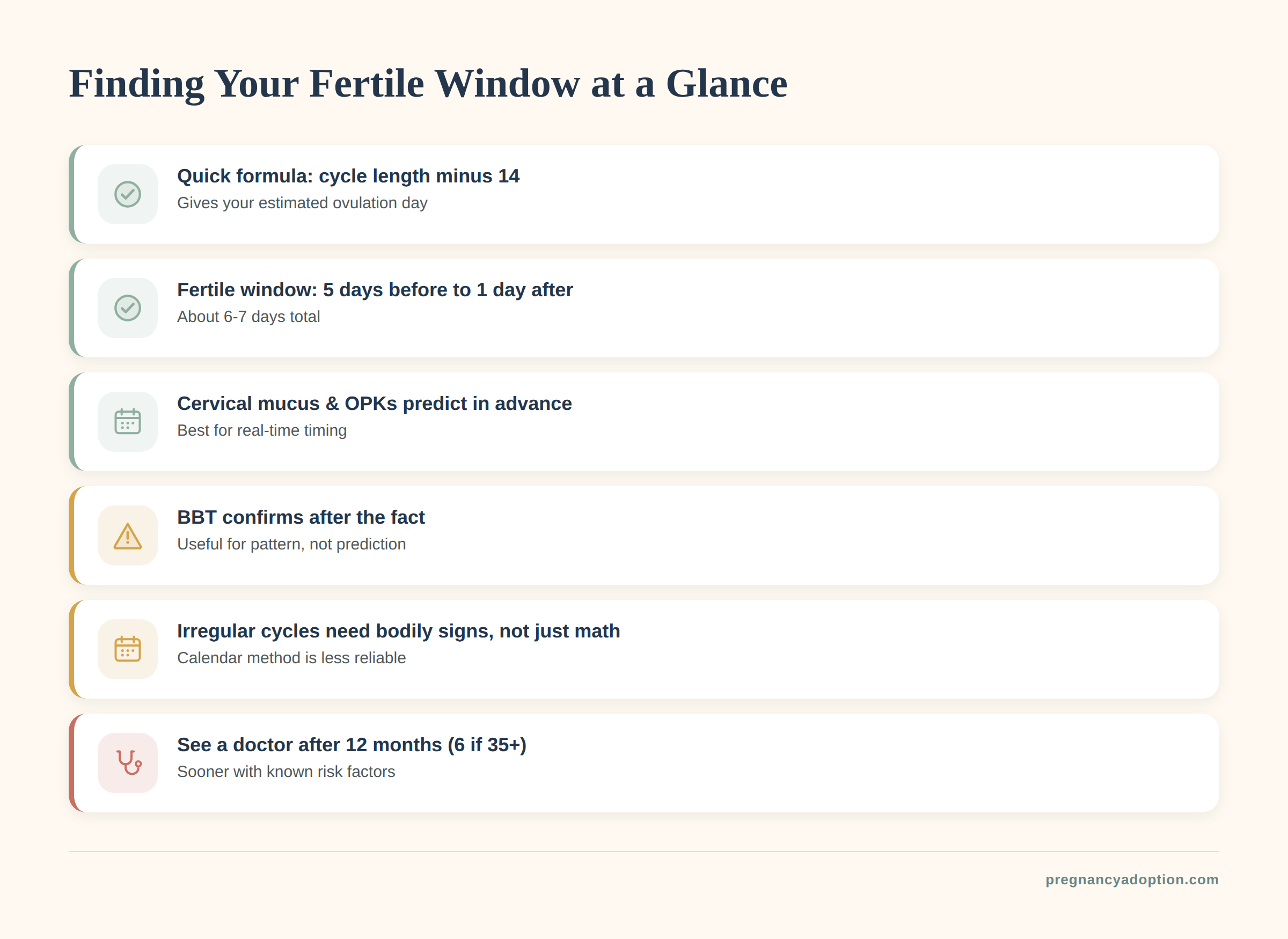
- The quick formula is your cycle length minus 14 — that’s your estimated ovulation day, counting from the first day of your last period. A 28-day cycle puts ovulation around day 14; a 32-day cycle puts it around day 18.
- Your fertile window is about six days long, not one: roughly five days before ovulation through about a day after, because sperm can survive in the reproductive tract for three to five days while the egg itself is viable for only about 12 to 24 hours after release.
- No single tracking method is perfectly precise on its own. The calendar method estimates where ovulation is likely to fall; basal body temperature confirms it happened only after the fact; cervical mucus and ovulation predictor kits (OPKs) are the two methods that can flag it’s approaching in real time.
- Irregular cycles make calendar-based estimates considerably less reliable, which is exactly when leaning on bodily signs (cervical mucus, OPKs) over calendar math matters most.
- Standard medical guidance suggests trying for 12 months (or 6 months if you’re 35 or older) before a fertility evaluation for most people with no known risk factors — sooner if you have irregular or absent periods, a history of pelvic conditions, or recurrent pregnancy loss.
Short Answer: The Quick Ovulation Calculation
If you only need a fast estimate, here it is: take your average cycle length, subtract 14, and count that many days forward from the first day of your last period. That’s your estimated ovulation day. Your fertile window runs from about five days before that date through about a day after it. The rest of this guide explains why that works, how to refine it with real tracking data, and what to do if your cycles don’t cooperate with a simple formula.
The Quick Formula
Finding Your Estimated Ovulation Day
Ovulation typically occurs about 14 days before your next period starts, not 14 days after your last one — the two land on the same date only if your cycle is exactly 28 days long. The more reliable version of the formula is: cycle length minus 14, counted forward from day 1 (the first day of your last period). For a 30-day cycle, that’s day 16; for a 24-day cycle, that’s day 10. This works because, across most natural cycles, the length of time from ovulation to the next period (the luteal phase) is fairly consistent at around 14 days, while the time leading up to ovulation (the follicular phase) is the part that actually varies from person to person and cycle to cycle — a distinction covered in full in the next section.
Finding Your Fertile Window
Once you have an estimated ovulation day, your fertile window is approximately that day minus five days through that day plus one day — about six to seven days total. For an estimated ovulation day of day 16, that’s roughly days 11 through 17. This window exists because of how long sperm and an egg each remain viable, explained in detail further below; it’s also the main reason a single-day guess is less useful than knowing the full window.
What This Guide Covers (and Why There’s No Interactive Tool)
What You’ll Find Below
This guide covers the full calendar-method formula with a worked example and a reference table, the biology behind the fertile window, how to read basal body temperature charts, cervical mucus changes, and ovulation predictor kits, how to combine methods for better accuracy, practical guidance on timing intercourse, what to do if your cycles are irregular or you have a condition like PCOS, common tracking mistakes, and when it’s worth talking to a provider if conceiving is taking longer than expected.
Why This Is a Formula-and-Table Guide, Not a Live Calculator
You may have noticed this page doesn't include a type-in-your-dates calculator widget. That's a deliberate, site-wide decision, not an oversight: pregnancyadoption.com/'s publishing standards don't allow embedded JavaScript or interactive scripts in article content, the same scope decision explained in full in our due-date calculator guide’s own editorial notes. Every formula here is written out precisely enough to calculate by hand, on a calendar, or in a simple spreadsheet — and the reference table further below functions as a paper calculator in its own right.
How Ovulation and the Menstrual Cycle Work
Understanding why the quick formula uses 14 specifically — and why it’s more reliable for some people than others — starts with what’s actually happening across a cycle.
The Three Phases of a Cycle
The Follicular Phase
The follicular phase runs from the first day of your period until ovulation. During this phase, several follicles in your ovaries each begin developing an egg; by roughly days 10 to 14 of a typical cycle, one follicle becomes dominant and matures enough to be released. This phase’s length is what drives most of the difference between a short cycle and a long one.
Ovulation and the Luteal Phase
Ovulation itself is the release of a mature egg from the dominant follicle, triggered by a surge in luteinizing hormone (LH) — the exact hormone ovulation predictor kits detect. After ovulation, the luteal phase begins: the ruptured follicle produces progesterone to prepare the uterine lining for a possible pregnancy, and this phase reliably lasts about 14 days (commonly ranging from about 10 to 16 days) before either a period starts or, if implantation occurs, pregnancy hormones take over instead.
Why Cycle Length Varies From Person to Person
The Follicular Phase Is the Variable Part
Because the luteal phase is relatively fixed at around 14 days for most people, nearly all of the difference between a 24-day cycle and a 35-day cycle comes from how long the follicular phase takes that particular cycle — which is exactly why “cycle length minus 14” is a more reliable way to estimate ovulation than simply assuming day 14 of every cycle regardless of its actual length.
What a “Normal” Cycle Length Range Looks Like
A cycle length anywhere from about 21 to 35 days is generally considered within a normal range, so ovulation timing is genuinely individual — someone with a consistent 24-day cycle will ovulate much earlier in their cycle than someone with a consistent 33-day cycle, and both are normal. Conditions like polycystic ovary syndrome (PCOS), thyroid disorders, primary ovarian insufficiency, and elevated prolactin levels can affect ovulation timing or whether it happens at all, as can excessive exercise, significant stress, and changes in body weight — covered further in the special-situations section below.
The Calendar Method, Step by Step
The quick formula above works fine as a single estimate, but the standard clinical version of the calendar method uses several cycles of your own data to narrow the fertile window further, which is worth doing if you’re tracking with any intention.
The Single-Cycle Quick Method
The Formula
Using just your most recent (or typical) cycle length: subtract 14 to estimate ovulation day, then build a window from five days before that date through one day after. This is the fastest version and a reasonable starting point, particularly for someone with consistent cycles.
A Worked Example
Say your last period started on March 3, and your typical cycle runs 29 days. Estimated ovulation day: 29 minus 14 equals day 15, which is March 17. Fertile window: roughly March 12 through March 18 (day 15 minus five days through day 15 plus one day).
The Six-Cycle Tracking Method
Why Track Multiple Cycles
A single cycle’s length can vary slightly from your personal average even when your cycles are generally regular, so a method that uses your shortest and longest cycle over roughly the past six months produces a wider, more conservative window that’s less likely to miss ovulation entirely. This is the version commonly described in clinical patient-education materials as “the calendar method” or “the rhythm method” for fertility awareness.
The Formula and a Worked Example
Track your cycle length (day 1 of one period to day 1 of the next) for at least six cycles. Subtract 18 from your shortest cycle length to find the first fertile day, and subtract 11 from your longest cycle length to find the last fertile day. For someone whose cycles over six months ranged from 27 to 32 days: 27 minus 18 equals day 9, and 32 minus 11 equals day 21 — giving a fertile window of roughly day 9 through day 21, a wider range than the single-cycle method because it’s built to account for natural month-to-month variation.
| Cycle length | Estimated ovulation day | Estimated fertile window (days) |
|---|---|---|
| 21 days | Day 7 | Days 2–8 |
| 24 days | Day 10 | Days 5–11 |
| 26 days | Day 12 | Days 7–13 |
| 28 days | Day 14 | Days 9–15 |
| 30 days | Day 16 | Days 11–17 |
| 32 days | Day 18 | Days 13–19 |
| 35 days | Day 21 | Days 16–22 |
This table uses the single-cycle quick method (cycle length minus 14, with a window of minus 5 to plus 1 day) for a fast lookup. If your cycle length varies by more than a few days month to month, the six-cycle tracking method above, or the bodily-sign methods covered next, will generally serve you better than this table alone.
The Fertile Window: Why It Spans Several Days
The egg itself is only viable for a short time, so it’s a common assumption that there’s exactly one fertile day per cycle. In practice, the window is wider — because sperm, not the egg, is the more patient half of the equation.
Sperm Survival and Egg Viability
How Long Sperm Can Wait
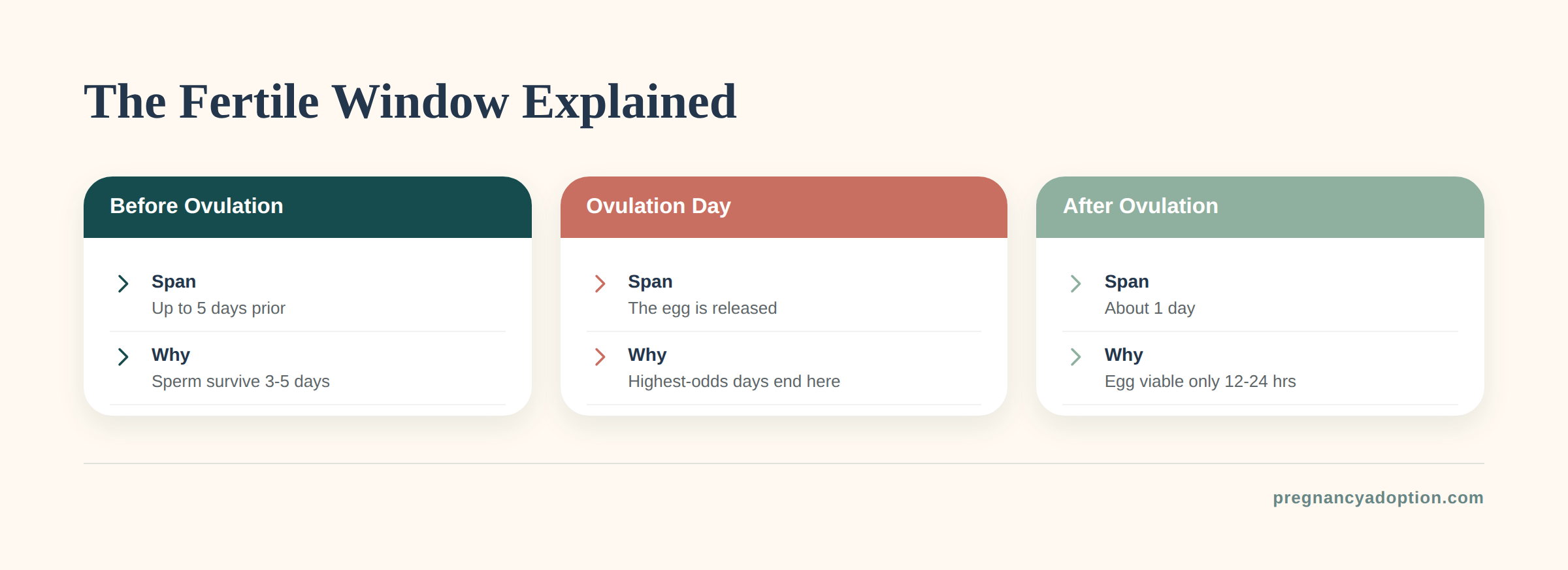
Sperm can survive inside the reproductive tract for roughly three to five days under favorable conditions, waiting for an egg to be released. This is the single biggest reason the fertile window extends backward from ovulation day rather than being limited to the day itself — intercourse several days before ovulation can still result in conception if sperm are still viable when the egg is released.
How Long the Egg Is Viable
Once released, the egg survives for only about 12 to 24 hours before it’s no longer capable of being fertilized. This is why the window extends only about one day past ovulation, rather than several days the way it extends backward — there’s very little margin for timing on the back end of the window compared to the front end.
What This Means for Timing
Why Day-of-Ovulation Sex Isn’t the Only Opportunity
Because sperm can wait several days but the egg can’t, the days leading up to ovulation are collectively just as important as ovulation day itself — in fact, research on timing and conception has generally found the one to two days immediately before ovulation to be the days with the single highest probability of conception, slightly ahead of ovulation day itself.
Why Timing Earlier Often Matters More
This is the practical reason tracking methods that can flag ovulation before it happens (cervical mucus changes, a positive OPK) are generally considered more useful for timing intercourse than a method that only confirms ovulation after it already occurred (basal body temperature) — a distinction covered directly in the next several sections.
Basal Body Temperature (BBT) Tracking
Basal body temperature is one of the oldest, lowest-cost ovulation-tracking methods, and it’s useful for confirming a pattern over time even though it has a real limitation worth understanding upfront.
How to Take and Chart Your Temperature
What You Need
A basal thermometer (one measuring to a tenth or hundredth of a degree, sold specifically for fertility tracking) and either a paper chart or a charting app. Standard household thermometers generally aren’t precise enough to catch the small shift BBT tracking depends on.
When and How to Measure
Take your temperature first thing every morning, before getting out of bed, eating, drinking, or even talking much — any of these can raise your temperature slightly and throw off the reading. Measuring at roughly the same time each day, after at least three to four hours of continuous sleep, gives the most consistent results. Record the number daily on a chart rather than trying to remember a trend from memory.
What a BBT Chart Can (and Can’t) Tell You
Confirming Ovulation Happened
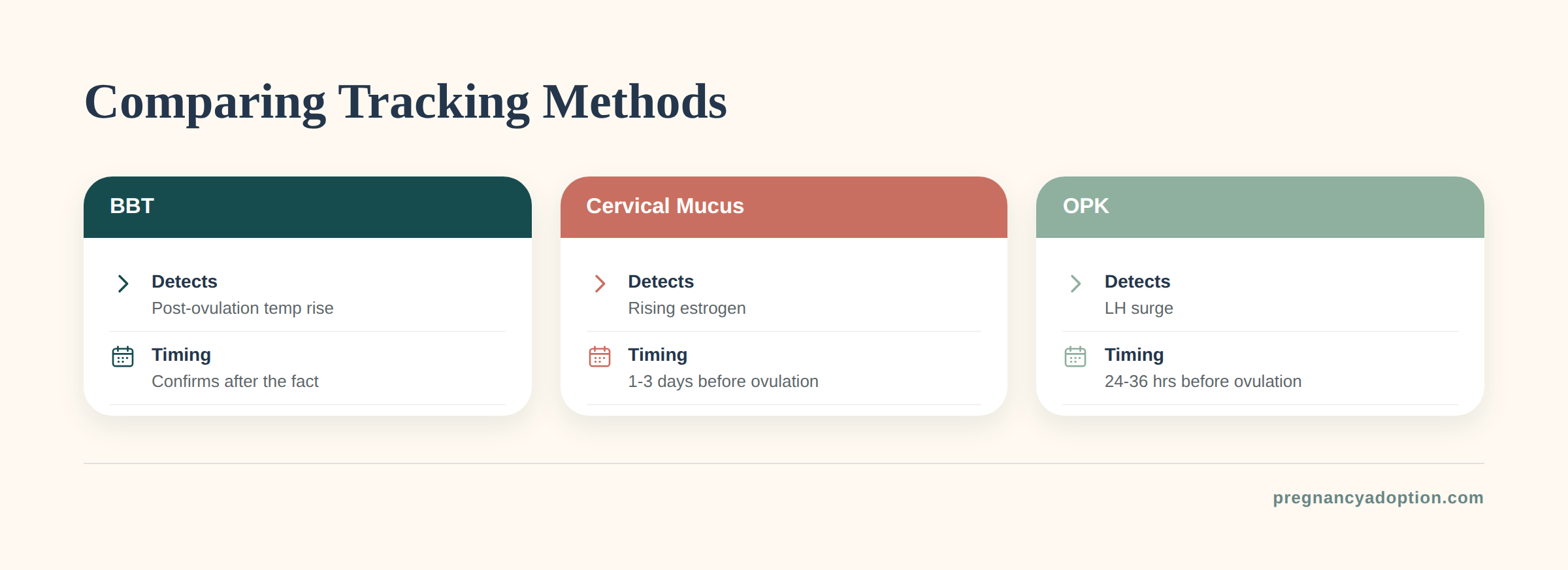
After ovulation, progesterone causes a small, sustained rise in basal body temperature — typically about 0.5 to 1 degree Fahrenheit — that holds until your next period (or continues, if pregnancy occurs). Seeing that sustained rise over several charted cycles is a reliable way to confirm that ovulation is actually happening and to learn roughly which cycle day it tends to fall on for you personally.
Why It Can’t Predict Ovulation in Advance
Because the temperature rise happens after ovulation has already occurred, BBT alone can’t tell you ovulation is coming in time to act on it that cycle — by the time you see the rise, the egg has already been released and is nearing the end of its 12-to-24-hour viability window. BBT is most useful as a pattern-confirmation tool over multiple cycles, and as a way to validate what a more real-time method (cervical mucus or an OPK) is telling you, rather than as a stand-alone, same-cycle prediction tool.
Cervical Mucus Tracking
Cervical mucus changes in a predictable pattern across a cycle in response to shifting hormone levels, and — unlike BBT — it changes in the days leading up to ovulation, not just after it.
The Stages of Cervical Mucus Across a Cycle
Early and Mid-Cycle Changes
Right after your period, many people notice little to no cervical mucus, sometimes described as a “dry” phase. As estrogen rises heading toward ovulation, mucus typically becomes more noticeable, often described as cloudy, white, or sticky.
The Egg-White Stage
In the one to a few days immediately before ovulation, cervical mucus characteristically becomes clear, slippery, and stretchy — frequently compared to raw egg white. This specific texture is the single most recognizable cervical-mucus sign of approaching ovulation, and it generally fades within a day or two after ovulation occurs.
How to Check and Record It
What to Look For
Checking daily (using toilet tissue, a finger, or noticing sensation and underwear) and noting the color, texture, and stretchiness lets you build a picture of where you are in the pattern. The shift toward the clear, stretchy “egg-white” texture is the specific change worth watching for as a signal that ovulation is approaching, typically within the next one to a few days.
Common Tracking Mistakes
Semen, spermicide, certain lubricants, and some vaginal infections can all be mistaken for or mask natural cervical mucus changes, so checking before intercourse (rather than after) and being aware of anything else that might be present gives a cleaner read. Hormonal birth control suppresses these natural changes entirely, so this method isn’t usable while on it.
Ovulation Predictor Kits (OPKs) and Fertility Monitors
Ovulation predictor kits are the most direct, hormone-based way to catch ovulation approaching in real time, which is why they’re often paired with cervical mucus tracking for people actively trying to time intercourse.
How OPKs Work
What the Test Detects
OPKs detect luteinizing hormone (LH) in urine. LH is normally present at low levels throughout the cycle, but it surges sharply 24 to 36 hours before ovulation, triggering the egg’s release — the same surge BBT tracking indirectly confirms after the fact, but here detected directly and in advance.
What a Positive Result Means
A positive OPK result means ovulation is expected within roughly the next 24 to 36 hours — making the day of a positive test and the following one to two days the highest-value window for timing intercourse if conception is the goal, consistent with the fertile-window biology described above.
Getting Accurate Results
When to Start Testing
Start testing a few days before your earliest expected ovulation day based on your calendar-method estimate — commonly around cycle day 10 for an average 28-day cycle, adjusted earlier or later based on your own typical cycle length — and continue daily (or twice daily, per some kit instructions) until you get a positive result.
Common Testing Mistakes
Testing with heavily diluted urine (right after drinking a lot of fluid), testing at an inconsistent time of day, or stopping too early because a cycle is running longer than expected are the most common reasons someone misses their own LH surge. PCOS, in particular, can produce persistently elevated LH that makes some OPKs harder to interpret — covered further in the special-situations section below.
| Method | What it detects | Predicts or confirms? | Typical lead time |
|---|---|---|---|
| Calendar / cycle-length method | Estimated timing based on cycle length | Predicts (estimate only) | Days in advance, but an estimate, not a measurement |
| Basal body temperature (BBT) | Post-ovulation progesterone rise | Confirms (after the fact) | None — confirms ovulation already happened |
| Cervical mucus | Rising estrogen approaching ovulation | Predicts (real-time sign) | Roughly 1–3 days before ovulation |
| Ovulation predictor kit (OPK) | LH surge | Predicts (real-time, hormone-based) | Roughly 24–36 hours before ovulation |
Combining Methods: The Symptothermal Approach
Each method above has a real gap on its own, which is exactly why clinical fertility-awareness education generally recommends combining more than one rather than relying on a single signal.
Why One Method Alone Has Limits
What the Calendar Method Misses
The calendar method is only ever an estimate based on past cycle lengths — it can’t account for a cycle that happens to run longer or shorter than your typical pattern, and it says nothing about what’s actually happening hormonally in the current cycle.
What BBT and OPKs Each Miss
BBT confirms ovulation only after it’s already happened, which is too late to act on for that cycle. OPKs are more real-time but can occasionally produce a false or unclear reading, particularly with certain hormonal conditions, and they only cover a narrow window once testing starts.
What Combining Methods Looks Like in Practice
A Sample Tracking Routine
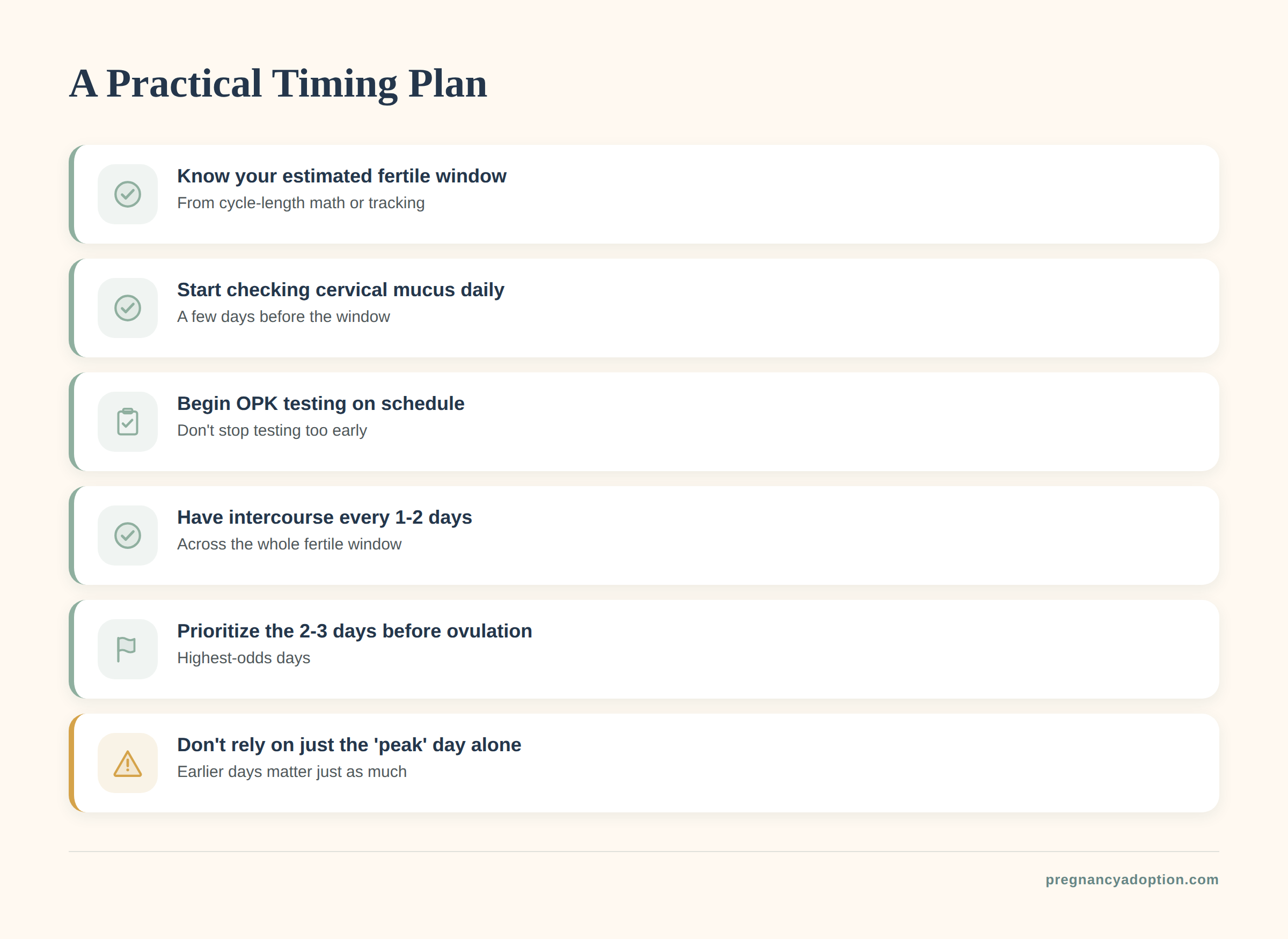
A common combined approach: use your calendar-method estimate to know roughly when to start paying attention, begin checking cervical mucus daily from a few days before that estimate, start OPK testing once mucus changes begin or a few days before the estimated day, and continue charting BBT throughout to confirm, cycle over cycle, that the pattern you’re seeing from the other two methods lines up with when ovulation is actually occurring. This combined approach (sometimes called the symptothermal method) is more labor-intensive than any single method alone, but it’s also considerably more informative.
Fertility Apps and Tracking Tools
Many fertility-tracking apps let you log cycle dates, BBT readings, cervical mucus observations, and OPK results in one place and will generate a predicted fertile window from the combination — which is a convenient way to apply everything in this section, as long as you understand what inputs the app is actually using. Before entering sensitive health and reproductive data into any app, it’s worth reviewing that app’s specific privacy policy, since data-sharing practices vary considerably between apps.
Timing Intercourse for the Best Chance of Conceiving
Once you have a sense of your fertile window — whether from the calendar method alone or from a combination of signs — the practical question becomes how to actually use that information.
How Often and When
The Simple Answer
Having intercourse every one to two days throughout your estimated fertile window gives sperm a reasonable, continuously refreshed presence across the days when conception is most likely, without requiring the kind of rigid, stressful daily schedule some people assume is necessary. If that cadence isn’t practical, prioritizing the two to three days immediately before your estimated ovulation day (or immediately following a positive OPK) captures the highest-probability days specifically.
Does Frequency Reduce Sperm Quality?
Frequent ejaculation (daily or near-daily) does not meaningfully reduce the chances of conception for most people with typical sperm counts, so there’s generally no need to “save up” or abstain outside the fertile window in anticipation of it — in fact, prolonged abstinence can sometimes reduce sperm motility rather than improve outcomes.
Common Questions About Timing
Does Position or Timing of Day Matter?
There’s no strong evidence that a specific intercourse position or time of day meaningfully improves conception odds beyond simply having intercourse within the fertile window itself — the biology described above (sperm survival, egg viability, and which days fall in the window) is what matters most.
What If You Miss the Fertile Window?
Missing a particular cycle’s window isn’t a lost opportunity in any larger sense — it simply means that cycle is less likely to result in conception, and the same tracking approach applies again next cycle. For most people without a known fertility issue, it reasonably takes several cycles of well-timed attempts before conception occurs, which the “when to see a doctor” section further below puts in context.
When the Calendar Method Is Less Reliable
Every formula and table in this guide assumes a reasonably consistent cycle length. When that assumption doesn’t hold, the calendar method’s accuracy drops considerably — which is worth recognizing rather than continuing to rely on a calculation that isn’t matching reality.
Irregular or Very Long/Short Cycles
Why the Calendar Method Breaks Down
The calendar method depends on cycle length being a reasonably stable, predictable number from month to month. If your cycle length varies widely — say, anywhere from 24 to 45 days — a single formula applied to “your cycle length” doesn’t have a stable number to work from, and any estimated fertile window built that way carries much more uncertainty than the tables above suggest.
What Counts as “Irregular”
A cycle outside the roughly 21-to-35-day normal range, or one that varies by more than about seven to nine days from cycle to cycle, is generally considered irregular enough to make calendar-based estimation meaningfully less reliable. Occasional one-off variation is common and not necessarily a sign of anything beyond normal fluctuation; a persistent pattern of irregularity is the more relevant signal.
What to Use Instead
Leaning on Bodily Signs Over Calendar Math
With irregular cycles, cervical mucus tracking and OPKs become considerably more valuable than calendar math, since both respond to what’s actually happening hormonally in the current cycle rather than to an assumption based on past cycle lengths. BBT charting still has a role in confirming, after the fact, whether and roughly when ovulation occurred in a given cycle, which can help identify a pattern even within overall irregularity.
When to Involve a Provider
Going several months without a period at all (amenorrhea) can be a sign that ovulation isn’t happening regularly or at all, and is generally worth discussing with a provider rather than continuing to track without result — a theme that applies even more directly to the specific conditions covered in the next section.
Special Situations
A handful of circumstances change how ovulation tracking works in practice, beyond ordinary cycle-length irregularity.
PCOS and Other Ovulation Disorders
Why Ovulation Can Be Unpredictable or Absent
Polycystic ovary syndrome (PCOS) is one of the most common causes of irregular or absent ovulation, alongside thyroid disorders, primary ovarian insufficiency, and elevated prolactin levels. These conditions can make cycles unpredictable in length, infrequent, or entirely absent, which undermines the calendar method’s core assumption more severely than ordinary irregularity does.
What Tracking Looks Like With PCOS
PCOS specifically can also complicate OPK testing, since some forms of PCOS involve persistently elevated baseline LH levels that can produce confusing or frequent false-positive-looking readings; cervical mucus and BBT tracking, interpreted over several cycles, are often more informative in that situation, but anyone with a PCOS diagnosis who is trying to conceive is generally better served working directly with a provider on an individualized tracking and treatment approach than relying on the general methods in this guide alone.
Postpartum, Breastfeeding, and Coming Off Birth Control
Postpartum and Breastfeeding
Ovulation can resume at different times after childbirth depending heavily on whether and how much someone is breastfeeding, and it’s possible to ovulate before a first postpartum period returns at all — meaning a calendar method built around “days since your last period” doesn’t have a clear starting point in this situation. Cervical mucus and other real-time signs are generally more useful here than calendar math.
Right After Stopping Hormonal Birth Control
Cycles can take a few months to settle into a predictable pattern after stopping hormonal birth control (the pill, a hormonal IUD, an implant, or the shot), so the first cycle or two off birth control is a reasonable one to track carefully with bodily signs rather than assume a “typical” cycle length right away.
Trying to Conceive After a Loss
When Ovulation Typically Resumes
Ovulation commonly resumes within a few weeks after an early pregnancy loss, though the exact timing varies by individual circumstances and how far the pregnancy had progressed; our miscarriage guide covers physical recovery and medical follow-up in more depth than this guide’s tracking-focused scope.
Emotional Considerations Alongside the Practical Ones
Resuming ovulation tracking while also processing a loss can bring up complicated feelings, and there’s no required timeline for when someone needs to feel ready to start tracking again — going at your own pace, and discussing timing with your provider if you’re unsure, is a reasonable approach.
Common Mistakes When Tracking Ovulation
Assuming Day 14 Every Cycle
Why This Happens
Day 14 is the textbook number most commonly cited for a 28-day cycle, so it’s an easy default to reach for even when your own cycle doesn’t run exactly 28 days.
What to Do Instead
Use the cycle-length-minus-14 formula with your own actual cycle length, not a flat “day 14” assumption, and refine it further with bodily signs if your cycles vary at all from month to month.
Using BBT to Predict Instead of Confirm
Why This Happens
Because BBT tracking feels rigorous and data-driven, it’s easy to assume it can tell you ovulation is coming — but, as covered above, the temperature rise only happens after ovulation, not before it.
What to Do Instead
Use BBT to confirm a pattern over several cycles, and pair it with cervical mucus tracking or OPKs for same-cycle, forward-looking prediction.
Stopping OPK Testing Too Early
Why This Happens
If a cycle runs longer than expected, testing based on a prior cycle’s typical timing can end before the actual LH surge occurs, leading to a false sense that “nothing happened” this cycle.
What to Do Instead
Continue testing daily until you get a clearly positive result or your period arrives, rather than stopping on a fixed day based on a previous cycle’s timing.
Only Having Sex on the “Peak” Day
Why This Happens
It’s intuitive to assume the single predicted ovulation day is the only day that matters, which can lead to narrowly timing intercourse around that one date alone.
What to Do Instead
Per the fertile-window biology covered earlier, the one to two days before predicted ovulation are at least as important as the day itself — spreading intercourse across the whole estimated window, not just the single predicted peak day, better reflects how conception timing actually works.
If You’ve Been Trying for a While: When to See a Doctor
Careful tracking helps, but it doesn’t guarantee a quick result, and knowing the standard guidance for how long is reasonable to keep trying on your own helps set realistic expectations either way.
The Standard Timelines
Under Age 35
For someone under 35 with no known fertility-related health conditions and reasonably regular cycles, standard guidance suggests trying for at least a full year of regular, well-timed attempts before seeking a fertility evaluation. This isn’t because nothing can be done sooner if you’re concerned — it’s because, statistically, the large majority of couples in this situation do conceive within that first year.
Age 35 and Older
For someone 35 or older, that recommended waiting period shortens to about six months, since fertility naturally declines with age and the value of earlier evaluation increases accordingly; at 40 and older, many sources recommend considering evaluation even sooner, without waiting out a fixed number of months at all.
Reasons Not to Wait
Cycle and Health Red Flags
Certain situations are reasons to seek evaluation sooner regardless of age or how long you’ve been trying: irregular or absent periods, a known or suspected condition like endometriosis or pelvic inflammatory disease, or a male partner’s history of testicular trauma or chemotherapy. None of these situations benefit from waiting out the standard timeline first.
Recurrent Pregnancy Loss
Two or more pregnancy losses is generally considered its own, separate reason to seek an evaluation — commonly with a reproductive endocrinologist specifically — rather than continuing to try independently and waiting to see what happens. This is a distinct situation from ordinary difficulty conceiving, and it’s evaluated differently.
From Ovulation Tracking to a Confirmed Pregnancy
If tracking leads to a positive pregnancy test, the same ovulation or conception date you were tracking toward becomes useful again, in a different way.
Calculating a Due Date From Your Tracked Date
The Ovulation-Based Due-Date Formula
Once you have a confirmed or best-estimated ovulation or conception date, you can estimate a due date directly from it — a different formula than the standard last-menstrual-period method, covered in full with worked examples in our due-date calculator guide, which this guide doesn’t re-derive here.
Why This Can Be More Precise Than an LMP-Only Estimate
A due date calculated from a tracked ovulation date (rather than an assumed day-14-of-28 estimate from your last period alone) removes the biggest source of error in the standard method, particularly if your cycles don’t run a textbook 28 days — the same reasoning our due-date guide explains in more depth. If instead you already have a due date or an LMP and want to work backward to estimate when conception likely happened, our conception calculator guide covers that reverse calculation specifically.
Early Symptoms and When to Test
What to Watch For
Early pregnancy symptoms can begin subtly in the days and weeks after a tracked ovulation, and our pregnancy symptoms guide covers the full range and typical timing in depth rather than repeating that content here.
When a Test Is Likely to Be Accurate
How early you can reliably test depends on days past ovulation, not days since your last period — a distinction our guide to testing early and our guide to when to test both cover directly, and which becomes considerably easier to apply correctly once you already know your tracked ovulation date from this guide’s methods.
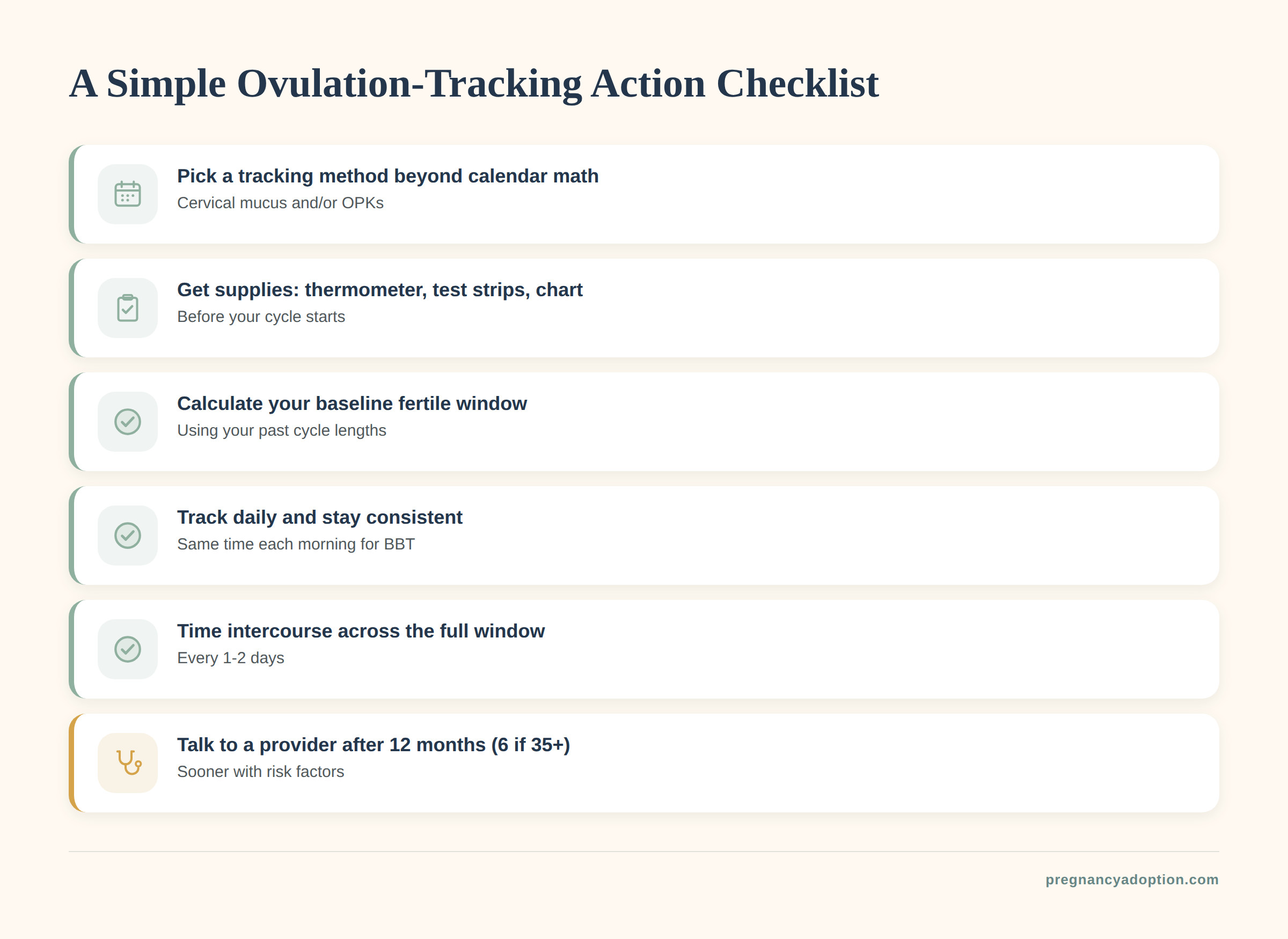
A Simple Ovulation-Tracking Action Checklist
Before You Start Tracking
Get Set Up
Pick at least one tracking method beyond the calendar estimate alone (cervical mucus and/or OPKs are the two with real-time predictive value), and get the basic supplies — a basal thermometer if you’re adding BBT, a supply of OPK test strips, and a chart or app to log results consistently.
Know Your Baseline
If you have at least a few months of past cycle-length data, calculate your single-cycle or six-cycle estimated fertile window using the formulas above as a starting reference point for when to begin closer daily tracking.
During Your Cycle
Track Daily
Check cervical mucus daily, begin OPK testing a few days before your estimated window, and chart BBT each morning if you’re using it — consistency matters more than any single day’s reading.
Time Intercourse Across the Window
Aim for intercourse every one to two days across your estimated fertile window, prioritizing the two to three days before predicted ovulation or immediately following a positive OPK if a less frequent schedule is more practical.
Glossary of Terms Used in This Guide
A quick reference for the terms this guide uses most often, grouped by category.
Cycle and Timing Terms
Follicular Phase
The portion of the menstrual cycle from the first day of a period until ovulation, during which a follicle matures; the main source of natural cycle-length variation.
Luteal Phase
The portion of the cycle from ovulation until the next period begins, typically lasting about 10 to 16 days; relatively consistent in length compared to the follicular phase.
Fertile Window
The span of days in a cycle during which intercourse can result in conception, typically about five days before ovulation through about a day after, based on sperm survival and egg viability.
Tracking Method Terms
Basal Body Temperature (BBT)
Body temperature measured immediately upon waking, before any activity; rises slightly and stays elevated after ovulation due to progesterone, confirming (but not predicting) that ovulation has occurred.
Ovulation Predictor Kit (OPK)
A urine test that detects the luteinizing hormone (LH) surge that triggers ovulation, typically 24 to 36 hours in advance.
Symptothermal Method
A fertility-awareness approach that combines more than one tracking sign (commonly BBT with cervical mucus and/or OPKs) rather than relying on a single method alone.
Fertility and Planning Terms
Luteinizing Hormone (LH)
The hormone whose sharp rise (the “LH surge”) triggers the release of a mature egg from the ovary; the hormone ovulation predictor kits are designed to detect.
Infertility
Generally defined, for surveillance and research purposes, as not conceiving after 12 or more months of regular, unprotected intercourse; a related but separate clinical question from how any one cycle’s tracking turns out.
Trying to Conceive (TTC)
Common shorthand, especially in fertility-tracking apps and communities, for actively attempting to become pregnant, often alongside ovulation tracking of the kind described throughout this guide.
Frequently Asked Questions
Quick Calculation and Formula Questions
What’s the fastest way to estimate my ovulation day?
Subtract 14 from your average cycle length, then count that many days forward from the first day of your last period. A 28-day cycle puts ovulation around day 14; a 32-day cycle puts it around day 18.
Why subtract 14 specifically?
Because the luteal phase (from ovulation to your next period) is relatively consistent at around 14 days for most people, while the follicular phase (before ovulation) is the part that actually varies — so working backward 14 days from your next expected period is more reliable than assuming ovulation always falls on day 14 of every cycle.
Do I count day 1 as the first day of bleeding, or the first full day of flow?
Day 1 is the first day any bleeding appears, including light spotting before a fuller flow begins — the same convention used throughout this site’s due-date and cycle calculations.
What if my cycle length changes slightly every month?
Use your average cycle length over the past several months for the quick formula, or use the six-cycle tracking method (subtract 18 from your shortest cycle and 11 from your longest) for a wider, more conservative window that accounts for that variation.
Can I calculate ovulation if I only know my average cycle length, not exact daily tracking?
Yes — the single-cycle quick method only requires your typical cycle length and the start date of your last period; it’s an estimate, not a precise measurement, but it’s a reasonable starting point.
Does this formula work the same way for every cycle length?
The underlying math (cycle length minus 14) applies the same way regardless of cycle length, though very short or very long cycles are more likely to also involve irregular ovulation, which the calendar formula can’t detect on its own.
Is there a different formula if I have a known short or long luteal phase?
If you know your own luteal phase length differs from the typical 14 days (for example, from several cycles of BBT charting), use your own luteal phase length in place of 14 for a more personalized estimate.
How many days after my period ends does ovulation happen?
This depends on how long your period itself lasts and your overall cycle length, so there’s no single fixed number of days after your period ends — the calculation in this guide works from the first day of your period, not the last.
Fertile Window and Timing Questions
How many days per cycle am I actually fertile?
About six to seven days: roughly five days before ovulation through about a day after, based on how long sperm can survive and how long the egg remains viable.
Which single day in the fertile window has the highest chance of conception?
Research on timing and conception has generally found the one to two days immediately before ovulation to carry the highest probability, slightly ahead of ovulation day itself.
Can I get pregnant from sex that happened a week before ovulation?
It’s unlikely, since sperm generally survive no more than about five days — sex a full week before ovulation falls outside the typical fertile window, though individual variation exists.
Can I get pregnant the day after ovulation?
It’s possible but less likely than earlier in the window, since the egg is viable for only about 12 to 24 hours after release — by a day after ovulation, that viability window has typically closed.
Does the fertile window shift if my cycle is unusually short or long?
Yes — the fertile window is calculated relative to your estimated ovulation day, so a shorter or longer cycle shifts the entire window earlier or later accordingly, per the cycle-length-minus-14 formula.
Is it possible to ovulate twice in one cycle?
A second egg can occasionally be released within roughly 24 hours of the first (which is how fraternal twins can occur), but this is distinct from ovulating twice at two separate, widely spaced points in the same cycle, which doesn’t happen.
Basal Body Temperature Questions
How much should my temperature rise after ovulation?
Typically about 0.5 to 1 degree Fahrenheit, sustained from the day after ovulation until your next period (or continuing, if pregnancy occurs).
What if I don’t see a clear temperature rise after several charted cycles?
A consistently unclear or absent rise across multiple cycles is worth discussing with a provider, since it can be a sign that ovulation isn’t occurring as expected, among other possible explanations.
Does illness or poor sleep affect my BBT reading?
Yes — fever, alcohol, poor or interrupted sleep, and taking your temperature at a notably different time than usual can all produce a misleading reading on a given day; noting these disruptions on your chart helps you discount an outlier reading later.
Can I use a regular thermometer instead of a basal thermometer?
A standard household thermometer usually isn’t precise enough to reliably detect the small, roughly half-degree shift BBT tracking depends on — a basal thermometer, which measures in tenths or hundredths of a degree, is the more reliable choice.
How long should I chart BBT before trusting the pattern?
Most guidance suggests at least two to three full cycles before drawing firm conclusions about your personal pattern, since a single cycle’s chart can be affected by one-off disruptions.
Cervical Mucus Questions
What does “egg-white” cervical mucus actually look and feel like?
Clear, slippery, and stretchy — it can often be stretched between two fingers without breaking, similar in texture to raw egg white, which is where the common description comes from.
I don’t notice much cervical mucus at all — is that a problem?
Some people naturally produce less noticeable mucus than others, and dehydration, certain medications, and the days right after a period can all reduce what’s visible; if you consistently can’t identify any pattern across several cycles, discussing it with a provider is reasonable.
Can I track cervical mucus while using a lubricant?
Many lubricants can mimic or mask natural cervical mucus, so checking before intercourse rather than relying on observations made afterward gives a cleaner read.
Does cervical mucus tracking work on hormonal birth control?
No — hormonal birth control suppresses the natural cycle changes this method depends on, so it isn’t usable while on it.
Ovulation Predictor Kit Questions
How many days before my estimated ovulation day should I start testing?
Commonly a few days before your earliest calendar-based estimate — for an average 28-day cycle, that’s often around day 10 — adjusted earlier or later based on your own typical cycle length.
What does it mean if I get a positive OPK result for several days in a row?
This can happen with some conditions, including PCOS, which can involve persistently elevated baseline LH; if positive results extend well beyond the expected one- to two-day surge window repeatedly, it’s worth discussing with a provider.
Can I use OPKs and BBT together?
Yes — this is a common combined approach: OPKs flag the LH surge in real time, and BBT later confirms, via the post-ovulation temperature rise, that ovulation actually followed the surge as expected.
Do digital and test-strip OPKs work the same way?
Both detect the same LH surge; digital versions typically just interpret the result for you (showing a smiley face or similar indicator) rather than requiring you to compare line darkness yourself, which some people find easier to read accurately.
Is a faint line on an OPK the same as a positive result?
Generally no — most OPKs are designed to show a test line as dark as or darker than the control line for a true positive; a faint line usually indicates LH is present but hasn’t yet surged to the threshold that predicts imminent ovulation.
Can fertility medications affect OPK accuracy?
Certain fertility medications can affect hormone levels in ways that make standard OPKs less straightforward to interpret; anyone using fertility medication under a provider’s care should follow that provider’s specific monitoring guidance rather than relying on general OPK instructions alone.
Combining Methods and Apps Questions
Do I need to use all three tracking methods at once?
No — many people get useful information from just one or two methods, particularly cervical mucus tracking paired with OPKs. Combining more methods generally improves confidence but isn’t required to get started.
Are fertility-tracking apps as accurate as tracking by hand?
An app is only as accurate as the data entered into it — if you’re logging the same cervical mucus, BBT, or OPK observations you’d otherwise write on paper, the underlying accuracy is the same; the app mainly adds convenience and automatic calculation.
Is it safe to enter my cycle and fertility data into a tracking app?
Data-sharing practices vary considerably between apps, so reviewing a specific app’s privacy policy before entering sensitive reproductive health data is a reasonable precaution, particularly for lesser-known apps.
Can a fertility-tracking app predict ovulation without any manual input from me?
Most apps rely at least partly on cycle-length data you provide, and improve their predictions as you log more cycles and more bodily signs over time — very few can predict accurately from day one with no input at all.
Irregular Cycles and PCOS Questions
How different do my cycle lengths need to be before they count as “irregular”?
Variation of more than about seven to nine days between your shortest and longest cycles over several months is generally considered irregular enough to make calendar-based estimation meaningfully less reliable.
Can I still track ovulation at all with PCOS?
Yes, though it typically takes more than calendar math alone — cervical mucus and BBT tracking over several cycles, combined with a provider’s guidance on interpreting OPKs given PCOS’s effect on baseline LH, tend to be more informative than calendar estimates for most people with PCOS.
What does it mean if I haven’t had a period in several months?
Going several months without a period (amenorrhea) can indicate that ovulation isn’t occurring regularly or at all, and is generally worth discussing with a provider rather than continuing to track without a clear cycle to measure.
Can stress actually delay or prevent ovulation?
Significant physical or emotional stress can affect the hormonal signals that trigger ovulation in some people, which is one of several reasons a single stressful cycle can run longer than usual or not produce ovulation on the expected pattern.
Does being underweight or overweight affect ovulation?
Yes — body weight at either extreme can disrupt the hormonal balance ovulation depends on, which is one of the factors a provider may discuss if ovulation tracking consistently isn’t showing a clear pattern.
Postpartum and Special Situations Questions
Can I ovulate before my first postpartum period returns?
Yes — it’s possible to ovulate before menstruation resumes after childbirth, particularly with breastfeeding, which is why a calendar method built around “days since your last period” doesn’t have a reliable starting point in this situation.
How long after stopping birth control should I wait before tracking?
You can start tracking right away, but expect your first cycle or two off hormonal birth control to be less predictable than your eventual baseline, since cycles can take a little time to settle into a consistent pattern.
How soon can I start tracking ovulation again after a miscarriage?
Ovulation commonly resumes within a few weeks for many people, though the exact timing varies by individual circumstances; your provider can give guidance specific to your situation, and our miscarriage guide covers physical recovery in more depth.
Does breastfeeding always delay ovulation?
Not always, and not predictably — breastfeeding can suppress ovulation in some people, especially with frequent, exclusive nursing, but this isn’t a reliable form of contraception and ovulation can still occur unexpectedly.
Timing Intercourse Questions
Do we need to have sex every single day during the fertile window?
No — every one to two days across the fertile window is generally sufficient; daily intercourse isn’t required and some people find every-other-day timing easier to sustain without added stress.
Does taking a fertility supplement change how I should time intercourse?
Most fertility supplements are intended to support overall reproductive health rather than change the biological timing of the fertile window itself, so the same timing guidance in this guide generally still applies; discuss any specific supplement with your provider.
What if we can only have sex once during the fertile window?
A single well-timed instance of intercourse — particularly in the one to two days before predicted ovulation — can still result in conception; more frequent timing across the window simply improves the odds rather than being strictly required.
Does male partner age affect timing considerations?
Sperm quality can decline somewhat with age, though less dramatically than egg quality does, and this is a separate consideration from the fertile-window timing itself, which depends on the egg’s release and viability.
When to See a Doctor Questions
Does tracking ovulation help a doctor if we do seek an evaluation?
Yes — bringing your tracked cycle lengths, any BBT charts, and OPK results to an evaluation gives your provider useful real information to work from, rather than starting the conversation with no cycle data at all.
If my cycles are regular, does that mean I’m definitely ovulating?
Regular cycle timing is a reasonably good sign, but it isn’t an absolute guarantee — BBT charting or a provider-ordered hormone test are more direct ways to confirm ovulation is actually occurring.
Is one year of trying the same for everyone?
No — the one-year guideline applies to people under 35 with no known risk factors; it shortens to about six months at 35 and older, and several specific health situations (described above) are reasons to seek evaluation sooner regardless of age.
What happens at a first fertility evaluation appointment?
This typically involves a review of your cycle and health history, sometimes bloodwork to check hormone levels, and sometimes imaging; your specific provider can describe what their own evaluation process involves.
Comparing This Guide to Others
How is this different from your due date calculator guide?
Our due date calculator guide is for people who are already pregnant (or have a known ovulation/conception date) and want to estimate when their baby is due; this guide is for people who are not yet pregnant and want to find their fertile window for the purpose of trying to conceive.
How is this different from your conception calculator guide?
Our conception calculator guide mainly works backward from a known due date or LMP to estimate when conception likely happened — useful if you’re already pregnant or reconstructing a past timeline. This guide instead helps you find your fertile window going forward, cycle by cycle, while you’re actively trying to conceive.
How is this different from your pregnancy calculator hub guide?
Our pregnancy calculator guide is a directory covering every type of pregnancy-related calculator on this site; this guide is the dedicated deep-dive specifically on ovulation and fertile-window tracking that the hub guide points to.
Does this guide replace what my doctor would tell me about ovulation?
No — this guide is meant to help you track and understand your own cycle in the meantime; a provider can offer individualized guidance, testing, and treatment that general tracking methods can’t replicate, particularly if tracking alone isn’t leading to a clear answer.
Terminology and Definitions Questions
What’s the difference between “ovulation” and “fertilization”?
Ovulation is the release of a mature egg from the ovary; fertilization is the separate event in which a sperm actually joins with that egg, which can only happen within the egg’s roughly 12-to-24-hour viability window after ovulation.
What does “cycle day” mean?
Cycle day is simply the count of days starting from day 1 (the first day of a period) — “cycle day 14” means the fourteenth day of that count, regardless of how long the overall cycle ends up being.
What’s the difference between the “follicular phase” and the “proliferative phase”?
These terms largely describe the same pre-ovulation portion of the cycle from two different angles — “follicular phase” refers to the ovary (a follicle maturing), while “proliferative phase” refers to the uterine lining (which thickens in response to rising estrogen over the same stretch of time).
Is “fertility awareness method” (FAM) the same as the methods in this guide?
Fertility awareness methods are a broader category that includes the calendar, BBT, and cervical-mucus tracking approaches described in this guide, used either to identify a fertile window for conceiving or, with stricter protocols followed carefully, to avoid pregnancy — this guide focuses specifically on the conceiving use case.
What does “anovulation” mean?
Anovulation means a cycle in which ovulation doesn’t occur at all, even if bleeding that resembles a period still happens; it’s one of the situations where calendar-based and even bodily-sign tracking can be misleading without a provider’s involvement.
Method and Formula Quick-Lookup Questions
What’s the fertile-window offset from estimated ovulation day, in one line?
Minus five days to plus one day around your estimated ovulation day — roughly six to seven days total.
What’s the typical luteal phase length range?
Commonly cited as about 10 to 16 days, with 14 days as the typical average used in the quick formula.
What’s the typical “normal” cycle length range?
Roughly 21 to 35 days, measured from the first day of one period to the first day of the next.
How far in advance does a positive OPK predict ovulation?
Roughly 24 to 36 hours in advance.
How long does sperm survive, and how long is the egg viable?
Sperm: roughly three to five days. Egg: roughly 12 to 24 hours after ovulation.
Age and Fertility Context Questions
At what age does fertility typically start declining more noticeably?
Around age 30 is commonly cited as when the yearly rate of decline in the chance of conceiving begins to pick up, with a more pronounced change generally described starting in the mid-to-late 30s.
Does male partner fertility decline with age the same way?
Less steeply, but age is still a factor — men aged 40 and older are more likely to report difficulty conceiving than younger men, even though the decline is generally more gradual than the age-related decline in egg quantity and quality.
Is it harder to track ovulation accurately as you get older?
The tracking methods themselves work the same way at any reproductive age, but cycles can become more irregular approaching perimenopause, which makes calendar-based estimation specifically less reliable — bodily-sign tracking becomes more valuable in that situation, similar to irregular cycles generally.
Does this guide’s one-year/six-month guidance change if we’re not sure exactly how long we’ve been trying?
A rough estimate of how many months or cycles you’ve been actively trying, even without exact tracking data for all of them, is generally enough to have a meaningful conversation with a provider about whether it’s time for an evaluation.
A Few Final Practical Questions
Can I use this guide’s methods if I’m trying to avoid pregnancy rather than achieve it?
The same biological facts apply either way, but using fertility awareness to avoid pregnancy requires considerably stricter protocols, more conservative windows, and typically professional instruction to use reliably — this guide is written for the conceiving use case and shouldn’t be relied on alone as a contraceptive method.
What should I do with my tracked data once I get a positive pregnancy test?
Bring your tracked ovulation or conception date, along with your typical cycle length, to your first prenatal visit — your provider can use it directly, and our due-date calculator guide explains exactly how that date translates into an estimated due date.
Is it normal to feel discouraged after a few cycles of careful tracking without success?
Yes — it’s a common and understandable reaction, and per the statistics in the “when to see a doctor” section above, several cycles of well-timed trying without a result is still well within the range most people under 35 experience before conceiving.
Does this guide apply the same way for someone using donor sperm or intrauterine insemination (IUI)?
Yes — the same ovulation-tracking methods and fertile-window timing apply regardless of whether conception is being attempted through intercourse, at-home insemination, or a clinic-based IUI procedure; the timing goal (insemination within the fertile window) is the same either way.
What’s the single most important takeaway from this guide?
That ovulation tracking is a skill that improves with a few cycles of practice, combining a simple formula with real bodily signs gives a considerably better picture than either alone, and the fertile window is wider than one day — so timing intercourse across it, not just on one predicted peak day, is what the underlying biology actually supports.
A Few Closing Clarifications
Do I need to track every single cycle indefinitely, or just while actively trying?
Most people only need to track closely while actively trying to conceive; once a confirmed pregnancy occurs, the tracking methods in this guide are no longer needed for that purpose, though your tracked ovulation date remains useful for due-date calculation, as covered above.
Is there a “best” single method to start with if I’m new to tracking?
Cervical mucus tracking is often recommended as a reasonable starting point since it requires no supplies at all and gives a real-time signal; many people then add OPKs for more precise confirmation of the LH surge once they’re ready to invest in test strips.
Can two people with the same cycle length have different actual ovulation days?
Yes — the cycle-length-minus-14 formula is an estimate based on a typical luteal phase, but individual variation in luteal phase length (commonly 10 to 16 days) means two people with identical 28-day cycles could still ovulate on slightly different cycle days relative to that estimate.
Why does this guide recommend tracking more than one cycle before drawing conclusions?
A single cycle can be affected by travel, illness, stress, or simple natural variation, so a pattern confirmed across two or three cycles is considerably more trustworthy than any one cycle’s data taken alone — the same reasoning behind the six-cycle version of the calendar method described earlier.
Can traveling across time zones around my expected fertile window throw off my tracking?
It can disrupt BBT readings in particular, since the timing and quality of sleep affects that measurement most directly; cervical mucus checks and OPK testing are generally easier to keep consistent while traveling, since neither depends on an undisturbed morning routine the way BBT does.
Does this guide’s information apply the same way for someone using a gestational carrier or donor egg?
The ovulation-tracking methods themselves describe the biology of whoever is providing the egg being tracked — for a donor-egg cycle, timing is coordinated by the fertility clinic around the egg donor’s own cycle and medication protocol rather than through at-home tracking of the intended parent, so this guide’s methods apply most directly to the person whose own ovulation is being tracked.
The bottom line
Estimating ovulation starts with a simple formula — your cycle length minus 14 — and gets considerably more precise once you add real-time bodily signs: cervical mucus changes and a positive ovulation predictor kit both flag ovulation approaching, while basal body temperature confirms afterward that it happened. Your fertile window spans roughly six days because sperm can survive several days while the egg itself is viable for less than a day, so timing intercourse across that whole window, not just on one predicted peak day, better reflects how conception actually works. If your cycles are irregular or a condition like PCOS is in the picture, bodily signs matter more than calendar math — and if well-timed trying hasn’t led anywhere after about a year (or six months at 35 and older), that’s a reasonable point to bring a provider into the conversation.
About pregnancyadoption.com/
pregnancyadoption.com/ publishes free, judgment-free information on pregnancy, pregnancy options, and adoption for anyone trying to understand what's happening in their body or what choices are available to them. We are not a law firm, an adoption agency, or a medical practice — we're an independent editorial resource, and we don't place children, provide legal representation, or profit from which option a reader ultimately chooses.
Every article carrying medical information is written to a source-tiering standard (government and medical-authority sources first, established nonprofits second, commercial sources never used as factual authority) and reviewed by a licensed clinician before publication. Time-sensitive information is scheduled for review on a recurring cadence, and factual errors reported by readers are corrected promptly. Read our full About & Editorial Guidelines page for details on our review process, sourcing standards, and how to report a correction.
Medical and Legal Disclaimer
This article is provided for general educational purposes only and does not constitute medical, legal, financial, or tax advice. Reading this content does not create a doctor-patient, attorney-client, or any other professional relationship between you and pregnancyadoption.com/, its authors, or its reviewers. Always seek the advice of a licensed physician, midwife, attorney, or other qualified professional with any questions you may have regarding a medical condition, a legal right, or a financial decision, and never disregard or delay seeking professional guidance because of something you have read here. If you believe you may be experiencing a medical emergency, call 911 or your local emergency number immediately.
Clinical definitions, timing ranges, and prevalence figures referenced in this article are accurate to the best of our knowledge as of this article’s last review date but may not reflect the most current research or your individual situation. We make reasonable efforts to verify accuracy but make no warranty, express or implied, as to the completeness, reliability, or timeliness of any information on this page. Links to third-party websites are provided for convenience only; we do not control and are not responsible for the content, accuracy, or privacy practices of external sites, and inclusion of a link is not an endorsement.
To the fullest extent permitted by applicable law, pregnancyadoption.com/ and its authors, editors, and medical/legal reviewers disclaim all liability for any loss, injury, or damage of any kind arising from reliance on the information in this article. This disclaimer does not limit any rights you may have under law that cannot be waived. Read our full Medical and Legal Disclaimer for complete terms.
Sources and further reading
This guide draws on patient-education and clinical guidance from the following organizations. Individual circumstances vary — use this guide to prepare good questions for your own health care provider, not as a substitute for individualized medical advice.
- Cleveland Clinic — Ovulation: What It Is, Signs, and Tracking — fetched directly during research; basis for the cycle-phase explanation, fertile-window length, sperm-survival and egg-viability figures, BBT/cervical-mucus/OPK descriptions, and the calendar-method formula and worked example.
- Centers for Disease Control and Prevention (CDC) — Infertility FAQs — fetched directly during research; basis for the infertility definition, the age-based evaluation-timeline guidance, risk-factor exceptions, and prevalence statistics.
- American College of Obstetricians and Gynecologists (ACOG) — Evaluating Infertility
- March of Dimes — Ovulation — general corroboration of cycle-phase and fertile-window basics.
