
If you have a due date, a last menstrual period (LMP), or a string of ovulation-tracking data, you can estimate roughly when conception happened — but only ever as a window of several days, never as one guaranteed date. A conception calculator works by applying a fixed, well-established offset (about two weeks, on average) to whichever starting point you already have, then adjusting for anything you know about your own cycle. This guide walks through every version of that calculation: forward from your LMP, backward from a known due date, and from tracking data, a single known date of intercourse, or a fertility-treatment date — along with the biology that explains why “when did I conceive” almost never has a single-day answer.
MedlinePlus, a service of the U.S. National Library of Medicine, has a reference on conception and fertilization timing. The American College of Obstetricians and Gynecologists (ACOG) is also a reliable source on ovulation and conception.
Key takeaways
- A conception date can be estimated from your LMP, a known due date, ovulation-tracking data, or a fertility-treatment date — each method has a different level of precision.
- Every method produces a range, typically spanning several days, because sperm can survive inside the body for up to five days and an egg can be fertilized for roughly 12 to 24 hours after ovulation.
- The standard shortcut — two weeks after your LMP, or 266 days before your due date — assumes a 28-day cycle with ovulation on day 14; adjusting for your actual cycle length improves the estimate.
- Only a known IVF, IUI, or other assisted-reproduction date gives you an exact conception day rather than an estimated window.
- A conception estimate is not a legal or forensic finding; if timing matters for a paternity, custody, or adoption-related legal question, that requires a qualified attorney, not a calculator.
The Short Answer
A conception calculator takes a date you already know — most often your last menstrual period or your due date — and applies the standard two-week offset that separates the start of a menstrual cycle from ovulation. The result is always presented as a window, not a single day, because conception itself can occur across a several-day span depending on when intercourse happened relative to ovulation.
What a Conception Calculator Actually Estimates
The Two Common Starting Points (LMP or Due Date)
Most people arrive at this question from one of two directions. If you know your LMP and roughly how regular your cycles are, you can estimate forward to a likely conception window. If you already have a due date — from a provider, an old record, or a due-date calculator — you can estimate backward to the same window. Both directions rely on the same underlying two-week relationship; they just start from opposite ends of it.
Why It Produces a Window, Not a Single Day
Ovulation timing varies from person to person and cycle to cycle, and even within a single cycle, sperm can fertilize an egg any time from several days before ovulation to about a day afterward. That combination — variable ovulation timing plus a multi-day fertile window — is why a responsible conception estimate is always expressed as a range (commonly five to seven days) rather than a single calendar date, unless you have an exact, medically documented conception date from a fertility procedure.
When People Typically Use This Calculation
During an Already-Confirmed Pregnancy
The most common reason is simple curiosity or timeline-building once a pregnancy is already confirmed: reconstructing when conception likely happened, cross-checking an early ultrasound date, or just satisfying a natural question about how the dates line up. Our guide to calculating your current gestational age covers the reverse of this — converting a known conception or IVF-transfer date into your current week — if that is what you are trying to do instead.
Outside of a Medical Context
Conception timing also comes up outside of prenatal care: for people trying to conceive who want to understand their own fertile window going forward, for reconstructing a timeline when an original LMP was never recorded, and — relevant to this site’s broader audience — for adoption professionals, attorneys, or expectant parents who need a general, non-clinical timeline. The dedicated section below covers what a conception estimate can and cannot establish in that kind of context.
| You know… | You can estimate… | Typical precision |
|---|---|---|
| Your LMP and average cycle length | A conception window, forward | ±3–5 days |
| Your due date (provider- or calculator-derived) | A conception window, backward | ±3–5 days, plus any imprecision already in the due date |
| Ovulation-tracking data (BBT, OPK, cervical mucus) | A narrower conception window | ±1–2 days |
| A single date of intercourse | Whether conception was possible that day | Cannot confirm it happened, only that it was plausible |
| An IVF, IUI, or fertility-treatment date | An exact conception day (fresh transfer) or a tightly bounded window (IUI) | Exact to ±1 day |
How Conception Actually Happens: The Biology Behind the Estimate
Every conception-date estimate rests on the same handful of biological facts. Understanding them makes it much easier to trust — and correctly interpret — any number a calculator gives you.
Ovulation: When the Egg Is Released
Typical Timing in an Average Cycle
In an average 28-day cycle, ovulation — the release of an egg from the ovary — typically happens around day 12 to 14, counting the first day of the last menstrual period as day 1. That timing is the basis for the standard “two weeks after your LMP” shortcut used throughout this guide and by nearly every conception and due-date calculator.
Why Ovulation Timing Varies Between Cycles and People
A 28-day, day-14-ovulation cycle is a population average, not a guarantee for any individual cycle. Ovulation can occur anywhere from about day 10 to day 21 of a cycle, and the exact day can shift from one cycle to the next even in the same person, driven by stress, illness, travel, body-weight changes, and simple biological variation. This is the single biggest reason a conception estimate has to be a range rather than a fixed point — the starting assumption itself already has built-in uncertainty before the fertile window is even considered.
The Fertile Window: Why Conception Can’t Be Pinned to One Day
How Long Sperm Can Survive Inside the Body
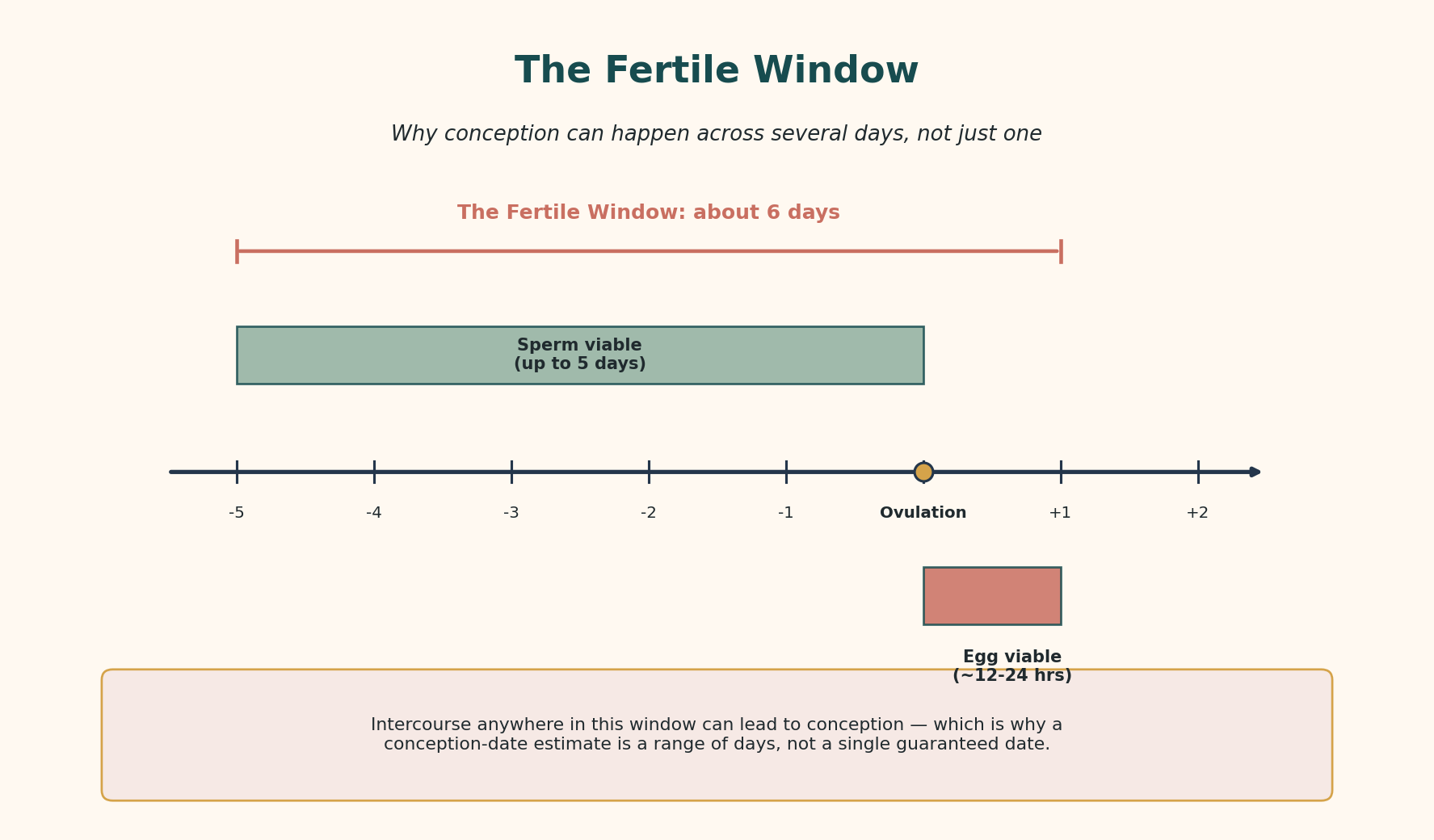
Sperm can survive inside the female reproductive tract for up to five days under favorable conditions. That means intercourse that happens up to five days before ovulation can still result in conception, once the egg is released and viable sperm are already waiting in the fallopian tube.
How Long an Egg Can Be Fertilized After Ovulation
Once released, an egg can typically be fertilized for about 12 to 24 hours before it is no longer viable. Combined with sperm’s several-day survival window, this creates a fertile window that spans roughly six days: the five days before ovulation plus the day of ovulation itself, with the highest odds of conception concentrated in the two to three days immediately before ovulation.
| Day relative to ovulation | Can intercourse that day lead to conception? | Why |
|---|---|---|
| 5 days before | Possible, lower odds | Near the outer edge of typical sperm survival |
| 3–2 days before | Possible, higher odds | Sperm are viable and waiting when the egg is released |
| 1 day before / day of ovulation | Most likely window | Highest concentration of documented conceptions |
| 1 day after ovulation | Possible, lower odds | Near the outer edge of typical egg viability |
| 2+ days after ovulation | Very unlikely | Egg is no longer viable for fertilization |
Estimating Conception From Your Last Menstrual Period (LMP)
If you know the first day of your last period, this is usually the most convenient starting point — and, for anyone with reasonably regular cycles, a genuinely reliable one.
The Standard Forward Calculation
The Basic Method
Add 14 days to the first day of your LMP to estimate the midpoint of your likely conception window, then treat the five days before that midpoint through about one day after it as the full window. This mirrors the same two-week offset used in standard due-date calculation, just applied to find the conception day instead of the delivery day.
A Worked Example
Suppose your LMP started on June 1. Adding 14 days gives June 15 as the estimated midpoint of your conception window. Your full estimated window, accounting for sperm survival and egg viability, would run from approximately June 10 through June 16, with June 14–15 the most likely days.
Adjusting for Cycle Length
Why a 28-Day Assumption Doesn’t Fit Everyone
The “add 14 days” shortcut assumes a 28-day cycle. Plenty of people have shorter or longer cycles as a normal, healthy pattern, and using the 28-day assumption on a 32-day or 24-day cycle will systematically shift the estimate in the wrong direction.
The Luteal-Phase-Based Adjustment Method
The most useful adjustment relies on a clinical pattern: the luteal phase (the time from ovulation to the start of the next period) is relatively consistent, typically 12 to 14 days, while the phase before ovulation is what actually varies between people. That means a more accurate estimate of ovulation day comes from counting backward from your next period, not forward from your LMP: subtract about 14 days from the first day of the period after the one in question. If you only have your LMP and your typical cycle length, you can approximate the same idea by subtracting 14 from your average cycle length to estimate which day of the cycle ovulation likely fell on.
A Worked Example With a Longer Cycle
Suppose your LMP started on June 1 and your cycles typically run 32 days rather than 28. Subtracting 14 from 32 gives day 18 as the estimated ovulation day, meaning conception likely happened around June 18 (day 18 of the cycle, counting June 1 as day 1) rather than June 15. Using the default 28-day shortcut on a 32-day cycle would have placed the estimate four days too early.
| Average cycle length | Estimated ovulation day (from LMP) | Estimated conception window |
|---|---|---|
| 24 days | Day 10 | Days 5–11 of the cycle |
| 28 days | Day 14 | Days 9–15 of the cycle |
| 30 days | Day 16 | Days 11–17 of the cycle |
| 32 days | Day 18 | Days 13–19 of the cycle |
| 35 days | Day 21 | Days 16–22 of the cycle |
This same cycle-length adjustment is the one referenced briefly in our due-date calculator guide’s discussion of cycle-length-adjusted clinic estimates; this section is the fuller treatment of that same underlying method, applied specifically to estimating conception rather than a due date.
Estimating Conception From a Known Due Date
Sometimes the due date is the only number you have — from a provider visit, an old chart, or a calculator — and the LMP was never recorded or isn’t remembered with confidence. You can still work backward to an estimated conception window.
The Basic Backward Calculation
Subtracting 266 Days From the Due Date
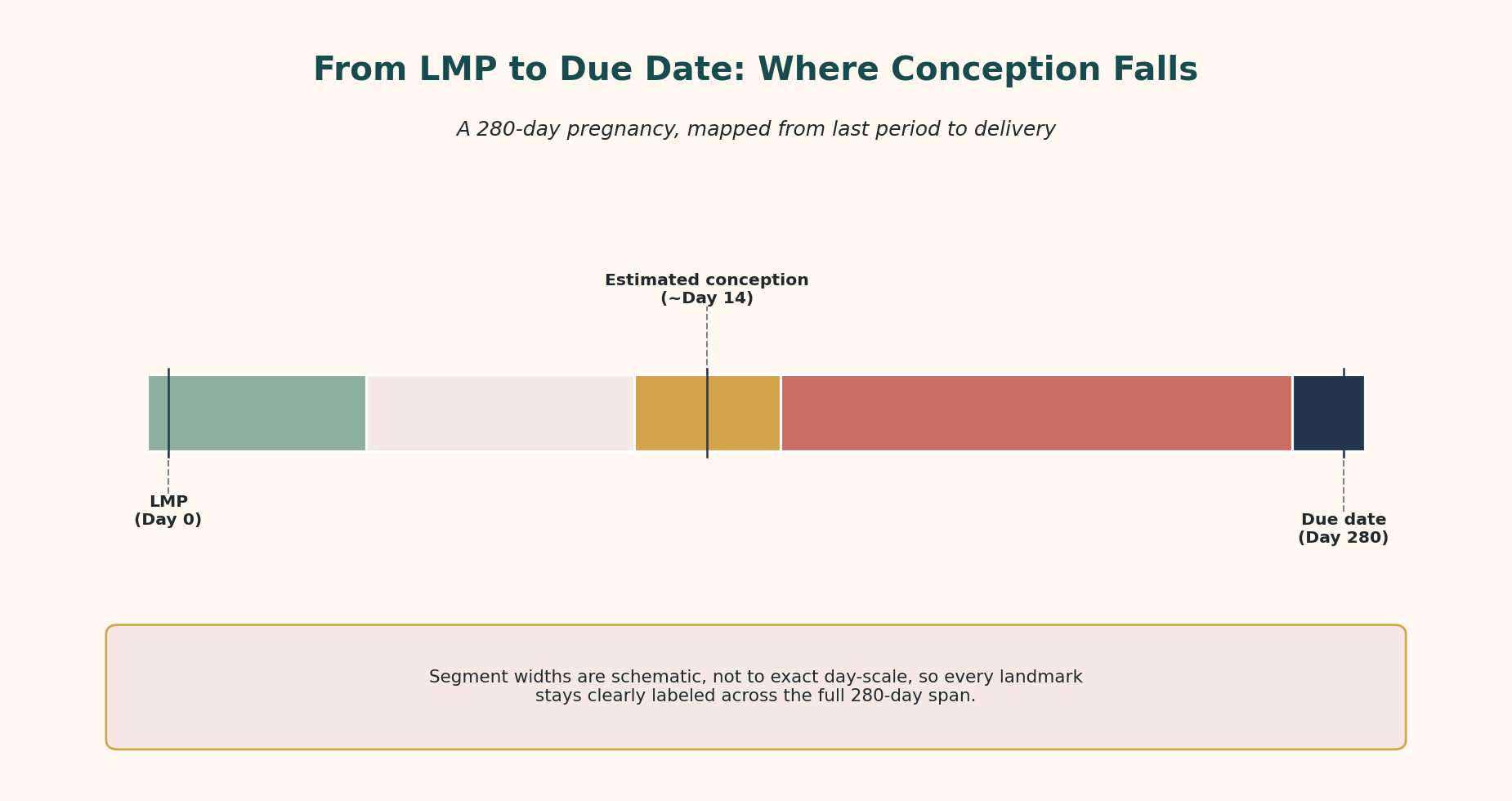
A standard due date is defined as 280 days after LMP, and conception is estimated at 266 days before that same due date (280 minus the standard 14-day LMP-to-ovulation offset). Subtracting 266 days from a known due date gives the estimated midpoint of the conception window.
A Worked Example
Suppose your due date is March 10 of next year. Counting back 266 days lands on approximately June 17 of the current year as the estimated conception midpoint, with the fuller window running from roughly June 12 through June 18.
What This Method Assumes — and What It Can’t Correct For
It Inherits Whatever Assumption Produced the Due Date
This calculation is only as good as the due date feeding into it. If the due date itself was calculated using the standard 28-day, day-14-ovulation assumption, working backward from it will simply reproduce that same assumption — it cannot magically recover a more precise conception date than the due date’s own method supports. If the due date was instead set by an early, accurate dating ultrasound, the backward calculation inherits that ultrasound’s precision, which is generally better.
When to Use This Method vs. the LMP Method
Use the due-date method when you trust the due date more than you trust your memory of your LMP — for example, after a first-trimester dating ultrasound has revised your due date, or if you simply never tracked your LMP but do have a confirmed due date on record. Use the LMP-based method instead when you have a clearly remembered or recorded LMP and reasonably regular cycles, since it lets you apply your own actual cycle length rather than whatever assumption is already baked into a due date. For the full methodology behind how a due date itself gets calculated in the first place — including the LMP, ovulation, and IVF-transfer-date formulas — see our complete due-date calculator guide, which owns that topic in full; this section only covers the reverse direction.

A related, more day-to-day calculation — figuring out how many weeks pregnant you are today, whether counting forward from a start date or backward from your due date — is covered in full in our pregnancy calculator guide, which also gives a brief overview of the reverse-conception calculation covered here in more depth.
Other Ways to Estimate a Conception Date
LMP and due-date calculations both rely on population averages. If you have more personal data, you can often narrow the window considerably.
From Ovulation-Tracking Data
Basal Body Temperature (BBT) Charting
Basal body temperature rises slightly — typically by about 0.5 to 1 degree Fahrenheit — after ovulation, once progesterone increases. Because the shift is detected after the fact, BBT charting confirms that ovulation already happened rather than predicting it in advance, but a consistent chart across several cycles gives a reliable personal baseline for roughly when in your cycle ovulation tends to occur.
Ovulation Predictor Kits (OPKs) and Cervical Mucus
OPKs detect the surge in luteinizing hormone (LH) that happens 24 to 36 hours before ovulation, giving a more forward-looking signal than BBT. Tracking changes in cervical mucus (becoming clearer, thinner, and more stretchy in the days leading up to ovulation) can add another data point. Combining a positive OPK with mucus changes and, ideally, a BBT rise afterward gives one of the more precise non-clinical estimates available, typically narrowing the conception window to one or two days rather than five to seven.
From a Single Known Date of Intercourse
What a Single Date Can Establish
If you know the specific date of a single instance of intercourse, you can check it against the fertile-window information in the biology section above: if that date falls within roughly five days before to one day after your estimated or confirmed ovulation day, conception was possible.
What It Cannot Establish
A single date can tell you conception was possible, but not that it definitely happened, or that it happened on that exact day rather than from sperm that survived a day or two afterward relative to when the egg was actually released. Treat a single-date estimate as a plausibility check, not a certainty.
From IVF, IUI, or a Known Fertility-Treatment Date
Why This Is the Most Precise Starting Point Available
A known fertility-treatment date removes almost all of the guesswork described elsewhere in this guide. A fresh IVF embryo transfer has a known, exact conception (fertilization) date from the lab record. An IUI (intrauterine insemination) date gives a very tightly bounded window, since sperm are placed directly at the time of the procedure rather than relying on natural timing within a cycle.
Where the Full Due-Date Math Lives
Converting an IVF or IUI date into a due date uses a different day-count than the LMP-based 280-day rule (267 days for a day-3 transfer, 263 days for a day-5/blastocyst transfer, for example), and converting a known conception or transfer date into your current gestational age uses yet another formula. Both are covered in full, with worked examples for fresh transfers, frozen transfers, and donor/surrogacy arrangements, in our due-date calculator guide’s IVF section and our current-gestational-age guide’s conception/IVF section; this guide focuses on the conception date itself rather than either of those downstream calculations.
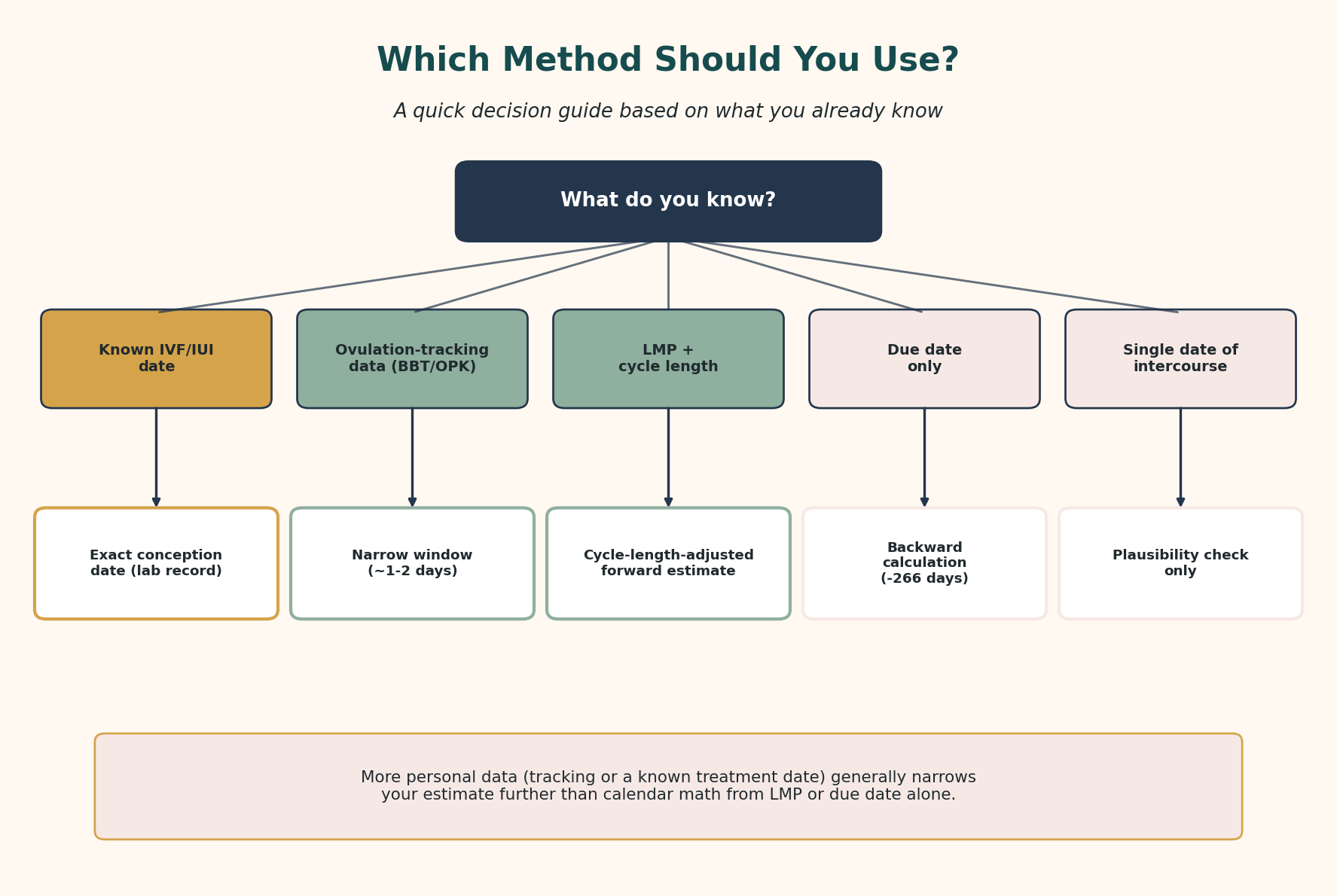
| Method | Typical window | Best used when |
|---|---|---|
| LMP + standard 14-day offset | ±3–5 days | Regular ~28-day cycles, confident LMP date |
| LMP + cycle-length adjustment | ±2–4 days | Regular cycles that aren’t 28 days |
| Backward from due date | ±3–5 days (plus the due date’s own imprecision) | Confident due date, uncertain or unrecorded LMP |
| BBT + OPK + cervical mucus tracking | ±1–2 days | At least one full cycle of consistent tracking |
| Single known intercourse date | Plausibility only, not a confirmed window | Only one recorded encounter in the relevant timeframe |
| IVF embryo transfer | Exact (fertilization date known from lab record) | Any IVF pregnancy |
| IUI procedure date | ±1 day | Any IUI pregnancy |
How Accurate Is a Conception Calculator?
Every method in this guide is a genuine estimate, not a measurement — it’s worth understanding exactly where the uncertainty comes from so you can judge how much confidence to place in any specific number.
Where the Uncertainty Comes From
Natural Cycle-to-Cycle Variability
Even someone with generally “regular” cycles can ovulate a few days earlier or later than usual in any given cycle, due to stress, illness, travel, or simple biological variation. This is compounded by the fertile window itself spanning several days (see the biology section above), so two independent sources of variability stack on top of each other in any estimate.
Recall and Record-Keeping Accuracy
Estimates built on a remembered LMP date are only as good as that memory. Studies of self-reported LMP dates consistently find a meaningful error margin compared to prospectively recorded dates or ultrasound-confirmed dating, which is part of why an early ultrasound is generally treated as more reliable than a self-reported LMP whenever the two disagree by more than about a week.
What an Ultrasound Can (and Can’t) Tell You About Conception Timing
Ultrasound Dates the Pregnancy, Not a Specific Day or Act
A dating ultrasound measures the size of the embryo or fetus and compares it to standard growth curves to estimate gestational age — it does not detect a conception event directly. In practice, this means an ultrasound can meaningfully narrow or correct a conception-date estimate (especially when it’s done early, and especially when it disagrees with an LMP-based estimate by more than the accepted redating threshold), but it still produces an estimated age with its own margin of error, not an exact conception day.
Where to Find Full Ultrasound-Accuracy Detail
The specific redating thresholds ACOG uses at different gestational ages, and a full breakdown of how ultrasound accuracy narrows in early pregnancy and widens later on, are covered in depth in our due-date calculator guide’s ultrasound and redating section and in our current-gestational-age guide’s ultrasound accuracy section; this guide focuses specifically on what that means for a conception-date estimate rather than repeating the full clinical thresholds here.
Special Situations That Change the Estimate
A few common situations make the standard 14-day-offset shortcut noticeably less reliable, and are worth flagging on their own.
Irregular Cycles and PCOS
Why a Standard Offset Doesn’t Work Well
Conditions like polycystic ovary syndrome (PCOS) can make ovulation infrequent, unpredictable, or absent in a given cycle, and cycle length itself may swing widely from month to month. Any calculation that assumes a fixed, predictable ovulation day is far less reliable under these conditions, since the underlying assumption — a consistent luteal-phase length following a variable-but-detectable ovulation — may not hold as cleanly.
What to Rely on Instead
Ovulation-tracking data (BBT, OPKs, or a provider-ordered ovulation-tracking ultrasound series) is considerably more useful than a calendar-based estimate in this situation, since it detects what’s actually happening in a given cycle rather than assuming a population average. An early dating ultrasound, once pregnancy is confirmed, is typically the most reliable source of gestational-age (and therefore conception-window) information available.
Recently Stopped Hormonal Birth Control
Why the First Cycles Can Be Unpredictable
After stopping hormonal birth control (the pill, a hormonal IUD, an implant, or an injection), it can take one or more cycles for ovulation timing to settle into whatever is typical for that individual, and the first post-birth-control cycle is often longer or shorter than what becomes typical afterward.
What This Means for a Conception Estimate
If conception happened in the first cycle or two after stopping birth control, a standard 28-day-cycle assumption is especially likely to be inaccurate, since there often isn’t yet an established “typical” cycle length to adjust from. An early dating ultrasound is the most reliable way to establish timing in this situation.
Breastfeeding and Lactational Amenorrhea
Why Ovulation Can Return Before a Period Does
Breastfeeding can suppress ovulation for a variable length of time after a previous birth (a pattern sometimes called lactational amenorrhea), but ovulation frequently returns before the first postpartum period does — meaning it’s possible to conceive again before any period has occurred to mark a new cycle’s start.
What This Means for Dating a New Pregnancy
Without a clear LMP to count from, a conception-date estimate for a new, closely spaced pregnancy usually has to rely more heavily on an early dating ultrasound, ovulation-tracking data if any was kept, or a known IVF/IUI date, rather than the standard LMP-based calculation used throughout most of this guide.
| Situation | Why the standard method is less reliable | Better alternative |
|---|---|---|
| PCOS or irregular cycles | Ovulation timing is unpredictable or infrequent | Ovulation tracking; early dating ultrasound |
| Recently stopped hormonal birth control | No established “typical” cycle length yet | Early dating ultrasound |
| Breastfeeding / lactational amenorrhea | Ovulation can return before a period does, with no LMP to count from | Early dating ultrasound; any kept tracking data |
| Twins or multiples | No change to the conception-dating math itself | Same methods as a singleton pregnancy |
Common Mistakes When Estimating a Conception Date
Most conception-date errors come from a handful of predictable mix-ups rather than the math itself being wrong.
Mistakes With the LMP-Based Method
Forgetting the Two-Week Offset
The most common mistake is treating the LMP date itself as the conception date. Conception happens around two weeks after the LMP, not on it — confusing the two produces an estimate that’s off by roughly 14 days, which is a large enough error to change which month a due date or a “how far along” answer falls in.
Assuming Everyone Ovulates on Day 14
The 28-day/day-14 pattern is a population average, not a personal guarantee. Applying it without adjustment to a cycle that’s meaningfully shorter or longer than 28 days produces a systematically shifted estimate — see the cycle-length adjustment table earlier in this guide for a better approach.
Mistakes With the Due-Date-Based Method
Working Backward From an Outdated Due Date
If a due date has ever been revised — most commonly after a first-trimester dating ultrasound — always use the current, updated due date for a backward calculation, not an earlier one. Working backward from a due date that’s since been corrected will simply reproduce the same outdated estimate.
Expecting a Single Exact Day Instead of a Window
Every method in this guide, including the most precise tracking-based ones, produces a range rather than a single guaranteed day (with the sole exception of a known IVF transfer date). Treating any calculated result as a certain, single-day fact — rather than the best available estimate — is a common source of unnecessary confusion when it doesn’t match some other independent estimate exactly.
Conception Timing in Adoption, Paternity, and Legal Contexts
Because this site covers both pregnancy and adoption, it’s worth addressing directly why “when did conception happen” sometimes matters well beyond simple curiosity or due-date planning.
Why Conception Timing Sometimes Comes Up in These Situations
Common, Non-Adversarial Reasons
An adoption professional or attorney may want a general timeline — an approximate due date or trimester, rather than a precise conception day — to plan around key milestones like matching, hospital planning, or required legal notice periods. In most cases, the same general estimates covered throughout this guide (and in our broader pregnancy calculator guide) are entirely sufficient for that kind of planning purpose.
Paternity and Birth-Father Questions in an Adoption Context
Conception timing can also come up in connection with identifying or providing legal notice to a child’s birth father, an important and legally sensitive part of many adoption processes. Requirements around notice, consent, and putative-father registries vary significantly by state, and whether a conception-date estimate is even relevant depends heavily on the specific legal situation.
What This Guide Can and Can’t Establish
An Estimate, Not Legal or Forensic Proof
Every method described in this guide produces an informational estimate intended for pregnancy planning and general timeline purposes — not a legal or forensic finding. A calculated conception window cannot establish paternity, satisfy a court’s evidentiary standards, or substitute for genetic testing where paternity is contested. This mirrors the same boundary drawn in our due-date calculator guide, which similarly notes that its formulas aren’t intended as a legal or forensic tool.
Where to Get the Right Kind of Help
If conception timing matters for a specific legal question — paternity, custody, an adoption proceeding, or anything else with legal consequences — the right next step is a licensed attorney who can advise on what standard of evidence applies in that specific context, which may include genetic testing rather than date-based estimation at all. If you’re an expectant parent considering adoption and have questions about how the process works, including birth-father notice requirements, that falls outside this guide’s scope; it’s a subject this site covers in dedicated adoption-process guides rather than in a dating-and-calculator context.
Conception Calculators, Apps, and Tools
Most of what an online conception calculator or app does is automate exactly the arithmetic described throughout this guide — but it’s worth knowing what’s actually happening behind the interface.
What a Conception Calculator Tool Typically Asks For
Standard Inputs
Most tools ask for either your LMP plus your average cycle length, or your due date, and apply the same forward or backward two-week-offset calculation covered earlier in this guide. Some more advanced tools also accept ovulation-tracking data (a positive OPK date, or a BBT-confirmed ovulation day) for a narrower estimate.
What a Good Tool Should Tell You About Its Own Limits
A trustworthy calculator should present its result as a window or range, disclose that it’s using a population-average assumption unless you’ve entered your own cycle-length or tracking data, and avoid presenting a single date with false precision. If a tool gives you one exact date with no range or caveat at all, treat that number as a convenient midpoint rather than a guaranteed fact.
Getting the Most Useful Result
Using Your Best Available Data
Enter your actual average cycle length rather than accepting a default 28-day assumption if you know your own cycles run differently. If you have any ovulation-tracking data at all, even from a single cycle, it will generally narrow the estimate more than LMP-based calculation alone.
Updating Your Estimate After New Information
If an early dating ultrasound revises your due date, recalculate your conception-window estimate from the updated due date rather than continuing to rely on an earlier LMP-based estimate — the same “use your most current, most reliable number” principle that applies throughout pregnancy dating calculations generally.
Glossary of Conception-Dating Terms
A quick reference for the terms used throughout this guide.
Biological and Cycle Terms
Ovulation and Fertilization Terms
- Ovulation — the release of a mature egg from an ovary, typically around the midpoint of a menstrual cycle.
- Fertilization — the process by which a sperm and egg combine, forming what will become an embryo; this is the biological event a “conception date” refers to.
- Zygote — the single cell formed immediately after fertilization, before it begins dividing.
- Implantation — the point, typically about a week after fertilization, when the developing embryo attaches to the uterine lining; covered in full in our implantation bleeding guide.
Fertile-Window Terms
- Fertile window — the span of days in a cycle during which intercourse can result in conception, based on sperm survival time and egg viability.
- Luteal phase — the second half of the menstrual cycle, from ovulation until the next period begins, typically 12 to 14 days and relatively consistent for a given individual.
- Follicular phase — the first half of the cycle, from the start of a period until ovulation; this is the phase whose length actually varies between people and cycles.
- Days past ovulation (DPO) — a common shorthand, especially in fertility-tracking communities, for counting days since a confirmed or estimated ovulation day.
Dating and Calculation Terms
Calculation and Method Terms
- LMP (last menstrual period) — the first day of a person’s most recent period before conception; the standard starting point for most pregnancy-dating calculations.
- Gestational age — a pregnancy’s age counted from the LMP, which runs about two weeks ahead of the embryo or fetus’s actual age since conception.
- Naegele’s rule — the standard formula adding 280 days to the LMP to estimate a due date; the basis for this guide’s 266-day backward calculation to conception.
- Dating ultrasound — an early-pregnancy ultrasound used to estimate gestational age from embryo or fetal measurements, often used to confirm or revise an LMP-based estimate.
Clinical and Practical Terms
- BBT (basal body temperature) — a person’s resting body temperature, which rises slightly after ovulation; used as a retrospective ovulation-tracking method.
- OPK (ovulation predictor kit) — a home test that detects the LH surge that precedes ovulation by roughly 24 to 36 hours.
- IUI (intrauterine insemination) — a fertility procedure placing sperm directly into the uterus around the time of ovulation, giving a tightly bounded conception-date estimate.
- IVF embryo transfer — placing a fertilized embryo into the uterus during in vitro fertilization; a fresh transfer has a known, exact fertilization (conception) date from the lab record.
Frequently Asked Questions
General Conception Calculator Questions
What exactly is a conception calculator?
A conception calculator is a tool (or a manual calculation) that estimates when conception likely happened, using either your last menstrual period plus cycle length, or a known due date, as the starting point.
Is a conception calculator the same as an ovulation calculator?
They’re closely related but answer slightly different questions: an ovulation calculator typically looks forward, predicting your next fertile window for someone trying to conceive, while a conception calculator typically looks backward or forward from an already-known date to estimate when conception already happened.
Can a conception calculator tell me the exact day I conceived?
Only if you have a known IVF embryo transfer date. Every other method in this guide produces an estimated window, typically five to seven days wide, rather than a single guaranteed day.
Do I need to know my due date to use a conception calculator?
No — you can estimate a conception window from your LMP alone, from ovulation-tracking data, or from a known fertility-treatment date, in addition to working backward from a due date.
Is there a cost to using a conception calculator?
The manual calculations described throughout this guide are free and require nothing beyond a calendar. Most online conception-calculator tools and apps are also free, though some pregnancy-tracking apps bundle the feature into a broader paid subscription.
Can a conception calculator tell me the sex of the baby?
No — none of the calculations in this guide use or produce information about fetal sex; conception-date estimation is purely a timing calculation.
LMP-Based Method Questions
Why does the LMP-based method add 14 days instead of counting from the first day of my period directly?
Ovulation — and therefore conception — happens partway through the cycle, not on the first day of the period. The 14-day offset accounts for the time between the start of a period and the typical timing of ovulation in an average cycle.
What if I don’t remember my exact LMP date?
Use your best estimate and treat the resulting conception window as correspondingly less precise; if you have a due date from a provider or a dating ultrasound, the backward calculation described in this guide may give a more reliable estimate than a poorly remembered LMP.
Does the LMP method work the same way for every cycle length?
The basic 14-day shortcut assumes a 28-day cycle. For other cycle lengths, use the cycle-length adjustment method described earlier in this guide, which typically gives a meaningfully better estimate.
What if my cycles vary in length from month to month?
Use your average cycle length for a rough estimate, but recognize that the more your cycles vary, the wider your true uncertainty is — ovulation-tracking data or an early dating ultrasound will generally serve you better than calendar math alone in this situation.
Can I use the first day of spotting as my LMP date if my period arrived gradually?
Use the first day of actual menstrual flow, not preceding spotting, as your LMP date, consistent with how the same convention is applied in due-date calculation generally.
Due-Date-Based (Backward) Method Questions
Why subtract 266 days instead of 280 days to estimate conception from a due date?
280 days is the full LMP-to-due-date length; subtracting the standard 14-day LMP-to-ovulation offset from that gives 266 days as the due-date-to-conception length.
Can I get the same result by subtracting 280 days and then adding back 14?
Yes — subtracting 280 days from a due date gives an estimated LMP, and adding 14 days to that estimated LMP lands on the same conception-window midpoint as subtracting 266 days directly; both are equivalent ways of expressing the same relationship.
My due date has been revised since my dating ultrasound. Which one should I use?
Always use your current, most recently confirmed due date for a backward conception calculation — an ultrasound-revised due date is generally more reliable than the original LMP-based estimate it replaced.
Does this backward method work the same way for a due date calculated from an IVF transfer?
Not directly — an IVF pregnancy’s due date is calculated using a different day-count than the standard 280-day LMP rule, so backing out a conception date from an IVF-based due date isn’t necessary anyway, since the actual conception (fertilization) date is already known from the lab record.
Is a backward calculation from a due date ever more accurate than an LMP-based forward calculation?
It can be, specifically when the due date was set or revised by an early, reliable dating ultrasound and your recalled LMP is uncertain — in that case, the due date itself carries better information than an uncertain LMP would.
Ovulation-Tracking and Fertility-Awareness Questions
Which is more accurate: BBT charting or an OPK?
They measure different things and work well together — an OPK predicts ovulation 24 to 36 hours in advance, while a BBT rise confirms after the fact that ovulation already happened; using both gives a more complete picture than either alone.
How many cycles of tracking do I need before I can trust my own pattern?
Most fertility-awareness guidance suggests at least two to three consistently tracked cycles before relying heavily on your own personal pattern, since a single cycle could be unusually early or late for you.
Can a fertility-tracking app calculate my conception date for me automatically?
Many apps that record BBT, OPK results, or cervical mucus observations will estimate an ovulation day automatically, which you can then use with this guide’s fertile-window information to estimate a conception window.
Does cervical mucus tracking alone give a reliable estimate?
Cervical mucus changes provide useful supporting information but are somewhat more subjective than a BBT chart or an OPK result; most fertility-awareness methods recommend using it alongside at least one other tracking method rather than by itself.
If I tracked ovulation but didn’t record the specific day, can I still use this guide?
Yes — general tracking impressions (for example, “usually around day 16 of my cycle”) are still more useful than the default 28-day assumption, even without a precisely recorded day.
Cycle Length and Irregular Cycle Questions
What counts as an “irregular” cycle for the purposes of this guide?
Cycles that vary by more than about seven to nine days from one to the next, or that fall well outside the roughly 21-to-35-day range considered typical, are generally treated as irregular for dating purposes.
My cycles are regular but just longer than 28 days. Does that make me irregular?
No — a consistently longer or shorter cycle (for example, always 32 days) is a normal, regular pattern; use the cycle-length adjustment table earlier in this guide rather than treating it as an irregularity.
Can stress or illness shift ovulation timing in an otherwise regular cycle?
Yes — significant stress, illness, travel, or major schedule disruption can delay or occasionally advance ovulation even in someone with generally predictable cycles, which is part of why any single cycle’s estimate carries some built-in uncertainty.
Does age affect how reliable a calendar-based conception estimate is?
Cycle regularity can change with age, particularly as someone approaches perimenopause, which can make calendar-based estimation less reliable during that transition regardless of how regular cycles were previously.
If I have no idea how long my cycles typically run, what should I do?
Use the standard 28-day assumption as a rough starting point, but rely more heavily on an early dating ultrasound once pregnancy is confirmed, since it doesn’t depend on cycle-length assumptions at all.
IVF, IUI, and Fertility Treatment Questions
If I had a frozen embryo transfer (FET), what’s my conception date?
For a frozen transfer, the original fertilization date (when the embryo was first created, possibly months or years earlier) is technically the conception date, though for pregnancy-dating purposes, providers typically calculate gestational age from the transfer date and the embryo’s age at freezing rather than the original fertilization date — see our due-date calculator guide’s IVF section for the full method.
Does a donor egg or donor embryo change how conception date is calculated?
No — the calculation is based on when fertilization actually occurred (or, for a transfer, the transfer date and embryo age), regardless of whose egg, sperm, or embryo was used.
Is IUI conception timing as precise as IVF?
It’s very close but not quite as exact, since IUI still relies on ovulation happening naturally around the time of the procedure rather than a lab-controlled fertilization event; most estimates treat an IUI-based conception date as accurate to within about a day.
Can I use this guide’s LMP-based method for an IVF or IUI pregnancy instead?
It’s not necessary and would be less accurate — a known treatment date already gives you a far more precise starting point than a population-average LMP-based calculation would.
Does surrogacy change conception-date calculation?
No — the conception (fertilization) date is determined the same way regardless of whether the pregnancy is being carried by a gestational carrier; only the pregnancy itself, not the underlying date math, differs.
Accuracy and Precision Questions
How wide is a “typical” conception window estimate?
Most calendar-based methods (LMP-based or backward from a due date) produce a window of about five to seven days; tracking-based methods can narrow that to one or two days; only a known IVF transfer date gives an exact single day.
Why do two different conception calculators sometimes give me slightly different dates?
Small differences usually come from slightly different rounding conventions or default cycle-length assumptions between tools; if the results are within a few days of each other, both are reflecting the same underlying uncertainty rather than one being simply wrong.
Can bloodwork or a pregnancy test tell me my exact conception date?
No — a pregnancy test (or hCG bloodwork) confirms that a pregnancy exists and can give a rough sense of how far along it is based on hCG levels, but hCG-based estimates are considerably less precise than ultrasound or tracking-based dating for pinning down a specific conception date.
Is a conception-date estimate more or less accurate than a due-date estimate?
They carry essentially the same underlying uncertainty, since one is calculated directly from the other using a fixed 14-day offset — improving the accuracy of one (for example, with an ultrasound) improves the other by the same amount.
Should I trust my own calculation over what an app or calculator tells me?
If you’ve entered the same inputs (LMP or due date, and your actual cycle length if applicable), a correctly performed manual calculation and a reputable app should agree; if they don’t, double-check which starting date and cycle-length assumption each one actually used.
Twins and Multiples Questions
Does carrying twins change how conception date is calculated?
No — the same LMP-based, due-date-based, and tracking-based methods apply whether a pregnancy is a singleton or twins; a single conception event is being dated in either case.
What about twins from two separate eggs (fraternal twins) — do they have different conception dates?
Fraternal twins result from two eggs released and fertilized within the same fertile window, so their conception dates are generally treated as the same for dating purposes, even though the two fertilization events are technically separate.
Does IVF with multiple embryo transfer change conception dating for twins?
No — if two embryos are transferred on the same day, both share the same known conception (fertilization) date from the lab record, the same as a single-embryo transfer.
Is there ever a case where twins have genuinely different conception dates?
Rarely, a phenomenon called superfetation (a second, separate conception occurring after a pregnancy has already begun) has been documented, but it is considered extremely uncommon and isn’t a standard consideration for typical conception-date estimation.
Special Situations Questions
How does a miscarriage or pregnancy loss affect a later conception-date estimate?
A cycle following a loss can behave differently than a typical cycle, sometimes with a delayed return of regular ovulation; an early dating ultrasound is generally the most reliable way to establish timing for a pregnancy that follows soon after a loss.
Does an IUD failure change how I’d estimate a conception date?
No — once conception occurs, the same dating methods apply regardless of what form of contraception was in use; there’s no special conception-date adjustment specific to IUD failure.
Can thyroid conditions or PCOS medication affect ovulation timing enough to matter here?
Yes — conditions and medications that affect ovulation timing (thyroid disorders, PCOS treatments, and others) can shift when in a cycle ovulation actually happens, which is one more reason tracking data or an ultrasound is often more reliable than calendar assumptions for anyone managing one of these conditions.
I conceived while using a fertility app that predicted a different ovulation day than my calculation here. Which should I trust?
If the app used your own tracked data (BBT, OPK results, or cervical mucus observations) rather than a generic calendar assumption, it likely reflects your actual cycle better than a population-average calculation; if it was calendar-only, the two methods are working from the same kind of assumption and should generally agree once cycle length is entered consistently.
Does this guide apply the same way to a pregnancy conceived naturally after infertility treatment for something unrelated (for example, ovulation induction medication without IUI)?
Largely yes — if conception itself happened through timed intercourse rather than a lab or in-office procedure, the same tracking-based and calendar-based methods described in this guide apply, since the medication is affecting when ovulation happens rather than how conception is dated afterward.
Adoption, Paternity, and Legal Questions
Can an adoption professional use the calculations in this guide for planning purposes?
Yes — the same general timeline estimates covered throughout this guide (an approximate due date, trimester, or conception window) are typically sufficient for planning purposes like matching or hospital-plan timing, without needing precise clinical dating.
Does an estimated conception date have any legal weight in a paternity case?
No — an estimated conception window from this guide’s methods is informational only and is not designed to meet a legal or forensic evidentiary standard; a contested paternity question is resolved through genetic testing and legal process, not date arithmetic.
If I’m considering placing a child for adoption, do I need to calculate a conception date for any part of that process?
Generally no — adoption planning typically relies on a due date or current trimester rather than a precise conception date; if a specific situation calls for more detail, an adoption professional or attorney involved in your case can advise on what’s actually needed.
Where can I learn more about birth-father notice or consent requirements in adoption?
Those requirements vary significantly by state and are outside the scope of this dating-and-calculator guide; this site covers adoption process topics, including birth-father and other-parent considerations, in its dedicated adoption-focused guides.
Can this guide help me figure out if a specific person could be the biological father based on a conception window?
This guide can only tell you whether a specific date falls within a biologically plausible fertile window — it cannot confirm or rule out a specific individual as a biological parent; that requires genetic (DNA) testing.
Is genetic testing more reliable than a conception-date estimate for paternity questions?
Yes, substantially — genetic testing directly examines biological relationship rather than inferring plausibility from dates, which is why it’s the standard used in legal paternity determinations rather than calendar-based conception estimation.
Comparing This Guide to Others
How is this guide different from the pregnancy calculator hub guide on this site?
Our pregnancy calculator guide covers the full range of calculator types at a hub level, including a brief overview of working backward from a due date to a conception estimate; this guide is the full, dedicated deep-dive on conception-date estimation specifically, covering methods and biology that the hub guide only summarizes.
How is this guide different from the due date calculator guide?
Our due-date calculator guide owns the full forward methodology for calculating a due date itself (LMP, ovulation, and IVF formulas, plus ACOG redating thresholds); this guide instead focuses on estimating conception timing, whether forward from an LMP or backward from an already-known due date.
How is this guide different from the “how many weeks pregnant am I” guide?
That guide covers converting a known conception or IVF-transfer date into your current gestational age — the opposite direction from this guide, which focuses on estimating an unknown conception date in the first place.
How is this guide different from the pregnancy week calculator guide?
Our pregnancy week calculator guide starts from a current gestational week (however it was determined) and converts it into a trimester, month, and calendar-month mapping. This guide doesn’t address trimester or month conversion at all — it’s entirely about estimating when conception itself occurred.
Which guide should I read first if I’m not sure which one I need?
If you want to know how far along you are today, start with our current-gestational-age guide. If you want to know your due date, start with our due-date calculator guide. If you specifically want to estimate when conception happened, this guide is the right starting point.
Tools and App Questions
Do I need a special app to estimate a conception date, or can I do it by hand?
Every method in this guide can be done by hand with just a calendar; an app or online calculator is a convenience, not a requirement, and produces the same result as the manual calculation when given the same inputs.
Are conception-calculator apps private, or do they share my data?
Data-sharing practices vary considerably between apps and are described in each app’s own privacy policy; reviewing that policy before entering sensitive reproductive-health data into any app is a reasonable precaution.
Can I build my own simple conception-date spreadsheet?
Yes — the LMP-based and due-date-based formulas in this guide (add or subtract a fixed number of days) translate directly into a simple spreadsheet date formula, without needing a dedicated app.
Why do some apps ask for my average cycle length instead of just my LMP?
Cycle length is what allows a tool to move beyond the generic 28-day assumption and apply the cycle-length adjustment described earlier in this guide, generally producing a more personalized estimate.
Should I update an app’s conception-date estimate after a dating ultrasound?
Yes — if your app allows you to manually enter or adjust your due date, updating it after a dating ultrasound will also update any conception-date estimate the app derives from it.
Common Mistakes and Troubleshooting Questions
My calculated conception date doesn’t match when I remember having intercourse. What should I do?
Remember that sperm can survive up to five days, so a plausible conception date can fall several days before an act of intercourse; check whether the calculated window overlaps at all with any intercourse in the relevant timeframe rather than expecting an exact same-day match.
I calculated a conception date that falls before my LMP. What went wrong?
This usually means a date was entered in the wrong order (mixing up a due date with an LMP date) or in the wrong date format (day/month swapped with month/day); double-check which specific date you entered and in what format.
My conception-date estimate and my provider’s estimate disagree by more than a week. What should I do?
Your provider’s estimate — especially if based on an early dating ultrasound — is generally more reliable than a calendar-based estimate; ask your provider what their estimate was based on, and use that as your primary reference going forward.
Can rounding differences alone explain a few days’ discrepancy between two calculations?
Yes — small differences in how a tool rounds or defines “day 1” of a cycle can shift a result by a day or two, which is well within the normal range of variation for this kind of estimate.
I used a due date that later got revised. Do I need to redo my conception estimate?
Yes — always base a backward conception calculation on your most current, confirmed due date rather than an earlier one that’s since been corrected.
Terminology and Definition Questions
What’s the difference between “conception” and “fertilization”?
The terms are generally used interchangeably in everyday and clinical conversation to refer to the moment sperm and egg combine; some sources distinguish “conception” as the broader establishment of pregnancy (including implantation) rather than the fertilization moment alone, but for the purposes of this guide’s date calculations, the two terms refer to the same event.
Is “conception date” the same thing as “date of fertilization”?
Yes, for the purposes of every calculation in this guide — both terms refer to the same biological event.
What does “gestational age” mean compared to “conception age” or “fetal age”?
Gestational age is counted from the LMP and runs about two weeks ahead of conception age (also called fetal age), which is counted from the actual conception date; providers and calculators default to gestational age unless stated otherwise.
What does “DPO” mean in fertility-tracking communities?
DPO stands for “days past ovulation,” a shorthand used to count days since a confirmed or estimated ovulation day, often used to time pregnancy tests or track early-pregnancy symptoms relative to conception.
What’s a “chemical pregnancy” and does it affect a later conception-date estimate?
A chemical pregnancy is a very early pregnancy loss, often occurring around the time an expected period would start; it doesn’t change how a conception date would be calculated for a subsequent pregnancy, though it may affect how confidently a cycle’s timing is remembered.
Practical and Miscellaneous Questions
Do I need my conception date for anything my provider will ask me at a prenatal visit?
Providers primarily work from your LMP and any dating ultrasound results rather than asking for a self-calculated conception date directly, though bringing your best available dates and any tracking data to your first visit is always useful.
Does knowing my conception date change my prenatal care schedule?
No — your prenatal care schedule is driven by your gestational age (calculated from your LMP or a dating ultrasound), not by your conception date specifically, since the two are related by the same fixed offset in any case.
Can I use a conception-date estimate to guess when I’ll feel early pregnancy symptoms?
Roughly — early symptoms are generally described relative to conception or ovulation (for example, “symptoms often start around one to two weeks after conception”), so a conception-window estimate can give a rough timing reference; our pregnancy symptoms guide covers typical symptom timing in full.
Is there a way to double-check a conception-date calculation myself?
Yes — calculate it two ways (for example, forward from your LMP and, separately, backward from your due date if you have one) and confirm they land within a few days of each other, which is the expected range of agreement between two versions of the same underlying method.
Does time zone or travel affect a conception-date calculation?
Not meaningfully — conception-date estimation works in whole days rather than precise times, so ordinary time-zone differences or travel don’t introduce a practically significant error into the calculation.
Where can I find a printable version of the tables in this guide?
The tables in this guide are formatted to display cleanly if you print the page directly from your browser; no separate printable file is provided.
Quick Scenario Walkthroughs
Scenario: I know my LMP was April 3 and my cycles are a typical 28 days. What’s my conception window?
Adding 14 days to April 3 gives April 17 as the estimated midpoint, with a full window of roughly April 12 through April 18.
Scenario: My due date is January 20, and I don’t know my LMP. What’s my conception window?
Subtracting 266 days from January 20 gives an estimated conception midpoint of approximately April 27 of the prior year, with a window of roughly April 22 through April 28.
Scenario: My LMP was May 10, and my cycles typically run 34 days. What’s my conception window?
Subtracting 14 from a 34-day cycle gives day 20 as the estimated ovulation day; counting 20 days from May 10 (counting May 10 as day 1) lands on approximately May 29 as the estimated conception midpoint.
Scenario: I had an IUI on September 8. What’s my conception date?
Your conception date is effectively September 8, the day of the procedure, since IUI places sperm directly at the intended time of fertilization rather than relying on a broader natural fertile window.
Scenario: I have one BBT-confirmed ovulation day of June 22 from a single tracked cycle. What’s my conception window?
Your conception window is approximately June 17 through June 23 (the days before June 22 when sperm could have survived, plus June 22 and the day after, when the egg was viable), a narrower and more personalized window than a calendar-based estimate alone would give.
Provider Communication Questions
Should I bring my own conception-date calculation to my first prenatal visit?
It can be helpful context, but your provider will primarily rely on your LMP and any dating ultrasound rather than a self-calculated conception date; bringing your best available dates (LMP, cycle length, any tracking data) is more useful than the conception estimate itself.
Will my provider ask me directly when I think I conceived?
Some providers do ask, particularly if you have IVF, IUI, or detailed tracking data that could refine dating beyond a standard LMP-based estimate; if you have that information, it’s worth mentioning even if not asked directly.
What if my provider’s estimate and my own calculation disagree?
Defer to your provider’s estimate, especially if it’s based on a dating ultrasound, since ultrasound measurements are generally more reliable than calendar-based calculation alone; ask what their estimate was based on if you’re curious about the discrepancy.
Can a midwife or family medicine provider help with conception-date questions the same way an OB-GYN can?
Yes — dating a pregnancy, including any conception-timing discussion, is standard practice across provider types who offer prenatal care, not something specific to OB-GYNs alone.
Is it normal to not know or care about an exact conception date during a healthy pregnancy?
Completely normal — many people never calculate a conception date at all and rely entirely on their due date and gestational age for prenatal care and planning purposes; this guide exists for those who are specifically curious or have a particular reason to need the estimate.
A Few Final Clarifying Questions
Is “conception” the same moment as “getting pregnant”?
In everyday usage, yes — the two phrases are typically used interchangeably to refer to the same fertilization event, even though a pregnancy isn’t clinically confirmed until later, after implantation and often a positive test.
Can stress after conception affect the conception date itself?
No — once conception has occurred, nothing afterward changes when it happened; stress or other factors can affect the course of an existing pregnancy but not retroactively shift the conception date.
Does the father’s age or health affect how conception date is calculated?
No — conception-date calculation is based entirely on cycle and ovulation timing on the pregnant person’s side, plus sperm-survival biology in general; it doesn’t factor in the sperm-contributing partner’s individual age or health as a calculation input.
If I conceived while traveling internationally, does that complicate the calculation?
Not for the calculation itself — international travel doesn’t change the biology involved, though keeping track of dates across time zones is worth double-checking if you’re trying to pin down a specific day.
Can environmental factors like temperature or altitude shift conception timing?
There’s no well-established practical effect of ordinary temperature or altitude variation on conception-date calculation for typical circumstances; the standard cycle-based and tracking-based methods in this guide apply the same way.
Is there a “safest” or “best” day within the fertile window to try to conceive, for someone actively trying?
Research generally points to the one to two days immediately before ovulation as having the highest per-cycle conception odds, though pregnancies conceived at other points within the fertile window are common and completely normal; this guide focuses on dating an already-occurred conception rather than optimizing timing for someone currently trying.
What’s the single most important thing to remember from this entire guide?
A conception date is almost always a window, not a single guaranteed day, because ovulation timing varies and both sperm and the egg remain viable for a meaningful number of days around it — treat any calculated date as the best available estimate rather than a certainty, and let an early dating ultrasound refine it whenever one is available.
Historical and Miscellaneous Questions
Has the standard 280-day, 14-day-offset convention always been used?
The basic approach — adding a fixed number of days to the LMP — traces back to 19th-century obstetric practice and has remained the standard convention since, even as ultrasound has become the more precise tool for confirming or adjusting the estimate it produces.
Why do some older sources describe pregnancy as “10 lunar months” instead of 9 calendar months?
A lunar month (about 28 days) divides evenly into the standard 280-day pregnancy length, giving exactly 10 lunar months, while calendar months of uneven length don’t divide evenly into 280 days, which is why the “10 lunar months” convention appears in some older or non-Western medical traditions alongside the more familiar “9 months.”
Is the concept of a “fertile window” a recent scientific discovery?
The general timing of ovulation relative to menstruation has been understood in broad terms for roughly a century, though the specific durations for sperm survival and egg viability have been refined through more recent clinical research.
Do other countries calculate conception and due dates differently than the United States does?
The core LMP-based, 280-day/266-day convention is used internationally as a standard obstetric practice, though some countries express gestational age using slightly different rounding or presentation conventions.
Is there an official government or medical body that “owns” the standard conception-dating formula?
Professional bodies such as the American College of Obstetricians and Gynecologists (ACOG) publish official guidance on pregnancy dating conventions and ultrasound-based redating thresholds, which this guide’s related articles reference directly.
Does this guide’s information apply the same way regardless of a person’s age or how many prior pregnancies they’ve had?
Yes — the underlying biology of ovulation timing, sperm survival, and egg viability described in this guide applies broadly across ages and pregnancy histories; individual cycle characteristics can still vary, which is exactly why tracking data and ultrasound confirmation are recommended whenever precision matters.
The bottom line
A conception date can be estimated forward from your last menstrual period, backward from a known due date, from ovulation-tracking data, or exactly from a known IVF transfer date — but outside of that last case, the honest answer is always a window of several days, not a single guaranteed date. That’s because ovulation timing varies between cycles and people, and because sperm can survive up to five days while an egg remains fertilizable for roughly 12 to 24 hours after release. Use your best available data, adjust for your own cycle length when you can, and let an early dating ultrasound refine any estimate once one is available.
About pregnancyadoption.com
pregnancyadoption.com publishes free, judgment-free information on pregnancy, pregnancy options, and adoption for anyone trying to understand what’s happening in their body or what choices are available to them. We are not a law firm, an adoption agency, or a medical practice — we’re an independent editorial resource, and we don’t place children, provide legal representation, or profit from which option a reader ultimately chooses.
Every article carrying medical information is written to a source-tiering standard (government and medical-authority sources first, established nonprofits second, commercial sources never used as factual authority) and reviewed by a licensed clinician before publication. Time-sensitive information is scheduled for review on a recurring cadence, and factual errors reported by readers are corrected promptly. Read our full About & Editorial Guidelines page for details on our review process, sourcing standards, and how to report a correction.
Medical and Legal Disclaimer
This article is provided for general educational purposes only and does not constitute medical, legal, financial, or tax advice. Reading this content does not create a doctor-patient, attorney-client, or any other professional relationship between you and pregnancyadoption.com, its authors, or its reviewers. Always seek the advice of a licensed physician, midwife, attorney, or other qualified professional with any questions you may have regarding a medical condition, a legal right, or a financial decision, and never disregard or delay seeking professional guidance because of something you have read here. If you believe you may be experiencing a medical emergency, call 911 or your local emergency number immediately.
Clinical definitions, timing ranges, and prevalence figures referenced in this article are accurate to the best of our knowledge as of this article’s last review date but may not reflect the most current research or your individual situation. We make reasonable efforts to verify accuracy but make no warranty, express or implied, as to the completeness, reliability, or timeliness of any information on this page. Links to third-party websites are provided for convenience only; we do not control and are not responsible for the content, accuracy, or privacy practices of external sites, and inclusion of a link is not an endorsement.
To the fullest extent permitted by applicable law, pregnancyadoption.com and its authors, editors, and medical/legal reviewers disclaim all liability for any loss, injury, or damage of any kind arising from reliance on the information in this article. This disclaimer does not limit any rights you may have under law that cannot be waived. Read our full Medical and Legal Disclaimer for complete terms.
Sources and further reading
This guide draws on patient-education, clinical, and regulatory sources from the following organizations. Government and major medical-authority sources are prioritized for material clinical claims; established nonprofit and hospital-system sources are used for supporting patient-facing explanations.
- Eunice Kennedy Shriver National Institute of Child Health and Human Development (NICHD) — menstrual cycle and ovulation timing, sperm survival
- Cleveland Clinic — Luteal Phase of the Menstrual Cycle — luteal phase length and characteristics
- Cleveland Clinic — Conception: Fertilization, Timeline & How to Get Pregnant — egg viability and fertilization timeline
- Cleveland Clinic — Sperm — sperm survival and lifespan factors
- StatPearls / NCBI Bookshelf (National Library of Medicine) — Pregnancy Dating — Naegele’s rule and ultrasound dating-accuracy ranges
- March of Dimes — Calculating Your Due Date — patient-facing due-date and ovulation calculation guidance
- American College of Obstetricians and Gynecologists (ACOG) — official guidance on pregnancy dating and ultrasound-based redating thresholds, referenced via this site’s related due-date and gestational-age guides
