
“How many weeks pregnant am I?” sounds like it should have one simple answer, but it’s actually a distinct question from “when is my due date” — and it’s answered with different math. This guide is the dedicated deep-dive on that specific question: how to calculate your current gestational age accurately, from any starting point you have (an LMP, a due date, a conception date, or an IVF transfer date), how ultrasound measurements estimate it directly, and what to do when your own number doesn’t match what an app or your provider says. For due-date calculation itself — the formulas, worked examples, and accuracy research behind estimating when you’ll deliver — see our due-date calculator guide, which owns that topic in full; for a broader overview of pregnancy calculators generally, see our pregnancy calculator guide.
Short Answer: How to Find Out How Many Weeks Pregnant You Are
If you are asking “how many weeks pregnant am I,” the answer comes down to a simple gestational-age calculation most providers use the same way.
“How many weeks pregnant am I” is a slightly different question than “when is my due date,” and it has its own quick answer. If you know the first day of your last menstrual period (LMP), count the number of days between that date and today, then divide by seven. The whole number is your current week; the remainder is your extra days.
The American College of Obstetricians and Gynecologists (ACOG) explains how gestational age is calculated clinically. Mayo Clinic also publishes a week-by-week pregnancy guide.
Key Takeaways
- Your current gestational age is a count forward from your LMP to today (or backward from a known due date), not a guess or a range.
- Clinically, “gestational age” starts counting about two weeks before conception actually happens — a convention explained fully later in this guide.
- If your LMP isn’t reliable (irregular cycles, IVF, unknown dates), an ultrasound-based estimate is more accurate than a calendar count — covered in detail below.
- This guide focuses specifically on calculating your current week. For due-date calculation methodology itself, see our due-date calculator guide.
The Fast Method, If You Know Your LMP
Count the Days, Then Divide by Seven
Take today’s date and the first day of your last period. Count every day in between, including your LMP date itself as day zero. Divide the total by seven. The quotient is your week number; the remainder is your day count within that week. This is exact arithmetic — there’s no rounding involved unless your starting date itself is uncertain.
A 10-Second Worked Example
If your LMP was 165 days ago, divide 165 by 7: that’s 23 with a remainder of 4. You are 23 weeks and 4 days pregnant. The full method, including how to handle month-length differences and leap years, is covered step by step in the LMP-calculation section below.
If You Don’t Know Your LMP, or It Isn’t Reliable
Use Your Due Date Instead
If a provider has already given you a due date — whether it came from an LMP calculation or an ultrasound — you can work backward from it instead. Subtract the number of days remaining until your due date from 280, then divide by seven. This backward method, with a full worked example, is covered later in this guide.
Use an Ultrasound Estimate or a Provider Chart as a Cross-Check
If your cycles are irregular, you conceived through IVF, or you simply don’t have a confident LMP date, a calendar count based on that date won’t be reliable no matter how carefully you do the arithmetic. In that case, an ultrasound-based estimate (see the dedicated section below) or your provider’s own chart is the more trustworthy source for your current week — the special-situations section further down walks through each scenario specifically.
Gestational Age vs. Fetal Age: What’s the Difference
Almost every “how many weeks pregnant” number you’ll ever see — on a calculator, in an app, on a provider’s chart, or in a research study — is a gestational age, not a fetal age. They’re both real, valid ways of measuring the same pregnancy, but they start counting from different moments, and they’re consistently about two weeks apart. Not knowing which one you’re looking at is one of the most common sources of “wait, that doesn’t add up” confusion in pregnancy dating.
What Each Term Actually Means
Gestational Age: Counted From Your Last Menstrual Period
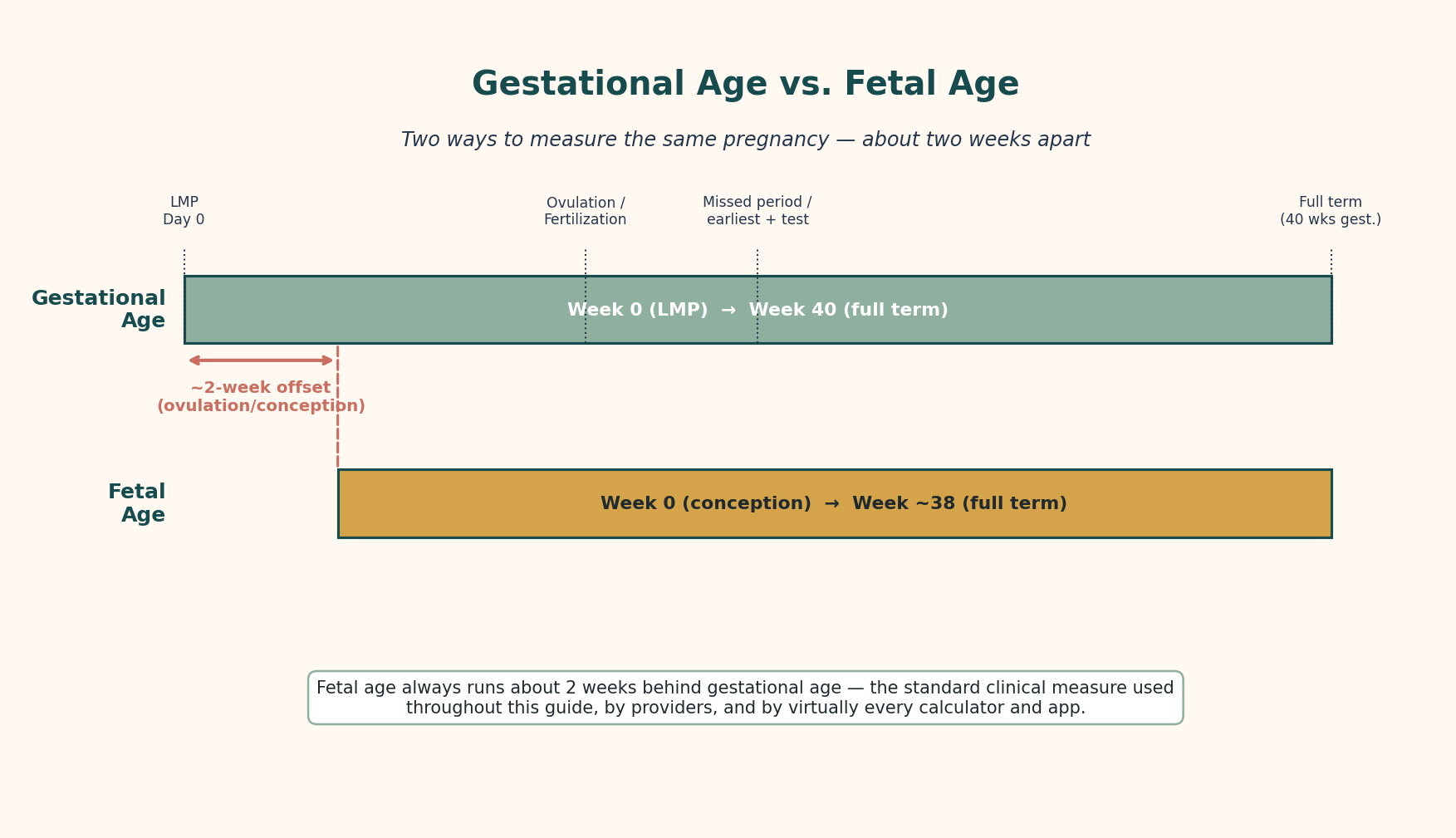
Gestational age is the clinical standard used throughout this guide, by essentially all providers, and by every calculator and app you’re likely to encounter. It counts forward from the first day of your last menstrual period (LMP) — a date that happens roughly two weeks before ovulation and conception actually occur. A pregnancy is described as “40 weeks” using this convention, even though conception itself happened around week 2.
Fetal (or Conceptional) Age: Counted From Fertilization
Fetal age — also called conceptional age or embryonic age — counts forward from the actual date of fertilization instead. It’s a more biologically direct measure of how long the embryo or fetus has existed, and it’s the convention used in some embryology and developmental-biology research. Using this convention, a full-term pregnancy is closer to 38 weeks of fetal age, not 40.
The Two-Week Offset, With a Comparison Table
Why the Gap Is Almost Always About 14 Days
Ovulation, and the fertilization that typically follows it, occurs around day 14 of an average 28-day cycle — which is also day 14 of the gestational-age count, since that count starts on day 1 of the same cycle. That’s the entire explanation for the offset: gestational age has a roughly two-week head start built into it before conception has even happened. If your cycles run longer or shorter than 28 days, the real-world offset shifts slightly, but the standard convention still assumes the average two-week gap for calculation purposes.
A Side-by-Side Example
The table below lines up a few milestones using both conventions, so you can see exactly where the two-week gap shows up in practice.
| Milestone | Gestational age | Fetal (conceptional) age |
|---|---|---|
| First day of last menstrual period | 0 weeks, 0 days | Not yet applicable |
| Ovulation / fertilization (typical) | 2 weeks, 0 days | 0 weeks, 0 days |
| Missed period / earliest positive test window | 4 weeks, 0 days | 2 weeks, 0 days |
| End of first trimester | 13 weeks, 6 days | ~11 weeks, 6 days |
| Commonly cited viability threshold | 24 weeks, 0 days | ~22 weeks, 0 days |
| Full term (standard due date) | 40 weeks, 0 days | ~38 weeks, 0 days |
Why Clinical Practice Uses Gestational Age, Not Fetal Age
The Practical Reason: A Period Is Observable, Conception Usually Isn’t
The reason gestational age won out as the clinical standard is entirely practical, not scientific: most people can identify the first day of their last period with reasonable confidence, while very few can pinpoint the exact day fertilization occurred. Building the entire dating system around an observable, reportable date — even though it starts the clock before conception — makes the convention usable at population scale.
What This Means When You’re Reading an App, a Study, or a Chart
Unless a source specifically says otherwise, assume any “weeks pregnant” figure you see is a gestational age. This matters most when comparing your own numbers to a research study or an academic source that uses fetal age instead — the two-week gap can otherwise look like a discrepancy in your own dating when it’s really just a difference in convention. If you’re ever unsure which one a specific source is using, the “week 40 vs. week 38 for full term” comparison in the table above is a reliable tell.
Calculating Your Current Week From Your Last Menstrual Period
If you know the first day of your last menstrual period and your cycles are reasonably regular, this is the most direct way to find your current gestational age. The method itself is simple day-counting, but a handful of edge cases — leap years, date-format mix-ups, and cycle irregularity — trip people up often enough that they’re worth walking through individually.
The Standard Forward-Count Method
Step-by-Step Instructions
Identify the first day of your last menstrual period as your starting date (day 0). Count every calendar day from that date up to and including today. Divide the total number of days by seven. The whole-number result is your current week; whatever is left over (0 through 6) is your extra days.
A Complete Worked Example
Suppose your LMP was March 1. If today is August 14 of the same year, count the days: March has 31 days (30 remaining after March 1), April 30, May 31, June 30, July 31, and 14 days into August, for a total of 30 + 30 + 31 + 30 + 31 + 14 = 166 days. Dividing 166 by 7 gives 23 with a remainder of 5 — you are 23 weeks and 5 days pregnant.
| Month | Days (non-leap year) | Days (leap year, February only) |
|---|---|---|
| January | 31 | 31 |
| February | 28 | 29 |
| March | 31 | 31 |
| April | 30 | 30 |
| May | 31 | 31 |
| June | 30 | 30 |
| July | 31 | 31 |
| August | 31 | 31 |
| September | 30 | 30 |
| October | 31 | 31 |
| November | 30 | 30 |
| December | 31 | 31 |
Edge Case: Counting Across a Leap Year
Why a Leap Year Can Quietly Shift a Manual Count
If your pregnancy spans a February in a leap year, that month has 29 days instead of 28 — an easy detail to miss if you’re counting by memory rather than checking a calendar. Missing it shifts every subsequent date in your manual count by one day, which can nudge your calculated week (or your due date, if you’re counting all the way to 280 days) off by a day.
Worked Example Spanning February 29
Suppose your LMP was January 20 in a leap year, and today is March 10 of that same year. January contributes 11 remaining days, February contributes 29 (the leap-year length), and March contributes 10, for a total of 11 + 29 + 10 = 50 days. Dividing 50 by 7 gives 7 weeks and 1 day. Using the wrong February length (28 instead of 29) would have produced 49 days — 7 weeks exactly — a one-day error that compounds if left uncorrected in further calculations. A calendar app or spreadsheet date-difference function avoids this entirely, since it handles leap years automatically.
Edge Case: International Date-Format Mix-Ups
The DD/MM vs. MM/DD Trap
Written numerically, dates are formatted differently depending on where you are: many countries write day/month/year (07/03/2026 means March 7), while the United States conventionally writes month/day/year (07/03/2026 means July 3). If you enter or read a date using the wrong convention — for example, using a U.S.-formatted calculator with a date written in day/month order — you can end up with a starting date that’s off by weeks, not just days, whenever the day and month numbers are both 12 or under.
How to Avoid It
Whenever possible, use unambiguous formats: write out the month by name (“7 March 2026” or “March 7, 2026”) rather than an all-numeric date, especially when using an app, calculator, or medical form that might default to a different regional convention than the one you’re used to. If you notice a calculated week that seems off by an implausible amount (several weeks, rather than a day or two), a date-format mismatch is one of the first things worth checking.
Edge Case: Cycle-Length Irregularity
Why the Standard Method Assumes a 28-Day Cycle
The standard LMP-based forward count doesn’t actually use your cycle length at all — it simply counts calendar days from your LMP to today. But the underlying assumption baked into that convention (that ovulation happens around day 14) assumes a fairly typical 28-day cycle. If your cycles consistently run notably longer or shorter than that, your actual ovulation and conception date shifts relative to your LMP, even though the day-count math itself doesn’t change.
A Simple Adjustment When You Know Your Average Cycle Length
Some calculators let you enter your typical cycle length and adjust the standard 14-day ovulation assumption accordingly — for example, treating ovulation as occurring around day 21 of a consistently 35-day cycle instead of day 14. This is a modest refinement, not a substitute for clinical dating; if your cycles are irregular enough that you don’t have a reliable “typical” length to enter, the special-situations section later in this guide, and an early ultrasound, are the more dependable paths to an accurate current week.
Calculating Your Current Week From a Known Due Date
If a provider or a previous calculation has already given you a due date, you don’t need your original LMP to find your current gestational age — you can work backward from the due date instead. This section covers that backward calculation on its own terms. For how the due date itself was calculated in the first place, including the underlying formulas, see our due-date calculator guide, which owns that topic in full.
The Backward-Count Method
Step-by-Step Instructions
Count the number of days remaining between today and your due date. Subtract that number from 280 (the standard 40-week, LMP-based pregnancy length). Divide the result by seven. The whole number is your current week; the remainder is your extra days.
A Complete Worked Example
Suppose your due date is December 1, and today is September 8 of the same year — 84 days away (23 remaining in September, 31 in October, 30 in November, and 0 more needed once you reach December 1 exactly… counted precisely: September 8 to December 1 spans 22 + 31 + 30 + 1 = 84 days). Subtract 84 from 280 to get 196. Divide 196 by 7 for exactly 28 weeks, 0 days.
Why This Method Works Even Without an LMP
The Math Behind It
A standard due date is defined as exactly 280 days after LMP. That means “days remaining until the due date” and “days elapsed since the LMP” always add up to 280, regardless of what the LMP date actually was. Because of that fixed relationship, you can recover your current gestational age purely from the due date and today’s date, without ever needing the original starting date at all.
When to Prefer This Method Over the LMP-Based One
This backward method is the more reliable option whenever the due date on record is more trustworthy than your recalled LMP — for example, after a first-trimester ultrasound has redated the pregnancy, or if you simply don’t remember your last period with confidence but do have a due date from a provider visit. If your due date has ever been officially revised, always recalculate from the current, updated due date, not an earlier one, to avoid working from an outdated number.
Calculating Your Current Week From a Conception Date or IVF Transfer Date
If you know your actual conception date — through ovulation tracking, a fertility procedure, or IVF — you have a more precise starting point than an LMP estimate, but you still need to convert it into the standard gestational-age convention used by every calculator, chart, and provider you’ll deal with. This section covers that conversion for both a known conception/ovulation date and an IVF transfer date.
From a Known Conception or Ovulation Date
Add Two Weeks to Convert to Gestational Age
Because gestational age counts from roughly two weeks before conception (see the gestational-age-vs-fetal-age section above for the full explanation), converting a known conception date into a gestational age is a simple addition: add 14 days to your conception date to get an equivalent “LMP” date for calculation purposes, then use the standard forward-count method from there.
A Complete Worked Example
Suppose you know you conceived on May 10. Add 14 days to get an equivalent LMP date of April 26. If today is October 2 of the same year, count forward from April 26 to October 2: that’s 4 remaining days in April, plus 31 (May) + 30 (June) + 31 (July) + 31 (August) + 30 (September) + 2 (October) = 159 days. Dividing 159 by 7 gives 22 weeks, 5 days.
From a Known IVF Transfer Date
Why the Embryo’s Age at Transfer Matters
An IVF embryo isn’t a freshly fertilized egg at the moment of transfer — it’s already a specific number of days old, most commonly a 3-day (cleavage-stage) or 5-day (blastocyst-stage) embryo. To convert a transfer date into gestational age, you need to account for that head start: a day-5 transfer represents an embryo that’s already 5 days past fertilization, and a day-3 transfer one that’s 3 days past.
A Complete Worked Example for a Day-5 Blastocyst Transfer
For a day-5 transfer, the embryo’s fertilization date is 5 days before the transfer date; the gestational-age equivalent starting date is 14 days before that fertilization date (per the conception-to-gestational-age offset above), which works out to 19 days before the transfer date overall. If your transfer date was July 1, your gestational-age equivalent starting date is June 12. From there, use the standard forward-count method: if today is September 20, count forward from June 12 — 18 remaining days in June, plus 31 (July) + 31 (August) + 20 (September) = 100 days. That’s 14 weeks, 2 days. A day-3 transfer follows the same logic with a 17-day offset instead of 19. Many fertility clinics will also give you this gestational-age-equivalent starting date directly, which removes the need to calculate it by hand.
Understanding “Weeks and Days”: Why Precision Matters
You’ll notice gestational age is almost always written as something like “24 weeks, 3 days” rather than rounded to “24 weeks” or expressed as a decimal like “24.4 weeks.” That specific format isn’t arbitrary — it reflects how the underlying calculation actually works, and in some contexts the extra precision genuinely matters.
Why It’s Written as “Weeks and Days,” Not a Decimal
The Notation Directly Reflects the Division Remainder
As shown throughout the calculation sections above, gestational age comes from dividing a total day count by seven. The remainder of that division — a number from 0 to 6 — is the “days” part, and it’s kept as a whole number of days rather than converted into a decimal fraction of a week, because a whole day is the smallest unit that’s actually meaningful clinically.
A Common Misreading to Avoid
“24 weeks, 3 days” does not mean 24.3 weeks — three days is closer to 24.43 weeks (3 divided by 7 is approximately 0.43). Mixing up “3 days” with “0.3 of a week” is a frequent source of confusion when people try to convert a weeks-and-days figure into a decimal for their own tracking or comparison purposes.
Where This Precision Genuinely Matters
Viability and Other Clinical Thresholds
Certain clinical decisions and thresholds are defined at a specific week, and sometimes a specific day within that week, rather than a rounded figure. Because thresholds like these can be defined this precisely, a provider’s own weeks-and-days figure — not a rough estimate — is the number that matters for any decision tied to a specific gestational-age cutoff.
Growth-Chart Percentiles
Fetal growth charts, which compare measurements like estimated weight or abdominal circumference against a population of pregnancies at the same gestational age, are built around specific weeks and days rather than rounded weeks. A measurement plotted against the wrong day within a week can shift which percentile it appears to fall into, which is part of why providers track gestational age this precisely at growth-monitoring visits.
Where It Doesn’t Matter Much
Everyday Planning and General Milestones
For most day-to-day purposes — telling family how far along you are, general pregnancy planning, or following week-by-week development information — rounding to the nearest week is perfectly fine, and it’s how most casual conversation about pregnancy naturally happens anyway. The extra day-level precision becomes useful specifically at clinical visits, growth-monitoring appointments, and any point where a provider is comparing your numbers against a threshold or a chart.
A Simple Rule of Thumb for When to Round
If a number you’re calculating is headed for a conversation with a provider, a growth chart, or anything tied to a specific clinical threshold, keep the exact weeks-and-days figure. If it’s headed for a conversation with family, friends, or your own casual tracking, rounding to the nearest week loses nothing meaningful.
How Ultrasound Measurements Estimate Your Current Gestational Age
A calendar count is only as accurate as the starting date you feed into it. Ultrasound takes a different approach entirely: instead of counting days from a reported date, it measures the fetus directly and estimates gestational age from typical growth patterns. This section explains how that works and why its accuracy changes significantly across the three trimesters — a topic neither the due-date guide nor the general calculator hub on this site covers in this level of detail.
First-Trimester Dating: Crown-Rump Length (CRL)
How CRL Is Measured
Crown-rump length measures the embryo or fetus from the top of the head to the bottom of the rump, excluding the limbs and the yolk sac. It becomes measurable around 6 weeks of gestational age and is used for dating up to roughly 13-14 weeks. Because the embryo grows at a remarkably consistent rate during this window, CRL-based formulas can translate a single measurement into a gestational-age estimate with unusual precision for a biological measurement.
Why It’s the Single Most Accurate Dating Method Available
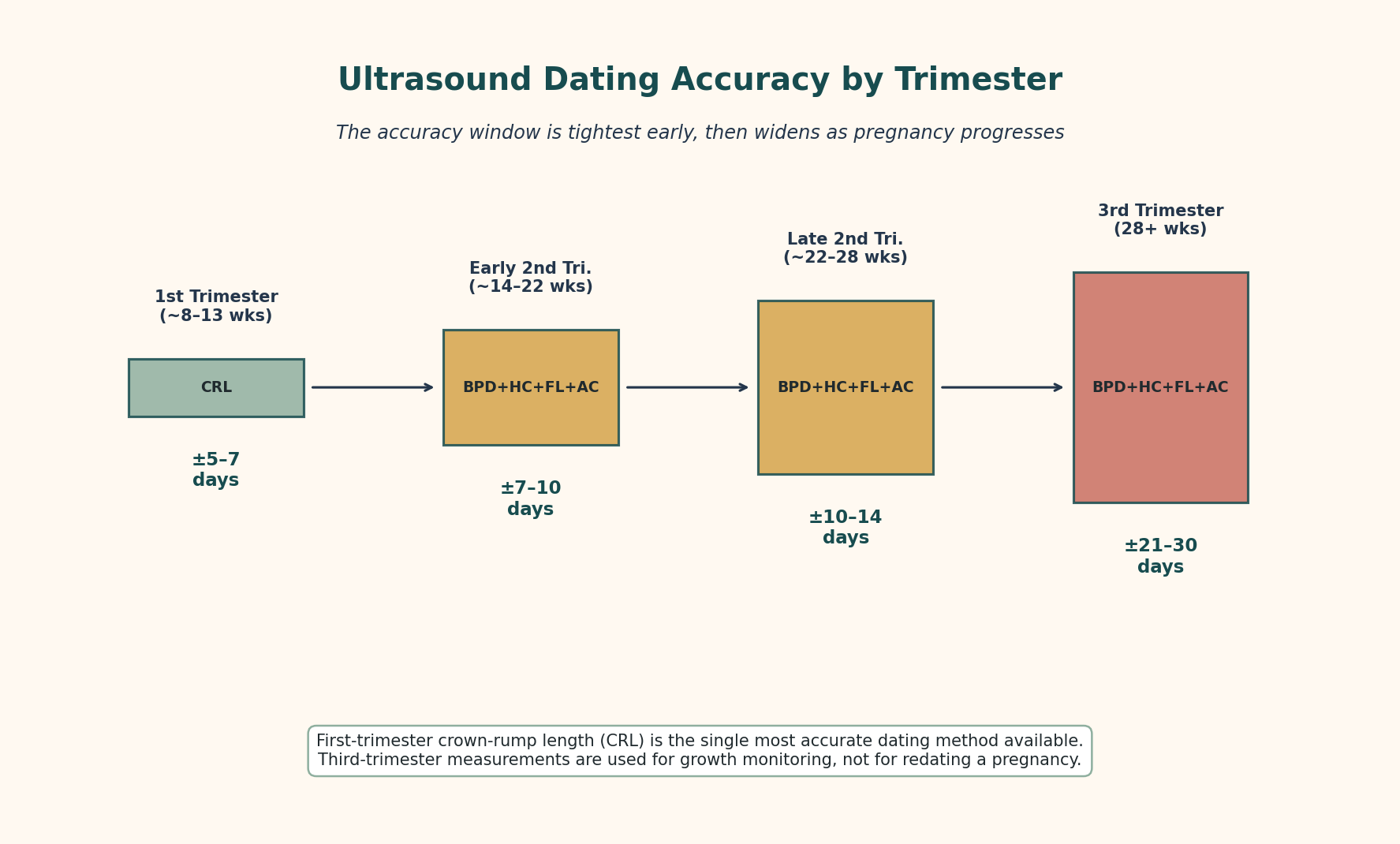
A first-trimester CRL measurement, taken between about 8 and 12 weeks, is generally accurate to within roughly 5 to 7 days — the tightest accuracy window of any dating method, calendar-based or ultrasound-based. This is exactly why a first-trimester ultrasound is so often used to confirm or adjust a due date: at this stage, the measurement is typically more reliable than a self-reported LMP, especially when cycles are irregular or the LMP date is uncertain.
Second-Trimester Dating: A Multi-Measurement Approach
The Four Standard Measurements
Once the embryo becomes a fetus with more distinct anatomy, dating shifts from a single crown-rump measurement to a combination of several: biparietal diameter (BPD, the width of the head from side to side), head circumference (HC), femur length (FL), and abdominal circumference (AC). Each is measured at a standardized location and angle so that results are comparable across providers and machines.
Why Combining Measurements Improves the Estimate
Using several measurements together, rather than relying on just one, evens out the natural variation in how individual fetuses grow — one baby might have a slightly larger head and a slightly shorter femur than average, for instance, and a single-measurement estimate would be thrown off by that, while a combined estimate is more robust to it. Research comparing dating approaches has found that multi-measurement models consistently produce more accurate gestational-age estimates than models based on any single measurement alone, particularly head-circumference-only estimates, which tend to carry a higher error rate on their own.
| Trimester / window | Typical method | Approximate accuracy window |
|---|---|---|
| First trimester (roughly 8-13 weeks) | Crown-rump length (CRL) | ±5 to 7 days |
| Early second trimester (roughly 14-21 weeks 6 days) | BPD, HC, FL, AC combined | ±7 to 10 days |
| Late second trimester (roughly 22-27 weeks 6 days) | BPD, HC, FL, AC combined | ±10 to 14 days |
| Third trimester (28 weeks and beyond) | BPD, HC, FL, AC combined | ±21 to 30 days |
Third-Trimester Dating: Why It’s the Least Reliable Window
The Accuracy Window and Why It Widens So Much
By the third trimester, individual variation in fetal size has compounded considerably — babies who will ultimately be born larger or smaller than average have typically begun diverging from the “typical” growth curve well before this point. That growing variation is exactly why the accuracy window widens to roughly three to four weeks by this stage, far looser than the first-trimester window.
Why a Late Measurement Shouldn’t Be Used to Redate a Pregnancy
Because third-trimester biometry is so much less precise, a measurement that looks “off” for the expected gestational age at this stage is far more likely to reflect normal individual variation, or an actual growth pattern worth monitoring, than an error in earlier dating. For that reason, a third-trimester scan generally isn’t used on its own to change an already-established due date or gestational age — the dating set earlier in pregnancy (ideally from a first-trimester CRL measurement) is considered more reliable and is kept unless there’s a specific clinical reason to revisit it.
When Your Calculated Week Doesn’t Match What Your Provider Says
It’s common to calculate your own current week, check an app, and then hear a slightly different number at a provider visit. Most of the time this is easy to explain and nothing to worry about — but the right response depends on how big the gap actually is.
Small Discrepancies: A Day or Two
Usually Just Rounding or a Different “Day Zero” Convention
A one- or two-day gap is almost always a mechanical difference rather than a dating problem: some tools count the LMP date itself as day 0, others as day 1, and some round a chart date to the nearest visit day rather than calculating the exact current day. None of these small conventions meaningfully change your actual gestational age.
When You Genuinely Don’t Need to Reconcile This
If the gap is a day or two and both numbers come from the same underlying due date, there’s no need to “fix” anything — use whichever figure your provider’s chart shows for any clinically relevant purpose (scheduling, growth tracking), and treat your own calculation as a convenient personal estimate rather than the official record.
Moderate Discrepancies: Around a Week
Often a Sign the Due Date Was Adjusted at Some Point
A gap of around a week frequently means your due date was redated at some point — commonly after a first-trimester ultrasound — and one of the tools you’re comparing (an app, an old calculation, a printed handout from an earlier visit) is still using the original, unrevised date while the other reflects the update.
How to Reconcile It: Always Use the Most Recently Confirmed Date
When this happens, treat your most recent official due date — the one your current provider is actively using — as the source of truth, and recalculate your current week from that date going forward using the backward-count method covered earlier in this guide. Update any app or personal tracker to match, so the same discrepancy doesn’t keep resurfacing at every visit.
Large Discrepancies: Multiple Weeks
Common Causes: Irregular Cycles, an Uncertain LMP, or a Data-Entry Error
A gap of several weeks or more usually points to something more specific: notably irregular cycles that threw off an LMP-based estimate, genuine uncertainty about the LMP date itself, a mixed-up date format (see the international-date-format edge case earlier in this guide), or simply a typo somewhere in an app or intake form.
What to Do: Ask Directly Which Date Your Provider Is Currently Using
Rather than trying to reconcile a large gap yourself, the most reliable step is to ask your provider directly which due date and gestational age are currently on your chart, and use that as your single source going forward for any calculation in this guide. If the gap arose because your LMP wasn’t reliable to begin with, an ultrasound-based estimate — ideally from earlier in the pregnancy — is the number worth trusting over a calendar count.
Special Situations: Irregular Cycles, IVF, and Unknown LMP
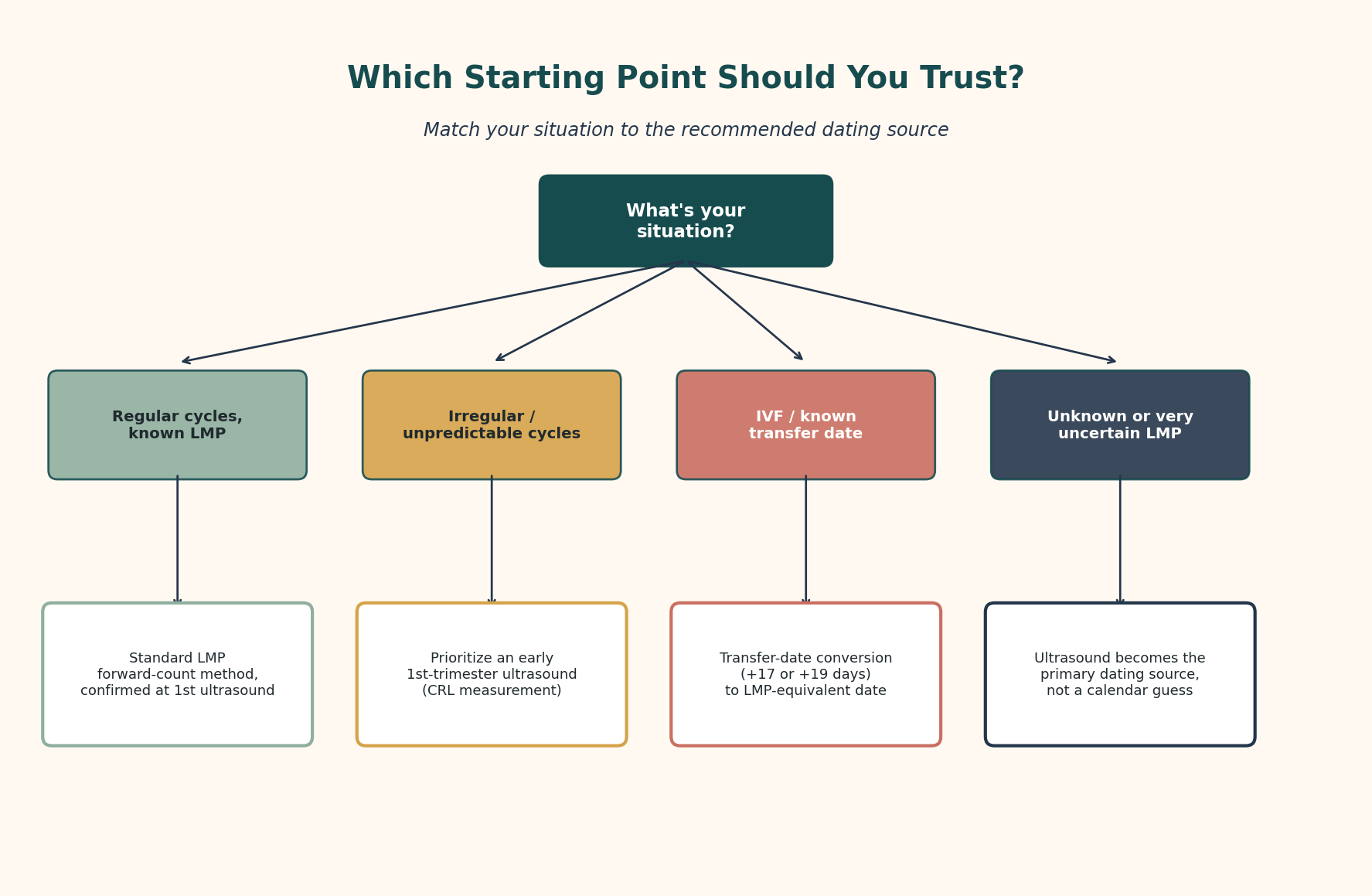
The standard forward-count method assumes a fairly typical, regular cycle and a confidently known LMP date. When either assumption doesn’t hold, the calculation itself doesn’t get more complicated — but which starting point you should trust does change. This section walks through the procedure for three of the most common situations.
Irregular, Long, or Short Cycles
Why the Standard Count Becomes Less Reliable
The forward-count method itself is just arithmetic on your LMP date — it works the same regardless of cycle length. What becomes unreliable is the LMP date’s relationship to your actual conception date: if your cycles vary widely in length from month to month, the standard “ovulation around day 14” assumption underlying the whole convention may be off by a week or more in either direction for any given cycle.
The Recommended Procedure
If you know your typical average cycle length and it’s fairly consistent (even if longer or shorter than 28 days), a cycle-length-adjusted calculation — shifting the assumed ovulation day proportionally — is a reasonable refinement, as covered in the LMP-calculation section above. If your cycles vary unpredictably from month to month with no reliable “typical” length, prioritize an early first-trimester ultrasound instead of a calendar-based estimate; a CRL measurement taken between about 8 and 12 weeks will generally be more accurate than any LMP-based guess in this situation.
IVF Pregnancies
Why Transfer-Date Math Is More Reliable Than an LMP-Based Guess
An IVF pregnancy has an unusually precise piece of information most pregnancies don’t: an exact, medically documented transfer date and a known embryo age at transfer (typically day 3 or day 5). That precision makes transfer-date-based dating inherently more reliable than an LMP-based estimate, even if your cycles are otherwise perfectly regular — there’s simply no guesswork involved in an IVF timeline the way there is with a typical ovulation estimate.
The Recommended Procedure
Use the transfer-date conversion method covered earlier in this guide (adding 19 days for a day-5 transfer, or 17 days for a day-3 transfer, to reach a gestational-age-equivalent starting date), or use the gestational-age-equivalent date your fertility clinic provides directly if one was given to you. Treat this transfer-based date as your authoritative starting point going forward, rather than defaulting back to an LMP-based app setting, which most pregnancy-tracking apps assume unless told otherwise.
Unknown or Uncertain LMP
When This Comes Up
Not knowing your LMP with confidence is more common than it might seem — it happens with recently discontinued hormonal birth control, breastfeeding-related irregular cycles, very light or easily missed periods, or simply not having tracked dates closely before finding out you were pregnant.
The Recommended Procedure
When your LMP genuinely isn’t reliable, don’t force a calendar-based estimate from a guessed date — it will carry the same uncertainty as the guess itself. Instead, an early ultrasound (ideally in the first trimester, for the tightest accuracy window described in the ultrasound section above) becomes the primary and most trustworthy source for your gestational age, and your provider will typically set your working due date from that measurement rather than from an LMP estimate.
Day-to-Weeks-and-Days Conversion Reference Table
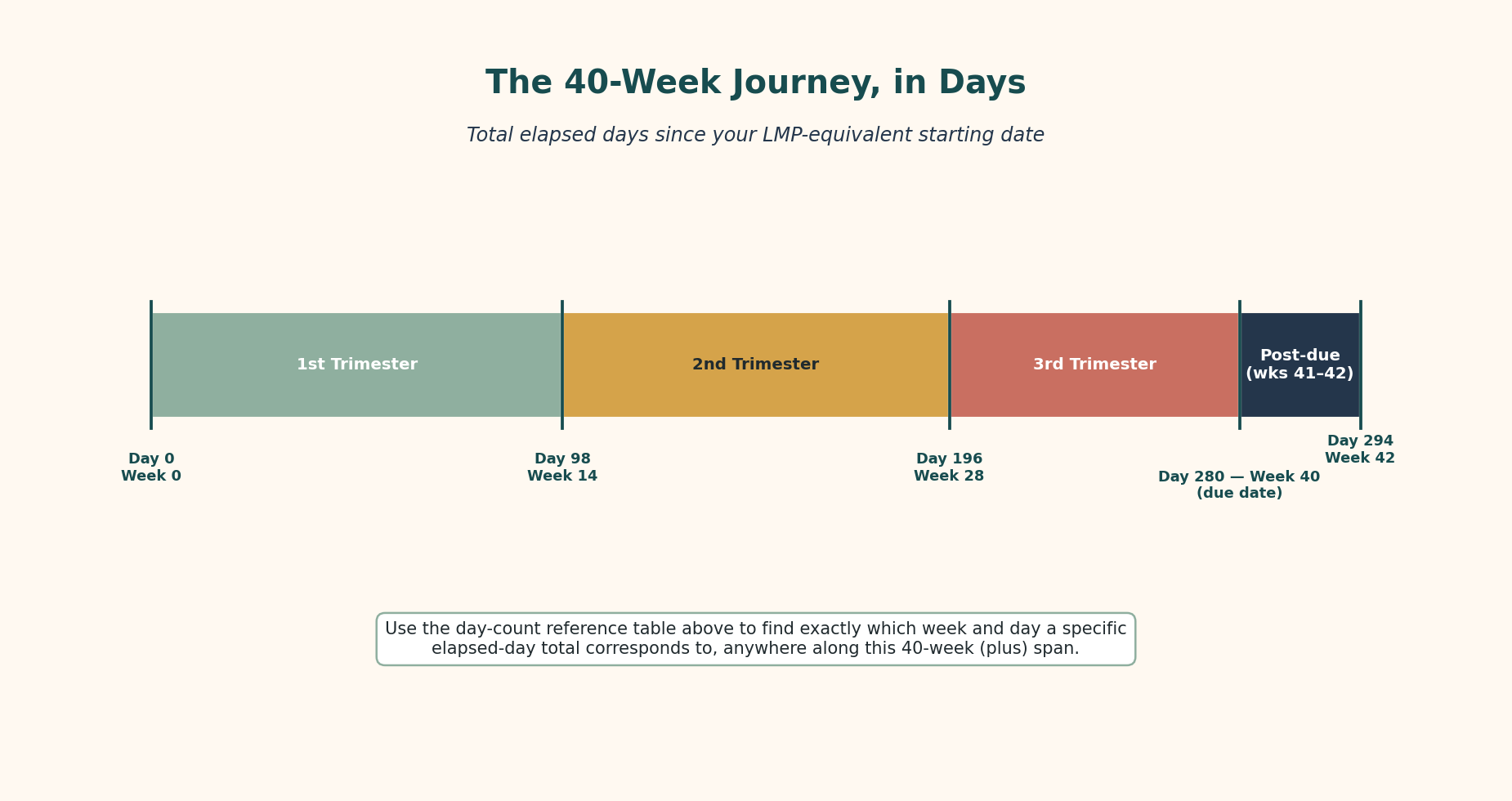
If you already have a total day count — from a spreadsheet, a calendar app’s date-difference feature, or your own manual count — but want to skip the division step, this reference table converts elapsed days since your LMP (or your LMP-equivalent starting date, per the conception and IVF conversions earlier in this guide) directly into a week number. This is a pure day-count lookup, not a week-by-week development or milestone guide; for what’s typically happening at each stage of pregnancy, a dedicated week-by-week guide is planned separately for this site.
How to Use This Table
Step 1: Find Your Total Day Count
Count the number of days between your starting date (day 0) and today, the same way described in the LMP-calculation section above — or use a calendar app or spreadsheet date-difference function, which handles month lengths and leap years automatically.
Step 2: Match It to the Corresponding Week Row
Find the row below whose day range includes your total day count. That row’s week number is your current completed week; your position within that day range (counting from the range’s first day as day 0) is your extra days.
Conversion Table: Weeks 0 Through 20
Early Pregnancy Through the End of the Second Trimester’s First Half
This covers the earliest weeks through roughly the midpoint of a standard 40-week pregnancy.
A Reading Example
If your day count comes to 100, scan the range column until you find the row that contains it: Days 98–104 corresponds to completed week 14. A day count of 100 therefore means you’re 14 weeks, 2 days along (100 minus the range’s starting day of 98).
| Completed week | Day-count range since starting date |
|---|---|
| 0 | Days 0–6 since LMP |
| 1 | Days 7–13 since LMP |
| 2 | Days 14–20 since LMP |
| 3 | Days 21–27 since LMP |
| 4 | Days 28–34 since LMP |
| 5 | Days 35–41 since LMP |
| 6 | Days 42–48 since LMP |
| 7 | Days 49–55 since LMP |
| 8 | Days 56–62 since LMP |
| 9 | Days 63–69 since LMP |
| 10 | Days 70–76 since LMP |
| 11 | Days 77–83 since LMP |
| 12 | Days 84–90 since LMP |
| 13 | Days 91–97 since LMP |
| 14 | Days 98–104 since LMP |
| 15 | Days 105–111 since LMP |
| 16 | Days 112–118 since LMP |
| 17 | Days 119–125 since LMP |
| 18 | Days 126–132 since LMP |
| 19 | Days 133–139 since LMP |
| 20 | Days 140–146 since LMP |
Conversion Table: Weeks 21 Through 42
Second Half of Pregnancy Through Post-Due-Date Weeks
This range covers the remainder of a standard pregnancy, including the post-40-week days some pregnancies continue into before delivery.
A Reading Example
If your day count comes to 275, the row for completed week 39 (Days 273–279) contains it, meaning you’re 39 weeks, 2 days along (275 minus 273). A day count of exactly 280 lands at the very start of week 40 — your standard due date, if you started counting from LMP.
| Completed week | Day-count range since starting date |
|---|---|
| 21 | Days 147–153 since LMP |
| 22 | Days 154–160 since LMP |
| 23 | Days 161–167 since LMP |
| 24 | Days 168–174 since LMP |
| 25 | Days 175–181 since LMP |
| 26 | Days 182–188 since LMP |
| 27 | Days 189–195 since LMP |
| 28 | Days 196–202 since LMP |
| 29 | Days 203–209 since LMP |
| 30 | Days 210–216 since LMP |
| 31 | Days 217–223 since LMP |
| 32 | Days 224–230 since LMP |
| 33 | Days 231–237 since LMP |
| 34 | Days 238–244 since LMP |
| 35 | Days 245–251 since LMP |
| 36 | Days 252–258 since LMP |
| 37 | Days 259–265 since LMP |
| 38 | Days 266–272 since LMP |
| 39 | Days 273–279 since LMP |
| 40 | Days 280–286 since LMP |
| 41 | Days 287–293 since LMP |
| 42 | Days 294–300 since LMP |
How Your Current Week Relates to Trimesters
Once you know your current week from any of the calculation methods above, placing it within a trimester takes one more quick lookup. This section covers just the boundaries themselves — for the fuller weeks-to-months conversion, including how months are typically grouped in a 9-month description of pregnancy, see our pregnancy calculator guide, which owns that detailed conversion table.
The Three Trimester Boundaries
First Trimester: Weeks 1 Through 13
The first trimester spans from the very start of pregnancy through the end of week 13 (13 weeks, 6 days, to be precise, since gestational age is counted starting at week 0). This is generally the window covered by first-trimester-specific ultrasound dating, discussed in the ultrasound section above.
Second and Third Trimester Boundaries
The second trimester runs from week 14 through the end of week 27. The third trimester begins at week 28 and continues through delivery, whether that happens at the standard 40-week mark or, as is common, a week or two before or after it.
| Trimester | Week range |
|---|---|
| First trimester | Weeks 0–13 |
| Second trimester | Weeks 14–27 |
| Third trimester | Week 28 through delivery |
Where to Find a Deeper Weeks-to-Months Breakdown
The Full Weeks-to-Months Conversion Lives in Our Calculator Hub Guide
If you want to know what “month” your current week falls into — a common but genuinely inexact conversion, since calendar months don’t divide evenly into 40 weeks — our pregnancy calculator guide has a complete week-by-week-to-month table along with an explanation of why the “9 months” and “10 months” descriptions of pregnancy both exist and use different month-length conventions. For a complete individual week-by-week table (rather than a month-grouped one), plus a sourced look at why NICHD, Cleveland Clinic, and this site itself don’t all draw the exact same trimester-boundary week, see our pregnancy week calculator guide.
What This Section Adds Instead: Just Your Current Placement
This guide’s focus is narrower and more direct: once you’ve calculated your current week using any method above, the trimester table here tells you immediately which trimester you’re in, without needing the fuller month-by-month conversion unless you specifically want it.
Tools and Methods for Tracking Your Current Week
Every method in this guide — manual counting, an app, or a provider’s own chart — should agree once they’re all working from the same starting date. Where they differ is in convenience, transparency, and how well they handle special situations. This section compares the three main ways people actually track their current week day to day.
Manual Calculation
The Advantage: Full Transparency and No Dependency on Any Tool
Calculating by hand, whether on paper, a calendar, or a spreadsheet, means you always know exactly which starting date and which method produced your current-week figure. It also works anywhere, doesn’t require an account or an app download, and makes it easy to recalculate quickly if your due date is ever revised.
The Drawback: You Have to Get the Edge Cases Right Yourself
The tradeoff is that leap years, cycle-length adjustments, and date-format mix-ups (all covered earlier in this guide) become your responsibility to catch, where a well-built app or spreadsheet formula handles them automatically. A simple date-difference function in any spreadsheet program removes most of this risk while keeping the transparency of doing it yourself.
Pregnancy-Tracking Apps
The Advantage: Convenience and Automatic Recalculation
A dedicated pregnancy app handles the day-counting, leap years, and week/trimester lookups automatically, and most will recalculate your current week every day without you doing anything. Many also layer on general weekly information alongside the date math itself.
The Drawback: Default Assumptions Are Easy to Overlook
Most apps default to an LMP-based calculation with a standard 28-day-cycle assumption unless you actively change a setting — which means an app can quietly be using a less accurate starting point than you actually have, particularly if you conceived through IVF, have irregular cycles, or received a redated due date after an ultrasound. Checking (and if needed, manually overriding) the starting date or due date an app is using is worth doing once, early on, rather than assuming the default is correct for your situation.
Provider Charts and Patient Portals
Why This Is the Authoritative Source
Your provider’s own chart reflects whatever combination of LMP, ultrasound dating, and any subsequent redating decisions is currently considered most accurate for your specific pregnancy — which makes it the single most authoritative number available to you, ahead of any personal calculation or app default.
How Often It’s Actually Updated
A provider’s recorded due date and gestational age are typically set early (often after a first-trimester ultrasound) and then left unchanged for the rest of the pregnancy unless there’s a specific clinical reason to revisit it — so checking in with your chart or portal after any dating-relevant appointment, rather than assuming it updates automatically week to week, is the more reliable habit.
Common Mistakes When Calculating How Many Weeks Pregnant You Are
Most errors in current-gestational-age calculation trace back to one of a small handful of recurring mix-ups. Knowing what they are makes them much easier to catch in your own numbers.
Confusing “Weeks Pregnant” With “Weeks Until Due Date”
Why This Mix-Up Happens So Often
Both numbers are about the same pregnancy and both are expressed in weeks, which makes them easy to swap without noticing — especially since, for a standard LMP-based due date, the two figures always add up to roughly 40. It’s an easy slip to say “32 weeks” when you mean 32 weeks left, rather than 32 weeks pregnant.
How to Keep Them Straight
“Weeks pregnant” counts forward from your LMP (or LMP-equivalent starting date) to today. “Weeks until due date” counts forward from today to your due date. If a number you’ve calculated doesn’t match what you expected, checking which direction you actually counted in is the first thing worth verifying.
Using an Outdated Due Date After a Redate
Why Old Numbers Linger Longer Than You’d Expect
Once a due date is redated — most often after a first-trimester ultrasound — the old date can keep showing up in places that don’t automatically sync: a printed handout from an early visit, an app that was never updated, or your own memory of the original number you were first given.
The Fix: Always Recalculate From the Most Current Official Date
Whenever you’re not sure which due date is current, ask your provider directly and use whichever date they confirm as active for every calculation in this guide going forward, including the backward-count method described earlier.
Miscounting Across a Leap Year or a Date-Format Mismatch
A Quick Recap of Both Edge Cases
As covered in the LMP-calculation section above, a manual count that spans a leap-year February can be off by a day if you assume 28 days instead of 29, and a date written in an unfamiliar day/month order can be misread entirely, producing an error of weeks rather than days.
How to Catch a Miscount Before It Compounds
If a calculated current week seems implausible — noticeably different from what an app, a provider chart, or a recent ultrasound suggests — a leap-year miscount or a date-format misread are two of the first, most common explanations worth checking before assuming something more complicated is going on.
What to Do With Your Current Week (Next Steps)
Knowing your current gestational age is useful mainly for what it lets you do next — schedule the right appointments, understand what a provider tells you at a visit, or simply track your own pregnancy with more confidence. This section covers a few practical next steps depending on where you are.
If You’re Early in Pregnancy
Confirm Your Dating at a First Prenatal Visit
If you haven’t yet had a first-trimester ultrasound, this is generally when your calculated current week and due date get their most important check — a CRL measurement in the accuracy window described earlier in this guide. Bring your own LMP date (or conception/transfer date, if applicable) to that visit even if you’ve already calculated a current week yourself, since it helps your provider confirm or adjust it.
Related Reading for Earlier-Stage Questions
If you’re still working through whether you’re pregnant at all, or what to do immediately after a positive test, our guide on what to do after a positive pregnancy test covers those first steps, and our pregnancy symptoms guide covers the broader early-pregnancy picture, including its own compact explanation of the LMP-based dating convention this guide goes into in full depth.
If You’re in the Second or Third Trimester
Use Your Current Week for Growth-Monitoring Context
Later in pregnancy, your current gestational age becomes the reference point providers use to interpret growth measurements, screening-test timing, and any monitoring specific to your pregnancy. Keeping your own calculation aligned with your provider’s chart (using the discrepancy-troubleshooting guidance above if the two ever diverge) means you’re working from the same number they are at every visit.
Keep Your Personal Tracking in Sync With Your Chart
If you use an app or your own spreadsheet to track your pregnancy day to day, it’s worth a quick check-in after any appointment where dating came up, to make sure your personal tracker still matches your provider’s current, official numbers rather than an earlier version of them.
Glossary of Gestational Dating Terms
This glossary covers terms specific to current-gestational-age calculation and ultrasound-based dating — this guide’s own focus. For due-date-formula terms like Naegele’s Rule, EDD, and the ACOG term categories, see the glossary in our due-date calculator guide; for general calculator-and-conversion terms, see the glossary in our pregnancy calculator guide.
Age and Dating Terms
Gestational Age
The standard clinical measure of pregnancy duration, counted from the first day of the last menstrual period — roughly two weeks before conception actually occurs. Explained in full, with a comparison table, earlier in this guide.
Fetal Age (Conceptional Age)
Pregnancy duration counted from the actual date of fertilization instead of the LMP, running about two weeks behind gestational age at any given point.
Weeks and Days
The standard notation for gestational age (for example, “24 weeks, 3 days”), reflecting the whole-week quotient and day remainder from dividing a total day count by seven.
Ultrasound Measurement Terms
Crown-Rump Length (CRL)
A first-trimester ultrasound measurement from the top of the head to the bottom of the rump, used as the most accurate single method for dating a pregnancy, typically between about 6 and 13-14 weeks.
Biparietal Diameter (BPD)
A measurement of the width of the fetal head from one side to the other, used alongside other measurements for second- and third-trimester dating and growth assessment.
Head Circumference (HC) and Abdominal Circumference (AC)
Measurements of the perimeter of the fetal head and abdomen respectively, used together with BPD and femur length in multi-measurement gestational-age and growth estimates.
Femur Length (FL)
A measurement of the length of the fetal thighbone, used alongside BPD, HC, and AC in second- and third-trimester dating.
Precision and Discrepancy Terms
Accuracy Window
The typical range of error (expressed in days) around a gestational-age estimate from a given method; this window is narrowest for first-trimester CRL measurements and widest in the third trimester, as detailed in the ultrasound section above.
Redating
The process of officially revising a pregnancy’s due date and gestational age, typically based on an early ultrasound measurement that differs meaningfully from an LMP-based estimate — a decision governed by ACOG guidelines covered fully in our due-date calculator guide.
Discrepancy
Any mismatch between two gestational-age figures for the same pregnancy (for example, a personal calculation versus a provider’s chart); see the dedicated troubleshooting section above for how to interpret one by size.
Frequently Asked Questions
Core Calculation Method Questions
What’s the single fastest way to figure out how many weeks pregnant I am?
If you know the first day of your last menstrual period, count the days between that date and today and divide by seven — the whole number is your week, the remainder is your extra days. If you only have a due date, subtract the days remaining until it from 280 and divide by seven instead. Both methods are covered with full worked examples earlier in this guide.
Do I need any special tool to calculate my current gestational age?
No — every calculation in this guide is basic arithmetic you can do on a calendar, with a spreadsheet’s date-difference function, or by hand. Apps and provider portals are convenient, but they’re not doing anything more sophisticated than the same day-count math described in the calculating-from-LMP section above.
Accuracy and Reliability of Your Calculation
How accurate is a calendar-based current-week calculation?
The arithmetic itself is exact — there’s no rounding or estimation once you have a day count. All of the actual uncertainty comes from how confident you are in your starting date. A precisely known IVF transfer date gives you a highly reliable current week; an uncertain, irregular-cycle LMP gives you a much less reliable one, even though the math performed on it is identical.
Is an ultrasound estimate always more accurate than my own calendar count?
Not always — if your LMP is well-documented and your cycles are regular, a calendar count based on it can be as accurate as, or even slightly more precise than, a later ultrasound estimate, especially compared to a second- or third-trimester scan. Ultrasound tends to be more accurate specifically when your LMP is uncertain, or when it’s performed very early (in the first-trimester window described in the ultrasound section above).
Ultrasound Measurement Questions
What is crown-rump length and why is it used only in early pregnancy?
Crown-rump length (CRL) measures an embryo or early fetus from the top of the head to the bottom of the rump. It’s used only in the first trimester because that’s the window (roughly 6 to 13-14 weeks) during which growth is consistent enough across pregnancies for a single measurement to translate into a highly precise age estimate — a precision that doesn’t hold up as well later in pregnancy, once individual growth variation increases.
What do BPD, HC, FL, and AC actually measure?
Biparietal diameter (BPD) measures the width of the head side to side; head circumference (HC) measures the perimeter of the head; femur length (FL) measures the thighbone; and abdominal circumference (AC) measures the perimeter of the abdomen. Together, these four measurements are used for second- and third-trimester dating and growth assessment, as covered in the ultrasound section above.
Fetal Age vs. Gestational Age Questions
Why is pregnancy described as 40 weeks if conception happens around week 2?
Because the standard clinical convention (gestational age) starts counting from your last menstrual period, not from conception — a date that’s easier for almost everyone to identify. Conception typically happens around two weeks into that count, which is why “40 weeks” gestational age corresponds to roughly 38 weeks of true fetal age. This is explained fully, with a comparison table, in the gestational-age-vs-fetal-age section above.
Which age should I use when talking to my provider?
Gestational age — it’s the standard your provider, your chart, and virtually every calculator and app use, so using the same convention avoids confusion. Fetal age mainly shows up in some academic or embryology contexts rather than routine clinical care.
Discrepancy and Troubleshooting Questions
My app says I’m one week further along than my provider does — should I worry?
Not necessarily. A one-week gap is a moderate discrepancy that most often means one of the two sources is using an outdated due date from before a redating ultrasound. Check which due date your provider currently has on file and use that going forward for both your own tracking and your app, updating the app’s setting if needed — the moderate-discrepancy guidance above covers this in more detail.
What should I do if my own calculation is off by several weeks from my provider’s number?
A gap that large usually points to something more specific than rounding — often an uncertain LMP, irregular cycles, or a date-format mix-up. Rather than trying to reconcile it yourself, ask your provider directly which due date and gestational age are currently on your chart, and use that as your single reliable source going forward.
Special Situations Questions
My cycles are irregular — can I still calculate my current week from my LMP?
You can still do the arithmetic, but the result is less reliable, because irregular cycles make the standard “ovulation around day 14” assumption behind the calculation less trustworthy. An early first-trimester ultrasound is generally the more dependable source in this situation, as covered in the special-situations section above.
I got pregnant through IVF — which starting date should I use?
Use your embryo transfer date, converted to an LMP-equivalent starting date (adding 17 days for a day-3 transfer or 19 days for a day-5 transfer), or the gestational-age-equivalent date your fertility clinic gave you directly. This is more precise than defaulting to an LMP-based app setting, which assumes a natural conception timeline that doesn’t apply to an IVF pregnancy.
“Weeks and Days” and Precision Questions
Is “24 weeks 3 days” the same as 24.3 weeks?
No — this is a common misreading. Three days is a fraction of a week (3 divided by 7, or about 0.43), so “24 weeks, 3 days” is closer to 24.43 weeks, not 24.3. The weeks-and-days notation explained above avoids decimals specifically because it keeps whole days as the smallest, clearest unit.
Why do providers bother tracking days, not just weeks?
Some clinical decisions and growth-chart comparisons are defined at a specific week and day, not a rounded week, so the extra precision genuinely matters in those specific contexts — covered in the weeks-and-days-precision section above.
Trimester and Conversion Table Questions
What week does the second trimester start?
Week 14, using the convention followed consistently on this site. The first trimester spans weeks 0 through 13, the second spans weeks 14 through 27, and the third begins at week 28 — shown in the trimester-boundaries table above.
Is the day-count conversion table on this page the same as a week-by-week development table?
No — the table above converts a raw day count into a week-and-day figure only; it doesn’t describe what’s developmentally happening at each week. A separate week-by-week development guide is planned for this site and will cover that content instead.
Tools, Apps, and Tracking Questions
Should I trust my pregnancy app’s current-week display?
Generally yes, as long as it’s using the correct starting date or due date for your situation. Most apps default to an LMP-based calculation with a standard 28-day-cycle assumption, so it’s worth checking (and correcting, if needed) the date the app is actually using, especially if you conceived through IVF, have irregular cycles, or received a redated due date after an ultrasound.
Why does my app’s current week change by more than one day overnight sometimes?
This shouldn’t normally happen if the app is doing a straightforward day-count calculation — a jump larger than expected usually means the app recalculated from a changed due date (for example, after you or your provider updated it), not that something is wrong with the ordinary passage of time.
Common Mistakes Questions
What’s the single most common mistake people make calculating their current week?
Confusing “weeks pregnant” with “weeks until my due date” — the two numbers roughly add up to 40 for a standard pregnancy, which makes it easy to state one when you mean the other. The common-mistakes section above covers this and several other frequent errors.
How do I know if I’ve made a leap-year counting error?
If your manual count spans a February in a leap year and you assumed 28 days instead of 29, your result will be off by exactly one day. If a calculated number is off by just a day or two from what you expected, this is one of the first things worth double-checking.
Twins, Multiples, and Other Pregnancy-Type Questions
Is calculating current gestational age different for twins or multiples?
No — the dating math itself (whether forward from an LMP-equivalent date or backward from a due date) is identical for a singleton or a multiple pregnancy. What typically differs for multiples is the monitoring schedule and, often, an earlier expected delivery window, not the underlying gestational-age calculation.
Does IVF with a donor egg or a gestational carrier change how I should calculate my current week?
No — the calculation is based on the embryo transfer date and the embryo’s age at transfer, not on the genetic or gestational arrangement involved, so the same IVF conversion method described earlier in this guide applies regardless.
Provider Communication and Appointment Questions
Should I bring my own current-week calculation to my prenatal appointments?
It’s helpful, but not strictly necessary — your provider will calculate and record your own gestational age based on your reported dates and, often, an ultrasound. Bringing your own LMP date, conception date, or transfer date to a visit (even if you’ve already calculated a current week yourself) helps your provider confirm or refine that number with you.
What should I say if I’m not sure of my LMP date at a first visit?
Say so directly — tell your provider you’re uncertain rather than guessing a date to avoid an awkward silence. An uncertain LMP is common and simply means your provider will likely lean more heavily on an early ultrasound to establish your dating, which is covered in the special-situations section above.
Historical and Conventional Questions
Why is pregnancy commonly described as “9 months” if it’s actually 40 weeks?
40 weeks divides into 9 uneven, roughly month-length blocks under the common convention, even though an average calendar month doesn’t divide evenly into weeks. Our pregnancy calculator guide has the full weeks-to-months table and explains exactly how this uneven division works.
Is the “10 lunar months” description of pregnancy still used?
It shows up less often than the “9 months” convention in everyday use, but it’s a real alternative convention that divides the same 40 weeks into ten even 4-week blocks instead of nine uneven ones — again, detailed further in the pregnancy calculator guide’s conversion section.
hCG Levels, Blood Tests, and Dating
Can a blood hCG level tell me exactly how many weeks pregnant I am?
Not precisely — hCG levels rise over a wide range at any given gestational age, so while a very low or very high level relative to typical ranges can prompt a provider to look more closely, hCG numbers alone aren’t used as a precise dating method the way an LMP-based count or an ultrasound measurement is. Our pregnancy test guide covers hCG and testing in more detail.
Why does my early blood test result mention a gestational age if hCG isn’t used for precise dating?
An early lab report’s gestational-age reference is typically just carrying forward whatever LMP-based or other estimate was already on file at the time of the test, not a figure derived from the hCG result itself.
Estimated Fetal Weight and Gestational Age
Is estimated fetal weight the same thing as gestational age?
No — they’re related but distinct. Gestational age is a measure of time (how many weeks along the pregnancy is); estimated fetal weight is a separate measurement derived from some of the same ultrasound biometry (like AC and FL) but used to assess growth and size, not to establish the date itself.
Can an unusually large or small estimated fetal weight change my gestational age?
Generally no on its own — as discussed in the third-trimester-dating section above, a size measurement that looks unusual later in pregnancy is more often interpreted as a growth pattern to monitor than as evidence that the established gestational age needs to be revised.