
If you’ve had a baby recently and you’re not feeling like yourself — more sad, anxious, numb, or overwhelmed than you expected, in a way that isn’t lifting — you’re not alone, and this is not a reflection of your worth as a parent. Postpartum depression is common, it’s treatable, and reaching out for help is one of the most protective things you can do for both yourself and your baby. This guide walks through the full spectrum of postpartum mood changes, from the very common and short-lived “baby blues” through postpartum depression, postpartum anxiety and OCD, and the rare but serious emergency of postpartum psychosis, along with how each is screened for, treated, and when to seek help right away.
This article is written for general education and does not replace the specific guidance of your own medical and mental health providers. It has been reviewed for medical accuracy, and figures that vary by source, are still evolving in current guidance, or could not be confirmed against a live source this session are flagged throughout. Crisis-line phone numbers in this article are flagged for pre-publication confirmation against their official sources — see the editor’s note at the end of this guide.
If you’re having thoughts of harming yourself or your baby, or you notice hallucinations, confusion, or delusions in yourself or someone you know after childbirth, this is a medical emergency. Call 911 or go to the nearest emergency room now. You can also call or text 988 (the Suicide & Crisis Lifeline) any time, free and confidential. The National Maternal Mental Health Hotline is available at 1-833-TLC-MAMA (1-833-852-6262), by call or text, and Postpartum Support International’s HelpLine is available at 1-800-944-4773, with text support also available. You do not have to wait for an appointment to use any of these.
Short Answer: What Postpartum Depression Is and What to Do Right Now
Postpartum depression (PPD) is a real, common, and treatable medical condition — a form of clinical depression that develops during pregnancy or in the months after childbirth, distinct from the much more common and much milder “baby blues” that most new parents experience in the first couple of weeks. It’s caused by a combination of hormonal, physical, and psychological factors, not by anything you did or didn’t do, and it responds well to treatment: therapy, medication, or both, along with practical and social support. If what you’re feeling is severe, involves thoughts of harming yourself or your baby, or includes confusion or hallucinations, treat it as an emergency and seek immediate help using the resources above — don’t wait to see if it passes on its own.
The One-Paragraph Version
What’s Actually Happening
After delivery, your body goes through an abrupt hormonal shift — a sharp drop in estrogen and progesterone, on top of sleep deprivation, physical recovery from birth, and a major life transition — and for some people, this combination triggers a genuine depressive episode rather than passing adjustment. It’s a medical condition with a physiological basis, not a character flaw or a sign you’re not cut out for parenting.
Why Getting Help Matters
Untreated postpartum depression can persist for many months and can affect your own wellbeing, your relationships, and your baby’s early development; treated postpartum depression, by contrast, has a very good prognosis, with most people recovering fully. Getting help early tends to shorten how long you struggle and reduce the downstream impact on your whole family.
What Happens If You Reach Out
You’ll Likely Start With a Conversation, Not a Crisis
For most people, reaching out starts with a conversation — with your OB provider, your baby’s pediatrician, a therapist, or a dedicated helpline — not a hospitalization or an emergency. Many providers use a short screening questionnaire, covered in the screening section below, as a starting point for that conversation.
Treatment Is Individualized
What helps varies by person and by severity — some people do well with therapy alone, others benefit from medication, and some need both along with practical support at home. The treatment sections below walk through the main options in detail.
Key Takeaways
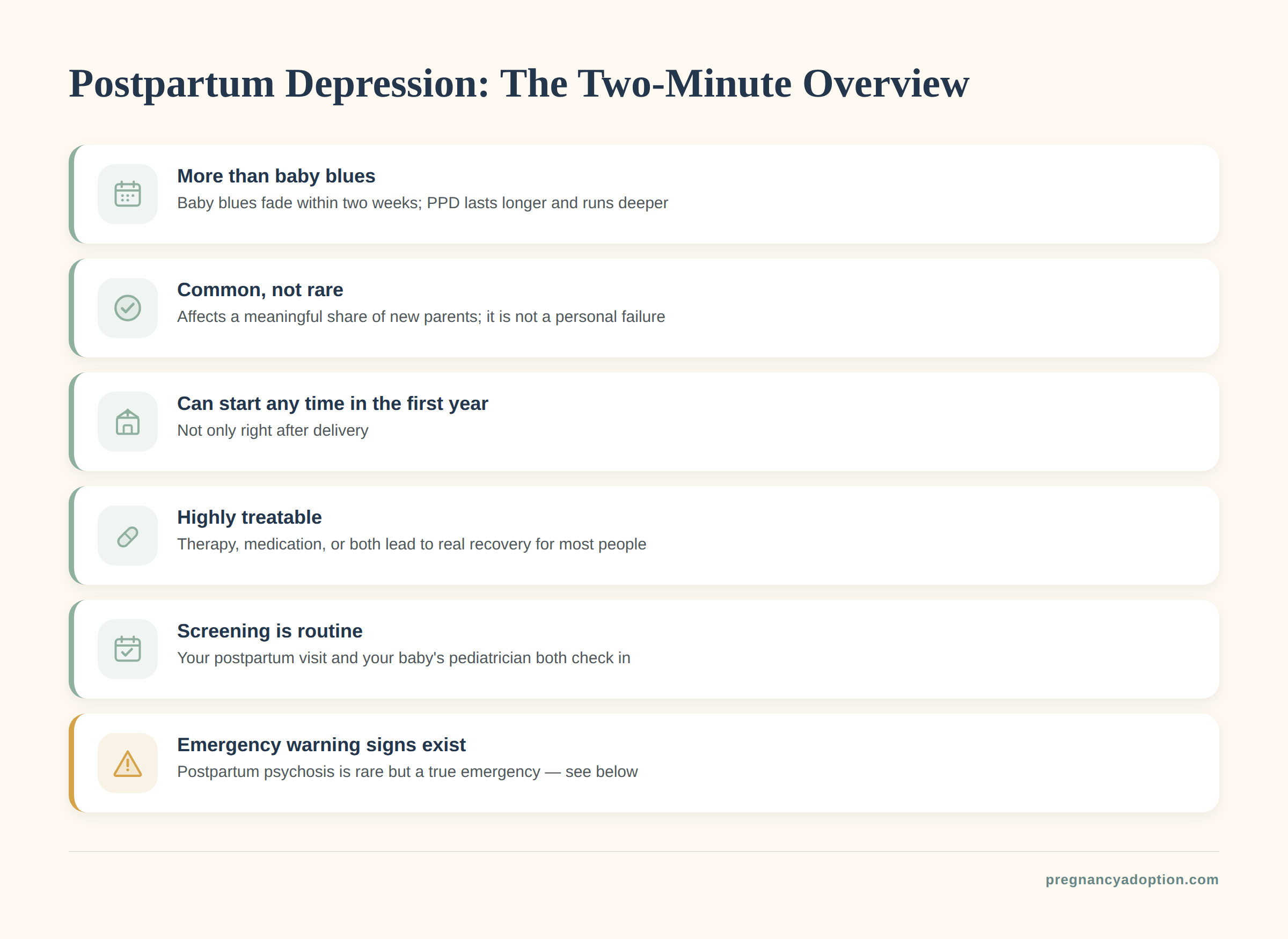
- Postpartum depression is common, treatable, and not caused by anything you did — it’s a medical condition with a physiological basis.
- It’s different from the much more common, much milder “baby blues,” which resolves on its own within about two weeks.
- Most people recover fully with treatment — therapy, medication, or both — and treatment tends to work better and faster the earlier it starts.
- Postpartum psychosis is rare but is a true psychiatric emergency, distinct from postpartum depression, and requires immediate medical attention.
- If you’re having thoughts of harming yourself or your baby, or notice confusion or hallucinations, call 911, go to the nearest emergency room, or call or text 988 right away.
Baby Blues, Postpartum Depression, and Postpartum Psychosis: Telling Them Apart
These three terms get used loosely and sometimes interchangeably in everyday conversation, but they’re clinically distinct, with different timelines, severity, and levels of urgency. Understanding the differences helps you know what you’re dealing with and how quickly to act.
Baby Blues
What It Is
The baby blues is an extremely common, mild, short-lived period of mood swings, weepiness, irritability, and anxiety that begins within the first two to five days after delivery, often peaks around day three to five, and resolves on its own within about two weeks with no treatment needed.
When It’s No Longer “Just the Blues”
If low mood, anxiety, or weepiness is still present, or is getting worse, beyond about two weeks postpartum, or if it’s severe enough to interfere with your ability to function or care for yourself and your baby even in the first two weeks, it’s worth getting evaluated rather than assuming it will resolve on its own.
Postpartum Depression (PPD)
What It Is
Postpartum depression is a more severe, more persistent form of depression that can begin during pregnancy or any time in the months after birth — clinically, it’s classified as major depressive disorder “with peripartum onset,” and “peripartum” (covering both pregnancy-onset and postpartum-onset) has become the more current clinical term precisely because a meaningful share of cases begin before delivery.
How It Differs From Baby Blues
PPD is distinguished from baby blues by persistence (most of the day, nearly every day, for two weeks or more), severity, and functional impairment — an inability to feel joy even when circumstances allow for rest and support, and real interference with your ability to function or care for yourself and your baby. The full symptom list is in the signs and symptoms section below.
Postpartum Psychosis
What It Is
Postpartum psychosis is rare — commonly cited at roughly one to two cases per 1,000 births — and is categorically different from PPD: it involves a break from reality (hallucinations, delusions, severe confusion) with rapid onset, usually within the first one to two weeks postpartum. It is a true psychiatric emergency, covered in full in its own dedicated section below, and should never be treated as “just severe PPD.”
Why This Distinction Matters So Much
Confusing postpartum psychosis with a severe case of PPD can delay the immediate psychiatric care it requires — nearly all cases need hospitalization, and the risk to both the parent and the baby is real and time-sensitive. If you or someone you love shows any of the warning signs covered later in this guide, treat it as an emergency, not a “wait and see” situation.
| Feature | Baby blues | Postpartum depression | Postpartum psychosis |
|---|---|---|---|
| How common | Very common | Roughly 1 in 7, with ranges varying by study | Rare, roughly 1–2 per 1,000 births |
| Typical onset | Days 2–5 postpartum | During pregnancy through the first year postpartum | Usually within the first 1–2 weeks postpartum |
| Typical duration | Resolves within ~2 weeks | Can persist for months without treatment | Requires immediate treatment; rapid onset |
| Core features | Weepiness, mood swings, mild anxiety | Persistent sadness, loss of interest, severe anxiety, difficulty bonding | Hallucinations, delusions, severe confusion |
| Urgency | Monitor; no treatment usually needed | Seek evaluation and treatment | Medical emergency — seek immediate care |
How Common Is Postpartum Depression?
Postpartum depression is far from rare, though exact prevalence figures vary depending on the study, the population surveyed, and how depression was measured.
The Commonly Cited Figures
“1 in 7” and Related Estimates
A frequently cited figure, from a large study published in JAMA Psychiatry, estimates that roughly 1 in 7 new mothers experiences postpartum depression. CDC surveillance data using self-reported symptoms has found rates commonly in the range of roughly 11 to 20 percent depending on the state and year studied.
Why the Numbers Vary
Different studies use different tools (a self-report survey versus a validated screening questionnaire versus a full clinical diagnosis) and different populations, which is why you’ll see a range rather than one single number across reputable sources — this isn’t a sign that the condition is poorly understood, just that measurement approaches differ.
Who It Affects
It Can Affect Anyone Who Has Recently Given Birth
Postpartum depression doesn’t discriminate by age, background, income, or how much a pregnancy was planned or wanted — it can affect first-time parents and experienced parents alike, and it’s not a reflection of how much you wanted or love your baby.
It’s Likely Underreported
Stigma, fear of judgment, and fear that disclosing symptoms could lead to unwanted involvement from others are all believed to contribute to underreporting, which is part of why routine screening (covered below) matters so much — it gives people a structured, lower-barrier way to disclose what they’re experiencing.
Signs and Symptoms
Postpartum depression can look different from person to person, but a cluster of common symptoms shows up consistently across clinical descriptions.
Emotional Symptoms
Persistent Sadness, Emptiness, or Hopelessness
A low mood that’s present most of the day, nearly every day, rather than coming and going — this is one of the clearest distinguishing features from the baby blues, which fluctuates and lifts within about two weeks.
Severe Anxiety, Irritability, or Anger
Intense worry (sometimes focused specifically on the baby’s health or safety), irritability that feels out of proportion or out of character, or anger that’s hard to control are all common presentations of PPD, not just sadness alone.
Guilt, Shame, or Feeling Like a “Bad Mother”
Many people with PPD feel intense guilt or shame about not feeling the way they expected to feel about their baby, which can make it harder to reach out — these feelings are a symptom of the condition, not an accurate reflection of your parenting.
Loss of Interest or Pleasure
A noticeable loss of interest or pleasure in things you’d normally enjoy, including difficulty feeling joy even during good moments with your baby or family.
Physical and Cognitive Symptoms
Sleep and Appetite Changes Beyond What a Newborn Explains
Some sleep disruption and appetite change is universal with a newborn in the house, but PPD can cause insomnia even when the baby is sleeping, or sleeping far more than usual, along with a significant loss of appetite or eating much more than usual — the key distinguishing question is whether it goes well beyond what having a newborn alone would explain.
Overwhelming Fatigue
Exhaustion that feels disproportionate to how much sleep you’re actually getting, or that doesn’t improve with rest when you do get it.
Difficulty Concentrating or Making Decisions
Trouble thinking clearly, concentrating, or making even small decisions, which can compound the sense of being overwhelmed.
Physical Aches Without a Clear Cause
Headaches, stomach problems, or other physical symptoms that don’t have an obvious physical explanation are a recognized, if less commonly discussed, feature of depression generally, including PPD.
Behavioral and Relational Symptoms
Withdrawing From Family and Friends
Pulling away from people you’d normally lean on, avoiding visits or calls, or isolating yourself more than usual.
Difficulty Bonding With Your Baby
Feeling disconnected from your baby, or like you’re going through the motions of caregiving without the emotional connection you expected, is a common and very difficult symptom to talk about — and an important one to disclose to a provider, since it’s treatable and tends to improve significantly once treatment starts.
Intrusive, Scary Thoughts
Unwanted, distressing thoughts about something bad happening to the baby, or about your own adequacy as a parent, can occur with PPD; this overlaps with postpartum OCD specifically, covered in its own section below, which has an important distinction from psychosis worth understanding.
Thoughts of Self-Harm or Harming the Baby
In more severe cases, PPD can include recurrent thoughts of death, suicide, or harming yourself or your baby. These thoughts should always be treated as urgent — if you’re experiencing them, use the crisis resources at the top of this guide now, not after finishing this article.
When Postpartum Depression Typically Starts
One of the more common misconceptions about PPD is that it only happens in the days immediately after birth — in reality, it has a wider window than that, which matters for knowing when to stay alert.
Onset During Pregnancy
Depression Can Begin Before Delivery
A meaningful share of what’s clinically grouped as “peripartum” depression actually begins during pregnancy, not after — which is part of why “peripartum” has become the more current clinical term, encompassing both pregnancy-onset and postpartum-onset cases rather than treating them as entirely separate conditions.
Why This Matters for Screening
Because onset can occur during pregnancy, many screening protocols now recommend at least one depression screening at some point during pregnancy, not only after birth — see the screening section below for more detail.
Onset After Delivery
The Formal Diagnostic Window vs. Common Clinical Practice
The formal diagnostic criterion for major depressive disorder “with peripartum onset” specifies onset during pregnancy or within four weeks of delivery. In everyday clinical practice, though, symptoms that first appear anywhere in the first year after birth are generally still evaluated and treated as postpartum depression — this is a genuine, acknowledged difference between strict diagnostic criteria and how the condition is approached clinically, not a contradiction that needs to be resolved one way or the other.
Why Later-Onset Cases Still Matter
Some people don’t notice symptoms until several months postpartum, sometimes after returning to work, after weaning from breastfeeding, or after a stressful event — these later-onset cases are just as real and just as treatable as earlier-onset cases, and shouldn’t be dismissed as “not really postpartum depression” just because of timing.
What Causes Postpartum Depression?
Postpartum depression results from a combination of factors rather than any single cause, which is part of why it isn’t something a person could simply will themselves out of.
Biological Factors
The Post-Delivery Hormonal Drop
Estrogen and progesterone levels, which rise dramatically during pregnancy, drop sharply within days of delivery — a hormonal shift believed to contribute to mood changes in a way that’s biologically plausible, though it doesn’t fully explain why some people develop PPD and others with a similar hormonal shift don’t, suggesting individual vulnerability factors are also at play.
Sleep Deprivation and Physical Recovery
Profound sleep disruption and the physical demands of recovering from childbirth while caring for a newborn place real physiological stress on the body, which can worsen or trigger depressive symptoms independent of hormonal factors.
Psychological and Social Factors
The Scale of the Life Transition
Becoming a parent, or adding another child to the family, is one of the largest identity and life-structure transitions most people go through, and that transition itself — independent of hormones — is a recognized contributor to postpartum mood difficulties.
Lack of Support or High Life Stress
Limited practical or emotional support, relationship strain, financial stress, or other significant life stressors occurring around the same time as the birth all raise risk, covered in more detail in the risk factors section below.
Risk Factors
Certain factors are associated with a higher likelihood of developing postpartum depression, though having one or more risk factors doesn’t guarantee you’ll develop it, and plenty of people with no apparent risk factors still do.
Well-Established Risk Factors
A Personal History of Depression or Anxiety
A prior personal history of depression or anxiety, including a previous episode of postpartum depression in an earlier pregnancy, is consistently identified as one of the strongest and most consistent predictors across studies.
Family History, Limited Support, and Major Life Stress
A family history of mood disorders, a lack of social support, significant relationship stress or intimate partner violence, an unplanned or ambivalent pregnancy, and broader socioeconomic stress (financial strain, housing instability, lack of paid leave) are all well-established contributors.
A Traumatic or Complicated Birth, or a NICU Stay
A traumatic or medically complicated birth experience — including complications like preeclampsia or an emergency delivery — a baby’s NICU admission, or carrying multiples all raise risk, likely through a combination of medical stress, disrupted bonding time, and the practical and emotional toll of a more complicated start.
Contributing Factors Worth Understanding
Breastfeeding Difficulties
Difficulty breastfeeding is associated with higher PPD risk, though the relationship likely runs in both directions — breastfeeding struggles can contribute to depression, and depression can also make breastfeeding harder — rather than one simply causing the other in a single direction.
Thyroid Dysfunction
Postpartum thyroid problems can produce symptoms that closely mimic or compound depression, which is why many clinicians recommend checking thyroid function as part of a PPD evaluation — this is better understood as an important condition to rule out alongside a PPD diagnosis than as a straightforward risk factor in the same category as the others above. See the ruling out other causes section below.
Screening for Postpartum Depression
Because postpartum depression is common and often goes unreported without being asked about directly, routine screening using a standardized tool has become a widely recommended part of both prenatal and postpartum care.
The Edinburgh Postnatal Depression Scale (EPDS)
What It Is
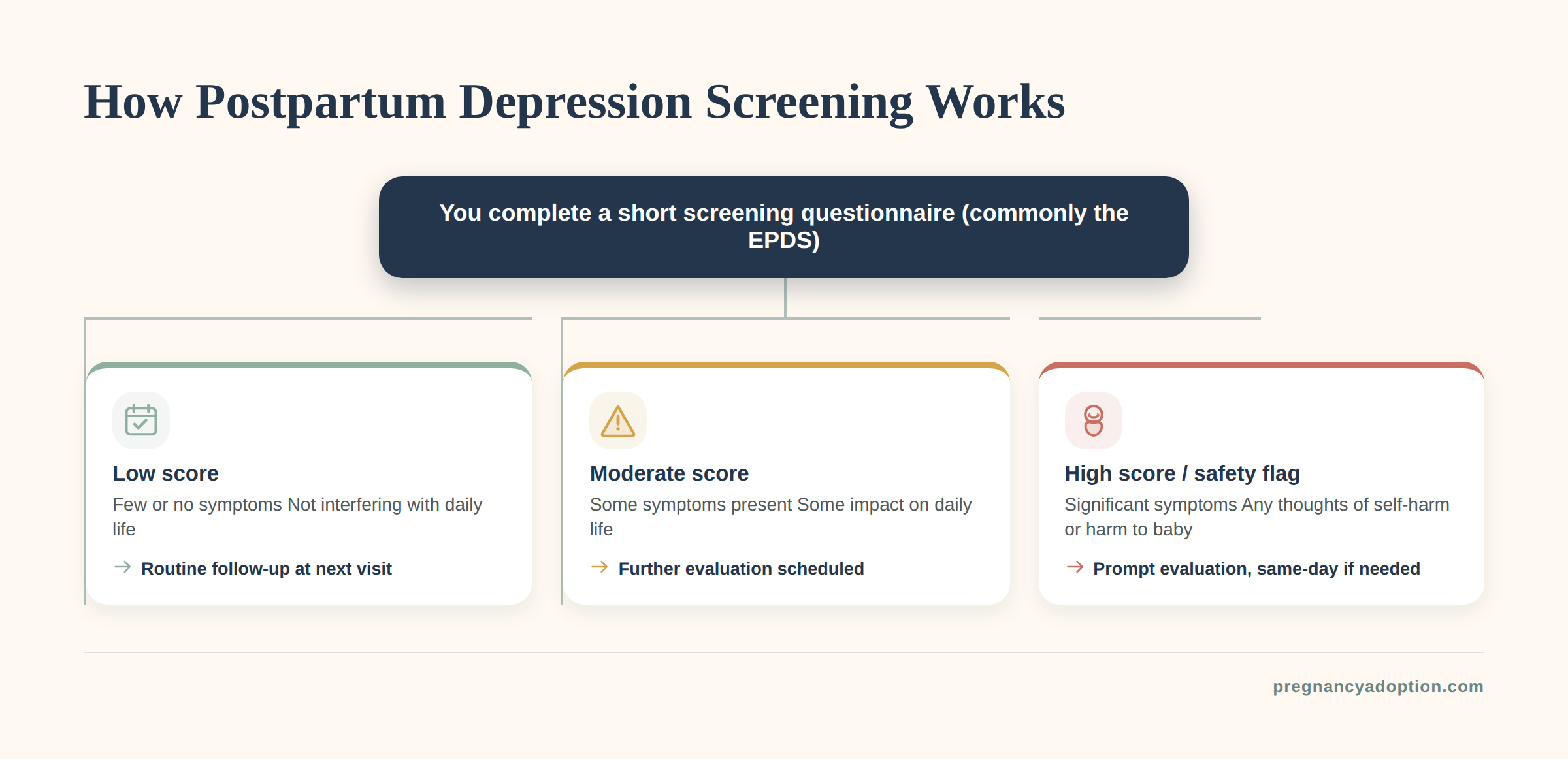
The EPDS is a brief, ten-item, self-report questionnaire, validated specifically for use in the perinatal period, with each item scored from zero to three. It’s a screening tool, not a diagnostic one — a higher score indicates a need for further evaluation, not a diagnosis on its own.
How It’s Scored
Scores above a certain threshold — commonly cited in the range of 10 to 13 depending on the specific validation study and population — are generally treated as indicating a need for follow-up assessment. One specific item asks directly about thoughts of self-harm, and a positive response to that item is treated as requiring immediate clinical attention regardless of the total score.
When and Where Screening Happens
At Prenatal and Postpartum Obstetric Visits
Professional guidance generally recommends screening for depression and anxiety symptoms at least once during the perinatal period using a standardized, validated tool, with the EPDS the most commonly used option in practice.
At Your Baby’s Pediatric Well-Child Visits
Because pediatric visits tend to be more frequent than postpartum OB follow-up in the first year, pediatric guidance has increasingly recommended screening mothers for postpartum depression at well-child visits as well, commonly in the first several months of a baby’s life. If your baby’s pediatrician asks you to fill out a mood questionnaire, this is why — it’s a routine, expected part of modern well-child care, not a sign anything specific has been noticed about you.
| Feature | Detail |
|---|---|
| Format | 10-item self-report questionnaire, scored 0–3 per item |
| Purpose | Screening (flags need for follow-up), not a standalone diagnosis |
| Typical positive-screen threshold | Commonly cited around 10–13, varies by study |
| Self-harm item | One item asks directly about self-harm thoughts; a positive answer prompts immediate follow-up regardless of total score |
| Where it’s used | Prenatal visits, postpartum OB visits, and increasingly at pediatric well-child visits |
Getting a Diagnosis
A positive screening result is the start of a conversation, not the end of one — here’s generally what happens next.
What a Full Evaluation Involves
A Clinical Conversation About Your Symptoms
A provider — your OB, a primary care provider, or a mental health professional — will typically ask about the specific symptoms you’re experiencing, how long they’ve lasted, and how much they’re affecting your daily functioning, comparing what you describe against standard diagnostic criteria.
Ruling Out Other Contributing Factors
A thorough evaluation often includes checking for other conditions that can produce similar symptoms, particularly thyroid dysfunction and significant anemia, since treating an underlying physical cause can meaningfully improve or resolve depression-like symptoms. See the ruling out other causes section below.
Who Can Make the Diagnosis
Your OB or Primary Care Provider Can Often Start Treatment
Many OB providers and primary care providers are comfortable diagnosing and starting treatment for postpartum depression themselves, particularly for more straightforward cases, without necessarily requiring a referral to a psychiatrist first.
When a Referral to a Mental Health Specialist Makes Sense
More complex cases — a history of other mental health conditions, a lack of response to initial treatment, or any features suggesting postpartum psychosis or a bipolar-spectrum condition — generally warrant referral to a psychiatrist or other mental health specialist with experience in perinatal mental health.
Postpartum Anxiety and Postpartum OCD
Depression isn’t the only mood or anxiety condition that can emerge in the postpartum period — postpartum anxiety and postpartum obsessive-compulsive disorder are both real, recognized conditions, often discussed together with PPD under the umbrella term “perinatal mood and anxiety disorders.”
Postpartum Anxiety
What It Looks Like
Excessive, hard-to-control worry (often focused on the baby’s health or safety), physical symptoms like a racing heart or shortness of breath, difficulty sitting still or relaxing, and sometimes panic attacks. It can occur alongside PPD or entirely on its own.
Why It’s Often Under-Recognized
Because anxiety symptoms look different from classic depression, and because some worry about a new baby is expected and normal, postpartum anxiety is sometimes under-recognized compared to PPD — if your worry feels constant, disproportionate, or hard to control, it’s worth bringing up specifically, even if you don’t feel “depressed.”
Postpartum OCD
Intrusive, Unwanted Thoughts
Postpartum OCD involves intrusive, unwanted, distressing thoughts — often about something terrible happening to the baby, sometimes involving the parent themselves accidentally or intentionally causing harm — accompanied by compulsive behaviors (checking, avoidance, mental rituals) aimed at reducing the distress these thoughts cause.
The Critical Distinction From Psychosis
This is one of the most important distinctions in this entire guide: postpartum OCD intrusive thoughts are ego-dystonic, meaning the person experiencing them finds them disturbing, unwanted, and recognizes they don’t want to act on them — insight is intact. This is clinically different from postpartum psychosis, where similar-sounding content can appear as a genuine delusion, with the person’s grip on reality and insight impaired. If you’re having scary, unwanted thoughts but you’re distressed by them and know you don’t want to act on them, that pattern is far more consistent with postpartum OCD than psychosis — but either way, both conditions deserve prompt evaluation, and this distinction is something a mental health professional should help you sort through, not something to self-diagnose.
| Condition | Core feature | Insight into symptoms |
|---|---|---|
| Postpartum depression | Persistent low mood, loss of interest, hopelessness | Intact — aware of feelings, though may feel helpless to change them |
| Postpartum anxiety | Excessive, hard-to-control worry, physical anxiety symptoms | Intact — aware the worry feels excessive |
| Postpartum OCD | Intrusive, unwanted thoughts plus compulsions to reduce distress | Intact — finds the thoughts disturbing and doesn’t want to act on them |
| Postpartum psychosis | Hallucinations, delusions, severe confusion | Impaired — a genuine break from reality; medical emergency |
Postpartum Psychosis: A Psychiatric Emergency
Postpartum psychosis is rare, but it’s serious enough, and the window for safe intervention narrow enough, that it deserves its own clear, unambiguous treatment in this guide, separate from PPD.
Recognizing the Warning Signs
Hallucinations and Delusions
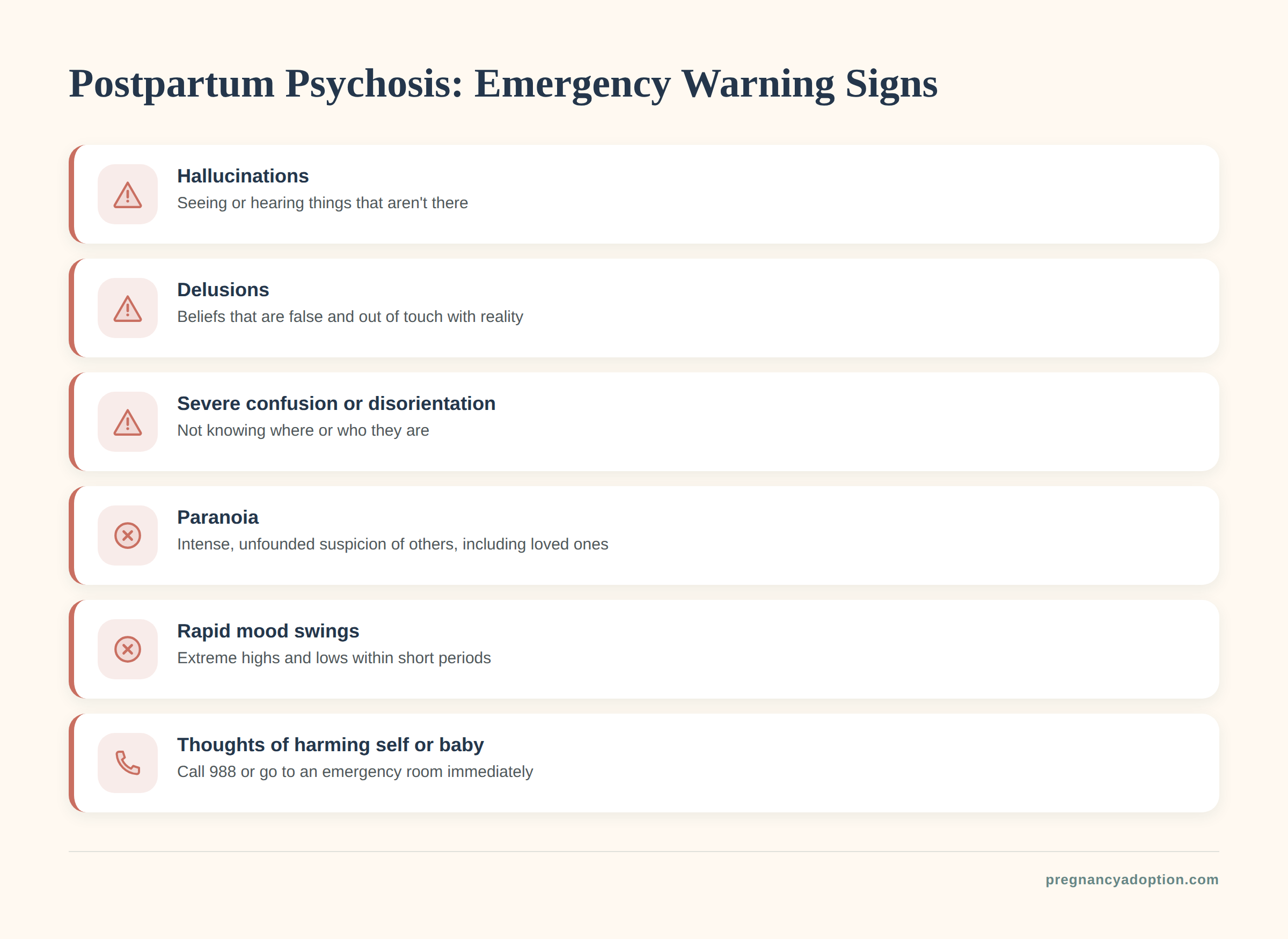
Seeing, hearing, or believing things that aren’t real — for example, hearing voices, or holding a fixed, false belief (a delusion), sometimes specifically about the baby being in danger, defective, or needing to be “saved” in some way.
Severe Confusion and Rapid Mood Swings
Marked disorientation or confusion, extreme and rapid mood swings, severe agitation, paranoia, and bizarre or erratic behavior, often with significant insomnia, are all part of the typical presentation.
Why This Is a True Emergency
Rapid Onset, High Stakes
Postpartum psychosis classically develops quickly — often within the first one to two weeks after delivery, sometimes within the first few days — and because it impairs a person’s grip on reality and judgment, it carries a real, elevated risk of both suicide and harm to the baby if untreated. This is why it requires immediate psychiatric evaluation, almost always including hospitalization, rather than a scheduled outpatient appointment.
What to Do if You See These Signs
If you notice these signs in yourself or someone you love after childbirth, call 911 or go to the nearest emergency room immediately — do not wait to see if it passes, and do not try to manage it alone at home.
Who’s at Higher Risk
A History of Bipolar Disorder
A personal or family history of bipolar disorder is widely identified as the single largest known risk factor for postpartum psychosis — if this applies to you, it’s worth discussing proactively with your care team during pregnancy, so a monitoring plan can be in place before delivery.
A Prior Episode of Postpartum Psychosis
A previous episode substantially raises the risk of recurrence in a future pregnancy, which is covered further in the future pregnancies section below.
| Postpartum depression | Postpartum psychosis | |
|---|---|---|
| Reality testing | Intact — insight into one’s own feelings remains | Impaired — hallucinations, delusions, confusion |
| Typical onset speed | Can develop gradually | Usually rapid, within days to two weeks |
| Urgency | Seek evaluation and treatment promptly | Medical emergency — call 911 or go to the ER now |
| Typical setting for treatment | Outpatient therapy and/or medication | Almost always requires hospitalization |
Ruling Out Other Causes
Because some medical conditions can produce symptoms that look like or worsen depression, a thorough evaluation often includes checking for a few specific, treatable physical causes.
Thyroid Dysfunction
Postpartum Thyroiditis
Postpartum thyroiditis — inflammation of the thyroid gland that can occur in the months after delivery — can cause symptoms including fatigue, low mood, and anxiety that closely mirror depression, and is generally checked with a simple blood test.
Why This Matters
If a thyroid problem is identified and treated, mood symptoms often improve significantly as a result — which is exactly why this is a standard, routine part of a thorough PPD evaluation rather than an optional add-on.
Other Physical Contributors
Anemia and Significant Blood Loss
Significant blood loss during delivery can lead to anemia, which can independently cause fatigue, low mood, and difficulty concentrating — another treatable physical contributor worth ruling out.
Severe Sleep Deprivation
While some sleep disruption is unavoidable with a newborn, severe, prolonged sleep deprivation can independently worsen or mimic depressive symptoms, and practical strategies to protect even small blocks of sleep (covered in the self-care section below) can meaningfully help alongside other treatment.
Treatment: Therapy
Psychotherapy is a well-supported, first-line treatment for postpartum depression, used either on its own or in combination with medication depending on severity.
Cognitive Behavioral Therapy (CBT)
What It Involves
CBT focuses on identifying and changing unhelpful thought patterns and behaviors that contribute to depression, with practical, structured techniques you practice both in and between sessions.
Why It’s Commonly Recommended
CBT has a strong evidence base for depression generally and for PPD specifically, and its structured, skills-based approach fits well into the limited time and energy many new parents have available for therapy.
Interpersonal Therapy (IPT)
What It Involves
IPT focuses specifically on the relationships and role transitions around you — relevant given how much of the postpartum period involves renegotiating relationships and identity — helping you work through relationship stress, role changes, and grief or loss that may be contributing to your depression.
How It Compares to CBT
Both are well-supported, evidence-based options; which one fits better often comes down to personal fit with the approach and therapist availability rather than one being clearly superior to the other for PPD specifically.
Finding a Therapist Experienced With Postpartum Depression
Look for Perinatal Mental Health Experience Specifically
A therapist with specific training or experience in perinatal mental health will be more familiar with the particular dynamics of PPD, postpartum OCD, and related conditions than a general practice therapist — ask directly about this experience when choosing a provider.
Telehealth Can Lower a Major Barrier
Telehealth therapy options have made it considerably easier for new parents to attend sessions without arranging childcare or travel, which is worth asking about if logistics have been a barrier to seeking help.
Treatment: Medication
Medication is a well-established, effective option for moderate to severe postpartum depression, often used alongside therapy rather than instead of it.
SSRIs: The Standard First-Line Option
How They Work
Selective serotonin reuptake inhibitors (SSRIs) are the standard first-line medication class for PPD, the same class commonly used for depression generally, working by affecting serotonin levels in the brain over a period of several weeks.
Breastfeeding Considerations
Certain SSRIs, including sertraline, are frequently preferred for breastfeeding parents because of a relatively larger body of reassuring data on how little of the medication transfers into breast milk, though this is an individualized decision made with your prescriber weighing your specific situation. See the breastfeeding and treatment section below for more.
Newer PPD-Specific Medications
Brexanolone (Zulresso)
Brexanolone, approved by the FDA in 2019, was the first medication specifically approved for postpartum depression. It’s given as a continuous intravenous infusion over 60 hours in a certified healthcare facility, under monitoring for sedation risk.
Zuranolone (Zurzuvae)
Zuranolone, approved by the FDA in August 2023, works through a similar mechanism to brexanolone but is taken orally, once daily in the evening with a fat-containing meal, over a 14-day course — the first oral medication specifically approved for PPD, notable for comparatively fast symptom improvement. It carries a sedation warning, including guidance not to drive for a number of hours after each dose.
What to Expect When Starting Medication
It Takes Time to Work
SSRIs typically take several weeks to produce their full effect, which can be a frustrating adjustment period — your prescriber can help set realistic expectations and adjust the plan if needed.
Side Effects Are Usually Manageable and Often Temporary
Most people tolerate SSRIs reasonably well, and early side effects (like mild nausea or sleep changes) often improve within the first couple of weeks; talk to your prescriber about anything that doesn’t improve or that feels intolerable rather than stopping medication on your own.
| Option | Form | Key details |
|---|---|---|
| SSRIs (e.g., sertraline) | Daily oral tablet | Standard first-line option; takes several weeks for full effect; sertraline often preferred for breastfeeding |
| Brexanolone (Zulresso) | 60-hour IV infusion | First PPD-specific approval (2019); requires a certified healthcare facility |
| Zuranolone (Zurzuvae) | Daily oral capsule, 14-day course | First oral PPD-specific approval (2023); comparatively fast acting; sedation warning |
Breastfeeding and Treatment
A common worry is that treating PPD means having to stop breastfeeding — for most people and most treatment options, this isn’t an either-or decision.
You Generally Don’t Have to Choose
Many Treatments Are Compatible With Breastfeeding
Therapy has no interaction with breastfeeding at all, and several SSRIs, including sertraline, have a substantial body of data supporting their use during breastfeeding — your prescriber can help weigh the specific medication, your baby’s age and health, and your own preferences.
The Risk of Untreated Depression Is Also Real
It’s worth weighing the risks of a specific medication against the real risks of untreated depression — to you and to your baby — rather than assuming breastfeeding and treatment are automatically incompatible.
If You Need to Make Adjustments
Talk to a Prescriber Experienced in Lactation and Mental Health
A prescriber with specific experience in perinatal mental health and lactation can help you find an option that fits your situation, rather than defaulting to stopping breastfeeding or avoiding treatment altogether.
Stopping Breastfeeding, If You Choose To, Is Not a Failure
If you and your provider decide that stopping or adjusting breastfeeding is the right choice for your treatment and your family, that’s a legitimate medical decision, not a personal failure — your wellbeing matters as much as your baby’s feeding method.
Support Groups and Peer Support
Connecting with others who’ve experienced PPD can be a valuable complement to professional treatment, for many people.
Why Peer Support Helps
Reducing Isolation and Shame
Hearing from other parents who’ve experienced similar feelings can reduce the isolation and shame that often accompany PPD, and can make it easier to talk openly about what you’re experiencing.
Practical Tips From People Who’ve Been There
Peer groups often share practical coping strategies and resources that complement what you’re getting from professional treatment, from a perspective of lived experience.
Where to Find Support Groups
Postpartum Support International
Postpartum Support International (PSI) runs free virtual peer support groups specifically for perinatal mood and anxiety disorders, in addition to its HelpLine — see the crisis-resources box at the top of this guide for contact information.
Local and Hospital-Based Groups
Many hospitals, birthing centers, and community organizations also run local postpartum support groups — ask your OB provider, pediatrician, or hospital’s postpartum unit what’s available in your area.
How Partners and Family Can Help
Support from a partner or family member can make a real difference in both recognizing PPD early and supporting recovery.
Recognizing It Early
Know What to Watch For
Partners and family members are often the first to notice persistent changes in mood, withdrawal, or difficulty bonding, since they see the new parent daily in a way a provider at a scheduled visit doesn’t.
Raise It Gently, Without Judgment
Bringing up a concern gently and without judgment — focusing on specific observations rather than labels — tends to be received better than a more confrontational approach, and can open the door to seeking help.
Practical and Emotional Support
Take On Nighttime and Practical Caregiving Where You Can
Taking on a larger share of nighttime caregiving, household tasks, or logistics (scheduling appointments, managing the practical side of treatment) can meaningfully reduce the load on someone struggling with PPD.
Encourage, Rather Than Pressure, Treatment-Seeking
Encouraging someone to seek help, offering to help make or attend appointments, and following up supportively tends to work better than pressuring or insisting — while still taking it seriously enough to act if you see any warning signs covered elsewhere in this guide.
Partner and Paternal Postpartum Depression
Postpartum depression isn’t limited to the person who gave birth — partners, including fathers and non-birthing parents, can experience it too, and this is an increasingly recognized and researched area.
How Common It Is
A Real, Researched Phenomenon
Research, including meta-analyses pooling data across many studies, has found paternal postpartum depression to be a real and meaningfully common condition, with commonly cited prevalence estimates in roughly the 8 to 10 percent range overall.
Risk Rises When a Partner Also Has PPD
Paternal or partner PPD risk rises substantially when the other parent is also experiencing postpartum depression — some estimates cite a much higher rate in this situation specifically. This is part of why addressing one parent’s mental health can matter for the whole family’s wellbeing.
Screening and Support for Partners
Screening Is Less Standardized Than for Birthing Parents
Unlike the relatively well-established screening recommendations for birthing parents, there isn’t yet a single widely adopted formal screening guideline specifically for partners, though awareness and informal screening practices are growing.
The Same Treatment Options Generally Apply
Therapy, and medication where appropriate, are generally effective for partner/paternal postpartum depression in the same way they are for the birthing parent — if you’re a partner noticing persistent low mood, irritability, or withdrawal after a baby’s birth, it’s worth bringing up with your own provider rather than assuming it only applies to birthing parents.
Self-Care That Actually Helps
Self-care isn’t a substitute for professional treatment when PPD is present, but a handful of practical strategies can meaningfully support recovery alongside therapy or medication.
Protecting Sleep, Even in Small Blocks
Prioritize Sleep Over Other Tasks When You Can
Sleep deprivation both worsens depression symptoms and makes coping harder generally — protecting even a few consecutive hours, by splitting nighttime caregiving with a partner or accepting help from family, can make a meaningful difference.
Don’t Feel Guilty About Accepting Help With Sleep
Letting someone else take a nighttime feeding or a few hours of baby care so you can sleep is not a sign of weakness or poor parenting — it’s a legitimate, evidence-supported way to support your own recovery.
Movement, Nutrition, and Realistic Expectations
Gentle Movement Can Help, Within Medical Clearance
Light physical activity, once your provider has cleared you for it, is associated with mood benefits for many people — this doesn’t need to be a formal exercise routine; even short walks can help.
Basic Nutrition and Hydration Matter More Than They Might Seem To
It’s easy to skip meals or under-hydrate in the early postpartum period; keeping easy, accessible food and water nearby can help maintain the basic physical foundation your mood and energy depend on.
Lower the Bar on Everything Else
Letting go of non-essential tasks, accepting imperfection in things that don’t truly matter right now, and accepting practical help (meals, cleaning, errands) from people who offer it all reduce the overall load during an already demanding period.
What Doesn’t Reliably Help
“Just Push Through It” Advice
Well-meaning advice to just push through, stay positive, or “enjoy every moment” isn’t effective for a medical condition like PPD and can increase shame and isolation — if you’ve received this kind of advice, it doesn’t reflect a failure on your part to simply try harder.
Isolating Further
Withdrawing further from support, while an understandable response to feeling overwhelmed or ashamed, tends to worsen symptoms over time rather than provide relief — even small amounts of connection tend to help more than isolation, difficult as that can be to act on.
When to Seek Help: A Practical Guide
It’s not always obvious when ordinary new-parent exhaustion crosses into something that needs professional attention — this section offers a practical way to think it through.
Signs It’s Time to Reach Out
Symptoms Lasting More Than Two Weeks
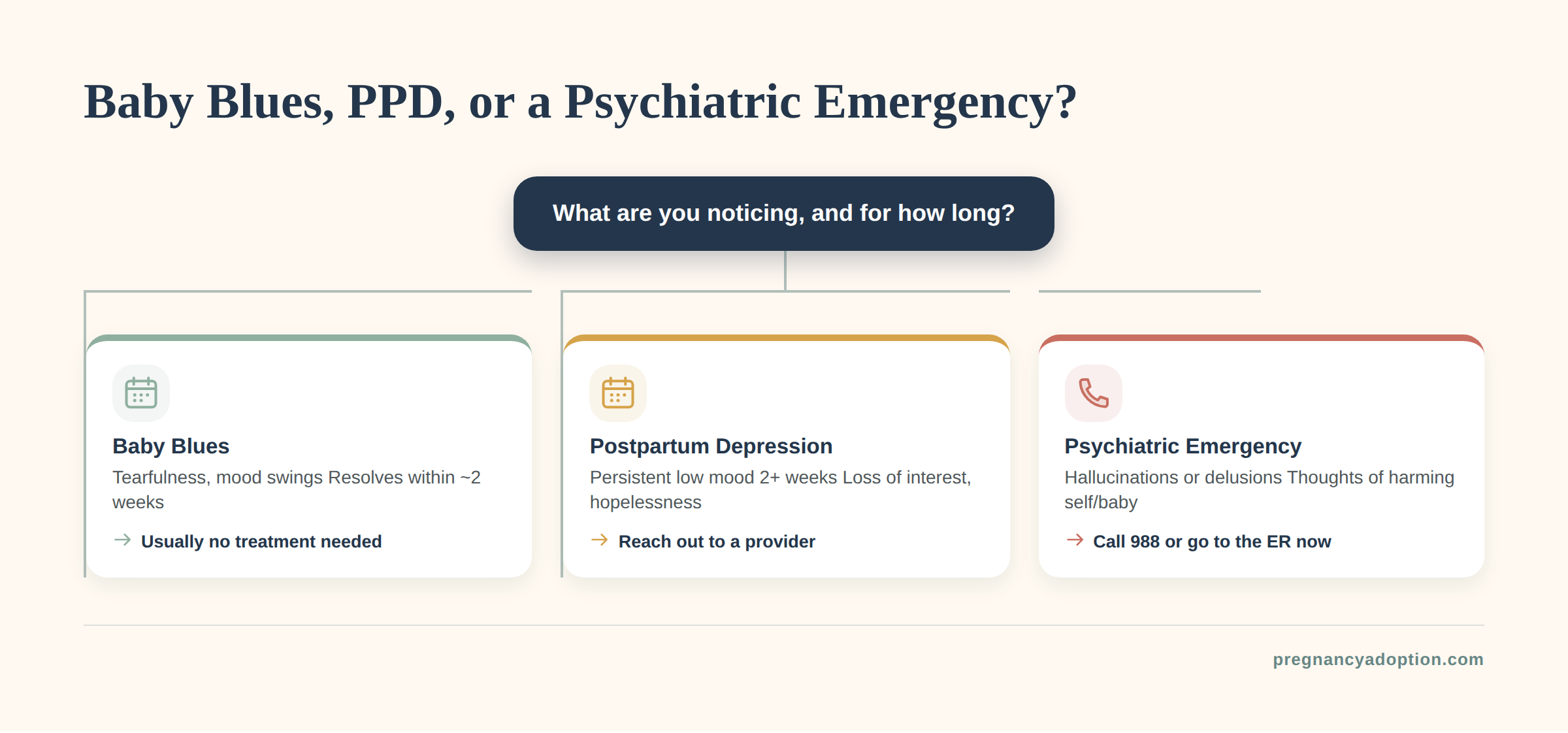
If low mood, anxiety, or other symptoms covered in the symptoms section above are still present, or getting worse, beyond about two weeks postpartum, it’s time to reach out to a provider rather than continuing to wait it out.
Symptoms Interfering With Daily Functioning
If you’re having real difficulty caring for yourself or your baby, or functioning in daily life, that’s a sign to seek help promptly, even if it’s been less than two weeks.
Signs It’s a True Emergency
Thoughts of Self-Harm or Harming the Baby
Any thoughts of harming yourself or your baby should be treated as urgent — use the crisis resources at the top of this guide, call 911, or go to the nearest emergency room now.
Hallucinations, Delusions, or Severe Confusion
Any sign of a break from reality — hearing or seeing things that aren’t there, fixed false beliefs, or severe confusion — is a psychiatric emergency; see the postpartum psychosis section above and seek immediate care.
| What you’re noticing | What to do |
|---|---|
| Mild mood swings, weepiness, in the first 2 weeks | Monitor; this is likely baby blues and should resolve on its own |
| Persistent sadness, anxiety, or loss of interest beyond 2 weeks | Contact your OB, primary care provider, or a therapist for evaluation |
| Symptoms interfering with caring for yourself or your baby | Seek evaluation promptly, regardless of how long it’s been |
| Intrusive, distressing thoughts you don’t want to act on | Discuss with a provider; likely postpartum anxiety/OCD, which is treatable |
| Thoughts of harming yourself or your baby | Treat as urgent — use crisis resources, call 911, or go to the ER now |
| Hallucinations, delusions, or severe confusion | Medical emergency — call 911 or go to the ER immediately |
Why Treatment Matters: Risks of Going Untreated
It’s worth being direct about why getting evaluated and treated matters, beyond simply feeling better — untreated postpartum depression carries real risks for the parent, the child, and the family as a whole.
Risks to the Parent
Untreated Depression Tends to Persist, Not Resolve on Its Own
Without treatment, postpartum depression can last months to years rather than resolving on its own the way baby blues does; some studies have found a meaningful share of untreated cases are still present well beyond the first postpartum year.
It Raises the Risk of Future Depressive Episodes
An untreated postpartum depressive episode is associated with a higher risk of future depressive episodes, including outside of subsequent pregnancies, which is one more reason early treatment is framed as protective rather than optional.
Risks to the Child and Family
Parent-Infant Bonding and Early Development Can Be Affected
As covered in the bonding section below, untreated maternal depression is associated with measurable, though not universal or deterministic, effects on early bonding and child development — this is precisely why clinicians treat PPD as a two-generation issue, not solely the parent’s concern.
Relationship and Family Strain Can Compound Over Time
Untreated depression places strain on partnerships and family relationships that tends to compound the longer it goes unaddressed, whereas treatment — even when it doesn’t resolve symptoms instantly — is associated with better relationship and family outcomes over time.
Recovery and Prognosis
With appropriate treatment, the outlook for postpartum depression is genuinely good — this is worth holding onto if you’re in the middle of it and it doesn’t feel that way right now.
What Recovery Typically Looks Like
Most People Recover Fully
The general clinical consensus is that the large majority of people with PPD recover fully with appropriate treatment, typically showing meaningful improvement within weeks to a few months of starting treatment.
Recovery Isn’t Always a Straight Line
It’s common to have better and worse days even while improving overall — this doesn’t mean treatment isn’t working, and it’s worth discussing the overall trend with your provider rather than judging progress by any single day.
Why Untreated PPD Is Worth Taking Seriously
It Can Persist for Months Without Treatment
Untreated postpartum depression can persist for many months, sometimes over a year, rather than resolving on its own the way baby blues does — this is part of why early treatment matters rather than waiting to see if it passes.
It Can Affect More Than Just You
Untreated PPD is associated with effects on bonding and on a child’s early emotional and cognitive development, and on relationships and family functioning more broadly — covered further in the bonding and your baby’s development section below, handled with the context that this is exactly why treatment matters, not as a source of additional guilt.
Future Pregnancies and Recurrence Risk
If you’ve had PPD once, it’s natural to wonder what that means for a future pregnancy.
Recurrence Risk
The Risk Is Meaningfully Elevated
Having had PPD in a prior pregnancy meaningfully raises the risk of experiencing it again in a future pregnancy, compared to the general population — estimates for exactly how much vary.
This Doesn’t Mean It Will Definitely Happen Again
An elevated risk is not a certainty — many people who’ve had PPD once go on to have a subsequent pregnancy and postpartum period without a recurrence, particularly with proactive planning.
Planning Ahead for a Future Pregnancy
Tell Your Care Team About Your History Early
Letting your OB provider know about a prior PPD (or postpartum psychosis) episode early in a future pregnancy allows for a proactive monitoring and support plan, rather than waiting to react if symptoms reappear.
A Proactive Plan Can Include Earlier Screening and a Ready Support Network
This might include more frequent mood screening during pregnancy and the postpartum period, having a therapist or prescriber already lined up before delivery, and making sure your support network knows what to watch for.
Bonding and Your Baby’s Development
This is a sensitive topic to cover honestly without adding to the guilt many people with PPD already feel — the goal here is context for why treatment matters, not a source of additional self-blame.
Why This Topic Matters
Difficulty Bonding Is a Symptom, Not a Character Flaw
Difficulty feeling connected to your baby is a recognized symptom of PPD itself, not evidence that you don’t love your baby or aren’t cut out for parenting — it’s one of the clearest signs that treatment, not more effort or willpower, is what’s needed.
Treatment Tends to Improve Bonding, Not Just Mood
As PPD improves with treatment, bonding and the ability to engage warmly with your baby typically improve as well — this is one of the concrete, meaningful benefits of getting help, beyond your own mood.
What the Research Says, in Context
Untreated PPD Is Associated With Developmental Effects
Research associates untreated PPD with effects on a child’s early emotional, behavioral, and cognitive development — this research exists specifically to underscore why early treatment matters and support should be accessible, not to assign blame to parents experiencing a medical condition.
These Effects Are Not Inevitable, and They’re Not a Verdict on You
Getting treatment, and the many protective factors a loving, engaged family provides even during a difficult period, meaningfully change this picture — this isn’t a deterministic outcome, and seeking help is exactly the action that changes the trajectory.
Access to Care: Cost, Insurance, and Telehealth
Cost and access are real barriers for many people considering treatment, and it’s worth knowing what options exist before assuming treatment is out of reach.
Insurance and Cost
Many Plans Cover Mental Health Treatment
Most insurance plans, including Medicaid, are required to cover mental health treatment to some degree under federal mental health parity requirements, though the specifics of coverage — which providers are in-network, copay amounts, and session limits — vary by plan.
Sliding-Scale and Community Options
Community mental health centers, some private therapists, and training clinics associated with universities often offer sliding-scale fees based on income, which can make treatment accessible even without insurance or with limited coverage.
Telehealth as an Access Tool
Lower Barriers for New Parents Specifically
Telehealth therapy and some medication-management appointments can be done from home, removing the need to arrange childcare or travel — this has made treatment meaningfully more accessible for many postpartum patients specifically.
Check What Your Insurance Covers for Telehealth
Telehealth coverage varies by plan and by state; it’s worth confirming with your insurer or a provider’s office whether a specific telehealth option is covered before assuming it is or isn’t.
Sleep, Nutrition, and Physical Recovery’s Role in Mental Health
Mental health in the postpartum period doesn’t exist separately from the body’s own recovery — sleep loss, nutritional depletion, and physical healing all interact with mood in ways worth understanding, even though none of them replace treatment when depression is actually present.
Sleep and Mood Are Closely Linked
Fragmented Sleep Can Both Cause and Worsen Low Mood
Newborns wake frequently, and the resulting fragmented, often severely reduced sleep is itself a known contributor to low mood, irritability, and difficulty coping — this doesn’t mean every tired new parent has postpartum depression, but chronic severe sleep deprivation can mimic or worsen depressive symptoms, which is part of why providers ask about sleep when screening.
Protecting Even Small Blocks of Sleep Helps
Where possible, splitting nighttime care with a partner or support person, accepting help so you can nap during the day, and treating sleep as a genuine priority rather than an indulgence can meaningfully improve coping, even if it doesn’t resolve clinical depression on its own.
Nutrition and Physical Healing
Some Nutritional Factors Are Worth Checking
Iron deficiency (common after blood loss at delivery) and low vitamin D have both been studied for links to postpartum mood, and your provider may check these as part of ruling out other causes (see the section above on ruling out other causes); correcting a genuine deficiency can help overall well-being, though it is not a substitute for treating depression itself when it’s present.
Physical Recovery and Mental Health Reinforce Each Other
Pain, incision healing (for a cesarean birth), and general physical exhaustion from recovery all affect mood and capacity to cope; this is one more reason postpartum checkups (see the dedicated section above) address physical and mental health together rather than treating them as fully separate concerns.
Postpartum PTSD (Birth Trauma)
One more condition belongs alongside PPD, postpartum anxiety/OCD, and postpartum psychosis on the perinatal mental health spectrum: postpartum post-traumatic stress disorder, sometimes called birth-trauma-related PTSD, triggered by a traumatic birth experience rather than developing independently of one.
What It Looks Like
Re-Experiencing the Birth
Intrusive memories, flashbacks, or nightmares specifically about the birth experience, along with intense distress when reminded of it — this can happen after a birth that involved a real medical emergency, but also after a birth that felt traumatic to the person experiencing it even if clinically it went “according to plan.”
Avoidance and Hyperarousal
Avoiding reminders of the birth (including, sometimes, medical settings or conversations about the birth), alongside hyperarousal symptoms like being easily startled, difficulty sleeping beyond typical newborn-care disruption, and a persistent sense of being “on edge.”
How It Relates to PPD
They Can Occur Together
Postpartum PTSD and postpartum depression can occur together, and a traumatic birth is itself a recognized risk factor for PPD, covered in the risk factors section above — they’re related but clinically distinct conditions that can require somewhat different treatment emphasis.
Trauma-Focused Treatment May Be Needed
If birth trauma is a significant part of the picture, trauma-focused therapy approaches (in addition to or instead of standard depression-focused therapy) are often recommended — it’s worth specifically mentioning the traumatic nature of your birth experience to your provider so treatment can be tailored accordingly.
Postpartum Checkups and Ongoing Medical Care
Mental health screening doesn’t happen in isolation — it’s typically woven into the broader schedule of postpartum medical checkups, which is worth understanding on its own.
The Standard Postpartum Visit Schedule
An Initial Check-In Within the First Few Weeks
Many practices now recommend an initial postpartum contact (sometimes a phone call or early in-person visit) within the first one to three weeks after delivery, in addition to the traditional six-week visit, reflecting updated guidance that recognizes the postpartum period as an ongoing process rather than a single appointment.
The Comprehensive Visit Around Six Weeks
A more comprehensive postpartum visit, commonly scheduled around six weeks after delivery, typically includes a physical exam, a discussion of physical recovery, contraception planning, and a mental health screening — this is one of the most consistent, built-in opportunities to raise any mood or anxiety concerns.
Making the Most of These Visits
Don’t Wait for the Screening Question if Something Feels Urgent
If you’re struggling before your scheduled postpartum visit, don’t wait for it — call your provider’s office and ask to be seen sooner, or use the crisis resources at the top of this guide if things feel urgent.
Bring a List if You’re Worried You’ll Forget Something
Postpartum visits can feel rushed, especially with a baby along; writing down your main concerns beforehand, including anything related to mood or anxiety, helps make sure they actually get addressed during a short appointment.
The Pediatrician’s Role in Catching Postpartum Depression
Your own postpartum visits aren’t the only built-in opportunity for screening — your baby’s pediatrician is often an equally important, and sometimes earlier, point of contact.
Well-Child Visits Are a Recognized Screening Opportunity
Pediatric Guidance Increasingly Recommends Parental Screening
Pediatric professional guidance increasingly recommends that pediatricians screen parents for postpartum depression at well-child visits during the baby’s first year, recognizing that parents often see a pediatrician more frequently than they see their own postpartum provider in the months after the six-week visit.
This Can Catch Cases That Emerge Later
Because postpartum depression can develop well beyond the six-week mark (see the section above on when it typically starts), pediatric well-child visits at two, four, six, nine, and twelve months offer repeated opportunities to catch a case that wasn’t present — or wasn’t yet noticeable — at the earlier postpartum checkup.
What to Expect if Your Pediatrician Asks
It’s a Normal, Routine Question, Not a Judgment
If your baby’s pediatrician asks how you’re doing emotionally or has you fill out a screening questionnaire, that’s a routine, evidence-based part of well-child care in many practices today, not a sign that they’ve noticed something alarming about you specifically.
You Can Also Raise It Yourself
You don’t have to wait to be asked — if you’re a parent at a well-child visit and you’re struggling, it’s entirely appropriate to raise it with the pediatric team directly, who can point you toward resources or your own provider even though you aren’t their primary patient.
Talking to Your Provider or Loved Ones
Knowing what to say can be one of the hardest parts of reaching out — this section offers some practical starting points.
Talking to Your Provider
You Don’t Need the Perfect Words
Simple, direct statements work well: “I think I might have postpartum depression,” or “I’ve been feeling really low and it’s not getting better” are both perfectly adequate ways to start the conversation.
Bring Specifics if You Can
Noting how long symptoms have lasted, how they’re affecting your daily functioning, and any thoughts of self-harm (even if they feel frightening to say out loud) helps your provider understand the full picture and respond appropriately.
Talking to Partners, Family, or Friends
You Don’t Have to Explain Everything at Once
You can share as much or as little as feels right, and you can ask directly for specific kinds of help (more sleep, more practical support, company) without needing to fully explain or justify what you’re experiencing.
It’s Okay to Ask Someone Else to Help You Make the Call
If reaching out yourself feels like too much, it’s entirely reasonable to ask a partner, family member, or friend to help you find a provider or even make the first call on your behalf.
Common Myths and Misconceptions
A few persistent myths about PPD can make it harder for people to recognize what they’re experiencing or feel comfortable seeking help.
Myths About Causes and Character
“It Means You Don’t Love Your Baby”
Not true. PPD is a medical condition with a physiological basis, not a reflection of how much you love or want your baby — many people with PPD love their babies deeply while still struggling with a real, treatable illness.
“It Only Happens to People Who Had a Difficult Birth or Pregnancy”
Not true. While a traumatic birth is a risk factor, PPD can and does occur after straightforward, uncomplicated pregnancies and deliveries just as often.
Myths About Timing and Treatment
“It Only Happens Right After Birth”
Not true, as covered in the when it typically starts section above — PPD can begin during pregnancy or at any point in the first year postpartum.
“You Just Have to Push Through It”
Not true, and potentially harmful advice — PPD is a treatable medical condition, and treatment tends to work faster and better the earlier it starts, not something that simply resolves with willpower or time alone.
What Living With Untreated PPD Can Feel Like, Day to Day
Clinical symptom lists can feel abstract — it can help to see what postpartum depression often looks like in the texture of an ordinary day, and how that typically shifts once treatment starts.
Before Treatment
Mornings That Feel Impossible
Waking up already exhausted, with a sense of dread about the day ahead rather than the newborn-exhaustion that simply comes from broken sleep; going through the motions of feeding and caring for the baby while feeling disconnected from it, or crying without a clear trigger partway through a routine task.
A Fog That Doesn’t Lift
Many people describe a persistent mental “fog” — difficulty following conversations, forgetting simple things, feeling like they’re watching themselves go through the day from a distance rather than fully present in it, on top of the baseline exhaustion of caring for a newborn.
After Treatment Starts Working
Gradual, Not Immediate, Change
Most people don’t wake up one day feeling completely different — improvement tends to show up gradually, as slightly more energy, a few moments of genuine connection with the baby, or a day that feels marginally more manageable than the one before.
Small Moments Starting to Feel Real Again
A common marker people describe is the return of small moments of genuine feeling — noticing you laughed at something without forcing it, or felt a flash of warmth looking at your baby — as early signs that treatment is working, even before the bigger picture feels fully resolved.
Where These Numbers Come From
Several figures throughout this guide come from specific studies and surveillance systems, and it’s worth understanding where they originate and why estimates sometimes vary.
Prevalence Research
The “1 in 7” Figure
The widely cited “roughly 1 in 7” estimate traces back to a large study published in JAMA Psychiatry that screened a substantial number of new mothers using a validated tool. It’s one of the most frequently referenced PPD prevalence figures in both clinical and public-facing sources.
CDC Surveillance Data
Separately, the CDC’s Pregnancy Risk Assessment Monitoring System (PRAMS) tracks self-reported postpartum depressive symptoms across participating states, generally finding rates in the roughly 11 to 20 percent range depending on the state and year — a somewhat different methodology (ongoing population surveillance versus a single research study) than the JAMA figure, which partly explains why the numbers don’t match exactly.
Why the EPDS Became the Standard Screening Tool
Validated Specifically for the Perinatal Period
The Edinburgh Postnatal Depression Scale was developed and validated specifically for use during pregnancy and the postpartum period, which is part of why it became the standard tool rather than a general-purpose depression screening questionnaire — general depression scales can over-flag normal postpartum fatigue and sleep changes that aren’t necessarily symptoms of depression in this specific context.
Widely Adopted, With Some Local Variation
While the EPDS itself is consistent, the specific cutoff score used to flag a “positive” screen and trigger follow-up varies somewhat by institution and study population, which is why this guide presents a range rather than one single number.
Workplace, Leave, and Returning to Work
For many people, navigating PPD overlaps with navigating parental leave and an eventual return to work, which adds its own layer of practical complexity.
Leave and Accommodations
Medical Leave May Be Available Beyond Standard Parental Leave
Depending on your employer and local law, a PPD diagnosis may qualify for additional medical leave (for example, under the federal Family and Medical Leave Act, where applicable) beyond standard parental leave — a provider’s documentation of the diagnosis is generally required to request this.
Short-Term Disability May Apply
Some short-term disability insurance plans cover a documented PPD diagnosis in a similar way to other qualifying medical conditions — check your specific plan’s terms, since coverage varies considerably.
Returning to Work
Timing the Return Around Your Treatment
If possible, coordinating your return-to-work timing with where you are in treatment — rather than returning before symptoms have meaningfully improved simply because leave has run out — can make the transition considerably easier, though this isn’t always financially possible for every family.
Talking to Your Employer, if You Choose To
You’re not obligated to disclose a specific diagnosis to your employer, though you may need to for formal leave or accommodation requests; a provider can often document a medical need without necessarily detailing the specific diagnosis, depending on what your employer’s process requires.
Cultural Perspectives and Family Expectations
How postpartum mental health is understood, discussed, and supported varies considerably across cultures and families, which can shape both risk and the path to getting help.
Cultural Postpartum Traditions
Structured Postpartum Rest Periods
Many cultures have traditional structured postpartum rest periods (sometimes called “postpartum confinement” or similar terms in different traditions) that provide built-in practical support — extended family help, reduced household responsibilities, and protected rest time — which some research associates with potential protective effects, though this is a developing area of study rather than a settled finding.
These Traditions Don’t Replace Treatment When PPD Is Present
Even within families and cultures with strong traditional postpartum support structures, PPD can still occur and still warrants professional evaluation and treatment — traditional support and professional treatment aren’t mutually exclusive.
When Stigma or Family Expectations Create Barriers
Stigma Can Make Disclosure Harder in Some Communities
In some families and cultural contexts, mental health struggles carry more stigma, or complaining about new motherhood specifically may be discouraged, which can make it harder to disclose symptoms or seek help — recognizing this barrier is a first step toward working around it, whether through a trusted provider, a culturally specific support resource, or a trusted friend outside the family system.
Finding Culturally Responsive Support
Some organizations and providers specifically focus on culturally responsive perinatal mental health support — it’s reasonable to ask a potential provider about their experience with your specific cultural context if this matters to you.
Questions to Bring to Your Provider
Having a few specific questions ready can make appointments feel more productive, especially when you’re not at your sharpest.
At an Initial Evaluation
“What Type of Postpartum Mood or Anxiety Condition Do You Think I’m Experiencing?”
Getting a clear sense of whether your provider thinks you’re dealing with PPD, postpartum anxiety, postpartum OCD, or something else helps you understand what to expect from treatment.
“What Treatment Options Make Sense for My Specific Situation?”
Ask specifically about therapy, medication, or both, and how your provider weighed factors like breastfeeding, symptom severity, and your own preferences in that recommendation.
About Medication, If It’s Recommended
“How Long Before I Should Expect to Notice a Difference?”
Understanding the realistic timeline helps you avoid giving up on a medication too early, before it’s had a chance to take effect.
“What Side Effects Should I Watch For, and What Should I Do if I Notice Them?”
Knowing what’s a normal, often-temporary adjustment versus what warrants a call to your prescriber helps you respond appropriately rather than either ignoring something important or stopping medication unnecessarily.
Supplements and Unproven Claims to Be Cautious About
The postpartum period, like pregnancy, attracts a lot of product marketing, some of it making claims about mood and mental health that outpace the actual evidence behind them.
Placenta Encapsulation
What’s Claimed
Placenta encapsulation — processing and consuming the placenta, typically in pill form — is marketed by some providers with claims of preventing or reducing postpartum depression, boosting milk supply, and other benefits.
What the Evidence Actually Shows
Current evidence does not support these claims; some analyses have also raised safety concerns, including bacterial contamination risk in improperly processed products. This is worth knowing before spending money on it with the expectation that it will meaningfully reduce PPD risk.
Omega-3s and Other Supplements
Omega-3 Fatty Acids
Some research has explored omega-3 fatty acid supplementation for mood support in the perinatal period, with mixed and inconclusive results so far — it’s reasonable to discuss with your provider as a general health measure, but it shouldn’t be relied on as a standalone PPD treatment or prevention strategy.
A General Rule of Thumb
If a supplement or product claims to treat or prevent postpartum depression specifically, it’s worth asking your provider about the actual evidence before relying on it instead of, or delaying, evidence-based treatment like therapy or medication.
Special Situations
A few specific circumstances change how postpartum depression tends to present or how it should be approached.
After a NICU Stay or Medically Complicated Birth
Higher Risk, and a Different Kind of Grief
A NICU stay or complicated birth raises PPD risk and often adds a distinct layer of trauma, fear, and sometimes grief for the birth experience you expected but didn’t have — this combination deserves specific attention from your care team, not just standard postpartum follow-up.
NICU Parents Benefit From Early, Proactive Screening
Because of the elevated risk, many NICU programs now include or recommend mental health screening and support for parents as a routine part of care, not something you need to ask for separately.
With Multiples
Compounded Physical and Emotional Demands
Caring for twins, triplets, or more multiplies the physical demands, sleep disruption, and logistical stress that contribute to PPD risk — parents of multiples are at meaningfully higher risk and deserve proactive attention to their own mental health, not just their babies’ care.
Specialized Support Resources Exist
Organizations and support groups specifically for parents of multiples can offer both practical strategies and peer understanding that’s hard to find in general new-parent spaces.
As a Teen Parent
Elevated Risk, Combined With Developmental and Social Factors
Teen parents face elevated PPD risk, compounded by their own ongoing developmental stage, potentially less-established support systems, and added social and educational stress — this site’s guide to pregnancy options for teens covers broader support resources relevant to this situation.
Finding Age-Appropriate Support
Look for providers and support groups experienced specifically with young parents, where available, since the dynamics and concerns can differ somewhat from an older parent’s experience.
As an LGBTQ+ Parent
Non-Birthing and Adoptive Parents Can Experience Postpartum Depression Too
Postpartum mood disorders aren’t limited to birthing parents or to opposite-sex couples — non-birthing parents, adoptive parents, and LGBTQ+ parents of all configurations can experience postpartum depression, sometimes compounded by a lack of providers or resources who understand their specific family structure.
Seek Out Affirming Providers
Where possible, look for therapists and support groups explicitly experienced with and affirming of LGBTQ+ families, since feeling safe and understood by a provider meaningfully affects whether someone continues treatment.
As a Solo or Single Parent
Fewer Built-In Support Structures, Higher Practical Load
Parenting without a co-parent at home removes a layer of built-in overnight and day-to-day support that many postpartum-depression prevention strategies assume is available, which can mean higher practical strain and, in some studies, higher reported rates of depressive symptoms among solo parents.
Building a Deliberate Support Network Matters More, Not Less
Because the built-in partner-support layer isn’t there, deliberately building a network — family, friends, a postpartum doula, a support group, or community and faith-based resources — becomes a more active, intentional task rather than something that happens automatically, and it’s worth starting that outreach early rather than waiting until you’re overwhelmed.
After a Previous Pregnancy Loss, With a Subsequent Birth
A Live Birth After Loss Can Bring Complicated, Layered Emotions
If you’ve experienced a previous miscarriage, stillbirth, or infant loss (covered in depth in this site’s guide to miscarriage), a subsequent live birth can bring genuine joy alongside anxiety, grief that resurfaces, or guilt about feeling anything other than happiness — all of which can coexist with or complicate postpartum depression screening and shouldn’t be dismissed as “just” leftover grief.
Mention This History Specifically to Your Screening Provider
A previous pregnancy loss is a known risk factor worth flagging explicitly during postpartum screening, since it can shape both your risk level and the kind of support that will actually help — providers familiar with perinatal loss can tailor their approach accordingly.
If You’re Navigating This Alongside an Adoption Plan
This site primarily serves people navigating pregnancy decisions and the adoption process, so a brief note on how postpartum mental health intersects with adoption is worth including here.
Postpartum Depression Can Affect Birth Parents After Placement, Too
Grief and Depression Can Coexist and Can Be Hard to Tell Apart
A birth parent who has placed a baby for adoption can experience both grief specific to placement and postpartum depression driven by the same hormonal and physical factors as any other postpartum period — these can occur together and can be hard to distinguish from each other without professional support, and both deserve care.
This Is a Distinct Topic From This Guide’s Main Focus
This guide focuses on postpartum depression generally; placement-specific grief and emotional support are covered in this site’s other guides on birth mother rights and the adoption process, and a mental health provider experienced with both postpartum mood disorders and adoption-related grief can help sort through what you’re experiencing. If you’re specifically navigating the hospital stay and immediate post-birth period around a placement, our guide to placing a baby for adoption covers that logistics and timeline in detail, and our open adoption guide covers what ongoing contact with your child can look like, which some birth parents find relevant to their own emotional processing over time.
Postpartum Depression Can Affect Adoptive Parents Too
Not Limited to Biological or Birthing Parents
Adoptive parents, including those who didn’t give birth, can experience a postpartum-adjustment-adjacent depression after bringing a new child home, driven by the same major life transition, sleep disruption, and identity shift factors that contribute to PPD generally, even without the same hormonal component.
It Deserves the Same Serious Attention
If you’re an adoptive parent experiencing persistent low mood, anxiety, or difficulty bonding after placement, it deserves the same serious attention and treatment as postpartum depression in a birth parent — don’t assume it doesn’t apply to you because you didn’t give birth.
If Someone You Love Has Postpartum Depression
If you’re reading this because you’re worried about someone else, here’s a practical starting point.
What You Can Do
Take What They Share Seriously, Without Minimizing It
If someone discloses what they’re feeling to you, take it seriously rather than minimizing it (“every new parent feels tired”) or rushing to reassure them it will pass — validation and taking action together tend to help more than reassurance alone.
Help With the Practical Step of Getting Evaluated
Offer to help find a provider, make the appointment, or go with them — the practical first step of getting evaluated can feel like the hardest part, and concrete help with it can make a real difference.
Know When to Act Immediately
Take Any Mention of Self-Harm Seriously
If someone mentions thoughts of harming themselves or their baby, don’t wait or assume they don’t mean it — help them access the crisis resources at the top of this guide, or call 911 if you believe anyone is in immediate danger.
Watch for Signs of Psychosis
If you notice hallucinations, delusions, severe confusion, or dramatically erratic behavior, treat it as the medical emergency it is — call 911 or get them to the nearest emergency room, even if they resist, since impaired insight is part of the condition itself.
A Simple Action Checklist
If you’re not sure where to start, here’s a straightforward sequence of steps.
If You’re Noticing Possible Symptoms in Yourself
Start With One Conversation
Tell one person — a provider, a partner, a friend — what you’re experiencing, using whatever words feel accessible, even if they’re imperfect.
Get Screened
Ask your OB provider, primary care provider, or your baby’s pediatrician for a depression screening if one hasn’t already been offered, or complete one through a provider’s patient portal if available.
If Symptoms Are Severe
Don’t Wait for a Scheduled Appointment
If symptoms are severe or rapidly worsening, call your provider’s office and ask for an urgent appointment, or use a crisis resource from the top of this guide rather than waiting for the next routine visit.
Loop In Your Support System
Let at least one person close to you know what’s going on, so you’re not navigating this entirely alone, and so someone else is aware enough to help if things escalate.
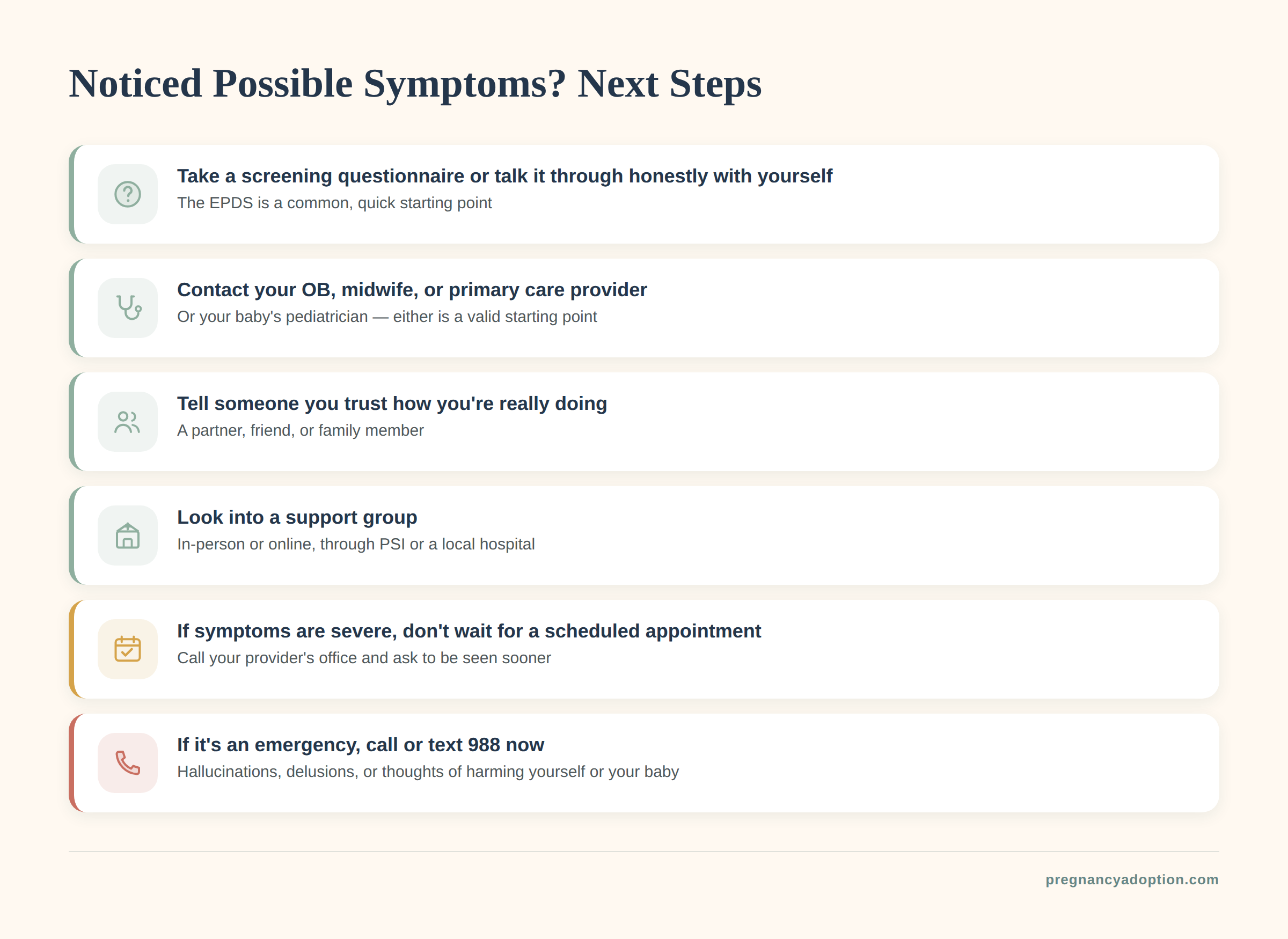
Glossary of Terms in This Guide
A quick reference for clinical terms used throughout this guide.
Mood and Diagnostic Terms
Baby Blues
A very common, mild, short-lived period of mood swings and weepiness in the first couple of weeks postpartum that resolves on its own.
Peripartum Onset
The current clinical term for a major depressive episode beginning during pregnancy or after delivery, replacing the older “postpartum-only” framing.
Perinatal Mood and Anxiety Disorders (PMADs)
An umbrella term covering postpartum depression, postpartum anxiety, postpartum OCD, and related conditions occurring during pregnancy or after birth.
Postpartum Psychosis
A rare, serious psychiatric emergency involving hallucinations, delusions, or severe confusion, requiring immediate medical care.
Screening and Treatment Terms
Edinburgh Postnatal Depression Scale (EPDS)
A validated, 10-item self-report screening questionnaire used to flag possible postpartum depression for further evaluation.
SSRI (Selective Serotonin Reuptake Inhibitor)
A class of antidepressant medication and the standard first-line medication option for postpartum depression.
CBT (Cognitive Behavioral Therapy)
A structured, evidence-based form of therapy focused on identifying and changing unhelpful thought patterns and behaviors.
IPT (Interpersonal Therapy)
A form of therapy focused on relationships and role transitions, well-supported for postpartum depression specifically.
Frequently Asked Questions
These questions cover the full range of follow-up questions that come up around postpartum depression, organized by theme.
Getting Started and Basics
Is postpartum depression the same as just being really tired?
No — while exhaustion is part of the picture, PPD is a distinct medical condition involving persistent mood, anxiety, and functioning changes that go well beyond what sleep alone would explain or fix.
Can postpartum depression happen after any pregnancy, even a wanted and planned one?
Yes — PPD is not related to how much a pregnancy was wanted or planned; it can affect anyone, regardless of how they felt about becoming a parent.
Symptoms
How long do I need to have symptoms before it counts as PPD?
There’s no single universal cutoff, but symptoms persisting most of the day, nearly every day, for two weeks or more is a commonly used general guideline, alongside how much they’re affecting your functioning.
Can PPD cause physical symptoms, not just emotional ones?
Yes — fatigue, appetite and sleep changes, and unexplained physical aches are all recognized features of depression, including PPD, alongside the emotional symptoms.
Diagnosis and Screening
Do I need to see a specialist to get diagnosed, or can my regular OB do it?
Many OB providers and primary care providers can diagnose and begin treating straightforward cases themselves; more complex cases may be referred to a psychiatrist or other mental health specialist.
What happens if I score high on a screening questionnaire?
A high score prompts further evaluation, not an automatic diagnosis — your provider will talk with you about your specific symptoms to determine next steps.
Baby Blues vs. PPD
How do I know if it’s baby blues or something more?
Time is the clearest signal — baby blues resolves within about two weeks on its own; if symptoms persist or worsen beyond that, it’s worth getting evaluated.
Can baby blues turn into postpartum depression?
It can appear that way, though clinically they’re considered distinct — what matters practically is that if symptoms don’t improve within the expected baby-blues window, it’s time to seek evaluation regardless of what you call it.
Postpartum Psychosis
Is postpartum psychosis the same thing as severe postpartum depression?
No — they’re categorically different conditions. Postpartum psychosis involves a break from reality (hallucinations, delusions, confusion) and is a true psychiatric emergency, not simply PPD at a higher severity level.
How quickly does postpartum psychosis develop?
Typically rapidly, often within the first one to two weeks after delivery, sometimes within the first few days.
Postpartum Anxiety and OCD
Is it normal to have scary thoughts about something happening to my baby?
Unwanted, distressing intrusive thoughts that you find disturbing and don’t want to act on are a recognized feature of postpartum OCD and anxiety, and are different from a genuine intent or desire to cause harm.
How do I know if my intrusive thoughts are OCD or something more serious?
If you’re distressed by the thoughts and know you don’t want to act on them, that pattern is more consistent with postpartum OCD than psychosis — but this distinction should be confirmed with a mental health professional, not self-diagnosed.
Causes and Risk Factors
Did I cause this by doing something wrong during pregnancy or after birth?
No — PPD results from a combination of hormonal, physical, and psychological factors, not from anything you did or didn’t do.
If I have no risk factors, can I still get PPD?
Yes — plenty of people with no apparent risk factors still develop PPD, and having risk factors doesn’t guarantee you will.
Treatment: Therapy
Do I have to do therapy forever once I start?
No — many people complete a defined course of therapy and see significant improvement; your therapist can help you determine an appropriate endpoint or ongoing-maintenance plan based on your progress.
What if I don’t click with my first therapist?
It’s common and reasonable to try a different therapist if the fit doesn’t feel right — therapeutic fit matters for how effective treatment is, and switching isn’t a failure on your part.
Treatment: Medication
Will I have to take medication forever?
Not necessarily — many people take medication for a defined period and taper off under medical guidance once they’ve recovered; this is a decision to make with your prescriber based on your specific situation.
Is it safe to start an antidepressant while breastfeeding?
Several options, including sertraline, have substantial data supporting their use during breastfeeding — this is an individualized decision to make with a prescriber experienced in perinatal mental health. See the breastfeeding and treatment section above.
Breastfeeding
Will medication pass into my breast milk?
Some medication does pass into breast milk in varying amounts; several SSRIs, including sertraline, are associated with relatively low transfer, which is part of why they’re often preferred, but this should be discussed individually with your prescriber.
If I have to stop breastfeeding to get treatment, does that make me a bad parent?
No — if stopping or adjusting breastfeeding is the right choice for your treatment and your family, that’s a legitimate medical decision, not a failure.
Support Groups
Are support groups a replacement for therapy or medication?
No — support groups are a valuable complement to, not a replacement for, professional treatment when PPD is at a level that warrants it.
Are postpartum support groups free?
Many, including Postpartum Support International’s groups, are offered free of charge — see the crisis-resources box at the top of this guide for contact information.
Partner and Paternal PPD
Can a partner who didn’t give birth really get postpartum depression?
Yes — this is a real, increasingly recognized and researched condition, not limited to the person who physically gave birth.
What causes postpartum depression in partners if they didn’t go through the hormonal changes of birth?
Sleep deprivation, the major life transition of new parenthood, relationship and financial stress, and the emotional toll of supporting a partner who may also be struggling are all believed to contribute, independent of the hormonal factors specific to the birthing parent.
Self-Care and Daily Life
Is self-care enough to treat PPD on its own?
Self-care can support recovery but isn’t a substitute for professional treatment when PPD is present — think of it as a complement to, not a replacement for, therapy or medication.
How can I prioritize sleep when I have a newborn who wakes up constantly?
Splitting nighttime caregiving with a partner, accepting help from family for even a few hours, or alternating “on duty” nights are all practical ways to protect blocks of sleep, even when uninterrupted full nights aren’t realistic yet.
Recovery
How long does it typically take to feel better?
Many people see meaningful improvement within weeks to a few months of starting treatment, though this varies by individual and by treatment approach.
What if I’m not improving even with treatment?
Tell your provider — this may mean adjusting the treatment plan (a different medication, a different therapy approach, or adding a treatment you’re not currently using) rather than something being wrong with you.
Future Pregnancies
Should I avoid having another baby if I’ve had PPD before?
This is a deeply personal decision; having had PPD before doesn’t mean you can’t or shouldn’t have another child — proactive planning with your care team can meaningfully reduce the impact if it recurs.
Can I take preventive steps during a future pregnancy?
Yes — telling your care team about your history early, arranging more frequent mood screening, and having a treatment plan or provider already in place before delivery are all proactive steps that can help.
Bonding and Your Baby
Does PPD permanently damage my relationship with my baby?
No — as PPD improves with treatment, bonding and connection typically improve as well; this isn’t a permanent or fixed outcome.
Is it too late to work on bonding if my baby is already several months old?
No — bonding can strengthen at any point, and getting treatment now is still meaningfully beneficial, regardless of your baby’s current age.
Adoption Context
Can a birth parent experience postpartum depression after placing a baby for adoption?
Yes — a birth parent can experience both placement-specific grief and postpartum depression from the same hormonal and physical factors as any postpartum period, and the two can be hard to distinguish without professional support.
Where can I learn more about grief specific to placing a baby for adoption?
This site’s other guides on birth parent rights and the adoption process cover placement-specific emotional support in more depth; a provider experienced in both postpartum mood disorders and adoption-related grief can help you sort through what you’re experiencing.
Severity and Escalation
How do I know if my PPD is mild, moderate, or severe?
Your provider will assess this based on your specific symptoms, how much they’re interfering with your functioning, and screening tool results — this isn’t something to self-categorize, since it directly affects the treatment recommendation.
Can mild PPD become severe if untreated?
It can worsen over time without treatment, which is part of why early evaluation matters even if symptoms currently feel manageable.
Why Treatment Matters
Will postpartum depression just go away on its own if I wait?
It can improve for some people, but it often doesn’t resolve fully without treatment, and it can persist much longer than baby blues does — waiting carries real risk, which is why evaluation is recommended rather than a “wait and see” approach once symptoms meet the threshold described earlier.
Will treating my depression help my baby too, not just me?
Yes — because early bonding and a parent’s capacity to respond to an infant’s cues are affected by untreated depression, treating the parent is considered a meaningful way to support the child’s early environment as well, not solely a benefit to the parent.