
When Can a Birth Mother Sign Adoption Papers? State Waiting Periods Explained
Short Answer: The One Universal Rule, and Why the Rest Is State-Specific
One rule is universal across all 50 states: a birth mother cannot legally sign binding adoption consent before the baby is born. Everything after that — how long she must wait after birth, how that window is counted, whether she can change her mind afterward, and what happens at the actual signing — varies by state and sometimes by circumstance. This guide doesn’t attempt to state your specific state’s exact number (our birth mother rights guide explains why, and covers the full state-variable timing categories). Instead, it focuses on what isn’t covered elsewhere: how these windows are actually counted, what can extend them, what the signing day itself looks like in practice, and exactly how to find your own state’s specific answer.

Why This Question Comes Up So Often
Why do so many people search for an exact number here?
It’s a completely reasonable thing to want certainty about — signing adoption consent is one of the most significant legal acts a person can take, and wanting to know exactly when it happens is a natural response to an emotionally heavy moment. The honest answer is that the exact number genuinely depends on your state, and sometimes on your specific circumstances, which is why this guide focuses on helping you find and understand your own answer rather than guessing at one in general terms.
Is there a way to get a fast, reliable answer to “how many days” for a specific state?
Yes — see the dedicated section below on exactly how to look this up directly from a primary source and confirm it with an attorney, rather than relying on a number repeated secondhand across the internet, which is a common source of outdated or incorrect information in this specific area.
What This Guide Covers, and What It Deliberately Doesn’t
What does this guide focus on that others on this site don’t?
How waiting periods are actually counted (business days vs. calendar days, from birth vs. from discharge), what commonly extends or complicates the standard window, what the signing day itself looks like step by step, and how to find your own state’s specific number — all genuinely practical ground not covered in depth elsewhere on this site.
What does this guide intentionally leave to other guides?
The full legal-rights picture — a birth mother’s complete list of rights before signing, the illustrative waiting-period-length categories, revocation-window categories, and grounds to contest a signed consent — lives in our birth mother rights guide, which this guide links to rather than re-deriving. Consent-validity requirements and putative-father notice law live in our adoption consent laws guide.
How Post-Birth Waiting Periods Are Actually Counted
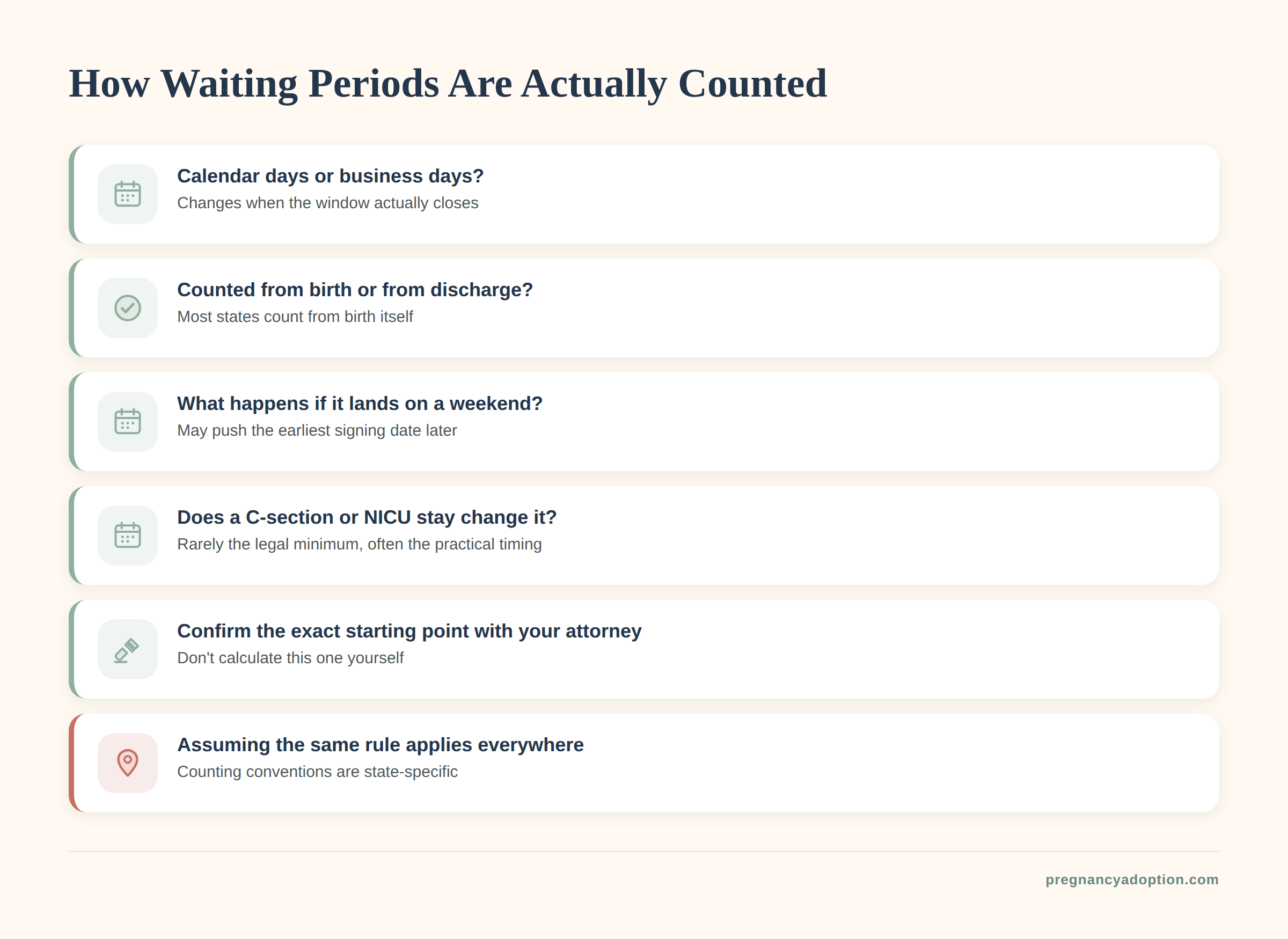
Calendar Days vs. Business Days
Does a state’s waiting period count weekends and holidays?
This depends entirely on how a specific state’s statute is written — some count calendar days (every day counts, weekends included), while others count only business days, which can meaningfully change when the window actually closes, especially around a holiday weekend. This single distinction is one of the most common sources of confusion and is worth confirming explicitly with an attorney rather than assuming either convention applies.
If a waiting period ends on a weekend or holiday, what typically happens?
Practices vary — some jurisdictions push the earliest signing date to the next business day if a required court or notary office isn’t open, while others allow signing on the calculated date regardless of day of week if a notary is privately available. This is a detail worth asking an attorney about ahead of time rather than discovering it on the day itself.
From Birth, or From Discharge?
Does the waiting period start at the moment of birth, or when the birth parent leaves the hospital?
In most states the clock is measured from the time of birth itself, not from hospital discharge — but this is exactly the kind of detail that varies and should never be assumed.
Does an early discharge or an extended hospital stay change the calculation?
Generally not, if the state’s statute measures from birth — but a longer stay (discussed further in the next section) can still affect when signing is practically convenient to arrange, even if it doesn’t change the legal starting point.
| Counting convention | Example effect, illustrative only | Why it matters |
|---|---|---|
| Calendar days from birth | A state requiring “3 days” would allow signing on the 4th calendar day after birth, weekends included | The most straightforward convention, but not universal |
| Business days from birth | The same “3 days” requirement could take longer in real time if it falls across a weekend | Can shift the earliest possible date later than a calendar-day count would suggest |
| From birth vs. from discharge | A multi-day hospital stay could matter for practical scheduling, even where it doesn’t change the legal start point | Confusing these two starting points is a common source of miscalculation |
| Weekend/holiday landing on the calculated date | May push the earliest practical signing date to the next business day if a required notary or court office is closed | A legal date and a practically available date aren’t always the same day |
What Can Extend or Complicate the Standard Window
Medical Recovery Situations
Does a C-section delivery change the waiting period?
The legal minimum itself generally doesn’t change based on delivery method, but practical readiness to sign — understanding and voluntarily consenting to a serious legal document — can be affected by a longer or more difficult recovery, and a signing can typically be delayed until the birth parent is genuinely ready, not just legally eligible.
What if the baby needs a NICU stay after birth?
A NICU stay doesn’t typically change the birth mother’s own legal waiting period (since it’s generally about her readiness, not the baby’s location), but it does commonly affect the practical logistics and emotional context around when a family actually wants to proceed with signing — this is a good specific scenario to raise directly with an attorney and agency early in planning.
Multiples, Complications, and Other Practical Factors
Does having twins or multiples change anything about the waiting period?
Not the statutory minimum itself in most cases, though the practical and emotional weight of the decision, and sometimes the logistics of separate or joint consent documents, can add complexity worth discussing directly with an attorney well before the delivery.
Can a hospital or agency’s own internal policies add time beyond the state’s legal minimum?
Yes — a specific hospital, agency, or attorney’s office may have its own scheduling practices or internal comfort-level policies that add practical time beyond the bare legal minimum, which is a separate thing from the law itself and worth asking about directly rather than assuming the legal minimum is also the practical timeline.
What Actually Happens at a Consent Signing

Before You Sign Anything
What review typically happens right before signing?
An independent attorney — ideally one representing the birth parent specifically, not one provided or paid for solely by the adoptive family or agency, where that distinction is available in your state — should walk through the actual document with you in plain language, confirming you understand exactly what it does, before you’re asked to sign it. This is the same signing-day step covered briefly as part of the wider process in our step-by-step guide to placing a baby for adoption, which this article expands on in much greater depth.
Is it normal to still have questions right up until the moment of signing?
Completely normal — a good attorney or counselor expects this and should welcome last-minute questions rather than rushing past them. If a professional seems impatient with final questions on a decision this significant, that’s worth naming directly rather than pushing through discomfort.
The Signing Itself
What does the physical act of signing typically involve?
Typically: reviewing and signing the consent document itself in front of a required witness, notary, or court officer (whichever your state requires), sometimes alongside related paperwork (such as a relinquishment of specific rights or an acknowledgment of counseling received). The exact combination of documents varies by state and agency.
How long does the actual signing appointment usually take?
This varies, but it’s rarely a rushed, five-minute event — most attorneys and agencies build in time for a final review and any last questions, which is appropriate given what’s being decided.
Who Needs to Be Present or Involved
Required Participants
Who is legally required to be present at a signing?
At minimum, the birth parent signing and whoever your state requires to witness or certify the signature — a notary, a judge, or another court officer, depending on the state.
Is the adoptive family typically present at the signing?
This varies by personal preference and agency practice as much as by law — some birth parents prefer the adoptive family present as part of an open, shared moment, while others prefer a private signing with just their attorney and the required witness. Neither approach is more “correct”; it’s a personal decision worth discussing ahead of time with whoever is coordinating the plan.
Optional but Common Support
Can a birth parent bring a support person who isn’t otherwise part of the process?
In most cases, yes — a trusted friend, family member, or counselor accompanying a birth parent for emotional support is generally welcomed by agencies and attorneys, though it’s worth confirming ahead of time if the setting (such as a courtroom) has specific access rules.
Is a counselor or social worker typically involved in the signing appointment itself?
Sometimes, particularly if a state requires counseling as part of the consent process or if the agency’s practice includes it — but this is separate from the legal witnessing requirement and varies by state and agency. Choosing an agency whose practices around this feel comfortable and transparent is worth factoring into agency selection; see our guide to choosing an adoption agency for that broader decision.
| Factor | Typically changes the legal minimum? | Typically changes practical timing? |
|---|---|---|
| Weekend or holiday at the end of the window | Rarely | Often — notary/court availability |
| C-section or difficult recovery | Rarely | Sometimes — readiness to sign |
| Baby in the NICU | Rarely | Sometimes — logistics and emotional timing |
| Multiples / twins | Rarely | Sometimes — document complexity |
| Interstate placement (ICPC involved) | No, but adds a separate process | Often — see the ICPC section below |
| Agency or attorney’s internal scheduling practice | No — not a legal factor | Often — a practical add-on to the legal minimum |
Hospital, Attorney Office, or Courthouse: Where Signing Happens
Common Locations
Does signing always happen at the hospital?
Not always — depending on your state’s requirements and the specific professionals involved, signing might happen at the hospital before discharge, at an attorney’s office sometime after discharge, or in some states, before a judge at a courthouse.
Does it matter which location is used?
Mainly for logistics and comfort rather than legal validity, as long as your state’s specific witnessing requirement is met wherever it happens — some birth parents prefer the distance and formality of an attorney’s office over signing at the hospital so soon after delivery, while others prefer the convenience of not having to travel again.
If Travel Is Involved
What if the birth parent needs to travel for the signing?
This is worth planning for in advance with your attorney or agency, including who covers any associated costs — lawful pregnancy-related expense support in many states can include reasonable costs connected to the adoption plan, though the specifics are state-variable and worth confirming directly.
Can signing happen remotely or electronically in some states?
Some states have adopted remote notarization or electronic signing options in limited circumstances, though this is an evolving area and far from universal — confirm directly with your attorney whether it’s an option where you are, rather than assuming it is or isn’t.
If You’re Not Ready When the Minimum Passes
There’s No Requirement to Sign Immediately
Does a birth parent have to sign the moment the minimum waiting period ends?
No — the waiting period is a floor, not a deadline. Reaching the minimum simply means signing is now legally possible; it doesn’t create any obligation to do so on that exact day, and taking more time is entirely reasonable.
What if more time is needed to feel genuinely ready?
Taking that time is appropriate and expected — a good attorney or agency will support a birth parent moving at the pace that feels right, rather than pushing toward a specific date. If any professional seems to be pressuring a faster timeline than feels right, that’s worth raising directly or seeking a second opinion.
Changing Course Before Signing
What happens if a birth parent decides not to sign at all?
Nothing is legally finalized until consent is actually signed — deciding to parent instead, at any point before signing, doesn’t require a separate “cancellation” document, since no binding legal step has yet occurred.
Does backing out before signing affect any support already received?
This depends on your state’s specific rules about lawful pregnancy-related expense support and is worth understanding in advance directly from your attorney, since approaches vary and this is not an area to guess about.
After Signing: The Revocation Window, Briefly
Why This Section Stays Brief
Why doesn’t this guide cover revocation in depth here?
Because our birth mother rights guide already covers revocation-window categories and the narrow legal grounds to contest a signed consent in full depth, and repeating that here would duplicate rather than add to it. This section exists only to flag that the question exists and point you to where the depth lives.
What’s the one thing worth knowing about revocation before signing day, even briefly?
Whether your specific state provides any window to change your mind after signing — and if so, how long it is — is one of the single most important facts to know cold, from your own attorney, before signing day, not learned afterward if it turns out to matter.
Where to Get the Full Picture
Where should someone go for the complete revocation-window breakdown?
Our birth mother rights guide is the right next stop, with its full illustrative-categories table and FAQ coverage of revocation specifically.
Should this question be asked before or after signing?
Before — ideally well before, as part of the same pre-signing conversation with your attorney covered earlier in this guide, not as an afterthought once the document is already signed.
Interstate Situations and the ICPC
What the ICPC Is
What is the ICPC, and when does it apply?
The Interstate Compact on the Placement of Children (ICPC) is an agreement among all states governing placements where a child is being adopted by a family living in a different state than where the child was born. It doesn’t change the birth parent’s own consent timing, but it adds a separate approval process before the adoptive family can legally bring the baby across state lines.
Does the ICPC delay when a birth parent can sign consent?
No — consent timing is governed by the birth state’s own waiting-period rules, independent of the ICPC. What the ICPC affects is how soon after signing the adoptive family can legally travel home with the baby, which is a separate timeline worth understanding if your plan involves a family from another state.
What This Means Practically
How long does ICPC approval typically take?
This varies by the specific states involved and current processing volume, commonly taking anywhere from several days to a few weeks — your attorney or agency can give a more specific estimate based on the particular states in your situation.
Does an interstate placement change anything about where or how signing itself happens?
Not typically — signing still happens according to the birth state’s own rules and location practices covered earlier in this guide. The ICPC process begins after signing and consent, as a separate, subsequent step. For the father’s-side consent and notice questions that can also come up in an interstate plan, see our birth father rights guide.
How to Find Your Own State’s Specific Rules

Primary Sources Worth Starting With
What’s the most reliable starting point for a specific state’s actual statute?
Child Welfare Information Gateway’s State Statutes Search is a commonly used, regularly updated starting point for locating a specific state’s adoption consent and waiting-period statutes directly, rather than relying on a number repeated secondhand across unrelated websites.
Is a government source alone enough to rely on?
It’s an excellent starting point, but statutes can be dense, cross-referenced, and subject to amendment — confirming your reading of a specific statute with a licensed attorney in your state remains the necessary final step before relying on any number for an actual decision.
Getting a Confirmed, Personalized Answer
How does someone find a qualified adoption attorney if they don’t already have one?
A state bar association’s lawyer referral service, a reputable adoption agency’s attorney network, or a recommendation from a trusted adoption professional are all reasonable starting points for finding attorney representation specifically in adoption law.
Is it worth asking an agency directly instead of researching independently first?
Both are useful and not mutually exclusive — an agency can often give a quick practical answer, but independent confirmation through your own attorney (ideally one representing only your interests, not the adoptive family’s or agency’s) remains the most reliable final step before signing anything.
Common Misunderstandings About Timing
Misunderstandings About the Minimum
Myth: A shorter waiting period means less time to decide.
Not accurate — the waiting period is a legal floor for when consent *can* be signed, not a deadline for making a final decision. Taking more time than the legal minimum, for as long as actually needed, is always an option, as covered earlier in this guide.
Myth: Everyone involved can agree to sign earlier than the state minimum if everyone’s ready.
Not accurate — the minimum is a statutory floor, not a default that can be shortened by mutual agreement, however ready everyone feels. No professional should suggest otherwise.
Misunderstandings About What Changes the Timeline
Myth: A verbal agreement or hospital plan made before birth locks in a timeline.
Not accurate — nothing agreed to, said, or written before birth is a binding legal consent, and it has no effect on when actual legal consent can be signed, which can only happen after birth under every state’s law.
Myth: Once the waiting period passes, the adoption is automatically finalized.
Not accurate — signing consent (once the minimum has passed) is a significant step, but it’s followed by a revocation window (if applicable) and a separate court finalization process later, not an instant, final outcome.
Questions to Ask Your Attorney Before Signing Day
Timing-Specific Questions
What’s the single most important timing question to ask before signing day?
The exact length of your specific state’s post-birth waiting period and, separately, its revocation window (if any) — both as exact numbers, not general ranges, confirmed directly for your situation.
What other timing-related questions are worth asking?
Whether your state counts calendar or business days, whether the window is measured from birth or discharge, what happens if the calculated date falls on a weekend or holiday, and whether any of the complicating factors discussed earlier in this guide apply to your specific situation.
Process Questions
What logistics questions are worth asking ahead of time?
Where signing will happen, who is legally required to be present, what documents will be signed, and how long the appointment is expected to take — all covered in general terms earlier in this guide, but worth confirming specifically for your plan.
What should happen if an answer from an agency or attorney seems to conflict with something read elsewhere?
Raise the discrepancy directly rather than assuming either source is automatically correct — laws change, and a good attorney will welcome the question rather than being defensive about it.
A Simple Preparation Checklist
Before Delivery
What’s worth confirming well before the due date?
Your specific state’s waiting-period length, revocation-window length (if any), whether your state requires calendar or business days, and where signing is expected to take place — all directly from your own independent attorney.
What’s worth discussing with your support network in advance?
Who you want present (or not present) at signing, and any practical logistics like travel or time off that might be needed once the date approaches.
Around the Time of Signing
What’s worth doing in the days immediately before signing?
A final review conversation with your attorney, confirming you still feel ready, and asking any remaining questions — there’s no such thing as too late to ask a genuine question before signing.
What’s worth knowing is true even after signing?
Whether your state’s revocation window (if any) is still open, and exactly how to exercise it if you need to — information that should already be clear from your pre-signing conversation, not something to figure out under pressure afterward.
Glossary of Terms Used in This Guide
Timing and Process Terms
Post-birth waiting period
The minimum amount of time, set by state law, that must pass after birth before adoption consent can be legally signed.
Revocation window
A further period after signing, provided in some but not all states, during which a birth parent may still legally withdraw consent.
ICPC (Interstate Compact on the Placement of Children)
An agreement among all states governing approval for an adoptive placement crossing state lines, separate from the birth parent’s own consent timing.
Signing-Related Terms
Witnessing / notarization
The formal certification of a signature by a notary, judge, or other authorized officer, required in every state in some form to make consent legally valid.
Independent counsel
An attorney representing only the birth parent’s interests, as distinct from one provided or paid for by the adoptive family or agency.
Frequently Asked Questions
Getting Started
Is there any state where a birth mother can sign adoption papers before the baby is born?
No — this is the one universal rule across all 50 states, with no exceptions regardless of how settled a plan feels beforehand.
Where can I find my own state’s exact waiting-period number?
Start with Child Welfare Information Gateway’s State Statutes Search, then confirm your reading with a licensed adoption attorney in your state, as covered in the dedicated section of this guide above.
Timing Specifics
Does the waiting period count the day of birth itself as day one?
This varies by state’s specific statutory language and is worth confirming directly rather than assuming — some statutes count the day of birth, others start counting the following day.
If I’m not ready when the minimum passes, do I lose the chance to place the baby for adoption later?
No — reaching the minimum simply opens the window for signing to become legally possible; there’s no deadline by which you must sign or lose the option, as covered earlier in this guide.
Counting and Calculation
Does my state count the day of birth as “day zero” or “day one”?
This is exactly the kind of statutory-language detail that varies by state and is easy to get wrong by assumption — confirm it directly with an attorney using your state’s actual statute text rather than a general rule of thumb.
If my state’s minimum is measured in calendar days, does that include the day I’m actually signing?
This depends on how the specific statute phrases the calculation — “at least X days after birth” is sometimes interpreted differently than “on or after the Xth day” — another reason to have your attorney confirm the exact earliest legally valid date rather than calculating it yourself from a general description.
Is there a nationwide standard waiting-period length I can use as a rough guide?
No single number applies nationwide, which is exactly why this guide doesn’t state one — lengths vary meaningfully by state, and using any single number as even a rough guide risks being meaningfully wrong for your specific situation.
The Signing Appointment Itself
Can a birth parent back out in the middle of the signing appointment, after starting to sign?
Until a document is actually, fully executed according to your state’s requirements, nothing is legally binding — stopping partway through, for any reason, is always an option, and a professional present should respect that without pressure to continue.
What if I realize during the appointment that I don’t fully understand something in the document?
Stop and ask — this is exactly the moment the pre-signing attorney review exists for, and signing something you don’t fully understand is never advisable regardless of how far along the appointment is or how it might feel to pause.
Is it normal to feel emotional during the actual signing?
Completely normal — this is one of the most significant moments in the entire process, and a wide range of emotional responses, including ones that shift during the appointment itself, are expected rather than unusual.
How soon after signing does the adoptive family typically take the baby home?
This varies by state, by whether a revocation window applies and how it’s structured, and by whether an interstate ICPC process is involved — your attorney can give a specific timeline estimate based on your exact circumstances rather than a general answer.
Agencies, Attorneys, and Professionals
Can an agency require a specific attorney for the birth parent to use?
Practices vary, but independent representation — an attorney whose only obligation is to the birth parent’s own interests — is generally considered the stronger standard, and a birth parent can typically request or seek out their own attorney even if an agency has a preferred referral.
What if I can’t afford an attorney for this process?
In many adoption plans, reasonable attorney fees for independent legal representation of the birth parent are covered as part of lawful adoption-related expenses — ask directly and in writing about this rather than assuming it isn’t available, and a legal aid organization or state bar referral service can also help locate representation regardless of ability to pay directly.
Can I change attorneys if the relationship isn’t working for me?
Yes, at any point before signing, and discuss the specifics of timing with a new attorney directly if this becomes relevant close to a planned signing date.
Interstate and Special Situations
Does the ICPC apply if the adoptive family lives in the same state as the birth?
No — the ICPC specifically governs placements crossing state lines; an in-state adoption doesn’t trigger this separate process.
What happens if the adoptive family wants to travel home before ICPC approval comes through?
They generally cannot legally do so until approval is granted — this is exactly the kind of timing detail that should be planned for in advance with an attorney familiar with interstate placements, since it affects the adoptive family’s side of the timeline directly.
Does tribal affiliation change anything about consent timing covered in this guide?
Potentially, yes — the Indian Child Welfare Act (ICWA) can add distinct consent-execution and placement-preference requirements in situations where it applies; our adoption consent laws guide covers this in more depth, and an attorney with specific ICWA experience should be involved if it’s relevant to your situation.
Does a birth parent’s age (if a minor) change any of the timing covered in this guide?
It can — many states apply additional procedural protections for a minor birth parent, such as requiring a guardian ad litem or specific judicial involvement, which can affect the signing process though not necessarily the underlying waiting-period length itself. An attorney should address this specifically if it applies.
Reassurance
Is it normal to feel anxious about getting the timing exactly right?
Very normal, and also not something you need to track alone — this is precisely what an attorney’s role includes, confirming every date and requirement specific to your situation so you don’t have to calculate it yourself under pressure.
Where should I go next if a question about my own specific state or situation isn’t answered here?
A licensed adoption attorney in your state remains the right next step for anything specific to your exact circumstances — this guide is designed to help you understand the shape of the question and ask it well, not to replace that direct, personalized confirmation.
Comparing This Topic to Related Guides
How is this guide different from the site’s birth mother rights guide?
Our birth mother rights guide covers the complete picture of a birth mother’s rights throughout the process — choice of family, privacy, lawful support, the full illustrative waiting-period and revocation categories, and grounds to contest consent. This guide focuses narrowly on the timing mechanics and practical signing-day experience that guide doesn’t go deep on.
How is this guide different from the site’s adoption consent laws guide?
Our adoption consent laws guide covers what makes consent legally valid, who else must consent (including a father’s rights and ICWA situations), and a broader legal framework. This guide is specifically about timing — when signing can happen and what that day looks like in practice.
How is this guide different from the site’s adoption process guide?
Our adoption process guide walks through the entire adoption timeline from beginning to end as one step among many. This guide zooms in specifically on the consent-signing moment and the timing questions around it, in much greater depth than a single step in a broader process guide could cover.
Practical Scenarios
What if the birth parent lives in a different state than where the birth takes place?
Generally, the waiting-period and signing rules of the state where the birth actually occurs apply, not the birth parent’s home state — but this can involve additional complexity worth discussing directly with an attorney familiar with both states if it applies to your situation.
What if the adoptive family changes during the waiting period, before signing?
Since nothing is legally finalized until consent is signed, a birth parent retains the right to change the adoptive family selection at any point before signing — this is a significant decision worth discussing with your attorney and counselor if it comes up.
What if labor and delivery don’t go as planned — does that affect any of the timing covered here?
The legal waiting period itself is generally unaffected by how delivery unfolds, but practical readiness to sign, as covered earlier in this guide, absolutely can be — there’s no requirement to rush toward a signing date because of how the birth itself went.
After the Fact
If I already signed consent and now have questions about what comes next, is this the right guide?
This guide focuses mainly on the period leading up to and including signing; our birth mother rights guide is the better next stop for questions about what happens after signing, including revocation and finalization.
Does anything in this guide apply retroactively if I signed consent years ago?
No — this guide describes current, general timing patterns relevant to someone currently considering or approaching an adoption plan, not a resource for reopening or reassessing a consent signed long ago; a past adoption-related legal question is best directed to an attorney with that specific context.
One Last Set of Practical Questions
Is it possible for a state to have no waiting period at all?
States vary considerably in how they structure this requirement, and the specific details for any state should always be confirmed directly rather than assumed — this is exactly the kind of fact worth getting from a primary source, as covered in the dedicated section of this guide above.
Can the waiting period be waived by a judge in unusual circumstances?
Some states may allow limited judicial discretion in specific circumstances, though this is not universal and far from guaranteed — an attorney can address whether this is a realistic option in your state and situation.
Does signing consent for one child set any precedent for a future pregnancy or adoption plan?
No — each adoption plan and each state’s consent process is independent; a past signing doesn’t create any binding pattern or precedent for a future, separate situation.
Is there anything about this entire topic that’s genuinely urgent to figure out immediately?
Not in the sense of needing to rush — the one thing worth treating with real priority is starting the conversation with an independent attorney early, ideally well before your due date, so that by the time any waiting period actually begins, every timing question covered in this guide already has a confirmed, specific answer rather than being figured out under pressure.
The Adoptive Family’s Side of Timing
Does the adoptive family have any legal role in the birth parent’s waiting period itself?
No — the waiting period belongs entirely to the birth parent as the person whose consent is being given; the adoptive family doesn’t have a legal role in shortening, extending, or waiving it, however eager or supportive they may be.
How should an adoptive family handle the uncertainty of not knowing the exact signing date in advance?
Patience and flexibility are generally expected and appropriate — a reputable agency or attorney will set realistic expectations with an adoptive family about this uncertainty well before placement, since pressuring a birth parent toward a specific date is both inappropriate and, in many cases, against professional and legal standards.
Is it appropriate for an adoptive family to ask directly about the expected timeline?
Asking an agency or attorney for a general, realistic range is reasonable; pressuring the birth parent directly about timing is not, and a professional agency or attorney should help manage this boundary appropriately on both sides.
Counseling and Emotional Support
Is counseling required before signing in every state?
Not universally — some states require or strongly encourage counseling as part of the consent process, while others don’t mandate it, though many agencies offer or encourage it regardless of whether it’s a strict legal requirement.
Does counseling before signing affect the legal timing covered in this guide?
Generally not directly — counseling and the legal waiting period are typically separate requirements that can run concurrently, though a specific state’s process may sequence them in a particular way worth confirming with your attorney or agency.
Where can someone find counseling support specifically focused on adoption decisions?
Many adoption agencies provide or connect birth parents with adoption-competent counselors as a standard part of their services; asking directly during agency selection, as covered in our guide to choosing an adoption agency, is a reasonable way to confirm what’s available.
Documentation and Records
What happens to the signed consent document after the appointment?
It typically becomes part of the official court record supporting the later adoption finalization, with copies retained by the relevant attorneys, agency, and court, depending on your state’s specific record-keeping practices.
Does the birth parent keep a copy of what they signed?
In most cases, yes — receiving a copy of what you’ve signed is a reasonable and common practice, and it’s worth confirming directly that you’ll receive one if it isn’t offered automatically.
Are adoption consent records ever sealed, and does that affect anything covered in this guide?
Many states seal adoption records to some degree after finalization, which is a separate topic from the signing-day timing this guide covers — it mainly becomes relevant much later, in contexts like adult-adoptee record access, which is outside this guide’s scope.
When Plans Change
What if the birth parent decides on a different adoptive family after already meeting with one?
Since nothing is final until signing, this kind of change, while emotionally significant, doesn’t require any legal “undoing” — it’s a continuation of an still-open decision rather than a reversal of a completed one.
What if a planned open adoption arrangement is still being negotiated close to the expected signing date?
This is worth resolving with your attorney before signing day if possible, since post-adoption contact agreements are sometimes handled as separate documents with their own state-specific enforceability rules — raising this with your attorney well in advance avoids last-minute pressure on an already significant day.
Does a change in the adoptive family’s circumstances close to the due date affect the birth parent’s timing?
Not directly — the birth parent’s own waiting period and readiness remain the controlling factors; a change on the adoptive family’s side is a separate matter to be addressed by the agency or attorneys involved, not something that should pressure the birth parent’s own timeline.
Financial and Expense-Related Questions
Does receiving pregnancy-related expense support before signing affect my legal ability to change my mind?
In most states, lawful pregnancy-related expense support is not treated as a binding condition on the final decision — but exact rules vary by state, and understanding this clearly, in writing, from your attorney before accepting any support is an important step, not an afterthought.
What’s generally considered lawful adoption-related expense support?
Many states allow reasonable support for pregnancy-related medical care, counseling, and sometimes living and legal expenses connected to the adoption plan — the specific categories and limits are state-variable and worth understanding clearly and in writing well before signing day.
Who typically pays for the attorney representing the birth parent?
In many adoption plans, the adoptive family or agency covers reasonable attorney fees for the birth parent’s independent representation as part of lawful adoption expenses — confirm this directly and in writing early in the process rather than assuming either way.
Timing Relative to Other Life Events
Does an upcoming move to a different state affect the timing covered in this guide?
Potentially — if a move affects which state’s law governs the birth and placement, this is worth raising directly and early with your attorney, since it can meaningfully affect both the waiting-period rules and whether the ICPC applies.
Does a birth parent’s existing custody situation with other children affect adoption-consent timing?
Not typically the timing itself, though it can be a relevant and important part of the broader conversation with your attorney and counselor about the overall plan and its implications.
If I’m also considering parenting, does exploring adoption at all commit me to anything on a timeline?
No — exploring adoption as an option, including meeting with agencies or attorneys, creates no binding obligation or timeline; nothing becomes legally binding until consent is actually signed after birth, as covered throughout this guide.
A Few More Reassurance Questions
Is it okay to ask the same timing question to more than one attorney if I want to be sure?
Yes — getting a confirmed answer you feel confident in matters more than asking only once, and a good attorney won’t be bothered by a client wanting to be sure about something this significant.
What if different sources (a website, an agency, an attorney) give me slightly different answers about timing?
Raise the discrepancy directly with your attorney and ask them to confirm against the actual current statute — laws do change, sources can be outdated, and your attorney’s direct confirmation is the version to rely on for an actual decision.
Is it normal to want to understand every detail covered in this guide before feeling ready to move forward?
Completely reasonable — this is a significant, largely irreversible legal process, and wanting a clear, confirmed understanding of the timing involved before proceeding reflects good judgment, not overthinking.
Specific Hospital and Delivery Scenarios
Does a premature birth change anything about the waiting period calculation?
The legal starting point is generally still the moment of birth itself, regardless of gestational age at delivery — but a premature birth often means a longer hospital stay and recovery, which can affect practical readiness even if it doesn’t change the legal minimum.
What if the birth parent is transferred to a different hospital or even a different state during labor or shortly after?
This kind of situation is uncommon but not unheard of, and it’s worth having a contingency conversation with your attorney about in advance if there’s any known risk of it — generally, the state where the birth actually occurs remains the relevant one for the waiting period calculation.
Does a home birth versus a hospital birth change the waiting-period calculation?
The underlying statutory minimum doesn’t generally depend on delivery setting, though practical logistics — such as where a notary or required witness can meet you — can differ meaningfully and are worth planning for in advance if a home birth is part of your plan.
If the Birth Parent and Birth Father Disagree
Does this guide’s timing information apply the same way to a birth father’s consent, if his is required?
Not necessarily the same timing in every respect — a birth father’s consent process can involve additional steps like establishing paternity or responding to formal notice, covered in depth in our birth father rights guide rather than repeated here.
What happens if a birth mother wants to proceed with an adoption plan but the birth father objects?
This is a significant, state-variable legal situation that goes well beyond the timing scope of this guide — our birth father rights guide covers how a father’s objection is handled and what legal standards apply, and an attorney experienced in contested situations should be involved promptly if this applies to you.
Does an unresolved disagreement between birth parents delay the waiting period itself?
The waiting period itself is generally unaffected, since it governs the birth mother’s own consent timing — but an unresolved disagreement can absolutely affect the broader timeline and outcome of the adoption plan as a whole, and should be addressed with your attorney as early as possible rather than close to a planned signing date.
Technology and Remote Processes
If remote notarization is available in my state, does the waiting period calculation change?
No — remote or electronic signing options, where available, generally affect how and where signing happens, not when it can first legally happen; the underlying waiting-period minimum remains governed by the same state rules either way.
Is a video call with an attorney a substitute for an in-person pre-signing review?
In many cases a video consultation is a perfectly reasonable way to conduct the pre-signing review itself, though the final signing and witnessing requirements still need to meet your state’s specific in-person or notarization standards.
Putting It All Together
If I take away only a few things from this entire guide, what should they be?
First, consent can never be signed before birth, with no exceptions. Second, your exact waiting period and revocation window are state-specific and should come from a direct, confirmed source — never a general guide like this one. Third, reaching the legal minimum doesn’t create any obligation to sign immediately; taking the time you actually need is always appropriate.
What’s the single most useful action to take after reading this guide?
Scheduling time with an independent adoption attorney, specifically to walk through your own state’s waiting-period length, revocation-window length, and the practical signing-day logistics covered throughout this guide — turning general understanding into a confirmed, personal plan.
Confirming Information Over Time
How often do state waiting-period laws actually change?
Not frequently, but it does happen — state legislatures periodically revisit adoption law, which is exactly why this guide avoids stating specific numbers that could become outdated, and why confirming current law directly (rather than relying on an older source, including this one after enough time has passed) matters.
If I read a specific state’s waiting period in a different article or book, should I trust it?
Treat it as a starting point to verify, not a final answer — cross-check it against Child Welfare Information Gateway’s current statute search and confirm with an attorney, since even well-intentioned secondary sources can be outdated or imprecise.
Is social media or an online adoption forum a reliable place to learn a specific state’s timing rules?
Personal experiences shared there can be informative for emotional context and general expectations, but they’re not a reliable substitute for a verified legal answer, since individual experiences can reflect an outdated law, a misunderstanding, or a situation with unusual circumstances that don’t generalize.
A Few More Scenario Questions
What if I’m placing more than one child (such as in a subsequent pregnancy) — does prior experience change the current timing?
No — each pregnancy and adoption plan is legally independent; your state’s current waiting-period and revocation rules (confirmed fresh each time, since laws can change) apply the same way regardless of any prior adoption experience.
Does military deployment of a parent affect any of the timing discussed in this guide?
This can introduce real complexity, particularly around notice to a deployed birth father, and is worth raising specifically and early with an attorney experienced in this exact scenario rather than assuming standard timing rules apply without modification.
What if the birth parent is incarcerated during the relevant timeframe?
This is a specific, legally complex scenario requiring direct attorney guidance on how your state handles consent logistics and any required accommodations — general guidance isn’t a reliable substitute for this situation.
Does immigration status affect any of the timing or process covered in this guide?
Immigration status doesn’t generally affect the adoption-consent timing rules themselves, but it can intersect with other parts of an adoption plan in ways worth discussing directly with an attorney if relevant to your situation.
Final Practical Notes
Should this guide be read once, or revisited closer to the actual due date?
Revisiting it closer to your due date, after you’ve already had an initial conversation with an attorney, can help the specific details feel more concrete and less abstract — many people find a second read more useful once their own state’s specific numbers are already confirmed.
Is there a risk in learning too much about this topic before talking to a professional?
Not really — arriving at an attorney or counselor conversation with informed, specific questions (like the ones throughout this guide) tends to make that conversation more useful, not less, as long as the general information here isn’t mistaken for your own state’s confirmed answer.
A Closing Set of Questions on Confidence and Control
Does understanding all of this timing information mean I have to make a final decision right now?
No — understanding the timing mechanics is separate from the underlying decision itself, and you can take in all of this information while still genuinely undecided; many people research the process thoroughly before, during, and even after deciding, at whatever pace feels right.
Who ultimately controls the pace of this entire process?
Within the bounds of your state’s legal minimums, the birth parent retains significant control over pace — nothing becomes legally binding until consent is signed, and a good attorney and agency should support, not override, your own sense of readiness throughout.
What if I feel like I’m being rushed by someone involved in this process?
That feeling is worth naming directly and immediately, either to your independent attorney or, if needed, to a different attorney entirely — no one involved in a lawful adoption plan should be pressuring you toward a faster timeline than feels right, and a professional who does so is not acting appropriately.
Is it okay to pause the entire planning process at any point, not just around the signing date specifically?
Yes — at any stage before consent is signed, pausing to reconsider, take more time, or even step back from the adoption plan entirely is within your rights, and a reputable agency or attorney will respect that without pressure.
Understanding “High Intent” Questions Like This One
Why does this specific question (“when can a birth mother sign”) tend to come up so close to an actual decision point, rather than earlier in someone’s research?
It’s often one of the last concrete, practical questions someone wants answered once they’ve already done the broader thinking about whether adoption is the right path — which is part of why this guide pairs the timing mechanics with direct next steps (finding an attorney, confirming your specific state) rather than leaving it at a purely informational level.
If someone is just starting to consider adoption and found this guide first, is this the right starting point?
Not quite — our guide to being pregnant and considering adoption is the better starting point for someone earlier in the decision process, with this guide better suited to someone who has already moved toward an adoption plan and wants to understand the signing mechanics specifically.
Does reading this guide mean someone has already decided to place a baby for adoption?
Not at all — understanding how a process works doesn’t require having decided to go through with it; informed research at any stage of considering adoption is a reasonable and common approach.
A Few Remaining Logistics Questions
Does the waiting period length differ between a private (independent) adoption and an agency adoption?
The underlying statutory waiting-period minimum is generally set by state law regardless of whether an agency or independent attorney is facilitating the adoption — but procedural details and practical timelines can still differ by path, which is worth discussing directly with whichever professional is coordinating your specific plan.
If an agency is involved, do they handle scheduling the actual signing appointment?
Typically yes, in coordination with the attorney — an agency’s caseworker or coordinator commonly handles logistics like scheduling, location, and who needs to be present, while the attorney handles the legal review and document itself.
What if no agency is involved and it’s a fully independent, attorney-only adoption?
In this structure, the attorney (or attorneys, if both sides have separate representation) typically coordinates the signing logistics directly, without a separate agency caseworker involved — the same underlying legal timing rules still apply either way.
Is there a cost specifically associated with the signing appointment itself, separate from overall legal fees?
Usually the signing itself is included within overall attorney or agency fees rather than billed as a separate line item, though notary fees or court filing fees (where applicable) may apply — confirm the specific fee structure with your attorney or agency in advance.
Last Clarifications
Does this guide apply to a stepparent adoption or relative adoption the same way it applies to a newborn infant placement?
Not necessarily in the same way — this guide focuses specifically on newborn infant adoption consent timing, which is the context most of this site’s content addresses; a stepparent, relative, or older-child adoption can involve meaningfully different consent and timing rules worth discussing with an attorney experienced in that specific type of adoption.
Does anything in this guide change if the adoption is being finalized through a religious or faith-based agency?
The underlying state legal requirements for consent timing apply the same way regardless of an agency’s religious affiliation; an agency’s own additional practices (such as required counseling) may vary by organization, which is worth asking about directly during agency selection.
Where is the best place to bookmark or return to for a quick refresher on the timing concepts in this guide?
This guide itself is designed to be revisited as a reference once you have your own state’s specific numbers confirmed — pairing the general framework here with your attorney’s specific answers is the most useful combination going into signing day.
One Final Round of Questions
Does a birth parent have to explain their reasons for choosing adoption as part of the signing process?
No — while counseling conversations may explore your decision-making as a supportive process, there’s no legal requirement to justify or explain your reasons as part of the consent document itself or the signing appointment.
Is there a standard national form used for adoption consent, or does every state have its own?
Every state has its own specific consent document and legal requirements for what it must contain — there’s no single national form, which is part of why working with an attorney licensed in the relevant state matters so much for this specific step.
If I have more questions after reading this entire guide, is that a sign I’m not ready?
Not at all — having more specific questions after a thorough general overview is a completely normal, even expected, outcome, and it’s exactly what the next conversation with an independent attorney is for.
Is it reasonable to expect a professional to answer every one of these questions clearly and without hesitation?
Yes — a qualified adoption attorney should be able to answer the timing, process, and logistics questions covered throughout this guide clearly and specifically for your state. If a professional seems vague, evasive, or unable to answer basic timing questions, that’s a reasonable signal to seek a second opinion before proceeding further.
What’s the best mindset to bring into this entire process, timing included?
Informed patience — understanding that the legal framework exists to protect your ability to make a genuinely voluntary, well-informed decision, not to rush you toward one, and that taking the time the process actually allows for is both expected and appropriate.
A Last Practical Pair
Does this guide’s framework apply the same way in U.S. territories as it does in the 50 states?
U.S. territories generally have their own specific adoption statutes, which may differ from any individual state’s approach — Child Welfare Information Gateway’s resources generally cover territories as well as states, and an attorney licensed in the relevant territory should be consulted the same way as for any state.
If I only remember one sentence from this entire guide, what should it be?
Consent can never be signed before birth, your exact waiting period and revocation window are specific to your state and should come from a confirmed, direct source, and reaching the legal minimum is the start of your options, not a deadline to act on them.
What’s the most important single action item to take away from this guide right now?
If you don’t already have an independent adoption attorney, finding one is the action worth prioritizing above everything else in this guide — every other timing question here ultimately gets its real, reliable answer through that relationship.
Does needing this much explanation mean the process itself is unreasonably complicated?
Not necessarily — the complexity mostly reflects how much legitimate state-by-state variation exists in U.S. family law generally, not that this specific process is unusually difficult compared to other significant legal decisions. Breaking it into the specific questions covered throughout this guide is meant to make it manageable rather than overwhelming.
Is there a shorter version of this entire guide worth keeping in mind on signing day itself?
Yes: confirm the exact earliest legal date with your attorney in advance, know whether your state counts calendar or business days, know your revocation window if any exists, bring your questions without hesitation, and remember that nothing about the appointment obligates you to rush.
Does any of this guide’s framework change if the pregnancy was the result of a crisis situation rather than a planned pregnancy?
The legal timing rules themselves apply the same way regardless of the circumstances of conception, though the surrounding support — counseling, legal advocacy, and connection to appropriate resources — may need to be more tailored; a counselor or attorney experienced in supporting someone through a crisis pregnancy can help ensure the broader support matches the situation, separate from the timing mechanics covered in this guide.
Is it ever appropriate to ask an agency or attorney to put a specific timing answer in writing?
Yes — asking for a written confirmation of your state’s specific waiting-period and revocation-window length, rather than relying on a verbal answer alone, is a reasonable request that a professional should be glad to provide, and it gives you something concrete to refer back to as your due date approaches.
Where should this guide fit into an overall timeline of preparing for an adoption plan?
Ideally, read early enough to shape your questions for an initial attorney consultation, then revisited again as your due date approaches once your own specific numbers are confirmed — not something to encounter for the first time in the hospital, if it can be avoided.
What’s the last thing worth saying before closing this guide out?
Whatever your state’s specific numbers turn out to be, you’re not expected to navigate this process alone — an independent attorney, a counselor, and a reputable agency, if one is involved, each exist specifically to help carry the parts of this that don’t need to rest on your shoulders alone.
Is there anything about this topic that tends to surprise people most once they’ve gone through it?
Many people report that the actual signing appointment felt calmer and more procedurally straightforward than they expected going in — the hardest part is usually the emotional weight of the decision itself, not the mechanics of the appointment, once a knowledgeable attorney has walked through everything in advance.
Does knowing all of this in advance actually make signing day easier emotionally, or only logistically?
Often both — while no amount of preparation removes the emotional weight of the moment itself, most people find that having the logistics and legal mechanics already settled frees up mental and emotional space to be present for the moment itself, rather than spending it on uncertainty about the process.
Where should someone go next after finishing this guide?
If adoption is still being explored as an option generally, our guide to being pregnant and considering adoption is a good next stop; if a plan is already underway, scheduling that independent attorney consultation discussed throughout this guide is the most useful next concrete step.
Does finishing this guide mean someone is fully prepared for signing day?
It means having a solid general framework and a strong set of questions — true readiness still comes from pairing that framework with your own attorney’s confirmed, state-specific answers, which this guide has pointed toward throughout rather than attempted to replace.
One rule is absolute everywhere: consent can’t be signed before birth. Everything else — the exact waiting period, how it’s counted, whether a revocation window applies, and what the signing day itself looks like — is state-variable and sometimes circumstance-variable, which is why this guide focuses on helping you find and confirm your own specific answers rather than offering a number that might not apply to you. Start with Child Welfare Information Gateway’s state statute search, then confirm everything with an independent attorney well before signing day.
pregnancyadoption.com/ provides independent, judgment-free information for people navigating pregnancy, parenting, and adoption decisions. Our content is reviewed for accuracy and clarity, and we link out to established legal and child-welfare authorities throughout our guides. We don't provide individualized legal, medical, or adoption-placement services directly — our goal is to help you ask better questions when you do seek that support. Learn more about our editorial approach.
This article is for general informational purposes only and does not constitute legal advice. Adoption consent, waiting-period, and revocation laws vary significantly by state and change over time. No specific state’s waiting-period length, revocation-window length, or procedural requirement is stated in this article. Always consult a licensed adoption attorney in your state before making any decision related to adoption consent. See our full disclaimer for more detail.
