A missed period paired with a negative pregnancy test is one of the more disorienting places to land — not pregnant, apparently, but also not back to normal. The good news is that this exact combination has a well-understood set of explanations, and working through them in order, rather than jumping straight to the most alarming possibility, usually gets you to a clear answer faster than another round of searching your symptoms at 1 a.m. This guide walks through how to rule pregnancy out with confidence, the full range of non-pregnancy causes worth knowing about, and exactly when a missed period is worth a call to a health care provider rather than more waiting.
Key takeaways
- A negative test before or right around a missed period is often simply too early — hCG may not have risen high enough yet, especially if ovulation happened later than usual that cycle.
- If pregnancy is confidently ruled out, the most common non-pregnancy causes are stress, significant weight change, over-exercise or under-fueling, hormonal birth control transitions, PCOS, thyroid disorders, and perimenopause.
- Missing three periods in a row, or a pattern of irregularity over several months, is the general threshold for seeing a health care provider, regardless of what any single test says.
- A missed period is a symptom your body is producing for a reason — it’s worth taking seriously as information, not just as an inconvenience to wait out.
- The uncertainty itself, before you have an answer either way, is a legitimate source of stress worth acknowledging rather than pushing through silently.
The Short Answer: A Missed Period With a Negative Test, at a Glance
A missed period but negative pregnancy test is confusing, but it usually has a clear, identifiable explanation once you rule a few things out.
| Situation | Most likely explanation |
|---|---|
| Period is only a few days late, single negative test | Testing too early, or a normal amount of cycle variation |
| Period is a week or more late, single negative test | Worth retesting with first-morning urine, or seeing a provider for a blood test |
| Period is late, multiple negative tests over several days, no other symptoms | Increasingly likely to be a true negative — a non-pregnancy cause becomes more probable |
| Periods have been irregular for months, not just this one cycle | Worth a provider visit regardless of today’s test result |
| Missed period plus symptoms like excess hair growth, acne, or hot flashes | Consider a hormonal cause (PCOS, thyroid, perimenopause) — see the relevant section below |
The Three Broad Explanations
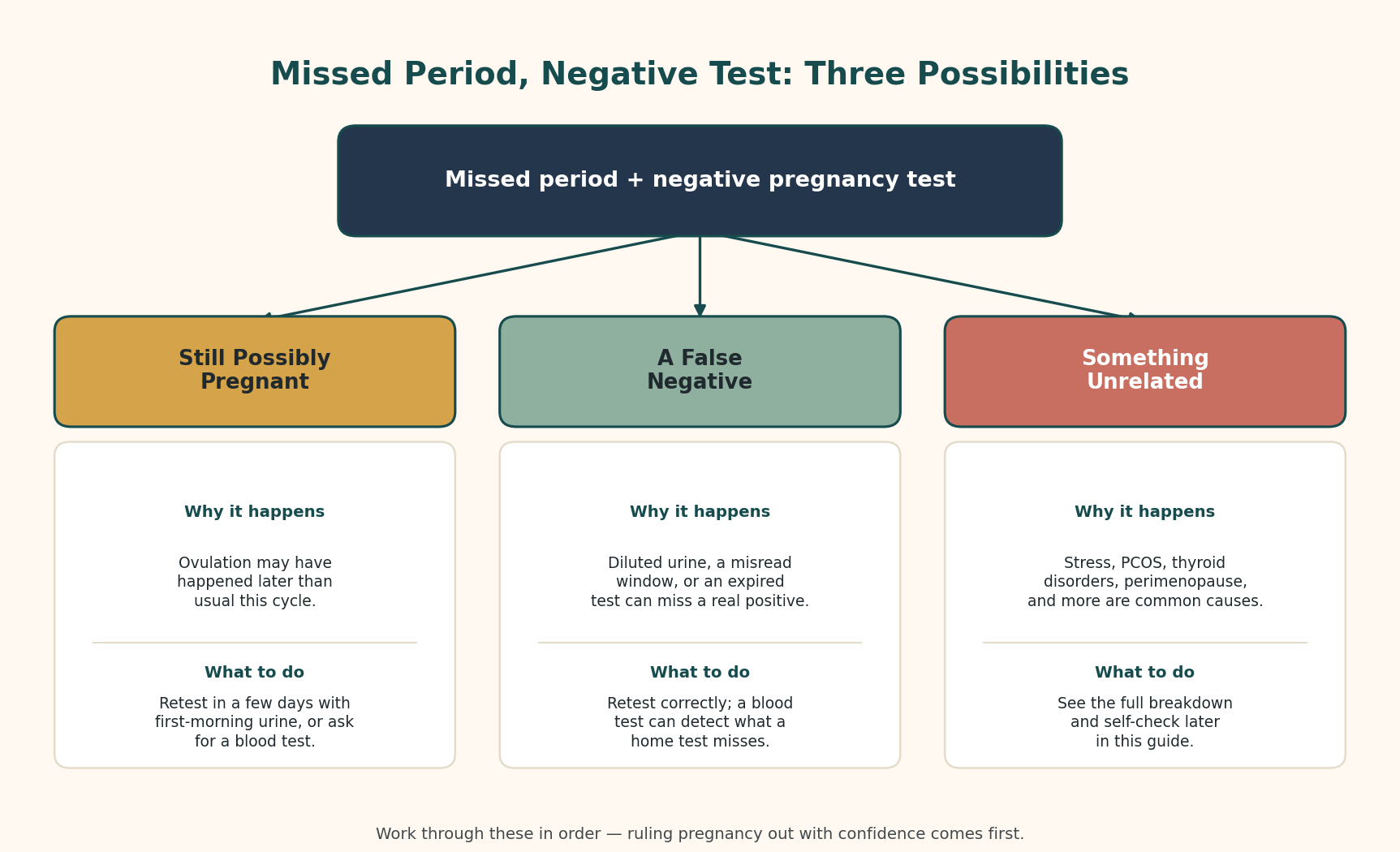
You Could Still Be Pregnant
A single negative test, especially one taken close to when a period was expected, doesn’t rule pregnancy out with complete certainty. This is the first possibility worth working through methodically before moving on to anything else.
The Test Could Be a False Negative
Even a well-timed test can occasionally miss a genuine pregnancy for reasons that have nothing to do with the test being defective — timing relative to ovulation, urine dilution, or a misread result window are the usual culprits.
Something Unrelated to Pregnancy Could Be Going On
Once pregnancy is confidently ruled out, a long list of common, well-understood conditions and circumstances can also delay or stop a period. Most are ordinary, several are easily identified with a simple conversation and a blood test, and none of them mean something is seriously wrong just because a period didn’t show up on schedule.
How to Use This Guide
Work Through It in Order
The sections below are organized the way a methodical person — or a good clinician — would actually work through this question: rule pregnancy out first, then move through non-pregnancy causes from most common and temporary to less common and more involved, then use the self-check and “when to see a doctor” sections to decide on next steps.
What This Guide Doesn’t Cover (and Where That Lives Instead)
This guide doesn’t re-explain the detailed mechanics of why early tests produce false negatives, the full day-by-day optimal-testing framework, or the absolute earliest-testing-boundary science — our full pregnancy test guide, our guide to when to take a pregnancy test, and our guide to how early you can take a pregnancy test each cover one of those in much more depth than this guide does. If your test eventually turns positive, our guide to what to do after a positive test picks up from there.
Ruling Out Pregnancy First
Before working through non-pregnancy causes, it’s worth being genuinely confident that pregnancy has been ruled out — otherwise everything that follows is built on an uncertain foundation.
Could You Simply Be Testing Too Early?
Late Ovulation Is More Common Than People Assume
Cycle-length calculators assume ovulation happens on a predictable day, but real ovulation timing shifts from cycle to cycle for most people, and more so for anyone with naturally irregular cycles. If ovulation happened later than usual, your actual conception date — and therefore your hCG timeline — is also later than a calendar-based estimate would suggest, which means a “late” period by the calendar might not be nearly as far past ovulation as it appears.
Where the Full Timing Logic Lives
Our guide to when to take a pregnancy test covers exactly how ovulation timing, luteal-phase length, and cycle irregularity change the calculation, including how to adjust your own expectations if your cycles don’t follow a textbook 28-day pattern.
Retesting the Right Way
A Few Days Matters More Than a Few Hours
If a negative result doesn’t match your expectations, retesting the same day or the next morning rarely adds new information, because hCG (if present) hasn’t had much time to change. Spacing a retest out by several days gives a genuine pregnancy time to become clearly detectable if the first test was simply too early.
Where the Full Retesting Rules Live
Our timing guide’s retesting section covers exactly how long to wait, what to do about a faint line, and when repeated testing stops being useful and a blood test becomes the more efficient next step.
When a Blood Test Settles It for Good
Why It Can Detect What a Home Test Misses
A quantitative blood test can detect meaningfully lower hCG concentrations than most home tests, which makes it a genuinely more sensitive tool in situations where a home test keeps coming back negative but suspicion remains high — a late period, symptoms, or simply wanting a definitive answer sooner.
Asking for One Isn’t “Jumping the Gun”
A provider’s office can run a blood test at essentially any point once a period is late; there’s no rule that you need to exhaust home testing first. If repeated negative home tests and a persistently missed period are creating real stress, asking for a blood test is a reasonable way to get a faster, more conclusive answer rather than continuing to buy more home tests.
If You’re Confident You’re Not Pregnant: Where to Go From Here
Once pregnancy has been reasonably ruled out — through timing, a retest, or a blood test — the question shifts from “am I pregnant” to “why did my body do this.” That’s a genuinely useful shift, because the answer is almost always identifiable.
A Missed Period Is a Symptom, Not a Diagnosis
Your Body Is Telling You Something, Even If It Isn’t Pregnancy
A period is the visible end product of a fairly complex hormonal sequence involving the brain, the ovaries, and the uterus. When any part of that sequence is disrupted — by stress, by a hormonal imbalance, by energy availability, or by a specific medical condition — a missed or delayed period is often the first outward sign, sometimes before any other symptom shows up at all.
Most Causes Below Are Common and Manageable
None of the causes covered in this guide are rare curiosities; each one affects a meaningful share of menstruating people at some point, and each has a well-established path to diagnosis and management. A missed period turning out to have an identifiable cause is the expected outcome, not an unusual one.
How the Rest of This Guide Is Organized
From Everyday and Temporary to More Involved
The sections below move roughly from the most common and usually temporary causes (stress, a single stretch of poor sleep or illness) toward causes that are more likely to need an actual diagnosis and ongoing management (PCOS, thyroid disorders, perimenopause). You don’t need to read them in order if one already sounds like your situation.
A Self-Check Table Ties It Together Near the End
After covering each cause individually, a self-check section cross-references common accompanying symptoms against the categories above, to help you narrow down which explanation is worth raising first if you do see a provider.
Everyday, Usually Temporary Causes
Stress
How Stress Actually Delays Ovulation
Significant mental or emotional stress can alter the signaling the hypothalamus sends to the rest of the reproductive system, which can delay or suppress ovulation for that cycle. Because a period depends on ovulation having occurred roughly two weeks earlier, delayed or absent ovulation shows up on the calendar as a late or missing period, even though nothing is structurally wrong.
How Long This Typically Lasts
A single stressful stretch — a demanding work period, a major life event, an acute family crisis — commonly affects just one cycle, with periods returning to their usual pattern once the stressor eases. If missed or irregular periods continue well beyond the stressful period itself, or happen repeatedly across several cycles, that’s worth mentioning to a provider rather than continuing to attribute it to stress indefinitely.
Significant Weight Change
Both Directions Can Disrupt Cycles
Both substantial weight loss and substantial weight gain, especially when it happens relatively quickly, can disrupt the hormonal signaling that regulates ovulation. This is one of the more commonly cited causes of a missed period unrelated to pregnancy, and it applies regardless of which direction the change happened in.
The Body Treats Rapid Change as a Signal, Not Just the Number Itself
It’s the rate and magnitude of change — not any specific number on a scale — that tends to matter most to the hormonal systems involved. A gradual, stable weight over time is generally associated with more predictable cycles than a period of rapid change in either direction, which is why providers usually ask about recent weight history when a missed period is otherwise unexplained.
Travel, Illness, and Disrupted Sleep
Why Time Zones and Fevers Show Up on a Calendar
Crossing several time zones, an acute illness with fever, and significantly disrupted sleep can each temporarily affect the same hormonal signaling pathway that stress does, occasionally delaying ovulation by days to weeks. None of these are usually cause for concern on their own, especially when there’s an obvious, time-limited trigger you can point to.
When These One-Off Disruptions Resolve on Their Own
In most cases, a cycle affected by travel or a short illness returns to normal the following month without any intervention. If a specific trigger doesn’t clearly explain what happened, or if cycles stay irregular well after the trigger has resolved, it’s a reasonable point to consider one of the causes covered later in this guide instead.
Exercise, Energy Availability, and Hypothalamic Amenorrhea
What’s Actually Happening in the Body
The Hypothalamus Deprioritizing Reproduction
When the body isn’t taking in enough energy relative to how much it’s expending — through a combination of eating patterns and physical activity level — the hypothalamus can respond by essentially deprioritizing reproductive function, since maintaining a menstrual cycle takes real metabolic resources. Clinically, this pattern is called hypothalamic amenorrhea, and it’s a well-recognized, well-studied cause of missed periods, particularly among competitive athletes and endurance trainees, though it isn’t limited to that group.
Why This Isn’t About Any Single “Bad” Habit
This isn’t the result of any one workout or any one meal; it reflects a sustained pattern of energy availability over time. It also isn’t unique to any particular body size or fitness level — it’s about the balance between energy intake and energy expenditure, which can affect people across a wide range of body types and training histories.
When It’s Worth a Closer Look
Signs This May Be More Than a One-Off Cycle
A pattern of consistently absent or infrequent periods alongside a significant, sustained increase in training volume, a significant change in eating patterns, or both together, is worth discussing with a health care provider rather than assuming it will resolve on its own. Additional signs like persistent fatigue, low mood, or a noticeable drop in performance despite consistent training can travel alongside this pattern.
Why This Is a Conversation for a Provider, Not a Self-Diagnosis
Because the underlying cause can involve a genuine mismatch between energy needs and energy intake, working through it is best done with a health care provider — potentially alongside a registered dietitian or a mental health professional — rather than through self-directed changes to diet or exercise based on something read online. A provider can also rule out other causes covered elsewhere in this guide before attributing missed periods specifically to energy availability.
Hormonal Birth Control and Recently Stopping It
While Using Hormonal Birth Control
Some Methods Are Designed to Reduce or Stop Periods
Several hormonal birth control methods intentionally thin the uterine lining to the point where periods become very light, infrequent, or absent entirely — this is an expected effect of the method, not a sign of a problem, and many people using these methods are specifically counseled to expect it.
Which Methods Most Commonly Do This
Hormonal IUDs, the contraceptive implant, and the birth control shot are the methods most likely to reduce or stop periods altogether, especially the longer they’re used. Certain continuous or extended-cycle pill regimens are designed to do the same thing on purpose. If you’re using one of these methods and stop having periods, that’s usually the method working as intended rather than a reason for concern — though it’s still reasonable to confirm this with whoever prescribed it if you weren’t specifically told to expect it.
After Stopping Hormonal Birth Control
Why the First Cycle or Two Can Be Unpredictable
After stopping any hormonal method, it can take your body a cycle or more to resume its own independent hormonal rhythm, and the first “period” after stopping isn’t always a true, ovulation-linked menstrual period. This means a late or absent period in the first month or two after stopping birth control is common and often not a sign of anything beyond your body recalibrating.
“Post-Pill Amenorrhea” Isn’t a Formal Diagnosis, but the Pattern Is Real
The term “post-pill amenorrhea” is sometimes used informally to describe an extended delay in periods returning after stopping hormonal contraception, though it isn’t a distinct medical diagnosis on its own — in most cases, it reflects an underlying tendency toward irregular cycles that the birth control had been masking all along, rather than something the birth control itself caused. If periods haven’t returned within about three months of stopping, it’s a reasonable point to check in with a provider, both to confirm you’re not pregnant and to rule out an underlying cause.
Emergency Contraception
A Recognized, Temporary Effect on Timing
Emergency contraception works partly by delaying or preventing ovulation, and one well-documented side effect is a period that arrives earlier or later than expected in the cycle it was used — sometimes by up to a week or so in either direction. This is a known, expected effect of the medication rather than a sign that something went wrong.
When a Delayed Period After Emergency Contraception Is Worth Checking
If your period is more than about a week late after taking emergency contraception, taking a pregnancy test and considering a follow-up with a provider is a reasonable step, both because emergency contraception isn’t 100% effective and because a delay that long is somewhat beyond the typical range for the medication’s effect alone.
PCOS: One of the Most Common Medical Causes
| Feature | What it looks like |
|---|---|
| Irregular or absent ovulation | Periods fewer than about eight times a year, cycles longer than about 35 days, or periods stopping altogether |
| Signs of elevated androgens | Excess facial or body hair, persistent acne, or male-pattern hair thinning |
| Polycystic-appearing ovaries on ultrasound | Enlarged ovaries containing multiple small, immature follicles that aren’t releasing eggs regularly |
What PCOS Actually Is
Irregular Ovulation Is the Core Feature
Polycystic ovary syndrome is a hormonal condition in which ovulation happens infrequently or not at all, along with elevated levels or activity of hormones called androgens. Despite the name, the “cysts” involved aren’t the same as the fluid-filled cysts people usually picture — they’re small, immature follicles that simply aren’t being released on a regular cycle.
How Common It Is
PCOS is one of the most common hormonal conditions affecting people of reproductive age, and it’s also one of the most common identifiable causes of an irregular or missed period once pregnancy has been ruled out. Many people first learn they have it specifically because a missed or irregular period prompted an evaluation.
Other Signs That Often Come With It
Signs Related to Androgens
Beyond irregular periods, PCOS commonly involves signs linked to elevated androgens — excess hair growth on the face or body, persistent acne that doesn’t respond well to typical treatments, or thinning hair on the scalp in a male-pattern distribution. Not everyone with PCOS has all of these signs, and having one or two doesn’t automatically mean PCOS is the explanation.
Why Diagnosis Usually Needs More Than One Sign
Because irregular periods alone can have many causes, and androgen-related signs can occur for other reasons too, a PCOS diagnosis typically requires at least two of the three features in the table above, along with ruling out other conditions that can look similar. This is exactly the kind of evaluation a health care provider is equipped to do with bloodwork and, if needed, an ultrasound — it isn’t something to self-diagnose from a symptom checklist alone.
How PCOS Is Typically Managed
Treatment Is Tailored to Your Specific Goals
There’s no single treatment for PCOS — the right approach depends heavily on what matters most to you right now, whether that’s regulating your cycle, managing androgen-related symptoms, or planning for a future pregnancy. Hormonal birth control is commonly used to regulate cycles and reduce androgen-related symptoms for those not currently trying to conceive, while other medications may be used specifically to support ovulation for those who are.
Why an Actual Diagnosis Still Matters Even If You’re Not Trying to Conceive Right Now
PCOS is also linked to longer-term considerations around insulin resistance and cardiovascular health, which is part of why getting an actual diagnosis and a management plan matters even if fertility isn’t an immediate concern. A provider can help you understand what, if anything, needs ongoing monitoring beyond the cycle irregularity itself.
Thyroid Disorders
An Underactive Thyroid (Hypothyroidism)
How It Disrupts Cycles
The thyroid gland’s hormones interact closely with the hormonal system that regulates ovulation, so when the thyroid isn’t producing enough hormone, cycles can become long, irregular, or absent altogether. Some people also notice heavier-than-usual bleeding when periods do occur, rather than a consistent pattern of missed ones.
Other Symptoms That Often Travel With It
Fatigue that doesn’t improve with rest, unexplained weight gain, feeling cold more easily than usual, dry skin, and hair thinning commonly accompany hypothyroidism-related cycle changes. Hypothyroidism is common enough — affecting a meaningful share of adults, more often women, and becoming more common with age — that it’s routinely one of the first things a provider checks for when evaluating a missed period.
An Overactive Thyroid (Hyperthyroidism)
A Different Pattern, Similar Result
An overactive thyroid can also disrupt ovulation and menstrual regularity, though the accompanying symptoms tend to run in the opposite direction from hypothyroidism — unintended weight loss, a faster-than-usual heart rate, feeling unusually warm, anxiety, or trouble sleeping. Either direction of thyroid dysfunction can produce the same basic outward sign: a missed or irregular period.
Why a Simple Blood Test Is the Way to Check
Thyroid function is checked with a standard blood test measuring thyroid-stimulating hormone (TSH) and, if needed, related thyroid hormones directly — it’s one of the simplest, least invasive tests in the entire evaluation of a missed period, and correcting a thyroid imbalance often restores regular cycles once treatment is underway.
Getting Thyroid Levels Back on Track
Treatment Is Usually Straightforward
Hypothyroidism is typically treated with a daily synthetic thyroid hormone that replaces what the thyroid isn’t producing enough of on its own, while hyperthyroidism has several possible treatment approaches depending on the specific underlying cause. Both conditions are generally well-managed once identified, with periodic bloodwork used to fine-tune the dose over time.
How Soon Cycles Typically Improve
Once thyroid hormone levels are brought back into a normal range, menstrual regularity often improves within a few cycles, though the exact timeline varies by person and by how significant the imbalance was to begin with. If periods don’t improve after thyroid treatment has stabilized your levels, that’s worth a follow-up conversation, since it may point toward an additional contributing cause.
Perimenopause
When It Typically Starts
Often Years Before Most People Expect
Perimenopause, the transitional years leading up to menopause, generally begins in the mid-40s for most people, though the exact timing varies and it can start somewhat earlier for some. It’s easy to associate irregular periods exclusively with younger reproductive years or with pregnancy, which means perimenopause is sometimes overlooked as an explanation until periods have already been unpredictable for a while.
How Long the Transition Usually Lasts
On average, perimenopause lasts around four years before periods stop entirely, though it can run considerably shorter or longer than that for any individual person. It officially ends, and menopause officially begins, after twelve consecutive months without a period.
What Actually Happens to Your Periods
Unpredictable, Not Necessarily Absent
During perimenopause, the ovaries gradually produce less of the hormones that regulate the cycle, which tends to make periods erratic rather than simply stopping all at once — cycles may become longer or shorter than usual, and bleeding may be heavier or lighter than what’s typical for you. A missed period during this stage is common and, by itself, isn’t usually a cause for alarm.
Why You Can Still Get Pregnant During This Time
Because ovulation continues to happen, just unpredictably, pregnancy is still possible throughout perimenopause until a full twelve months have passed without a period. This is exactly why ruling pregnancy out with a test (and a blood test if a home test is unclear) still matters during this life stage, rather than assuming a missed period must be perimenopause simply because of age.
Breastfeeding and the Postpartum Period
Why Breastfeeding Delays Periods
The Hormone Behind It
Breastfeeding, particularly frequent, exclusive breastfeeding, raises levels of a hormone called prolactin, which in turn suppresses ovulation. This is a normal, expected biological response, not a malfunction — it’s part of why exclusive breastfeeding is sometimes used as a temporary, though not fully reliable, form of natural contraception in the first months after birth.
Why the Timing Varies So Much From Person to Person
How long periods stay away during breastfeeding depends heavily on how frequently and exclusively you’re nursing — someone breastfeeding exclusively around the clock may not have a period for many months, while someone breastfeeding less frequently, or supplementing with formula, may see periods return much sooner. There’s no single “normal” timeline here, which is part of why a missed period during this stage doesn’t automatically signal a problem.
A Negative Test Doesn’t Rule Out Ovulation Having Resumed
Fertility Can Return Before a Period Does
Ovulation typically happens before the first postpartum period, not after it, which means it’s possible to become pregnant again before your period has even returned. A missed period during this stage could still reflect a new pregnancy, even though a home test taken very early in that new pregnancy could still come back negative for the same timing reasons covered earlier in this guide.
Why This Matters If You’re Not Trying to Conceive Again
If you’re not trying to become pregnant again soon after a birth, it’s worth discussing contraception with a provider well before assuming breastfeeding alone will reliably prevent it, since the method’s effectiveness depends on very specific, consistent conditions that don’t apply to every breastfeeding pattern.
Medications and Chronic Health Conditions
Medications Linked to Missed Periods
Common Categories Worth Knowing About
Certain antipsychotic medications, some blood pressure medications, opioid pain medications, and chemotherapy drugs are among the medication categories recognized as potential causes of missed or irregular periods. This isn’t an exhaustive list, and not everyone taking these medications experiences this effect — but if a missed period started around the same time as a new prescription, that timing is worth mentioning at your next visit.
Never Stop a Prescribed Medication Without Talking to the Prescriber
If you suspect a medication is affecting your cycle, the right next step is a conversation with whoever prescribed it, not stopping it on your own — for many of these medications, stopping abruptly carries its own risks that are usually more significant than an irregular period. A prescriber can weigh the trade-offs and, if appropriate, discuss alternatives.
Chronic Conditions Worth Ruling Out
Conditions That Affect Hormone Regulation
Beyond PCOS and thyroid disorders, conditions such as diabetes, celiac disease, and disorders affecting the pituitary gland can each disrupt the hormonal signaling that regulates the menstrual cycle. Chronic illness in general — even conditions that don’t obviously involve hormones — can sometimes affect cycle regularity as the body directs resources toward managing the underlying condition.
Why These Are Worth Mentioning at Any Visit, Not Just a Gynecology One
Because these conditions span multiple areas of medicine, a missed period is worth mentioning to any provider you’re already seeing regularly for a chronic condition, not only at a dedicated women’s health visit. A provider managing your diabetes or another chronic condition may be able to connect a cycle change to something already being tracked, rather than treating it as an entirely separate, unexplained symptom.
Structural Causes: Uterine Scarring and Other Physical Factors
Why a Prior Procedure Can Matter
Uterine scarring, sometimes following a dilation and curettage (D&C), a cesarean delivery, or another uterine procedure, can occasionally interfere with the uterine lining enough to cause unusually light periods or a missed period, even when hormone levels themselves are normal. This is a less common cause than the hormonal explanations covered earlier, but it’s part of a thorough evaluation, especially if a missed period followed a specific procedure by weeks or months.
How It’s Identified
Structural causes are typically identified through imaging rather than bloodwork alone — a pelvic ultrasound or a more specialized procedure like a hysteroscopy can directly visualize the uterine cavity if a provider suspects a structural explanation after ruling out the more common hormonal causes first.
Which Explanation Fits Your Situation? A Self-Check
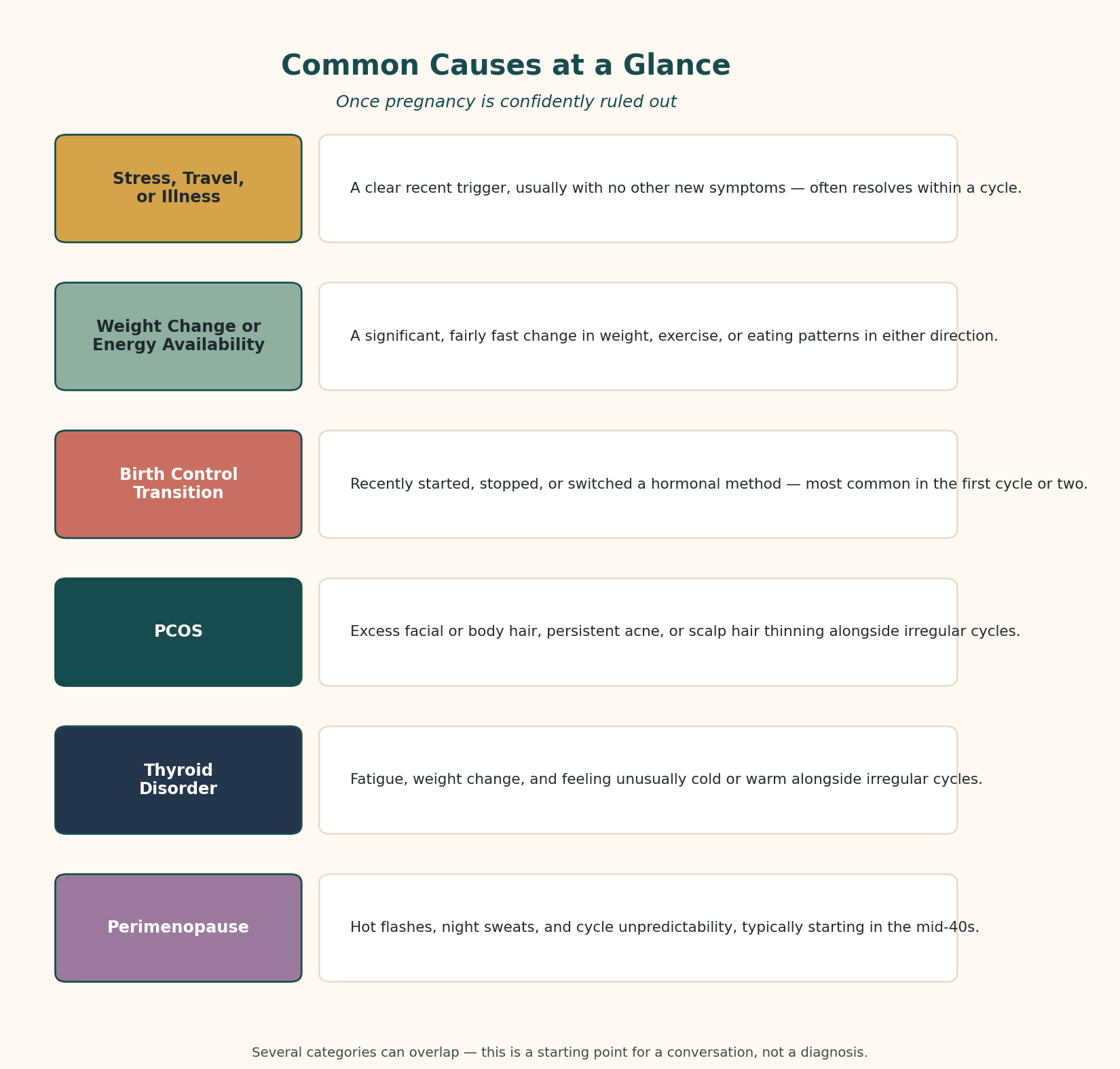
| If you’ve also noticed… | Consider looking more closely at… |
|---|---|
| A recent major stressor, illness, or travel, with no other symptoms | Stress or a temporary disruption |
| A significant, relatively fast weight change in either direction, or a big change in exercise or eating patterns | Energy availability and hypothalamic amenorrhea |
| Excess facial or body hair, persistent acne, or scalp hair thinning | PCOS |
| Fatigue, weight change, feeling unusually cold or warm, or a fast/slow heart rate | A thyroid disorder |
| Hot flashes, night sweats, or age in the mid-40s or beyond | Perimenopause |
| Recently started, stopped, or switched hormonal birth control | A birth control transition |
| Currently breastfeeding or within several months postpartum | Lactational amenorrhea |
| A new medication started around the same time | A medication side effect |
Matching Your Symptoms to a Likely Category
If This Is a One-Time, Isolated Late Period
A single late or missed period with an obvious recent trigger — a stressful week, a bout of illness, a long flight — and no other new symptoms is the pattern most likely to resolve on its own without any specific intervention. Giving it one more cycle to see if things return to normal is a reasonable approach in this situation.
If This Has Happened Repeatedly
A pattern that’s repeated across two or more cycles, or that comes with any of the accompanying signs in the table above, points more clearly toward one of the specific causes covered in this guide and is worth raising with a provider rather than continuing to wait it out.
What This Self-Check Can’t Do
It’s a Starting Point for a Conversation, Not a Diagnosis
This table is designed to help you describe your situation clearly and know what to mention first — it isn’t a diagnostic tool, and several of these categories can overlap or coexist. Only a health care provider, usually with bloodwork and sometimes imaging, can actually confirm which explanation applies to you.
When in Doubt, the Next Section Covers When to Actually Go In
If you’re unsure whether your situation warrants a visit yet, the next section lays out the general thresholds providers typically use, along with specific symptoms that move up the timeline regardless of how many periods you’ve missed.
When to See a Doctor
| Step | What it checks for |
|---|---|
| History and physical exam | Recent life changes, weight history, medications, family history, and physical signs like excess hair growth |
| A repeat pregnancy test (often blood-based) | Definitively rules pregnancy in or out with higher sensitivity than most home tests |
| Hormone bloodwork (TSH, prolactin, and others as indicated) | Thyroid function, prolactin levels, and signs of PCOS or other hormonal imbalances |
| Pelvic ultrasound, if indicated | Ovarian appearance and uterine lining, particularly if PCOS is suspected |
| Additional imaging (such as a pituitary MRI), if indicated | Reserved for specific situations where bloodwork points toward a pituitary cause |
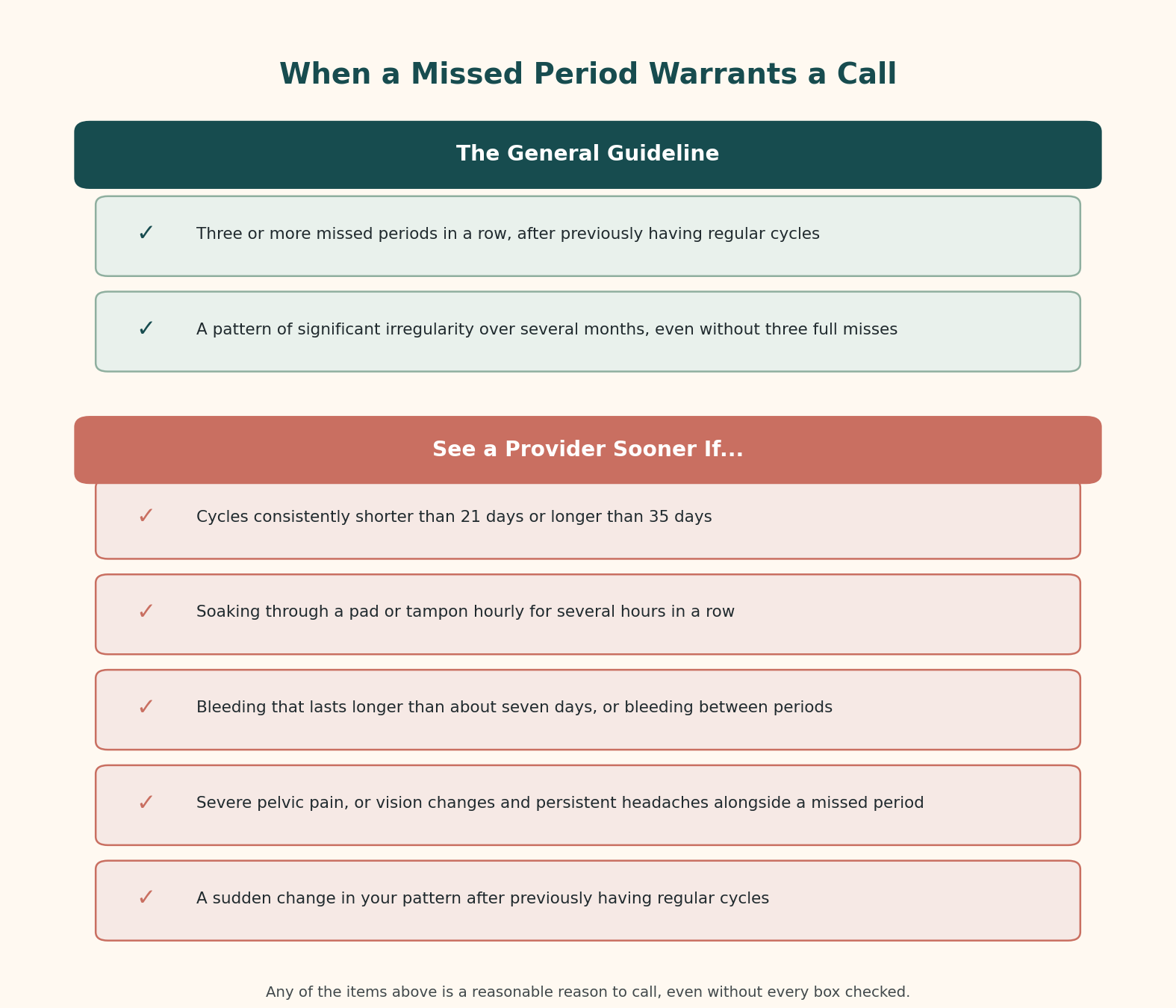
The General Rule of Thumb
Three Missed Periods in a Row
Missing three periods in a row, after previously having regular cycles, is the general threshold most clinical guidance uses for when a missed period warrants a medical evaluation, regardless of what any pregnancy test has shown.
A Pattern of Irregularity Over Several Months
Even without three fully missed periods, a pattern of significant irregularity — cycles that vary widely in length, unusually long gaps between periods, or periods that have become unpredictable after previously being consistent — is also worth bringing up at a visit rather than waiting for the three-missed-period threshold specifically.
Reasons to Go In Sooner
Symptoms That Warrant a Sooner Visit
Cleveland Clinic’s patient guidance on irregular periods lists several specific reasons to see a provider sooner than the three-missed-period guideline: cycles consistently shorter than about 21 days or longer than about 35 days, soaking through a pad or tampon every one to two hours for several hours in a row, bleeding that lasts longer than about seven days, bleeding between periods, or a sudden change after previously having regular cycles. Severe pelvic pain or symptoms like vision changes or persistent headaches alongside a missed period are also reasons to be seen sooner. Severe one-sided pelvic pain, especially with vaginal bleeding or dizziness, can also be a sign of ectopic pregnancy even when a home test reads negative early on — see our ectopic pregnancy guide for the full list of emergency warning signs.
If You Have a Known Condition Already
If you already have a diagnosed condition known to affect cycles — an eating disorder history, a thyroid condition, PCOS, or a chronic illness — a new or worsening pattern of missed periods is worth mentioning at your next routine visit for that condition even before hitting the three-missed-period mark, since it may reflect a change in how well-managed the underlying condition currently is.
What Typically Happens at That Visit
A Conversation and a Physical Exam First
Most evaluations start with a detailed conversation about your cycle history, recent life changes, medications, and any other symptoms, followed by a physical exam. This alone often narrows down the likely explanation considerably before any testing happens.
Bloodwork and Imaging, If Needed
Depending on what the history and exam suggest, a provider may order bloodwork, a pelvic ultrasound, or occasionally additional imaging, as outlined in the table above. Not everyone needs every test — the specific workup is tailored to what your particular situation points toward.
What to Bring to Your Appointment
A Cycle Record Makes the Visit More Productive
If you’ve been tracking your cycles, bringing that record — even a few months of rough dates jotted in a notes app — gives your provider a genuine head start compared to trying to recall dates from memory during the appointment itself. A record of any accompanying symptoms, when they started, and any recent life changes (new medications, significant stress, a change in exercise or eating patterns) rounds out the picture.
A Short List of Questions Helps Too
It’s easy to forget what you wanted to ask once you’re in the room. Jotting down a few specific questions beforehand — what tests they’re planning to run and why, how soon you might expect results, and what the next step would be depending on what those results show — helps make sure the visit actually answers what you came in for.
The Emotional Side of Not Knowing
Limbo Is Genuinely Stressful, Whichever Outcome You’re Hoping For
Whether You Want to Be Pregnant or Really Don’t
A missed period with an unclear cause puts you in a genuinely uncomfortable holding pattern, and that discomfort is real regardless of which answer you’re hoping for. Someone actively trying to conceive and someone hoping not to be pregnant can both find this exact situation stressful in their own way, and neither reaction needs justifying.
The Uncertainty Itself Is a Legitimate Source of Anxiety
It’s not unreasonable to feel unsettled by not having an answer yet, even before you know whether there’s anything to actually worry about. Uncertainty is its own distinct source of stress, separate from whatever the eventual answer turns out to be, and it’s worth acknowledging rather than dismissing as an overreaction to “probably nothing.”
A Few Things That Can Help While You Wait
Set a Specific Retest or Appointment Date, Then Try to Let It Go Until Then
Deciding in advance exactly when you’ll retest or call a provider — rather than testing repeatedly or checking symptoms every few hours — can meaningfully reduce the day-to-day mental load of waiting. Having a concrete plan tends to feel more manageable than open-ended uncertainty, even when the plan itself is simply “wait three more days.”
You’re Allowed to Talk About This Before There’s an Answer
You don’t need a confirmed diagnosis or a positive test to talk to a partner, a friend, or a provider about what you’re going through. Waiting alone with this kind of uncertainty tends to make it feel bigger than it is; talking about it, even without a resolution yet, often makes it more manageable.
If You Do Confirm a Pregnancy Later
A Late Positive Doesn’t Change What It Means
The Same Result, Just a More Complicated Path to It
If continued testing or a blood test eventually does confirm a pregnancy, the delay in getting there doesn’t change anything about the pregnancy itself or what the appropriate next steps are. A pregnancy confirmed on day 20 of uncertainty is medically identical to one confirmed on day one.
Where to Go Next
Our guide to what to do after a positive pregnancy test walks through the first-week priorities step by step — confirming with a provider, starting a prenatal vitamin, telling the people in your life, and more.
If You’re Not Sure How You Feel About It
That’s a Separate, Equally Valid Question
Whether you’re hoping this test turns positive or hoping it stays negative, it’s worth remembering that confirming a pregnancy and deciding what you want to do about it are two separate questions. Neither one has to be resolved before the other.
Where to Find Judgment-Free Information
(A dedicated, neutral overview of pregnancy options — continuing a pregnancy, adoption, and other paths — is planned for this site. In the meantime, a primary care provider or a local reproductive health clinic can offer confidential, judgment-free information regardless of which direction you’re leaning.)
Common Mistakes That Add Confusion or Delay
Mistakes That Add Confusion
Testing Repeatedly Within the Same Day or Two
Because hCG changes on a timescale of days rather than hours, testing multiple times within a day or two of an initial negative rarely produces new information and mostly adds expense and anxiety. Spacing tests out by several days, as covered earlier in this guide, is a far more informative approach.
Assuming a Single Late Period Always Means Something Is Wrong
A single isolated late period, especially with an obvious recent trigger like stress or travel, is common and usually not a sign of an underlying condition. Jumping straight to researching serious diagnoses after one late cycle tends to create more anxiety than the situation warrants.
Mistakes That Add Delay
Self-Diagnosing a Specific Condition Online and Stopping There
It’s easy to read about PCOS or thyroid disorders, recognize a symptom or two, and assume that’s the answer without ever getting an actual evaluation. Because several of the conditions in this guide share overlapping symptoms, and because some require specific bloodwork to confirm, a self-diagnosis can end up being wrong in ways that matter for treatment — getting an actual evaluation is what turns a guess into an answer.
Waiting Many Months Before Mentioning a Pattern to a Provider
Some people wait far longer than the general three-missed-period guideline before bringing up a pattern of irregular periods, often because any single instance felt easy enough to explain away. Mentioning a pattern earlier, even if it turns out to be nothing significant, costs very little and can catch a manageable condition before it’s had as much time to progress.
Tracking Your Cycle: A Simple Way to Get Clearer Answers
Why Tracking Helps, Starting Today
It Turns “I Think I’m Late” Into an Actual Data Point
Without a record, it’s easy to be unsure whether a cycle is genuinely unusual or just feels that way in the moment. Even a rough record of when periods start and roughly how long they last makes it much easier to answer a provider’s first question — “how long has this been going on?” — with something more useful than a guess.
It Helps You (and a Provider) Spot Patterns Faster
A single missed period is hard to interpret in isolation, but a few months of data can reveal a pattern — consistently short or long cycles, a gradual lengthening over time, or a cluster of missed periods around a specific event — that points more clearly toward one of the categories covered in this guide.
What to Track and How
The Basics Are Enough to Start
Start date, approximate length, and flow (light, typical, or heavy) for each period is genuinely enough to be useful — you don’t need to track basal body temperature or cervical mucus unless you’re also trying to pinpoint ovulation for another reason. Noting major life events (illness, travel, a significant stressor, a medication change) alongside your cycle data can also help connect the dots later.
Apps and Paper Both Work
A dedicated period-tracking app can calculate cycle length automatically and flag when a period is later than your own historical pattern, which is often more useful than a fixed 28-day assumption. A simple note on a calendar or in a notes app works just as well if you’d rather not use a dedicated app — the goal is consistency, not a particular tool.
Frequently Asked Questions About a Missed Period With a Negative Test
Testing and Timing Questions
How many days late does a period need to be before I should worry about the test being wrong?
A negative test taken within the first few days after a missed period is still commonly a timing issue rather than a wrong result. Once a period is a week or more late with a continued negative, retesting with first-morning urine or seeing a provider for a blood test is a reasonable next step.
Can I be pregnant with three or more negative tests in a row?
It becomes progressively less likely with each properly spaced, correctly used negative test, especially once you’re well past your missed period, but it isn’t impossible in unusual situations like unusually late ovulation or very dilute urine. A blood test is the most reliable way to settle the question completely at that point.
Does a faint line count as a negative or a positive?
A faint but genuine line, however light, is generally read as a positive result rather than a negative, since most tests are designed to show any line at all only when hCG is present. Our full pregnancy test guide covers reading faint lines and evaporation lines in detail.
Should I use first-morning urine even if my period is already several days late?
Yes — first-morning urine is more concentrated regardless of how late your period is, which makes it the more reliable sample any time you test, not just in the first days after a missed period.
I have a very irregular cycle to begin with. How do I even know my period is “late”?
With naturally irregular cycles, “late” is better judged against your own personal range of cycle lengths over the past several months rather than a fixed 28-day assumption. If you don’t track your cycles, a reasonable default is to wait somewhat longer than you otherwise would before concluding a negative result is meaningful.
Can dehydration or not drinking enough water cause a false negative?
It’s actually the opposite — overly diluted urine from drinking a lot of fluid right before testing is what can cause a false negative, not dehydration. A concentrated, first-morning sample is what you want, not an especially watery one.
Is it possible for a pregnancy test to expire and give a false negative because of that?
Yes — an expired test can produce an unreliable result, including a false negative, which is one of several test-related explanations covered in more depth in our full pregnancy test guide.
My period tracker app predicted my period, but the prediction was wrong. Does that mean something is off with my body?
Not necessarily — app predictions are estimates based on your past cycle data, and a single missed prediction is common even in people with generally regular cycles, especially if a recent cycle was itself unusual. A pattern of repeatedly inaccurate predictions is more meaningful than any single miss.
Can ovulation predictor kits help me figure out if I actually ovulated this cycle?
They can offer a clue, since a kit that never detects a hormone surge across an entire cycle may suggest ovulation didn’t occur as expected, but they’re not a definitive diagnostic tool on their own. A provider can confirm anovulation more reliably through bloodwork or other testing if it’s a recurring pattern.
Non-Pregnancy Causes Questions
Can a single stressful week really delay a period by more than a few days?
Yes — significant acute stress can delay ovulation by more than a few days in some cases, which then delays the period that depends on it. A single unusually stressful event is a common, well-recognized explanation for an isolated late cycle.
How much weight change is enough to affect a period?
There’s no single universal number, since it depends on the individual and the rate of change rather than a fixed threshold — a relatively fast, significant change in either direction is what tends to matter most. A provider can help evaluate whether a specific weight change is a likely contributor in your particular situation.
I haven’t changed my exercise routine at all. Could it still be energy-related?
It’s possible, since energy availability depends on the balance between intake and expenditure, not on exercise alone — a change in eating patterns without any change in activity level can shift that balance too. This is exactly the kind of nuance worth discussing with a provider rather than ruling out based on exercise habits alone.
Can travel alone really delay a period, even without jet lag symptoms?
Yes — crossing time zones can disrupt the internal signaling that regulates ovulation timing even in people who don’t notice classic jet lag symptoms like daytime sleepiness. The effect is usually temporary and resolves within a cycle or two.
Can shift work or an irregular sleep schedule cause the same kind of delay as travel?
Yes — the same internal signaling that responds to time-zone changes also responds to irregularly timed sleep, which is part of why people who work rotating or overnight shifts sometimes notice more cycle variability than people with consistent sleep schedules. A more consistent sleep pattern, where your schedule allows for it, can help stabilize cycles affected this way.
Can starting a new job or a major life transition delay a period even without an obvious “stressful” feeling?
Yes — a big transition can register as stress to the body’s hormonal systems even if it doesn’t feel emotionally distressing in the moment; excitement, a packed schedule, and disrupted routines can all contribute in similar ways to a period more commonly associated with negative stress.
Does an illness need to be severe to delay a period, or can a common cold do it?
It typically takes a more significant illness — a high fever or something requiring real recovery time — to noticeably delay a period; a routine cold usually isn’t enough on its own. If a period is consistently delayed after even mild illnesses, that pattern is worth mentioning to a provider rather than assuming every illness is the cause.
PCOS, Thyroid, and Perimenopause Questions
Can you have PCOS without any excess hair growth or acne?
Yes — PCOS is typically diagnosed when at least two of three features are present (irregular ovulation, signs of elevated androgens, and polycystic-appearing ovaries), so it’s possible to have irregular periods and polycystic-appearing ovaries without noticeable androgen-related symptoms like excess hair growth.
Is PCOS the same thing as having ovarian cysts?
Not exactly — the follicles seen on an ultrasound in PCOS are small, immature follicles that aren’t releasing eggs on schedule, which is different from the larger, sometimes symptomatic fluid-filled cysts that can occur independently of PCOS.
Can PCOS go away on its own?
PCOS is generally a longer-term hormonal pattern rather than something that resolves entirely on its own, though its symptoms, including cycle irregularity, can often be effectively managed with treatment tailored to a person’s specific goals and symptoms.
How does a doctor tell the difference between a thyroid problem and PCOS if both cause missed periods?
Bloodwork is what distinguishes them — thyroid function tests (like TSH) identify a thyroid cause, while a combination of hormone levels and, sometimes, an ultrasound help identify PCOS. The two conditions can also coexist, which is part of why a provider typically checks for both rather than assuming one explanation.
Can thyroid problems cause a completely missed period, or just irregular ones?
Both patterns are possible — an underactive thyroid can cause cycles to become long and infrequent, occasionally to the point of stopping altogether, while some people notice irregular timing without complete absence. Either pattern is worth checking with a simple blood test.
At what age should I start considering perimenopause as a possible explanation?
Perimenopause most commonly begins in the mid-40s, though it can start somewhat earlier for some people. If you’re in this general age range and experiencing new cycle irregularity, it’s a reasonable possibility to raise with a provider alongside ruling out pregnancy and other causes.
Can perimenopause start in your late 30s?
It’s less common but not impossible — cycle changes that begin notably earlier than the mid-40s are still worth evaluating with a provider, both to confirm perimenopause specifically and to rule out other causes of early irregular cycles.
Do I need an ultrasound to be diagnosed with PCOS?
Not necessarily — since PCOS diagnosis typically requires at least two of three features, some people are diagnosed based on irregular ovulation plus androgen-related signs alone, without needing an ultrasound, while others do have one as part of a complete evaluation.
Can I have a normal weight and still have PCOS?
Yes — PCOS occurs across the full range of body sizes, and while it’s sometimes associated with higher body weight, it’s also diagnosed regularly in people at an average or lower body weight. Weight alone isn’t a reliable way to rule PCOS in or out.
If my mom or sister has PCOS, am I more likely to have it too?
PCOS does appear to run in families to some degree, so having a close relative with the condition is one more reason to mention it to a provider if you’re also experiencing irregular periods, though it doesn’t mean you’ll definitely develop it yourself.
Is there a way to tell hypothyroidism and perimenopause apart without bloodwork, since some symptoms overlap?
Not reliably — fatigue, mood changes, and cycle irregularity can appear in both, which is exactly why a simple thyroid blood test is typically one of the first steps in evaluating irregular periods regardless of age, rather than assuming perimenopause based on age alone.
Can stress make PCOS or thyroid-related irregularity worse, even though stress alone didn’t cause it?
It’s plausible that added stress could make an already-irregular cycle even less predictable, since stress and the other causes in this guide can affect overlapping hormonal pathways. This is more reason to mention your overall stress level and life circumstances when discussing a missed period with a provider, rather than assuming only one explanation applies.
When to Worry Questions
Is it ever an emergency if my period is late and my test is negative?
A late period with a negative test is not, by itself, a medical emergency. Severe pelvic pain, very heavy bleeding, fainting, or other acute symptoms alongside a late period warrant prompt medical attention regardless of what any pregnancy test shows, but the missed period itself is not an urgent situation on its own.
What if I’ve missed three periods but I’m not experiencing any other symptoms at all?
Missing three periods in a row is the general threshold for seeing a provider even without other symptoms, since it’s specifically the absence of a clear explanation that makes an evaluation worthwhile — there may be an underlying cause that simply hasn’t produced any other noticeable signs yet.
Could a missed period be a sign of something serious like cancer?
It’s an uncommon cause and not the first thing providers typically look for, but certain pituitary or ovarian growths can occasionally affect menstrual regularity, which is part of why a thorough evaluation — rather than assuming the most common causes automatically apply — matters if initial testing doesn’t turn up an answer.
I’m on medication for anxiety or depression. Could that be why my period is late?
Some psychiatric medications, particularly certain antipsychotics, are recognized causes of missed or irregular periods, largely through their effect on prolactin levels. If you suspect a connection, raise it with your prescriber rather than stopping the medication, since there are often alternatives or adjustments that don’t require going without treatment.
How long is too long to just “wait and see” before seeing someone?
Three missed periods in a row is the general guideline, though a shorter timeline is reasonable if you also have other symptoms, a known condition that affects cycles, or simply want peace of mind sooner. There’s no real downside to seeing a provider earlier than the guideline suggests.
Will a doctor think I’m overreacting if I come in after just one missed period?
No — providers regularly see patients with a single missed period, especially alongside a negative pregnancy test, and would rather rule out a cause early than have someone wait through months of uncertainty. Wanting an answer sooner rather than later isn’t overreacting.
Can a missed period ever just be completely unexplainable, even after a full evaluation?
Occasionally, yes — a thorough evaluation doesn’t always identify a specific cause, particularly for an isolated event. When that happens, a provider will typically recommend monitoring for a pattern over the following cycles rather than continuing to pursue an explanation for a single occurrence.
If my period comes back on its own before I get to a doctor’s appointment, should I still go?
It depends on why you scheduled it — if it was specifically to rule out pregnancy and that’s now settled, and this was an isolated, explainable event, you can reasonably decide together with the office whether to keep or cancel the visit. If you’d already missed three or more periods or had other concerning symptoms, it’s still worth keeping the appointment, since a single returned period doesn’t rule out an underlying pattern worth discussing.
Comparing This Guide to Others
How is this different from your main pregnancy test guide?
Our main pregnancy test guide covers how tests work, test types, step-by-step usage, and the full range of reasons behind both false negatives and false positives. This guide assumes you’ve already gotten a negative result and focuses specifically on what to do next and what else, beyond pregnancy, could explain a missed period.
How is this different from your guide on when to take a pregnancy test?
Our timing guide is aimed at someone deciding when to test in the first place, including detailed guidance on retesting intervals and cycle-length adjustments. This guide picks up after you’ve already tested negative and are trying to figure out what’s actually going on.
I got a positive result after all. Where should I go next on this site?
Our dedicated guide to what to do after a positive pregnancy test covers the first-week priorities step by step — confirming with a provider, prenatal vitamins, telling the people in your life, and more.
Which guide should I start with if I haven’t tested at all yet?
Start with our full pregnancy test guide for the general picture, or our timing guide if you specifically want to know the best day to test. This guide is the right starting point once you’ve already tested and gotten a negative result you’re trying to make sense of.
Do I need to read all four testing-related guides on this site?
No — each one is designed to stand on its own for its specific question. Start with whichever guide matches where you currently are: deciding when to test, understanding how tests work in general, pushing the earliest possible testing boundary, or, as with this guide, making sense of a negative result alongside a missed period.
I took emergency contraception recently and now my period is late with a negative test. Which guide is most relevant to me?
This guide’s “Emergency Contraception” section covers that specific situation directly. If the delay goes beyond about a week or you want to rule pregnancy out with more confidence, our timing guide can help you figure out the most reliable day to retest.
My period is late, my test is negative, and I also have symptoms like extreme fatigue and cold intolerance. Where should I focus first?
Those specific symptoms line up closely with the thyroid section of this guide — a simple TSH blood test is usually the fastest way to confirm or rule that out, and it’s a reasonable first thing to mention at a visit alongside the missed period itself.

Glossary of Terms Used in This Guide
A quick reference for terms used throughout this guide. For pregnancy-testing terminology specifically, our full pregnancy test guide has a more general glossary.
Testing and Cycle Terms
hCG (human chorionic gonadotropin)
The hormone pregnancy tests detect; produced after a fertilized egg implants in the uterus.
Luteal phase
The second half of the menstrual cycle, from ovulation until the next period begins.
Amenorrhea
The medical term for the absence of menstrual periods, either primary (never having started) or secondary (periods stopping after previously occurring).
Anovulation
A cycle in which ovulation does not occur, which typically means no period follows on the usual schedule.
Cycle irregularity
A pattern in which the length of time between periods varies significantly from cycle to cycle, rather than following a consistent pattern.
Medical and Hormonal Terms
PCOS (polycystic ovary syndrome)
A hormonal condition involving irregular ovulation and elevated androgen levels or activity, one of the most common identifiable causes of missed or irregular periods.
Androgens
A group of hormones, including testosterone, that in elevated amounts can cause symptoms like excess hair growth or acne.
Hypothyroidism
An underactive thyroid gland that doesn’t produce enough thyroid hormone, which can disrupt menstrual regularity among other effects.
Hyperthyroidism
An overactive thyroid gland that produces too much thyroid hormone, which can also disrupt menstrual regularity.
TSH (thyroid-stimulating hormone)
The hormone typically measured first in a blood test to screen for thyroid problems.
Hypothalamic amenorrhea
Absent periods caused by the hypothalamus deprioritizing reproductive function, often related to energy availability, significant stress, or a combination of factors.
Perimenopause
The transitional years leading up to menopause, typically starting in the mid-40s, during which periods become irregular before stopping entirely.
Prolactin
A hormone that rises during breastfeeding and suppresses ovulation; also checked by bloodwork when evaluating unexplained missed periods, since certain medications and other conditions can raise it too.
Hysteroscopy
A procedure in which a thin, lighted scope is used to directly examine the inside of the uterus, sometimes used to identify structural causes of missed or abnormal periods.
Primary ovarian insufficiency
A condition in which the ovaries stop functioning normally before age 40, leading to irregular or absent periods and reduced fertility.
The bottom line
A negative test alongside a missed period doesn’t rule pregnancy out entirely on the first try, but once pregnancy is confidently ruled out through timing, a retest, or a blood test, there’s almost always an identifiable explanation — stress, a weight change, energy availability, a birth control transition, PCOS, a thyroid disorder, or perimenopause among the most common. Missing three periods in a row, or noticing a pattern of irregularity over several months, is the general signal to see a health care provider regardless of what any single test says. Whatever the eventual answer turns out to be, the uncertainty in the meantime is a legitimate thing to feel unsettled about — you don’t have to wait for a diagnosis to talk about it.
About pregnancyadoption.com
pregnancyadoption.com publishes free, judgment-free information on pregnancy, pregnancy options, and adoption for anyone trying to understand what’s happening in their body or what choices are available to them. We are not a law firm, an adoption agency, or a medical practice — we’re an independent editorial resource, and we don’t place children, provide legal representation, or profit from which option a reader ultimately chooses.
Every article carrying medical information is written to a source-tiering standard (government and medical-authority sources first, established nonprofits second, commercial sources never used as factual authority) and reviewed by a licensed clinician before publication. Time-sensitive information is scheduled for review on a recurring cadence, and factual errors reported by readers are corrected promptly. Read our full About & Editorial Guidelines page for details on our review process, sourcing standards, and how to report a correction.
Medical and Legal Disclaimer
This article is provided for general educational purposes only and does not constitute medical, legal, financial, or tax advice. Reading this content does not create a doctor-patient, attorney-client, or any other professional relationship between you and pregnancyadoption.com, its authors, or its reviewers. Always seek the advice of a licensed physician, midwife, attorney, or other qualified professional with any questions you may have regarding a medical condition, a legal right, or a financial decision, and never disregard or delay seeking professional guidance because of something you have read here. If you believe you may be experiencing a medical emergency, call 911 or your local emergency number immediately.
Clinical definitions, timing ranges, and prevalence figures referenced in this article are accurate to the best of our knowledge as of this article’s last review date but may not reflect the most current research or your individual situation. We make reasonable efforts to verify accuracy but make no warranty, express or implied, as to the completeness, reliability, or timeliness of any information on this page. Links to third-party websites are provided for convenience only; we do not control and are not responsible for the content, accuracy, or privacy practices of external sites, and inclusion of a link is not an endorsement.
To the fullest extent permitted by applicable law, pregnancyadoption.com and its authors, editors, and medical/legal reviewers disclaim all liability for any loss, injury, or damage of any kind arising from reliance on the information in this article. This disclaimer does not limit any rights you may have under law that cannot be waived. Read our full Medical and Legal Disclaimer for complete terms.
Sources and further reading
This guide draws on patient-education and clinical guidance from the following organizations. Individual circumstances vary — use this guide to prepare good questions for your own health care provider, not as a substitute for individualized medical advice.
- Mayo Clinic — Amenorrhea: Symptoms and Causes
- Cleveland Clinic — Amenorrhea: Types, Causes, Symptoms, Diagnosis & Treatment
- Cleveland Clinic — Irregular Periods (Abnormal Menstruation): Causes & Treatment
- Cleveland Clinic — Hypothalamic Amenorrhea: Causes, Symptoms & Treatment
- Cleveland Clinic — Perimenopause: Age, Stages, Signs, Symptoms & Treatment
- Cleveland Clinic — Hypothyroidism (Underactive Thyroid)
- Mayo Clinic — Polycystic Ovary Syndrome (PCOS): Symptoms and Causes
- Mayo Clinic — Home Pregnancy Tests: Can You Trust the Results? (Patient Education)