
If you’ve adopted a child, or you’re budgeting for an adoption you haven’t started yet, the federal adoption tax credit is almost certainly the single largest piece of money you can get back from the process — for many families, tens of thousands of dollars over the life of their return. It’s also one of the most misunderstood credits in the entire tax code: people assume it’s a simple check, or that it covers everything, or that it works the same way it did when a friend claimed it five years ago. None of that is reliably true, because the dollar amounts change every year, part of the credit only became refundable starting with tax year 2025, and the rules for domestic adoptions, international adoptions, and adoptions that fall through before finalizing are each genuinely different. This guide walks through exactly how the credit works right now — current-year dollar figures verified directly against IRS.gov, eligibility, what counts as a qualified expense, the special-needs flat-credit rule, the income phase-out, the refundable/nonrefundable split, carryforward, how it interacts with employer adoption benefits, and how to actually file Form 8839 — so you can claim every dollar you’re entitled to and avoid the mistakes that slow down a refund or draw IRS attention. For the underlying cost of adopting itself — agency fees, legal fees, international travel, home study costs — see our companion guide to adoption costs by adoption type; this guide focuses specifically on the tax mechanics of offsetting those costs.
Short Answer: What the Adoption Tax Credit Is and Who It’s For
The federal adoption tax credit, created under Internal Revenue Code Section 23, lets eligible taxpayers claim a credit against their federal income tax for qualified adoption expenses paid to adopt an eligible child, up to a dollar cap that’s adjusted for inflation every year. For tax year 2025, that cap is $17,280 per child; for tax year 2026, it rises to $17,670 per child. A portion of the credit — up to $5,000 per child for 2025, and up to $5,120 per child for 2026 — is refundable, meaning you can receive it even if you owe little or no federal income tax; the remainder is nonrefundable but can be carried forward for up to five years. The credit phases out at higher incomes and cannot be claimed twice for the same dollar of expense already reimbursed by an employer’s adoption-assistance program.
What This Credit Does, in One Sentence
The Core Mechanism
You total up what you spent on legitimate adoption-related costs (or, for a special-needs adoption, you skip that step entirely), compare that total to the annual dollar cap, apply an income-based reduction if your household income is high enough to trigger one, and the result is a credit that reduces your federal tax bill dollar-for-dollar — not a deduction that merely reduces the income you’re taxed on.
Why “Nonrefundable” Isn’t the Whole Story Anymore
For years, this credit had a reputation among adoptive families as “money you only get if you already owe a lot in taxes,” because it was entirely nonrefundable: a family with a modest tax bill could carry the credit forward for years without ever fully using it. That changed starting with tax year 2025, when a new law made a meaningful slice of the credit refundable. Section 9 below explains exactly how the split works and why it matters most for lower- and middle-income adoptive families.
Who This Guide Is Written For
Adoptive and Prospective Adoptive Parents
This guide assumes you’re either in the process of adopting, have already finalized an adoption, or are budgeting ahead of starting one and want to understand how much of the cost the federal government will actually offset. It applies to domestic infant adoption, adoption from foster care, and international adoption alike, with the differences flagged wherever they matter.
What We Deliberately Don’t Cover Here
This is a tax-mechanics guide, not a cost guide or a process guide. For the dollar-by-dollar breakdown of what adoption actually costs by type — agency fees, attorney fees, international program and travel costs, foster-care adoption’s typically much lower cost — see our companion guide to adoption costs. For how adoption actually works and the overall process, including matching, placement, and finalization timelines, see our guide to how adoption works, our guide to the adoption process, and our guide to how to adopt a child. For home study requirements, see our home study guide, and for the baseline legal and agency eligibility rules to adopt at all, see our adoption requirements guide.
The IRS maintains the authoritative, up-to-date reference on the Adoption Credit, including current-year limits and qualified expenses. The Child Welfare Information Gateway (U.S. Department of Health and Human Services) also outlines how this credit fits into the broader cost picture of adoption.
Key Takeaways
- The maximum adoption tax credit is $17,280 per eligible child for tax year 2025 and $17,670 per eligible child for tax year 2026 — verified live against IRS.gov as of October 2, 2026. These figures are adjusted for inflation every year, so always confirm the figure for the specific tax year you’re filing, not the year you adopted.
- Starting with tax year 2025, up to $5,000 per child (2025) or $5,120 per child (2026) of the credit is refundable; the rest is nonrefundable but carries forward up to five years.
- A child determined to have special needs by a state (or, as of 2025, a tribal government) qualifies a family for the full credit amount regardless of how much — or how little — they actually spent.
- The credit phases out as modified adjusted gross income (MAGI) rises, and it cannot be claimed on the same dollar of expense an employer already reimbursed tax-free.
Understanding the Adoption Tax Credit: IRC Section 23 Explained
The adoption tax credit isn’t a program you apply for separately from your taxes — it’s a credit you calculate and claim directly on your federal income tax return, using Form 8839, for the same tax year in which the rules say your expenses or finalization count. Understanding where it comes from and how a credit differs mechanically from a deduction makes the rest of this guide easier to follow.
Where the Credit Comes From
A Brief Legislative History
Congress created the adoption tax credit in 1996 to help offset the real financial cost of adoption and to put public policy weight behind permanent families for children — including children adopted from foster care who have been determined to have special needs. The credit has been adjusted, expanded, and occasionally restructured several times since, including a temporary period of full refundability around 2010–2011 under separate legislation that later expired, returning the credit to fully nonrefundable status for well over a decade. The most significant recent change is the partial refundability provision described below, which took effect starting with tax year 2025.
Why the Credit Exists
Adoption — whether domestic infant adoption, international adoption, or adoption from foster care — carries real costs: agency fees, legal fees, home study fees, and for international adoptions, travel and foreign program costs. The credit exists specifically to reduce the federal tax burden on families who take on those costs to build a family through adoption, with an especially strong allowance (the special-needs flat credit, covered in Section 7) for children who might otherwise face reduced odds of being adopted at all.
How It’s Different From a Deduction
Credit vs. Deduction, in Dollars
A tax deduction reduces the income you’re taxed on; a tax credit reduces the tax itself, dollar for dollar. If you’re in, say, a 22% marginal tax bracket, a $10,000 deduction saves you roughly $2,200 in actual tax. A $10,000 tax credit saves you the full $10,000 (up to the limits and phase-outs described throughout this guide). That difference is enormous, and it’s the main reason the adoption tax credit is worth understanding in detail rather than treating as an afterthought at tax time.
Why That Difference Matters for Adoption Specifically
Adoption expenses are large, often concentrated in one or two tax years, and not tied to any ongoing deduction category most families already track (like mortgage interest or charitable giving). Because the adoption credit is a dollar-for-dollar credit rather than a deduction, a family that spends, for example, $17,280 in qualified expenses in 2025 can offset their federal tax liability by up to the full $17,280 (subject to the phase-out and the nonrefundable-portion limits covered later) — not merely a fraction of it.
The Big Legislative Change You Need to Know About
The One Big Beautiful Bill Act’s Refundability Provision
Tax legislation enacted in 2025 (commonly referred to as the One Big Beautiful Bill Act) made a portion of the adoption tax credit refundable for the first time on a permanent basis, starting with tax year 2025. This is a structural change, not a one-time rebate: the refundable amount is itself indexed for inflation each year going forward, which is why the refundable cap is $5,000 for 2025 and rises to $5,120 for 2026. Before this change, a family with little federal tax liability — a common situation for younger families, single-income households, or families who had just taken on significant adoption-related debt — could end up carrying forward a large unused credit for years without ever converting much of it into real cash back.
What Didn’t Change
The overall maximum credit per child, the definition of qualified adoption expenses, the special-needs flat-credit rule, the five-year carryforward window for the nonrefundable portion, and the coordination rule with employer-provided adoption assistance are all unchanged in their basic structure. What changed is purely how much of the credit you can get as a refund versus how much you can only use to offset tax you actually owe.
Key Takeaways
- The adoption tax credit (IRC Section 23) is a dollar-for-dollar reduction of federal tax liability, not a deduction — far more valuable per dollar of qualified expense than a deduction would be.
- It has existed since 1996 and was briefly fully refundable around 2010–2011 before reverting to nonrefundable; it became partially and permanently refundable again starting with tax year 2025.
- The refundable portion is itself inflation-indexed each year, just like the overall cap — it is not a flat, one-time dollar figure.
Current-Year Dollar Figures: 2025 and 2026 at a Glance
Because every dollar figure in this credit is adjusted for inflation annually by the IRS, the numbers below are the ones that matter right now — verified directly against IRS.gov (the Adoption Credit page, the 2025 Form 8839 instructions, and the IRS’s own announcement of Revenue Procedure 2025-32 covering 2026 inflation adjustments) as of October 2, 2026. Do not rely on a dollar figure you remember from a prior year’s return, a friend’s experience, or an older article; confirm the figure for the specific tax year you are filing.
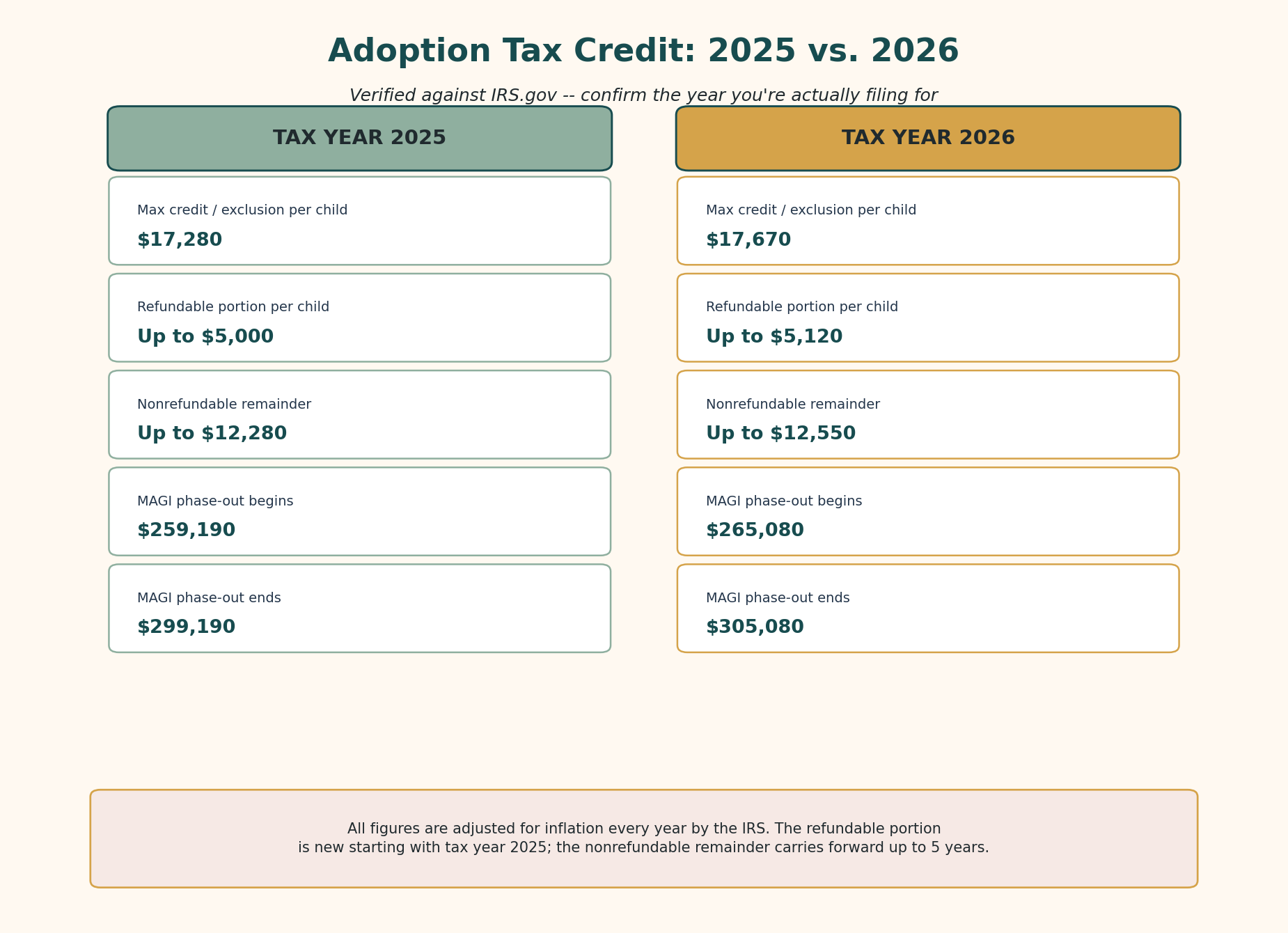
| Figure | Tax year 2025 | Tax year 2026 |
|---|---|---|
| Maximum credit per eligible child | $17,280 | $17,670 |
| Maximum employer-assistance exclusion per eligible child | $17,280 | $17,670 |
| Refundable portion per eligible child (new starting 2025) | Up to $5,000 | Up to $5,120 |
| Nonrefundable remainder (carries forward up to 5 years) | Up to $12,280 | Up to $12,550 |
| MAGI phase-out begins (full credit available at or below) | $259,190 | $265,080 |
| MAGI phase-out ends (credit fully eliminated at or above) | $299,190 | $305,080 |
Why These Numbers Change Every Year
Annual Inflation Indexing
Congress wrote the adoption tax credit’s dollar caps to adjust automatically for inflation each year, the same way federal income tax brackets and the standard deduction do. The IRS publishes the coming year’s figures each fall through a Revenue Procedure (the 2026 figures above come from Revenue Procedure 2025-32, released in October 2025); by the time you’re preparing a return for a given tax year, the final figures are set and published on IRS.gov and in that year’s Form 8839 instructions.
Why You Should Always Check the Year You’re Filing For, Not the Year You Adopted
This is a common point of confusion: the dollar cap and phase-out range that apply to your claim are the ones in effect for the tax year in which you’re claiming the expense or finalization — not necessarily the year the adoption process began. Because of the timing rules covered in Section 12, a single adoption can sometimes involve expenses claimed across more than one tax year, each year governed by that year’s own dollar figures.
What These Numbers Actually Limit
The Combined Credit-Plus-Exclusion Cap
The dollar figure in the first two rows of Table 1 isn’t two separate $17,280 (or $17,670) allowances — it’s one combined ceiling per child that covers the credit and the employer-provided benefits exclusion together. If an employer’s adoption-assistance program already excluded, say, $6,000 of qualified expenses from your taxable income, your remaining room for the credit itself on that same child is reduced accordingly. Section 11 covers this coordination rule in full.
Per-Child, Not Per-Family
Every dollar figure in this credit is applied per eligible child, not per tax return or per family. A family finalizing adoptions of two children in the same year can potentially claim up to the full per-child maximum for each child — up to $34,560 combined for two children in 2025, or $35,340 for two children in 2026 — subject separately to the phase-out and nonrefundable/refundable split for each child’s claim.
Who Qualifies: Eligibility Rules for the Adoption Tax Credit
Eligibility for the adoption tax credit depends on three independent things being true at once: you adopted (or are adopting) a child who meets the IRS’s definition of an eligible child, you either paid qualified adoption expenses or the child has a qualifying special-needs determination, and your income falls within or below the phase-out range for the year you’re claiming.
The Basic Eligibility Checklist
You Adopted (or Are Adopting) an Eligible Child
The IRS’s definition of an eligible child for this credit is covered in full in Section 5, but at a glance: generally, a child under age 18, or a person of any age who is physically or mentally unable to care for themselves. This is the credit’s own definition and is not identical to the “qualifying child” test used elsewhere in the tax code for dependency or the Child Tax Credit.
You Paid Qualified Adoption Expenses, or the Child Has Special Needs
For most adoptions, you need qualified adoption expenses (Section 6) to claim anything beyond zero. For a child determined to have special needs by a state or tribal government, however, you can claim the full credit amount for the year of finalization regardless of your actual expenses — see Section 7.
Your Income Is Within the Phase-Out Range
If your modified adjusted gross income is at or below the lower phase-out threshold for the year ($259,190 for 2025; $265,080 for 2026), you’re eligible for the full credit amount (subject to the expense cap). Above that threshold, the credit is reduced on a sliding scale until it disappears entirely at the upper threshold. Section 8 walks through the exact math.
Filing Status Rules
Married Filing Jointly Is the Default Requirement
If you’re married, you generally must file a joint return with your spouse to claim the adoption tax credit. This trips up some families who otherwise file separately for unrelated reasons (student loan repayment plans, for example) without realizing it could cost them this credit entirely.
The Narrow Married-Filing-Separately Exception
There’s a specific, narrow exception: you may still qualify filing separately if you lived apart from your spouse for the last six months of the tax year, the eligible child lived in your home for more than half the year, and you paid more than half the cost of keeping up that home — essentially the same “considered unmarried” test used for head-of-household status elsewhere in the tax code. If you’re in a separated-but-not-divorced situation and considering filing separately, this is worth confirming with a tax professional before you file, not after.
Who Cannot Claim the Credit
Adopting Your Spouse’s Child
Expenses connected with adopting your spouse’s child (a stepparent adoption) do not qualify as qualified adoption expenses for this credit, regardless of how much you spent on the legal process. This is a flat exclusion, not a phase-out or reduction.
Surrogacy Arrangements
Expenses connected with a surrogate parenting arrangement are also excluded from qualified adoption expenses. This distinction matters because surrogacy and adoption are sometimes discussed together informally, but the tax code treats them as entirely separate categories, and surrogacy-related costs get no benefit under this particular credit.
Key Takeaways
- Eligibility requires an eligible child under the credit’s own definition, either qualified expenses or a special-needs determination, and income within the phase-out range.
- Married couples generally must file jointly to claim this credit; the “lived apart six months” exception is narrow and worth professional confirmation if you think it applies to you.
- Stepparent adoptions and surrogacy arrangements are categorically excluded — no phase-out, no partial credit, no exception.
What Counts as a “Qualifying Child” for the Credit
The adoption tax credit uses its own definition of “eligible child,” separate from the dependency and Child Tax Credit definitions used elsewhere on your return. Getting this distinction right matters because a child can be an eligible child for this credit without yet being a tax dependent, and vice versa in some situations.
Age and Capacity Requirements
Under 18 at Any Point During the Year
A child is an eligible child for this credit if they were under age 18 at any point during the tax year. If a child turns 18 partway through the year, they’re still treated as eligible for the portion of that year before their birthday — in practice, this rarely limits a claim meaningfully, since most adoption-related qualified expenses are tied to the adoption process itself rather than spread evenly across the calendar year.
Any Age, If Unable to Care for Themselves
Separately, a person of any age — including an adult — qualifies as an eligible child if they are physically or mentally unable to care for themselves. This provision matters most for families adopting an adult relative with a significant disability, a less common but entirely real category of adoption this credit covers on the same terms as a minor child’s adoption.
Citizenship and Residency Status
U.S. Children vs. Foreign-Born Children
The credit draws a sharp line between a child who is a U.S. citizen or resident (a “domestic” adoption for purposes of this credit, regardless of whether the child was placed through a domestic infant adoption, a foster-care adoption, or any other domestic placement route) and a child who is not a U.S. citizen or resident at the time the adoption effort begins (a “foreign” adoption for purposes of this credit). This distinction is about the child’s citizenship and residency status, not geography or agency type, and it’s the single most important fact that determines which timing rule in Section 12 applies to your claim.
Why This Distinction Drives the Timing Rules in Section 12
For a domestic-status child, you can generally claim qualified expenses even if the adoption is never finalized (including a failed attempt), following a “claim it the year after you paid it, unless finalization happens sooner” rule. For a foreign-status child, no credit is allowed at all until the adoption actually becomes final — if it never finalizes, the credit is permanently unavailable for that attempt, full stop. Confirming your child’s status under this definition early is worth doing with your adoption attorney or agency, since it changes your tax-filing strategy from the very first dollar you spend.
Multiple Children
Each Child Gets Their Own Limit
If you adopt more than one child — whether as part of the same case (siblings placed together) or in separate adoptions in the same or different years — each child has their own separate dollar cap, their own separate phase-out application, and their own separate timing determination. Siblings adopted together as a single legal case still each count as a separate eligible child for purposes of the dollar limit.
Each Child Gets Their Own Form 8839 Part I Entry
Mechanically, Form 8839’s Part I has separate columns for each eligible child, and the credit calculation in Part II is done per child before being combined into a single total credit amount on the form. Section 13 walks through this structure in detail.
Qualified Adoption Expenses: What You Can and Can’t Claim
“Qualified adoption expenses” has a specific legal definition for this credit: reasonable and necessary adoption fees, attorney fees, court costs, travel expenses (including meals and lodging while away from home), and other expenses that are directly related to, and whose principal purpose is, the legal adoption of an eligible child. Getting the “what counts” question right is where most of the real dollar value of this credit gets decided.
| Category | Qualifies | Does not qualify |
|---|---|---|
| Agency and professional fees | Licensed adoption agency fees, placement fees | Fees paid to an unlicensed or informal intermediary where applicable law requires licensing |
| Legal costs | Attorney fees, court costs, filing fees directly tied to the adoption | Legal fees for unrelated matters bundled into the same invoice without allocation |
| Home study | Home study fees paid before you’re matched with a specific child | N/A — home study fees generally qualify as long as adoption-related |
| Travel | Transportation, meals, and lodging while away from home for adoption-related purposes | Travel unrelated to the adoption, or travel after the adoption is complete for non-adoption reasons |
| Foreign adoption-specific costs | Re-adoption fees to finalize a foreign adoption under U.S. state law | N/A — re-adoption costs generally qualify for foreign adoptions |
| Reimbursed expenses | N/A | Any expense already reimbursed by an employer, government program, grant, or other source |
| Excluded relationships | N/A | Expenses to adopt a spouse’s child (stepparent adoption); surrogacy-arrangement expenses |
| Unlawful expenses | N/A | Any expense connected with violating state or federal law, or with carrying out any surrogate parenting arrangement |
What Qualifies
Agency and Adoption Fees
Fees paid to a licensed adoption agency — application fees, program fees, placement fees — are the most common category of qualified expense, and typically the largest single line item for domestic infant and international adoption. For the full dollar-amount breakdown of what these fees typically run by adoption type, see our adoption cost guide; this guide’s focus is strictly on which of those costs the IRS lets you claim back.
Legal and Court Costs
Attorney fees for handling the adoption, court filing fees, and related legal costs directly tied to finalizing the adoption all qualify. If your attorney’s invoice bundles adoption work with unrelated legal services, ask for an itemized breakdown so you can isolate the adoption-specific portion for your records.
Travel, Meals, and Lodging
Reasonable travel costs incurred for adoption-related purposes — including a required trip to meet a birth parent, attend a court hearing, or travel internationally to complete an in-country adoption process — qualify, including meals and lodging while away from home. This is frequently the single largest qualified-expense category for international adoptions specifically, given the multi-week in-country stays many countries require.
Home Study and Re-Adoption Costs
Home study fees paid to become approved to adopt qualify as adoption expenses even if paid before you’re matched with a specific child — see our home study guide for what the home study process itself involves. For international adoptions, re-adoption fees (the cost of finalizing or confirming the adoption under your home state’s law after the foreign adoption is complete) also qualify.
What Doesn’t Qualify
Expenses Reimbursed by Someone Else
Any expense that’s reimbursed — by an employer’s adoption-assistance program, a grant, a government program, or any other source — cannot also be claimed as a qualified expense for the credit. This is the same no-double-benefit principle that governs the employer-assistance coordination rule in Section 11, and it applies broadly to grants and other financial assistance as well; for the landscape of grants and employer programs generally (not their tax treatment), see our adoption cost guide.
Expenses That Violate State or Federal Law
Expenses connected with violating state or federal law, or with any arrangement that amounts to paying for a child rather than paying for the legal process of adoption, are categorically excluded. This is partly why the state-specific caps on allowable birth-parent expenses in domestic infant adoption matter — expenses that exceed what state law permits can jeopardize both the adoption itself and this credit.
Surrogacy and Stepparent Adoption Costs
As noted in Section 4, surrogacy-arrangement expenses and stepparent-adoption expenses are excluded outright, regardless of how adoption-like the paperwork or process feels in a given case.
Gray Areas Worth Double-Checking
Expenses Paid Before You’re “Officially” in the Adoption Process
Expenses like a home study paid before you’ve been matched with any child, or general adoption-education costs paid while you’re still deciding whether to pursue adoption at all, can still qualify as long as their principal purpose is the eventual legal adoption of an eligible child. Keep records either way; a tax professional can help you characterize a borderline expense correctly rather than guessing.
Expenses for an Adoption That Falls Through
Whether a failed or disrupted adoption attempt’s expenses still qualify depends heavily on whether the child involved was a domestic-status or foreign-status child under the definition in Section 5 — this is one of the most consequential and least understood parts of this entire credit, and it gets a full dedicated treatment in Section 12.
Key Takeaways
- Qualified adoption expenses must be reasonable, necessary, and directly tied to the legal adoption process — agency fees, legal fees, home study fees, and adoption-related travel are the core categories.
- Any expense already reimbursed from another source cannot also be claimed; this is a strict no-double-benefit rule enforced across employer benefits, grants, and government programs alike.
- Stepparent adoptions, surrogacy arrangements, and any expense connected with violating state or federal law are categorically excluded, with no partial credit available.
The Special Needs Adoption Rule: Full Credit Without Proof of Expenses
One provision of the adoption tax credit surprises almost every family who encounters it for the first time: if your adopted child has been determined to have special needs, you can claim the full maximum credit for the year of finalization — $17,280 for 2025, $17,670 for 2026 — regardless of how much you actually spent, even if your actual qualified expenses were zero.
What “Special Needs” Means for This Credit (It’s Not What You Might Assume)
A State or Tribal Determination, Not a Medical Diagnosis
“Special needs” for purposes of this credit does not mean a specific medical diagnosis, disability, or age. It means a state (or, as of a 2025 update, a tribal government) has made a formal determination that the child cannot or should not be returned to their parents’ home, and that the child is unlikely to be adopted without financial or other assistance, factoring in characteristics like the child’s ethnic background, age, membership in a minority or sibling group, medical condition, or disability. This determination happens as part of the foster-care adoption process in the state or tribe with jurisdiction over the child, generally for a child who is a U.S. citizen or resident.
The 2025 Tribal-Parity Update
Beginning in 2025, Indian tribal governments gained the same authority as state governments to make this special-needs determination, a change confirmed directly on IRS.gov’s adoption credit guidance. If you adopted through a tribal child welfare system, this update may directly affect whether your child’s determination qualifies for the flat-credit treatment described here — worth confirming with your tribal adoption caseworker or a tax professional if your situation involves this update.
How the Flat-Credit Rule Works
You Get the Full Amount Even With $0 in Expenses
This is the single most valuable provision in the entire credit for the families it applies to. Most special-needs adoptions happen through the foster-care system, where agency and legal costs to the adoptive family are often minimal or fully subsidized already — meaning a family might otherwise have little or nothing to claim under the standard qualified-expenses rule. The flat-credit rule removes that limitation entirely: the full per-child maximum is available in the year of finalization, with no expense documentation required to support the dollar amount itself (though you still need the special-needs determination on file — see below).
Why This Exists
Congress built this provision specifically to support the adoption of children in foster care who have been identified as harder to place — children who are older, part of a sibling group, or have a diagnosed medical or developmental condition. Rather than tying the benefit to out-of-pocket cost (which is often low for these adoptions precisely because of other subsidies), the credit rewards the adoption itself.
Documentation You Still Need
The State or Tribal Determination Letter
Even though you don’t need to document expenses to claim the flat amount, you do need the formal special-needs determination from the state or tribal agency with jurisdiction. This is typically a letter or form issued as part of your adoption assistance agreement (sometimes called an adoption subsidy agreement) at or before finalization.
Keeping It With Your Other Adoption Records
Keep this determination letter with the rest of your permanent adoption paperwork — not just your tax files for the year you claim the credit — since it may be relevant again if you’re ever asked to substantiate the claim in a later year, including during any carryforward years if part of the credit is unused. See Section 14 for a full record-keeping checklist.
Key Takeaways
- A special-needs determination — made by a state or, since 2025, a tribal government — unlocks the full adoption credit amount regardless of actual expenses, even at $0 spent.
- This is specifically relevant to foster-care adoption, where many out-of-pocket costs are otherwise minimal.
- You still need the formal determination letter on file, even though you don’t need expense receipts to support the dollar amount.
Income Phase-Out: How MAGI Reduces or Eliminates Your Credit
The adoption tax credit isn’t available at every income level without limit. Above a certain modified adjusted gross income (MAGI), the credit is gradually reduced, and above a higher threshold, it disappears completely for that tax year.
How the Phase-Out Math Works
The Formula
The IRS reduces your allowable credit proportionally based on where your MAGI falls within the phase-out range. For 2025, the range runs from $259,190 (full credit available at or below this level) to $299,190 (credit fully eliminated at or above this level) — a $40,000 range. For 2026, the range runs from $265,080 to $305,080. If your MAGI falls inside the range, your allowable credit is reduced by the same percentage as your position within that $40,000 band: for example, being halfway through the range cuts your available credit roughly in half.
A Worked Example
Say a married couple filing jointly in 2025 has qualified adoption expenses of $17,280 (the full cap) and a MAGI of $279,190 — exactly halfway through the $259,190–$299,190 phase-out range. Because they’re 50% of the way through the range, their allowable credit is reduced by roughly 50%, leaving them with an allowable credit of about $8,640 instead of the full $17,280. A family with a MAGI at or below $259,190 in the same situation would receive the full $17,280.
Calculating Your MAGI for This Credit
Start With Form 1040 Adjusted Gross Income
For most taxpayers, MAGI for this credit starts with the adjusted gross income (AGI) already calculated on your Form 1040. For the majority of domestic filers with no foreign income involved, MAGI for this credit equals AGI exactly — no further adjustment needed.
Add Back Specific Foreign-Income Exclusions
If you have foreign earned income, foreign housing exclusions or deductions (Form 2555), income excluded under the Puerto Rico income exclusion, or income excluded under the American Samoa provisions (Form 4563), those amounts get added back to your AGI to arrive at MAGI for this credit specifically. This affects relatively few families, but it’s worth checking if any of these apply to your situation — the Form 8839 instructions include a specific MAGI worksheet for this calculation.
What to Do If You’re Near the Threshold
Timing Income and Deductions
If your household income puts you close to either end of the phase-out range in a given year, the difference between crossing the threshold or staying under it can be worth thousands of dollars in credit. Some families have legitimate ability to shift the timing of bonus income, retirement account contributions, or other MAGI-affecting items between tax years — but this requires planning before year-end, not after you’ve already filed.
Why This Is a Conversation for a Tax Professional, Not a DIY Move
Because this credit interacts with other income-based phase-outs and credits on your return, and because the stakes (potentially the entire credit amount for a child) are high, this is exactly the kind of situation where a qualified tax professional’s review is worth the cost — consistent with this article’s own required review standard. Don’t make income-timing decisions based on an estimate alone.
Key Takeaways
- The credit phases out over a $40,000 MAGI band each year: $259,190–$299,190 for 2025, and $265,080–$305,080 for 2026.
- MAGI for this credit equals ordinary AGI for most filers; it only differs if you have specific foreign-income exclusions to add back.
- Families near either end of the phase-out range should get professional tax planning help before year-end, not after filing.
Refundable vs. Nonrefundable: How the Credit Actually Pays Out
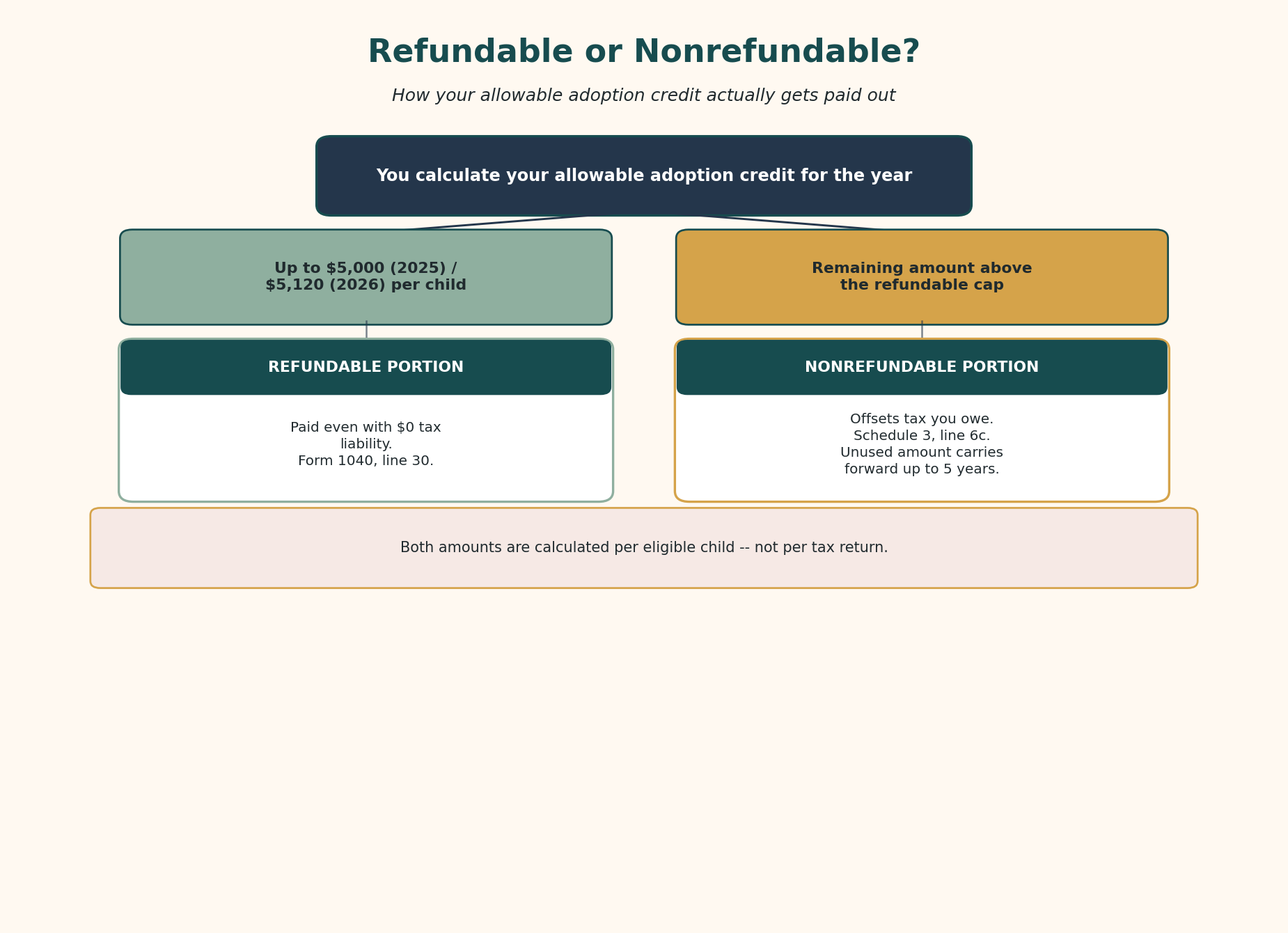
This is the most consequential recent change to the adoption tax credit, and it determines whether a family with a modest tax bill actually sees cash back, or merely a credit they can’t fully use.
What Changed Starting in Tax Year 2025
Before 2025: Fully Nonrefundable
For many years leading up to 2025, the entire adoption tax credit was nonrefundable: it could reduce your tax liability to zero, but it could never generate a refund beyond what you’d otherwise overpaid through withholding or estimated payments. Any amount of credit left over after reducing your tax liability to zero simply carried forward to future years — valuable, but only if you eventually had enough tax liability to absorb it within the carryforward window.
2025 Onward: Partially Refundable
Starting with tax year 2025, up to $5,000 per eligible child (rising to $5,120 for 2026, and indexed for inflation in future years) is refundable — meaning the IRS pays it to you even if your tax liability is zero, the same way the refundable portion of the Child Tax Credit or the Earned Income Tax Credit works.
How the Split Works in Practice
The Refundable Portion
The refundable portion is calculated per eligible child, capped at $5,000 (2025) or $5,120 (2026), and is not reduced simply because your tax liability is low — that’s the entire point of refundability. It’s entered on Form 1040 (or 1040-SR/1040-NR) line 30, flowing through the same mechanism used for other refundable credits, rather than through Schedule 3.
The Nonrefundable Remainder
Whatever is left of your allowable credit above the refundable cap is nonrefundable: it reduces your tax liability, potentially to zero, but any amount beyond that is not paid out as a refund — it carries forward instead (Section 10). This nonrefundable portion flows through Schedule 3, line 6c, to your Form 1040.
Why the Distinction Matters for Lower-Income Adoptive Families
Tax Liability vs. Tax Refund
Before 2025, a family with, say, $4,000 in total federal tax liability for the year and a $17,280 adoption credit could only use $4,000 of it that year — the rest carried forward, waiting for future tax liability to absorb it. Under the current rule, that same family can receive up to $5,000 (2025) as a refund regardless of their $4,000 liability, plus use whatever liability they do have against the nonrefundable remainder, with any leftover nonrefundable amount still carrying forward.
A Worked Example Comparing Both Portions
Take a family with $17,280 in qualified expenses in 2025, no phase-out reduction, and $3,000 in total federal tax liability before credits. Under current rules: up to $5,000 is refundable regardless of liability. The remaining $12,280 is nonrefundable; it can offset their $3,000 liability (bringing it to $0), and the unused $9,280 carries forward for up to five years. Total immediate benefit in year one: $5,000 refundable plus $3,000 of tax liability offset, for $8,000 of real value realized immediately, with $9,280 still available in future years.
Key Takeaways
- Up to $5,000 per child (2025) or $5,120 per child (2026) of the credit is refundable — paid even with zero tax liability — a change that took effect starting with tax year 2025.
- The refundable portion goes on Form 1040 line 30; the nonrefundable remainder goes through Schedule 3, line 6c.
- This change specifically benefits lower- and middle-income adoptive families who previously had to carry forward most of the credit without ever converting it to cash.
Carryforward Rules: What Happens If the Credit Exceeds Your Tax Liability
Even with the new refundable portion, most families with substantial qualified adoption expenses will still have a nonrefundable amount larger than their tax liability in the year they claim it. That’s what the five-year carryforward rule is for.
The Five-Year Window
How Carryforward Is Calculated Year to Year
Any nonrefundable credit amount you can’t use in the current year because it exceeds your tax liability carries forward to the next tax year, where it’s added to (and used before) any new adoption credit you might be calculating that year, then applied against that year’s tax liability. This repeats for up to five years total from the year the credit was first calculated.
What Happens If You Still Haven’t Used It After Five Years
If any portion of the nonrefundable credit remains unused after the five-year carryforward window closes, it’s forfeited — it cannot be claimed in year six or beyond, and it cannot be converted to a refund at that point. This is a real planning consideration for families with high qualified expenses and modest, stable tax liability: the math is worth running in advance rather than discovering a shortfall after the window has closed.
Carryforward and the Refundable Portion
Only the Nonrefundable Piece Carries Forward
The refundable portion ($5,000 for 2025, $5,120 for 2026, per child) is paid out in the year it’s claimed and does not carry forward — there’s no mechanism to “save” unused refundable credit for a future year, because by definition it’s already been paid regardless of liability.
Ordering Rules: Current-Year Credit vs. Carryforward
When you have both a carryforward amount from a prior year and a newly calculated credit in the current year, the form’s worksheets apply carryforward amounts according to the ordering rules in the Form 8839 instructions for that year — generally using older carryforward amounts before newer ones, so nothing expires prematurely if it can be avoided. A tax professional preparing a multi-year adoption claim should walk you through exactly how your specific carryforward is being sequenced.
Practical Planning Around Carryforward
Why High Total Adoption Costs Can Take Multiple Tax Years to Fully Use
A family with $17,280+ in qualified expenses in a single child’s adoption, combined with a modest annual tax liability (common for younger families, single-income households, or families carrying other debt), may need several tax years to fully absorb the nonrefundable portion of the credit. This is normal and expected — it’s exactly what the five-year window exists to accommodate — but it means the credit’s true value to your household may not show up as a single lump sum in one filing season.
Keeping Track Across Years
Keep a simple running log of how much credit you’ve claimed, how much carried forward, and how much remains, year by year. Tax software and professional preparers generally track this automatically from year to year on the same return, but if you switch preparers or software, bring your prior-year Form 8839 and credit carryforward worksheet with you — this is one of the most common points where a carryforward amount gets lost or miscalculated.
Key Takeaways
- Unused nonrefundable credit carries forward for up to five years; any amount still unused after that window closes is permanently forfeited.
- Only the nonrefundable portion carries forward — the refundable portion is paid in full in the year claimed, with nothing left to carry.
- Families with high qualified expenses and modest tax liability should run the multi-year math in advance and keep careful year-to-year records to avoid losing carryforward amounts when switching preparers.
Employer-Provided Adoption Assistance: The Coordination Rule
Many employers offer adoption-assistance benefits as part of their compensation package — direct financial assistance toward adoption costs, paid through a formal program. For the broader landscape of employer adoption benefits and how common they are, see our adoption cost guide; here, the focus is narrowly on how these benefits interact with your taxes.
| Feature | Adoption tax credit (IRC Sec. 23) | Employer-assistance exclusion (IRC Sec. 137) |
|---|---|---|
| What it does | Reduces your federal tax liability dollar-for-dollar | Excludes employer-paid adoption benefits from your taxable income |
| 2025 maximum per child | $17,280 | $17,280 |
| 2026 maximum per child | $17,670 | $17,670 |
| Income phase-out range | Same MAGI range applies ($259,190–$299,190 for 2025; $265,080–$305,080 for 2026) | Same MAGI range applies |
| Where it shows on your return | Form 8839, Part II; flows to Schedule 3 line 6c (nonrefundable) and Form 1040 line 30 (refundable) | Form 8839, Part III; excluded amount reported via W-2 Box 12, Code T |
| Can you use both on the same expense? | No — the combined cap applies across both benefits together for the same child | No — same combined cap |
What an Employer Adoption-Assistance Program Is, for Tax Purposes
The Written-Plan Requirement
For an employer’s adoption benefit to qualify for tax-free treatment under this exclusion, it generally must be provided under a separate written plan set up by the employer that meets specific nondiscrimination and eligibility requirements — an informal or ad hoc payment from an employer doesn’t automatically qualify the same way.
How It Shows Up on Your W-2
Qualifying employer-provided adoption benefits are reported in Box 12 of your Form W-2 with Code T. This amount is not included in your Box 1 taxable wages (to the extent it’s excludable), which is how the exclusion actually delivers its tax benefit — it never shows up as taxable income in the first place, rather than being deducted after the fact.
The No-Double-Dipping Rule
Same Dollar, Same Expense, One Benefit
You cannot claim the adoption tax credit for the same dollar of expense that was already excluded from your income through an employer’s adoption-assistance program. The combined dollar cap in Table 1 above applies across both benefits together for a given child — not $17,280 (or $17,670) for the exclusion and a separate $17,280 (or $17,670) for the credit.
Claim the Exclusion First, Then the Credit on What’s Left
Mechanically, you apply the employer exclusion to your qualified expenses first, and then calculate the credit only on whatever qualified expenses remain unreimbursed, up to the remaining room under the combined cap. Form 8839 walks through this in a specific order (Part III before Part II in practical calculation terms, even though Part II appears first on the form), and getting this sequence wrong is one of the more common preparation errors — see Section 15.
Worked Example: Combining Employer Benefits and the Credit
The Numbers
Say a family incurs $20,000 in qualified adoption expenses in 2025, finalized in 2025, and their employer’s adoption-assistance program excludes $6,000 of that from their taxable income (reported via W-2 Box 12, Code T). The combined cap for 2025 is $17,280 per child. After the $6,000 exclusion, $11,280 of room remains under the combined cap ($17,280 − $6,000).
The Order of Operations
The family’s qualified expenses ($20,000) exceed both the remaining room ($11,280) and the original combined cap, so the exclusion uses its full $6,000, and the credit is then available on up to $11,280 of the remaining expenses (still subject to the MAGI phase-out if applicable) — not on the full $14,000 of expenses left unreimbursed by the employer benefit. The extra $2,720 of expense above the combined cap ($14,000 remaining expense minus $11,280 of available credit room) simply doesn’t generate additional federal tax benefit under this credit.
Key Takeaways
- The employer-provided adoption-assistance exclusion and the adoption tax credit share one combined per-child dollar cap — they are not two separate full allowances.
- Employer benefits must come through a qualifying written plan and are reported via W-2 Box 12, Code T, to get the tax-free exclusion treatment.
- Always apply the employer exclusion first, then calculate the credit only on remaining qualified expenses, up to whatever room is left under the combined cap.
Timing Rules: Domestic, International, and Failed Adoption Attempts
This is the single most misunderstood part of the adoption tax credit, and it’s the one most likely to cause a family to claim expenses in the wrong tax year — or to wrongly assume no credit is available at all. The rule depends entirely on whether the child is domestic-status or foreign-status under the definition in Section 5, and whether and when the adoption becomes final.
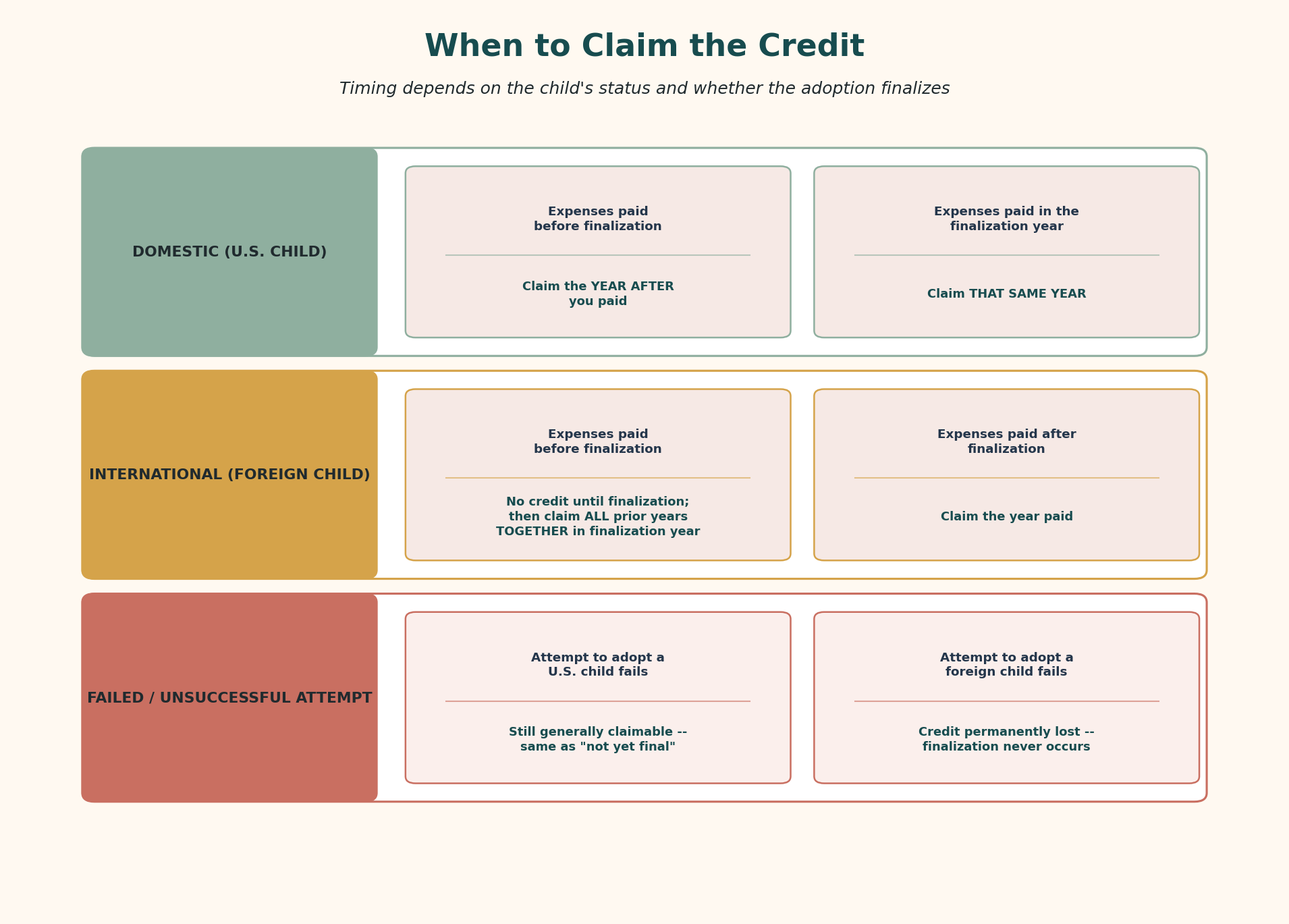
| Adoption type | If you pay expenses… | …then claim the credit in |
|---|---|---|
| Domestic (U.S. child) | Any year before the year the adoption becomes final | The year after the year of payment |
| Domestic (U.S. child) | The year the adoption becomes final | The year the adoption becomes final |
| Domestic (U.S. child) | Any year after the year the adoption becomes final | The year of payment |
| Foreign (non-U.S. child) | Any year before the year the adoption becomes final | The year the adoption becomes final (not before) |
| Foreign (non-U.S. child) | The year the adoption becomes final | The year the adoption becomes final |
| Foreign (non-U.S. child) | Any year after the year the adoption becomes final | The year of payment |
| Failed/unsuccessful attempt to adopt a U.S. child | Any year | Treated the same as a domestic adoption “not yet final” — the year after payment |
| Failed/unsuccessful attempt to adopt a foreign child | Any year | No credit available — foreign adoptions require finalization, with no exception for failed attempts |
Domestic Adoptions (U.S. Children)
Expenses Paid Before Finalization
If you pay qualified expenses in a year before the year your domestic adoption becomes final, you claim those expenses on the following year’s return — not the year you paid them, and not the year of finalization if finalization happens later still. For example, home study and agency fees paid in 2025 for an adoption that doesn’t finalize until 2027 would be claimed on your 2026 return (the year after payment), not held until 2027.
Expenses Paid in or After the Year of Finalization
Expenses paid in the same year the adoption becomes final are claimed that same year. Expenses paid in a year after finalization (post-finalization legal cleanup costs, for instance) are claimed in the year they’re actually paid — the simplest of the three sub-rules.
International (Foreign) Adoptions
No Credit Until Finalization
For a foreign-status child, you cannot claim any adoption credit at all — for any year’s expenses — until the adoption actually becomes final. This is a hard rule with no partial-credit exception: expenses paid in 2024, 2025, and 2026 for an international adoption that doesn’t finalize until 2027 all wait until the 2027 return.
What Happens to Expenses Paid in Earlier Years
Once the foreign adoption does finalize, you claim all qualified expenses paid in that year and in every prior year, aggregated together, on the return for the year of finalization — subject, of course, to the dollar cap and phase-out rules in effect for that finalization year. This is why international adoption families sometimes see a single very large claim in one tax year rather than smaller claims spread across several years.
Failed or Unsuccessful Adoption Attempts
Domestic Failed Attempts: You May Still Be Able to Claim
If you paid qualified expenses attempting to adopt a child who is a U.S. citizen or resident and that specific attempt was unsuccessful (a birth parent changes their mind before consent becomes irrevocable, a match falls through, or any other disruption), those expenses are treated the same as expenses for a domestic adoption that simply hasn’t finalized yet — meaning you can generally still claim them, following the “year after payment” rule above, even though that particular adoption never happened.
Foreign Failed Attempts: The Credit Is Lost
If the same kind of disruption happens during an attempt to adopt a foreign-status child, the outcome is very different: because no credit is available for a foreign-status child until finalization, and a failed attempt by definition never finalizes, no credit is ever available for those specific expenses. This asymmetry — a real financial difference between a failed domestic attempt and a failed international attempt — is worth understanding before you commit significant funds to an international adoption process, and it’s a factor some families weigh when comparing domestic and international adoption costs up front.
Key Takeaways
- Domestic adoption expenses paid before finalization are claimed the year after payment; expenses paid in or after the finalization year are claimed in the year paid.
- Foreign adoption expenses cannot be claimed at all until the adoption finalizes — then all prior years’ expenses are claimed together in the finalization year.
- A failed domestic adoption attempt generally still allows the credit (following the “not yet final” timing rule); a failed international adoption attempt permanently forfeits the credit for those expenses, since foreign-status adoptions require finalization with no exception.
How to Claim the Credit: Form 8839 Step by Step
Claiming the adoption tax credit means completing and attaching Form 8839 to your federal income tax return. The form has three parts, and understanding what each one does — and in what order to actually work through them — makes the filing process far less confusing than it looks at first glance.
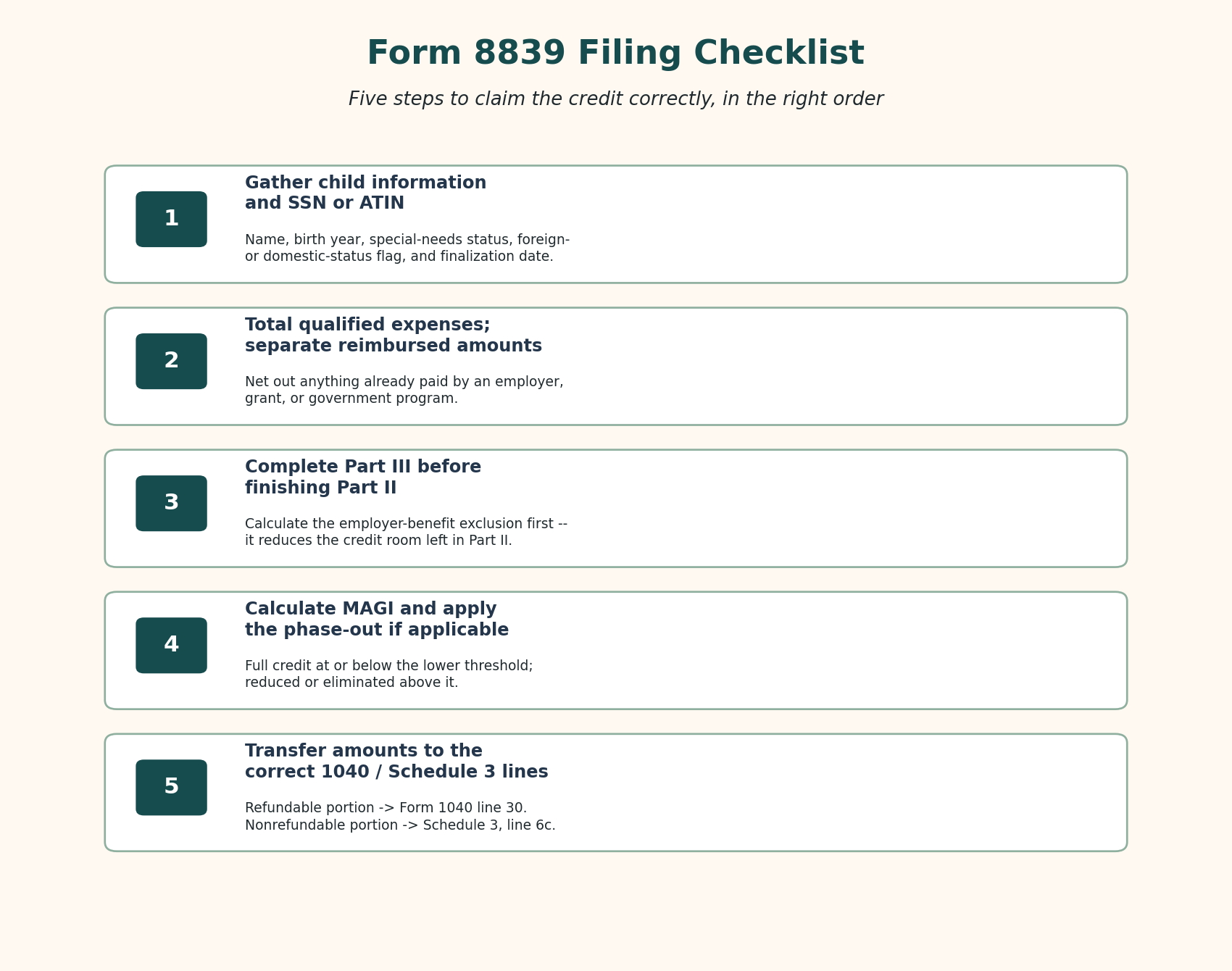
Before You Start: What You Need on Hand
Child Information
You’ll need each eligible child’s name, year of birth, and Social Security Number or Adoption Taxpayer Identification Number (ATIN) — see Section 14 for what to do if you don’t have a permanent SSN yet. You’ll also need to know the child’s domestic or foreign status and, if finalized, the exact finalization date.
Expense Records and Employer Benefit Statements
Pull together a total of qualified adoption expenses paid during the relevant year (and, for foreign adoptions reaching finalization, all prior years as well), plus your W-2 to identify any Box 12, Code T employer-provided adoption benefits already excluded from your income.
Walking Through the Form’s Three Parts
Part I — Information About Your Eligible Child or Children
Part I collects the identifying information above for each eligible child, in separate columns — name, year of birth, whether the child has special needs, whether the child is a foreign-status child, and the finalization date if applicable. This section sets up everything that follows in Parts II and III.
Part II — Adoption Credit
Part II calculates your actual credit: starting from the per-child maximum for the tax year, subtracting any amount already claimed for that same child in a prior year (since the dollar cap is cumulative per child across the years you claim expenses for a given adoption, not reset annually), subtracting any employer-exclusion amount already used for that child, applying the MAGI phase-out if applicable, and then splitting the result into its refundable and nonrefundable components.
Part III — Employer-Provided Adoption Benefits
Part III calculates how much of your employer-provided adoption benefit (from W-2 Box 12, Code T) can actually be excluded from income, using a similar phase-out calculation. Although Part III appears after Part II on the printed form, its result feeds into the Part II calculation, so most preparers complete Part III’s figures first in practice.
Where It Connects to Your Form 1040
The Nonrefundable Portion
The nonrefundable portion of your credit, after the Credit Limit Worksheet in the instructions confirms it doesn’t exceed your actual tax liability, is entered on Schedule 3 (Form 1040), line 6c, which then flows into your total credits on Form 1040.
The Refundable Portion
The refundable portion is entered directly on Form 1040, 1040-SR, or 1040-NR, line 30 — bypassing Schedule 3 entirely, consistent with how other refundable credits are reported.
Common Filing Mistakes on Form 8839
Missing or Mismatched Social Security Numbers
A missing, incorrect, or mismatched SSN/ATIN for the eligible child is one of the most common reasons a return gets flagged for review or a refund gets delayed. Double-check this against the child’s Social Security card or ATIN confirmation letter before filing, not against memory.
Claiming in the Wrong Tax Year
Given how counterintuitive the timing rules in Section 12 are, claiming domestic expenses in the year paid (instead of the year after) or claiming foreign expenses before finalization are the two most common timing errors. Both can require an amended return to correct, which delays the benefit further.
Key Takeaways
- Form 8839 has three parts: child information (Part I), the credit calculation (Part II), and the employer-benefit exclusion (Part III) — complete Part III’s figures before finishing Part II, even though Part II appears first.
- The nonrefundable portion flows through Schedule 3, line 6c; the refundable portion goes directly on Form 1040, line 30.
- SSN/ATIN errors and wrong-tax-year claims are the two most common — and most delay-prone — filing mistakes on this form.
| Part | What it covers | Feeds into |
|---|---|---|
| Part I | Eligible child identifying information: name, birth year, SSN/ATIN, special-needs status, foreign-status flag, finalization date | Sets up Parts II and III |
| Part II | Adoption credit calculation: per-child cap minus prior-year amounts and employer exclusion, MAGI phase-out, refundable/nonrefundable split | Schedule 3, line 6c (nonrefundable); Form 1040 line 30 (refundable) |
| Part III | Employer-provided adoption benefits exclusion calculation, using the same MAGI phase-out | Reduces the combined cap available in Part II; excluded amount already reflected via W-2 Box 12, Code T |
Record-Keeping: What Documentation You Need and How Long to Keep It
Good records don’t just protect you in the event of an IRS inquiry — they’re what lets you actually calculate the credit correctly in the first place, especially across the multi-year claims that domestic pre-finalization timing and foreign-adoption aggregation (Section 12) both require.
Documents to Collect as You Go
Financial Records
Keep itemized invoices and proof of payment (bank or credit card statements, cancelled checks, receipts) for every adoption-related expense, categorized by type (agency fee, legal fee, travel, home study, etc.) and date paid. If any portion was reimbursed by an employer, a grant, or any other source, keep that documentation too, since you’ll need to net it out.
Legal and Agency Documents
Keep your adoption agency or attorney’s engagement agreement and fee schedule, the final adoption decree or order, and — for special-needs adoptions — the state or tribal special-needs determination letter described in Section 7. For international adoptions, also keep the foreign country’s adoption decree and any U.S. re-adoption or recognition order.
How Long to Keep Everything
The General Three-Year Rule, and Why Adoption Records Deserve Longer
The IRS’s general statute of limitations for auditing a return is three years from filing (longer in specific circumstances), which is the baseline most tax guidance cites for how long to keep supporting records. For adoption-credit records specifically, keep everything substantially longer than that baseline — ideally for as long as you might still be using a carryforward amount tied to that adoption, plus the standard look-back period after that.
Carryforward Years Extend the Clock
Because the nonrefundable portion of the credit can carry forward for up to five years, and because the IRS could in principle examine any year in which you claimed a carryforward amount, the practical record-retention window for a single adoption’s paperwork can stretch to eight years or more after the expenses were originally paid. Treat your adoption-expense file as a single multi-year package, not something to discard after the first year you file.
Organizing Records for Multi-Year Claims
A Simple Year-by-Year Expense Log
Keep a running spreadsheet or document listing every qualified expense by date, amount, category, and which tax year it was (or will be) claimed in, along with running totals against the per-child dollar cap. This single document is often more useful to a tax preparer than a folder of individual receipts, because it shows the overall picture at a glance.
What to Hand Your Tax Preparer
At minimum, bring your expense log, any employer W-2 Box 12 Code T amounts, prior-year Form 8839 copies (if this isn’t your first year claiming for this child), the special-needs determination letter if applicable, and the finalization decree. A preparer working from complete records the first time avoids the amended-return corrections described in Section 15.
Key Takeaways
- Keep itemized financial records, agency/legal documents, and (if applicable) the special-needs determination letter and foreign adoption decree, organized by category and date.
- Plan to keep adoption-credit records for well beyond the standard three-year audit window — carryforward years can extend the practical retention period to eight years or more.
- A single running expense log, handed to your preparer alongside prior-year Form 8839 copies, is the single most useful document for a clean multi-year claim.
Common Mistakes That Trigger IRS Scrutiny or Delay Your Refund
Most problems with adoption-credit claims aren’t fraud — they’re honest timing and documentation errors, made more likely by how counterintuitive some of this credit’s rules are. Here are the ones that come up most often.
Mistakes With the Child’s Information
Missing SSN or ATIN
Filing without a valid SSN or ATIN for the eligible child is a near-guaranteed way to have the claim rejected or delayed. If you don’t yet have a permanent SSN for a newly adopted child, an ATIN (applied for using Form W-7A) is the intended interim solution specifically for this situation — don’t simply omit the identifying number and hope it processes.
Confusing “Final” With “Placed”
Placement (the child physically joining your home, pending legal finalization) and legal finalization (the court order making the adoption permanent) are different events with different tax consequences under Section 12’s timing rules. Using the placement date where the finalization date is required — or vice versa — is a common and avoidable error.
Mistakes With Expenses
Double-Claiming Employer-Reimbursed Costs
Claiming the full amount of an expense on Form 8839 Part II without netting out the portion already excluded via an employer’s program (Part III) is one of the most common substantive errors, and it’s exactly the kind of mismatch that can surface through W-2 matching on the IRS’s end.
Claiming Expenses for a Spouse’s Child or Surrogacy
As covered in Section 4, stepparent-adoption and surrogacy-arrangement expenses are categorically excluded — claiming them anyway, even in good faith, is a straightforward disallowance risk.
Mistakes With Timing and Carryforward
Claiming in the Wrong Year
Given the counterintuitive domestic “year after payment” rule and the foreign “wait until finalization” rule in Section 12, claiming expenses in the year paid rather than the year the rule actually requires is probably the single most common substantive mistake on this form.
Losing Track of Carryforward Amounts
Failing to correctly carry forward an unused nonrefundable amount from a prior year — especially when switching tax preparers or software between years — can mean losing access to credit you’re still legally entitled to use. Always reconcile your current year’s starting carryforward figure against your prior year’s Form 8839 and carryforward worksheet.
Key Takeaways
- SSN/ATIN errors, confusing placement with finalization, and double-claiming employer-reimbursed expenses are the most common substantive mistakes on an adoption-credit claim.
- Wrong-tax-year claims — driven by the counterintuitive domestic and foreign timing rules — are probably the single most frequent error overall.
- Reconcile your carryforward balance against last year’s return every year, especially after switching preparers or software.
How the Adoption Tax Credit Fits Into Your Overall Adoption Budget
The adoption tax credit is a powerful offset, but it’s not a source of upfront cash, and understanding that distinction matters for realistic budgeting, not just for filing correctly after the fact.
The Credit Offsets Costs, It Doesn’t Cover Them Upfront
Timing Mismatch: You Pay Now, the Credit Arrives Later
Agency fees, legal fees, and (for international adoptions) travel costs are typically due during the adoption process itself — often well before you file the tax return that will eventually claim the credit, and sometimes more than a year before, given the domestic “year after payment” rule. The credit arrives as reduced tax liability or a refund months or years after you actually spent the money.
Why Cash-Flow Planning Still Matters
Because of this timing mismatch, families still need a realistic plan for covering costs as they come due — savings, a reasonable payment timeline with the agency, and an honest look at grants, employer benefits, and other financial assistance that arrive on a different schedule than a tax credit does.
Where to Go for the Full Cost Picture
Agency, Legal, and Travel Costs by Adoption Type
For the actual dollar ranges adoptive families report paying for domestic infant adoption, international adoption, and foster-care adoption — including agency fees, attorney fees, home study costs, and travel — see our dedicated adoption cost guide. This article intentionally does not repeat that cost breakdown; its job is the tax treatment of those costs once you’ve incurred them.
Grants and Other Financial Assistance
Adoption grants, employer-assistance programs generally (beyond the narrow tax-coordination point covered in Section 11), and other financial-assistance resources are also covered in full in our adoption cost guide, which is the right place to start if you’re trying to close a funding gap rather than understand the tax mechanics of a gap you’ve already closed.
Building a Realistic Budget Timeline
Before You Start
Before committing to an agency or program, map out roughly when each major cost will come due against your own cash flow, and separately map out when you realistically expect to see the tax credit’s benefit, given the timing rules in Section 12. These are two different timelines, and conflating them is a common source of mid-process financial stress.
During the Process
As you go, keep the expense log described in Section 14 updated in real time rather than reconstructing it later — this also makes it far easier to see, mid-process, whether you’re approaching the per-child dollar cap or the MAGI phase-out range before it’s too late to plan around either.
After Finalization
Once finalization happens, confirm with your tax preparer which tax year each piece of your expense history actually gets claimed in (Section 12), and whether any carryforward planning (Section 10) is needed given your household’s typical tax liability.
Key Takeaways
- The credit offsets your federal tax bill; it does not provide upfront cash during the adoption process itself, so cash-flow planning for actual due dates still matters.
- For the dollar-by-dollar cost picture this credit is offsetting, see our companion adoption cost guide — this article deliberately does not duplicate that breakdown.
- Map your spending timeline and your tax-benefit timeline separately; they rarely line up, and assuming they will is a common source of mid-process financial stress.
Special Situations: Multiple Children, Divorce, Military, and State Credits
A handful of situations change how the credit applies in ways worth knowing about before they come up, rather than discovering them at filing time.
Adopting Multiple Children (Not Siblings as One “Case”)
Separate Limits Per Child
As covered in Section 5, every eligible child — even siblings adopted together in a single legal proceeding — has their own separate dollar cap, MAGI phase-out application, and refundable/nonrefundable split. A family adopting a sibling group of three in 2026 could have up to $53,010 in combined maximum credit available (three times $17,670), subject to each child’s own expense allocation and the family’s single MAGI calculation applied to each child’s phase-out.
Separate Timing Per Child
If a family adopts children in separate, unrelated adoptions in different years — say, a domestic adoption finalized in 2025 and an international adoption finalized in 2027 — each child’s claim follows its own timing rule from Section 12 completely independently of the other.
Divorce, Separation, and Who Claims the Credit
Only One Taxpayer (or Joint Filers) Claims Per Child
The adoption tax credit cannot be split or claimed twice for the same child by two different taxpayers in the same year. For a married couple filing jointly, this isn’t an issue; for separated or divorced co-parents who jointly adopted before separating, or for unmarried co-adoptive parents, determining who claims the credit (and in what proportion, if expenses were shared) is a question worth resolving with a tax professional and, if necessary, documented in any separation or custody agreement.
Coordinating With a Co-Parent or Ex-Spouse
If both former partners paid qualified expenses toward the same child’s adoption, keep clear records of who paid what, since the IRS doesn’t automatically know how to split a joint expense between two separate future tax returns — that allocation needs to be determined and supported by your own records.
Military Families and Adoption Reimbursement
Department of Defense Adoption Reimbursement
Some military families are eligible for a separate Department of Defense adoption reimbursement benefit, administered outside the IRS tax system entirely.
Coordinating Military Reimbursement With the Federal Credit
Just as with employer-provided civilian adoption-assistance benefits (Section 11), any DoD adoption reimbursement that covers a specific expense would reduce the amount of that same expense still available for the federal adoption tax credit, following the same no-double-benefit principle. Confirm the exact coordination mechanics with a military tax assistance office or a tax professional familiar with military benefits before filing.
State Adoption Tax Credits and Deductions
Some States Offer Their Own Credit
A number of states offer their own adoption-related tax credit or deduction on the state return, separate from and in addition to this federal credit. The specific states offering one, their dollar amounts, and their eligibility rules vary and change over time.
State Credit Doesn’t Reduce Your Federal Credit Eligibility
As a general matter, claiming a state-level adoption credit or deduction does not, by itself, reduce your eligibility for the federal credit described throughout this guide — the two systems are independent.
Key Takeaways
- Each eligible child — even siblings adopted together — has their own separate dollar cap, phase-out, and timing determination.
- Only one taxpayer (or one set of joint filers) can claim the credit per child; separated or divorced co-parents need their own documentation and tax guidance to allocate shared expenses correctly.
- Military DoD adoption reimbursement and state-level adoption credits both exist alongside the federal credit, but their specific rules vary and change — confirm directly rather than assuming.
Glossary of Adoption Tax Credit Terms
Quick definitions for the terms used throughout this guide, in plain language.
Core Credit Terms
Adoption Tax Credit
The federal tax credit under IRC Section 23 for qualified adoption expenses paid to adopt an eligible child, subject to an annually adjusted dollar cap, an income phase-out, and (starting with tax year 2025) a partially refundable structure.
Qualified Adoption Expenses
Reasonable and necessary adoption fees, attorney and court costs, travel expenses, and other costs whose principal purpose is the legal adoption of an eligible child, excluding anything reimbursed from another source, surrogacy costs, or stepparent-adoption costs.
Eligible Child
For this credit specifically: a child under age 18, or a person of any age physically or mentally unable to care for themselves. This definition is separate from the “qualifying child” test used for dependency or the Child Tax Credit elsewhere on your return.
Income and Phase-Out Terms
Modified Adjusted Gross Income (MAGI)
For this credit, generally your Form 1040 adjusted gross income, increased by specific foreign-income exclusions (foreign earned income, Puerto Rico income exclusion, American Samoa income exclusion) if applicable.
Phase-Out Range
The band of MAGI (e.g., $259,190–$299,190 for 2025) within which the credit is gradually reduced from its full amount to zero.
Nonrefundable Credit
A credit that can reduce your tax liability to zero but cannot generate a payment beyond that; any unused nonrefundable amount for this credit carries forward for up to five years.
Refundable Credit
A credit (or, here, a portion of a credit) that is paid out even if your tax liability is zero — new for the adoption credit starting with tax year 2025, up to $5,000 per child (2025) or $5,120 per child (2026).
Process and Documentation Terms
Form 8839
The IRS form used to calculate and claim both the adoption tax credit and the employer-provided adoption benefits exclusion, attached to your Form 1040.
Carryforward
The mechanism allowing an unused nonrefundable credit amount to be applied against tax liability in a future year, for up to five years total.
ATIN (Adoption Taxpayer Identification Number)
A temporary taxpayer identification number, applied for via Form W-7A, used for a child in a pending domestic adoption who doesn’t yet have a Social Security Number.
Finalization
The point at which a court order makes an adoption legally permanent — distinct from placement, and the key event that determines timing under Section 12’s rules.
Re-Adoption
The process (and associated qualified expense) of finalizing or confirming a foreign adoption under U.S. state law after the adoption is completed abroad.
Special Categories
Special Needs Adoption (Credit Definition)
A child determined by a state (or, since 2025, a tribal government) to be unable to return to their birth family’s home and unlikely to be adopted without assistance — a determination, not a specific diagnosis — which unlocks the full credit amount regardless of actual expenses.
Domestic vs. Foreign Adoption (Credit Definition)
Based on the child’s citizenship/residency status at the start of the adoption effort — not geography or agency type — and the single biggest factor determining which timing rule in Section 12 applies.
Employer-Provided Adoption Assistance (Section 137 Exclusion)
Employer-paid adoption benefits provided under a qualifying written plan, excludable from taxable income up to the same combined per-child cap that applies to the credit itself, reported via W-2 Box 12, Code T.
One Big Beautiful Bill Act (OBBBA)
2025 federal tax legislation that made a portion of the adoption tax credit permanently (and inflation-indexed) refundable, starting with tax year 2025.
Frequently Asked Questions
These questions cover the long tail of specific situations that come up around the adoption tax credit — organized by theme, and written to avoid repeating anything already answered in full above.
Getting Started With the Credit
Do I need to apply for the adoption tax credit separately from my taxes?
No. There’s no separate application process. You claim it directly on your federal income tax return by completing and attaching Form 8839, the same way you’d claim any other tax credit.
Can I claim this credit if I haven’t finalized the adoption yet?
It depends on whether the child is domestic-status or foreign-status, per Section 12. A domestic (U.S. citizen or resident) child’s pre-finalization expenses are generally claimable, following the “year after payment” rule. A foreign-status child’s expenses cannot be claimed at all until finalization.
Eligibility Basics
Does my income completely disqualify me if I’m a high earner?
Only if your MAGI is at or above the upper phase-out threshold for the relevant tax year ($299,190 for 2025; $305,080 for 2026). Below that, you may still receive a partial credit if you’re within the phase-out range, or the full credit if you’re below the lower threshold.
Can both parents in a two-parent household each claim a separate credit for the same child?
No. Only one credit is available per eligible child, claimed by the taxpayer or joint filers who adopted that child — it cannot be duplicated across two separate returns for the same child in the same year.
Qualified Expenses: What Counts
Do adoption education classes or required training courses count as qualified expenses?
If required as part of the formal adoption process and directly related to the legal adoption, these can generally qualify, similar to home study costs. Keep the invoice and a note of the requirement in your records.
Can I count the cost of baby supplies or a nursery as a qualified expense?
No. Qualified expenses are tied specifically to the legal adoption process itself (fees, legal costs, travel, home study) — general child-rearing purchases like a crib or baby supplies are not qualified adoption expenses under this credit.
Qualified Expenses: What Doesn’t Count
If my employer reimburses only part of an expense, can I claim the rest?
Yes — you claim the credit only on the unreimbursed portion of that expense, up to the remaining room under the combined per-child cap described in Section 11.
Can I claim expenses paid with adoption grant money?
No. Expenses covered by a grant are treated the same as any other reimbursed expense — they don’t qualify for the credit, since the no-double-benefit rule applies across all reimbursement sources, not just employer benefits.
Special Needs Adoption Questions
Who decides whether my child has “special needs” for this credit?
A state government (or, since 2025, a tribal government) with jurisdiction over the child’s adoption makes this determination — not the IRS, and not a private medical provider acting alone. See Section 7.
Can an international adoption ever qualify for the special-needs flat credit?
Generally no — the special-needs determination described here applies to children who are U.S. citizens or residents, consistent with how the foster-care special-needs adoption system works.
Income and MAGI Phase-Out
Does the phase-out apply separately to each child, or once per household?
The phase-out percentage is based on your single household MAGI, but it’s applied to each child’s own credit calculation separately — so a high-MAGI household in the phase-out range would see the same percentage reduction applied to each eligible child’s claim.
If my income changes significantly from the year I paid expenses to the year I claim them, which year’s MAGI matters?
The phase-out uses your MAGI for the tax year in which you’re claiming the credit — which, per Section 12’s timing rules, isn’t always the same year you paid the expense. This is one more reason the timing rules matter for real dollar outcomes, not just paperwork mechanics.
Refundable Portion Questions
Do I get the refundable portion automatically, or do I have to request it?
It’s calculated automatically as part of completing Form 8839 correctly and flows to Form 1040 line 30 — there’s no separate request or election needed, but it does need to be calculated correctly on the form itself.
Does the refundable portion count as taxable income in a future year?
No. A federal tax credit or refund of this kind is not itself taxable income in a later year.
Nonrefundable Portion and Carryforward
Do I need to do anything special to carry forward an unused credit, or does it happen automatically?
Tax software and professional preparers generally calculate and carry forward the unused amount automatically from year to year on the same return, using the carryforward worksheet in the Form 8839 instructions, but you (or your preparer) do need to correctly transfer that figure if you switch software or preparers.
What happens to an unused carryforward amount if I get divorced during the five-year window?
This depends on who originally claimed the credit and how it’s allocated going forward; it’s a genuinely fact-specific question best resolved with a tax professional, ideally addressed explicitly in any separation agreement.
Employer-Provided Adoption Benefits
Is my employer required to offer an adoption-assistance program?
No. Offering an adoption-assistance program is entirely voluntary for employers; the tax exclusion described in Section 11 only applies if your employer chooses to offer one as a qualifying written plan.
How do I know if my employer’s program qualifies for the tax exclusion?
Ask your HR or benefits department directly whether the program is structured as a written plan intended to qualify under the relevant tax code section, and confirm the amount is reported via W-2 Box 12, Code T at year-end.
Domestic Adoption Timing
I paid agency fees in 2024 for a domestic adoption that finalized in 2026. When do I claim them?
Following the domestic timing rule in Section 12, expenses paid in a year before finalization are claimed the year after payment — so those 2024 expenses would be claimed on your 2025 return, not held until the 2026 finalization year.
What if I paid expenses in the exact same year the adoption finalized?
Those are claimed in that same finalization year — the simplest case under the domestic timing rule.
International/Foreign Adoption Timing
My international adoption has taken four years and isn’t final yet. Have I lost the ability to claim any of those expenses?
No — for a foreign-status child, all qualified expenses paid in every year leading up to finalization are preserved and claimed together, in the year finalization finally occurs. You haven’t lost anything; you simply haven’t reached the year you’re allowed to claim it yet.
Does the per-child dollar cap for a multi-year international adoption use the cap from the year I paid each expense, or the year of finalization?
The cap that applies is generally the one in effect for the year you’re actually claiming the credit — the finalization year — even though the underlying expenses may have been paid in earlier years with different caps.
Failed or Disrupted Adoption Attempts
My domestic adoption attempt failed after I’d already paid several thousand dollars in legal and agency fees. Can I still claim anything?
Generally yes, following the “not yet final” domestic timing rule — those expenses are typically claimed the year after you paid them, the same as any other pre-finalization domestic expense, even though that particular attempt didn’t succeed.
If I have multiple failed domestic attempts before a successful one, do all the failed attempts’ expenses count toward the same child’s cap?
Expenses connected to failed attempts to adopt a specific eligible child, and expenses for the eventual successful adoption of that same child, would generally be tracked together against that one child’s per-child cap.
Form 8839 Mechanics
Do I need to file Form 8839 every year, or only the year I first claim the credit?
You generally file it for any year in which you’re claiming new qualified expenses, using carryforward from a prior year, or claiming the employer-benefits exclusion — which can mean multiple years of filing for a single adoption, given the carryforward and multi-year timing rules covered throughout this guide.
Can I e-file Form 8839, or does it require a paper return?
Form 8839 is generally e-fileable along with the rest of your return through standard tax software, consistent with most other IRS forms, though specific software support can vary by provider.
Form 8839 Common Errors
I think I made a timing error on a return I already filed. What do I do?
You’ll likely need to file an amended return (Form 1040-X) for the affected year, subject to the standard amended-return statute of limitations. A tax professional can help determine whether amending is worthwhile given the dollar amounts involved and the time remaining in the window.
Does an incorrect SSN/ATIN always cause a full rejection, or sometimes just a delay?
Outcomes vary — sometimes it causes processing delays while the IRS requests correction, and in other cases it can result in the credit being disallowed until corrected. Either way, double-checking this information before filing avoids the issue entirely.
Multiple Children and Multiple Adoptions
If I adopt one child this year and another next year, does anything carry over between them?
No — each child’s eligibility, expenses, cap, and timing are entirely independent of each other, even within the same family and the same general time period.
Can I claim a partial credit for one child and the full flat special-needs credit for a sibling in the same filing?
Yes — each child is evaluated on their own facts; one sibling could qualify under the special-needs flat-credit rule while another sibling in the same adoption is evaluated under the standard qualified-expenses rule, if their individual circumstances differ.
Married Filing Separately and Divorce Situations
I’m separated but not yet divorced — can I claim this credit filing separately without meeting the narrow exception?
Generally no — without meeting the specific “lived apart six months, child lived with you more than half the year, you paid more than half the home’s costs” exception described in Section 4, married-filing-separately status generally disqualifies you from this credit entirely.
If we divorce mid-process, who’s eligible to claim expenses paid after the divorce is final?
Whichever spouse actually pays the qualifying expenses after the divorce, and who otherwise meets the eligibility rules (including, if relevant, which parent the child lives with), may be able to claim those post-divorce expenses — this is a fact-specific determination worth resolving with a tax professional and ideally addressed in the divorce decree itself.
Record-Keeping and Audits
How likely is an adoption-credit claim to trigger an IRS audit?
There’s no reliable published audit-rate statistic specific to this credit. Good documentation is the right response regardless of audit likelihood, since it’s what actually substantiates your claim if ever asked.
What specific documents does the IRS most commonly request if it does review an adoption-credit claim?
Typically, proof of the adoption expenses (invoices, payment records), proof of the child’s eligible-child status (birth/age documentation, disability documentation if relevant), the adoption decree or finalization order, and the special-needs determination letter if claiming the flat credit.
State Adoption Tax Credits
How do I find out if my state offers its own adoption tax credit?
Check your state’s department of revenue website directly, or ask a tax professional licensed in your state — this guide does not maintain a state-by-state table, consistent with this site’s policy against stating state-specific figures that could be outdated or wrong.
If my state has its own credit, do I file a separate form for it?
Generally yes — a state adoption credit, if your state offers one, is claimed on your state income tax return using that state’s own forms, separate from federal Form 8839.
Military and Federal Employee Benefits
Does military adoption reimbursement reduce my federal adoption tax credit the same way an employer benefit does?
The same general no-double-benefit principle likely applies to any reimbursed expense, including military reimbursement, but the exact coordination mechanics for the DoD program specifically were not independently verified for this guide.
