
An epidural is the most commonly used form of pain relief during labor in the United States, but what it actually involves, when you can get one, and what happens afterward often stays genuinely unclear until you’re in the room asking about it. This guide walks through exactly how an epidural works, who’s eligible, the placement procedure step by step, the real risk-benefit picture, how it compares to other pain-management options, and what recovery looks like — so you can have an informed, confident conversation with your provider well before you’re in active labor, rather than piecing information together for the first time in the moment.
Short Answer: What an Epidural Is and How It Works
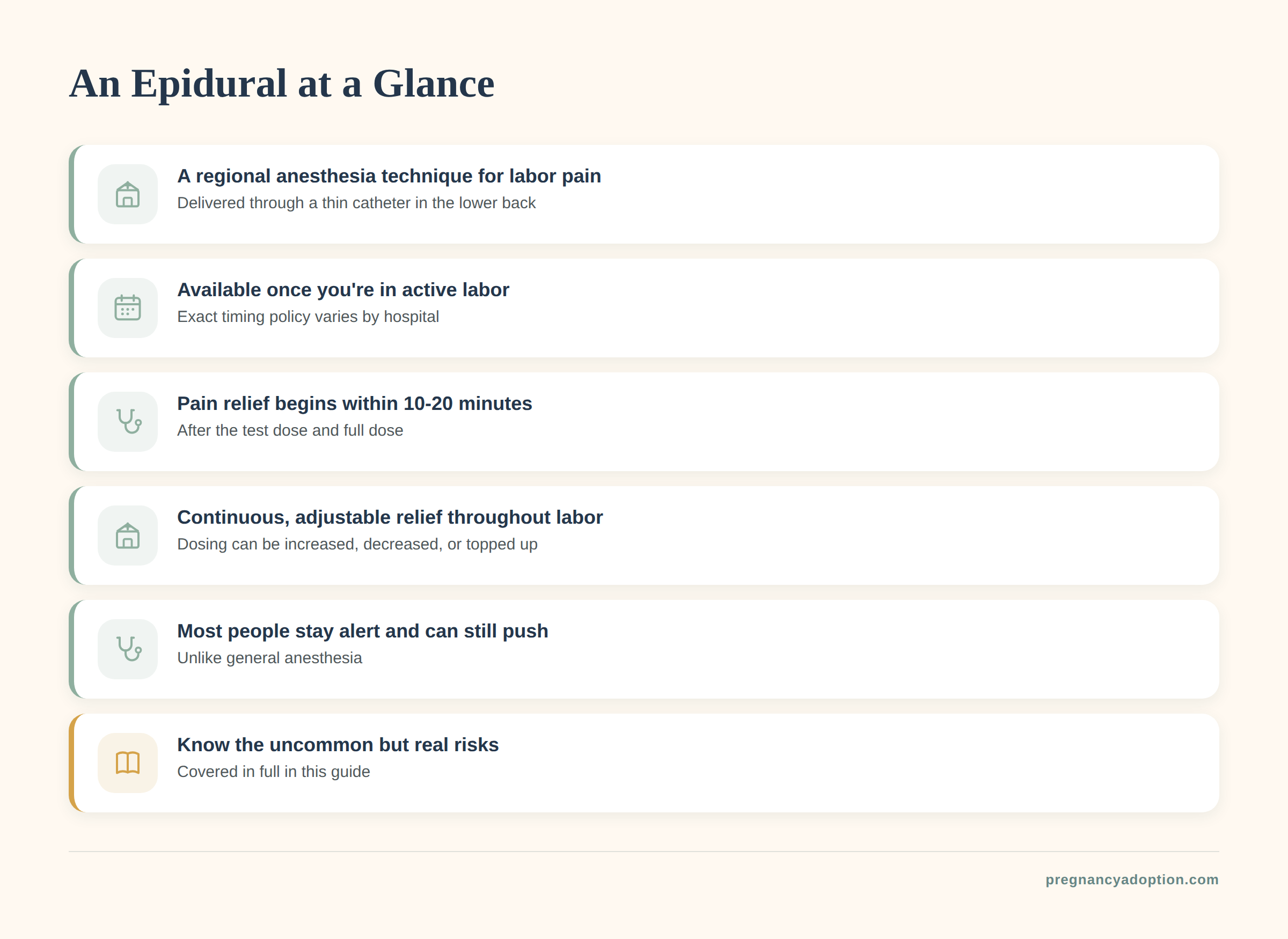
An epidural is a regional anesthesia technique that numbs sensation from the lower body down, delivered through a thin catheter placed in the space around your spinal cord. It’s typically available once you’re in active labor, administered by an anesthesiologist or nurse anesthetist, and provides continuous pain relief for as long as the catheter stays in place — commonly through delivery.
Key Takeaways
- An epidural numbs pain while generally preserving some sensation and the ability to push, unlike general anesthesia.
- Most people can request an epidural once they’re in active labor, though hospital policy and your specific situation affect exact timing.
- Common side effects (lower blood pressure, itching, a temporary numb feeling) are usually manageable; serious complications are uncommon.
Why So Many People Choose This Option
Most people who choose an epidural do so for two connected reasons: how well it works and how much it lets them stay present. Unlike a single injection or an oral medication that wears off on a fixed schedule, an epidural catheter stays in place throughout labor, so the dose can be adjusted up or down, topped up, or continued steadily for as long as you need it — including through an unexpectedly long labor without having to decide upfront exactly how much pain relief you’ll need in total. And because the medication is targeted at the nerves serving your lower body rather than circulating throughout your whole system, most people remain fully alert, oriented, and able to take part in decisions as they come up, from signing a consent form for an unplanned intervention to simply following what your nurse and provider are telling you in the moment. That combination — strong, adjustable relief without sedation — is a large part of why the epidural is the most-used form of labor pain relief in the United States, rather than it being the default simply for lack of alternatives.
What This Guide Covers
This guide is organized to answer the questions people actually ask, in the order they tend to come up: what an epidural is and how it’s placed, who qualifies and when you can request one, what it feels like during and after, the real benefits and risks side by side, how it compares with other pain-relief options, what changes in specific situations like preeclampsia or twins, and what recovery looks like once it’s over. The goal is to get you from a general sense of “it’s the shot in your back that helps with labor pain” to a working understanding detailed enough to ask your own provider sharper, more specific questions. What it can’t do is replace that conversation. Your own medical history, your specific hospital’s policies, and how your particular labor unfolds all affect which parts of this general picture apply to you — this guide is meant to prepare you for that conversation, not substitute for it.
How an Epidural Actually Works
| Type | How it’s given | Onset | Typical use |
|---|---|---|---|
| Epidural | Catheter left in place in the epidural space, continuous or on-demand dosing | 10-20 minutes | Labor pain relief over an extended period |
| Spinal | Single injection directly into the spinal fluid | Minutes | Planned cesarean delivery, faster onset needed |
| Combined spinal-epidural (CSE) | Both techniques together — spinal for fast initial relief, epidural catheter for ongoing dosing | Minutes, with ongoing coverage | Fast relief plus flexibility for a longer labor |
The Epidural Space
The epidural space sits just outside the tough membrane (the dura) that surrounds your spinal cord and the fluid around it, in the lower part of your back. The catheter is placed into this space, not into the spinal fluid itself — that distinction is why an epidural typically takes 10 to 20 minutes to reach full effect, somewhat slower than a spinal injection placed directly into the fluid. Once medication is delivered into the epidural space, it spreads out and bathes the bundle of nerve roots exiting your spinal cord at that level, blocking pain signals from those nerves before they ever reach your brain. Because those specific nerve roots serve your lower abdomen, pelvis, and legs, the numbing effect is concentrated there rather than spreading to your arms, chest, or face — which is also part of why you generally stay clear-headed and alert even as the pain itself fades.
The Medications Used
The core of most epidural solutions is a local anesthetic — commonly bupivacaine or ropivacaine, medications chemically related to the kind used for dental numbing, though formulated and dosed very differently for this purpose. Most protocols combine that anesthetic with a low dose of an opioid, commonly fentanyl, delivered directly into the epidural space rather than into your bloodstream the way an IV opioid would be. Combining the two lets your anesthesia team use a lower dose of each medication than either would need alone, which is the basis for the lower-dose, more sensation-preserving approaches many hospitals use today (sometimes called a “walking epidural,” covered later in this guide). The exact mix, concentration, and dosing schedule varies by hospital protocol and by how your labor is progressing, and your anesthesia team can adjust it throughout — this isn’t a one-size, fixed-dose medication the way a single injection would be.
Who Can Get an Epidural
Most people in labor are candidates for an epidural, though a handful of medical and practical factors can affect eligibility or exact timing. The sections below cover general eligibility first, then the specific factors — bleeding disorders, infection at the injection site, prior spine surgery — that lead to a closer look rather than an automatic yes or no.
General Eligibility
Most people in labor qualify for an epidural, whether they’re delivering vaginally or having a planned or unplanned cesarean — it’s one of the most versatile pain-management options available precisely because it works for both. What it does depend on is practical: having an anesthesiologist or nurse anesthetist actually available to place and manage it, which isn’t automatic at every facility around the clock. Larger hospitals with dedicated labor and delivery units typically have 24/7 anesthesia coverage; smaller hospitals or birth centers may not, which can affect whether an epidural is realistically available at 3 a.m. versus during a weekday shift. If epidural availability matters to your decision about where to deliver, this is worth confirming directly — during a prenatal visit, a hospital tour, or a phone call to the labor and delivery unit — rather than assuming every birth setting offers the same round-the-clock access.
Factors That Can Affect Eligibility
A small number of medical factors can make epidural placement riskier or require extra evaluation rather than ruling it out automatically. Conditions that affect blood clotting, or a significantly low platelet count, are the most common reason an anesthesia team looks more closely before proceeding — this site’s preeclampsia guide covers the specific platelet threshold that condition can involve, since preeclampsia is one of the more common reasons platelet counts drop during pregnancy. An active skin infection right at the planned injection site, or a pre-existing spine condition or prior spine surgery, are the other main factors that can complicate placement or call for an alternative approach. None of these automatically rule out an epidural — they mean your specific history needs a direct conversation with your anesthesia team, ideally before labor rather than for the first time once you’re already in the room asking for one.
Timing: When During Labor You Can Get One
One of the most common questions people bring to this topic is when, exactly, an epidural can be requested — and the honest answer has shifted meaningfully from what older guidance, or an earlier birth experience, might have suggested. The two sections below cover both ends of that question: whether there’s a “too early,” and whether there’s a genuine “too late.”
The Old Myth About “Too Early”
For years, many hospitals held to a rule that an epidural couldn’t be placed until labor had progressed to a specific cervical dilation — often around 4 to 5 centimeters — out of a since-revised concern that placing one earlier might slow labor down more than it actually does. That specific-dilation rule has largely fallen out of favor in current obstetric practice; most hospitals today will place an epidural on request once active labor is confirmed, without requiring you to hit a particular number first. That said, “most hospitals” isn’t “every hospital,” and exactly what counts as confirmed active labor, and how quickly a request gets acted on, still varies by institution and by how busy the unit is at that moment. Asking directly, during a prenatal visit or a hospital tour, what your specific hospital’s timing approach actually is will give you a far more reliable answer than any general rule — including this one.
Is There Such a Thing as “Too Late”?
There is a practical upper limit, though it’s about speed rather than a fixed cutoff. If labor is progressing very quickly and delivery looks to be minutes away, there may simply not be enough time left for an epidural to take effect — placement itself takes several minutes, and the medication needs another 10 to 20 minutes to reach full effect, a window a fast-moving final stage of labor may not allow. Your care team is the one tracking how quickly things are moving and will tell you directly if that applies to your specific situation. Even so, it’s worth asking rather than assuming it’s too late on your own — labor speed is hard to judge from the inside, and the answer genuinely depends on exactly where you are at the moment you ask, not a general rule about how many centimeters or hours remain.
The Epidural Placement Procedure, Step by Step
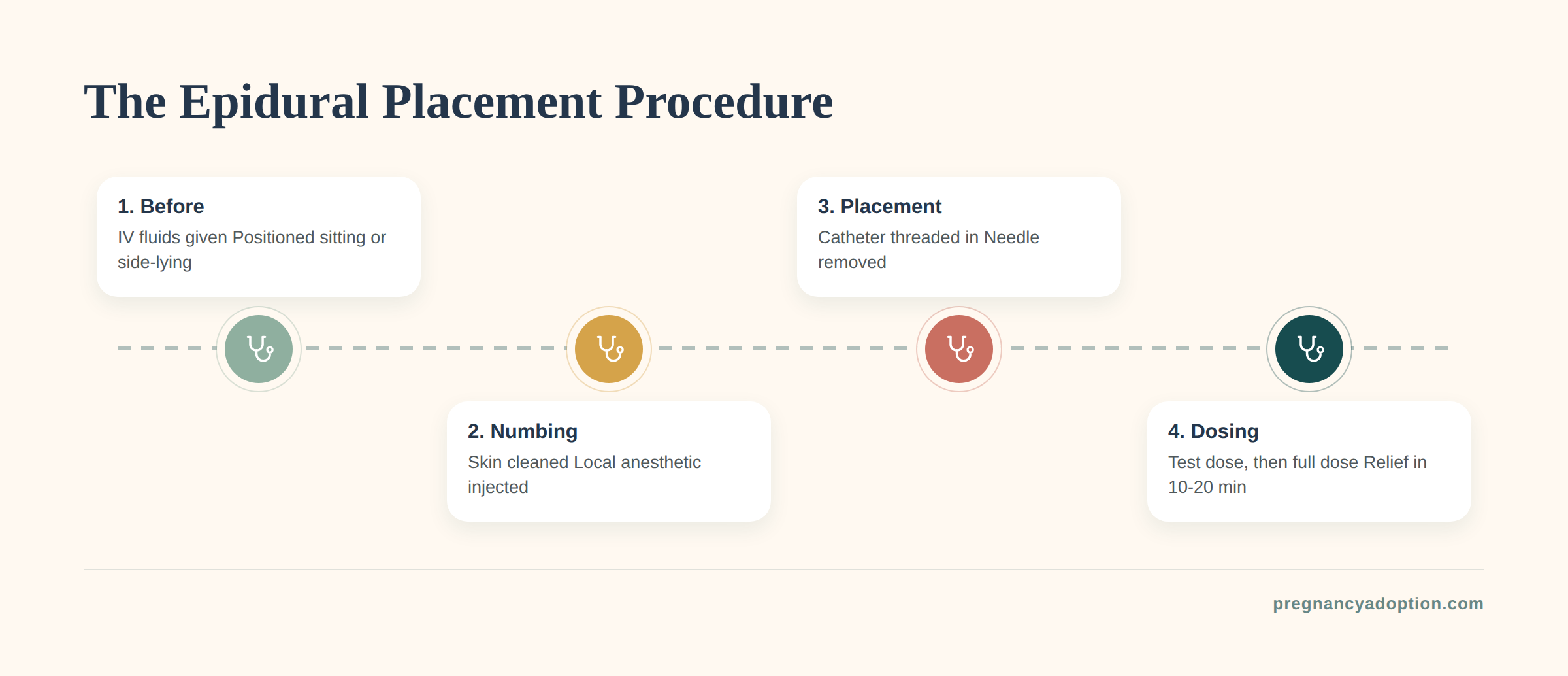
Knowing what actually happens, step by step, can make the process feel far less uncertain when the time comes.
Before Placement
Before the epidural itself is placed, you’ll typically receive IV fluids — a standard step that helps reduce the chance of the blood-pressure drop that can occur once the medication takes effect, by making sure you’re well-hydrated going in rather than treating a drop after it happens. You’ll then be positioned either sitting up and leaning forward over a pillow or the back of the bed, or lying on your side curled forward with your chin toward your knees; both positions widen the small gaps between your vertebrae, giving your anesthesia team a clearer target and making placement easier and generally faster. Your nurse or support person can help you hold the position and stay as still as comfortably possible, which matters more for this step than almost any other in the process.
During Placement
Your lower back is first cleaned with an antiseptic solution, and a local anesthetic is injected just under the skin to numb the area before the epidural needle itself goes in — this initial numbing injection is often described as the single most noticeable sensation in the whole process, a brief sting or pressure rather than the sharp pain many people brace for. Once the skin is numb, a thin, flexible catheter is threaded through a larger needle into the epidural space; the needle is then withdrawn, leaving only the soft, flexible catheter behind, which is taped securely along your back for the rest of your labor. The needle itself is never left in place — only the thin tubing remains, which is part of why most people report not feeling it once it’s taped down.
After Placement
Once the catheter is in position, your anesthesia team typically gives a small test dose first, to confirm the catheter is correctly placed and working as expected, before giving the full dose. Pain relief generally begins within 10 to 20 minutes of the full dose, building gradually rather than switching on all at once. For the next 20 to 30 minutes especially — the window when a blood-pressure drop is most likely — your blood pressure and your baby’s heart rate are monitored closely, on top of the monitoring that continues throughout the rest of your labor. If you notice feeling unusually lightheaded, nauseated, or short of breath during this early window, telling your nurse right away lets them check your blood pressure and adjust your IV fluids before it becomes more uncomfortable.
What It Actually Feels Like
Descriptions vary by individual, by dose, and by how your own body responds, but a few patterns come up often enough to be worth describing in advance, so you know roughly what to expect rather than discovering it for the first time mid-contraction.
During Placement
Most people describe the placement itself as pressure, or a brief stinging sensation from the numbing injection, rather than the sharp, ongoing pain they’d braced for — the numbing step genuinely does its job for the part that would otherwise hurt most. What’s asked of you is to stay as still as you reasonably can throughout, including through a contraction if one happens to occur during placement; your anesthesia team will generally try to time the needle insertion between contractions when possible, but labor doesn’t always cooperate with scheduling. A nurse or support person coaching you through staying still — focusing on breathing, a fixed point in the room, or their voice — can make a real difference in how manageable that brief window feels, even if it’s only a minute or two of needing to hold position.
Once It’s Working
Once the medication takes full effect, most people experience significant pain relief while still feeling pressure or movement — complete numbness with no sensation at all is actually less common with the lower-dose approaches many hospitals use today, which are specifically designed to take the edge off severe pain without erasing every sensation below the waist. Alongside the pain relief, many people notice a heavy, warm, or tingling feeling settling into their legs as the medication spreads, sometimes described as feeling unusually relaxed or weighted down rather than simply numb. Both effects are expected and are signs the epidural is working as intended, not signs that something has gone wrong — though if one leg feels dramatically more affected than the other, or the sensation feels wrong in a way you can’t quite describe, telling your nurse is worth doing rather than assuming it will even out on its own.
Benefits of an Epidural
Beyond pain relief itself, an epidural offers a few practical advantages that are easy to overlook if you’re only thinking about it as “the thing that makes the pain stop.” The sections below cover both the everyday benefit (adjustable, restful relief) and the situational medical advantages that apply more narrowly.
Effective, Adjustable Pain Relief
Because the catheter stays in place throughout labor, your dose isn’t fixed the way a single injection or a timed oral medication would be — your anesthesia team can adjust it up if you’re still in significant discomfort, or down if you’d like to preserve more sensation and mobility, based on how you’re feeling and how labor is progressing. That flexibility is part of why effective pain relief from an epidural can let some people genuinely rest, or even sleep, during a long labor, in a way that’s harder to manage through sheer willpower or non-medication techniques alone when a labor stretches well beyond the hours anyone was expecting. For an induction or a long first labor in particular, being able to rest rather than being worn down by hours of unrelieved pain can meaningfully affect how much energy and coping capacity you have left for the pushing stage later on.
Medical Advantages in Specific Situations
Beyond general comfort, an epidural already in place offers a practical medical advantage if a cesarean becomes necessary partway through labor: the same catheter can often be quickly “topped up” to a stronger dose for surgical-level anesthesia, which is generally faster than starting a brand-new procedure from scratch at a moment when speed matters. This site’s preeclampsia guide covers another specific advantage in more depth — epidural anesthesia is often specifically preferred for people with preeclampsia, partly because it can help manage blood pressure during labor, on top of its pain-relief benefit. Neither of these is a reason to choose an epidural if you’d otherwise prefer not to; they’re simply additional, situation-specific factors your care team may raise if either applies to you.
Risks and Side Effects

| Effect | Relative frequency | Notes |
|---|---|---|
| Lower blood pressure | Common | Managed with IV fluids and monitoring |
| Itching | Common | Often related to the opioid component, treatable if bothersome |
| Shivering | Common | Not fully understood, generally harmless |
| Headache (post-dural puncture) | Uncommon | From an inadvertent dural puncture, treatable if it occurs |
| Nerve injury | Rare | Most temporary numbness or tingling resolves on its own |
| Infection or serious bleeding at the site | Rare | Serious but uncommon complications |
Common, Manageable Effects
A drop in blood pressure is one of the more common effects of an epidural, which is exactly why IV fluids are given beforehand and your blood pressure is monitored closely in the minutes right after placement — it’s an anticipated, managed effect rather than a surprise complication, and your care team has a routine for addressing it quickly if it happens. Itching, often related to the opioid component of the epidural mixture rather than the anesthetic itself, and shivering, which isn’t fully understood medically but is generally harmless, are both common enough that your nurse will likely ask about them directly. Neither needs to simply be endured — treatment is available for itching if it becomes bothersome, and shivering, while it can feel alarming in the moment, isn’t on its own a sign that anything is wrong.
Less Common but Notable Risks
If the needle inadvertently punctures the dural membrane during placement — an uncommon but recognized occurrence even with an experienced anesthesia team — it can cause a distinctive headache, often worse when sitting or standing and easing when lying flat. It’s treatable, sometimes with conservative measures like rest, hydration, and caffeine, and sometimes with a specific follow-up procedure called a blood patch, which uses a small amount of your own blood to seal the puncture and typically provides significant relief. Temporary numbness or tingling in a specific area can also occur and typically resolves within days to weeks on its own; permanent nerve injury from an epidural is rare. None of these risks are meant to be alarming on their own — they’re included here so that if something unusual does come up during your recovery, you recognize it as a known, generally manageable possibility rather than a mystery.
Common Myths About Epidurals
A few persistent myths about epidurals circulate widely enough — among family, online communities, and sometimes outdated personal experience — that they’re worth addressing directly rather than letting them quietly shape a decision based on inaccurate expectations.
Myths About Pain and Control
Two of the most persistent epidural myths are really opposite ends of the same misunderstanding about how much sensation remains. Modern, lower-dose epidurals are generally designed to reduce pain while preserving some sensation and movement, not to eliminate all feeling below the waist — complete numbness is less typical with current approaches than older, higher-dose techniques used in the past. Following directly from that, the idea that an epidural makes effective pushing impossible doesn’t hold up either: most people with an epidural, particularly with a modern lower-dose approach, can still push effectively, feel enough pressure to sense timing, and actively participate in the second stage of labor rather than being passively talked through it.
Myths About Risk and the Back
Research doesn’t support a strong link between epidural use and long-term back pain beyond what’s commonly experienced after childbirth generally, regardless of which pain-management choice someone makes — pregnancy and delivery themselves put real strain on the back, independent of anesthesia. The related claim that an epidural “always” slows labor down significantly is more nuanced than a flat yes or no; the dedicated section further down this guide (Does an Epidural Slow Down Labor?) walks through what current research actually shows, which is a more modest and situation-dependent effect than this myth suggests, especially with the lower-dose approaches common today.
Epidural vs. Other Pain Management Options

| Option | How it works | Duration |
|---|---|---|
| Epidural | Regional nerve block via catheter | Continuous, adjustable through labor |
| IV opioid medication | Systemic pain relief through the bloodstream | Short-acting, wears off and can be redosed |
| Nitrous oxide | Inhaled gas, self-administered during contractions | Brief, as-needed |
| Non-medication techniques | Breathing, movement, hydrotherapy, massage | Ongoing, no dosing limits |
Medication-Based Alternatives
If an epidural isn’t available, isn’t wanted, or isn’t yet appropriate, two medication-based alternatives are commonly offered. IV opioid medications provide pain relief that circulates through your whole bloodstream rather than targeting the lower body specifically, which generally means less complete relief than an epidural and can cause drowsiness in both parent and, if given close to delivery, the baby — a tradeoff worth discussing with your provider if timing is close. Self-administered inhaled nitrous oxide offers a different tradeoff: a fast on/off effect you control yourself breath by breath, appealing to people who want a lower-intervention option or who want to preserve the ability to switch to something else easily, though it generally provides less complete pain relief than an epidural for most people.
Non-Medication Techniques
Non-medication techniques can meaningfully help many people cope with labor pain on their own, and they’re not mutually exclusive with medication-based options — most people who eventually get an epidural still use breathing techniques, position changes, or movement earlier in labor, and many continue some comfort measures alongside it rather than treating the choice as strictly either/or. Structured breathing patterns and regular position changes can help manage both pain and labor progress; warm water immersion and massage are commonly used comfort measures, particularly earlier in labor before an epidural (if chosen) comes into the picture. Thinking of these as complementary tools rather than a single all-or-nothing plan tends to leave people with more flexibility as labor actually unfolds.
Epidurals in Special Situations
A few specific circumstances change how epidural anesthesia is typically approached, either because they affect eligibility, change the usual timing recommendation, or simply come up often enough in questions that they deserve their own direct answer rather than being folded into the general guidance above.
Preeclampsia
This site’s preeclampsia guide covers in depth why epidural or spinal anesthesia is often specifically preferred for people with preeclampsia, including the exact platelet-count threshold that can affect eligibility. The short version: epidural anesthesia can help manage blood pressure during labor, which is directly relevant to a condition defined by dangerously elevated blood pressure. Because platelet counts can decline over the course of labor with preeclampsia, your anesthesia team may recommend placing the epidural earlier rather than later, as a precaution against platelet levels dropping below a safe threshold before it’s placed — ask your specific care team about their approach if you have preeclampsia, since the usual “wait until you want it” timing doesn’t fully apply here.
Gestational Diabetes
As this site’s gestational diabetes guide notes, blood sugar monitoring continues through labor regardless of which pain-management option you choose, and your care team factors any epidural-related effects into that ongoing monitoring rather than treating it as a separate concern. Gestational diabetes itself doesn’t restrict epidural eligibility — the same general candidacy factors that apply to anyone in labor apply here too, without an additional gestational-diabetes-specific hurdle.
Twins or Multiples
An epidural is often specifically recommended for people expecting twins or other multiples, mainly for the flexibility it provides: if delivery of a second twin requires an unplanned intervention — repositioning, a vacuum-assisted delivery, or an unplanned cesarean for the second baby after a vaginal delivery of the first — having a working epidural already in place means that flexibility is available immediately rather than needing to be arranged under time pressure. If you’re expecting multiples, raising your pain-management preferences early with your provider is worth doing precisely because this recommendation comes up so often; it’s a conversation better had calmly in a prenatal visit than for the first time once you’re already in active labor.
VBAC (Vaginal Birth After Cesarean)
An epidural is generally considered safe, and is often specifically recommended, for a VBAC (vaginal birth after cesarean) attempt — partly for the same readiness-for-a-repeat-cesarean reason that applies to twins, since a VBAC attempt carries some chance of needing a repeat cesarean if labor doesn’t progress safely. A common concern is whether an epidural could mask the pain of uterine rupture, a rare but serious VBAC complication; current practice generally holds that other warning signs — particularly changes in fetal heart rate — remain detectable even with an epidural in place, and your care team monitors specifically for this throughout a VBAC attempt rather than relying on pain alone as the warning signal.
Does an Epidural Slow Down Labor?
| Labor stage | General pattern |
|---|---|
| First stage (dilation) | Modest or no significant slowing in most current research |
| Second stage (pushing) | Can modestly lengthen pushing time in some studies |
| Overall cesarean rate | Current evidence doesn’t show a strong causal link to increased cesarean rate |
What Current Research Suggests
Earlier research suggested epidurals had a more significant labor-slowing effect than current evidence supports; more recent, lower-dose approaches to dosing appear to have a smaller impact on labor progress than the older, higher-dose techniques those earlier studies were often based on. At the same time, labor duration varies enormously between individuals for reasons that have nothing to do with pain-management choice — prior pregnancies, the baby’s position, the strength and pattern of contractions, and simple individual variation all play a role — which makes it genuinely difficult to attribute a specific slowdown to the epidural alone in any one person’s labor, even when a slowdown does happen to occur around the same time.
The Pushing Stage Specifically
Some research suggests the second stage of labor — the actual pushing — may run somewhat longer with an epidural in place than without one, though current guidelines have also become more flexible about how long a healthy second stage can safely continue, which softens how much that modest lengthening actually matters in practice. Some providers proactively reduce the epidural dose as pushing approaches specifically to preserve more sensation and pushing effectiveness during that stage; this isn’t universal practice, so asking your own provider whether they take this approach, and what you can expect if they do, is a reasonable question to raise well before you’re in active labor.
Epidural for Cesarean Delivery
This site’s C-section guide covers planned and unplanned cesarean delivery in full depth; this section covers only the epidural-specific angle — namely, what changes about anesthesia depending on whether you already have a labor epidural in place or are starting fresh for a planned surgical delivery.
Using an Existing Epidural
If you already have a labor epidural in place and a cesarean becomes necessary, your anesthesia team can often quickly increase the dose through the same catheter to reach surgical-level anesthesia, rather than needing to place an entirely new spinal or epidural. This “top-up” approach is generally faster than starting from scratch, which matters most in situations where a cesarean needs to happen on a tighter timeline — though even in a true emergency where every minute counts, general anesthesia may occasionally be used instead if there isn’t time even for a top-up.
A New Epidural or Spinal for a Planned Cesarean
For a planned cesarean where there’s no existing labor epidural to build on, spinal anesthesia — a single injection with faster onset than an epidural — is commonly used instead, since the predictable timing of a scheduled surgery doesn’t require the gradual, adjustable approach an epidural catheter is built for. Like an epidural, spinal anesthesia for a cesarean generally allows you to remain awake and alert for the birth, which many people specifically value regardless of which anesthesia route they end up taking — this site’s C-section guide covers the planned-cesarean experience in full depth beyond this epidural-specific angle.
After the Epidural: Recovery and Postpartum
| Timeframe | What’s typical |
|---|---|
| First few hours | Sensation and movement gradually return; some numbness or heaviness may linger |
| First day | Mild back soreness at the injection site is common |
| First week or two | Any lingering tingling or numbness typically resolves |
Right After the Catheter Is Removed
Feeling and movement typically return within a few hours of the catheter being removed and no further medication being given, though the exact timing varies by individual and by how much medication was used. Before you get up and walk for the first time, your care team will confirm you have adequate strength and sensation in your legs — this check matters because residual numbness, even mild, meaningfully raises fall risk, and the first walk after delivery is not the moment to discover your legs aren’t quite ready yet.
In the Days After
Mild soreness or light bruising right at the lower-back injection site is common in the first day or two and generally resolves on its own within a few days, similar to soreness you might feel after any injection site healing. What’s different, and worth a call to your provider, is severe or worsening back pain, a severe headache — especially one that gets noticeably worse when sitting or standing and better lying flat — fever, or any new or worsening numbness or weakness once you’re home. Ordinary, gradually improving soreness doesn’t need a call; a symptom that’s severe, getting worse rather than better, or paired with fever or new neurological changes does.
When an Epidural Isn’t Recommended or Possible
A small number of situations make an epidural inadvisable or simply not possible, splitting roughly into two categories: genuine medical contraindications, where the risk outweighs the benefit for your specific situation, and practical limitations, where the medicine would be fine but the logistics aren’t there to support it.
Medical Contraindications
Significant bleeding or clotting abnormalities, including a very low platelet count, can make epidural placement too risky to proceed — your anesthesia team evaluates this against your specific bloodwork rather than a blanket rule, since the relevant thresholds depend on the exact lab values and how quickly they’re trending. An active skin infection right at the planned injection site, or a confirmed allergy to the specific medications an epidural uses, are the other main reasons an epidural may not be recommended in a given case. None of these are common, and all of them come with alternative pain-management options already covered earlier in this guide if they apply to you.
Practical Limitations
Beyond medical reasons, two practical factors can limit epidural availability regardless of your eligibility. Some smaller hospitals or freestanding birth centers don’t have 24/7 anesthesia coverage, which is worth confirming directly if epidural access factors into where you choose to deliver. And as covered earlier in this guide’s timing section, labor that’s progressing very quickly may simply not leave enough time for an epidural to take effect before delivery happens — a practical limitation of timing, not a judgment about whether you’d otherwise have qualified.
Walking Epidurals and Low-Dose Options
Lower-dose approaches have become more common over the past couple of decades, aiming to preserve more mobility and sensation than the higher-dose epidurals that were standard practice in earlier years — though, as the sections below explain, the name “walking epidural” promises a bit more freedom of movement than most hospitals’ actual safety protocols allow.
What a “Walking Epidural” Actually Means
A “walking epidural” typically refers to a lower-dose combination of local anesthetic and opioid, designed to preserve more muscle strength and sensation than a traditional higher-dose epidural — it’s a different balance point, not the complete absence of medication the name might suggest. Despite that name, many hospitals still restrict actual walking after a walking epidural for safety reasons, even though the lower dose does genuinely preserve more sensation and movement than older, higher-dose approaches; “walking epidural” describes the dosing philosophy more than a guaranteed ability to walk around freely during labor.
Ask About Your Specific Hospital’s Approach
Not every hospital offers a true low-dose “walking” protocol, so if preserving mobility and sensation matters to you, asking directly about your specific hospital’s typical dosing approach — rather than assuming “walking epidural” is standard everywhere — will get you a more useful answer than the general term implies. Some hospitals also offer patient-controlled epidural analgesia (PCEA), which lets you self-administer small additional doses within a safe, preset limit through the same catheter, giving you more direct, moment-to-moment control over your own pain management rather than relying solely on your nurse to request adjustments on your behalf.
Cost and Insurance
Epidural cost is typically bundled into overall delivery costs rather than billed as a fully separate line item, though specifics vary meaningfully by hospital, region, and insurance plan — enough that it’s worth understanding the general billing pattern before you’re looking at an unfamiliar line item on a bill weeks after delivery.
How It’s Typically Billed
Epidural cost is typically bundled into overall delivery costs rather than billed as one isolated line item, but many hospitals bill anesthesia services separately from the hospital’s own facility fee — meaning you may see a distinct anesthesiologist’s bill in addition to your main hospital bill, which can be surprising if you weren’t expecting two separate statements. Most insurance plans cover epidural anesthesia as part of labor and delivery care, but your specific deductible, copay, and whether the anesthesia provider happens to be in-network under your plan can all meaningfully affect your actual out-of-pocket cost, independent of whether the epidural itself is covered in principle.
Questions Worth Asking in Advance
Two calls, made before your due date rather than during labor, can head off a lot of billing surprises later. Confirming with your insurance whether your hospital’s anesthesia providers are in-network under your specific plan matters because out-of-network anesthesia billing is a well-documented source of unexpectedly large medical bills, even when the hospital itself is in-network. Separately, many hospitals can provide a general estimated cost range for anesthesia services if you ask directly during pre-registration — it won’t be an exact figure, since labor isn’t a scheduled service with a fixed price, but a general range is still more useful than finding out for the first time on a bill that arrives weeks later.
Preparing for the Conversation With Your Provider
| Category | Question to ask |
|---|---|
| Timing | What’s your hospital’s specific policy on when I can request an epidural? |
| Availability | Is anesthesia coverage available 24/7 at this hospital? |
| Dosing approach | Do you offer a lower-dose or walking-epidural option? |
| My specific history | Does anything in my medical history affect my epidural eligibility? |
Bringing This Up Before Labor
Raising your epidural-related questions during a routine prenatal visit or a hospital tour, well before labor starts, gives you time to actually understand your specific hospital’s timing, dosing, and anesthesia-availability approach without the pressure and urgency of active labor working against a calm conversation. This site’s third-trimester guide covers birth plan basics in more depth; your pain-management preferences, including however open or settled you are on an epidural, are a natural part of that document — not because a birth plan is binding, but because writing it down helps you think it through in advance and gives your care team a quick reference for your preferences.
Keeping an Open Mind
You don’t have to commit to a firm decision in advance — many people deliberately keep an open mind and decide based on how labor actually feels once it begins, rather than locking in a choice weeks ahead of a situation they can’t fully predict. And whichever way you lean going in, you can change your mind in either direction during labor itself: someone who planned to avoid an epidural can request one, and someone who planned to get one can decide to wait or skip it, based on your care team’s guidance and what’s medically appropriate for you at that specific point in labor. Neither choice, made in the moment, is a failure to stick to a plan — it’s the plan working as intended, as a starting point rather than a contract.
A Simple Action Checklist

Before Labor
Ask About Your Hospital’s Specific Policies
Timing, dosing approach, and anesthesia availability all vary by hospital — ask during a prenatal visit or tour.
Note Any Relevant Medical History
Mention any bleeding disorders, prior spine surgery, or other relevant history to your provider well before your due date.
After Delivery
Expect Gradual Sensation Return
Feeling and movement typically return within a few hours of catheter removal.
Know the Warning Signs Worth Calling About
Severe or worsening headache, severe back pain, fever, or new numbness or weakness after going home.
Glossary of Terms in This Guide
Anesthesia Terms
Epidural Space
The space just outside the membrane surrounding the spinal cord and spinal fluid, where an epidural catheter is placed.
Spinal Anesthesia
A single injection of anesthetic directly into the spinal fluid, typically used for faster onset than an epidural.
Process Terms
Top-Up Dose
An increased dose given through an existing epidural catheter, often used to achieve surgical-level anesthesia if a cesarean becomes necessary.
Post-Dural Puncture Headache
A distinctive headache that can occur if the needle inadvertently punctures the dural membrane during placement, treatable if it occurs.
Frequently Asked Questions
Getting Started
Do I have to decide about an epidural before I go into labor?
No — many people keep an open mind and decide in the moment, though researching your options in advance, as part of a birth plan, can help you feel more prepared either way.
Is an epidural the right choice for everyone?
No single pain-management choice is right for everyone — this is a personal decision based on your own preferences, medical history, and how labor actually unfolds.
Safety and Effectiveness
Is an epidural safe for most people?
Yes, for most people — epidurals are widely used and generally considered safe, though like any medical procedure they carry some risk, covered in Section 8 above.
How effective is pain relief, realistically?
Most people experience significant pain relief, though the degree can vary by individual and by the specific dosing approach used.
How It Works: Mechanics Questions
Is the epidural needle left in my back the whole time?
No — only the thin, flexible catheter remains in place; the needle used to guide the catheter into position is removed immediately after placement, leaving just the soft tubing taped to your back.
Can I feel the catheter once it’s placed?
Most people report not feeling the catheter itself once it’s taped in place, though you may be aware of some tape or the general sensation of something on your back.
Timing and Scheduling Questions
Can I request an epidural right when I arrive at the hospital, even before active labor?
Generally, no — most hospitals require confirmation of active labor first, though exact policy varies; Section 4 above covers this in more depth.
What if my hospital has only one anesthesiologist on call and they’re busy with another patient?
This can cause a delay — ask your specific hospital about their typical anesthesia staffing and response time during your prenatal visit or tour if this is a concern for you.
Placement Procedure Questions
How long does placement itself actually take?
Typically around 10 to 20 minutes for the full procedure, including positioning, skin numbing, and catheter placement, though exact timing varies by individual and by how straightforward placement is.
Do I need to hold completely still through an entire contraction?
Your anesthesia team will typically try to time the actual needle placement between contractions when possible, though staying as still as you can throughout the process remains important for safety.
Sensation and Experience Questions
Will I still feel contractions at all with an epidural?
Many people still feel pressure or a sense of contractions happening, especially with lower-dose modern approaches, while the sharp pain itself is significantly reduced or eliminated.
Can I feel when it’s time to push?
Most people retain enough sensation to recognize pushing urges, particularly with lower-dose dosing; your nurse also helps guide timing based on monitoring if sensation is more reduced.
Benefits Questions, Expanded
Can an epidural help me rest during a long induction?
Yes — for a long labor, particularly an induction that can extend over many hours, effective pain relief that allows rest is one of the more commonly cited practical benefits.
Does an epidural reduce stress hormones during labor?
Some research suggests effective pain relief can reduce stress-hormone levels during labor, though this is an area of ongoing study rather than a settled, precisely quantified effect.
Risks Questions, Expanded
How likely is a post-dural puncture headache, realistically?
It’s an uncommon but recognized occurrence; exact rates vary by source and by the experience level of the person placing the epidural.
If I get a post-dural puncture headache, how is it treated?
Treatment can range from conservative measures (rest, hydration, caffeine) to a specific procedure called a blood patch, which often provides significant relief — your care team will discuss options if this occurs.
Myths Questions, Expanded
Is it true that choosing an epidural means I’ve “given up” or failed at natural childbirth?
No — pain management is a personal medical choice, not a measure of character or commitment; there’s no single “right” way to give birth, and choosing an epidural is neither better nor worse than any other informed choice.
Does an epidural mean I won’t bond properly with my baby right after birth?
No — most people with an epidural are fully alert and able to participate in skin-to-skin contact and early bonding immediately after delivery, the same as with other pain-management choices.
Comparing Options Questions
Can I combine an epidural with non-medication techniques like breathing or position changes?
Yes — many people use breathing techniques, position changes (within what the epidural allows), and other comfort measures alongside an epidural rather than viewing it as an either/or choice.
Is nitrous oxide a reasonable alternative if I’m unsure about an epidural?
It can be a reasonable option for some people, offering mild, flexible, self-administered relief without the procedure an epidural requires — ask your hospital whether it’s available if you want to keep options open.
Special Situations Questions, Expanded
Does having a higher BMI affect epidural placement?
It can make placement somewhat more technically challenging in some cases, though it doesn’t rule out an epidural — your anesthesia team has specific techniques and experience for a range of body types.
Does a prior back surgery rule out an epidural entirely?
Not necessarily — it depends on the specific surgery and its location; discuss your surgical history directly with your anesthesia team well before labor so they can evaluate your specific situation.
Labor Progress Questions, Expanded
If my labor does slow down after an epidural, is that dangerous?
A modest slowdown generally isn’t dangerous on its own — your care team monitors overall labor progress and your baby’s wellbeing throughout, and would address any concerning pattern regardless of its cause.
Can Pitocin be used alongside an epidural if labor slows?
Yes — if labor progress genuinely stalls, Pitocin (a synthetic form of oxytocin) can be used to help strengthen contractions, whether or not an epidural is in place.
Cesarean-Related Questions, Expanded
If I have a labor epidural and need an emergency cesarean, is the top-up always fast enough?
In most cases, yes — a top-up dose through an existing, well-functioning epidural catheter is typically fast; in a true emergency requiring immediate delivery, general anesthesia may occasionally be used instead if there isn’t time even for a top-up.
Will I be awake for a cesarean with an epidural top-up?
Yes, typically — like the original epidural, a top-up for cesarean delivery generally allows you to remain awake and alert, with the lower body numbed for the surgery.
Recovery Questions, Expanded
How long until I can walk normally after the epidural wears off?
Most people regain normal walking ability within a few hours of the catheter being removed and sensation fully returning, though your care team confirms adequate strength before you get up unsupervised.
Is it normal to still feel some back soreness days after delivery?
Mild soreness at the injection site for a few days is common and generally unrelated to any serious complication; it typically resolves on its own.
Contraindications Questions, Expanded
Does taking a blood thinner during pregnancy automatically rule out an epidural?
Not automatically — your anesthesia team evaluates the specific medication, dose, and timing of your last dose relative to delivery; some blood thinners require a specific waiting window before epidural placement is considered safe.
What if I have a low platelet count that isn’t related to preeclampsia?
The same general principle applies regardless of cause — your anesthesia team evaluates your specific platelet count against safety thresholds before proceeding, whatever the underlying reason for the low count.
Walking Epidural Questions, Expanded
Is a walking epidural less effective at pain relief than a traditional one?
It can provide somewhat less complete numbness in exchange for more preserved movement and sensation — the tradeoff is intentional, and many people find the balance acceptable, though individual experience varies.
Can I switch from a walking epidural to a stronger dose later if needed?
Yes — dosing can generally be adjusted up if a lower initial dose isn’t providing enough relief, giving you flexibility within the same catheter placement.
Cost Questions, Expanded
Is the cost of an epidural the same no matter which hospital I choose?
No — costs can vary meaningfully by hospital, region, and specific anesthesia provider; if cost is a significant concern, ask for an estimate from your specific hospital in advance.
Does choosing an epidural significantly increase my total delivery bill?
It typically adds a distinct anesthesia charge on top of other delivery costs, though the overall proportional impact varies by your specific insurance coverage and hospital’s billing structure.
Preparing and Communicating With Your Provider, Expanded
Should I write my epidural preference into my birth plan even if I’m unsure?
Yes — noting that you’re open to deciding in the moment is itself useful information for your care team, and it’s just as valid a stated preference as a firm yes or no.
What if my provider seems dismissive when I ask detailed questions about epidurals?
You’re entitled to clear, direct answers about a procedure that will be performed on you — if you don’t feel your questions are being taken seriously, it’s reasonable to ask again more specifically or raise the concern with your care team directly.
Decision-Making and Confidence Questions
Is it normal to still feel unsure about my pain-management choice close to my due date?
Yes, completely normal — many people keep an open mind deliberately, precisely because it’s hard to know in advance exactly how labor will feel or unfold.
What if my partner or family has strong opinions about whether I should get an epidural?
This is ultimately your medical decision to make, in partnership with your care team — it’s reasonable to set a boundary with family or a partner if their opinions feel like pressure rather than support.
