
A cesarean section — a c-section — is major abdominal surgery to deliver a baby through an incision in the abdomen and uterus, used in roughly one-third of all U.S. births today Whether yours is planned weeks in advance or decided in the middle of labor, this guide walks through why a cesarean is recommended, exactly what happens during the surgery, what recovery looks like day by day, which warning signs matter, and what a cesarean means for future pregnancies — so you can feel informed and prepared rather than caught off guard.
Short Answer: What a C-Section Is and When It Happens

A cesarean delivers your baby through a surgical incision instead of through the vagina. Some cesareans are planned in advance because of a known complication or a prior cesarean; many more are decided after labor has already started, when something changes that makes a vaginal delivery riskier than a surgical one. Either way, the surgery itself typically takes under an hour, and most people go home within two to four days.
Key Takeaways
- About 1 in 3 U.S. births is by cesarean, making it one of the most common major surgeries performed
- A cesarean can be planned ahead of time or decided during labor; both are medically legitimate paths to a safe delivery.
- Recovery is longer than from a vaginal birth — typically several weeks for the incision and deeper tissue to heal — but most people recover fully with no lasting limitations.
Why This Guide Exists
When a cesarean becomes necessary during labor, decisions often move fast, and there’s little time to absorb new information in the moment — reading through this guide ahead of time, even if you’re planning and hoping for a vaginal birth, means fewer surprises if your plan changes partway through. A meaningful share of cesareans aren’t decided until labor is already underway, so preparing only for the birth you’re hoping for, while understandable, can leave you navigating unfamiliar territory at precisely the moment you have the least bandwidth to process new information. If you already know you’re having a planned cesarean, this guide is just as relevant to you: it covers the practical preparation, what actually happens during the procedure, and recovery in the same depth it would for an unplanned one, since the surgery itself and the recovery that follows are largely the same regardless of how the decision to have one was reached. Either way, a cesarean is a major abdominal surgery and a birth at the same time, and understanding what to expect at each stage — before, during, and after — tends to make the experience feel more manageable than going in without a clear picture.
What This Guide Covers
This guide walks through the full picture, start to finish: why a cesarean is recommended in various situations, what happens before, during, and after the surgery itself, your pain-management options, the specific warning signs worth knowing during recovery, the emotional side of recovery, breastfeeding after a cesarean, the actual risks involved, vaginal birth after cesarean (VBAC), and what having a cesarean means for how you might approach future pregnancies. The goal is to give you a genuinely complete reference, not a surface-level overview, so that whichever part of this experience you’re currently facing, you can find real substance rather than a brief mention and a link elsewhere. That said, this guide provides general information meant to prepare and inform you, not a substitute for individualized medical guidance — your own surgical and recovery plan should always be discussed directly with your obstetric provider, who knows your specific medical history, your current pregnancy, and any factors unique to your situation that a general guide like this one can’t account for. Think of this as the foundation that makes those conversations with your provider more informed and more productive, not a replacement for them.
Planned vs. Emergency (Unplanned) Cesarean
Not every unplanned cesarean is a true emergency. Understanding the difference helps set realistic expectations for how much notice, choice, and time you’ll have.
Planned (Scheduled) Cesarean
A planned cesarean is scheduled ahead of your due date, usually because of a known factor identified during pregnancy — a prior cesarean, a baby who remains breech close to term, placenta previa, or a maternal health condition that makes labor itself riskier than a planned surgical delivery. In most cases, you’ll know the date weeks in advance, which is one of the more meaningful practical differences between a planned and an unplanned cesarean: there’s genuine time to prepare rather than adjusting to the idea in the middle of labor. Because there’s no rush, a planned cesarean allows time for pre-operative testing to confirm you’re ready for surgery, a dedicated conversation with your anesthesia team about your options and any relevant history, and practical arrangements for help at home afterward, since recovery involves real physical limitations for several weeks. Knowing your delivery date in advance can also simply be easier to plan around emotionally — you can arrange childcare for other children, coordinate with family or a partner’s work schedule, and mentally prepare for a cesarean rather than processing a change in plans while already in labor.
Unplanned Cesarean During Labor
An unplanned cesarean happens when labor was expected to proceed vaginally but a complication arises partway through — labor stalling despite adequate contractions, concerning changes in the baby’s heart rate pattern on the monitor, or a baby that isn’t descending through the birth canal as expected despite pushing. This is a common path to a cesarean; plenty of people who never planned on one end up having their baby this way, and it doesn’t reflect anything you did wrong during labor. Not all unplanned cesareans move at the same speed, which is worth understanding since “unplanned” can sound more alarming than the actual situation often is. Some allow a few minutes to finish a conversation with your care team, get settled, and have your support person join you; others, involving a more acute threat to the baby or the parent, move within minutes, with less time for explanation in the moment. Your care team will tell you which situation you’re in, and it’s reasonable to ask directly if you’re unsure — most teams narrate what’s happening as they go, even when things are moving quickly.
“Emergency” Doesn’t Always Mean a Crisis in the Moment
Clinically, cesareans are sometimes categorized by urgency level rather than lumped into a single “emergency” label, and that distinction matters more than it might seem — the range runs from immediate, life-threatening situations requiring delivery within minutes, to cesareans that are unplanned and need to happen without extensive delay, but aren’t acutely dangerous in the moment. Hearing the word “emergency” attached to your own cesarean can understandably feel frightening, but it doesn’t automatically mean the kind of crisis the word evokes; hospitals often use “emergency” as a categorization label covering a fairly wide range of actual urgency. If your cesarean becomes unplanned, it’s entirely reasonable to ask your care team directly how urgent the situation actually is and what’s driving the decision. Many people find that specific, concrete context — understanding the actual reason and actual timeline — reduces fear far more effectively than vague reassurance alone, even when the honest answer is that things do need to move quickly. Care teams are generally used to this question and can usually answer it briefly, even in the middle of a fast-moving situation.
Common Reasons a Cesarean Is Recommended
| Category | Examples | Typically known in advance? |
|---|---|---|
| Labor not progressing | Dystocia (stalled dilation), failed induction | No — discovered during labor |
| Fetal distress | Concerning heart-rate patterns, cord compression | No — discovered during labor |
| Fetal position | Breech, transverse | Often — identified before labor |
| Placental issues | Placenta previa, placental abruption | Often previa; abruption often sudden |
| Multiples | Twins or higher-order multiples in certain positions | Often known in advance |
| Prior cesarean or uterine surgery | Repeat cesarean, prior myomectomy | Yes — known in advance |
| Maternal health conditions | Severe preeclampsia, certain heart or brain conditions, active genital herpes | Usually known in advance |
| Physical obstruction | Large fibroid, pelvic fracture or deformity | Usually known in advance |
Labor-Related Reasons
When dilation or fetal descent stops progressing despite adequate, regularly spaced contractions over a meaningful period of time — a pattern sometimes called labor dystocia — a cesarean is often recommended rather than continuing to wait indefinitely, since prolonged labor carries its own risks for both parent and baby, including infection risk once membranes have ruptured and increasing fatigue that can itself complicate labor further. Providers generally give labor a reasonable amount of time to progress before recommending this step, since labor speed varies widely between individuals and even between pregnancies for the same person, but there’s a point where continued waiting stops being the safer option. A failed induction is a related but distinct reason: if labor is being medically induced and the cervix doesn’t respond adequately after a reasonable trial — commonly extending well beyond a full day in some hospital protocols, depending on the specific induction method and your individual response — a cesarean becomes the next recommended step rather than continuing an induction that isn’t working. In both situations, the underlying logic is the same: labor that genuinely isn’t progressing, despite real attempts to help it along, carries more risk than proceeding to a cesarean.
Repeat Cesarean
Many people with one prior low-transverse cesarean — the most common type of uterine incision, covered in more detail in the incisions section below — are reasonable candidates for a vaginal birth after cesarean (VBAC), covered in full later in this guide. Others choose, or are advised toward, a repeat planned cesarean instead, based on their specific obstetric history, the reason for their original cesarean, and their own preferences after weighing the relevant risks and benefits of each path. Neither path is automatically the right one for everyone; it’s a genuinely individual decision made with your provider based on your complete history, not a default that applies the same way to every repeat pregnancy. The more prior cesareans someone has had, the more a repeat planned cesarean is typically favored over attempting a vaginal birth, largely due to risks that rise with each additional cesarean — covered in more depth in this guide’s section on future-pregnancy considerations — including the uterine rupture risk associated with VBAC attempts and the placental risks associated with multiple prior surgeries. If you’re deciding between these paths for a current pregnancy, that conversation is worth having early and directly with your provider.
Maternal Health Conditions That Can Lead to a Cesarean
Several maternal health conditions make a cesarean more likely, either because labor itself carries added risk or because the condition requires faster, more controlled delivery timing.
Hypertensive Conditions
As this site’s preeclampsia guide covers in depth, a rapidly worsening clinical picture or eclampsia — the more severe, seizure-involving progression of preeclampsia — may call for a cesarean specifically because surgery can often be accomplished faster than waiting for an induction to progress through labor, and speed genuinely matters once severe preeclampsia or eclampsia develops. That urgency is specific to the more severe end of the condition, though, and it’s worth being clear that having preeclampsia at all does not, by itself, mean you’re headed toward a cesarean. In most cases, induction with a goal of vaginal delivery is attempted first and frequently succeeds, with a cesarean reserved either for the same general obstetric reasons it would apply to any pregnancy — labor not progressing, fetal heart rate concerns — or for the genuine urgency that comes with a rapidly worsening case. If you’ve been diagnosed with preeclampsia, your care team will walk you through what that means specifically for your delivery plan based on how your particular case is progressing, rather than applying a one-size-fits-all approach to every preeclampsia diagnosis.
Placental Conditions
Placenta previa, where the placenta covers part or all of the cervix instead of implanting higher in the uterus, makes a vaginal delivery dangerous because the baby would have to pass directly through the placenta, risking severe bleeding for both parent and baby. A planned cesarean is typically recommended for this reason, and it’s usually identified well before labor begins through a routine ultrasound, giving you time to plan rather than discovering it during labor itself. Placental abruption is a different and generally more acute situation: a placenta that separates from the uterine wall before delivery, partially or fully, can threaten both the parent’s and baby’s safety by disrupting oxygen and blood supply, and it often calls for an urgent cesarean, with the specific urgency depending on the severity of the separation and how far along labor already is. Both conditions are about the placenta’s position or stability rather than anything about the baby’s health directly, and both are reasons where a cesarean is specifically the safer path rather than one option among several equally reasonable choices.
Infections and Other Conditions
An active genital herpes outbreak at the time labor begins is a common and specific reason for a planned cesarean, since the goal is avoiding transmission of the virus to the baby during passage through the birth canal, where exposure risk is highest during an active outbreak; outside of an active outbreak, a herpes diagnosis doesn’t generally call for a cesarean on its own. Certain maternal cardiac, neurological, or spinal conditions represent a separate category of reasons: for some of these conditions, the physical strain and exertion of pushing during labor carries more risk than a planned cesarean would, particularly for certain heart conditions where sustained cardiovascular strain is a genuine concern, or spinal conditions where the positioning and pressure involved in labor could cause complications. This determination is made individually, generally with input from the relevant specialist managing that specific condition alongside your obstetric provider, rather than following a single blanket rule — the same underlying heart or spinal condition can call for different delivery recommendations depending on its specific severity and how it’s being managed in your particular case.
Fetal and Pregnancy-Related Reasons
Some reasons for a cesarean relate to the baby or the pregnancy itself rather than to the parent’s own health.
Fetal Heart Rate Concerns
Continuous fetal monitoring during labor sometimes shows heart-rate patterns suggesting the baby isn’t tolerating labor as well as expected — certain decelerations, reduced variability, or other patterns your care team is specifically trained to watch for. Depending on how severe the pattern is and how quickly it resolves on its own or with simple interventions like repositioning or oxygen, this can lead to a more urgent cesarean if the pattern doesn’t improve within a reasonable window. Cord compression, where the umbilical cord gets squeezed during contractions or by the baby’s position, can reduce oxygen delivery to the baby and is often a contributing factor in these concerning heart-rate patterns. A prolapsed cord — where the cord slips ahead of the baby into the birth canal, particularly after the water breaks — is a distinctly different and more acute situation: it’s considered a true obstetric emergency, since the cord can become compressed between the baby and the birth canal, cutting off oxygen supply, and it requires immediate cesarean delivery. If your care team identifies a prolapsed cord, you’ll notice the response move very quickly, which reflects the genuine urgency of that specific situation rather than something going generally wrong.
Fetal Position
As this site’s third trimester guide covers, a baby who remains breech (bottom or feet positioned to deliver first) or transverse (lying sideways) close to delivery generally can’t deliver vaginally in most circumstances, since these positions make a safe vaginal delivery substantially more difficult and risky than when the baby is head-down. If the position persists despite attempts to encourage a head-down position, such as an external cephalic version procedure some providers offer, a cesarean is typically planned in advance once it’s clear the position isn’t going to change before labor. Macrosomia, meaning an estimated fetal weight significantly above average for gestational age, is a separate consideration that may raise concern about whether a safe vaginal delivery is achievable, particularly when combined with other risk factors like a narrow maternal pelvis or a prior difficult delivery. This site’s gestational diabetes guide covers the specific estimated-weight thresholds often discussed in that context, since gestational diabetes is one of the more common contributors to a larger-than-average estimated fetal weight, and it’s worth noting that estimated fetal weight from ultrasound carries meaningful margin of error, which your provider will factor into the overall decision rather than relying on a single number alone.
Multiples
With twins, position matters considerably more than the number of babies alone when it comes to delivery planning: twins where the first baby (the one positioned to deliver first) is head-down are often still reasonable candidates for a vaginal delivery, sometimes even when the second twin is in a different position, since providers experienced in twin deliveries have techniques for managing the second baby’s delivery after the first. Other position combinations, or higher-order multiples such as triplets, more often call for a planned cesarean, since the complexity and risk of coordinating multiple vaginal deliveries in sequence rises with each additional baby and with less favorable positioning. Multiples deliveries generally involve a more detailed, individualized delivery plan worked out well before labor begins, considering each baby’s specific position, the overall health of the pregnancy, and how far along you are, since multiples pregnancies more commonly deliver somewhat earlier than a single pregnancy. If you’re expecting multiples, this planning conversation with your care team typically happens earlier and in more depth than it would for a single pregnancy, precisely because there’s more to coordinate.
Preparing for a Planned Cesarean
Knowing your surgery date in advance means there’s real preparation worth doing, beyond simply waiting for the day to arrive.
Pre-Operative Appointments and Testing
Most hospitals schedule pre-admission bloodwork and a review of your full medical history in the days or weeks before a planned cesarean, to confirm you’re medically ready for surgery and to flag anything your anesthesia and surgical team should be aware of in advance — prior reactions to medications, bleeding disorders, or other relevant history. This testing is standard for any planned surgery, not specific to you or a sign of a particular concern, and it’s typically a fairly quick appointment rather than an extensive workup. Many hospitals also offer a dedicated appointment or phone call with anesthesia staff ahead of a planned cesarean specifically, separate from your general pre-admission testing, covering your anesthesia options in more detail, any relevant history such as prior reactions to anesthesia or chronic conditions that might affect your anesthesia plan, and a chance to ask questions before the day of surgery itself. Taking advantage of this dedicated conversation, if your hospital offers one, means fewer new questions and less new information to process on the actual day of your surgery, when you’re likely to have plenty else on your mind already.
Practical Preparation
Because recovery from a cesarean limits lifting and strenuous activity for several weeks — longer than typical recovery from a vaginal birth — arranging help at home in advance is genuinely worth doing before surgery rather than trying to figure it out while you’re already recovering. This might mean lining up help for other children’s school pickups and daily routines, arranging for someone to handle pet care, or simply having a partner, family member, or friend plan to be around for household tasks during the first couple of weeks. Beyond a standard hospital bag, a few cesarean-specific packing choices can make early recovery more comfortable: loose, high-waisted clothing that sits above your incision rather than rubbing against it, a nursing-friendly layer if you’re planning to breastfeed, and your own pillow, which many people find genuinely useful for bracing against your abdomen when you cough, laugh, or shift position, since those movements can otherwise pull uncomfortably on a healing incision. None of this preparation needs to be elaborate, but doing it ahead of time means one less thing to think about while you’re also recovering from major surgery and caring for a newborn.
Questions Worth Asking Your Surgical Team
A few questions are worth bringing to a pre-operative conversation with your surgical team, regardless of whether your cesarean is planned well in advance or was decided more recently. About the day itself: ask what time to arrive, when you should stop eating and drinking beforehand (a standard pre-surgery requirement to reduce anesthesia-related risk), which of your regular medications to take as usual versus hold on the day of surgery, and who will be present in the operating room, since hospital staffing and policies vary. About your preferences: ask specifically whether delayed cord clamping, immediate skin-to-skin contact if you and the baby are both doing well, and having a support person present for the delivery itself are available at your hospital — many hospitals do offer these, but policies and defaults vary enough that confirming in advance, rather than assuming, avoids disappointment or a rushed conversation in the moment. Writing these questions down ahead of time and bringing the list to an appointment, rather than trying to remember everything on the spot, tends to work better for most people.
What Happens During the Procedure, Step by Step
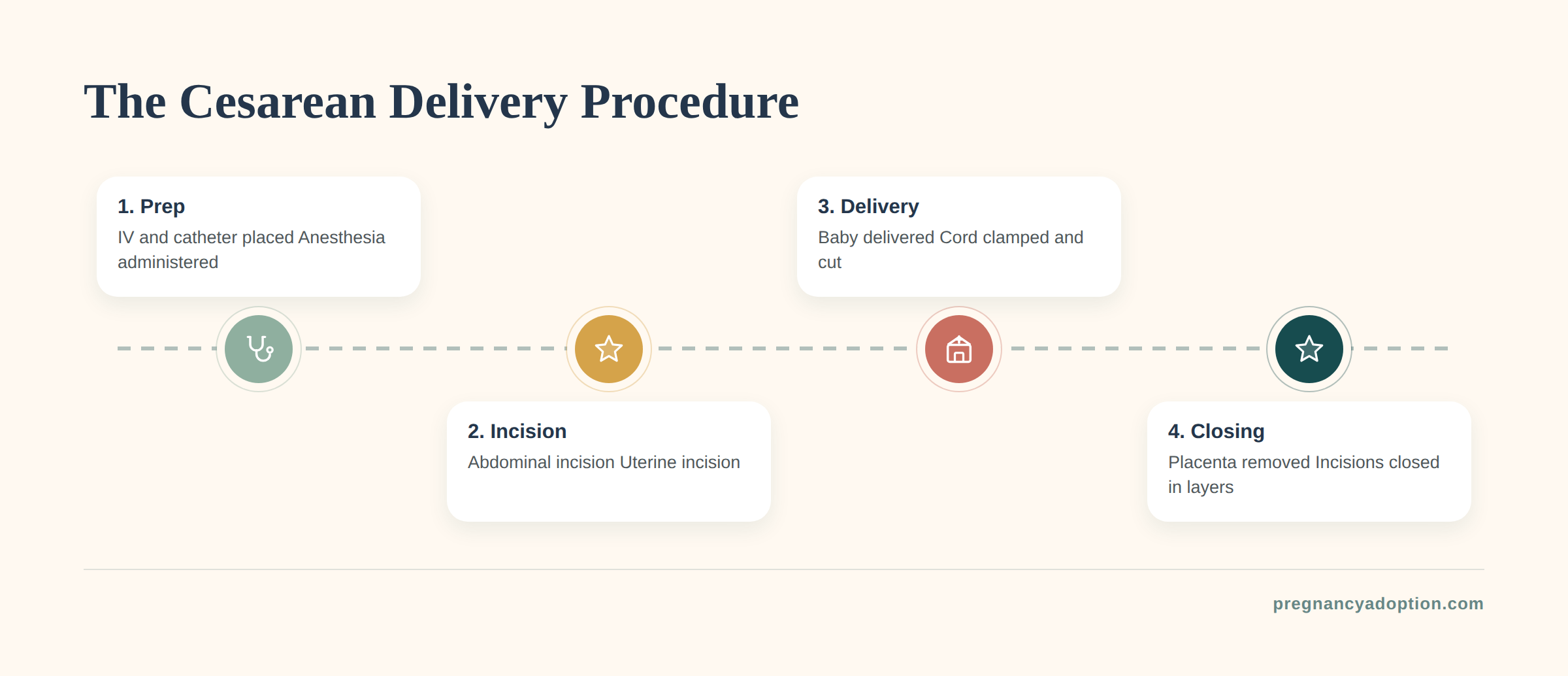
A cesarean follows a fairly consistent sequence, whether planned or unplanned, though the pace and atmosphere differ considerably between the two.
Before the Incision
Once you’re brought into the operating room, a fairly standard sequence of preparation happens before the actual surgery begins: you’ll have an IV placed if one isn’t already in, a bladder catheter inserted (which stays in through the early part of recovery, covered later in this guide), and your abdomen cleaned thoroughly with an antiseptic solution to reduce infection risk. A small screen is usually raised at chest level, which keeps you from seeing the surgical field directly while still allowing you to be present and, in most cases, awake for the birth. Most cesareans use regional anesthesia — either a spinal block or an epidural, each covered in more detail in the anesthesia section of this guide — which numbs you from roughly the chest down while you remain awake and alert throughout the procedure. This preparation phase can feel like it takes a while, especially if you’re anxious or if this is an unplanned cesarean happening faster than expected, but it’s a standard, well-practiced sequence that surgical teams go through for every cesarean, planned or not.
The Incisions
Most skin incisions for a cesarean are horizontal, made low on the abdomen near the pubic hairline — sometimes informally called a “bikini cut” because it typically sits low enough to be hidden by most underwear and swimwear once healed. A vertical incision is less common and is generally reserved for certain emergencies where speed is the priority, or specific situations like some cases involving extensive scar tissue from prior surgeries, where a vertical approach gives the surgeon better access. Separately from the skin incision, the uterine incision — the cut made into the uterus itself to deliver the baby — is most often a low transverse cut across the lower, thinner part of the uterus. This specific type of uterine incision matters beyond the current delivery: it’s the type most compatible with a future VBAC attempt, as this guide’s VBAC section explains in more detail, because a low transverse incision carries a lower uterine rupture risk in a future labor than other incision types. Your surgical record, specifically noting which type of uterine incision you had, becomes relevant information for any future pregnancy.
Delivery and Closing
Once both the skin and uterine incisions are made, the surgeon delivers the baby, clears the baby’s airway, and clamps and cuts the umbilical cord — a sequence that typically happens within just a few minutes of the first incision, which often surprises people who expect the whole surgery to take as long as the delivery itself does. After the baby is delivered, the placenta is removed, and then the longer part of the surgery begins: the uterine and abdominal incisions are closed in layers with stitches, carefully reconstructing the tissue the surgeon opened to reach the baby. This closing phase generally takes considerably longer than the delivery portion — often 30 to 45 minutes or more, depending on the specific situation — which is worth knowing in advance so the pacing of the surgery doesn’t feel unexpected: a very quick delivery followed by a much longer closing process is the normal pattern, not a sign that something is taking too long or going wrong.
Anesthesia Choices for a Cesarean
| Type | How it’s given | Typical use |
|---|---|---|
| Spinal block | Single injection into spinal fluid, fast onset | Most planned cesareans without an existing labor epidural |
| Epidural “top-up” | Existing labor epidural catheter given a stronger dose | Unplanned cesarean after an epidural was already placed for labor |
| Combined spinal-epidural | Both techniques together | Planned cesarean needing flexibility for longer surgery |
| General anesthesia | Fully asleep, breathing tube placed | True emergencies or when regional anesthesia isn’t possible or fast enough |
Regional Anesthesia (Staying Awake)
Regional anesthesia lets you stay awake and alert for your baby’s birth, which is the primary reason it’s used whenever time and circumstances reasonably allow — it generally carries a lower overall risk profile than general anesthesia for both parent and baby, and importantly, it allows a support person to be present in the operating room with you, which general anesthesia typically doesn’t permit. For these reasons, regional anesthesia is the default approach for the large majority of cesareans, whether planned or unplanned, as long as there’s time to place it and no specific medical reason rules it out. As this site’s epidural guide covers in more detail, if you already have a working labor epidural in place because you were attempting a vaginal delivery before your cesarean became necessary, your anesthesia team can often “top up” the existing epidural with a stronger dose appropriate for surgery, rather than placing an entirely new spinal block from scratch. This can save valuable time in a more urgent situation and means you may not need an additional procedure if your epidural is already working well.
General Anesthesia
General anesthesia, where you’re fully unconscious for the surgery, is reserved for a narrower set of situations: when the fastest possible delivery is needed and there isn’t time to place or wait for regional anesthesia to take effect, when regional anesthesia isn’t a safe option for a specific medical reason particular to your situation, or when regional anesthesia has already been attempted but doesn’t provide adequate coverage once surgery begins. It’s a less common path for most cesareans precisely because regional anesthesia is preferred whenever circumstances allow it. With general anesthesia, you won’t be awake or aware for your baby’s birth, and your support person typically can’t be present in the operating room, since general anesthesia involves additional monitoring and safety considerations that regional anesthesia doesn’t. If general anesthesia becomes necessary for your specific delivery, your care team will explain the reasoning as clearly as the situation allows, and in a genuine emergency, the priority is appropriately on getting your baby delivered safely as quickly as possible, with full explanations following once things have stabilized.
Right After Birth: The First Hour
The period immediately following delivery, while your incision is being closed, is often when skin-to-skin contact and early bonding can begin, even during surgery.
Skin-to-Skin and Bonding
If both you and your baby are doing well after delivery and you have regional anesthesia, many hospitals can bring your baby to your chest for skin-to-skin contact right there in the operating room while the surgical team finishes the closing phase of your surgery — a practice that’s become increasingly standard as hospitals have recognized its benefits for bonding and, for those breastfeeding, for establishing early feeding. If this matters to you, it’s worth asking about specifically in advance, since practices and equipment for OR skin-to-skin vary somewhat by hospital. If immediate skin-to-skin in the OR isn’t possible — because your baby needs immediate evaluation by the pediatric team, because you received general anesthesia, or for any other reason specific to your delivery — your support person or a nurse can often hold your baby skin-to-skin nearby until you’re able to, so that bonding time isn’t necessarily lost even when it can’t happen in the exact moment of birth. Many people find that knowing this backup option exists in advance eases some of the worry about what happens if the ideal scenario isn’t possible.
Monitoring in the Recovery Area
After surgery, you’ll typically spend one to a few hours in a dedicated recovery area, separate from the postpartum room you’ll move to afterward, where your vital signs, the amount of bleeding, and your incision are all closely monitored as the anesthesia begins to wear off and your body starts the early stages of recovery. This closer initial monitoring is standard after any major surgery and isn’t a sign of a specific concern; it’s simply the window where complications, if they’re going to show up at all, are most likely to become apparent, so closer observation during this time is the normal, cautious default. If you’re breastfeeding, many people can begin as soon as they feel ready — even during this early recovery window in the recovery area itself, not only once you’ve reached your postpartum room — with support from nursing staff to help you find a comfortable position that doesn’t put pressure on your healing incision while your baby latches. There’s no need to wait until you feel fully recovered to start; starting early, even briefly, is something many people are able to do and that lactation support staff can help facilitate.
Hospital Recovery: Day by Day
| Timeframe | What’s typical |
|---|---|
| First few hours | Recovery-area monitoring; catheter still in place; limited mobility |
| Day 1 | Catheter removed; encouraged to sit up and begin short, assisted walks |
| Day 2 | Walking more independently; pain managed with oral medication; newborn care support |
| Day 3 | Many people are discharged; incision reviewed before leaving |
| Discharge | Typically 2 to 4 days after surgery, depending on recovery and any complications |
The First Day
Nurses typically encourage sitting up and taking a few assisted steps within a day of your surgery, which can feel genuinely daunting right after major abdominal surgery, but early movement meaningfully reduces the risk of blood clots and helps your digestive system restart after the disruption of surgery and anesthesia. This isn’t about pushing you to do more than you’re ready for — the first steps are usually brief and closely assisted — but getting moving sooner rather than later is one of the more evidence-backed recovery practices after a cesarean specifically, and most people find it’s more manageable than they expected once they actually try. Your bladder catheter, placed before surgery began, is usually removed once you’re able to get up and use the bathroom on your own, which generally happens within that first day as well, timed around your increasing mobility rather than a fixed schedule. Having the catheter removed is often one of the more noticeable, welcome milestones of the first day, since it marks a concrete step toward greater independence and comfort.
Days Two and Three
Each day after surgery typically brings more comfortable, more independent movement than the day before, with your pain medication gradually shifting from IV administration to oral forms as your body continues recovering and your pain becomes more manageable with less intensive medication. This isn’t a perfectly linear process — some days feel better than others, and that’s a normal part of recovery rather than a setback — but the overall trajectory across days two and three is generally one of steady improvement. Hospital staff, including nurses and often a dedicated lactation consultant if you’re breastfeeding, can help you learn practical techniques for picking up, holding, and feeding your baby in ways that protect your healing incision during these early, more limited-mobility days — things like which holds put the least pressure on your abdomen, and how to get in and out of bed without straining your core muscles. Taking advantage of this hands-on guidance while you’re still in the hospital, rather than figuring it out alone once you’re home, tends to make the transition home noticeably smoother.
Going Home: Incision Care and Activity Limits
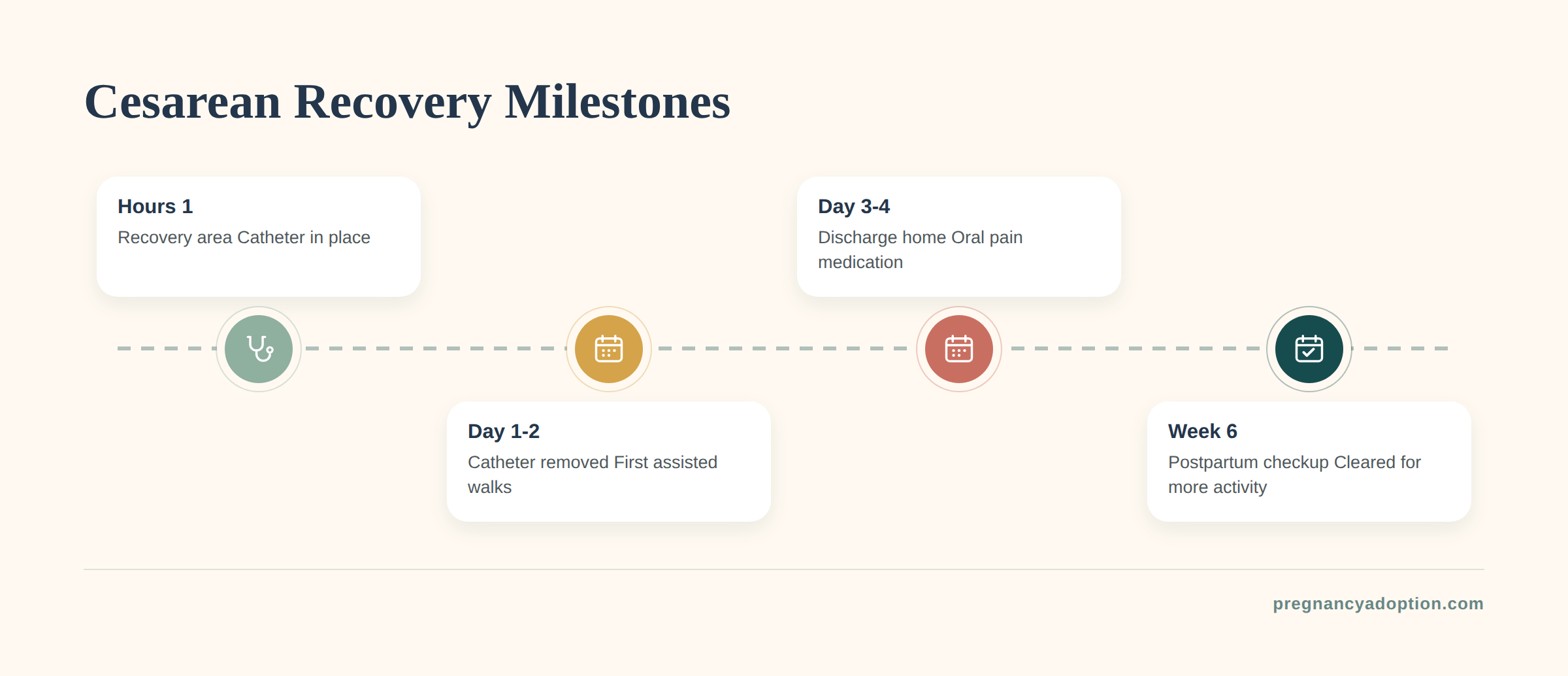
Once you’re home, incision care and activity pacing become your main day-to-day focus for the first several weeks.
Caring for Your Incision
Caring for your incision as it heals mostly comes down to a few consistent habits: gently wash it with mild soap and water during your normal shower, pat it dry afterward rather than rubbing, and avoid soaking in a bath until your provider has confirmed the incision is healed enough to handle submersion, since standing water can introduce more infection risk than a shower does. Beyond basic cleaning, it’s worth knowing what’s actually normal to see as a cesarean incision heals, since not every change is cause for concern: mild redness directly along the incision line, some numbness around the area (which can persist for months and sometimes longer, as nerve endings regenerate slowly), and a firm ridge of healing tissue along the scar are all common and expected parts of healing. Your provider will give you guidance specific to your own incision and healing pattern at your follow-up appointments, and this guide’s warning-signs section below covers the specific changes — rather than the ordinary ones described here — that do warrant a call to your provider rather than waiting to see if they resolve.
Activity Restrictions
Most providers recommend not lifting anything heavier than your baby for the first several weeks of recovery — commonly cited as roughly 10 to 15 pounds — to protect your healing incision and the core abdominal muscles that were affected by surgery, since lifting heavier objects puts meaningful strain on tissue that’s still repairing itself. This restriction often surprises people with other young children at home, since it can mean temporarily not being able to pick up a toddler, which is worth planning around in advance with help from a partner or family member. Many providers also suggest waiting roughly one to two weeks before driving, and longer than that if you’re still taking a prescription pain medication that could affect your reaction time or judgment; the specific timeline depends on your individual recovery and your provider’s own guidance. Stairs are generally fine in moderation during recovery, though it’s worth pacing yourself early on rather than making frequent trips up and down in the first days, when movement is still more effortful and your body is working hard to heal.
Rest and Pacing
Setting up your space so that frequently needed items — diapers, water, snacks, your phone, and anything else you reach for often — are within arm’s reach of wherever you and your baby spend most of your time meaningfully reduces unnecessary up-and-down movement during the early, more limited-mobility days of recovery. This kind of simple, practical “nesting” before you even need it can make a real difference in how much unnecessary strain you put on your healing body each day, since every unplanned trip across the room or up a flight of stairs adds up. This is also a genuinely reasonable time to accept help with cooking, cleaning, caring for older children, and looking after pets, rather than feeling like you need to manage everything yourself on top of recovering from major surgery and caring for a newborn. Recovery tends to go more smoothly, both physically and emotionally, for people who lean on the support available to them during these early weeks rather than trying to run a full household solo while their body is still healing — accepting help isn’t a failure to cope, it’s a reasonable part of recovering well.
Pain Management After a Cesarean
Pain after a cesarean is expected and manageable, with options that scale down as healing progresses.
Medication Options
Pain in the first day or two after surgery is often managed with IV medication, or sometimes a longer-acting dose given during the surgery itself, before transitioning to oral medication as you recover — commonly a combination of ibuprofen and acetaminophen, which together can be quite effective for post-surgical pain, with something stronger available if needed for the first days when discomfort is typically at its peak. This transition from IV to oral medication generally tracks with your overall recovery, moving at a pace your care team adjusts based on how you’re actually doing rather than a fixed schedule applied to everyone the same way. At home, most people manage well with over-the-counter options like ibuprofen and acetaminophen, often alternating between them on a schedule for the first week or two. If you’re prescribed something stronger for a short period after you go home, your provider will specifically discuss breastfeeding compatibility if that’s relevant to you, since some stronger pain medications require more caution while breastfeeding than standard over-the-counter options do, and your provider can help you weigh pain control against any breastfeeding considerations.
Non-Medication Comfort Measures
Beyond medication, a few non-medication comfort measures can meaningfully ease the discomfort of early cesarean recovery. Bracing — pressing a pillow firmly against your abdomen when you cough, laugh, sneeze, or get up from sitting or lying down — can noticeably reduce discomfort by supporting your incision during exactly the kinds of sudden movements that otherwise pull uncomfortably on healing tissue; many people find this simple technique more helpful than they expected. A heating pad set on a low setting, applied for short periods rather than continuously, and finding genuinely supported positions for sitting and lying down — propped with pillows rather than lying flat or sitting unsupported — can also ease residual soreness, especially in the first couple of weeks when discomfort tends to be most noticeable. None of these measures replace medication when you actually need it, but combining them with your pain-management plan, rather than relying on medication alone, tends to make day-to-day movement and basic tasks feel more manageable during the early weeks of recovery.
Warning Signs That Need Medical Attention

| Symptom | What to do |
|---|---|
| Incision swelling, redness, warmth, or discharge | Call your provider promptly |
| Fever | Call your provider promptly |
| Heavy bleeding, soaking a pad an hour or more | Seek care urgently |
| Worsening (not improving) pain | Call your provider promptly |
| Severe leg pain, swelling, or redness (possible clot) | Seek care urgently |
| Chest pain or trouble breathing | Seek emergency care |
| Thoughts of harming yourself or your baby | Seek help immediately |
Incision-Related Warning Signs
A specific set of incision-related changes is worth watching for and calling your provider about, as distinct from the normal healing signs covered earlier in this guide. Increasing redness that’s spreading rather than stable, noticeable warmth to the touch around the incision, increasing swelling, increasing pain rather than gradual improvement, or any discharge from the incision — especially when combined with a fever — together suggest a possible infection and warrant a call to your provider rather than waiting to see if the symptoms resolve on their own. Catching a potential infection early generally makes it easier to treat, which is why these specific signs are worth taking seriously rather than assuming they’ll pass. Separately, if part of the incision appears to be separating or opening — sometimes called incision dehiscence — contact your provider promptly rather than trying to manage it yourself at home with bandages or home remedies, since this needs professional evaluation to determine the right next step, which can range from closer monitoring to additional treatment depending on how much of the incision is affected and how it looks.
Systemic Warning Signs
Beyond incision-specific warning signs, a few broader, systemic symptoms are worth knowing during cesarean recovery. Severe swelling, warmth, or pain in one leg — particularly localized to the calf — can signal a blood clot and needs urgent evaluation, since cesarean recovery carries a somewhat elevated blood clot risk compared to a vaginal birth, largely tied to the reduced mobility of the first days after surgery; this is exactly why early walking, covered earlier in this guide, is encouraged so soon after surgery despite how counterintuitive that can feel right after major surgery. Postpartum mental health is a separate but equally important category to watch for during recovery from any birth, cesarean or vaginal: severe mood swings, overwhelming sadness, appetite or sleep changes that go beyond the normal exhaustion of caring for a newborn, or difficulty caring for yourself or your baby are all worth raising directly with your provider rather than assuming they’re simply part of adjusting to parenthood. This site’s postpartum depression guide covers this topic in considerably more depth, including guidance on when these symptoms cross into something that benefits from more active support rather than simply waiting for them to pass on their own.
Emotional Recovery and Processing an Unplanned Cesarean
The emotional side of a cesarean — especially an unplanned one — deserves as much attention as the physical recovery.
Processing an Unplanned or Difficult Birth Experience
Feeling grief, disappointment, or even anger about a birth that didn’t go as planned — particularly an unplanned cesarean after hoping for a vaginal delivery — is a common and entirely valid response, not a sign of ingratitude for a healthy outcome or an overreaction to something that “turned out fine.” Both things can be true at once: genuine gratitude for a healthy baby and genuine grief or disappointment about how the birth itself unfolded, and holding both doesn’t diminish either one. Many people find it’s genuinely helpful to talk through what actually happened with their care team afterward, sometimes at a follow-up appointment specifically dedicated to this, rather than only at a brief postpartum check that focuses mainly on physical recovery. Asking specifically why certain decisions were made during labor — what the actual medical reasoning was in the moment — can turn confusion or a vague sense that something went wrong into genuine understanding, which for many people meaningfully changes how they feel about the experience even when the outcome itself doesn’t change. This conversation is worth having even weeks or months later if it wasn’t addressed at the time.
When Feelings Run Deeper
Some people experience symptoms consistent with birth-related trauma after a difficult, frightening, or fast-moving cesarean — this is a recognized, genuinely treatable experience, not something to minimize, dismiss, or push through alone simply because the physical outcome was a healthy baby. Birth trauma can show up as intrusive memories of the delivery, heightened anxiety particularly around medical settings or future pregnancies, difficulty feeling connected to the birth experience or even to the baby in some cases, or a persistent sense of fear or dread when thinking back on what happened. These are real, documented responses that mental health professionals who specialize in this area are specifically equipped to help with, not something you’re expected to simply get over with time alone. A therapist experienced in perinatal mental health, a postpartum support group specifically for people who’ve had difficult birth experiences, or starting the conversation with your own obstetric or primary care provider are all reasonable starting points if a difficult birth experience is still weighing on you weeks or months later — there’s no specific timeline after which it becomes “too late” to seek support for this.
Breastfeeding and Bonding After a Cesarean
A cesarean doesn’t prevent breastfeeding or bonding — it mainly changes positioning and timing in the early days.
Positioning Around the Incision
Finding a comfortable position for breastfeeding that keeps your baby’s weight off your healing incision takes some adjustment after a cesarean, and a couple of positions tend to work particularly well for most people. A football hold — where your baby is tucked under your arm along your side, facing you, rather than lying across your lap — keeps their weight and movement away from your abdomen entirely, which many people find more comfortable in the first weeks than more traditional positions. Lying on your side to nurse, with your baby facing you, is another option that avoids any pressure on your incision while also letting you rest more than you could sitting upright. Pillows are genuinely useful here, whether that’s a dedicated nursing pillow or just a few regular pillows propped around your midsection to support your baby at the right height, so you’re not leaning forward or bearing any of your baby’s weight on your abdomen while you nurse. Hospital lactation staff can help you find and practice these positions before you go home, which tends to make the transition easier than figuring it out alone for the first time.
Milk Supply and Timing
A cesarean itself doesn’t reduce your body’s ability to produce milk — your milk supply is driven by hormonal changes and, after that, by how often and effectively milk is removed, not by how your baby was delivered. Any delay in the first feeding, whether due to your own recovery immediately after surgery or because your baby needs some initial evaluation by the pediatric team, is typically brief and doesn’t prevent breastfeeding from being successfully established afterward. As with any birth, feeding early and often once you and your baby are both ready genuinely supports your milk supply, since frequent removal of milk is what signals your body to keep producing more. Lactation support staff, available at most hospitals, can help you work around the specific physical limitations of surgical recovery in the first days — finding comfortable positions, as covered above, and helping with latch technique while you’re also managing post-surgical pain and limited mobility. If you’re concerned about your supply specifically because of your cesarean, that concern is understandable but not usually borne out; most of the usual breastfeeding guidance and troubleshooting applies the same way it would after any birth.
Risks and Possible Complications
| Category | Examples |
|---|---|
| During surgery | Bleeding, anesthesia reactions, rare injury to bladder or bowel |
| In recovery | Infection (incision, uterus, urinary tract), blood clots |
| For the baby | Transient breathing difficulty, rare surgical nicks |
| For future pregnancies | Scar tissue, placenta previa/accreta, uterine rupture risk during VBAC |
Risks During Surgery
A cesarean generally involves more blood loss than a vaginal birth, since it’s a major abdominal surgery rather than a vaginal delivery, and your surgical team monitors your blood loss closely throughout the procedure, with blood transfusion available if it’s ever needed, though that’s uncommon for a routine cesarean. As with any surgery involving anesthesia, there’s a small risk of an anesthesia-related reaction, which is part of why your pre-operative conversation with anesthesia staff, covered earlier in this guide, matters — it gives your anesthesia team the history they need to minimize this risk for your specific situation. Rare surgical injury to nearby organs, most commonly the bladder or bowel given their proximity to the surgical site, is uncommon but possible, and becomes somewhat more likely in situations involving extensive scar tissue from prior abdominal surgeries, including prior cesareans, which can make the anatomy less straightforward for the surgeon to navigate. These risks are genuinely rare for the large majority of cesareans, and your surgical team takes specific precautions throughout the procedure precisely to minimize them, but understanding that a cesarean is real surgery, with real surgical risks, is part of making an informed decision about any delivery method.
Risks in Recovery
Infection is among the most commonly discussed post-cesarean complications, and it can affect the incision itself, the uterine lining (sometimes called endometritis), or the urinary tract, particularly given the bladder catheter used during and immediately after surgery. This guide’s warning-signs section, covered earlier, walks through the specific signs of each of these that are worth catching early, since prompt treatment generally leads to a straightforward recovery from a post-surgical infection when one does develop. Blood clots are a separate recovery-phase risk worth understanding: reduced mobility in the hours and early days immediately after surgery raises clot risk somewhat compared with a vaginal birth, where people are typically up and moving sooner. This is precisely why early walking is encouraged so soon after surgery, even when it feels difficult — it’s one of the more effective, low-cost ways to actively reduce this specific risk, alongside any additional clot-prevention measures your care team may use, such as compression devices during your hospital stay. Both of these risks are manageable and, for most people, don’t end up becoming an actual complication, but knowing the warning signs means you’re positioned to catch either one early if it does happen.
Risks for the Baby
Babies born by cesarean, especially those delivered before labor has started on its own (as with many planned cesareans), are somewhat more likely to experience brief breathing difficulty in the first hours after birth compared to babies born vaginally. This is thought to relate to the hormonal and physical processes of labor itself, which help prepare a baby’s lungs to transition to breathing air, and which a baby delivered before labor begins doesn’t experience in the same way. This breathing difficulty is usually mild and typically resolves on its own with monitoring, sometimes with brief additional support, and your baby’s care team will be specifically watching for this in the hours after a cesarean delivery as a matter of standard practice. Rare surgical nicks — small, accidental cuts to the baby’s skin that can occasionally happen during the uterine incision, since the surgeon is working close to the baby while trying to avoid exactly this — are uncommon, and when they do occur, they’re typically small and heal without any lasting issue. Your baby’s care team will point out and document any nick if one occurs, so you’re aware of it rather than discovering it unexpectedly.
VBAC: Vaginal Birth After a Cesarean
A VBAC — vaginal birth after cesarean — is a reasonable, often successful option for many people with a prior cesarean, though not everyone is an equally good candidate.
Who’s Generally a Good Candidate
A prior low-transverse uterine incision — the most common type, covered earlier in this guide’s section on the surgery itself — no more than one or two prior cesareans, and no other major obstetric complications in the current pregnancy generally make someone a reasonable VBAC candidate, meaning attempting a vaginal birth after a previous cesarean is a medically reasonable option worth discussing with your provider. This isn’t an automatic approval, though; your provider will weigh your complete history, including why your prior cesarean happened and how your current pregnancy is progressing, before confirming whether VBAC is a reasonable path for you specifically. ACOG recommends attempting a VBAC specifically at a facility equipped to respond quickly with an emergency cesarean if one becomes necessary during labor, since the main risk of a VBAC attempt — covered in the next section — requires that capability to be available without significant delay. This is worth asking about directly if you’re considering VBAC: not every hospital or birth setting is equipped for this, which can be a genuinely relevant factor in where you choose to deliver if VBAC is something you’re hoping to pursue.
Weighing the Risks and Benefits
A successful VBAC comes with real benefits worth weighing: a shorter recovery than another surgery would require, avoiding the risks that come with any additional abdominal surgery, and for some people, a birth experience that feels closer to what they’d originally hoped for before their first cesarean. These benefits are genuine, and they’re part of why VBAC is offered as an option for reasonable candidates rather than routinely steering everyone toward a repeat cesarean. The main added risk of attempting a VBAC, weighed against these benefits, is uterine rupture along the scar from the prior cesarean — a rare but serious complication where the uterine wall tears at the site of the previous incision during labor. This is precisely why VBAC attempts call for continuous monitoring during labor and delivery at a facility equipped to respond quickly with an emergency cesarean if needed, as covered in the previous section: the risk is low for a reasonable VBAC candidate, but it’s serious enough that the setting and monitoring genuinely matter. Your provider can walk you through your own individual risk level based on your specific history, which varies somewhat from person to person even among reasonable VBAC candidates.
How a VBAC Is Monitored
Continuous fetal heart-rate monitoring during a VBAC attempt helps your care team catch early signs of a developing problem, including subtle changes in the baby’s heart-rate pattern that can be an early warning sign of uterine rupture before more obvious symptoms appear — this is part of why continuous monitoring, rather than intermittent checks, is standard specifically for a VBAC attempt, even though intermittent monitoring is sometimes used for other labors. As this site’s epidural guide notes, having an epidural during a VBAC attempt is generally considered safe and doesn’t mask or prevent other warning signs, such as the fetal heart-rate changes mentioned above, from being detected by your monitoring equipment and care team — a common misconception is that an epidural might hide the pain that would otherwise signal a problem, but the monitoring itself, not your own pain perception, is what’s primarily relied on to catch early warning signs. This means choosing to have an epidural during a VBAC attempt doesn’t meaningfully change the safety monitoring in place, and it’s a reasonable choice for pain management during a VBAC labor the same way it would be for any other labor.
Future Pregnancies After a Cesarean
| Number of prior cesareans | General pattern |
|---|---|
| One | VBAC often reasonable; placenta accreta/previa risk modestly elevated |
| Two | VBAC candidacy more individualized; risk rises further |
| Three or more | Repeat cesarean usually favored; accreta and other risks notably higher |
Scar Tissue and Adhesions
Scar tissue, medically called adhesions, can form between the uterus and nearby organs — such as the bladder or bowel — after any abdominal surgery, including a cesarean, as part of the body’s normal healing response to surgical incisions. Occasionally, adhesions make a future abdominal surgery, including a repeat cesarean, technically more complex for the surgeon, since tissue that would normally move and separate easily can instead be bound together in ways that take more careful dissection to navigate safely. That said, most adhesions don’t cause any day-to-day symptoms and most people with them never notice anything different in their regular life; adhesions matter mainly in the specific context of a future surgery, where your surgeon will account for them based on your surgical history and, if needed, adjust their approach accordingly. If you’ve had multiple prior abdominal surgeries, including more than one cesarean, mentioning this complete history to any future surgeon — not just assuming they already know from your records — helps them plan appropriately in advance rather than discovering the extent of scar tissue only once surgery has begun.
Placenta Previa and Placenta Accreta Risk
The risk of placenta previa and, more seriously, placenta accreta — a condition where the placenta grows too deeply into the uterine wall, sometimes into the muscle itself or beyond — rises with each additional prior cesarean, making this one of the more significant cumulative risks to understand if you’re considering how many children to have or how to approach a specific future pregnancy after a cesarean. Placenta accreta in particular can involve serious bleeding risk at delivery and sometimes requires a planned hysterectomy at the time of delivery to manage safely, which is part of why this specific risk gets singled out rather than treated as a minor footnote. This rising risk with each cesarean is a significant factor some people genuinely weigh when deciding how many children to have, and it’s also a relevant factor in discussions between VBAC and a repeat planned cesarean for a specific future pregnancy — since avoiding an additional cesarean, when VBAC is a reasonable option, can mean avoiding this specific added risk for that pregnancy and any after it. Your provider can discuss your own individual risk level based on how many cesareans you’ve had and your specific obstetric history.
Spacing Pregnancies After a Cesarean
Many providers recommend a minimum interval between a cesarean delivery and the start of a subsequent pregnancy — commonly at least 18 months between deliveries — to allow the uterine incision to heal fully before another pregnancy places new demands on that same tissue, particularly if a future VBAC is being considered, since adequate healing time is one of the factors that affects VBAC safety and candidacy. This recommended spacing isn’t an arbitrary rule; it reflects what’s currently understood about how long uterine tissue genuinely needs to regain its strength after a cesarean, and conceiving sooner than that recommended window is associated with somewhat higher risk, including for uterine rupture if a VBAC is later attempted. If you’re planning pregnancies close together after a cesarean, for any reason, raising this directly and specifically with your provider lets them flag any individual concerns particular to your healing, your specific incision, and your overall history, rather than relying on general guidance alone that may not account for factors specific to your situation. This conversation is worth having proactively, before you’re already pregnant again, if spacing is a consideration for you.
Cesarean Delivery by Maternal Request
Some people request a planned cesarean for a first baby without a specific medical indication — a legitimate, if less common, path some providers will discuss.
What Professional Guidance Says
ACOG has noted that requesting a cesarean without an underlying medical reason — sometimes called a maternal-request cesarean — may not be the best option for everyone, especially those planning several future pregnancies, given the cumulative risks that rise with each additional cesarean, covered earlier in this guide’s section on future-pregnancy considerations. This is a nuanced position rather than a blanket discouragement: it reflects weighing the specific risks of cesarean delivery against the specific risks and uncertainties of labor, which vary depending on individual circumstances and how many future pregnancies someone is hoping for. Not every provider or hospital offers this option in practice, even when it’s medically discussed as a legitimate possibility in guidance documents. Some providers and hospitals are willing to discuss and perform a maternal-request cesarean after a thorough conversation about risks, benefits, and alternatives; others are not, whether due to institutional policy, individual provider philosophy, or other factors specific to that practice or facility — this varies meaningfully by provider and by facility, so if this is something you’re considering, it’s worth raising directly and early with your specific provider rather than assuming it will or won’t be available.
Things Worth Weighing Before Requesting One
Because risk accumulates with each additional cesarean — placenta previa and accreta risk, surgical complexity from scar tissue, and the other factors covered throughout this guide’s risk sections — how many future pregnancies you’re hoping for is a genuinely relevant factor worth weighing before requesting a cesarean without a medical reason. Someone planning just one more pregnancy faces a meaningfully different risk calculation than someone hoping for several more children, and that’s worth being honest with yourself and your provider about as part of this decision. It’s also worth examining what’s actually driving the request, since the underlying reason can open up options you might not have considered. If fear of labor itself, or processing a prior difficult birth experience, is the real driver behind wanting a planned cesarean, discussing that directly and specifically with your provider — rather than requesting a cesarean as a way to avoid the conversation — sometimes surfaces alternatives worth considering alongside a planned cesarean, such as continuous one-on-one labor support, a detailed anesthesia plan addressing your specific concerns, or simply a more thorough conversation about what happened in a prior birth and what might go differently this time.
A Cesarean in the Context of an Adoption Plan
If you’re pregnant and considering or pursuing an adoption plan, a cesarean adds a few additional considerations worth planning for ahead of time.
If You’re Placing Your Baby for Adoption
As this site’s prenatal care and adoption plan guide covers, your hospital plan — including who holds the baby after delivery, your preferences around time together with the baby, and your own physical recovery needs — can and should be discussed with your adoption professional and hospital team well in advance, regardless of whether you’re delivering vaginally or by cesarean. A cesarean doesn’t change the fundamental questions involved in planning your hospital stay around an adoption plan, but it does add some practical considerations worth factoring in, covered in the next section. It’s worth being clear about one thing directly: needing more physical recovery time after a cesarean doesn’t change or complicate your adoption plan itself in any way — hospital staff and adoption agency staff are generally experienced in coordinating both a surgical recovery and an adoption plan at the same time, and your plan remains exactly as valid and exactly as much yours to direct as it would be after any other delivery method. If anything about coordinating these two things feels uncertain, raising it directly with your adoption professional ahead of time is worth doing.
Practical Considerations
Because cesarean recovery typically means a slightly longer hospital stay than a vaginal birth — often two to four days compared with one to two for an uncomplicated vaginal delivery — it’s worth building this extra time into your expectations and your discussions with your adoption professional about timing and logistics, including when paperwork, visits, and any time-sensitive steps in your plan are likely to happen relative to your discharge date. This isn’t a complication to your plan, just a practical scheduling detail worth having accounted for ahead of time rather than discovering it only once you’re in the hospital recovering. The emotional-recovery guidance covered earlier in this guide — about processing a difficult or unplanned birth experience, and about birth trauma when feelings run deeper than ordinary disappointment — applies fully alongside the emotional dimensions specific to navigating an adoption plan at the same time. Support for both can and should happen together as part of the same overall care, rather than being treated as competing priorities where attention to one means less attention to the other; a good hospital and adoption support team should be able to hold both at once.
The Partner or Support Person’s Role
A cesarean changes some of what a partner or support person can do compared with a vaginal delivery, but their role remains meaningful throughout.
In the Operating Room
If you have regional anesthesia and the situation isn’t a full emergency, most hospitals allow one support person in the operating room with you during a cesarean, typically seated near your head, out of the sterile field the surgical team is working in, so they can be present and supportive without interfering with the procedure itself. This is the same general setup many people picture for a vaginal delivery, just adapted for an operating room setting, and it means you’re generally not alone for the birth even though it’s happening in a more clinical setting than a typical labor and delivery room. With general anesthesia, or in a true emergency where speed is the priority, a support person usually cannot be in the room — this is specifically about maintaining safety and a sterile surgical environment under those circumstances, not about excluding your support person for any other reason, and it’s worth understanding in advance so it doesn’t feel like an unexplained exclusion if it happens to apply to your specific delivery.
During Hospital Recovery
While you’re adjusting to limited mobility in the days after surgery, a support person can take on genuinely practical, hands-on help with the baby — diaper changes, soothing a fussy newborn, and bringing the baby to you for feeding so you’re not getting up and down more than necessary while your incision is still healing. This kind of practical help matters more than it might sound like in the abstract, since even small amounts of unnecessary movement add up when you’re recovering from abdominal surgery. Beyond hands-on baby care, a support person can also help track questions for your care team as they come up throughout the day, communicate your preferences and needs when you’re groggy from pain medication or simply exhausted, and generally serve as a steady, present source of support through what is, regardless of how smoothly it goes, a physically demanding recovery layered on top of adjusting to a new baby. Having someone else able to advocate for you during moments when you’re not at your sharpest is one of the more underrated practical benefits of having support present during hospital recovery.
A Simple Action Checklist
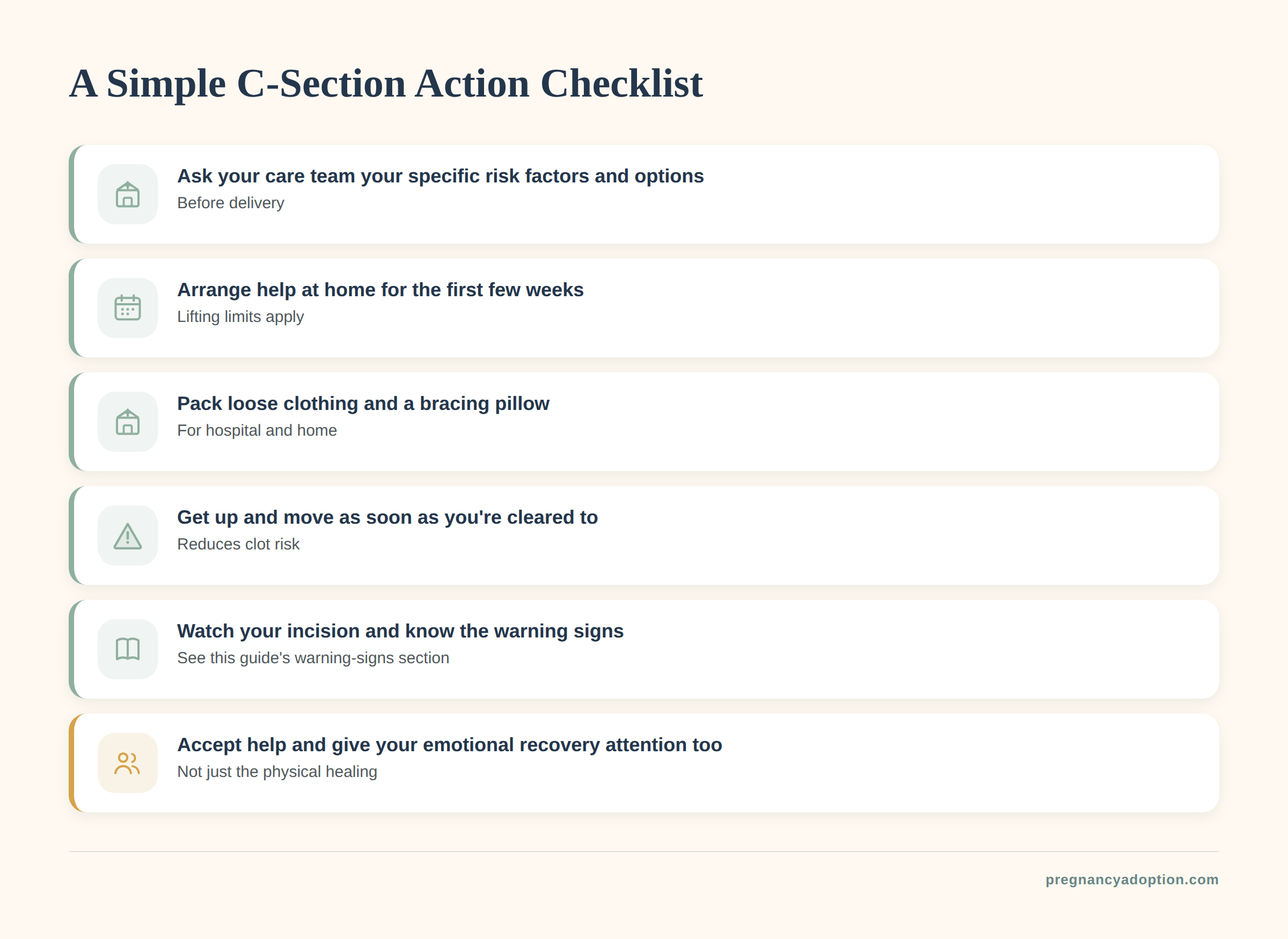
Before Surgery
If You Know in Advance
Complete pre-admission testing, ask your questions from Section 6, arrange help at home, and pack loose clothing and a bracing pillow.
If It Becomes Unplanned
Ask your care team what category of urgency you’re in, and know that your questions are still welcome even as things move quickly.
After Surgery
In the Hospital
Get up and move as soon as you’re cleared to, ask for pain management proactively rather than waiting until pain is severe, and ask for help positioning your baby for feeding.
At Home
Watch your incision for the warning signs in Section 13, respect your lifting limits, and accept help — physical and emotional — without guilt.
Glossary of Terms in This Guide
Surgical and Clinical Terms
Low Transverse Incision
A horizontal cut across the lower, thinner part of the uterus — the most common type and the one most compatible with a future VBAC attempt.
Dystocia
Labor that isn’t progressing normally, often due to the baby’s position, size, or inadequate contractions.
Anesthesia Terms
Spinal Block
A single injection of anesthesia directly into the spinal fluid, providing fast-onset numbness for surgery.
Epidural Top-Up
Increasing the dose in an already-placed labor epidural catheter to achieve surgical-level anesthesia for an unplanned cesarean.
Future-Pregnancy Terms
VBAC
Vaginal birth after cesarean — successfully delivering vaginally in a pregnancy following a prior cesarean.
Placenta Accreta
A condition where the placenta grows too deeply into the uterine wall, a risk that rises with each additional prior cesarean.
Frequently Asked Questions
Basic Understanding
What exactly is a c-section?
A cesarean section is surgery to deliver a baby through incisions in the abdomen and uterus rather than through the vagina.
How common are c-sections?
Roughly 1 in 3 U.S. births is by cesarean, making it one of the most frequently performed major surgeries
Deciding on a Cesarean
Who makes the final decision about whether I need one?
This is a shared decision between you and your care team, though in a true emergency, your team may need to act quickly to protect your or your baby’s safety.
Can I refuse a recommended cesarean?
You generally have the right to decline recommended medical care after a full discussion of risks, though your team will explain why they believe it’s the safest option in your specific situation.
Anesthesia Questions
What if regional anesthesia doesn’t fully work?
Your anesthesia team will check coverage before starting and can adjust the dose or, rarely, switch to general anesthesia if coverage is inadequate.
Will I be nauseated?
Nausea is a fairly common side effect of cesarean anesthesia, usually treatable with medication given during or after surgery.
Incision Care Questions
What type of stitches or closure is used?
This varies by surgeon and situation — staples, dissolvable stitches, or surgical glue are all used; your team will tell you which was used and any specific care instructions.
When do stitches or staples come out?
If non-dissolvable staples or stitches were used, they’re typically removed at a follow-up visit, often within one to two weeks; dissolvable stitches resolve on their own.
Pain and Medication Questions
How long does incision pain typically last?
Noticeable soreness often improves significantly within two weeks, with milder tenderness sometimes persisting longer, especially with certain movements.
Is it safe to take pain medication while breastfeeding?
Many common options, including ibuprofen and acetaminophen, are considered compatible with breastfeeding; your provider will flag anything that isn’t if you’re prescribed something stronger.
Emotional and Mental Health Questions
Is it normal to feel disconnected from the birth experience?
Yes, especially after a fast-moving or unplanned cesarean — many people describe needing time to emotionally process what happened, separate from the physical recovery.
How do I know if what I’m feeling is more than normal adjustment?
Persistent sadness, intrusive memories of the birth, anxiety that interferes with daily function, or any thoughts of harming yourself or your baby all warrant reaching out for support — see this site’s postpartum depression guide for more detail.
Breastfeeding Questions
Does a cesarean delay milk coming in?
It can be delayed by a day or so in some cases, though this varies individually and isn’t universal; lactation support can help you monitor feeding effectiveness regardless.
What’s the best position to avoid incision pain while nursing?
The football hold and side-lying position are commonly recommended specifically because they keep the baby’s weight off your abdomen.
Risk and Safety Questions
Is a c-section riskier than a vaginal birth overall?
Each has its own risk profile; a cesarean carries somewhat higher surgical risks, while certain situations make a cesarean the safer option specifically for that pregnancy — risk is best assessed in your individual context, not as a blanket comparison.
What increases my personal risk of complications?
Factors like obesity, diabetes, multiple prior abdominal surgeries, and certain chronic conditions can raise complication risk; your care team can speak to your specific profile.
VBAC Questions
If I had one cesarean, am I automatically eligible for a VBAC next time?
Not automatically — eligibility depends on your specific incision type, overall obstetric history, and current pregnancy factors, discussed individually with your provider.
What’s my chance of a successful VBAC?
Success rates vary by individual factors, but a meaningful majority of appropriately selected candidates do deliver vaginally
Adoption-Plan Questions
Does having a cesarean change anything about my adoption plan logistics?
It mainly affects timing — a slightly longer hospital stay — rather than the plan itself; coordinating with your adoption professional in advance smooths this out.
Can my adoption professional still be involved during my hospital stay?
Yes — hospital and agency teams are generally experienced in coordinating hospital logistics alongside an adoption plan, regardless of delivery method.
Partner and Support-Person Questions
Can my partner cut the umbilical cord during a cesarean?
This varies by hospital and situation; some allow it with appropriate precautions, so it’s worth asking in advance if it matters to you.
What should my support person expect emotionally in the OR?
It’s a clinical, fast-moving environment that can feel intense even when everything is going well — knowing this in advance helps some support people feel more prepared.
Rare Serious Complications Questions
What is postpartum hemorrhage and how does it relate to a cesarean?
Postpartum hemorrhage (heavy bleeding after delivery) is somewhat more common after a cesarean than after a vaginal birth and is actively monitored for and managed by your surgical team throughout and after the procedure.
What is uterine atony?
It refers to the uterus not contracting firmly enough after delivery, a leading cause of postpartum hemorrhage, managed with medication and, rarely, additional intervention.
Diastasis Recti and Core Recovery Questions
What is diastasis recti, and is it related to having a cesarean?
Diastasis recti is a separation of the abdominal muscles that can occur with any pregnancy, regardless of delivery method; it’s assessed and, if present, addressed through targeted rehab rather than being specific to cesarean recovery.
When can I see a pelvic floor or core-rehab physical therapist?
Many providers can refer you once you’re cleared for general activity, often around the six-week visit, though some practices offer earlier gentle guidance — ask your provider what’s available.
Hernia and Long-Term Surgical Questions
Does a cesarean increase my risk of a hernia later in life?
Incisional hernias are an uncommon but recognized long-term risk after any abdominal surgery, including a cesarean; persistent bulging or pain at the incision site, even years later, is worth mentioning to a provider.
Does scar tissue from a cesarean complicate unrelated future abdominal surgery?
It can add some complexity for a surgeon operating in that area later, which is why it’s helpful to mention your cesarean history before any future abdominal procedure, even an unrelated one.
Spinal Headache Questions
What causes a headache after spinal or epidural anesthesia?
A post-dural puncture headache can occur if spinal fluid leaks slightly at the injection site; it’s uncommon but recognizable by a specific pattern — worse when upright, better when lying flat.
How is a spinal headache treated?
Options range from caffeine, fluids, and rest to, for persistent cases, a procedure called a blood patch that seals the small leak; your anesthesia team will guide treatment if this occurs.
Postpartum Bleeding (Lochia) Questions
How much bleeding is normal after a cesarean?
Some vaginal bleeding (lochia) is normal after any delivery, including a cesarean, typically heaviest in the first few days and gradually tapering over several weeks.
When does normal bleeding become a warning sign?
Soaking through a pad within an hour, passing large clots, or bleeding that increases rather than tapers over time are all reasons to seek prompt medical attention.
Uterine Rupture Symptom Questions
What are the warning signs of uterine rupture during a VBAC attempt?
Signs can include sudden, severe abdominal pain that doesn’t fade between contractions, abnormal fetal heart-rate patterns, or vaginal bleeding; this is why continuous monitoring during a VBAC attempt is standard practice
How quickly is uterine rupture treated if it happens?
It requires an emergency cesarean as quickly as possible; facilities offering VBAC are specifically equipped to respond rapidly for this reason.
Birth Control Timing Questions, Expanded
Can I start hormonal birth control while breastfeeding after a cesarean?
Certain options (such as progestin-only methods) are generally considered compatible with breastfeeding; your provider can help you choose based on your feeding plan and personal preferences at your postpartum visit.
Is an IUD placement affected by having had a cesarean?
Not fundamentally — IUD placement timing after a cesarean follows similar general postpartum guidance as after a vaginal birth, discussed at your follow-up visit.
Choosing a Hospital or Birth Setting Questions
Does it matter which hospital I choose if I might need a cesarean?
Yes, somewhat — hospitals vary in how quickly they can move to an emergency cesarean and in their maternity-care level designation, so asking about this directly when choosing where to deliver is a reasonable step.
What do maternity “levels of care” designations mean?
They broadly describe a hospital’s capability to handle complications of increasing complexity, from routine low-risk care up to the most specialized maternal and newborn intensive care
