
Alabama Adoption Laws and Process: Consent, Rights, Costs, and Finalization
Adoption law is written state by state, and Alabama has its own specific statutes governing who must consent to an adoption, how long a birth parent has to change their mind, what a prospective adoptive family can lawfully pay for, and what happens at the courthouse on finalization day. This guide walks through Alabama’s adoption law and process in full, citing the specific Alabama Code and Alabama Administrative Code sections behind each rule where a source provided one, while being transparent about where sources conflict or leave a gap. It’s written for prospective adoptive parents, expectant parents considering adoption in Alabama, and birth fathers trying to understand their rights — though its legal depth makes it useful for anyone researching Alabama adoption law specifically.
This guide is not a substitute for a licensed Alabama adoption attorney reviewing your specific situation. Alabama’s own adoption statutes (primarily Title 26, Chapters 10A and 10C of the Alabama Code) are detailed and, in at least one place discussed below, genuinely ambiguous even in official summaries — exactly the kind of situation where a quick online answer isn’t enough and professional legal advice matters.
Short Answer: Alabama Adoption at a Glance
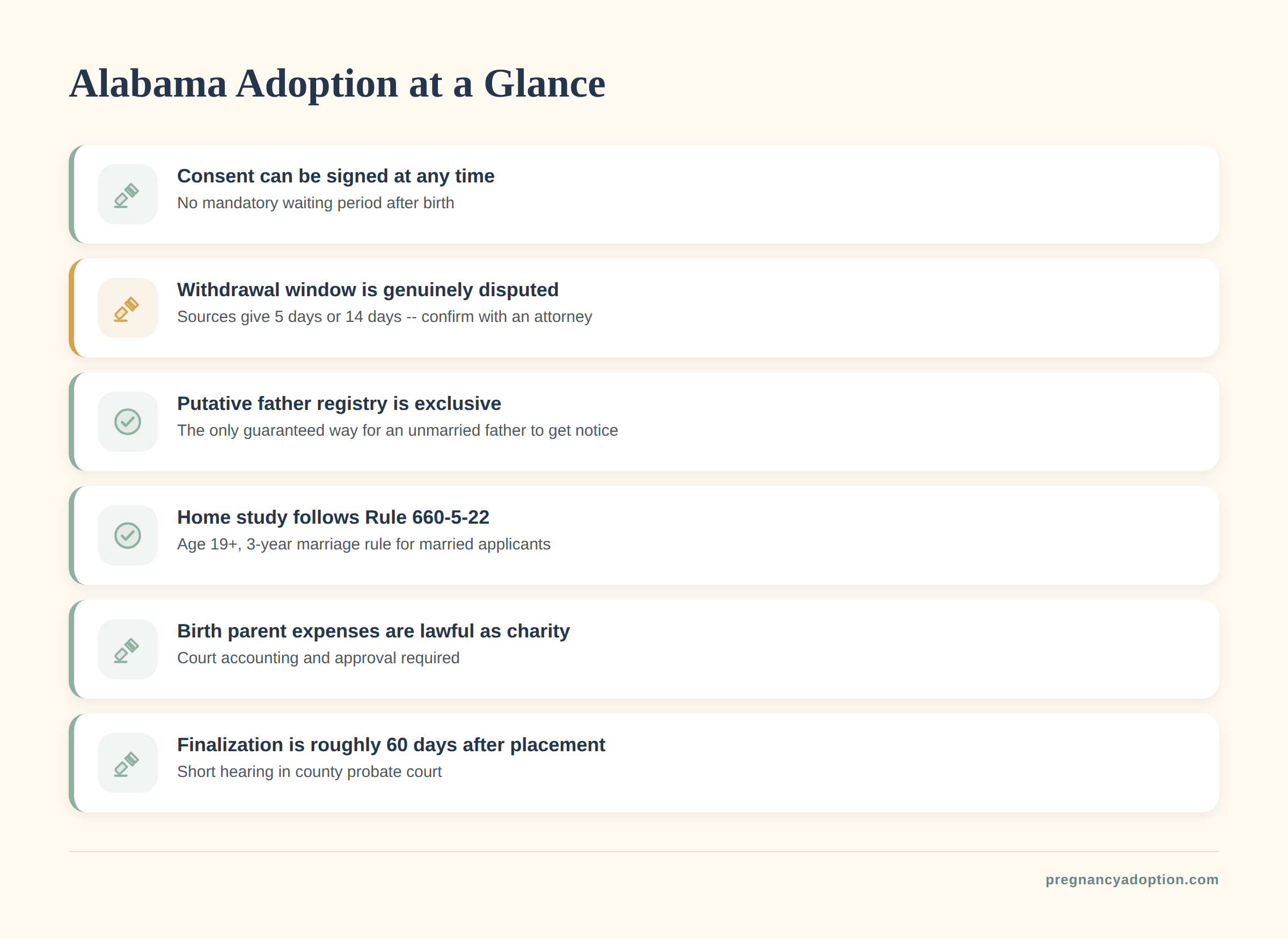
In Alabama, adoption consent generally must come from the birth mother, certain presumed or putative fathers, and a child age 14 or older, under Alabama Code Title 26, Chapter 10A. Consent can be signed at any time with no mandatory waiting period, but a mother’s prebirth consent must be confirmed before a probate judge. Alabama’s statute itself gives two different consent-withdrawal windows in different sections — 5 days and 14 days — a genuine sourced conflict this guide flags rather than resolves, so confirm the current rule with an attorney before relying on either number. Alabama maintains a putative father registry (§ 26-10C-1) that is the exclusive way an unmarried father can preserve his right to notice and a chance to contest an adoption. Home studies are governed by § 26-10A-19 and Alabama Administrative Code Rule 660-5-22, with specific applicant qualifications including a 3-year marriage requirement for married applicants and a minimum age of 19. Finalization typically happens at a short hearing in county probate court roughly 60 days after placement, once post-placement supervision (required within 45 days of placement) and any required ICPC or ICWA clearance are complete.
Key Takeaways
- Alabama’s consent-withdrawal window is genuinely disputed even in official government summaries — 5 days in one statutory cross-reference, 14 days in another — so this is the single most important thing to confirm with an attorney before relying on any number, including this guide’s.
- Alabama’s putative father registry is the exclusive legal mechanism for an unmarried father to preserve his right to notice of an adoption; failing to register (or establish paternity another recognized way) means he generally won’t be notified.
- Birth parent medical and living expenses are lawful in Alabama as “an act of charity” under § 26-10A-34, but require court accounting and approval — this isn’t informal reimbursement.
Who This Guide Is For
Alabama adoption law speaks to several different readers at once, and recognizing which situation applies to you up front makes the rest of this guide easier to use. If you live in Alabama, or you’re completing an interstate adoption that involves an Alabama birth parent, an Alabama-licensed agency, or an Alabama probate court, this guide walks through the state-specific rules that layer on top of the general adoption process covered in our broader national guides — consent mechanics, the putative father registry, home study requirements, and the finalization hearing all work somewhat differently here than the national-average picture. If you’re an expectant parent in Alabama weighing adoption, the sections on consent timing and withdrawal rights below are the ones that matter most to you directly, since they govern what you’re agreeing to and how much room you have to change your mind. And if you’re a father — married, unmarried, or uncertain of your legal status — the sections on presumed and putative fatherhood and the state’s putative father registry explain, in concrete terms, what Alabama law requires of you to protect your parental rights, and what happens if those steps are skipped.
What This Guide Covers, and What It Doesn’t
This guide is built specifically around Alabama’s own statutes and administrative rules, citing the actual Alabama Code and Alabama Administrative Code sections behind each major rule rather than falling back on the “requirements vary by state” framing that our general, national adoption-law guides necessarily use. That specificity is useful, but it comes with limits worth stating plainly. Statutes get amended, administrative rules get revised, and a guide like this one reflects its sources as of when they were researched — not necessarily the law as it stands the day you’re reading it. For the general national mechanics behind terms like revocation, the putative father registry, or the home study process, this guide links out to our dedicated national guides throughout, so you can see how an Alabama-specific rule compares to the broader pattern. But for anything you intend to actually act on — signing a consent, registering as a putative father, structuring a payment to a birth parent — confirm the current, governing rule with a licensed Alabama adoption attorney first. That step matters more here than in most states, given the genuine ambiguity this guide documents directly in Section 3.
Who Must Consent to an Adoption in Alabama
| Party | When consent is required | Statutory citation |
|---|---|---|
| The mother | Always, unless an exemption applies (Section 6 below) | Alabama Code Title 26, Chapter 10A |
| The presumed father | When the child was born during a marriage, or within 300 days after one ended, among other marriage-related situations | § 26-10A-8 |
| The agency holding relinquishment or custody | When a licensed agency holds the child’s relinquishment or permanent custody and has placed the child | Title 26, Chapter 10A |
| A putative father | If made known to the court and he complies with the putative father registry statute and responds to notice within 30 days | § 26-10C-1 |
| The child | Age 14 or older, unless the court finds the child lacks mental capacity | § 26-10A-7 |
| The adult being adopted (adult adoption only) | Always, for adult adoptions | §§ 26-10A-6, 26-10A-11 |
The Birth Mother’s Consent
In nearly every Alabama adoption, the birth mother’s consent is a legal precondition — the adoption simply can’t proceed without it unless a specific statutory exemption applies, most commonly a prior termination of her parental rights or a qualifying relinquishment to the Department of Human Resources or a licensed agency, both covered in Section 6 below. What makes Alabama’s version of this rule distinctive is where and how that consent has to happen. A mother’s prebirth consent specifically must be signed or confirmed in person before a probate judge, who is legally required to explain what the consent means, what the withdrawal time limits and procedure are, and to hand her a withdrawal form directly — a more formal, judge-supervised step than the broader menu of consent-execution options available to other consenting parties, which Section 3 describes. This in-person judge requirement exists precisely because prebirth consent is uniquely consequential: it’s given before the birth parent has even met the child, so Alabama builds in a direct, documented explanation of rights at the moment of signing. For the fuller national narrative of what a birth mother is entitled to throughout an adoption, see our birth mother rights guide, which this Alabama-specific guide builds on.
The Father’s Consent — Presumed, Putative, or Neither
Not every father’s consent works the same way under Alabama law, and which category you or the birth father falls into changes what’s required. Under § 26-10A-8, a presumed father — most commonly a man married to the mother when the child was born, or within 300 days after that marriage ended — generally holds the same consent rights as the mother herself. Alabama’s broader paternity statute, Ala. Code § 26-17-204, recognizes presumption through additional circumstances too, including a man who receives the child into his home and openly holds the child out as his own, so marriage isn’t the only route to this stronger legal status. A man who isn’t married to the mother and hasn’t otherwise established legal paternity through one of the routes in Section 5 is instead a “putative father,” and his consent rights depend almost entirely on one specific action: whether he used Alabama’s putative father registry. That mechanism is consequential enough on its own that it gets its own dedicated section — Section 4 — rather than a brief mention here, since registering (or failing to) can be the difference between having a legal say in the adoption and not.
How Consent Must Be Signed, and When It Can Be Withdrawn
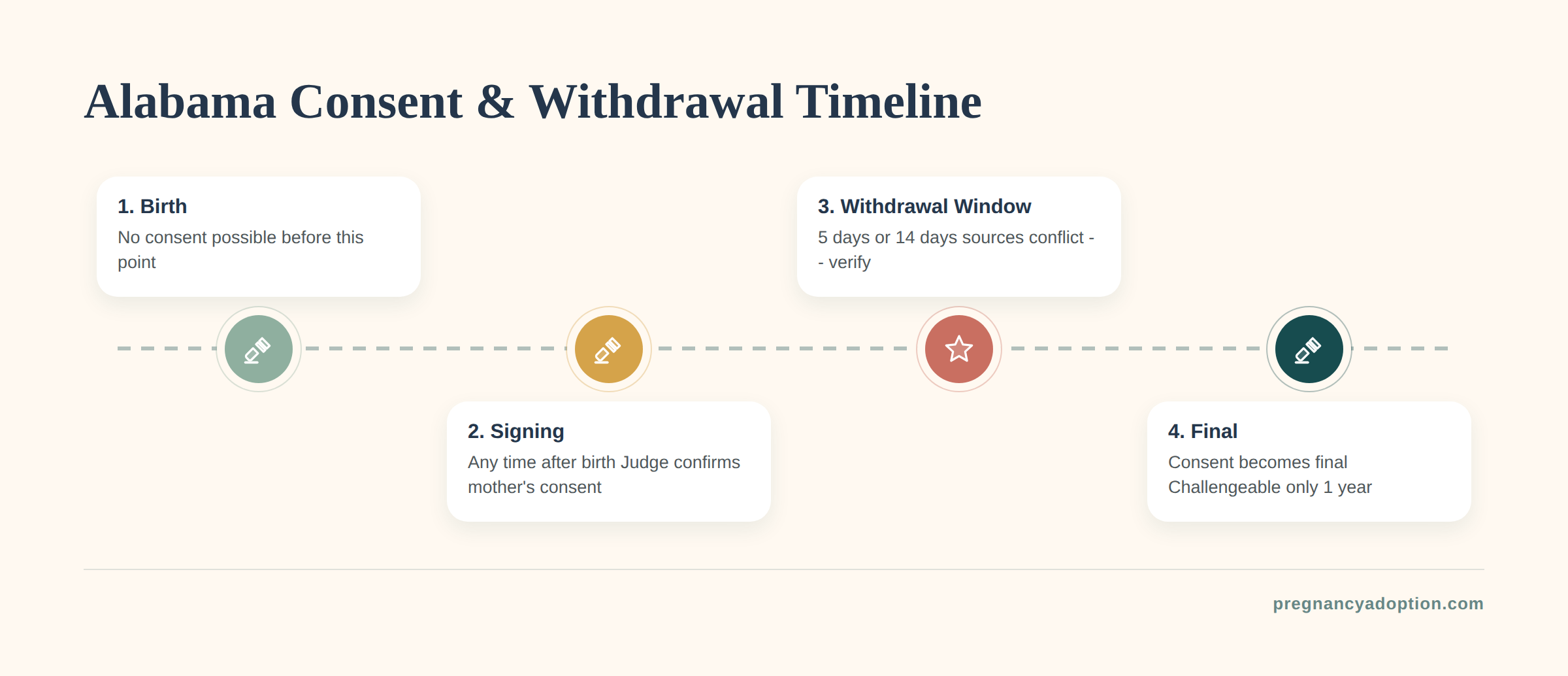
Alabama law (§ 26-10A-13) allows a consent or relinquishment to be taken “at any time” — there’s no mandatory waiting period after birth before a mother can sign, unlike some states. What happens after signing is where Alabama’s own published guidance becomes genuinely unclear, and this guide treats that honestly rather than picking a number that might be wrong.
| Source provision | Window given | Conditions |
|---|---|---|
| § 26-10A-13, short-window cross-reference | 5 days from birth or signing, whichever is later | No additional condition stated in this cross-reference |
| § 26-10A-13 and § 26-10-14, revocation section | 14 days from birth or signing, whichever is later | Requires a court finding that withdrawal is “reasonable under the circumstances” and consistent with the child’s best interests |
| Fraud, duress, mistake, or undue influence | Any time until the final decree | Must be shown that it was caused by the petitioner, the petitioner’s agent, or the agency |
| After the final decree | Generally not challengeable after 1 year | Exception for a kidnapped child |
Why Two Different Numbers Appear in the Same Law
Researching this guide turned up a genuine discrepancy worth flagging directly rather than quietly resolving on your behalf. The same government-sourced summary of Alabama’s own consent statute gave two different answers for how long a consent-withdrawal window lasts — five days in one part of its discussion of § 26-10A-13, and fourteen days in another part that references § 26-10A-13 together with § 26-10-14. We don’t know, from the sources reviewed for this guide, which figure currently governs, whether one reflects an older version of the statute, or whether the two sections apply to different circumstances that the summary didn’t fully distinguish. We’re surfacing this discrepancy explicitly, rather than picking the number that sounds more conservative and presenting it as settled, because a reader relying on the wrong figure in a genuinely time-sensitive legal situation could lose a right that still existed, or mistakenly believe they have more time than they actually do. If you are inside what might be a withdrawal window in Alabama right now, don’t rely on either number from this guide or from any other general source. Contact a licensed Alabama adoption attorney immediately and ask them to confirm the current, governing statutory language directly, including whether § 26-10A-13 has been amended since these sources were last updated.
How Consent Must Be Executed
Where and in front of whom a consent is signed matters as much as what it says. As Section 2 describes, a mother’s prebirth consent specifically must be signed or confirmed before a probate judge, who explains its legal effect and the withdrawal procedure and hands her a withdrawal form directly. Every other consent in an Alabama adoption — whether signed before or after the birth — has more flexibility in where it can happen: before a judge or clerk of a court with adoption jurisdiction, a public officer the judge appoints, a person an authorized agency appoints to conduct investigations or home studies, or a notary public, under §§ 26-10A-11 and 26-10A-12. Alabama maintains statutory forms for both giving consent and withdrawing it, which gives the process some built-in consistency across different counties and practitioners, and the Administrative Office of Courts develops a separate, specific form used for adult adoptions, reflecting how differently that path is handled under Alabama law. Using the correct form, signed before an authorized person, is what makes a consent legally valid in the first place — an informal written statement, however sincere, doesn’t substitute for this statutory process.
Alabama’s Putative Father Registry
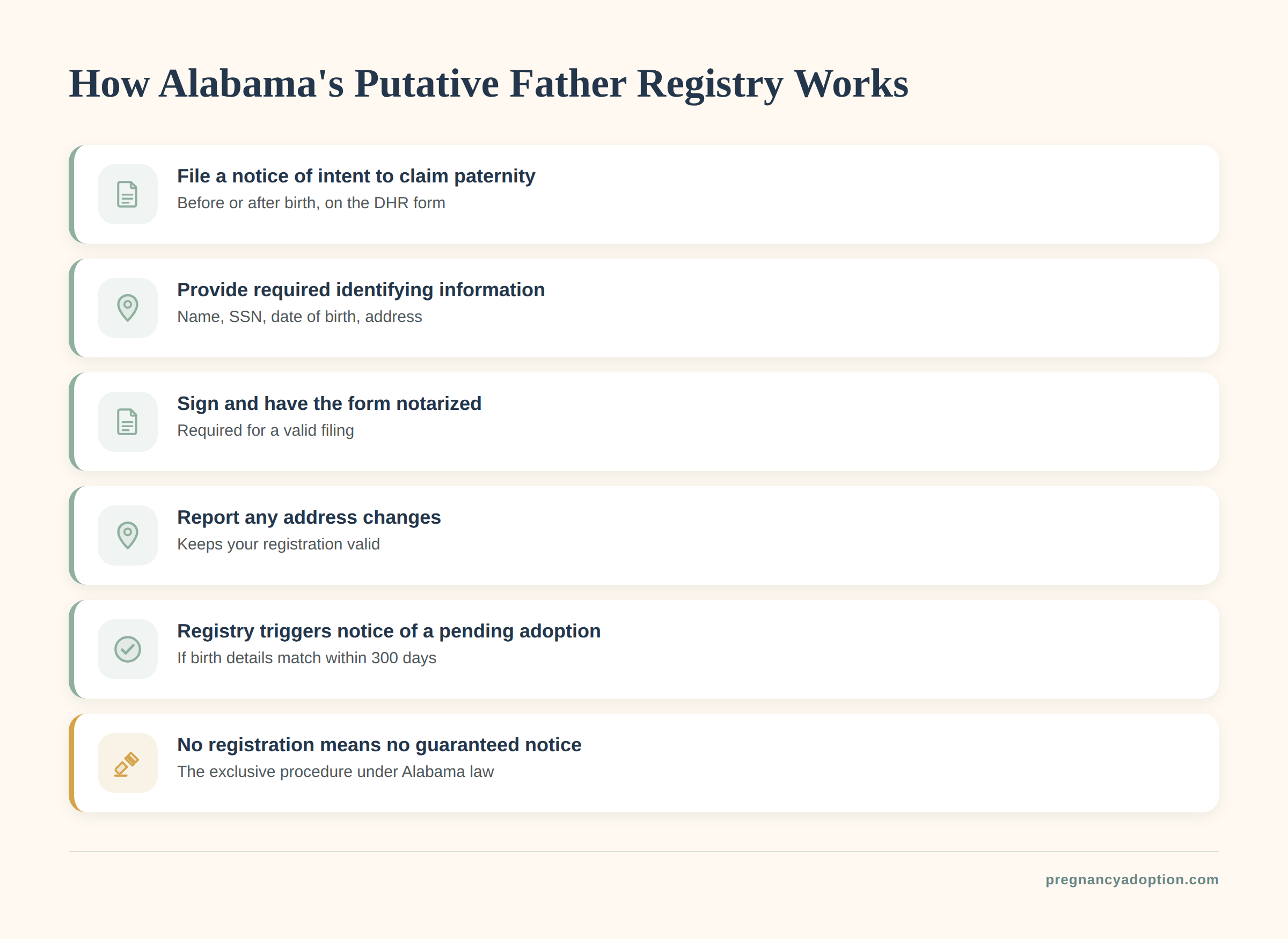
Alabama’s putative father registry, maintained by the Department of Human Resources under § 26-10C-1, is described in the statute itself as “the exclusive procedure available for any person who claims to be the other parent” to receive notice of and contest a pending adoption, for children born out of wedlock on or after January 1, 1997. In plain terms: if an unmarried father doesn’t use this registry (or otherwise legally establish paternity), Alabama’s notice process generally won’t reach him. For the national picture of why registries like this exist and how other states handle it, see our birth father rights guide.
How to Register
Alabama’s putative father registry is a public records system, and what it collects reflects that purpose: the name, Social Security number, date of birth, and address of anyone who has been adjudicated a parent, filed a notice of intent to claim parentage, or filed an acknowledgment of paternity. A man registering must also provide the other parent’s identifying and contact details, the birth parent’s information, income and financial information on a prescribed form, the child’s name and birthplace if known, and the possible dates of conception — enough detail for the registry to actually be searched and matched against a pending adoption. Registration itself has to happen on the department’s own form, signed by the putative father and notarized, and he’s responsible for reporting any address changes afterward so the department can actually reach him if a matching adoption notice comes in. He may file before the child is even born. The sources reviewed for this guide give no stated deadline for filing after birth, which is itself worth treating as a reason not to delay rather than as license to wait — confirm with a current Alabama attorney whether a specific post-birth deadline has since been added by amendment, since the absence of a stated deadline in older sources isn’t a guarantee that none exists today.
What Happens After Registration
Registering is only useful if it actually triggers notice when it matters, and Alabama’s process for that is specific. If the department receives notice of a pending adoption involving a child born within 300 days of a date of intercourse listed in the registry, and the same birth parent is named, it must send a copy of the registry notice to the adoption court. The court then notifies the putative father that an adoption is pending, and separately notifies the birth parent that he has, in fact, registered — a two-way notice step that gives both sides visibility into where things stand. The reverse situation is just as important to understand: the sources reviewed for this guide don’t describe a specific penalty for failing to register beyond the practical consequence that follows directly from how the system works. Because the registry is the exclusive way to trigger this notice process, a father who never registers and never otherwise establishes legal paternity through one of the routes in Section 5 generally won’t appear in it, and the notice process described above simply won’t be triggered on his behalf. A notice of intent can be revoked at any time, and becomes void once the registry receives that revocation.
Establishing Paternity in Alabama
Registering with the putative father registry is one path to protecting a father’s rights, but it isn’t the only way Alabama law recognizes a man as a child’s legal parent. This section covers the other routes, under Alabama’s broader parentage statute, Ala. Code § 26-17-204 and related sections.
Presumption, Acknowledgment, and Adjudication
Marriage isn’t the only route to presumed-father status in Alabama, and legal paternity itself can be established several different ways depending on the circumstances. Beyond the marriage-based presumption described in Section 2, a man is also presumed to be a child’s parent if he and the mother attempted to marry, or if he receives the child into his home and openly holds the child out as his own while the child is a minor, under § 26-17-204 — a conduct-based route to the same legal status that doesn’t depend on a marriage certificate at all. Separately, a parent may acknowledge parentage in writing under Alabama’s legitimation statute, or an unmarried parent may file a written notice of declaration of legitimation, attested by two witnesses, under Ala. Code § 26-11-2. That step does more than establish paternity for adoption purposes — it also makes the child capable of inheriting from him under Alabama law — and it’s a distinct, standalone process from the adoption-specific putative father registry covered in Section 4, worth not confusing with it.
Court Adjudication and Challenges
When paternity is genuinely disputed, or simply unknown, Alabama’s courts have direct authority to resolve the question before an adoption can properly proceed — a court may determine parentage outright, rather than relying solely on the presumption or acknowledgment routes described above. Once a man’s status as a presumed, acknowledged, or adjudicated parent is established through any of these routes, though, Alabama sets a deliberately high bar for undoing it. That status can only be disproved through admissible genetic testing that excludes him or identifies another person as the parent, under § 26-17-201. This isn’t a status that can be challenged on the strength of someone’s say-so, a change of circumstances, or a later change of mind — it requires scientific evidence that affirmatively rules the man out. That high bar reflects how seriously Alabama law treats an already-established parent-child legal relationship: once paternity is adjudicated, acknowledged, or legally presumed, the law treats unwinding it as a serious step requiring serious proof, not a routine administrative correction.
When Consent Isn’t Required: Implied Consent and Exemptions
Alabama law recognizes that in some circumstances, requiring a formal signed consent isn’t appropriate or possible — either because a parent’s own conduct has effectively forfeited the need for it, or because a separate legal process (like termination of parental rights) has already resolved the question. These are covered under §§ 26-10A-9 and 26-10A-10.
Implied Consent Through Conduct
Consent to an adoption doesn’t always have to be given affirmatively in writing — under certain conditions, Alabama law treats a parent’s own conduct as functionally equivalent to consenting, and understanding these triggers matters for anyone navigating this process from either side. Consent can be implied through abandonment, which Alabama defines concretely rather than leaving to interpretation: a father who knows about the pregnancy and provides no financial or emotional support for the six months before birth, a parent who leaves a child without provision for identification for 30 days, or a parent who knowingly leaves a child with others without support, communication, or a significant parental relationship for six months, can each have their consent implied on this basis. Consent can also be implied through a more procedural failure: when a parent receives formal notice of the pending adoption and simply doesn’t respond within 30 days, or when a putative father fails to comply with the registry statute described in Section 4. Both routes exist for the same underlying reason — a parent who has had a real, documented opportunity to assert their rights and does not take it can lose the ability to block an otherwise-proceeding adoption, even without signing a formal consent document.
When No Consent Is Required at All
In some situations, Alabama law doesn’t require a parent’s consent at all, because the legal question has already been settled through another process entirely. Consent isn’t required from a parent whose rights have already been terminated through a separate legal proceeding, a parent who has relinquished a minor child to the Department of Human Resources or a licensed agency, or a parent who is deceased or presumed deceased — in each case, there’s no remaining legal relationship, or formally resolved status, left for a consent requirement to attach to. Consent is also not required from an alleged father who has signed a written statement denying paternity, since he’s affirmatively disclaimed the relationship the consent requirement exists to protect, or from a natural father when the mother indicates he’s unknown — unless he later becomes known to the court through one of the paternity-establishment routes described in Section 5, at which point the ordinary consent rules would apply to him going forward.
Special Consent Situations: Minors and Incapacitated Parents
Two groups receive specific additional protection in Alabama’s consent statute: parents who are themselves minors, and parents who are legally incapacitated.
When a Parent Is a Minor
A consenting parent who is themselves a minor gets an additional layer of legal protection that doesn’t apply to adult parents under Alabama law. A guardian ad litem — an independent advocate appointed specifically to represent that minor’s interests — must be appointed before the minor gives consent, separate from and in addition to the general consent-execution rules described in Section 3. This protection exists because a minor parent is being asked to make one of the most consequential legal decisions of their life, often under real emotional and practical pressure, and the law builds in an independent check on that process. There’s a narrower exception worth knowing about, though: a minor father may give implied consent through his own conduct — the same kind of conduct-based implied consent described in Section 7 — and if the court finds this by what the statute calls “conclusive evidence,” notice and a guardian ad litem aren’t required for him specifically. That’s a fact-intensive, high-bar exception rather than a routine shortcut, and anyone navigating it is well served by confirming exactly how it would apply with a current Alabama attorney.
When a Parent Is Legally Incapacitated
Alabama law also addresses the situation where a parent has been legally determined to be incapacitated. Consent isn’t required from a parent who has been adjudged incompetent or mentally incapable, if the disability is likely to last long enough that delaying the adoption until the parent might be restored to capacity would harm the child. This isn’t an automatic rule that applies the moment someone receives an incapacity diagnosis — it’s a fact-specific judicial determination that weighs the likely duration and severity of the incapacity against the real-world cost to the child of waiting. That balancing act is exactly why this provision exists in the first place: Alabama law is trying to protect a legally incapacitated parent’s underlying rights while still recognizing that a child’s need for permanency can’t be held indefinitely hostage to an uncertain timeline for someone else’s possible recovery. Given how much judgment is built into this standard, it’s exactly the kind of situation where an attorney’s involvement — ideally for both the incapacitated parent’s interests and the prospective adoptive family — is essential rather than optional.
Who Can Adopt in Alabama: Eligibility Requirements
Alabama’s eligibility requirements for prospective adoptive parents are set mainly through Alabama Administrative Code Rule 660-5-22-.03(6), which governs the home-study process described in Section 9. For the general, national eligibility framework, see our adoption requirements guide; this section covers Alabama’s specific thresholds.
| Requirement | Alabama’s specific rule |
|---|---|
| Minimum age | Both spouses (if married) must be at least 19 |
| Marital status | Single applicants may apply; married applicants must have been married at least 3 years |
| Background checks | Applicants and household members 19+ must be fingerprinted and undergo criminal records checks |
| Financial stability | Income and savings must be sufficient to meet family needs without difficulty |
| Health | All family members need medical reports showing good health; applicants must assure they’ll provide physician-recommended medical treatment |
| Residency | Applicants must currently live in Alabama and expect to remain long enough to complete the process |
| Citizenship | At least one prospective parent must be a U.S. citizen |
| Religion, race, national origin | Religion is not a bar; race or national origin cannot be the sole or primary criterion |
Disqualifying Factors
Alabama sets hard limits on who can be approved to adopt, built around specific categories of criminal history rather than a general character assessment. Under Administrative Code Rule 660-5-22-.03, a home can’t be approved if any adult household member has a conviction for a sex-related crime, a serious intentional, reckless, or negligent injury, danger, or death to a person, a crime against a child, major property intrusion or weapon use to secure property, arson, or manufacturing, selling, distributing, using, or possessing controlled substances or alcohol. These categories are deliberately broad in scope — they reach beyond just the prospective adoptive parents to any adult living in the household, since a home study is ultimately evaluating the safety of the environment a child would be placed into, not just the character of the petitioners themselves. That said, Alabama does build in some room for rehabilitation: past convictions in other categories may be excepted with credible documentation showing the person has changed in the years since. The significant exception to that flexibility is child sex crimes or serious child injury or death, which appear to be treated as absolute bars rather than subject to any rehabilitation exception — reflecting how Alabama weighs those specific categories of harm against everything else on the list.
Exemptions From the Full Process
Not every Alabama adoption goes through the full investigation process described elsewhere in this guide, and knowing which category you fall into early can save real time. Under §§ 26-10A-27 and 26-10A-28, unless the court specifically directs otherwise, no investigation is required when a person adopts their spouse’s child, or when a specified set of relatives — grandparents, siblings, aunts, uncles, and their spouses — adopt a specified minor relative. This exemption exists because these relationships typically come with an existing, verifiable connection to the child that a stranger’s home study is designed to establish from scratch, so the law doesn’t require families to duplicate work that the relationship itself already demonstrates. It’s worth being precise about what this exemption does and doesn’t cover, though: it removes the investigation requirement specifically. It doesn’t exempt the adoption from Alabama’s consent rules described in Sections 2 through 7, and it doesn’t exempt it from the court finalization process described in Section 16 — every Alabama adoption, however it’s categorized, still has to clear those two requirements in full.
The Alabama Home Study Process
Alabama’s home study is governed by § 26-10A-19 and Administrative Code Rule 660-5-22, and may be conducted by the Alabama Department of Human Resources, a licensed child-placing agency, an individual or agency the department has licensed to perform investigations, or a licensed social worker. For the general, national home-study process, see our home study guide; this section covers what’s specific to Alabama.
What a Preplacement Home Study Covers
Before a child can be placed in your home, Alabama requires a preplacement investigation to determine, in the statute’s own language, “the suitability of each petitioner and the home in which the adoptee will be placed.” Under Rule 660-5-22-.03(7), that investigation is genuinely comprehensive: it includes a criminal background check, a review of any court orders or judgments affecting the adoptee or the petitioner’s own children, a review of adoption-related costs and expenses, at least one home visit, individual interviews with the applicants, a look at the family’s actual reasons for pursuing adoption, interviews with at least two references once approval appears likely, a diagnostic evaluation that recommends a type of child the family is suited for and addresses their future plans, and completion of required adoption training. Each of these pieces feeds into a single underlying judgment about whether this specific household is ready and suitable for a placement. Timing matters as much as content here: a child can’t be placed with you before this investigation is complete, and the investigation itself must be completed within 24 months of placement — a window families should plan around rather than treat as a formality to rush through at the last minute.
After Placement
The home study process in Alabama doesn’t end once a child is placed — a postplacement investigation picks up where the preplacement one left off. It must happen as soon as possible after notice of placement, and in any case within 45 days of it. The investigator observes the adoptee directly and interviews the petitioner at home, and the resulting report addresses compliance with the consent or relinquishment provisions covered in Sections 2 through 7, along with any information that wasn’t already gathered during the preplacement study. This isn’t a repeat of the earlier investigation so much as a genuine check on how the placement is actually going, now that the child is physically in the home. Interjurisdictional placements add another layer on top of this: under §§ 26-10A-35 and 38-7-15, anyone bringing a child into Alabama for adoption must first obtain the department’s consent, and the department may investigate whether the proposed parents are financially able, physically able, and morally fit — a check that runs alongside, rather than replacing, the ICPC process described in Section 12.
Types of Adoption in Alabama
Alabama recognizes the same broad categories of adoption as most states — domestic infant, foster care, stepparent/relative, international, and adult adoption — each governed by somewhat different procedural rules under Title 26. For full national definitions of each type, see our types of adoption guide; this section focuses on what’s Alabama-specific about each.
| Type | Alabama-specific note |
|---|---|
| Domestic infant (agency or independent) | Full home study and consent process under Title 26, Chapter 10A applies in full |
| Foster care adoption | Home study often free when conducted by the state agency; many children qualify for Title IV-E Adoption Assistance |
| Stepparent adoption | Investigation exempted under § 26-10A-27 unless the court directs otherwise |
| Relative adoption | Investigation exempted under § 26-10A-28 for specified relatives and their spouses |
| International adoption | Re-adoption in Alabama courts may be required or recommended depending on the originating country’s process |
| Adult adoption | Requires the adult’s own written consent under §§ 26-10A-6 and 26-10A-11, using an Administrative Office of Courts form |
Domestic Infant and Foster-to-Adopt
Most of this guide’s consent, home-study, and expense sections apply most directly to one specific path: domestic infant adoption, where a prospective family works with a licensed Alabama agency or independently through an attorney to adopt a newborn or infant. If that’s your situation, the sections on consent timing, the putative father registry, and lawful expenses are the ones most worth reading closely. Foster-to-adopt works differently, both practically and legally. Under Administrative Code Rule 660-5-22-.03(10)(b) and (11), the department decides whether a foster home should become an adoptive home by weighing a specific set of factors: the child’s attachment to the foster parents, how much time the child has already spent in that home, the child’s age relative to the foster parents, the foster parents’ health and income, the involvement of the birth family, and the overall appropriateness of the placement. That’s a meaningfully different decision-making process than the preplacement home study most domestic infant adoptions go through, because by the time a foster-to-adopt decision is being made, the department already has direct, ongoing knowledge of how the placement is actually working.
Relative, Stepparent, and Adult Adoption
Relative and stepparent adoptions, as Section 8 describes, skip the full investigation requirement in most cases — though the court retains discretion to require one if circumstances warrant it — and the underlying consent rules from Sections 2 through 7 still apply to these adoptions in full; the exemption only ever touched the investigation piece, never the consent requirements themselves. Adult adoption sits in its own, meaningfully different category. The adult being adopted personally consents to their own adoption, which is a fundamentally different legal posture than the birth-parent-consent framework that governs every other path described in this guide, and the Administrative Office of Courts develops a specific form just for this kind of adoption rather than relying on the birth-parent-and-child-age-threshold model used elsewhere. If you’re considering an adult adoption in Alabama — often to formalize an existing family relationship, or for inheritance purposes — expect the process to look and feel noticeably different from the minor-child adoption process the rest of this guide focuses on.
The Alabama Adoption Process, Step by Step
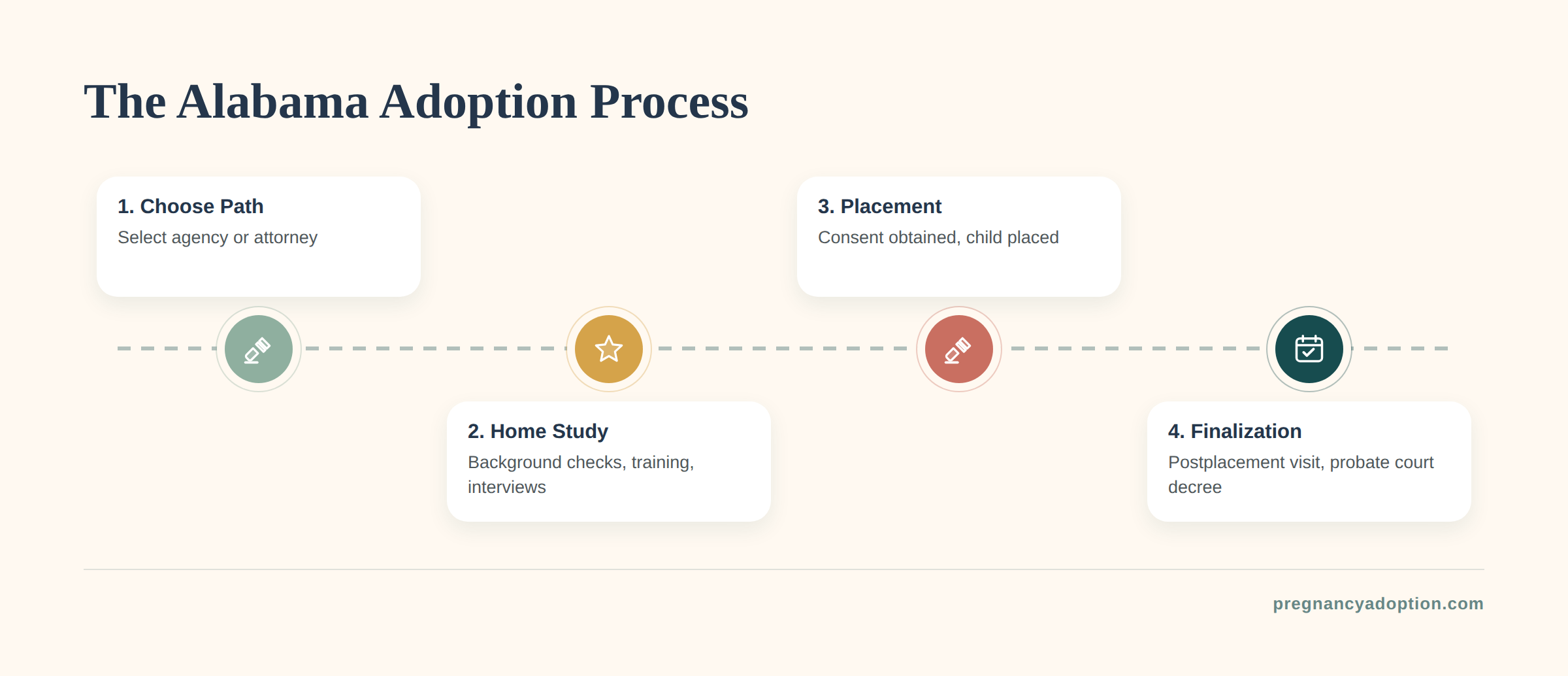
Combining the statutory pieces above into a single sequence, an Alabama domestic adoption generally moves through the following stages. For the general, national version of this sequence, see our adoption process guide.
Before Placement
Getting from a decision to adopt to an actual placement in Alabama involves two foundational steps that have to happen before anything else can move forward. First, decide which path fits your situation — domestic infant, foster care, relative or stepparent, or international adoption — and select a licensed Alabama agency or adoption attorney to work with; Section 18 below walks through what to look for in that choice, since it shapes nearly everything that follows. Second, complete the preplacement home study described in Section 9. This step genuinely can’t be skipped or shortcut for most adoption paths, and it can take real time to complete given everything it involves: the interviews, the criminal background checks, the reference checks, and the required adoption training. Families sometimes underestimate how much calendar time this phase alone can take, which is worth planning around from the outset rather than discovering partway through the process.
Placement Through Finalization
Once you’re matched with a birth parent — or a child becomes available to you through foster care or a relative situation — the process moves into its most consequential phase. Consent is obtained from the relevant parties under the rules described in Sections 2 through 7, and the child is placed in your home. From there, two parallel clocks start running: a postplacement investigation has to occur within 45 days of placement, as Section 9 describes, and the finalization hearing is typically scheduled roughly 60 days after placement, which Section 16 covers in detail. Both of these steps get their own full treatment later in this guide, but it’s worth seeing them here as part of one continuous sequence — consent, placement, supervision, and finalization aren’t separate, disconnected requirements so much as stages of a single process that Alabama law expects to move through in a fairly predictable order once a match is made.
Interstate Adoption and the ICPC in Alabama
Many adoptions cross state lines — an Alabama family adopting a child born in another state, or an out-of-state family adopting a child born in Alabama — and these require compliance with the Interstate Compact on the Placement of Children (ICPC) in addition to Alabama’s own adoption statutes.
When ICPC Applies
Adoptions that cross state lines bring in an entirely separate layer of legal process on top of everything else described in this guide. When a child is being brought into Alabama for adoption, §§ 26-10A-35 and 38-7-15 require the person or agency doing so to first obtain the Alabama Department of Human Resources’ consent, which may include a review of whether the proposed parents are financially able, physically able, and morally fit — essentially an additional state-level check layered on top of the home study process described in Sections 9 and 10. The reverse situation works the same way in principle: an Alabama-born child being placed with an out-of-state family similarly requires Interstate Compact on the Placement of Children clearance before the child can cross state lines for that placement. The sources reviewed for this guide didn’t detail Alabama’s specific sending-state procedure in the same depth as the receiving-state rules above, so if this situation applies to you, raise it directly with your agency or attorney rather than assuming the receiving-state process described here covers both directions equally.
ICPC and Finalization
For any adoption where the Interstate Compact on the Placement of Children applies, clearance under it — and, where relevant, clearance under the Indian Child Welfare Act — is generally required before Alabama’s final adoption decree can be issued. That single requirement has a real practical consequence worth planning around: interstate adoptions typically take longer than in-state ones to reach finalization, simply because there’s an additional compliance step that has to be completed and documented before the probate court will sign off. In practice, families don’t usually navigate this coordination directly themselves. Your adoption attorney or agency typically handles the ICPC paperwork and timing alongside the other Alabama-specific process steps described throughout this guide, communicating with the sending and receiving states’ compact offices on your behalf. That doesn’t mean it’s worth ignoring, though — understanding that this step exists, and roughly where it sits in the overall timeline, helps you set realistic expectations rather than being surprised by a finalization date that moves later than an in-state adoption’s would.
What You Can Lawfully Pay For: Alabama’s Expense Rules
Alabama law specifically addresses what a prospective adoptive family may lawfully pay toward a birth parent’s expenses, under §§ 26-10A-23 and 26-10A-34 — and it draws a clear line between lawful charitable support and prohibited payment for a child.
| Category | Status | Statutory basis |
|---|---|---|
| Mother’s maternity-related medical/hospital costs and essential living costs during pregnancy-related incapacity | Lawful, as “an act of charity” | § 26-10A-34(a) |
| Valid bills for medical, legal, prenatal, or other professional services | Lawful | § 26-10A-34(a) |
| A fee for matching adoptive parents with a child, or for placing/assisting/arranging a placement | Prohibited | §§ 26-10A-23(a), 26-10A-34(b) |
| Any money or thing of value paid or received for giving up a child | Prohibited; affidavit required at finalization | § 26-10A-23(d) |
Court Oversight of Payments
Alabama doesn’t leave adoption-related payments to private arrangement between the parties — the probate court actively oversees them. Before paying any expenses, petitioners must file a full accounting of expected adoption-related charges with the court, and actually making those payments requires court approval, though fees may be placed in escrow in the meantime while that approval is pending. The court’s default posture favors approving reasonable fees: it can only refuse to approve an expense if it makes specific written findings that the expense is unreasonable, and it can’t refuse to approve a fee for documented services simply because no child was ultimately placed — recognizing that legitimate professional services (legal work, agency services) have value regardless of whether a particular match succeeds. The process doesn’t end with a single approval, either. Petitioners must later file a sworn statement accounting for all disbursements actually made, and both the adoptive parents and the surrendering parents must sign affidavits under penalty of perjury before the final adoption order, stating that no money or thing of value was paid or received in exchange for giving up the child — a direct, personal attestation layered on top of the court’s own oversight.
What the Sources Don’t Specify
One thing worth knowing up front about Alabama’s expense rules: the sources reviewed for this guide state no specific dollar cap on lawful birth-parent or other adoption-related expenses, unlike some states that set an explicit ceiling on what can lawfully be paid. That absence doesn’t mean anything goes — it means the court-accounting and approval process described in Section 13 is doing the regulatory work that a flat dollar cap does in other states, evaluating reasonableness case by case rather than against a fixed number. It’s also worth confirming directly whether Alabama has since added a specific cap, since the sources behind this guide reflect a point in time and statutes in this area do get amended. Given the court-accounting and approval requirements already in place, your adoption attorney should walk you through exactly what documentation you’ll need and what categories of expense are likely to be approved before any payment is made, rather than relying on a general list like this one to estimate what’s permissible.
Alabama Adoption Costs
Beyond the birth-parent expenses covered in Section 13, Alabama adoptions involve department and agency fees with their own specific rules. For general national cost ranges across fee categories, see our adoption cost guide; this section covers what’s specific to Alabama’s state fee structure.
The Department Investigation Fee
Beyond the broader categories of adoption expense, Alabama charges one specific, statutorily set fee: under § 26-10-4.1 and Administrative Code Rule 660-5-22.04, the Department of Human Resources collects a $300 investigation fee, generally paid by the petitioners unless it’s waived. That fee isn’t charged in several defined situations — when parental rights have already been terminated, when the child was placed by the department or a licensed agency, or when a licensed agency performed the investigation itself — and it also doesn’t apply to stepparent and relative adoptions, consistent with their broader investigation exemption described in Section 8. Waivers beyond those categories fall into two types. The department must waive the fee for indigent petitioners whose gross income doesn’t exceed 100 percent of the federal poverty guidelines — a mandatory waiver, not a discretionary one. It may also waive the fee for good cause in several other situations, including petitioners related to the child beyond the exempt degree, a child who has already lived with the petitioners for several years, preserving sibling relationships, a child with diagnosed special needs, adopting three or more siblings at once, approved foster parents adopting independently, or other unusual circumstances the department finds warrant it.
Other Cost Considerations
The $300 state investigation fee is a fixed, known quantity, but it’s typically the smallest line item in an Alabama adoption’s overall cost. The larger cost drivers — agency program fees, attorney fees, and lawful birth-parent expenses under the court-oversight framework described in Section 13 — follow the same general national ranges and categories covered in our adoption cost guide, since Alabama’s statutes don’t set specific dollar figures for most of these categories the way they do for the department’s own fee. Budgeting for an Alabama adoption, in other words, means combining this guide’s specific, statutory numbers with the broader national cost ranges our other guides describe, rather than expecting Alabama law itself to spell out a total price tag. One cost-offsetting factor applies regardless of which state you adopt in: qualified adoption expenses may be eligible for the federal adoption tax credit, covered in full in our adoption tax credit guide, which applies the same way to an Alabama adoption as it would anywhere else in the country.
Post-Placement Supervision and Reporting
Once a child is placed in your home, Alabama law requires a period of supervision and reporting before the court will finalize the adoption — a check on the placement’s success before it becomes permanent.
The Postplacement Visit
As Section 9 describes, the postplacement investigation has a firm timing requirement: it must occur as soon as possible after notice of placement, and in any case within 45 days of it. During that visit, the investigator observes the adoptee directly and interviews the petitioner at home — worth understanding not as a bureaucratic formality, but as a genuine, statutorily required check-in on how the placement is actually going now that the child is physically in your home. The resulting report has a specific focus: it addresses compliance with the consent or relinquishment provisions described in Sections 2 through 7, confirming that the legal steps that made the placement possible were actually followed correctly, along with any information that wasn’t already gathered during the earlier preplacement study. Approaching this visit as a genuine opportunity to raise questions or concerns — rather than something to simply get through — tends to serve families better than treating it as a hurdle between placement and finalization.
What Happens If a Concern Arises
The sources reviewed for this guide don’t lay out a specific, formal escalation procedure for what happens if a postplacement visit raises a concern — that’s a gap worth being upfront about rather than guessing at. In practice, based on how the broader postplacement process works, this would typically mean one or more of: additional supervision or follow-up visits, a delayed finalization hearing while the concern is addressed, or further involvement from the department or your agency. If you’re in this situation, or want to understand what to expect before you’re in it, ask your agency or attorney directly what their specific process looks like, since this is exactly the kind of practical detail that varies by agency and isn’t fully codified in statute. More generally, your assigned home-study professional — whether that’s department staff, a licensed agency representative, or a licensed social worker, per the categories described in Section 9 — is the right first point of contact for any question that comes up during this period, before or after a formal concern is raised.
Finalization: The Alabama Adoption Hearing
| Milestone | Typical timing |
|---|---|
| Postplacement investigation | Within 45 days of placement |
| Finalization hearing scheduled | Roughly 60 days after initial placement |
| Hearing length | Typically 30 to 60 minutes |
| ICPC/ICWA clearance (if applicable) | Must be complete before the final decree issues |
What Happens at the Hearing
The finalization hearing is held in your local county probate court, and while it’s the culmination of everything described earlier in this guide, the hearing itself tends to be more conversational than families expect. The family, your attorney, and sometimes the social worker who conducted your home study are sworn in; you’ll typically introduce yourselves to the judge and answer questions about why you chose adoption and how you’ll provide a safe, loving home for the child. This isn’t an adversarial proceeding — by the time a case reaches this hearing, the consent requirements, home study, and postplacement supervision described throughout this guide have already been satisfied, and the hearing functions more as a formal, judicial confirmation of a placement that’s already been thoroughly vetted. At the end of it, the judge signs the final decree, which grants you permanent legal custody — the legal moment the adoption becomes final and irrevocable, subject only to the narrow post-decree challenge window described in Section 3.
Before the Decree Can Be Issued
Not every Alabama adoption is ready for finalization the moment a postplacement investigation is complete. Where ICPC or ICWA applies, as described in Section 12, that clearance has to be obtained before the final decree can actually be issued — one of the most common reasons an interstate or tribal-affiliated adoption takes noticeably longer to reach finalization than an in-state, non-ICWA adoption does. This isn’t a formality that can be worked around once the hearing date arrives; it’s a hard prerequisite the probate court will check for. In practice, your adoption attorney and agency typically coordinate the hearing date and courthouse location directly with the probate court, factoring in all the prerequisites described in Sections 9 through 15 — the home study, postplacement supervision, any required interstate clearance, and the court’s own calendar — so that by the time a hearing date is actually set, everything that needs to be in place already is.
Alabama Adoption Records and Post-Adoption Contact
Like most states, Alabama treats adoption records as confidential by default, with specific statutory procedures governing both record access later in life and any ongoing contact arrangement between birth and adoptive families.
Sealed Records and Access
Once an Alabama adoption is finalized, the records of it are generally sealed, consistent with the confidentiality framework most states apply to protect the privacy of everyone involved — the birth parents, the adoptive family, and the child. That confidentiality isn’t absolute or permanent in every circumstance, though: there is a specific statutory process by which an adult adoptee, a birth parent, or another eligible party can request access to those sealed records, separate from the general rule of confidentiality. The sources reviewed for this guide describe the existence of this process without fully detailing its specific eligibility requirements or procedural steps, which varies based on who’s requesting access and why. If you’re an adult adoptee or a birth parent seeking information about an Alabama adoption — your own, or one you were part of — the Alabama Department of Human Resources and a licensed Alabama adoption attorney are the appropriate starting points for navigating that specific process, rather than relying on this guide’s general overview of the confidentiality framework.
Open Adoption Agreements
It’s worth being precise about a distinction that’s easy to blur: an open adoption agreement — covering ongoing contact and information-sharing between the birth family and the adoptive family after placement — is a separate arrangement from the legal consent that makes the adoption itself valid in the first place. Signing a consent under the rules described in Sections 2 and 3 is what legally allows the adoption to proceed; an open adoption agreement is a different, additional document that addresses what happens afterward, and the two shouldn’t be confused or treated as interchangeable. Our open adoption guide covers the general national framework for how these agreements typically work, what they commonly include, and how families approach them. One detail worth flagging specifically for Alabama: whether and how an open adoption agreement is legally enforceable varies meaningfully by state, so confirm Alabama’s specific approach with your adoption attorney before relying on an informal understanding alone — an agreement that feels solid in conversation isn’t necessarily one a court would enforce if circumstances later changed.
Choosing an Agency or Attorney in Alabama
Every step described in this guide — consent, home study, expense accounting, finalization — depends on working with a properly licensed Alabama professional. For the full national framework on evaluating and selecting one, see our guide to choosing an adoption agency; this section covers what’s specific to confirming Alabama licensure.
Confirming Alabama Licensure
Choosing who you work with for an Alabama adoption is one of the most consequential decisions in the entire process, and verifying their credentials directly — rather than taking a website’s claims at face value — is worth the extra step. Under § 26-10A-19, a home study and related investigation may be conducted by the Alabama Department of Human Resources, a licensed child-placing agency, an individual or agency the department has specifically licensed, or a licensed social worker. Confirm any agency or individual’s current Alabama licensure directly with the department before engaging their services, rather than relying solely on their own representations. The same diligence applies to legal counsel: an Alabama-licensed adoption attorney, confirmable through the Alabama State Bar, is essential given how much of this guide’s content genuinely requires current, state-specific legal advice rather than general guidance — the consent-withdrawal conflict documented in Section 3 alone is a clear example of why having an attorney who stays current on Alabama’s specific statutes matters more here than it might in a more straightforward jurisdiction.
Questions Specific to an Alabama Adoption
Beyond the general questions any prospective adoptive family should ask an agency or attorney, there are a couple of questions specific to Alabama worth raising directly, precisely because of what this guide has documented about the state’s own legal landscape. Given the genuine five-day/fourteen-day discrepancy documented in Section 3, ask any Alabama agency or attorney directly which window currently governs consent withdrawal and how they’ve confirmed it — their answer, and how confidently they give it, is a reasonable signal of how current and careful their legal knowledge actually is, since this isn’t a detail a well-informed Alabama adoption professional should be vague about. If your adoption will cross state lines, as described in Section 12, ask specifically about the agency’s or attorney’s experience coordinating ICPC clearance with Alabama, since this adds real procedural complexity and potential delay beyond what an in-state adoption involves, and experience with it specifically — not just adoption law generally — is worth confirming before you commit to working with someone.
Common Mistakes in Alabama Adoptions
Several mistakes come up repeatedly in Alabama adoptions specifically, beyond the general mistakes covered in our broader adoption guides.
Mistakes Around Consent and Timing
The single most consequential Alabama-specific mistake this guide can help readers avoid is treating either the five-day or the fourteen-day figure from Section 3 as settled without confirming it directly with a current attorney. Don’t let either number from this guide, or from any other general source, substitute for that confirmation — the cost of guessing wrong on a time-sensitive consent-withdrawal window is simply too high to risk. A second, quieter mistake involves timing on the father’s side rather than the mother’s. Because Alabama’s putative father registry, described in Section 4, gives no stated post-birth deadline in the sources reviewed for this guide, some fathers mistakenly assume there’s no real urgency to registering. Registering as early as possible — including before the child is even born, which the statute explicitly allows — is the safer approach given how consequential the registry’s exclusivity is: it’s the only mechanism that reliably triggers the notice process described in Section 4, and there’s little practical downside to registering early if there’s any chance you’ll want a legal say in the adoption.
Mistakes Around Expenses and Process
Because Alabama requires a full accounting and court approval before birth-parent expense payments are made, as Section 13 describes, paying informally without that documentation in place risks running afoul of §§ 26-10A-23 and 26-10A-34’s requirements — even when the underlying payment itself would have been entirely lawful if it had gone through the proper accounting process. The problem in these cases usually isn’t that the payment was improper in substance; it’s that skipping the court-accounting step turns an otherwise-permissible expense into a procedural violation. The second common mistake involves timeline planning rather than paperwork: families pursuing an interstate adoption sometimes underestimate how much ICPC clearance, described in Section 12, adds to the finalization timeline described in Section 16. Building in extra time from the outset — rather than assuming an interstate adoption will move at the same pace as an in-state one — avoids a lot of unnecessary stress during what’s already an emotionally demanding process, and it’s a far easier adjustment to make at the planning stage than partway through.
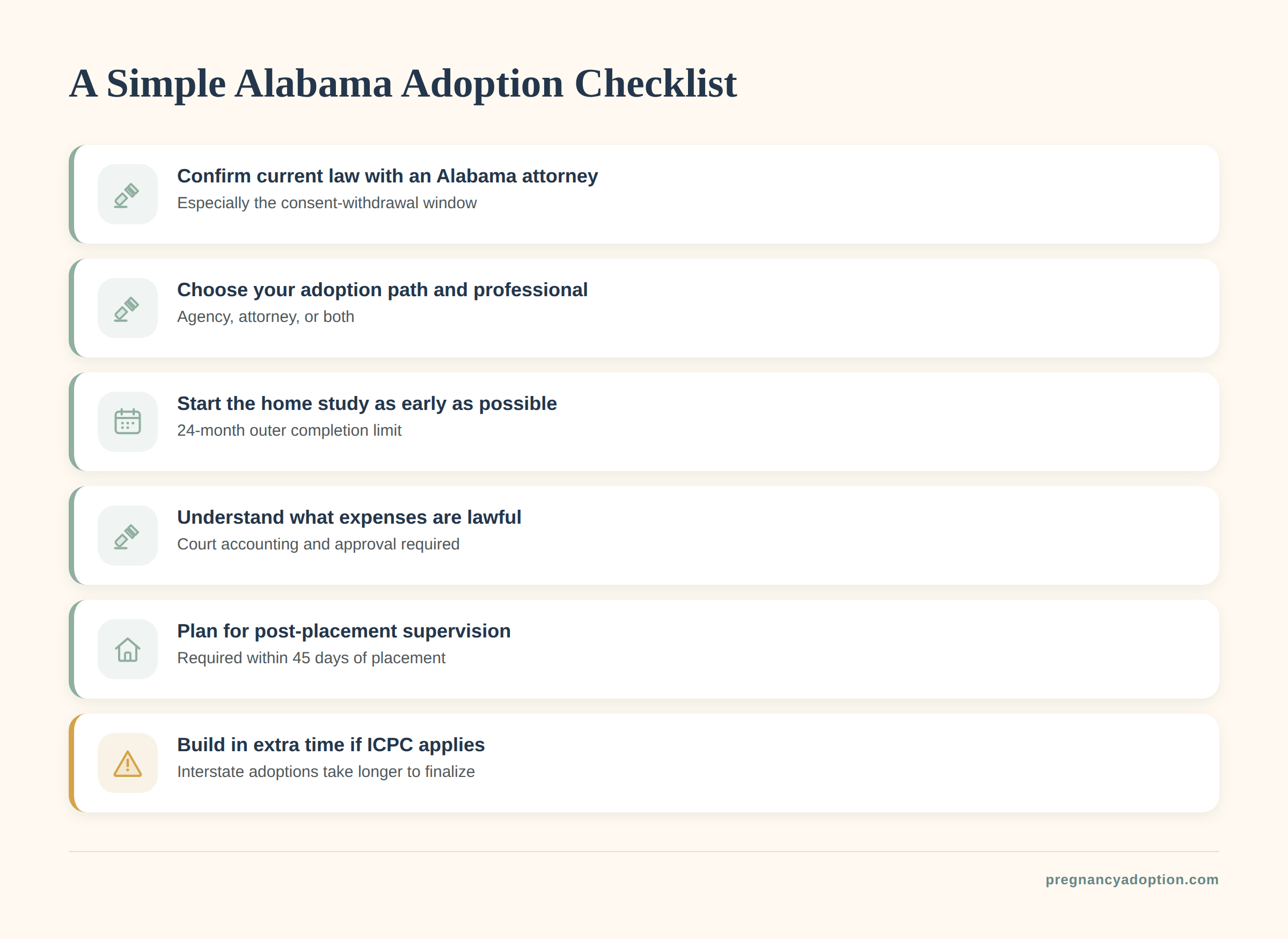
A Simple Action Checklist
Early Steps
Confirm Current Law With an Attorney
Before relying on any specific figure in this guide — especially the consent-withdrawal window in Section 3 — confirm it directly with a licensed Alabama adoption attorney.
Choose Your Path and Professional
Decide among the adoption types in Section 10, and select a properly licensed Alabama agency or attorney as described in Section 18.
Through Placement and Finalization
Complete the Home Study Early
Start the preplacement home study (Section 9) as early as possible, given its components and the 24-month completion window.
Track Post-Placement Requirements
Keep the 45-day postplacement supervision window (Section 15) and the roughly 60-day finalization timeline (Section 16) in mind as you plan, building in extra time if ICPC applies (Section 12).
Glossary of Terms
Consent-Related Terms
Putative Father
A man who may be a child’s biological father but hasn’t established legal paternity through marriage, acknowledgment, adjudication, or Alabama’s putative father registry.
Relinquishment
A parent’s voluntary surrender of a child to the Department of Human Resources or a licensed agency, distinct from signing consent directly to a specific adoptive family.
Process-Related Terms
ICPC (Interstate Compact on the Placement of Children)
The interstate agreement governing how a child can lawfully be placed for adoption across state lines, required before an interstate adoption can finalize.
Preplacement Investigation
Alabama’s term for the home study completed before a child can be placed with prospective adoptive parents.
Frequently Asked Questions
General Alabama Adoption Questions
What’s the single most important thing to verify before relying on this guide?
The consent-withdrawal window discussed in Section 3 — Alabama’s own sourced guidance gives two different numbers (5 days and 14 days), and this is the kind of fact where being wrong has real consequences.
Does this guide cover every Alabama county’s specific court procedures?
No — finalization happens in county probate court, and some local procedural details can vary by county; your attorney will know your specific county’s practices.
Questions About Consent and the Putative Father Registry
Is there a deadline to register after birth?
The source reviewed for this guide didn’t state one, which is a reason to register as early as possible — including before birth — rather than assume there’s no urgency.
Can a putative father change his mind after registering?
Yes — a notice of intent can be revoked at any time, and becomes void once the registry receives the revocation.
Questions About Eligibility and the Home Study
Does a past conviction automatically disqualify an applicant?
Not always — most disqualifying convictions allow an exception with credible documentation of rehabilitation, except for child sex crimes or serious child injury or death.
How long does the home study take?
Alabama law gives a 24-month outer limit for completing the preplacement investigation, though most families complete it well before that limit given the required steps.
Questions About Costs and Expenses
Is there a set adoption cost in Alabama?
No — beyond the $300 department investigation fee (which may be waived), most costs follow the general national ranges covered in our adoption cost guide rather than a fixed Alabama figure.
Does Alabama offer its own state adoption tax credit, separate from the federal one?
The sources reviewed for this guide didn’t identify a separate Alabama-specific adoption tax credit beyond the federal credit — confirm current state tax treatment with a tax professional.
Questions About Interstate and Special Situations
Does ICWA ever apply in an Alabama adoption?
It can, when a child is a member of or eligible for membership in a federally recognized tribe; ICWA clearance would then be required before finalization, alongside or instead of ICPC depending on the situation.
What if the adoption involves a child with special needs?
Special-needs status can affect foster-to-adopt subsidy eligibility (Section 10) and may support a discretionary department-fee waiver (Section 14), among other considerations worth raising directly with your agency.
Questions About Who Can Adopt in Alabama
Is there an income requirement to adopt in Alabama?
Alabama’s rule requires that income and savings be “sufficient to meet family needs without difficulty,” which is a holistic assessment rather than a fixed minimum dollar figure
Do military families face different rules adopting in or from Alabama?
The sources reviewed for this guide didn’t identify Alabama-specific exceptions for military families beyond the residency requirement in Section 8, which could be a practical consideration during a permanent-change-of-station move — raise your specific situation directly with an Alabama agency.
What if I already have biological children — can I still adopt in Alabama?
Yes — having biological children doesn’t disqualify an applicant; the home study will typically include your existing children as part of the household assessment described in Section 9.
Questions About Special Needs and Sibling-Group Adoption
Is financial assistance available for special-needs adoption in Alabama?
Yes — the federal Title IV-E Adoption Assistance Program, described briefly in Section 10, can provide a one-time payment, ongoing monthly assistance, continued Medicaid coverage, or some combination for qualifying children adopted from Alabama’s foster care system.
Are nonrecurring adoption expenses reimbursed in Alabama?
Many states, including Alabama, reimburse adoptive families for one-time costs directly tied to finalizing a special-needs adoption — legal fees, court costs, and the home study itself — up to a state-set cap
Who do I contact about Alabama’s foster-to-adopt and special-needs programs specifically?
The Alabama Department of Human Resources administers these programs directly; your local county DHR office or a licensed agency specializing in foster-to-adopt placements is the appropriate starting point.
Questions About Birth Family and Open Adoption in Alabama
What if the birth father disagrees with the adoption plan?
His rights depend on whether and how he’s established legal paternity, per Sections 2 through 6 — if he hasn’t registered with the putative father registry or otherwise established paternity, his ability to contest the plan is significantly limited.
Can grandparents or other relatives intervene in an Alabama adoption?
Generally only if they hold independent legal standing, such as a prior court-appointed guardianship; simple disagreement with the birth parent’s plan isn’t itself a legal basis to intervene.
Does Alabama require counseling for birth parents before consent?
The sources reviewed for this guide didn’t identify a specific statutory counseling mandate beyond the probate judge’s required explanation of legal effect for a mother’s prebirth consent (Section 2); many licensed agencies independently offer or require counseling as part of their own practice standards
Who pays for the birth mother’s independent legal counsel in Alabama?
This varies by arrangement; many domestic infant adoptions include the adoptive family or agency covering this cost as a standard practice, consistent with the general national pattern described in our birth mother rights guide, though it isn’t a fixed Alabama statutory requirement on its own.
Questions About International Adoption Through Alabama
Does the Alabama home study differ for an international adoption?
The core components under Rule 660-5-22-.03(7) apply similarly, though an international adoption typically adds country-specific requirements from the receiving country and U.S. Citizenship and Immigration Services on top of Alabama’s own process
Does the $300 department fee apply to international adoptions?
The fee structure in Section 14 is specific to Alabama Department of Human Resources investigations; an international adoption’s home study is more commonly completed by a licensed private agency, whose own fee structure would apply instead
Is the federal adoption tax credit available for international adoptions finalized through Alabama?
Generally yes, following the same federal rules described in our adoption tax credit guide, regardless of which state’s courts handle any domestic re-adoption step.
Questions About Termination of Parental Rights in Alabama
Does a parent get a court-appointed attorney in a termination proceeding?
Generally yes, if the parent can’t afford one — termination proceedings typically require a higher standard of proof and stronger procedural protections than most other family-law matters, reflecting how serious they are.
Can a parent whose rights were terminated later regain them?
This is generally very difficult and fact-specific; termination is designed to be a permanent legal outcome in most circumstances, distinct from the time-limited revocation window discussed in Section 3.
Where can I learn more about termination of parental rights specifically?
Our national adoption consent laws guide covers the general termination-as-a-substitute-for-consent framework in more depth; for Alabama-specific termination proceedings, consult a family law attorney, since this guide focuses on voluntary consent and Alabama’s statutory text around it.
Questions About Records, Birth Certificates, and Identity
Does Alabama have a mutual-consent reunion registry?
Some states maintain a registry allowing an adult adoptee and birth parent to mutually agree to exchange identifying information; whether Alabama currently operates one, and its specific procedure, wasn’t confirmed in the sources reviewed for this guide
Does the child’s name legally change at finalization?
Generally yes, if the adoptive parents request a name change as part of the petition — this is typically addressed in the same finalization proceeding described in Section 16 rather than requiring a separate legal process.
What happens to the child’s citizenship status in an international adoption finalized through Alabama?
Citizenship for an internationally adopted child is governed by federal immigration law (commonly the Child Citizenship Act) rather than Alabama state law; confirm current requirements with U.S. Citizenship and Immigration Services and your international adoption agency
Questions About Working With an Alabama Agency or Attorney
Can I work with an out-of-state agency for an Alabama adoption?
Possibly, particularly for an interstate adoption already requiring ICPC coordination (Section 12), but confirm that any agency involved is properly licensed for the specific role they’re playing in your state or Alabama’s process.
Do I need both an agency and an attorney, or just one?
This depends on your chosen path — many domestic infant adoptions involve both an agency (matching, counseling, case management) and an attorney (legal representation, court filings), while some independent adoptions proceed primarily through an attorney; ask any professional you’re considering to clarify their specific role.
What questions should I ask an Alabama agency about their specific state experience?
Beyond the general interview questions in our choosing-an-agency guide, ask specifically how many Alabama adoptions they’ve completed, their familiarity with the consent-withdrawal conflict in Section 3, and their experience (if relevant to you) with ICPC coordination.
How much does an Alabama adoption attorney typically cost?
This varies by attorney and case complexity; the general national legal-fee ranges in our adoption cost guide are a reasonable starting reference point, though you should get a specific, written fee estimate directly from any attorney you’re considering.
Questions About Stepparent and Relative Adoption Specifics
Can grandparents adopt their grandchild in Alabama?
Yes — grandparents are among the specified relatives eligible for the investigation exemption under § 26-10A-28, though the underlying consent requirements from the child’s legal parents still generally apply unless an exemption covers that too.
Does relative adoption in Alabama require court approval even without a home study?
Yes — the exemption in Section 8 removes the investigation requirement specifically, not the court finalization process itself; every Alabama adoption, including relative and stepparent adoptions, still requires a court decree under the finalization process in Section 16.
Can a relative adopt a child already in Alabama’s foster care system?
Yes — kinship/relative foster-to-adopt is a recognized and often prioritized pathway within Alabama’s foster care system, following the general foster-to-adopt framework described in Section 10, with relative applicants sometimes subject to adjusted licensing standards
Is a Safe Haven surrender the same as a formal adoption consent?
No — Safe Haven laws are a separate, narrower legal mechanism for emergency newborn safety; they don’t follow the same consent-signing, withdrawal-window, or home-study process described throughout this guide.
What if I’m an expectant parent in crisis and not sure adoption is right for me?
This guide focuses on Alabama adoption law specifically; if you’re still deciding whether adoption is the right path at all, our guide on pregnancy options and considering adoption covers the fuller decision-making picture, not just the legal mechanics.
Does Alabama require any specific hospital plan for a birth parent planning adoption?
Specific hospital procedures (such as whether the birth parent and adoptive family are both present, how long the mother stays, and how the newborn is discharged) are typically coordinated through your agency or attorney with the specific hospital, rather than set by a single Alabama statute
Who do I contact in an urgent, time-sensitive Alabama adoption situation?
Contact a licensed Alabama adoption attorney or agency immediately rather than relying on this guide’s general information — time-sensitive legal situations, especially anything touching the consent-withdrawal window in Section 3, need real-time professional guidance.
Questions About ICWA and Tribal Consent in Alabama
Who determines whether ICWA applies to a specific Alabama adoption?
This is typically determined early in the process through required inquiry into the child’s and birth parents’ potential tribal affiliation; your agency or attorney should raise this question directly rather than assume it doesn’t apply.
Does ICWA replace Alabama’s own consent statute when it applies?
No — ICWA generally adds requirements on top of applicable state law rather than replacing it entirely, though specific areas (like placement preferences) follow ICWA’s federal framework; see our national adoption consent laws guide for the fuller ICWA framework.
What happens if ICWA eligibility is discovered after placement?
This can significantly complicate an already-placed adoption and generally requires immediate attorney involvement with ICWA-specific experience, since the notice and preference requirements are meant to apply from as early in the process as possible.
Questions About Health, Insurance, and Medical Care
Does Alabama require specific newborn medical screenings before an adoptive placement?
Standard newborn screening (hearing, metabolic, and other routine tests) applies the same way regardless of whether a child will be placed for adoption; this follows Alabama’s general newborn-care standards rather than an adoption-specific rule.
What if the child has an undisclosed or later-discovered medical condition?
This is a sensitive, fact-specific situation; your agency’s and attorney’s disclosure practices during matching, along with your own informed consent to proceed, are the relevant considerations — raise any concerns immediately with your professional team if this arises.
Is genetic testing ever required as part of an Alabama adoption?
Generally not for the adoption itself, though genetic testing can be used specifically to disprove a presumed father’s paternity status under § 26-17-201, described in Section 5, in situations where paternity is disputed.
Questions About Adoption and Immigration Status
What if the birth parent is not a U.S. citizen?
The birth parent’s immigration status doesn’t itself bar them from placing a child for adoption or affect their consent rights under Alabama law as described throughout this guide; immigration-specific questions should be directed to an immigration attorney alongside your adoption attorney.
Does ICPC still apply if one state involved is actually a foreign country?
No — ICPC specifically governs placements between U.S. states; an adoption involving a child from another country follows the separate international/intercountry adoption framework referenced in Section 20, not the interstate ICPC process in Section 12.
Who can help with the immigration-specific aspects of an international adoption finalized through Alabama?
U.S. Citizenship and Immigration Services and an attorney with specific international-adoption immigration experience are the appropriate resources, separate from (though coordinated with) the Alabama-specific adoption attorney handling the state court process.
Questions About Adoption Assistance Program Specifics
Can a family adopting privately (not through foster care) access Title IV-E assistance?
Title IV-E Adoption Assistance is specifically tied to children adopted from the foster care system with a special-needs determination; a private domestic infant adoption generally wouldn’t qualify under this specific program
Does nonrecurring adoption expense reimbursement require separate application from Title IV-E assistance?
These are related but distinct benefits — nonrecurring expense reimbursement covers one-time finalization-related costs, while ongoing Title IV-E assistance covers continued support; confirm the specific application process and any required coordination with the Department of Human Resources.
What happens to adoption assistance benefits if the family later moves out of Alabama?
Adoption assistance agreements are generally designed to be portable across state lines once established, since the benefit is tied to the child’s special-needs determination rather than residency in the state that originally approved it
Questions About the Difference Between Adoption and Guardianship
Which option is right for a relative raising a child informally?
This depends heavily on individual family circumstances, the birth parents’ situation, and long-term goals — an attorney can help weigh adoption against guardianship against other legal arrangements based on your specific facts, rather than a generic answer applying to every family.
Does guardianship require the same home study as adoption?
Guardianship proceedings generally follow a different, often less extensive process than the full adoption home study described in Section 9, though specific requirements vary by the type of guardianship and the court involved
Is guardianship reversible in a way adoption isn’t?
Generally yes — guardianship is more commonly modifiable or terminable by the court than a finalized adoption, which becomes essentially permanent after the 1-year post-decree challenge window described in Section 3 closes.