
Considering Adoption in the First Trimester: What You Can Plan and What Can Wait
Short Answer: Early Days, Real Options, No Rush to Decide Everything
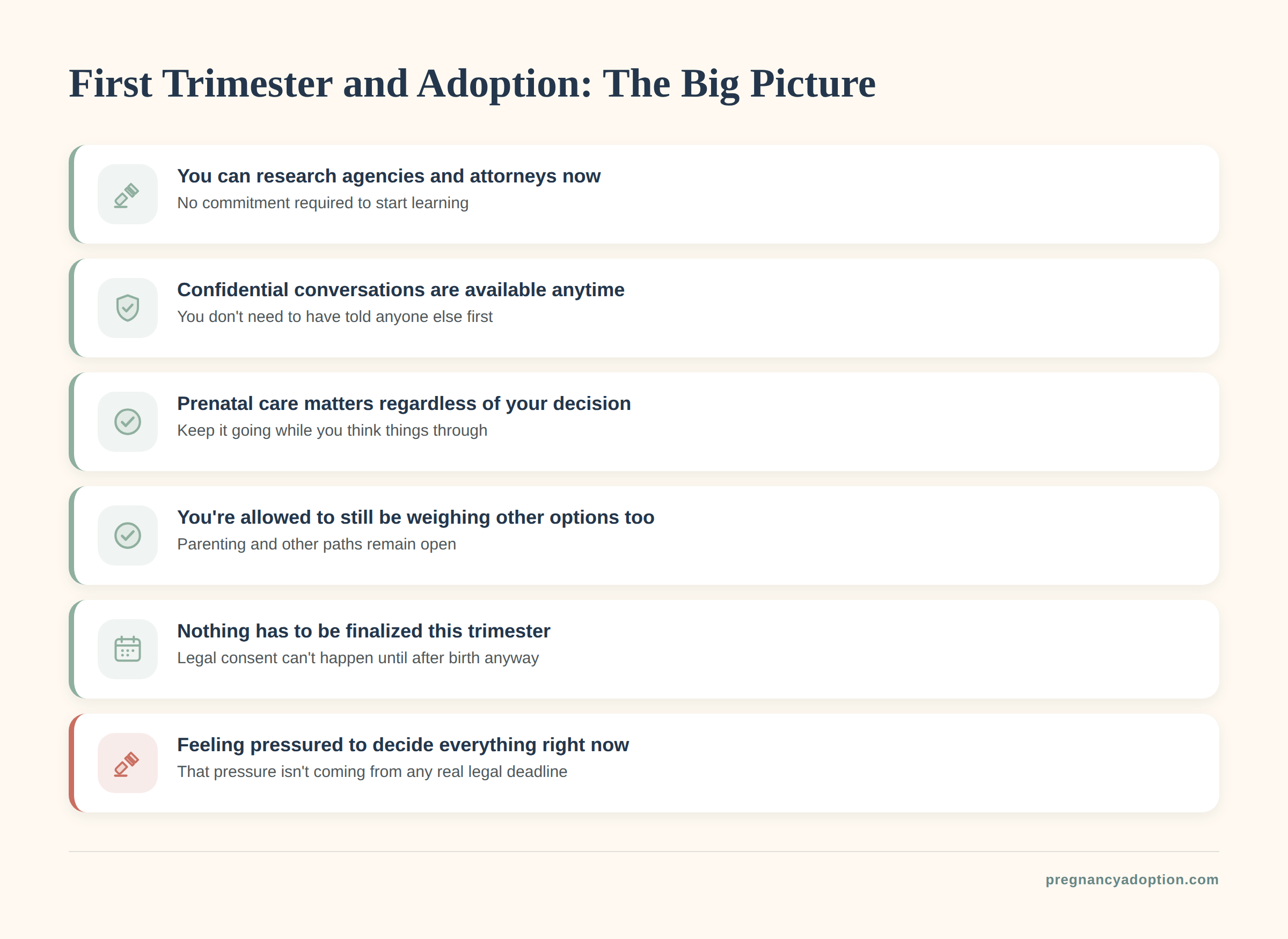
If you’re in the first trimester and considering adoption, you have real, useful things you can start now — researching agencies and attorneys, having confidential exploratory conversations, beginning to understand your options — without needing a final decision yet. Some things genuinely have to wait: legal consent can never be signed until after birth, and firm hospital or family-selection details usually come together later in pregnancy. This guide focuses specifically on what the first trimester stage looks like for adoption planning; for the general question of whether adoption is right for you, our broader guide to considering adoption covers that in depth.
Why the First Trimester Feels Different
Why does this stage feel especially uncertain compared to later in pregnancy?
Early pregnancy carries its own physical uncertainty (miscarriage risk is highest in the first trimester) alongside the emotional weight of a significant decision, which can make the first trimester feel like an especially unsettled time to think about adoption. That’s a normal reaction to a genuinely uncertain stage, not a sign you’re approaching it wrong.
Is it too early to start thinking about adoption in the first trimester?
No — many people start researching and asking questions in the first trimester specifically because they want time to think clearly rather than deciding under pressure later. Starting early doesn’t commit you to anything; it simply gives you more time and information.
What This Guide Covers
What does this guide focus on that other guides on this site don’t?
The practical shape of the first-trimester stage specifically — what’s realistic to start now, what has to wait, and a realistic sense of how the timeline unfolds from here — rather than the general case for or against adoption, which our broader guide already covers.
Does this guide assume I’ve already decided on adoption?
No — everything here is written for someone exploring the option, not someone who has committed to it. Exploring and deciding are separate steps, and you can do the first without having done the second.
What You Can Realistically Start Now
Information and Research
What’s a reasonable first research step in the first trimester?
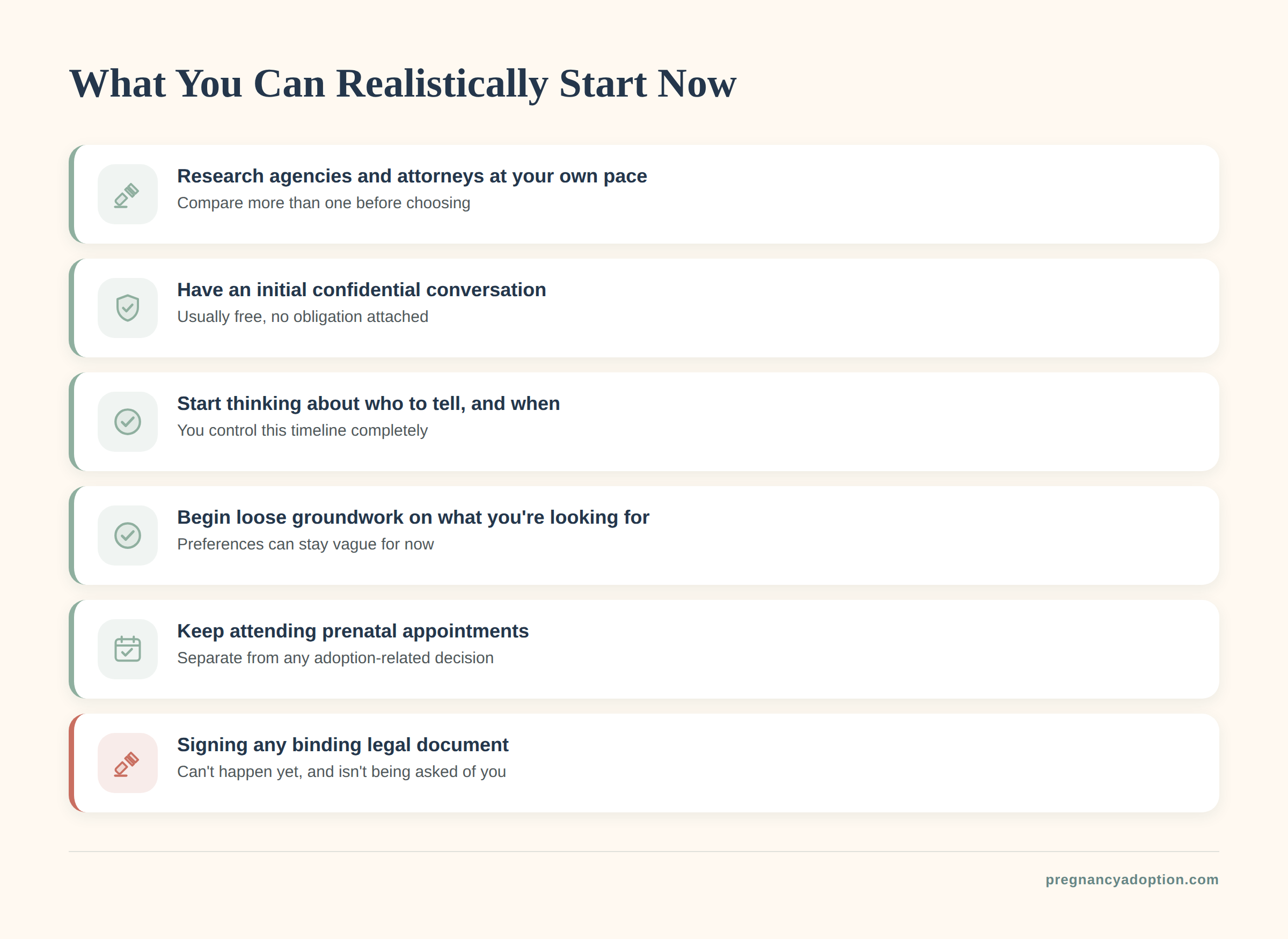
Reading general, neutral information about how adoption works (like our guide to considering adoption and our adoption process overview) and beginning to understand what agencies and attorneys in your area offer is a reasonable, low-pressure starting point.
Is it useful to compare multiple agencies this early?
Yes — comparing a few options early, without committing to any of them, can help you feel more informed and less rushed later; our guide to choosing an adoption agency covers what to look for.
Early Conversations
Can I talk to an agency or attorney confidentially this early, before telling anyone else?
Yes — reputable adoption professionals are used to fielding exploratory questions from people who haven’t told family or a partner yet, and an initial conversation doesn’t commit you to anything.
Is counseling available this early, even before a firm decision?
Many agencies and independent counselors offer options counseling specifically for people who are still deciding, not just people who have already chosen adoption — this is worth seeking out early if you want support while you think things through.
Researching and Contacting an Agency or Attorney
What to Look For Early On
What matters most when comparing agencies or attorneys this early?
How they handle a first conversation — whether it feels neutral, pressure-free, and genuinely informative — tells you a lot before you’ve committed to anything; our dedicated guide covers the fuller list of questions worth asking.
Do I need to commit to one specific agency this early?
No — most people are free to have exploratory conversations with more than one professional before choosing, and taking that time in the first trimester, when there’s no immediate deadline, is often easier than doing so later.
What a First Conversation Typically Covers
What does an initial call with an agency or attorney usually involve?
Generally a general overview of how their process works, answers to your specific questions, and an explanation of what, if anything, happens next if you want to continue — not a commitment or a signed agreement.
Is it normal to still feel undecided after this first conversation?
Very normal — a first conversation is meant to inform, not resolve, your decision, and feeling just as undecided afterward (or more informed but still undecided) is a completely typical outcome.
Early, Confidential Conversations
Keeping Your Exploration Private
Do I have to tell anyone I’m considering adoption before I explore it?
No — you can research and have exploratory conversations with professionals confidentially, before telling a partner, family, or anyone else, if that’s what feels right for you at this stage.
Is there a risk in waiting to tell people until I’m more certain?
Not inherently — many people prefer to gather information and feel more grounded in their own thinking before involving others, and there’s no requirement to share your exploration with anyone before you’re ready.
If You Want Support While You Think
Who can I talk to confidentially if I want support but I’m not ready to tell family or a partner?
A neutral options counselor, separate from any adoption agency’s own interests, can be a useful first conversation — many are specifically trained to support someone who hasn’t told anyone else yet.
Is a counselor obligated to tell anyone else about our conversation?
Confidentiality practices vary by provider and setting, so it’s worth asking directly about privacy before a first conversation if that’s a specific concern for you.
What Typically Has to Wait
Legal Steps
What’s the one thing that can never happen this early, no matter how certain you feel?
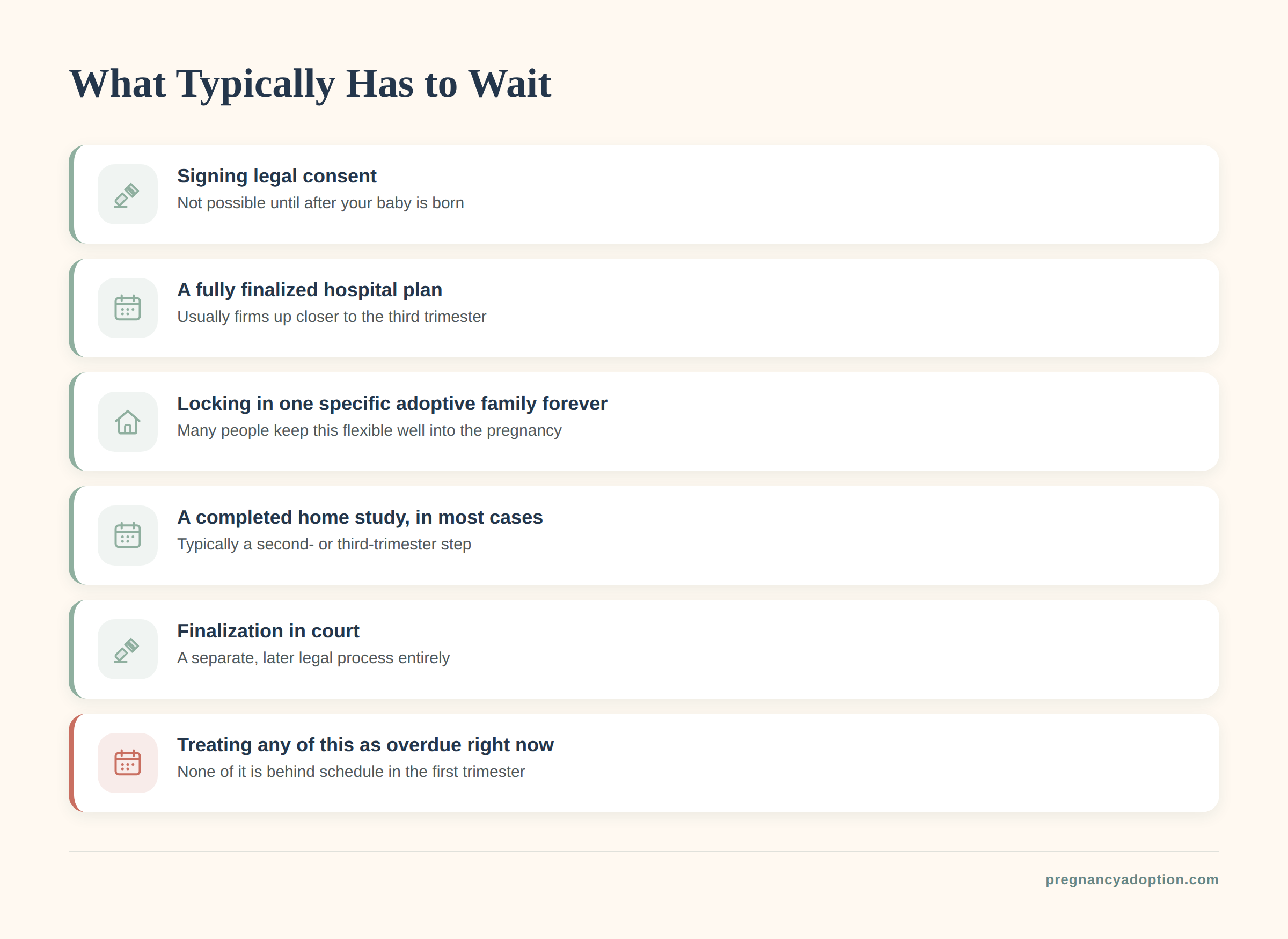
Signing legal adoption consent — this can never happen before birth in any U.S. state, regardless of how settled a plan feels in the first trimester. Our guide to adoption consent timing covers this in full.
Does anything agreed to or written down this early create a binding commitment?
No — a verbal agreement, a letter of intent, or even a detailed plan made in the first trimester is not legally binding; our birth mother rights guide covers why this matters and what rights you retain throughout.
Planning Details
Can I finalize which family will adopt my baby this early?
You can begin reviewing family profiles early if you want to, but many people find their preferences shift as pregnancy progresses, and final family selection commonly happens later — there’s no requirement to lock this in during the first trimester.
Can hospital-plan details (who’s present, timing, etc.) be finalized this early?
Not usually in a firm way — these details are typically worked out closer to delivery, since circumstances and preferences can change; this guide’s companion articles on the second and third trimesters cover how that planning deepens as the pregnancy progresses.
| Step | First trimester | Later in pregnancy |
|---|---|---|
| Researching agencies/attorneys | Yes — a good time to start | Can continue or finalize |
| Confidential exploratory conversation | Yes | Yes, anytime |
| Family profile review | Can begin, often not final | Typically firms up |
| Hospital plan details | Too early for most people | Usually finalized closer to delivery |
| Legal consent signing | Never — not legally possible | Only after birth, per state law |
A Realistic Timeline From Here
From Now Through the Rest of Pregnancy
What does a typical adoption-planning timeline look like from the first trimester onward?
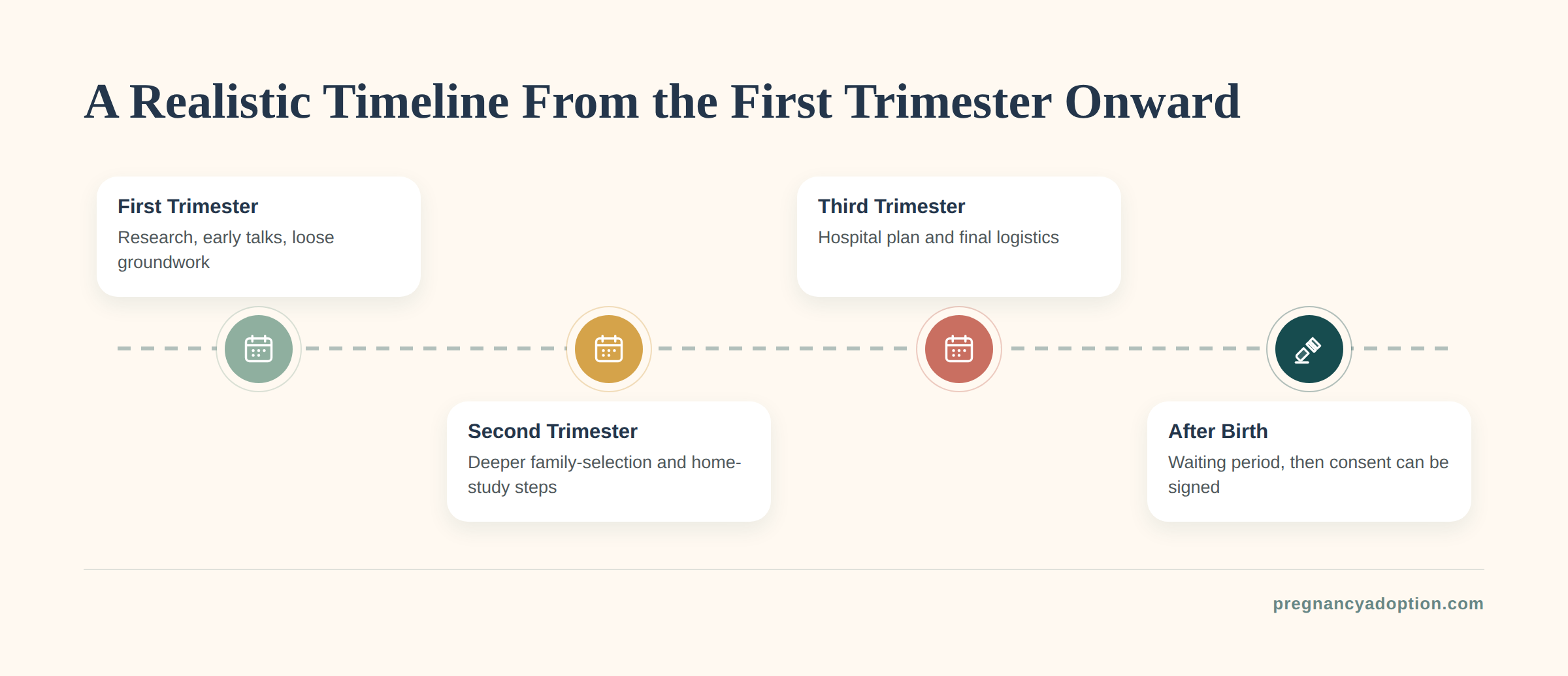
Broadly: research and early conversations now, deepening family selection and more concrete planning in the second trimester, and hospital-plan and final logistics coming together in the third trimester — though pace varies considerably by person, and there’s no single correct speed.
Is it normal for the timeline to not match this general pattern exactly?
Completely normal — some people move faster, some slower, and some go back and forth; this is a general shape to expect, not a schedule you’re expected to keep to.
Staying Flexible
What if my thinking changes significantly as pregnancy progresses?
That’s expected and accounted for throughout this process — nothing is final until legal consent is signed after birth, so changing direction at any point before that remains fully available to you.
Should I set a personal deadline for making a final decision?
Not necessarily — while practical planning benefits from some forward motion, there’s no legal requirement to decide by a specific date, and artificial self-imposed deadlines can add pressure that isn’t actually necessary.
| Trimester | Typical planning focus | Companion guide |
|---|---|---|
| First trimester | Research, confidential conversations, early counseling | This guide |
| Second trimester | Deeper family-selection, home-study groundwork begins | Considering adoption in the second trimester |
| Third trimester | Hospital-plan finalization, final logistics, consent timing | Considering adoption in the third trimester (planned) |
If You’re Still Weighing Parenting or Abortion Too
Exploring More Than One Path at Once
Is it okay to research adoption, parenting, and abortion information at the same time?
Yes, and it’s common — our unplanned pregnancy guide and our pregnancy options guide are both built for exactly this kind of side-by-side exploration, without steering you toward any one path.
Does exploring adoption information mean I’ve ruled out the other options?
No — reading about one option doesn’t require ruling out the others first, and many people research in parallel before narrowing down.
Where to Go for Broader Decision Support
Where should I go if I want neutral information comparing all three paths, not just adoption?
Our pregnancy options guide and our unplanned pregnancy guide cover parenting, adoption, and abortion side by side; this guide is adoption-specific and assumes you’re at least seriously considering that path among others.
Does timing (how many weeks pregnant) affect which options are realistically available?
It can, particularly for abortion, where state law and gestational timing both matter — this is a time-sensitive, state-variable legal question outside this guide’s scope; a healthcare provider or a neutral options counselor can give you current, accurate information specific to your situation.
Telling Family, a Partner, or No One Yet
Deciding Who Knows and When
Do I need to tell the biological father this early?
Legal notice requirements for a father vary by state and generally become more relevant procedurally later in the process; our birth father rights guide covers when and how this typically applies. In the first trimester, there’s usually no immediate legal requirement forcing a conversation before you’re ready, though this varies and is worth confirming with an attorney if it’s a pressing concern.
What if I’m not ready to tell my own family yet?
That’s entirely your choice — there’s no requirement to involve extended family in your exploration or early planning, and many people wait until they feel more settled in their own thinking first.
If You Do Decide to Tell Someone
Is there a “right” way to tell someone I’m considering adoption?
There’s no single right approach — choosing a time and setting where you feel supported, and being clear that you’re still exploring rather than announcing a final decision if that’s accurate, can help manage others’ reactions and expectations.
What if someone reacts negatively when I tell them?
A difficult reaction from someone you’ve told doesn’t change your own rights or options — a neutral counselor can help you process that reaction separately from your own decision-making process.
Early Family-Selection Groundwork
Starting to Look, Without Committing
Is it useful to start looking at adoptive family profiles this early?
For some people, yes — it can make the idea feel more concrete and help clarify preferences; for others, it feels premature this early, and that’s equally valid. There’s no requirement to start this specific step in the first trimester.
What kinds of preferences are worth starting to think about, even loosely?
General openness-level preferences (how much ongoing contact you might want), and broad characteristics that matter to you, if any — our open adoption guide covers the spectrum of contact arrangements in depth.
Keeping Expectations Realistic
Should I expect to find “the one” family this early?
Not necessarily — many people’s sense of what they’re looking for evolves over the course of pregnancy, and treating early browsing as exploratory rather than final tends to feel less pressured.
Does starting to look early create any obligation toward a specific family?
No — reviewing profiles, even having early conversations with a specific prospective family, doesn’t create a binding commitment; nothing is final until legal consent is signed after birth.
Prenatal Care While You Decide
Care Comes First, Regardless of Your Decision
Do I need to decide about adoption before starting prenatal care?
No — getting prenatal care and deciding your path forward are separate steps; our guide to prenatal care and adoption planning covers how the two fit together specifically, and our first-trimester guide covers the medical side of this stage in depth.
Does considering adoption change what prenatal care I should get?
No — the same prenatal care recommendations apply regardless of whether you’re parenting or considering adoption, as covered in the guides linked above.
Combining Medical Care and Planning Conversations
Should I mention to my provider that I’m considering adoption?
This is your choice, not a requirement — some people find it helpful so their provider can connect them with relevant resources, while others prefer to keep medical care and adoption planning separate for now.
Can a healthcare provider connect me with adoption resources if I want that?
Many can, particularly through hospital social workers — this can be a useful, low-pressure way to get connected to information if you’re not sure where else to start.
Managing Uncertainty and Changing Your Mind
Uncertainty Is Normal at This Stage
Is it normal to still feel very uncertain throughout the first trimester?
Very normal — the first trimester is early for most people to have fully settled thinking about a decision this significant, and uncertainty at this stage doesn’t predict what you’ll ultimately decide.
Is it okay to lean toward adoption one week and parenting the next?
Yes — this kind of back-and-forth is a normal part of processing a major decision, not a sign anything is wrong with how you’re approaching it.
Changing Course Later
If I start exploring adoption now and later decide to parent, does that create any problem?
No — exploring adoption, even extensively, creates no obligation or cost if you decide to parent instead; nothing becomes binding until consent is signed after birth.
Will professionals judge me for changing my mind partway through?
A reputable professional expects and supports this possibility rather than treating it as a problem — if you encounter pressure or judgment for reconsidering, that’s a signal worth taking seriously about that specific professional’s approach.
Common First-Trimester Mistakes to Avoid
Timing-Related Mistakes
What’s a common mistake people make by moving too fast this early?
Treating early conversations or profile browsing as more binding than they actually are, which can create unnecessary pressure. Remembering that nothing is final until legal consent is signed after birth can help keep this stage feeling exploratory rather than locked in.
What’s a common mistake people make by waiting too long to start anything?
Delaying all research and conversations until much later in pregnancy, which can mean less time to think clearly and more pressure later — starting to gather information now doesn’t commit you to anything and can ease pressure down the line.
Other Common Missteps
What’s a common mistake around who to involve early on?
Feeling obligated to tell people before you’re ready, based on someone else’s expectations rather than your own readiness — as covered earlier in this guide, you control this timeline.
What’s a common mistake around agency or attorney selection this early?
Committing to the first professional contacted without comparing options, simply because the first trimester can feel like a time to “just get started” — taking a bit more time to compare, as covered earlier in this guide, is usually worth it.
A Simple First Steps Checklist
This Week
What’s a reasonable first action this week if you’re just starting to explore?
Reading our broader guide to considering adoption and, if you want neutral comparative information, our pregnancy options guide.
What’s worth thinking about before a first conversation with a professional?
A few genuine questions you have, and whether you want that first conversation to stay confidential from others in your life for now.
Over the Coming Weeks
What’s reasonable to work toward over the following weeks, without rushing?
Comparing a couple of agencies or attorneys, having at least one exploratory conversation, and continuing or starting prenatal care, regardless of where your thinking lands.
What shouldn’t be rushed, even if you feel ready to move quickly?
Family selection and any sense of a “final” decision — as covered throughout this guide, these commonly settle later, and there’s no advantage to forcing them early.
Glossary of Terms Used in This Guide
Process Terms
Options counseling
Neutral counseling that helps someone think through parenting, adoption, and abortion without steering them toward any particular choice.
Adoption plan
The overall set of decisions and preparations — family selection, hospital plan, openness terms — that come together over the course of a pregnancy if someone chooses adoption.
Related Terms
Expectant parent
The term generally used for someone pregnant and considering options before any adoption decision has been made; “birth parent” is typically used after placement.
Family selection
The process of reviewing and choosing a prospective adoptive family, which commonly deepens and firms up later in pregnancy rather than in the first trimester.
Frequently Asked Questions
Getting Started
Is the first trimester too early to contact an adoption agency?
No — many people contact agencies or attorneys in the first trimester specifically to start gathering information early, without any obligation to proceed.
Do I have to have a firm decision before I contact anyone?
No — exploratory, confidential conversations are a normal and expected part of this process, even for someone who hasn’t decided anything yet.
What’s Realistic This Early
Can I choose the adoptive family in the first trimester?
You can start looking if you want to, but most people find this firms up later in pregnancy rather than in the first trimester, as covered earlier in this guide.
Is there anything that absolutely cannot happen this early, no matter what?
Yes — legal consent can never be signed before birth, in any state, regardless of how certain a plan feels in the first trimester.
Medical and Physical Concerns
Does considering adoption affect what prenatal care decisions I should make?
No — as covered earlier in this guide, prenatal care decisions are the same regardless of your eventual path; our first-trimester guide covers the medical side in full.
What if I experience a miscarriage while I’m still exploring adoption?
This is, understandably, an entirely separate and significant loss to process; our miscarriage guide covers medical and emotional support for this specifically, separate from the adoption-planning content in this guide.
Does morning sickness or early pregnancy symptoms affect my ability to make decisions right now?
Physical symptoms can understandably make it harder to focus on a big decision — there’s no requirement to make progress on adoption planning while you’re also managing difficult physical symptoms, and waiting until you feel more able to think clearly is reasonable.
Financial Questions This Early
Can I get financial help this early in pregnancy if I’m exploring adoption?
Some agencies offer lawful pregnancy-related expense support as part of an adoption plan, though this typically becomes more concrete once a plan is further along — ask directly and early if this is a pressing concern, and get any arrangement in writing.
Does accepting any financial help this early commit me to anything?
In most states, lawful pregnancy-related expense support is not treated as a binding commitment to complete an adoption — but exact rules vary by state, and understanding this clearly from an attorney before accepting any support matters, as covered in our consent-timing guide.
Are there other financial resources besides adoption-related support available this early?
Yes — general pregnancy-related assistance programs exist independent of any adoption plan; exploring these doesn’t require any adoption-related commitment and can be a reasonable parallel step regardless of your eventual decision.
If You Already Have Other Children
Does having other children change anything about exploring adoption this early?
Not procedurally, though it’s often part of the broader context a counselor can help you think through — this guide’s general framework still applies the same way.
Do I need to involve my other children in this early exploration stage?
Not necessarily — how and when to involve other children, if at all, is a personal decision, often best discussed with a counselor experienced in supporting families through this kind of decision.
Age and Life Stage Questions
Does my age affect what I can do in the first trimester regarding adoption?
There’s no minimum age to start gathering information or having exploratory conversations; our pregnant teen options guide covers how minor-specific consent and parental-involvement rules may apply once a decision is closer.
I’m in college — does that change anything about this early stage?
Not procedurally, though practical considerations like academic timing may factor into your own thinking — a neutral counselor can help you think through how your specific circumstances fit into your decision.
Does this guide apply the same way regardless of how many times I’ve been pregnant before?
Yes — the general shape of what’s realistic in the first trimester applies the same way regardless of pregnancy history, though your own prior experience may inform how you personally approach this stage.
Working With Professionals Early
How do I know if an agency or attorney is reputable before committing to anything?
Our guide to choosing an adoption agency covers specific questions to ask and red flags to watch for, useful even at this early, non-committal stage.
What if a professional pressures me to decide faster than I’m comfortable with, even this early?
That’s a reasonable signal to pause and consider a different professional — pressure at any stage, including the earliest exploratory conversations, isn’t consistent with ethical, client-centered practice.
Can I switch which agency or attorney I’m talking to if the first one doesn’t feel right?
Yes — nothing about an early conversation obligates you to continue with that specific professional, and switching at this stage is simple and common.
Understanding the Bigger Picture
Why does this guide emphasize “what can wait” as much as “what you can do now”?
Because a common source of unnecessary pressure in early pregnancy is feeling like everything needs to be decided and locked in immediately — understanding what genuinely doesn’t need to happen yet is just as useful as knowing what you can start.
Does taking things slowly in the first trimester put me at any disadvantage later?
Not typically — the general planning timeline covered earlier in this guide allows for a measured pace, and rushing early decisions doesn’t generally improve outcomes later in the process.
Is there a wrong way to approach this stage?
The main thing to avoid is letting pressure — from a professional, from family, or self-imposed — push you faster than feels right; beyond that, there’s considerable room for different paces and approaches.
Open, Closed, and Semi-Open Adoption This Early
Do I need to decide on openness level (how much contact after placement) this early?
Not yet — our open adoption guide covers the spectrum of contact arrangements in depth, and most people find this preference becomes clearer as they learn more and as pregnancy progresses, rather than needing to be fixed in the first trimester.
Is it useful to at least start learning about the different openness options now?
Yes — understanding what open, semi-open, and closed adoption actually involve can be useful background knowledge even before you have a firm preference, and it can inform the kinds of questions you ask professionals and prospective families later.
Does my openness preference affect which agency or attorney I should work with?
It can — some professionals specialize in or more strongly support certain openness arrangements, which is a reasonable thing to ask about during early agency comparison, even if your own preference isn’t fully settled yet.
If You’re Supporting Someone Else
I’m not the one pregnant, but I’m supporting someone who is considering adoption this early — how can I help?
Listening without pushing toward any particular outcome, helping with practical research if asked, and encouraging access to neutral counseling (rather than substituting your own opinion for it) are generally the most supportive approaches at this stage.
What if I personally have strong feelings about what the pregnant person should decide?
It’s natural to have feelings, but sharing them as pressure rather than as one perspective among many can make an already difficult decision harder — a neutral counselor is a better outlet for working through your own strong feelings separately.
Can I attend an exploratory conversation with an agency or attorney alongside the pregnant person?
Often yes, if that’s what the pregnant person wants — but the decision to include you, and how much, should be theirs to make, not assumed.
Religious and Cultural Considerations
Does my religious or cultural background affect what’s realistic to explore this early?
The general shape of early exploration — research, confidential conversations — is available regardless of background; some agencies specialize in serving specific faith or cultural communities, which is worth factoring into agency comparison if it matters to you.
Is it possible to find an agency aligned with specific religious or cultural values this early in the process?
Yes — many areas have agencies with specific religious or cultural affiliations, and researching this is a reasonable part of the early agency-comparison step covered earlier in this guide.
If This Isn’t Your First Time Considering Adoption
Does having placed a child for adoption before change anything about this process?
The general first-trimester framework in this guide still applies, though your own prior experience, including any feelings connected to it, is worth bringing into conversations with a counselor who can support you with that specific context.
What if I decided against adoption in a previous pregnancy but I’m considering it now?
Each pregnancy and each decision is independent — a previous choice doesn’t bind or predict this one, and exploring adoption now is just as valid regardless of what you decided before.
Multiples and Complicated Pregnancies
Does expecting twins or multiples change anything about exploring adoption this early?
The general framework in this guide still applies, though matching and planning logistics can become more complex with multiples — this is worth raising early and specifically with any agency or attorney you talk to.
What if my pregnancy is considered high-risk — does that change what I should do in the first trimester?
Medical care should take priority regardless of your adoption thinking, and a high-risk designation doesn’t change the general adoption-exploration framework described in this guide, though it may be worth mentioning to any adoption professional you’re in contact with so they understand your full situation.
If a Prenatal Diagnosis Comes Up
What if a prenatal screening test raises a concern during the first trimester?
This is a distinct and significant situation with its own considerations; our guide to adoption planning after a prenatal diagnosis covers this specifically, separate from the general first-trimester content in this guide.
Does a diagnosis this early change the general timeline discussed in this guide?
It can, depending on the specific diagnosis and recommended medical follow-up — your care team and, if relevant, our dedicated guide are the right next resources for this specific situation.
Legal Representation Questions
Do I need my own attorney this early, or is that premature?
Having your own independent attorney becomes more essential later in the process (particularly before signing anything), but there’s no harm in an early consultation if you want one — many offer free initial consultations specifically for this purpose.
Is the attorney an agency recommends automatically representing my interests?
Not necessarily — an attorney representing only your interests, separate from one provided or paid for solely by the adoptive family or agency, is generally the stronger standard; our birth mother rights guide covers this distinction in more depth.
Can I ask an agency upfront whether independent legal representation is available to me?
Yes — this is a reasonable and important question to ask early, during the same comparison process covered earlier in this guide, rather than discovering the answer later.
Documentation to Start Gathering
Is there anything practical worth starting to gather or organize this early?
Not urgently — most required documentation becomes relevant later in the process; our adoption documents checklist covers what’s typically needed once a plan is further along.
Should I start keeping notes about my own thinking and questions during this stage?
Many people find this genuinely useful — writing down questions as they come up, and reflecting on your own evolving thinking, can make later conversations with professionals or counselors more productive.
Foster Care and Other Adoption Paths
Does this guide apply if I’m thinking about a path other than a typical domestic infant adoption?
This guide is written specifically with newborn infant adoption planning in mind, which is the context most relevant to someone in the first trimester making a placement decision; other adoption paths, like foster care adoption, generally apply to a different situation (an already-born child needing a home) rather than a current pregnancy decision.
What’s the difference between a private adoption and working through an agency, and does it matter this early?
Both are reasonable options to research in parallel this early; the practical and legal mechanics differ somewhat, but the general first-trimester exploration framework in this guide applies to either path.
Interstate Questions This Early
Does it matter this early whether the adoptive family might live in a different state?
Not for the exploration stage itself, though it becomes procedurally relevant later through the Interstate Compact on the Placement of Children (ICPC), covered in our consent-timing guide — no need to resolve this detail in the first trimester specifically.
Should I limit my agency or attorney search to my own state this early?
Not necessarily — many agencies and attorneys work across state lines or have networks that do; casting a slightly wider net during early research is a reasonable approach if your local options feel limited.
What If You Feel Rushed by Circumstances
What if external circumstances (financial pressure, housing, a relationship ending) make this feel urgent even in the first trimester?
Real practical pressures are valid and worth naming directly to a counselor, who can help connect you with broader resources (not just adoption-specific ones) that might ease some of that pressure separately from the adoption decision itself.
Does genuine urgency in my circumstances change any of the legal timing covered in this guide?
No — the legal framework (especially that consent can’t be signed before birth) applies the same way regardless of how urgent your circumstances feel, which is itself a built-in protection against being rushed into an irreversible decision.
Thinking About the Child’s Future
Is it normal to think a lot about what life will be like for the child depending on my decision?
Very normal, and this kind of thinking is often a genuine part of working through the decision — a counselor can help you think through this without presenting one outcome as objectively better for a child than another.
Will people judge me no matter which path I choose?
Unfortunately, some people hold strong opinions about any path a pregnant person chooses — surrounding yourself with support that respects your own process, rather than pushing an agenda, matters more than trying to preempt every possible judgment.
Online Research and Social Media
Is it safe to research adoption information on social media or online forums?
Personal stories shared there can offer emotional context and a sense of not being alone, but they’re not a reliable substitute for accurate, current, professional information — treat them as one input among several rather than a primary source for decisions.
Should I post about considering adoption on social media this early?
This is entirely your choice, but it’s worth thinking through in advance, since a public post removes the option of keeping your exploration private later if you change your mind about who should know.
Are online adoptive-family profile databases a reliable way to start browsing this early?
Reputable agencies’ own profile databases are generally a reasonable starting point if you want to browse; independent of an agency, it’s worth being cautious about unaffiliated listing sites and confirming legitimacy before engaging with any specific profile or family directly.
If You Received Unsolicited Advice
What if someone who isn’t a professional gives me confident advice about what I “should” do?
Well-meaning advice from friends or family doesn’t carry the same reliability as guidance from a neutral options counselor or an attorney, especially on time-sensitive legal or medical specifics — it’s reasonable to listen politely while still seeking out professional guidance for anything that actually matters to your decision.
What if I received inaccurate information from someone about adoption law or process?
This is common, since adoption law and process are genuinely complex and vary by state — confirming anything significant with an actual attorney or agency, rather than relying on secondhand information, is always the safer approach.
Preparing for Your Next Conversation
What questions are worth preparing before a first conversation with an agency or attorney?
Questions about confidentiality, cost, their general process and timeline, how they handle disagreement between birth parents if relevant, and what independent legal representation looks like through them — many of these are covered in more depth in our agency-selection guide.
Is it okay to bring a written list of questions to a first conversation?
Yes — many people find this helpful, especially if nerves or emotion make it hard to remember everything in the moment; a good professional won’t mind at all.
What if I think of more questions after the first conversation ends?
Follow-up questions are completely normal and expected — a good agency or attorney will welcome continued questions as your thinking develops, not just during a single initial call.
Mental Health Support
Is it normal to want mental health support specifically, separate from adoption-focused counseling?
Yes — some people benefit from general mental health support (a therapist, for example) alongside or instead of adoption-specific options counseling, especially if anxiety, low mood, or stress feel like the bigger immediate concern; both kinds of support can coexist.
Does seeking mental health support signal that something is wrong with how I’m handling this?
Not at all — seeking support during a major life decision reflects good self-care, not a problem; many people find a combination of general and adoption-specific support most helpful.
If I’m struggling significantly with anxiety or low mood, is this guide the right resource?
This guide focuses specifically on adoption-planning logistics; if you’re experiencing persistent sadness, anxiety, or difficulty functioning, reaching out to a healthcare provider or mental health professional directly is an important parallel step, separate from the planning content here.
A Few More Practical Scenarios
What if I’m currently unhoused or facing housing instability — does that change what’s realistic this early?
The general exploration steps in this guide remain available, and this is also exactly the kind of circumstance worth raising directly and early with a counselor or agency, since connecting you with broader support resources, not just adoption-specific ones, is often part of what a good professional can help with.
What if I don’t have reliable internet or phone access for research and calls?
Local health centers, clinics, and hospital social workers can often help connect you with adoption information and professionals directly, without requiring independent online research.
What if English isn’t my first language — is support available?
Many agencies and attorneys offer services in multiple languages or can arrange interpretation — asking directly about this during early agency comparison is a reasonable and important step if this applies to you.
Timing Relative to Prenatal Appointments
Should I bring up adoption at my first prenatal appointment?
This is entirely your choice — some people mention it so their provider can help connect them with resources, while others prefer to keep early medical care and adoption exploration separate for now, as covered earlier in this guide.
Does my provider need to know about my adoption exploration to give me appropriate prenatal care?
No — standard prenatal care recommendations don’t depend on whether you’re exploring adoption, so there’s no medical necessity to disclose this if you’d rather not.
Immigration and Citizenship Questions
Does immigration status affect what’s realistic to explore in the first trimester?
The general exploration steps remain available regardless of immigration status; some specific legal and documentation questions can intersect with immigration status later in a plan, which is worth raising directly with an attorney if relevant to your situation.
Is it safe to contact an adoption agency or attorney regardless of immigration status?
Reputable agencies and attorneys generally focus on the adoption-related conversation itself; if this is a specific concern, asking directly about their approach to this before sharing detailed personal information is a reasonable step.
If Your Situation Involves a Crisis
What if this pregnancy resulted from a situation I’d describe as a crisis, like assault?
This deserves specialized, trauma-informed support beyond general adoption-planning content — a counselor or advocate experienced specifically in this area, alongside any adoption-specific support you seek, is an important parallel resource.
Does this guide’s general framework still apply in a crisis-pregnancy situation?
The basic legal timing facts (like consent never being possible before birth) apply the same way, but the surrounding emotional support needs careful, specialized attention that goes beyond what this planning-focused guide covers.
A Closing Set of Practical Questions
Is there a single most useful first action for someone just starting to read about this topic?
Reading our broader guide to considering adoption for the fuller decision-support picture, then, if adoption still feels like a path worth exploring further, having one confidential conversation with a neutral counselor or a reputable agency.
How will I know when I’m ready to move from “exploring” to more concrete planning?
There’s no universal marker — for many people, it’s simply a growing sense of clarity after enough information and reflection; a counselor can help you recognize and trust that shift when it happens, rather than needing to force it on a timeline.
What’s the most important thing to remember throughout this entire first-trimester stage?
That nothing is final until legal consent is signed after birth — which means every step covered in this guide, however far you take it, remains genuinely reversible until that one specific, later moment.
If You’re Reading This for Someone Else
I’m a friend or family member trying to understand what my loved one is going through — is this guide useful for me too?
Yes — understanding the general shape of what’s realistic and what has to wait can help you offer informed, non-pressuring support rather than well-meaning but inaccurate advice.
What’s the most helpful thing I can do as a supportive friend or family member during this stage?
Mostly, following their lead — offering to help with practical research if asked, listening without pushing a particular outcome, and respecting their timeline and confidentiality preferences, even if it’s slower or different than you’d expect.
Last Clarifications
Does any of this guide’s content apply differently for a same-sex couple or single parent considering adoption for their child?
The general framework of what’s realistic in the first trimester applies the same way; specific family-structure considerations mostly become relevant later, in family-selection and legal-paperwork stages rather than at this early exploratory stage.
Is this guide meant to be read once, or returned to throughout the first trimester?
It’s designed to be useful either way — many people find it helpful to revisit sections as their own thinking develops or as specific questions come up over the following weeks.
What should someone do immediately after finishing this guide if adoption still feels like a path worth exploring?
Reach out for one confidential conversation — with a counselor, an agency, or an attorney, whichever feels most comfortable to start with — simply to keep gathering accurate, personalized information at whatever pace feels right.
Relationship Between This Stage and the Rest of the Process
Does how someone handles the first trimester predict how the rest of their adoption journey, if they choose it, will go?
Not really — the first trimester is just the earliest stage, and how someone approaches it (quickly, slowly, with lots of research, or with very little) doesn’t determine the quality or outcome of later stages.
If I don’t do much at all during the first trimester, am I behind?
No — there’s no required pace, and many people do very little formal planning in the first trimester and still have a perfectly smooth, well-supported process later; this guide describes what’s possible, not what’s required.
Does this guide’s existence imply that every expectant parent considering adoption needs to follow all of these steps?
No — this guide describes options and general patterns, not a required checklist; using only the parts that feel relevant and useful to your own situation is entirely appropriate.
One Final Pair of Questions
If I only remember one thing from this entire guide, what should it be?
You can start learning and having confidential conversations now without deciding anything, and nothing becomes legally final until consent is signed after birth — so there’s no need to feel locked in at this early stage.
What’s the best overall mindset for approaching the first trimester if adoption is on your mind?
Curious rather than rushed — treating this stage as an opportunity to gather accurate information and figure out what you actually think, at a pace that feels sustainable, rather than a deadline to meet.
Checking in With Yourself
How do I know if I’m making progress, even without a final decision?
Progress at this stage usually looks like having better information, clearer questions, and a stronger sense of your own values and priorities — not necessarily a finished decision; all of those count as real progress.
Is it okay if my progress looks different from what I expected going in?
Yes — plans and expectations commonly shift once real information and real conversations enter the picture, and that’s a sign the process is working as intended, not a sign something went wrong.
What if I feel like I should have stronger opinions by now, even this early?
There’s no required timeline for forming strong opinions about a decision this significant — feeling unsettled in the first trimester is common and doesn’t reflect poorly on your process.
A Few Words on Pacing Yourself
Is it better to front-load all the research now, or spread it out?
Either approach can work — some people prefer to gather everything at once to feel grounded, while others prefer a slower, spread-out pace that matches their emotional bandwidth; there’s no single right way to pace this.
What if I need to step away from thinking about this for a while?
That’s a reasonable response to a heavy topic — stepping back temporarily doesn’t close any doors, since nothing about your options or timeline is lost by taking a pause when you need one.
Reading This Guide in Context
Should this be the only guide I read before taking any action?
No single guide, including this one, replaces personalized conversations with an attorney and a counselor — this guide is meant to prepare you for those conversations, not substitute for them.
What if information in this guide seems to conflict with something an agency or attorney told me?
Raise the discrepancy directly with that professional and ask them to clarify — current, personalized professional guidance should generally take precedence over a general informational guide like this one, since laws and specific circumstances can affect the right answer.
Is this guide’s general approach — patience, confidentiality options, no rush to decide — unusual compared to other information you might find?
Not unusual among reputable professional sources, though it can differ from more pressured messaging sometimes found elsewhere; a consistently patient, pressure-free approach across the professionals and resources you use is a reasonable standard to hold them to.
Insurance and Practical Coverage Questions
Does exploring adoption affect my existing health insurance coverage for the pregnancy?
No — your own health insurance coverage for prenatal care and delivery is a separate matter from any adoption plan, and exploring or even deciding on adoption doesn’t change what your plan covers for you.
If I’m on my parents’ insurance, will they be notified that I’m pregnant?
Policies vary by insurer and plan, and this is a question worth asking the insurance company directly or discussing with a counselor if it’s a concern — it isn’t something this early-planning guide can answer for every situation, but it’s a reasonable thing to raise in a confidential conversation with an agency or counselor who may have seen the specific scenario before.
Will exploring adoption show up anywhere that could affect future insurance applications?
Exploring options or having early conversations with an agency or attorney isn’t the kind of event that typically appears in insurance records — this is a different category from the medical care itself, which is recorded the way any pregnancy-related care would be.
If You’re Not in the United States
Does this guide apply if I’m not located in the United States?
This guide is written with U.S. adoption law and process in mind; if you’re located elsewhere, the general emotional and planning themes may still be useful, but the legal process, timing, and consent framework will differ substantially by country, so local professional guidance is especially important.
Where should someone outside the U.S. start looking for accurate information?
A local family law attorney, a national or regional adoption authority, or a licensed social worker in your own country is a better starting point than a U.S.-focused guide for anything legal or procedural.
A Note on Reading Pace
Do I need to read this entire guide in one sitting?
No — this is a long, detailed guide precisely so it can answer many different situations, and most people find it more useful as a reference to return to for specific sections rather than something to absorb all at once.
Is it normal to reread sections multiple times as my thinking develops?
Yes, that’s a common and reasonable way to use a guide like this — your questions and priorities may shift over the coming weeks, and rereading a section with fresh eyes often surfaces something that didn’t stand out the first time.
Questions About Agency and Attorney Fees This Early
Do I have to pay anything to have an initial exploratory conversation with an agency or attorney?
Typically no — initial consultations with reputable licensed adoption agencies and attorneys are generally offered at no cost, since they’re part of determining whether working together makes sense for both sides.
Should I be suspicious if an agency or attorney asks me to pay something just to talk to them?
A request for payment before any services have been discussed or agreed to is worth asking careful questions about, and comparing against a second agency or attorney’s approach is a reasonable way to get a sense of what’s standard.
If I decide not to pursue adoption after an initial conversation, do I owe anything?
With a reputable agency or attorney, exploring your options and then deciding not to proceed typically doesn’t create any financial obligation — the exploratory conversation itself is not a commitment.
Thinking About Multiple Potential Adoptive Families
At this early stage, do I need to have already narrowed down what kind of family I want?
No — the first trimester is generally still a research and groundwork stage, and most people haven’t yet reached the point of reviewing specific family profiles, so there’s no expectation that you’ve formed detailed preferences yet.
Is it normal to have no idea yet what I’m looking for in an adoptive family?
Yes — many people’s sense of what matters to them in a family only becomes clearer once they’ve done more research and had more conversations, so arriving at this stage without firm preferences is common rather than unusual.
If English Isn’t Your First Language
Can I get support in a language other than English during this process?
Many agencies and attorneys can arrange interpretation or have bilingual staff, so it’s worth asking directly about language support when you first reach out — this is a reasonable and common request.
Will language differences affect my options or rights in any way?
No — your rights and options as an expectant parent considering adoption aren’t affected by what language you speak; the practical question is simply making sure you fully understand each conversation and document, which qualified interpretation support is meant to ensure.
If You’re Already Working With More Than One Professional
Is it a problem to be talking with more than one agency or attorney at this stage?
No — comparing more than one agency or attorney during this early exploratory stage is common and generally encouraged, since it helps you find the right fit before committing to anyone.
Should I tell each agency or attorney that I’m also talking with others?
Being upfront about this is reasonable and often appreciated — most professionals in this field expect that expectant parents are comparing options early on, and transparency tends to make those conversations more useful.
Considering Your Own Support Network
Do I need a strong support network already in place before I can start this process?
No — many people begin exploring their options and talking with professionals before they’ve lined up broader personal support, and part of what a counselor or agency can help with is thinking through what support might be useful and how to build it over time.
What if I feel like I’m navigating this mostly on my own right now?
That’s a common starting point, and it doesn’t mean you have to stay there — a counselor, agency social worker, or support group can provide meaningful support even in the absence of personal relationships you feel able to lean on right now.
If You’re a Minor
Does being a minor change anything about starting this process in the first trimester?
It can affect some legal and procedural details, including parental notification in certain circumstances, so this is a conversation worth having directly and early with a counselor or agency familiar with your state’s rules for minors — see pregnant teenager options for a broader look at this situation.
Can a minor still have confidential conversations with an agency or counselor?
Generally yes, though the specifics of confidentiality and any notification requirements can vary — this is exactly the kind of question to raise directly in that first conversation.
A Few Scheduling Logistics
Do early conversations with an agency or attorney need to happen in person?
No — phone and video consultations are widely available and commonly used, especially for this early exploratory stage, so location and transportation generally aren’t barriers to getting started.
How much time should I set aside for a first exploratory call?
A first call often runs somewhere in the range of 30 minutes to an hour, though this varies by agency or attorney — it’s reasonable to ask how long to expect when you schedule it.
Keeping Records of Your Own
Should I be keeping my own notes as I go through this early research stage?
Many people find it helpful to jot down questions as they come up and brief notes after each conversation — this becomes useful both for comparing agencies or attorneys and for remembering what’s already been covered as the weeks go by.
Is there anything specific I should be writing down from these early conversations?
Dates, who you spoke with, what was discussed, and any follow-up steps or deadlines mentioned are all worth noting — a simple running log, even informal, can make later conversations with professionals more efficient.
One Last Grounding Thought
If I only take one thing from this entire guide, what should it be?
That the first trimester is a research-and-groundwork stage, not a decision deadline — you can learn, ask questions, and talk to professionals now without anything being locked in, and the legal step that actually finalizes an adoption plan can’t happen until after your baby is born.
Is it okay if my thinking looks completely different a month from now?
Yes — it’s common, and even expected, for a person’s thinking to keep developing throughout the first trimester as they learn more and talk to more people; nothing about where you stand today locks in where you’ll stand later.
What Comes Right After This Stage
What should I expect to be focused on once I move into the second trimester?
If you’re still considering adoption at that point, the focus tends to shift toward deeper groundwork — more concrete family-selection conversations, home-study-related steps if you’re working with an agency, and firming up details that were still open-ended in the first trimester — see adoption in the second trimester for what that stage typically involves.
Does everything from the first trimester carry forward, or does some of it need to be redone?
Most groundwork carries forward — the research, the professional relationships, and the private conversations you’ve had don’t need to be redone, though your specific plans and preferences can and often do keep developing as you learn more.
A Final Word on Pacing This Decision
Is there a risk of waiting too long to make any decision at all?
Practically speaking, there’s no first-trimester deadline that forces a decision — the meaningful legal deadlines come much later, around birth, so taking this early stage at a pace that feels right for you is a reasonable approach, not a risk.
What’s the most important thing to do differently than someone who feels rushed?
Give yourself permission to gather information and talk to professionals without treating any single conversation as the moment you have to decide — that distinction between researching and deciding is what this entire guide is built around.
Confidentiality and Telling Others
Can I explore adoption without my employer finding out?
Generally yes — exploring adoption options is a private matter, and there’s no requirement to disclose this to an employer; any pregnancy-related workplace questions are a separate topic from the adoption exploration itself.
What if I’m not out as pregnant yet at all — can I still start this process?
Yes — confidential conversations with an agency, attorney, or counselor don’t require you to have told anyone else about the pregnancy itself yet.
Is it common for people to keep their adoption exploration completely private for the entire first trimester?
Yes, this is common — many people use the first trimester specifically as a private information-gathering period before deciding who, if anyone, to involve.
Logistics and Practical Questions
Does where I live affect what I can start doing this early?
The general shape of early exploration — research, confidential conversations, comparing professionals — is available regardless of location; state-specific legal details become more relevant later in the process and are covered in our adoption consent laws guide.
Do I need health insurance or a specific income level to start exploring adoption?
No — exploring adoption as an option isn’t conditioned on your financial situation; in fact, many people explore adoption partly because of financial circumstances, and lawful pregnancy-related expense support may be available as part of an eventual plan.
Is there a cost to just researching and having early conversations?
Typically no — initial conversations with reputable agencies and attorneys are generally free, since formal fees usually apply later in an actual adoption plan, not during early exploration.
The Emotional Side
Is it normal to feel relief after an early exploratory conversation, even without deciding anything?
Yes — simply having accurate information and feeling less alone with the question can bring real relief, independent of what you ultimately decide.
What if I feel guilty just for considering adoption this early?
Feelings of guilt are common but don’t reflect anything objectively wrong with considering your options — a neutral counselor can help you process this feeling separately from the decision itself.
Is it okay to feel hopeful and scared about this at the same time?
Completely normal — most significant life decisions carry mixed emotions, and there’s no requirement to feel only one way about this to be approaching it thoughtfully.
Involving a Partner
Does my partner need to agree with me about considering adoption?
This depends on your specific relationship and, in some cases, legal paternity questions covered in our birth father rights guide — but your own right to explore information and have early conversations isn’t contingent on a partner’s agreement.
What if my partner wants to parent and I’m considering adoption, or vice versa?
This is a difficult but not uncommon situation — a neutral counselor experienced in exactly this kind of disagreement can help both of you be heard, and an attorney can clarify how your state handles a father’s rights and involvement if agreement isn’t reached.
Should I wait to explore adoption until my partner and I are on the same page?
Not necessarily — many people find that having accurate information first actually helps a difficult conversation with a partner go better, rather than waiting for full agreement before learning anything.
Comparing This Guide to Others on This Site
How is this guide different from the site’s general considering-adoption guide?
Our general guide covers the full decision-support picture regardless of how far along you are; this guide is specific to the first-trimester stage, focused on what’s realistic to start now versus what has to wait.
How is this guide different from the site’s first-trimester pregnancy guide?
Our first-trimester guide covers the medical and developmental side of this stage in depth, with only a brief mention of adoption; this guide goes deep specifically on the adoption-planning side.
Will there be a similar guide for the second and third trimesters?
Yes — considering adoption in the second trimester and a companion third-trimester guide follow the same stage-specific approach as this one.
A Few More Reassurance Questions
Is it normal to feel like I’m moving too slowly compared to how I imagined this process?
Very normal — most people’s actual pace looks different from how they imagined it beforehand, and there’s no single correct speed for a decision this significant.
What if I decide adoption isn’t right for me after all this early research?
That’s a completely valid outcome — early research exists precisely to help you make an informed decision, whatever that decision turns out to be, and deciding against adoption after exploring it thoroughly is not a wasted process.
Where should I go next if a question about my specific situation isn’t answered here?
A neutral options counselor or an adoption attorney are the right next steps for anything specific to your circumstances — this guide is designed to help you understand the general shape of this stage, not replace that personalized conversation.
The first trimester is a genuinely reasonable time to start exploring adoption, but it doesn’t have to be when you finalize anything. Research, confidential conversations, and early counseling are all realistic now; firm family selection, hospital-plan details, and legal consent all come later, with consent specifically never possible before birth. Taking this stage at your own pace, with accurate information and without pressure, is the healthiest way to approach it.
pregnancyadoption.com/ provides independent, judgment-free information for people navigating pregnancy, parenting, and adoption decisions. Our content is reviewed for accuracy and clarity, and we link out to established legal and child-welfare authorities throughout our guides. We don't provide individualized legal, medical, or adoption-placement services directly — our goal is to help you ask better questions when you do seek that support. Learn more about our editorial approach.
This article is for general informational purposes only and does not constitute legal or medical advice. Adoption laws, including consent and timing rules, vary significantly by state. Always consult a licensed adoption attorney and a neutral options counselor before making any decision related to pregnancy or adoption. See our full disclaimer for more detail.
