
“Open adoption” gets used as though it describes one fixed arrangement — some regular photos, maybe a yearly visit — but in practice it’s closer to a relationship than a format, and relationships change. This guide is for anyone living inside that reality: an expectant or birth parent weighing how much contact to ask for, an adoptive parent trying to honor an agreement in good faith while still parenting their own child, or an adoptee — of any age — trying to understand where a birth family relationship fits in their own sense of self. We go deep specifically on contact, boundaries, and agreements: what openness actually ranges across, how a post-adoption contact agreement is built and whether it’s enforceable in your state, how contact typically shifts as a child grows, where the friction usually shows up, and what to do if an arrangement breaks down.
If you’re earlier in the decision — still weighing whether adoption is the right path at all, or how open you want an arrangement to be in the first place — our guide for expectant parents considering adoption covers that broader decision, including an introduction to the openness spectrum, at the level appropriate for someone still deciding. This guide assumes you’re past that point: you’re in an open or semi-open arrangement already, you’re actively negotiating one, or you want to understand it in real depth before you do. If closed adoption is more what you’re exploring instead — including search, reunion, and adult-adoptee access to records — our companion guide to closed adoption covers that territory fully; the two guides are written as a pair, and we’ll point you there at the specific places where that’s genuinely the better next read.
The Child Welfare Information Gateway publishes a national overview of openness in adoption. The National Council For Adoption also tracks how open-adoption agreements are evolving state by state.
Key takeaways
- “Open” is not one thing. It’s a spectrum across at least three separate dimensions — who’s in contact, how often, and through what channel — and two families can both accurately call their adoption “open” while living very differently.
- A written post-adoption contact agreement (often called a PACA) is strongly recommended even where it isn’t legally binding, because it creates a shared, specific reference point that an informal understanding usually can’t.
- Whether that agreement is enforceable in court depends almost entirely on your state, and this is one of the most consequential and most misunderstood facts in open adoption — Section 7 covers it in full, with the nuance that enforceability often depends on additional factors beyond just which state you’re in.
- Contact is supposed to change. Longitudinal research on open adoption families finds that the large majority of birth parents experience some shift in contact over an eight-year period — this is normal, not a sign the arrangement failed.
- Adoptees are not passive recipients of whatever openness level the adults arranged. As they grow, most take an increasingly active role in shaping their own contact, and their own relationship to it changes with their developing sense of identity.
- If an agreement breaks down, you generally have options short of (and sometimes instead of) court — mediation, renegotiation, and, in some cases, legal recourse where your state allows it. Section 15 and Section 16 walk through what’s actually available.
Short Answer: What Open Adoption Actually Means
Open adoption describes an arrangement in which a birth parent and an adoptive family maintain some form of ongoing contact or information exchange after an adoption is finalized — ranging from occasional photo updates sent through an agency to direct phone calls, visits, and shared holidays, depending entirely on what both sides agree to. It does not change who holds legal parental rights: the adoptive parents are the child’s full legal parents, with complete day-to-day authority, regardless of how much contact exists. Openness describes the relationship and the flow of information, not the legal structure underneath it.
What Openness Is Not
It’s Not Shared Custody
A birth parent in an open adoption has no legal custody, visitation right, or decision-making authority over the child unless a specific state’s law and a specific court order say otherwise in an unusual case — contact happens because the adoptive family agrees to it, not because the law requires it in most states. This surprises some people on both sides of the relationship, and it’s worth understanding clearly before you build expectations around a specific level of contact.
It’s Not a Single, Fixed Category
“Open” and “closed” sound like a binary, but real arrangements land across a continuum, and most fall somewhere in the middle rather than at either extreme. The next section breaks that continuum into its actual working parts rather than treating it as two boxes to choose between.
Who This Guide Is Written For
Birth Parents Navigating or Negotiating Contact
If you’ve placed a child, or you’re an expectant parent currently working out what openness level to ask for, this guide covers how agreements are typically built, what’s realistic to expect, and what your options are if contact doesn’t go the way it was supposed to. If you’re still earlier than that — weighing adoption itself, or wanting the full action-oriented walkthrough of placing a child — our guide to placing a child for adoption covers that broader process, with openness as one decision point inside it; this guide goes deeper specifically on what happens with that decision afterward.
Adoptive Parents Managing an Ongoing Relationship
If you’re adoptive parents trying to honor a contact agreement thoughtfully — or trying to figure out how to renegotiate one that no longer fits your family — the sections on boundaries, changed circumstances, and renegotiation are written as much for you as for a birth parent. Our guide to adopting a child covers openness as one factor in choosing a match and a professional; this guide picks up from there, once a relationship actually exists.
Adoptees Trying to Understand Their Own Experience
Section 14 is written specifically from and for the adoptee’s vantage point — covering identity, belonging, and what research actually shows about how kids and young adults experience contact with birth family, including the fact that their own preferences about it tend to shift as they grow.
Open Adoption Is a Spectrum, Not a Single Arrangement
Every open adoption sits at a specific point across several independent dimensions at once, and understanding those dimensions separately — rather than reaching for a single label like “pretty open” — makes it much easier to actually negotiate an arrangement and to recognize when it’s drifted from what was originally agreed.

Dimension One: Who’s Actually in Contact
Birth Parent to Adoptive Family, or Birth Parent to Child Directly
In some arrangements, contact runs primarily between the adults — a birth mother and the adoptive parents — with the child receiving information secondhand, through photos or stories the adoptive parents share. In others, especially as a child gets older, contact becomes increasingly direct between the birth parent and the child themselves: texts, calls, or visits that don’t route through the adoptive parents as intermediaries every time. These are genuinely different experiences of “openness,” and a family can shift between them over years without ever changing a formal written term.
Extended Family, Siblings, and Others Beyond the Birth Parent
Openness doesn’t have to be limited to the birth parent who placed the child. Grandparents, siblings (biological or through later births on the birth parent’s side), and other birth relatives are sometimes included in a contact arrangement, sometimes not — and whether they are is a separate negotiation from the core birth-parent relationship, worth naming explicitly rather than assuming.
Dimension Two: How Often, and On What Schedule
From a Few Times a Year to Ongoing and Unscheduled
Frequency ranges from an annual update to essentially ongoing, informal contact — a running group text, social media connection, or standing arrangement to see each other around specific holidays. Neither end is more “correct”; what matters is that the frequency reflects something both sides actually want and can sustain, not a number either side felt they had to accept to seem appropriately open or appropriately cautious.
Fixed Schedule vs. As-Needed
Some arrangements specify exact dates or occasions (a birthday card, a visit each summer); others are deliberately open-ended, with contact happening whenever either side reaches out. A fixed schedule gives predictability and a clear standard to point back to; an as-needed approach gives flexibility but can drift into inconsistency without anyone intending it to. Many families land on a hybrid: a guaranteed minimum (say, quarterly photos) with room for more whenever both sides want it.
Dimension Three: Through What Channel
Agency-Mediated vs. Direct Contact
Early open adoptions, and some that remain this way by choice, route contact through the placing agency — photos and letters are sent to the agency, which forwards them, sometimes with identifying details removed. Direct contact means the birth parent and adoptive family communicate with each other without an intermediary, by phone, text, email, or in person. Many relationships start mediated and shift toward direct contact as trust builds, though the reverse happens too, particularly if either side wants more structure or distance for a period of time.
In-Person, Written, and Digital Contact Carry Different Weight
A visit, a handwritten letter, and a text message are not interchangeable even when they convey similar information — each carries a different emotional register and a different level of ongoing access. Social media in particular has become its own sub-category: being connected on a platform where either side can see the other’s daily life, tagged photos, and friends creates a kind of passive, constant visibility that older open adoption models, built around scheduled letters, didn’t anticipate. Section 10 covers the specific friction social media visibility tends to create.
Key Takeaways
- Openness is better described across three separate dimensions — who’s in contact, how often, and through what channel — than as a single point on an open-to-closed line.
- A relationship can shift along any one of these dimensions (say, moving from agency-mediated to direct contact) without anyone renegotiating the others.
- Social media has created a distinct, often unaddressed sub-category of contact that many older agreements never explicitly covered.
Where Semi-Open and Closed Fit on the Same Map
Semi-Open Is a Midpoint Across These Same Dimensions, Not a Fourth Category
What’s typically called “semi-open” usually means moderate positions across the three dimensions above — periodic, agency-mediated contact between the adults, without direct child contact or a standing schedule. It’s not a separate system with its own rules; it’s simply a different combination of the same three variables.
Closed Adoption Sits at the Far End, and Has Its Own Deep Treatment Elsewhere on This Site
A fully closed adoption — no contact, no identifying information shared, often (though not always, depending on era and state) sealed records — sits at the far end of the same map: minimal or no contact, no channel at all, often no knowledge of identity on either side. It remains a legal option in every state and is, for some families, genuinely the right fit. Because closed adoption carries its own distinct body of law and practice — sealed-records access, reunion registries, confidential intermediary systems, and the adult-adoptee search process — we don’t rebuild that territory here. Our closed adoption guide is the dedicated, deep treatment of that end of the spectrum; Section 17 below gives a short, direct comparison between the two for anyone deciding between them, but the full depth on closed adoption specifically lives there.
Why Open Adoption Became the Norm
If the idea of ongoing contact between a birth parent and an adoptive family feels like a newer or less “traditional” model, that impression is accurate — but the shift happened fast, and understanding why helps explain some of the friction families still run into today, since practice changed faster than everyone’s expectations did.
The Historical Default Was Closed, and Recently
Before the 1990s, Closed Was the Overwhelming Norm
For most of the 20th century, domestic infant adoption in the U.S. operated on a closed model by default: sealed records, no identifying information exchanged, and an assumption that severing contact entirely served everyone’s interests, especially the child’s. Fewer than roughly 5% of domestic infant adoptions before 1990 involved any ongoing openness
The Shift Happened Within a Single Generation
By the early 2010s, large surveys of U.S. adoption agencies found that the overwhelming majority — roughly 90% or more — were actively recommending open arrangements, and agency-reported data put the share of domestic infant adoptions with some openness at upward of 90%, a near-total reversal from the pre-1990 baseline.
What Drove the Change
Research on Adoptee and Birth-Parent Wellbeing
A body of research accumulated through the 1980s and 1990s, including longitudinal work out of the Minnesota/Texas Adoption Research Project, consistently found that birth parents in more open arrangements reported less unresolved grief and greater peace with their decision than those in closed arrangements, and that many adoptees reported wanting more information about their origins than a closed system provided, regardless of how loved they felt in their adoptive family. This research didn’t claim openness was right for everyone, but it undercut the earlier assumption that closed adoption was automatically the safer, cleaner choice.
A Shift in Who’s Doing the Choosing
As domestic infant adoption moved toward a model where expectant parents actively choose the adoptive family rather than an agency assigning one, openness naturally became part of the matching conversation — an expectant parent who’s chosen a specific family is more likely to want some continued connection to that choice than someone whose placement was arranged for them with no say at all.
What Changed in Everyday Practice
From Sealed Files to Semi-Public Information
Where closed adoption relied on records that even the parties themselves couldn’t access, open adoption assumes from the outset that both sides know who the other is, at least at some level — a foundational, structural difference that reframes everything from the legal paperwork to the everyday expectations both families walk in with.
Agencies Shifted From Gatekeepers to Facilitators
Agencies that once controlled all contact between the parties increasingly repositioned themselves as facilitators of a direct relationship rather than permanent intermediaries — a shift that’s part of why negotiating the actual agreement today usually happens with professional support but produces a relationship the families manage themselves afterward, rather than one the agency continues to broker indefinitely.
Key Takeaways
- Closed adoption was the overwhelming default before roughly 1990; open and semi-open arrangements became the clear majority practice within about two decades.
- The shift was driven largely by research suggesting openness was associated with better outcomes for birth-parent grief resolution and adoptee access to origin information, not by a change in law.
- Practice changing faster than everyone’s underlying expectations is part of why many families — and many agencies — still aren’t fully prepared for how to manage an open relationship once it’s underway.
What Contact Actually Looks Like: Types, Channels, and Frequency
It helps to see the range of what “contact” can actually mean laid out concretely, since the word covers an enormous amount of ground.
Information-Only Contact
Photos and Written Updates
The most common baseline form of contact is periodic photos and a short written update — how the child is doing, a milestone, a general sense of life — sent at agreed intervals (often quarterly or at birthdays and major holidays) without necessarily involving real-time conversation. This is often where agreements start even when both sides eventually want more.
Medical and Background Information Updates
Separately from relational contact, many agreements include an understanding that either side will share relevant new medical information if it arises — a genetic condition discovered later, for example — since this matters for the child’s ongoing care regardless of how much personal contact exists otherwise.
Real-Time, Interactive Contact
Phone and Video Calls
Scheduled or spontaneous calls allow a level of real-time relationship that written updates don’t — hearing a voice, watching a child’s reactions live — and are a common middle step between information-only contact and in-person visits, particularly across distance.
Texting and Messaging
Many birth parents and adoptive families settle into an ordinary texting relationship over time, similar to how any extended family member might stay in touch — this tends to happen organically rather than being specified in detail in a written agreement, and it’s one of the more common ways contact quietly becomes more frequent than what was originally formalized.
In-Person Contact
Scheduled Visits
Visits range from an annual get-together to regular, frequent time together depending on geographic proximity and the relationship’s depth — some families see each other around specific holidays or the child’s birthday every year; others visit more informally and often, especially when they live close by.
Shared Life Events
Some open adoption relationships extend to shared participation in events beyond routine visits — school performances, sports, religious milestones, or family gatherings — which represents a different, often more integrated level of relationship than scheduled visits alone.
| Type of contact | What it typically involves | Common frequency range |
|---|---|---|
| Agency-mediated letters/photos | Written updates and photos sent through the placing agency, sometimes with identifying details limited | Quarterly to annually |
| Direct written updates | Letters, cards, or emails sent directly between birth parent and adoptive family, no intermediary | Monthly to a few times a year |
| Texting/messaging | Ongoing, informal digital contact, often evolving organically rather than by formal schedule | Highly variable; can be frequent and unscheduled |
| Phone or video calls | Scheduled or spontaneous real-time conversation | From a few times a year to monthly or more |
| In-person visits | Scheduled get-togethers, sometimes tied to holidays or birthdays | Annually to several times a year |
| Shared life events / integrated contact | Participation in school, sports, religious, or family milestones as an extended-family-like presence | As events occur; often reflects a long-established, high-trust relationship |
These ranges describe common practice, not a standard or a recommendation — the right type and frequency for a specific family is a negotiated, individual decision, not something to read off a chart.
Why the Channel Itself Is Worth Naming Explicitly
Each Channel Implies a Different Level of Ongoing Access
Agreeing to “photos a few times a year” and agreeing to “connect on social media” sound like they could produce a similar amount of information, but social media connection gives each side continuous, unscheduled visibility into the other’s life — which is a meaningfully different arrangement than either side may have actually intended when discussing openness in general terms.
Naming the Channel Prevents a Common Source of Later Conflict
A surprising amount of open adoption friction traces back to an agreement that specified frequency and type of information but never specified channel — leading one side to assume a direct, ongoing digital connection was implied, while the other assumed a quarterly, agency-mediated exchange. The next section covers building this into the agreement itself so it doesn’t have to be guessed at later.
The Post-Adoption Contact Agreement (PACA): What It Is and What It Covers
A post-adoption contact agreement — sometimes called a PACA, a contact agreement, or an open adoption agreement — is a written document specifying the type, frequency, and terms of contact that a birth parent and adoptive family have agreed to maintain after finalization. Child Welfare Information Gateway, the federal clearinghouse for adoption and child-welfare law and research, describes these simply as arrangements that allow contact between a child’s adoptive family and birth family members after the adoption is finalized, and notes that they can be either informal mutual understandings or formal, legally structured documents.
Why Put It in Writing At All
Even Where It Isn’t Legally Enforceable, It’s Still Worth Having
A written agreement creates a specific, shared reference point — not a vague sense of “we’ll stay in touch,” but an actual record of what frequency, type, and channel both sides agreed to. Even in a state where a court won’t enforce it, a written document reduces the single biggest source of later conflict: two people genuinely remembering the same conversation differently.
It Also Protects the Birth Parent During a Uniquely Vulnerable Moment
A contact agreement is typically discussed and drafted during pregnancy or shortly after birth — a period when a birth parent is making an enormous decision under real emotional and sometimes financial pressure. Having specific terms in writing, reviewed with independent counsel, protects against the agreement becoming vaguer or less generous after the emotional urgency of the moment has passed for the adoptive family.
What a Typical Agreement Actually Covers
The Core Terms: Who, How Often, and How
At minimum, a working agreement specifies which parties are included (just the birth parent, or extended birth family too), the frequency of contact for each type specified, and the channel — mirroring the three dimensions covered in Section 2. Vague language (“regular updates,” “staying in touch”) is the single most common weakness in agreements that later break down, simply because “regular” means something different to each side.
Review and Modification Terms
A thoughtful agreement anticipates that circumstances will change and builds in a process for revisiting the terms — a periodic check-in date, or simply an agreed method for either side to request a renegotiation conversation — rather than treating the original terms as permanent. Section 9 covers why this matters as much as the original terms themselves.
| Element | What it should specify |
|---|---|
| Parties included | Birth parent(s) only, or also grandparents, siblings, or other birth relatives |
| Type of contact | Photos, letters, calls, video, texting, in-person visits — named specifically, not generally |
| Frequency | A specific interval (e.g., quarterly) or a clear minimum, even if more frequent contact is also expected informally |
| Channel | Direct or agency-mediated; whether social media connection is included or explicitly excluded |
| Point of contact | Who initiates and who responds, especially important once a child is old enough to be a direct participant |
| Review process | When and how the agreement will be revisited as the child grows or circumstances change |
| What happens if either side wants to pause or change terms | A process for requesting a change, ideally including a neutral third party or mediator if direct conversation stalls |
Who’s Typically Involved in Drafting It
The Adoption Agency or Attorney Facilitating the Placement
Most agreements are drafted with the placing agency’s or attorney’s involvement, since they’re positioned to help both sides discuss expectations honestly during matching — professional guidance recommends thoroughly discussing expectations with both expectant and adoptive parents during this stage specifically, in an open, non-judgmental conversation, rather than assuming goodwill alone will produce a workable agreement.
Each Party’s Own Independent Counsel
Just as with the broader adoption process, a birth parent’s own attorney — separate from any attorney representing the adoptive family — is the appropriate person to review a contact agreement’s terms before signing, for the same reason independent representation matters throughout: your interests and the adoptive family’s interests can diverge, and a shared attorney can’t represent both. Our guide to birth mother rights and our guide to birth father rights cover independent legal representation and consent in full; this guide focuses specifically on the contact-agreement piece rather than rebuilding that broader legal-rights content here.
Key Takeaways
- A PACA is a written record of agreed contact terms — who’s included, how often, and through what channel — and it’s worth having even where it can’t be enforced in court.
- Vague language is the most common weakness in agreements that later cause conflict; specificity protects both sides.
- A good agreement includes its own process for being revisited later, since circumstances reliably change over an eighteen-plus-year relationship.
Negotiating the Agreement: Process, Timing, and Who’s Involved
Getting to a workable agreement is less about finding the objectively “right” level of openness and more about a structured, honest negotiation between two parties who, at the time it’s drafted, often have very different amounts of experience thinking about what they actually want.
When Negotiation Typically Happens
During Matching, Before Placement
Most contact expectations are first discussed during the matching process, when an expectant parent is reviewing prospective adoptive families and openness preferences are part of what’s being compared — our guide to adopting a child covers this from the adoptive-parent side, where openness level is one factor they consider when presenting themselves to prospective birth parents.
Finalized Closer to or After Birth
While general expectations are discussed earlier, the actual written agreement is often finalized closer to birth or shortly after, once the relationship between the specific people involved has had some time to develop and once the birth parent’s actual post-birth state of mind and preferences — which can shift from what felt right earlier in pregnancy — are clearer.
Why This Negotiation Is Harder Than It Looks
One Side Often Has More Practice Imagining the Future Relationship
Adoptive parents, especially those who’ve been through a matching process before, often have more developed language for what level of openness they want. An expectant parent may be negotiating this kind of relationship-defining conversation for the first time, under real emotional weight — which is exactly why independent counseling and legal representation, not just the agency facilitating the match, matters at this stage specifically.
Imagining the Child at Different Ages Is Genuinely Hard to Do in Advance
It’s difficult for anyone to accurately predict what level of contact they’ll want once a newborn becomes a curious seven-year-old, or a teenager forming their own opinions about the relationship. This is a reasonable limitation to acknowledge directly during negotiation, rather than pretending the agreed terms will feel exactly right forever — which is part of why a built-in review process matters as much as the initial terms.
Questions Worth Asking Directly During Negotiation
What Does Each Side Actually Need, Versus What They Assume Is Expected
It’s worth asking plainly: what does each of us actually want here, separate from what we think the other person — or a prospective match — expects us to offer or accept? Agreeing to more openness than you genuinely want, in order to seem like a more appealing match or a more generous birth parent, is a common and understandable mistake that tends to surface as resentment or quiet withdrawal later rather than as an honest renegotiation in the moment.
What Happens If One Side’s Circumstances Change Significantly
Raising this directly during negotiation — a move, a new relationship, a return to substance use, a mental health crisis — normalizes the idea that change is expected, rather than treating any future deviation as a betrayal of the original agreement. Section 12 covers these specific situations at length.
Key Takeaways
- Most openness expectations start forming during matching, but the written agreement is usually finalized closer to or after birth.
- Accurately predicting what level of contact will feel right years into the future is genuinely difficult for anyone — which argues for building flexibility into the process, not for skipping the conversation.
- Naming the possibility of future change explicitly during negotiation, rather than avoiding the topic, tends to produce a more resilient relationship later.
Is a Contact Agreement Legally Enforceable? Why It Depends on Your State
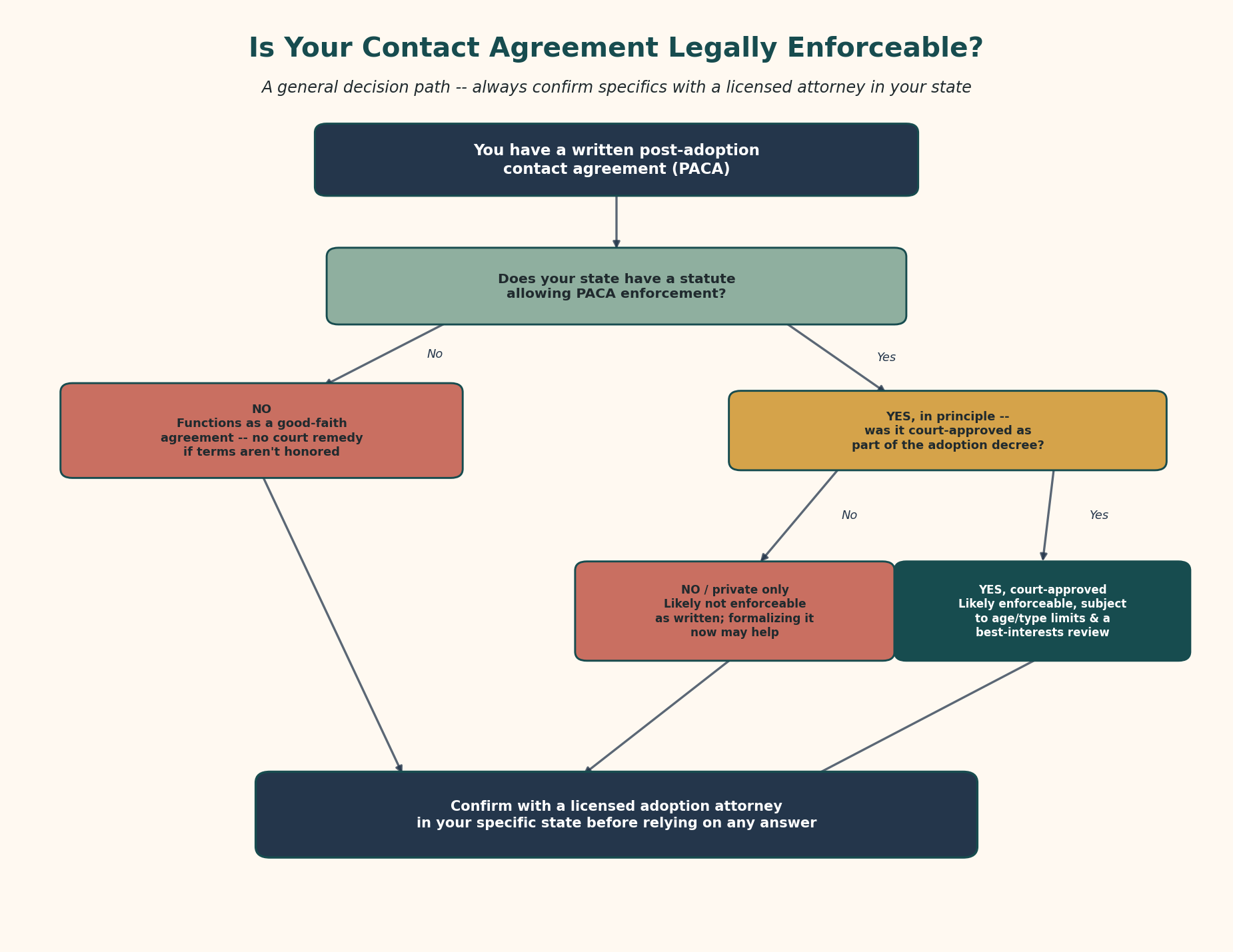
This is the single most consequential, and most commonly misunderstood, legal fact about open adoption. The honest answer is: it depends — on your state, and often on additional factors within that state — and anyone who tells you a contact agreement is simply “legally binding” or simply “not worth the paper it’s written on,” full stop, is oversimplifying a genuinely variable area of law.
The Basic Split, and Why It Exists
Roughly Half of States Provide Some Legal Mechanism to Enforce These Agreements; the Rest Generally Don’t
A meaningful share of U.S. states have enacted statutes that allow a post-adoption contact agreement to be incorporated into the adoption decree or otherwise made enforceable in court, meaning a birth parent in those states may have a legal remedy if an adoptive family stops honoring the agreed terms. In states without such a statute, these agreements generally function as good-faith arrangements: morally and relationally significant, but without a court remedy if one side simply stops complying.
The Legal Reasoning Behind Non-Enforcement
States that decline to enforce these agreements generally point to the same underlying principle: once an adoption is finalized, the adoptive parents hold the same fundamental right to direct their child’s upbringing that any legal parent holds, and courts have historically been reluctant to let a contract signed before or shortly after birth override that authority indefinitely, especially since a court-ordered contact schedule can’t flex the way an actual relationship needs to as a child grows. This reasoning echoes the logic the U.S. Supreme Court applied in the 2000 case Troxel v. Granville — a case about grandparent visitation rights, not adoption directly, but one adoption-law commentary frequently cites by analogy for the same underlying principle: that parents’ authority to make decisions about their children carries substantial constitutional weight that a court is reluctant to override through a rigid, outside order.
It’s Not Always a Simple State-by-State Line
Some States Limit Enforceability by the Child’s Age or the Type of Adoption
Even within states that do provide some enforcement mechanism, the right can be narrower than “any agreement is enforceable” — some limit it to agreements involving older children, some apply it only in cases where the state initiated termination of parental rights (as in foster-care adoption) rather than ordinary private domestic placements, and some require the agreement to have been formally approved by the court as part of the adoption decree itself, rather than simply signed privately between the parties. A private, informal agreement never submitted to the court is less likely to be enforceable even in a state that otherwise allows it, which is exactly why working with an attorney to formalize the agreement properly — not just writing it down between yourselves — matters if enforceability is something you’re counting on.
Intra-Family Adoptions Are Sometimes Treated Differently
Adoptions within an existing family structure — a stepparent or grandparent adopting a child whose biological parent remains part of the extended family’s life — are sometimes treated with more judicial willingness to oversee continued contact than an adoption between two previously unconnected families, since the underlying relationships and practical realities differ.
| Pattern | What it generally means |
|---|---|
| Full statutory enforceability | State law allows a contact agreement, once approved as part of the adoption decree, to be enforced in court like any other court order |
| Limited or conditional enforceability | Enforcement exists but is narrowed — by the child’s age, by adoption type (e.g., only foster-care/state-initiated cases), or by a requirement that the agreement be court-approved rather than private |
| No statutory enforcement mechanism | Agreements function as good-faith understandings; a birth parent generally has no court remedy if the adoptive family stops honoring the terms |
| Unclear or evolving | Some states have changed their approach over the past decade, or have case law that complicates a simple statutory answer |
This table describes general categories, not a specific state-by-state list — exact rules, conditions, and any recent legislative changes must be confirmed with a licensed adoption attorney in the relevant state.
Even Where It’s Enforceable, Enforcement Isn’t Automatic or Absolute
A Court Still Weighs the Child’s Best Interests
In states that do enforce these agreements, a judge can still modify or decline to enforce specific terms if maintaining them would be harmful or unsafe for the child — enforceability isn’t a rigid contract guarantee; it’s one factor a court weighs, with the child’s welfare still the controlling standard, the same way it is throughout family law.
Enforcement Is a Legal Process, Not a Phone Call
Even in an enforceable state, exercising that right means initiating a court process — filing a petition, presenting evidence that the agreement existed and was violated, and potentially litigating what remedy is appropriate — which takes time, cost, and legal representation. This is worth knowing honestly going in: “enforceable” doesn’t mean “self-correcting,” and Section 15 covers what the realistic path looks like if it comes to that.
Key Takeaways
- Whether a post-adoption contact agreement can be enforced in court depends on your specific state, and sometimes on additional conditions within that state — there is no single national rule.
- Even in states with an enforcement mechanism, courts still weigh the child’s best interests and can modify or decline to enforce specific terms.
- Formalizing the agreement properly — with court approval as part of the adoption decree, where that’s how your state’s mechanism works — matters more than simply having something in writing, if enforceability is a priority for you.
How Contact and Relationships Change as the Child Grows
Longitudinal research that followed open adoption families over many years — most notably the Minnesota/Texas Adoption Research Project, which tracked families across roughly two decades — gives a genuinely useful picture of how these relationships actually evolve, as opposed to how people expect them to going in.
What the Research Actually Found
Most Relationships Change, and That’s the Norm, Not the Exception
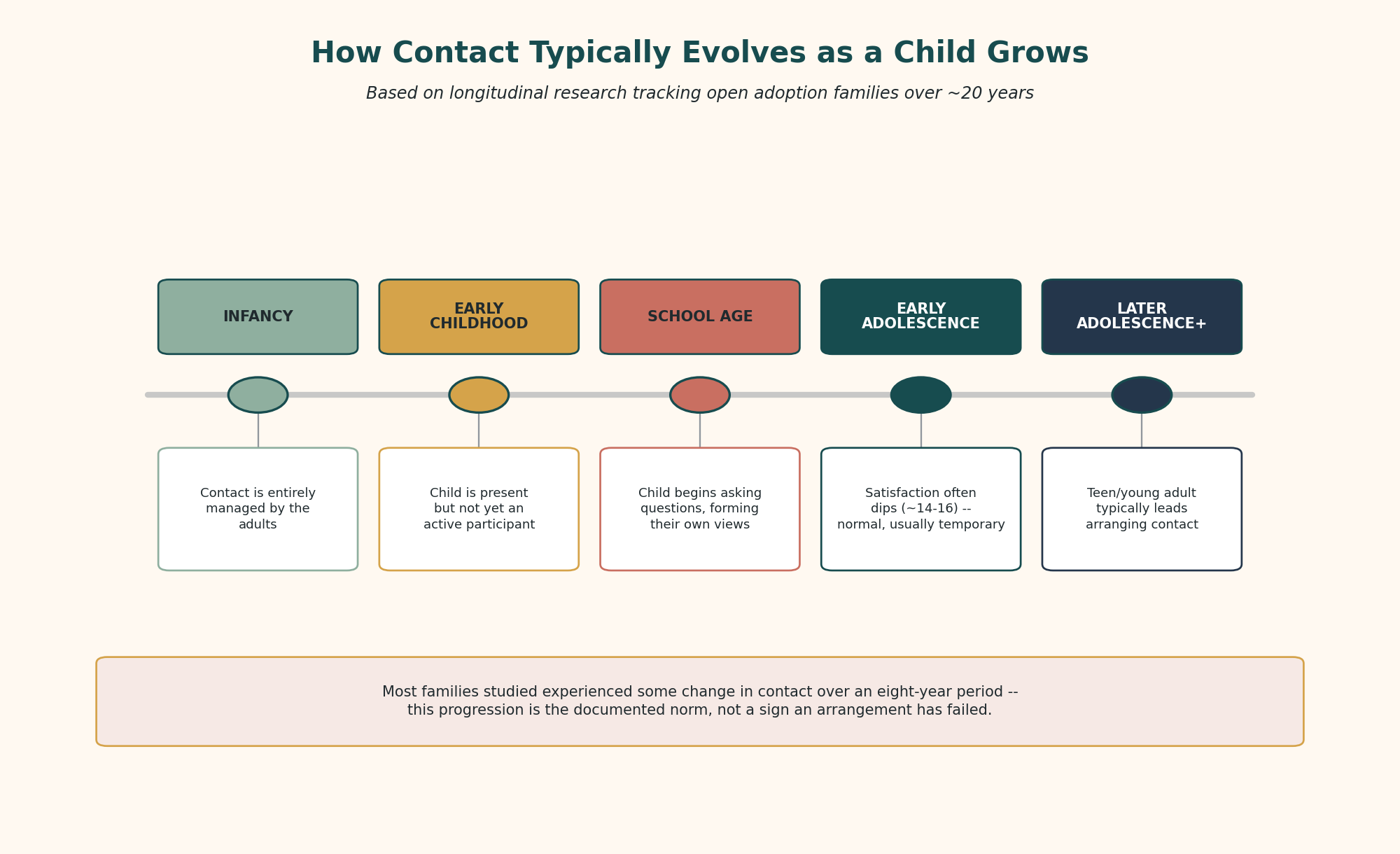
In this research, the majority of birth parents experienced some change in their contact arrangement over an eight-year period, and a meaningful share of relationships that started more distant (through a mediator, limited information) moved toward more direct, fuller contact over time — not the reverse pattern many people instinctively expect. A smaller share moved the other direction, toward less contact, and some arrangements that started with ongoing contact were suspended or stopped by one side. All three patterns occurred, and none of them, on their own, indicates the arrangement “failed.”
Satisfaction Tends to Track With Follow-Through, Not With the Specific Amount of Contact
The same research found that birth parents in arrangements that stayed fully disclosed and consistent reported meaningfully higher satisfaction than those whose arrangements started with mediated contact and then stopped — suggesting that a relationship that’s maintained as agreed, even at a modest level, tends to serve people better than one that started more ambitious and then quietly dissolved.
How a Child’s Own Role in Contact Shifts With Age
Early Childhood: Contact Happens Through the Adoptive Parents
In infancy and early childhood, contact is almost entirely managed by the adults — a young child isn’t initiating calls or deciding how they feel about a visit in any sophisticated way, and the relationship exists largely between the birth parent and the adoptive parents, with the child present but not yet an active participant.
School Age Through Adolescence: The Child Increasingly Participates and Then Leads
The same research found that by adolescence, many young people had taken over responsibility for arranging or requesting contact themselves, shifting from passive recipients of whatever their parents had arranged to active participants with their own preferences. Interestingly, satisfaction with contact among the adolescents studied dipped somewhat during middle adolescence (roughly ages 14 to 16) before rising again in later adolescence — a pattern that tracks with broader adolescent identity development generally, not something specific to being adopted, and worth knowing so a temporary dip in a teenager’s enthusiasm for contact isn’t mistaken for a permanent rejection of the relationship.
What This Means Practically for the Adults Involved
Build Flexibility In, Rather Than Treating the Original Terms as the Permanent Baseline
Since most relationships change in some way over years, an agreement that frames its original terms as the fixed standard — against which any later shift counts as a departure or a broken promise — sets up conflict that a more flexible framing avoids. Section 9 covers how to build and use a renegotiation process specifically because of this research.
A Teenager Pulling Back Temporarily Is Common, Not a Verdict on the Relationship
If a contact relationship that was going well becomes less enthusiastic during a child’s early-to-mid teen years, that’s a well-documented, broadly normal pattern connected to adolescent development generally — not a sign that the relationship has failed or that the child has decided they don’t want it. Patience, rather than treating it as a crisis, tends to serve everyone better here.
Key Takeaways
- The large majority of open adoption relationships studied over an eight-year period experienced some change — this is the norm, not a sign of failure.
- Consistency and follow-through matter more to birth-parent satisfaction than the specific amount of contact agreed to initially.
- Children take an increasingly active role in shaping contact as they grow, with a documented, likely developmentally normal dip in enthusiasm during middle adolescence that tends to resolve rather than persist.
Renegotiating: Why Changing the Agreement Is Normal, Not Failure
Given how reliably these relationships change, building an actual process for renegotiating an agreement — rather than treating any deviation from the original terms as a crisis — is one of the more protective things a family can do early on.
What a Healthy Renegotiation Process Looks Like
A Clear, Agreed Way to Raise the Topic
The simplest version of this is an explicit, upfront agreement that either side can request a conversation about adjusting contact at any time, without that request itself being treated as a rejection of the other person or the relationship. Naming this possibility during the original negotiation (Section 6) normalizes it before it’s ever actually needed.
A Scheduled Check-In, Separate From an As-Needed Request
Some families build in a periodic review — for example, revisiting the arrangement whenever the child starts a new school stage — as a scheduled, low-stakes opportunity to adjust terms, distinct from an urgent renegotiation prompted by a specific problem. Having both a scheduled and an as-needed path gives families more than one way to adjust course.
Common, Legitimate Reasons to Renegotiate
The Child’s Own Changing Needs or Preferences
As covered in the previous section, a child’s own role in and feelings about contact shift substantially with age — what worked well for a toddler may not fit a ten-year-old’s schedule and growing sense of privacy, and an arrangement that keeps pace with the child’s actual developmental stage, rather than the terms agreed to in infancy, tends to serve the relationship better long-term.
A Genuine Capacity Change on Either Side
A new baby in either family, a move, a change in work schedule, or a mental-health or recovery process can genuinely change what’s sustainable, independent of anyone’s feelings about the relationship itself. Naming the real constraint directly — “I can manage monthly calls but not weekly ones right now” — tends to land better than letting contact quietly lapse without explanation, which is often read (sometimes incorrectly) as rejection.
How to Actually Have the Conversation
Lead With the Relationship, Not Just the Logistics
Framing a renegotiation request around the relationship’s wellbeing (“I want this to keep working for both of us long-term, which is why I want to talk about adjusting X”) tends to produce a more collaborative conversation than framing it purely as a scheduling complaint.
Get Outside Support If a Direct Conversation Stalls
If a renegotiation conversation isn’t going well on its own, a neutral third party — a counselor experienced in adoption, or formal mediation — can help both sides actually hear each other rather than escalating. Section 16 covers what this kind of support typically looks like and how to find it.
Key Takeaways
- Building an explicit process for renegotiating contact terms — both scheduled check-ins and an as-needed path — is one of the most protective things a family can set up early.
- A child’s changing developmental needs and a genuine capacity change on either side are both legitimate, common reasons to adjust an agreement, not signs of a broken relationship.
- Naming a real constraint directly tends to be read better than letting contact quietly lapse without explanation.
Common Friction Points in Open Adoption Relationships
Certain patterns of conflict come up often enough across open adoption relationships that it’s worth naming them directly, rather than letting each family feel like they’re the only ones running into a specific problem.
Mismatched Assumptions About What Was Agreed
Vague Original Terms Resurface as Disagreement Later
As covered in Section 5, “we’ll stay in touch” means something different to everyone, and a surprising amount of friction is really a disagreement about what was originally agreed, surfacing months or years later as a dispute about who changed the arrangement.
One Side Assuming a Level of Access the Other Didn’t Intend
This shows up most often with digital contact specifically — one side assuming a social media connection means ongoing, unrestricted visibility into the other’s life, while the other assumed it was a more limited, occasional point of contact. Naming the channel explicitly, as covered earlier, prevents a lot of this.
Boundary and Privacy Friction
Unannounced Visits or Contact Attempts
A birth parent showing up without notice, or an adoptive family going quiet for an extended stretch without explanation, are both common sources of real distress — the first because it violates a reasonable expectation of advance notice, the second because silence is often interpreted as rejection even when it reflects something else entirely (overwhelm, a life crisis, simple inconsistency). Section 11 covers how to address both directly.
Oversharing or Undersharing on Social Media
An adoptive family posting extensively about the child publicly can feel, to a birth parent, like losing control over information they expected to stay more private; conversely, a birth parent posting about the adoption or the child in ways the adoptive family didn’t expect can create its own discomfort. This is worth addressing explicitly as part of the agreement rather than discovering the mismatch after it’s already happened.
Emotional Friction That Isn’t Really About the Logistics
Grief Showing Up as Irritability or Withdrawal
A birth parent’s unresolved grief, or an adoptive parent’s own anxiety about the relationship, can surface as friction over seemingly small logistical points — a late reply, a short visit — when the underlying issue is actually about loss, insecurity, or fear, not the specific logistics being argued about. Recognizing this pattern in yourself or the other party is often more useful than trying to solve the surface-level disagreement alone.
Feeling Like the “Third Parent” or Feeling Shut Out — Two Sides of the Same Tension
Adoptive parents sometimes worry that a birth parent’s presence undermines their own parental authority or their child’s sense of who their “real” parents are; birth parents sometimes feel reduced to a background presence with no meaningful role. Both fears are common, understandable, and usually softened by direct, honest conversation about each person’s actual role, rather than by either side avoiding the topic.
| Friction point | A more constructive approach |
|---|---|
| Disagreement about what was originally agreed | Return to the written agreement if one exists; if not, treat this as a prompt to create or update one with specific terms |
| Unannounced visits or contact attempts | Name a clear, mutually agreed notice expectation directly, rather than addressing it only after it happens |
| Extended silence without explanation | Share the real reason, even briefly (“I’ve been overwhelmed, not pulling away from you”), rather than letting silence be interpreted as rejection |
| Mismatched social media expectations | Discuss and agree on social media terms explicitly, as their own category separate from other contact types |
| Conflict that seems bigger than the stated issue | Consider whether unresolved grief, insecurity, or fear about the relationship’s future is the real driver, and address that directly or with support |
| Feeling sidelined or feeling threatened in one’s role | Have a direct conversation about each person’s actual role and how it’s experienced, rather than assuming the other person’s intentions |

Key Takeaways
- A large share of open adoption friction traces back to vague original terms rather than to anyone acting in bad faith.
- Unannounced contact and unexplained silence are both common flashpoints, usually resolved by naming expectations and real reasons directly rather than leaving them unspoken.
- Conflict over small logistics sometimes reflects a deeper, unaddressed fear about the relationship’s security — worth considering before assuming the surface disagreement is the whole story.
Setting, Communicating, and Respecting Boundaries
A boundary in open adoption isn’t a rejection of the relationship — it’s a condition that makes the relationship sustainable for the person setting it. Both birth parents and adoptive parents have a legitimate claim to boundaries, and respecting the other side’s boundary is as much a part of a healthy open adoption as maintaining contact itself.
What a Reasonable Boundary Looks Like
Boundaries About Timing, Notice, and Method
“Please call or text before visiting, rather than arriving unannounced” or “I’d rather we communicate through messaging than scheduled calls right now” are boundaries about how contact happens, not about whether it happens — and they’re almost always reasonable to ask for and reasonable to receive without taking offense.
Boundaries About Content and Disclosure
“I’d rather we not discuss [a specific topic] in front of the kids yet” or “please don’t post photos of visits publicly” address what’s shared and with whom, and are just as legitimate as logistical boundaries, even when they’re harder to raise because they touch on more emotionally loaded territory.
How to Communicate a Boundary Without It Landing as Rejection
Separate the Boundary From the Relationship’s Value
Explicitly saying that a specific limit doesn’t reflect a desire for less of the relationship overall — “I want this to keep going; I just need X to change for it to keep working for me” — helps the other person hear the boundary as a maintenance request rather than a withdrawal.
Be Specific Rather Than Vague
“I need more notice before visits” is more actionable and less likely to be misread than “things have felt off lately” — specificity gives the other person something concrete to actually do differently, rather than leaving them to guess.
Respecting a Boundary Someone Else Has Set
A Boundary Isn’t a Negotiating Position to Push Against
If a birth parent or adoptive family sets a boundary — about notice, about a topic, about frequency — treating it as an opening offer to be worn down rather than a genuine limit tends to damage trust quickly and is one of the more common ways a workable relationship starts to deteriorate.
Ask Questions Instead of Assuming Intent
If a boundary feels confusing or hurtful, asking directly what’s behind it (“Can you help me understand why that matters to you?”) tends to produce more useful information and less resentment than assuming the worst about why it was set.
Key Takeaways
- A boundary is a condition for sustainability, not a rejection — framing it that way, on both the giving and receiving end, keeps relationships intact.
- Specific, concrete boundary requests are easier to honor than vague expressions of discomfort.
- Treating someone else’s stated boundary as negotiable, rather than respecting it, is one of the more reliable ways to damage trust in an open adoption relationship.
When Life Circumstances Change: Relocation, New Partners, Substance Use, Safety
Some of the hardest renegotiation conversations in open adoption aren’t about preference at all — they’re prompted by a genuine change in someone’s life circumstances that affects what contact is realistic or safe.
Relocation and Distance
A Move Doesn’t Have to End the Relationship, But It Does Change Its Shape
Most forms of ongoing contact — calls, video, messaging, mail — don’t depend on geographic proximity, though a move understandably affects the practicality of in-person visits specifically. Addressing this directly (“we can’t visit as often, but let’s commit to video calls on this schedule instead”) tends to preserve the relationship better than letting distance quietly reduce all forms of contact by default.
Planning Ahead When a Move Is Known in Advance
If a move is planned, raising it with the other party before it happens — rather than after — gives everyone time to adjust expectations and logistics together, rather than reacting to a sudden change after the fact.
New Partners and New Children in Either Family
A Birth Parent’s New Partner or Children
A birth parent going on to have other children, or entering a new relationship, is a normal part of life that sometimes complicates contact logistics (a new partner’s comfort level, additional children’s schedules) without reflecting anything negative about the original relationship. Being transparent about these changes, rather than letting the adoptive family learn about them indirectly, tends to preserve trust.
An Adoptive Family’s Changing Composition
A divorce, remarriage, or additional children in the adoptive family can shift household dynamics and change what level of contact feels manageable — raising this honestly, rather than letting contact quietly lapse without context, helps the birth parent understand the change isn’t about them specifically.
Substance Use, Mental Health Crises, and Safety Concerns
A Birth Parent’s Return to Active Substance Use or an Unaddressed Mental Health Crisis
If a birth parent is in active substance use or an acute mental health crisis, an adoptive family may reasonably pause or restrict contact temporarily to protect the child, while ideally communicating that the pause is about safety and is not necessarily permanent — this is one of the more painful but legitimate reasons contact changes, and it’s worth naming as a possibility during the original negotiation rather than only addressing it if and when it happens.
When Contact Itself Raises a Safety Concern
If contact with a specific birth relative, or specific contact logistics (an unknown address, unsupervised time), raises a genuine safety concern for the child or for the birth parent, an adoptive family generally has the latitude — and the responsibility — to restrict or modify contact accordingly, since no agreement overrides a legal parent’s ongoing duty to protect the child. A birth parent in an unsafe relationship themselves should know that our broader expectant-parent guide and national domestic-violence resources remain available independent of, and not conditioned on, the adoption relationship.
Key Takeaways
- A move doesn’t have to end a relationship, but it does change which types of contact stay practical — naming that directly preserves more of the relationship than letting it lapse silently.
- New partners and new children on either side are a normal part of life and worth disclosing transparently rather than letting the other party learn about them indirectly.
- A temporary pause in contact tied to a genuine safety concern — substance use, a mental health crisis, an unsafe situation — is a legitimate protective measure, not automatically a permanent end to the relationship, if it’s communicated as such.
Wanting More Contact, or Wanting Less: Navigating Mismatched Expectations
It’s common for one side of an open adoption relationship to want a different amount of contact than the other, at any point in the relationship’s life — this isn’t automatically a crisis, but it does require direct handling rather than avoidance.
When the Birth Parent Wants More Contact Than the Adoptive Family Is Offering
Naming the Specific Gap
Rather than a general sense of wanting “more,” identifying specifically what’s missing — more frequent updates, more advance notice before visits, more direct (rather than agency-mediated) contact — gives the adoptive family something concrete to respond to, and makes it easier to find a middle ground than a vague request for “more openness” does.
Understanding the Adoptive Family’s Side Without Necessarily Accepting It as Final
An adoptive family that’s pulled back may be managing their own anxiety, logistical overwhelm, or a desire to establish their own family identity before expanding contact — understanding the likely reason doesn’t obligate a birth parent to simply accept less than they need, but it can inform how the renegotiation conversation goes.
When the Adoptive Family Wants More Contact Than the Birth Parent Is Offering
Respecting That a Birth Parent’s Capacity for Contact Can Genuinely Be Limited
A birth parent pulling back isn’t necessarily rejecting the child or the relationship — grief, a need for distance to build their own life, or simple overwhelm are all legitimate reasons that don’t reflect on the adoptive family or the child’s worth. Pressuring a birth parent toward more contact than they can sustain tends to produce exactly the inconsistency that research shows correlates with lower satisfaction for everyone, including, eventually, the child.
What the Adoptive Family Can Offer in the Meantime
Continuing to send updates on the agreed schedule, even without reciprocal engagement, keeps a door open without demanding anything the birth parent isn’t currently able to give — many birth parents who pulled back for a period re-engage later, and consistent, low-pressure outreach from the adoptive family’s side tends to make that easier when they’re ready.
When the Gap Doesn’t Resolve Through Direct Conversation
Consider Whether the Original Agreement Itself Needs Updating
If a mismatch persists, it’s worth asking honestly whether the original terms were ever realistic for both sides in the first place, rather than treating the current gap purely as one side falling short of a standard that may not have fit either person well to begin with.
Bring in Outside Support Before the Gap Hardens Into Resentment
A mediator or adoption-competent counselor, covered in Section 16, can help both sides articulate what they actually need and hear what the other person is realistically able to offer — often more productively than continuing to negotiate directly once frustration has built up on either side.
Key Takeaways
- Naming a specific gap (“more advance notice,” “direct rather than mediated contact”) is more productive than a general sense of wanting “more” or “less” openness.
- A birth parent’s reduced capacity for contact is often about grief, overwhelm, or life circumstances rather than a reflection on the child or the adoptive family.
- Consistent, low-pressure outreach from the adoptive family keeps a door open without demanding more than a birth parent can currently give.
The Adoptee’s Experience: Identity, Belonging, and Finding Their Voice
Most of this guide so far has focused on the adults negotiating and maintaining contact. The person actually living inside the arrangement — the adoptee — has their own, separate experience of it, and that experience deserves direct attention rather than being inferred only from what the adults decide on their behalf.
Identity Formation Happens Differently With an Ongoing Birth-Family Relationship
Access to Origins Information Is Associated With Clearer Identity Development
Research on adoptee identity consistently points to the value of having access to accurate, ongoing information about one’s origins — not necessarily constant contact, but the ability to ask questions and get real answers — as supportive of a more integrated sense of identity compared with growing up without that access. This doesn’t mean more contact is automatically better for every adoptee; it means having information available, at a pace the adoptee can process, tends to serve identity development better than a vacuum does.
“Boundary Ambiguity” Is a Normal, Documented Part of Adoptive Family Life
Researchers studying open adoption families use the term boundary ambiguity to describe the genuine, ongoing uncertainty adoptive family members can feel about who is or isn’t “family” in a functional sense — a birth parent who’s present at holidays occupies an ambiguous role that doesn’t map neatly onto traditional family categories. This ambiguity tends to be highest in fully open, consistently maintained relationships, not because openness is worse, but because a richer, more present relationship naturally raises more complex questions about role and belonging than a more distant one does. Naming this ambiguity as normal and expected, rather than as evidence that something is wrong, helps families — and adoptees themselves — hold it with less anxiety.
How Adoptees’ Own Preferences About Contact Change With Age
Young Children Experience Contact Largely Through Their Parents’ Framing
A young child’s sense of a birth parent relationship is shaped heavily by how their adoptive parents talk about it — with warmth and ease, or with tension and avoidance — more than by the amount of contact itself. This is part of why how adoptive parents discuss the relationship matters as much as the logistics of contact.
Adolescents Often Want More Control, Not Necessarily More or Less Contact
As covered in Section 8, teenagers frequently want to take over initiating and managing contact themselves rather than having it arranged entirely by their parents — this shift in control, more than a simple increase or decrease in frequency, is often what actually changes during adolescence, and treating a teen’s desire for more say as a loss of the relationship rather than a normal developmental step tends to create unnecessary conflict.
What Adoptees Say They Need From the Adults Around Them
Honesty Delivered at an Age-Appropriate Pace, Not Secrecy “For Their Own Good”
A consistent theme in adoptee accounts and in research on adoption communication is a preference for honest, age-appropriate information over a well-intentioned effort to shield them from complexity — adoptees generally report wanting to understand their own story accurately, even when parts of it are difficult, rather than discovering gaps or inconsistencies later and losing trust in how it was handled.
Permission to Have Complicated, Even Contradictory Feelings
Loving an adoptive family deeply and still having real questions, grief, or curiosity about a birth family are not in tension with each other, and adoptees generally benefit from hearing this directly from the adults around them, rather than sensing that any curiosity about their birth family is an implicit criticism of their adoptive family.
Key Takeaways
- Access to honest, ongoing origins information — not necessarily maximum contact — is what research associates most consistently with clearer adoptee identity development.
- “Boundary ambiguity,” a documented and normal feature of open adoptive families, tends to be highest in the most consistently maintained open relationships — a sign of a rich relationship, not a problem to eliminate.
- Adolescents typically want more control over contact, not simply more or less of it, and adoptees generally report wanting honest information delivered at their own pace over being protected from complexity.
Helping a Child Understand Their Own Open Adoption Story
Section 14 covered what adoptees generally say they need; this section covers the practical side for the adults — how to actually talk about an open adoption relationship with a child at different ages, so the relationship is something the child understands rather than something that simply happens around them.
Age-Appropriate Language at Each Stage
Toddlers and Young Children: Simple, Concrete, and Repeated
Young children absorb and accept whatever framing they’re given with remarkable ease — a simple, matter-of-fact explanation (“you grew in [birth parent]’s belly, and now you live with us, and we love hearing from her”) introduced early and repeated consistently tends to normalize the relationship far more effectively than waiting for a single, formal conversation later. There’s no need to explain legal process or complex history at this age; concrete, loving language is enough.
School-Age Children: Answering the Questions They’re Actually Asking
As children get older, they start asking more specific questions — why they don’t live with their birth parent, whether they have other siblings, what their birth parent is like — and the general guidance from adoption-competent sources is to answer the actual question asked, honestly and at the child’s level, rather than either over-explaining or deflecting. A child will generally ask for more detail when they’re ready for it, and trusting that pacing tends to work better than deciding in advance how much they can handle.
Talking About the Harder Parts of the Story
Explaining Why a Birth Parent Placed a Child for Adoption, Without Over-Simplifying or Over-Explaining
Children often want to know “why,” and the honest answer is sometimes complex — financial hardship, age, circumstances, a genuine choice made with care. Adoption-competent guidance generally favors a version of the truth that’s accurate and doesn’t frame the birth parent negatively, even when the real reasons involved real hardship, since a child’s sense of their own origin story is tied up in how that story is told to them.
What to Say If Contact Has Become Inconsistent or Has Stopped
If a birth parent relationship covered in the next section has become inconsistent or paused, children generally do better with an honest, age-appropriate acknowledgment (“she’s going through a hard time right now, and that’s not about you”) than with silence that leaves them to invent their own explanation — which is often harsher and more self-blaming than the truth.
Key Takeaways
- Simple, consistent, age-appropriate language introduced early tends to normalize an open adoption relationship better than a single formal conversation held later.
- Answering the specific question a child actually asks, honestly and at their level, generally works better than deciding in advance how much they can handle.
- Honest, age-appropriate acknowledgment of a difficult or inconsistent contact situation protects a child from filling the silence with a harsher, self-blaming explanation of their own.
What Happens When an Agreement Breaks Down
Sometimes, despite everyone’s intentions, an open adoption relationship breaks down — contact stops, one side becomes unreachable, or the terms are simply no longer being honored. Understanding what’s actually available at that point matters more than general reassurance that “it’ll work out.”
If You’re the Birth Parent and Contact Has Stopped
Check What Your Specific State’s Law Actually Allows
As covered in Section 7, your options depend heavily on whether your state provides any enforcement mechanism and whether your specific agreement was formalized in a way that qualifies — an independent attorney can tell you plainly whether you have a legal remedy or whether the agreement functions as a good-faith arrangement without one in your situation.
Consider Reaching Out Directly, and Separately Consider Mediation
Before assuming the relationship is permanently over, a direct, calm attempt to understand what happened — a life crisis, overwhelm, a misunderstanding — sometimes resolves what looked like a full breakdown. If direct contact isn’t productive or isn’t possible, professional mediation is often a more realistic next step than litigation, both practically and emotionally.
If You’re the Adoptive Family and the Birth Parent Has Become Unreachable or Erratic
Document What’s Happened, and Communicate Honestly With the Child at an Age-Appropriate Level
Keeping a record of attempted contact and what’s known about the situation protects everyone, including supporting an honest, age-appropriate explanation to the child later rather than a vague, unexplained absence that a child may fill in with their own, often harsher, assumptions.
A Pause Isn’t Necessarily Permanent, Even When It’s Long
Birth parents who disappear from contact for a period — sometimes years — do sometimes re-engage later, often during a period of greater personal stability. Leaving a reasonable, low-pressure door open (continuing agreed updates, for instance, if that was part of the original arrangement) costs little and preserves the possibility of reconnection if and when the birth parent is in a position for it.
If the Relationship Needs to End, or Needs a Long Pause, for Safety Reasons
Safety Takes Priority Over Maintaining the Agreement as Written
If continuing contact genuinely endangers the child or either adult — due to violence, substance-use-related risk, or another serious safety concern — pausing or ending contact is a legitimate and sometimes necessary step, regardless of what the original agreement specified. No contact agreement, enforceable or not, overrides a legal parent’s fundamental duty to protect their child, or a person’s right to protect their own safety.
Document the Reason, and Revisit It When Circumstances Genuinely Change
A safety-based pause is more defensible, and more revisitable later, when the specific reason is documented honestly rather than left vague — this also protects against the pause becoming permanent by default, once the underlying safety concern has actually been resolved.
Key Takeaways
- What’s actually available if an agreement breaks down depends heavily on your state’s enforceability rules and how your specific agreement was formalized — confirm this directly rather than assuming either way.
- A pause in contact, even a long one, isn’t necessarily permanent, and a low-pressure open door costs little while preserving the possibility of reconnection.
- A genuine safety concern justifies pausing or ending contact regardless of what the original agreement said — safety is not something any contact agreement can override.
Mediation and Professional Support for Open Adoption Relationships
Open adoption relationships are genuinely unusual — few other relationships combine this much intimacy, this much legal asymmetry, and this much built-in ambiguity about role — which is exactly why professional support designed specifically for them exists and is worth using rather than muscling through alone.
What Open Adoption Mediation Actually Involves
A Neutral Facilitator, Not an Advocate for Either Side
Open adoption mediation typically brings the birth and adoptive family together, with a neutral facilitator experienced in adoption specifically, to address concerns about an existing agreement or to build a new one — the mediator’s role is to help both sides articulate what they need and hear each other, not to argue for one side’s position.
When It’s Typically Used
Mediation is commonly sought when a written agreement exists but isn’t being followed as understood, when an informal arrangement needs to become more structured, or when the two sides have developed genuinely different views on what the contact terms should be going forward — essentially, whenever direct conversation between the parties has stalled without necessarily being hostile.
Counseling Specifically for Adoption-Related Relationship Dynamics
Adoption-Competent Counselors Understand the Specific Dynamics at Play
A therapist or counselor with specific experience in adoption dynamics — as opposed to general family counseling — understands concepts like boundary ambiguity, grief that coexists with confidence in a decision, and the particular pressures open adoption relationships carry, and can help individual family members (a birth parent processing grief, an adoptive parent managing anxiety about the relationship, an adoptee working through identity questions) separately as well as together.
This Kind of Support Doesn’t Mean the Relationship Is in Crisis
Seeking counseling or mediation proactively — before a relationship has actually broken down — is a reasonable, healthy step, not an admission that something has gone wrong. Many families use periodic check-ins with an adoption-competent counselor the same way they’d use a scheduled relationship check-in, specifically because this kind of relationship benefits from structured reflection more than most.
Where to Find This Kind of Support
Through Your Original Placing Agency, If They Offer Post-Placement Services
Many licensed agencies continue to offer post-placement support, including mediation or counseling referrals, for a period after placement or indefinitely — worth asking about directly even if you haven’t used this kind of support before, since it’s often available at lower or no cost through the original agency relationship.
Independently, Through Adoption-Specific Practitioners
If your original agency doesn’t offer this, or you’d prefer independent support, adoption-competent mediators and counselors practice independently in most regions, and a directory search through a national adoption organization or a referral from an independent adoption attorney can help locate one with relevant experience.
Key Takeaways
- Open adoption mediation uses a neutral facilitator to help both families address a stalled agreement or build a new one, not to advocate for either side.
- Adoption-competent counseling addresses dynamics — grief, boundary ambiguity, identity questions — that general family counseling may not be equipped to recognize.
- Seeking this kind of support proactively is a sign of taking the relationship seriously, not evidence that something has already gone wrong.
Open Adoption vs. Closed Adoption: How They Compare
Since this guide and our closed adoption guide are written as companion pieces, it’s worth a direct, short comparison here — not to re-derive closed adoption’s own depth, but to help you know quickly which guide actually answers your current question.
What Each Term Actually Describes
Open Adoption, in One Line
Some level of ongoing, identified contact or information exchange between a birth parent and adoptive family after placement, ranging across the dimensions covered in Section 2.
Closed Adoption, in One Line
No ongoing contact and no identifying information exchanged between the birth and adoptive families, historically with sealed court and birth records — though record-sealing rules and adult-adoptee access to them vary significantly by state and have changed in many states over recent decades, a topic our closed adoption guide covers in full.
| Factor | Open adoption | Closed adoption |
|---|---|---|
| Contact after placement | Some level, by agreement, ranging from occasional updates to frequent direct contact | None by default; any later contact generally requires a separate search/reunion process |
| Identifying information | Generally known to both sides from the outset | Generally not shared at placement; may be accessible later depending on state law |
| Governing document | A post-adoption contact agreement (PACA), enforceable or not depending on the state | Typically none — there’s no ongoing contact to formalize |
| How it can change | Renegotiated directly between the parties, or through mediation | Reopened later only through reunion registries, confidential intermediaries, or a formal search process, where available — see our closed adoption guide |
| Where to go deeper | This guide | Our closed adoption guide |
If You’re Still Deciding Between Them
This Is a Preference, Not a Test With a Right Answer
Research has not established that one arrangement is uniformly better for birth parents, adoptive families, or children — what the evidence more consistently supports is that a well-maintained, honestly communicated arrangement at whatever openness level both sides can genuinely sustain tends to outperform an ambitious arrangement that isn’t followed through on. Our expectant-parent guide covers this decision point directly if you haven’t yet chosen.
Your Preference Can Also Change After Placement
Some birth parents who initially wanted a more closed arrangement later wish for more contact, and some who started fully open later want more distance — neither path is unusual, and both this guide and our closed adoption guide cover what’s available if your preference shifts after the fact.
Key Takeaways
- Open and closed adoption differ primarily in contact and identifying information, not in who holds legal parental rights.
- Neither arrangement is established as uniformly “better” — consistency and honest communication at a sustainable level matter more than which option is chosen.
- If closed adoption, reunion, or record access is your actual question, our dedicated closed adoption guide is the deeper resource for that territory specifically.
Special Situations
Most of this guide describes the general pattern, but several situations change the picture enough to deserve direct, separate treatment.
Kinship and Relative Adoption
Contact Dynamics Are Different When the Birth Parent Is Already Part of the Extended Family
When a grandparent, aunt, uncle, or other relative adopts a child whose biological parent remains part of the broader family’s life — at gatherings, through other relatives — “openness” isn’t really a chosen arrangement in the same sense; it’s closer to an ongoing reality that still benefits from the same clarity about roles and boundaries covered throughout this guide, even without a formal contact agreement in the usual sense.
Legal Enforceability Patterns Can Differ Here Too
As noted in Section 7, some states treat intra-family contact arrangements with more judicial willingness to formalize and oversee than arrangements between previously unconnected families — worth raising specifically with an attorney if this describes your situation.
Sibling Relationships Across Multiple Placements
When Siblings Are Placed With Different Families
If a birth parent has placed more than one child, sometimes with different adoptive families, maintaining sibling relationships across those placements is its own distinct and important form of openness, separate from the birth-parent-to-adoptive-family relationship, and worth raising explicitly with each placing agency or family rather than assuming it will happen automatically.
Later-Born Siblings Who Were Not Placed
If a birth parent goes on to parent other children after an earlier placement, introducing those relationships — biological siblings who are being raised by the birth parent, meeting a sibling who was placed — is a significant and personal decision each family navigates on its own terms, generally best discussed openly rather than avoided out of uncertainty about how to raise it.
LGBTQ+ Birth Parents and Adoptive Families
The Same Framework Applies, With Some Additional Considerations
Everything covered in this guide about negotiating, maintaining, and renegotiating contact applies regardless of the sexual orientation or gender identity of either party — openness is not a different process for LGBTQ+ birth parents or adoptive families, though specific considerations (how a birth parent’s own family responds to the arrangement, or how an adoptive family discusses an LGBTQ+ birth parent’s identity with the child at different ages) are worth raising directly with an adoption-competent counselor experienced in this area.
Finding Culturally Competent Support
If a mediator, counselor, or agency doesn’t have specific experience with LGBTQ+ family configurations, it’s reasonable to ask directly about their experience before relying on them for sensitive conversations in this area, the same way it’s reasonable to ask about any specialized experience relevant to your specific situation.
Transracial, International, and Interstate Openness Considerations
Transracial Open Adoption Adds Its Own Layer to the Identity Questions in Section 14
When a child’s birth parent is a different race or ethnicity than their adoptive family, an ongoing relationship with that birth parent can be a genuinely valuable, concrete connection to a part of the child’s identity and heritage that the adoptive family can’t fully provide on their own — many transracial-adoption specialists consider this one of open adoption’s more significant, specific benefits, separate from the general identity-development research covered earlier in this guide. Maintaining that connection deliberately, rather than letting logistics quietly erode it, is worth treating as a priority rather than an incidental nice-to-have.
Interstate Agreements Add a Layer of Legal Complexity
When the birth parent and adoptive family live in different states — a common situation given how many domestic adoptions involve placement across state lines — the agreement is still generally governed by the state where the adoption itself was finalized, but logistics like mediation access, future legal recourse, and even which state’s attorney to consult can get genuinely more complicated.
Key Takeaways
- Kinship adoption changes the practical shape of “openness” since the birth parent often remains part of the extended family’s life regardless of a formal agreement — the same boundary and communication principles still apply.
- Sibling relationships across multiple placements, or with later-born siblings, are their own distinct form of openness worth raising explicitly rather than assuming will be handled automatically.
- The core framework for negotiating and maintaining contact applies regardless of either party’s sexual orientation or gender identity, though it’s reasonable to seek specifically experienced support for related considerations.
- In transracial adoptions, an ongoing birth-parent relationship can be a specific, concrete asset to a child’s identity and heritage connection, worth protecting deliberately rather than letting it lapse.
Common Mistakes and Misconceptions About Open Adoption
A handful of misunderstandings come up often enough to address directly.
Misconceptions About What Openness Changes Legally
Myth: Open Adoption Means Shared Custody
As covered in Section 1, the adoptive parents hold full, exclusive legal parental rights regardless of how open the arrangement is — a birth parent’s ongoing contact does not create any legal custody or decision-making authority unless a highly unusual court order says otherwise.
Myth: A Written Agreement Is Always Legally Binding
As covered in Section 7, enforceability depends entirely on the state and often on additional conditions within it — assuming a written agreement is automatically court-enforceable, or automatically worthless, are both mistakes in roughly half of U.S. states.
Misconceptions About What Change in Contact Means
Myth: Any Change From the Original Agreement Means the Relationship Failed
As covered in Section 8, the large majority of these relationships change over time — this is the documented norm, not evidence of a broken arrangement.
Myth: A Teenager Pulling Back Means They’ve Rejected Their Birth Family
A well-documented, likely developmentally normal dip in enthusiasm for contact during middle adolescence tends to resolve rather than persist — treating it as a permanent rejection, rather than a phase, can itself damage the long-term relationship more than the dip would have on its own.
Misconceptions About Boundaries and Conflict
Myth: Setting a Boundary Means You Want Less of the Relationship
As covered in Section 11, a boundary is usually a condition for sustaining the relationship, not a step toward ending it — conflating the two leads people to avoid necessary boundaries out of fear of how they’ll be read.
Myth: A Good Open Adoption Relationship Shouldn’t Need Outside Support
Mediation and adoption-competent counseling exist specifically because these relationships are genuinely unusual in structure — using this kind of support reflects taking the relationship seriously, not a sign that something has gone uniquely wrong in yours.
Glossary of Open Adoption Terms
A quick reference for terms used throughout this guide.
Core Relationship Terms
Open adoption
An adoption arrangement involving some level of ongoing contact or identifying-information exchange between a birth parent and adoptive family after placement.
Semi-open adoption
An arrangement with moderate contact — often agency-mediated or periodic — falling between fully open and fully closed, rather than a separate, fixed category.
Closed adoption
An arrangement with no ongoing contact and no identifying information exchanged between birth and adoptive families; see our dedicated closed adoption guide for full treatment.
Post-adoption contact agreement (PACA)
A written document specifying the type, frequency, and terms of contact a birth parent and adoptive family have agreed to after finalization; also called an open adoption agreement or contact agreement.
Legal Terms
Enforceability
Whether a court can legally require compliance with a contact agreement’s terms; depends on the specific state’s statutes and, often, on how the agreement was formalized.
Court-approved agreement
A contact agreement formally incorporated into the adoption decree itself, as opposed to a private agreement signed only between the parties — relevant to whether enforceability mechanisms apply in states that have them.
Best interests of the child standard
The controlling legal standard courts apply when weighing any contact-related dispute, including in states that otherwise enforce contact agreements — a court can modify or decline to enforce terms it finds harmful to the child.
Relational and Developmental Terms
Boundary ambiguity
A documented phenomenon in adoptive families describing genuine uncertainty about family roles created by an ongoing birth-family relationship; found to be highest in fully open, consistently maintained arrangements.
Renegotiation
The process of revisiting and adjusting a contact agreement’s terms as circumstances or preferences change; a normal and expected part of long-term open adoption relationships rather than a sign of failure.
Open adoption mediation
A structured process in which a neutral facilitator experienced in adoption helps birth and adoptive families address a stalled agreement or build a new one.
Adoption-competent counseling
Counseling provided by a therapist with specific training and experience in adoption dynamics, as distinct from general family counseling.
Frequently Asked Questions
Understanding What Open Adoption Means
Does open adoption mean the birth parent has custody or visitation rights?
No. The adoptive parents hold full legal parental rights regardless of how much contact exists; openness describes the relationship and information exchange, not legal custody.
Is there a legal definition of “open adoption”?
Not a single, uniform one — it’s a practice description covering a wide range of actual arrangements, not a defined legal category the way “finalization” or “consent” are.
The Openness Spectrum
What’s the real difference between “semi-open” and “open”?
There’s no fixed legal line — semi-open generally describes more limited, often mediated contact, while open generally describes more direct, frequent contact, but real arrangements blend elements of both.
Can we have direct contact but only a few times a year?
Yes — frequency and directness (channel) are separate dimensions, as covered in Section 2, and can be combined in whatever way fits both sides.
Building the Agreement
Do we need a lawyer to write a post-adoption contact agreement?
It’s strongly advisable — as covered in Section 5, independent legal review helps ensure the terms are specific, realistic, and, where your state allows it, formalized in a way that supports enforceability if that matters to you.
What happens if we never formalize anything in writing?
The relationship still exists, but it rests entirely on an informal, mutual understanding — which is more vulnerable to the kind of mismatched-assumption friction covered in Section 10, and generally has no legal remedy if it breaks down, regardless of your state.
Enforceability Specifics
How do I find out if my state enforces post-adoption contact agreements?
An adoption attorney licensed in your state is the most reliable source, since this is exactly the kind of state-variable legal fact that changes over time and shouldn’t be assumed from a general guide.
If my state doesn’t enforce these agreements, is there any point in having one?
Yes — as covered in Section 5, a written agreement still creates a clear, shared reference point that reduces the single biggest source of conflict (differing memories of what was agreed), even without a court remedy attached.
How Contact Changes Over Time
Is it normal for contact to decrease over the years?
Yes, for some families — as covered in Section 8, research found that most families experience some change over time, in either direction, and a decrease doesn’t automatically mean anything has gone wrong.
Is it normal for contact to increase over the years?
Yes — in the same research, a notable share of relationships that started more limited moved toward more direct, fuller contact over time, often as trust built between the families.
Renegotiating the Agreement
How do we actually start a conversation about changing our agreement?
Section 9 covers this directly — naming the request clearly, framing it around sustaining the relationship rather than just logistics, and using a scheduled check-in or an as-needed request, whichever fits your situation.
What if the other party refuses to discuss changing the agreement at all?
This is a reasonable point to bring in outside support — a mediator or adoption-competent counselor, covered in Section 16, can sometimes open a conversation that’s stalled between the parties directly.
Common Friction Points
What should we do if we disagree about what the original agreement actually said?
Returning to the written document, if one exists, is the first step; if there isn’t one, or it’s genuinely ambiguous, this is a strong signal to create or update a clearer, more specific written agreement going forward, as covered in Section 10.
Is it reasonable to ask for advance notice before any visit?
Yes — this is one of the most common and most reasonable boundaries in open adoption relationships, covered in Section 10 and Section 11, and asking for it isn’t a sign of distrust.
Setting and Respecting Boundaries
How do I set a boundary without the other person feeling rejected?
Section 11 covers this directly — being specific about the boundary and explicitly separating it from the relationship’s overall value tends to help the other person hear it as intended.
What if I set a boundary and the other person keeps pushing past it?
This is worth naming directly and, if it continues, a reasonable point to involve a mediator or adoption-competent counselor — a boundary that’s repeatedly disregarded is a serious trust issue worth addressing head-on rather than quietly tolerating.
Changed Life Circumstances
Does a birth parent’s move to another state affect the agreement?
It can affect which types of contact stay practical, especially in-person visits, but as covered in Section 12, most forms of contact don’t depend on proximity, and it’s worth adjusting the specific logistics rather than assuming the whole relationship has to change.
What if the birth parent has more children later — should the adoptive family expect to meet them?
This is worth discussing directly rather than assuming either way — some families naturally extend the relationship to include later-born siblings, and others keep it more separate, and both are reasonable depending on everyone’s comfort.
The Adoptee’s Perspective
At what age should we start telling our child about their adoption and birth family?
Most adoption-competent guidance favors age-appropriate honesty from very early on, rather than a single “big reveal” conversation later — a counselor experienced in adoption can help with specific language for your child’s age.
Is it normal for my child to have mixed feelings about their birth parent relationship?
Yes — as covered in Section 14, having complicated or even contradictory feelings about a birth family relationship is common and doesn’t conflict with also feeling securely attached to their adoptive family.
When Things Break Down
What’s the first thing I should do if contact suddenly stops?
As covered in Section 15, a calm, direct attempt to understand what happened is usually the first step, before assuming the relationship is permanently over or escalating to legal action.
Is it ever appropriate to just end the relationship entirely?
In cases involving a genuine, ongoing safety concern, yes — as covered in Section 15, safety takes priority over maintaining an agreement as written, though this is different from pausing contact over an ordinary disagreement.
Mediation and Professional Support
How much does open adoption mediation typically cost?
This varies by provider and region; some placing agencies offer it as part of ongoing post-placement support at no or low cost, while independent mediators charge their own fees — ask directly about cost before committing.
Do both sides have to agree to try mediation, or can one side request it unilaterally?
Mediation generally requires both sides’ willingness to participate; one side can propose it, but it isn’t typically something imposed on an unwilling party outside of a formal court process.
Talking to a Child About Their Story
At what age should I start talking with my child about their birth parent?
Adoption-competent guidance generally favors starting with simple, age-appropriate language from toddlerhood, as covered in Section 15, rather than waiting for a single later conversation — early, repeated, matter-of-fact framing tends to normalize the relationship more effectively.
What if my child asks a question I don’t know how to answer?
It’s reasonable to say honestly that you don’t have the full answer yet and will find out, rather than guessing or deflecting — children generally handle “I don’t know, let’s find out together” better than a vague non-answer.
Documentation and Practical Record-Keeping
Should I keep my own copies of the contact agreement and any amendments?
Yes — keeping your own complete, dated copies of the original agreement and any later changes protects both sides and is especially useful if a dispute or a renegotiation conversation ever requires looking back at exactly what was agreed.
Should I keep a record of actual contact that happens, separate from the written agreement itself?
Many birth parents and adoptive families find it useful to keep a simple log — dates of visits or calls, what was shared — both as a keepsake for the child later and as a practical record if questions about consistency come up down the road.
When Only One Parent or Family Member Wants Contact
What if the birth mother wants contact but the birth father doesn’t, or vice versa?
Each birth parent’s relationship with the adoptive family can be negotiated and maintained somewhat independently, as covered in Section 5 — one parent’s disinterest doesn’t have to end the other’s relationship, though it’s worth discussing directly with the adoptive family how this asymmetry will be handled.
What if one adoptive parent wants more contact than the other?
This is worth resolving between the adoptive parents directly, ideally before it creates inconsistency the birth parent experiences as confusing or unpredictable — presenting a unified, agreed position tends to work better for everyone, including the child.
Choosing an Openness Level Before Placement
How do I know what level of openness is right for me as an expectant parent?
There’s no universally correct answer — it depends on your own comfort with ongoing contact, your relationship with the prospective adoptive family, and how much involvement feels sustainable for you specifically; our expectant-parent guide covers this decision in more depth if you haven’t yet chosen.
Can I ask a prospective adoptive family about their openness preferences before choosing them?
Yes — this is a standard and important part of the matching conversation, and a prospective family’s willingness to discuss their own openness expectations honestly is itself useful information about how the relationship might go.
Adoptive Parents’ Own Emotional Experience
Is it normal for adoptive parents to feel anxious about an open adoption relationship, especially early on?
Yes — anxiety about a relatively new, unfamiliar kind of relationship is common, and many adoptive parents report that this eases as trust builds over time with consistent, positive contact.
What if I feel threatened by how much my child loves their birth parent?
This is a common, human reaction worth naming to a counselor or trusted support person rather than acting on directly — a child’s capacity for love isn’t zero-sum, and research doesn’t support the fear that a strong birth-parent relationship diminishes a child’s attachment to their adoptive parents.
Multiple Adoptive Families and Blended Situations
What if the adoptive family later adopts another child, biologically unrelated to the first child’s birth parent?
This doesn’t change the existing contact agreement with the first child’s birth parent, though it’s worth being thoughtful about how the family explains the different birth-family relationships to each child as they grow, since siblings in the same household may have different levels of openness with their own respective birth families.
How do siblings with different openness levels in the same family typically handle that difference?
Age-appropriate honesty that each child’s story and relationship is their own, rather than a competition or a sign of unequal treatment, tends to help — a family counselor experienced in adoption can help navigate this conversation if it becomes a point of tension between siblings.
Preparing for the First Few Years After Placement
What should we expect emotionally in the first few months after placement, before the relationship has settled into a rhythm?
It’s common for everyone involved — birth parent, adoptive parents, and eventually the child — to feel some uncertainty and emotional intensity in the earliest period, simply because the relationship is new and the roles haven’t yet become familiar; this tends to ease as a consistent pattern of contact builds trust over the first year or two.
How soon after placement should the first in-person visit or call happen, if that’s part of the plan?
This varies by what the specific agreement specifies and by how everyone is doing emotionally in the immediate aftermath of placement — there’s no universal timeline, and it’s reasonable for a birth parent to need more time before the first contact than the written schedule technically allows, with advance communication about the delay.
