
If you’re preparing to adopt, there’s a good chance the home study is the single step you’re most nervous about — and it’s also the one step every path to adoption in the United States requires, with no exceptions. Whether you’re adopting a newborn domestically, a child from foster care, or a child from another country, a licensed social worker will review your documents, run background checks, interview you and anyone else in your household, and visit your home before any agency, court, or expectant parent can move forward with you as a prospective family. This guide walks through exactly what that process involves: the paperwork, the background checks, what the home visit actually looks for (and what it doesn’t), the interview questions you’ll really be asked, a realistic timeline, what happens if something raises a concern, and what to do if your wait stretches past your home study’s expiration date. We cover the home study itself in depth; for the broader adoption process it sits inside, see our complete guide to how to adopt a child, and for the underlying eligibility rules the home study verifies, see our adoption requirements guide.
Short Answer: What a Home Study Is, and Why It’s the Gate Every Adoption Passes Through
An adoption home study is a structured assessment, conducted by a licensed social worker, that reviews your readiness to adopt through documents, background checks, interviews, and at least one visit to your home. It exists to protect the child being placed, not to find an excuse to say no — the overwhelming majority of home studies end in an approved recommendation, and the process is built to help you succeed, not to trip you up.
Key Takeaways
- Every U.S. adoption — domestic infant, foster care, stepparent, relative, and international — legally requires a home study before a child can be placed with you. There is no way around it, and no reputable path skips it.
- A home study is not a test of whether your house is impressive. It checks for safety and stability, not for a nursery, a particular square footage, or a particular income level beyond basic sufficiency.
- Most of the process is paperwork, background checks, and conversation. The home visit itself is typically one to two hours, not an inspection with a white-glove standard.
- From a completed application to an approved report, two to four months is typical for most domestic home studies, though it can run longer depending on your agency’s caseload and how quickly background checks clear in your state.
- If your wait for a match or placement runs longer than your home study stays valid — typically 12 to 24 months, depending on state and program — you’ll need an update, not a full redo. Section 15 below covers this.
What This Guide Covers, and What It Deliberately Doesn’t
What You’ll Find Here
This guide is entirely about the home study step itself: the document checklist, the background-check process, what a home visit actually involves, the interview content, a realistic timeline, cost, common reasons for delay, and how to keep your home study current if your wait runs long. It’s written for prospective adoptive parents who are either about to start a home study or are in the middle of one and want to know what’s actually ahead.
What Lives in Our Other Guides Instead
For the full picture of how adoption works end to end — choosing a path, finding an agency, matching, and finalization — see our how to adopt a child guide. For the detailed breakdown of who is legally eligible to adopt (age, marital status, income minimums, state-by-state variation), see our adoption requirements guide. For a full cost breakdown across every adoption path, see our adoption cost guide — this article names the home-study fee as one line item but doesn’t re-derive the full cost picture.
Why This Step Exists at All
It’s a Legal Requirement, Not an Agency Preference
State law requires a home study for every domestic adoption, and federal regulation requires one for every Hague-process intercountry adoption. No agency, attorney, or facilitator can waive it, and no legitimate adoption — including most stepparent and relative adoptions in many states — proceeds without some version of it.
It Protects the Child, and It Also Protects You
The home study’s purpose is to confirm that a child placed with you will be safe and that you understand what you’re taking on. That protective function runs in your favor too: it’s also the mechanism that gives an expectant parent, a birth family, a court, or a sending country confidence to place a child with a family they’ve never met.
What Is an Adoption Home Study, and Why Does Every Adoption Require One?
A home study is both a process and a document. The process is weeks of paperwork, interviews, and a home visit; the document is the written report your social worker produces at the end, summarizing your household and recommending whether, and what kind of, placement is appropriate for your family.
The Home Study as a Process
A Structured Assessment, Not an Open-Ended Investigation
Every home study follows a defined structure set by state law and, for licensed agencies, by state licensing requirements: a written application, a defined document checklist, mandated background checks, a set number of interviews, and at least one in-person home visit. The specifics vary somewhat by state and by agency, but the shape is the same everywhere — this isn’t an open-ended inquiry into your life, it’s a bounded process with a known endpoint. The federal Child Welfare Information Gateway, a service of the U.S. Department of Health and Human Services, maintains a national overview of adoption requirements and the home study process that is a useful starting reference alongside your own state’s specific rules.
It Happens Before You’re Matched, Not After
In nearly every path to adoption, the home study is completed and approved before you’re presented to an expectant parent, before you’re listed as a waiting family for a child in foster care, or before a sending country will consider your file. It’s the credential that makes you “adoption-ready,” not a step that happens after a child is already identified.
The Home Study as a Document
What the Written Report Actually Contains
The final report typically includes a narrative description of your household, education and employment history, health status, financial picture, relationship and marital history, motivation for adopting, parenting philosophy, support network, and the results of your background checks and references — ending in a specific recommendation about the number, age range, and sometimes background of children your family is approved to parent.
Who Reads It, and When
The completed report goes to your agency, and often to a court, a state child-welfare department, an interstate compact (ICPC) office, or a sending country’s adoption authority, depending on your adoption type. In a domestic infant adoption, a summarized or full version is often shared with the expectant parent considering you as an adoptive family, since they’re typically choosing among approved families, not unvetted applicants.
Why the Requirement Is Universal Across Adoption Types
Domestic Infant, Foster Care, and Relative Adoptions All Require One
Whether you’re adopting a newborn through a private agency, a child from the foster care system, or in most cases a relative’s child, state law requires a completed and approved home study before placement. The intensity and specific checklist differ somewhat by type (Section 17 below), but none skips the requirement entirely.
International Adoption Adds a Federal Layer
For adoptions from countries that are part of the Hague Adoption Convention, federal regulation requires the home study to be completed according to specific Hague standards, including a minimum number of hours of required training (Section 10), on top of whatever your state separately requires.
Key Takeaways
- A home study is both the weeks-long process of document review, background checks, interviews, and a home visit, and the written report that results from it.
- It happens before matching or placement, not after — it’s what makes you an approved, “home-study-ready” family rather than a step you complete once a child is already identified.
- The requirement is universal across domestic infant, foster care, relative, and international adoption, though the specific checklist and intensity vary by type.
Who Conducts Your Home Study: Agency, Independent Social Worker, or Both
Your home study has to be completed by a licensed social worker or an agency licensed to provide home study services in your state — not by a friend with a related degree, not by your adoption attorney, and not by the agency that’s placing the child if your state requires a separation of those two roles.
Agency-Conducted Home Studies
Your Full-Service Agency Does It In-House
If you’re working with a full-service domestic or international adoption agency, that agency’s own licensed social workers typically conduct your home study as part of their broader service, bundled into their overall program fee or billed as a distinct line item within it.
Foster Care Home Studies Are Usually Conducted by the State or Its Contracted Agency
If you’re adopting through the public foster care system, your home study (sometimes called a “family assessment” in this context) is typically conducted by your state or county child welfare agency directly, or by a private agency under contract to do this work on the state’s behalf — usually at no cost to you.
Independent (Private) Home Study Providers
When You’d Use One Instead
If you’re pursuing an independent or attorney-facilitated adoption rather than working with a full-service agency, or if your placing agency doesn’t itself provide home study services, you’ll hire a separate, independently licensed social worker or home-study agency to complete this piece on its own.
The Report Still Has to Meet the Same Standard
An independently completed home study has to meet the same state (and, for international adoption, federal Hague) requirements as an agency-completed one — the difference is who you’re paying and coordinating with, not a lower bar. Many states require the independent provider to hold a specific license type; ask directly before hiring one.
How to Choose and Vet a Home Study Provider
Confirm Licensing Before You Pay Anything
Ask for the specific license or agency accreditation that authorizes them to conduct home studies in your state, and verify it independently through your state’s licensing board or child welfare department rather than taking a website’s word for it.
Ask About Turnaround Time and Communication Style Up Front
Since your home study’s pace depends heavily on your provider’s caseload and responsiveness, it’s reasonable to ask directly, before signing anything, how many families they’re currently handling, their typical timeline from application to finished report, and how you’ll communicate with them (email, phone, a client portal) throughout.
Key Takeaways
- A home study must be conducted by a licensed social worker or agency — your full-service agency, your state’s child welfare department, or an independent home-study provider you hire separately.
- Foster care home studies are typically done by the state or its contracted agency, usually at no direct cost to you.
- An independently conducted home study must meet the same state and, for international adoption, federal standards as an agency-conducted one — verify licensing directly rather than assuming it.
The Complete Home Study Document Checklist
The paperwork is usually the first thing you’ll tackle, and it’s also the piece most within your control to speed up. Most of the documents below are things you can start gathering the day you decide to adopt, well before your first interview is even scheduled.
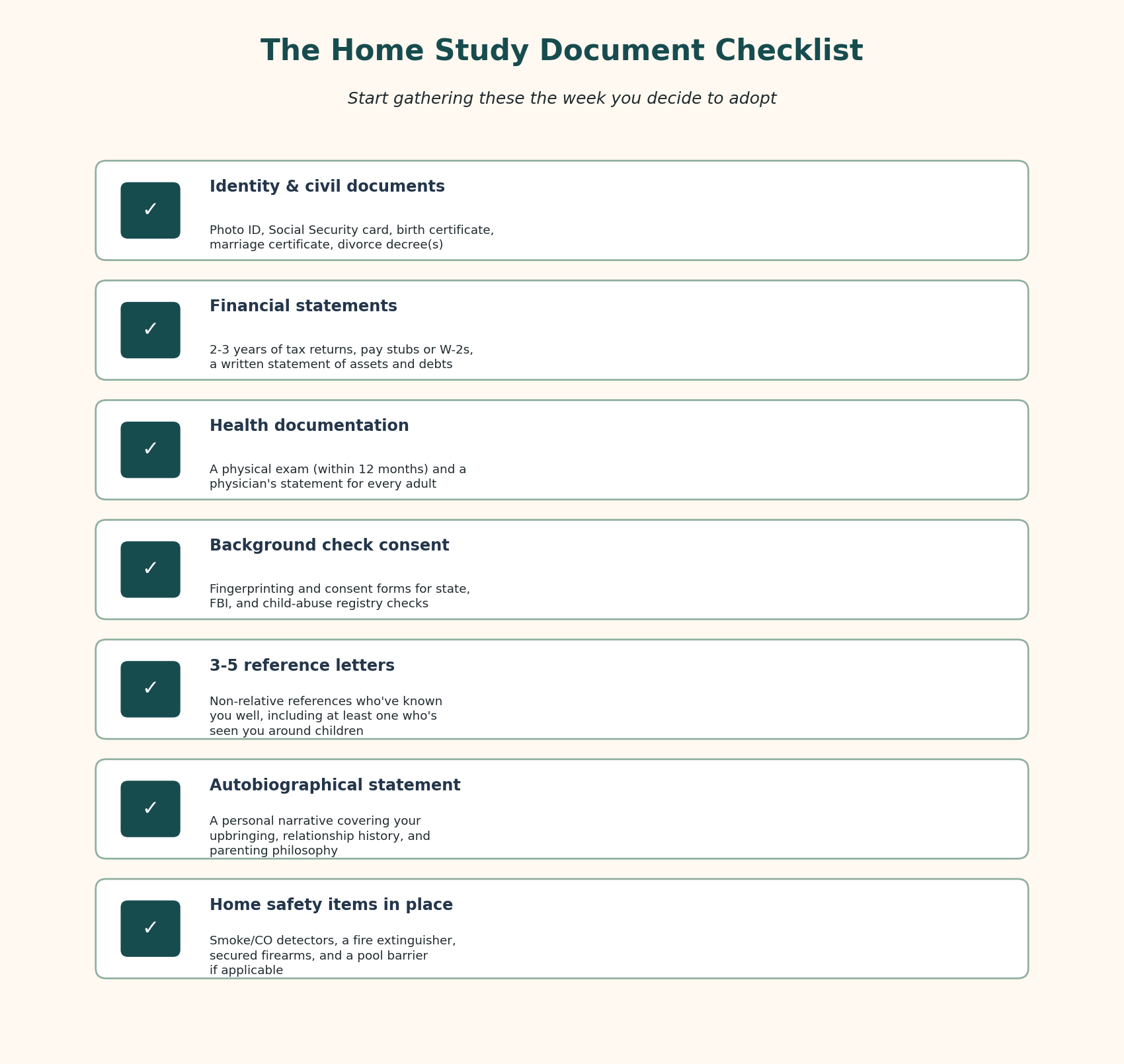
Identity and Civil Documents
Proof of Identity for Every Adult in the Household
Expect to provide a government-issued photo ID (driver’s license or passport) and Social Security card for yourself and your spouse or partner, plus the same for any other adult living in the home.
Birth, Marriage, and Divorce Records
Certified copies of birth certificates for every household member, your marriage certificate if applicable, and certified divorce decrees for any prior marriages are standard requirements — if you were previously married, expect to provide documentation for that marriage’s end, not just your current one.
Proof of Residence
A utility bill, lease, or mortgage statement confirming your current address is a routine, low-effort item most applicants already have on hand.
Financial and Health Documentation
Income and Tax Records
Expect to provide two to three years of tax returns, recent pay stubs or W-2s, and a written financial statement listing assets, debts, and monthly expenses — this establishes financial stability, not a specific minimum income beyond what your agency or state requires (see our adoption requirements guide for how income eligibility is actually assessed).
Proof of Health and Life Insurance
Most agencies and states want to see that you have health insurance in place for a future child and, often, some form of life insurance, as part of demonstrating the household’s financial stability.
A Physical Exam and Health Statement for Every Adult
Every prospective parent typically needs a physical exam, usually completed within the prior 12 months, along with a physician’s statement confirming no condition that would prevent you from safely parenting, plus a tuberculosis test for household members in many states and for most international programs.
Household and Family-Specific Documents
Information About Any Children Already in the Home
If you have biological, adopted, or foster children currently living with you, expect to provide their birth certificates and basic health information, and plan for them to be included — age-appropriately — in parts of the interview process (Section 16 covers this specific situation).
Pet Records, If Applicable
Many agencies ask for proof of current vaccinations for household pets, and some request a basic temperament reference, particularly for dogs — this is a routine item, not a sign of unusual scrutiny.
Autobiographical Statement and Reference Contact Information
You’ll write a personal autobiographical statement (Section 6) and provide contact information for three to five non-relative references (Section 7) — these two items take the most personal effort of anything on this checklist and are worth starting early.
| Category | Typical Documents | When to Start Gathering |
|---|---|---|
| Identity & civil records | Photo ID, Social Security card, birth certificate, marriage certificate, divorce decree(s) | Immediately — most people have these on hand or can request certified copies quickly |
| Residence | Utility bill, lease, or mortgage statement | Immediately |
| Financial | 2-3 years of tax returns, pay stubs/W-2s, written financial statement, proof of insurance | As soon as you apply — tax returns can take time to locate for older years |
| Health | Physical exam (within 12 months), physician’s statement, TB test where required | Schedule within the first few weeks — appointment availability can be a bottleneck |
| Background checks | Fingerprinting consent, state and FBI criminal history, child abuse/neglect registry, sex offender registry checks (Section 5) | As soon as your provider sends consent forms — processing time is often the longest single step |
| References | 3-5 non-relative reference letters or forms | Ask people as soon as you start the process, even before forms are ready |
| Personal | Autobiographical statement | Draft early; this is the most time-intensive document to write well |
| Household | Children’s records (if applicable), pet vaccination records (if applicable) | As requested by your provider, typically early in the process |
How to Keep the Paperwork From Becoming the Bottleneck
Build a Single Folder (Physical or Digital) on Day One
Most of the delay in this phase comes from documents being scattered across old filing cabinets, email attachments, and memory rather than from the documents being hard to obtain. A single, organized folder you add to as soon as you locate each item prevents the scramble.
Request Certified Copies Early, Since Those Take the Longest
Certified birth certificates and divorce decrees from a vital records office or court clerk can take two to six weeks to arrive by mail in some jurisdictions, which makes them worth requesting in the first week of your process rather than the week your social worker asks for them.
Key Takeaways
- The document checklist spans identity, financial, health, background-check, reference, and personal-statement categories — none of it is unusual to ask for, even if the total volume feels like a lot at once.
- Certified civil documents (birth certificates, divorce decrees) and the autobiographical statement take the longest to produce and are worth starting in week one.
- A single organized folder, started on day one, is the simplest way to prevent paperwork from becoming the slowest part of your timeline.
Background Checks and Clearances: What Gets Checked, and By Whom
Background checks are mandatory for every adult in the household, not just the prospective adoptive parents — and they’re usually the step with the longest, least controllable processing time in the entire home study.
The Four Standard Checks
Fingerprint-Based Criminal History (State and FBI)
Every adult household member is typically fingerprinted, with those prints run against your state’s criminal history repository and the FBI’s national database — this catches criminal history across state lines, not just within your current state of residence.
Child Abuse and Neglect Registry Checks
A separate check against your state’s child abuse and neglect central registry is standard, and if you’ve lived in more than one state since turning 18, expect a check against each of those states’ registries too — this multi-state requirement is a common source of added time, since each state’s registry office has its own turnaround.
National and State Sex Offender Registry Checks
A check against the National Sex Offender Public Website and your state’s registry is a standard, federally encouraged component for most adoption and foster care home studies.
Who Gets Checked, and How Far Back It Looks
Every Adult in the Household, Not Just the Applicants
Any adult who lives in the home — an adult child, a parent, a roommate, a frequent long-term houseguest in some states’ definitions — typically has to complete the same background-check process as the prospective adoptive parent, since they’ll have regular contact with a placed child too.
Lookback Periods Vary by State and Check Type
Some checks look at your entire adult history; others are bounded to a specific number of years or to every state you’ve resided in since a specific age. There’s no single national standard for exactly how far back each check reaches.
What a Criminal History Doesn’t Automatically Mean
Context and Time Matter More Than a Single Flag
A record on a background check does not automatically disqualify you. Agencies and states generally distinguish between offenses that create a mandatory, often permanent bar (most commonly certain violent crimes, child abuse or neglect findings, and specific sexual offenses) and other history that’s evaluated in context — how long ago it occurred, what’s changed since, and how it relates to parenting a child.
Full, Upfront Disclosure Is Always the Safer Choice
A past arrest, charge, or finding you disclose yourself, with context, is handled very differently by most social workers than the same history discovered independently through the background check after you didn’t mention it. If you have any history at all, raising it yourself, early, in the application or your first interview is consistently the better approach than hoping it doesn’t surface.
Key Takeaways
- Four checks are standard for every adult household member: state and FBI fingerprint-based criminal history, state child abuse/neglect registry, multi-state registry checks if you’ve lived elsewhere since age 18, and sex offender registry checks.
- Background checks are typically the longest-running, least controllable step in the timeline — submit fingerprinting paperwork as soon as it’s available to you.
- A past record doesn’t automatically disqualify you; context, time elapsed, and the specific offense matter, and disclosing it yourself upfront is always the better approach than having it surface independently. For the federal fingerprint-based check specifically, the FBI’s own guidance on Identity History Summary Checks explains how that part of the process works and how to request a copy of your own record.
The Autobiographical Statement: What to Write and Why It Matters
Nearly every home study requires a written autobiographical statement from each prospective parent — often the single piece of the paperwork people find hardest to start, mostly because it’s open-ended in a process that’s otherwise full of checkboxes.
What It’s Actually For
It Gives Your Social Worker Context Before You Ever Meet
Your autobiography gives your social worker a head start on understanding your background, values, and motivations before the first interview, which usually makes that conversation more efficient and more substantive rather than starting from zero.
It’s Part of the Permanent Record, Not Just a Formality
The statement typically becomes part of your file and, in domestic infant adoption, is sometimes shared in some form with an expectant parent reviewing family profiles — worth keeping in mind as you decide how much detail to include and how to frame it.
What to Actually Include
Your Own Upbringing and Family of Origin
Expect to write about your childhood, your relationship with your own parents or caregivers, and how that background shapes how you think about parenting — this is one of the most consistently requested topics across agencies and states.
Your Relationship or Marital History
A summary of your current relationship (or, if single, your relationship history and current support system), including how long you’ve been together, how you handle disagreement, and — if applicable — any prior marriages or significant long-term relationships.
Your Motivation for Adopting and Your Parenting Philosophy
Most templates ask directly why you want to adopt, what led you to this specific path, and how you think about discipline, structure, and connection as a parent — vague answers here tend to generate more follow-up questions in the interview than specific, honest ones.
Common Mistakes When Writing It
Writing What You Think They Want to Hear Instead of What’s True
Social workers read a lot of these statements and are generally good at noticing generic, performative language. A specific, honest account — including acknowledging real struggles you’ve worked through — reads as more credible than a flawless-sounding narrative.
Leaving Out Something You’re Worried Will Look Bad
If something in your history concerns you — a past struggle with depression, a difficult period in your marriage, a previous home study with another agency that didn’t go smoothly — addressing it directly in your own words, with what’s changed since, is almost always better received than silence followed by the topic surfacing elsewhere in your file.
Key Takeaways
- The autobiographical statement gives your social worker context before your first interview and typically becomes part of your permanent file.
- Core topics are consistent across agencies: your own upbringing, your relationship history, your motivation for adopting, and your parenting philosophy.
- Specific, honest writing — including direct acknowledgment of past struggles and what’s changed — is received better than a polished but generic narrative.
References: Who to Ask, What They’re Asked, and How Many You Need
Most home studies require three to five personal references, usually non-relatives, who can speak to your character, your relationship, and your readiness to parent from an outside vantage point.
Who Qualifies as a Reference
Non-Relatives Who’ve Known You for a Meaningful Period
Agencies typically want references who are not related to you by blood or marriage and who’ve known you well for at least a year or two — close friends, longtime coworkers, neighbors, or a pastor or community leader who knows your household well are all common choices.
At Least One Reference Who’s Seen You Around Children
Many agencies specifically ask for at least one reference who has observed you interacting with children, whether that’s a sibling’s kids, a niece or nephew, a friend’s children, or children in a community or volunteer role.
What References Are Actually Asked
Character, Stability, and the Relationship Itself
Reference forms or calls typically ask how the person knows you, how long, their honest assessment of your character and relationship stability, and whether they have any concerns about your readiness to parent.
Specific Observations, Not Just a General Endorsement
A reference who can describe a specific moment or pattern — how you handled a stressful situation, how you interact with a particular child in their life — generally carries more weight with a social worker than one who writes only general praise.
How to Choose and Prepare Your References
Pick People Who’ll Actually Respond Promptly
A reference who’s enthusiastic in principle but slow to return a form or a phone call can become one of the more frustrating bottlenecks in your timeline — ask directly whether they can commit to responding within a specific window, and give them a heads-up before the form or call actually arrives.
Give Them Context, Not a Script
Letting a reference know generally what to expect (a short form or a 15-20 minute phone call, a handful of questions about your character and your readiness to adopt) helps them respond promptly and thoughtfully — just don’t coach specific answers, since genuine, independent impressions are the entire point.
Key Takeaways
- Most home studies require three to five non-relative references who’ve known you for a meaningful period, with at least one who’s observed you around children.
- References are typically asked about your character, relationship stability, and any concerns about your readiness to parent — specific observations carry more weight than general praise.
- Choosing references based on their responsiveness, not just their enthusiasm, prevents one of the more common and avoidable sources of delay.
Health, Financial, and Relationship Requirements the Home Study Verifies
A home study doesn’t invent its own separate standard for who’s fit to adopt — it verifies, with documentation and interviews, that you meet the eligibility criteria your state and agency already require. The detailed breakdown of those underlying criteria lives in our adoption requirements guide; this section covers specifically how the home study checks them.
Health Verification
A Physical Exam, Not a Health-Perfection Standard
Your physician’s statement confirms you don’t have a condition that would prevent you from safely caring for a child — it is not a requirement to be free of any chronic condition, disability, or mental health history. A well-managed chronic illness, a physical disability, or a treated mental health condition is typically evaluated on how it’s managed, not treated as an automatic bar.
Honesty About Ongoing Treatment Is Expected
If you’re managing a health condition with medication, therapy, or another ongoing treatment, disclosing that directly — along with how it’s managed and your provider’s assessment — is the standard expectation, not a liability to hide.
Financial Verification
Stability and Sufficiency, Not a Specific Income Floor Set by This Article
Your financial documents are reviewed for stability (steady income, manageable debt relative to income, a workable budget) rather than against a single nationwide dollar figure — specific income thresholds, where they exist, are set by your state or agency and detailed in our adoption requirements guide, not restated here.
A Plan for the Added Cost of a Child, Not Just Current Finances
Beyond your current financial snapshot, expect a conversation about how you’d handle the ongoing cost of raising a child — insurance, child care if you’re working, and your broader financial plan — as part of demonstrating readiness rather than just current solvency.
Marital and Relationship History Verification
Relationship Stability, However Your Household Is Structured
Whether you’re married, in a long-term partnership, or single, the home study verifies the stability of your household and relationships rather than requiring a specific family structure — our adoption requirements guide covers which structures are eligible under which programs in detail.
Prior Marriages and Significant Relationships Come Up Directly
If you’ve been married before, expect direct questions about what led to the end of that relationship and what’s different now — this is a standard, expected line of inquiry, not a red flag in itself.
Key Takeaways
- The home study verifies eligibility criteria your state and agency already set — it doesn’t create a separate, harsher standard of its own.
- Health and financial review looks for management and stability, not perfection or a single universal dollar threshold; for the underlying eligibility figures, see our adoption requirements guide.
- Relationship history, including prior marriages, is discussed directly and matter-of-factly — it’s standard, not disqualifying on its own.
The Home Visit: What a Social Worker Actually Looks For (and What They Don’t)
The in-person home visit is the part people picture most vividly when they imagine a home study — and it’s usually far less dramatic, and far shorter, than the anxiety beforehand suggests.
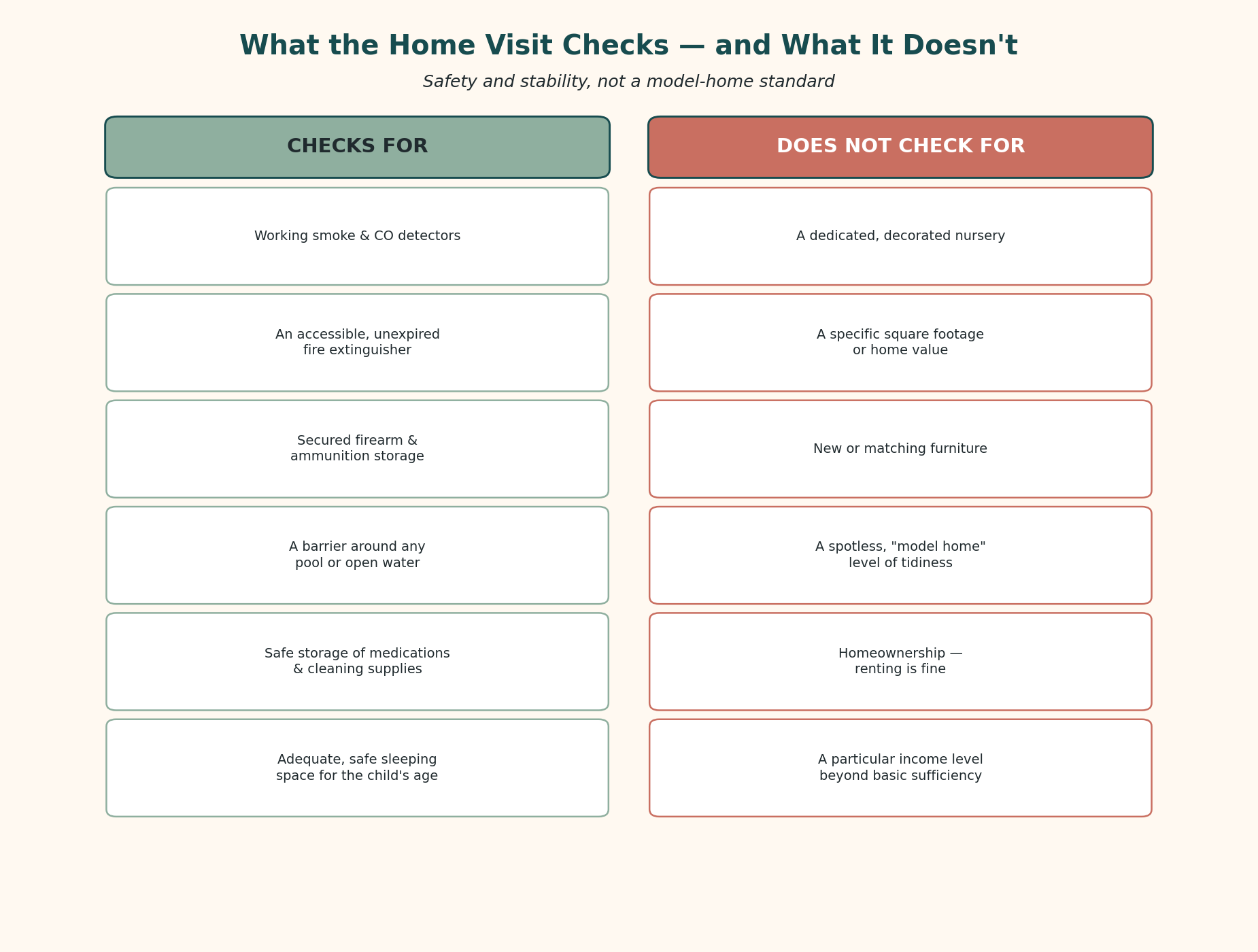
What the Visit Actually Involves
A Walkthrough, Not a Forensic Inspection
Your social worker will typically walk through your home with you, looking at where a child would sleep, general safety conditions, and the overall livability of the space — this usually takes somewhere between 45 minutes and two hours, not a full day.
One Visit Is Standard; Some Programs Require More
A single home visit is typical for most domestic home studies, though some states, some international programs, and some foster care assessments require two or more visits, sometimes including one unannounced follow-up.
What Gets Checked for Safety
Fire and Basic Hazard Safety
Working smoke detectors on every level and near sleeping areas, a fire extinguisher that’s accessible and not expired, and a working carbon monoxide detector where fuel-burning appliances are present are near-universal expectations.
Firearm and Hazardous-Material Storage
If you own firearms, expect a direct check that they’re stored securely — typically locked, and in most guidance, stored separately from ammunition. Medications, cleaning supplies, and other hazardous materials are also expected to be stored out of easy reach of a child, scaled to the age of child you’re approved to parent.
Water and Pool Safety
A pool, hot tub, or other standing-water feature typically needs a barrier — fencing, a cover, or an alarm, depending on your state’s and agency’s specific standard — before a young child could be placed in the home.
Sleeping Arrangements and General Livability
Adequate, Not Elaborate, Sleeping Space
You need a safe, appropriate place for a child to sleep — this does not have to be a dedicated, decorated nursery, and bedroom-sharing rules (how many children can share a room, by age and sex) vary by state and by agency rather than following one fixed national rule.
General Safety and Functioning Utilities
Working heat, water, and electricity, and a generally hazard-free living environment, are the baseline — the visit is checking that the home functions safely, not auditioning its décor.
| Checks For | Does Not Check For |
|---|---|
| Working smoke and carbon monoxide detectors | A specific brand or newer-model detector |
| An accessible, unexpired fire extinguisher | A dedicated fire-safety room or equipment beyond the basics |
| Secured firearm and ammunition storage, if applicable | An absence of firearms altogether — ownership itself is not disqualifying |
| A barrier around pools, hot tubs, or open water features | An absence of a pool — it needs to be safely secured, not removed |
| Safe storage of medications and cleaning supplies | A childproofed home identical to one already raising a toddler, if you’re approved for an older child |
| Adequate, safe sleeping space for the approved age/number of children | A dedicated, decorated nursery or a specific square footage |
| Overall functioning utilities and a hazard-free living environment | New furniture, a particular home value, or homeownership versus renting |
What the Home Visit Deliberately Does Not Evaluate
Your House Does Not Need to Be “Perfect”
A lived-in home with ordinary clutter, modest furniture, or a smaller footprint is not a problem. Social workers who conduct these visits regularly are generally looking for a safe, stable household, not a magazine-ready one, and most will tell you so directly if you ask.
Renting Is Not a Disqualifier, and Neither Is a Specific Income Level Beyond Sufficiency
Whether you own or rent, and the specific size of your home, are not independent disqualifying factors — what matters is that the space is safe and adequate for the number and age of children you’re approved to parent, which our adoption requirements guide covers from the eligibility-criteria side.
Key Takeaways
- The home visit is typically a 45-minute to two-hour walkthrough, not a forensic or white-glove inspection.
- Safety items checked include smoke/CO detectors, a fire extinguisher, secured firearms and medications, and a barrier around any pool or open water — not décor, square footage, or whether you own or rent.
- “Adequate” sleeping space, not an elaborate nursery, is the standard, and bedroom-sharing rules are state-and-agency-specific, so confirm yours directly rather than assuming.
The Interview: What You’ll Actually Be Asked, Individually and Together
Interviews are usually the part applicants worry about second-most, right after the home visit — and like the home visit, the actual content tends to be more conversational and less adversarial than people expect.
How the Interviews Are Structured
Individual Interviews for Each Adult
If you’re married or partnered, expect at least one interview with each of you individually, separate from your partner — this isn’t a trap looking for inconsistency so much as a standard way of giving each person room to speak for themselves.
A Joint Interview Together
Expect at least one interview with both partners together, covering your relationship, how you make decisions jointly, and your shared vision for parenting.
What Individual Interviews Typically Cover
Your Own Childhood and Upbringing
Expect questions about how you were raised, your relationship with your own parents or caregivers, and how that experience shapes the kind of parent you want to be — this is one of the most consistently asked topics across agencies and states.
Your Parenting Philosophy and Approach to Discipline
You’ll likely be asked directly how you plan to handle discipline, structure, and conflict with a child, and how you were disciplined growing up — there’s no single “correct” answer here; the social worker is assessing thoughtfulness and safety (no endorsement of physical punishment that crosses into abuse), not a specific parenting style.
Your Support Network
Expect questions about who you’d turn to for practical and emotional support — family, friends, a faith community, other adoptive parents — since having an identifiable support system is a meaningful part of most assessments.
What the Joint Interview Typically Covers
Your Relationship History and How You Handle Disagreement
Expect questions about how long you’ve been together, how you resolve conflict, and — if either of you was previously married — what changed and what you’ve learned.
Your Shared Motivation and Expectations
You’ll likely be asked why you’re choosing adoption specifically, what led you to this point (including, where relevant, any history of infertility or loss), and what you’re each hoping for and expecting from the experience.
Openness, and Your Willingness Around a Child’s Background
Expect direct questions about your comfort with openness (ongoing contact or information-sharing with birth family — see our guides to open adoption and closed adoption for the full spectrum), and about the ages, backgrounds, or specific needs you’re open to parenting.
Interviews When Children Are Already in the Home
Age-Appropriate Conversations With Current Kids
If you already have children at home, most social workers will talk with them too, in a way scaled to their age — for younger children this might be brief and informal; for older children and teens, it’s typically a more direct conversation about how they feel about a sibling joining the family.
Their Honest Reaction Matters, and That’s Expected
A current child expressing some ambivalence or specific concerns is a normal, expected part of this conversation, not something that derails your approval — social workers are generally looking for whether the family as a whole has thought this through, not for universal enthusiasm from every family member.
Key Takeaways
- Expect at least one individual interview per adult and at least one joint interview, covering your own upbringing, parenting philosophy, support network, relationship history, and motivation for adopting.
- There’s no single “correct” answer to most interview questions — thoughtfulness, honesty, and safety matter more than matching a particular script.
- If you have children already at home, expect them to be included age-appropriately, and some honest ambivalence from them is normal, not disqualifying.
Adoption Education and Training Requirements
Beyond paperwork and interviews, most home studies require some amount of formal adoption-specific education before the process is considered complete — the amount and content depend heavily on which adoption path you’re on.
Why Training Is Required at All
Adoption Involves Specific Dynamics Ordinary Parenting Preparation Doesn’t Cover
Topics like talking with a child about their adoption story over time, supporting a child through grief or identity questions, navigating openness with birth family, and — for many placements — supporting a child who’s experienced early trauma or disruption are specific enough that most agencies and states require dedicated preparation rather than assuming general parenting readiness covers it.
It’s a Checklist Item, Not an Exam You Can Fail
Required training is typically completed through self-paced online modules, in-person classes, or a combination, and is assessed by completion (often a certificate), not by a pass/fail test of your answers.
Training Requirements by Adoption Type
Domestic Infant Adoption
Most domestic infant adoption programs require a more modest amount of training, typically covering open adoption dynamics, attachment, and — where relevant — transracial or transcultural parenting, often in the range of a few hours total.
Foster Care Adoption
Foster care adoption typically requires a more substantial, state-mandated pre-service curriculum (often known by names like PRIDE, PATH, or a state-specific equivalent), frequently running from roughly 10 to 30-plus hours, covering trauma-informed caregiving, the child welfare system, and working with birth families.
International (Hague) Adoption
Federal regulation requires a minimum of 10 hours of Hague-approved training for intercountry adoptions from Hague Convention countries, typically covering institutionalization effects, attachment and bonding, and cultural considerations specific to the child’s country of origin.
Key Takeaways
- Nearly every adoption path requires some amount of adoption-specific training beyond general parenting readiness, assessed by completion rather than a pass/fail test.
- Domestic infant adoption typically requires the least training; foster care typically requires the most, through a state-mandated curriculum; international Hague adoption has a federal 10-hour minimum.
- Training is usually self-paced or class-based and can often be completed in parallel with the rest of your home study, rather than adding sequential time to your timeline.
A Realistic Home Study Timeline, Step by Step
“How long does this take” is one of the most common questions about the home study, and the honest answer has a real range — but the range isn’t random; it’s driven by a handful of identifiable steps, each with its own typical pace.
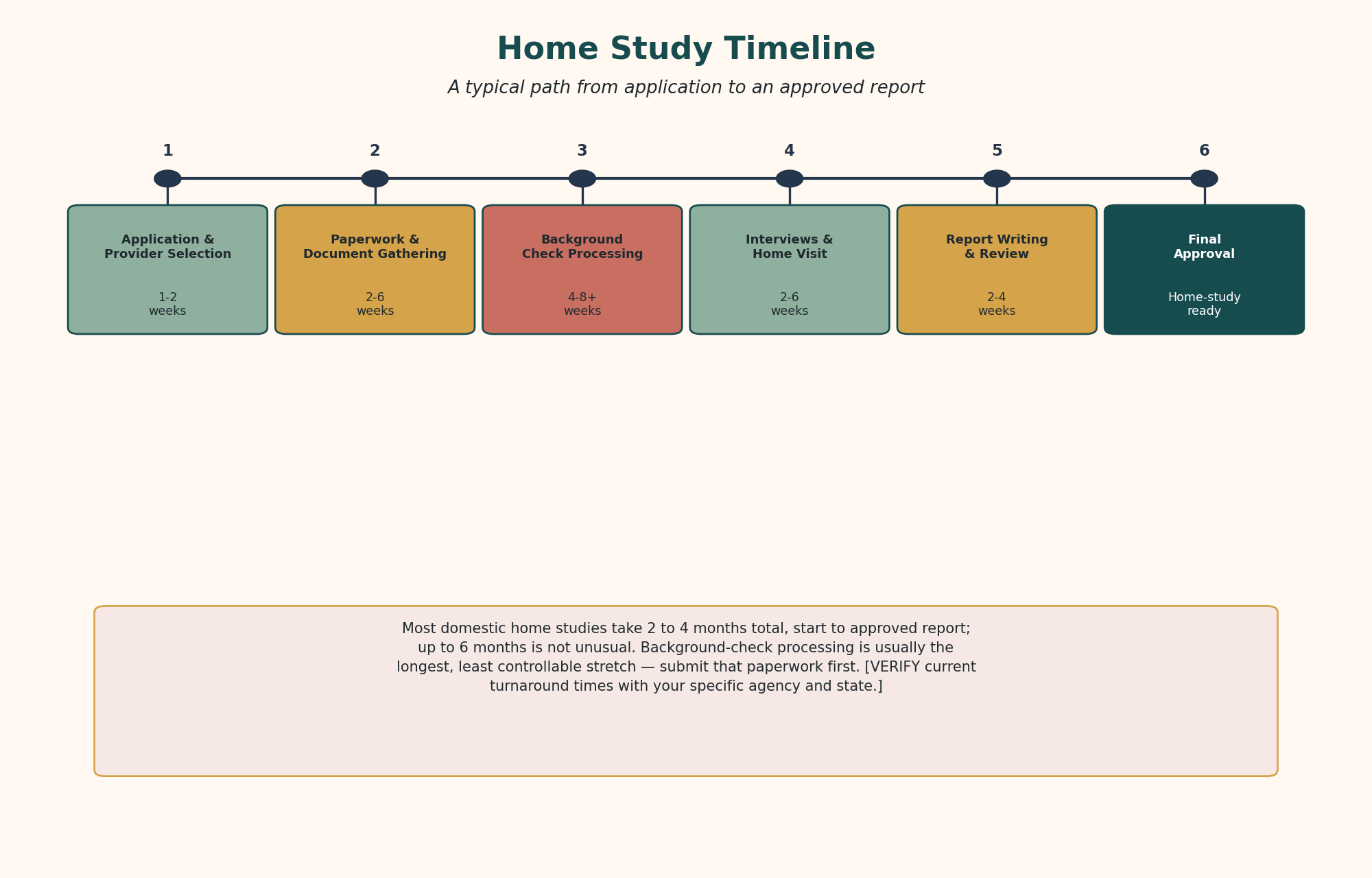
The Steps That Make Up the Timeline
Application and Provider Selection
Choosing and formally applying with your agency or independent home-study provider is typically the fastest step, often a week or two once you’ve decided who to work with.
Paperwork and Background-Check Processing
Gathering documents and submitting fingerprints usually overlaps, and background-check turnaround — which depends on your state’s and the FBI’s processing speed, not your own effort — is frequently the longest single stretch, sometimes four to eight weeks or more.
Interviews and the Home Visit
Scheduling and completing your individual and joint interviews, plus the home visit, typically takes a few weeks, largely dependent on your own and your social worker’s calendar availability.
From Completed Paperwork to an Approved Report
Report Writing and Internal Review
Once all the pieces are in, your social worker needs time to write the narrative report and, at many agencies, have it reviewed by a supervisor before it’s finalized — this can take anywhere from two to four weeks depending on staffing and caseload.
Final Approval
Once the report is finalized and internally approved, you’re a “home-study-ready” family — able to be matched, listed, or presented to expectant parents or sending countries, depending on your adoption type.
What Actually Speeds This Up or Slows It Down
What’s In Your Control
Returning paperwork quickly, choosing responsive references, scheduling your physical exam early, and completing required training promptly are the levers you actually have — these alone can meaningfully shorten your timeline compared to letting any one of them drag.
What Isn’t: Background-Check and Agency-Staffing Speed
Background-check processing time and your agency’s or provider’s current caseload are largely outside your control. Asking directly, early on, about expected turnaround for both gives you a realistic target rather than an open-ended guess.
| Stage | Typical Duration | Mostly In Your Control? |
|---|---|---|
| Application & provider selection | 1-2 weeks | Yes |
| Document gathering | 2-6 weeks (often overlapping with other steps) | Largely yes |
| Background check processing | 4-8+ weeks | No — depends on state/federal processing |
| Interviews & home visit | 2-6 weeks | Partly — scheduling depends on both parties |
| Required training | Varies by type; often completed in parallel | Largely yes |
| Report writing & approval | 2-4 weeks | No — depends on agency staffing/caseload |
| Typical total, start to approved report | 2 to 4 months for most domestic home studies; up to 6 months is not unusual | Mixed |
Key Takeaways
- Most domestic home studies run two to four months from application to an approved report, with up to six months not unusual depending on agency and background-check turnaround.
- Background-check processing and agency staffing are the two biggest drivers of delay, and neither is within your direct control.
- Returning paperwork promptly, choosing responsive references, and completing training early are the levers that are within your control.
Home Study Cost: The Line Item, and Where to Find the Full Breakdown
The home study itself is one specific, nameable cost inside a much larger adoption budget — this section names that line item; it does not re-derive the full adoption cost picture, which lives in our adoption cost guide.
What the Home-Study Fee Typically Covers
The Core Service Itself
The home-study fee generally covers your social worker’s time: document review, interviews, the home visit, and writing the final report — whether it’s billed as a standalone fee or bundled into a broader program fee depends on your agency.
What’s Often Billed Separately
Fingerprinting and background-check processing fees, the cost of your required physical exam, and adoption-education course fees are frequently billed separately from the core home-study fee itself, so it’s worth asking your provider for an itemized estimate rather than assuming one number covers everything.
Why You Won’t Find a Single Fixed Number Here
Cost Varies by Provider, State, and Adoption Type
Home-study fees differ meaningfully depending on whether you’re working with a full-service agency, an independent provider, a public foster-care agency (often no-cost to you), or an international program, and by region. For the complete, current cost breakdown across every adoption path, see our adoption cost guide rather than relying on any single figure here.
Foster Care Home Studies Are Typically Free or Low-Cost to You
If you’re adopting through the public foster care system, the state or its contracted agency generally covers the home-study cost as part of the broader, largely free-to-the-adoptive-family foster care adoption process — a meaningful contrast to the fees typical of private domestic and international home studies.
Key Takeaways
- The home-study fee covers your social worker’s time for document review, interviews, the home visit, and the written report — fingerprinting, physical exams, and training courses are often billed separately.
- Cost varies substantially by provider type, state, and adoption path; foster care home studies are typically free or low-cost, while private domestic and international ones carry a real fee.
- For the complete cost picture across every stage of adoption, not just this one line item, see our adoption cost guide.
Common Reasons for Delay or a Negative Recommendation, and How to Address Them
Most home studies end in approval — but it’s worth understanding honestly what actually causes a delay or, far less commonly, a negative recommendation, so you can address a real concern rather than worrying about an imagined one.
Reasons That Typically Cause a Temporary Delay, Not a Denial
A Safety Hazard That Can Be Fixed
An expired fire extinguisher, a missing smoke detector, an unsecured firearm, or an unfenced pool typically results in a request to fix the specific issue and a follow-up visit, not an outright denial — these are, by a wide margin, the most common and most fixable sources of delay.
A Recent Major Life Transition
A recent job change, a move, a death in the family, or a recent separation or divorce often leads a social worker to recommend waiting a defined period for things to stabilize before proceeding, rather than a denial — this is a pause, not a closed door.
Incomplete Paperwork or Unresponsive References
Missing documents or references who haven’t responded are among the most common and most avoidable delays, and are entirely within your ability to resolve by following up directly.
Reasons More Likely to Lead to a Negative Recommendation
Undisclosed History Discovered Through Background Checks
A criminal or child-protective-services history that surfaces through the background check without having been disclosed by you first is handled far more skeptically than the same history raised honestly upfront — this is one of the clearest, most consistent patterns across agencies.
Unaddressed Safety, Mental Health, or Substance-Use Concerns
A disqualifying criminal history, an untreated and unmanaged mental health or substance-use concern that raises genuine safety questions, or an unresolved history of domestic violence or child abuse are the categories most likely to lead to an actual negative recommendation rather than a temporary pause.
What to Do If You Receive a Concern, a Delay, or a Negative Recommendation
Ask Directly What the Specific Concern Is
A specific, named concern is almost always more actionable than a vague sense that something went wrong — ask your social worker directly what exactly was flagged and what, specifically, would need to change.
Understand Your Right to Respond or Appeal
Many states and agencies allow you to respond to a draft report before it’s finalized, or to appeal a completed negative recommendation; the specific process varies by state and provider.
Consider a Second Provider If the Relationship Itself Is the Problem
If you believe the concern reflects a mismatch with a particular social worker rather than a genuine issue with your household, many families have successfully restarted with a different independent provider or agency — this isn’t an option in every case, but it’s worth exploring where it’s genuinely applicable.
| Issue | Typical Outcome | How to Address It |
|---|---|---|
| Fixable safety hazard (extinguisher, detector, firearm storage, pool barrier) | Temporary delay, follow-up visit | Fix the specific item and request a prompt re-check |
| Recent major life transition (job change, move, loss, separation) | Recommended waiting period | Allow the defined stabilization period, then request to resume |
| Incomplete paperwork or unresponsive reference | Delay until resolved | Follow up directly; consider swapping an unresponsive reference |
| Undisclosed history found via background check | Significant credibility concern, possible negative recommendation | Disclose upfront in every future application; address directly if already flagged |
| Unaddressed safety, mental health, or substance-use concern | Possible negative recommendation | Seek and document treatment/management; discuss directly with your social worker and, if needed, an attorney |
Key Takeaways
- Most issues — hazards, recent transitions, incomplete paperwork — cause a temporary delay with a clear path to resolution, not a denial.
- Undisclosed history discovered independently, rather than disclosed upfront, is one of the most consistent drivers of an actual negative recommendation.
- You generally have the right to understand the specific concern and, in many states, to respond to a draft report or appeal a finished one — ask directly rather than assuming the decision is final.
If Placement Takes a While: Updates, Renewals, and Keeping Your Home Study Current
An approved home study doesn’t stay valid forever — and if your wait for a match or placement runs long, which happens often enough to plan for, you’ll need to keep it current rather than let it quietly expire.
How Long a Home Study Stays Valid
Typically 12 to 24 Months, Depending on State and Program
Most states and agencies require a home study to be refreshed somewhere between every 12 and 24 months, though some states and programs allow longer.
Certain Pieces Expire Faster Than the Whole Report
Background checks, your physical exam, and your financial statement often have their own, shorter expiration windows (sometimes a year or less) even if your overall home study report is still within its broader validity period — tracking these separately prevents a surprise gap.
What Triggers an Update, Beyond the Clock Running Out
A Change in Household Composition or Address
Moving to a new home, a marriage, a divorce, a new adult moving into the household, or the birth or placement of another child all typically require an update, regardless of where you are in your validity window.
A Change in Employment or Significant Financial Status
A major job change or a significant shift in your financial picture is generally something to report to your social worker, since it may need to be reflected in an updated financial statement even outside your normal renewal cycle.
What the Update Process Actually Involves
Lighter Than the Original, Not a Full Repeat
An update typically focuses on what’s changed since your original study — refreshed background checks, an updated financial statement and physical exam, a shorter interview, and a brief re-visit to confirm safety items are still in place — rather than rebuilding the entire file from scratch.
Court and Interstate (ICPC) Systems Require an Active Study
If your home study lapses while you’re between placements, courts and interstate compact (ICPC) offices generally will not authorize a new placement until it’s current again — which makes tracking your expiration date proactively, rather than reactively, worth building into your planning if your wait is running long.
Key Takeaways
- Home studies typically stay valid for 12 to 24 months, though individual pieces (background checks, physical exams, financial statements) often expire sooner on their own.
- A move, a household change, a new job, or a significant financial shift can trigger an update requirement even before your normal renewal date.
- An update is meaningfully lighter than your original home study — focused on what’s changed, not a full redo — but courts and ICPC offices won’t authorize a placement with a lapsed study, so track your expiration date proactively.
Preparing for Your Home Study: A Step-by-Step Readiness Checklist
A handful of concrete steps, mostly doable in the weeks before your first interview is even scheduled, meaningfully reduce both the stress and the timeline of the process ahead.
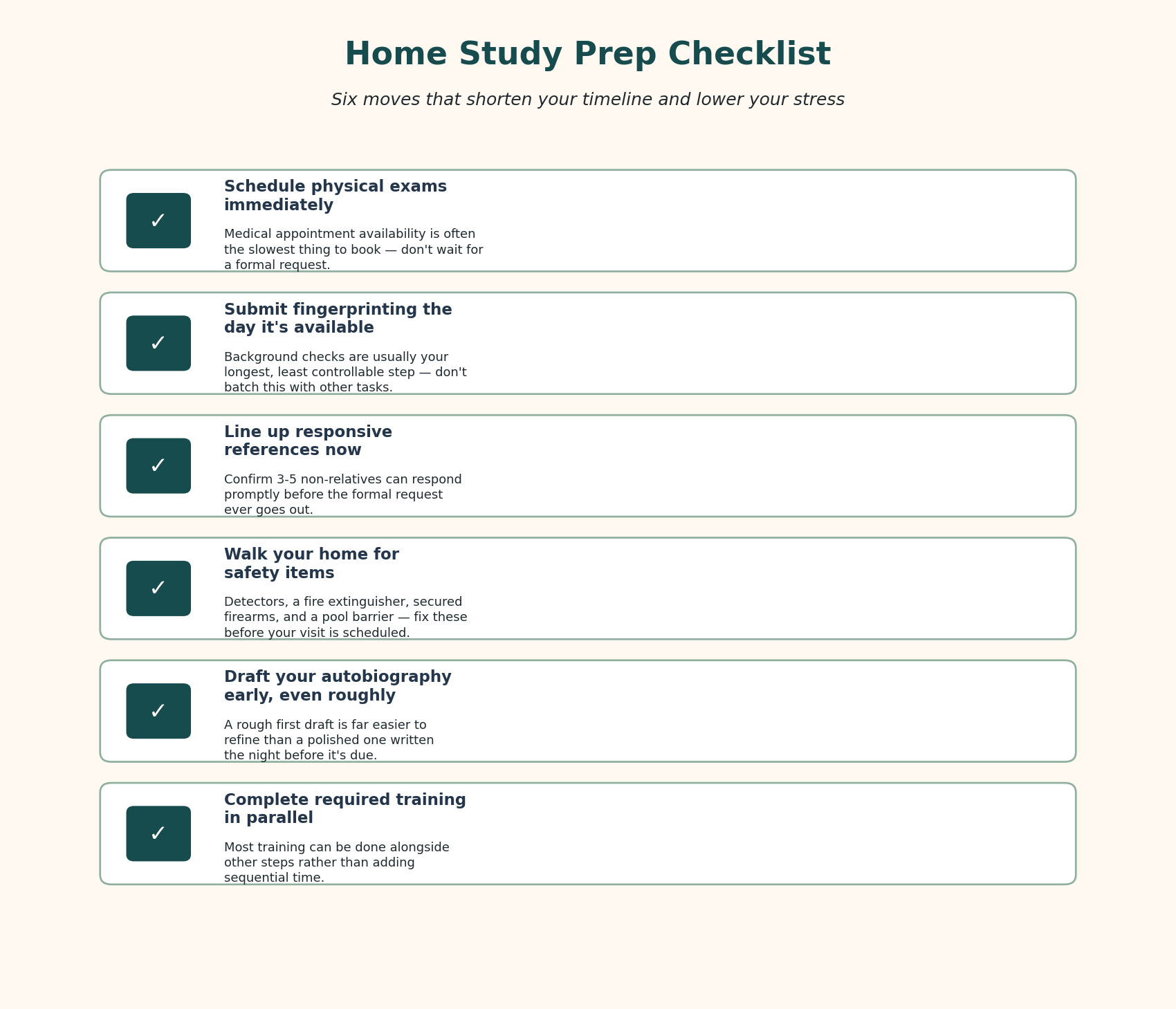
Paperwork and Scheduling Steps
Schedule Your Physical Exams Immediately
Medical appointment availability is often the single slowest thing to book, so scheduling physical exams for every adult in the household in week one, rather than waiting for your social worker to formally request it, is one of the highest-leverage early moves.
Submit Fingerprinting and Background-Check Paperwork the Day It’s Available
Since background-check processing is usually your timeline’s longest, least controllable stretch, submitting the paperwork the moment your provider makes it available — rather than batching it with other tasks — shortens your overall timeline more than almost anything else on this list.
Line Up Responsive References Now, Not When They’re Requested
Ask your chosen references for their commitment before the formal request goes out, so there’s no delay between your provider sending the form and the reference actually completing it.
Home and Household Steps
Walk Your Home Specifically Looking for Section 9’s Safety Items
Check smoke and carbon monoxide detectors, confirm your fire extinguisher isn’t expired, secure any firearms and ammunition, and address pool or water-feature barriers before your visit is scheduled, not the night before.
Secure Medications and Hazardous Materials
Move medications, cleaning supplies, and other hazardous materials to storage that’s out of easy reach, scaled appropriately to the age range of children you expect to be approved for.
Personal Preparation Steps
Start Drafting Your Autobiography Early, Even Roughly
A rough first draft, written weeks before it’s due, is far easier to refine than a polished statement written the night before a deadline — give yourself room to revise.
Talk Through Likely Interview Topics With Your Partner Beforehand
Discussing your parenting philosophy, your views on openness, and your motivation for adopting with your partner before the joint interview — not to script matching answers, but to genuinely think it through together — tends to make that conversation feel more natural.
Key Takeaways
- Scheduling physical exams and submitting background-check paperwork immediately are the two highest-leverage moves for shortening your overall timeline.
- Walking your home for Section 9’s specific safety items before your visit is scheduled prevents the most common, most avoidable source of delay.
- Starting your autobiography early and talking through likely interview topics with your partner beforehand reduces both your stress and your actual time in the process.
Special Situations: Single Applicants, LGBTQ+ Applicants, Renters, Existing Children, and Past Denials
A handful of situations come up often enough, and generate enough anxiety on their own, that they’re worth addressing directly and specifically.
Single Applicants
Single Status Is Not, by Itself, a Barrier
Single prospective parents complete home studies successfully every day; the process focuses on your support network, financial stability, and readiness rather than requiring a partner — our adoption requirements guide covers which specific programs do and don’t restrict eligibility by marital status.
Expect More Focus on Your Support System
Without a co-parent, expect somewhat more detailed questions about who specifically would help with childcare, emergencies, and day-to-day support — naming specific people and specific arrangements, rather than a general “my family would help,” tends to land better.
LGBTQ+ Applicants
Sexual Orientation and Gender Identity Are Not Legitimate Grounds for Denial
A licensed social worker conducting a legitimate home study evaluates the same criteria — stability, safety, readiness — regardless of sexual orientation or gender identity; if you encounter an agency or individual provider that treats this differently, that’s a signal to work with a different provider, not a reflection of a legal requirement.
Choosing an Agency With a Track Record of LGBTQ+ Placements Can Simplify the Process
Asking directly, before applying, about an agency’s or provider’s experience and track record with LGBTQ+ families tends to produce a smoother, more comfortable process than discovering a mismatch partway through.
Renters and Smaller Homes
Renting Is Routine, Not a Red Flag
As covered in Section 9, home ownership is not a requirement — a lease in good standing and a landlord reference, if requested, is all that’s typically needed on this front.
A Smaller Home Simply Needs to Be Safe and Adequate
A smaller apartment or home is evaluated on safety and adequate space for the number and age of children you’re approved for, not against a specific square-footage benchmark.
Families With Children Already in the Home
Birth, Adopted, and Foster Children Are All Included in the Process
As covered in Section 10, current children in the household are typically interviewed age-appropriately and factor into your social worker’s assessment of household readiness and dynamics.
Spacing and Sibling-Group Considerations
Some agencies and states consider the age gap between a current child and a prospective new placement as part of the assessment, particularly for younger children — ask your specific provider how this factors into your case rather than assuming a universal rule.
Previous Denials or an Incomplete Prior Home Study
A Past Denial Doesn’t Automatically Bar You From Trying Again
If a previous home study ended in a negative recommendation or you withdrew partway through, a new provider can generally conduct a fresh assessment — but expect direct questions about what happened previously and what’s changed since, and be prepared to disclose that history upfront (Section 5).
Address the Specific, Named Concern Before Reapplying
If you know specifically what concern was raised previously, taking concrete, documentable steps to address it — financial changes, completed treatment, home repairs — before starting again gives a new provider something concrete to evaluate rather than just your word that things have changed.
Key Takeaways
- Single status, LGBTQ+ identity, and renting are not legitimate grounds for denial on their own — the process evaluates stability and safety, not household structure or sexual orientation.
- Current children in the household are included age-appropriately in the assessment, and some honest ambivalence from them is normal, not disqualifying.
- A previous denial doesn’t bar you from trying again, but disclosing that history upfront and addressing the specific concern that was raised gives a new provider something concrete to evaluate.
How the Home Study Differs by Adoption Type: Domestic Infant, Foster Care, and International
The home study’s core structure — documents, background checks, interviews, a home visit, training — is consistent across adoption types, but the intensity, cost, and specific requirements shift depending on which path you’re on. This section covers only how the home study itself differs; for the full picture of each adoption path, see our how to adopt a child guide.
Domestic Infant Adoption
Typically the Fastest, Least Document-Heavy Version
Domestic infant home studies generally require the shortest training requirement and, because there’s no international legal layer involved, tend to move through the process somewhat faster than international programs, assuming background checks clear on a typical timeline.
Strong Emphasis on Openness and Expectant-Parent Readiness
Because most domestic infant adoptions today involve some degree of openness, expect a notably strong focus in your interviews on your comfort with ongoing contact or information-sharing — see our guides to open adoption and closed adoption for the full range of arrangements this covers.
Foster Care Adoption
A More Intensive Training Requirement, Usually at No Cost
As covered in Section 10, foster care home studies typically require substantially more training hours than domestic infant adoption, covering trauma-informed care in depth — but the home study itself is usually provided at no direct cost to you, since it’s conducted by or for the state.
Often Called a “Family Assessment,” With the Same Core Elements
You may hear this process referred to as a “family assessment” or “home study” interchangeably in the foster care context — the terminology differs by state, but the underlying documents, checks, interviews, and home visit are the same core structure described throughout this guide.
International (Hague) Adoption
A Federal Layer on Top of Your State’s Requirements
As covered in Section 10, Hague-process international adoptions add a federal minimum training requirement and specific documentation standards set by U.S. Citizenship and Immigration Services on top of whatever your state separately requires.
Often the Longest Validity-Tracking Burden
Because international adoption timelines can run long and depend on a sending country’s own process, international adoptive families are especially likely to need at least one home study update (Section 15) before placement actually occurs — worth planning for financially and logistically from the start.
Key Takeaways
- The home study’s core structure is the same across adoption types; what shifts is training intensity, typical cost, and specific documentation layers.
- Foster care home studies require the most training hours but are typically free; domestic infant adoption requires the least training and emphasizes openness readiness; international adoption adds a federal layer on top of state requirements.
- International adoptive families are especially likely to need at least one update before placement, given typically longer overall timelines.
Common Mistakes That Slow Down or Derail a Home Study
A handful of avoidable missteps account for a disproportionate share of home study delays and complications — nearly all of them are fixable simply by knowing about them in advance.
Mistakes With Paperwork and Timing
Waiting to Start Documents Until They’re Formally Requested
Certified civil documents and background-check processing both have lead times outside your control — starting the moment you decide to adopt, rather than waiting for a checklist to arrive, is one of the simplest ways to avoid unnecessary delay.
Choosing References for Enthusiasm Alone, Not Responsiveness
As covered in Section 7, an eager but slow-to-respond reference is a common, avoidable bottleneck — confirm a realistic response window before listing someone.
Mistakes of Disclosure
Hoping a Past Issue Won’t Surface Instead of Raising It Yourself
As covered in Sections 5 and 13, nearly every social worker treats history you disclose yourself, with context, very differently from the same history discovered independently through a background check — silence is consistently the riskier choice.
Underselling a Genuine Struggle Instead of Showing How You’ve Grown From It
A past period of financial hardship, a difficult stretch in a marriage, or a mental health challenge that’s now well-managed tends to read as more credible, not less, when you address it directly and describe what’s different now.
Mistakes in How You Approach the Process Itself
Treating the Home Visit Like an Inspection to Perform For
As covered in Section 9, over-preparing for a “perfect house” standard that doesn’t actually exist tends to create unnecessary stress without improving your outcome — focus on the specific, named safety items instead of general appearances.
Not Asking Direct Questions When Something Is Unclear
Whether it’s an unclear document requirement, an ambiguous timeline estimate, or a vague concern raised in your interview, asking your social worker directly for specifics consistently produces a better outcome than guessing or assuming the worst.
Key Takeaways
- Most avoidable delays come from starting paperwork late, choosing unresponsive references, or withholding history that later surfaces independently.
- Over-preparing for an imagined “perfect house” standard wastes energy better spent on the specific, named safety items this guide actually describes.
- Asking your social worker direct questions, rather than guessing, is consistently the better approach whenever something in the process is unclear.
