
If you’re pregnant, haven’t had any prenatal care — or only a visit or two, a while ago — and you’re considering adoption, this guide is for you. You don’t need to have decided anything yet, you don’t need to explain why you haven’t been seen by a provider, and you don’t need to wait until you’ve figured out your plan to get medical care. This guide walks through exactly how to get help today, what a first visit looks like when it’s happening later than usual, how paying for it actually works if you have no insurance, and — because this site also covers adoption in depth — how a gap in prenatal care does or doesn’t affect an adoption plan, with no judgment anywhere in between.
Short Answer: You Can Get Medical Help Today, No Matter What You Decide
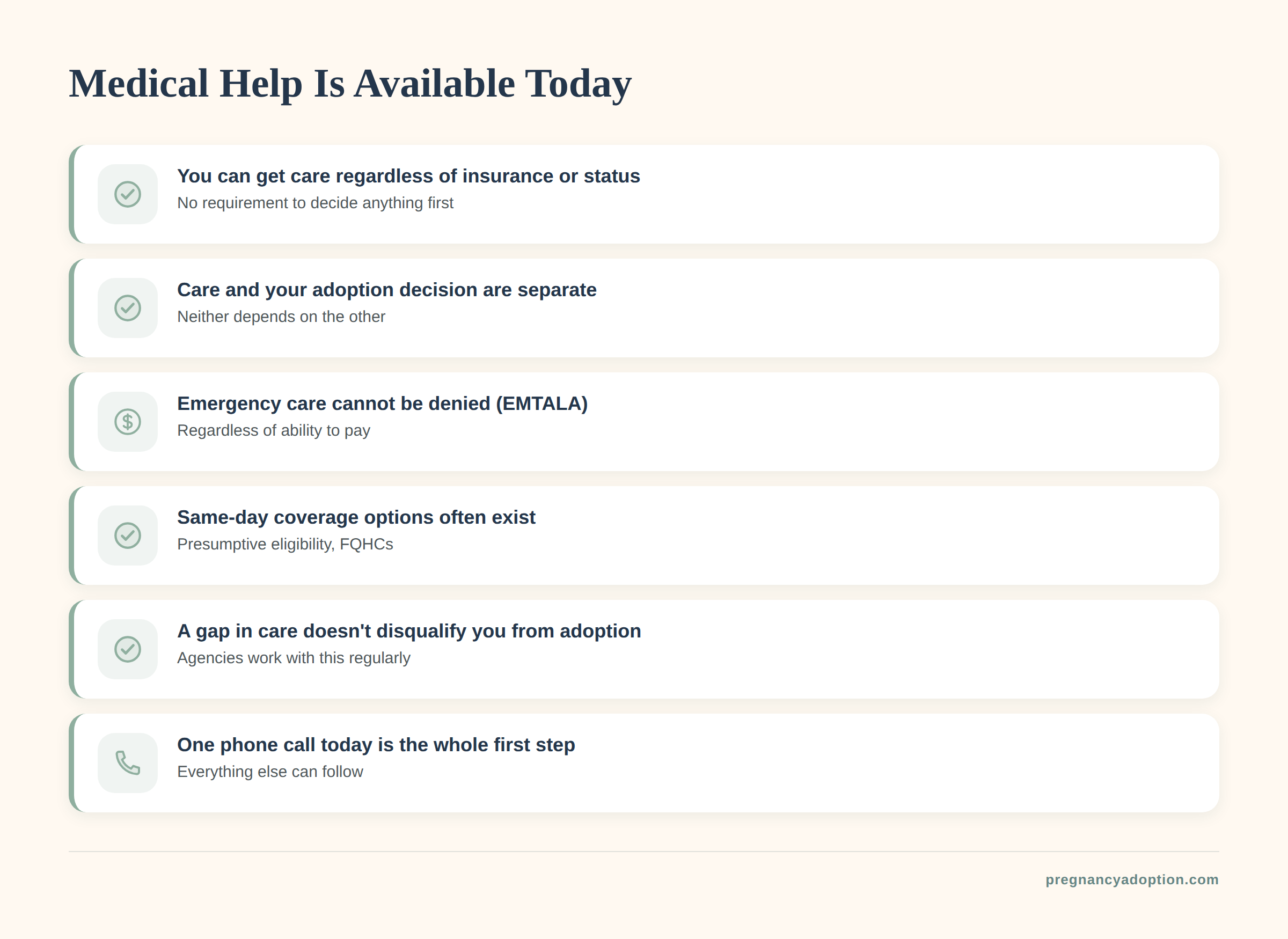
You can get prenatal care right now, this week, regardless of how far along you are, whether you have insurance, your immigration status, or what you’ve decided — or haven’t decided — about parenting, adoption, or anything else. None of those things are a requirement for getting seen, and none of them change the care you’re entitled to receive.
The One Thing to Know Right Now
Medical Care and Your Adoption Decision Are Completely Separate
Getting prenatal care has no bearing on whether you place a baby for adoption, parent, or haven’t decided — it doesn’t make any option more or less available to you, and no provider or clinic will ask you to decide before treating you. Our guide on prenatal care while making an adoption plan covers this in full detail for anyone who is already able to access routine care and wants to understand how the two tracks run side by side; this guide’s own focus is getting you from no care to some care, starting today.
You Don’t Need to Decide Anything Before You Go
You don’t need a plan, a due date, insurance, or an answer about adoption to walk into a clinic or call for an appointment. The only thing that matters to get started is showing up or calling — everything else, including what you ultimately decide, can come later.
What This Guide Covers (and Doesn’t)
What’s Here
This guide covers: when to go to the emergency room right now, how to get a non-emergency appointment started today, how paying for care actually works with no insurance, what a first visit covers when it happens later in pregnancy than usual, and how a gap in prenatal care affects — or, more precisely, doesn’t affect — an adoption plan.
What to Read Instead
If you’re already receiving routine prenatal care and want to understand privacy, disclosure, and how to coordinate it with an adoption plan over a full pregnancy, our dedicated guide on that topic is the more detailed resource. If you’re earlier in deciding what you want to do about the pregnancy at all — parenting, adoption, or abortion — our broader pregnancy options guide covers that decision, plus general access-to-care information, at full depth.
Why You Might Not Have Had Care Yet — And Why That Doesn’t Matter Now
There’s no version of “why” that changes what happens when you call or walk into a clinic today. This section exists because understanding that your reasons are common and understandable can make it easier to actually pick up the phone.
Common, Completely Understandable Reasons
Fear, Shame, or Not Being Ready to Tell Anyone
Not wanting anyone — a partner, parent, employer, or community — to know you’re pregnant is one of the most common reasons prenatal care gets delayed, and it’s a completely understandable one. A visit can be kept private; see the safety and confidentiality content later in this guide for how.
Cost, Insurance, or Not Knowing Where to Go
Not having insurance, assuming a visit would be unaffordable, or simply not knowing where an uninsured person can be seen are all common, fixable barriers — the paying-for-care section below covers exactly how people without insurance get seen.
Not Realizing You Were Pregnant Until Later
Irregular periods, symptoms that were easy to attribute to something else, or using contraception that made a missed period less noticeable can all lead to a pregnancy being discovered well into the second or even third trimester. This is common, and a later discovery doesn’t change what prenatal care can still do for you from this point forward.
You Are Not the Only One, and You Are Not in Trouble
How Common This Actually Is
According to a CDC data brief analyzing a recent full year of U.S. birth certificate data, about 6.2% of people who gave birth had late or no prenatal care — 4.6% starting in the third trimester and 1.6% with no prenatal care at all. Rates were meaningfully higher among teenagers, people having a fourth or later birth, and people paying for their own care rather than using insurance, and varied widely by state. In plain terms: this is a genuinely common situation, not a rare or unusual one.
Nothing About Your Past Changes What Happens Next
No clinic, hospital, or provider treats a late or absent prenatal-care history as something to be punished for. The entire purpose of today’s visit is simply to start getting care from this point forward — nothing about how you got here changes that.
When to Go to the Emergency Room Right Now
Before anything else in this guide: some symptoms need care immediately, not after reading the rest of this page, not after finding a regular provider, and not after deciding anything about adoption.
Warning Signs That Mean Go Now, Not Later
Signs Requiring Immediate Care
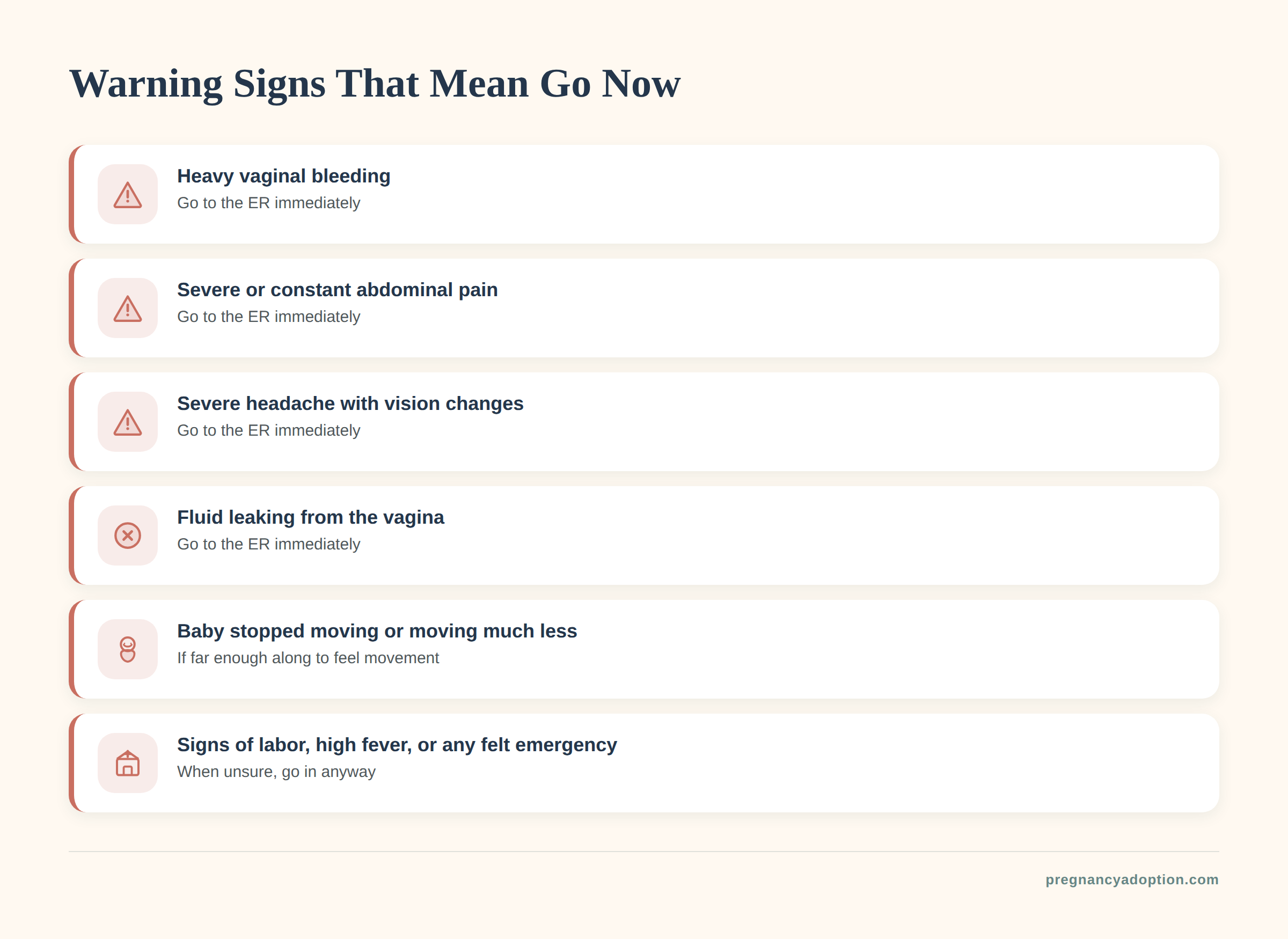
Go to the nearest emergency room right away for: heavy vaginal bleeding, severe or constant abdominal pain, a severe headache with vision changes, fluid leaking from the vagina, a baby that has stopped moving or is moving much less than usual (if you’re far enough along to normally feel movement), signs of labor if you’re not yet far enough along for it to be safe, a high fever, or any symptom that feels like a genuine emergency to you.
When You’re Not Sure If It’s an Emergency
If you’re genuinely unsure whether something qualifies, err on the side of going in or calling ahead — emergency staff are used to assessing pregnancy-related symptoms that turn out to be minor, and there’s no penalty for being cautious.
Your Right to Emergency Care, Regardless of Insurance or Status
EMTALA, in Plain Terms
Under a federal law called EMTALA (the Emergency Medical Treatment and Labor Act), any hospital with an emergency department must provide a medical screening exam and stabilizing treatment for an emergency medical condition — including pregnancy-related emergencies and active labor — regardless of your insurance status, ability to pay, or immigration status. A hospital cannot turn you away or delay this screening to check on payment first.
What to Expect When You Arrive
You’ll be examined, your symptoms will be evaluated, and you’ll be treated or stabilized based on medical need. Billing and insurance questions happen separately from, and after, the medical decision-making — you do not need to resolve a payment question before being seen.
How to Get Non-Emergency Care Started Today
If nothing above applies and this is about starting routine prenatal care rather than an emergency, here’s how to actually get an appointment moving today.
Same-Day and Fast-Track Options
Calling a Community Health Center
Federally Qualified Health Centers (FQHCs) — also called community health centers — provide care regardless of insurance status, on a sliding fee scale based on income, and many see pregnant patients quickly given the time-sensitive nature of prenatal care. The Health Resources and Services Administration’s “Find a Health Center” locator tool can identify centers near a given ZIP code
Applying for Presumptive-Eligibility Medicaid the Same Day
Many states offer presumptive-eligibility Medicaid for pregnancy, which can grant temporary coverage the same day you apply, often at the point of your first visit, before your full Medicaid application is processed — see the paying-for-care section below for how this works.
What to Say When You Call
You Don’t Need to Explain Anything
You don’t owe a receptionist, scheduler, or provider an explanation for why you haven’t been seen before. “I’m pregnant and need to be seen as soon as possible” is a complete reason on its own.
A Simple Script You Can Use
Something as simple as: “I think I’m pregnant and haven’t seen a doctor yet. I don’t have insurance right now. Can you tell me what my options are and how soon I can be seen?” is enough to get the conversation moving — most front-desk staff at a clinic or health center have had this exact conversation many times before.
Paying for Care When You Have No Insurance
Not having insurance is one of the most common reasons prenatal care gets delayed, and it’s also one of the most fixable — there are several real paths to coverage or low-cost care, often starting the same day.
Presumptive Eligibility and Emergency Medicaid
How Presumptive Eligibility Works
In states that offer it, presumptive-eligibility Medicaid lets a qualified provider or clinic grant temporary pregnancy-related Medicaid coverage on the spot, based on income self-attestation, while a full application is processed — meaning a visit can be covered the same day it happens rather than waiting weeks for approval.
Emergency Medicaid for Immigration-Status-Related Coverage Gaps
Separate from presumptive eligibility, many states offer “Emergency Medicaid” or a state-specific equivalent that covers labor, delivery, and certain pregnancy-related emergency care regardless of immigration status, even for people who don’t otherwise qualify for full Medicaid. Rules and program names vary significantly by state
Sliding-Scale and No-Cost Options
Federally Qualified Health Centers
As noted above, FQHCs provide primary and prenatal care on a sliding fee scale based on income, regardless of insurance status, and are often the fastest path to an affordable first visit.
Hospital Financial Assistance Programs
Most hospitals have a financial assistance or charity-care program that can reduce or eliminate billed costs for patients below certain income thresholds; asking a hospital’s billing or financial-counseling department directly, even after a visit has already happened, is a normal and reasonable step.
| Situation | Likely path | How fast |
|---|---|---|
| Low income, otherwise Medicaid-eligible | Presumptive-eligibility Medicaid (where offered), then full Medicaid application | Often same-day temporary coverage |
| Undocumented or ineligible for full Medicaid | Emergency Medicaid / state-specific equivalent for labor and delivery; FQHC for routine visits | Varies by state and situation |
| No insurance, income-based eligibility unclear | Federally Qualified Health Center (sliding fee scale) | Often days, not weeks |
| Already seen once but worried about the bill | Hospital or clinic financial assistance / charity care program | Apply any time, including after a visit |
What Happens at a First Prenatal Visit This Late
A first visit in the second or third trimester looks somewhat different from a textbook first-trimester visit — not because anything is wrong, but because some things need to happen faster, and the order of priorities shifts.
Figuring Out How Far Along You Actually Are
Why an Ultrasound Becomes the Priority
According to a clinical review published in American Family Physician, when a patient presents for a first visit late in pregnancy, an ultrasound to establish or confirm gestational age becomes an early priority — more so than it would be for an on-time first visit — because a late or inaccurate due-date estimate is linked to problems like missed multiple pregnancies or unnecessary induction for a pregnancy that isn’t actually past term. If your last period date is uncertain or your cycles are irregular, the ultrasound measurement generally takes priority over an estimated date.
What If You Genuinely Don’t Know
If you can’t recall your last period at all, that’s fine — an ultrasound can estimate gestational age directly from the size of the fetus, without needing that information from you. See the “If You’re Not Sure How Far Along You Are” section below.
Catch-Up Labs, Screenings, and Vaccines
What Gets Checked at Any Stage
Regardless of how far along you are, a late first visit typically includes standard first-visit bloodwork (blood count, blood type, infection screening for things like hepatitis B, HIV, and syphilis), a urine test, and a review of your medical and pregnancy history, medications, and any substance use — the same core workup a first-trimester visit would include, just compressed into fewer visits.
What Depends on How Far Along You Are
Some screenings and vaccines are specifically timed: gestational diabetes testing typically happens around or after 24 weeks, Group B streptococcus testing around or after 35 weeks, and the Tdap vaccine is generally recommended after 27 weeks. If you’re already past one of these points at your first visit, your provider will usually do that testing right away rather than waiting for the “usual” window, since the window has already arrived.
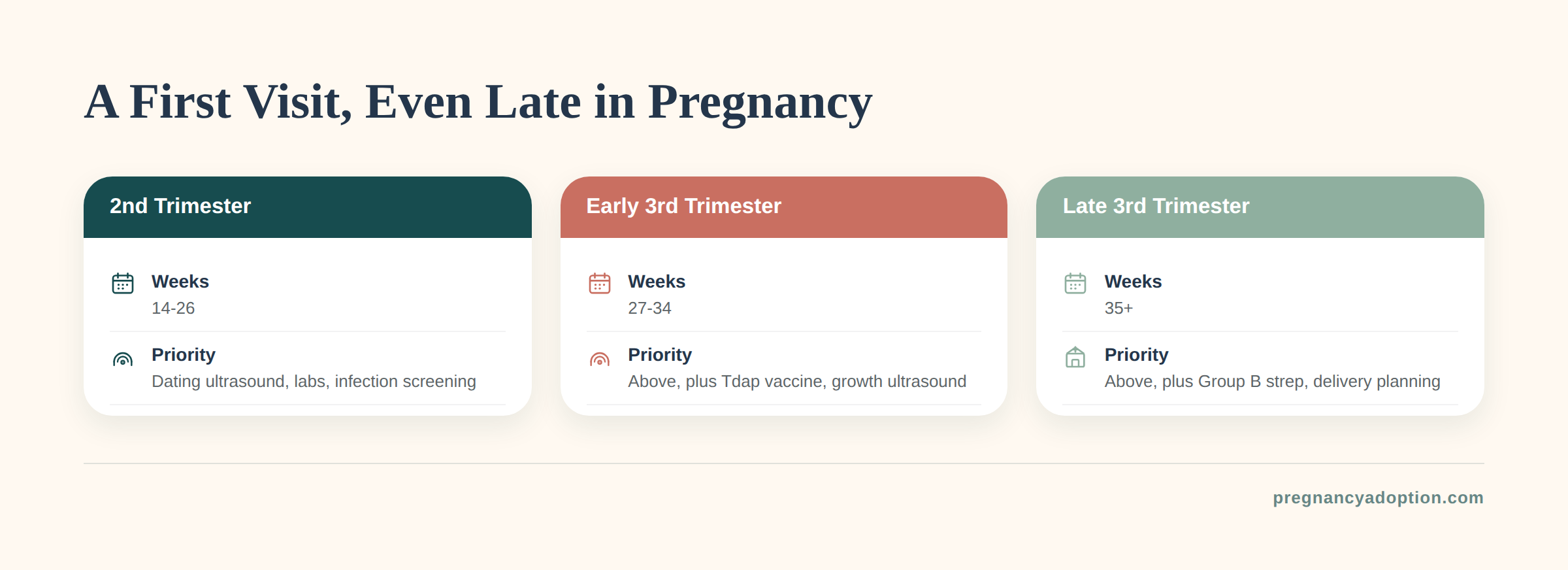
| If you’re around | What’s typically prioritized |
|---|---|
| 14–26 weeks (second trimester) | Dating ultrasound, first-visit bloodwork, infection screening, gestational diabetes testing once past 24 weeks |
| 27–34 weeks (early third trimester) | Everything above, plus Tdap vaccine, growth-focused ultrasound, and closer monitoring going forward |
| 35+ weeks (late third trimester) | Everything above, plus Group B strep testing and a focused history (prior cesarean, bleeding disorders, substance use) relevant to a near-term delivery |
If You’re Not Sure How Far Along You Are
Not knowing exactly how far along you are is common, especially if you haven’t been tracking your cycle or weren’t expecting to be pregnant, and it doesn’t stop care from moving forward.
Why This Still Matters Even Without an Exact Date
Timing Affects Which Tests and Vaccines Are Relevant
As the catch-up table above shows, several screenings and vaccines are timed to a gestational-age window, so having at least a rough estimate helps your provider know what to prioritize at your very first visit, rather than everything happening in an unfocused rush.
It Also Affects Delivery Planning
Knowing roughly when a due date is expected matters for monitoring and delivery planning later on, even if the number is revised once an ultrasound gives a more precise estimate.
How a Provider Figures It Out Without Your Help
An Ultrasound Measurement Stands In for a Missing Date
An ultrasound estimates gestational age directly from measurements of the fetus, which is especially useful when a last-period date is unknown, uncertain, or unreliable — it doesn’t require you to know or recall anything.
You Can Also Use This Site’s Own Calculators Once You Have a Date
Once your provider gives you an estimated due date or gestational age from an ultrasound, our pregnancy calculator guide and our guide on figuring out how many weeks pregnant you are can help you track your own current week between visits.
If You Haven’t Decided What You Want to Do Yet
It’s completely normal to be getting medical care before you’ve settled on a decision — the two things don’t have to happen in any particular order, and starting care doesn’t lock you into anything.
Getting Care Doesn’t Commit You to Anything
A Visit Is Not a Decision
Scheduling or attending a prenatal visit is not an announcement, a commitment, or a signal of what you’re planning to do — it’s simply medical care, available to you regardless of what you decide or when you decide it.
You Can Change Direction at Any Point
Whatever you’re leaning toward today — parenting, adoption, or still genuinely unsure — your medical care continues the same way regardless of if or when that leaning shifts.
Where to Go If You Want to Think It Through First
A Broader Options Guide
Our pregnancy options guide walks through parenting, adoption, and abortion without pressure in any direction, and covers general access-to-care questions (insurance, safety, cost) at full depth if you want a broader starting point than this guide’s own adoption-specific focus.
A Guide Specifically on Considering Adoption
If adoption specifically is on your mind, our guide for people considering adoption while pregnant is the more detailed next read once you’re ready for it.
Telling a Provider You’re Considering Adoption
Whether and when to mention adoption to a medical provider is entirely your choice, not a requirement of getting care.
What You’re Required to Share (Almost Nothing)
Medical History, Not Life Plans
You’re expected to share medical information relevant to your care — symptoms, medications, prior pregnancies, substance use — but you are never required to disclose that you’re considering adoption, or anything about your plans for after delivery, to receive prenatal care.
A Provider’s Job Doesn’t Depend on Knowing
A provider can give you complete, high-quality prenatal care without ever knowing what you’re considering doing after the baby is born — that information isn’t medically necessary for routine prenatal care itself.
What Sharing Can Make Easier, If You Choose To
Coordinating With an Agency or Attorney
If you do choose to share that you’re considering adoption, it can make it easier for your provider’s office to coordinate records or scheduling with an adoption agency or attorney, if and when you want that coordination to happen — but this is optional, not required. Our fuller guide on prenatal care and adoption plans covers this coordination in depth.
You Can Decide Later, or Never
There’s no deadline for deciding whether to mention it, and you can choose not to mention it at all without it affecting the quality of care you receive.
How a Gap in Prenatal Care Affects an Adoption Plan
If adoption is something you’re considering, it’s worth addressing directly: having had little or no prenatal care does not change your options or your rights.
It Does Not Disqualify You
There Is No Prenatal-Care Requirement to Consider or Pursue Adoption
No adoption agency, attorney, or legal process requires a minimum amount of prenatal care as a condition of placing a baby for adoption. Your legal right to consider, pursue, or decide against adoption is identical regardless of your prenatal-care history.
Agencies Work With This Situation Regularly
Adoption professionals are familiar with expectant parents who come to them with little or no prior prenatal care — it is not an unusual circumstance from their perspective, and a reputable agency or attorney will not treat it as a problem to be solved before helping you.
How Agencies and Attorneys Handle Medical Unknowns
Unknown Information Is Simply Recorded as Unknown
Adoption paperwork, including the non-identifying medical and social history shared with a prospective adoptive family, has a standard way of handling information that isn’t available: it’s recorded as unknown or not applicable, rather than left blank in a way that implies something was withheld.
Getting Care Now Still Helps, Even Starting Late
Any care you receive from this point forward — even starting in the third trimester — adds real, current medical information to that history, which is part of why getting seen now is worth doing regardless of how the rest of the pregnancy unfolds.
What Happens to the Medical History Form
You Fill In What You Know
A standard non-identifying medical history questionnaire asks about your own health history and, where known, your family’s — you answer what you know and leave the rest unknown, which is a normal, expected outcome of this form rather than something you need to apologize for or explain.
A Provider’s Records Can Fill In the Rest Going Forward
Once you’re receiving care, your provider’s own records (test results, ultrasound findings, delivery records) become part of the medical picture available to share, supplementing whatever you’re able to report from memory.
If You’re Already in Labor or About to Deliver With No Prior Care
If you’re reading this because labor has already started, or you think it might have, the guidance is simple and doesn’t require reading the rest of this page first.
Go to the Hospital — That’s the Whole Plan
Call 911 or Go to the Nearest Emergency Department
If you believe you’re in labor, call 911 or go directly to the nearest hospital emergency department or labor and delivery unit. You do not need an appointment, a referral, insurance, or any prior prenatal visit to be seen and treated.
EMTALA Applies Here Too
As covered earlier in this guide, federal law requires a hospital with an emergency department to provide a medical screening exam and stabilizing treatment — which for active labor means delivering your baby safely — regardless of your insurance, documentation status, or whether you’ve ever been seen before.
What Actually Happens When You Arrive
A Rapid Assessment Takes the Place of Your Missing Records
Hospital staff are equipped to assess and safely deliver a patient with zero prior prenatal records — they’ll do a rapid history, an ultrasound if time allows, and the same safety monitoring any laboring patient receives, adjusted for not having a baseline from earlier visits.
A Hospital Social Worker Can Help With Everything Else
Most hospitals have a social worker who can help with coverage questions, connect you with resources after delivery, and — if you’re considering adoption — often has experience coordinating with or referring to local adoption agencies and attorneys, even on short notice. Our guide on placing a baby for adoption at the hospital covers hospital-stay logistics and decision-making in full detail.
Safety Concerns That Might Be Keeping You From Care
Sometimes the barrier to care isn’t cost or scheduling at all — it’s safety. These concerns deserve direct acknowledgment, not just a mention in passing.
A Partner or Family Member Controlling Your Access
Providers Can Help You Access Care Confidentially
Medical providers and clinics are trained to help patients access care privately when a partner or family member is controlling their schedule, phone, or finances, and can discuss safety planning specific to appointments and any records you’d prefer kept confidential.
The National Domestic Violence Hotline
The National Domestic Violence Hotline (1-800-799-7233, thehotline.org) provides confidential support and safety planning, including how to seek medical care safely, even if you’re not sure whether what you’re experiencing counts as “abuse.”
Fear Related to Immigration Status
Emergency Care Cannot Be Denied Based on Status
As covered above, EMTALA’s emergency-care guarantee applies regardless of immigration status, and many states offer Emergency Medicaid or an equivalent program for labor and delivery regardless of status as well.
Clinics Generally Don’t Ask About Status for Routine Care
Community health centers and many clinics do not require proof of citizenship or immigration status to provide routine prenatal care, particularly when paid for on a sliding scale; asking directly and confidentially about a specific clinic’s policy before a visit is a reasonable step if this is a concern.
Fear of Judgment Over Substance Use
Fear of being judged, reported, or prosecuted over substance use during pregnancy is a common reason people avoid prenatal care entirely — and it’s worth addressing directly, because avoiding care tends to make outcomes worse, not better.
What Providers Are Actually Focused On
Treatment, Not Punishment
A prenatal care provider’s primary goal when substance use comes up is connecting you with treatment and monitoring your pregnancy safely — not reporting you or ending the relationship. Being honest with a provider about substance use generally leads to better, safer care for both you and the pregnancy, not worse treatment.
You Can Ask About Confidentiality Directly
If this is a specific worry, you can ask a provider directly, before disclosing anything, what their confidentiality practices are and what circumstances would ever require them to report something — a reasonable question that providers are used to answering.
What Disclosure Does and Doesn’t Trigger
Rules Vary Significantly by State
Whether and when a provider is legally required to report substance use during pregnancy varies significantly by state, and some states have specific legal protections or separate treatment-focused reporting pathways rather than punitive ones.
Avoiding Care Entirely Is the Higher-Risk Choice
Whatever the legal specifics in your state, avoiding all prenatal care out of fear of this one issue removes the chance to get help with the substance use itself and to monitor the pregnancy for anything else that might need attention — getting seen and asking your specific questions directly is almost always the better path than staying away entirely.
Common Mistakes and Misconceptions
A few beliefs specifically keep people with little or no prenatal care from seeking help, even after they’re ready to consider it.
“It’s Too Late for Care to Help”
Why This Happens
It’s easy to assume that if you’ve missed the “ideal” window, there’s no point starting now — but prenatal care isn’t all-or-nothing, and catching up on even a portion of it, as described in the first-visit section above, has real value.
What to Do Instead
Call or go in regardless of how far along you are. A provider’s job is to figure out what’s useful to do from today forward, not to judge what didn’t happen earlier.
“I’ll Be Reported or Arrested”
Why This Happens
Fear of legal consequences — for substance use, immigration status, or simply not having sought care sooner — is a powerful and understandable deterrent, amplified by stories and misinformation that don’t always reflect how most clinical encounters actually go.
What to Do Instead
Going without care removes your ability to get ahead of any of these concerns; asking a provider directly and confidentially about their specific policies, as described above, replaces fear-based guessing with an actual answer.
“No Agency Will Work With Me Now”
Why This Happens
It’s easy to assume that a gap in prenatal care somehow disqualifies you from working with an adoption agency or attorney, especially if you’re also feeling judged or behind in other ways.
What to Do Instead
As covered in the “How a Gap in Prenatal Care Affects an Adoption Plan” section above, this simply isn’t how adoption professionals evaluate a situation — reaching out to an agency or attorney, even with no prior care at all, is a normal and workable starting point.
A Step-by-Step Action Checklist for Right Now
If everything above feels like a lot at once, here’s the condensed version — a simple sequence of next steps.
Today
If Anything in the Warning-Signs List Applies
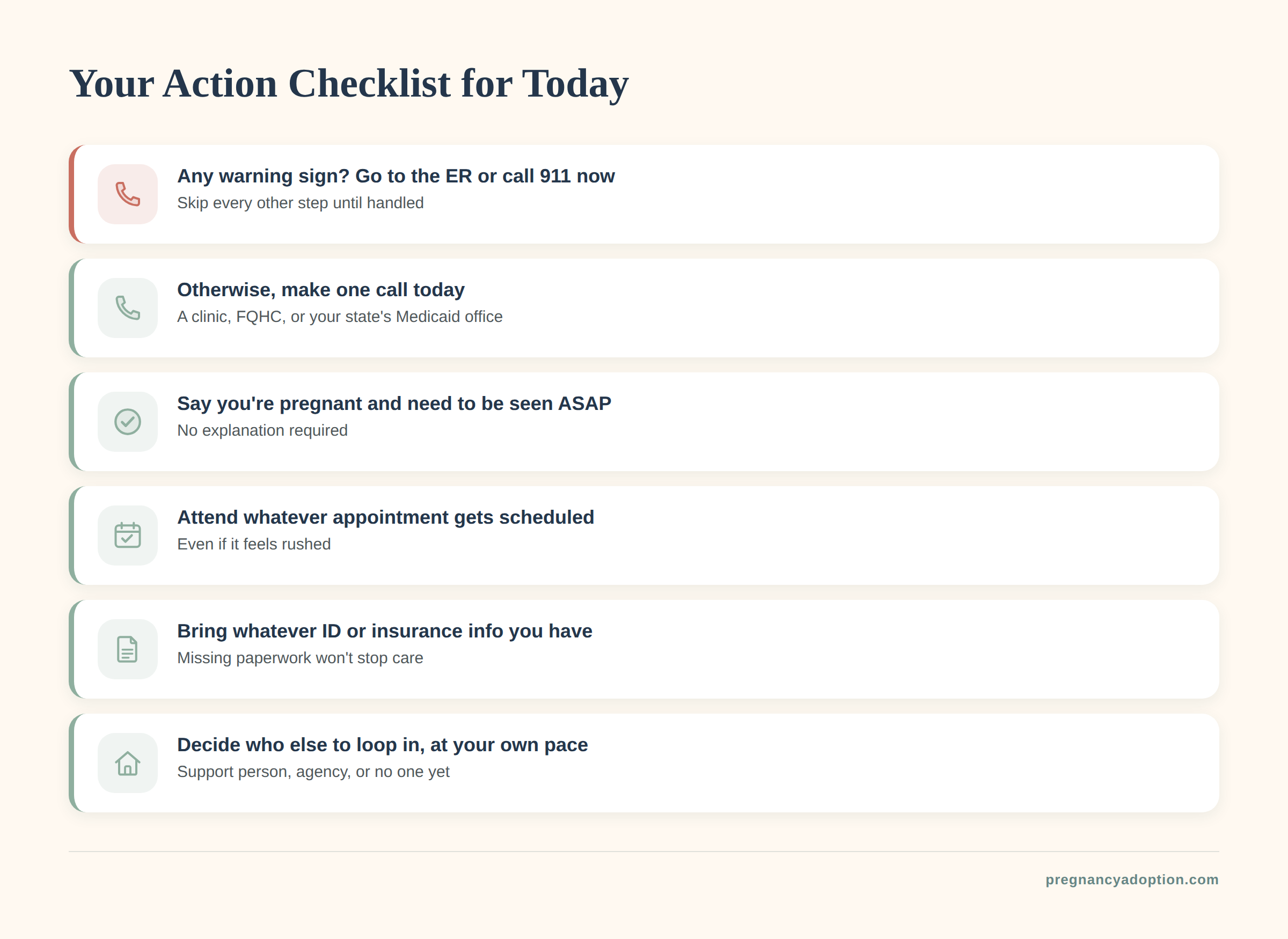
Go to the nearest emergency room or call 911 now — skip every other step below until that’s handled.
Otherwise, Make One Call
Call a community health center, a local clinic, or your state’s Medicaid office and say you’re pregnant and need to be seen as soon as possible. That one call is the entire goal for today.
This Week
Attend Your First Visit
Go to whatever appointment gets scheduled, even if it feels rushed, incomplete, or like “just a start” — it is a start, and it’s the one that matters most.
Decide, at Your Own Pace, Who Else to Loop In
Whether that’s a support person, an adoption agency or attorney, or no one else yet — this decision can wait until after you’ve been seen, and is entirely yours to make on your own timeline.
Glossary of Terms Used in This Guide
Care Access Terms
Federally Qualified Health Center (FQHC)
A community health center that receives federal funding to provide primary and preventive care, including prenatal care, on a sliding fee scale based on income, regardless of insurance status.
Presumptive Eligibility
A process some states use to grant temporary Medicaid coverage for pregnancy on the spot, based on self-reported income, while a full application is processed.
EMTALA
The Emergency Medical Treatment and Labor Act, a federal law requiring hospitals with emergency departments to provide a screening exam and stabilizing treatment for an emergency medical condition, including active labor, regardless of insurance, ability to pay, or immigration status.
Prenatal Care Terms
Late Entry to Prenatal Care
Starting prenatal care after the first trimester, most often in the second or third trimester, rather than as soon as a pregnancy is confirmed.
Dating Ultrasound
An ultrasound performed primarily to estimate or confirm gestational age directly from measurements of the fetus, especially useful when a last-menstrual-period date is unknown or unreliable.
Catch-Up Screening
Tests, labs, or vaccines that are time-sensitive to a stage of pregnancy (such as gestational diabetes testing or Group B strep testing) and are performed as soon as possible after a late first visit if their usual window has already arrived.
Adoption-Specific Terms
Non-Identifying Medical History
A standard form used in adoption that records an expectant parent’s own and family medical history, without identifying information, to share with a prospective adoptive family — information that isn’t known or available is simply recorded as unknown.
Emergency Medicaid (or State-Specific Equivalent)
A limited form of Medicaid coverage, available in many states, that covers labor, delivery, and certain pregnancy-related emergency care regardless of immigration status, even for people who don’t otherwise qualify for full Medicaid coverage.
Frequently Asked Questions
Getting Started Questions
I haven’t seen a doctor at all and I’m already pretty far along — is it even worth starting now?
Yes. Prenatal care isn’t all-or-nothing; even a late start adds real, useful medical monitoring and catch-up testing for the rest of your pregnancy. See the “What Happens at a First Prenatal Visit This Late” section above.
Do I need an appointment, or can I just walk in somewhere?
Many community health centers and clinics can see new patients quickly by phone, and some accept walk-ins for urgent situations; calling ahead is usually faster, but if something feels urgent, going to an emergency department is always an option.
What if I don’t have a photo ID or any paperwork with me?
Most clinics can still see you and will work through a simpler intake process; lack of paperwork is not, on its own, a reason care would be refused, and emergency care specifically cannot be denied for this reason under EMTALA.
Can I get care in a different city or state than where I live?
Generally yes — prenatal care and emergency care are not restricted by home address, though specific state Medicaid programs may have residency requirements for full, ongoing coverage.
Cost and Coverage Questions
I make too much for Medicaid but still can’t afford insurance — what are my options?
A Federally Qualified Health Center’s sliding fee scale can still make care affordable even outside Medicaid’s income limits, since fees are set based on your specific income and household size rather than a fixed price.
Will I get a huge bill after an emergency room visit?
You may receive a bill, but hospital financial assistance and charity-care programs can often reduce or eliminate it based on income — apply for this even after the visit has already happened.
Does presumptive eligibility cover my whole pregnancy, or just the first visit?
Presumptive eligibility is generally a temporary bridge while a full Medicaid application is processed, not a replacement for ongoing coverage — your clinic or caseworker can walk you through completing the full application once the bridge coverage starts.
What if I’m undocumented — can I still get prenatal care, not just emergency delivery care?
In many places, yes — Federally Qualified Health Centers generally don’t require proof of immigration status for routine care, and some states extend pregnancy-related Medicaid-equivalent coverage regardless of status. Confirm specifics with a local clinic directly, since rules vary by state.
Timing and Medical Questions
How will anyone know how far along I am if I don’t know my last period date?
An ultrasound measurement can estimate gestational age directly, without needing that information from you — see the “If You’re Not Sure How Far Along You Are” section above.
Will I need extra tests because I’m starting late?
You’ll likely have several tests done closer together than they would be with an on-time start, since time-sensitive screenings that have already come due get prioritized right away rather than waiting for their “usual” window.
Is it dangerous that I haven’t had any prenatal care yet?
Research links late or absent prenatal care to somewhat higher rates of certain complications, though the evidence connecting the two directly is limited, and many factors beyond prenatal care timing affect pregnancy outcomes. The point of this guide is simply that starting now, whenever “now” is, is the right next step — not to add worry on top of what you’re already navigating.
What if I think I might be further along than I feel, or less far along than I thought?
This is exactly what a dating ultrasound resolves — mention any uncertainty to your provider so they know to prioritize that measurement at your first visit.
Adoption-Specific Questions
Will an adoption agency think less of me for not having had prenatal care?
A reputable adoption agency or attorney works with this situation regularly and won’t treat it as a problem or a judgment of you — see the “How a Gap in Prenatal Care Affects an Adoption Plan” section above.
Do I have to explain to an agency why I didn’t get care sooner?
No — you’re never required to justify your prenatal-care history to an agency, attorney, or anyone else involved in an adoption plan.
Will the adoptive family know I didn’t get prenatal care until late?
Non-identifying medical history forms record what’s known and mark the rest as unknown; whether and how a gap in care timing specifically is described is something you can discuss directly with your agency or attorney.
Can I still choose an adoptive family if I haven’t had any prenatal care?
Yes — the process of matching with or choosing an adoptive family is not conditioned on prenatal-care history. Our guide on choosing an adoption agency covers that process in full.
Does it matter for adoption purposes if I get care now versus having had it from the start?
Any care you receive adds current, useful medical information to your file going forward; it doesn’t retroactively “fix” the earlier gap, but it isn’t meant to — its value is in what it does for the rest of your pregnancy and the resulting medical history.
Safety and Confidentiality Questions
Can I get care without my partner or family finding out?
Providers and clinics are trained to help patients access care confidentially, including around appointment scheduling, billing, and records, particularly when safety is a concern — mention this directly when you call.
What if I’m afraid of being reported for using drugs or alcohol during pregnancy?
See the “Fear of Judgment Over Substance Use” section above — providers are primarily focused on treatment and safe monitoring, and you can ask directly about confidentiality before disclosing anything.
Is there a hotline I can call if I’m not ready to go to a clinic yet but need to talk to someone?
The National Domestic Violence Hotline (1-800-799-7233) is available for safety-related concerns specifically; for general pregnancy-decision support, many local pregnancy resource organizations and adoption agencies offer confidential helplines as well.
What if I’m a minor and don’t want my parents to know?
Rules about a minor’s ability to consent to their own prenatal care and to make decisions about a pregnancy vary by state; a clinic or provider’s staff can explain your specific state’s rules directly and confidentially.
Practical Next-Step Questions
What’s the single most important thing to do after reading this guide?
Make one phone call today — to a community health center, a clinic, or your state’s Medicaid office — and say you’re pregnant and need to be seen as soon as possible. Everything else can follow from there.
What if the first place I call can’t see me quickly?
Try a second option from the same list (a different clinic, a different FQHC location, or your state’s Medicaid or health department line) — availability varies by location, and one “not right away” answer doesn’t mean none are available.
Do I need to bring anything to my first appointment?
Bring whatever you have — an ID, insurance card, or proof of income if you have them — but don’t let missing any of these stop you from going; most clinics can work with what you’re able to bring.
Where can I read more once I’ve gotten care started?
Our guide on prenatal care while making an adoption plan is the natural next read once you’re receiving ongoing care and want to understand how it coordinates with an adoption plan in more depth; our guide for people considering adoption while pregnant is the next step if adoption specifically is on your mind.
Comparing This Guide to Others
How is this guide different from the prenatal-care-and-adoption-plan guide on this site?
Our prenatal care and adoption plan guide assumes you can already access routine care and focuses on medical privacy, disclosure, and coordinating care with an agency or attorney across a full pregnancy. This guide is written for the step before that — getting from no care, or very little care, to some care, starting today.
Should I read this guide or the broader pregnancy options guide first?
If you’re still deciding what you want to do about the pregnancy at all, our pregnancy options guide is the broader starting point. If you already know adoption is at least on the table and your main blocker is simply not having seen a doctor yet, this guide is the more direct resource.
Does this guide repeat the access-to-care information in the pregnancy options guide?
No — this guide covers access to care at a level specific to the “little or no prenatal care, considering adoption” situation, and links to the broader guide rather than re-explaining its general EMTALA, Medicaid, and clinic-access content from scratch.
Is there a guide specifically about placing a baby for adoption at the hospital?
Yes — our guide on placing a baby for adoption at the hospital covers hospital-stay decision-making and logistics once you’re there to deliver, in much more depth than this guide’s brief in-labor section above.
More on Catching Up Medically
If I’ve had exactly one prenatal visit so far, does that count as “some” care or “no” care?
One visit is meaningfully different from none — it likely means some baseline information already exists (blood type, early labs, an early due-date estimate) that a later visit can build on, rather than starting completely from scratch.
Will my provider be upset or frustrated with me for the gap in care?
A provider’s focus at a late first visit is almost entirely forward-looking — what needs to happen from today onward — not on assigning blame for what didn’t happen earlier. This is a routine, if less common, type of visit for most prenatal providers.
How many visits will I need to have before delivery if I’m starting late?
This depends on how far along you are at your first visit and how the rest of the pregnancy goes; a provider starting care late will typically schedule visits more frequently than usual to compress the normal monitoring schedule into the time remaining.
Can I still get an accurate due date if I start care in the third trimester?
An ultrasound can still estimate gestational age reasonably well in the third trimester, though the estimate becomes somewhat less precise later in pregnancy than an early first-trimester measurement would be — your provider can explain the expected precision at your specific stage.
What if I’ve been having symptoms for months and I’m worried something is already wrong?
Mention every symptom you’ve noticed, even if it was weeks or months ago, at your first visit — a provider would rather hear about something that turned out to be nothing than miss something relevant to your current care.
Do I need to remember every detail of my pregnancy so far for the first visit to go well?
No — share what you remember and don’t worry about the rest; a provider’s own exam and testing will fill in a meaningful amount of the picture regardless of what you can recall.
More on Adoption and Record-Keeping
Will a gap in prenatal care show up as a red flag in adoption paperwork?
Non-identifying medical history forms are built to accommodate incomplete information as a normal, expected possibility, not as a flag requiring special handling — see the glossary above for how “unknown” fields are treated.
Can I still receive adoption-related financial or living assistance if I haven’t had prenatal care yet?
Many agencies and attorneys can discuss financial assistance and support options regardless of your prenatal-care history; reaching out directly is the fastest way to get an answer specific to your situation and state.
If I decide on adoption after getting care started, do I need to restart anything medically?
No — your prenatal care continues exactly the same way regardless of when, or whether, you finalize an adoption decision during the pregnancy.
Does an agency need to speak with my medical provider directly?
Not necessarily — some expectant parents choose to have their agency or attorney coordinate directly with a provider’s office, while others prefer to keep those relationships entirely separate; either approach is workable, and this is your choice to make.
What if I want to keep my adoption plan private from my medical team entirely?
You’re fully entitled to do this — as covered in the “Telling a Provider You’re Considering Adoption” section above, disclosure to your medical team is never required.
Rural Access and Telehealth Questions
What if there’s no clinic or hospital anywhere near me?
Calling the nearest option, even if it involves travel, and asking specifically about transportation assistance is worthwhile — some clinics, health departments, and adoption agencies can help coordinate transportation for appointments in rural areas.
Can a first visit happen over telehealth if I can’t get to a clinic right away?
Some portions of prenatal care, like a history review or certain follow-up conversations, can sometimes happen by telehealth, but an in-person visit is generally still needed for the physical exam, bloodwork, and ultrasound — a clinic can tell you what’s possible for your specific first visit.
Does living in a state with fewer maternity care providers change any of this guidance?
The core guarantees (EMTALA for emergencies, FQHC sliding-scale access, presumptive-eligibility Medicaid where offered) apply regardless of local provider shortages, though finding an available appointment may take more calls in an area with fewer options.
Who can help me figure out transportation to appointments?
A clinic’s front desk, a hospital social worker, or a local adoption agency (if you’re already in touch with one) can often point you to local transportation assistance programs specific to your area.
Emotional and Reassurance Questions
I feel ashamed that I waited this long to get care — is that normal?
Yes, that feeling is extremely common, and it’s also not a reflection of anything that will affect the care you receive starting now — providers see this situation regularly and are focused on what happens next, not on how you feel you should have acted sooner.
What if I’m scared that getting care will somehow “make it real” in a way I’m not ready for?
That’s a completely understandable feeling, and it’s worth naming directly: getting medical care doesn’t require you to be emotionally ready for every part of the situation at once — it’s simply a step toward having the information and options you need, whenever you decide to use them.
Is it okay to cry, be anxious, or feel numb at my first visit?
Yes — providers who see pregnant patients regularly are used to a wide range of emotional responses at a first visit, especially a late one, and none of them will be treated as unusual or inappropriate.
What if I still don’t feel ready to make any decision about adoption after getting care?
That’s completely fine — getting medical care and deciding about adoption are separate processes on separate timelines, and you’re not required to have settled one before, during, or immediately after the other.
Hospital and Delivery Logistics Questions
What if I go into labor before I’ve had any prenatal visits at all?
Go directly to the hospital or call 911 — see the “If You’re Already in Labor” section above. Hospitals are equipped to safely deliver a baby even with zero prior prenatal records.
Will I be asked a lot of questions during labor if I haven’t had any prior care?
You’ll be asked a focused set of safety-relevant questions (medical history, medications, substance use, allergies) as part of a rapid intake — this happens efficiently alongside your care, not as a prerequisite to receiving it.
Can I still request a specific type of delivery experience (like minimal interventions) without prior prenatal care?
You can discuss preferences with the delivery team, though without prior records some decisions may need to be made more conservatively for safety reasons; your care team can walk you through what’s realistic given your specific situation in the moment.
If I deliver with no prior care, does that change anything about my legal right to make an adoption plan afterward?
No — your legal rights regarding parenting or placing a baby for adoption after delivery are not affected by your prenatal-care history. Our guide on birth parent rights covers these rights in full.
Insurance and Billing Follow-Up Questions
What if I already got a bill from an emergency room visit and I’m worried about it?
Contact the hospital’s billing or financial-counseling department directly and ask about financial assistance or charity-care programs — these can typically be applied for after a visit, not just before one.
Can a bill from a past visit affect whether I’m seen again at the same clinic?
Reputable clinics and FQHCs generally don’t deny future care over a past unpaid balance, particularly for time-sensitive prenatal care; if this is a concern, you can ask directly about the clinic’s specific policy.
Does applying for Medicaid retroactively cover a visit I already paid for out of pocket?
Some states’ Medicaid programs offer retroactive coverage for a period before the application date, which can sometimes reimburse or offset an earlier out-of-pocket visit — ask your caseworker or clinic directly about retroactive eligibility in your state.
Will using a sliding-scale fee at an FQHC affect my credit or show up on a report?
Routine sliding-scale medical billing at a community health center is handled like standard medical billing and is not inherently different from any other provider’s billing process; ask the clinic directly about their specific billing and collections practices if this is a concern.
Partner and Family Questions
Do I need my partner’s permission or involvement to get prenatal care?
No — you can seek and consent to your own prenatal care as an adult without needing permission from a partner, and providers will treat you as the decision-maker for your own care.
What if my family doesn’t know I’m pregnant and I don’t want them to find out from a bill or insurance statement?
Ask your clinic directly about confidential billing options, such as having statements sent to a different address or communicated by a different method — many clinics can accommodate this, especially when you explain the concern.
Can a family member bring me to an appointment without my provider assuming anything about my situation?
Providers are accustomed to patients arriving with all kinds of support people, or none at all, and don’t draw conclusions about your plans or decisions based on who accompanies you.
What if my partner is the reason I’ve been avoiding care?
If a partner is controlling your access to medical care, see the “Safety Concerns That Might Be Keeping You From Care” section above — providers and the National Domestic Violence Hotline can help you access care safely and confidentially.
Special Situations
What if I’m a teenager and haven’t told any adult I’m pregnant?
Many states allow minors to consent to their own prenatal care without parental involvement, though the specifics vary; a clinic’s staff can explain your state’s exact rules confidentially when you call. Our guide for pregnant teenagers covers this situation in more depth.
What if I don’t currently have stable housing?
Not having stable housing doesn’t disqualify you from prenatal care, Medicaid, or emergency care — mention your housing situation to a clinic or hospital social worker, who can often connect you with both medical care and housing-specific resources together.
What if I’m currently involved with the criminal justice system in some way?
Pregnant people retain the right to prenatal care regardless of involvement with the criminal justice system; specifics depend heavily on your exact circumstances, and a social worker, public defender, or legal aid organization can advise on logistics specific to your situation.
What if I already have other children and I’m worried this will affect my custody of them?
Seeking prenatal care for a current pregnancy is not, on its own, a basis for a custody action regarding other children; if you have specific custody concerns, a family law attorney or legal aid organization can advise directly on your situation.
Documentation and Follow-Up Questions
What records should I try to keep once I start getting care?
Ask your clinic for copies of visit summaries, lab results, and ultrasound reports as you go — having your own copies makes it easier to switch providers, loop in an agency or attorney, or simply keep track of your own pregnancy.
What if I switch clinics partway through because of a move or an insurance change?
Ask your current clinic to transfer your records to the new one, or request your own copies to bring along — this is a routine request that clinics handle regularly.
Do I need to keep track of every appointment date myself?
It can help, but it isn’t required — your clinic maintains its own records of your visits, and most will remind you of upcoming appointments.
What if I miss a scheduled appointment after getting started?
Call to reschedule as soon as you can; missing one appointment doesn’t undo the care you’ve already started, and clinics generally work with patients to get back on track rather than treating a missed visit as disqualifying.
A Few Final Clarifying Questions
Is this guide only for people who are definitely choosing adoption?
No — this guide is written for anyone with little or no prenatal care who is at least considering adoption as a possibility; it’s equally useful whether you’re fairly certain, still weighing it, or simply want the option available to you alongside parenting.
What if I read this whole guide and I’m still not sure what to do about the pregnancy itself?
That’s completely fine — this guide’s job is to get you medical care, not to resolve the parenting-versus-adoption question; our pregnancy options guide is there whenever you’re ready to work through that separately.
Does any of this guidance change if I’m carrying twins or multiples?
The core guidance — get care now, regardless of how far along you are — applies the same way; a multiple pregnancy may simply mean your provider monitors you more closely once you’re seen, which your provider will explain directly.
Who wrote and reviewed this guide?
See the "About pregnancyadoption.com/" section below for this site's editorial and review process, and the editor's note at the end of this article for this specific guide's review status and sources.
Quick Scenario Walkthroughs
I’m about 7 months along, haven’t seen anyone, and I’m scared to make the first call — what do I actually say?
Call a community health center and say: “I’m pregnant, around seven months, and haven’t been seen by anyone yet. I need an appointment as soon as possible.” That’s the entire script — the rest of the conversation is theirs to guide, not yours to prepare for.
I don’t have insurance, I’m not sure if I qualify for Medicaid, and I don’t want to wait weeks to find out — what’s my fastest option?
Ask the first clinic or health department you call specifically about same-day presumptive-eligibility Medicaid, if your state offers it, or about their sliding-fee-scale rate if it doesn’t — either path can usually get you seen well before a full Medicaid application would otherwise be processed.
I think I might be in early labor and I’ve never seen a doctor this entire pregnancy — what do I do in this exact moment?
Call 911 or go directly to the nearest hospital’s emergency department or labor and delivery unit right now — do not wait to find a regular provider first. See the “If You’re Already in Labor” section above for exactly what happens when you arrive.
I’m undocumented, uninsured, and about five months along — where do I even start?
Start with your nearest Federally Qualified Health Center, which generally doesn’t require proof of immigration status for routine sliding-scale care, and ask directly about Emergency Medicaid or your state’s equivalent program for when you deliver.
I had one prenatal visit months ago, then stopped going — do I start over, or pick up where I left off?
Call the same clinic if possible, or a new one if that’s easier, and mention the earlier visit; either way, you’re picking up from today’s gestational age forward, not starting completely from zero, since that earlier visit’s information can still be useful.
I’m considering adoption but haven’t told anyone, including any doctor, and I’m already close to my due date — what’s the right order of calls to make?
Medically, call a clinic or go to the emergency department first if you haven’t been seen at all this close to delivery — that’s the most time-sensitive step. Reaching out to an adoption agency or attorney can happen before, after, or alongside that call, in whichever order feels right to you; neither call depends on the other happening first.
Returning to This Guide Later
Is it okay to come back and re-read parts of this guide after my first visit?
Yes — many readers find the “What Happens at a First Prenatal Visit This Late” and “How a Gap in Prenatal Care Affects an Adoption Plan” sections more useful to revisit after an initial visit, once some of the immediate fear has eased and more specific questions have come up.
Will this guide be updated as I move through the rest of my pregnancy?
This guide stays focused on the late-start and no-prior-care situation specifically; once you’re receiving ongoing care, our fuller prenatal-care-and-adoption-plan guide becomes the more relevant reference for everything that follows.
What’s the single most important sentence in this entire guide?
You can get medical help today, no matter how far along you are, what you have or don’t have, or what you’ve decided about adoption — everything else in this guide exists to make that one sentence actionable.
Is there anything this guide deliberately doesn’t cover that I should know about?
Yes — full routine-visit scheduling, the complete Medicaid-eligibility mechanics, and the full depth of disclosure and privacy choices while coordinating ongoing care with an adoption plan all live in our dedicated prenatal-care-and-adoption-plan guide rather than being repeated here; this guide’s own focus stays on the specific no-care-yet or late-start situation and getting you from there to an actual first visit.
If I only have time to do one thing after reading this guide, what should it be?
Make the one phone call described in the action checklist above — to a community health center, a clinic, or your state’s Medicaid office — today, before anything else on this page.
Can I print or save this guide to look back at before making that call?
Yes — this guide is published as a standard web page, and you’re welcome to save, print, or bookmark it, including the action checklist and the warning-signs list, for quick reference before or after you call.
Is it normal to need to read a guide like this more than once before actually picking up the phone?
Completely normal — making that first call can be one of the hardest steps in this entire guide, emotionally, even though it’s the simplest one logistically. Coming back to re-read the short answer or the action checklist as many times as it takes is a reasonable way to work up to making it.
The bottom line
You can get prenatal care today, regardless of how far along you are, whether you have insurance, your immigration status, or what you’ve decided about adoption or parenting. If anything in the warning-signs list applies, go to the emergency room now. Otherwise, one phone call to a community health center, clinic, or your state’s Medicaid office is the entire first step. A gap in prenatal care doesn’t disqualify you from considering adoption, doesn’t need to be explained to anyone, and doesn’t change your rights in either direction — the only thing that matters now is getting seen, starting today.
About pregnancyadoption.com/
pregnancyadoption.com/ publishes free, judgment-free information on pregnancy, pregnancy options, and adoption for anyone trying to understand what's happening in their body or what choices are available to them. We are not a law firm, an adoption agency, or a medical practice — we're an independent editorial resource, and we don't place children, provide legal representation, or profit from which option a reader ultimately chooses.
Every article carrying medical or legal information is written to a source-tiering standard (government and medical-authority sources first, established nonprofits second, commercial sources never used as factual authority) and reviewed by a licensed professional before publication. Time-sensitive information is scheduled for review on a recurring cadence, and factual errors reported by readers are corrected promptly. Read our full About & Editorial Guidelines page for details on our review process, sourcing standards, and how to report a correction.
Medical and Legal Disclaimer
This article is provided for general educational purposes only and does not constitute medical, legal, financial, or tax advice. Reading this content does not create a doctor-patient, attorney-client, agency-client, or any other professional relationship between you and pregnancyadoption.com/, its authors, or its reviewers. Always seek the advice of a licensed physician, midwife, attorney, or other qualified professional with any questions you may have regarding a medical condition, a legal right, or a financial decision, and never disregard or delay seeking professional guidance because of something you have read here. If you believe you may be experiencing a medical emergency, call 911 or your local emergency number immediately.
Legal and program-eligibility rules referenced in this article, including Medicaid presumptive eligibility, Emergency Medicaid, and mandatory-reporting rules, vary significantly by U.S. state and change over time. Wherever this article references a state-variable rule, it deliberately avoids stating a specific figure or policy as universal and instead points to a provider, clinic, or qualified professional for your specific situation. We make reasonable efforts to verify accuracy but make no warranty, express or implied, as to the completeness, reliability, or timeliness of any information on this page.
To the fullest extent permitted by applicable law, pregnancyadoption.com/ and its authors, editors, and medical/legal reviewers disclaim all liability for any loss, injury, or damage of any kind arising from reliance on the information in this article. This disclaimer does not limit any rights you may have under law that cannot be waived. Read our full Medical and Legal Disclaimer for complete terms.
Sources and further reading
This guide draws on clinical, government, and nonprofit sources for the following organizations. Individual circumstances vary — use this guide to prepare good questions for your own health care provider, attorney, or adoption professional, not as a substitute for individualized advice.
- CDC/NCHS — Data brief on prenatal care utilization (birth certificate data)
- American Family Physician — Clinical review: Late Entry to Prenatal Care
- Health Resources and Services Administration (HRSA) — Get Health Care (community health centers / sliding fee scale)
- Child Welfare Information Gateway — Adoption
- Medicaid.gov — Pregnancy coverage and presumptive eligibility background
- The National Domestic Violence Hotline
