
If you’re bleeding or cramping in early pregnancy and wondering whether you’re having a miscarriage, you’re likely scared, and you may be looking for information in the middle of the night with no one to ask. This guide walks through what miscarriage actually is, how common it really is, why it happens — starting with the single most important thing to understand, which is that the leading cause is never something you did — how it’s diagnosed, what your real treatment options are, and what physical and emotional recovery tend to look like. It also explains how to tell when symptoms might point toward something more urgent, like a possible ectopic pregnancy, and when it’s time to seek care right now rather than wait for a callback.
Short Answer: What Miscarriage Is and What To Do Right Now
Miscarriage is the loss of a pregnancy before the 20th week, and it is common — most estimates place it at around 1 in 10 clinically recognized pregnancies, with the real number likely higher once very early, undetected losses are counted. The leading cause is a random chromosomal abnormality at conception, which is not something caused by anything you did, ate, lifted, or felt stressed about. Symptoms typically include vaginal bleeding and cramping, though some miscarriages are found on a routine ultrasound with no symptoms at all. Diagnosis usually involves an ultrasound and sometimes blood testing; treatment options include watching and waiting, medication, or a minor procedure, and all three are medically legitimate choices. If you’re bleeding heavily, running a fever, in severe pain, or feeling faint, skip ahead to the emergency guidance below before reading anything else.
The One-Paragraph Version, If That’s All You Have Time For
What’s Happening, Medically
A miscarriage means a pregnancy has stopped developing and is ending (or has already ended) before 20 weeks. It can happen gradually, with spotting and cramping over days, or suddenly, with heavier bleeding. It can also be discovered with no symptoms at all, at a routine ultrasound, when a pregnancy that looked fine on paper turns out not to have a heartbeat. None of these patterns is more or less “real” than another, and none of them reflects anything you did wrong.
What To Do in the Next Few Minutes
If you have heavy bleeding, fever, severe one-sided pain, shoulder pain, or feel like you might pass out, go to an emergency room or call your local emergency number now — don’t wait to finish this article first. If your symptoms are lighter — spotting, mild cramping, uncertainty — call your OB-GYN’s office or midwife today; most practices have a same-day nurse line for exactly this situation. If you don’t have a prenatal provider yet, an urgent care clinic or ER can do the initial evaluation.
Who This Guide Is Written For
If You Think You Might Be Having a Miscarriage Right Now
Start with the emergency warning signs section just below, then read the symptoms and miscarriage vs. possible ectopic pregnancy sections, which explain what your bleeding and pain pattern might mean and when it points toward a different, more urgent problem. The diagnosis section explains what to expect at your appointment.
If You’ve Already Had a Miscarriage and Want to Understand It
The causes, types, physical recovery, and emotional recovery sections are written for you — especially the section on why this wasn’t something you caused, which we’d encourage you to read even if you think you already know it.
If You’re Planning a Future Pregnancy After Loss
Jump to when it’s medically reasonable to try again, recurrent pregnancy loss, and reducing risk in a future pregnancy. If you’re also trying to work out how far along a future pregnancy is or what’s typical week by week, our gestational age guide covers that separately from this article.
The American College of Obstetricians and Gynecologists (ACOG) publishes a patient FAQ on early pregnancy loss. MedlinePlus, a service of the U.S. National Library of Medicine, also maintains a topic overview on miscarriage.
Key Takeaways
- Miscarriage — pregnancy loss before 20 weeks — occurs in roughly 1 in 10 clinically recognized pregnancies, and the true rate is likely higher once pregnancies lost before a positive test or missed period are counted.
- The leading cause is a random chromosomal abnormality at conception. This is not caused by exercise, stress, lifting, sex, prior birth control use, or anything else within your control.
- Heavy bleeding, fever, severe pain, shoulder pain, or feeling faint are emergency signs — don’t wait on these.
- There are three legitimate management options (watchful waiting, medication, and a minor procedure), and none of them is medically “better” in every situation — the right one depends on your specifics and your preferences.
When Miscarriage Symptoms Need Emergency Care
Most miscarriage symptoms, while frightening, are not medical emergencies and can be evaluated within a day through your regular provider. But a smaller set of symptoms means you should stop reading and get care now — either because of the volume of bleeding itself, or because the pattern of symptoms raises concern for a different, more urgent condition like ectopic pregnancy, where a pregnancy has implanted outside the uterus. The guidance below is deliberately placed near the top of this guide rather than buried in the FAQ, because it’s the single most time-sensitive thing here.
Seek Care Immediately (Emergency Room or Call 911) If You Have
Heavy Bleeding
Soaking through more than two regular pads per hour for two hours in a row, passing clots larger than a golf ball repeatedly, or bleeding that simply doesn’t seem to be slowing down is heavy enough to need emergency evaluation, not a next-day appointment. Hospital patient-education materials commonly use a similar benchmark — soaking a full pad in one to two hours — as a trigger to go to the emergency department rather than wait.
Fever
A temperature of 100.4°F (38°C) or higher, especially alongside bleeding, cramping, or foul-smelling discharge, can signal an infection related to pregnancy tissue remaining in the uterus (sometimes called a septic miscarriage). This needs same-day medical attention, typically antibiotics and often a procedure to clear the uterus.
Severe Pain
Pain that is severe, one-sided, or getting rapidly worse — rather than the crampy, period-like pain many miscarriages involve — deserves urgent evaluation. One-sided pain in particular is a signal providers take seriously because it can point toward ectopic pregnancy rather than a typical miscarriage; see the section below for how the two are told apart.
Signs of Shock
Feeling lightheaded or faint, a racing heartbeat, cold or clammy skin, rapid shallow breathing, or confusion can all indicate your body is struggling with significant blood loss. These signs mean you need emergency care immediately — ideally with someone driving you or calling an ambulance, since fainting while driving yourself is its own danger.
Why These Signs Matter: Possible Ectopic Pregnancy vs. Typical Miscarriage
The Difference, in One Paragraph
A typical miscarriage usually involves bleeding and cramping that’s centered low in the pelvis or feels like strong period cramps, without a sharp one-sided component. Severe one-sided pelvic pain, pain that radiates to the shoulder (from internal bleeding irritating the diaphragm), and dizziness or fainting are the classic pattern that points toward a possible ectopic pregnancy — a pregnancy growing outside the uterus, most often in a fallopian tube, which can become a life-threatening emergency if the tube ruptures. The two conditions can genuinely look similar early on, which is exactly why providers don’t try to guess from symptoms alone and instead confirm with ultrasound and blood testing.
When to Call 911 vs. Your OB’s Nurse Line
Call 911 or go directly to an emergency room for any of the four signs above, or for shoulder-tip pain and dizziness together, which is a particularly concerning ectopic pregnancy pattern. Call your OB-GYN, midwife, or their after-hours line for lighter bleeding, mild-to-moderate cramping, or general uncertainty about what you’re feeling — they can tell you whether to come in today or wait until morning. If you’re ever unsure which category you’re in, treat it as the emergency option; it’s always reasonable to be evaluated and told it’s not urgent.
Key Takeaways
- Soaking more than two pads an hour for two hours, fever of 100.4°F or higher, severe or one-sided pain, and signs of shock (faintness, racing heart, confusion) are emergency signs — seek care immediately rather than waiting for a scheduled appointment.
- One-sided pain, shoulder pain, and dizziness together point more toward a possible ectopic pregnancy than a typical miscarriage, and need urgent same-day evaluation.
- When in doubt, it’s always reasonable to go in and be told everything is fine — providers would rather see you than have you wait out a true emergency at home.
How Common Is Miscarriage, Really?
If you’ve had a miscarriage, one of the most disorienting parts can be realizing how rarely people talk about how common it actually is. Depending on how you count it — clinically recognized pregnancies only, or every fertilized egg from the moment of conception — the real answer ranges from “common” to “the single most common pregnancy outcome that isn’t a live birth.”
The Statistics Behind the Numbers
Of Clinically Recognized Pregnancies
The American College of Obstetricians and Gynecologists (ACOG) and the National Institute of Child Health and Human Development (NICHD) both cite early pregnancy loss as occurring in roughly 10% of clinically recognized pregnancies — meaning pregnancies that have already been confirmed by a positive test or a provider. Mayo Clinic puts the figure slightly higher, at 10% to 20% of known pregnancies, and Cleveland Clinic describes it similarly as “about 1 in 10.” Across all of these sources, roughly 80% of miscarriages happen within the first trimester, before 13 weeks.
Of All Conceptions, Including Before You’d Know
The 10% figure only counts pregnancies that were confirmed. A meaningful number of pregnancy losses happen before a missed period or a positive test — sometimes called a chemical pregnancy, covered in the types section below. Cleveland Clinic notes directly that “many people likely miscarry early without ever receiving a diagnosis or knowing they’re pregnant.” Because these losses are, by definition, mostly invisible to medical record-keeping, researchers can’t give a single precise number for the true total rate — but every major source agrees it is higher than the 10% figure for clinically recognized pregnancy alone.
Why It’s Hard to Get an Exact Number
Underreporting and Undetected Loss
Miscarriage isn’t a reportable condition the way some infectious diseases are, so there’s no single national registry counting every case the way the CDC tracks, say, live births. Most statistics come from clinical studies of people who were already being monitored early in pregnancy (often through fertility treatment, where hCG and ultrasound tracking starts very early) rather than the general population, which can skew the numbers in either direction depending on the study.
Chemical Pregnancy’s Role in the True Rate
A chemical pregnancy — implantation followed by a loss so early it happens around the time of an expected period, often with a positive test followed quickly by a negative one or just a heavier, later period than usual — is now detectable by home tests in a way it simply wasn’t a generation ago, because of how sensitive today’s tests are. That increased detection is part of why “how common is miscarriage” doesn’t have one tidy answer: more early losses are visible now than used to be.
You’re Not Alone — Why This Statistic Matters
Miscarriage Is Common But Still a Real Loss
“Common” and “minor” are not the same thing, and this guide treats them as entirely separate ideas throughout. Knowing that 1 in 10 (or more) pregnancies end this way doesn’t make an individual loss any less significant — it just means that if you’re going through this, a very large number of people have gone through something similar, often silently.
Breaking the Silence Around It
Because miscarriage is so rarely discussed openly, many people are surprised to learn how common it is only after they’ve experienced one themselves. If you’re searching for these numbers in the middle of a loss, you are not uniquely unlucky, and you are not alone in this experience even if it feels that way right now.
Key Takeaways
- Roughly 1 in 10 clinically recognized pregnancies end in miscarriage, per ACOG and NICHD; Mayo Clinic’s broader estimate is 10% to 20%.
- About 80% of all miscarriages happen in the first trimester, before 13 weeks.
- The true total rate of pregnancy loss — counting losses before a person knows they’re pregnant — is understood to be higher than the 10% clinical figure, though it can’t be pinned to one exact number.
- Common does not mean minor. Both things can be true at once.
This Is Not Your Fault: Understanding Why Miscarriage Happens
If you take away only one section from this entire guide, make it this one. The single most common cause of miscarriage is a random genetic error that occurs at the moment of conception — before you even knew you were pregnant, before any food you ate, any workout you did, any stress you felt, and any decision you made. It is not a punishment, not a sign your body “failed,” and not something a different choice would have prevented in the vast majority of cases.
Chromosomal Abnormalities: The Leading Cause
What This Actually Means
When an egg and sperm combine, the resulting cells need the correct number and arrangement of chromosomes to develop normally. Sometimes an egg or sperm cell has an extra or missing chromosome, or chromosomes get rearranged in a way that isn’t compatible with ongoing development. Mayo Clinic and Cleveland Clinic both report that chromosomal abnormalities account for roughly half to two-thirds of first-trimester miscarriages; ACOG’s practice bulletin on early pregnancy loss cites approximately 50% of cases. These errors happen at conception, essentially at random, and become more likely with increasing parental age (covered in the next section) — but they are a matter of biological chance, not a result of anything either parent did in the days, weeks, or months around conception.
Why This Is Not Caused By Anything You Did
If you’ve been replaying the days before your loss — the coffee you drank, the workout you pushed through, the flight you took, an argument you had — please hear this plainly: none of these cause a chromosomal abnormality, and none of them cause the large majority of miscarriages. The error that leads to most early pregnancy loss is set at the moment of conception, before any of your daily choices afterward could have mattered. Self-blame is an extremely common response to miscarriage, but it is not supported by what actually causes it.
What Does NOT Cause Miscarriage (Common Myths)
Exercise, Stress, Lifting, and Sex
Moderate exercise, everyday stress, lifting normal objects, and sexual activity do not cause miscarriage in a typical, otherwise healthy pregnancy. Cleveland Clinic specifically lists stress, exercise, sex, and birth control pill use as factors that do not cause miscarriage — these are among the most common sources of guilt, and among the most clearly ruled out.
Working, Flying, and Prior Contraceptive Use
Working at a job (including a physically demanding one, within normal safety limits), flying in an airplane, and having previously used hormonal birth control also do not cause miscarriage. If a well-meaning relative or a forum post has suggested otherwise, it isn’t supported by the medical evidence on what actually drives early pregnancy loss.
Other Medical Causes (Less Common Than Chromosomal)
Hormonal Causes
Conditions like poorly controlled thyroid disease, uncontrolled diabetes, and certain ovarian or hormonal irregularities can contribute to miscarriage risk by affecting the uterine lining or the hormonal support a pregnancy needs in its earliest weeks. These are identifiable, often manageable conditions — not character flaws — and are part of why a provider may order hormone-related blood work after a loss, especially a recurrent one.
Structural or Uterine Causes
Problems with the shape of the uterus — including a uterine septum (a band of tissue dividing part of the uterine cavity), fibroids, polyps, or scar tissue from a prior procedure — can sometimes interfere with implantation or the physical space a pregnancy needs to grow. These structural causes are more often discussed as part of a recurrent pregnancy loss workup than after a single miscarriage, since they’re a less common cause of a one-time loss.
Key Takeaways
- Chromosomal abnormalities — random genetic errors at conception — cause roughly half to two-thirds of first-trimester miscarriages, per ACOG and Mayo Clinic. This is a matter of biological chance, not something you caused.
- Exercise, stress, lifting, sex, working, flying, and prior birth control use do not cause miscarriage, according to Cleveland Clinic and other medical sources.
- Less common causes include hormonal conditions (thyroid disease, uncontrolled diabetes) and structural uterine issues, which are more often investigated after repeated losses than after one.
Other Causes and Risk Factors
Beyond chromosomal abnormalities, a smaller share of miscarriages are linked to identifiable medical causes or risk factors. Understanding the difference between a “risk factor” (something that statistically raises the odds) and a “cause” (something that directly produced this specific loss) matters — having a risk factor does not mean it caused your particular miscarriage, and most people with these risk factors go on to have healthy pregnancies.
Clotting Disorders
Antiphospholipid Syndrome
Antiphospholipid syndrome is an autoimmune condition in which the body produces antibodies (including anticardiolipin antibodies and lupus anticoagulant) that increase blood clotting risk, including in the small vessels that support a developing pregnancy. It’s one of the few causes of recurrent pregnancy loss that has a specific, treatable intervention — typically blood-thinning medication during a future pregnancy — which is part of why it’s tested for in a recurrent-loss workup.
Other Clotting-Related Causes
Inherited clotting disorders are sometimes investigated as well, though the evidence linking most inherited clotting mutations specifically to miscarriage (as opposed to other pregnancy complications) is less consistent than for antiphospholipid syndrome. Your provider can explain which, if any, clotting workup makes sense for your specific history.
Infections
Which Infections Are Linked
Certain infections present at the time of conception or in early pregnancy can contribute to pregnancy loss, though infection is a less common identifiable cause than chromosomal abnormality. This is one reason prenatal care includes screening for certain infections early on.
What This Means Practically
If an infection is suspected as a contributing factor, your provider will typically test for and treat it directly rather than leaving it as an open question — but for most single, uncomplicated miscarriages, no infection is identified and none needs to be hunted for unless there’s a specific reason to suspect one.
Advanced Parental Age
Age-Related Risk by the Numbers
Age is one of the most consistently documented risk factors for miscarriage, primarily because egg quality — and the likelihood of a chromosomal error — changes with age. The table below reflects figures from ACOG’s practice bulletin on early pregnancy loss.
| Maternal age | Estimated miscarriage risk |
|---|---|
| Early 20s to early 30s | About 9% to 17% |
| Age 35 | About 20% |
| Age 40 | About 40% |
| Age 45 | About 80% |
Paternal Age’s Smaller but Real Role
Research on paternal (sperm-contributing partner’s) age and miscarriage risk is less extensive than for maternal age, but some studies suggest a smaller, independent increase in risk at more advanced paternal ages as well. It’s a secondary factor compared with maternal age, and not something typically addressed unless other risk factors are also present.
Lifestyle and Other Risk Factors
Factors With Some Supporting Evidence
Mayo Clinic lists several additional factors associated with somewhat higher miscarriage risk: smoking, heavy alcohol use, significant caffeine intake, illicit drug use, being significantly underweight or overweight, uncontrolled chronic health conditions (like uncontrolled diabetes or thyroid disease), and certain inherited chromosome translocations carried by a parent.
The Difference Between a Risk Factor and “Your Fault”
Even where a real risk factor exists — say, a chronic health condition — having that risk factor is not the same as that factor having definitively caused a specific miscarriage, most of which still trace back to a random chromosomal error layered on top of any individual risk profile. Risk factors are useful for future prevention conversations with your provider, not for assigning blame for what already happened.
Key Takeaways
- Miscarriage risk rises with maternal age: roughly 9%–17% in the 20s to early 30s, about 20% at 35, about 40% at 40, and about 80% at 45, per ACOG.
- Clotting disorders (especially antiphospholipid syndrome), certain infections, and lifestyle risk factors (smoking, heavy alcohol or caffeine use, being significantly under- or overweight) are all documented contributors, but each explains a minority of cases compared with chromosomal causes.
- A risk factor raises statistical odds; it doesn’t mean that factor caused your specific loss.
Types of Miscarriage and Early Pregnancy Loss
“Miscarriage” isn’t one single pattern — providers use several more specific terms depending on what’s seen on ultrasound and what’s happening with bleeding and the cervix. Knowing the vocabulary can make a confusing appointment easier to follow, and can help explain why your situation might look different from a friend’s “same” diagnosis.

| Type | What’s happening | Cervix | Typical next step |
|---|---|---|---|
| Threatened miscarriage | Bleeding (with or without cramping), pregnancy may still be viable | Closed | Ultrasound to check for a heartbeat; often watch and wait |
| Inevitable miscarriage | Bleeding and cramping, loss cannot be stopped | Open (dilated) | Expectant, medication, or surgical management |
| Incomplete miscarriage | Some pregnancy tissue has passed, some remains in the uterus | Usually open | Often needs medication or a procedure to finish passing tissue |
| Complete miscarriage | All pregnancy tissue has passed | Closing or closed | Follow-up ultrasound to confirm; usually no further treatment needed |
| Missed miscarriage | Pregnancy has stopped developing, but no bleeding or cramping yet | Closed | Discuss all three management options, since your body hasn’t started the process on its own |
| Chemical pregnancy | Very early loss, often around the time of an expected period, before ultrasound could show anything | N/A — too early to assess | Usually no treatment needed; confirm with a provider if bleeding is heavy or prolonged |
Threatened Miscarriage
What It Means
A threatened miscarriage means you have bleeding, with or without cramping, but your cervix is still closed and an ultrasound may still show a heartbeat. This is a genuinely uncertain category — some threatened miscarriages resolve into a normal, ongoing pregnancy, and others go on to become an actual loss. It is not a guarantee either way, which is part of why this diagnosis can feel like a frustrating holding pattern.
What Happens Next
Management is typically watchful waiting, since there’s rarely a medication or procedure that changes the outcome of a threatened miscarriage — the pregnancy’s trajectory is usually already determined by this point, even if it isn’t yet visible. Your provider may recommend pelvic rest (avoiding intercourse and vaginal insertion) and a follow-up ultrasound in one to two weeks, though evidence that this changes the outcome is limited; it’s often recommended more for peace of mind and symptom monitoring than because it’s proven to prevent loss.
Inevitable and Incomplete Miscarriage
Inevitable Miscarriage
“Inevitable” sounds harsh, but it’s a precise clinical term: it means the cervix has already begun to open along with bleeding and cramping, which means the pregnancy cannot continue. At this point, the conversation shifts from “will this happen” to “how do you want to manage it,” using the options in the management options section below.
Incomplete Miscarriage
An incomplete miscarriage means the process has started — some tissue has passed — but some remains in the uterus on ultrasound. This usually comes with ongoing bleeding and cramping, sometimes heavier than you’d expect, because the uterus is still trying to empty itself. Treatment often involves medication or a procedure to help the uterus finish the process, though a smaller amount of retained tissue is sometimes managed expectantly.
Complete Miscarriage
What It Means
A complete miscarriage means all pregnancy tissue has passed from the uterus. Bleeding and cramping typically ease fairly quickly once this happens, though some spotting can continue for days to a few weeks afterward.
Confirming Completeness
Providers usually confirm a complete miscarriage with a follow-up ultrasound showing an empty uterus, sometimes paired with a repeat hCG blood test to confirm hormone levels are falling as expected. This confirmation matters because it rules out the incomplete category above, which can look similar from the outside but needs a different plan.
Missed Miscarriage
Why It’s Often a Surprise
A missed miscarriage (sometimes called a missed abortion, in clinical terminology that doesn’t reflect elective abortion at all) means the pregnancy has stopped developing, but the body hasn’t yet recognized this with bleeding or cramping. These are often discovered unexpectedly at a routine ultrasound when a pregnancy that felt completely normal — sometimes with no bleeding and ongoing pregnancy symptoms — turns out not to have a heartbeat, or shows no growth since the last visit.
How It’s Found and What Happens Next
Because there are no symptoms prompting the diagnosis, a missed miscarriage is found on ultrasound, sometimes confirmed with a second scan a week or more later if the first one is ambiguous (see the diagnosis section for the specific criteria providers use). Because your body hasn’t started the process naturally, all three management options — expectant, medication, and surgical — are genuinely on the table, and the choice is more fully yours than it might be with an inevitable miscarriage already in progress.
Chemical Pregnancy
What It Is
Cleveland Clinic describes a chemical pregnancy as “a very early miscarriage that happens within the first five weeks of pregnancy before the pregnancy can be seen on an ultrasound.” It typically shows up as a positive pregnancy test followed within days by bleeding that looks like a period — sometimes heavier or with more cramping than usual, sometimes arriving close enough to the expected period date that it’s mistaken for one.
How Common It Is
Because chemical pregnancies happen before ultrasound can confirm anything and often before a person even strongly suspects pregnancy, they’re inherently undercounted — but increasingly sensitive home pregnancy tests mean more people detect the positive test before the loss than used to be possible. If you’ve had this experience, it is a real pregnancy loss, even though clinically it’s managed very differently (almost always with no treatment needed) from a loss later in the first trimester.
A Note on Recurrent Pregnancy Loss
The Short Version Here
If you’ve had more than one miscarriage, there’s a separate, more specific set of definitions and a diagnostic workup that may apply — covered in full in the recurrent pregnancy loss section further down this guide, since it deserves more depth than fits naturally here.
Why It’s Treated Separately in This Guide
A single miscarriage and recurrent pregnancy loss are approached differently by providers — a single loss usually doesn’t trigger extensive testing, while a pattern of losses often does. Keeping them in separate sections lets each get the depth it needs without conflating “what happened this time” with “what might be happening repeatedly.”
Key Takeaways
- Threatened miscarriage (bleeding, closed cervix) is genuinely uncertain and may or may not become an actual loss; inevitable and incomplete miscarriage mean loss is confirmed or already underway.
- A missed miscarriage is found with no symptoms, usually at a routine ultrasound — and because your body hasn’t started the process, all three management options are typically available to you.
- A chemical pregnancy is a very early loss, often around the time of an expected period, before ultrasound could show anything — it’s a real loss even though it’s managed differently from a later first-trimester miscarriage.
Recognizing the Symptoms of Miscarriage
Miscarriage symptoms vary widely — some people have heavy bleeding and intense cramping over a day or two, others have light spotting over a week or more, and some have no symptoms at all until a scheduled ultrasound. This section covers the general patterns; for a side-by-side comparison with normal early-pregnancy symptoms more broadly, our pregnancy symptoms guide covers the full range of what’s typical in early pregnancy, which this article doesn’t repeat.
Bleeding: From Spotting to Heavy
What Miscarriage Bleeding Can Look Like
Bleeding associated with miscarriage can range from light spotting (similar in appearance to the start or end of a period) to heavy bleeding with large clots. Mayo Clinic notes bleeding may occur “with or without pain.” Color can range from pink or brown to bright red, and the amount often — but not always — tracks with how far the process has progressed; a threatened miscarriage may involve only light spotting, while an inevitable or incomplete miscarriage often involves heavier flow.
How This Differs From Normal Early-Pregnancy Bleeding
Not all bleeding in early pregnancy is a miscarriage sign. Normal implantation bleeding is typically light, brief (often just a day or two of spotting), and happens around the time a period would have been due; our implantation bleeding guide covers what’s normal there in detail, since it’s a frequent source of confusion this article doesn’t re-derive. The bleeding that’s more concerning for pregnancy loss tends to be heavier, more prolonged, accompanied by cramping that’s worse than typical period cramps, or includes passing visible tissue — covered just below.
Cramping and Pain
What’s Typical
Cramping with miscarriage often feels similar to strong menstrual cramps — a dull, central, lower-abdominal ache that can come in waves — sometimes extending to the lower back. Mayo Clinic describes this as “pain or cramping in the pelvic area or lower back.”
What’s Concerning
Pain that is severe, sharply one-sided, or rapidly escalating is a different pattern and deserves urgent evaluation rather than being assumed to be “just” miscarriage cramping — see the miscarriage vs. possible ectopic pregnancy section just below for exactly how these patterns differ and what to do.
Passing Tissue or Clots
What You Might See
As a miscarriage progresses, it’s common to pass blood clots, and sometimes recognizable pregnancy tissue — which can look grayish-white, membranous, or like a small sac, especially slightly later in the first trimester. Earlier losses often look more like a heavy period with clots, without clearly identifiable tissue.
What To Do If This Happens
You don’t need to collect or inspect what you pass, though some people choose to if it helps them process the experience, or if a provider has asked them to bring in tissue for testing (sometimes done after a recurrent loss, to check for chromosomal patterns). If you’re unsure whether you’ve passed all the tissue, that uncertainty is exactly what a follow-up ultrasound is for — you don’t need to figure it out yourself from what you’ve seen in the bathroom.
When There Are No Symptoms At All
Missed Miscarriage, Revisited
As covered above, a missed miscarriage can have zero bleeding or cramping — the first sign is sometimes the absence of expected pregnancy symptoms (nausea easing earlier than expected, for instance), though plenty of missed miscarriages happen with no symptom change of any kind until the ultrasound.
Why Routine Ultrasounds Matter Here
This is part of why early ultrasounds matter even in a pregnancy that feels completely normal — they can catch a loss that your body hasn’t yet signaled through bleeding or pain, which matters for timely, informed decision-making about management options rather than an unexpected discovery weeks later.
Key Takeaways
- Miscarriage bleeding ranges from light spotting to heavy flow with clots; cramping typically feels like strong period cramps, centered and not sharply one-sided.
- Normal implantation bleeding is light and brief — see our implantation bleeding guide for what’s typical there instead of assuming the worst from light spotting alone.
- Some miscarriages (missed miscarriage) have no symptoms at all and are found only on a scheduled ultrasound.
Miscarriage Bleeding vs. Normal Early Pregnancy Bleeding
Because light bleeding is common in both a healthy early pregnancy and the start of a miscarriage, this is one of the most anxiety-provoking gray areas in early pregnancy. This section focuses specifically on how to think about that uncertainty — not on re-explaining what counts as normal pregnancy symptoms generally, which our pregnancy symptoms guide already covers.
What Normal Early Pregnancy Bleeding Looks Like
Implantation Bleeding
Implantation bleeding is light, usually brief (a day or two, sometimes up to a few days), and occurs around the time a period would be expected, roughly 10 to 14 days after conception. It’s typically pink or brown rather than bright red, and isn’t accompanied by the kind of escalating cramping seen in a miscarriage in progress. Our dedicated implantation bleeding guide walks through this in full detail, including how to tell it apart from a period, which we won’t repeat here.
Other Causes of Light Bleeding in Early Pregnancy
Light bleeding can also come from cervical sensitivity (the cervix has more blood flow in pregnancy and can bleed slightly after intercourse or an exam), and in some cases from a subchorionic hemorrhage — a small collection of blood between the uterine wall and the pregnancy membranes, often found incidentally on ultrasound, which frequently resolves without affecting the pregnancy. Any of these can coexist with an otherwise healthy, ongoing pregnancy.
What Points More Toward Pregnancy Loss
Volume and Color Clues
Bleeding that is heavier than a period, bright red rather than brown or pink, soaks through pads rather than just spotting, or includes clots or tissue leans more toward pregnancy loss than normal early bleeding — though none of these signs alone is a certain diagnosis without a provider’s evaluation.
Timing and Accompanying Symptoms
Bleeding that starts later than the implantation-bleeding window (well past the time a period would be due, into a pregnancy you already knew about), that gets progressively heavier rather than staying light and brief, or that comes with strong, escalating cramping is more concerning than a day or two of light spotting right around the expected period date.
When You Genuinely Can’t Tell the Difference (the Most Common Scenario)
Why That’s Okay
In practice, many people experience bleeding that doesn’t cleanly match either the reassuring or the concerning pattern, and that ambiguity is extremely common — not a sign you’re missing some obvious clue. Even experienced providers don’t try to diagnose a miscarriage from a phone description of bleeding; they use ultrasound and sometimes blood testing, covered in the diagnosis section below, because symptoms alone genuinely aren’t reliable enough to tell.
What To Do
If you’re bleeding in early pregnancy and unsure what it means, call your provider rather than trying to self-diagnose from symptoms online. If your test was recently negative and you’re not sure if you were ever pregnant to begin with, our missed period, negative test guide and pregnancy test accuracy guide cover that specific situation, which is a different question from the one this article addresses.
Key Takeaways
- Normal implantation bleeding is light, brief, and happens around the expected period date — see our dedicated guide for what’s typical.
- Heavier, brighter-red, prolonged bleeding with escalating cramping leans more toward pregnancy loss, but no symptom pattern alone is diagnostic.
- It’s genuinely common not to be able to tell from symptoms alone — that’s exactly what ultrasound and blood testing are for, not a sign you’re missing an obvious clue.
Miscarriage vs. Ectopic Pregnancy: Telling Them Apart
This section is one of the most important in this entire guide, because miscarriage and ectopic pregnancy can present with overlapping early symptoms — bleeding and cramping — but they are medically very different, and ectopic pregnancy can become a life-threatening emergency if it isn’t caught in time. This article focuses on helping you recognize when your symptoms point toward “this might not be a typical miscarriage” so you can get to the right kind of care quickly; the full detail on ectopic pregnancy itself — including tubal rupture risk, methotrexate treatment, and surgical options — is covered in our dedicated ectopic pregnancy guide, which we’d encourage you to read in full if anything below sounds like what you’re experiencing.
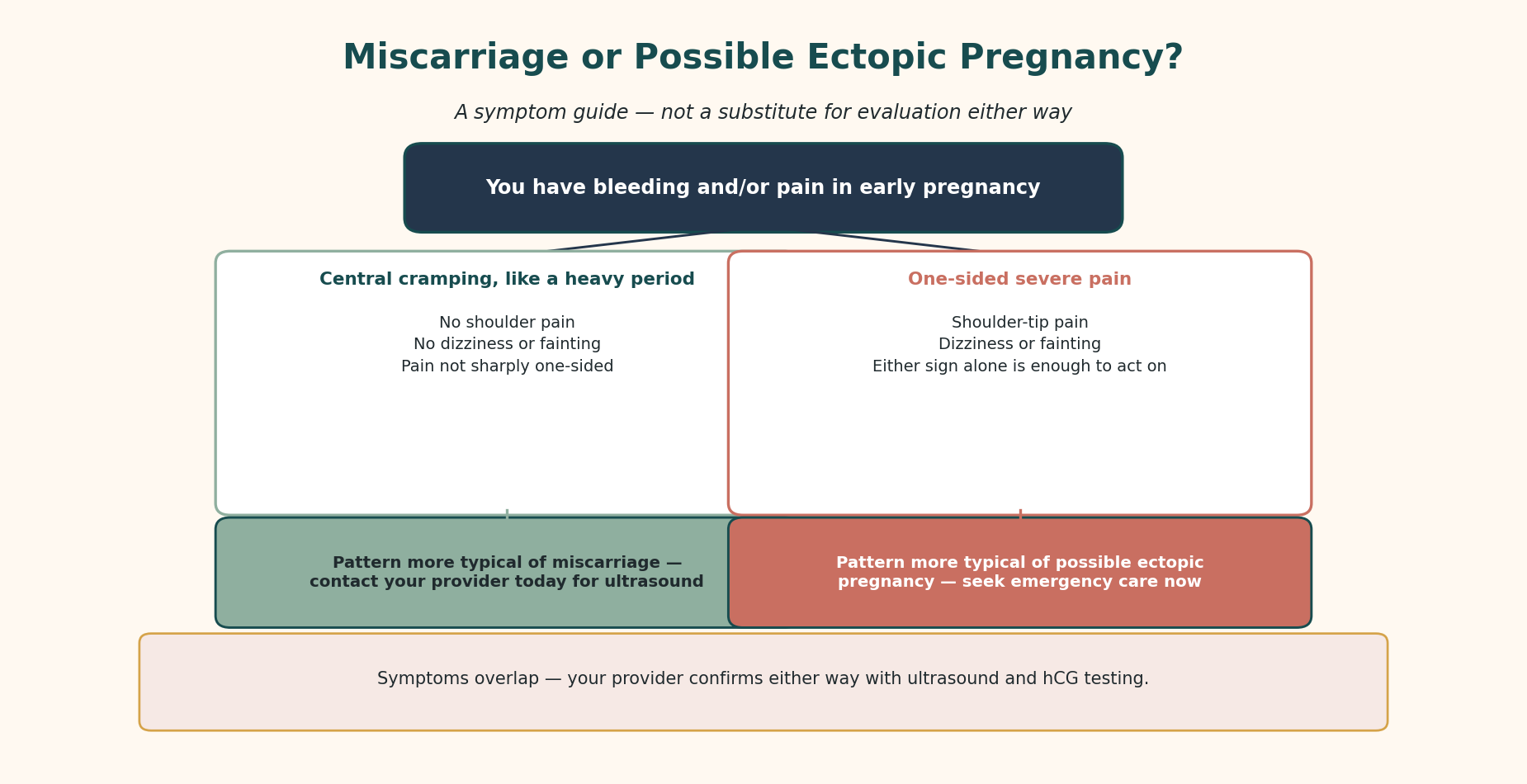
| Symptom pattern | More typical of miscarriage | More typical of possible ectopic pregnancy |
|---|---|---|
| Pain location | Central, low in the pelvis, like period cramps | One-sided, often severe and localized |
| Bleeding pattern | Ranges from spotting to heavy, like a period | Can be light, heavy, or even absent — bleeding pattern alone is not reliable here |
| Shoulder pain | Not typical | A specific warning sign (from internal bleeding irritating the diaphragm) |
| Dizziness or fainting | Uncommon unless bleeding is very heavy | A significant warning sign, especially paired with one-sided or shoulder pain |
| Timing | Can occur any time in the first trimester | Usually diagnosed between about weeks 4 and 12, often earlier in the window |
Why This Distinction Matters So Much
Different Diagnostic Path
A miscarriage is managed with the options covered later in this guide: watching and waiting, medication, or a minor procedure — none of which is a surgical emergency. An ectopic pregnancy, by contrast, cannot continue safely anywhere outside the uterus and requires either medication (methotrexate) or surgery, specifically because of where the pregnancy has implanted, not how it’s bleeding. Our ectopic pregnancy guide covers that treatment pathway in full.
Different Urgency
An undiagnosed ectopic pregnancy can progress to a ruptured fallopian tube, causing significant internal bleeding — a true surgical emergency. This is the single biggest reason providers evaluate early pregnancy bleeding with ultrasound and blood testing rather than assuming miscarriage from symptoms alone, even when the symptoms sound like a “classic” miscarriage pattern.
Signs That Point More Toward Ectopic Pregnancy
One-Sided Severe Pain
Pain that is sharp, severe, and clearly on one side (rather than centered) is one of the clearest signals that something other than a typical miscarriage may be happening. Mayo Clinic specifically lists “severe pain on one side of your pelvis” as a sign requiring immediate care for possible ectopic pregnancy.
Shoulder Pain and Dizziness or Fainting
Shoulder pain in early pregnancy is an unusual symptom that doesn’t have an obvious explanation from a typical miscarriage — it occurs when blood from an ectopic pregnancy irritates the diaphragm, and it’s specific enough that it should prompt emergency evaluation on its own. Dizziness or fainting, especially alongside either of the signs above, suggests significant internal blood loss and is also an emergency sign, per Mayo Clinic’s guidance on this combination of symptoms.
Signs That Point More Toward Miscarriage
Central Cramping and a Period-Like Bleeding Pattern
Cramping that’s centered and feels like a strong period, with bleeding that resembles a heavy period (even if heavier or longer than usual), without shoulder pain or fainting, is the more typical miscarriage pattern described throughout this guide.
Overlap Is Real — Why Providers Still Test Either Way
Even a “textbook” miscarriage presentation doesn’t rule out ectopic pregnancy with certainty, which is exactly why this isn’t a self-diagnosis checklist — it’s a guide to what should make you move faster, not a substitute for the ultrasound and blood work that actually confirms which is happening.
What Your Provider Will Do To Tell the Difference
Ultrasound Location Check
A transvaginal ultrasound can usually show whether a pregnancy is located inside the uterus (consistent with ongoing pregnancy or miscarriage) or is not visible in the uterus at a point where it should be — which raises concern for ectopic pregnancy and prompts the more specific workup covered in our ectopic pregnancy guide.
Serial hCG Patterns
Blood tests measuring hCG, often repeated 48 hours apart, help fill in the picture when ultrasound alone isn’t conclusive (which is common very early on). A healthy early pregnancy typically shows a significant rise over 48 hours; a slowly rising, plateauing, or falling level can be consistent with either miscarriage or ectopic pregnancy, which is why this blood work is paired with ultrasound rather than used alone — see the diagnosis section just below for more detail.
Key Takeaways
- One-sided severe pain, shoulder pain, and dizziness or fainting point more toward a possible ectopic pregnancy than a typical miscarriage — seek emergency care for this combination.
- Central, period-like cramping and bleeding without those signs is more typical of miscarriage, but symptoms alone never fully rule out ectopic pregnancy.
- Providers confirm which is happening with ultrasound (checking the pregnancy’s location) and often serial hCG blood testing, not from symptoms alone — see our full ectopic pregnancy guide for the complete diagnostic and treatment picture.
Getting Diagnosed: Ultrasound and hCG Monitoring
Diagnosing a miscarriage with confidence usually takes a combination of ultrasound and, sometimes, blood testing — and occasionally takes more than one visit, which can feel agonizingly slow when you just want an answer. Providers are deliberately cautious here: declaring a wanted pregnancy over too early, based on one ambiguous scan, is a mistake they work hard to avoid.
The Pelvic (Transvaginal) Ultrasound
What It Can Show
A transvaginal ultrasound (using a probe inserted into the vagina, which gives a clearer early-pregnancy view than an abdominal scan) can show the location of a pregnancy, whether a heartbeat is present, and measurements like the gestational sac size and the embryo’s crown-rump length. ACOG’s practice bulletin on early pregnancy loss lists specific findings considered diagnostic of pregnancy loss — for example, a crown-rump length of 7mm or more with no heartbeat, or a gestational sac of 25mm or more with no embryo visible inside it.
Why One Scan Sometimes Isn’t Enough
Early in pregnancy, measurements can fall into a “suspicious but not yet diagnostic” range — for instance, a smaller crown-rump length without a heartbeat, or a gestational sac without a yolk sac yet. In these cases, ACOG’s guidance calls for a follow-up scan in about one to two weeks rather than an immediate diagnosis, specifically to avoid prematurely ending a pregnancy that might still be developing normally but is simply earlier than initially estimated.
Serial hCG Blood Testing
What a Healthy Early Rise Looks Like
In a typical, viable early pregnancy, hCG (human chorionic gonadotropin, the hormone pregnancy tests detect) rises significantly over the course of 48 to 72 hours in very early pregnancy. There’s also a recognized “discriminatory zone” — an hCG level (commonly cited around 1,500 to 2,000 mIU/mL on transvaginal ultrasound) above which a normal pregnancy should be visible in the uterus; above that level with nothing visible in the uterus raises concern for either a very early loss or an ectopic pregnancy.
What a Falling or Plateauing Level Can Mean
An hCG level that rises much more slowly than expected, plateaus, or falls can indicate either a miscarriage in progress or an ectopic pregnancy — it does not, on its own, tell providers which. This is why an abnormal hCG pattern typically leads to a repeat ultrasound rather than an immediate conclusion, and why patience with this process, frustrating as it is, matters for getting the right diagnosis the first time.
Putting It Together: How Providers Reach a Diagnosis
The “Possible” vs. “Confirmed” Distinction
You may hear language like “this may not be a viable pregnancy” before a provider is ready to say “this is a confirmed miscarriage.” That gap exists because the specific diagnostic criteria (like the ultrasound measurements above) are intentionally conservative, to avoid a false-positive miscarriage diagnosis in a pregnancy that’s simply earlier than your dates suggested.
Why Patience Matters Here, Even When It’s Agonizing
Waiting a week for a confirmatory scan when you already suspect the worst is genuinely one of the hardest parts of this experience. It exists to protect against ending a wanted, viable pregnancy based on an ambiguous early scan — a safeguard that matters even though living inside that uncertainty for a week is its own kind of difficult. It’s reasonable to ask your provider directly how confident they are and what, specifically, the follow-up scan is looking for.
Key Takeaways
- Transvaginal ultrasound is the primary diagnostic tool, using specific measurement criteria (like crown-rump length and gestational sac size) defined by ACOG to confirm pregnancy loss.
- Serial hCG blood testing, often 48 hours apart, helps when ultrasound findings are ambiguous — a significant rise suggests a healthy early pregnancy, while a slow rise, plateau, or fall can indicate miscarriage or ectopic pregnancy and prompts further evaluation.
- A “possible” diagnosis sometimes needs a follow-up scan in one to two weeks before becoming “confirmed” — a deliberately cautious process designed to avoid ending a pregnancy that’s actually still developing normally.
Your Management Options: Expectant, Medication, and Surgical
Once a miscarriage is confirmed, there are three medically recognized ways to manage it, and all three are legitimate choices — this guide presents them neutrally, without ranking one as universally “better,” because the right choice genuinely depends on your specific situation, your symptoms, your schedule, and your personal preference.
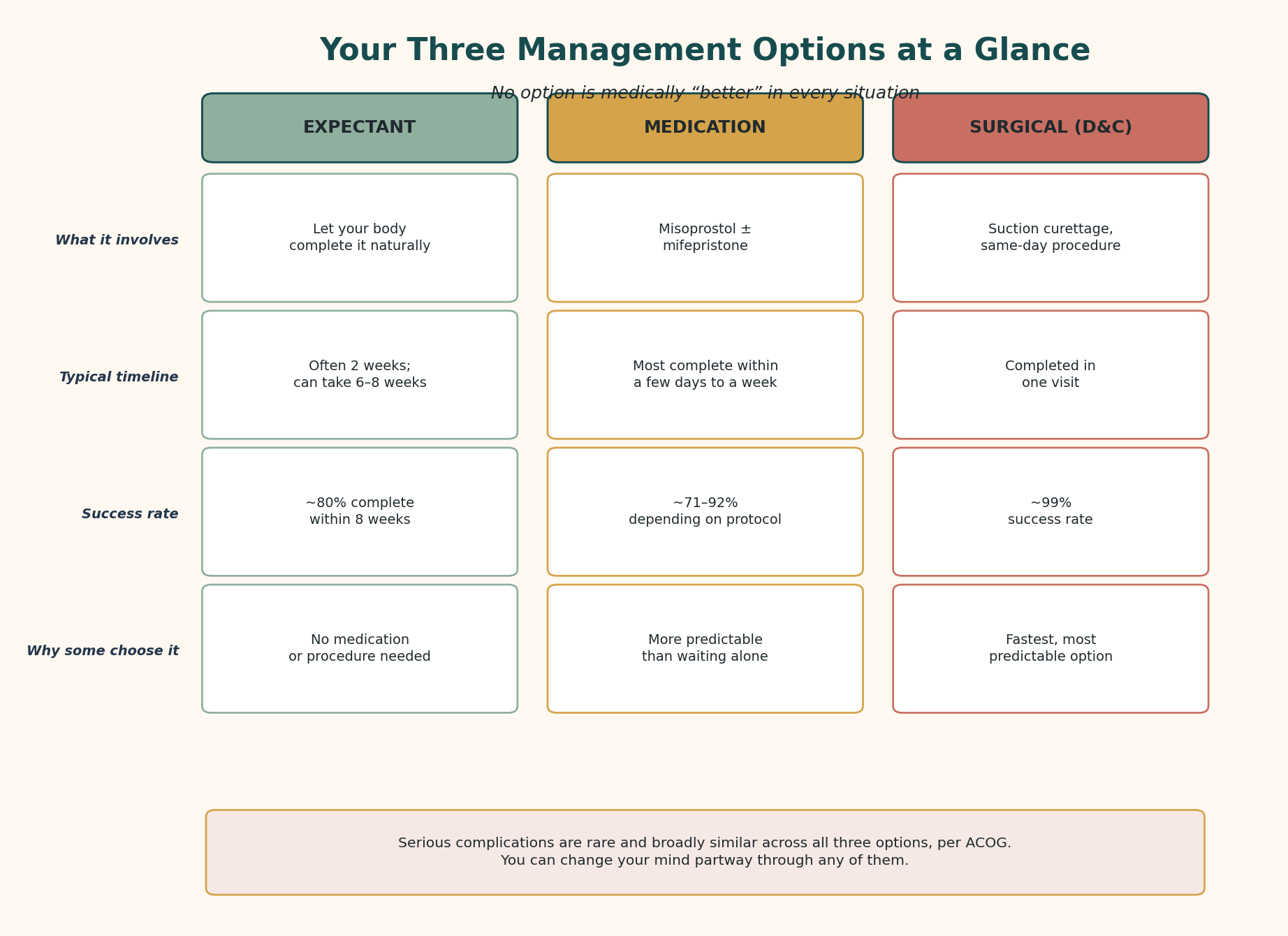
| Option | What it involves | Typical timeline | Approximate success rate |
|---|---|---|---|
| Expectant management | Letting the miscarriage complete naturally, without medication or a procedure | Often within 2 weeks; can take up to 6–8 weeks | About 80% complete within 8 weeks, per ACOG; roughly 25% may still need a procedure |
| Medication management | Misoprostol, often combined with mifepristone taken 24 hours earlier | Most complete within a few days to about a week | About 71%–84% with misoprostol alone (by dose); up to roughly 92% with mifepristone plus misoprostol combined |
| Surgical management (D&C / suction curettage) | A brief in-office or operating-room procedure to remove remaining pregnancy tissue | Completed same-day, in one procedure | Approaches 99%, per ACOG |
Expectant Management (Watchful Waiting)
What It Involves
Expectant management means letting your body complete the miscarriage on its own, without medication or a procedure, while your provider monitors you with follow-up visits or scans. According to ACOG’s practice bulletin, about 80% of people achieve complete expulsion within 8 weeks using this approach, with higher success when symptoms (bleeding, cramping) are already present rather than with a missed miscarriage that hasn’t started on its own. Roughly 25% of people who choose expectant management eventually need a procedure if the process doesn’t complete on its own.
Who It Tends To Suit
This option often appeals to people who want to avoid medication or a procedure if possible, who aren’t in a rush for a specific timeline, and who are comfortable with some unpredictability in how long the process takes and how it feels physically. It’s generally not recommended if you have signs of infection, very heavy bleeding risk factors, or a strong preference for a faster, more predictable timeline.
Medication Management (Misoprostol, With or Without Mifepristone)
How It Works
Misoprostol causes the cervix to soften and the uterus to contract, helping the body pass pregnancy tissue more quickly than it might on its own. ACOG’s practice bulletin describes a standard protocol of 800 micrograms of vaginal misoprostol, with a repeat dose if needed. Adding mifepristone 24 hours before the misoprostol dose has been shown to meaningfully improve how often the process completes without further intervention, and to lower the chance of needing a subsequent procedure.
What To Expect
Most people complete the process within a few days to about a week, with bleeding and cramping more intense than a period — often with over-the-counter or prescription pain medication recommended alongside it. Success rates vary by what type of loss is being treated: ACOG cites roughly 81% success for an anembryonic pregnancy (a gestational sac without an embryo), about 88% for an embryonic or fetal loss with misoprostol alone, and up to roughly 92% when mifepristone is added before misoprostol.
Surgical Management (D&C / Suction Curettage)
How It Works
Dilation and curettage (D&C), more specifically suction curettage for most first-trimester losses, is a brief procedure that removes remaining pregnancy tissue directly, usually under local anesthesia, sedation, or sometimes general anesthesia, depending on the setting. ACOG notes it can often be done in an office setting with local anesthesia, and that suction curettage specifically offers a faster, more predictable complete evacuation than older surgical techniques.
Who It Tends To Suit
Surgical management has the highest single-treatment success rate — approaching 99%, per ACOG — and offers the most predictable timeline, which can matter if you want closure quickly, have heavy bleeding, show signs of infection, or have already tried expectant or medication management without full success. Serious complications (significant hemorrhage, infection, or rare uterine scarring) are uncommon and occur at broadly similar low rates across all three management options, not specifically elevated with surgery.
There Is No “Better” Option — Choosing What’s Right for You
Questions to Ask Your Provider
Useful questions include: Is my situation (bleeding pattern, how far along I am, any infection risk) a good fit for all three options, or does something point toward one specifically? What would the next step look like if my first choice doesn’t fully work? And, practically, how much bleeding, pain, and time away from work or responsibilities should I expect with each option?
It’s Okay to Change Your Mind
If you start with expectant management and it feels like too much waiting, or you choose medication and want to switch to a procedure partway through, that’s a normal and acceptable thing to communicate to your provider — these aren’t one-way doors, and providers are used to patients adjusting their choice as the experience unfolds.
Key Takeaways
- Expectant management (about 80% successful within 8 weeks), medication management (roughly 71%–92% depending on the specific protocol and type of loss), and surgical management (approaching 99%) are all legitimate options, per ACOG.
- No option is universally “better” — the right choice depends on your bleeding pattern, timeline preference, infection risk, and personal comfort with waiting versus a more predictable, faster process.
- Serious complications are uncommon and occur at broadly similar low rates across all three options.
- You’re allowed to change your mind partway through if your first choice isn’t working for you.
What Happens During and Right After Each Option
Knowing roughly what to expect physically — not just the clinical description of each option, but what the hours and days actually feel like — can make the experience less frightening, whichever path you choose.
What To Expect With Expectant or Medication Management
Timeline
With expectant management, bleeding and cramping can start gradually or begin suddenly, and the heaviest part of the process (often described as feeling like a strong, crampy, heavy period, sometimes with recognizable tissue) typically lasts a few hours to a day or two, even though the full process of spotting afterward can take longer. With medication management, the heaviest bleeding and cramping usually begin within a few hours of the misoprostol dose and are most intense for several hours, easing over the following day or two.
Pain Management
Over-the-counter pain relief (ibuprofen or acetaminophen, per your provider’s guidance) is commonly recommended and often sufficient; some providers also prescribe something stronger for the first day of medication management specifically, given how intense cramping can be in that window. A heating pad, rest, and having someone around for the first day of either option — even just to be present, not necessarily to do anything — is a reasonable thing to plan for in advance.
What To Expect With a D&C
The Day Of
A D&C is typically a same-day procedure: you’ll have the procedure itself (often 10 to 15 minutes, though you’ll be at the facility longer for preparation and recovery), under local anesthesia, sedation, or general anesthesia depending on the setting and your preference, and go home the same day with someone else driving if sedation or anesthesia was used.
Immediately Afterward
Cramping and light-to-moderate bleeding or spotting afterward is normal and typically milder than with expectant or medication management, since the tissue has already been removed directly. Most people can return to normal (non-strenuous) activities within a day or two, though your provider will give you specific guidance based on your procedure and anesthesia type.
Follow-Up Care, Regardless of Which Option
Confirming Completion
Whichever option you choose, your provider will typically want to confirm the miscarriage is complete — sometimes with a follow-up ultrasound, sometimes with a repeat hCG blood test showing levels falling as expected, and sometimes with both. This matters because an incomplete miscarriage (tissue left behind) can need further treatment even after you feel like the physical process is over.
Rh Factor and Rh Immune Globulin
If you’re Rh-negative blood type, you’ll typically be offered an injection of Rh immune globulin (often known by the brand name RhoGAM) after a miscarriage, regardless of which management option you chose. This prevents your body from developing antibodies against Rh-positive blood, which could otherwise complicate a future pregnancy if that pregnancy is Rh-positive. Your provider will confirm whether this applies to you based on your blood type.
Key Takeaways
- Expectant and medication management typically involve a few hours to a couple of days of the most intense bleeding and cramping, often manageable with over-the-counter pain relief.
- A D&C is a same-day procedure with typically milder bleeding and cramping afterward, since tissue is removed directly.
- Follow-up confirmation (ultrasound and/or repeat hCG) matters regardless of which option you chose, and Rh-negative patients are typically offered Rh immune globulin after any pregnancy loss.
Physical Recovery Timeline
Physical recovery from miscarriage follows a reasonably predictable pattern, though the exact timeline varies by person and by which management option you used.

The First Few Days to Weeks
Bleeding and Cramping
Bleeding is often heaviest in the first day or two, then gradually lightens; Cleveland Clinic notes that spotting can continue for 3 to 4 weeks after a miscarriage in some cases. Cramping usually eases substantially after the first several days, though mild cramping can come and go for a short while longer.
Activity and Rest
Most providers recommend avoiding tampons and vaginal insertion (including intercourse) for about two weeks, or until bleeding has substantially resolved, to reduce infection risk while your cervix is still slightly open. Light activity is generally fine as soon as you feel able; there’s no universal requirement for bed rest, though plenty of rest in the first few days is reasonable and often welcome regardless.
Your Cycle and Hormones Returning
When Your Period Comes Back
Many people get their first period within about four to six weeks after a miscarriage, though it can take a few cycles for things to feel fully back to your personal normal, especially if your cycles weren’t perfectly regular before pregnancy either.
Why a Positive Pregnancy Test Can Linger
Because hCG takes time to clear your system completely, a home pregnancy test can stay positive for several days to a couple of weeks after a miscarriage even though the pregnancy has ended — this is expected and not a sign anything is wrong, though your provider may use a quantitative blood hCG test to track the decline more precisely if there’s any question about whether the loss is complete.
Signs Recovery Isn’t Going as Expected
Physical Red Flags
Bleeding that gets heavier instead of lighter over time, bleeding that returns after stopping, pain that worsens rather than improves, or fever are all signs to contact your provider — and if they match the emergency criteria covered earlier in this guide (very heavy bleeding, high fever, severe pain, signs of shock), they warrant emergency care rather than a routine call.
When to Call vs. When to Go to the ER
Call your provider’s office for bleeding that’s heavier than expected but not soaking through pads rapidly, mild fever, or pain that’s uncomfortable but manageable. Go to the ER for anything matching the emergency signs above — heavy bleeding (more than two pads an hour for two hours), fever of 100.4°F or higher, severe pain, or signs of shock.
Key Takeaways
- Bleeding is usually heaviest in the first day or two, with spotting sometimes continuing 3 to 4 weeks; most providers recommend avoiding tampons and intercourse for about two weeks.
- A period typically returns within about four to six weeks, and a home pregnancy test can stay positive for a week or two afterward as hCG clears — this is expected, not a red flag on its own.
- Worsening bleeding or pain, returning bleeding after it stopped, or fever are signs to contact your provider; anything matching the emergency criteria covered earlier warrants the ER instead.
Emotional Recovery and Grief
Physical recovery from miscarriage often happens faster than emotional recovery, and the gap between the two can be confusing — you might feel physically fine while still deeply grieving, or feel emotionally steadier before your body has fully caught up. Both patterns, and everything in between, are normal.
This Loss Is Real, Regardless of How Far Along You Were
Why Gestational Age Doesn’t Determine the Size of Grief
A loss at five weeks and a loss at eighteen weeks are medically different in some respects, but neither is inherently a “smaller” loss than the other in terms of what it means emotionally. You may have already imagined a due date, picked a name, told people, or simply felt a connection to the pregnancy from the moment of a positive test — none of that requires a certain number of weeks to become real grief, and nobody else gets to decide how significant your loss was to you.
Grief That Doesn’t Look Like You Expected
Grief after miscarriage can include sadness, but also anger, numbness, relief (especially with a complicated or ambivalent pregnancy, which doesn’t cancel out grief), guilt despite everything covered earlier in this guide about chromosomal causes, or a strange sense of calm that then arrives later, sometimes around a due date or an anniversary. There’s no single “correct” emotional response, and an unexpected reaction doesn’t mean you’re grieving wrong.
What Grief Can Look Like, Including the Research Behind It
Common Emotional Responses
A study from researchers at Imperial College London and KU Leuven, published in the American Journal of Obstetrics and Gynecology, followed more than 650 women after early miscarriage or ectopic pregnancy and found that one month after the loss, nearly 29% met criteria for post-traumatic stress, 24% reported moderate-to-severe anxiety, and 11% reported moderate-to-severe depression. At nine months, those numbers had declined but remained significant: about 18% still showed PTSD symptoms, 17% reported severe anxiety, and 6% reported severe depression — compared with roughly 13% anxiety and 2% depression among women with ongoing healthy pregnancies in the same study. In the researchers’ own words, distress “remains at clinically important levels at 9 months” for a meaningful share of people.
Partners, Family, and Different Grieving Styles
Partners grieve too, sometimes differently — they may feel pressure to “stay strong” for the person who physically experienced the loss, which can suppress their own grief or make them seem less affected than they are. Couples sometimes grieve on different timelines or in different styles (needing to talk it through versus needing distraction), and that mismatch, while painful, is common rather than a sign something is wrong with the relationship.
When Grief Becomes Something More
Signs to Watch For
Given how common clinically significant anxiety, depression, and post-traumatic stress symptoms are after pregnancy loss (as the research above shows), it’s worth taking seriously if you notice persistent intrusive thoughts or flashbacks about the loss, anxiety that’s interfering with daily functioning, depression that isn’t lifting, difficulty bonding with a subsequent pregnancy once you reach that point, or thoughts of self-harm. None of these mean you’re uniquely broken — they mean it’s time to ask for more support than friends and family can provide alone.
Getting Support
A therapist experienced in pregnancy loss or reproductive mental health, a perinatal grief support group (in-person or online), or a conversation with your OB-GYN or midwife about how you’re coping emotionally are all reasonable next steps. If you’re ever having thoughts of harming yourself, the 988 Suicide & Crisis Lifeline (call or text 988) is available any time, free and confidential.
Supporting Someone Through a Miscarriage
What Helps
Acknowledging the loss directly (“I’m so sorry — this is a real loss and I’m here”), asking what they need rather than assuming, following their lead on how much they want to talk about it, and checking in again after the first week or two (when a lot of support tends to fall away) are all genuinely helpful.
What to Avoid Saying
Well-meant phrases like “at least it was early,” “everything happens for a reason,” “you can try again,” or “at least you know you can get pregnant” tend to minimize the loss rather than comfort the person experiencing it, even when they’re said with real love. Simple, direct acknowledgment of the loss — without trying to find a silver lining on someone else’s behalf — is almost always better received.
Key Takeaways
- This loss is real regardless of gestational age — there’s no “too early” threshold below which grief isn’t valid.
- Research following women after early pregnancy loss found roughly 29% met criteria for post-traumatic stress at one month, declining to about 18% at nine months, with clinically significant anxiety and depression rates following a similar pattern — these numbers show significant, measurable distress is common, not a personal failing.
- Persistent intrusive thoughts, anxiety or depression that isn’t lifting, or thoughts of self-harm are signs to seek additional support — a therapist, grief support group, or your provider can help, and the 988 Suicide & Crisis Lifeline is available any time.
- When supporting someone else through this, direct acknowledgment of the loss helps far more than well-meant attempts to find a silver lining.
When Is It Medically Reasonable to Try Again?
There’s no single universal answer to “how long should I wait,” but research and clinical guidance have shifted meaningfully in recent years, and it’s worth understanding both the old advice and what’s replaced it.
The Old Advice vs. What We Know Now
Where the “Wait Six Months” Idea Came From
The World Health Organization’s older guidance recommended waiting at least six months after a pregnancy loss before conceiving again, largely out of general caution about allowing the body time to recover and reducing the interval-related risks seen with very short intervals between live births.
What Newer Research Shows
A large 2022 study published in the peer-reviewed journal PLOS Medicine analyzed Norwegian birth registry data covering more than 49,000 births following a miscarriage and roughly 23,700 births following an induced abortion. The researchers found that conceiving within three months after a pregnancy loss was not associated with increased risk of adverse pregnancy outcomes compared with waiting longer. This kind of large population-level evidence is part of why many clinicians no longer apply a strict six-month rule for most people after a single, uncomplicated first-trimester miscarriage.
Physical Readiness
Your Cycle and Ovulation
As covered in the recovery section above, ovulation and fertility can return before your first period does — Cleveland Clinic notes fertility “can return within two weeks” of a first-trimester miscarriage — which means it’s medically possible to conceive again before you’ve had a confirming period at all. If you don’t want to conceive again immediately, it’s worth discussing contraception with your provider sooner than you might expect.
What Your Provider May Want to Check First
After a single, uncomplicated miscarriage, most providers don’t require specific testing before you try again. After a D&C, your provider may want to confirm your uterus has healed on a follow-up visit. After recurrent losses, a workup (covered in the next section) may be recommended before or during a future pregnancy attempt, depending on what’s found.
Emotional Readiness
There’s No “Right” Timeline
Some people feel ready to try again within weeks; others need months or longer, and some feel pulled in both directions at once — wanting to try again while also still actively grieving. Both the physical “all clear” and your own emotional sense of readiness matter, and they don’t have to arrive on the same schedule.
Talking It Through With Your Partner or Support System
If you’re parenting or planning with a partner, differing readiness timelines between you are common and worth discussing directly rather than assuming you’re on the same page. There’s no obligation to decide quickly, and “we’re not sure yet” is a completely reasonable place to sit for a while.
Key Takeaways
- Older guidance recommended waiting six months; a large 2022 study in PLOS Medicine, using Norwegian birth-registry data on over 49,000 births, found no increased risk from conceiving within three months of a loss, and many clinicians no longer apply a strict six-month rule for most people.
- Fertility can return within about two weeks of a first-trimester miscarriage, often before your first period — worth knowing whether or not you want to conceive again right away.
- Emotional readiness and physical readiness don’t have to arrive on the same timeline, and there’s no single “right” answer for how long to wait.
Recurrent Pregnancy Loss: When to Ask for a Workup
Most people who have one miscarriage go on to have a healthy pregnancy without any special workup. But if you’ve had more than one loss, there’s a more specific path worth understanding.
What Counts as Recurrent Pregnancy Loss
The Current Definition
Recurrent pregnancy loss has classically been defined as three or more consecutive pregnancy losses, but the American Society for Reproductive Medicine has moved toward a broader definition of two or more clinically recognized pregnancy losses, per guidance referenced by UCLA Health. Because the exact threshold your provider uses can vary by practice, it’s worth asking directly when a workup might be offered to you specifically, rather than assuming a fixed number applies everywhere.
Why Definitions Have Changed
The shift toward evaluating after two losses reflects a recognition that waiting for a third loss before investigating can mean missing a treatable cause earlier, particularly for conditions like antiphospholipid syndrome where treatment in a future pregnancy can meaningfully change outcomes.
What the Workup Typically Looks For
Genetic and Chromosomal Testing
This can include karyotype testing of both partners (checking for balanced chromosomal translocations that don’t affect the parent but can affect embryos), and sometimes genetic testing of pregnancy tissue from a prior loss if it was preserved.
Structural, Hormonal, and Clotting Testing
A uterine evaluation (ultrasound, saline-infusion ultrasound, hysterosalpingogram, or hysteroscopy) checks for structural issues like a septum, fibroids, or scarring. Hormonal testing often covers thyroid function, prolactin, and diabetes screening. Antiphospholipid antibody testing (including anticardiolipin antibodies and lupus anticoagulant) checks for the clotting-related cause covered earlier in this guide.
| Category | What’s tested | What it can find |
|---|---|---|
| Genetic / chromosomal | Karyotype of both partners; sometimes genetic testing of prior pregnancy tissue | Balanced chromosomal translocations carried by a parent |
| Uterine structure | Ultrasound, saline-infusion ultrasound, hysterosalpingogram, hysteroscopy | Septum, fibroids, polyps, scarring |
| Hormonal | Thyroid function, prolactin, diabetes screening, ovarian reserve testing | Thyroid disease, uncontrolled diabetes, hormonal irregularities |
| Clotting / immune | Antiphospholipid antibody panel (anticardiolipin antibodies, lupus anticoagulant) | Antiphospholipid syndrome |
What the Workup Often Finds — and Doesn’t
When a Cause Is Identified
When a specific cause is found, treatment is targeted to it — anticoagulant medication for antiphospholipid syndrome, surgical correction for certain structural issues, or hormone management for thyroid or other hormonal causes, among others.
When No Cause Is Found (and Why That’s Not Nothing)
According to UCLA Health, more than half of recurrent pregnancy loss cases remain unexplained even after a full workup. This can feel like a frustrating non-answer, but it isn’t necessarily a bad prognosis: the same source notes that people with unexplained recurrent loss and a normal workup have roughly a 77% chance of a successful future pregnancy without any specific intervention, and that even broader research on unexplained recurrent loss generally puts the chance of a future successful pregnancy at better than 50% without intervention. “Unexplained” is a statement about the limits of current testing, not a prediction that it will happen again.
Key Takeaways
- Recurrent pregnancy loss has classically meant three or more losses, though the American Society for Reproductive Medicine has moved toward defining it as two or more — ask your provider which threshold applies to your care.
- A workup can include genetic/chromosomal testing, uterine imaging, hormonal testing, and antiphospholipid antibody testing.
- More than half of recurrent-loss cases remain unexplained even after a full workup, but the outlook is still good — roughly 77% of people with a normal workup go on to a successful pregnancy without further intervention, per UCLA Health.
Reducing Risk in a Future Pregnancy
Because the leading cause of miscarriage is chromosomal and essentially random, there’s a limit to how much any future pregnancy’s risk can be controlled — but there are still a few genuinely useful, evidence-based things within your influence, alongside a longer list of things that are not.
What You Can Reasonably Influence
General Preconception Health
Taking a prenatal vitamin with folic acid before conceiving, avoiding smoking and heavy alcohol use, moderating caffeine intake, and reaching or maintaining a healthy weight range are all reasonable, evidence-supported steps — not because any one of them guarantees anything, but because they’re genuinely within your control and have documented associations with pregnancy outcomes generally.
Managing Known Conditions
If you have a condition like diabetes, thyroid disease, or a clotting disorder, working with your provider to get it well-controlled before conceiving again is one of the more directly actionable steps available, since several of these conditions have a documented link to miscarriage risk when poorly managed.
What You Cannot Control (and Shouldn’t Blame Yourself For)
Chromosomal Randomness
No amount of diet, exercise, supplements, or stress management prevents the random chromosomal errors that cause most miscarriages. This bears repeating from earlier in this guide because it’s easy to slip back into self-blame when planning a future pregnancy, searching for something — anything — you could do differently.
Age-Related Risk
If age is a factor in your risk profile, as covered in the age-related risk table earlier in this guide, that’s not something lifestyle changes can offset, though it doesn’t mean a healthy pregnancy isn’t still the most likely outcome at any age — even at the higher end of the ranges in that table, most pregnancies do not end in loss.
Extra Monitoring in a Pregnancy After Loss
Early Ultrasounds and hCG Checks
Many providers offer earlier-than-standard ultrasounds or hCG monitoring in a pregnancy that follows a loss, specifically to provide earlier reassurance (or earlier information, if something isn’t progressing as expected) than the standard prenatal schedule would otherwise offer. It’s reasonable to ask for this directly if it isn’t offered and would help your anxiety.
Emotional Support During Early Weeks
The early weeks of a pregnancy after loss are frequently described as some of the most anxious of the entire pregnancy, even when everything is going well medically. Naming that anxiety to your provider, a therapist, or a support group — rather than trying to just push through it alone — is a reasonable and common thing to need.
Key Takeaways
- Preconception health steps (folic acid, avoiding smoking/heavy alcohol use, managing known conditions) are genuinely useful but don’t guarantee an outcome, since most miscarriage risk is chromosomal and random.
- Age-related risk and chromosomal randomness are not within your control, and are not things to blame yourself for while planning ahead.
- Extra early monitoring and emotional support are both reasonable things to ask for in a pregnancy that follows a loss.
Special Situations
A few circumstances change how miscarriage is experienced or discussed, even though the core medical facts in this guide still apply.
Miscarriage After Fertility Treatment (IUI or IVF)
Why It Can Feel Different
A miscarriage after IUI or IVF often follows months or years of treatment, appointments, and financial and emotional investment, which can intensify grief and make “just try again” feel especially dismissive, given everything that went into that specific attempt.
What’s the Same Medically
The underlying causes, diagnostic process, and management options covered throughout this guide are generally the same regardless of how conception occurred — a miscarriage after IVF is still most commonly caused by the same chromosomal factors described earlier, not by something about the fertility treatment itself failing differently.
Miscarriage With Twins or Multiples (Vanishing Twin Syndrome)
What Vanishing Twin Syndrome Is
Vanishing twin syndrome occurs when one embryo in a multiple pregnancy is seen on an early ultrasound but is no longer visible on a later one, while the pregnancy otherwise continues. Cleveland Clinic estimates this affects roughly 15% to 35% of twin pregnancies, and about half of pregnancies with three or more embryos.
What To Expect
Most instances cause no noticeable symptoms at all, though some involve light bleeding or mild cramping that can be mistaken for a typical early-pregnancy symptom. When it happens in the first trimester, Cleveland Clinic notes it usually doesn’t affect the remaining pregnancy, though your provider may still want to grieve the loss with you if you ask, even while continuing to care for an ongoing pregnancy — both can be true at once, and support staff are generally prepared for that complexity.
Miscarriage and an Unplanned or Still-Undecided Pregnancy
If You Were Still Deciding
If you were still weighing parenting, adoption, or abortion when a miscarriage happened, it’s entirely normal to have complicated feelings — relief, grief, both at once, or something that doesn’t fit either label — and none of those reactions needs to be resolved quickly or explained to anyone.
Where to Go for Options Information
If you’re processing this alongside broader questions about an unplanned pregnancy generally — the decision-making process, timelines, or where to find neutral counseling — our unplanned pregnancy guide covers that territory in full, separate from the medical focus of this article.
Key Takeaways
- A miscarriage after fertility treatment is medically similar to any other miscarriage, even though the emotional weight of the specific attempt can make it feel different.
- Vanishing twin syndrome, affecting roughly 15%–35% of twin pregnancies per Cleveland Clinic, usually doesn’t affect a continuing pregnancy when it happens in the first trimester — and grieving the twin that was lost is still valid even while the other pregnancy continues.
- Complicated feelings about a miscarriage during an undecided or unplanned pregnancy are normal and don’t need to be resolved quickly.
Glossary of Miscarriage-Related Terms
Quick definitions for the clinical terms used throughout this guide, in plain language.
Types of Loss
Miscarriage / Spontaneous Abortion / Early Pregnancy Loss
Interchangeable clinical terms for the loss of a pregnancy before 20 weeks; “spontaneous abortion” is medical terminology and does not refer to elective abortion.
Threatened Miscarriage
Bleeding, with or without cramping, while the cervix remains closed and the pregnancy may still be viable.
Inevitable Miscarriage
Bleeding and cramping with an open (dilated) cervix; the pregnancy cannot continue.
Incomplete Miscarriage
Some pregnancy tissue has passed, but some remains in the uterus on ultrasound.
Complete Miscarriage
All pregnancy tissue has passed from the uterus, typically confirmed by follow-up ultrasound.
Missed Miscarriage
The pregnancy has stopped developing, but no bleeding, cramping, or tissue passage has started; usually found on a routine ultrasound.
Chemical Pregnancy
A very early loss occurring within about the first five weeks, before a pregnancy would be visible on ultrasound, often appearing as a positive test followed by a period-like bleed.
Recurrent Pregnancy Loss (RPL)
Multiple pregnancy losses before 20 weeks; historically defined as three or more consecutive losses, with some professional guidance now using two or more as the threshold for a workup.
Diagnosis and Monitoring Terms
Transvaginal Ultrasound
An ultrasound performed with a probe inserted into the vagina, which gives a clearer early-pregnancy view than an abdominal ultrasound.
hCG (Human Chorionic Gonadotropin)
The pregnancy hormone detected by pregnancy tests; its blood level pattern over time can help providers assess whether a pregnancy is developing typically.
Discriminatory Zone
The hCG level (commonly cited around 1,500 to 2,000 mIU/mL on transvaginal ultrasound) above which a normal, viable intrauterine pregnancy should be visible on ultrasound.
Crown-Rump Length
A measurement of the embryo from the top of the head to the bottom of the torso, used alongside the presence or absence of a heartbeat to help assess pregnancy viability on ultrasound.
Gestational Sac
The fluid-filled structure visible on early ultrasound that contains the developing embryo; its size and contents are part of how early pregnancy viability is assessed.
Subchorionic Hemorrhage
A small collection of blood between the uterine wall and the pregnancy membranes, often found incidentally on ultrasound, which frequently resolves without affecting the pregnancy.
Causes and Related Conditions
Chromosomal Abnormality
A random error in the number or structure of chromosomes at conception; the leading identifiable cause of miscarriage, responsible for roughly half to two-thirds of first-trimester losses.
Antiphospholipid Syndrome
An autoimmune condition causing increased blood-clotting risk, including in the vessels supporting early pregnancy; one of the few treatable causes of recurrent pregnancy loss.
Uterine Septum
A band of tissue dividing part of the uterine cavity, a structural cause sometimes identified during a recurrent pregnancy loss workup.
Balanced Chromosomal Translocation
A rearrangement of chromosomal material that doesn’t affect the carrying parent’s health but can affect the chromosomal balance of embryos they conceive, sometimes identified through karyotype testing after recurrent loss.
Management and Treatment Terms
Expectant Management
Allowing a miscarriage to complete naturally, without medication or a procedure, with provider monitoring.
Medication Management
Using misoprostol, often combined with mifepristone taken beforehand, to help the body complete a miscarriage more predictably than expectant management alone.
Misoprostol
A medication that softens the cervix and causes uterine contractions, used in miscarriage management to help the body pass pregnancy tissue.
Mifepristone
A medication sometimes given 24 hours before misoprostol in miscarriage management, shown to improve the likelihood of complete expulsion without further intervention.
Dilation and Curettage (D&C) / Suction Curettage
A brief procedure that removes remaining pregnancy tissue from the uterus directly; suction curettage is the preferred surgical technique for most first-trimester losses.
Rh Immune Globulin (Rh Immunoglobulin)
An injection offered to Rh-negative patients after a pregnancy loss to prevent antibody development that could complicate a future Rh-positive pregnancy.
Other Related Terms
Ectopic Pregnancy
A pregnancy implanted outside the uterus, most often in a fallopian tube, which cannot continue safely and requires its own specific treatment — see our dedicated ectopic pregnancy guide for full detail.
Vanishing Twin Syndrome
The loss of one embryo in a multiple pregnancy, visible on an early ultrasound but no longer present on a later one, while the remaining pregnancy continues.
Implantation Bleeding
Light, brief bleeding that can occur around the time a period is due, when a fertilized egg implants in the uterine lining — a normal early-pregnancy event, not a sign of loss; see our implantation bleeding guide.
Gestational Age
How far along a pregnancy is, typically measured in weeks from the first day of the last menstrual period; see our gestational age guide for how this is calculated.
Frequently Asked Questions
These questions cover the long tail of things people ask about miscarriage that aren’t already addressed in full above, organized by theme. If you don’t see your exact question, the sections linked throughout this guide likely cover it in more depth.
Getting Started: The Basics
Is miscarriage the same thing as a spontaneous abortion?
Yes — “spontaneous abortion” is the formal medical term you may see on paperwork or test results, and it means exactly the same thing as miscarriage. It has no relationship to elective (induced) abortion; the word “spontaneous” is doing the work of distinguishing the two.
At what point does a loss become a “stillbirth” instead of a miscarriage?
The dividing line most U.S. sources use is 20 weeks of pregnancy: a loss before 20 weeks is classified as a miscarriage or early pregnancy loss, and a loss at or after 20 weeks is classified as a stillbirth. This guide covers miscarriage specifically.
Statistics and How Common It Is
Is miscarriage more common in a first pregnancy?
Miscarriage risk is driven mainly by factors like age and chromosomal chance rather than whether it’s a first pregnancy specifically. A first pregnancy is not inherently higher-risk on that basis alone.
Does the risk of miscarriage go down after each week that passes?
Generally, yes — overall miscarriage risk decreases as a pregnancy progresses through the first trimester, since risk is heavily concentrated in the earliest weeks (which is part of why many providers wait until after 12 weeks to make some announcements or decisions, though that’s a personal choice, not a requirement).
Causes and Self-Blame
I had a glass of wine before I knew I was pregnant. Did that cause my miscarriage?
Almost certainly not. Most miscarriages are caused by a chromosomal error present from the moment of conception, well before any lifestyle factor in the days or weeks that followed could have mattered. A single instance of something before you knew you were pregnant is not a meaningful risk factor.
Could an argument, a fall, or an injury have caused my miscarriage?
A minor fall or an argument does not cause miscarriage in a typical pregnancy. A significant physical trauma is a different question your provider can address directly, but everyday stress, emotional conflict, or a minor stumble are not established causes.
Chromosomal and Genetic Questions
If my miscarriage was chromosomal, does that mean I carry a genetic problem?
Not usually. Most chromosomal abnormalities that cause miscarriage are random errors that occurred during that specific conception (in the egg or sperm cell division process), not an inherited condition you carry. A parent carrying a balanced translocation is a less common, specifically testable possibility, usually considered only after recurrent loss.
Can I test the miscarriage tissue to find out if it was chromosomal?
Sometimes, yes — if tissue is available (often after a D&C) and there’s a reason to test it (such as recurrent loss), genetic testing of the tissue can sometimes identify a chromosomal abnormality. This isn’t routinely done after a single miscarriage, but you can ask your provider whether it’s an option for your situation.
Types of Miscarriage: Follow-Up Questions
Can a threatened miscarriage turn into a healthy, ongoing pregnancy?
Yes — a threatened miscarriage is genuinely uncertain, and a meaningful portion of these pregnancies continue normally. It’s one of the few diagnoses in this guide where “wait and see” isn’t just a management choice but an accurate description of the medical uncertainty itself.
Is a missed miscarriage more dangerous than other types?
Not inherently — the main practical difference is that your body hasn’t started the process on its own, which means you and your provider are choosing a starting point for management (expectant, medication, or surgical) rather than reacting to a process already underway.
Bleeding Symptom Questions
Is brown blood better or worse than bright red blood in early pregnancy?
Not necessarily either — color alone isn’t a reliable indicator of severity. Brown blood is often (but not always) older blood that’s taken longer to leave the body, while bright red tends to be fresher, but both can occur with both normal pregnancies and pregnancy loss.
How much bleeding is “too much” if I’m not sure it’s reached the 2-pads-an-hour threshold?
If you’re genuinely unsure whether you’ve crossed that threshold, err toward getting evaluated rather than trying to measure precisely in the moment — the threshold is a clear trigger for emergency care, not a bar you need to definitively confirm you’ve crossed before seeking help.
Pain and Cramping Questions
How does miscarriage cramping compare to labor contractions?
Early miscarriage cramping is generally much milder than labor contractions, more comparable to strong menstrual cramps, though a loss later in the first trimester can involve more intense cramping that some people compare to early labor-like sensations.
Is back pain alone, without cramping, a miscarriage sign?
Back pain alone, without bleeding or other symptoms, is not a specific or reliable sign of miscarriage on its own — it’s extremely common in pregnancy generally for other reasons. Combined with bleeding and cramping, it fits the broader pattern described in the symptoms section above.
Miscarriage vs. Ectopic Pregnancy: Follow-Up Questions
Can you have ectopic-like symptoms and it still turns out to be a normal miscarriage?
Symptom overlap happens, which is exactly why providers confirm with ultrasound and blood testing rather than diagnosing from symptoms described over the phone — having a concerning symptom pattern doesn’t guarantee an ectopic pregnancy, but it does mean you should be evaluated promptly either way.
Is it possible to have no symptoms at all with an ectopic pregnancy?
Yes, in some cases, which is part of why routine early ultrasounds matter even without symptoms — our ectopic pregnancy guide covers the full range of presentations in detail.
Ultrasound Diagnosis: Follow-Up Questions
Why did my ultrasound say “no definitive heartbeat yet” instead of giving me a clear answer?
This usually means your measurements fall in the range where it’s genuinely too early to tell, rather than measurements that are diagnostic of loss — see the diagnosis section above for the specific thresholds providers use, and the usual next step of a follow-up scan in one to two weeks.
Can my dates be wrong in a way that explains an ultrasound that looked concerning?
Yes, this happens often — if your cycle is irregular or ovulation happened later than a standard 28-day cycle would suggest, your pregnancy may genuinely be earlier than your last-period-based due date implies, which is exactly why ACOG’s guidelines call for a follow-up scan before concluding a loss in ambiguous cases.
Expectant Management: Follow-Up Questions
How do I know if expectant management isn’t working and I need to switch approaches?
Your provider will typically set a follow-up scan or check-in; if tissue hasn’t passed within the expected window (often discussed around the two-week mark, though up to 6–8 weeks is still considered within range per ACOG), or if you develop concerning symptoms, that’s when switching to medication or surgical management is usually discussed.
Is expectant management more painful than medication management?
Pain levels vary by individual rather than reliably by method, though some people find the less predictable timing of expectant management more stressful even if the physical pain itself is comparable.
Medication Management: Follow-Up Questions
Is misoprostol for miscarriage management the same medication used for medication abortion?
Misoprostol is the same medication used in both contexts, though the clinical situation, intent, and sometimes the specific protocol differ — for miscarriage management, it’s being used to help complete a pregnancy loss that has already occurred or been confirmed as non-viable, not to end an ongoing pregnancy.
Can I take misoprostol at home, or does it have to be done at a clinic?
Many people take misoprostol at home after instruction from their provider, with a clear plan for what to expect and when to call or seek care; this depends on your specific provider’s protocol and your comfort level.
Surgical Management (D&C): Follow-Up Questions
Will I be asleep for a D&C, or will I feel it?
This depends on the anesthesia approach — options can include local anesthesia (you’re awake but the area is numbed), sedation, or general anesthesia, and ACOG notes the procedure can often be done in an office setting with local anesthesia. Your provider will discuss which options are available and appropriate for your situation.
How long does a D&C procedure actually take?
The procedure itself is typically brief, often around 10 to 15 minutes, though you should expect to be at the facility longer overall for preparation, the procedure, and recovery time afterward, especially if sedation or anesthesia is used.
Physical Recovery: Follow-Up Questions
Is it normal to feel exhausted for weeks after a miscarriage, beyond just the bleeding?
Yes — hormonal shifts as your body returns to its non-pregnant state, physical recovery, and emotional toll can all contribute to fatigue that outlasts the bleeding itself. If exhaustion is severe or persistent well beyond a few weeks, it’s worth mentioning to your provider to rule out other contributing factors.
When can I take a bath again after a miscarriage?
Many providers recommend showers over baths during active bleeding, similar to general guidance around vaginal insertion and infection risk during this window; ask your specific provider for guidance tailored to your situation and management option.
Emotional Recovery: Follow-Up Questions
Is it normal to feel relieved as well as sad, especially with an unplanned or complicated pregnancy?
Yes — relief and grief can coexist, and having complicated feelings doesn’t cancel out real grief or mean you didn’t care about the pregnancy. Both feelings are valid and common, especially with a pregnancy that wasn’t simple to begin with.
How long is “too long” to still be grieving a miscarriage?
There’s no fixed timeline after which grief becomes inappropriate — as the research cited earlier in this guide shows, clinically significant distress can persist for many months for a meaningful share of people. If grief feels unmanageable or is worsening rather than gradually easing, that’s the more useful signal to seek additional support, not a specific number of weeks or months.
Supporting a Partner or Loved One
My partner seems unaffected — does that mean they don’t care?
Not necessarily — partners sometimes grieve more privately, may feel pressure to “be strong,” or may process loss on a different timeline. It’s worth gently asking how they’re doing rather than assuming their outward presentation reflects their actual feelings.
How do I support a friend through a miscarriage without saying the wrong thing?
Acknowledging the loss directly, asking what they need rather than guessing, and avoiding phrases that minimize the loss (covered in the emotional recovery section above) are the most reliably helpful approaches. When in doubt, “I’m so sorry, and I’m here” is rarely the wrong thing to say.
Trying to Conceive Again
Do I need to see a doctor before trying again after just one miscarriage?
Not necessarily, for a single, uncomplicated first-trimester miscarriage — many providers don’t require a specific pre-conception visit in that situation, though it’s always reasonable to check in if you have questions or want reassurance before trying again.
Should I track ovulation more carefully after a miscarriage?
This is a personal choice rather than a medical requirement — some people find ovulation tracking reassuring and useful for timing, while others find it adds stress; there’s no evidence that tracking itself changes your odds of a healthy outcome.
Recurrent Pregnancy Loss: Follow-Up Questions
Do both partners need to be tested in a recurrent pregnancy loss workup?
Often, yes — karyotype testing, in particular, is typically recommended for both partners, since a balanced translocation can be carried by either person and still affect embryos.
Can recurrent pregnancy loss be caused by something different each time?
Yes — it’s possible for different losses in the same person to have different underlying contributors (for example, one chromosomal and another related to a treatable clotting factor), which is part of why a full workup looks across several categories rather than assuming one cause explains every loss.
Miscarriage After Fertility Treatment
Is miscarriage more common after IVF than after natural conception?
Research on this varies by the specific population studied and factors like maternal age, since people pursuing IVF are sometimes older or have specific underlying fertility factors already; a direct, universal comparison isn’t something this guide can state as a single figure.
Does a miscarriage after IVF mean the embryo grading or genetic testing was wrong?
Not necessarily — even embryos that look healthy on grading, or that passed preimplantation genetic testing for the conditions it screens for, can still be affected by factors that testing doesn’t catch, or can be affected by maternal factors unrelated to the embryo itself.
Multiples and Vanishing Twin: Follow-Up Questions
Will I be told specifically if I had a vanishing twin, or might it go unnoticed?
If an early ultrasound showed two embryos and a later one shows only one, your provider should tell you directly — this isn’t something typically withheld, though very early vanishing twin situations (before any ultrasound was done) might never be specifically identified as such.
Do I need extra monitoring if I had a vanishing twin and I’m continuing the other pregnancy?
Your provider will determine this based on timing and your specific situation — Cleveland Clinic notes that first-trimester vanishing twin usually doesn’t affect the remaining pregnancy, but your provider may still choose some additional monitoring depending on your case.
