
Finding out you’re pregnant at 16 can feel overwhelming, but you have real options, real rights, and real support available — starting today, regardless of what you decide or haven’t decided yet. This guide walks through getting confidential medical care, your three options in brief, who can help you right now, your rights at school, and the legal questions that come up specifically at 16 — with no judgment anywhere in between.
Short Answer: You Have Options, Rights, and Support Available Now
You can get medical care, explore your options, and get support right now at 16, whether or not you’ve told your parents yet, and whatever you ultimately decide. Nothing about being 16 specifically shuts any of these doors, though some processes do involve extra legal steps compared to being an adult.
Key Takeaways
- You can get confidential prenatal care and explore your options starting today.
- You have three options — parenting, adoption, and abortion — and this guide links to our full-depth guide on each.
- Several sources of confidential help exist even if you’re not ready to tell your parents.
- You have real rights to stay in school and keep up with your education.
- A handful of legal questions come up specifically at 16, including medical-consent thresholds and the partner’s-age question.
The One Thing to Know Right Now
Being 16 Doesn’t Close Any Doors
Every option available to an older pregnant person is still available to you, even though a few of them involve extra legal steps because you’re a minor. Nothing here is designed to pressure you toward any one choice.
You Don’t Have to Figure Everything Out Today
Getting medical care is the one genuinely time-sensitive first step; deciding on parenting, adoption, or abortion can take the time it reasonably takes, within the practical limits each option has.
What This Guide Covers (and Where to Go for More)
This Guide’s Own Focus
This guide focuses on what’s genuinely specific to being 16: medical-consent thresholds that sometimes use 16 as a cutoff, school and compulsory-attendance questions, the partner’s-age question, and transportation and daily-life logistics.
Our Fuller General Guide
For the complete general picture — all three options in full depth, general minor-consent law, judicial bypass, Title IX, and adoption guardian-consent rules — see our guide for pregnant teenagers, which this article deliberately does not repeat.

Getting Confidential Medical Care
Getting seen by a medical provider is the one step worth doing right away, regardless of what you decide afterward.
Confirming the Pregnancy and Getting Prenatal Care
Confirming Is the First Step
A home pregnancy test followed by a confirmation visit at a clinic, health department, or your regular provider is the standard first step; many clinics offer free or low-cost confirmation testing.
Starting Prenatal Care Doesn’t Require a Decision First
You don’t need to have decided on parenting, adoption, or abortion before starting prenatal care — getting seen and deciding can happen on separate timelines.
Medical-Consent Age Thresholds Specific to 16
Some States Use 16 as a Specific Legal Threshold
Unlike the general minor-consent landscape covered in our teen-options hub, several states set 16 specifically (rather than a single universal age) as a threshold for a minor’s ability to independently consent to certain health services.
Pregnancy-Related Care Often Has Its Own Rule
Separately, nearly every state allows a pregnant minor of any age to consent to her own pregnancy-related medical care specifically, regardless of general minor-consent age thresholds for other services — our prenatal care and adoption plan guide covers this in more depth.
Your Three Options, Briefly
You have three options, the same three any pregnant person has, and no one can make this decision for you.
Parenting, Adoption, and Abortion — The Short Version
Parenting
Raising the child yourself, with whatever support system you build around that — family, your partner, school resources, and community support.
Adoption
Making an adoption plan, which can range from a fully open relationship with the adoptive family to a more closed arrangement, depending on what you choose.
Abortion
Ending the pregnancy, subject to your state’s specific gestational-age limits and any parental-involvement requirements that apply to minors in your state.
Where to Go for the Full Picture on Each
Dedicated Guides for Each Option
This guide keeps each option brief; see “If You’re Considering Parenting,” “If You’re Considering Adoption,” and “If You’re Considering Abortion” below for slightly more detail specific to being 16, and our teen-options hub for the complete picture on all three.
No Pressure Toward Any One Option
Nothing in this guide, or in the guides it links to, is designed to steer you toward one option over another — the goal is giving you accurate information so you can decide for yourself.
| Option | What’s Different Because You’re a Minor |
|---|---|
| Parenting | No legal barrier specific to being a minor; practical support planning matters more |
| Adoption | Court involvement in finalizing consent is common for minor birth parents, varies by state |
| Abortion | Parental notification/consent or judicial bypass may apply, depending on your state |
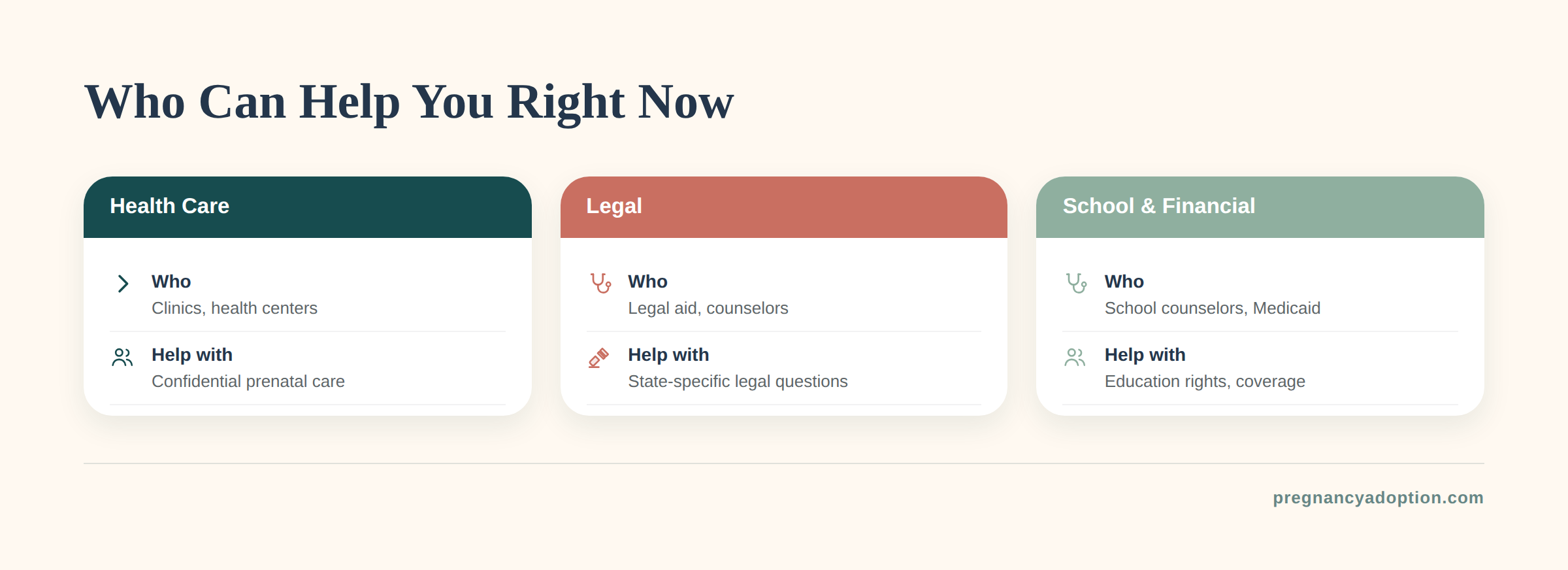
Who Can Help You Right Now
You don’t have to navigate this alone, and you don’t have to start with your parents if you’re not ready to.
Confidential Sources of Support
Pregnancy Options Counseling
Pregnancy options counselors (available through clinics, some school counselors, and dedicated hotlines) can talk through all three options with you without pushing you toward any one of them.
School Counselors and Social Workers
Many school counselors and social workers are trained to connect students with confidential resources and are often bound by confidentiality rules separate from telling your parents, though policies vary by school and district.
People You Might Choose to Tell — Or Not
A Trusted Adult
A trusted adult — an aunt, an older sibling, a family friend, a coach — can sometimes be a useful first person to tell before telling your parents, if you have someone like that in your life.
Your Decision to Make, on Your Own Timeline
There’s no single right order for telling people; what matters is getting medical care started, which doesn’t require telling anyone beyond the provider seeing you.
School and Continuing Your Education
You have real, legally protected rights to continue your education, and being 16 specifically raises a question the general guide and PA-0051’s 17-specific content didn’t need to cover.
Your Rights to Stay Enrolled
You Can Stay in Your Regular School
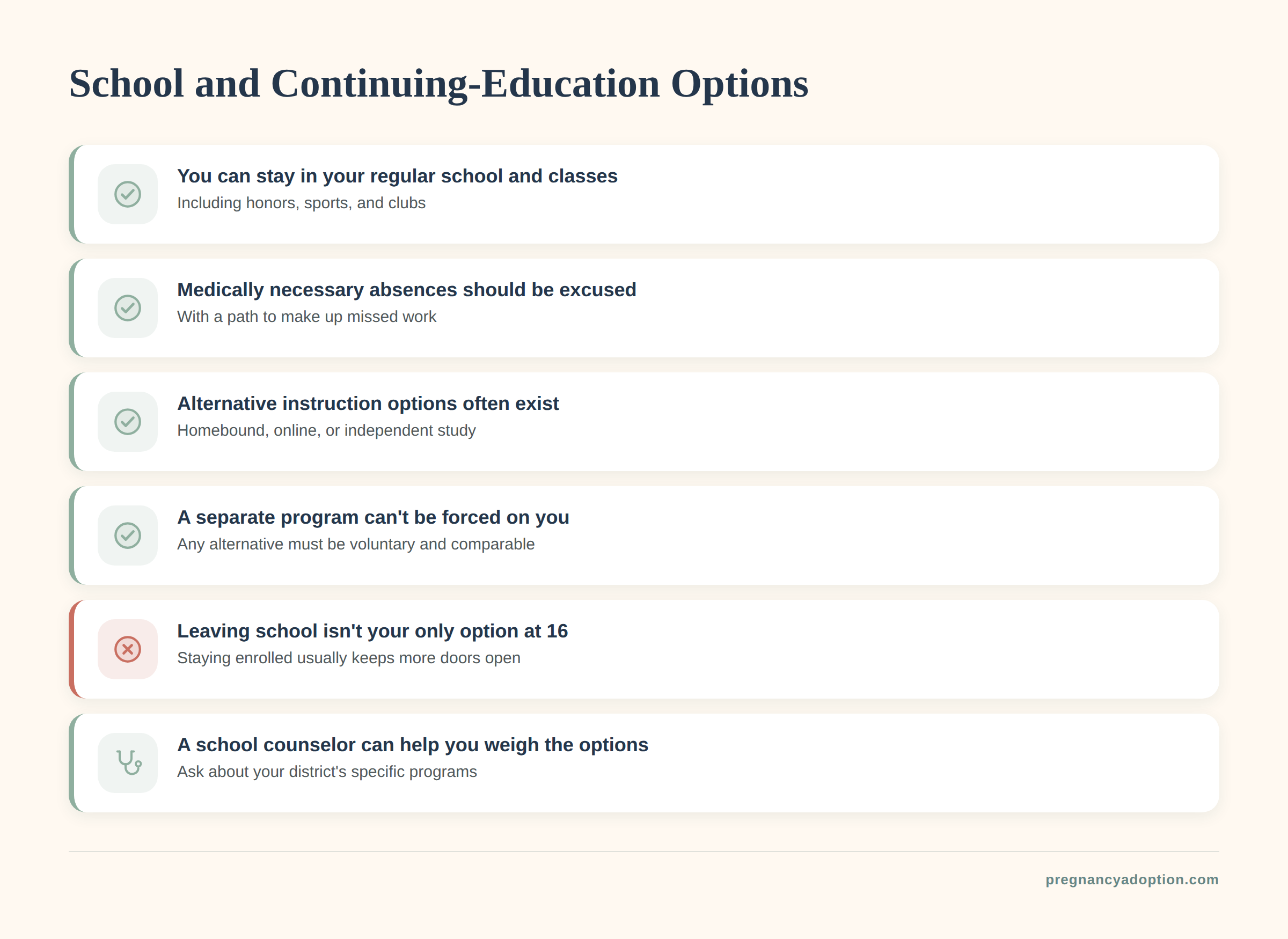
Federal law (Title IX) generally prohibits schools from excluding you from classes, activities, honors courses, sports, or leadership roles because of pregnancy, and any separate program offered must be voluntary and comparable to the regular one.
Excused Absences and Makeup Work
Absences for prenatal appointments and childbirth recovery should be excused for as long as medically necessary, with options to make up missed work rather than losing credit outright.
Options If Compulsory Attendance Age Is a Factor for You
Sixteen Is a Threshold Age in Many States
In many states, 16 is the age at which compulsory school attendance ends — a genuinely new consideration this guide needs to address that didn’t come up the same way for a junior or senior closer to a defined graduation path.
Staying Enrolled Is Still Usually the Stronger Option
Even where leaving school becomes legally possible at 16, staying enrolled — using the accommodations and alternative-instruction options described above — generally keeps more doors open than leaving does, and a school counselor can help weigh the specific options available in your district.
Alternative and Online Instruction
If attending your regular building isn’t working during part of your pregnancy or after birth, schools are generally required to offer the same special-instruction options they’d offer any student with a temporary medical condition — homebound instruction, online coursework, or independent study among them.
Legal Questions Specific to Being 16
A few legal questions come up specifically at 16 that are worth understanding, in addition to the general minor-consent and judicial-bypass content covered in our teen-options hub.
Parental Involvement Laws for Medical Decisions
These Laws Vary Significantly by State
Whether a parent must be notified or must consent before a minor can access abortion care, and what judicial-bypass process exists as an alternative, varies by state and isn’t specific to being 16 versus 17 — our teen-options hub covers this in full general depth.
Pregnancy-Related Care Is Usually Treated Differently
As noted above, most states let a pregnant minor of any age consent to her own prenatal and delivery care specifically, separate from the broader parental-involvement question that applies to abortion specifically in some states.
The Partner’s-Age Question
A Sharper Version of a Question Raised at 17
If your partner is significantly older than you, the age gap between a 16-year-old and an adult partner more often crosses into statutory age-of-consent territory than the same gap would for a 17-year-old, because age-of-consent and “close in age” exemption laws vary by state and by the specific ages involved.
This Is a Legal Question Worth Getting Real Answers To
If you have concerns about your specific situation, a confidential conversation with a pregnancy options counselor, a school counselor, or a legal aid organization can help you understand what applies in your state without requiring you to involve anyone else first.
If Your Parents Don’t Know Yet
Deciding whether, when, and how to tell your parents is a real decision, separate from deciding what to do about the pregnancy itself.
Deciding Whether and When to Tell Them
There’s No Required Timeline
Outside of specific legal requirements tied to certain procedures (like some states’ parental-involvement laws for abortion), there’s no general requirement that you tell your parents by a certain point, though involving a trusted adult earlier rather than later often makes practical logistics easier.
Practicing the Conversation Can Help
Practicing what you want to say, possibly with a counselor or trusted adult first, can make the actual conversation feel more manageable when you’re ready to have it.
If You’re Worried About Their Reaction
Safety Comes First
If you have genuine safety concerns about telling a parent — fear of violence or being forced out of your home — a school counselor, pregnancy options counselor, or a domestic-violence or youth-shelter hotline can help you think through safety planning before that conversation happens.
Most Reactions Are More Manageable Than Feared
Many parents react better than initially feared, though every family is different, and it’s reasonable to prepare for a range of reactions rather than assume the worst or the best.
Paying for Care and Everyday Needs
Cost shouldn’t be a barrier to getting care, and several programs exist specifically to help.
Health Care Coverage Options
Medicaid and CHIP
Pregnancy-related Medicaid coverage is available in every state, often with income thresholds specifically more generous for pregnancy coverage than general Medicaid, and minors can often apply or be assisted in applying without needing a parent to be the one who applies.
Community Health Centers
Federally Qualified Health Centers offer sliding-scale care regardless of insurance status or ability to pay.
Everyday Financial and Practical Support
WIC and Other Nutrition Support
The WIC program (Women, Infants, and Children) provides nutrition support and is generally available to pregnant people regardless of age, including minors.
School-Based and Community Resources
Some schools and community organizations offer additional practical support — from maternity clothes to parenting classes to case management — worth asking a school counselor or pregnancy options counselor about directly.
| Program | What It Covers |
|---|---|
| Pregnancy Medicaid | Prenatal, delivery, and postpartum medical care, often with more generous income limits than general Medicaid |
| Federally Qualified Health Centers | Sliding-scale medical care regardless of insurance status |
| WIC | Nutrition support and food assistance during pregnancy and after birth |
| School-based support programs | Varies by district — may include case management, parenting classes, or practical supplies |
Getting to Appointments
Transportation is a genuinely practical hurdle at 16 that’s worth planning for directly.
If You Don’t Drive Yet
A New Logistics Question at This Age
Many 16-year-olds are newly eligible to drive but may not yet have a license or regular access to a car, which makes getting to appointments a more immediate planning question than it might be for an older teen who’s had a few years to establish transportation options.
Options Beyond Driving Yourself
A trusted adult, a school-based transportation program, rideshare services (where age-appropriate and available), or public transit are all reasonable ways to get to appointments if driving yourself isn’t an option yet.
Making the Most of Each Visit
Batching Questions
If getting to appointments takes real effort to arrange, writing down questions ahead of each visit helps make sure a harder-to-schedule trip covers everything you need.
Asking About Telehealth
Some prenatal care includes telehealth options for certain check-ins, which can reduce how many in-person trips you need to arrange transportation for — worth asking your provider about directly.
If You’re Considering Parenting
If parenting is the direction you’re leaning, a few practical realities are worth knowing early.
What Changes, Practically
Building a Support System Matters
Whoever your support system ends up being — parents, other family, your partner, school resources — building it early tends to make the transition to parenting more manageable than trying to figure it out after the baby arrives.
School and Parenting Can Coexist
The school rights and continuing-education options described above apply the same way whether you’re pregnant now or already parenting; many teen parents do complete their education, especially with the right support in place.
Where to Go for the Full Parenting-vs-Other-Options Picture
A Dedicated Comparison
For a fuller comparison of parenting against the other two options, see our adoption versus parenting guide.
This Guide Keeps the Parenting Section Brief on Purpose
Day-to-day parenting logistics, budgeting, and long-term planning are covered at full depth in that comparison guide and elsewhere on this site; this section’s job is simply to flag the age-16-specific practical realities above, not to repeat general parenting guidance.
If You’re Considering Adoption
If adoption is a direction you’re considering, being a minor adds a few specific legal steps to the process.
What the Adoption Process Looks Like for a Minor
You Still Make the Decision
As the birth mother, the decision to place a child for adoption is still yours to make — being a minor adds procedural steps (such as potential court involvement in finalizing consent) rather than taking the decision away from you.
Agencies and Attorneys Handle Minors Regularly
Adoption agencies and attorneys work with minor birth parents regularly and can walk you through exactly what additional steps, if any, apply in your state.
Where to Go for the Full Adoption Picture
Dedicated Adoption Guides
Our adoption process guide and birth mother rights guide cover the complete adoption picture, including the general minor-specific consent content our teen-options hub also addresses.
Choosing an Agency or Attorney
When you’re ready, our guide to choosing an adoption agency covers what to look for, including agencies experienced specifically with minor birth parents.
If You’re Considering Abortion
If abortion is a direction you’re considering, the main 16-specific wrinkle is procedural, not medical.
Parental Involvement and Judicial Bypass, Briefly
Requirements Vary by State
Some states require parental notification or consent before a minor can access abortion care, with a judicial-bypass process (going to court instead) as an alternative where parental involvement isn’t possible or safe; this requirement applies based on being a minor generally, not specifically because you’re 16 rather than 17.
Time Limits Make This Worth Acting on Promptly
Because abortion access is also subject to gestational-age limits that vary by state, this is the one option where acting promptly — even just to get accurate information about your state’s specific rules — matters more than with the other two options.
Where to Go for the Full Picture
Our Teen-Options Hub
The full general picture on parental-involvement laws and the judicial-bypass process is covered in our teen-options hub, which this article deliberately does not repeat.
Finding Care in Your State
Our unplanned pregnancy guide covers general access-to-care steps that apply regardless of which option you’re leaning toward, including abortion specifically.
Your Relationship and Support System
Your relationship with your partner, and your broader support system, both matter as you navigate this.
Your Partner’s Involvement
His Involvement Doesn’t Determine Your Decision
Whatever your relationship with the other parent looks like, the decision about parenting, adoption, or abortion is legally yours to make, though many people do want their partner involved in the conversation and planning.
If the Relationship Is Unhealthy or Unsafe
If your relationship with your partner involves pressure, control, or any form of abuse, that’s a separate and serious concern worth raising with a trusted adult or a domestic-violence resource, independent of any pregnancy decision.
Friends and Peer Support
Peer Support Can Help
Some people find it helpful to connect with other teen parents or pregnant teens, whether through a school program, a community organization, or an online support community, for the kind of peer understanding that’s harder to get elsewhere.
You Decide Who to Tell and When
Just as with parents, there’s no required timeline for telling friends — that’s your decision to make based on who you trust and when you’re ready.
Common Mistakes and Misconceptions
A few misconceptions come up often enough at this age to be worth addressing directly.
“I Have to Decide Everything Today”
Medical Care Is the Only Truly Urgent Step
Getting medical care started is genuinely time-sensitive; deciding among parenting, adoption, and abortion can take the time each option’s own practical limits allow, which is more time than many people initially assume.
Information Gathering Isn’t the Same as Deciding
Talking to a pregnancy options counselor or reading about all three options doesn’t commit you to anything — it’s a reasonable way to make a more informed decision when you are ready.
“No One Will Help Me Because I’m Not 18”
Confidential Help Exists Specifically for Minors
Pregnancy options counselors, many school counselors, community health centers, and dedicated teen-focused hotlines all exist specifically to help minors navigate situations like this — being under 18 doesn’t close off help, even if it changes a few procedural details.
Medical Care Specifically Doesn’t Require Adult Involvement First
As covered above, pregnancy-related medical care is generally accessible to a minor of any age without requiring a parent to consent first, in nearly every state.
“Telling My Parents Means Losing Control of the Decision”
The Decision Legally Stays Yours
Telling a parent doesn’t legally transfer the decision to them — the choice among parenting, adoption, and abortion remains yours to make, even though many families do make the decision together once everyone is informed.
You Can Involve Them on Your Terms
How much you involve your parents in the decision-making process itself, versus simply informing them, is something you can shape based on your own relationship and comfort level.
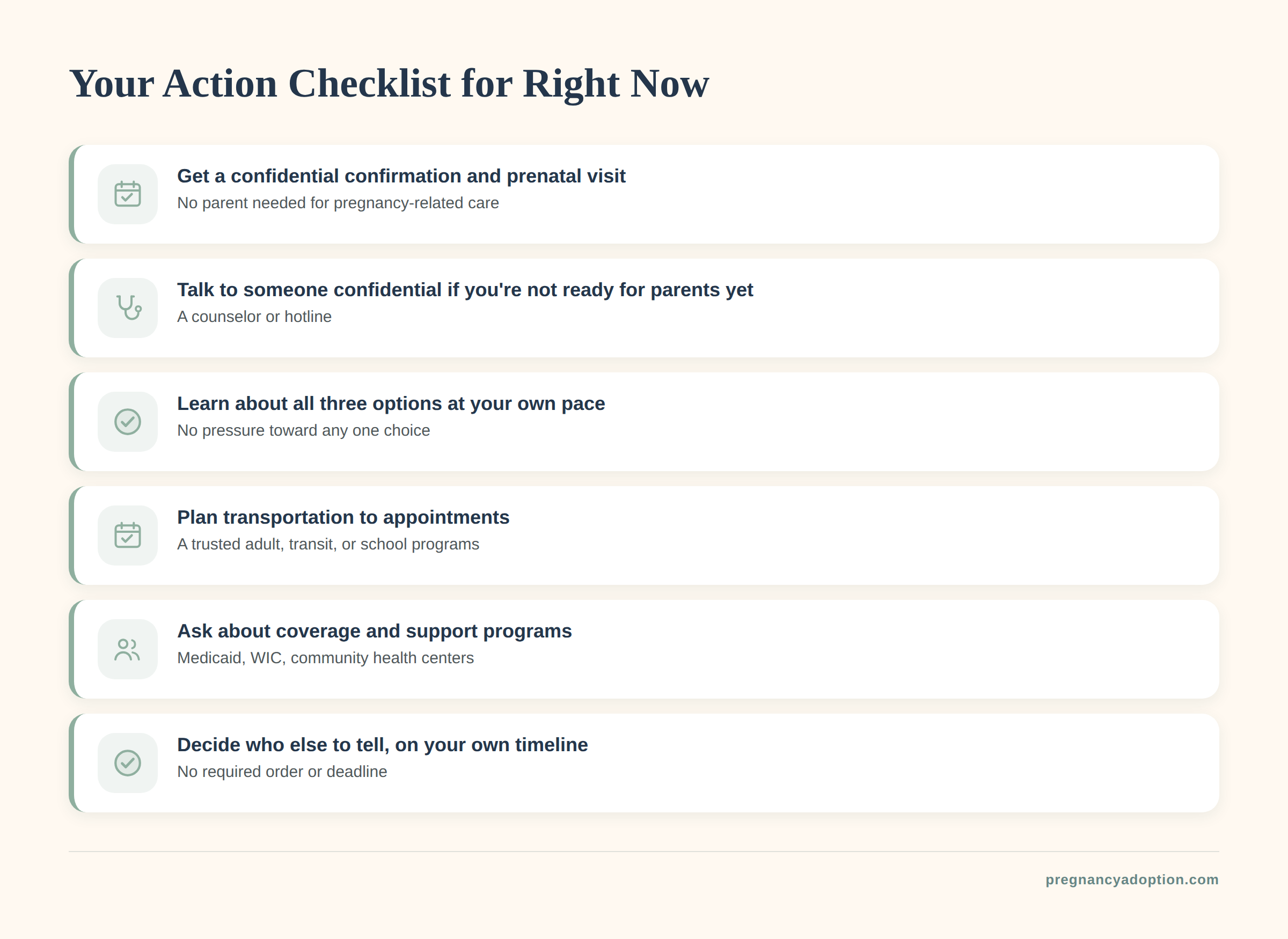
A Step-by-Step Action Checklist for Right Now
Today or This Week
Get Medical Care Started
Confirm the pregnancy if you haven’t already, and schedule (or walk into) a confidential confirmation and prenatal-care visit at a clinic, health department, or your regular provider.
Talk to Someone Confidential If You’re Not Ready for Parents Yet
A pregnancy options counselor, a school counselor, or a dedicated hotline can be a first conversation that doesn’t require telling your parents yet.
In the Weeks Ahead
Learn About All Three Options
Read through our teen-options hub and the option-specific guides linked throughout this article at whatever pace feels right.
Plan Transportation and Practical Logistics
Figure out how you’ll get to appointments and what financial or school-based support programs might apply to you, using Table 1 above as a starting point.
Glossary of Terms Used in This Guide
Legal Terms
Judicial Bypass
A court process that allows a minor to obtain court authorization for an abortion without parental involvement, in states that otherwise require parental consent or notification.
Compulsory School Attendance Age
The age up to which a state legally requires school attendance; this age varies by state and is a relevant threshold specifically around age 16 in many states.
Age of Consent / Close-in-Age Exemption
The age of consent is the age at which a person can legally consent to sexual activity; a close-in-age exemption is a provision in some states’ laws that treats sexual activity between two people close in age differently than a larger age gap.
Medical and Educational Terms
Minor Consent Law
State laws governing when and for what services a minor can legally consent to their own medical care without parental involvement.
Title IX
A federal law prohibiting sex-based discrimination in education programs, which includes specific protections for pregnant and parenting students.
Homebound Instruction
An alternative-instruction option, sometimes available to pregnant or postpartum students, in which schoolwork is completed at home with school support rather than in the regular classroom.
Frequently Asked Questions
Getting Started
Do I need my parents’ permission to see a doctor about my pregnancy?
In nearly every state, a pregnant minor of any age can consent to her own pregnancy-related medical care without needing parental permission first.
What if I’m not sure I’m even pregnant yet?
A home pregnancy test is a reasonable first step; many clinics also offer free confirmation testing if you want it confirmed by a provider directly.
Is there a hotline I can call if I just want to talk to someone first?
Yes — pregnancy options counseling hotlines exist specifically for this; see the editor’s note at the end of this guide for sourcing on where our general teen-options hub lists current resources.
School and Education
Can my school force me to leave or switch to a separate program?
No — federal law generally prohibits that; any alternative program offered must be voluntary and comparable to your regular program, not a mandatory separate placement.
Will missing school for appointments hurt my grades?
Properly excused, medically necessary absences generally shouldn’t be penalized, and you should have a path to make up missed work rather than simply losing credit.
I’m only a sophomore — does that change anything about my school options?
It mostly changes the planning horizon: with more years of school remaining than a junior or senior would have, continuing-education planning may need to account for a longer stretch of time, but your underlying rights are the same regardless of grade level.
Can I leave school at 16 if I decide that’s what I want?
In states where compulsory attendance ends at 16, it may be legally possible, but staying enrolled using the accommodations described above generally keeps more doors open for your future than leaving does — it’s worth talking through with a school counselor before deciding either way.
What if my school doesn’t seem to know these rules?
Not every school staff member is familiar with pregnant-student rights in detail; asking to speak with a Title IX coordinator specifically, or bringing printed information with you, can help if you run into resistance.
Medical Care and Consent
Do I need a parent to come with me to a doctor’s appointment?
Generally, no, for pregnancy-related care specifically — most states let a pregnant minor consent to her own prenatal and delivery care without a parent present or consenting, though individual clinic policies on who can be in the room can vary.
What if the clinic asks for my parent’s insurance information?
You can ask directly about confidential options, including whether the clinic bills in a way that doesn’t generate an insurance statement visible to a parent, or whether a confidential, low-cost, or sliding-scale option is available instead.
Is genetic or prenatal testing handled differently because I’m a minor?
The testing itself isn’t different; the consent process for it generally follows the same pregnancy-related-care consent rules described above, though it’s worth asking your specific provider directly.
Can I choose a different doctor than the one my family normally uses?
Yes — choosing a different provider, including one at a dedicated community health center or clinic, is generally an option if you’d prefer more privacy than your family’s usual doctor would offer.
Legal Questions
Can my parents force me to choose a specific option?
No — the legal decision among parenting, adoption, and abortion belongs to you, even though your parents may have strong opinions and even though some procedural steps (like parental notification laws for abortion in some states) involve them.
What is a “close-in-age exemption” exactly?
It’s a provision some states include in their age-of-consent laws that treats sexual activity between two people within a certain number of years of each other differently than it would treat a larger age gap — the specifics (how many years, what ages) vary significantly by state.
Could my partner get in legal trouble because of our age difference?
Possibly, depending on your state’s specific age-of-consent and close-in-age exemption laws and the exact ages involved — this is genuinely state-variable and worth a confidential conversation with a pregnancy options counselor or legal aid organization if you have concerns.
Does the father have any legal rights or say in my decision?
The decision among parenting, adoption, and abortion remains legally yours; a birth father’s legal rights and involvement, particularly in an adoption plan, are covered in more depth in our birth father rights guide.
If Your Parents Don’t Know Yet
What if I’m scared to tell my parents at all?
Fear about telling parents is common and doesn’t mean something is wrong with your situation specifically; a school counselor, pregnancy options counselor, or trusted adult can help you think through both the conversation itself and any safety concerns first.
Is there a “right” way to bring it up?
There’s no single right way — some people prefer writing a letter first, others prefer having a trusted adult or counselor present, and others prefer saying it directly; whichever approach fits your family and your comfort level is reasonable.
What if my parents are supportive of some options but not others?
That’s common, and it doesn’t change that the decision is legally yours; it may mean the conversation is harder, but a pregnancy options counselor can help you navigate a family where opinions differ.
Paying for Care
What if I don’t know how to apply for Medicaid myself?
A clinic’s financial counselor, a school counselor, or a pregnancy options counselor can often help walk you through a Medicaid application, including pregnancy-specific coverage, without requiring your parents to be the ones who apply.
Does WIC require my parents to apply on my behalf?
WIC eligibility and application processes can vary; many pregnant minors are able to apply for WIC on their own behalf once pregnant, though it’s worth confirming the specific process with your local WIC office.
Are there programs specifically for pregnant teenagers, not just pregnant people generally?
Yes — some communities have teen-parent-specific programs offering case management, parenting classes, and practical support; a school counselor or pregnancy options counselor is often the best starting point for finding what exists locally.
Relationships and Support
What if my partner and I disagree about what to do?
This is a real and common situation; because the legal decision is yours, your partner’s preference matters as input but doesn’t override your choice. A pregnancy options counselor can help you both talk through the disagreement.
What if I don’t have a supportive family at all?
A school counselor, pregnancy options counselor, or youth-serving organization can often help connect you with support systems — mentors, case managers, or community programs — even when family support isn’t available.
Is it normal to feel differently about this from day to day?
Yes — it’s common for feelings about the pregnancy and the decision ahead to shift day to day, especially early on; that’s a normal part of processing a major decision, not a sign you’re doing something wrong or inconsistent.
Should I tell my friends before I tell my parents?
There’s no required order — some people find it easier to tell a trusted friend first for emotional support, others prefer telling parents first; either approach is reasonable.
Transportation and Logistics
What if I genuinely have no way to get to a clinic?
Call the clinic directly and ask — many have experience helping patients problem-solve transportation, including information on local transit options, rideshare assistance programs, or community volunteer driver programs.
Can a friend who also doesn’t drive help me get around?
A friend without a license generally can’t legally drive you, but a friend can still be useful for figuring out public transit routes, splitting rideshare costs, or simply coming along for support if a trusted adult is driving.
Is it okay to ask a school counselor for help with transportation specifically?
Yes — school counselors are often aware of local transportation resources and programs, even ones not specifically advertised, so asking directly is a reasonable first step.
Comparing This Guide to Others on This Site
How is this guide different from the general teen-options hub?
Our teen-options hub covers the complete general picture — all three options, general minor-consent law, judicial bypass, Title IX, and adoption guardian-consent rules — at full depth. This guide stays focused on what’s genuinely specific to being 16 and links back to the hub for everything else.
How is this different from the “Pregnant at 17” guide?
Our pregnant at 17 guide focuses on what’s specific to being closer to 18 — particularly the effect of turning 18 mid-process and junior/senior-year school planning. This guide focuses instead on compulsory-attendance-age proximity, driving/transportation independence, and a sharper version of the partner’s-age question, since these are the pieces that are genuinely different at 16.
Should I read both guides, or just this one?
Reading this guide and the general teen-options hub together gives you the full picture; the “Pregnant at 17” guide is mainly useful if you want to understand how guidance shifts as you get closer to 18, but isn’t required reading for your own situation now.
Special Situations
I’m in foster care — does any of this guidance change for me?
Some processes, like who can provide consent for certain decisions, may involve your caseworker or a court-appointed guardian rather than a biological parent; a caseworker or a pregnancy options counselor familiar with foster-care-specific rules can help clarify what applies in your situation.
I’m undocumented — can I still get care and explore my options?
Yes — pregnancy-related medical care and options counseling are generally accessible regardless of immigration status; community health centers in particular generally don’t require proof of immigration status for routine care.
I’m pregnant with twins — does that change any of the 16-specific guidance here?
The core guidance in this guide applies the same way; a multiple pregnancy may affect medical specifics your provider will cover directly, but doesn’t change the legal or school-related content in this article.
What if I became pregnant through something I didn’t consent to?
If your pregnancy resulted from sexual assault, that’s a separate and serious matter — a trusted adult, a school counselor, or the National Sexual Assault Hotline can help you access both medical care and support specific to that situation, alongside anything in this guide.
Quick Scenario Walkthroughs
I just found out I’m pregnant, I’m 16, and I haven’t told anyone — what’s the very first thing I should do?
Call or visit a clinic, health department, or community health center and ask for a confidential pregnancy confirmation and prenatal-care appointment — that’s the entire first step, and it doesn’t require telling anyone else first.
I’m 16, my boyfriend is 19, and I’m scared about what that means legally — who do I talk to?
A pregnancy options counselor or a legal aid organization can give you confidential, state-specific information about age-of-consent and close-in-age exemption laws without requiring you to involve your parents or anyone else first.
I’m a sophomore and worried I’ll have to drop out — what should I actually do?
Talk to a school counselor as early as you’re comfortable doing so — ask specifically about your rights under Title IX, what alternative-instruction options your district offers, and how absences for appointments will be handled, before assuming you have to leave.
I think I want to consider adoption but I don’t know where to start — what’s step one?
Start with our guide to choosing an adoption agency, which covers what to look for, including agencies experienced with minor birth parents specifically.
I’m considering abortion and I’m worried about the clock running out — what do I do right now?
Contact a clinic in your state as soon as possible to get accurate, current information about your state’s specific gestational-age limits and parental-involvement requirements — this is the one option where getting information promptly genuinely matters most.
Myths and Misconceptions From Others
Someone told me that at 16, my parents automatically make the decision for me — is that true?
No — the legal decision among parenting, adoption, and abortion belongs to you, not your parents, even though some states require parental notification or consent specifically for abortion, with judicial bypass as an alternative.
I’ve heard that schools have to kick out pregnant students — is that accurate?
No — federal law generally prohibits that; you have a right to stay in your regular school and program, as covered in “Your Rights to Stay Enrolled” above.
A friend said doctors have to tell your parents no matter what — true?
Generally not for pregnancy-related care specifically; as covered above, most states let a pregnant minor consent to her own prenatal and delivery care without requiring parental notification.
Is it true that adoption agencies won’t work with someone my age?
No — adoption agencies and attorneys work with minor birth parents regularly and are generally well-equipped to handle the additional procedural steps that come with it.
Mental Health and Emotional Support
Is it normal to feel scared, numb, or both at once?
Yes — a wide range of emotional reactions is normal when processing a pregnancy at 16, and feeling several conflicting things at once, including numbness alongside fear, doesn’t mean anything is wrong with how you’re coping.
Should I talk to a counselor even if I’m not sure I need one?
If you’re unsure, talking to a school counselor or pregnancy options counselor even just once is a low-commitment way to find out whether ongoing support would help — you’re not obligated to continue if it doesn’t feel useful.
What if I feel pressure from multiple directions — family, partner, friends — about what to do?
Feeling pulled in different directions by the people around you is common; a neutral pregnancy options counselor, who isn’t personally invested in any one outcome, can be a useful space to think through what you actually want separate from everyone else’s opinions.
Documentation and Follow-Up
Should I keep records of my appointments and conversations?
Keeping a simple record — dates of appointments, who you spoke with, and what was discussed — can be genuinely useful, especially if your situation involves multiple agencies, a court process, or coordination between school and medical providers.
What if I need to request school records or documentation for a program?
A school counselor or registrar can typically help you request what you need; minors generally retain some rights to their own educational records, though the exact process varies by school and state.
Part-Time Jobs and Everyday Life
I have a part-time job — do I have any protections there too?
Depending on your state and employer, some pregnancy-related workplace protections may apply even to a part-time or minor employee, though the specific rules differ from the school-based protections covered above.
Can I keep participating in sports or extracurriculars?
Generally, yes — schools can’t categorically exclude you from sports or extracurriculars because of pregnancy, though your provider’s guidance on what activity level is appropriate for your specific pregnancy still applies, same as for any pregnant person.
What about driver’s ed — can I still take it while pregnant?
There’s no general reason pregnancy would prevent you from taking driver’s education; if a specific physical requirement of the course concerns you, that’s worth a quick conversation with the instructor or your provider.
Siblings and Extended Family
Should I tell my siblings before my parents?
There’s no required order; some people find a sibling easier to tell first for emotional support, while others prefer going straight to parents or a non-family trusted adult — whatever order fits your family is reasonable.
What if a grandparent or other relative finds out before I’m ready to tell them?
If this happens, it’s reasonable to ask that relative directly to let you be the one to decide when and how other family members find out, if that matters to you.
Returning to This Guide Later
Will this guide still be useful once I’ve made a decision?
Yes — once you’ve decided, the option-specific sections (“If You’re Considering Parenting,” “If You’re Considering Adoption,” “If You’re Considering Abortion”) and their linked full-depth guides become the more directly useful parts to revisit going forward.
What if my situation changes partway through — can I change my mind?
Within each option’s own practical limits (adoption plans and abortion both have timing constraints that parenting doesn’t), it’s generally possible to change your mind as your thinking develops; a pregnancy options counselor can help you think through what’s realistically still possible at any given point.
Is it okay to come back and re-read sections as things come up?
Yes — many readers find it more useful to revisit specific sections as relevant questions come up along the way, rather than trying to absorb everything in one read-through.
A Few Final Clarifying Questions
What’s the single most important thing to remember from this guide?
You have options, rights, and support available right now, regardless of what you decide and regardless of whether you’ve told anyone else yet — getting medical care started is the one truly time-sensitive first step.
What if I only do one thing after reading this?
Get a confidential confirmation and prenatal-care appointment scheduled for this week, even if everything else still feels undecided.
Where should I go if this guide didn’t answer my specific question?
Our teen-options hub covers more general ground, and a pregnancy options counselor can answer anything specific to your individual situation that no general article can fully address.
Body Image and Physical Changes
Is it normal to feel self-conscious about pregnancy at this age, at school?
Yes — feeling self-conscious about physical changes while around classmates is a common experience; your school’s obligation to treat you the same as any other student, covered above, exists precisely because this transition can already feel difficult without added exclusion or stigma.
How do I handle questions or comments from classmates?
You’re not obligated to explain or discuss your pregnancy with classmates beyond whatever you’re comfortable sharing; deciding in advance how much you want to say, and to whom, can make unexpected questions easier to handle in the moment.
Confidentiality in Practice
Can my school tell my parents I’m pregnant without my permission?
Generally, routine educational staff aren’t required to notify parents specifically because a student is pregnant, though school policies and state laws on this vary, and certain situations (like safety concerns) can involve different rules.
What about my medical records — are those private from my parents too?
Pregnancy-related medical records you consented to on your own are generally subject to the same confidentiality protections as any patient’s records, though the specifics of what a parent can access can vary depending on insurance billing and state law.
Can I ask a clinic not to send any mail or calls to my home?
Many clinics can accommodate a request for confidential communication (a cell phone number, a different mailing address, or no mail at all) — ask directly when you schedule your appointment.
Planning Beyond the Immediate Decision
Do I need to think about college or long-term plans right now?
Not urgently — getting through the immediate decision and the practical logistics around it matters more right now; longer-term planning can follow once the more immediate pieces are in place.
Does being pregnant at 16 affect my ability to go to college later?
Not inherently — staying enrolled and on track academically, using the protections and accommodations described above, is the main factor that keeps future options like college open, regardless of the pregnancy itself.
Working With a Pregnancy Options Counselor
What actually happens in a pregnancy options counseling session?
A counselor typically asks about your situation, explains all three options neutrally, answers your questions, and helps you think through what matters most to you — without telling you what to choose.
Do I have to commit to a decision by the end of the session?
No — a counseling session is a conversation, not a decision deadline; you can take as much time afterward as you need, within each option’s own practical limits.
Can I bring someone with me to a counseling session?
Many counselors allow you to bring a trusted support person if you want one, though some conversations may also happen one-on-one at certain points — ask when you schedule.
Is pregnancy options counseling free?
Many pregnancy options counseling services are free or low-cost, particularly those offered through clinics, health departments, or dedicated nonprofit hotlines; cost shouldn’t be a barrier to having this conversation.
Thinking About the Future
How do I know which option is “right” for me?
There’s no universal right answer — the right option is the one that fits your specific circumstances, values, and resources, which is exactly why neutral information and counseling matter more than anyone else’s opinion about what you “should” do.
What if I regret whatever I decide?
It’s normal to have complicated feelings about a major decision regardless of which option you choose; having accurate information and support going in, and ongoing support afterward, are the best tools for navigating whatever feelings come up later.
Is it okay to lean toward one option today and feel differently next week?
Yes — it’s common for your thinking to shift as you learn more or process your feelings; that’s part of why this guide and the counseling resources it points to are available throughout, not just at the start.
If You’re Also Managing a Health Condition
I have a pre-existing health condition — does that complicate anything specific to being 16?
A pre-existing condition affects your medical care and coordination with specialists the same way it would for anyone pregnant, regardless of age; the 16-specific content in this guide (consent, school, legal questions) applies on top of, not instead of, that medical coordination.
Can I still get the accommodations described in this guide if I also have a disability?
Generally, yes — disability-related school accommodations and pregnancy-related protections can both apply at once; a school counselor or your school’s disability-services coordinator can help make sure both are addressed together.
Talking to Younger Siblings or Other Kids in the Family
Do I need to explain anything to younger siblings?
That’s entirely your choice and your family’s; there’s no requirement to explain anything to younger siblings, and how much to share, and when, is reasonable to decide based on their age and your own comfort.
What if a younger sibling finds out before I’m ready?
If this happens, it’s reasonable to talk with them (or have a parent or trusted adult talk with them) about keeping it private for now, if that’s what you want, while you continue deciding how and when to share more broadly.
A Few More Practical Questions
Can I request a female provider if that makes me more comfortable?
Many clinics can accommodate a request for a female provider when one is available on staff — it’s reasonable to ask when you schedule your appointment.
What should I bring to my first prenatal appointment?
Any ID you have, insurance information if applicable, a list of questions, and — if it would help you feel more comfortable — a trusted support person, are all reasonable things to bring; missing any of these generally won’t prevent you from being seen.
Is there anything I should avoid saying or doing that might complicate my options later?
Not really — being honest with your provider and any counselor you work with generally serves you better than trying to manage what you share; they’re there to help you navigate your actual situation, not to judge your choices.
Work, Hobbies, and Everything Else Going On
I’m on a sports team — do I have to quit?
No — as covered above, schools generally can’t exclude you from sports because of pregnancy; your provider’s guidance on activity level specific to your pregnancy is what should actually shape your participation, not a blanket assumption that you need to stop.
I’m applying for summer jobs or internships — should I mention my pregnancy?
You’re generally not required to disclose a pregnancy during a job or internship application process; whether and when to mention it to an employer once hired is a separate, personal decision.
I was really looking forward to a specific school trip or event — will I still get to go?
That depends on timing, the nature of the event, and your provider’s guidance, same as it would for any other temporary medical consideration — ask directly rather than assuming you’ll automatically be excluded.
One More Round of Common Questions
Is there an age below which none of this guide’s content applies?
This guide is written specifically for being 16; if you’re younger, some of the specifics here (compulsory-attendance age, driving eligibility) may not apply the same way, and our teen-options hub is a better general starting point.
What if I turn 17 partway through this process?
Most of the guidance here doesn’t change meaningfully between 16 and 17; our pregnant at 17 guide covers what’s specifically different as you get closer to 18, if that becomes relevant to your situation.
Can I print this guide to share with a counselor or trusted adult?
Yes — this guide is published as a standard web page, and you’re welcome to save, print, or share it, including the action checklist and Table 1’s program list, with anyone helping you navigate this.
Checking Your Understanding
Does any part of this guide depend on which state I live in?
Yes, significantly — minor-consent specifics, compulsory-attendance age, age-of-consent and close-in-age exemption rules, Medicaid eligibility details, and parental-involvement requirements for abortion are all state-variable.
Is everything in this guide equally time-sensitive?
No — medical care is the most time-sensitive step; abortion specifically has the tightest external time limits if that’s a direction you’re considering; parenting and adoption planning generally allow more time to think things through.
Wrapping Up
If this whole guide boiled down to one sentence, what would it be?
Get medical care started this week, know that the decision among your three options is legally yours, and reach out to a confidential counselor if you want support figuring out the rest.
Is it normal to need to come back and read this more than once?
Completely normal — many readers find it useful to revisit specific sections as new questions come up, rather than absorbing everything in a single read-through right after finding out.
A Last Few Odds and Ends
I’m nervous about my first appointment — is that normal?
Very normal — nerves before a first medical appointment, especially around a sensitive topic, are common at any age; bringing a trusted support person or a written list of questions can help the appointment feel more manageable.
What if the first clinic I contact isn’t a good fit?
You’re not obligated to stay with the first provider or clinic you contact; trying a different clinic, community health center, or provider is a reasonable option if the first one doesn’t feel right for any reason.
Does this guide apply the same way if I’m already a few months along?
Yes — the medical-care, school, legal, and option-specific guidance in this article applies regardless of how far along you already are, though timing matters more for abortion specifically given gestational-age limits.
Is there anything different about this guide if I’m 16 and already have another child?
The core guidance stays the same; practical logistics (childcare during appointments, coordinating school around an existing child) become additional planning considerations worth raising with a school counselor or case manager.
Final Reassurance
Am I the only 16-year-old dealing with this?
No — pregnancy among 16-year-olds, while less common than it once was, is far from unheard of, and the systems described throughout this guide (school protections, confidential medical care, pregnancy options counseling) exist specifically because this situation comes up regularly enough to need dedicated support.
Will people treat me differently once they know?
Reactions vary widely by person and by relationship; the legal protections covered in this guide (particularly at school) exist specifically to limit how much being pregnant is allowed to change how you’re treated in those formal settings, even though you can’t control every individual reaction.
Is it okay if I still feel unsure about everything after reading this whole guide?
Yes — feeling unsure after a first read is common; this guide and the resources it links to are meant to be a starting point and an ongoing reference, not something that resolves every feeling in a single sitting.
Checking in One More Time
What if my question isn’t answered anywhere in this guide?
A pregnancy options counselor can answer individual questions this general guide can’t anticipate; our teen-options hub is also worth checking, since it covers more ground at general depth than this companion guide does.
Can my provider or counselor keep working with me even after I turn 17 or 18?
Generally, yes — most providers and counselors continue working with you as you age, and your care doesn’t have to restart from scratch just because a birthday passes partway through.
Is there a wrong time to start reaching out for help?
No — whether you’re at the very beginning of figuring things out or well into a decision already, reaching out to a pregnancy options counselor, school counselor, or clinic is useful at any point in the process.
One Last Set of Practical Questions
Do I need to bring a parent’s signature for anything at the clinic?
For pregnancy-related care specifically, generally no, as covered earlier in this guide; some clinics may still ask for emergency-contact information, which doesn’t have to be a parent if you’d prefer someone else listed.
What if I move partway through this process — does everything restart?
Some things, like an in-progress Medicaid application or school enrollment, may need to be transferred or restarted depending on where you move; a case manager, counselor, or your new clinic can help you figure out what carries over.
Is it okay to ask the same question to more than one source if I want to double-check the answer?
Yes — especially for state-variable topics in this guide, checking a question with more than one source (a counselor and a clinic, for example) is a reasonable way to feel confident in the answer.
Looking Ahead
Will guidance like this change as laws change over time?
Yes — the state-variable legal specifics flagged throughout this guide are exactly the parts most likely to change over time; the broader message, that you have options, rights, and support at 16, has stayed stable even as specific state laws have shifted.
Should I check back on this guide periodically, or is one read enough?
If your situation unfolds over weeks or months, it’s reasonable to check back periodically, particularly on the sections most relevant to wherever you are in the process at that point.
Very Last Things
Is there a version of this conversation I can have with a counselor that doesn’t involve deciding anything today?
Yes — many first conversations with a pregnancy options counselor are explicitly just information-gathering, with no expectation that you leave having made a decision.
What’s the kindest thing I can tell myself while figuring this out?
That needing time, information, and support to work through a major decision is a reasonable response to a genuinely big situation, not a sign that you’re handling it wrong, and not something to feel rushed about.
And Finally
If I read nothing else in this guide, what should I remember?
You’re allowed to get help, ask questions, and take the time you reasonably need — being 16 doesn’t disqualify you from any of that.
Is it okay to share this guide with someone else going through the same thing?
Yes — this guide is written to be shared, whether with a friend in a similar situation, a trusted adult who wants to understand what you’re navigating, or a counselor you’re working with.
Who wrote and reviewed this guide?
See the "About pregnancyadoption.com/" section below for this site's editorial and review process, and the editor's note at the end of this article for this specific guide's review status, sources, and current open items.
Does reading this guide mean I have to make a decision right now?
No — reading, learning, and asking questions are separate from deciding; you can take in all the information here and still need more time, more conversations, or another appointment before you’re ready to decide anything.
Is there a quick way to summarize this guide for someone who’s short on time?
The bottom-line box just below this FAQ section is written to be easy to share or read aloud, covering the core message in a few sentences.
Does this guide apply the same way no matter which option I end up choosing?
Yes — the medical-care, school, legal, and support content here applies regardless of whether you end up choosing parenting, adoption, or abortion; the option-specific sections simply add a little more detail once you have a clearer direction in mind.
One last check — what’s the single first thing I should do after reading this guide?
Reach out for a confidential pregnancy confirmation and prenatal-care appointment this week, even if everything else still feels unresolved — that one step keeps every other option open while you take the time you need to decide the rest.
Is it okay if I don’t remember every detail from this guide later?
Yes — remembering that you have options, rights, and confidential support available matters far more than memorizing every specific detail, and this guide will still be here to revisit whenever you need it again, at any point in the process.
The bottom line
You have real options, real rights, and real support at 16. Getting medical care started is the one genuinely time-sensitive first step; deciding among parenting, adoption, and abortion can take the time each option’s own practical limits allow. You don’t have to tell your parents before getting care or talking to a confidential counselor, you have real rights to stay in school, and a handful of legal questions specific to being 16 — medical-consent thresholds, compulsory-attendance age, and the partner’s-age question — are worth understanding but shouldn’t feel like additional barriers to getting the support you need.
About pregnancyadoption.com/
pregnancyadoption.com/ publishes free, judgment-free information on pregnancy, pregnancy options, and adoption for anyone trying to understand what's happening in their body or what choices are available to them. We are not a law firm, an adoption agency, or a medical practice — we're an independent editorial resource, and we don't place children, provide legal representation, or profit from which option a reader ultimately chooses.
Every article carrying medical or legal information is written to a source-tiering standard (government and medical-authority sources first, established nonprofits second, commercial sources never used as factual authority) and reviewed by a licensed professional before publication. Time-sensitive information is scheduled for review on a recurring cadence, and factual errors reported by readers are corrected promptly. Read our full About & Editorial Guidelines page for details on our review process, sourcing standards, and how to report a correction.
Medical and Legal Disclaimer
This article is provided for general educational purposes only and does not constitute medical or legal advice. Reading this content does not create a doctor-patient or attorney-client relationship between you and pregnancyadoption.com/, its authors, or its reviewers. Always seek the advice of a licensed physician, counselor, or attorney with any questions you may have regarding a medical condition or a legal right, and never disregard or delay seeking professional guidance because of something you have read here. If you believe you may be experiencing a medical emergency or are in immediate danger, call 911 or your local emergency number immediately.
Legal rules referenced in this article, including minor-consent law, compulsory school-attendance age, parental-involvement requirements for abortion, age-of-consent and close-in-age exemption law, and Medicaid eligibility, vary significantly by U.S. state and change over time; some federal regulations referenced here, including certain Title IX pregnancy-related protections, have also been subject to recent legal challenges. Wherever this article references a state-variable or legally contested rule, it deliberately avoids stating a specific figure or policy as universal and instead points to a school counselor, pregnancy options counselor, or qualified professional for your specific situation. We make reasonable efforts to verify accuracy but make no warranty, express or implied, as to the completeness, reliability, or timeliness of any information on this page.
To the fullest extent permitted by applicable law, pregnancyadoption.com/ and its authors, editors, and medical/legal reviewers disclaim all liability for any loss, injury, or damage of any kind arising from reliance on the information in this article. This disclaimer does not limit any rights you may have under law that cannot be waived. Read our full Medical and Legal Disclaimer for complete terms.
Sources and further reading
This guide draws on legal, government, and nonprofit sources for the following organizations. Individual circumstances vary significantly by state — use this guide to prepare good questions for a school counselor, pregnancy options counselor, or qualified professional, not as a substitute for individualized advice.
- Guttmacher Institute — State Laws and Policies (minor consent and related state-by-state data)
- A Better Balance — Pregnant or Parenting at School: Know Your Rights
- Planned Parenthood — Pregnancy Options
- Our teen-options hub (same-site sibling; see its own source map for general minor-consent, judicial-bypass, Title IX, and adoption guardian-consent sourcing not repeated here)
- Our “Pregnant at 17” guide (same-batch sibling; reciprocal link per PA-0051’s forward-link obligation)
