The first trimester — roughly the first thirteen weeks of pregnancy — is when the most rapid and foundational development happens, even though very little of it is visible from the outside. This guide walks through what’s actually happening week by week, from fertilization through week 13: the embryo’s and then fetus’s development, what you might notice physically, what your prenatal visits and screening tests look like, and the warning signs worth knowing about along the way.
This article is written for general education and does not replace the specific guidance of your own medical provider. It has been reviewed for medical accuracy, and figures that vary by source or could not be confirmed against a live source this session are flagged throughout — see the editor’s note at the end of this guide.
Severe one-sided abdominal pain, shoulder-tip pain, or dizziness/fainting can be signs of an ectopic pregnancy — a medical emergency. Heavy bleeding (soaking a pad an hour or more) with cramping can be a sign of miscarriage in progress. Either of these warrants calling your provider right away or going to an emergency room. This guide’s warning signs section below covers both in more detail, with links to this site’s full guides on each.
Short Answer: What Happens in the First Trimester
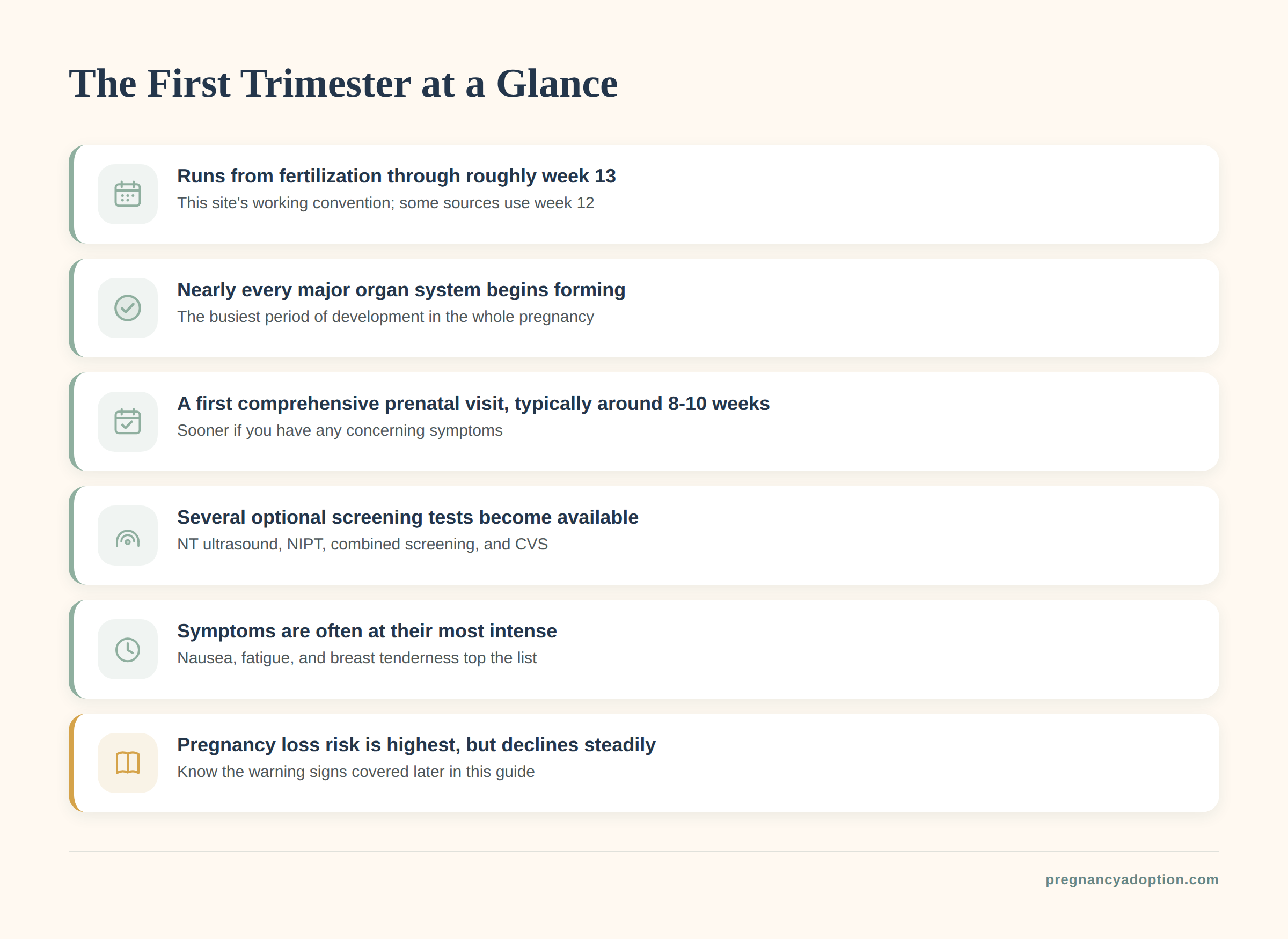
The first trimester runs from fertilization through roughly week 13, and it’s when every major organ system begins forming — by the end of it, what started as a single fertilized cell has become a fetus with a beating heart, developing limbs, and recognizably human features, even though it’s still only a few inches long. For you, the first trimester often brings the most intense early symptoms (nausea, fatigue, breast tenderness), your first prenatal visits, and a series of optional screening tests that can tell you about your baby’s chromosomal health well before any of this is visible on the outside.
Why the First Trimester Matters So Much
The first trimester carries outsized importance because this is when the fundamental architecture of your baby’s body is laid down. Nearly every major organ system begins forming within these thirteen weeks — the neural tube, which will become the brain and spinal cord, closes within the first few weeks; a primitive heart begins beating before most people even know they’re pregnant; and the buds that become arms, legs, eyes, and ears all appear in rapid succession. Because so much foundational development is compressed into such a short window, this period is considered the most developmentally sensitive stretch of the entire pregnancy — it’s part of why providers emphasize starting a prenatal vitamin with folic acid as early as possible and avoiding alcohol, tobacco, and certain medications from the outset. This window is also when pregnancy loss is statistically most likely, with the risk declining substantially as the weeks pass and dropping further still once the second trimester begins. That combination — rapid, consequential development alongside elevated loss risk — is why this guide treats the first trimester as worth understanding in real depth rather than skimming past. For a full look at why early loss happens and what it means for you specifically, this site’s complete guide to miscarriage goes much further than this overview can.
What This Guide Covers
This guide is structured differently from this site’s other early-pregnancy resources. Rather than organizing around a single theme — symptoms, testing methodology, or due-date calculation — it walks through the first trimester in roughly the order you’ll actually experience it: first the broad, often symptom-free window of weeks 1 through 4, when conception and implantation are happening before most people even suspect they’re pregnant, and then week by week from 5 through 13, covering what’s developing in your baby and what you might be feeling yourself. Alongside that developmental timeline, this guide covers two practical threads that matter just as much: what actually happens at your first comprehensive prenatal visit, including when it’s typically scheduled and what to expect walking in, and the menu of first-trimester screening tests you’ll likely be offered — nuchal translucency ultrasound, non-invasive prenatal testing (NIPT), the first-trimester combined screening, and chorionic villus sampling (CVS) — each explained by name, with typical timing and a plain-language sense of what each one can and can’t tell you. The goal is that by the end, you have both the developmental picture and the practical roadmap in one place.
Key Takeaways
- The first trimester runs from fertilization through roughly week 13, and it’s when nearly every major organ system begins forming.
- This guide walks through development week by week, alongside what you might notice physically each week.
- First-trimester screening tests (NIPT, nuchal translucency, combined screening, CVS) are optional and can tell you about chromosomal health well before anything is visible on ultrasound.
- Miscarriage risk is highest in the first trimester and declines substantially as it progresses; ectopic pregnancy is a rare but serious complication to watch for.
- Not every source defines the exact week-13 cutoff identically — this guide uses this site’s own weeks 1–13 convention, explained in the next section.
How the First Trimester Is Defined
Before walking through the weeks themselves, it’s worth understanding how “week” is actually counted in pregnancy, since this trips people up more than almost anything else in early pregnancy.
Gestational Age vs. Fetal Age
One of the most common sources of confusion in early pregnancy is how the weeks are actually counted. Gestational age — the convention this guide uses throughout, and the one your provider will use — is measured from the first day of your last menstrual period (LMP), not from the moment of conception itself, which typically occurs roughly two weeks later. The practical effect is that at what’s called “week 4,” your baby has only been developing for about two weeks since fertilization; the extra two weeks are counted from before conception even happened, simply because LMP is a date everyone can identify with reasonable confidence, while the exact moment of conception usually isn’t knowable. This matters because every week referenced throughout this guide — “week 6,” “week 10,” and so on — refers to gestational age, matching how your provider will talk about your pregnancy, how your due date is calculated, and how this site’s own due-date and week-by-week calculators work. If you’re not sure of your LMP, or your cycles are irregular, gestational age is typically estimated instead from an early ultrasound measurement; this site’s guide to gestational dating covers that calculation, and the broader LMP-versus-conception distinction, in much greater depth.
Not Every Source Agrees on the Exact Boundary
Even the definition of “first trimester” isn’t perfectly standardized across sources, which can be a little disorienting when you’re trying to track where you stand. This guide, consistent with this site’s week-by-week pregnancy calculator and gestational dating guide, treats the first trimester as spanning weeks 1 through 13 (that is, 13 weeks and 6 days), with the second trimester beginning at week 14. Other reputable sources, including the NICHD, draw the boundary a week earlier, defining the first trimester as weeks 1 through 12 and starting the second trimester at week 13. The underlying biology and developmental timeline are identical either way — nothing about your baby’s actual development changes based on which labeling convention a given source uses. What matters practically is simply knowing that this small discrepancy exists, so that if you see a slightly different cutoff mentioned elsewhere — in an app, a book, or another website — you’re not left wondering whether something is wrong. Your own provider will have a consistent convention they use for your specific care, and that’s the one worth anchoring to for any decisions about timing of visits or tests.
| Source/convention | First trimester defined as |
|---|---|
| This site (and ACOG’s common usage) | Weeks 1–13 (13w6d) |
| NICHD | Weeks 1–12 |
| Counted from | Last menstrual period (gestational age), not conception |
Weeks 1–4: Before Most People Know
The first four weeks of pregnancy, by gestational dating, include time before conception even happens — this is the window this site’s early pregnancy symptoms (DPO) guide covers in day-by-day detail; this section gives the development side specifically.
What’s Happening
The earliest stretch of pregnancy, gestational weeks 1 through 4, covers a period that’s easy to misunderstand because so much of it happens before conception in the calendar sense. Weeks 1 and 2 are counted from the first day of your last period, before ovulation and fertilization have even taken place — this isn’t a quirk or an error, it’s simply how the gestational-age dating convention described above works, since the start of your last period is the most reliable fixed point available. Fertilization itself typically happens around gestational week 3, when a single sperm and egg combine to form one cell that begins dividing rapidly within hours. Over the next several days, that rapidly dividing cluster of cells — now called a blastocyst — travels through the fallopian tube toward the uterus, where it implants into the uterine lining around gestational week 4. That implantation is a pivotal moment: it’s what establishes the physical connection through which the pregnancy will draw nutrients and, eventually, trigger the hormonal signal a pregnancy test detects. Some people notice light spotting around implantation, sometimes mistaken for a period; this site’s implantation bleeding guide covers that specific experience, including how to tell it apart from a true period, in full depth.
What You Might Notice
During weeks 1 through 4, many people notice nothing different at all, and that’s entirely expected — conception and implantation are happening at a cellular level that simply doesn’t produce symptoms you’d feel. The most common first sign, a missed period, doesn’t typically arrive until around week 4, since that’s when the pregnancy hormone hCG has risen enough to prevent your body from shedding the uterine lining as usual. It’s only around this same time — roughly the point of a missed period — that home pregnancy tests typically become reliably positive, since they work by detecting hCG in urine at a concentration that takes those first few weeks to build up. Testing earlier than that can produce a false negative not because anything is wrong, but simply because hCG hasn’t yet reached a detectable level; testing again a few days later, once your period is late, is usually the more reliable approach. Some people do notice subtle signs even in this early window — mild cramping, fatigue, or breast tenderness — though these are easy to miss or attribute to something else. This site’s pregnancy symptoms guide and pregnancy test guide each cover their respective topics, timing, and accuracy in much greater depth than this overview.
Week 5
This is often the earliest point at which a pregnancy is confirmed, and it’s when foundational development accelerates rapidly.
Baby’s Development
By this week, two of the most consequential developmental events of the entire pregnancy are already underway. The neural tube — a structure that will become the brain and spinal cord — begins closing around this time, and its proper closure is one of the most developmentally important milestones in all of pregnancy; this is a major part of why providers recommend starting a folic-acid-containing prenatal vitamin as early as possible, ideally even before conception, since adequate folic acid is linked to a lower risk of neural tube defects. At the same time, a primitive heart tube is beginning to form from a cluster of cells that will soon organize into a functioning, beating heart. That heartbeat typically won’t be detectable on ultrasound for another week or two yet, even though the structure is already assembling itself. None of this is visible or felt by you at this stage — it’s happening at a scale and depth that no amount of attention to your own body would reveal — which is exactly why early prenatal vitamin use and avoiding known risks matters even before you’ve had a chance to confirm the pregnancy with a provider.
What You Might Notice
This is often the week when pregnancy starts to feel more concretely real. Many people get a positive home pregnancy test around this point, now that hCG levels have risen enough to register reliably, and early symptoms can start to show up alongside it — fatigue that feels heavier than usual, breast tenderness, or mild nausea, though the timing and intensity of all of these vary enormously from person to person and even from one pregnancy to the next in the same person. Once you have a positive test, this is a reasonable time to make that first call to a provider’s office. Many practices prefer to schedule the actual comprehensive first visit for around 8 weeks, since that timing often allows for a more informative ultrasound, but calling as soon as you have a positive result is still the right move — the office can advise on timing, any early labs they want done sooner, and what to do if you have risk factors that warrant being seen right away. The first prenatal visit section later in this guide covers in detail what typically happens once that visit occurs and how to decide between providers if you haven’t already.
Week 6
Development continues rapidly, and this is often the first week a heartbeat can be detected.
Baby’s Development
Around this week, pregnancy starts to become visible in a very literal, technical sense: a heartbeat can often — though not always, depending on timing and the equipment used — be detected via a transvaginal ultrasound. If a heartbeat isn’t seen at exactly this point, that alone isn’t necessarily a cause for alarm, since dating can be off by several days or more depending on cycle length and ovulation timing; a provider will typically recheck a bit later if the timing seems too early rather than drawing an immediate conclusion. The embryo itself is still extremely small at this stage, often compared in size to a sweet pea, but development is proceeding quickly: small limb buds that will eventually become arms and legs are appearing, along with the very first indications of where eyes and ears will form. None of these structures are recognizable yet in any visual sense — this is foundational scaffolding rather than anything resembling a recognizable face or limbs — but the basic plan for the body is actively being laid down week by week during this stretch.
What You Might Notice
For many people, this is around when early pregnancy symptoms start to intensify rather than ease. Nausea — sometimes accompanied by vomiting, commonly called morning sickness even though it can strike at any time of day — often becomes more pronounced during this window for the people who experience it at all; some people have very little nausea throughout, which is equally normal and says nothing about how the pregnancy is progressing. Fatigue, too, is commonly at its most intense during this early stretch, driven by a combination of rapidly rising hormone levels, particularly progesterone, and the sheer physiological effort your body is putting into supporting early development. It’s common to feel like you could sleep far more than usual and still not feel rested. These symptoms, while often unpleasant, are generally not something to be concerned about on their own; they tend to be the body’s response to genuinely significant hormonal shifts rather than a sign that anything is wrong. This site’s pregnancy symptoms guide covers practical management strategies for nausea and fatigue, along with the specific point at which either one crosses from uncomfortable into something worth calling your provider about.

Week 7
The embryo is growing quickly now, roughly doubling in size from the week before.
Baby’s Development
Brain development continues at a rapid pace during this week, with the structures that will eventually support complex neurological function continuing to organize and grow. The arm and leg buds that appeared a week or two earlier are now elongating, and at their ends, the very earliest beginnings of hands and feet are becoming visible, though they’re still far from anything recognizable as fingers or toes. In terms of overall size, the embryo is often compared to a blueberry at this point in development — still much too small to be felt by you in any way, but with a body plan that’s becoming more defined with each passing day. The embryo at this stage typically has a distinctly curved shape, with a disproportionately large head relative to the rest of the body, which is normal and reflects how much of early development is concentrated on the brain and central nervous system before the rest of the body catches up proportionally in later weeks and months.
What You Might Notice
The symptoms that began in previous weeks often continue building during this stretch. Nausea, fatigue, and breast tenderness commonly persist or intensify for people who experience them, though — as throughout this guide — the range of what counts as normal is wide, and some people continue to feel comparatively few symptoms even as development progresses on schedule. One new experience that can begin around this time is more frequent urination. As your uterus grows, even though it’s still quite small, and your blood volume and kidney filtration both increase to support the pregnancy, many people notice needing to urinate more often than usual, including overnight. This is a normal physiological response rather than a sign of a urinary tract infection, though burning, pain, or a strong odor alongside increased frequency would be worth mentioning to your provider, since those could indicate an infection that’s worth treating. Otherwise, increased urination frequency is simply one more of the many small, expected adjustments your body is making as the pregnancy progresses.
Week 8
Nearly all essential organs have now begun to form, even though the embryo is still quite small.
Baby’s Development
Hands and feet, whose earliest beginnings appeared a week or so ago, are now developing fingers and toes specifically — though at this stage they remain webbed, more like small paddles than fully separated digits. The webbing will gradually recede over the coming weeks as individual fingers and toes become distinct. Facial features are also becoming more defined during this window, with the structures that will become eyes, a nose, and a mouth settling into more recognizable positions, even though the face overall still looks quite different from how it will by the end of the trimester. Perhaps most remarkably, the embryo begins making small spontaneous movements around this time — tiny flexes and twitches of developing muscle — even though these movements are far too subtle and the embryo far too small for you to feel anything yet. Fetal movement won’t become perceptible to you until well into the second trimester, typically somewhere in the range of 16 to 25 weeks depending on factors like whether this is a first pregnancy, so there’s no cause for concern about not feeling anything at this early stage.
What You Might Notice
For many people, this window — roughly the 8-week mark — represents the peak intensity of early pregnancy symptoms. Nausea, fatigue, and the other discomforts covered throughout this guide are often at or near their most pronounced here, which can feel discouraging if you’re in the middle of it, but it also means that for most people, some degree of relief is coming as the trimester progresses, even if it doesn’t arrive all at once. Emotional ups and downs are also extremely common during this stretch, and they tend to stem from two compounding sources: the rapid hormonal shifts your body is experiencing, which have a genuine, physiological effect on mood regulation, and the emotional weight of early pregnancy itself — processing the reality of what’s ahead, managing physical discomfort, and often doing all of this while trying to function normally at work or with other responsibilities. Neither source of mood change reflects anything wrong with you; it’s a predictable and well-recognized part of this stage of pregnancy. The emotional changes section later in this guide goes into more depth on what’s normal and when it’s worth reaching out for additional support.
Week 9
This week marks the end of the embryonic period — from here on, the medical term shifts from “embryo” to “fetus.”
Baby’s Development
This week often marks a meaningful terminology shift: once enough foundational development has occurred — the major organ systems have begun forming and the basic body plan is established — the medical term for your baby changes from “embryo” to “fetus.” This isn’t an arbitrary label change; it reflects a genuine transition from the period focused on laying down the basic architecture of the body to a period focused more on growth, refinement, and the maturation of structures that already exist in rudimentary form. A few specific, visible changes accompany this transition: the small tail-like structure present in earlier weeks, a normal, temporary feature of early development rather than a sign of anything unusual, has disappeared by this point, and eyelids are beginning to form over the eyes, though they’ll remain fused shut for some time yet — they won’t open until later in pregnancy. Growth continues rapidly during this stretch, even though the overall size remains small enough that nothing is outwardly visible to you yet.
What You Might Notice
At this stage, most people still don’t have a visible baby bump, even though the uterus itself is steadily growing to accommodate the developing pregnancy — the growth simply hasn’t reached a point where it changes your outward shape yet. How soon a bump becomes visible varies quite a bit from person to person, influenced by body type, abdominal muscle tone, and whether this is a first pregnancy, since bumps often show somewhat earlier in later pregnancies, given that abdominal muscles and tissue have already been stretched once before. On the symptom side, this is sometimes when people first start to notice the most intense early discomforts beginning to ease, though this varies enormously — for some people, meaningful relief doesn’t arrive until later in the trimester, and for others it carries into the second trimester or beyond. There’s no “normal” timeline that applies universally here; both an early easing and a longer stretch of symptoms are well within the range of typical experience, and neither pattern indicates anything about how the pregnancy itself is progressing.
Week 10
Vital organs are now functioning, even though development and refinement continue.
Baby’s Development
By this week, several vital organs have progressed enough to be functioning in at least a basic form: the kidneys are beginning to produce small amounts of urine, the liver is starting to process some basic metabolic functions, and the intestines are developing the structure they’ll need to eventually digest food — all while continuing to mature and refine their function throughout the rest of the pregnancy and, for some systems, even after birth. Hands and feet have also progressed further: the webbing that separated gradually over recent weeks has now fully disappeared, leaving individual fingers and toes, and tiny nails are beginning to form at their tips. In terms of size, the fetus is often compared to a small strawberry at this point — still quite small, but with recognizably formed limbs, digits, and the beginnings of the proportions that will continue developing throughout the pregnancy. None of this growth is yet large enough to be felt or seen externally, but it represents real, measurable progress that’s typically confirmed at ultrasounds scheduled around this point or shortly after.
What You Might Notice
Many providers schedule the first comprehensive prenatal visit somewhere in the range of 8 to 10 weeks, so this week or the next may be when that visit actually happens for you — the first prenatal visit section later in this guide walks through what typically occurs. Physically, some people begin noticing a new sensation around this time: mild pulling, stretching, or aching low in the abdomen, often on one or both sides, caused by the round ligaments that support the uterus stretching as it grows. This is usually referred to as round ligament discomfort, and it’s generally considered a normal part of early-to-mid pregnancy rather than a warning sign, though sharp or severe pain, especially on one side, or pain accompanied by bleeding or dizziness, is different and worth mentioning to your provider promptly — the warning signs section of this guide covers that distinction in more detail. As always, when something feels uncertain, it’s reasonable to call your provider’s office and ask rather than trying to judge it entirely on your own.
Week 11
Growth accelerates notably this week, and some of the body’s reflexes begin appearing.
Baby’s Development
Bones, which up to this point have been made of soft, flexible cartilage, begin the process of hardening into true bone during this week — a gradual process that continues well beyond the first trimester. Alongside this, the fetus can now make small reflexive movements, early versions of the kinds of motions that will eventually include kicks and stretches you’ll be able to feel later in pregnancy. External genitalia also begin forming around this time, though the distinction between male and female isn’t yet reliably visible on ultrasound — that typically doesn’t become possible until somewhat later, often in the range of 18 to 20 weeks, once the relevant structures have developed further and become large enough to distinguish clearly. If you’re hoping to learn or confirm your baby’s sex from an early ultrasound around this point, it’s worth knowing in advance that the anatomy usually isn’t developed enough yet to tell with confidence.
What You Might Notice
This window is a common time for providers to offer first-trimester screening tests — nuchal translucency ultrasound and the first-trimester combined screening in particular tend to have their most reliable measurement windows starting around now, which is why many practices schedule these tests for roughly this point in the pregnancy. The screening tests section later in this guide covers each test’s specific timing and what it can and can’t tell you, since the tests differ meaningfully from one another in method and purpose. On the symptom side, some people start to notice their energy level beginning to return around this stage, a welcome shift after what can be several weeks of significant fatigue; for others, fatigue persists through the rest of the first trimester or even into the second. Both experiences are well within the normal range, and there’s no fixed timeline by which energy is supposed to return — it depends on individual physiology as much as anything else.
Week 12
This week is a common one for the nuchal translucency ultrasound, and the fetus is now noticeably more developed.
Baby’s Development
Reflexive development continues to refine during this week: fingers and toes can now curl, a small but meaningful sign of increasingly coordinated neuromuscular function, even though — as with other movement at this stage — none of it is yet perceptible to you. In terms of overall size, the fetus is often compared to a lime at this point, and the proportions of the body are becoming noticeably more balanced between head and torso compared to earlier weeks, when the head made up a much larger share of total size. This gradual proportional shift will continue throughout the rest of pregnancy, as growth increasingly shifts toward the body and limbs catching up to the head’s earlier head start. Internally, organ systems that began forming weeks ago continue maturing, laying further groundwork for the rapid growth phase that characterizes much of the second trimester.
What You Might Notice
The nuchal translucency ultrasound, discussed in more detail in the screening tests section of this guide, is commonly performed somewhere between roughly 11 and 14 weeks, which means week 12 often falls right in the middle of that typical window for many people — if you haven’t already had this scan, this may be around when it’s scheduled. On the symptom front, this is frequently cited as a turning point: many people — though, as throughout this trimester, not everyone — begin to notice a genuine, sustained improvement in how they feel around this time, with nausea easing and energy gradually returning. This shift, when it happens, is often one of the more welcome milestones of early pregnancy, marking the approach toward the generally more comfortable stretch of the second trimester. If you’re not noticing this improvement yet, that doesn’t mean anything is wrong; the timeline for symptom relief varies widely, and some people don’t feel a meaningful shift until later weeks.
Week 13
The final week of the first trimester, by this guide’s convention — a natural transition point heading into the second trimester.
Baby’s Development
As the first trimester draws to a close, several more refinements are underway. Vocal cords are forming, laying the groundwork for the ability to cry after birth, and the unique ridge patterns on fingers and toes that will become fingerprints are also developing around this time — details so fine they illustrate just how much specific, individualized development is happening even this early. The intestines, which earlier in development grew partly within the base of the umbilical cord due to limited space in the small abdominal cavity, finish migrating fully into the abdomen around this week. This migration is a normal, expected part of development rather than any kind of complication, though it’s sometimes a point of confusion for people who come across the detail and worry it sounds unusual. By the end of this week, most of the foundational body plan established over the preceding weeks is in place, with the remaining months of pregnancy focused primarily on growth and continued maturation of systems already formed.
What You Might Notice
For many people, this final week of the first trimester marks a genuine turning point. Energy often continues returning, nausea continues easing for those who experienced it, and there can be a real sense — both physical and emotional — that the pregnancy is settling into a more stable, predictable rhythm. That said, every pregnancy’s timeline is its own; some people are still managing significant symptoms at this point, and that’s not a sign that anything is wrong, just a reflection of how widely individual experience varies even among people at the exact same gestational age. As you move into the second trimester, it can help to get a clearer sense of what’s ahead: this site’s due date calculator and week-by-week pregnancy calculator can show you exactly how far along you are and preview the general shape of the second and third trimesters, including when common milestones like feeling fetal movement and finding out the baby’s sex typically occur.
| Week | Approximate size comparison | Key milestone |
|---|---|---|
| 5 | Sweet pea | Heart tube begins forming |
| 6 | Lentil | Heartbeat often detectable |
| 7 | Blueberry | Rapid brain development |
| 8 | Raspberry | Fingers and toes begin forming |
| 9 | Grape | Embryonic-to-fetal transition |
| 10 | Small strawberry | Vital organs functioning |
| 11 | Fig | Bones begin hardening |
| 12 | Lime | Reflexive movements develop |
| 13 | Peach | Vocal cords, fingerprints forming |
Size comparisons are commonly cited approximations and vary somewhat by source.
Your First Prenatal Visit, Week by Week
The first comprehensive prenatal visit is one of the most important early steps you can take, and timing it well can make a real difference in catching anything that needs early attention.
When the First Visit Typically Happens
There’s a reason most providers don’t rush to schedule your very first comprehensive prenatal visit the moment you get a positive test. Many prefer to wait until somewhere around 8 to 10 weeks, since this window often allows for a more informative ultrasound — one where a heartbeat can be reliably confirmed and the pregnancy’s location definitively verified as being in the uterus rather than, in rare cases, elsewhere. That timing is a balance: waiting a bit allows the visit to answer more questions at once, while still happening well within the window where early concerns can be caught and addressed. This site’s pregnancy test guide and positive-test next-steps guide both cover the logistics of what to do between getting a positive result and that first visit, including when and how to make the initial call. That said, this typical timeline isn’t universal. Certain situations call for being seen sooner rather than waiting for the standard window — a history of ectopic pregnancy, significant bleeding, severe abdominal pain, or any other symptom your provider should know about immediately are all reasons to call right away rather than waiting. The warning signs section later in this guide covers the specific symptoms that warrant prompt attention regardless of how far along you are.
What Typically Happens at the First Visit
The first comprehensive prenatal visit tends to cover considerably more ground than many people expect walking in. Beyond simply confirming the pregnancy, it typically includes a detailed health history covering past pregnancies, existing medical conditions, medications, and family history; a physical exam; a round of blood work checking things like blood type, Rh factor, immunity to certain infections, and overall blood counts; and often an ultrasound to confirm dating and viability. The visit also usually includes a conversation about your estimated due date and the general schedule of visits you can expect over the following months, since prenatal care follows a fairly predictable visit cadence that increases in frequency as pregnancy progresses. This fuller picture goes well beyond what’s covered in this site’s shorter positive-test next-steps guide, which focuses more narrowly on the immediate steps right after a positive test. The first visit is also typically when your provider introduces the optional first-trimester screening tests available to you, walking through what each one involves so you can decide, with full information, whether any of them are right for your situation.
| Element | Typical timing | What it usually involves |
|---|---|---|
| Confirmation visit or call | As soon as you test positive | Confirms the positive result, may schedule the first comprehensive visit |
| First comprehensive visit | Around 8–10 weeks | Health history, physical exam, blood work, due date discussion |
| Dating ultrasound | Often at or near the first visit | Confirms location and gestational age |
| Screening test discussion | At or shortly after the first visit | Reviews optional first-trimester screening choices |
Timing varies by provider and by individual circumstances.
Choosing a Prenatal Care Provider
Before the first visit even happens, there’s a decision many people haven’t thought through yet: who should actually provide that care.
The Main Types of Providers
Several different types of providers can manage prenatal care and attend a birth, and understanding the differences can help you choose what fits your situation and preferences. Obstetricians (OBs) are physicians who specialize specifically in pregnancy, childbirth, and related surgery, including cesarean delivery, and they’re often the default choice for higher-risk pregnancies or for anyone planning a hospital birth, since they’re equipped to manage complications directly if they arise. Certified nurse-midwives are advanced-practice clinicians with specialized training in pregnancy and childbirth who can provide the full range of routine prenatal care and attend births, often emphasizing a lower-intervention philosophy of care for low-risk pregnancies while remaining fully able to recognize and refer out for complications that need an OB’s involvement. Some family physicians also provide prenatal care and attend births as part of a broader practice, offering continuity with a provider who may already know your health history well. All three provider types are qualified to manage a routine, low-risk pregnancy; the meaningful differences tend to show up in philosophy of care, practice setting, and how complications are handled if they come up.
How to Decide What Fits
With multiple provider types available, a few practical factors tend to narrow the decision quickly. Insurance coverage is often the most immediate filter — checking which provider types and specific practices are in-network can meaningfully affect your out-of-pocket costs, so it’s worth confirming early rather than discovering a mismatch after you’ve already started care with someone. Your own risk profile matters too: if you have a pre-existing health condition, a history of pregnancy complications, or you’re expecting multiples, starting with an OB or a maternal-fetal medicine specialist is often the more appropriate choice from the outset, since those situations are more likely to benefit from a physician equipped to manage complexity directly. For an uncomplicated, low-risk pregnancy, on the other hand, many people are equally well served by an OB, a certified nurse-midwife, or a family physician, and the more decisive factors often come down to personal fit — how comfortable you feel communicating with a particular provider, the setting where you’d prefer to give birth, and practical considerations like office location and appointment availability. There’s no universally “better” choice among the qualified options; the right fit depends on your specific circumstances and preferences.
First-Trimester Screening Tests, Explained
Several optional screening tests are commonly offered during the first trimester, each with a different purpose, timing window, and level of invasiveness. None of these are required — they’re choices, and it’s entirely reasonable to decline any or all of them.
Nuchal Translucency (NT) Ultrasound
The nuchal translucency ultrasound is a specialized scan that measures the small pocket of fluid that normally accumulates at the back of a developing baby’s neck. That measurement, when combined with blood-test results from the first-trimester combined screening described below, feeds into a statistical risk estimate for certain chromosomal conditions, including Down syndrome. On its own, the NT measurement doesn’t diagnose anything — it’s one input into a broader risk calculation, not a yes-or-no answer. Timing matters quite a bit for this particular test: it’s usually performed between roughly 11 and 14 weeks, and the measurement is considered reliable only within that fairly narrow window, since the fluid pocket changes in a predictable way as the pregnancy progresses and the test’s accuracy depends on catching it within the validated range. If you’re interested in this screening, it’s worth confirming with your provider’s office early enough that scheduling doesn’t slip past the reliable window, since missing it means losing the option rather than simply getting a slightly less accurate result.
First-Trimester Combined Screening
The first-trimester combined screening pairs the nuchal translucency ultrasound measurement with a blood test that measures two specific substances, hCG and PAPP-A, circulating in the pregnant person’s blood. Combining the ultrasound measurement and the blood results produces a single statistical risk estimate for certain chromosomal conditions that’s generally considered more informative than either component would be on its own. As with the NT ultrasound alone, it’s important to understand what kind of answer this test actually gives: the result is a risk estimate — often expressed as odds, like 1 in 500 — rather than a diagnosis. A higher-risk result means statistically elevated odds, not a confirmed finding, and it typically leads to a conversation with your provider about further diagnostic options, such as CVS or amniocentesis later in pregnancy, rather than any conclusion reached from the screening result alone. Many people who receive a higher-risk screening result go on to have a straightforward pregnancy with no diagnosed condition at all, which is part of why screening and diagnosis are kept conceptually distinct throughout this guide.
Non-Invasive Prenatal Testing (NIPT)
NIPT works differently from the ultrasound-based screenings described above: it analyzes small fragments of fetal DNA that circulate in the pregnant person’s bloodstream, using only a blood draw rather than any imaging. This approach allows it to screen for certain chromosomal conditions, including Down syndrome, with generally higher accuracy than the combined screening described above, though — like the other screening tests on this list — it still produces a risk assessment rather than a definitive diagnosis, and a higher-risk result would typically prompt discussion of diagnostic follow-up testing. NIPT can usually be performed starting around 10 weeks, slightly earlier than when the NT ultrasound becomes reliable, and some people choose to have NIPT done on its own, while others combine it with the NT ultrasound and combined screening for an even fuller picture. Which combination of tests makes sense, if any, is worth discussing directly with your provider, since the right choice depends on factors like your age, personal risk tolerance, and what you’d actually do with the information once you have it.
Chorionic Villus Sampling (CVS)
CVS is meaningfully different from every test described above: where NT ultrasound, the combined screening, and NIPT all produce risk estimates, CVS is a diagnostic test, meaning it can confirm or rule out certain chromosomal and genetic conditions directly rather than simply estimating likelihood. It works by taking a small sample of tissue from the placenta — specifically the chorionic villi — which is then analyzed directly in a lab. CVS is usually performed between roughly 10 and 13 weeks, placing it earlier in pregnancy than amniocentesis, the other major diagnostic option, which is typically done later. People typically consider CVS after receiving a higher-risk result from one of the screening tests above, when there’s a known family history of a specific genetic condition, or simply out of a personal preference for diagnostic certainty rather than a probabilistic estimate. It’s worth knowing that CVS carries a small but real risk of miscarriage associated with the procedure itself, somewhat higher than the risk associated with amniocentesis later in pregnancy — your provider can discuss how that risk applies to your specific situation and help you weigh it against what the test would tell you.
| Test | Type | Typical timing | What it involves |
|---|---|---|---|
| Nuchal translucency (NT) | Screening | ~11–14 weeks | Specialized ultrasound measurement |
| First-trimester combined screening | Screening | ~11–14 weeks | NT ultrasound + blood test |
| NIPT | Screening | ~10 weeks onward | Blood draw only |
| CVS | Diagnostic | ~10–13 weeks | Placental tissue sample |
All figures in this table should be confirmed against current clinical guidance before publication.

The First Visit and Tests, Side by Side
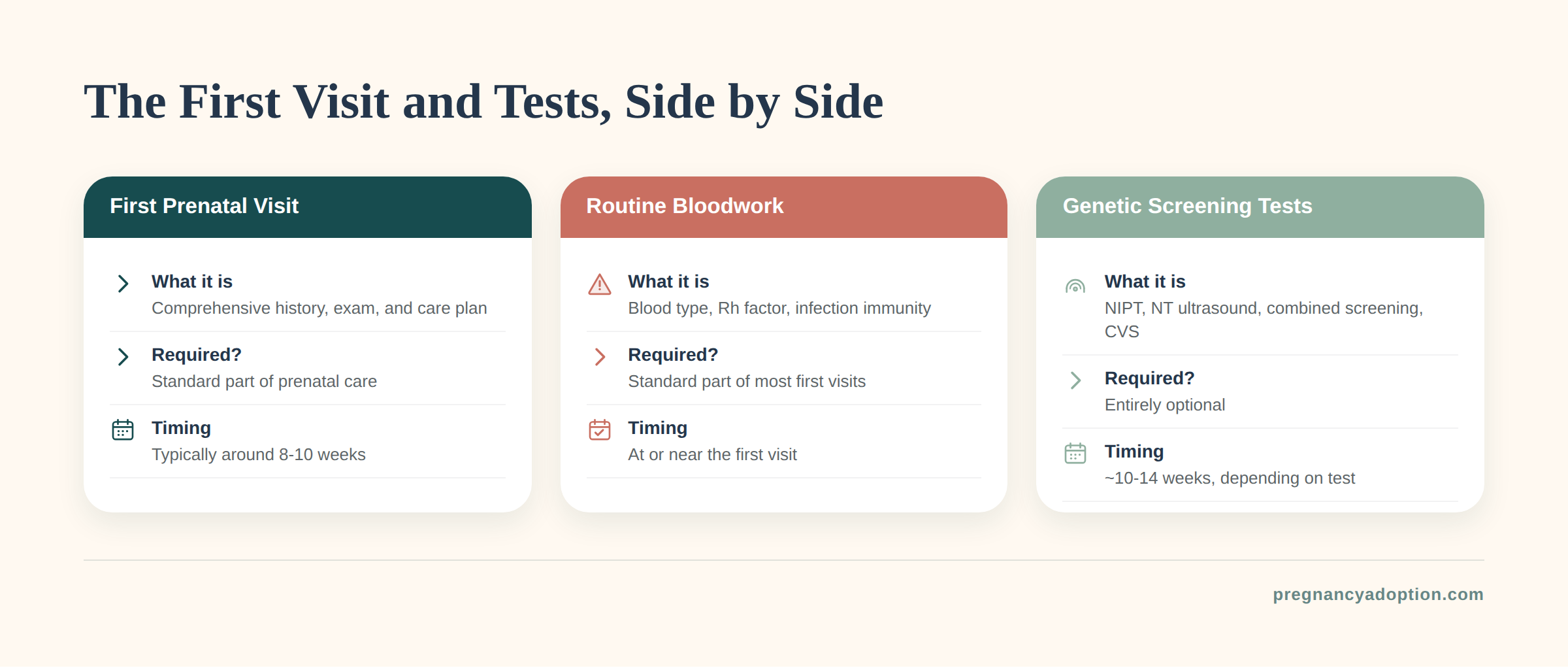
It can be easy to conflate the first prenatal visit itself with the optional screening tests — here’s a simple side-by-side comparison to keep them straight.
Three Different Things, Often Confused
It’s easy to lump “prenatal visits” and “prenatal tests” together in your head, but they’re genuinely different things serving different purposes, and understanding the distinction can help you know what to expect and what’s optional. The first comprehensive prenatal visit, covered earlier in this guide, is standard practice for essentially everyone and forms the ongoing foundation of your care — it isn’t something most people choose to skip, since it establishes your baseline health information and the schedule for the rest of your pregnancy. Within that visit, routine bloodwork — checking your blood type, Rh factor, immunity to certain infections, and overall blood counts — is also a standard part of care that nearly everyone receives, not an optional add-on. The screening tests described in the section above, by contrast — NT ultrasound, the combined screening, NIPT, and CVS — are genuinely optional and are declined by many people with no issue at all; they exist to give you additional information you can choose to seek out or not, rather than being a required part of baseline prenatal care the way the first visit and routine bloodwork are.
Deciding What’s Right for You
Whether to pursue any of the optional screening tests described above is a personal decision, and there’s genuinely no single right answer that applies to everyone. Some people want as much information as early as possible, regardless of what they’d ultimately do with a concerning result; others would rather not know unless and until something requires action, and still others fall somewhere in between, interested in some tests but not others. What matters most is being honest with yourself about what you’d actually do with the information — would a higher-risk result change any decisions you’d make, or would you proceed the same way regardless? There’s no obligation to have figured this out in advance; a good conversation with your provider at your first visit should walk through what each test can and can’t tell you, the accuracy and limitations specific to each option, and the follow-up pathway if a result comes back higher-risk, so you can make a decision that actually fits your situation rather than simply defaulting to whatever is most commonly ordered.
Common Symptoms Through the Trimester
The week-by-week sections above touch on symptoms as they tend to arise, but this site’s pregnancy symptoms guide and early pregnancy symptoms guide cover the full list and timing in much more depth than repeating it here would add.
The Symptoms Most People Associate With the First Trimester
When people picture the first trimester, three symptoms tend to come to mind first: nausea (with or without vomiting, often called morning sickness even though it can occur at any hour), profound fatigue, and breast tenderness. These three are genuinely the most commonly reported first-trimester symptoms, driven largely by the rapid rise in pregnancy hormones, particularly hCG and progesterone, during these early weeks. But they’re far from the only symptoms people experience — this site’s full pregnancy symptoms guide covers a much longer list, including less commonly discussed experiences like heightened sense of smell, food aversions, mild headaches, and emotional shifts, along with practical strategies for managing each one. Timing and intensity vary enormously from person to person: some people sail through the first trimester with barely any noticeable symptoms at all, while others have a genuinely difficult stretch of several weeks. Both experiences — and everything in between — are well within the range of what’s considered normal, and neither pattern says anything definitive about how the pregnancy itself is progressing or how the rest of the pregnancy will go.
When a Symptom Is a Reason to Call, Not Just Tough It Out
The vast majority of first-trimester symptoms, however unpleasant they feel day to day, aren’t medically concerning on their own — nausea, fatigue, breast tenderness, and the many other common experiences covered in this site’s symptoms guide are uncomfortable but expected parts of early pregnancy for most people. That said, uncomfortable and dangerous are not the same thing, and you don’t have to simply endure a symptom without asking for help just because it falls into the “common” category. Some symptoms are their own recognized medical conditions with real treatment options: severe, persistent vomiting that prevents you from keeping any fluids down, for instance, is its own diagnosable condition called hyperemesis gravidarum, and it’s treatable — there’s no need to white-knuckle through it hoping it resolves on its own. More broadly, if any symptom feels disproportionate to what you’d expect, is getting steadily worse rather than better, or is simply affecting your ability to function, that’s worth a call to your provider regardless of whether it technically counts as “common.” The warning signs section immediately below covers the specific symptoms that cross the line from uncomfortable into something requiring prompt attention.
Warning Signs: Ectopic Pregnancy and Miscarriage
Most first trimesters proceed without any of the complications below. This section exists so you know when to call right away — it is intentionally brief, because this site has two full guides dedicated to these topics in much greater depth.
Symptoms That Warrant a Same-Day Call
A handful of first-trimester symptoms warrant contacting your provider the same day, or going to urgent care, rather than waiting to mention them at your next scheduled visit. Heavy vaginal bleeding, soaking through a pad in an hour or less, severe one-sided abdominal pain, and dizziness or fainting can each be signs of either an ectopic pregnancy or a miscarriage in progress, both of which need prompt medical evaluation. This site maintains complete, dedicated guides to both ectopic pregnancy and miscarriage, covering their full symptom pictures, underlying causes, how each is diagnosed, and what happens afterward in much more depth than this overview section is designed to provide — this guide intentionally stays brief here so as not to duplicate that more specialized content. Severe vomiting is the other major same-day concern: if you’re unable to keep any fluids down for an extended stretch, that’s the hyperemesis gravidarum scenario mentioned above, and it warrants a call because unmanaged dehydration can become a serious problem on its own, separate from the original nausea. In any of these situations, it’s always better to call and be reassured than to wait and wonder.
Why This Guide Doesn’t Cover These in Depth
You may notice that this guide moves through ectopic pregnancy and miscarriage relatively briefly, even though both are significant topics closely tied to the first trimester. That’s intentional: each of these topics is substantial enough — with its own distinct causes, diagnostic processes, treatment pathways, and real emotional weight — that this site treats them as complete, standalone guides rather than folding them into a subsection here, where they’d necessarily be compressed into something far less useful than what a dedicated guide can offer. If either of these topics is relevant to you right now, whether because you’re experiencing concerning symptoms or because you’re processing a past loss, this site’s ectopic pregnancy guide and miscarriage guide are the more appropriate next stop, offering the full depth this overview doesn’t attempt to replicate. That said, if you’re in the middle of an urgent symptom right now — heavy bleeding, severe pain, fainting, or an inability to keep fluids down — the right first step is to call your provider or go to urgent care immediately; reading further can wait until after you’ve been seen and the immediate situation is addressed.
| Symptom | Possible concern | What to do |
|---|---|---|
| Heavy vaginal bleeding | Miscarriage, ectopic pregnancy | Call provider same day or go to urgent care |
| Severe one-sided abdominal pain | Ectopic pregnancy | Seek care immediately |
| Dizziness or fainting | Ectopic pregnancy (internal bleeding) | Seek care immediately |
| Can’t keep any fluids down | Hyperemesis gravidarum | Call provider same day |
| Fever over 100.4°F | Possible infection | Call provider same day |
This is not a complete list. The ectopic pregnancy guide and miscarriage guide cover full symptom pictures.
Lifestyle and Prenatal Care Basics
A few foundational habits make a real difference in the first trimester, even before you’ve had your first comprehensive visit.
What to Start Right Away
A small number of habit changes are worth starting as soon as you know you’re pregnant, or even before, since their benefit is tied to consistent use from early pregnancy onward. Starting a prenatal vitamin containing folic acid is one of the most well-established of these recommendations — ideally this would begin before conception, but starting now, as soon as you know, is still genuinely valuable, since folic acid taken in early pregnancy is linked to a meaningfully lower risk of certain neural tube defects, including spina bifida. Avoiding alcohol, tobacco, and any unprescribed recreational drug use is equally important and, among all the guidance in prenatal care, among the most clear-cut and least qualified: no amount of alcohol has been established as definitively safe during pregnancy, and both tobacco and unprescribed drug use carry real, well-documented risks to the developing pregnancy. If you were using any of these before learning you were pregnant, the right response is simply to stop now and talk to your provider about any specific concerns, rather than feeling you need to have been perfect from day one — what matters most is the change going forward.
What to Be Thoughtful About
Beyond the clear-cut recommendations above, a second category of guidance calls for being thoughtful rather than following a single hard rule. Certain foods — particularly certain raw or undercooked meats, fish, and eggs, unpasteurized dairy products, and high-mercury fish like certain tuna, swordfish, and shark — are worth checking on specifically, since they carry risks, such as listeria or mercury exposure, that are manageable simply by being aware of them. The same goes for medications: some common over-the-counter options are generally considered fine in pregnancy, while others are better avoided or used only under guidance, and it’s genuinely easier to ask your provider or pharmacist before starting or continuing something than to try to research every individual product yourself. Caffeine falls into this same thoughtful-rather-than-absolute category: most current guidance supports moderate intake, commonly cited as staying under roughly 200 milligrams per day — about the amount in one 12-ounce cup of coffee — rather than eliminating caffeine entirely, though your provider can speak to whether your specific situation calls for a different approach.
Cost and Insurance Considerations for the First Trimester
Prenatal care isn’t free, and figuring out coverage early can save a lot of stress later in pregnancy.
Understanding Your Coverage
Taking a little time to understand your insurance coverage before your first prenatal visit, rather than after the bills start arriving, is a genuinely useful step that’s easy to skip in the rush of early pregnancy. Calling your insurance provider directly to ask specifically about prenatal care coverage, which providers and facilities are in-network, and what your likely out-of-pocket costs will look like can help you avoid unpleasant surprises and, in some cases, help you choose a provider or facility more deliberately rather than by default. If you don’t have insurance yet, it’s worth knowing that many states offer expanded Medicaid eligibility specifically for pregnant applicants, often with meaningfully higher income limits than standard Medicaid eligibility requires. This means it’s worth applying for pregnancy-related Medicaid even if you were previously denied for non-pregnancy Medicaid under the regular income limits — the pregnancy-specific eligibility rules in many states are different enough that a prior denial doesn’t necessarily predict the outcome of a new application.
What Typically Costs the Most
Not all prenatal-related costs are created equal, and knowing roughly where the bigger expenses tend to fall can help with planning. The genetic screening and diagnostic tests covered earlier in this guide — NIPT, the first-trimester combined screening, and CVS in particular — are sometimes billed separately from routine prenatal visit costs, and insurance coverage for them varies more widely than coverage for routine care does; if you’re considering any of these tests, it’s worth asking your insurance specifically about coverage for that named test rather than assuming it’s covered the same way routine visits are. Looking further ahead, delivery and hospital costs are typically the largest expense associated with pregnancy by a wide margin, generally dwarfing everything that happens during the first trimester. Even though delivery is still months away, it’s worth starting to research what delivery will cost under your specific plan relatively early, simply so there are no major surprises once that bill actually arrives — costs can vary significantly depending on whether you have a vaginal delivery or a cesarean, and whether any complications arise.
Working Through the First Trimester
Most people continue working through some or all of the first trimester, and a few practical and legal basics can make that easier.
When and Whether to Tell Your Employer
There’s generally no legal requirement to tell your employer you’re pregnant during the first trimester, and the right timing for you is a personal decision rather than something dictated by rule. Many people choose to wait until after the higher-risk early weeks have passed — often sometime after the first trimester — simply for their own comfort in sharing the news before they feel ready. Others tell their employer earlier, sometimes right away, especially if they need workplace accommodations sooner, such as modified duties, additional breaks, or adjustments related to physical job demands. There’s a real trade-off at play here: keeping the news private for longer preserves your privacy and control over who knows and when, while telling your employer earlier opens up access to certain workplace protections and accommodations that are generally easier to invoke once your employer is formally aware. Neither choice is inherently better; it depends on your specific job, your relationship with your employer, and your own comfort level with disclosure.
Workplace Protections to Know About
A couple of specific legal protections are worth knowing about if you’re weighing when to disclose a pregnancy at work, at least in the context of U.S. employment law. The Pregnant Workers Fairness Act generally requires covered employers to provide reasonable accommodations for pregnancy-related conditions — things like more frequent breaks, modified duties, or temporary adjustments to physical job requirements — unless doing so would impose an undue hardship on the employer. Separately, the Pregnancy Discrimination Act generally prohibits employers from treating you unfavorably specifically because of pregnancy, childbirth, or related medical conditions, covering things like hiring, firing, promotion, and job assignments. If you believe you’re experiencing discrimination or being denied a reasonable accommodation you’re entitled to, your company’s HR department is typically the first place to raise the concern, and the Equal Employment Opportunity Commission is the federal agency that handles complaints if an internal resolution doesn’t work. These protections vary somewhat by state and by employer size, so it’s worth looking into the specifics that apply to your particular employment situation if this becomes relevant.
Traveling During the First Trimester
For most people with uncomplicated pregnancies, the first trimester doesn’t rule out travel, though a few considerations are worth thinking through.
General Travel Considerations
For most low-risk pregnancies, first-trimester travel by car, train, or air is generally considered fine, and there’s no blanket reason to cancel or avoid travel plans simply because you’re newly pregnant. That said, “generally fine” isn’t the same as “no considerations at all” — it’s worth checking with your provider about your specific situation, especially if you have any risk factors, a history of complications, or symptoms that have you uncertain. Beyond the question of whether travel itself is safe, the more common issue during the first trimester is simply comfort: nausea and fatigue, if you’re experiencing either, can make travel considerably more taxing than it would be otherwise. Planning around that reality tends to help more than trying to push through it — building in extra rest, keeping easy snacks and water readily accessible, and choosing a flexible itinerary that doesn’t require pushing through discomfort on a rigid schedule can make a real difference in how manageable a trip feels.
Specific Situations Worth Planning Around
A couple of more specific situations are worth thinking through if you’re planning travel during the first trimester. International travel to certain destinations carries its own health considerations — some regions, for example, carry a risk of Zika virus, which has specific implications for pregnancy — so it’s worth discussing any international itinerary with your provider before booking, rather than after, in case a destination needs to be reconsidered or additional precautions taken. Separately, if you’re currently experiencing any of the warning signs covered earlier in this guide — heavy bleeding, severe pain, dizziness, or an inability to keep fluids down — the right move is to postpone travel and get evaluated first. Being far from your usual care team is exactly the wrong time to be waiting out a concerning symptom to see if it resolves on its own; it’s much better to delay a trip by a few days than to be managing a potential complication somewhere unfamiliar, without easy access to the provider who already knows your history.
Emotional Changes in the First Trimester
The emotional side of early pregnancy gets less attention than the physical side, but it’s just as real.
A Wide Range of Feelings Is Normal
Early pregnancy brings an unusually wide emotional range, and it’s worth knowing upfront just how normal that range actually is. It’s entirely common to feel genuinely excited and genuinely anxious within the same hour — sometimes even within the same thought — or, just as commonly, to feel surprisingly little at all, almost disconnected from the news given how significant it is. There’s no single emotional response that counts as the “correct” one, regardless of whether the pregnancy was planned, long-hoped-for, or a surprise. Part of what drives this emotional range is genuinely physiological rather than purely psychological: the rapid hormonal shifts of early pregnancy have a real, measurable effect on mood regulation in the brain, meaning that some emotional volatility isn’t simply “all in your head” — it has a biological basis, much like the mood changes some people notice around their menstrual cycle, but considerably more pronounced. For most people, this particular intensity of mood fluctuation eases somewhat as the trimester progresses and hormone levels stabilize into the patterns that will characterize the rest of the pregnancy.
When to Reach Out for More Support
While emotional ups and downs are expected in early pregnancy, there’s a point at which it’s worth actively reaching out rather than assuming it will simply pass. If low mood, anxiety, or intrusive, hard-to-shake worry persists on most days for more than about two weeks, or starts interfering with your ability to function at work, in relationships, or in daily tasks, that’s worth mentioning to your provider directly rather than waiting to see if it resolves on its own. Support for mental health concerns during pregnancy is genuinely available, and early pregnancy mental health deserves the same attention and seriousness as mental health later in pregnancy or in the postpartum period, even though it tends to get discussed less. Separately, if what you’re navigating is less about mood and more about a genuinely difficult decision — weighing parenting, adoption, or abortion — that’s a different kind of support need, and this site’s pregnancy options overview and unplanned pregnancy guide are built specifically to help you think through what fits your situation, without steering you toward any particular choice.
Special Situations
A few circumstances change what the first trimester looks like in practice.
If You’re Considering Adoption
If you’re weighing adoption as you navigate this pregnancy, it’s worth knowing clearly that the prenatal care guidance throughout this entire guide still applies to you in full — nothing about considering adoption changes the recommendations around prenatal visits, screening tests, warning signs, or any of the other content covered here. This site’s prenatal care and adoption plan guide goes further, covering specifically how prenatal care and an adoption plan fit together in practice, including things like how medical decision-making and information-sharing typically work when adoption is part of the picture. Importantly, you don’t need to have made a final decision about parenting, adoption, or abortion before starting or continuing prenatal care — getting medical care and deciding your path forward are two separate processes that can, and often do, happen in parallel. You’re allowed to take the time you need on the second question while still taking care of the first.
If You’re a Teen or Very Young Adult
The week-by-week developmental information, the screening test options, and the warning signs covered throughout this guide all apply the same way regardless of your age — being a teenager or very young adult doesn’t change the underlying biology or the medical guidance in any of the sections above. What does differ for younger people are the surrounding legal, school, and family-dynamics questions that come with being a minor, and this site’s pregnant teen options guide is built specifically to address those additional layers — things like parental involvement in medical decisions, school attendance and accommodation rights, and family communication, none of which this general guide attempts to cover. If privacy or the question of parental involvement is a particular concern for you, the pregnant teen options guide also covers confidential counseling and testing options available in many areas, in considerably more depth than would fit naturally into this broader developmental overview.
If This Pregnancy Followed a Loss
If a previous pregnancy ended in miscarriage or another form of loss, it’s extremely common to feel heightened anxiety throughout this first trimester of a subsequent pregnancy — vigilance about every symptom, difficulty feeling reassured even when things are progressing normally, and a kind of bracing for bad news that can be exhausting to carry. Many providers recognize this and will offer more frequent reassurance visits or earlier ultrasounds specifically for people in this situation; it’s absolutely worth asking your provider directly whether that’s an option, rather than assuming you simply have to wait for the standard visit schedule. It’s also worth naming directly: well-meaning advice from others to “just relax and trust it’ll be fine” often badly misses how real and physiologically grounded this anxiety is — it isn’t something you can simply reason your way out of. Naming what you’re feeling to your provider, a therapist, or a support group for pregnancy after loss tends to be a far more useful step than trying to talk yourself out of the anxiety on your own.
If You’re Expecting Multiples
If you’re pregnant with multiples, the week-by-week developmental pattern described throughout this guide broadly applies to each baby individually, even though you’re tracking more than one at once. A few things do tend to differ, though: discovery often happens somewhat earlier than in a singleton pregnancy, since multiples can sometimes be suspected based on unusually high hCG levels or confirmed directly on an early ultrasound; the frequency of prenatal visits is often higher than for a singleton pregnancy; and the interpretation of screening tests covered earlier in this guide can differ, since the standard screening calculations were generally developed and validated for single pregnancies. Multiples pregnancies are also often considered higher-risk by default, simply due to the increased physical demands and higher likelihood of certain complications, which may mean an earlier referral to an obstetrician or a maternal-fetal medicine specialist even if you initially started care with a midwife or family physician — that referral reflects standard practice for multiples rather than a sign that something specific has gone wrong in your case.
If You Have a Pre-Existing Health Condition
If you’re managing a pre-existing health condition — diabetes, high blood pressure, a thyroid disorder, an autoimmune condition, or something else — letting your provider know as early as possible, ideally at or before your first prenatal visit, allows your care team to plan your monitoring and management appropriately right from the start, rather than catching up after the fact. Conditions like these can affect how closely you’re monitored, which additional tests might be recommended, and sometimes which provider type is most appropriate for your care, as discussed in the provider-type section earlier in this guide. It’s also common for medications used to manage pre-existing conditions to need adjustment during pregnancy, since not every medication that’s safe and effective outside of pregnancy remains the best choice during it. The one firm rule here is never to stop a medication on your own without medical guidance — instead, work with your provider, and often the specialist who originally prescribed it, to make any changes safely and with a plan for monitoring how you respond.
Telling Others and Building Your Support System
Beyond your own emotional adjustment, deciding who to tell and building a practical support network are their own first-trimester tasks.
Deciding Who to Tell, and When
There’s no required or “correct” timeline for telling people you’re pregnant, and the right approach is whatever actually feels comfortable to you. Some people tell close family and friends immediately, wanting support and company through the early weeks; others wait until after the first trimester has passed, given the somewhat higher loss risk earlier on, preferring to share the news once they feel more confident the pregnancy is progressing well. Both approaches, and everything in between, are completely reasonable, and there’s no evidence that one timing choice is inherently better than another for your wellbeing or the pregnancy’s outcome — it’s purely a matter of personal preference. It’s also entirely normal to tell different people at different times rather than making a single announcement to everyone at once: many people tell a partner or their closest confidant right away while choosing to wait considerably longer before telling extended family, coworkers, or a wider social circle. There’s no rule requiring everyone to find out simultaneously, and staggering the news to fit your own comfort level is completely standard.
Building Practical Support
Beyond the emotional side of support, it’s worth thinking concretely about practical, day-to-day help, especially if fatigue or nausea is making ordinary tasks harder than usual. Identifying one or two specific people — a partner, a family member, or a close friend — who can realistically help with things like meal preparation, errands, or childcare for other children can meaningfully lighten the load during a period when your energy may be significantly reduced. It’s often more effective to ask for something specific, such as handling grocery runs for a couple of weeks, than to make a general request for help, since specific asks are both easier for others to say yes to and easier for you to actually receive. Beyond people you already know, online and in-person communities can provide a different, valuable kind of support: due-date-based due groups connect you with others at the same stage of pregnancy, local new-parent meetups build community ahead of the baby’s arrival, and condition-specific support groups — for hyperemesis, for pregnancy after a previous loss, or for other specific situations — offer a kind of peer understanding that friends and family, however well-meaning, sometimes can’t fully provide.
A Simple Action Checklist
Here’s a condensed list of what matters most in the first trimester, pulled together from everything above.
As Soon As You Know
Confirm and Start Basic Care
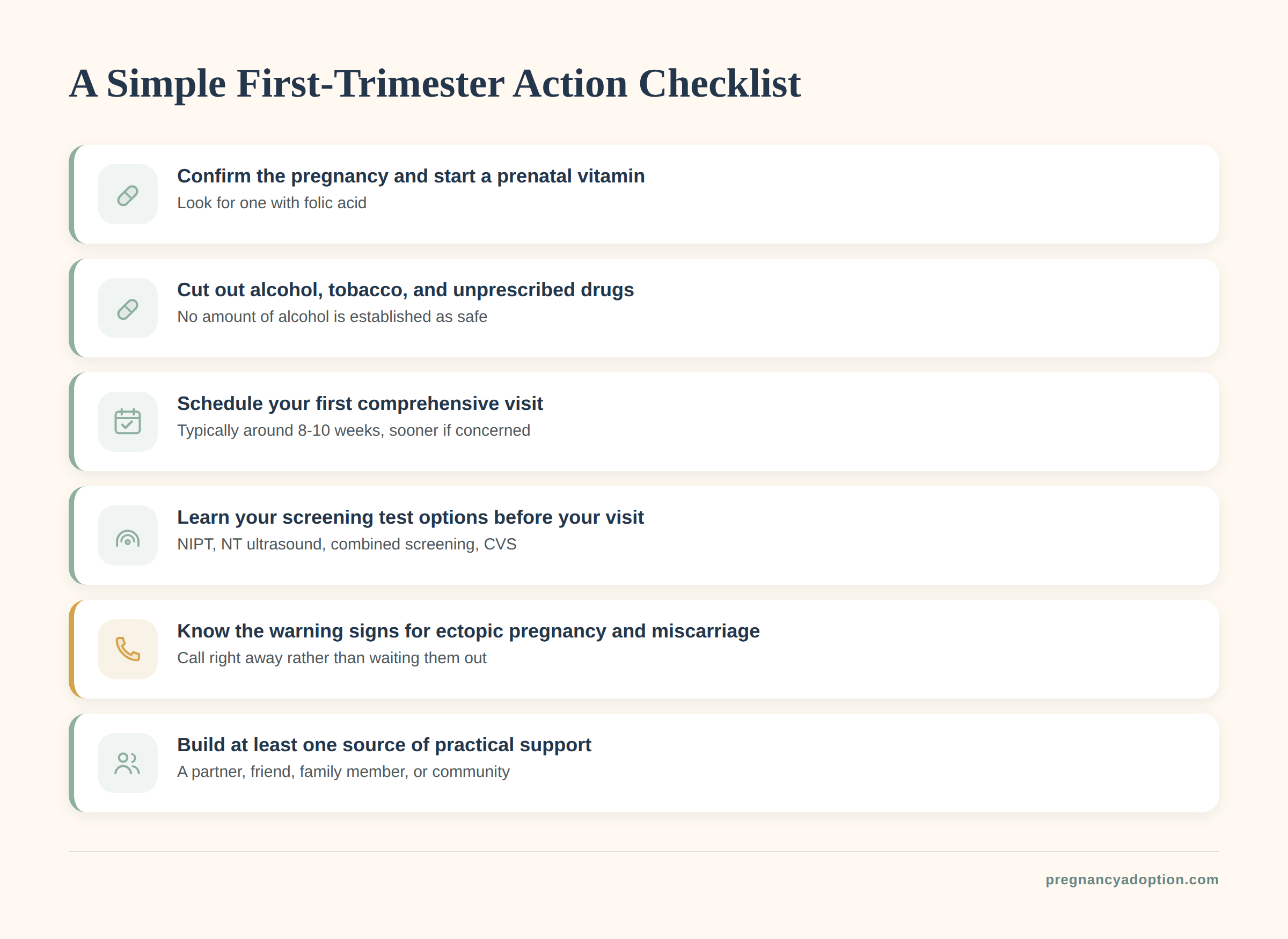
Confirm the pregnancy, start a prenatal vitamin with folic acid, and cut out alcohol, tobacco, and unprescribed drugs right away.
Schedule Your First Visit
Call to schedule the first comprehensive prenatal visit, typically around 8 to 10 weeks, sooner if you have any concerning symptoms.
Through the Rest of the Trimester
Learn About Your Screening Options
Review the screening tests in this guide so you’re prepared to make an informed choice at or before your first visit.
Watch for Warning Signs, and Don’t Wait Them Out
Know the warning signs covered above, and call right away rather than waiting to see if they pass on their own.
| Week(s) | Key focus |
|---|---|
| 1–4 | Conception and implantation, often before you know |
| 5–8 | Heart and brain development; symptoms often build and peak |
| 8–10 | First comprehensive prenatal visit, typically |
| 10–13 | Screening tests offered; organs maturing; symptoms often ease |
| 13 | End of first trimester, by this site’s convention |
Glossary of Terms in This Guide
Dating and Terminology
Gestational Age
Pregnancy duration counted from the first day of the last menstrual period, the standard convention used throughout this guide and most of this site.
Trimester
One of three roughly 13-week divisions of pregnancy; this site uses weeks 1–13 for the first trimester, while some sources use weeks 1–12.
Development Terms
Embryo
The term used for the developing organism through roughly the end of week 8 or 9, after which the term shifts to “fetus.”
Neural Tube
The early structure that develops into the brain and spinal cord, forming and closing in the first several weeks of development.
Screening and Testing Terms
NIPT (Non-Invasive Prenatal Testing)
A blood-based screening test analyzing fetal DNA fragments in the pregnant person’s blood, available starting around 10 weeks.
Nuchal Translucency (NT)
A specialized ultrasound measurement of fluid at the back of the baby’s neck, used as part of first-trimester screening.
Chorionic Villus Sampling (CVS)
A diagnostic test involving a small placental tissue sample, offered to confirm or rule out certain chromosomal and genetic conditions.
Combined Screening
A screening approach that combines the NT ultrasound with blood-test results to produce a single risk estimate.
Care and Visit Terms
hCG (Human Chorionic Gonadotropin)
The hormone detected by pregnancy tests, produced by the developing placenta; this site’s pregnancy test guide covers how hCG testing works in full depth.
Dating Ultrasound
An early ultrasound used primarily to confirm gestational age and location, often performed at or near the first comprehensive prenatal visit.
Hyperemesis Gravidarum
A diagnosed condition involving nausea and vomiting severe enough to risk dehydration or weight loss, distinct from ordinary morning sickness and requiring medical treatment.
Rh Factor
A protein on red blood cells; being Rh-negative can require specific monitoring and medication (RhoGAM) at certain points in pregnancy to prevent complications.
Quickening
The point at which a pregnant person first feels fetal movement, typically occurring in the second trimester rather than the first.
Frequently Asked Questions
Dating and Timing Questions
Why is pregnancy counted from my last period instead of conception?
It’s counted this way because the exact date of conception usually isn’t known, while the first day of the last period usually is — this site’s how-far-along guide covers this convention in more depth.
Why do some sources say the first trimester ends at week 12 and others say week 13?
Different organizations draw the boundary slightly differently; this site’s convention, used consistently across its calculators and guides, is weeks 1 through 13.
Development Questions
When does the heart start beating?
The heart begins forming and beating very early, often detectable on ultrasound by around week 6, though this varies somewhat.
When can you find out the baby’s sex?
While external genitalia begin forming in the first trimester, they typically aren’t reliably distinguishable on ultrasound until later, often around 18 to 20 weeks — well into the second trimester.
Symptom Questions
Is it normal to have no symptoms at all?
Yes — some people have very few or no noticeable symptoms in the first trimester, and this says nothing about how the pregnancy is progressing. This site’s pregnancy symptoms guide covers the full range of what’s considered normal.
When do first-trimester symptoms usually peak?
Many people notice symptoms peaking somewhere around weeks 8 to 10, though this varies considerably from person to person.
Prenatal Visit Questions
Do I need to wait until 8 weeks to see anyone?
No — if you have any concerning symptoms, or simply want to be seen sooner, you can and should call your provider earlier; the typical 8-to-10-week window is a general guideline, not a hard rule.
What should I bring to my first visit?
Bringing a list of current medications and supplements, your menstrual history (especially the first day of your last period), and any questions you’ve been saving up is generally useful preparation.
Screening Test Questions
Do I have to get any of these screening tests?
No — every screening test covered in this guide is optional, and many people choose to decline some or all of them with no issue.
What happens if a screening test comes back higher-risk?
A higher-risk screening result isn’t a diagnosis — it typically leads to a conversation with your provider about further diagnostic testing options, like CVS or amniocentesis, to get a clearer answer.
Warning Sign Questions
How do I know if cramping is normal or a warning sign?
Mild, brief cramping is common and often normal, while severe, persistent, or one-sided pain warrants a call — when in doubt, it’s always reasonable to call and ask rather than guess.
Is spotting always a sign of miscarriage?
No — light spotting is relatively common in early pregnancy and isn’t always a sign of a problem, though it should always be mentioned to your provider. This site’s implantation bleeding guide and miscarriage guide cover the distinctions in depth.
Lifestyle and Prenatal Care Questions
Is it too late to start a prenatal vitamin if I’m already a few weeks along?
No — it’s genuinely never too late to start; begin as soon as you can, even if it wasn’t from the very first week.
Is any amount of alcohol considered safe?
No amount of alcohol has been established as safe during pregnancy, which is why complete avoidance is the standard recommendation.
Emotional and Family Questions
Is it normal to feel ambivalent even about a planned pregnancy?
Yes — ambivalence, even about a wanted and planned pregnancy, is a completely normal part of the emotional adjustment, and doesn’t mean anything is wrong.
When should I tell people I’m pregnant?
That’s entirely a personal decision — some people wait until after the first trimester given the higher early loss risk, while others tell people right away; there’s no single right timeline.
Special Situation Questions
Do I need parental permission to get prenatal care as a minor?
This varies by state and by type of care — this site’s pregnant teen options guide covers consent and confidentiality rules for minors in detail.
Does considering adoption change what prenatal care I should get?
No — the prenatal care steps in this guide apply the same way regardless of whether you’re parenting or considering adoption; this site’s prenatal care and adoption guide covers how the two intersect.
Nutrition Basics Questions
Do I need to “eat for two” starting now?
No — most guidance suggests no significant calorie increase is needed in the first trimester specifically, with modest increases typically recommended later in pregnancy; the quality and variety of what you eat matters more than the quantity this early.
What if I can barely eat anything because of nausea?
Small, frequent, bland meals are often more manageable than three large meals when nausea is severe — and if you truly can’t keep food or fluids down, that’s a reason to call your provider rather than push through alone, as covered in the warning signs section above.
Common Myths and Misconceptions
Does the shape of your bump predict the baby’s sex?
No — this is a widely repeated myth with no scientific basis; bump shape is influenced by factors like muscle tone, body type, and pregnancy number, not fetal sex.
Does heartburn mean the baby will have a lot of hair?
This is another popular myth without real scientific support, though one small study found a loose statistical association — it’s not something to rely on as a predictor.
Transitioning to the Second Trimester
How will I know the first trimester is actually over?
By this site’s convention, the first trimester ends at the close of week 13 — there’s no single dramatic marker, though many people notice symptom relief and renewed energy around this general window.
What changes right at the start of the second trimester?
For many people, the most noticeable early change is symptom relief, followed over the coming weeks by a visible bump and, eventually, felt movement — this site’s forthcoming second-trimester guide will cover this period in the same week-by-week depth as this guide.
More Multiples and Fertility Treatment Questions
How early can multiples usually be detected?
Multiples can sometimes be suspected from unusually high hCG levels and are often confirmed by ultrasound as early as 6 to 8 weeks, though timing varies.
Are symptoms usually worse with multiples?
Many people carrying multiples report more intense first-trimester symptoms, including nausea, given generally higher hormone levels, though this varies considerably and isn’t universal.
More Practical Questions for Partners
What can a partner actually do to help in the first trimester?
Attending appointments when possible, taking on more of the household load if fatigue or nausea is severe, and simply asking what would help (rather than assuming) are all concretely useful steps.
Is it normal for a partner to feel left out of the process this early?
Yes — with most of the first trimester’s changes invisible and internal, partners sometimes describe feeling like bystanders; attending visits and ultrasounds together, when possible, can help close that gap.
Questions About Records and Continuity of Care
What if I need to switch insurance mid-first-trimester?
Request copies of your records from your current provider as soon as a switch is likely, and inform your new insurer and provider of your pregnancy status promptly to avoid any gaps in coverage or care continuity.
How do I get copies of my own prenatal records?
You’re generally entitled to copies of your own medical records — most practices have a formal request process, sometimes through a patient portal, and may charge a small administrative fee.
Questions About Sleep and Rest
Is it normal to need 10 or more hours of sleep?
Yes — needing significantly more sleep than usual is extremely common in the first trimester, driven by the enormous physiological workload of early pregnancy; giving yourself permission to rest more is reasonable rather than something to push through.
Is it safe to sleep on my stomach or back this early?
Yes — in the first trimester, before the uterus has grown large enough to make this uncomfortable or to affect circulation, sleeping in any position, including on your stomach or back, is generally considered fine. Position becomes more relevant later in pregnancy.
Questions About Exercise and Movement
What types of exercise are generally considered safest in the first trimester?
Walking, swimming, prenatal yoga, and stationary cycling are commonly cited as good first-trimester options for most low-risk pregnancies — check with your provider about your specific situation and any modifications worth making.
Should I stop a more intense exercise routine I had before pregnancy?
Generally, continuing a pre-existing exercise routine at a similar intensity is often fine for low-risk pregnancies, though this is worth discussing specifically with your provider, especially for higher-intensity or contact sports.
Questions About Intimacy and Relationships
Is sex safe during the first trimester?
For most low-risk pregnancies, sex is generally considered safe throughout the first trimester — this site is developing a dedicated guide to sex during pregnancy with more detail; in the meantime, check with your provider about any specific concerns.
Is it normal for libido to change in the first trimester?
Yes — libido can increase, decrease, or fluctuate, often influenced by nausea, fatigue, and hormonal shifts; neither direction of change is abnormal.
Questions About Specific Lab Values and Tests
What does a complete blood count at my first visit check for?
A complete blood count typically screens for anemia and other blood-related conditions that could affect your pregnancy — your provider will flag and address any abnormal results as part of your ongoing care plan.
Will I be tested for diabetes this early?
Routine gestational diabetes screening typically happens later, usually in the second trimester, though those with specific risk factors may be screened earlier at their provider’s discretion.