
“Domestic infant adoption” is the path most people picture by default when they hear the word “adoption”: a U.S.-born newborn, placed with an adoptive family by a parent who made that plan during or shortly after pregnancy, usually with a licensed agency or an adoption attorney guiding the way. But the phrase covers a genuinely involved process — choosing a professional and a path, completing a home study, building a profile, waiting to be matched, navigating the hospital period, and clearing a state’s consent and revocation requirements before finalization — that most people researching it have never walked through before. This guide pulls that whole path together in one place: what domestic infant adoption actually is, how it’s arranged, what it realistically costs and takes, and the mistakes and scams that trip up well-meaning prospective adoptive parents most often. We’re not a law firm, an adoption agency, or a medical practice, and nothing here is written to steer you toward or away from this path — our goal is for you to understand exactly what you’d be signing up for before you take the first concrete step.
Short Answer: What Domestic Infant Adoption Is, in Brief
Domestic infant adoption is the adoption of a U.S.-born newborn whose expectant or birth parent has made an adoption plan, almost always arranged through a licensed adoption agency, an adoption attorney, or (in some states) a licensed facilitator. The adoptive family typically completes a home study and builds a profile, the expectant parent reviews profile options and chooses a family (or an agency narrows the field based on stated preferences), and — after the baby is born, since legal consent can never be signed beforehand — the case moves through a state-defined consent and, in most states, revocation window before a court finalizes the adoption. It is generally the highest-demand and one of the higher-cost adoption paths, with waiting times that are genuinely unpredictable because they depend on an expectant parent’s own timeline and choice, not on an agency’s schedule.
The One-Paragraph Version
Who’s Involved and What Has to Happen
Three parties are always involved in some combination: the expectant or birth parent making the adoption plan, the prospective adoptive family being matched with them, and a licensed professional (an agency, an attorney, or both) making sure every legal requirement is actually met along the way. Nothing is final until a court finalizes the adoption, and no legal consent can be signed until after the child is born, no matter how far along the planning was beforehand.
What Makes This Path Distinct From Other Types
Unlike foster care adoption, where a caseworker actively works to match a family to a specific waiting child, domestic infant adoption depends on an expectant parent choosing to move forward with a given family — which is part of why it can feel less predictable than other paths, even for families who’ve done everything right. Our types of adoption comparison guide covers how this path stacks up against foster care, international, relative, and stepparent adoption in full side-by-side depth; this guide stays focused specifically on domestic infant adoption.
What This Guide Covers — and What It Deliberately Doesn’t
What’s Here
This article walks the whole domestic-infant-specific path: choosing between an agency, an independent attorney-led arrangement, or a facilitator; the home study as a starting gate; building an effective adoptive family profile; how matching actually works and what affects how long it takes; what happens if a match falls through; the hospital period; consent and revocation; interstate placement considerations; openness; cost, in broad strokes; and the scams and bad-faith practices this specific path is most vulnerable to.
What’s Deliberately Deferred Elsewhere
This guide does not rebuild the detailed, state-by-state legal mechanics of consent and revocation (that’s our full adoption process guide), the itemized cost breakdown (that’s our adoption cost guide), the home study checklist (that’s our adoption home study guide), or the cross-type comparison against foster care and international adoption (that’s our types of adoption guide). Each is linked throughout, at the point a reader would actually want that depth.
Key Takeaways
- Domestic infant adoption is the adoption of a U.S.-born newborn, almost always arranged through a licensed agency, an adoption attorney, or a facilitator, with the expectant parent retaining real choice over the adoptive family up until legal consent is signed after birth.
- It’s generally the highest-demand domestic path, and waiting times are genuinely unpredictable because they depend on an expectant parent’s own timeline, not an agency’s schedule.
- This guide is the dedicated, domestic-infant-specific deep dive — for the universal legal process, itemized costs, and cross-type comparison, see the linked sibling guides throughout.
What Domestic Infant Adoption Actually Is
Before getting into process and cost, it helps to be precise about what domestic infant adoption means, since the term gets used loosely and sometimes gets confused with related but distinct paths.
The Core Definition
A U.S. Newborn, an Adoption Plan, and a Licensed Professional
Domestic infant adoption describes a U.S. expectant parent deciding, sometime during pregnancy or shortly after birth, to place their newborn with an adoptive family they’ve chosen or helped choose, almost always working with a licensed adoption agency or an adoption attorney to make sure every legal requirement is met. The word “domestic” distinguishes it from international adoption (a child who is a citizen of another country); “infant” distinguishes it from foster care adoption of an older child and from relative or stepparent adoption, where the adoptive parent already has an existing relationship with the child.
Why “Private Domestic Adoption” and “Domestic Infant Adoption” Aren’t Quite the Same Term
You’ll sometimes see “private domestic adoption” used as a near-synonym, but the two aren’t identical: private domestic adoption is a broader statistical category that includes a small number of older-child private placements alongside infant placements, while domestic infant adoption refers specifically to newborns. This article uses “domestic infant adoption” throughout because that’s the specific path most people researching this topic are actually asking about.
How It Differs From Related Paths
It’s Not Foster-to-Adopt
In foster care adoption, a child is already in the state child welfare system, and a caseworker actively works to match an approved family to that specific child, whose birth parents’ rights have been or are being legally terminated. In domestic infant adoption, there’s no prior state involvement — the expectant parent is making a voluntary adoption plan, retains full parental rights through birth, and generally chooses the adoptive family rather than being matched to one by a caseworker.
It’s Not the Same as “Private Adoption” as an Arrangement Type
“Private” is also sometimes used to describe the independent, non-agency arrangement style (as opposed to agency-facilitated adoption) — a different axis entirely from where a child comes from. Domestic infant adoption can be arranged either through an agency or independently; our private adoption guide covers the independent, attorney-led arrangement style itself in dedicated depth, across adoption types, not just infant placements.
The Legal Skeleton Underneath It
Consent Can’t Happen Before Birth
Every U.S. state requires that legal consent to an adoption be signed after the child is born — a safeguard against an expectant parent being pressured into an irreversible decision before they’ve met the baby or experienced the birth itself. This is universal even though the specific waiting period after birth before consent can be signed, and whether or how long a revocation window follows it, varies by state.
A Court — Not an Agency or a Signed Agreement — Makes It Final
No matter how smoothly matching and placement go, a domestic infant adoption isn’t legally complete until a judge reviews the full record and enters a final decree of adoption. Everything described in this guide — the home study, the match, the hospital plan, even a signed consent — is a step toward that moment, not a substitute for it.
Key Takeaways
- Domestic infant adoption specifically means a U.S.-born newborn, placed under a voluntary adoption plan, almost always through a licensed agency or attorney.
- It’s distinct from foster care adoption (an older child already in state care) and from “private adoption” as an arrangement style, which can apply to domestic infant adoption or to other types.
- Legal consent can never be signed before birth, and nothing is final until a court finalizes the adoption — a sequence covered in full procedural detail in our adoption process guide.
How Common Domestic Infant Adoption Is, and Why That’s Changed
Domestic infant adoption is often assumed to be the most common form of adoption, but the real numbers tell a more specific story — one that explains a lot about why matching can take as long as it does.
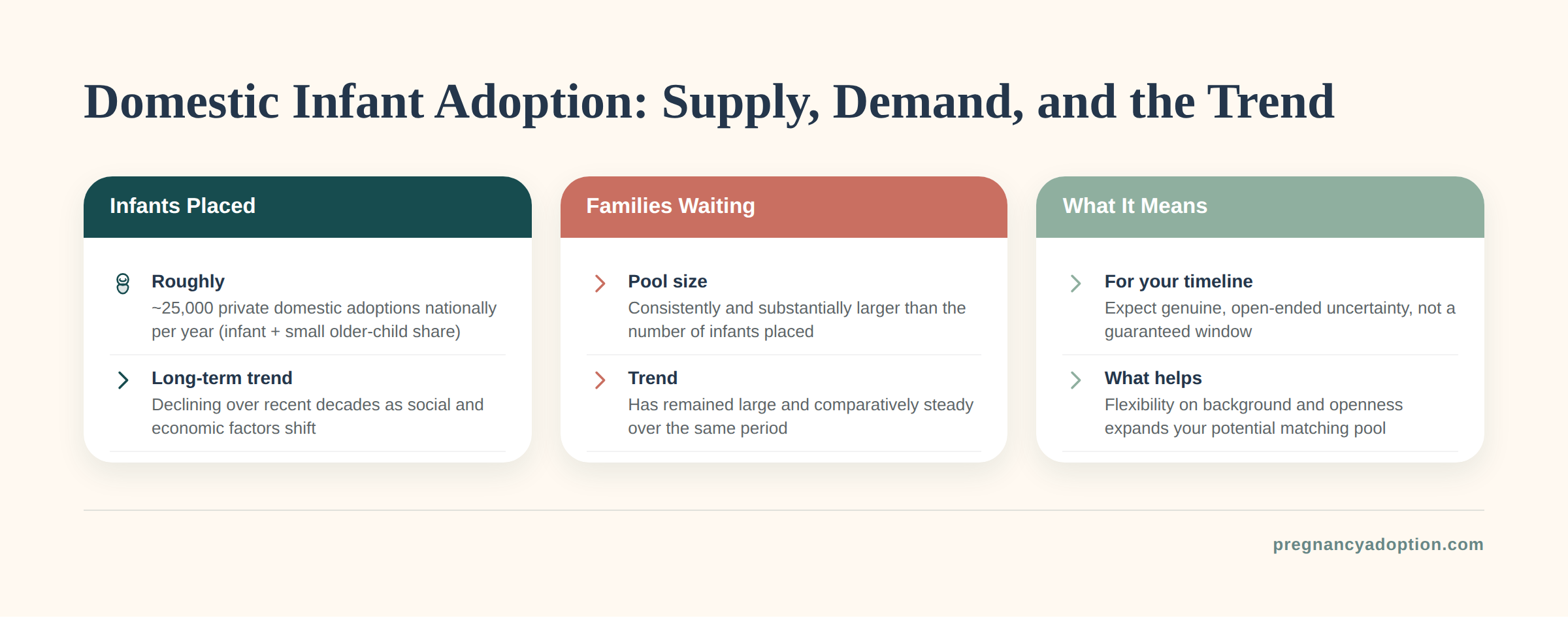
| Measure | What’s Known | What It Means for You |
|---|---|---|
| Private domestic adoptions per year (infant + small share of older-child) | Roughly 25,000 nationally in recent estimates from National Council For Adoption | A much smaller pool than the number of families hoping to adopt a newborn |
| Demand from prospective adoptive families | Has consistently and substantially exceeded the number of infants placed, in every recent year tracked | Expect real, open-ended uncertainty around matching timing, regardless of how strong your profile is |
| Long-term trend | The number of infants placed for domestic adoption has declined over recent decades, driven by broader social and economic shifts | This is a multi-decade structural trend, not a temporary dip — plan accordingly rather than expecting it to reverse |
Why Demand Outpaces Supply
Fewer Infants Placed for Adoption Than in the Past
The number of U.S. infants placed for domestic adoption each year has declined substantially over recent decades, reflecting broader shifts including expanded access to contraception and family-planning resources, reduced social stigma around parenting outside marriage, and a wider range of support available to parents who choose to parent rather than place. This isn’t a sign that adoption has become less valid or less needed — it’s simply a demographic and social reality that shapes how long matching realistically takes.
A Large and Fairly Steady Pool of Prospective Adoptive Families
At the same time, the number of families hoping to adopt a newborn through domestic infant adoption has remained large relative to the number of infants placed, for reasons including infertility, a preference for adopting an infant specifically, and a general and longstanding interest in domestic infant adoption as a family-building path. The mismatch between these two numbers — not any failure on an individual family’s part — is the single biggest driver of matching wait times.
What This Means Practically
Expect Real Uncertainty, Not a Guaranteed Timeline
No agency or attorney, however experienced, can promise a specific matching timeline, because matching ultimately depends on an expectant parent’s own decision and preferences — something entirely outside any professional’s control. Agencies and attorneys who imply otherwise, or who guarantee a match within a specific window, are a signal worth treating with real skepticism, covered further in this guide’s section on avoiding scams.
Flexibility Measurably Affects Your Position in the Pool
Being genuinely open to a wider range of circumstances — a birth parent’s health history, prenatal substance exposure, a range of racial or ethnic backgrounds, or an open adoption arrangement — generally expands how many expectant parents’ profiles your family might be a fit for, which in turn tends to shorten an average wait, though it doesn’t eliminate the underlying uncertainty.
Key Takeaways
- Roughly 25,000 private domestic adoptions (infant and a small share of older-child) happen nationally each year, against a much larger pool of hoping-to-adopt families.
- The gap between supply and demand, not any individual shortcoming, is the single biggest driver of how long matching takes.
- No professional can guarantee a matching timeline — a claim to the contrary is a red flag covered later in this guide.
Who’s Involved, and What Each Party Actually Does
Domestic infant adoption involves a smaller, more specific cast than some other adoption types — understanding exactly what each party does (and doesn’t do) makes the rest of this guide easier to follow.
The Expectant or Birth Parent
Before Placement, “Expectant Parent” Is the Accurate Term
Before a child is born and placed, the accurate and preferred term is “expectant parent” — not “birth mother” or “birth father,” which accurately apply only after placement. This isn’t just style: up until the moment legal consent is signed, this person holds full, unqualified parental rights, identical to any other parent’s, and retains the right to change their mind about adoption entirely.
Real Choice Over the Family and the Arrangement
In modern domestic infant adoption practice, the expectant parent generally reviews adoptive family profiles and chooses who to move forward with, specifies real preferences (geography, family structure, openness level, and more), and retains the right to change that choice at any point before signing consent. Our guide for expectant parents considering adoption covers this side of the process in complete depth; this guide covers it only as far as an adoptive family needs to understand it.
The Prospective Adoptive Family
Completing a Home Study and Building a Profile
The prospective adoptive family’s role is to become approved to adopt (through a home study), build an honest, effective profile that gets shown to expectant parents, and — once matched — support the expectant parent and prepare for placement, in whatever way the specific arrangement calls for.
Waiting Without a Guaranteed Outcome
Unlike some other paths, being approved and having an active, well-presented profile doesn’t guarantee a match within any particular window; the adoptive family’s role during the waiting period is largely about patience, continued readiness, and honest engagement when a potential match does come along.
The Agency, Attorney, or Facilitator
Managing the Legal and Logistical Work
A licensed agency, an adoption attorney, or (where legal) a facilitator manages some combination of matching, home study coordination, counseling for the expectant parent, and the legal filings that make the adoption valid — exactly which party does which piece depends on which path you choose, covered in the next section.
Why At Least One Licensed Professional Is Always Required
No U.S. state allows a fully informal, do-it-yourself domestic infant adoption without any licensed professional involved — the required consent process, and often the home study, simply can’t be lawfully completed without one. Working with an experienced, specifically adoption-focused professional (not just any attorney or any agency) is widely recommended precisely because the legal requirements are specific and unforgiving of mistakes.
The Court
The Only Party That Can Make It Final
However smoothly matching, placement, and the hospital period go, a judge reviewing the full case record and entering a final decree of adoption is the only thing that makes a domestic infant adoption legally permanent. Our adoption process guide covers the court’s role and the finalization hearing itself in complete step-by-step detail.
Why This Structure Protects Everyone Involved
This single point of finality exists specifically so that no one party — not an agency, not an attorney, not even both families acting in full agreement — can complete an adoption without an independent legal check. It gives the expectant parent a clearly defined, reviewable process rather than an informal handshake, and it gives the adoptive family a legally unassailable basis for their parental rights going forward.
Choosing Your Path: Agency, Independent/Attorney-Led, or Facilitator
One of the first real decisions a prospective adoptive family makes is how to arrange their domestic infant adoption — through a licensed agency, independently with an attorney, or, in some states, through a facilitator. Each has a genuinely different structure, cost profile, and level of built-in support.
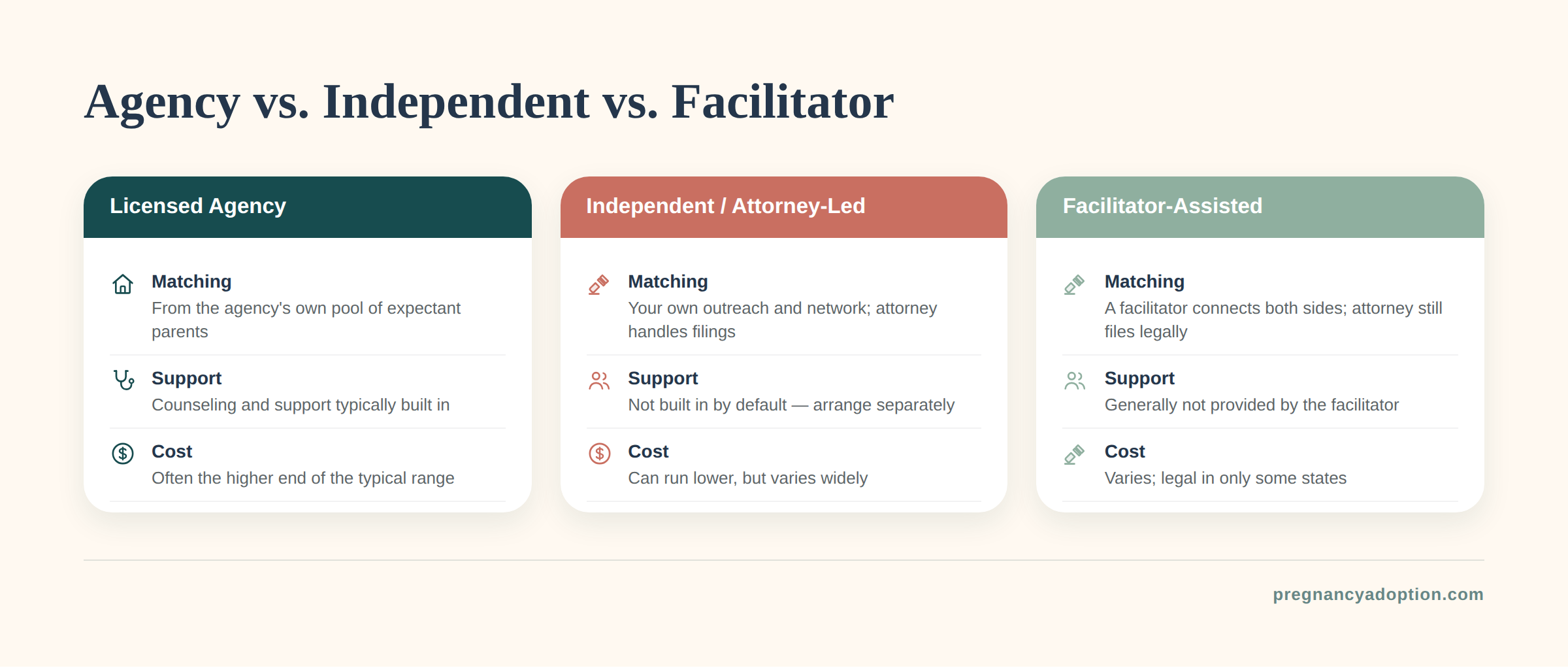
| Path | Who Handles Matching | Built-In Counseling/Support | Typical Cost Level |
|---|---|---|---|
| Licensed agency | The agency, from its own pool of expectant parents and waiting families | Generally yes — agency counselors typically support the expectant parent directly | Often the higher end of the typical range; see our cost guide |
| Independent, attorney-led | The adoptive family’s own outreach and network, with the attorney handling legal filings | Not built in by default — the family or attorney may need to separately arrange counseling | Can run lower than agency fees, but varies widely |
| Facilitator-assisted | A facilitator connects expectant parents and adoptive families; an attorney still handles legal filings separately | Generally not provided by the facilitator itself | Varies; legal in only some states — confirm first |
Working With a Licensed Agency
What an Agency Typically Provides
A licensed agency generally manages matching from its own pool of expectant parents, conducts or coordinates the home study, provides counseling and support to the expectant parent, and often coordinates lawful medical and living-expense support within state limits. For many first-time adoptive families, this built-in structure and counseling support is the single biggest reason to choose an agency over an independent arrangement.
What to Verify Before Committing
Confirm a prospective agency’s state licensing status directly with your state’s child welfare licensing authority, rather than relying on the agency’s own marketing materials, and ask specifically how many domestic infant matches the agency facilitated in the past year, what its average wait time has looked like recently, and exactly what’s included in its quoted fee before you sign anything.
Independent, Attorney-Led Adoption
What Independent Adoption Actually Involves
In an independent adoption, the match between expectant parent and adoptive family happens outside a central agency structure — often through the adoptive family’s own outreach, a smaller personal network, or an attorney’s own contacts — with an attorney still required to handle the legal filing and consent process. This path is legal in most, but not all, states.
Why Independent Adoption Isn’t Automatically Cheaper or Simpler
Independent adoption can mean more direct control and, in some cases, lower fees, but it also means less built-in counseling support for the expectant parent and more responsibility on the adoptive family and attorney to ensure every legal requirement is properly met — there’s no agency structure providing that oversight by default. Our private adoption guide covers independent adoption’s legal mechanics and state-by-state considerations in dedicated depth.
Facilitators and Why They’re a Separate Category
What a Facilitator Does and Doesn’t Do
An adoption facilitator helps connect expectant parents and prospective adoptive families — essentially a matching service — without being a licensed adoption agency, and generally without providing the counseling, legal, or oversight functions an agency or attorney provides.
Why Several States Restrict or Ban For-Profit Facilitation
Because facilitators have historically operated with less regulatory oversight than agencies or attorneys, several states restrict or prohibit for-profit facilitation specifically; where facilitators are legal, a licensed attorney is still required for the actual legal consent and filing process.
How Most Families Actually Decide
Weighing Structure Against Control and Cost
Most families weigh how much built-in structure and counseling support they want for the expectant parent against how much direct control and potentially lower cost an independent arrangement might offer — neither path is inherently better, and many experienced adoption attorneys can walk a family through which fits their specific situation during an initial consultation.
Some Families Pursue More Than One Path at Once
It’s not uncommon for a family to work with an attorney for independent networking while also staying on an agency’s waiting list, as long as both professionals are aware of the arrangement and there’s no risk of double-matching or fee conflicts — discuss this directly and transparently with each professional before pursuing it.
Key Takeaways
- Agency, independent/attorney-led, and facilitator-assisted are the three main ways to arrange a domestic infant adoption, each with a genuinely different structure, cost profile, and built-in support level.
- Independent adoption and facilitator legality both vary by state — confirm both before building a plan around either.
- Neither path is inherently better; the right choice depends on how much structure, counseling support, and direct control your family wants.
The Home Study: Where Every Domestic Infant Adoption Starts
Whichever path you choose, an approved home study is almost always the gate you have to pass through before active matching can begin.
Why the Home Study Comes First
Agencies and Attorneys Generally Won’t Present an Unapproved Family
Expectant parents are generally shown only families who’ve already completed and passed a home study — a meaningful vetting step that’s already done by the time an expectant parent sees your profile. Starting the home study as early as possible, rather than waiting until you feel fully “ready,” is one of the most common pieces of advice experienced adoption professionals give new families.
What the Home Study Actually Assesses
A home study generally involves background checks, interviews, a home visit, financial and health information, and often required training — assessing safety and overall readiness to parent, not wealth, home size, or a particular family structure. Our dedicated home study guide covers exactly what’s involved, how long it typically takes, and how to prepare, in depth this overview intentionally doesn’t duplicate.
Timing It Against Matching
A Typical Home Study Takes a Few Months
Most home studies take roughly two to three months from start to approval, though this varies by state, agency, and how quickly the family completes its own part of the process — scheduling it early, rather than treating it as a formality to rush through at the last minute, generally shortens your overall timeline the most.
Approval Doesn’t Expire Immediately, but It Does Expire
An approved home study is typically valid for about a year before requiring renewal, and a lapsed home study can stall a placement that’s otherwise ready to move forward — keep track of your approval date and plan for a renewal update well before it lapses.
Key Takeaways
- An approved home study is almost always required before active matching begins, and starting it early is one of the most effective ways to shorten your overall timeline.
- A typical home study takes a few months and generally needs renewal roughly annually — plan around both.
- Full home study requirements and preparation steps are covered in our dedicated home study guide.
Building an Adoptive Family Profile That Actually Works
Your adoptive family profile — sometimes still called a “Dear Birth Mother” letter, though that specific framing has become less universal — is often the single biggest factor within your control during the matching stage, and it deserves far more attention than many first-time families give it.
What a Profile Actually Needs to Do
Help an Expectant Parent Picture Your Actual Life
A strong profile gives an expectant parent a genuine, specific sense of your day-to-day life, your values, and why you want to adopt — not a generic, polished presentation that could describe almost any family. Specific details (what a Saturday morning actually looks like, a real family tradition, how you talk about hard topics) tend to land far better than broad, interchangeable statements about being “loving” and “stable.”
Address Openness and Contact Directly, Not Vaguely
Many expectant parents specifically look for how a family talks about ongoing contact and openness — vague or avoidant language here is one of the more common reasons a strong-seeming profile doesn’t generate interest. Being honest and specific about what level of contact you’re genuinely comfortable with serves everyone better than defaulting to language you think sounds appealing but don’t actually mean.
Format: Book, Website, or Video
The Traditional Printed Profile Book
A printed or PDF profile book — typically 10 to 20 pages of photos and short narrative sections — remains the most common format many agencies use, and it’s worth treating the writing with real care rather than defaulting to agency-provided template language verbatim.
Website and Video Profiles
A growing number of families supplement or replace the traditional profile book with a dedicated website or a short video, which can convey warmth and personality a static page sometimes can’t — ask your agency or attorney whether this is something expectant parents in their specific program tend to engage with, since norms vary by agency and region.
Common Mistakes in Profile-Building
Overpolishing at the Expense of Authenticity
A profile that reads like a glossy brochure, with professionally staged photos and generic language throughout, can come across as less trustworthy than one with a few candid, imperfect moments — many expectant parents say directly that they’re looking past the surface presentation toward genuine specifics about values and daily life.
Leaving Out Honest Answers to Hard Questions
Avoiding or glossing over topics like openness preferences, how you’d talk with a child about their adoption story as they grow, or your own family’s reaction to adopting can read as evasive — addressing these directly, even briefly, tends to build more trust than sidestepping them.
Getting Useful Feedback Before You’re Shown to Anyone
Ask Your Agency or Attorney for Direct, Specific Feedback
Most experienced agencies and adoption-focused attorneys will review a draft profile and give specific, sometimes blunt feedback before it’s shown to any expectant parent — take this feedback seriously rather than treating it as optional, since professionals who’ve seen hundreds of profiles have real insight into what resonates.
Consider a Second Opinion From Someone Outside Your Immediate Circle
A friend or family member who knows you well may be too close to notice what an unfamiliar reader would find vague or confusing — some families find it useful to show a draft to someone with no prior context and ask what they’d genuinely take away from it.
Key Takeaways
- Your profile is one of the most within-your-control factors in matching, and specific, honest, non-generic content tends to outperform polished but vague presentation.
- Address openness and contact preferences directly rather than vaguely, since this is a frequent point of genuine interest for expectant parents.
- Take direct feedback from your agency or attorney seriously, and consider a second opinion from someone outside your immediate circle before your profile is shown to anyone.
How Matching Actually Works
“Matching” is the stage most prospective adoptive families spend the most time thinking about — and it’s also the stage with the most variability, since it depends on how a given agency or attorney structures the process.
Profile Review and Introductions
The Expectant Parent Generally Chooses
In most modern domestic infant adoptions, the expectant parent reviews profiles and chooses which family to connect with, rather than the reverse — a meaningful shift from how adoption worked decades ago, and one that shapes how this entire stage is structured.
Early Conversations Aren’t Binding on Either Side
An agency or attorney typically facilitates an initial call or meeting once an expectant parent expresses interest in a specific family’s profile; nothing is legally binding at this stage, and either side can step back without obligation, right up until legal consent is signed after birth.
What Happens Once You’re “Matched”
An Agreement to Move Forward, Not a Guarantee
Being matched means an expectant parent has chosen or agreed to move forward with your family — it’s a meaningful, often emotional milestone, but it is not placement, and it is not adoption. In most domestic infant adoptions, it’s understood by everyone involved that the expectant parent retains the right to change their mind at any point before signing consent after birth, even after a match.
Building a Relationship During the Match Period
Many families and expectant parents build some relationship during the match period — through calls, texts, or in-person visits, depending on geography and both sides’ comfort — which can meaningfully shape how placement and any ongoing openness arrangement unfold later. How much contact happens during this period varies enormously and should be guided by what the expectant parent is comfortable with.
Why Being Matched Isn’t the Same as Being “Chosen Forever”
A Match Can Still Change Before Placement
It’s emotionally difficult but important to understand clearly: a match reflects where things stand today, not a locked-in outcome. An expectant parent can decide to parent, to choose a different family, or to pause the process entirely at any point before consent — this isn’t a failure of the match or a sign anything went wrong, and this guide covers what that experience looks like for an adoptive family in the next section.
Agencies and Attorneys Generally Prepare Families for This Possibility
A reputable professional will be direct with you, before you’re ever matched, about the real possibility that a match doesn’t lead to placement — if a professional avoids this topic or presents matching as effectively guaranteed once it happens, that’s worth asking more pointed questions about.
Key Takeaways
- In most domestic infant adoptions, the expectant parent reviews profiles and chooses the adoptive family, rather than the reverse.
- Being matched is a meaningful milestone but not a guarantee — the expectant parent retains the right to change their mind at any point before signing consent after birth.
- A reputable agency or attorney will be direct with you about this possibility before you’re ever matched, not after.
What Affects How Long You’ll Wait to Be Matched
“How long will it take?” is the question nearly every prospective adoptive family asks first, and it’s also the one with the least satisfying honest answer — but several real, identifiable factors do meaningfully affect where a given family lands.
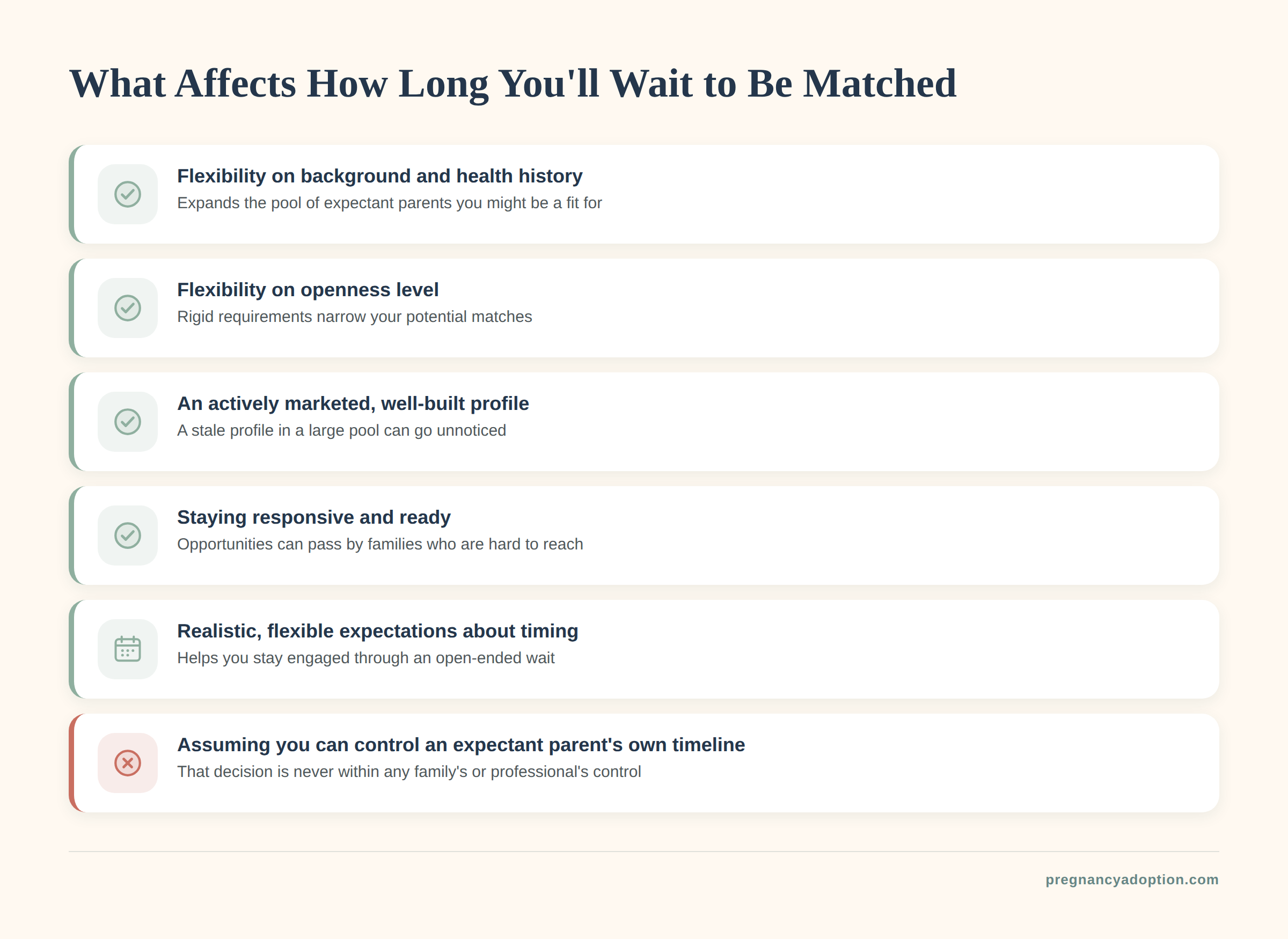
| Factor | Tends to Shorten the Wait | Tends to Lengthen the Wait |
|---|---|---|
| Flexibility on background/health history | Openness to a wider range of prenatal history, health background, or circumstances | A narrow set of preferences that few expectant parents’ situations will match |
| Openness-level flexibility | Comfort with a range of openness arrangements, rather than insisting on one specific level | Requiring full openness or full closure as a hard condition |
| Profile marketing activity | An agency or attorney actively and currently marketing your profile to new expectant parents | A profile that’s gone stale within an agency’s larger, less-actively-marketed pool |
| Pool size and timing | Working with a professional currently seeing a healthy volume of expectant-parent inquiries | Simple timing luck, which no family or professional fully controls |
Factors Genuinely Within Your Control
How You Set Your Preferences
Preferences around a child’s health history, prenatal exposure, racial or ethnic background, and openness level are entirely your own to set — but the more specific and restrictive they are, the smaller the pool of expectant parents whose situation will be a potential match, and the longer an average wait tends to run. This isn’t a judgment of any particular preference; it’s simply how the math of a supply-and-demand mismatch works.
How Responsive and Engaged You Are
Being quickly responsive when your agency or attorney reaches out, keeping your home study and paperwork current, and staying actively engaged (rather than going quiet for long stretches) all help make sure you’re genuinely ready when an opportunity does come along — a family that’s hard to reach can lose out on a potential match simply through bad timing.
Factors Outside Your Control
An Expectant Parent’s Own Timeline and Decision
Ultimately, matching depends on an expectant parent choosing your family — a decision shaped by their own values, circumstances, and timeline, none of which any amount of profile-polishing or flexibility can control directly.
Geography and Regional Supply
Some regions have a larger relative pool of expectant parents considering adoption than others at any given time, and this shifts over time in ways no individual family can predict or influence — working with a professional with a wide geographic reach (within your state’s and any interstate placement’s legal requirements) can sometimes help offset this.
Setting Realistic Expectations
There’s No Reliable “Average” to Anchor To
You’ll encounter widely varying wait-time figures from different sources, and none of them reliably predicts your own experience, because the underlying factors are so individualized. Ask your specific agency or attorney for their own recent, honest track record rather than relying on a general statistic from elsewhere.
Preparing Emotionally for an Open-Ended Wait
Many prospective adoptive parents say the uncertainty of waiting — not knowing whether a match is weeks or many months away — is one of the hardest parts of the entire process, and it’s a completely normal reaction, not a sign anything is wrong with your approach. Many agencies offer or can refer you to waiting-parent support groups specifically because this experience is so common.
Key Takeaways
- Flexibility on background, health history, and openness level tends to shorten an average wait; narrow preferences tend to lengthen it.
- Ultimately, matching depends on an expectant parent’s own timeline and choice — a factor no family or professional fully controls.
- Ask your specific agency or attorney for their own recent track record rather than relying on a general industry statistic.
When a Match Falls Through: Understanding Disruption Risk
This is one of the most difficult realities of domestic infant adoption, and one that deserves honest, direct treatment rather than a brief mention: a match can end before placement, and sometimes even after placement but before finalization.
Why This Happens
The Expectant Parent’s Right to Change Their Mind
Up until legal consent is signed after birth — and, in most states, for some further window afterward during a revocation period — the expectant parent retains full legal parental rights and the right to decide not to place the child, with that family or at all. This isn’t a flaw in the system; it’s the entire point of the legal safeguards described throughout this guide, designed specifically to protect against pressuring someone into an irreversible decision.
How Often This Actually Happens
Reliable, consistently defined national statistics on domestic infant adoption disruption rates are limited, and figures circulated informally vary considerably in methodology and are often outdated; what’s consistently true is that it is a real and recognized possibility that reputable professionals prepare families for honestly, not a rare edge case to dismiss.
What It Looks Like From the Adoptive Family’s Side
Before Placement
Most commonly, a match ends before placement — an expectant parent decides to parent, chooses a different family, or the situation changes in some other way — and the adoptive family, often having built a real emotional connection and sometimes covered lawful medical or living expenses already, experiences real grief and disappointment that deserves to be taken seriously, not minimized.
After Placement, Before Finalization
Less commonly, a placement can be disrupted after the child has physically moved into the adoptive family’s home but before finalization — most often during a state’s revocation window, if one exists and the birth parent exercises it. This is uncommon, but it is a real possibility that’s worth understanding honestly before placement, not learning about for the first time if it happens.
How Reputable Professionals Handle This Risk
Preparing Families Honestly, Before It Happens
A trustworthy agency or attorney will discuss disruption risk directly with you during your initial consultations — not to discourage you, but so you go into matching with realistic expectations rather than discovering the possibility only if it happens to you.
Financial and Emotional Support When It Does
Ask any professional you’re considering directly what their specific support looks like if a match or placement is disrupted — whether lawfully advanced expenses are recoverable (often they are not, by law, since they’re a gift to support the expectant parent, not a loan), what counseling or support resources are available to you, and how quickly you can be reconsidered for a new match.
Protecting Yourself Financially and Emotionally
Understand What You’re Financially Exposed to in Advance
Lawful medical and living-expense support provided to an expectant parent is not recoverable if they decide not to place, in any state — this is a deliberate legal design, not a gap, since treating it as a loan or something owed would resemble payment for a child. Budget with this possibility in mind rather than assuming those funds are a safe, recoverable investment.
Building Support Before You Need It
Many families find it valuable to connect with a support group or a therapist experienced with adoption-related loss before starting the matching process, rather than searching for one for the first time in the middle of a difficult moment. Several national adoption organizations maintain directories specifically for this kind of support.
Key Takeaways
- A match can end before placement, and less commonly a placement can be disrupted before finalization — this reflects the expectant parent’s genuine legal right to change their mind, not a flaw in the process.
- Lawfully provided medical and living-expense support to an expectant parent is not recoverable if they decide not to place — budget with this possibility in mind.
- A trustworthy professional discusses this risk honestly with you before matching, not only if it happens.
The Hospital Period and the Immediate Post-Birth Days
The hospital period is often the most emotionally significant part of the entire process for everyone involved, and having a clear, agreed-upon plan in advance tends to make it go more smoothly for both families.
Building a Hospital Plan in Advance
What a Hospital Plan Typically Covers
A hospital plan — developed in advance with your agency or attorney’s guidance — typically covers who’s present during labor and delivery, how much time the expectant parent wants with the baby, whether and how the adoptive family is involved at the hospital, and what happens in the hours immediately following birth. These decisions belong primarily to the expectant parent, and a good agency or attorney builds the plan around what they want, not around the adoptive family’s preferences.
Staying Flexible as the Actual Day Approaches
Even a carefully built hospital plan sometimes needs to flex — labor doesn’t always go as scheduled, hospital staff and policies vary, and an expectant parent’s feelings in the moment can shift. Building in some flexibility, and trusting your agency or attorney’s real-time guidance, generally serves everyone better than treating the plan as a fixed script.
What Adoptive Families Can Reasonably Expect
Variable Hospital Involvement
Depending on the specific hospital plan, an adoptive family’s hospital involvement can range from being present throughout to waiting nearby to waiting at home for a call — there’s no single “normal” amount of hospital presence, and it’s set by the expectant parent’s own comfort level, not by any universal standard.
This Is Not Yet Legally Binding
Even once a baby is born and an adoptive family is involved at the hospital, nothing is legally final — legal consent still cannot be signed until the specific post-birth waiting period required by state law has passed, and the adoptive family does not yet have any legal parental status.
Supporting the Expectant Parent Well
Following Their Lead, Not Steering the Moment
This is, first and foremost, the expectant parent’s experience of giving birth — adoptive families who approach the hospital period by following the expectant parent’s lead, rather than trying to steer toward a particular outcome or timeline, generally build more trust and leave both sides in a better place regardless of how the match ultimately resolves.
What Not to Push For
Pressuring an expectant parent to sign anything, to commit verbally to a final decision while still at the hospital, or to spend less time with the baby than they want runs directly against the legal and ethical safeguards this entire process is built on — a good agency or attorney will actively guard against this kind of pressure from either side.
Key Takeaways
- A hospital plan, built in advance around the expectant parent’s own preferences, covers who’s present, time with the baby, and the immediate post-birth period.
- Nothing is legally final at the hospital — consent still can’t be signed until your state’s required post-birth waiting period has passed.
- Following the expectant parent’s lead, rather than steering toward an outcome, is both the ethical and the practically trust-building approach.
Consent, Revocation, and the Legal Finish Line
This section stays deliberately high-level, since the detailed, state-by-state legal mechanics live in a dedicated sibling guide — but understanding the basic shape matters for anyone navigating domestic infant adoption specifically.
Signing Consent
Only After the Required Waiting Period
Every state requires a minimum waiting period after birth before an expectant parent can legally sign consent — the specific length varies by state, and no amount of advance planning changes it.
What Consent Actually Does Legally
Signing consent is the legal act that begins ending the birth parent’s parental rights — in states with a revocation period, it isn’t yet irreversible at the moment of signing; in states without one, it may become irrevocable immediately except in rare cases of fraud or duress. Our birth mother rights and birth father rights guides cover exactly what consent means legally, from each parent’s own side, in complete depth.
The Revocation Window, Where One Exists
A State-Defined Window to Change One’s Mind
Most, though not all, states provide some window after consent is signed during which the birth parent can revoke it and reclaim parental rights before finalization — the length varies enormously, from none at all in a small number of states to a period of days or weeks elsewhere.
Why This Window Exists
The revocation window reflects the same underlying principle as the post-birth consent requirement: protecting a birth parent from being locked into an irreversible decision made under the acute emotional and physical circumstances immediately surrounding birth.
Post-Placement Supervision and Finalization
A Supervised Period Before the Court Finalizes
After any revocation window closes without revocation, most states require a period of post-placement supervision — scheduled visits from a social worker confirming the placement is going well — before the adoptive family’s attorney can file for finalization.
What Finalization Actually Changes
Once a judge enters the final decree of adoption, the birth parent’s rights are permanently and completely terminated, and the adoptive parents become the child’s full legal parents in every respect — a new or amended birth certificate is typically issued shortly afterward. Our adoption process guide covers this entire sequence, state-variability and all, in full step-by-step detail.
Key Takeaways
- Consent can’t be signed until a required post-birth waiting period passes, and most states provide a further revocation window afterward — both vary significantly by state.
- Post-placement supervision generally follows before a court can finalize the adoption.
- For the complete, state-flagged legal mechanics, see our dedicated adoption process guide.
Interstate Placements and the ICPC in Domestic Infant Adoption
Domestic infant adoption very often crosses state lines — an adoptive family in one state matched with an expectant parent in another — which adds a specific procedural layer worth understanding before it catches you by surprise.
Why Interstate Placements Are So Common in This Specific Path
Agencies and Attorneys Often Work Across State Lines
Because domestic infant adoption depends on matching with a comparatively small, geographically scattered pool of expectant parents, many agencies and attorneys work across multiple states, and a meaningful share of all domestic infant placements end up crossing a state line between the expectant parent’s location and the adoptive family’s home state.
This Adds a Legal Step, Not Just a Logistical One
An interstate placement isn’t simply a matter of booking travel — it triggers a specific legal compact that both the sending and receiving states must clear before the child can be lawfully placed.
What the ICPC Requires
Approval From Both States Before Placement
The Interstate Compact on the Placement of Children (ICPC) requires that both the sending state (where the child is born) and the receiving state (where the adoptive family lives) review and approve the placement before the child leaves the sending state — a safeguard intended to confirm the adoptive home is appropriate and that all legal requirements on both sides are satisfied.
What This Means for Your Timeline
ICPC review adds real time to an interstate placement — the adoptive family and baby often need to remain in the birth state for some period while paperwork clears, which can mean extended, sometimes costly, hotel or short-term housing stays. Ask your agency or attorney directly, early in the process, what ICPC timing has looked like recently for their interstate placements, since it varies by the specific states involved.
Practical Preparation for an Interstate Placement
Budget for an Extended Stay
Because the exact ICPC timeline can’t be predicted precisely, many families budget for an open-ended stay of at least a week or two in the birth state beyond the expected delivery date, and some lawfully include this cost as part of their overall adoption budget. Our cost guide covers how this factors into an overall domestic infant adoption budget.
Know Who’s Coordinating the Paperwork on Each Side
Confirm, before placement, exactly who is handling the ICPC paperwork in each state and how you’ll be kept updated on its status — a well-organized agency or attorney should have a clear, specific process for this rather than a vague “it’ll work out” answer.
Where the Deeper Legal Treatment Lives
Full ICPC and UCCJEA Mechanics
Our pregnancy options legal-landscape guide covers the ICPC, along with the related UCCJEA custody-jurisdiction framework, in dedicated depth; this section is limited specifically to how ICPC plays out in domestic infant adoption’s typical sequence.
When to Bring in Additional Legal Help
If your placement involves an unusually complicated interstate situation — a contested birth father in a third state, for instance — ask your adoption attorney directly whether additional, state-specific legal counsel in the other state is advisable, since ICPC complications can compound quickly in multi-party situations.
Key Takeaways
- Interstate placements are common in domestic infant adoption, and they trigger ICPC review from both the sending and receiving states before the child can lawfully leave the birth state.
- ICPC review adds real, somewhat unpredictable time — budget for an extended stay in the birth state when planning an interstate placement.
- Full ICPC and UCCJEA mechanics are covered in our pregnancy options legal-landscape guide.
Openness: What It Typically Looks Like in Domestic Infant Adoption
Openness — how much contact and information birth and adoptive families share, both around placement and afterward — comes up earlier and more centrally in domestic infant adoption than in most other types.
Why Openness Is Discussed So Early in This Path
It’s Often Part of the Matching Conversation Itself
Because the expectant parent is actively choosing a family, openness preferences frequently come up during the very first conversations — an expectant parent may ask directly how much contact a family is comfortable with, and a family’s stated openness preference can itself affect how many expectant parents’ profiles they’re shown.
Most Domestic Infant Adoptions Today Involve Some Openness
Fully closed domestic infant adoption, while still legal everywhere, is considerably less common today than it was decades ago, reflecting a broader shift in professional practice and research suggesting many members of the adoption constellation benefit from some ongoing connection or at least access to information.
The General Spectrum, Briefly
From Fully Closed to Fully Open
Arrangements generally fall somewhere between fully closed (no ongoing contact or identifying information shared) and fully open (ongoing direct contact), with a wide range of semi-open arrangements — letters and photos through an intermediary, periodic updates — in between. Our open adoption guide covers what each level actually looks like in practice, and how agreements are typically structured, in complete depth.
Preferences Can Be Discussed, Not Dictated by Either Side
A good agency or attorney mediates any mismatch between what an expectant parent wants and what an adoptive family is comfortable with during the matching stage, before placement — not after, when expectations have already diverged in practice.
Enforceability Varies by State
Not Every Post-Adoption Contact Agreement Is Legally Binding
Whether a post-adoption contact agreement is legally enforceable — meaning a court could compel compliance if one side stops honoring it — varies significantly by state; some states have specific statutes authorizing enforceable agreements, while in others, such arrangements rest more on good faith than legal obligation.
Why Honest Commitments Matter Regardless of Enforceability
Whether or not an agreement is technically enforceable, entering into it honestly — and genuinely intending to honor it — matters both ethically and for the relationship’s long-term health, since a family that treats an openness agreement as a formality to secure a match rather than a genuine commitment tends to damage trust badly if the gap becomes apparent later.
Key Takeaways
- Openness preferences often come up during the earliest matching conversations in domestic infant adoption, more centrally than in most other adoption types.
- Most domestic infant adoptions today involve at least some degree of openness, though fully closed arrangements remain legal everywhere.
- Enforceability of a post-adoption contact agreement varies by state — our open adoption guide covers the full mechanics and state-variable detail.
What Domestic Infant Adoption Costs, and Who Pays
Cost is one of the first questions most families ask, and domestic infant adoption generally sits toward the higher end of the overall adoption cost spectrum — this section gives a brief orientation; our dedicated cost guide carries the real, itemized detail.
| Cost Category | Who Typically Pays | Where the Full Detail Lives |
|---|---|---|
| Home study | Adoptive family | Home study guide |
| Agency or attorney/program fee | Adoptive family | Cost guide, Table 3 |
| Legal and court fees (both sides) | Adoptive family, in nearly all arrangements | Cost guide |
| Expectant parent’s lawful medical/living expense support | Adoptive family or agency, within state-regulated limits | Birth mother rights guide; cost guide |
| Post-placement supervision | Adoptive family (often bundled into the agency/program fee) | Cost guide |
The Broad Range, and Why It’s So Wide
A Genuinely Wide Range Depending on Path and Circumstance
Domestic infant adoption through a licensed agency and through an independent, attorney-led arrangement both carry real, substantial cost, generally running well into the tens of thousands of dollars in total, with the exact figure depending heavily on your specific agency or attorney, your state, and your individual case. Our adoption cost guide gives the real, current, itemized ranges for each category — this article deliberately stops at the orientation level.
What Drives Cost Toward the Higher End
Interstate placements (ICPC coordination and extended travel/lodging), a contested or legally complicated situation, and a longer overall matching wait that increases cumulative lawful support provided to the expectant parent all tend to push total cost upward, regardless of which path you choose.
What’s Never Lawfully Part of the Cost
Paying the Expectant Parent for the Child Is Illegal Everywhere
In every U.S. state, paying an expectant parent directly for “choosing” your family, or for the adoption itself, is illegal — what’s lawfully covered, within state-specific limits, is pregnancy-related medical care and, in many states, reasonable living expenses, which is a legally distinct category from payment for a child.
Why This Distinction Matters Practically
If any professional frames a payment to you as something other than lawful, state-regulated expense support — or asks you to pay an expectant parent directly, outside the agency’s or attorney’s own accounting — treat that as a serious red flag, covered further in this guide’s section on avoiding scams.
Financial Help Available
The Federal Adoption Tax Credit
The federal adoption tax credit can meaningfully offset qualified domestic infant adoption expenses, subject to eligibility rules and annual limits that change periodically. Our adoption tax credit guide covers current eligibility and claiming detail in full.
Grants, Loans, and Employer Benefits
Numerous nonprofit organizations offer adoption grants or interest-free loans, and a growing number of employers offer adoption-assistance benefits as part of broader family-building packages — our cost guide maintains a more complete resource overview.
Key Takeaways
- Domestic infant adoption generally carries substantial total cost, with the exact figure depending heavily on path, state, and individual circumstances — see our dedicated cost guide for current, itemized ranges.
- Paying an expectant parent directly for the adoption is illegal everywhere; only lawful, state-regulated medical/living expense support is permitted.
- The federal adoption tax credit, nonprofit grants, and employer benefits can all meaningfully offset net cost.
Avoiding Scams and Bad-Faith Practices
Domestic infant adoption’s combination of high demand, real money, and emotionally vulnerable prospective parents makes it a specific target for scams and bad-faith practices — this section goes deeper on this risk than any other guide on this site, because it’s a genuinely important, underdiscussed part of this particular path.
Scams That Target Prospective Adoptive Families
Multiple-Family and “Double-Matching” Scams
In rare but documented cases, an individual posing as a pregnant expectant parent has accepted lawful medical or living-expense support from more than one prospective adoptive family simultaneously, without disclosure, never intending to place with either — or in some cases, without being pregnant at all.
Fake Agency and Facilitator Scams
Unlicensed individuals or organizations have, in documented cases, presented themselves as legitimate agencies or facilitators, collected upfront fees, and provided little or no real matching service — always independently verify a professional’s current state licensing status directly with the licensing authority, not through the professional’s own website or materials.
Scams and Pressure Tactics That Can Target Expectant Parents
Coercive or Rushed Decision-Making
A bad-faith professional might pressure an expectant parent to decide quickly, limit the number of family profiles shown to create false urgency, or discourage them from taking time to genuinely consider parenting as a real option — all of which run against the ethical standards this entire field is built around.
Financial Pressure Disguised as Support
Offering unusually generous, open-ended financial support with the implicit expectation that it obligates the expectant parent to place is both unethical and, depending on how it’s structured, potentially illegal — lawful support is meant to help with genuine pregnancy-related needs, not to function as inducement.
Red Flags Worth Treating Seriously
Guarantees and Unusual Urgency
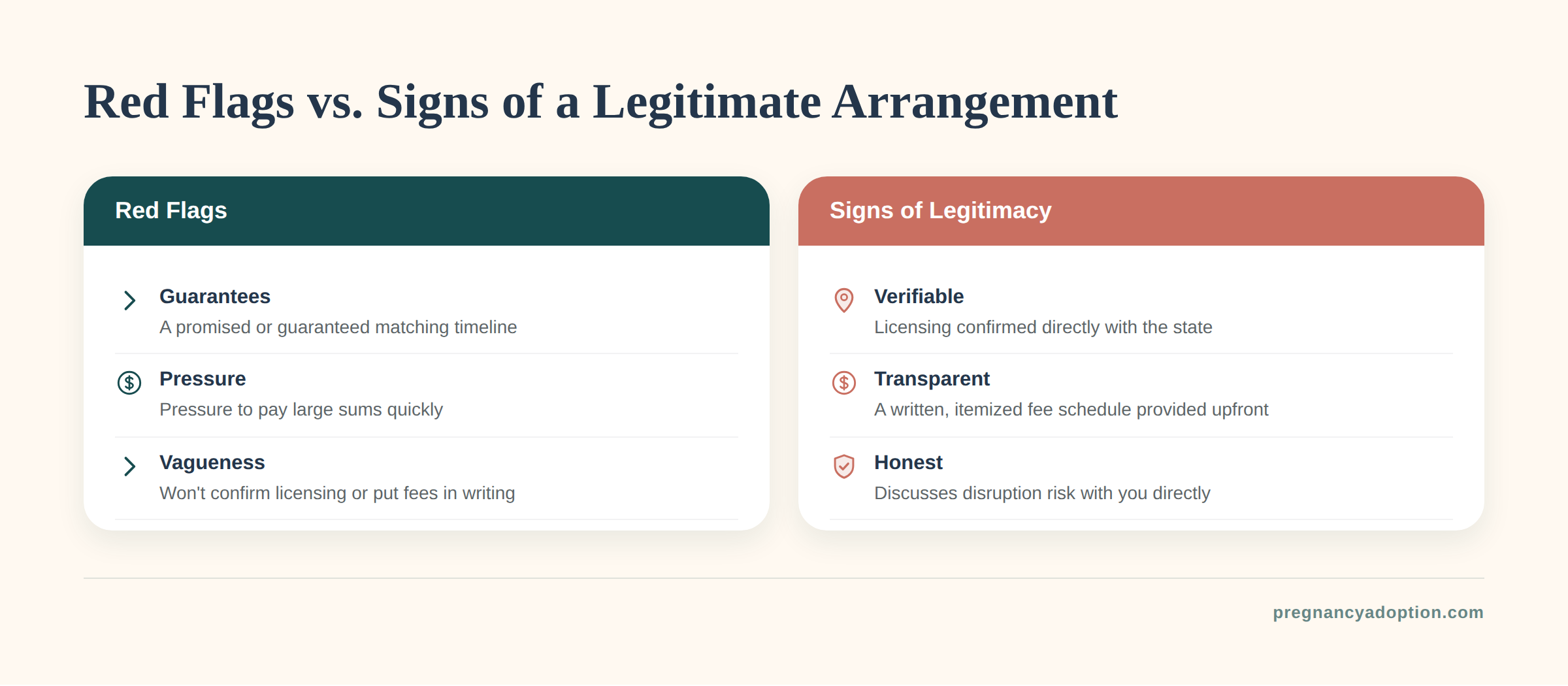
No legitimate professional can guarantee a specific matching timeline, since it depends on an expectant parent’s own decision — a guarantee, or pressure to sign and pay large sums quickly “before the opportunity disappears,” are both worth treating with real skepticism.
Vagueness About Licensing or Fees
A legitimate agency or attorney will be transparently licensed in your state, willing to provide a written, itemized fee schedule, and willing to explain exactly what consent and revocation look like in your specific state — hesitation, vagueness, or a refusal to put fees in writing is a serious warning sign.
What to Do if You Suspect a Problem
Verify Independently, Not Through the Professional Themselves
Contact your state’s child welfare licensing authority or attorney general’s office directly to confirm licensing status and check for any complaints on file, rather than relying on the professional’s own assurances.
Get an Independent Second Opinion
If something feels off, consult an independent adoption attorney who has no financial relationship with the agency or professional in question before proceeding further — this is a reasonable, low-cost step that can prevent a far more costly mistake.
Key Takeaways
- Domestic infant adoption’s combination of high demand, real money, and emotional vulnerability makes it a specific target for scams on both the adoptive-family and expectant-parent sides.
- A guaranteed timeline, pressure to pay quickly, and vagueness about licensing or fees are all serious red flags worth independent verification.
- Verify any professional’s licensing directly with your state’s licensing authority, and get an independent second opinion if something feels off.
Eligibility: What It Typically Takes to Be Approved
Eligibility requirements for domestic infant adoption are generally less restrictive than many people assume, though they genuinely vary by state and by individual agency or attorney.
What’s Generally Required
Age, Residency, and Background
Most states set a minimum age (often 18 or 21, rather than a maximum) and require a satisfactory background check and home study; marital status requirements have been significantly relaxed in most states over recent decades, and most no longer require marriage at all.
Financial Stability, Not Wealth
Agencies and attorneys generally want to see demonstrated financial stability and the ability to responsibly support a child — not a specific income threshold or home ownership. Our adoption requirements guide covers exactly what’s required, by state and in general, in complete depth.
What Can Affect — Without Automatically Disqualifying — Your Eligibility
A Past Criminal Record
This depends heavily on the nature, severity, and timing of the record and on state and agency-specific policy — some offenses (particularly those involving harm to a child) are near-universal disqualifiers, while others may not be, depending on circumstances. Raise this directly and honestly with an agency or attorney early in the process.
Health Conditions
A health condition generally doesn’t disqualify a prospective adoptive parent on its own; home studies typically assess overall capacity to care for a child rather than applying a rigid health standard, though specifics vary by agency.
Agency-Specific vs. Legal Requirements
Individual Agencies Can Set Additional Criteria
Beyond the baseline legal requirements set by state law, an individual agency can set its own additional criteria (for instance, a maximum number of years married, or a specific approach to certain health disclosures) — these agency-specific policies aren’t universal, so a family who doesn’t fit one agency’s specific criteria may still be eligible elsewhere.
Where to Get a Definitive Answer for Your Situation
Our adoption requirements guide and guide to adopting a child cover eligibility at the depth this overview intentionally doesn’t; for a truly definitive answer about your specific situation, an initial consultation with a specific agency or attorney is the most reliable source.
Key Takeaways
- Eligibility requirements for domestic infant adoption are generally less restrictive than many assume, with most states requiring only a minimum age, background check, and completed home study.
- Financial stability, not wealth, is what’s typically assessed — not a specific income threshold.
- Individual agencies can set additional criteria beyond state law, so a family ineligible at one agency may still be eligible elsewhere.
Is Domestic Infant Adoption the Right Path for Your Family?
Understanding how domestic infant adoption works doesn’t automatically answer whether it’s the right path for your family — that depends on factors genuinely personal to your situation.
| If This Describes You… | Domestic Infant Adoption May Be a Strong Fit |
|---|---|
| You specifically want to parent from infancy | Yes — this is the main path built around that specific outcome |
| You need a highly predictable timeline | Less likely a strong fit — matching timing is genuinely unpredictable; consider foster care adoption for comparison |
| You want meaningful ongoing contact with the birth family as a real possibility | Yes — openness is more central and more commonly available here than in some other types |
| Cost is your primary constraint | Worth comparing carefully against foster care adoption, which is typically far lower cost |
Questions Worth Asking Yourself Honestly
How Much Uncertainty Can You Genuinely Tolerate?
If an open-ended, unpredictable wait would be especially difficult for your family right now — financially, emotionally, or both — it’s worth being honest with yourself about that before committing significant time and money to this specific path.
How Flexible Are You, Really, on Preferences?
Many families enter the process with firmer preferences than they ultimately hold once they’re actually matching — being honest with yourself and your agency or attorney about where you have genuine flexibility, rather than overstating it to seem more appealing, generally leads to a better outcome for everyone.
How This Compares to Other Paths, Briefly
Versus Foster Care Adoption
Foster care adoption is generally far lower cost and often faster to an actual placement, but typically involves an older child or a child with documented needs rather than a newborn, and a different matching dynamic entirely (a caseworker matching, rather than an expectant parent choosing).
Versus International Adoption
International adoption has declined sharply in scale and generally carries a longer, more complex dual-legal-system process; domestic infant adoption generally offers a more predictable legal framework, even though matching timing itself remains uncertain. Our types of adoption guide covers this full comparison, across every type, in dedicated depth.
Key Takeaways
- Domestic infant adoption fits best for families specifically wanting to parent from infancy and genuinely comfortable with real timeline uncertainty.
- Honest self-assessment about your real flexibility on preferences tends to produce better outcomes than overstating flexibility to seem more appealing.
- For the full, side-by-side comparison against foster care, international, relative, and stepparent adoption, see our types of adoption guide.
The Realistic Timeline, Start to Finish
Pulling the whole path together, here’s the realistic shape of domestic infant adoption from the adoptive family’s side, start to finish.
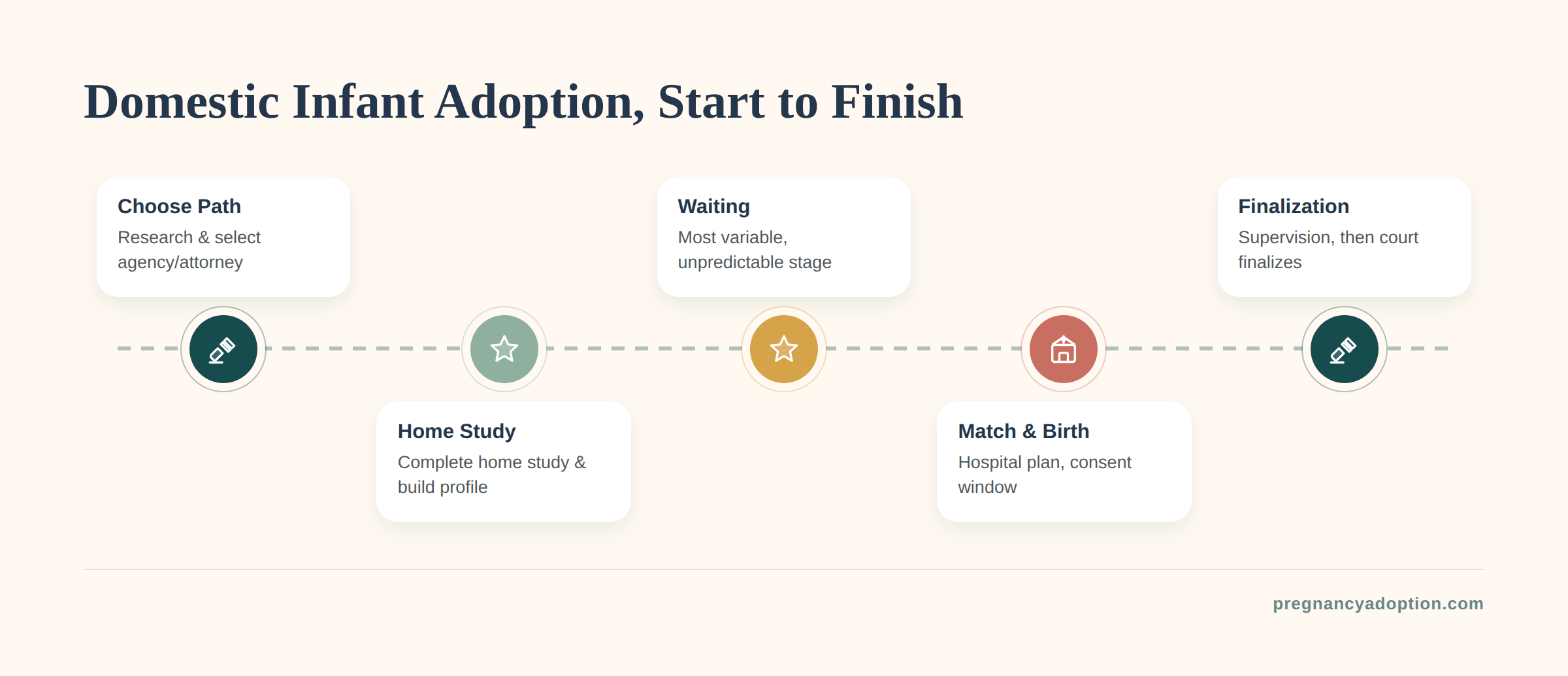
| Stage | What Happens | What Tends to Add Time |
|---|---|---|
| Choosing your path | Research and select an agency, attorney, or facilitator | Taking time to properly vet licensing and references — worth it, not a delay to skip |
| Home study and profile | Complete the home study; build your adoptive family profile | Starting late, or not prioritizing the profile’s quality |
| Waiting to be matched | Your profile is shown to expectant parents; the most unpredictable stage | Narrow preferences; simple timing; this stage has no reliable average |
| Match and hospital plan | Build a relationship with the expectant parent; finalize the hospital plan | Geographic distance; scheduling coordination |
| Birth, consent, and revocation window | Baby is born; required waiting period passes; consent is signed; any revocation window runs | State-variable waiting and revocation periods; interstate ICPC review if applicable |
| Post-placement supervision and finalization | Required supervisory visits; attorney files for finalization; court hearing | Local court scheduling; any required supervision period length |
Why Matching Dominates the Total Timeline’s Unpredictability
Every Other Stage Has a Rough Shape; Matching Doesn’t
The home study, hospital period, revocation window, and post-placement supervision all have a roughly predictable shape, even if the exact length varies somewhat — matching is the one stage genuinely without a reliable range, because it depends on an expectant parent’s own timeline.
Planning Around That Asymmetry
Many families find it useful to treat everything except matching as plannable (schedule the home study, prepare the nursery timeline loosely, budget realistically) while deliberately not setting a firm target date for matching itself, to avoid the frustration of missing a self-imposed deadline that was never realistic to begin with.
Where the Detailed, Legal Step-by-Step Timeline Lives
State-Specific Timing Detail
Our adoption process guide covers the detailed, state-flagged legal timeline — exact consent timing, revocation windows, and finalization scheduling — in complete depth; this section is limited to the overall shape specific to domestic infant adoption’s typical sequence.
What Can Meaningfully Speed Things Up
Starting your home study immediately, building a strong and honest profile from the outset, and genuine flexibility on preferences are the levers most within your control; everything else is either state-set or depends on an expectant parent’s own circumstances.
Key Takeaways
- Every stage of domestic infant adoption except matching has a roughly predictable shape; matching alone has no reliable average timeline.
- Planning everything else as plannable, while deliberately not setting a firm target date for matching, tends to reduce frustration.
- Full state-specific legal timing detail lives in our dedicated adoption process guide.
The Expectant Parent’s Side of This Process
This guide is written primarily for prospective adoptive families, but understanding the expectant parent’s side — briefly and respectfully — matters for anyone navigating this process well.
What an Expectant Parent Is Actually Navigating
A Deeply Personal Decision, Not a Transaction
An expectant parent considering domestic infant adoption is navigating one of the most significant decisions of their life, under real emotional and often financial pressure — understanding this, rather than treating matching as a straightforward transaction, shapes how adoptive families should approach every interaction throughout this process.
Real Rights Throughout, Not Just at Signing
An expectant parent retains full parental rights and real choice over the adoptive family, the openness arrangement, and whether to proceed at all, at every point until legal consent is signed — our birth mother rights guide covers this in complete depth, from the expectant parent’s own side.
Where to Send Someone Who’s an Expectant Parent, Not an Adoptive Parent
The Right Starting Guide
If you’re an expectant parent reading this and this isn’t actually the guide you need, our guide for expectant parents considering adoption is written specifically for you — covering your rights, choosing a professional and a family, and what to expect, from your own side rather than an adoptive family’s.
If You’re Still Weighing Adoption Against Parenting
Our unplanned pregnancy guide covers the full, genuinely neutral three-way decision between parenting, adoption, and abortion, and our adoption versus parenting guide is built specifically to help weigh those two paths against each other — neither assumes adoption is the right or expected outcome.
How Adoptive Families Can Support This Process Well
Genuine Respect, Not Performance
Respecting an expectant parent’s full decision-making authority throughout — not just in principle, but in how you actually communicate and behave during matching and the hospital period — matters more to a healthy outcome, for everyone, than anything in a polished profile.
Understanding Grief as a Normal, Expected Response
Many birth parents experience real grief after placement, even when the decision was one they made confidently and don’t regret — this is a widely recognized, normal response, not a sign the decision was wrong, and adoptive families who understand this going in tend to navigate an ongoing relationship, where one exists, with more empathy.
Key Takeaways
- An expectant parent retains full parental rights and real choice at every point until legal consent is signed — this guide’s adoptive-family focus doesn’t change that underlying reality.
- If you’re an expectant parent rather than a prospective adoptive parent, our guide for expectant parents considering adoption is the right starting point instead.
- Genuine respect for the expectant parent’s decision-making authority, throughout the process, matters more to a healthy outcome than anything else covered in this guide.
Common Mistakes Prospective Adoptive Parents Make
A number of avoidable mistakes come up repeatedly among first-time families pursuing domestic infant adoption — worth naming directly.
Mistakes Early in the Process
Delaying the Home Study
Waiting to start the home study until you feel fully “ready” — rather than starting it as early as realistically possible — is one of the most common and most avoidable sources of added delay, since the home study itself takes real time regardless of when you start it.
Underinvesting in the Profile
Treating the adoptive family profile as a formality to finish quickly, rather than genuinely investing time and honest reflection into it, often results in a profile that doesn’t generate meaningful interest — covered in detail earlier in this guide.
Mistakes During Matching and Waiting
Setting Preferences Too Narrowly Without Reflecting on Why
Narrowing preferences significantly without honestly examining whether each restriction reflects something you’re genuinely unprepared for, versus an assumption you haven’t actually tested, tends to needlessly extend an already uncertain wait.
Comparing Your Timeline to Someone Else’s
Comparing your own wait to another family’s experience — whether faster or slower — rarely provides useful information, since matching timing depends on highly individual factors that don’t generalize from one family’s story to another’s.
Mistakes Around Cost and Legal Steps
Not Getting a Written, Itemized Fee Schedule
Proceeding on a verbal or vague fee estimate, rather than insisting on a written, itemized schedule before committing, leaves families vulnerable to unexpected costs later — ask for this in writing from any agency or attorney before signing anything.
Assuming the Legal Process Is the Same Everywhere
Assuming your home state’s consent and revocation rules apply universally, especially in an interstate placement, is a common and potentially costly mistake — confirm the specific rules of every state actually involved in your placement with your attorney.
Mistakes Around the Hospital Period and Beyond
Pressuring, However Unintentionally
Well-meaning behavior that nonetheless creates pressure — frequent check-ins during labor, visible disappointment if the expectant parent wants more time alone, or language implying the match is already final — can genuinely harm the relationship and, in the worst cases, the expectant parent’s own sense of agency.
Underestimating the Need for Post-Placement Support
Assuming the hard part ends at placement, rather than preparing for the real adjustment period that follows (for your family and, where there’s ongoing contact, for the birth family too), leaves many families less prepared than they could have been for a normal, expected transition period.
Key Takeaways
- Delaying the home study and underinvesting in the profile are two of the most common and most avoidable sources of added delay.
- Comparing your own timeline to another family’s rarely provides useful information, given how individualized matching timing is.
- Insisting on a written, itemized fee schedule and confirming every involved state’s specific legal rules both prevent common, costly surprises.
Glossary of Domestic Infant Adoption Terms
A quick reference for terms used throughout this guide.
People and Roles
Expectant Parent
The accurate term for a pregnant person who has not yet placed a child for adoption; “birth parent” accurately applies only after placement.
Adoptive Family / Prospective Adoptive Parent
The person or people hoping to adopt, before and after being matched with an expectant parent.
Process Terms
Home Study
An assessment process — background checks, interviews, a home visit, and often required training — used to approve prospective adoptive parents before matching.
Matching
An expectant parent choosing or agreeing to move forward with a specific adoptive family; distinct from, and earlier than, placement or legal adoption.
Placement
The point at which a child physically moves into the adoptive family’s home, legally distinct from and generally preceding finalization.
Disruption
When a match ends before placement, or a placement ends before finalization, most often because the expectant or birth parent decides not to proceed.
Legal Terms
Consent
The legal act, which can only happen after birth, that begins the process of ending a birth parent’s parental rights.
Revocation Period
A state-law-defined window, varying significantly in length, during which a birth parent who has signed consent can still change their mind before finalization.
Post-Placement Supervision
A period after placement, before finalization, during which a social worker conducts required check-in visits.
Finalization
The court proceeding that makes an adoption legally permanent.
Interstate Compact on the Placement of Children (ICPC)
A legal agreement among all U.S. states requiring both the sending and receiving state’s approval before a child is placed for adoption across state lines.
Arrangement Terms
Agency-Facilitated Adoption
An adoption in which a licensed agency manages matching, counseling, and much of the practical process.
Independent (Attorney-Led) Adoption
An adoption arranged without a central agency, with an attorney handling the legal filing and consent process.
Facilitator
A person or organization that helps connect expectant parents and adoptive families without being a licensed agency, restricted or prohibited in some states.
Adoptive Family Profile
Materials (a book, website, or video) presenting a prospective adoptive family to expectant parents, sometimes still called a “Dear Birth Mother” letter.
Open, Semi-Open, and Closed Adoption
Terms describing the level of ongoing contact between birth and adoptive families after placement.
Frequently Asked Questions
Getting Started
What’s the very first concrete step toward domestic infant adoption?
Research and contact a few licensed agencies or adoption attorneys for an initial consultation — most offer this at no cost — and start your home study as soon as you’ve chosen a professional, since it’s the step that unlocks everything else.
How do I know if I should start with an agency or an attorney?
An initial consultation with each type of professional, where you ask directly how they structure matching, counseling, and fees, is the most reliable way to decide — see our comparison earlier in this guide for the factors most families weigh.
Domestic Infant Adoption Basics
Is “domestic infant adoption” the same as “private adoption”?
Not exactly — domestic infant adoption refers specifically to adopting a U.S.-born newborn; “private adoption” more often refers to the independent, non-agency arrangement style, which is a separate axis covered in our private adoption guide.
Can a domestic infant adoption involve a child older than a newborn?
Generally no — by definition, domestic infant adoption refers to a newborn placed shortly after birth; an older U.S.-born child placed privately falls into a smaller, related category sometimes grouped under “private domestic adoption” statistics but handled differently in practice.
Choosing Agency, Independent, or Facilitator
Can I switch from independent to agency-assisted partway through?
In many cases, yes, though it can add cost since you may end up paying for services (like matching) you’d already pursued independently — ask directly about this scenario’s fee implications before switching.
Is a nonprofit agency automatically more trustworthy than a for-profit one?
Not automatically — tax status doesn’t determine ethical practice; licensing status, references, and transparency about fees and process matter far more than whether an agency is structured as nonprofit or for-profit.
The Home Study
Can I start my home study before choosing an agency or attorney?
Some home study providers work independently of a specific agency or attorney, but most families complete it through or in coordination with whichever professional they’ve already chosen — ask directly about the typical sequence your professional expects.
Does a home study look different for domestic infant adoption than for foster care?
The core components (background checks, interviews, a home visit, training) are similar, but domestic infant home studies often include more extensive health-history and financial-stability review, since this path typically involves greater upfront cost and the expectant parent’s own review of your profile.
Building Your Adoptive Family Profile
How long should a profile book be?
Most run roughly 10 to 20 pages; your agency or attorney can tell you what length has worked well for expectant parents in their specific program recently.
Should I include extended family in my profile?
Many profiles include a brief section on extended family, since some expectant parents are specifically curious about the broader support network a child would grow up around — keep it genuine rather than padding for length.
How Matching Works
Will I get to talk to the expectant parent before being matched?
Often yes — an initial call or meeting, facilitated by your agency or attorney, is common once an expectant parent expresses interest in your profile, though exactly how this is structured varies by professional.
Can an expectant parent match with more than one family before choosing?
Some professionals present multiple family profiles to a single expectant parent, who then narrows and chooses; others focus on introducing one family at a time based on strong apparent fit — this varies by agency or attorney’s own process.
Wait Times
Is there anything that reliably guarantees a faster match?
No single factor guarantees a faster match, though genuine flexibility on background and openness, an actively marketed profile, and staying responsive to your agency or attorney all meaningfully improve your odds, as covered earlier in this guide.
Should I expect updates from my agency even when nothing is happening?
Ask directly what communication cadence to expect during quieter stretches — a reasonable agency or attorney should check in periodically even without active matching news, rather than going silent for long periods.
When a Match Falls Through
Will I be told why a match didn’t move forward?
Sometimes, though an expectant parent isn’t obligated to explain their decision, and some choose not to — your agency or attorney can tell you what, if anything, they’re able to share.
Can I be matched again right away after a disrupted match?
Generally yes, once you and your agency or attorney feel ready — there’s no formal waiting period, though taking real time to process the experience before re-engaging is reasonable and often recommended.
The Hospital Period
Can the hospital plan change at the last minute?
Yes, and this is normal — labor doesn’t always go as scheduled, and an expectant parent’s feelings in the moment can shift; staying flexible and trusting your agency or attorney’s real-time guidance matters more than rigidly following the original plan.
Is it appropriate to bring a gift to the hospital?
This depends entirely on what the expectant parent is comfortable with — ask your agency or attorney rather than assuming, since preferences vary widely and a well-meaning gesture can land wrong if it wasn’t wanted.
Consent and Revocation
Can an expectant parent sign consent while still in the hospital?
Only once the required post-birth waiting period in their state has passed — some states’ waiting periods are short enough that this can technically happen during a hospital stay; others require a longer wait after discharge.
What happens if the birth father’s consent is also required but he’s unreachable?
States generally have notice and, in many states, a putative father registry process intended to identify and notify an unreachable father before an adoption can proceed; our birth father rights guide covers this in detail.
Interstate Placements and the ICPC
How long does ICPC approval usually take?
It varies by the specific states involved and their current processing speed — ask your agency or attorney for their recent, honest experience with the specific state pair involved in your placement rather than relying on a general estimate.
Can we take the baby home before ICPC approval comes through?
No — ICPC approval from both states is required before the child can lawfully leave the sending state; attempting to bypass this creates serious legal risk.
Openness
Can we offer more openness than we’re initially matched on, later?
In practice, the level of contact in an open or semi-open arrangement can evolve by mutual agreement over time — though formally expanding from a closed arrangement generally requires both sides’ cooperation.
What if the expectant parent wants more contact after placement than we expected?
This is worth discussing directly and honestly, ideally before placement rather than after — a good agency or attorney mediates this kind of mismatch early, as covered earlier in this guide.
Cost and Financial Help
Is cost negotiable with an agency or attorney?
Some fee components may have limited flexibility, but core legal and program fees generally aren’t negotiable the way a retail price might be — ask directly what, if anything, is flexible rather than assuming.
What happens financially if we’re matched more than once before placement?
Depending on your agency’s or attorney’s fee structure, some costs (matching fees in particular) may need to be paid again for a new match — ask about this scenario specifically before your first match, not after a disruption.
Avoiding Scams
How do I verify an agency’s license myself?
Contact your state’s child welfare licensing authority directly and ask them to confirm the agency’s current status — don’t rely solely on a license number or certificate displayed on the agency’s own website.
Is it a red flag if a professional won’t let me speak with past clients?
It’s worth asking why, directly — a reasonable privacy-based explanation is different from a flat refusal with no explanation at all; most reputable professionals can connect you with at least one reference in some form.
Eligibility
Can I adopt if I’ve been divorced?
Yes — marital history generally isn’t a disqualifying factor; a home study assesses your current situation and readiness, not past relationship history on its own.
Is there a maximum age for adopting an infant?
Most states set a minimum age rather than a maximum, though some agencies set their own age-related guidelines or ask about parenting-energy considerations for an infant specifically — ask your chosen agency or attorney directly.
Deciding If This Path Is Right for You
Is it normal to feel unsure even after researching thoroughly?
Yes — many prospective adoptive parents describe feeling this way even after extensive research, since so much of the real experience only becomes clear once you’re actually in it; an initial consultation with a professional can sometimes resolve lingering uncertainty better than more solo research.
Should cost alone rule out domestic infant adoption for my family?
Not necessarily — between the adoption tax credit, grants, employer benefits, and loans, many families’ net cost ends up considerably lower than the headline figure; it’s worth exploring financial assistance options before ruling the path out on cost alone.
Timeline
Is there a season when more matches tend to happen?
No reliable seasonal pattern has been consistently documented — matching timing is driven by individual circumstances rather than a predictable calendar cycle.
How soon after placement is finalization typically complete?
This varies by state and by any required post-placement supervision period, generally ranging from several months to about a year after placement — see our adoption process guide for more specific, state-flagged detail.
The Expectant Parent’s Side
How can we support an expectant parent emotionally without overstepping?
Following their lead on how much contact and what kind of support they want, rather than assuming what they need, is the most reliable approach — your agency or attorney’s counselor can often give specific guidance for your situation.
Is it appropriate to ask the expectant parent about their own feelings toward adoption?
A genuine, respectful conversation is appropriate if the expectant parent is open to it, but this isn’t an area to probe uninvited — let them set the pace and depth of what they want to share.
Post-Placement Life and Support
Is it normal to feel anxious during the post-placement supervision period?
Yes — many new adoptive parents feel some anxiety during this period, even when everything is going well, simply because finalization hasn’t happened yet; this is a common, expected feeling, not a sign of a real problem.
What kind of post-adoption support is typically available?
Adoption-competent therapy, parent support groups, and, where an openness arrangement exists, help navigating that relationship are commonly offered by agencies and independent organizations alike.
