
Once you move past the question of whether adoption is the right path and into the question of how it actually happens, the adoption process turns out to be a genuine sequence of legal and practical steps, each with its own timing, paperwork, and decision points. This guide walks through that sequence in order — pre-placement planning, the home study, matching, the openness decision, birth and hospital logistics, legal consent, the state-variable revocation window, the Interstate Compact on the Placement of Children (ICPC) when a placement crosses state lines, post-placement supervision, and court finalization — with realistic timeframes at every stage. It’s written for anyone standing at the “okay, concretely, what happens and in what order” point: an expectant parent considering adoption, or a prospective adoptive parent trying to understand what the next twelve-plus months actually look like. If you’re still at the earlier, conceptual stage of understanding what adoption is and who’s typically involved, our overview of how adoption works is the better starting point; this guide picks up from there and goes deep on the mechanics.
Short Answer: The Adoption Process at a Glance
A domestic adoption in the United States moves through a fairly consistent arc regardless of whether it’s agency-facilitated or independently arranged through an attorney: pre-placement planning and a home study happen first (often in parallel with an expectant parent’s own decision-making), followed by matching, placement at or shortly after birth, legal consent from the birth parent(s) after a mandatory post-birth waiting period, a revocation window that varies by state, a period of post-placement supervision, and finally a court hearing that legally finalizes the adoption. When the adoptive family lives in a different state than where the child is born, an additional interstate approval step (ICPC) sits between placement and the family’s ability to leave the birth state with the child.
The Five-Stage Arc From Decision to Finalization
Pre-Placement: Planning, Home Study, and Matching
Before a child is ever placed, two parallel tracks are running: the adoptive family is completing a home study and preparing a profile, while an expectant parent (if one is involved in that specific adoption) is making and refining a plan — sometimes with a specific family already selected, sometimes still deciding. This pre-placement stage is typically the longest and most variable part of the entire timeline, because it depends on two different people’s readiness and circumstances syncing up.
Placement Through Finalization: Legal and Court Steps
Once a child is placed with the adoptive family — usually at or within days of birth — the process becomes much more procedural and far more consistent nationwide in its sequence, even though specific timeframes still vary by state: a mandatory wait before consent can be signed, a possible revocation window, interstate clearance if applicable, months of post-placement supervision, and then a finalization hearing that makes the adoption permanent.
How Long the Whole Process Actually Takes
Domestic Infant Adoption Timelines
There’s no single honest number here, because “the adoption process” bundles together a pre-placement period that can run from a few months to well over a year, plus a post-placement-to-finalization period that’s much more predictable, typically landing somewhere in the six-to-twelve-month range after a child is placed. Adoption professionals commonly describe a full process — from a completed home study to a finalized adoption — as averaging somewhere around a year, though this figure comes from industry sources rather than a government dataset and individual cases regularly fall well outside it in both directions
What Makes a Timeline Longer or Shorter
Three variables move the needle more than any others: how long it takes to match with an expectant parent (the least predictable piece, since it depends on someone else’s circumstances and timing), whether the placement crosses state lines and triggers ICPC, and how quickly a given state’s courts schedule finalization hearings. Everything else in this guide — the home study, consent mechanics, post-placement visits — tends to follow a fairly standard shape once those three variables are known.
The Child Welfare Information Gateway (U.S. Department of Health and Human Services) maintains a national overview of the adoption process. AdoptUSKids covers the process specifically for children in foster care.
Key Takeaways
- The adoption process has two distinct phases: a variable-length pre-placement phase (planning, home study, matching) and a more procedurally consistent post-placement phase (consent, revocation window, supervision, finalization).
- No consent to adoption can be signed before a child is born anywhere in the U.S., and every state imposes at least a short mandatory wait after birth before it can be signed.
- If the adoptive family and the birth parent live in different states, ICPC adds an interstate approval step between placement and the family’s ability to return home with the child.
- A full stage-by-stage table with realistic timeframes for each step is in Section 13 below.
Before the Steps: Which Adoption Process You’re Actually In
“The adoption process” isn’t one fixed sequence — it changes meaningfully depending on who’s adopting whom, and through what kind of arrangement. Before walking through the stages in detail, it helps to be clear about which version of the process applies to your situation, since this guide focuses on one specific track.
Why “The” Adoption Process Isn’t One Single Path
Agency-Facilitated vs. Independent/Attorney-Facilitated Adoption
In an agency-facilitated adoption, a licensed adoption agency manages matching, counseling, and much of the paperwork on both sides. In an independent or attorney-facilitated adoption, a licensed adoption attorney handles the legal mechanics while matching happens more directly between the expectant parent and adoptive family, sometimes through a separate matching or consulting service. Both tracks go through essentially the same legal stages described in this guide — home study, consent, revocation window, finalization — but the pre-placement planning stage looks different depending on which route you’re on.
Domestic Infant, Foster Care, and International Adoption Follow Different Tracks
This guide describes domestic infant and private domestic adoption procedure specifically. Foster care adoption (adopting a child already in the state child welfare system) follows a different legal track involving the child welfare agency and often a prior period as a licensed foster parent; international adoption adds immigration and the adoption laws of a second country on top of U.S. procedure. The conceptual differences between these paths — including who’s typically involved in each — are covered in our overview of how adoption works, which this guide deliberately doesn’t repeat.
This Guide’s Scope
We Focus on Domestic Infant and Private Adoption Procedure
Everything from Section 3 onward describes the sequence most relevant to a domestic infant or private domestic adoption — the path most expectant parents considering adoption and most first-time prospective adoptive parents are navigating. Many of the legal mechanics (consent, revocation, finalization) apply with only minor variation to other adoption types, but foster-care-specific procedure (such as the path from foster placement to adoption) and international-specific procedure (such as immigration processing) aren’t covered here in depth.
Where to Go for the Conceptual Overview First
If terms like “open adoption,” “home study,” or “ICPC” are unfamiliar and you want the big-picture explanation before the procedural one, start with how the adoption process works for the conceptual layer, then come back here for the step-by-step mechanics and timeline.
Stage 1: Pre-Placement Planning
Pre-placement planning is the stage where both sides of an eventual adoption — the prospective adoptive family and, in most domestic infant adoptions, a specific expectant parent — get ready to move forward, usually well before they’ve connected with each other. This stage runs on two separate, parallel tracks.
For Prospective Adoptive Parents: Getting Ready to Start
Deciding Between Agency, Attorney, and Facilitator Routes
The first practical decision is which route to pursue: a full-service agency, an adoption attorney handling an independent adoption, or some combination (an attorney plus a separate matching consultant, for instance). This decision affects nearly everything downstream — cost structure, how much control you have over the matching process, and how much support is built in versus something you’ll need to arrange yourself.
Budgeting Before You Begin
Costs are paid out across nearly every stage of this process — home study fees up front, agency or legal fees during matching, medical and sometimes living expense support during the pregnancy, and post-placement/legal fees at finalization — rather than as one lump sum. This guide flags where costs show up at each stage, but the full breakdown by adoption type and typical range lives in our dedicated adoption cost guide, which this guide doesn’t duplicate.
For Expectant Parents: Getting Ready to Start
Confirming the Pregnancy and Considering Timing
If you’re an expectant parent exploring adoption, the practical starting point is the same one covered at a decision-support level in our guide for people pregnant and considering adoption — this guide assumes you’ve already done at least some of that reflection and are ready for the mechanics of what happens next, so it won’t repeat that framing here.
Deciding on an Openness Level Early (Even Tentatively)
Many expectant parents find it useful to have at least a tentative sense of how much ongoing contact they want with the child after placement before matching begins, since this is one of the main things profiles and conversations with prospective families revolve around. Section 6 below covers exactly where this decision sits in the process; our guide to open adoption and our guide to closed adoption cover what each arrangement actually looks like in practice.
Key Takeaways
- Pre-placement planning runs on two separate tracks — the adoptive family’s and the expectant parent’s — that typically don’t start at the same time and don’t move at the same speed.
- Choosing between an agency and an independent/attorney-facilitated route is usually the first concrete decision a prospective adoptive parent makes, and it shapes most of what follows.
- Costs are distributed across the whole process rather than paid all at once; Section 14 maps out where they land.
Stage 2: The Home Study — What It Is and Where It Sits in the Timeline
The home study is the formal assessment every prospective adoptive parent must complete and have approved before a child can be placed with them, and its timing relative to everything else in this guide matters as much as its content.
What a Home Study Actually Checks
Background Checks, References, and Interviews
A licensed social worker conducts criminal background checks, child abuse and neglect registry checks, collects personal and professional references, and interviews every adult in the household, individually and together, about their background, relationship, parenting approach, and readiness. This is the same core structure used across most states and agencies, even though specific requirements vary.
The Home Visit and Required Training
A home visit confirms the physical space is safe for a child, and most states or agencies require a set number of hours of adoption-specific training (covering topics like attachment, openness, and transracial or transcultural parenting where applicable) before approval. The full checklist of exactly what’s required, state by state and agency by agency, is covered in depth in our dedicated home study guide — this section only needs you to understand what the home study is and when it happens, not its complete requirements list.
Timing: Why the Home Study Has to Come Before Matching
Typical Home Study Duration
Most sources describing the process put the home study itself at roughly two to three months from start to approval, depending on how quickly background checks clear and how promptly the family completes paperwork and training Agencies and attorneys generally will not actively present a family for matching until the home study is approved, which is why this is usually the first concrete milestone on the adoptive-parent side of the timeline.
How Long an Approved Home Study Stays Valid
An approved home study is not permanent — most states and agencies require it to be updated annually, or sooner if there’s a significant change in household composition, address, or finances, and an expired home study can stall a placement that’s otherwise ready to happen. Confirm your specific state’s and agency’s renewal requirement directly, since this detail varies
Key Takeaways
- The home study — background checks, references, interviews, a home visit, and required training — is usually completed before active matching begins, not after.
- A typical home study takes roughly two to three months, though this varies by agency, state, and how quickly the family completes its part.
- Home studies expire and need periodic renewal; an expired one can delay an otherwise-ready placement. Full requirements are in our home study guide.
Stage 3: Matching — How Expectant Parents and Adoptive Families Connect
Matching is the stage where a specific expectant parent and a specific prospective adoptive family identify each other as a potential fit — and it’s the single least predictable stage in the entire process, because it depends on two independent parties’ timing, preferences, and circumstances lining up.
How Matching Actually Works
Profile Review and Introductions
In most domestic infant adoptions today, the expectant parent reviews profiles (sometimes called “Dear Birth Mother” letters or family profiles) of waiting adoptive families and chooses one to connect with, rather than the reverse. An agency or matching consultant typically handles introductions and often facilitates early calls or meetings before any commitment is made on either side.
What Expectant Parents Typically Want to Know
Conversations at this stage commonly cover the family’s lifestyle, values, and parenting approach, their openness to an ongoing relationship after placement, and practical questions about support during the pregnancy. None of this is binding — a match can fall through at any point before placement, and nothing legally obligates either side until much later in the process.
The Waiting-to-Be-Matched Period
What Affects How Long Matching Takes
How quickly a family matches depends heavily on factors like how flexible they are about a child’s background, health history, and openness expectations, how actively their agency or consultant is marketing their profile, and simple timing luck. This stage can take anywhere from a few weeks to well over a year, and it’s the main reason overall timeline estimates vary so widely between families.
Matching Can Happen Before or After Birth
Some matches happen months before a due date; others happen very close to delivery, or occasionally after birth. A later match generally compresses everything downstream into a shorter window, while an earlier match gives more time for the hospital plan (Section 7) and openness arrangement (Section 6) to be worked out in advance.
Key Takeaways
- Matching is the stage most responsible for how unpredictable overall adoption timelines are, since it depends on two separate parties’ timing and preferences aligning.
- Nothing about a match is legally binding on either side until consent is actually signed, well after birth.
- Matching can happen at any point in pregnancy — sometimes months in advance, sometimes just before or after delivery.
Stage 4: Choosing the Openness Arrangement
Somewhere during matching — sometimes before, sometimes continuing to evolve after placement — the expectant parent and adoptive family work out what kind of ongoing contact, if any, they want after the adoption is finalized. This is a genuine process step, not just background context, because it typically gets put in writing and shapes expectations on both sides.
Open, Semi-Open, and Closed Adoption as a Process Decision
When in the Timeline This Gets Decided
Most agencies and attorneys raise the openness question early in matching conversations, since it’s often one of the first things an expectant parent wants to understand about a prospective family, and one of the first things a family needs to be honest with themselves about their own comfort level with. It can continue to be refined through placement and even after finalization in many open arrangements.
Putting the Arrangement in Writing
In many states, the agreed-upon contact plan can be documented in a post-adoption contact agreement; depending on the state, this agreement may or may not be legally enforceable in court, which is a detail worth confirming with your attorney or agency rather than assuming either way
Where to Go for the Full Comparison
Open Adoption in Depth
If you’re trying to understand what an open arrangement actually involves day to day — letters, visits, social media contact, or something else entirely — our open adoption guide covers the full range of what “open” can mean in practice.
Closed Adoption in Depth
If a fully closed arrangement, with no post-placement contact or identifying information shared, is what you’re considering instead, our closed adoption guide covers what that involves and why some people still choose it today.
Key Takeaways
- The openness arrangement is typically discussed and at least tentatively agreed upon during matching, before placement — not decided after the fact.
- Whether a post-adoption contact agreement is legally enforceable depends on your state; this is worth confirming directly rather than assuming.
- The full comparison of open, semi-open, and closed adoption lives in two dedicated guides, linked above, rather than being repeated here.
Stage 5: Hospital, Birth, and the Immediate Post-Birth Period
The hospital stage is short — typically a matter of days — but it’s dense with logistics, and it’s the point where a plan that’s been discussed for weeks or months becomes real in a hospital room.
The Hospital Plan
Who’s Present and What’s Typically Arranged in Advance
Most expectant parents and adoptive families, often with their agency’s or attorney’s help, work out a hospital plan in advance covering who will be present for the birth, whether and when the adoptive family will be at the hospital, how the baby will room, and who makes early medical decisions for the newborn before any legal transfer happens. None of this is legally required to happen a specific way — it’s a matter of what the expectant parent wants, since they remain the child’s full legal parent throughout.
What Happens If the Plan Changes at the Hospital
It’s common, and not treated as unusual by agencies or hospital social workers, for an expectant parent’s hospital-stage preferences to shift from what was discussed earlier in pregnancy — wanting more or less contact with the adoptive family, more time with the baby, or more space. A good agency or attorney treats this as the expectant parent’s prerogative, not a problem to be managed.
What Can’t Happen Before Birth
Consent Cannot Be Signed Prenatally
No matter how far along a hospital plan is, or how confident everyone feels, legal consent to the adoption cannot be signed before the child is born anywhere in the United States. This single fact shapes everything about how the hospital stage and the days immediately after it work.
The Expectant Parent’s Rights Don’t Change Until Consent Is Signed
Until consent is actually signed — which, as the next section covers, can’t happen until after a further mandatory wait following birth — the expectant parent holds full, unaltered legal parental rights, including the right to change their mind entirely. The full legal detail on what that means in practice is covered in our birth mother rights guide and, where a legal father is involved, our birth father rights guide.
Key Takeaways
- The hospital stage is short but logistically dense, typically worked out in advance as a hospital plan covering presence, rooming, and early decisions.
- It’s normal, not alarming, for an expectant parent’s preferences to shift once they’re actually at the hospital.
- Legal consent cannot be signed before birth anywhere in the U.S., which means full parental rights remain entirely intact through the hospital stay.
Stage 6: Legal Consent — What Happens, When
Consent is the formal legal act that starts the chain of events ending in a finalized adoption. As a process step, it’s worth understanding exactly what happens and roughly when — the deeper legal content (what makes consent valid, grounds to contest it, and putative-father notice requirements) belongs to two other guides this one deliberately doesn’t duplicate.
Signing Consent: The Procedural Mechanics
Minimum Waiting Period After Birth
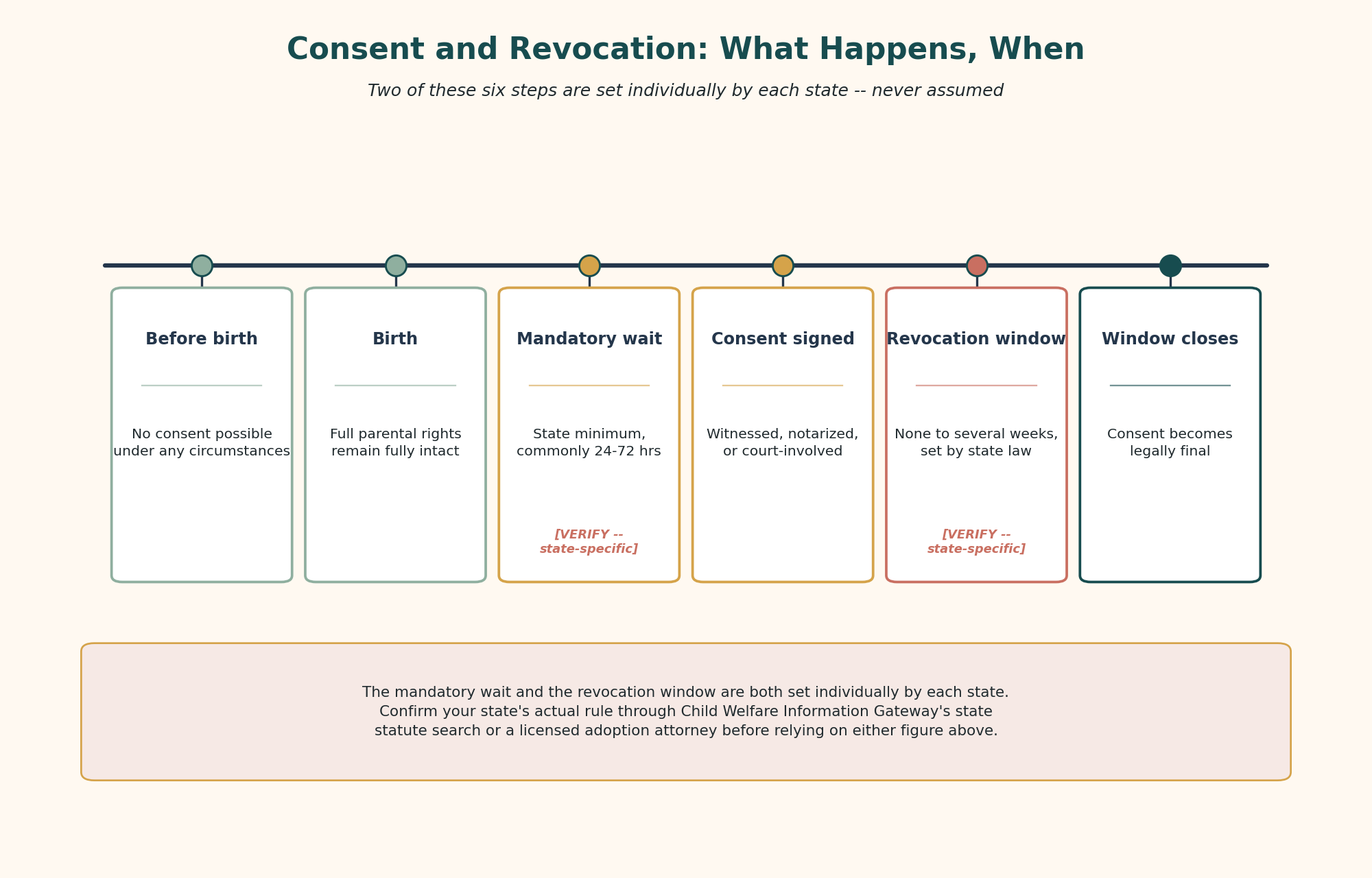
Every state requires at least a short mandatory waiting period after birth before a birth parent can sign consent — commonly cited as somewhere in the range of 24 to 72 hours in many states, though the exact minimum is set individually by each state and should never be assumed Consent is typically signed in front of a witness, a notary, or in some states a judge, depending on state procedure.
Who Else May Need to Consent or Be Notified
Depending on the situation, a legal or putative father may need to consent separately, be formally notified, or have his rights terminated through a separate process if he can’t be located or doesn’t respond — a process-heavy area with real legal stakes that our birth father rights guide covers in full rather than this one.
What This Guide Does and Doesn’t Cover on Consent
Process Mechanics Here; Full Legal Rights Elsewhere
This section is intentionally limited to the “what happens and roughly when” of signing consent. It does not cover what makes consent legally valid, the narrow grounds on which it can later be contested, or the full detail of putative-father notice law — all state-variable, high-stakes legal subject matter covered in depth in our birth mother rights guide and our birth father rights guide.
If You’re an Expectant Parent Approaching This Step
Before you sign anything, reading the full rights guide relevant to your situation and talking directly with an independent attorney (not one provided or paid for solely by the adoptive family or agency, where your state allows that distinction to matter) is worth doing regardless of how settled your decision feels. Our step-by-step guide for placing a baby for adoption covers this and the rest of the expectant-parent action checklist in one place.
Special Consent Situations
Consent by a Minor Expectant Parent
If the expectant parent is under 18, many states apply additional procedural protections — such as requiring a guardian ad litem, independent legal counsel, or a specific judicial involvement in the consent process — on top of the standard requirements described above. These protections exist specifically because of the added vulnerability involved and are not optional extra steps an agency can waive; a specialized adoption attorney is essential here, and this guide’s general mechanics should be treated as a floor, not the complete picture, for a minor’s situation
Consent in Cases Involving a Prior Adoption or Guardianship
If parental rights to the child have already been affected by a prior court proceeding — a guardianship, a prior termination, or an existing custody order — the consent process may involve additional parties or a different procedural path than the straightforward case this guide describes by default. Flagging this situation to your attorney or agency as early as possible, rather than discovering it mid-process, keeps it from becoming a late-stage delay.
Key Takeaways
- Every state requires a mandatory wait after birth — commonly, though not universally, in the range of 24 to 72 hours — before consent can be signed.
- A legal or putative father may need separate consent, notice, or a rights-termination process; this is covered in depth, not here, in a dedicated guide.
- A minor expectant parent or a case with a prior guardianship or custody order typically triggers additional procedural protections beyond the standard consent process.
- This section covers consent’s timing and mechanics only; full legal depth lives in the birth mother and birth father rights guides linked above.
Stage 7: The Revocation Window — A Process Step That Varies by State
After consent is signed, most — but not all — states provide a further window during which a birth parent can revoke that consent and reclaim parental rights before the adoption is finalized. As a process matter, this is one of the most consequential steps in the entire timeline, and one of the most heavily state-variable.
What a Revocation Period Is, Procedurally
Why It Exists
A revocation window exists to give a birth parent a real, legally protected chance to change their mind after the emotional and physical experience of birth and signing, rather than treating consent as instantly and irreversibly final the moment ink hits paper. Some states instead (or additionally) allow consent to be contested on narrow legal grounds like fraud or duress rather than through an open-ended revocation right — the distinction matters and is covered in full in our birth mother rights guide.
What Happens If Consent Is Revoked
If a birth parent properly revokes consent within their state’s window, the adoption process for that placement stops, and parental rights and custody typically return to the birth parent, generally following a procedure set by that state’s law and sometimes requiring court involvement to formally unwind. This is uncommon but is a real, legally protected possibility baked into the process by design, not an edge case the system is trying to prevent.
Why We Can’t Give You a Single Number
State Variation Is Real and Significant
The length of a revocation period ranges, depending on the state, from none at all (where consent is final and irrevocable from the moment it’s validly signed, absent fraud or duress) to a period of days, and in some states, weeks Some states also distinguish between a birth mother’s and a legal/putative father’s revocation rights, adding another layer of variation.
How to Get Your State’s Actual Rule Right Now
Child Welfare Information Gateway maintains a state-by-state statute search specifically for this kind of question, and it’s the right next step before signing anything or making any decision based on an assumed revocation window — alongside a direct conversation with a licensed adoption attorney in your state, which this guide cannot substitute for. The deeper legal explanation of revocation rights, including what a birth parent can and can’t do during this window, is in our birth mother rights guide.
| Concept | What it means procedurally | Why it’s not given a fixed number here |
|---|---|---|
| Pre-birth consent | Cannot be signed under any circumstances, in any state, before the child is born | This one rule is universal — it’s the only consent-related fact in this guide that is |
| Post-birth waiting period | A mandatory minimum number of hours or days after birth that must pass before consent can be signed | Set individually by each state; commonly discussed in a 24–72 hour range but not uniform |
| Revocation period | A window after signing during which consent can be withdrawn and parental rights reclaimed | Ranges from none to several weeks depending on the state |
| Contesting consent | Challenging an already-final consent on narrow legal grounds (such as fraud or duress) rather than a simple change of mind | Available grounds and procedure are set by state law and covered in our birth mother rights guide |
| Putative father notice | Separate rules governing whether and how an unmarried, non-consenting biological father must be notified | Varies significantly by state registry and notice requirements; covered in our birth father rights guide |
Key Takeaways
- Revocation periods range from nonexistent to several weeks depending on the state — there is no national standard, and this guide will not state a specific number as universal.
- A properly exercised revocation stops the adoption and generally returns parental rights to the birth parent, following that state’s procedure.
- Confirm your specific state’s rule through Child Welfare Information Gateway’s state statute search or a licensed adoption attorney before relying on any figure you’ve seen elsewhere.
Stage 8: ICPC — The Interstate Step Most People Don’t Know About
When the adoptive family lives in a different state than where the child is born, an additional legal step — the Interstate Compact on the Placement of Children, or ICPC — sits between placement and the family’s ability to leave the birth state with the child. This step surprises a lot of first-time adoptive parents, so it’s worth understanding in detail.
When ICPC Applies
Any Time the Child Crosses State Lines Before or At Placement
ICPC applies whenever a child is going to be placed with (or is already placed with) a family in a different state from where the child was born — a common situation in domestic infant adoption, since adoptive families and expectant parents are matched nationally, not just locally. Every U.S. state and the District of Columbia has adopted the compact, so this step applies no matter which two states are involved.
What ICPC Is Trying to Prevent
The compact exists so that a child isn’t moved across a state line into a placement that hasn’t actually been vetted, and so that both states agree on which one is legally and financially responsible for the child’s welfare if something goes wrong. In practice, this means the receiving state (where the adoptive family lives) has to review and sign off on the placement before the family can leave the birth state with the child — even if that family’s home study was already fully approved.
How the ICPC Process Actually Works, Step by Step
Sending State Steps: Form 100A and the Compact Packet
The sending state (where the child was born) compiles a placement request — commonly ICPC Form 100A — along with the approved home study, the adoptive family’s background information, and relevant medical and social history, and submits it through that state’s ICPC office to the receiving state’s ICPC office for review.
Receiving State Steps: Review and Form 100B Clearance
The receiving state’s ICPC office reviews the packet (and may request additional information) before issuing approval. Once approved, the receiving state’s agreement to accept supervisory responsibility is documented, and the family is cleared to return home with the child; actual placement and the child’s move across state lines is then confirmed, commonly on ICPC Form 100B.
How Long ICPC Takes
Typical Range and What Speeds It Up (NEICE)
ICPC approval has historically been described as taking anywhere from a few days to several weeks, depending heavily on how quickly each state’s office processes its queue and how complete the submitted packet is A growing number of states have adopted NEICE (the National Electronic Interstate Compact Enterprise), an electronic system for exchanging ICPC documents that has measurably shortened approval times compared to the mail- and fax-based process it replaced in those states, though not every state has adopted it yet
What Happens to the Family While They Wait
The child generally must legally remain in the birth state until ICPC clearance is granted, which means many adoptive families stay in a hotel, short-term rental, or with local contacts near the birth state during this window rather than traveling home immediately after the hospital discharge. Planning and budgeting for this stay — which can be brief or can stretch to several weeks — is a genuinely practical part of preparing for an interstate adoption that’s easy to underestimate.
Special ICPC Situations
Expedited or Emergency Requests
Some states have a process for requesting expedited ICPC review in specific circumstances, though “expedited” still means faster than the standard queue, not instantaneous, and isn’t guaranteed to be granted. Ask your agency or attorney directly whether your situation qualifies and what evidence or justification the receiving state would need to grant it
If a Receiving State Denies the Placement
A receiving state can decline to approve a placement, generally based on specific, documented concerns raised during its review, rather than as a routine occurrence — this is uncommon but is a real possibility built into the compact’s design, since the entire point of ICPC is that the receiving state has genuine authority to say no before the child crosses into its jurisdiction. If this happens, your agency or attorney would walk you through next steps specific to the stated concern.
| Step | Who acts | What happens |
|---|---|---|
| 1 | Sending state (birth state) caseworker/attorney | Compiles the placement packet: Form 100A, approved home study, background and medical/social history |
| 2 | Sending state ICPC office | Reviews the packet for completeness and forwards it to the receiving state’s ICPC office |
| 3 | Receiving state ICPC office | Reviews the packet, may request more information, and decides whether to approve the placement |
| 4 | Receiving state ICPC office | Issues approval and agrees to accept supervisory responsibility for the family |
| 5 | Both states | Document actual placement, commonly on Form 100B; family is cleared to travel home with the child |
| 6 | Receiving state agency/supervisor | Conducts the post-placement supervision period described in Section 11 |

Key Takeaways
- ICPC applies whenever a child is placed with a family in a different state than the birth state — a routine situation in domestic infant adoption, not a rare exception.
- The process runs through each state’s ICPC office using standardized forms (commonly 100A and 100B), with the receiving state’s approval required before the family can travel home.
- Approval timelines commonly range from a few days to several weeks and depend on the specific states involved; electronic processing (NEICE) has sped this up in states that use it.
Stage 9: Post-Placement Supervision
Once a child is placed and ICPC clearance (if applicable) is granted, the family enters a post-placement supervision period — a series of check-in visits that happen before the adoption can be legally finalized in court.
What Supervision Visits Actually Involve
Who Conducts Them and How Often
A licensed social worker, typically from the adoptive family’s home-study agency or a local agency contracted for the purpose, conducts a series of visits with the family — commonly monthly — to observe how the placement is going and document the child’s adjustment. The exact required frequency and total number of visits is set by state law or agency policy and varies
What’s Being Checked
These visits look at the child’s physical and emotional well-being, bonding and attachment progress, the home environment, and whether the family is following through on any commitments made during matching (including openness arrangements, where applicable). They’re generally framed as supportive check-ins rather than adversarial inspections, though they are a real legal requirement, not an optional courtesy.
How This Period Fits the Overall Timeline
Typical Length Before a Finalization Petition Can Be Filed
Many states require a minimum post-placement supervision period — commonly cited in the range of several months, with six months mentioned often in general process descriptions — before a finalization petition can even be filed, though some states allow it sooner and some require longer This period often runs concurrently with, rather than strictly after, part of the revocation window in states where that window is longer.
What Happens If a Concern Comes Up
If a supervising caseworker identifies a genuine concern during these visits, the usual response is additional support, services, or a modified visit schedule rather than an automatic disruption of the placement — true placement disruptions during supervision are uncommon, though they’re a real procedural category covered further in Section 17.
Key Takeaways
- Post-placement supervision involves a series of visits, commonly monthly, from a licensed social worker checking on the child’s adjustment and the family’s follow-through.
- Many states require a minimum supervision period — often described as around six months, though this varies by state — before a finalization petition can be filed.
- A concern raised during supervision typically leads to added support rather than automatically threatening the placement.
Stage 10: Court Finalization
Finalization is the step that makes the adoption legally permanent — the point where, in every sense that matters legally, the adoptive parents become the child’s parents and the process this entire guide has walked through comes to a close.
Filing the Petition
Who Files and What’s Included
The adoptive family’s attorney typically files a petition for adoption with the appropriate court once the required post-placement supervision period has been met, the revocation window (if applicable) has closed without revocation, and ICPC clearance (if applicable) has been fully documented. The petition is generally accompanied by the post-placement supervision reports, proof of consent, and other required documentation specific to that state and case.
When This Can Happen Relative to Placement
Depending on how quickly the revocation window closes, how long post-placement supervision takes, and how backed up the local court’s docket is, a finalization hearing commonly happens somewhere between six months and a year after placement, though it can be faster in some states and significantly slower in others, particularly in busier court jurisdictions
The Finalization Hearing
What Actually Happens in the Courtroom
A finalization hearing is typically brief and, in the vast majority of uncontested cases, straightforward — a judge reviews the submitted documentation, may ask the adoptive parents a few questions, and, if satisfied the legal requirements are met, issues a final decree of adoption. Many families describe it as more ceremonial than tense, especially compared to the legal steps that came before it.
What Changes Legally the Moment It’s Granted
The moment the decree is issued, the birth parent’s legal rights are permanently and fully terminated (if not already terminated earlier in the process), and the adoptive parents become the child’s legal parents in every respect, with the same rights and obligations as if the child had been born to them — including, typically, an amended birth certificate reflecting the new legal parentage.
Key Takeaways
- A finalization petition can be filed once post-placement supervision, any revocation window, and ICPC clearance (if applicable) are all complete.
- Finalization hearings commonly happen six months to a year after placement, but local court schedules and state requirements both shift this range.
- Finalization is permanent: it fully and finally transfers legal parentage, typically including an amended birth certificate.
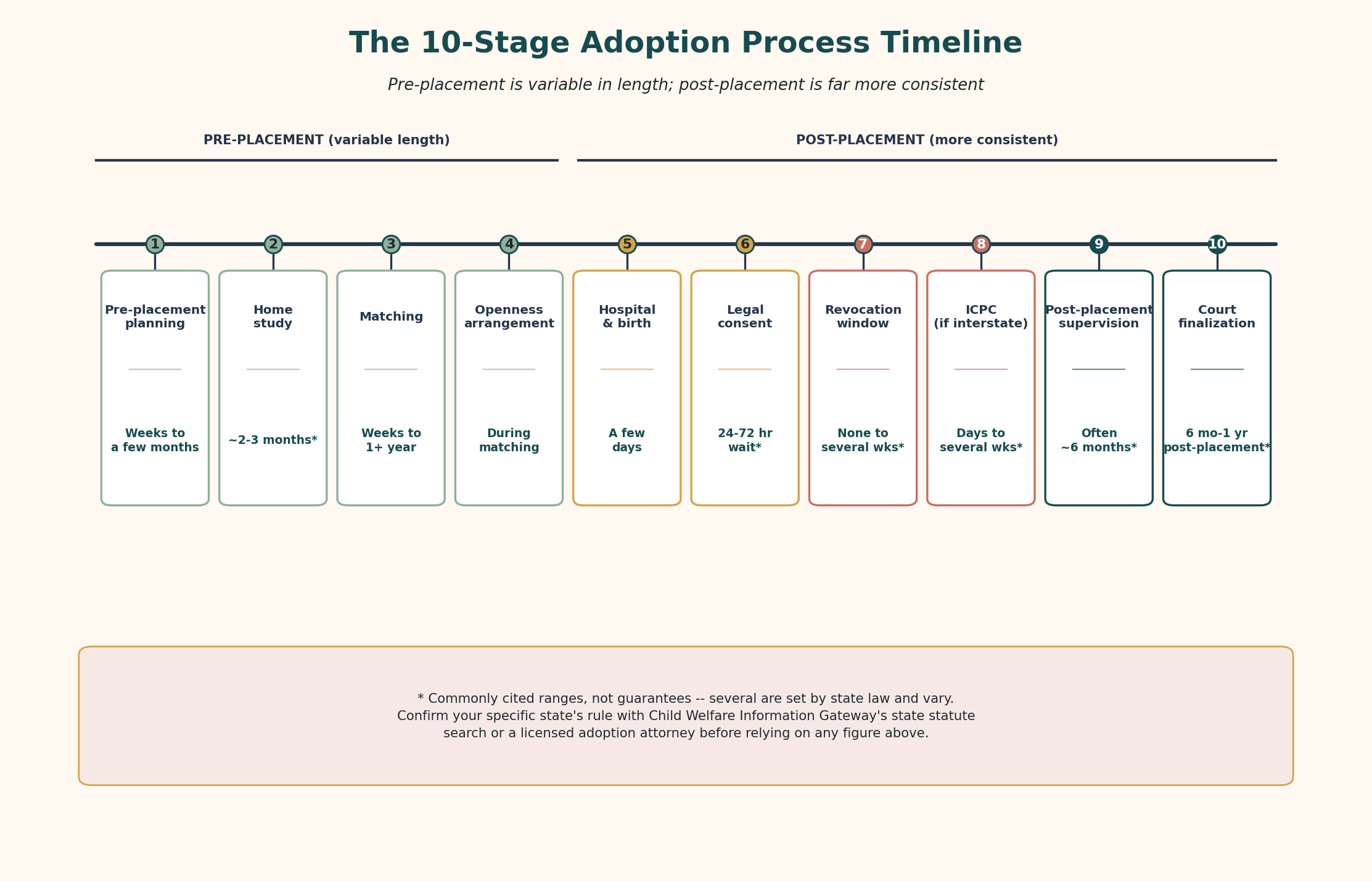
The Full Stage-by-Stage Timeline, in One Table
Putting every stage from this guide next to its typical timing makes the overall shape of the process much easier to hold in your head than reading through each section separately.
Reading the Table
Ranges, Not Promises
Every duration below is a commonly cited range, not a guarantee, and several rows are marked as state-variable rather than given a specific number at all, consistent with this guide’s approach throughout. Treat this table as a planning tool for understanding the shape of the process, not as a commitment any agency, attorney, or court is bound to.
Where Each Stage Can Compress or Stretch
The pre-placement rows (planning, home study, matching) are where the most variability lives — a quick match can compress the entire pre-placement phase into a few months, while a slow match can stretch it past a year. The post-placement rows are comparatively steady once you know your specific state’s requirements, which is why confirming those requirements early is worth the effort.
| Stage | What happens | Typically occurs | Commonly cited duration |
|---|---|---|---|
| 1. Pre-placement planning | Choosing a route (agency/attorney), budgeting, readiness work | Before matching | Weeks to a few months |
| 2. Home study | Background checks, references, home visit, training, approval | Before active matching | Roughly 2–3 months |
| 3. Matching | Profile review, introductions, mutual decision to move forward | Any time before birth, sometimes after | Weeks to over a year — the most variable stage |
| 4. Openness arrangement | Agreeing on post-placement contact; sometimes documented in writing | During matching, refined through placement | Ongoing through placement |
| 5. Hospital & birth | Hospital plan carried out; baby is born | At delivery | Typically a few days |
| 6. Legal consent | Birth parent(s) sign consent after mandatory wait | After birth, after state minimum wait | Commonly 24–72 hrs minimum wait |
| 7. Revocation window | State-specific window to revoke consent, where one exists | Immediately after consent is signed | None to several weeks, by state |
| 8. ICPC (if interstate) | Sending/receiving state review and approval to travel home | After placement, before leaving birth state | Days to several weeks |
| 9. Post-placement supervision | Monthly caseworker visits documenting adjustment | After placement/ICPC clearance | Often several months; commonly discussed around 6 months |
| 10. Court finalization | Petition filed; judge issues final decree | After supervision period and revocation window close | Commonly 6 months–1 year after placement |
What Drives Total Timeline Length Most
Matching Speed
Of everything in the table above, how quickly matching happens affects total timeline more than any other single factor, because it’s the stage most dependent on circumstances outside either party’s direct control.
Legal and ICPC Variables
After matching, the biggest swing factors are which two states are involved (if the placement is interstate), that state’s specific revocation and post-placement supervision requirements, and the local court’s scheduling capacity — all genuinely state- and jurisdiction-variable, which is why this guide consistently points you to direct, current confirmation rather than a fixed promise.
Key Takeaways
- The ten stages split roughly into a variable pre-placement phase and a more predictable post-placement phase.
- Matching speed is the single biggest driver of how long the whole process takes from start to finish.
- Every duration in Table 2 is a commonly cited range, not a guarantee — confirm specifics with your own agency, attorney, and state resources.
Two Tracks, Side by Side: A Parallel Checklist
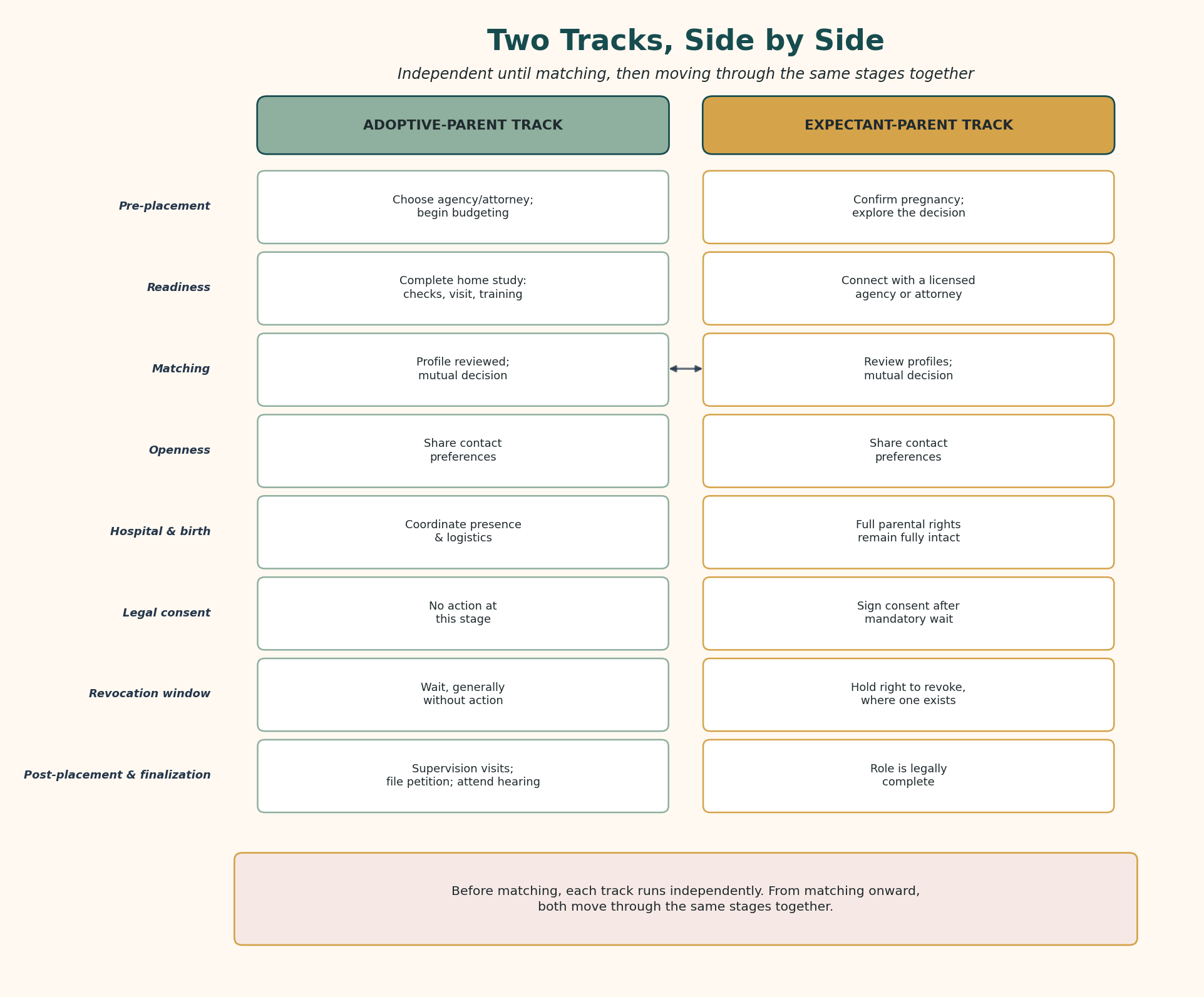
Because an adoptive family’s timeline and an expectant parent’s timeline run mostly independently until matching connects them, it can be hard to picture what each side is actually doing at the same point in the calendar. Laying the two tracks next to each other, stage by stage, makes that easier to see at a glance.
Reading the Two Tracks Together
Where the Tracks Run Independently
Before matching, the adoptive family’s home study and the expectant parent’s own planning and decision-making genuinely don’t depend on each other — one side can be fully ready and waiting while the other hasn’t started, or vice versa, and neither is doing anything wrong by moving at their own pace.
Where They Have to Sync Up
From matching onward, the two tracks become interdependent: the hospital plan, the openness arrangement, the timing of consent, and everything after it involves both sides moving through the same sequence of events together, even though only the expectant parent takes the legal actions (signing consent, exercising or not exercising a revocation right) that actually move the adoption forward at that stage.
The Parallel Checklist Table
How to Use This With Your Agency or Attorney
Use the table below as a conversation starter with your own agency, attorney, or caseworker — asking “where are we on each side of this right now” at any point in the process is a reasonable, welcome question, not an imposition.
What’s Different If You Match Later in Pregnancy
A later match simply compresses the rows below that happen “before matching” into the rows that happen “during matching,” since both tracks are now running against the same approaching due date rather than independently.
| Process stage | Adoptive-parent track | Expectant-parent track |
|---|---|---|
| Pre-placement planning | Chooses agency/attorney route; begins budgeting | Confirms pregnancy and timeline; begins exploring the decision itself |
| Home study / readiness | Completes background checks, references, home visit, training | Connects with a licensed agency or independent adoption attorney |
| Matching | Profile reviewed; introductory conversations; mutual decision to move forward | Reviews family profiles; selects a family (if applicable); mutual decision to move forward |
| Openness arrangement | Shares comfort level and preferences on contact | Shares comfort level and preferences on contact |
| Hospital plan | Coordinates presence, travel, and logistics in advance | Decides who’s present, rooming, and early decision-making preferences |
| Birth | Typically present or nearby, per the hospital plan | Gives birth; full parental rights remain entirely intact |
| Legal consent | No legal action taken at this stage | Signs consent, after the state’s mandatory post-birth wait, if proceeding |
| Revocation window | Generally waits during this period without further action | Holds the right to revoke consent, where a window exists under state law |
| ICPC (if interstate) | Often stays near the birth state awaiting clearance | No action required at this stage |
| Post-placement supervision | Participates in caseworker visits; cares for the child day to day | Generally no further required action unless opted into continued contact |
| Finalization | Attorney files petition; attends finalization hearing | Role in the process is legally complete once consent became final |
Key Takeaways
- Before matching, the adoptive-parent and expectant-parent tracks run independently and don’t need to be at the same point in their own readiness.
- From matching onward, the two tracks move through the same sequence of events together, even though the expectant parent holds the legal decision-making power at each step.
- Table 4 above is meant as a conversation tool with your own agency or attorney, not a rigid script every case follows exactly.
Where Costs Enter the Process
Cost isn’t a single number paid at one point — it’s spread across the timeline this guide has just walked through, which is useful to understand even though the full cost breakdown by adoption type lives elsewhere.
What’s Paid at Each Stage
Pre-Placement and Home Study Costs
Home study fees, agency application or program fees, and attorney retainer costs are typically paid early, during Stages 1 and 2, before matching even begins.
Expectant-Parent Expenses, Legal Fees, and Post-Placement Costs
During matching, pregnancy, and placement (Stages 3 through 9), costs can include legal fees for both sides’ attorneys, and, within the limits set by state law, the adoptive family’s or agency’s support for the expectant parent’s pregnancy-related medical and, in many states, reasonable living expenses. Post-placement supervision and the finalization petition itself (Stage 9 and 10) carry their own legal and agency fees.
Where to Get the Full Breakdown
Full Cost Guide
Exactly how much each of these categories typically costs, how it differs between agency and independent adoption, and what’s legally permissible for a family or agency to cover for an expectant parent is covered in full, with real ranges, in our dedicated adoption cost guide — intentionally not repeated here.
Adoption Tax Credit
Adoptive families may be able to recover a meaningful portion of qualified adoption expenses through the federal adoption tax credit; our adoption tax credit guide covers eligibility and how to claim it.
Key Takeaways
- Costs are distributed across nearly every stage of the process rather than paid as one lump sum.
- What’s legally permissible for a family or agency to cover for an expectant parent’s expenses varies by state and is covered, with real figures, in a dedicated guide.
- The federal adoption tax credit can offset a meaningful share of an adoptive family’s qualified expenses after the fact.
The Adoptive-Parent-Side Checklist
Pulling the adoptive-parent-facing steps from across this guide into one ordered checklist makes it easier to see what to actually do, and in what order, if you’re the one preparing to adopt.
Eligibility and Requirements
General Requirements Across States
Every state sets its own baseline eligibility rules for who can adopt — covering things like age, residency, and marital-status requirements where they exist — and these vary enough that this guide won’t restate them here.
Where the Full Requirements List Lives
The complete, current requirements picture — including how states differ on the details — is covered in our adoption requirements guide; a general introduction to the adopting process itself, for someone just starting to explore it, is in our guide on how to adopt a child.
Documentation to Start Gathering Early
Universal Paperwork
Regardless of route, most prospective adoptive parents need to gather identification documents, marriage certificates where applicable, financial statements, medical clearance from a physician, and proof of income or employment well before the home study begins, since delays here are one of the most common, avoidable causes of a slow start.
Paperwork Specific to Your Route
An agency-facilitated adoption typically has its own standardized application packet; an attorney-led independent adoption may require different documentation depending on your state and whether a separate matching service is involved. Our home study guide covers exactly what’s needed for that specific stage in full.
Key Takeaways
- Eligibility requirements to adopt vary by state; the full list is in a dedicated requirements guide rather than restated here.
- Gathering core documentation (ID, financial records, medical clearance) before the home study starts helps avoid the most common early-stage delays.
- Route-specific paperwork differs between agency and independent/attorney-facilitated adoption.
The Expectant-Parent-Side Checklist
The same approach, from the expectant parent’s side: pulling the action steps from across this guide into one ordered list, without repeating the deeper decision-support or legal-rights content that belongs to other guides.
Your Action Steps, in Order
Early and Mid-Pregnancy Steps
If you’re leaning toward adoption, early steps generally include confirming the pregnancy and your timeline, connecting with a licensed agency or an independent adoption attorney (rather than proceeding entirely informally), reviewing family profiles if you want input into who adopts, and starting to think through your openness preferences. Our full step-by-step guide to placing a baby for adoption walks through this entire action sequence in one place.
Steps Close to and After Birth
Closer to and after delivery, the steps shift to finalizing the hospital plan, understanding exactly when and how you’ll be asked to sign consent, and knowing your state’s specific revocation rule before you sign anything — all covered procedurally in Sections 5 through 7 above, with full legal depth in the guides linked below.
Where to Go for Rights Depth
Birth Mother Rights
For the complete legal picture of your rights throughout this process — what makes consent valid, what you can contest and how, and what protections exist specifically for you — see our birth mother rights guide.
Birth Father Rights
Where a legal or putative father is involved, his notice and consent rights follow their own rules, covered in full in our birth father rights guide — worth reading even if he isn’t currently involved in the pregnancy, since his rights don’t automatically disappear because of that.
Key Takeaways
- An expectant parent’s action checklist runs from early pregnancy outreach to a licensed agency or attorney through post-birth consent and revocation-window awareness.
- The full step-by-step action guide, with more detail than this section provides, is a dedicated companion guide.
- Full legal-rights depth for both birth mothers and birth/putative fathers lives in two dedicated guides, not in this process overview.
What Can Slow the Process Down or Stop It Entirely
Understanding where delays and, less commonly, full stops tend to happen helps set realistic expectations rather than being blindsided partway through.
Common Sources of Delay
Incomplete Paperwork and ICPC Hiccups
Incomplete home study documentation, slow-returning background checks, and ICPC packets missing required information are some of the most common, and most avoidable, sources of delay — double-checking paperwork completeness before submission at every stage is one of the simplest things either side can do to keep the timeline on track.
Court Docket Backlogs
Finalization timing is partly outside anyone’s control: busier court jurisdictions can take meaningfully longer to schedule a finalization hearing than less busy ones, even once every other requirement has been met.
When a Match or Placement Doesn’t Proceed
Before Birth: A Match Not Resulting in Placement
An expectant parent choosing to parent instead of placing, or choosing a different family, is a real and legally protected possibility at any point before consent is signed — this isn’t a failure of the process, it’s the process working as designed to protect the expectant parent’s full decision-making rights throughout pregnancy.
After Placement: A Disruption (Rare, but a Real Procedural Category)
A “disruption” refers to a placement ending after the child has already been placed with the adoptive family but before finalization — including, though far less commonly, a birth parent exercising a revocation right. Agencies and attorneys generally have a procedure for this exact situation, and it’s worth asking yours directly what that procedure looks like before placement, not after.
Key Takeaways
- Incomplete paperwork and court scheduling are the two most common sources of delay, and the first is largely preventable with careful preparation.
- An expectant parent choosing not to proceed before consent is signed is a protected right the process is designed around, not a system failure.
- A post-placement disruption is uncommon but real; ask your agency or attorney about their specific procedure for it in advance.
When the Process Looks Different: Kinship and Stepparent Adoption
Everything in Sections 3 through 12 describes the sequence for an unrelated domestic infant adoption. When the adoptive parent is already a relative or a stepparent, several of those stages shrink dramatically or disappear entirely — worth understanding on its own terms rather than assuming the full ten-stage sequence always applies.
What Changes in a Relative (Kinship) Adoption
Matching and ICPC Usually Don’t Apply
When a grandparent, aunt, uncle, or other relative is adopting a child they may already know well or already be caring for, there’s no matching stage in the sense described in Section 5, and ICPC typically isn’t triggered because the parties already know each other and the placement isn’t being arranged through an agency’s interstate network in the same way — though if the relative lives in a different state and the child is moving there as part of the adoption, it’s worth confirming directly with an attorney whether ICPC applies to your specific situation.
The Home Study and Legal Steps Often Still Apply
A home study is still typically required in most states, though some states streamline or modify it for a known relative compared to the full process for an unrelated family, and the core legal sequence — consent, any revocation window, post-placement supervision, and finalization — generally still applies, sometimes on a faster or simplified timeline set by that state’s kinship adoption provisions.
What Changes in a Stepparent Adoption
No Matching, Often No Home Study
A stepparent adopting a spouse’s child from a prior relationship skips matching entirely, since there’s no placement being arranged — the child is typically already living with both the parent and stepparent. Many states waive or significantly simplify the home study requirement in this situation, since the child and stepparent already share a household and relationship.
The Other Legal Parent’s Rights Still Matter
The most procedurally significant step in a stepparent adoption is usually establishing that the child’s other legal parent has consented, had their rights already terminated, or is legally unable to be located or to object — this is a real legal process, not a formality, and the full depth of a non-consenting parent’s rights in this situation is the same territory covered for any adoption in our birth father rights guide and our birth mother rights guide, whichever parent’s rights are in question.
Key Takeaways
- Kinship and stepparent adoptions generally skip the matching stage entirely and often skip or simplify the home study, since the adoptive parent already has a relationship with the child.
- ICPC usually doesn’t apply to a kinship or stepparent adoption, though it’s worth confirming directly if a relative lives in a different state.
- The other legal parent’s consent, termination, or inability to be located is typically the most legally significant step in a stepparent adoption specifically.
Record-Keeping: What to Keep Throughout the Process
A process that unfolds over many months, across more than one state in some cases, and through more than one professional relationship generates a lot of paperwork — knowing what to hang onto, and why, saves real trouble later.
Documents to Keep From Day One
Pre-Placement and Legal Documents
Keep copies of the approved home study and any updates to it, the signed matching agreement or acknowledgment (if your route uses one), all consent documents with signature dates, and any ICPC paperwork (including Form 100A/100B references) if the placement was interstate. These documents are what a court, a benefits office, or a future records request will eventually ask for, and recreating them after the fact is far harder than keeping them as you go.
Post-Placement and Finalization Documents
Keep every post-placement supervision report, the filed finalization petition, and — most importantly — the final decree of adoption and the resulting amended birth certificate once issued. The decree in particular is the document you’ll need for passport applications, school enrollment, health insurance, and any future legal matter touching the child’s parentage.
Why This Matters Later
Updating Records, Benefits, and Travel Documents
Social Security records, health insurance enrollment, a passport application, and school registration all typically require either the amended birth certificate or the final decree (sometimes both) as proof of legal parentage — having clean, organized copies ready avoids a scramble when one of these needs comes up unexpectedly.
If You Ever Need to Reconstruct the Timeline
In the rare situation where a legal question arises later — a contested matter, a records request from the child as an adult, or a benefits dispute — having a complete, dated record of every stage in this guide’s sequence, not just the final decree, is what actually lets an attorney reconstruct what happened and when.
Key Takeaways
- Keep every document generated at each stage of this guide, not just the final decree — pre-placement, consent, ICPC, and post-placement paperwork all matter later.
- The final decree and amended birth certificate are the documents most routinely needed afterward, for everything from passports to school enrollment.
- A complete, dated paper trail is what allows any later legal question to actually be answered.
Still Deciding Whether Adoption Is the Right Path?
Everything above assumes a decision to move forward with adoption has already been made, at least provisionally. If that’s not where you are yet, this section points you to the right resources rather than attempting to re-cover that ground here.
If You’re an Expectant Parent Who Hasn’t Decided
You Don’t Have to Start the Process to Learn About It
Nothing about reading this guide, or even an initial conversation with an agency or attorney, commits you to adoption — you can explore the process described here while still genuinely undecided, and most reputable agencies and attorneys expect and accommodate exactly that.
Where to Go for the Decision Itself
Our guide for people pregnant and considering adoption, our unplanned pregnancy guide, and our pregnancy options guide all cover the decision-support side of this question in depth — the values, timing, and counseling considerations that come before the process mechanics in this guide.
If You’re Weighing Adoption Against Parenting
A Dedicated Comparison Guide
Our adoption-versus-parenting comparison guide lays out that specific decision side by side, rather than this procedural guide attempting to make the case for one path over the other.
Options Counseling Resources
Genuinely neutral options counseling — from a source with no financial or religious stake in which path you choose — is available and differs from counseling designed to steer you toward one outcome; our unplanned pregnancy guide covers how to find and recognize it.
Key Takeaways
- Exploring this process, or even talking to an agency or attorney, doesn’t commit an expectant parent to adoption.
- The decision-support question (should I place this child for adoption at all) is covered in depth by other guides this one deliberately defers to.
- A dedicated guide compares adoption and parenting directly for anyone still weighing the two.
Common Mistakes and Misconceptions About the Adoption Process
A few process-specific misunderstandings come up often enough, on both sides of an adoption, to be worth naming directly.
Mistakes Adoptive Parents Make
Starting the Home Study Too Late
Because the home study has to be approved before active matching typically begins, starting it late pushes back everything downstream — a mistake that’s entirely avoidable simply by starting Stage 2 as early as the decision to pursue adoption is reasonably firm.
Assuming ICPC Is a Formality
Treating ICPC as a rubber stamp rather than a real review with real processing time has caught more than one adoptive family off guard with an unplanned extra week or more away from home — budgeting time and money for this possibility in advance avoids the surprise.
Misconceptions About the Legal Steps
“Signing Consent” Happens Once, in One Sitting
People sometimes assume consent is one simple signature; in practice it often involves multiple documents, a witness or notary, and, depending on the state, separate consent from more than one party, all governed by that state’s specific procedural requirements.
Confusing Placement With Finalization
Placement (the child moving in with the adoptive family) and finalization (the court making the adoption legally permanent) are often months apart and are legally very different milestones — the family has physical custody and is raising the child during that gap, but the adoption isn’t yet permanent in the eyes of the law until the finalization decree is issued.
Key Takeaways
- Starting the home study early and treating ICPC as a real process with real processing time are the two most avoidable adoptive-parent-side mistakes.
- Consent typically involves more than a single signature and may require more than one party’s participation, depending on the state.
- Placement and finalization are different legal milestones, often separated by many months.
Glossary of Terms
A quick reference for process-specific terms used throughout this guide.
Pre-Placement Terms
Home Study
The required assessment of a prospective adoptive family — background checks, references, interviews, a home visit, and training — that must be approved before a child can be placed with them.
Matching
The process by which a specific expectant parent and a specific prospective adoptive family identify each other, typically through profile review and introductory conversations facilitated by an agency or attorney.
Profile (or “Dear Birth Mother” Letter)
A written and photo-based introduction to a prospective adoptive family, prepared for expectant parents to review during matching.
Disruption
A placement that ends after the child has already been placed with the adoptive family but before the adoption is finalized.
Legal and Court Terms
Consent
The formal legal act by which a birth parent agrees to the adoption; it cannot be signed before birth and is subject to a mandatory post-birth waiting period that varies by state.
Revocation Period
A window, set by state law and varying significantly in length, during which a birth parent who has signed consent can still change their mind and reclaim parental rights before finalization.
Finalization
The court hearing and decree that makes an adoption legally permanent, terminating the birth parent’s rights and establishing the adoptive parents as the child’s legal parents.
Putative Father
A man who may be, but has not been legally established as, a child’s father; his notice and consent rights in the adoption process are governed by state-specific putative father registry and notice laws.
Interstate and Agency Terms
ICPC (Interstate Compact on the Placement of Children)
The interstate agreement, adopted by all fifty states and the District of Columbia, governing the process and approval required before a child can be placed with a family in a different state from where the child was born.
Sending State / Receiving State
In an ICPC placement, the sending state is where the child was born; the receiving state is where the adoptive family lives and will raise the child.
NEICE (National Electronic Interstate Compact Enterprise)
An electronic system, adopted by a growing but not yet complete set of states, for exchanging ICPC documents and approvals faster than the mail- or fax-based process it replaces.
Post-Placement Supervision
The period of caseworker visits, following placement, during which a child’s adjustment and the family’s circumstances are documented before a finalization petition can be filed.
Frequently Asked Questions
Getting Oriented to the Process
What are the actual steps in the adoption process, in order?
Broadly: pre-placement planning, the home study, matching, agreeing on an openness arrangement, the hospital stage and birth, legal consent, a possible revocation window, ICPC if the placement is interstate, post-placement supervision, and court finalization. Sections 3 through 10 above walk through each in detail, and Table 2 in Section 13 lays them out with timing.
Is the process different for adoptive parents versus expectant parents?
The legal milestones (consent, revocation, finalization) are the same regardless of which side you’re on, but the practical steps leading up to them differ — adoptive parents focus on the home study and matching from their side, while expectant parents focus on planning, choosing a family (if applicable), and the legal steps around and after birth.
Timing and Duration
How long does the whole adoption process take?
There’s no single reliable number, because the pre-placement phase (planning, home study, matching) varies enormously based on how quickly a match happens. Many industry sources describe a full process averaging somewhere around a year from an approved home study to finalization, but individual cases regularly fall well outside that figure in both directions
What’s the fastest the process could realistically happen?
In a best-case scenario — a family with an already-approved home study, a quick match, no ICPC step, and a fast-moving local court — the post-placement-to-finalization portion alone can be compressed to several months, though the minimum post-birth consent wait and any state revocation window set a hard floor that can’t be shortened.
The Home Study
How long does a home study really take?
Commonly cited as roughly two to three months, though this depends on how quickly background checks clear and how promptly the family completes its paperwork and training
What disqualifies someone during a home study?
This varies by state and agency and isn’t a short list that applies uniformly everywhere; our dedicated home study guide and our requirements guide cover this in the depth it deserves.
Matching
How do adoptive families and expectant parents actually find each other?
Most commonly through an agency’s or matching consultant’s existing network, online profile platforms, or, in some independent adoptions, through an attorney’s contacts — Section 3 above covers how the profile-review and introduction process typically works.
Can an expectant parent choose a family and then change their mind?
Yes, at any point before signing consent, which can’t happen until after birth. Choosing a family during matching is not a binding commitment.
Legal Consent
Can consent be signed before the baby is born?
No — this is universal across every U.S. state. Consent can only be signed after birth, and after whatever additional minimum waiting period that state imposes.
How long is the mandatory wait after birth?
It varies by state, commonly cited in the range of 24 to 72 hours in many states, though you should confirm your specific state’s rule rather than assume a number
The Revocation Window
What is a revocation period, exactly?
A window, where one exists under state law, during which a birth parent who has already signed consent can still change their mind and reclaim parental rights before the adoption is finalized.
Does every state have a revocation period?
No — some states treat validly signed consent as final immediately, absent fraud or duress, while others provide a window ranging from a few days to, in some states, several weeks
ICPC and Interstate Adoption
Do I need to worry about ICPC if the adoption is within one state?
No — ICPC only applies when the child is placed with a family in a different state than the birth state.
How long does ICPC approval usually take?
Commonly described as ranging from a few days to several weeks, depending on the two specific states involved and how complete the submitted packet is
Post-Placement Supervision
How many post-placement visits are typical?
Commonly monthly visits for several months, though the exact required number and frequency is set by state law or agency policy and varies
What happens during a post-placement visit?
A caseworker typically observes the child and family together, asks about adjustment and any concerns, and documents the visit in a report that eventually supports the finalization petition.
Court Finalization
How soon after placement can finalization happen?
Once the required post-placement supervision period and any revocation window have both closed, commonly somewhere between six months and a year after placement, though this varies by state and by local court scheduling
What happens at the finalization hearing?
A judge reviews the required documentation and, in the typical uncontested case, issues a final decree of adoption after a brief hearing — Section 10 above covers this in more detail.
Costs Throughout the Process
When do most adoption costs actually get paid?
Across the timeline rather than all at once — home study and application fees early, legal and support costs during matching and pregnancy, and finalization-related legal fees at the end. Section 14 above maps this out stage by stage.
Can an expectant parent be charged for any part of the process?
In a legal adoption, the costs described throughout this guide are generally borne by the adoptive family or agency, not the birth parent; our cost guide covers this distinction and its limits in full.
Eligibility and Documentation
What are the baseline requirements to adopt?
These vary by state and sometimes by agency, covering things like age, residency, and in some states marital status; the complete, current picture is in our requirements guide.
Do single people qualify to adopt?
In most states, yes; specific state and agency policies vary, and our requirements guide covers this directly.
The Expectant Parent’s Experience
Do I have to use an agency as an expectant parent?
No — an attorney-facilitated independent adoption is a legal alternative in most states, though working with a licensed professional of some kind (rather than an entirely informal arrangement) is strongly advisable for your own protection.
Am I allowed to change my mind at any point before signing consent?
Yes, fully and without penalty, at any point before consent is actually signed, which can’t happen until after birth. This is covered in full in our birth mother rights guide.
The Adoptive Parent’s Experience
What should I do first if I’m just starting to explore adopting?
Our general guide on how to adopt a child is the right starting point before diving into this guide’s procedural depth.
How do I choose between an agency and an attorney?
This depends on how much control you want over matching, how much support you want built in versus arranged yourself, and cost structure; Section 2 above covers the basic distinction, and our cost guide covers how pricing typically differs between the two.
Working With an Agency, Attorney, or Caseworker
How often should I expect to hear from my agency or attorney?
This varies by provider and by stage — expect more frequent contact during active matching and around placement, and quieter stretches during paperwork-processing periods like ICPC review or post-placement supervision. If communication goes quiet for longer than feels right to you, it’s reasonable to simply ask for a status update rather than assume no news means a problem.
What’s the difference between my caseworker and my attorney’s role?
A caseworker (often from the home-study or supervising agency) generally handles the social-work side — the home study itself, matching support, and post-placement visits — while an attorney handles the legal filings: consent documentation, ICPC coordination where relevant, and the finalization petition. Many cases involve both working in parallel rather than one replacing the other.
Same-Sex and LGBTQ+ Prospective Adoptive Parents
Does the process described here apply the same way to same-sex couples?
The legal sequence — home study, matching, consent, finalization — is the same, though which agencies, attorneys, and expectant parents are open to and experienced with same-sex adoptive families is worth researching directly, since comfort and experience level genuinely varies by provider.
Are there states where this process works differently for us?
Some state-level rules and individual agency policies affect LGBTQ+ prospective adoptive parents differently in practice even where the formal legal process is the same on paper; an LGBTQ+-experienced adoption attorney in your specific state is the right source for a current, accurate answer rather than a general guide.
Multiples, Sibling Groups, and Special Circumstances
Does the process change for twins or a multiples pregnancy?
The legal sequence is the same, applied to each child, though matching, hospital planning, and cost conversations often need to account for the specifics of a multiples situation well in advance — flag this to your agency or attorney as soon as it’s known.
What about placing or adopting a sibling group?
This is more common in foster-care adoption than domestic infant adoption, and when it does apply to a private domestic situation, the same consent, revocation, and finalization steps generally apply to each child, sometimes as a single combined case and sometimes individually depending on the court and circumstances.
Kinship and Stepparent Adoption Questions
Does a grandparent or other relative adopting a child still need a home study?
Usually yes, though many states streamline it for a relative who already knows the child well; confirm your specific state’s kinship adoption provisions rather than assuming it’s waived entirely.
Does ICPC apply if a relative in another state wants to adopt?
It can, depending on the specific circumstances and how the child is moving to that state; this is a case where confirming directly with an attorney matters more than relying on a general rule.
When Plans Change
What happens procedurally if the expectant parent decides to parent after matching but before birth?
The match ends, and there’s no adoption process to continue — the expectant parent retains full parental rights throughout pregnancy and was never obligated by the match itself, as covered in Sections 3 and 17 above.
Does the adoptive family get any costs back if a match doesn’t result in placement?
This depends heavily on your specific agency’s or attorney’s fee structure and any agreement you signed; it’s an important question to ask and understand before paying significant fees tied to a specific match, not after.
If Something Feels Wrong During the Process
What if I feel pressured by an agency, attorney, or the other party?
Pressure of any kind — to sign faster, to commit before you’re ready, or to make a decision that doesn’t feel like your own — is a legitimate reason to pause and seek an independent opinion, regardless of which side of the adoption you’re on or how far into the process you are.
Who can I talk to if I think my agency or attorney isn’t acting ethically?
Your state’s licensing board for the agency, or your state bar association for an attorney, is the appropriate place to raise a formal concern; a second, independent professional opinion is also a reasonable immediate step if something feels wrong.
